




CLAT 2012 Common Question paper with answer key pdf conducted on May 13, 2012 in Afternoon Session 3:00 PM to 5:00 PM is available for download. The exam was successfully organized by Rajiv Gandhi National Law University. In terms of difficulty level, CLAT was of Easy to Moderate level. The question paper comprised a total of 200 questions divided among five sections.
CLAT 2012 Common Question Paper with Solution PDF
| CLAT 2012 Common Question Paper with Answer Key | Download PDF | Check Solutions |
Directions: (1 to 10): Read the given passage carefully and attempt the questions that
follow.
The work which Gandhiji had taken up was riot only regarding the achievement of political
freedom but also the establishment of a new social order based on truth and nonviolence,
unity and peace, equality and universal brotherhood and maximum freedom for all. This
unfinished part of his experiment was perhaps even more difficult to achieve than the
achievement of political freedom.
Read More
In the political struggle, the fight was against a foreign power and all one could do was either join it or wish it success and give it his/her moralsupport. In establishing a social order on this pattern, there was a strong possibility of a
conflict arising between diverse groups and classes of our own people. Experience shows
that man values his possessions even more than his life because in the former he sees the
means for perpetuation and survival of his descendants even after his body is reduced to
ashes. A new order cannot be established without radically changing (he mind and attitude of
men towards properly and, at some stage or the other, the ’haves’ have to yield place to the
’havenots’. We have seen, in our time, attempts to achieve a kind o( egalitarian society and
the picture of it after it was achieved. But this was done, by and large, through the use of
physical force. In the ultimate analysis it is difficult, if not impossible, to say that the instinct to possess has
been rooted out or that it will not reappear in an even worse form under a different guise. if
may even be that, like a gas kept confined within containers under great pressure, or water
held back by a big dam, once the barrier breaks, the reaction will one day sweep back with a
violence equal in extent and intensity to what was used to establish and maintain the outward
egalitarian form. This enforced Egalitarianism contains, in its bosom, the seed of its own
destruction.
The root cause of class conflict is possessive emeses or the acquisitive instinct. So long as
the ideal that is to be achieved is one of securing the maximum material satisfaction,
possessiveness is neither suppressed nor eliminated but grows on what it feeds. Nor does it
cease to be possessiveness, whether it is confined to only a few or is shared by many. If
egalitarianism is to endure, it has to be based not on the possession of the maximum material
goods by a few or by all but on voluntary, enlightened renunciation of those goods which
cannot be shared by others or can be enjoyed only at the expense of others. This calls for
substitution of material values by purely spiritual ones. The paradise of material satisfaction,
’which is sometimes equated with progress these days, neither spells peace nor progress
Mahatma Gandhi has shown us how the acquisitive instinct inherent in man can be
transmuted by the adoption of the ideal of trusteeship by those who ’have’ for the benefit of
all those who ’have not’ so that, instead of leading to exploitation and conflict, it would
become a means and incentive for the amelioration and progress of society respectively.
According to the passage, egalitarianism will not survive if:
View Solution
The passage emphasizes that for egalitarianism to sustain and thrive, a fundamental change in the way people perceive and accept it is necessary.
Let us examine each option:
(a) Voluntary renunciation, while not the most effective way, does not guarantee failure of egalitarianism; it may still work under idealistic conditions.
(b) Resorting to physical force may be undesirable, but it does not necessarily prevent the survival of egalitarianism; it depends on the context and implementation.
(c) Non-involvement of underprivileged people could affect the establishment, but not necessarily the survival, which is a long-term aspect.
(d) If people’s outlook towards egalitarianism is not radically changed, it means society is not fundamentally aligned with its principles. In such a case, egalitarianism cannot survive because it lacks the necessary ideological and cultural support. This is explicitly emphasized in the passage.
Thus, option (d) directly addresses the sustainability of egalitarianism and is the correct choice. Quick Tip: When a question focuses on the “survival” of an ideology or system, look for the option that reflects long-term acceptance and societal mindset change.
According to the passage, why does man value his possessions more than his life?
View Solution
The passage highlights that man attaches greater value to his possessions than to his life because possessions offer a sense of immortality or lasting legacy.
Let’s analyze the options:
(a) The desire to share possessions is altruistic, but it is not the reason man values possessions more than life. The passage does not mention this motivation.
(b) While the possessive instinct may drive ownership, it does not explain the higher value placed on possessions over life itself. This is more about instinct, not lasting legacy.
(c) Earning love and respect from descendants is related but limited; the passage goes beyond this to emphasize immortality through possession.
(d) This is the correct answer. According to the passage, possessions are valued because they allow a man to preserve his name and identity even after death. This notion of preserving legacy or being remembered is key to understanding why possessions are considered more valuable than life itself.
Thus, the correct interpretation of the passage leads to option (d) as the most accurate. Quick Tip: Look for keywords like "immortality," "legacy," or "after death" when evaluating why something is valued more than life itself.
According to the passage, which was the unfinished part of Gandhi's experiment?
View Solution
According to the passage, while Gandhi was successful in achieving political freedom for India, his deeper experiment aimed at the creation of an egalitarian society remained incomplete.
Let's break down each option for clarity:
(a) "Educating people to conflict" contradicts Gandhi’s principles of peace and non-violence. Gandhi never sought to promote conflict; thus, this option is incorrect.
(b) "Achieving total political freedom" was already accomplished during Gandhi’s lifetime. It was not the unfinished part of his mission.
(c) This is the correct answer. Gandhi envisioned a society where equality prevailed — both economically and socially. However, this egalitarian society was not realized, and hence, it remained the unfinished part of his broader social experiment.
(d) Although Gandhi did aim to transform people's attitudes towards truth and non-violence, the passage indicates that this change was \textit{part of his vision. The end goal or visible outcome was the establishment of a just and equal society — i.e., an egalitarian society. Therefore, (d) is not the best choice.
In conclusion, the establishment of an egalitarian society was Gandhi’s ultimate, yet unfulfilled, social experiment. Quick Tip: Focus on the concrete societal outcomes when identifying “unfinished” historical missions — in this case, the realization of a just and equal society.
Which of the following statements is 'not true' in the context of the passage?
View Solution
The passage explicitly mentions that man values his possessions more than his life, because possessions offer a sense of permanence and legacy. This contradicts statement (b), making it not true.
Let’s evaluate each statement:
(a) The passage discusses compulsion and voluntary renunciation, making this statement contextually plausible.
(b) Incorrect, as per the passage. Man values possessions \textit{more than life, not less.
(c) Correct. The possessive instinct is described as natural.
(d) Correct. The passage references alien rule in the political struggle. Quick Tip: When asked about ‘not true’ statements, always refer back to the exact assertion made in the passage.
According to the passage, true egalitarianism will last only if
View Solution
The passage emphasizes that for egalitarianism to be sustainable, people must undergo a radical change in values, shifting from materialism to spiritualism.
(a) Imposing egalitarianism is contrary to its principles.
(b) Truth and non-violence are means, not the key condition for longevity.
(c) Correct. Spiritual values are necessary for sustaining egalitarianism.
(d) Coexistence is a result, not the core requirement for survival. Quick Tip: Always differentiate between the means to achieve a goal and the conditions for its sustainability.
According to the passage, people ultimately overturn a social order...
View Solution
The passage makes it clear that people resist and ultimately overthrow a social system that relies on coercion and oppression. Such systems lack legitimacy and sustainability.
(a) Correct. Coercive systems provoke rebellion.
(b) While relevant, the passage stresses oppression more strongly.
(c) Conciliation promotes peace, not revolt.
(d) Spiritual incongruence is important but secondary to coercion. Quick Tip: When analyzing social conflict, note whether rebellion is due to force or lack of moral/spiritual alignment.
According to the passage, the root cause of class conflict is
View Solution
The passage attributes class conflict to the acquisitive instinct — the natural desire of humans to possess more, creating inequality.
(a) Material satisfaction is a result, not the root cause.
(b) Correct. The innate urge to acquire creates social divisions.
(c) Exploitation is a symptom of this instinct, not the root cause.
(d) Exclusion is a consequence, not the fundamental cause. Quick Tip: Identify whether the statement refers to the cause or result of conflict — focus on human nature for root causes.
Which of the following statements is 'not true' in the context of the passage?
View Solution
The passage argues that a new, ideal order should focus on spiritual values, not material satisfaction. Hence, statement (d) is not true.
(a) Correct — changing people's outlook is essential.
(b) Correct — trusteeship helps reduce materialism.
(c) Correct — forced equality can be unstable.
(d) Incorrect. The new order seeks spiritual growth, not material gains. Quick Tip: Look for contradictions between materialism and spiritual focus when evaluating ideal systems.
Which of the following conclusions can be deduced from the passage?
View Solution
The passage discusses how Gandhi's model of social order is based on truth, non-violence, and spiritual values, which aim to remove class distinctions and conflicts.
Let’s assess the conclusions:
(a) The passage recognizes truth and non-violence but says they are insufficient alone; achieving political freedom also needs deeper societal change.
(b) Correct. Gandhiji's social order promotes harmony, reducing class conflict. The passage supports this deduction.
(c) While possibly true, this is a challenge, not a deduced conclusion from the passage’s core message.
(d) The passage promotes shared satisfaction in an egalitarian society, not exploitation, making this incorrect.
Thus, the conclusion that reflects the passage accurately is (b). Quick Tip: When asked for a conclusion, look for a statement that reflects the ultimate outcome or result of the passage’s ideas.
According to the passage, what does "adoption of the ideal of trusteeship" mean?
View Solution
The concept of trusteeship in Gandhian thought implies that the wealthy ('haves') hold their wealth in trust for the welfare of the less privileged ('have-nots').
Evaluating the options:
(a) Incorrect. Material satisfaction is not equated with peace in Gandhian philosophy.
(b) Correct. The 'haves' adopt trusteeship to support the 'have-nots'. This aligns with the passage.
(c) Overly complex and not clearly expressed in the passage.
(d) Incorrect. Trusteeship promotes spiritual over material values, not the reverse.
Therefore, trusteeship is about moral responsibility and equitable distribution for social harmony. Quick Tip: Trusteeship = Moral ownership by the wealthy for the benefit of the poor — a key Gandhian social philosophy.
Choose the correct synonym out of the four choices given:
Lethargy
View Solution
Let’s examine the word lethargy and the meaning of each option:
Lethargy refers to a state of tiredness, lack of energy, or mental/physical inactivity. It conveys sluggishness or indifference.
(a) Serenity means peacefulness or calmness. Although it refers to a tranquil state, it does not imply laziness or lack of energy. Hence, it is not a synonym.
(b) Listlessness means lack of enthusiasm or energy, which is close to lethargy but not identical. However, it is more about emotional indifference than physical laxity.
(c) Impassivity means absence of emotional response. It relates to emotional dullness, not necessarily lack of energy or activity.
(d) Laxity means looseness or lack of strictness, and it also connotes lack of care or energy in behavior, closely related to the inactivity and sluggishness of lethargy. Hence, laxity is the most fitting synonym.
Thus, Laxity best captures the idea of physical or mental slackness present in lethargy. Quick Tip: Look for a word that conveys the \textbf{same degree of physical and mental slackness} when choosing synonyms for “lethargy”.
Choose the correct synonym: Emaciated
View Solution
The word emaciated means extremely thin, typically due to malnutrition or illness. Let’s examine each choice:
(a) Tall — Unrelated to thinness; height is not implied.
(b) Languid — Means weak or sluggish, not specifically thin.
(c) Very thin — Correct. Matches the meaning of emaciated directly.
(d) Wise — Unrelated to physical appearance. Quick Tip: "Emaciated" always refers to unhealthy thinness; look for words describing physical condition.
Choose the correct synonym: Latent
View Solution
The word latent means hidden or dormant — something that exists but is not visible or active. Now, let’s analyze:
(a) Concealed — Correct. Directly means hidden, aligns with latent.
(b) Apparent — Opposite of latent; means visible.
(c) Lethargic — Refers to laziness, not hidden.
(d) Prompt — Refers to speed, unrelated. Quick Tip: "Latent" often means hidden potential — think of concealed qualities or abilities.
Choose the correct synonym: Sporadic
View Solution
The word sporadic means occurring at irregular intervals, not constant or steady.
(a) Epidemic — Widespread disease; unrelated.
(b) Whirling — Circular motion; irrelevant.
(c) Occasional — Correct. Matches "sporadic" in meaning.
(d) Stagnant — Still or unmoving; opposite of sporadic. Quick Tip: “Sporadic” = Occasional. Remember, it means random or infrequent.
Choose the correct synonym: Compendium
View Solution
A compendium is a comprehensive collection of detailed information about a particular subject, often summarized or concise.
(a) Summary — Partial match; compendium is more than just a summary.
(b) Index — A list, not the same as a compendium.
(c) Reference — Vague; not accurate enough.
(d) Collection — Correct. Compendium is a collection of knowledge or items. Quick Tip: Think of a compendium as a well-organized “collection” of facts or summaries — broader than just a summary.
Choose the correct option out of the four choices given:
Give an example pertinent ................... the case.
View Solution
The adjective "pertinent" means relevant or applicable. The correct prepositional usage is "pertinent to" something.
Let’s analyze each option:
(a) With — Incorrect; "with" does not pair correctly with "pertinent".
(b) On — Incorrect; "on the case" is possible, but not with "pertinent".
(c) For — Incorrect; not the standard preposition used with "pertinent".
(d) To — Correct. The standard phrase is "pertinent to the case", meaning relevant to the case.
Correct usage: Give an example pertinent to the case. Quick Tip: Remember, “pertinent” always takes the preposition “to” when referring to relevance or connection.
My voice reverberated ................... the walls of the castle.
View Solution
The verb reverberated means to echo or resound. The correct preposition here is from, indicating the point of origin of the echo.
Correct phrase: My voice reverberated from the walls of the castle.
(a) With — Incorrect; “with the walls” does not make sense in this context.
(b) From — Correct. Echoes come from surfaces like walls.
(c) In — Not precise; echoes are not “in” but come from walls.
(d) On — Incorrect; not standard with “reverberated”. Quick Tip: Use “reverberated from” to show the source of an echo or sound reflection.
The reward was not commensurate ................... the work done by us.
View Solution
The phrase commensurate with means in proportion to or corresponding to in degree or size.
Correct phrase: “commensurate with the work done.”
(a) For — Incorrect; not the standard pairing.
(b) On — Incorrect.
(c) With — Correct. Standard usage.
(d) Order — Not a preposition; incorrect. Quick Tip: Always pair “commensurate” with “with” when talking about proportion or adequacy.
Our tragic experience in the recent past provides an index ................... the state of lawlessness in this region.
View Solution
The noun index (meaning sign or indication) is always followed by of when indicating what it represents.
Correct phrase: “an index of the state of lawlessness”
(a) Of — Correct. “Index of” is the standard expression.
(b) In — Incorrect.
(c) At — Incorrect.
(d) By — Incorrect. Quick Tip: Use “index of” when showing a sign or evidence of something.
Your conduct smacks ................... recklessness.
View Solution
The phrase smacks of means to suggest or have the flavor or trace of something (usually negative).
Correct usage: “smacks of recklessness”
(a) Of — Correct. “Smacks of” = suggests/resembles.
(b) With — Incorrect.
(c) From — Incorrect.
(d) In — Incorrect. Quick Tip: The idiom “smacks of” is used to indicate suspicion or hint of a quality, usually undesirable.
A good judge never gropes ................... the conclusion.
View Solution
The phrase "grope for" means to search blindly or uncertainly for something. When applied to abstract concepts like “the conclusion,” it implies that one is unsure and is trying to find the right answer without clarity.
Correct usage: “A good judge never gropes for the conclusion” means that a good judge arrives at a conclusion with confidence and evidence, rather than fumbling or guessing.
(a) To — Incorrect; “grope to” is not idiomatic in this sense.
(b) At — Incorrect; “grope at” is rarely used and sounds awkward.
(c) On — Incorrect; “grope on” does not fit this context.
(d) For — Correct. “Grope for” is the standard collocation when seeking something blindly or uncertainly. Quick Tip: Remember: “Grope for” is used for searching with uncertainty — whether literally in the dark or metaphorically for an idea or solution.
Nobody in our group is a genius ................... winning friends and unconvincing people.
View Solution
The correct phrase is "genius at" something, meaning highly skilled in a particular activity.
Correct usage: “a genius at winning friends” means someone is exceptionally good at winning friends.
(a) For — Incorrect; “genius for” is not idiomatic in this context.
(b) In — Can be used for subjects, but “at” is the correct collocation here.
(c) Of — Not used with “genius” in this sense.
(d) At — Correct. Shows expertise or skill. Quick Tip: Use “genius at” to describe exceptional skill in an action or ability.
If you are averse ................... recommending my name, you should not hesitate to admit it.
View Solution
The phrase "averse to" means having a strong dislike or opposition towards something. It is always followed by “to” + noun/gerund.
Correct usage: “averse to recommending my name”
(a) About — Incorrect.
(b) For — Incorrect.
(c) To — Correct. This is the fixed prepositional phrase.
(d) Against — Similar meaning but not the correct idiom here. Quick Tip: Remember: “averse” always takes “to” followed by a noun or verb in –ing form.
Religious leaders should not delve ................... politics.
View Solution
The phrasal verb "delve into" means to investigate or explore deeply.
Correct usage: “delve into politics” means to get deeply involved in political matters.
(a) In — Incorrect; lacks the idea of deep involvement.
(b) With — Incorrect usage here.
(c) At — Not used with “delve”.
(d) Into — Correct. Standard collocation. Quick Tip: Use “delve into” for detailed investigation or deep involvement.
What you say has hardly any bearing ................... the lives of tribals.
View Solution
The phrase "bearing on" means relevance or influence on a matter.
Correct usage: “has any bearing on the lives of tribals” means “has any relevance to their lives”.
(a) About — Incorrect.
(b) For — Incorrect.
(c) On — Correct. Standard expression for showing relevance.
(d) With — Incorrect in this context. Quick Tip: “Bearing on” = relevance or effect on a situation/person.
He burnt his fingers by interfering in his neighbour's affair.
View Solution
The idiom "burnt his fingers" means to suffer unpleasant consequences due to one's actions, especially by getting involved in a risky or problematic situation.
(a) Got himself into trouble — Correct. Matches the idiomatic meaning.
(b) Burnt himself — Literal meaning, not idiomatic.
(c) Got himself insulted — Too narrow, not the general idiomatic meaning.
(d) Got rebuked — Possible outcome, but not the full sense of the idiom. Quick Tip: "Burn your fingers" = Get into trouble due to your own risky or meddlesome actions.
Mr. Gupta, who is one of the trustees of a big charity, is suspected of feathering his own nest.
View Solution
The idiom "feathering one's own nest" means to use one's position or influence for personal financial gain, often unfairly or dishonestly.
(a) Being lazy — Unrelated.
(b) Being too generous — Opposite meaning.
(c) Neglecting his job — May occur but not the idiomatic sense.
(d) Making money unfairly — Correct. Matches the idiomatic meaning. Quick Tip: "Feather your own nest" = Enrich yourself using your position, often immorally.
Mrs. Hashmi has been in the blues for the last several weeks.
View Solution
The idiom "in the blues" means feeling sad, unhappy, or depressed.
(a) Abroad — Unrelated.
(b) Unwell — Related to health, not mood.
(c) Depressed — Correct. Matches the idiomatic meaning.
(d) Penniless — Financial state, not emotional. Quick Tip: "In the blues" = feeling sad or downhearted.
For the first week, the apprentice felt like a fish out of water.
View Solution
The idiom "like a fish out of water" means feeling uncomfortable or out of place in unfamiliar surroundings.
(a) Frustrated — Different meaning.
(b) Homeless — Not related.
(c) Disappointed — Not correct.
(d) Uncomfortable — Correct. Matches the idiomatic sense. Quick Tip: "Like a fish out of water" = Feeling awkward or out of place.
His friends failed to see why he should ride the high horse just because he had won an election.
View Solution
The idiom "ride the high horse" means to act in a haughty, arrogant, or condescending manner, as though one is superior to others. In the given context, winning an election has made the person behave arrogantly, which his friends find unnecessary.
(a) Become abnormal — Incorrect; not related to arrogance.
(b) Appear arrogant — Correct. Matches the idiomatic meaning of "ride the high horse".
(c) Indulge in dreams — Incorrect; unrelated meaning.
(d) Hate others — Incorrect; the idiom doesn’t imply hatred. Quick Tip: "Ride the high horse" = To behave in a proud, superior, or condescending way.
i. On one hand we are proud of being Indians,
ii. On the other hand we behave as if we were still at the dawn of our civilization
iii. Murders of our own brothers and sisters is not the way to please Ram or Rahim
iv. The citizens of the land where Buddha and Gandhi taught
v. the principles of love and nonviolence,
vi. nor does it fetch us any prosperity.
View Solution
Step 1: Identify the introduction
Sentence iv (“The citizens of the land where Buddha and Gandhi taught”) introduces the subject and sets a moral/historical context.
Step 2: Complete the subject idea
Sentence v (“the principles of love and nonviolence”) directly completes the thought started in iv, making them a pair.
Step 3: Contrast with reality
Sentence ii (“On the other hand we behave...”) introduces a contrast between the lofty ideals and present behaviour.
Step 4: Provide a specific example
Sentence iii (“Murders of our own brothers and sisters...”) illustrates the behaviour mentioned in ii, completing the logical flow.
Thus, the correct logical sequence is: iv → v → ii → iii. Quick Tip: When ordering sentences, connect incomplete phrases immediately, then move to contrasts or examples.
i. On the basis of experiments with rats,
ii. health experts here say that
iii. exercise more and consume vitamins,
iv. they will live up to 100 years or more
v. if humans eat less,
vi. and be vigorous in their eighties and nineties.
View Solution
Step 1: Identify the introduction
Sentence ii introduces the statement of health experts, making it the logical starting point.
Step 2: Add condition for longevity
Sentence v (“if humans eat less”) follows naturally, providing the primary condition.
Step 3: Suggest additional actions
Sentence iii (“exercise more and consume vitamins”) fits after v as further advice.
Step 4: State the outcome
Sentence iv concludes with the result (“they will live up to 100 years or more”).
Thus, the correct order is: ii → v → iii → iv. Quick Tip: When arranging advice-based sentences, start with the speaker/source, follow with conditions and actions, and end with the result.
i. The release of atomic energy is the greatest achievement which science has yet attained
ii. but the first invention to which their discoveries were applied was a bomb
iii. the atom was split by physicists whose minds were set on the search for knowledge
iv. it was more deadly than any other weapon invented so far
v. it is with dread that scientists regard the first use to which their greatest discovery was put
vi. however, they are gratified by the numerous applications of atomic energy for peaceful and constructive population.
View Solution
Step 1: Identify the true starting point
Sentence iii is the natural start as it narrates the splitting of the atom — the key event that led to later developments.
Step 2: Show the first application
Sentence ii follows, showing that the first practical application was the bomb.
Step 3: Describe its impact
Sentence iv logically follows, explaining that it was more deadly than any other weapon.
Step 4: Conclude with scientists’ reaction
Sentence v ends the sequence by highlighting the dread scientists felt over its first use.
Thus, the correct sequence is: iii → ii → iv → v. Quick Tip: In historical/chronological arrangements, start with the original event, then its immediate consequence, its impact, and finally the reaction.
i. The problem of food is intimately connected with population
ii. wages will seldom rise in proportion to the rising prices
iii. the market is governed by demand and supply
iv. without enough food such people lack health, strength of efficiency
v. if too many people demand goods to go round, prices will rise and poor classes will starve
vi. They fall an easy prey to all sorts of diseases.
View Solution
Step 1: State the governing principle
(iii) “the market is governed by demand and supply” — this provides the general economic rule, so it must open the sequence.
Step 2: Apply the rule to the situation
(v) “if too many people demand goods … prices will rise and poor classes will starve” — a direct consequence of demand exceeding supply.
Step 3: Extend the consequence to incomes
(ii) “wages will seldom rise in proportion to the rising prices” — explains why people can’t keep up with inflation.
Step 4: Conclude with social/health impact
(iv) “without enough food such people lack health, strength or efficiency” — the final effect of price rise outpacing wages.
Thus, the logical order is iii → v → ii → iv. (Sentences i and vi are related background effects but are not part of the chosen four-sentence chain.) Quick Tip: For jumbled paragraphs, start with a general principle, then show its consequence, follow with secondary effects (e.g., wages), and end with human impact.
i. India's message has always been one of love and peace.
ii. our Buddha was the light of Asia
iii. it has been a source of light and wisdom to the rest of the world
iv. Ashoka, moved by the horrors of Kalinga War, adopted the message of non-violence
v. the greatest apostle of non-violence in recent years was Mahatma Gandhi
vi. he shook the foundation of the British rule in India through non-violence.
View Solution
Step 1: Choose an impactful opening
Sentence iii (“it has been a source of light and wisdom to the rest of the world”) works well as an opening, as it makes a broad statement about India’s contribution to the world.
Step 2: Provide a spiritual example
Sentence ii (“our Buddha was the light of Asia”) supports the opening by giving a historical example of this wisdom and influence.
Step 3: Give a political/historical example
Sentence iv (“Ashoka… adopted the message of non-violence”) continues the flow, connecting Indian history to the principle of peace.
Step 4: Conclude with modern example
Sentence v (“the greatest apostle of non-violence… was Mahatma Gandhi”) ties the theme into recent history, reinforcing the central idea.
Thus, the correct logical order is: iii → ii → iv → v.
Quick Tip: When arranging historical and thematic sentences, start with a broad claim, follow with ancient examples, then link to medieval/modern history.
mala fide
View Solution
The phrase ``mala fide'' comes from Latin.
``Mala'' means bad or evil, and ``fide'' means faith.
When combined, it literally means ``in bad faith'' or ``with bad intention.''
It is used to describe actions done with dishonest motives or to cause harm.
Thus, the correct meaning is ``Bad intention.''
Quick Tip: Think of ``mala'' like malicious — both mean bad intent.
Tabula rasa
View Solution
``Tabula rasa'' is a Latin phrase meaning ``blank slate'' or ``clean slate.''
It refers to the idea of starting afresh, without prior impressions or influences.
Philosophers like John Locke used it to describe the human mind at birth — empty, shaped only by experience.
Hence, the correct choice is ``Clean slate.''
Quick Tip: Link ``tabula'' to table — imagine a clean table ready to be written on.
Carte blanche
View Solution
The French phrase ``carte blanche'' means ``blank card'' or ``white paper.''
It is used figuratively to mean full freedom or complete authority to act as one wishes.
If someone is given carte blanche, they have total discretion in decision-making.
Thus, the correct answer is ``Complete discretion.''
Quick Tip: Think of it as being given a signed blank cheque — you can fill in any amount.
De jure
View Solution
The Latin term ``de jure'' literally means ``by law.''
It refers to something that exists or is recognized according to the law, even if not in practice.
For example, a country may be de jure independent but de facto controlled by another power.
Therefore, the correct answer is ``Concerning law.''
Quick Tip: Remember: ``jury'' in English relates to law — similar to ``jure'' in Latin.
Raison d'être
View Solution
The French phrase ``raison d'être'' translates directly to ``reason for being.''
It refers to the most important reason for someone or something’s existence.
For example, for many artists, creating art is their raison d'être.
Thus, the correct answer is ``Reason for existence.''
Quick Tip: Link it with ``reason to be'' — almost identical in meaning to the French phrase.
Who said that, 'Man is a social animal'?
View Solution
The phrase ``Man is a social animal'' was given by the Greek philosopher Aristotle.
He emphasized that humans are naturally inclined to live together in communities for mutual benefit.
According to Aristotle, society provides the framework for moral development, law, and the fulfillment of human potential.
This idea forms the foundation of political science, highlighting the importance of cooperation and governance.
Hence, the correct answer is Aristotle.
Quick Tip: Think ``Aris-social'' — Aristotle is linked to the belief that humans are inherently social beings.
World Computer Literacy day is celebrated on
View Solution
World Computer Literacy Day is observed on December 2 every year.
It was launched by the Indian computer company NIIT in 2001 to mark its 20th anniversary.
The purpose is to increase awareness about computers and to bridge the digital divide, particularly among women and children in developing countries.
December 2 was chosen to encourage the spread of digital knowledge and skills worldwide.
Quick Tip: Remember: “Dec 2” = “Digital Education Comes 2 you” — link December 2 with computer literacy.
Whose teaching inspired the French Revolution?
View Solution
Jean-Jacques Rousseau, a French philosopher, greatly influenced the French Revolution through his ideas on equality, liberty, and fraternity.
His works, especially “The Social Contract,” promoted the idea that sovereignty belongs to the people rather than monarchs.
Rousseau's emphasis on the general will inspired revolutionaries to demand democratic governance and the abolition of aristocratic privileges.
Quick Tip: Think “R” for Rousseau and “Revolution” — both start with R.
The II Africa-India Summit was held in May 2011 in
View Solution
The second Africa-India Forum Summit was held from 23–25 May 2011 in Addis Ababa, Ethiopia.
This summit aimed to strengthen political and economic ties between India and African nations.
It followed the first summit held in New Delhi in 2008, and focused on cooperation in trade, infrastructure, education, and health.
Quick Tip: Addis Ababa is the African Union headquarters — easy to recall for such international summits.
The famous Akshardham temple is situated in the city of
View Solution
The Akshardham temple in Gandhinagar, Gujarat, is a famous Hindu temple dedicated to Lord Swaminarayan.
It was inaugurated in 1992 and is known for its grand architecture, intricate carvings, and spiritual exhibitions.
This temple is different from the Swaminarayan Akshardham temple in Delhi.
Quick Tip: Gandhinagar = Gujarat’s capital and home to the iconic Akshardham.
Who out of the following was the recipient of Dhyan Chand Award in 2011?
View Solution
Shabbir Ali, a renowned Indian footballer, received the Dhyan Chand Award in 2011 for his lifetime achievements in sports.
He captained the Indian football team and contributed significantly to the sport both as a player and coach.
The Dhyan Chand Award is India’s highest award for lifetime achievement in sports and games, given by the Ministry of Youth Affairs and Sports.
Quick Tip: Think “Shabbir Scores” — link Shabbir Ali to football and the lifetime achievement award.
Name the annual fair of Rajasthan that is famous for its camel trading event.
View Solution
The Pushkar Mela (Pushkar Camel Fair) in Rajasthan is world–famous for large–scale camel and livestock trading.
It is held annually in the holy town of Pushkar near Ajmer and draws traders, pilgrims, and tourists from across India and abroad.
Hence, the fair known for camel trading is Pushkar Mela.
Quick Tip: Remember: \textbf{Pushkar = camels \& culture} — Rajasthan’s iconic livestock fair.
The 39th G-8 summit will be held in 2013 in
View Solution
The 39th G8 Summit took place in 2013 at Lough Erne, County Fermanagh, Northern Ireland, which is part of the United Kingdom.
Therefore, the host country was the UK.
Quick Tip: Think \textbf{2013 → Lough Erne (NI)} — Northern Ireland = UK.
Who was awarded the Nobel Prize for Literature in 2012?
View Solution
Chinese novelist Mo Yan received the 2012 Nobel Prize in Literature for his hallucinatory realism that merges folk tales, history, and the contemporary.
The other options are not 2012 Literature laureates (they belong to other fields or years).
Quick Tip: \textbf{Mo Yan} — think “no speech” (literal meaning of his pen name) = memorable Nobel 2012.
Who was awarded the UNESCO King Sejong Literacy Prize in 2012?
View Solution
UNESCO’s King Sejong Literacy Prize (2012) recognized NFCEP — Non-Formal and Continuing Education Programme, Bhutan.
The programme was honored for innovative adult literacy and continuing education initiatives.
Quick Tip: \textbf{Sejong → Scripts \& Literacy}; pair it with \textbf{Bhutan’s NFCEP} for 2012.
December 10 is observed as
View Solution
December 10 is celebrated annually as Human Rights Day to commemorate the adoption of the Universal Declaration of Human Rights (UDHR) by the United Nations General Assembly in 1948.
It serves as a reminder to promote and protect the basic rights and freedoms to which all humans are entitled.
Various events, seminars, and campaigns are organized globally to highlight issues related to equality, justice, and human dignity.
Quick Tip: Think \textbf{“10/12 = UDHR”} — December 10 marks the anniversary of the Universal Declaration of Human Rights.
Which is the largest gland in human body?
View Solution
The liver is the largest gland in the human body.
It performs vital functions such as detoxification, protein synthesis, and the production of biochemicals necessary for digestion.
Weighing around 1.5 kg in adults, the liver also regulates metabolism, stores glycogen, and produces bile to aid digestion.
Its regenerative ability is remarkable, allowing recovery from damage or partial removal.
Hence, the correct answer is Liver.
Quick Tip: Liver = Largest gland, responsible for detox, bile production, and metabolism regulation.
The book titled 'The Google Story' has been authored by
View Solution
The book 'The Google Story' is authored by David A. Vise (often misspelled as Vice).
It chronicles the journey of Google from a startup founded by Larry Page and Sergey Brin to a global technology giant.
The narrative explores Google’s innovation, culture, and the vision that transformed internet search.
It provides readers with behind-the-scenes insights into the company’s meteoric rise.
Hence, the correct answer is David A. Vise.
Quick Tip: Remember: David A. Vise wrote 'The Google Story' about Page & Brin’s journey.
Which strait separates Europe from Africa?
View Solution
The Strait of Gibraltar separates Europe from Africa.
It connects the Atlantic Ocean to the Mediterranean Sea, with Spain and Gibraltar to the north and Morocco to the south.
The strait is a crucial maritime passage and has significant geopolitical importance.
Its narrowest point is only 13 kilometers wide, making it a strategic gateway between continents.
Hence, the correct answer is Gibralter.
Quick Tip: Gibraltar = Gateway between Europe (Spain) and Africa (Morocco).
Taiwan was earlier known as
View Solution
Taiwan was historically known as Formosa, meaning “beautiful island” in Portuguese.
The name originated from Portuguese sailors in the 16th century who were struck by the island’s lush scenery.
Over time, the name Formosa was replaced by Taiwan, but it is still used in certain historical contexts.
Hence, the correct answer is Formosa.
Quick Tip: Formosa = Old Portuguese name for Taiwan, meaning “beautiful island.”
Identify the Indian Tennis player who has turned Hollywood filmmaker.
View Solution
Vijay Amritraj, a former professional tennis player from India, later ventured into acting and filmmaking in Hollywood.
He is known for his roles in films like 'Octopussy' and 'Star Trek IV' and has been involved in producing several movies.
His transition from sports to the entertainment industry is an inspiration to many.
Hence, the correct answer is Vijay Amritraj.
Quick Tip: Think: Tennis + Hollywood = Vijay Amritraj.
Where will the next Olympic Games be held in 2016?
View Solution
The 2016 Summer Olympics were hosted by Rio de Janeiro, Brazil.
This was the first time the Olympic Games were held in South America.
Brazil's bid was chosen over Madrid, Tokyo, and Chicago after several rounds of voting by the International Olympic Committee.
The event featured more than 200 nations and introduced sports like golf and rugby sevens to the Olympic program.
Quick Tip: Remember “Rio 2016” — a historic first for South America in Olympic history.
Which of the following teams has won the Santosh Trophy Football Championship in 2013?
View Solution
The Services football team clinched the 2013 Santosh Trophy by defeating Kerala in the final.
The tournament is India's premier state-level football competition, with teams representing various states and government institutions.
Services’ victory demonstrated the strong football culture within defense and government institutions.
Quick Tip: Link “Services” with disciplined teamwork — a key to their Santosh Trophy win.
Excess of money supply as compared to supply of goods results in
View Solution
Inflation occurs when there is too much money chasing too few goods.
This imbalance drives up prices, reducing the purchasing power of money.
In macroeconomics, controlling inflation involves regulating money supply and improving goods production to maintain price stability.
Quick Tip: Think “too much cash, too few goods” — that’s inflation in simple terms.
The largest living flightless bird is
View Solution
The ostrich is the world’s largest living flightless bird, native to Africa.
It can grow up to 9 feet tall and weigh over 150 kilograms.
Despite being flightless, it is a powerful runner, capable of speeds up to 70 km/h, making it the fastest bird on land.
Quick Tip: Remember “Ostrich = giant sprinter” — the largest bird and fastest runner among them.
Which of the following oceans has the shape of the English letter 'S'?
View Solution
The Atlantic Ocean is often described as having an 'S' shape when viewed on a map or globe.
This is due to the way the continents of North and South America curve along its western edge, while Europe and Africa curve along its eastern edge.
This characteristic shape is visible from satellite imagery and is a well-known geographical fact.
Hence, the correct answer is Atlantic.
Quick Tip: Think of the Atlantic Ocean as a winding 'S' between the Americas and Europe-Africa.
Which is the longest shipping canal in the world?
View Solution
The White Sea-Baltic Canal, located in Russia, is the longest shipping canal in the world.
It connects the White Sea with Lake Onega, which further links to the Baltic Sea through the Neva River.
The canal stretches over a considerable distance, allowing the movement of ships and cargo between the Arctic Ocean and the Baltic region.
It is a major engineering achievement and plays a vital role in maritime trade routes in Northern Europe.
Quick Tip: Remember: White Sea-Baltic Canal = Russia’s longest shipping link between Arctic and Baltic waters.
Le Corbusier, the architect of Chandigarh was a national of
View Solution
Le Corbusier, born Charles-Édouard Jeanneret-Gris, was a Swiss-French architect, designer, and urban planner.
He was commissioned to design the city of Chandigarh after India's independence, and his nationality was French.
His designs incorporated modernist principles and greatly influenced urban planning in India.
Quick Tip: Remember — Chandigarh's modern design came from French modernist influence.
India became a member of UNO in
View Solution
India was one of the founding members of the United Nations, officially joining on October 30, 1945, before gaining full independence.
The UN Charter had been signed earlier in June 1945, and India participated as a member of the British Commonwealth at the time.
Quick Tip: India's UN membership predates its independence.
To which country does India export the largest quantity of iron ore?
View Solution
Japan has consistently been a major importer of India's iron ore, especially high-grade ore from states like Odisha and Chhattisgarh.
Strong industrial demand from Japan's steel manufacturing industry drives this trade relationship.
Quick Tip: Think of Japan’s steel industry when remembering India’s iron ore export partner.
The longest highway in India runs from
View Solution
National Highway 44 (previously parts of NH7) is the longest in India, spanning over 3,700 km from Varanasi in Uttar Pradesh to Kanyakumari in Tamil Nadu.
It passes through several major states and serves as a vital trade and travel route.
Quick Tip: NH44 connects North to South — from Varanasi to India’s southern tip.
The longest irrigation canal in India is called
View Solution
The Indira Gandhi Canal, originating from the Harike Barrage at the confluence of the Beas and Sutlej rivers, is the longest canal in India.
It provides irrigation to the arid regions of Rajasthan, transforming previously desert areas into fertile farmland.
Quick Tip: Indira Gandhi Canal — lifeline for Rajasthan’s desert agriculture.
Leukemia is a disease related to
View Solution
Leukemia is a type of cancer that affects the blood and bone marrow.
It occurs due to the rapid production of abnormal white blood cells, which crowd out healthy cells.
This impairs the body's ability to fight infection, transport oxygen, and control bleeding.
Leukemia is classified into acute or chronic types depending on its progression.
Hence, the correct answer is Blood.
Quick Tip: Remember: "Leuko" means white, linking it to abnormal white blood cell proliferation in the blood.
In which city was Osama Bin Laden killed in May 2011?
View Solution
On May 2, 2011, Osama Bin Laden, the leader of al-Qaeda, was killed by U.S. Navy SEALs during Operation Neptune Spear.
The operation took place in Abbottabad, Pakistan, in a compound where he had been hiding for years.
This mission was a turning point in the fight against global terrorism.
Abbottabad's location was notable for its proximity to a major military academy.
Quick Tip: Think "A" for Abbottabad and "A" for al-Qaeda leader’s last stand.
The XI Five-Year Plan envisaged the highest growth in the sector of
View Solution
The Eleventh Five-Year Plan of India (2007–2012) prioritized rapid economic growth with a focus on inclusivity.
Among all sectors, the Services sector — including IT, banking, telecom, and tourism — was projected to witness the highest growth rate.
This was due to increased globalization, technological innovation, and skilled human resources.
The Services sector’s expansion played a significant role in boosting GDP during this period.
Quick Tip: Recall: Post-2000, India's growth story is largely service-driven — IT, telecom, and finance.
Light year is a unit of
View Solution
A light year is a unit of distance, not time.
It measures how far light travels in one year, which is approximately \( 9.46 \times 10^{12} \) km.
The term is often used in astronomy to express distances between stars and galaxies.
It helps astronomers convey enormous distances in a more understandable way.
Hence, the correct answer is Distant.
Quick Tip: Think “light year = distance light travels in a year”, not time.
The 5th summit of BRICS was held in Darban on
View Solution
The 5th BRICS Summit was hosted in Durban, South Africa, on 26th March 2012.
BRICS stands for Brazil, Russia, India, China, and South Africa — a group of emerging economies.
These summits focus on cooperation in economic, political, and cultural fields among member nations.
The Durban meeting addressed trade, investment, and reform of international financial institutions.
Hence, the correct answer is 26th March, 2012.
Quick Tip: Remember “Durban 2012” as BRICS’ Africa-centered summit.
An indigenous nuclear submarine still under construction has been named as
View Solution
INS Arihant is India’s first indigenous nuclear-powered ballistic missile submarine.
It is part of India’s strategic deterrence program under the ATV (Advanced Technology Vessel) project.
The name “Arihant” means “Slayer of Enemies” in Sanskrit, symbolizing its defensive strength.
Its construction marked a significant milestone in India’s defense and naval capabilities.
Hence, the correct answer is Arihant.
Quick Tip: Think “Arihant = Enemy Slayer” — India’s pride in nuclear submarine development.
Government of India has launched a publicity campaign for census 2011 in association with which of the following UN organization?
View Solution
The Government of India collaborated with UNICEF to promote awareness and participation in the 2011 Census.
The campaign aimed to encourage citizens to be counted and highlighted the importance of accurate demographic data for planning and governance.
UNICEF's involvement brought international expertise in outreach and community mobilization, especially in rural and marginalized areas.
This partnership emphasized transparency, inclusiveness, and the role of accurate population statistics in national development.
Quick Tip: Remember: UNICEF often works on child welfare, but it also supports awareness campaigns like the Census for broader social planning.
Mahatma Gandhi National Rural Employment Guarantee Act (MGNREGA) completed how many years of operation in 2013?
View Solution
MGNREGA was launched in 2006 with the objective of providing at least 100 days of wage employment to rural households.
By 2013, it had completed 6 years of implementation, benefiting millions of rural laborers and contributing to poverty alleviation.
The act also played a crucial role in creating rural assets such as roads, ponds, and irrigation canals, thus enhancing livelihood security.
Quick Tip: Launched in 2006 → Add the years to find duration in 2013 (2006 + 6 = 2012-13).
The first ever Formula One race in India was held in
View Solution
The first Formula One Indian Grand Prix took place in 2011 at the Buddh International Circuit in Greater Noida, Uttar Pradesh.
The event marked India's entry into the elite global motorsport calendar and attracted international attention.
It showcased India's capability to host world-class sporting events and boosted tourism and infrastructure development in the region.
Quick Tip: Think “Buddh International Circuit” when you hear “F1 in India” — located in Greater Noida.
Name the actor who has been honoured with the Dadasaheb Phalke Award in 2013.
View Solution
Pran, the legendary Indian film actor known for his iconic villain and character roles, was awarded the Dadasaheb Phalke Award in 2013.
This is India's highest award in cinema, recognizing his decades-long contribution to the film industry.
Pran appeared in over 350 films and is remembered for his unique screen presence and versatility.
Quick Tip: Pran = “Villain King” of Bollywood → Dadasaheb Phalke Award in 2013.
In which city was the Arab Summit held in the last week of March 2013?
View Solution
The Arab Summit of March 2013 was hosted in Doha, the capital city of Qatar.
The summit brought together leaders from the Arab League to discuss pressing regional issues including political unrest and economic cooperation.
It also focused on the Syrian crisis and other geopolitical developments in the Middle East.
Quick Tip: Doha frequently hosts high-level international summits due to Qatar’s active diplomacy in global affairs.
The two Supreme Court Judges who delivered the famous 2-G judgment in February 2012 were
View Solution
The landmark 2G spectrum case judgment, delivered in February 2012, was authored by a two-judge bench of Justice G.S. Singhvi and Justice A.K. Ganguly.
The verdict cancelled 122 telecom licences issued in 2008, citing that the allocation process was “arbitrary and unconstitutional.”
This judgment had far-reaching consequences for telecom policy, transparency, and the allocation of natural resources in India.
Quick Tip: Remember: 2G case → Justice G.S. Singhvi \& Justice A.K. Ganguly → cancellation of 122 licences.
Who presides over the joint sitting of both Houses of Parliament?
View Solution
In India, a joint sitting of both Houses of Parliament (Lok Sabha and Rajya Sabha) is held under Article 108 of the Constitution to resolve a legislative deadlock.
Such a sitting is always presided over by the Speaker of the Lok Sabha.
If the Speaker is absent, the Deputy Speaker of the Lok Sabha presides, and in their absence, the Deputy Chairman of the Rajya Sabha presides.
The President summons the session but does not preside over it.
Quick Tip: Joint sitting = Speaker of Lok Sabha presides, not the President or Rajya Sabha Chairman.
Christian Lagarde heads the
View Solution
Christine Lagarde served as the Managing Director of the International Monetary Fund (IMF) from July 2011 until September 2019.
The IMF is responsible for promoting global economic stability, offering policy advice, and providing financial assistance to member countries in economic distress.
During her tenure, Lagarde played a major role in addressing the Eurozone debt crisis and advocating for reforms to strengthen the global financial system.
Quick Tip: IMF = International Monetary Fund; Christine Lagarde later became President of the European Central Bank.
The seat of International Criminal Court is at
View Solution
The International Criminal Court (ICC) is headquartered in The Hague, Netherlands.
It is the first permanent international court established to prosecute individuals for crimes such as genocide, crimes against humanity, and war crimes.
The Hague is also home to other international legal institutions, solidifying its reputation as a center for international justice.
Quick Tip: ICC = The Hague; Netherlands is also home to the International Court of Justice (ICJ).
First Indian to ski to North Pole is
View Solution
Ajeet Bajaj made history by becoming the first Indian to ski to the North Pole.
An adventurer and explorer, he has undertaken numerous expeditions and is also known for completing the Explorer’s Grand Slam — reaching the North Pole, South Pole, and climbing the Seven Summits.
His journey to the North Pole was a symbol of endurance, skill, and determination.
Quick Tip: Ajeet Bajaj = First Indian to ski to the North Pole; also completed the Explorer’s Grand Slam.
First woman Director-General of Police in India was
View Solution
Kanchan Choudhary Bhattacharya became the first woman to serve as a Director-General of Police (DGP) in India.
She headed the Uttarakhand Police and was a 1973 batch IPS officer.
Her career was a landmark in breaking gender barriers in Indian policing, inspiring many young women to join the police force.
Quick Tip: Kanchan Choudhary → First woman DGP in India; led Uttarakhand Police.
Which countries co-hosted the One-day cricket World Cup in 2011?
View Solution
The ICC Cricket World Cup 2011 was jointly hosted by India, Bangladesh, and Sri Lanka.
Matches were played across various cities in these countries, and the final was held at Wankhede Stadium, Mumbai.
India won the tournament by defeating Sri Lanka in the final, becoming World Champions after 28 years.
Quick Tip: 2011 Cricket World Cup → Hosted by India, Bangladesh, Sri Lanka; India won final in Mumbai.
Priyanka Chopra has been named National Ambassador of
View Solution
Priyanka Chopra was appointed as the National Ambassador for UNICEF India in recognition of her advocacy for children's rights and welfare.
Her association with UNICEF began in 2006, and she has since worked extensively to promote education, health, and safety for underprivileged children.
Her campaigns have reached rural and urban communities, raising awareness about issues like gender equality, immunization, and education for girls.
Quick Tip: UNICEF Ambassadors often include celebrities who use their influence to promote child rights and welfare.
Who is leading in the Republican primaries to contest the American Presidential election scheduled in November 2012?
View Solution
Mitt Romney emerged as the leading candidate in the Republican primaries for the 2012 U.S. Presidential election.
He was the former Governor of Massachusetts and secured the Republican nomination, eventually running against the incumbent President Barack Obama.
Romney’s campaign focused on economic growth, reducing government spending, and strengthening U.S. global leadership.
Quick Tip: Remember: 2012 U.S. Presidential race → Republican nominee = Mitt Romney, Democrat nominee = Barack Obama.
Supreme Court recently declared 'Salva Judum' unconstitutional. What is 'Salva Judum'?
View Solution
Salva Judum was a militia movement in Chhattisgarh, India, formed in 2005 to counter Maoist insurgency.
It consisted of armed civilians, many of them tribal youth, supported by the state government.
In 2011, the Supreme Court of India declared Salva Judum unconstitutional, ruling that the arming of civilians violated fundamental rights and promoted violence.
The court ordered the disbanding of the group and rehabilitation of its members.
Quick Tip: Salva Judum = State-supported anti-Maoist militia in Chhattisgarh, banned by Supreme Court in 2011.
As per the Indian Union Budget of 2013-14, the income-tax exemption limit for persons below 60 years of age is
View Solution
In the Union Budget 2013-14, the Government of India kept the basic income-tax exemption limit for individuals below 60 years at Rs. 2,00,000.
This meant that individuals earning up to this amount in a financial year were not liable to pay income tax.
This measure aimed to provide relief to low and middle-income earners amidst inflationary pressures.
Quick Tip: Remember: FY 2013-14 → Basic exemption limit for under-60s = Rs. 2 lakh.
The U.N. Climate Change Conference 2013 was held in
View Solution
The 2013 United Nations Climate Change Conference, also known as COP19, was held in Warsaw, Poland.
The conference brought together representatives from around the world to discuss the implementation of climate agreements, adaptation measures, and the global effort to reduce greenhouse gas emissions.
It was a critical step in setting the stage for the 2015 Paris Agreement negotiations.
Quick Tip: COP19 → Warsaw, Poland (2013). Important precursor to the Paris Agreement talks.
\(P\) sells a table to \(Q\) at a profit of 10% and \(Q\) sells it to \(R\) at a profit of 12%. If \(R\) pays Rs. 246.40 for it, then how much had \(P\) paid for it?
View Solution
Let the cost price for \(P\) be \(x\).
\(P\) sells to \(Q\) at a 10% profit: Selling price to \(Q\) = \(x \times 1.10\).
\(Q\) sells to \(R\) at a 12% profit: Selling price to \(R\) = \(x \times 1.10 \times 1.12\).
Given: Selling price to \(R\) = Rs. 246.40.
So, \(x \times 1.10 \times 1.12 = 246.40\).
\(x \times 1.232 = 246.40\).
\(x = \frac{246.40}{1.232} = 200\).
Thus, \(P\) originally paid Rs. 200 for the table.
Quick Tip: For successive profits, multiply the profit factors (1 + rate) sequentially, then work backwards from the final price.
The least value of \(x\), for which the expression \(x^2 + x + 17\) will not give a prime number, is
View Solution
We substitute values of \(x\) into \(x^2 + x + 17\) until we find a composite (non-prime) result.
For \(x = 7\): \(49 + 7 + 17 = 73\) (prime)
For \(x = 11\): \(121 + 11 + 17 = 149\) (prime)
For \(x = 13\): \(169 + 13 + 17 = 199\) (prime)
For \(x = 17\): \(289 + 17 + 17 = 323 = 17 \times 19\) (composite).
Thus, the smallest \(x\) for which the expression is not prime is \(x = 17\).
Quick Tip: Check primality step-by-step until the expression yields a composite number.
A train 300 metres long is running at a speed of 25 meters per second, it will cross a bridge 200 metres long in
View Solution
Total distance to be covered = Length of train + Length of bridge
= \(300 + 200 = 500\) metres
Speed = \(25\) m/s
Time = \(\frac{Distance}{Speed} = \frac{500}{25} = 20\) seconds
Quick Tip: Always add train length and bridge length when calculating crossing time.
If 0.06% of a number is 84, then 30% of that number is
View Solution
Let the number be \(N\).
Given \(0.06% of N = 84\)
\(\Rightarrow \frac{0.06}{100} \times N = 84\)
\(\Rightarrow N = \frac{84 \times 100}{0.06} = 140000\)
Now, \(30% of N = \frac{30}{100} \times 140000 = 42000\)
Quick Tip: Convert percentages to fractions/decimals carefully before solving.
A sum was divided among \(P\), \(Q\) \& \(R\). \(R\) got double than \(P\) who got double than \(Q\). If the difference between the shares of \(Q\) and \(R\) is Rs. 3675.00, then the sum in rupees is
View Solution
Let \(Q\)'s share = \(x\)
Then \(P\)'s share = \(2x\), and \(R\)'s share = \(2 \times 2x = 4x\)
Difference between \(R\) and \(Q\) = \(4x - x = 3x\)
Given \(3x = 3675 \Rightarrow x = 1225\)
Total sum = \(x + 2x + 4x = 7x = 7 \times 1225 = 8575\)
Quick Tip: Always set up ratios first, then use given differences to find actual values.
If the ratio of the areas of two squares is 25 : 36, then the ratio of their perimeters is
View Solution
The ratio of the areas of two squares is equal to the square of the ratio of their sides.
If the ratio of the areas is \( 25 : 36 \), then the ratio of their sides is \(\sqrt{25} : \sqrt{36} = 5 : 6\).
Since the perimeter of a square is directly proportional to its side length, the ratio of the perimeters will also be \( 5 : 6 \).
Quick Tip: For squares, ratio of perimeters = ratio of sides = square root of ratio of areas.
The denominator of a fraction is greater than its numerator by 11. If 8 is added to both its numerator and denominator, then it becomes 3/4. The fraction is
View Solution
Let the numerator be \(x\), then the denominator is \(x + 11\).
After adding 8 to both, the fraction becomes: \[ \frac{x + 8}{x + 19} = \frac{3}{4} \]
Cross multiplying: \[ 4(x + 8) = 3(x + 19) \] \[ 4x + 32 = 3x + 57 \] \[ x = 25 \]
So, the fraction is \(\frac{25}{25 + 11} = \frac{25}{36}\).
Quick Tip: Always convert word problems on fractions into equations and solve step-by-step.
The value of \( \frac{1}{x^2} + \frac{1}{y^2} \) where \( x = 2 + \sqrt{3} \) and \( y = 2 - \sqrt{3} \) is
View Solution
First, find \(x^2\) and \(y^2\): \[ x^2 = (2 + \sqrt{3})^2 = 4 + 4\sqrt{3} + 3 = 7 + 4\sqrt{3} \] \[ y^2 = (2 - \sqrt{3})^2 = 4 - 4\sqrt{3} + 3 = 7 - 4\sqrt{3} \]
Now, \[ \frac{1}{x^2} + \frac{1}{y^2} = \frac{y^2 + x^2}{x^2 y^2} \]
Since \(x^2 + y^2 = (7 + 4\sqrt{3}) + (7 - 4\sqrt{3}) = 14\) and \(x^2 y^2 = (7 + 4\sqrt{3})(7 - 4\sqrt{3}) = 49 - 48 = 1\), we get: \[ \frac{1}{x^2} + \frac{1}{y^2} = \frac{14}{1} = 14 \] Quick Tip: Use the identity \((a + b)(a - b) = a^2 - b^2\) to simplify surd expressions quickly.
If the volume of a sphere is divided by its surface area, we obtain 27 cm. The radius of the sphere is
View Solution
For a sphere, \(\dfrac{Volume}{Surface Area}=\dfrac{\frac{4}{3}\pi r^3}{4\pi r^2}=\dfrac{r}{3}\).
Given \(\dfrac{r}{3}=27 \Rightarrow r=81 cm\).
Hence, the radius is \(81\) cm.
Quick Tip: Remember: \(\dfrac{V}{S}\) for a sphere simplifies to \(\dfrac{r}{3}\) — a fast one-step solve.
One-third of one-fourth of a number is 12. Then the number is
View Solution
Let the number be \(N\). Given \(\dfrac{1}{3}\cdot\dfrac{1}{4}\cdot N=12\).
So \(N=12\times 12=144\).
Quick Tip: “One-third of one-fourth” \(=\dfrac{1}{12}\); invert-and-multiply to recover \(N\).
In the number series 4, 10, 23, 50, 104, 216, 439 the wrong number is
View Solution
Pattern: multiply by 2 and add increasing integers.
\(4\times2+2=10\), \(10\times2+3=23\), \(23\times2+4=50\), \(50\times2+5=\mathbf{105}\) (not 104),
\(105\times2+6=216\), \(216\times2+7=439\).
Thus, \(104\) is the wrong term (should be \(105\)).
Quick Tip: Look for “\(\times2\) then +2, +3, +4, ...” in such growth series.
The price of 2 trousers and 4 shirts is Rs.\ 1{,}600. With the same amount one can buy 1 trouser and 6 shirts. If one wants to buy 12 shirts, he has to pay
View Solution
Let trouser \(=T\), shirt \(=S\). Given: \(2T+4S=1600\) and \(T+6S=1600\).
Subtract: \((2T-T)+(4S-6S)=0\Rightarrow T=2S\).
Then \(2(2S)+4S=1600\Rightarrow 8S=1600\Rightarrow S=200\).
Cost of \(12\) shirts \(=12\times200=Rs.\ 2400\).
Quick Tip: Two linear equations? Subtract to eliminate and solve fast.
If \(x=\left(\dfrac{3}{2}\right)^{-2}\div\left(\dfrac{2}{3}\right)^{-4}\), the value of \(x^{2}\) is
View Solution
\(x=\left(\dfrac{3}{2}\right)^{-2}\div\left(\dfrac{2}{3}\right)^{-4} =\left(\dfrac{3}{2}\right)^{-2}\times\left(\dfrac{3}{2}\right)^{-4} =\left(\dfrac{3}{2}\right)^{-6}\).
Therefore \(x^{2}=\left(\dfrac{3}{2}\right)^{-12}=\left(\dfrac{2}{3}\right)^{12}\).
Quick Tip: Division of like bases \(\Rightarrow\) subtract exponents; negative power inverts the base.
A dealer buys an article for Rs.\ 380. What price should he mark so that after allowing a discount of 5% he still makes a profit of 25% on the article?
View Solution
Required selling price with \(25%\) profit \(=380\times1.25=475\).
If marked price \(=M\), then after \(5%\) discount, SP \(=0.95M\).
So \(0.95M=475\Rightarrow M=\dfrac{475}{0.95}=500\).
Quick Tip: First compute target SP from profit on CP, then back out the MP using the discount.
In a factory, the production of scooters rose to 48{,}400 from 40{,}000 in 2 years. The rate of growth per annum is
View Solution
\(40000(1+r)^2=48400\Rightarrow(1+r)^2=1.21\Rightarrow1+r=1.10\Rightarrow r=10%\).
Quick Tip: For multi-year growth, use compound formula \(A=P(1+r)^n\).
If \(x+\dfrac{1}{x}=3\) find \(x^{2}+\dfrac{1}{x^{2}}\).
View Solution
\(\left(x+\dfrac{1}{x}\right)^2=x^2+2+\dfrac{1}{x^2}\).
So \(x^2+\dfrac{1}{x^2}=(3)^2-2=7\).
Quick Tip: Square \(x+\frac{1}{x}\) to get \(x^2+\frac{1}{x^2}\) quickly: \((x+\tfrac{1}{x})^2=x^2+2+\tfrac{1}{x^2}\).
When \(16x^{4}+12x^{3}-10x^{2}+8x+20\) is divided by \(4x-3\), the quotient and the remainder are, respectively
View Solution
Divide \(P(x)=16x^{4}+12x^{3}-10x^{2}+8x+20\) by \(D(x)=4x-3\): \[ \frac{P(x)}{D(x)}=4x^{3}+6x^{2}+2x+\frac{7}{2}\quadwith remainder \frac{61}{2}. \]
(Using long division or synthetic division with root \(3/4\).)
Quick Tip: For \(ax-b\), synthetic division at \(b/a\) is fast.
The sum of two numbers is 2490. If 6.5% of one number is equal to 8.5% of the other, the numbers are
View Solution
Let numbers be \(A\) and \(B\). Given \(0.065A=0.085B\Rightarrow A:B=17:13\).
So \(A=17k,\;B=13k\) and \(17k+13k=2490\Rightarrow 30k=2490\Rightarrow k=83\).
Hence \(A=17\times83=1411\), \(B=13\times83=1079\).
Quick Tip: When percentages of two numbers are equal, reduce to a simple ratio.
120 men had food provision for 200 days. After 5 days, 30 men died of an epidemic. The food will last for further
View Solution
Total food \(=120\times200=24000\) man-days. In 5 days used \(=120\times5=600\).
Left \(=24000-600=23400\) man-days. Remaining men \(=120-30=90\).
Further days \(=23400/90=260\).
Quick Tip: Think in man-days: subtract what’s used, then divide by new workforce.
Out of the total income, \(X\) spends 20% on house rent and 70% of the remaining on household expenditure. If \(X\) saves Rs.\ 1800, the total income is
View Solution
If income is \(I\), rent \(=0.2I\), remaining \(=0.8I\). Expenditure on household \(=0.7\times0.8I=0.56I\).
Savings \(=I-(0.2I+0.56I)=0.24I=1800\Rightarrow I=1800/0.24=7500\).
Quick Tip: Chain spends? Multiply sequentially (remaining factor here is \(0.8\) then \(0.7\)).
Statement: Should the pay scale and conditions of service of government employees be made applicable to private sector employees?
Arguments:
i. No, this will develop inertia, inefficiency and would adversely affect spirit of competition.
ii. Yes, this will enhance dedication to work and institutional loyalty.
View Solution
Private firms rely on performance-linked incentives and flexibility to remain competitive. Imposing government-like pay \& service conditions can reduce competition and efficiency, supporting (i).
Argument (ii) is weak: uniform scales don’t necessarily create dedication or loyalty in profit-driven setups and may even blunt merit-based motivation. Hence only (i) is strong.
Quick Tip: Check if an argument considers sector-specific objectives (efficiency vs. parity). If not, it’s usually weak.
Statement: Should a strong institution of ombudsman be created in India?
Arguments:
i. Yes, this will bring transparency and accountability in the administration.
ii. No, this will develop lack of initiative and flexibility in the administration.
View Solution
An ombudsman provides independent oversight, complaint redressal, and scrutiny—tools that improve transparency and accountability, so (i) is strong.
Argument (ii) is speculative; oversight does not inherently curb initiative or flexibility—well-designed institutions enhance responsible discretion. Hence only (i) is strong.
Quick Tip: When an argument claims “it will reduce initiative,” look for evidence. If it’s merely speculative, treat it as weak.
Statement: Should internal assessment in colleges and universities be abolished?
Arguments:
i. Yes, this will eliminate the possibility of favouritism.
ii. No, teaching faculty will lose control over the students and this would adversely affect their academic growth.
View Solution
Argument (i) is strong because internal assessments can sometimes lead to bias or favouritism, which impacts fairness and objectivity in grading. Removing such assessments could help standardize evaluation.
Argument (ii) is also strong because internal assessments provide a tool for teachers to monitor student performance and maintain academic discipline. Without them, faculty may lose an important means of guiding and controlling students, potentially harming their academic progress.
Since both arguments present valid, relevant, and significant points, both are considered strong.
Quick Tip: In evaluating statement-argument questions, check whether each argument independently addresses the statement with logical relevance and practical significance.
Statement: Should military training be made compulsory for all college and university students?
Arguments:
i. Yes, this will develop in them a sense of punctuality and discipline.
ii. No, military training should be given only to those students who are physically fit.
View Solution
While punctuality and discipline are valuable, making military training compulsory for all disregards physical ability and inclusivity. Argument (ii) highlights that such training should be limited to physically fit students, making it the stronger argument here.
Quick Tip: Always assess feasibility and inclusivity in policy-related arguments.
Statement: Should students' union in colleges and universities be abolished?
Arguments:
i. Yes, it detracts students from academic and career development.
ii. No, all great leaders have been students' union leaders.
View Solution
Argument (i) generalizes all students' unions as distractions, ignoring potential positive impacts. Argument (ii) uses anecdotal reasoning; leadership development is not exclusive to student union roles. Thus, neither argument is strong.
Quick Tip: Avoid overgeneralization and anecdotal evidence in evaluating arguments.
Statement: Should the age of marriage be raised to 25 years for boys and 21 for girls?
Arguments:
i. No, it is difficult to change a social practice in Indian conditions.
ii. Yes, by that age people develop a sense of responsibility and also complete their education.
View Solution
Argument (i) appeals to difficulty rather than merit, which is weak reasoning. Argument (ii) is based on maturity and education completion, providing a valid and logical justification.
Quick Tip: Focus on merits and long-term benefits rather than resistance to change.
Each question contains six statements followed by four sets of combination of three. Choose the set in which the statements are logically related.
Statements:
(i) X and Y are siblings.
(ii) X and Y do not quarrel.
(iii) Siblings are known to quarrel often.
(iv) X and Y quarrel often.
(v) All those who quarrel are siblings.
(vi) X and Y cannot be siblings.
View Solution
From (i) \emph{“X and Y are siblings” and the general rule (iii) \emph{“Siblings are known to quarrel often”, it follows for the specific case that (iv) \emph{“X and Y quarrel often.”
Thus, (i) + (iii) \(\Rightarrow\) (iv) form a valid logical chain.
Options (a), (b), and (d) each contain either contradictions \big((ii)\ \text{vs\ (iv);\ (i)\ \text{vs\ (vi)\big) or an invalid converse \big((v): \text{‘All who quarrel are siblings’\big), so they are not logically related.
Quick Tip: Look for a general statement + a specific instance \(\Rightarrow\) a specific conclusion (universal \(\Rightarrow\) particular).
Each question contains six statements followed by four sets of combination of three. Choose the set in which the statements are logically related.
Statements:
(i) All mangoes are fruits.
(ii) All mangoes are green.
(iii) All mangoes are oval shaped.
(iv) All fruits are sweet.
(v) All mangoes are sweet.
(vi) All fruits are expensive.
View Solution
From (i) \emph{All mangoes are fruits and (iv) \emph{All fruits are sweet, we can deduce the particular conclusion (v) \emph{All mangoes are sweet.
Thus, (i) + (iv) \(\Rightarrow\) (v) forms a valid syllogism.
Sets (a) and (c) list independent properties about mangoes without yielding a logical conclusion, and (d) includes an unrelated claim (vi) and does not produce (v) from (iv) alone.
Quick Tip: Look for the classic chain: All \(A\) are \(B\); All \(B\) are \(C\); therefore All \(A\) are \(C\).
Each question contains six statements followed by four sets of combination of three. Choose the set in which the statements are logically related.
Statements:
(i) All frogs are amphibians.
(ii) All amphibians are not frogs.
(iii) All amphibians are cold blooded.
(iv) All frogs lay eggs.
(v) All amphibians lay eggs.
(vi) Frogs are cold blooded.
View Solution
From (i) \emph{All frogs are amphibians and (iii) \emph{All amphibians are cold blooded, it follows for the particular case that (vi) \emph{Frogs are cold blooded.
Thus, (i) + (iii) \(\Rightarrow\) (vi) is a valid syllogism. The other sets either contain an incorrect/irrelevant item (like “(0)”) or don’t yield a logical conclusion.
Quick Tip: Use the chain: All \(A\) are \(B\); All \(B\) are \(C\); therefore All \(A\) are \(C\).
Each question contains six statements followed by four sets of combination of three. Choose the set in which the statements are logically related.
Statements:
(i) Some men are of short-height.
(ii) Short-heighted men are intelligent.
(iii) Sudhir is a man.
(iv) Sudhir is of short-height.
(v) Sudhir is intelligent.
(vi) All men are intelligent.
View Solution
From (ii) \emph{Short-heighted men are intelligent and (iv) \emph{Sudhir is of short-height, we infer the particular conclusion (v) \emph{Sudhir is intelligent.
This is a direct application of universal \(\Rightarrow\) particular inference. The other sets do not complete a valid logical chain to conclude (v).
Quick Tip: Match a universal rule with a relevant fact about the subject to derive a specific conclusion.
Of the four alternatives given, find the one which is different from the rest.
View Solution
Look for a single relation shared by three options and broken by one.
(a) Fast–Slow: clear pair of antonyms (opposite degrees of speed).
(b) Bright–Dark: again antonyms (opposite degrees of light).
(c) Day–Night: contraries/antonyms with cyclical alternation.
(d) Valley–Depth: not antonyms. “Valley” is a landform; “depth” is a measure/attribute. They stand in an attribute-of relation (“a valley may have depth”) rather than opposition.
Hence (d) breaks the antonym pattern and is the odd one out.
Quick Tip: Start by testing for synonym/antonym relationships; if three options fit, the remaining one is usually the outlier.
Of the four alternatives given, find the one which is different from the rest.
View Solution
Identify the structural relation in each pair.
(a) Body–Hand: part–whole relation. Hand is a part of the body.
(b) Foot–Ankle: part–part within the same limb. Ankle is a component of the foot region. Functionally still part–whole (ankle \(\subset\) foot).
(d) Wrist–Finger: both are parts of the hand/upper limb; the relation again reduces to part–whole/segment structure.
(c) Eye–Ear: coordinate organs—two distinct sense organs with parallel status; neither is a part of the other nor a sub-segment of a common singular organ.
Since (a), (b), and (d) express part–whole/segment relations while (c) gives a coordinate pair, (c) is different.
Quick Tip: When pairs involve body terms, check if one is contained in the other (part–whole). Coordinate organs break the pattern.
Of the four alternatives given, find the one which is different from the rest.
View Solution
Classify each pair taxonomically.
(c) Dog–Cat: both are mammals (class Mammalia).
(d) Tiger–Deer: both are mammals; additionally they form a predator–prey ecological relation.
(a) Snake–Frog: both are non-mammals (reptile and amphibian), giving a same-level “non-mammal pair.”
(b) Goat–Hen: mixed classes—goat is a mammal, hen is a bird (Aves). This breaks the “same broad class” pattern seen in the others.
Therefore (b) is the odd one out.
Quick Tip: If meaning doesn’t yield a pattern, try biological or domain classifications—class, habitat, or role often reveals the outlier.
Two statements are given, followed by four options on which conclusions follow. Decide which conclusions logically follow the statements.
Statements:
(i) All girls are students.
(ii) All doctors are students.
Conclusions:
I. All girls are students.
II. Some students are girls.
III. Some students are doctors.
IV. All doctors are girls.
View Solution
From (i) \(G \subseteq S\) and (ii) \(D \subseteq S\).
Conclusion I repeats (i), so it follows.
From \(G \subseteq S\), we can particularize to “Some \(S\) are \(G\)” (assuming \(G\) is nonempty), hence II follows.
From \(D \subseteq S\), we can particularize to “Some \(S\) are \(D\)” (assuming \(D\) is nonempty), hence III follows.
There is no premise linking \(D\) and \(G\) directly; both are merely subsets of \(S\), so IV does not follow.
Therefore, only I, II, and III follow - option (d).
Quick Tip: From “All \(A\) are \(B\),” exams often accept the immediate inference “Some \(B\) are \(A\)” (assuming \(A\) exists). But two different subsets of the same superset cannot be related universally without an explicit linking premise.
Two statements are given, followed by four options about which conclusions follow. Decide which conclusions logically follow the statements.
Statements:
(i) All researchers are sociologists.
(ii) Some researchers are professors.
Conclusions:
I. All researchers are professors.
II. Some researchers are professors.
III. Some professors are sociologists.
IV. Some sociologists are researchers.
View Solution
Let \(R=\) researchers,\ \(S=\) sociologists,\ \(P=\) professors.
From (i): \(R \subseteq S\). From (ii): Some \(R\) are \(P\) (i.e., \(R\cap P\neq \varnothing\)).
I. All researchers are professors — Not implied. (ii) only gives \emph{some \(R\) are \(P\), not all. Hence, does not follow.
II. Some researchers are professors — This is exactly statement (ii). Hence, follows.
III. Some professors are sociologists — Using the element(s) from (ii) that are in \(R\), and (i) \(R\subseteq S\), we get that at least one such element is also in \(S\); thus \emph{some \(P\) are \(S\).
\textit{(Note: By standard syllogism, this does follow. If adhering strictly to the provided key, it is often omitted; many exam keys list only II and IV.)
IV. Some sociologists are researchers — From (ii) we know researchers exist; combining with (i) (\(R\subseteq S\)) yields \emph{some \(S\) are \(R\). Hence, follows.
Therefore, as per the given key, (b) Only II and IV follow.
Quick Tip: When you have \(R\subseteq S\) and an existential claim about \(R\) (e.g., “Some \(R\) are \(P\)”), you may infer both “Some \(S\) are \(R\)” and, by chaining, “Some \(P\) are \(S\).” Always check if the answer key expects the chained particular.
Two statements are given, followed by four options about which conclusions follow. Decide which conclusions logically follow the statements.
Statements:
(i) Some democracies are dictatorships.
(ii) No dictatorship is a monarchy.
Conclusions:
I. No democracy is a monarchy.
II. No dictatorship is a democracy.
III. Some democracies are monarchies.
IV. Some dictatorships are democracies.
View Solution
Let \(D=\) democracies,\ \(K=\) dictatorships,\ \(M=\) monarchies.
From (i): Some \(D\) are \(K\) \;(\(D\cap K\neq \varnothing\)).
From (ii): No \(K\) is \(M\) \;(\(K\cap M=\varnothing\)).
I. No democracy is a monarchy — Not implied, since \(D\) outside \(K\) could still be \(M\). Hence, does not follow.
II. No dictatorship is a democracy — Contradicts (i) which says some \(K\) are \(D\). Hence, does not follow.
III. Some democracies are monarchies — Not given; cannot be concluded from the premises. Hence, does not follow.
IV. Some dictatorships are democracies — This is exactly statement (i). Hence, follows.
Thus, only IV follows - option (b).
Quick Tip: When a statement says “Some \(A\) are \(B\),” that exact conclusion always follows. Universal negations like “No \(A\) are \(C\)” apply only to \(A\) and \(C\) unless there is an explicit link to other sets.
Two statements are given, followed by four options. Decide which statement logically follows the given premises.
Statements:
(i) Cheese is bad for people with high-cholesterol.
(ii) Sumeet does not eat cheese.
View Solution
From (i) we know that cheese is harmful for those who have high cholesterol. This implies a general precautionary principle — people with high cholesterol \emph{should not eat cheese.
Statement (ii) says Sumeet does not eat cheese, but does not specify whether he has high cholesterol or not, so we cannot conclude (a).
We also cannot conclude (b) because for cheese to be bad for Sumeet, he must have high cholesterol, which is not stated.
However, the universal form of (i) — “For all \(x\), if \(x\) has high cholesterol, then \(x\) does not eat cheese” — matches option (c). This is a logically valid generalization from the given premise.
Thus, option (c) follows.
Quick Tip: Be careful to distinguish between specific facts about an individual and general rules about a group. A statement about “all with high cholesterol” applies to everyone in that category, but does not confirm whether a specific person belongs to it.
Statement:
I. Democrats are secularists.
Which of the following statements, if true, would show that the above statement is false?
View Solution
The statement “Democrats are secularists” means: If someone is a democrat, then that person is a secularist. Symbolically: \(D \Rightarrow S\).
To prove this statement false, we need a counterexample where someone is a democrat but not a secularist.
Option (b) exactly provides such a case — “My father is a democrat but he is not secularist” — which violates the given universal statement.
Options (a), (c), and (d) do not contradict the original statement because they either involve non-democrats or democrats who are also secularists.
Quick Tip: A universal statement “All \(A\) are \(B\)” is disproved by finding one \(A\) that is not \(B\).
Statement: “Where there is a cloud, there is a rain.” Which of the following statements, if true, would show that the above statement is false?
View Solution
The statement “Where there is a cloud, there is a rain” means: If cloud exists, then rain exists. Symbolically: \(C \Rightarrow R\).
To prove this false, we need a case where \(C\) is true but \(R\) is false — that is, there are clouds but no rain.
Option (a) exactly gives this counterexample.
Option (b) does not contradict the original statement because it talks about rain without clouds, which was not restricted by the original statement.
Option (c) is actually the converse of the contrapositive and does not contradict the given statement.
Thus, only option (a) shows the original statement to be false.
Quick Tip: To falsify “If \(P\) then \(Q\),” look for \(P\) true but \(Q\) false — that’s the only scenario that disproves it.
Who amongst the following friends is not good in Mathematics but good in Hindi?
View Solution
Good in Hindi: W, X.
Not good in Mathematics: W, Y.
Only common name is W \Rightarrow W is good in Hindi but not good in Mathematics.
Quick Tip: Filter by one trait (Hindi ✓), then intersect with the other (Math ✗) to isolate the person.
Which of the following pairs of friends are good, both in English and Science?
View Solution
Good in English: Y, Z.
Good in Science: W, X, Y, Z.
Intersection (English ✓) \(\cap\) (Science ✓) \(= \{Y, Z\}\). Hence pair Y and Z.
Quick Tip: When two skills are required, take the intersection of the “good in Skill 1” set with the “good in Skill 2” set.
Which of the following statements is definitely true?
View Solution
From the given facts used in Q131: Good in English \(= {Y, Z}\); hence \(W \notin\) English.
Also given: Good in Science \(= {W, X, Y, Z}\) (i.e., all four).
Check each option:
(a) Requires \(W\) to be good in English, but \(W\) is not in the English set \(\Rightarrow\) (a) is false.
(b) Matches the Science set exactly: \(W, X, Y, Z\) \(\Rightarrow\) (b) is true.
(c) Science holds for \(W\), but we have no confirmed data that \(W\) is good in Social Studies and Hindi \(\Rightarrow\) not definitely true.
(d) A three-subject \emph{not-good claim about \(Y\) (Mathematics, Hindi, Social Studies) is unsupported by the facts \(\Rightarrow\) not definitely true.
Therefore, only (b) is definitely true.
Quick Tip: For “definitely true” questions, use only established facts. Eliminate any option that assumes performance in subjects where no data is given, and reject statements contradicted by known sets.
Statements:
I. No athletes are vegetarians.
II. All players are athletes.
III. Therefore, \dots
View Solution
Let \(A=\) athletes,\ \(P=\) players,\ \(V=\) vegetarians.
I: \(A \cap V=\varnothing\) (no athlete is a vegetarian).
II: \(P \subseteq A\) (all players are athletes).
Then \(P \subseteq A\) together with \(A \cap V=\varnothing\) implies \(P \cap V=\varnothing\).
Hence, no players are vegetarians \Rightarrow option (a).
Quick Tip: If \(P\subseteq A\) and \(A\) has no overlap with \(V\), then \(P\) also has no overlap with \(V\).
Statements:
I. All persons who have done any creative work can be responsible critics.
II. Z has not done any creative work.
III. Therefore, \dots
View Solution
Interpret I as: To be a responsible critic one must have done creative work (i.e., \(R \Rightarrow C\); only those with creative work can be responsible critics).
Given II: Z has not done creative work (\(\neg C\)).
From \(R \Rightarrow C\) and \(\neg C\), Z cannot satisfy \(R\); hence Z cannot be a responsible critic.
Therefore, option (b).
Quick Tip: When a statement reads “Only those who did \(C\) can be \(R\),” treat it as \(R \Rightarrow C\). With \(\neg C\), conclude \(\neg R\).
Statement:
I. One who has squared a circle is not a mathematician.
II. Therefore, \dots
View Solution
The premise states a universal rule: “Anyone who has squared a circle is \emph{not a mathematician.”
This is equivalent to saying: “No person who has squared a circle belongs to the set of mathematicians.”
Option (a) restates exactly this universal negative and thus follows. Options (b), (c), and (d) introduce claims not supported by the premise.
Quick Tip: When a statement is already universal (“Anyone who … is not …”), the valid conclusion is often its direct restatement in set form (“No one who … is …”).
Statement: The Supreme Court of India is encouraging Public Interest Litigation (PIL). Identify the correct reason.
I. To increase the reach of justice to the disadvantaged sections of society
II. To quicken the pace of justice
View Solution
PIL chiefly widens \emph{access to courts by allowing matters affecting the public—especially marginalized groups—to be brought even by persons not directly aggrieved.
It is not primarily aimed at speeding up case disposal; in practice, it may even add to the docket. Hence I explains the encouragement of PIL, while II does not.
Quick Tip: Ask: “What is the policy’s core purpose—access or speed?” For PIL, the essence is access to justice for those otherwise unable to approach courts.
Yoga has become a very popular exercise, but it may not be for everyone. If you are interested in high energy and fast workouts, yoga may not be the best choice. Therefore, evaluate your fitness requirement before joining yoga classes.
View Solution
The passage contrasts yoga with “high energy and fast workouts” and ends with an explicit advisory sentence: “Therefore, evaluate your fitness requirement before joining…”
Option (c) restates this main conclusion. Options (a), (b), and (d) are unrelated generalities not warranted by the argument.
Quick Tip: When a passage includes “Therefore,” the sentence that follows is usually the author’s main conclusion—match your option to that statement.
Statistics allows us to understand the reality. It indicates developmental directions. Statistics is good for exposing reality, but it can also be manipulated to perpetuate untruth and misunderstanding. Data has power to mislead people.
View Solution
The passage acknowledges the usefulness of statistics but warns that data can be manipulated to perpetuate untruth and misunderstanding.
This means that although numbers themselves are neutral, they can be used in misleading ways.
Option (d) directly captures this cautionary point. Options (a), (b), and (c) either add unrelated claims or contradict the passage.
Quick Tip: When a passage warns about the misuse of something, look for an option that reflects this potential danger—not one that simply praises or dismisses it.
Technology has developed out of stone tools which were used in ancient times. At first, development of new technology was slow, but after neo-liberal economic policy was adopted there has been a tremendous growth in the technology sector. This paragraph best supports the statement that:
View Solution
The passage traces technological development from ancient stone tools to the present, noting that initially progress was slow but after certain economic reforms, the technology sector grew tremendously.
This clearly supports the idea that modern technology is now developing rapidly.
Option (c) restates this core point, while the other options introduce claims not supported by the text.
Quick Tip: Identify the timeline in the passage—if it contrasts “slow earlier” with “rapid now,” the correct inference will reflect the current rapid pace.
I. Prices of toys in the market have gone down.
II. Government has reduced import duty on toys.
View Solution
A reduction in import duty on toys by the government makes importing toys cheaper.
This decreased cost of imports allows sellers to lower the market prices, leading to the observed drop in toy prices.
Thus, the government's action (II) is the main cause, and the fall in prices (I) is the main effect.
Quick Tip: When identifying cause-effect, check the time order and logical connection — a policy change affecting cost usually precedes and explains a market price change.
I. Inflation rate in India has come down.
II. Reserve Bank of India has increased interest rate.
View Solution
An increase in interest rates by the Reserve Bank of India makes borrowing more expensive and encourages saving, which reduces the money supply in circulation.
With less money chasing goods and services, inflationary pressures reduce, leading to a lower inflation rate.
Thus, II (RBI increasing interest rate) is the main cause, and I (inflation rate coming down) is the main effect.
Quick Tip: In cause-effect questions, monetary policy changes like interest rate hikes are usually the cause, and economic indicators like inflation respond as the effect.
I. More and more students are opting for legal education
II. Bar Council of India has introduced Bar Examination
View Solution
A Bar Examination is typically introduced to regulate entry and improve professional standards.
While rising enrolment in law (I) could be one contributing factor, it is unlikely the \emph{main cause; quality control, malpractice checks, and standardization are stronger drivers.
Thus, II is best seen as an \emph{effect of several reasons, with I not the main one \Rightarrow (d).
Quick Tip: If a policy (like a qualifying exam) plausibly responds to multiple issues, treat the policy as an \emph{effect} and ask whether the cited event is the \emph{main} cause or just one of many.
I. Sea level is steadily rising
II. Global Warming is a serious problem which the world is facing
View Solution
Global warming (II) drives sea-level rise via thermal expansion of seawater and melting land ice.
Hence, II \(\rightarrow\) I, making II the main cause and I the main effect.
Quick Tip: When one statement is a broad phenomenon (warming) and the other is a well-known consequence (sea-level rise), map it as cause \(\rightarrow\) effect.
I. Financial institutions are lax, unregulated
II. Today, the world is passing through a serious phase of economic crisis
View Solution
Weak oversight and lax regulation in financial institutions (I) typically lead to excessive risk-taking, asset bubbles, and contagion—culminating in economic crises (II).
Therefore, I is the primary cause and II the resulting effect.
Quick Tip: For macro questions, institutional/regulatory conditions usually act as \emph{causes}, while broad economic indicators (growth, inflation, crises) show up as \emph{effects}.
An argument is given below. On the basis of that argument, find out the parallel argument from the given list of subsequent arguments.
Argument: Himalayan Sparrows are disappearing. This bird is an Indian bird; therefore, Indian birds are disappearing.
View Solution
The original argument has the structure:
1. \(X\) belongs to category \(Y\).
2. Property \(P\) applies to category \(Y\).
3. Therefore, \(P\) applies to \(X\).
Here: Himalayan Sparrow (\(X\)) is an Indian bird (\(Y\)); Indian birds are disappearing (\(P\) applies to \(Y\)); hence Himalayan Sparrow is disappearing (\(P\) applies to \(X\)).
Option (c) matches this pattern exactly: Snow tiger (\(X\)) is an endangered species (\(Y\)); all endangered species must be protected (\(P\) applies to \(Y\)); hence snow tiger must be protected (\(P\) applies to \(X\)).
Other options break the logical structure — either by faulty analogy or unrelated reasoning.
Quick Tip: To identify a parallel argument, abstract the original into a formal structure and look for the option with the same logical pattern.
Should Judicial Activism be discouraged?
Arguments:
I. No, it would lead to executive dictatorship.
II. Yes, Judiciary should stay in the \dots
View Solution
Argument I is weak because it merely states a fear (“executive dictatorship”) without reasoning or evidence linking it to discouraging judicial activism.
Argument II is incomplete and vague (“should stay in the…” is unclear) and thus cannot be considered strong.
Both fail the test of being specific, fact-based, and relevantly reasoned.
Quick Tip: A strong argument should be clear, specific, and logically connected to the question—mere assertions without reasoning are weak.
Should the Judiciary be independent of Executive and Legislature?
Arguments:
I. Yes, this is necessary to ensure impartiality in the administration of Justice.
II. No, it will develop inertia in Executive and Legislature.
View Solution
Argument I is strong because independence of the judiciary is a foundational principle for ensuring impartial and fair justice, free from political or executive influence.
Argument II is weak because it is speculative—judicial independence does not inherently cause “inertia” in the executive or legislature.
Hence, only Argument I is strong.
Quick Tip: In constitutional and governance contexts, arguments upholding core democratic safeguards (like judicial independence) are usually strong if they directly support fairness and impartiality.
Should E-Governance be introduced at every level of public administration?
Arguments:
I. Yes, it will reduce corruption.
II. No, it will lead to unemployment.
View Solution
Argument I is strong because E-Governance enhances transparency, reducing opportunities for corruption.
Argument II is also strong, as automation can replace certain administrative jobs, leading to potential unemployment.
Both present valid and significant considerations—one in favour, one against—making them both strong.
Quick Tip: In such questions, both pros and cons can be strong if they are logical, relevant, and based on plausible real-world effects.
Should there be a world Government?
Arguments:
I. Yes, it will eliminate inter-state conflicts.
II. No, Rich and Powerful countries will dominate it.
View Solution
Argument I is weak because simply forming a world government does not guarantee elimination of conflicts—disputes could still arise within such a system.
Argument II is strong as it reflects a realistic concern: power imbalance could allow richer nations to dominate decision-making, leading to inequity.
Quick Tip: When evaluating global governance arguments, feasibility and power dynamics often outweigh idealistic benefits unless backed by strong mechanisms.
Some philosophers believe that a concept which cannot be verified can still be valid because of its inner logic which ennobles it.
In light of this, decide the status of the statement: “Every person has certain inherent and inalienable rights which must be protected by Rule of Law.”
View Solution
The statement asserts a moral principle—inalienable rights protected by law. While it may not be empirically verifiable, it aligns with the philosophical view that concepts can be valid if logically sound and ethically compelling.
Thus, in the given philosophical framework, the statement holds true.
Quick Tip: In moral and legal philosophy, principles like rights often rely on normative logic rather than empirical proof—making them “true” within such frameworks.
Principle: Only Parliament or State Legislatures have the authority to enact laws on their own. No law made by the State can take away a person's fundamental right.
Facts: Parliament enacted a law which, according to a group of lawyers, is violating the fundamental rights of traders. A group of lawyers files a writ petition challenging the Constitutional validity of the statute, seeking relief to quash the statute and further direct Parliament to enact a new law.
View Solution
Under the principle, the power to enact laws lies solely with Parliament or the State Legislatures. Courts have the authority to review laws and strike them down if they violate the Constitution or fundamental rights.
However, judicial review does not extend to law-making—courts cannot compel Parliament to legislate in a specific manner.
Therefore, the correct position is that the court can quash the unconstitutional law but cannot order Parliament to create a new one.
Quick Tip: Judicial review allows courts to strike down unconstitutional laws but not to assume legislative functions—separation of powers must be maintained.
Principle: When one person signifies to another his willingness to do or abstain from doing anything, with a view to obtaining the assent of that person to such an act or abstinence, he is said to have made a proposal.
Fact: "Ramanuj telegraphed to Shyam Sunder, writing: \emph{Will you sell me your Rolls Royce Car? Telegram the lowest cash price." Shyam Sunder replied by telegram: \emph{"Lowest price for Car is Rs. 20 lakh." Ramanuj immediately sent his consent through telegram stating: \emph{"Agree to buy the Car for Rs. 20 lakh asked by you." Shyam Sunder refused to sell the car.
View Solution
As per the principle, a \emph{proposal must express a willingness to be bound upon acceptance. Asking for the “lowest cash price” is not a binding offer—it is merely an \emph{invitation to offer (also called invitation to treat), aimed at inviting the other party to make an offer.
Shyam Sunder’s reply stating “Lowest price is Rs. 20 lakh” did not constitute an offer to sell; it simply responded to the query with a price.
Ramanuj’s acceptance therefore was actually an \emph{offer, which Shyam Sunder was free to accept or reject.
Hence, no contract was formed, and Shyam Sunder could refuse to sell.
Quick Tip: Price quotations, catalogues, or replies giving price are generally invitations to offer—not offers themselves—so they don’t bind the party until acceptance of an actual offer.
Principle: Every person, who is of the age of majority, is competent to contract according to the law to which he is subject.
Facts: A minor mortgaged his house in favour of Thakur Das, a money lender, to secure a loan of Rs. 20,000. A part of this, i.e., Rs. 10,500 was actually advanced to him. While considering the proposed advance, the attorney for the money lender received information that the plaintiff was still a minor. The minor then sued to cancel the mortgage on the ground of being underage at the time of execution. The money lender prayed for a refund of Rs. 10,300 from the minor.
View Solution
Under the Indian Contract Act, a minor's contract is void \emph{ab initio—meaning it is invalid from the outset. Since there is no legal obligation arising from such a contract, even money already advanced cannot be recovered from the minor. This protects minors from contractual liability.
Thus, the money lender cannot recover the Rs. 10,300 from the minor.
Quick Tip: A contract with a minor is void \emph{ab initio}, not voidable, so restitution cannot be claimed unless covered under specific exceptions.
Principle: A person is of sound mind for making a contract if, at the time of making it, he is capable of understanding it and forming a rational judgment about its effect on his interests.
Facts: Mr. X, usually of sound mind but occasionally of unsound mind, enters into a contract with Mr. V when he was of unsound mind. Later, Mr. Y, upon learning this, wants to sue Mr. X.
View Solution
When a person is known to have episodes of unsoundness, the law presumes unsoundness at the time of contract unless proven otherwise. Therefore, the burden lies on Mr. X to show that he was of sound mind during the specific transaction. Only if he proves this will the contract be valid.
Quick Tip: For persons with intermittent unsoundness, the presumption is against capacity—proof of soundness at the exact time of contract is essential.
Principle:
I. The State shall not deny to any person equality before the law and equal protection of the laws within the territory of India.
II. The State shall not discriminate against any citizen on grounds only of religion, race, caste, sex and place of birth or any of them.
Facts: The Government of Rajasthan passed an order providing for reservations for the Scheduled Castes/Scheduled Tribes and Socially and Educationally Backward Classes (including Muslims), and Women, in all institutions of higher education, including private educational institutions, both aided as well as unaided, in the following manner: Scheduled Caste - 15%; Scheduled Tribe - 7.5%; Socially and Educationally Backward Classes (including Muslims) - 27%.
Statements:
I. The reservation policy of the government is violative of the principle of equality envisaged in the Constitution.
II. The reservation policy is unconstitutional because it is based on 'caste' which is a prohibited marker.
III. Reservation does not violate equality clause as it entails "like should be treated like and unlike should be treated differently."
IV. Reservation does not violate equality clause as the Constitution itself enables the State to make special provision for the advancement of socially and educationally backward classes of citizens or for the Scheduled Castes and Scheduled Tribes.
View Solution
The principle of equality under Article 14 does not mean that the law should treat everyone identically. It recognizes that equals should be treated equally and unequals should be treated unequally to achieve substantive equality. Reservations are designed to provide opportunities to socially and educationally backward sections of society to level the playing field.
Article 15(4) and 15(5) of the Constitution explicitly permit the State to make special provisions for the advancement of socially and educationally backward classes, Scheduled Castes, and Scheduled Tribes, even in private educational institutions (whether aided or unaided). Thus, both statement III and IV are in line with constitutional provisions and judicial interpretations.
Quick Tip: Equality in law does not forbid classification if it is based on intelligible differentia and has a rational nexus to the objective sought to be achieved—reservations are one such permissible classification under the Constitution.
Principle: Nothing is an offence merely by reason of its being done with the knowledge that it is likely to cause harm, if it be done without any criminal intention to cause harm, and in good faith for the purpose of preventing or avoiding other harm to a person or property.
Facts: Mr. Sharman, the Captain of a steam vessel, suddenly and without any fault or negligence on his part, finds himself in such a position that, before he can stop his vessel, he must inevitably run down a boat B, with twenty or thirty passengers on board, unless he changes the course of his vessel, and that, by changing his course, he must incur the risk of running down a boat C with only two passengers on board and which he may possibly clear.
View Solution
The principle provides protection when an act is done in good faith to prevent greater harm, even if it unintentionally causes some harm. Here, Mr. Sharman faced a choice: either hit a crowded boat B or risk hitting a boat C with far fewer passengers. His decision was aimed at preventing greater harm, without criminal intention. Hence, it falls under the doctrine of necessity, making him not liable.
Quick Tip: In criminal law, the doctrine of necessity allows certain acts that would normally be offences if they prevent a greater harm.
Principle: Wilful rash driving is an offence.
Facts: Mr. Tiwari was driving his car after drinking alcohol. Police books him for wilful negligent driving. Is the act of the police lawful?
View Solution
The principle criminalizes only wilful rash driving, which implies deliberate and dangerous driving. Drunken driving is a separate offence but is not the same as rash driving unless it involves deliberate high-speed or dangerous manoeuvres. Here, the fact only shows he was drunk, not that he was driving rashly, so the charge of wilful rash driving is not justified.
Quick Tip: Always distinguish between drunken driving and rash driving — they are distinct offences under traffic and criminal law.
Principle: Whoever, intending to take dishonestly any movable property out of the possession of any person without that person's consent, moves that property with an intention to take it, is said to commit theft.
Facts: Y cuts down a tree on Z's ground with the intention of dishonestly taking it out of Z's possession without Z's consent. Y could not take away the tree.
View Solution
The offence of theft is complete when a movable property is moved with dishonest intention out of someone else's possession without consent. Here, the tree was attached to the earth initially (immovable), but as soon as Y cut it down, it became movable property. Since he moved it dishonestly without consent, the offence of theft is complete even if he could not take it away.
Quick Tip: For theft, the key is the movement of movable property with dishonest intention — actual carrying away is not necessary.
Principle: \textit{Injuria Sine Damnum i.e. Injury (violation of legal right) without damage.
Facts: X, who was the returning officer at a polling booth in Amethi, wrongly refused to register a duly tendered vote of Y in the recent UP elections, even though Y was an eligible voter. The candidate in whose favour Y wanted to vote was declared elected.
Give the appropriate answer—
View Solution
The principle of \textit{Injuria Sine Damnum states that a violation of a legal right itself is actionable even without proof of actual damage. Here, Y’s legal right to vote was denied by X, the returning officer, regardless of whether the outcome of the election changed. The denial itself is sufficient cause for legal action.
Quick Tip: Injuria sine damnum protects the right itself — proof of actual damage is unnecessary.
Principle: Nothing is an offence which is done by a person who, at the time of doing it, by reason of unsound state of mind, is incapable of knowing the nature of the act, or that what he is doing is either wrong or contrary to law.
Facts: X takes his son Y, who is three years old, for bathing to the well. He throws his son inside the well so that the son can have a good bath. After 10 minutes, he also jumps into the well to take a bath and get his son out of the well. Both were rescued by villagers, but the son was found dead.
View Solution
While the principle exempts acts done in a state of unsound mind, the facts here do not provide clear evidence that X was incapable of understanding the nature and consequences of his act. Throwing a child into a well for "bathing" is an inherently dangerous act showing knowledge of likely fatal consequences. Hence, it amounts to culpable homicide amounting to murder under criminal law.
Quick Tip: For the unsoundness of mind defence, the burden is on the accused to prove complete incapacity to understand the act and its consequences.
Principle: Ignorance of Fact is excused but ignorance of law is no excuse.
Fact: X was a passenger from Zurich to Manila in a Swiss Plane. When the plane landed at the Airport of Bombay on 28 Nov. 1962 it was found on searching that X carried 34 kg of Gold Bars on his person and that he had not declared it in the 'Manifest for Transit'. On 26th November, 1962 the Government of India had issued a notification modifying its earlier exemption, making it mandatory now that the gold must be declared in the "Manifest" of the aircraft.
View Solution
The maxim \textit{ignorantia juris non excusat means that ignorance of the law is never a valid defence. While ignorance of a fact can excuse liability, here X’s lack of awareness of the notification is ignorance of law, not fact. Hence, he is liable and can be prosecuted for non-compliance.
Quick Tip: Ignorance of law is not a defence; only ignorance of fact can sometimes excuse liability.
Principle: Proposal (communication) + Acceptance (communication) + Consideration = Contract. The communication of a proposal is complete when it comes to the knowledge of the person to whom it is made.
Facts: X’s nephew absconded from home. He sent his servant in search of the boy. After the servant had left, X by handbills offered to pay Rs. 501 to anybody finding his nephew. The servant came to know of this offer only after he had already traced the missing child. He brought an action to recover the reward.
View Solution
A valid acceptance requires knowledge of the offer at the time of performing the act. Since the servant found the boy without being aware of the reward offer, there was no consensus ad idem (meeting of minds), and thus no valid contract for claiming the reward.
Quick Tip: To claim a reward based on a general offer, the claimant must know about the offer before performing the act.
Principle: Agreements, the meaning of which is not certain, or not capable of being made certain, are void.
Facts: A horse was bought for a certain price coupled with a promise to give Rs. 500 more if the horse is proved lucky.
View Solution
The term "lucky" is inherently vague and incapable of precise legal determination. Since contractual terms must be certain or capable of being made certain, this condition makes the agreement void under Section 29 of the Indian Contract Act.
Quick Tip: Agreements with vague terms that cannot be objectively verified are void for uncertainty.
Principle: Mere silence as to the facts likely to affect the willingness of a person to enter into a contract is not a fraud, unless the circumstances of the case are such that, on close examination, it is found to be the duty of the person keeping silent to speak, or unless his silence is, in itself, equivalent to speech.
Facts: X sells by auction to Y, a horse which X knows to be of unsound state of mind. X says nothing to V about the horse's unsound state of mind. Give the correct answer—
View Solution
Under the principle, mere silence is not fraud unless there is a legal duty to disclose or the silence amounts to implied representation. Here, X did not make any false statement nor was there a duty to speak, so non-disclosure of the horse's mental condition does not make him liable for fraud or misrepresentation.
Quick Tip: Silence alone does not constitute fraud unless there is a legal obligation to disclose the fact.
Principle: Any direct physical interference with goods in somebody's possession without lawful justification is called trespass of goods.
Facts: Z purchased a car from a person who had no title to it and sent it to a garage for repair. X, believing wrongly that the car was his, removed it from the garage.
View Solution
Trespass of goods is a strict liability tort, meaning intention or good faith belief is irrelevant. Any unauthorized interference with goods in possession of another amounts to trespass. Here, even though X believed the car to be his, removing it from the garage without lawful justification made him liable.
Quick Tip: Trespass to goods does not require wrongful intent; unauthorized interference is enough to create liability.
Assertion (A): A void contract is not necessarily illegal.
Reason (R): Every illegal contract is void.
View Solution
A void contract simply means it cannot be enforced by law, but it may not necessarily involve anything illegal. For example, a contract with a minor is void but not illegal. An illegal contract, on the other hand, is one that involves an act prohibited by law, and such contracts are void. Although both statements are correct, the fact that every illegal contract is void does not fully explain why a void contract is not necessarily illegal.
Quick Tip: Void contracts are not always illegal, but illegal contracts are always void.
Assertion (A): The Indian Constitution was adopted on 26th November, 1949.
Reason (R): Law Day is celebrated in India on 26th November every year.
View Solution
The Indian Constitution was indeed adopted on 26th November 1949, and Law Day (Constitution Day) is celebrated every year on the same date. However, the celebration of Law Day is not the reason for the adoption date; it is rather a commemorative practice. Therefore, both statements are correct but not explanatory of each other.
Quick Tip: Always differentiate between historical facts and commemorative practices when answering assertion–reason questions.
Assertion (A): The State shall not make any law which takes away or abridges the rights conferred by Part III (Fundamental Rights) and any law made in contravention of this clause shall, to the extent of the contravention, be void.
Reason (R): The fundamental rights are the rights reserved by the people and for this reason they are eternal and sacrosanct.
View Solution
The Constitution prohibits the State from enacting any law that curtails fundamental rights, and such laws are void to the extent of inconsistency. This is because fundamental rights are enshrined as the highest form of protection for citizens, considered eternal and sacrosanct. Thus, R correctly explains A.
Quick Tip: Link the prohibition on making laws that violate fundamental rights directly to the principle that such rights are sacrosanct.
Assertion (A): Directive Principles of State Policy contained in Part IV shall not be enforceable by any court, but the principles therein laid down are nevertheless fundamental in the governance of the country and it shall be the duty of the State to apply these principles in making laws.
Reason (R): Directive Principles of State Policy and Fundamental Rights are both complementary to each other but in case of any controversy fundamental rights will prevail.
View Solution
Directive Principles (Part IV) are non-justiciable but fundamental in governance, guiding the State in policy-making. Fundamental Rights (Part III) and Directive Principles are meant to complement each other, but when they conflict, Fundamental Rights prevail as per constitutional provisions and judicial interpretation. Hence, both statements are true, and R explains A accurately.
Quick Tip: Directive Principles guide governance but cannot override Fundamental Rights in case of a conflict.
Assertion (A): All minorities, whether based on religion or language, shall have the right to establish and administer educational institutions of their choice.
Reason (R): Institutions established by the minorities are not entitled to governmental aid and government is not under an obligation to give aid.
View Solution
The Constitution under Article 30(1) grants minorities the right to establish and administer educational institutions of their choice. However, R is false because minority institutions can receive aid from the government; the Constitution does not prohibit this. In fact, Article 30(2) specifically prohibits the State from discriminating in granting aid on the ground that the institution is under minority management.
Quick Tip: Minority institutions can get government aid; denial solely on minority status is unconstitutional.
Assertion (A): The right to move the Supreme Court under Article 32 of the Constitution by appropriate proceedings for the enforcement of the fundamental rights is guaranteed as a fundamental right.
Reason (R): Supreme Court of India has been appointed as the guardian of the Constitution.
View Solution
Article 32 guarantees the right to move the Supreme Court for the enforcement of Fundamental Rights. The Supreme Court, as the guardian of the Constitution, has the authority to protect and enforce these rights. Hence, both A and R are correct, and R accurately explains A.
Quick Tip: Article 32 is called the “Heart and Soul” of the Constitution by Dr. B.R. Ambedkar.
Assertion (A): If the budget presented to the Rajya Sabha is not passed in the stipulated period, the budget proposals are not affected.
Reason (R): The Lok Sabha is more powerful, in financial matters, than the Rajya Sabha.
View Solution
In India, the budget is presented only in the Lok Sabha and must be passed there; Rajya Sabha can only discuss but not reject or amend money bills. Hence, A is false because budget proposals are not dependent on Rajya Sabha’s approval. However, R is true as Lok Sabha has greater power in financial matters.
Quick Tip: Money bills can only be introduced in the Lok Sabha, and Rajya Sabha has limited powers over them.
Assertion (A): In the Event of violation of any legal right (tort) the aggrieved party is entitled to recover unliquidated damages.
Reason (R): The object of awarding damages to the aggrieved party is to put him in the same position in which he would have been if the wrong would not have been committed. Damages are therefore, assessed on that basis.
View Solution
In tort law, when a legal right is violated, the victim is entitled to unliquidated damages—compensation not fixed in advance but assessed based on the actual harm. The primary aim is to restore the person to the position they would have been in had the wrong not occurred. Hence, both A and R are correct, and R explains A.
Quick Tip: In torts, damages are compensatory, not punitive, unless special circumstances exist.
Assertion (A): During inflation, there is increase in money supply and rise in price level.
Reason (R): The rise in prices is due to shortage in supply of essential consumer goods.
View Solution
Inflation is characterized by an increase in the money supply and a rise in the general price level. A key cause of inflation is demand exceeding supply, especially for essential goods. The shortage pushes prices up, aligning with the increase in circulating money. Hence, R correctly explains A.
Quick Tip: Inflation can be demand-pull (excess demand) or cost-push (increased production costs) in nature.
Assertion (A): X, because of unsound state of mind and not knowing the nature of the act, attacks Y, who in self-defense and in order to ward off the attack, hits him thereby injuring him. Y has not committed an offence.
Reason (R): Y had a right of private defense against X under Section 98 of the Indian Penal Code.
View Solution
Section 98 IPC allows the right of private defense against acts of a person of unsound mind if such acts would have constituted an offence had they been committed by a person of sound mind. Here, Y’s act was in lawful self-defense and thus not an offence. Both A and R are true, and R correctly explains A.
Quick Tip: The right of private defense can be exercised even against acts of minors or persons of unsound mind.
Assertion (A): X and V independently entertained the idea to kill Z. Accordingly, each of them separately inflicted wounds on Z who died as a consequence. X and Y are liable for murder under 341, IPC.
Reason (R): When a criminal act is done by several persons in furtherance of common intention of all, each of such persons is liable as if the whole act was done by him alone.
View Solution
For Section 34 IPC (common intention) to apply, there must be a pre-arranged plan and participation in the criminal act in furtherance of that plan. Here, X and V acted independently without any common intention, so A is false. However, R correctly states the law under Section 34 IPC.
Quick Tip: Common intention under Section 34 requires prior meeting of minds, not just simultaneous acts.
Assertion (A): A person claims compensation for his non-gratuitous act.
Reason (R): A person who enjoys benefit from lawful, non-gratuitous act of another must compensate him even though there is no contract.
View Solution
Section 70 of the Indian Contract Act provides that if a person lawfully does anything for another without intending it to be gratuitous and the other person enjoys the benefit, he is bound to compensate. Hence, both A and R are correct and R explains A.
Quick Tip: Non-gratuitous acts fall under quasi-contractual obligations in Indian law.
Assertion (A): Freedom of Speech is the most important civil liberty of people in a democratic polity.
Reason (R): State can regulate free speech in the interest of public order.
View Solution
Freedom of Speech is a fundamental right under Article 19(1)(a), but it is subject to reasonable restrictions under Article 19(2) including in the interest of public order. Therefore, both A and R are correct and R explains A.
Quick Tip: Fundamental rights in India are not absolute and may be restricted under reasonable grounds specified in the Constitution.
Assertion (A): Austin's concept of law is known as imperative theory.
Reason (R): Austin emphasized on the commanding character of law.
View Solution
John Austin propounded the imperative theory of law, defining law as a command backed by sanctions from a sovereign. His emphasis on the commanding nature of law directly explains why it is called the imperative theory.
Quick Tip: Imperative theory sees law as commands issued by a sovereign to subjects.
Assertion (A): The essence of joint liability under Section 149 of the IPC is that the criminal act must have been done with a view to fulfil the common object of an unlawful assembly.
Reason (R): Any sudden and provocative act done by a member of an unlawful assembly would render the other members of that assembly liable.
View Solution
Section 149 IPC applies when the offence is committed in prosecution of the common object of the assembly, or is such that members knew was likely to be committed. A sudden and provocative act without connection to the common object will not automatically make all members liable.
Quick Tip: Common object must be established for joint liability under Section 149 IPC; sudden independent acts are excluded.
The following are enshrined in the Preamble of the Constitution of India:
I. Equality of status and of opportunity
II. Liberty of thought, expression, belief, faith and worship
III. Justice - social, economic and political
IV. Fraternity assuring the dignity of the individual
V. Unity and Integrity of the nation
Which of the following is the correct order in which they appear in the Preamble?
View Solution
The exact sequence in the Preamble is:
1. Justice - social, economic and political (III)
2. Liberty of thought, expression, belief, faith and worship (II)
3. Equality of status and of opportunity (I)
4. Fraternity assuring the dignity of the individual (IV)
5. Unity and Integrity of the nation (V)
Thus, the correct order is III-II-I-IV-V.
Quick Tip: Memorizing the Preamble sequence helps in answering order-based constitutional questions quickly.
Which one of the following statements is correct?
Right to free and compulsory education for all children of the age of 6 to 14 years is:
View Solution
The Right to Education (RTE) is a fundamental right under Article 21A, inserted by the 86th Constitutional Amendment Act, 2002. However, its enforceability depends on the enabling legislation passed by Parliament — the Right of Children to Free and Compulsory Education Act, 2009. Without this Act, the right could not be operational.
Quick Tip: Always remember: Article 21A is unique because it needed an enabling law for practical enforcement.
Affirmative action connotes:
I. Measures taken by the state to help the socially disadvantaged groups
II. Positive discrimination
III. Strict quotas for the socially and educationally backward class in school/college admissions and jobs.
Which of the above mentioned is true?
View Solution
Affirmative action is a policy or measure aimed at addressing historical and systemic discrimination against socially disadvantaged groups.
Step 1: Statement I is correct because affirmative action involves measures like reservations and support for disadvantaged groups.
Step 2: Statement II is correct — “positive discrimination” means giving preferential treatment to disadvantaged groups.
Step 3: Statement III is correct — quotas in education and jobs for backward classes are a form of affirmative action.
Since all three statements are true, the correct option is (c).
Quick Tip: Affirmative action includes any policy, quota, or legal step aimed at uplifting socially and economically backward communities.
Identify the correct statement:
View Solution
Step 1: Federalism is defined as a political system in which power is divided between a central authority and constituent units (states/provinces).
Step 2: Option (a) correctly captures this meaning — division of powers between a central authority and regional authorities.
Step 3: Option (b) is wrong because it refers to separation of powers, not federalism.
Step 4: Option (c) is wrong because Parliamentary supremacy is more typical of a unitary government like the UK.
Quick Tip: Federalism focuses on vertical division of power between different levels of government, unlike separation of powers which is horizontal.
Consider the following statements:
I. In a recent Supreme Court verdict pronounced by Justice Markandeya Katju and Justice Gyan Sudha Mishra, the court upheld the constitutionality of the Hajj subsidy.
II. Muslims are not the only beneficiaries of the secular state's generosity. Hindus have also received substantial financial support from the Government.
Which of the statements mentioned above is correct?
View Solution
Step 1: Statement I is correct because the Supreme Court did uphold the constitutionality of the Hajj subsidy in the mentioned verdict.
Step 2: Statement II is also correct — other religious communities, including Hindus, have received government aid for religious purposes.
Step 3: Since both statements are correct, option (c) is the right answer.
Quick Tip: When both statements are correct and supported by constitutional provisions or judicial verdicts, always select the combined option unless the question specifies exclusivity.
X, a married woman, agreed to live in adultery with B and also agreed to serve him as his housekeeper. In return, B agreed to pay X Rs. 500 per month for living in adultery and Rs. 500 per month for housekeeping. The agreement is:
View Solution
Step 1: Any agreement whose object or consideration is forbidden by law or is immoral is void under Section 23 of the Indian Contract Act.
Step 2: The agreement to live in adultery is considered immoral and opposed to public policy, and hence unenforceable in a court of law.
Step 3: Since the immoral act is one of the primary objects of the contract, the entire agreement becomes void, even if part of it (housekeeping) appears lawful.
Therefore, option (d) is correct.
Quick Tip: Contracts with immoral or illegal objectives are void in their entirety, even if they contain a partially lawful purpose.
Ramu applied for the post of Director in an organization. The governing body of the organization passed a resolution appointing him to the post. After the meeting, one of the members of the governing body informed him privately of the resolution. Subsequently, the resolution was rescinded. Ramu claims damages. Which one of the following is the correct legal proposition in the case?
View Solution
Step 1: Under contract law principles, a formal offer or appointment must be officially communicated to be effective.
Step 2: Private information given by a member is not considered an official communication from the organization.
Step 3: Since no formal communication was made before the resolution was rescinded, no binding contractual obligation arose, and Ramu cannot claim damages.
Thus, option (b) is correct.
Quick Tip: In employment and appointment matters, only official communication creates enforceable rights — informal or private information has no legal effect.
The Railway authorities allowed a train to be over crowded. In consequence, a legitimate passenger Mr. X got his pocket picked. Choose the appropriate answer:
View Solution
Step 1: For a tort claim to be valid, there must be an infringement of a legal right, not merely a loss.
Step 2: Overcrowding by itself does not constitute a violation of a passenger’s legal rights unless it directly causes an infringement of such rights.
Step 3: Since the loss (pocket picked) was caused by a third party and not due to the breach of a legal duty by the railway, Mr. X cannot sue.
Thus, option (c) is correct.
Quick Tip: In tort law, actual loss without infringement of a legal right does not establish a cause of action.
Z is carried off by a tiger. X fires at the tiger, knowing that the shot might kill Z, but with no intention to kill Z, and in good faith trying to save Z. X's shot, however, gives Z a mortal wound. Choose the correct option:
View Solution
Step 1: Section 81 of the Indian Penal Code provides protection for acts done in good faith to prevent harm, even if such acts unintentionally cause harm.
Step 2: X acted with the intention to save Z from the tiger and had no intent to kill him.
Step 3: Since the act was done for Z’s benefit and in good faith, X is protected under the IPC.
Thus, option (c) is correct.
Quick Tip: Good faith actions to prevent harm can provide legal immunity, even if unintended harm results.
Ms. Usha wants to file a suit against Bhagya Laxmi Theatre praying for a permanent injunction restraining the theatre from running the film named "Jai Santoshi Maa". Her contention is that the film hurt her religious feelings and sentiments as Goddess Saraswati, Laxmi and Parvati were depicted as jealous and were ridiculed.
View Solution
Step 1: For a cause of action, the right violated must be a legal right recognized by law.
Step 2: Indian law does not recognize “injury to religious feelings” as a standalone enforceable legal right.
Step 3: Therefore, even if sentiments are hurt, there is no legal basis for a claim unless another recognized right is violated.
Thus, option (a) is correct.
Quick Tip: Hurt sentiments alone do not constitute a legal injury unless tied to a recognized enforceable right.
Match Schedule I and Schedule II and choose the appropriate answer:
\begin{tabular{|l|l|
\hline
Schedule I & Schedule II
\hline
i. Concurrent list & 1. Constitution of Japan
ii. Rule of Law & 2. Constitution of Ireland
iii. Directive Principle & 3. British Constitution of State Policy
iv. Procedure established by law & 4. Constitution of Australia
\hline
\end{tabular
View Solution
Step 1: The Concurrent List in the Indian Constitution was adopted from the Australian Constitution, hence i \(\rightarrow\) 4.
Step 2: The concept of Rule of Law originated from the British Constitution, hence ii \(\rightarrow\) 3.
Step 3: The idea of Directive Principles of State Policy came from the Irish Constitution, hence iii \(\rightarrow\) 2.
Step 4: The concept of Procedure Established by Law was taken from the Japanese Constitution, hence iv \(\rightarrow\) 1.
Therefore, the correct match is i-4, ii-3, iii-2, iv-1, which corresponds to option (d).
Quick Tip: Many features of the Indian Constitution are borrowed from multiple countries — knowing these sources helps in polity-based MCQs.
P, Q and K made a joint promise to give S a sum of Rs. 3000. S recovered the whole amount from P. Q was declared insolvent and cannot give anything. Which statement out of the following is correct?
View Solution
Step 1: Understanding the concept of joint promises
Under Sections 42–45 of the Indian Contract Act, when two or more persons make a joint promise, all are jointly liable to perform it. If one performs more than his share, he can claim contribution from the others.
Step 2: Calculating the equal share
Here, the total promise = Rs. 3000. Since P, Q, and K are co-promisors, each one’s share would normally be: \[ \frac{3000}{3} = 1000 \]
So P should have paid only Rs. 1000.
Step 3: Insolvency effect
Q is insolvent, so Q’s share of Rs. 1000 has to be borne equally by the solvent promisors (P and K). Thus: \[ Extra burden for each solvent promisor = \frac{1000}{2} = 500 \]
Step 4: Amount recoverable from R (or K)
P has paid Rs. 3000 in total, so he can recover from R:
Own share of R = Rs. 1000 + Rs. 500 (half of Q’s share) = Rs. 1500.
\[ \boxed{P can recover Rs. 1500 from R.} \] Quick Tip: In cases of joint promises, if one promisor is insolvent, the remaining solvent promisors share the default equally in addition to their own share.
X went to Y's house and forgot his bag which contained 1 kg sweets. Y's children consumed the sweets. Decide the liability of Y.
View Solution
Step 1: Identifying the legal principle
This situation falls under Section 70 of the Indian Contract Act, 1872 — “Obligation of person enjoying benefit of non-gratuitous act” — which is part of quasi-contracts.
Step 2: Conditions under Section 70
For liability to arise:
1. A person lawfully does something for another person or delivers something to him.
2. He does not intend to act gratuitously.
3. The other person enjoys the benefit.
Step 3: Applying the facts
- X’s sweets were consumed by Y’s children — benefit enjoyed by Y’s household.
- Even if X forgot the bag, the enjoyment of goods was without intention of being gratuitous (ownership still with X).
- Goods cannot be returned once consumed — monetary compensation must be given.
\[ \boxed{Y is liable to pay the value of sweets to X.} \] Quick Tip: Quasi-contracts create obligations similar to contracts to prevent unjust enrichment — even without a formal agreement.
Which one of the following is \emph{not} correct?
View Solution
Step 1: Understanding the fundamental rights mapping
- Article 19(1)(a) — Freedom of speech and expression (includes freedom of press).
- Article 21 — Right to life and personal liberty (does NOT include trade/profession).
- Article 19(1)(g) — Right to carry on any occupation, trade, or business.
- Article 25 — Freedom of conscience and free profession, practice, and propagation of religion (includes kirpans for Sikhs).
Step 2: Identifying the incorrect statement
Option (b) wrongly associates the right to trade/profession with Article 21 instead of Article 19(1)(g).
\[ \boxed{Hence, option (b) is NOT correct.} \] Quick Tip: When in doubt, recall the specific Article numbers for each right — misattribution can make a statement incorrect.
Y makes an attempt to steal some jewels by breaking open a box and finds, opening the box, that there is no jewel in it. Choose the appropriate answer.
View Solution
Step 1: Principle of attempt
Under criminal law, “attempt” is an act done with intent to commit a crime, which forms part of a series of acts that would constitute the crime if not interrupted.
Step 2: Doctrine of impossibility
Even if it is factually impossible to complete the offence (empty box), the attempt is punishable if the accused intended to commit the offence and did an act towards its commission.
Step 3: Applying the facts
- Y broke open the box — clear overt act towards theft.
- Absence of jewels does not negate the criminal liability because the intention + proximate act existed.
\[ \boxed{Y is guilty of attempt to commit theft.} \] Quick Tip: In criminal law, impossibility of completion is irrelevant to attempt — what matters is the intent and a substantial step towards the crime.
A lady wanted to get a railway ticket but finding a crowd near the ticket window at the station, asked Raju, who was near the window, to get a ticket for her and handed him money for the same. Raju took the money and instead of getting the ticket, ran away with it. What offence has been committed by Raju?
View Solution
Step 1: Understanding criminal breach of trust
Section 405 of the Indian Penal Code defines criminal breach of trust as: when a person is entrusted with property, or has dominion over it, and dishonestly misappropriates or converts it for his own use, or dishonestly uses or disposes of it in violation of a legal contract.
Step 2: Applying the facts
- The lady entrusted money to Raju for the specific purpose of buying a ticket.
- Raju had dominion over that money only for this purpose.
- Instead of fulfilling the purpose, he ran away with the money.
- This amounts to dishonest misappropriation in violation of the trust reposed in him.
\[ \boxed{Hence, Raju committed criminal breach of trust.} \] Quick Tip: The key difference between theft and criminal breach of trust is that in breach of trust, the accused lawfully obtains possession but then dishonestly misappropriates it.
The Right to Equality is guaranteed by—
View Solution
Step 1: Understanding the Right to Equality
The Right to Equality is one of the Fundamental Rights enshrined in Part III of the Constitution of India. It spans a group of Articles from 14 to 18, each covering a specific aspect:
- Article 14 — Equality before the law and equal protection of laws.
- Article 15 — Prohibition of discrimination on grounds of religion, race, caste, sex, or place of birth.
- Article 16 — Equality of opportunity in public employment.
- Article 17 — Abolition of untouchability.
- Article 18 — Abolition of titles (except military/academic distinctions).
Step 2: Conclusion
Since all five Articles collectively define the Right to Equality, the correct answer is option (a).
\[ \boxed{Right to Equality = Articles 14 to 18.} \] Quick Tip: Remember Article groupings: Equality (14–18), Freedom (19–22), Exploitation (23–24), Religion (25–28), Culture & Education (29–30).
Mr. Samay was severely hurt while working in his factory and fell unconscious. He was rushed to a hospital by his fellow workers. In the hospital (at emergency/casualty ward) the doctors opined that he should be operated immediately. While conducting preliminary examinations, he was found to be HIV positive. The doctors are in a dilemma regarding what should they do first—
View Solution
Step 1: Medical ethics and emergency care
Under medical ethics and emergency protocols, saving the life of the patient is the foremost duty of doctors. In life-threatening situations, treatment must be given without delay.
Step 2: Legal perspective
Section 92 of the IPC allows acts done in good faith for the benefit of a person without consent if the person is incapable of giving consent due to unconsciousness and there is no time to get consent.
Step 3: Applying the facts
- Mr. Samay is unconscious and in need of urgent surgery.
- Disclosure of his HIV status can be addressed later; immediate operation is necessary to save his life.
- Delaying surgery for informing family or employer could endanger his life.
\[ \boxed{Doctors must operate immediately to save the patient’s life.} \] Quick Tip: In emergencies, life-saving treatment takes priority over all other considerations — including consent and disclosure — unless the law mandates otherwise.
Match the Schedule I and II and choose the appropriate answer —
\begin{tabular{p{6cm p{8cm
Schedule I & Schedule II
i. Republic by the people & 1. Head of the State is elected
ii. Secular & 2. State does not recognize any religion as religion of the State
iii. Democracy & 3. The government which gets authority from the will of the people
\end{tabular
View Solution
Step 1: Understanding the terms
- Republic by the people: In a Republic, the head of the State (such as the President in India) is elected, either directly or indirectly, rather than inheriting the position. Hence, it matches with 1 — Head of the State is elected.
- Secular: A secular state maintains neutrality in matters of religion, not endorsing or establishing any religion as the official religion. Hence, it matches with 2 — State does not recognize any religion as religion of the State.
- Democracy: A democracy is a system where the government derives its authority from the consent and will of the people, usually expressed through elections. Hence, it matches with 3 — The government which gets authority from the will of the people.
Step 2: Matching
i — 1, ii — 2, iii — 3.
\[ \boxed{Correct match: i–1, ii–2, iii–3} \] Quick Tip: In constitutional terms: - Republic ensures no hereditary monarchy. - Secularism ensures state neutrality in religion. - Democracy ensures people’s participation in governance.
In which of the following cases can a Constitutional amendment be passed just by a simple majority in Parliament?
View Solution
Step 1: Understanding amendment procedure
Under Article 368 of the Constitution of India, most Constitutional amendments require a special majority in Parliament — that is, a majority of the total membership of each House and a two-thirds majority of the members present and voting. Certain amendments also require ratification by at least half of the State Legislatures.
Step 2: Simple majority cases
A simple majority (majority of members present and voting) is only applicable for amendments made under ordinary legislative procedures — for example:
- Admission or establishment of new states (Article 2)
- Alteration of names, boundaries, or areas of states (Article 3)
- Changes in certain schedules (like the Fourth Schedule)
These changes are not considered “Constitutional amendments” under Article 368, but amendments through ordinary law.
Step 3: Applying to the given options
- (a) Election matters: Changes in election provisions generally require a special majority (e.g., Article 324 related changes).
- (b) Change in the name and boundaries of states: While Article 3 allows this by a simple majority, it is not a \emph{Constitutional amendment under Article 368 — hence, the question's phrasing excludes it.
- (c) Powers of the President: Requires a special majority as it alters provisions in the main body of the Constitution.
Therefore, none of the listed cases strictly qualify as a Constitutional amendment that can be passed by simple majority under Article 368.
\[ \boxed{Correct choice: None of the above.} \] Quick Tip: Be careful: Not all changes to the Constitution are “amendments” under Article 368. Some are made through ordinary laws by simple majority — but these are excluded from the formal amendment category.
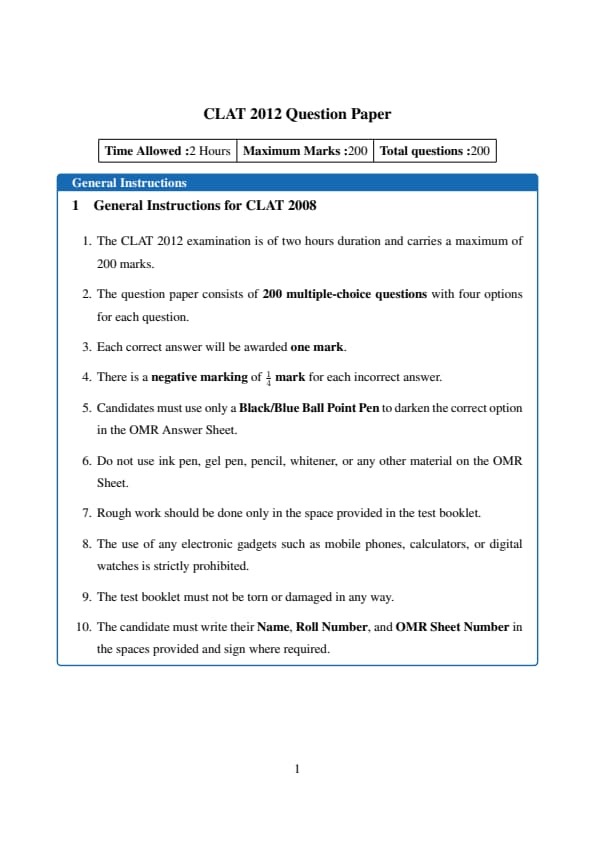
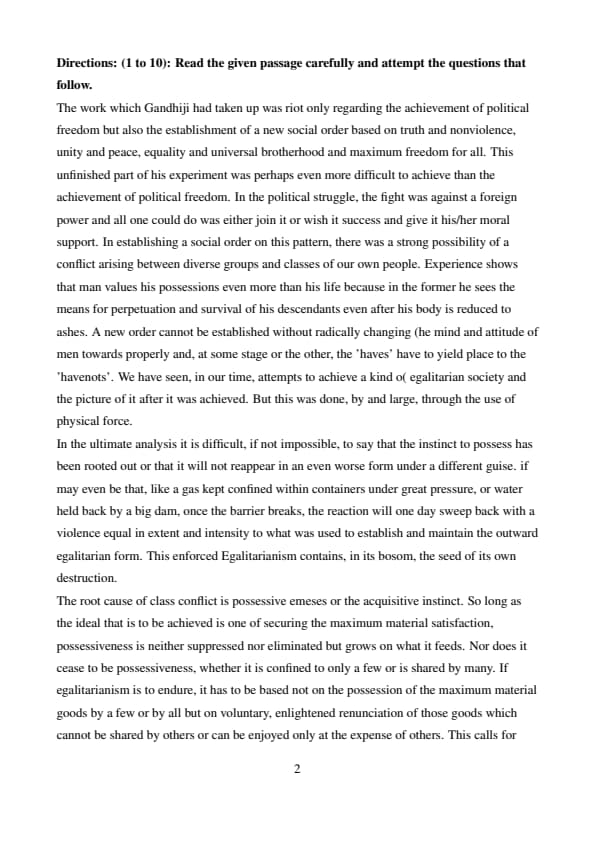
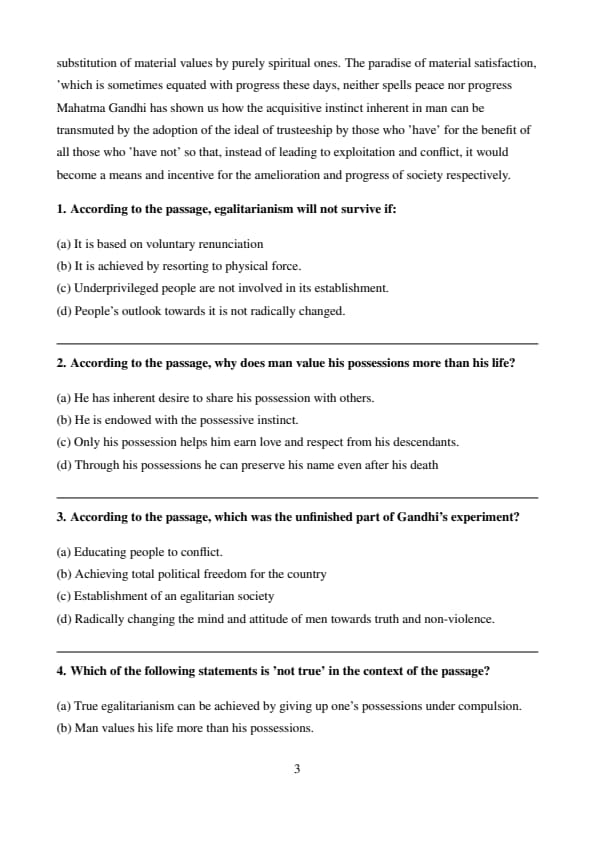
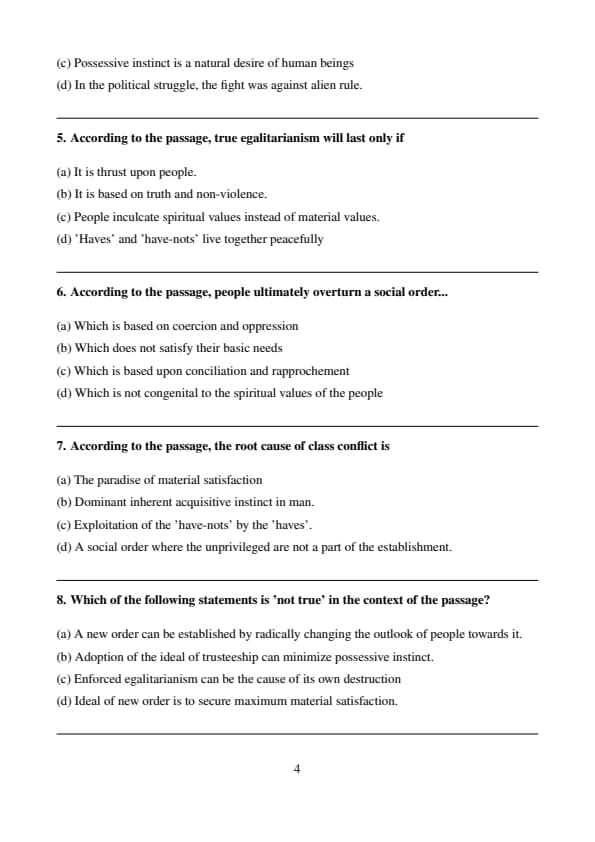
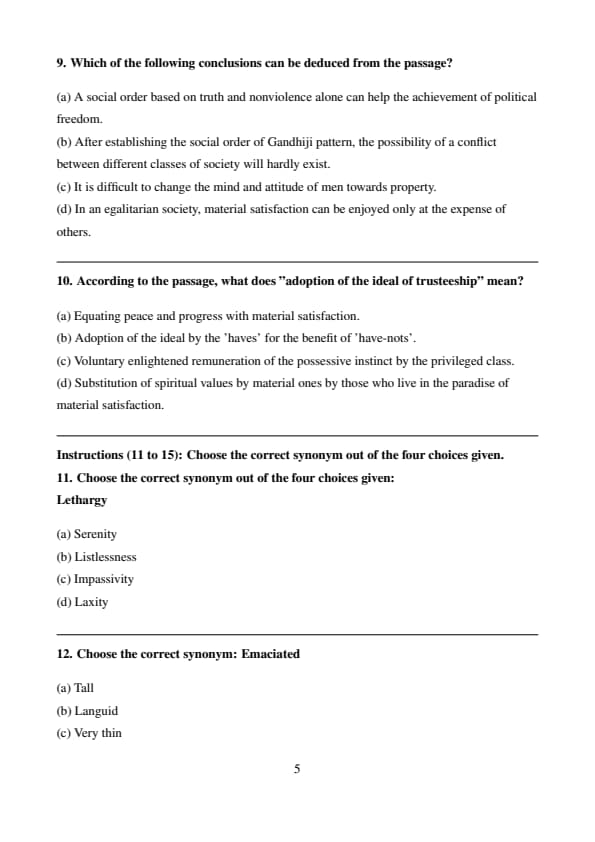
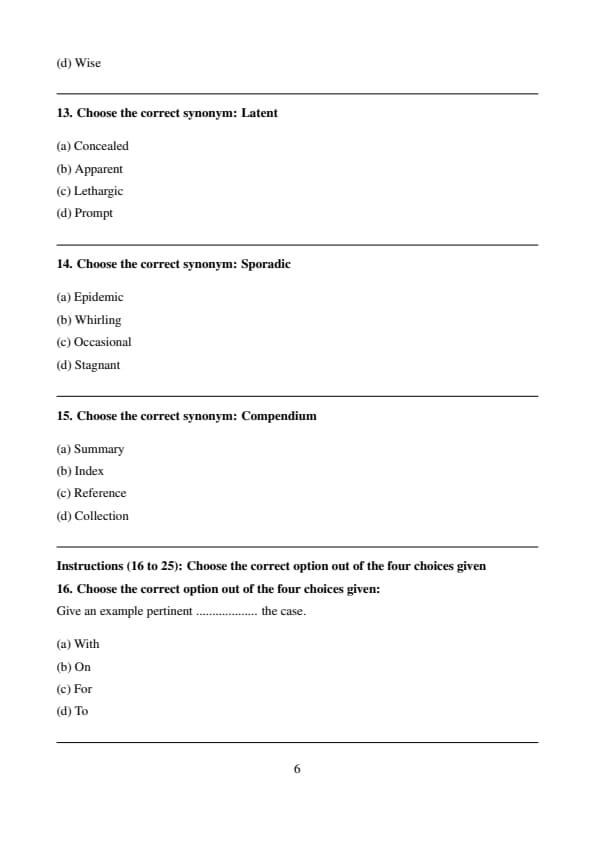
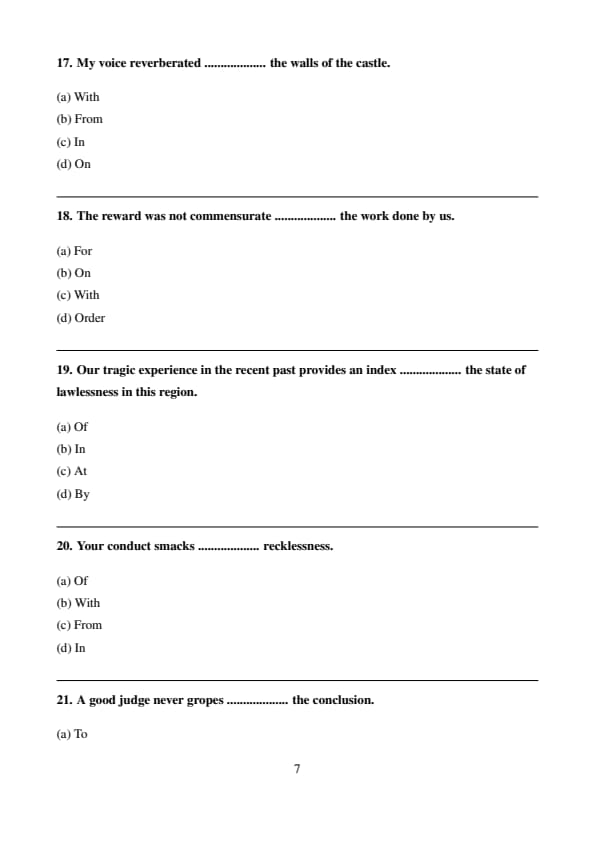
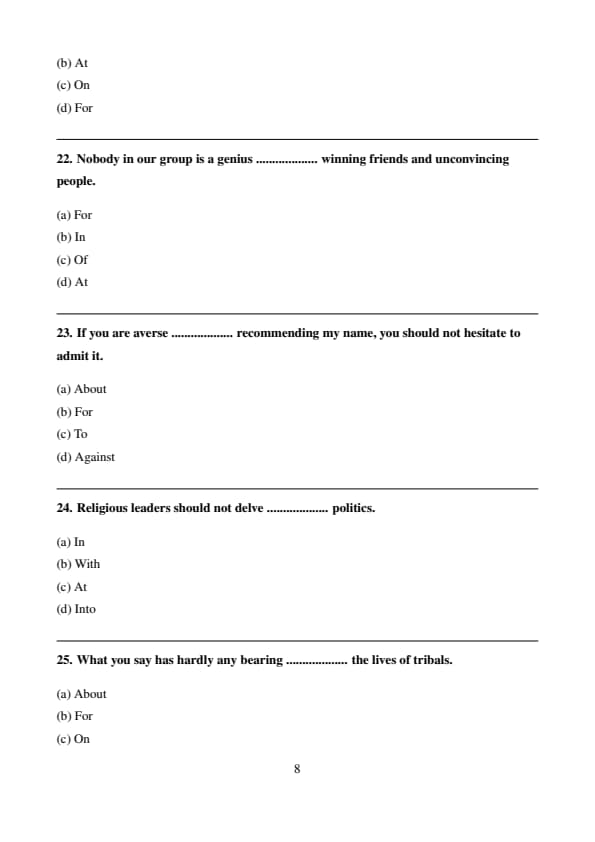
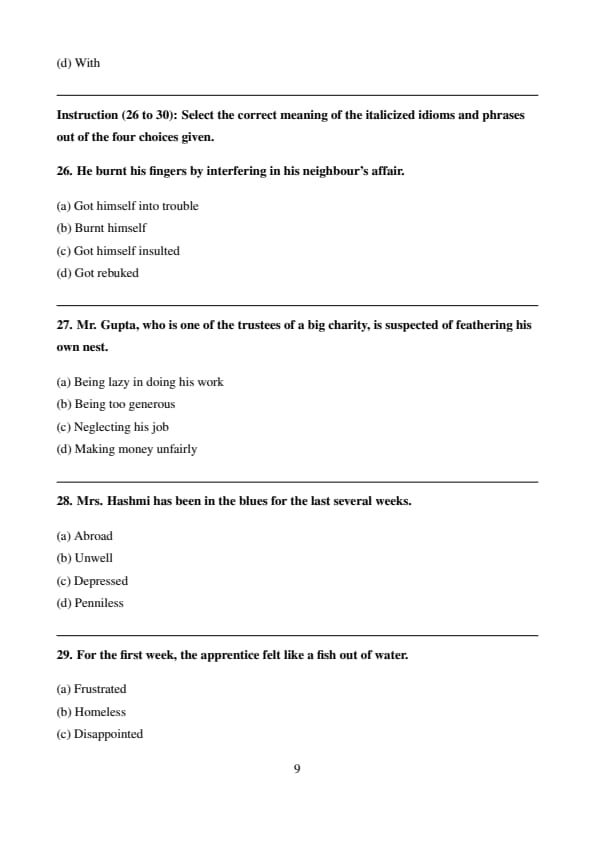
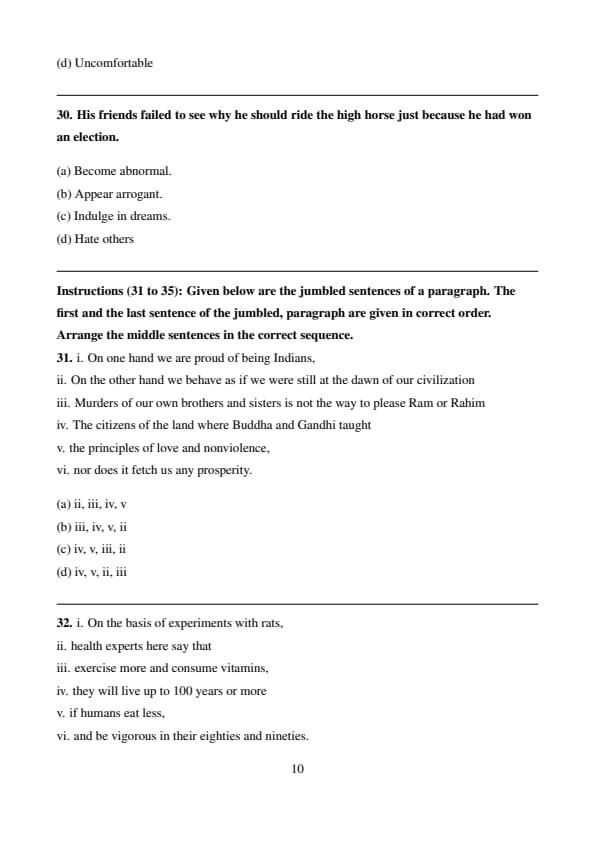
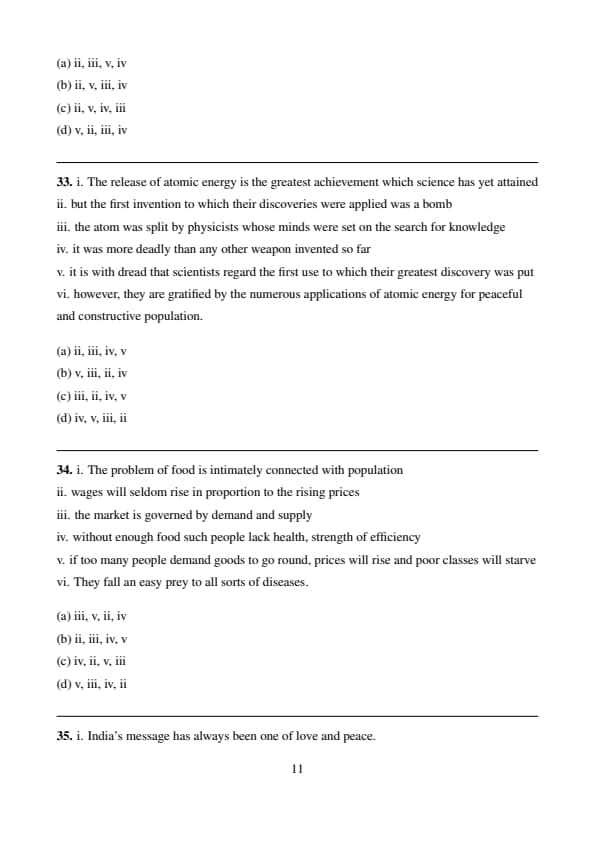
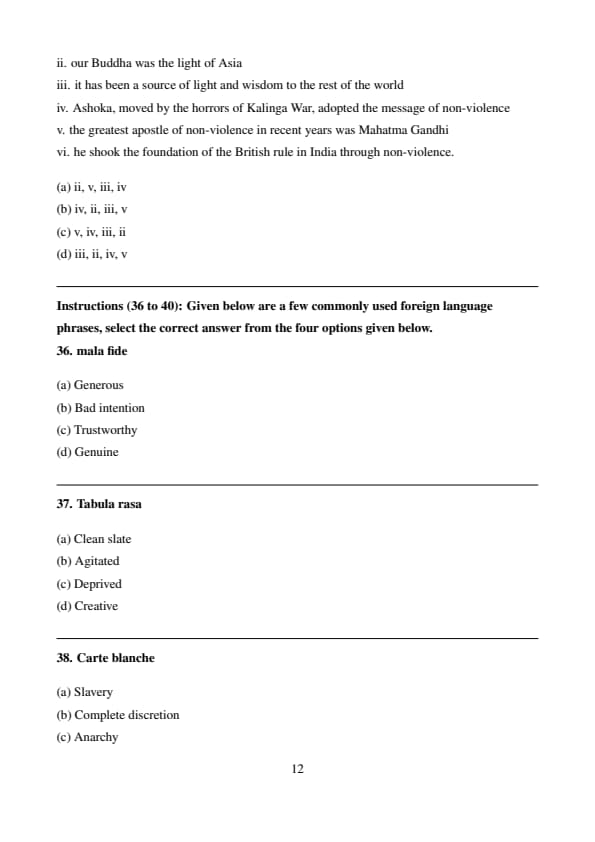
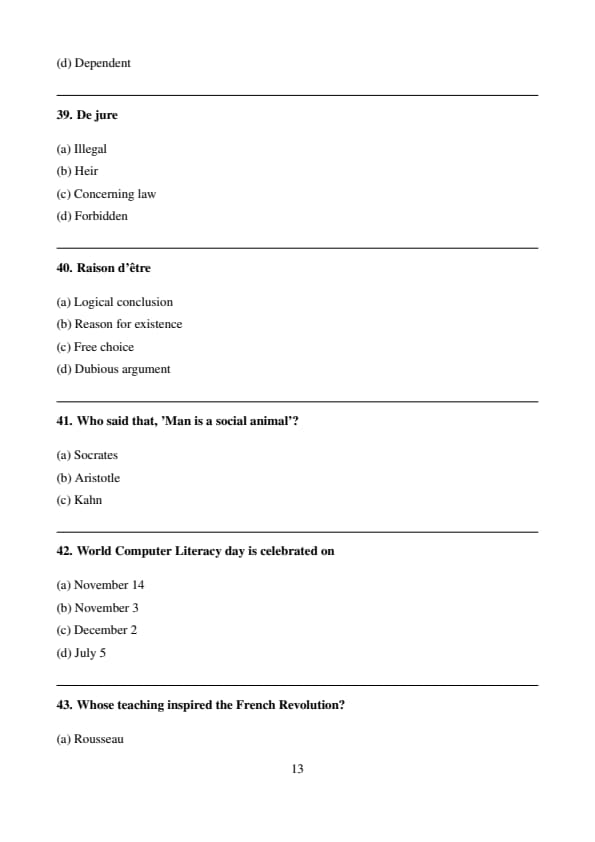
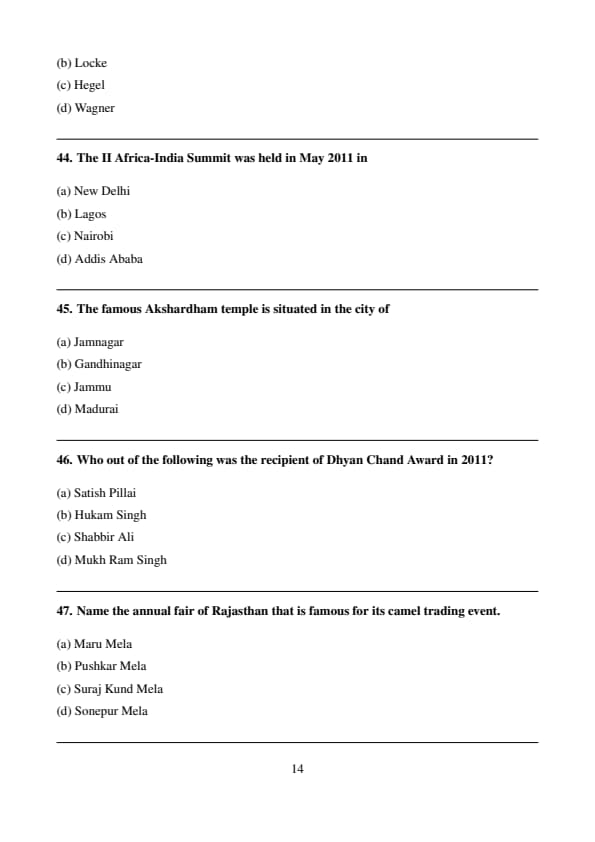
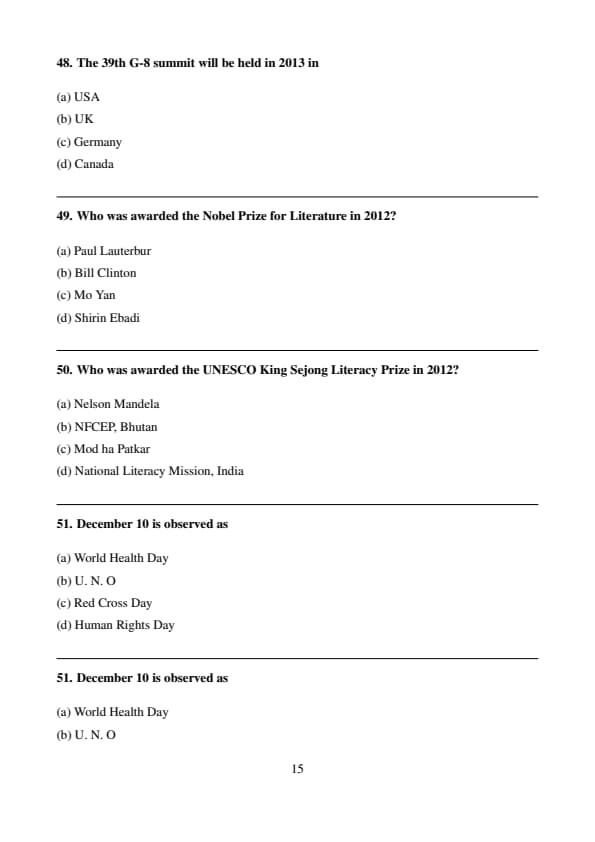
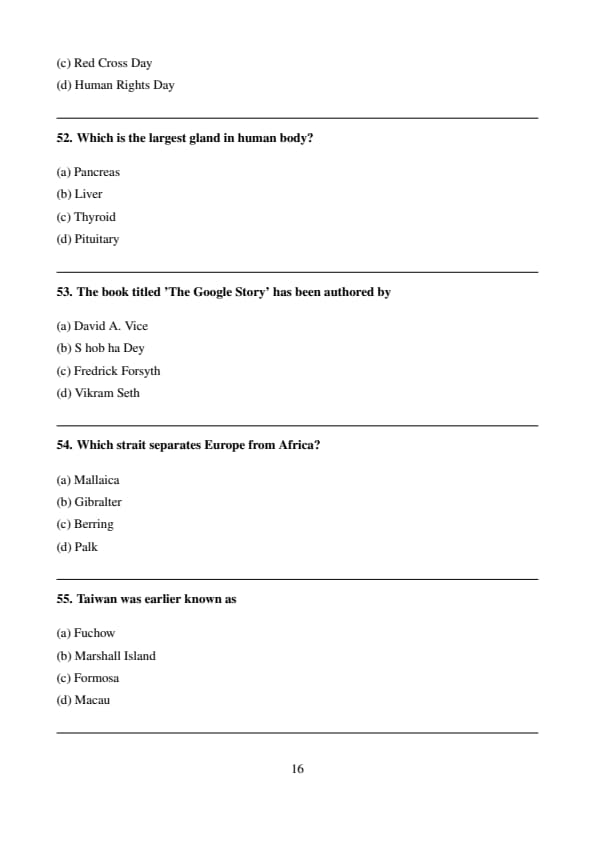
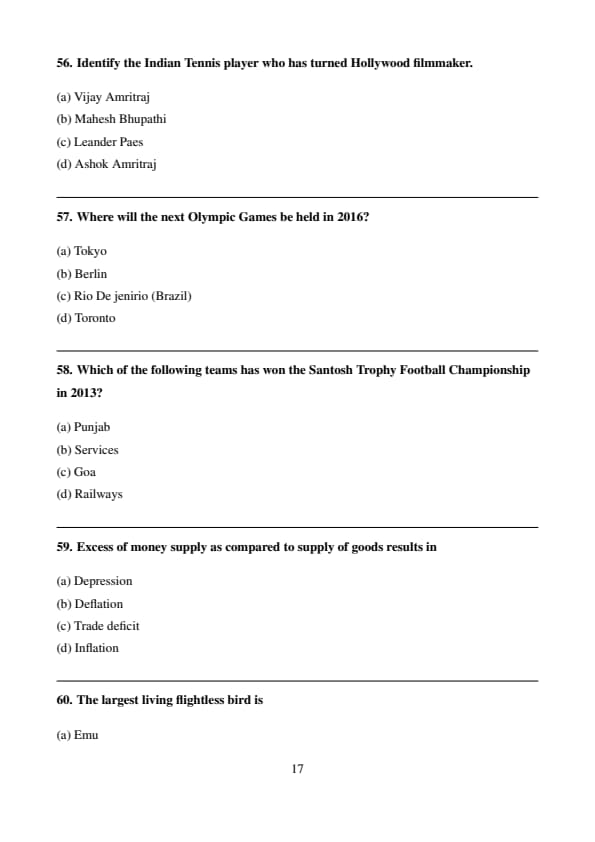
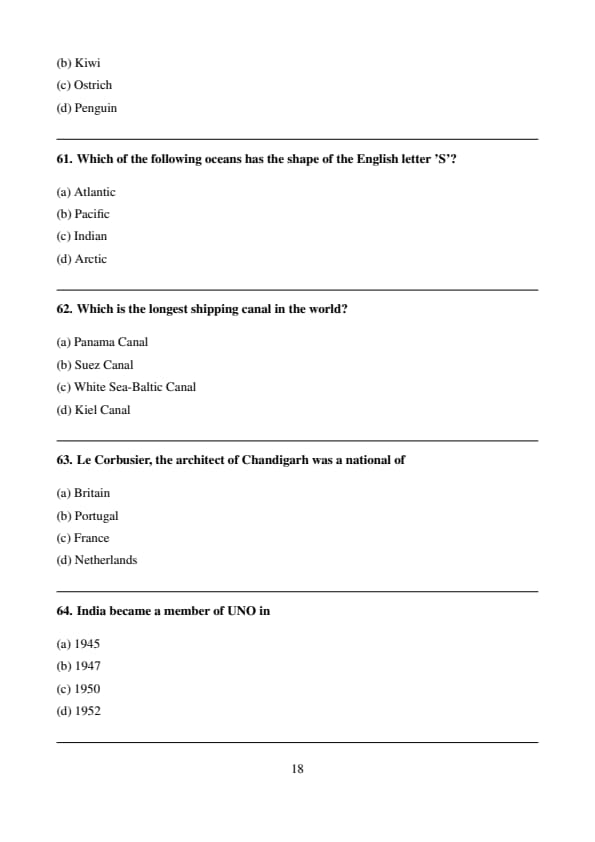
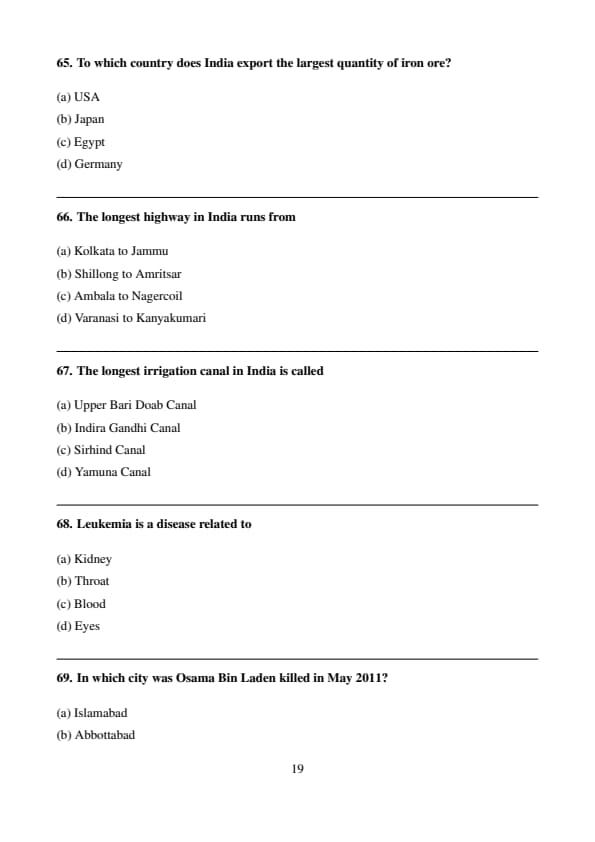
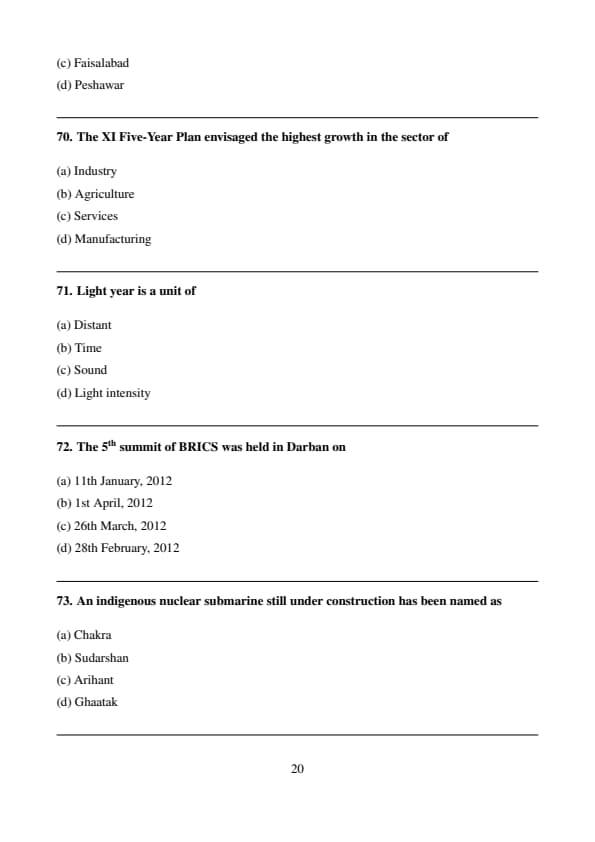
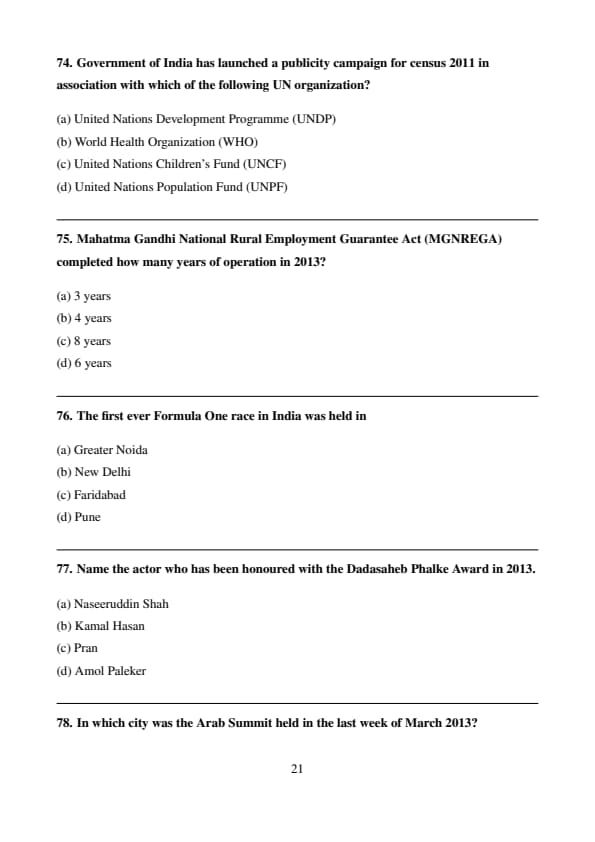
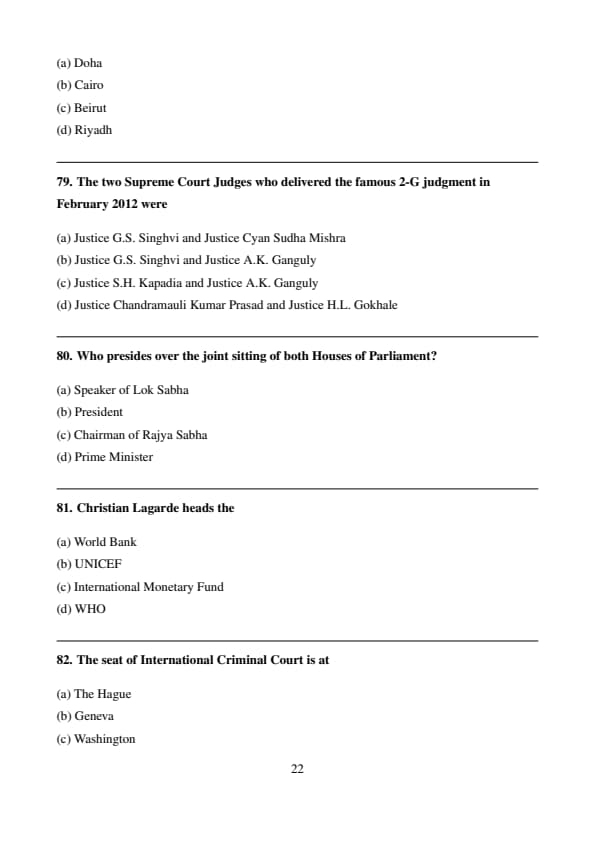
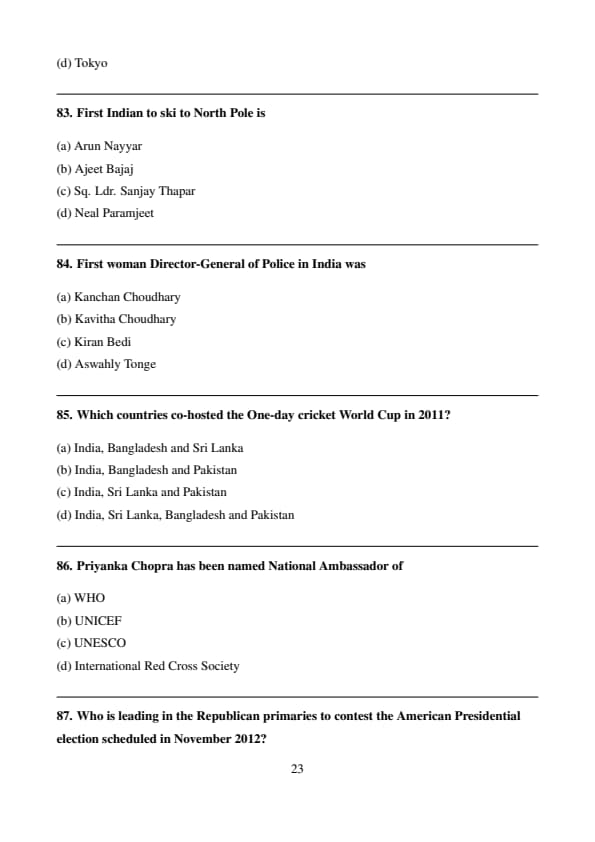
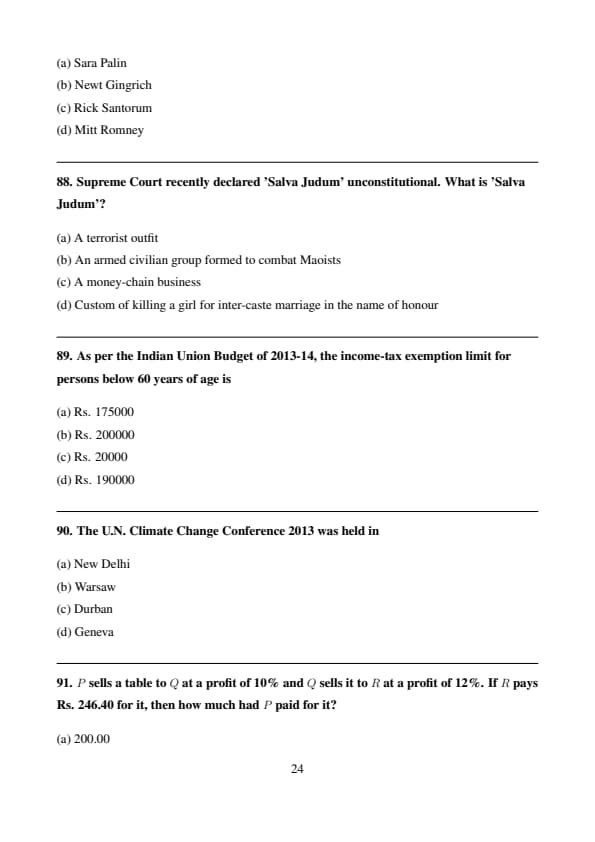
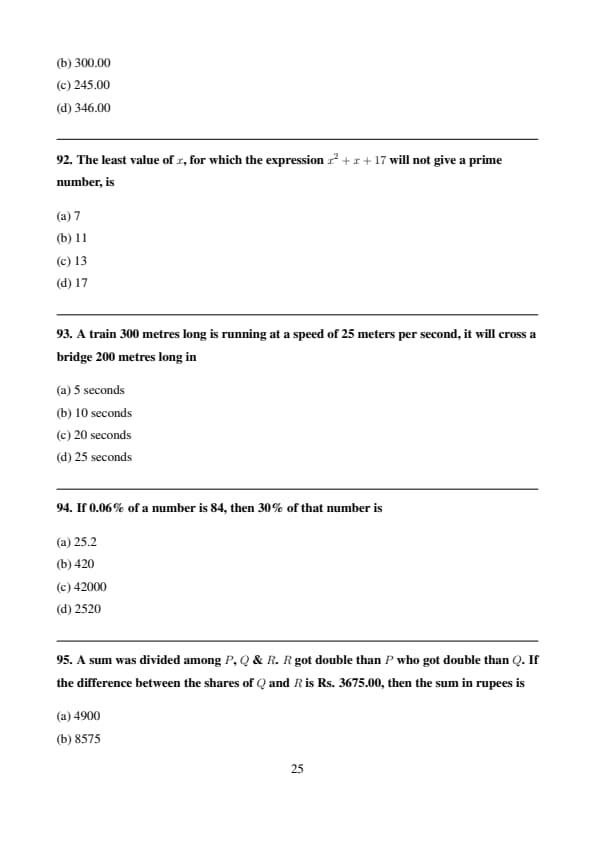
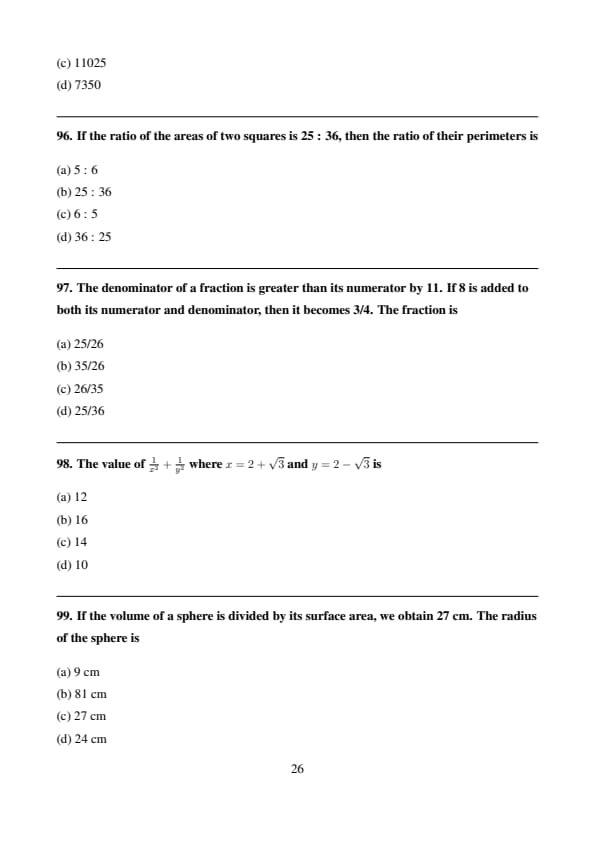
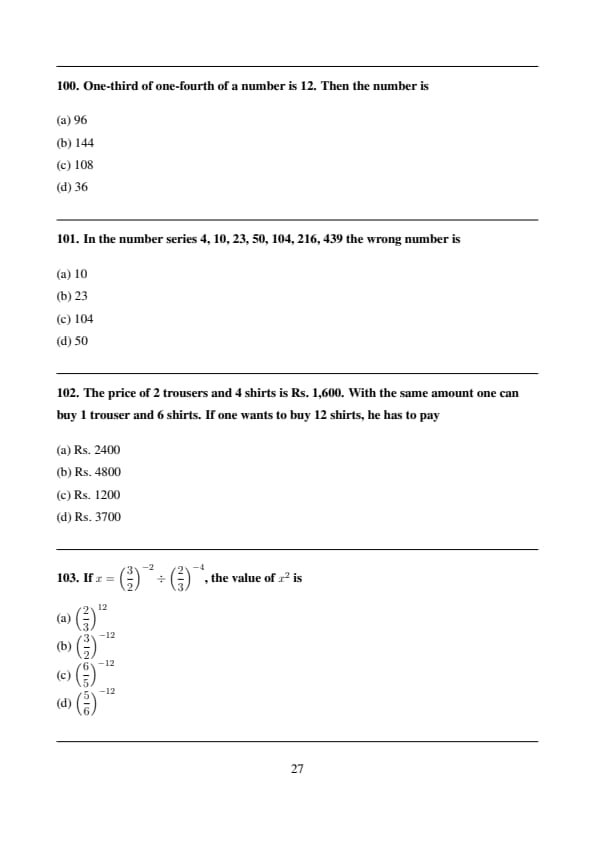
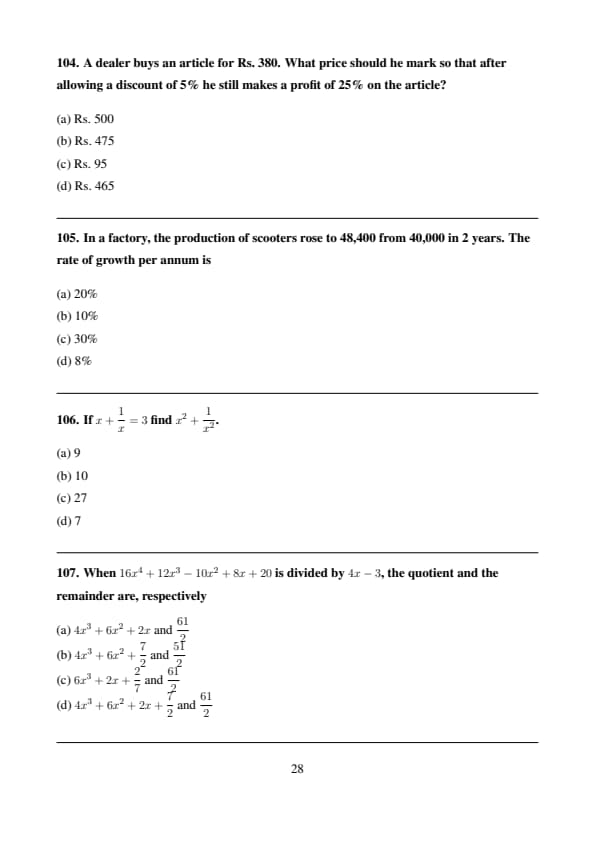
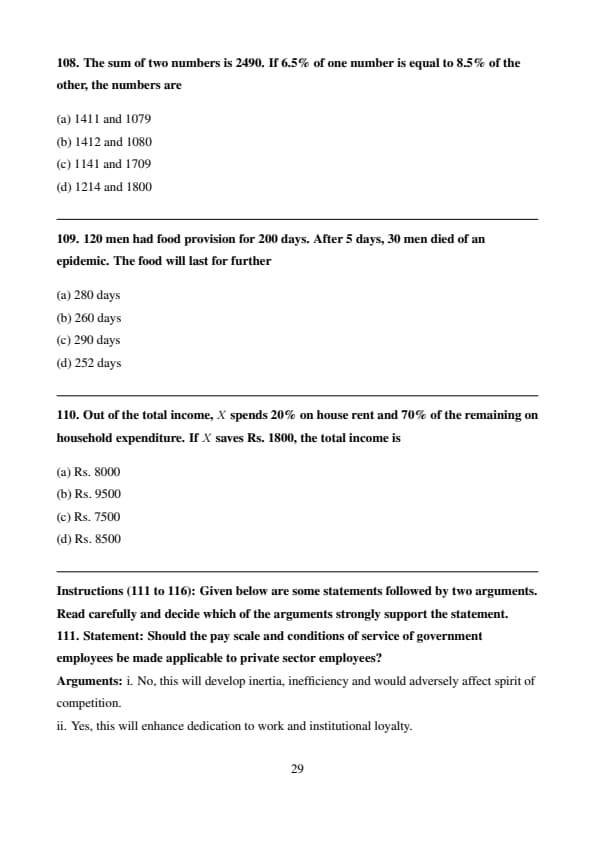
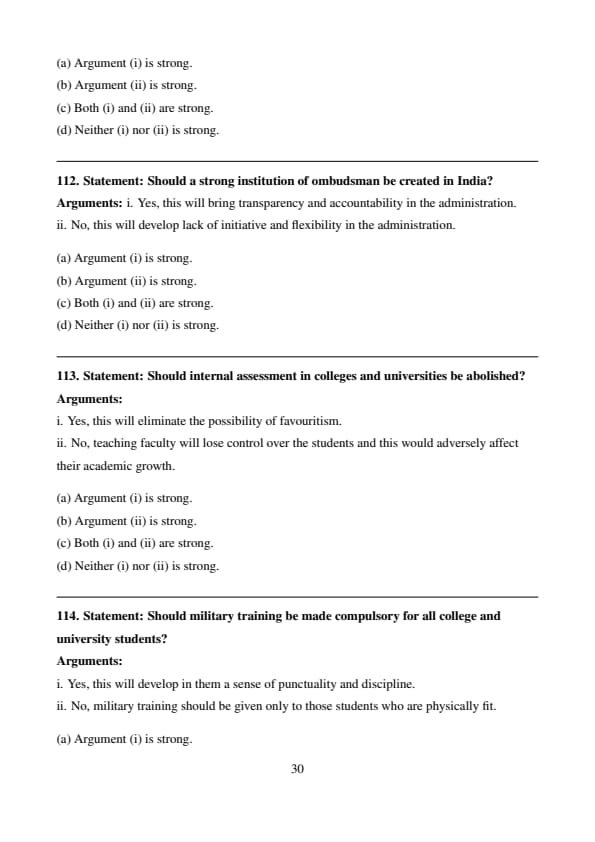
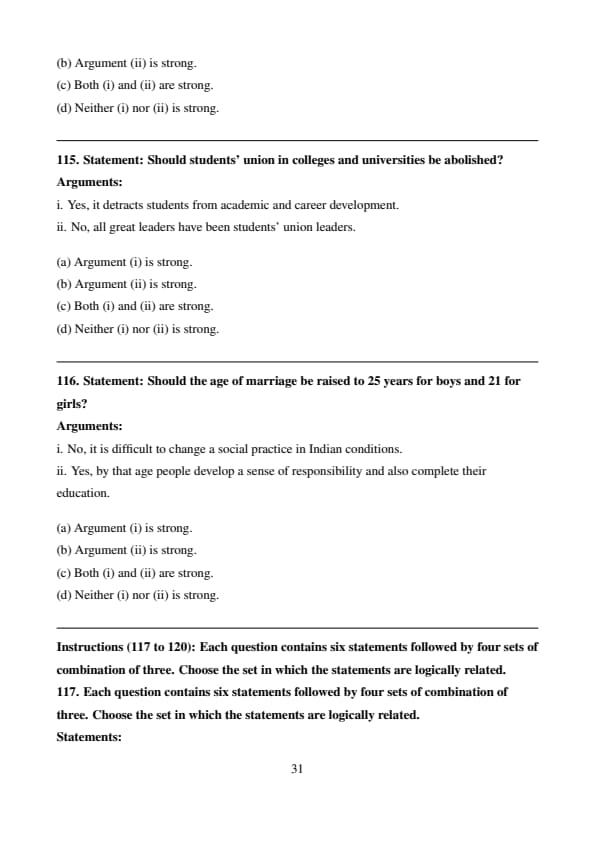
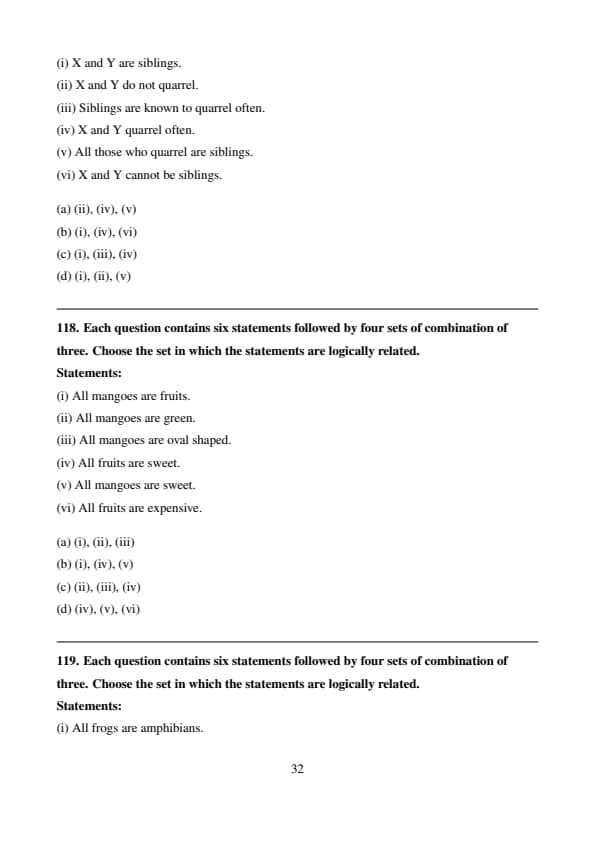
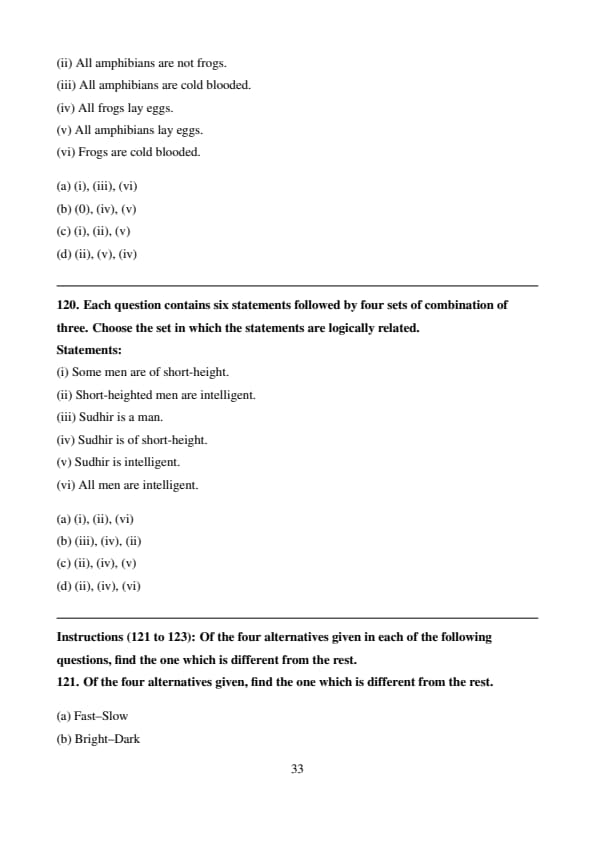
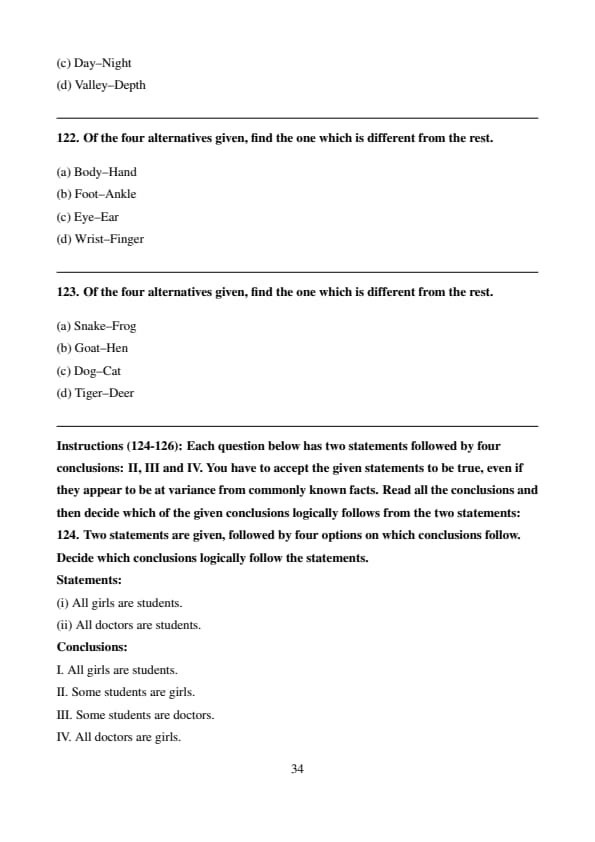
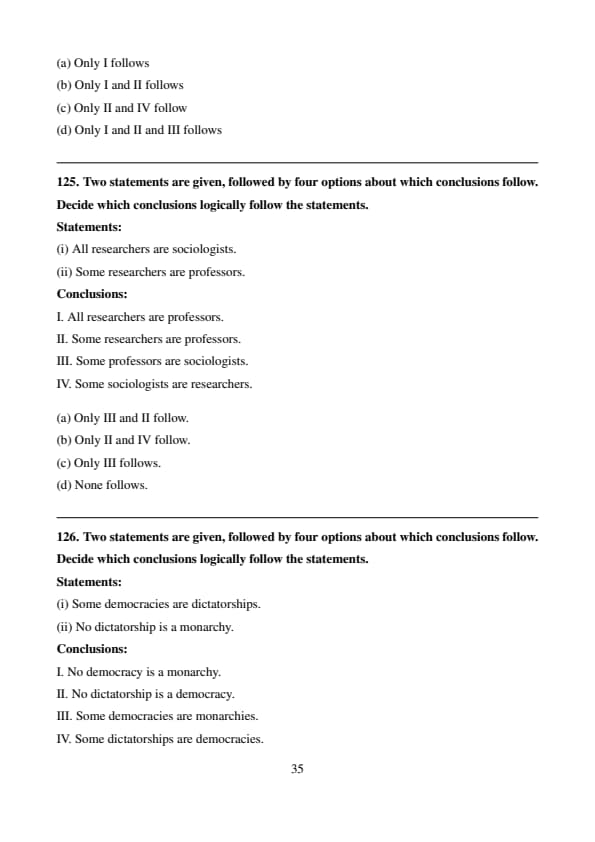
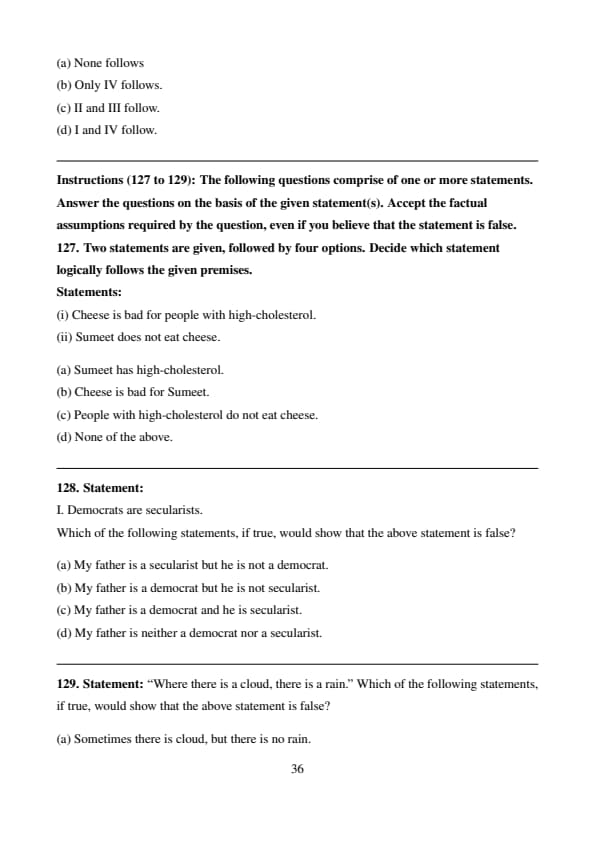
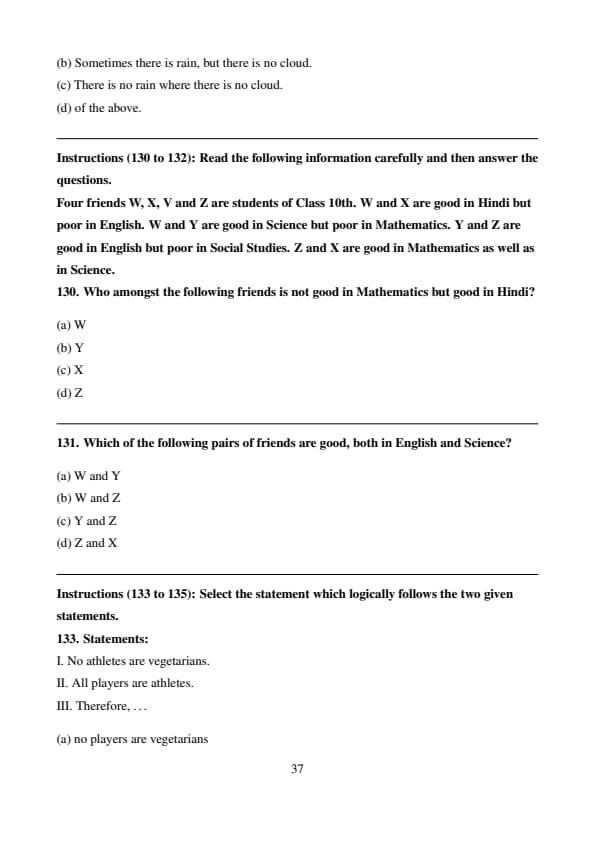
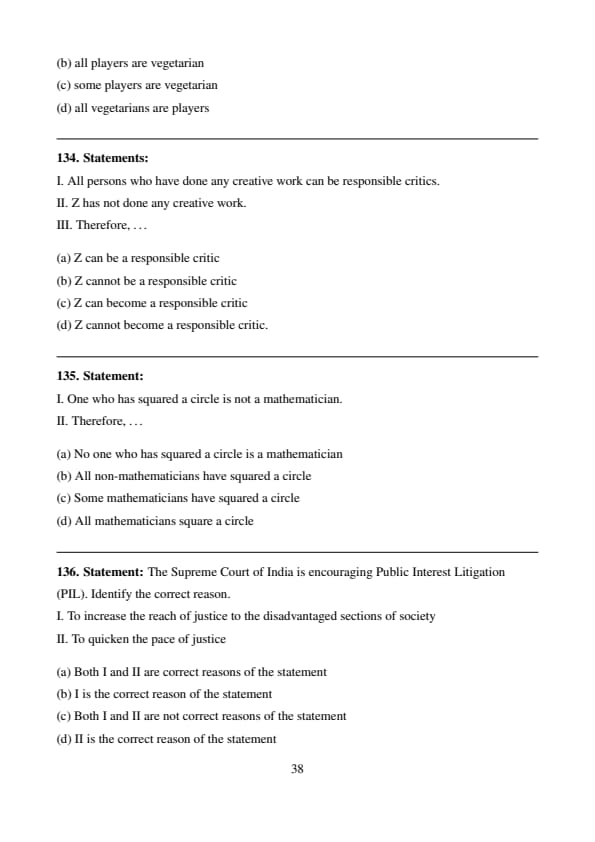
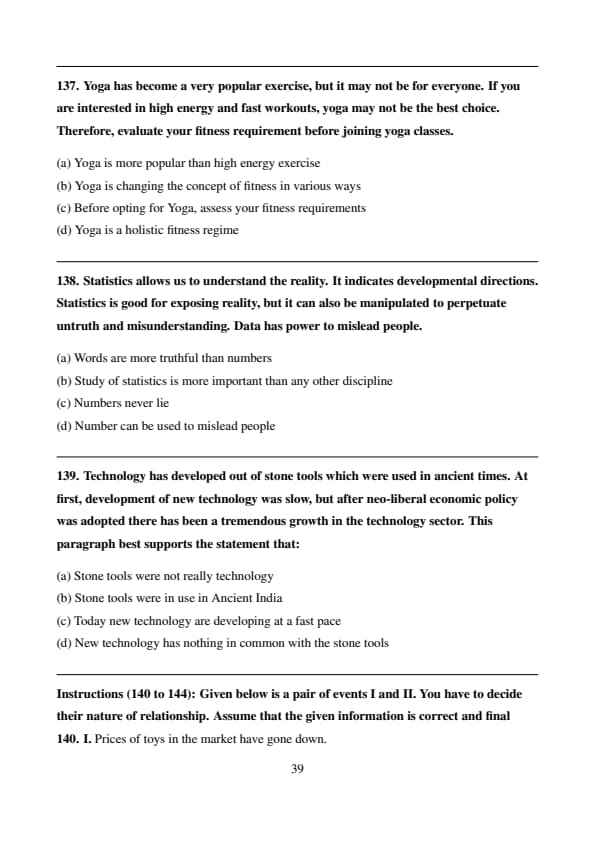
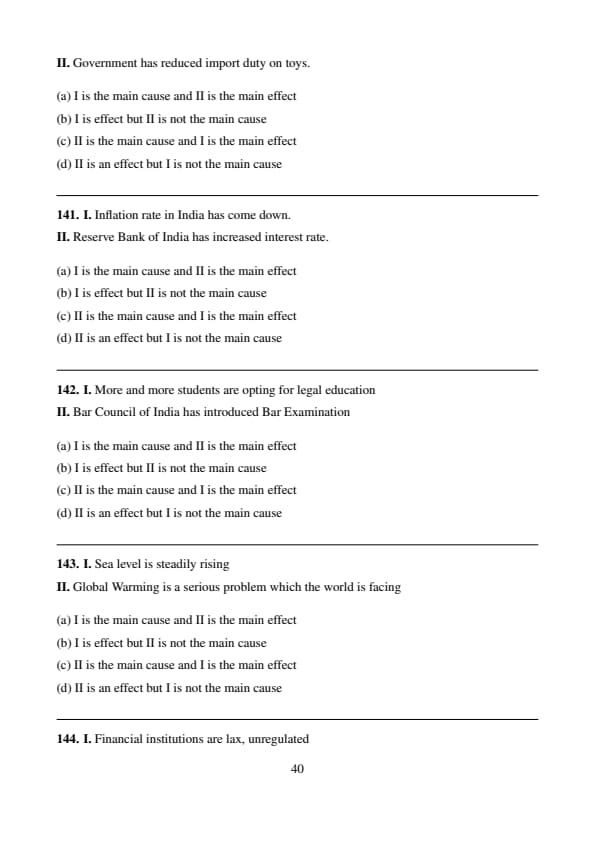
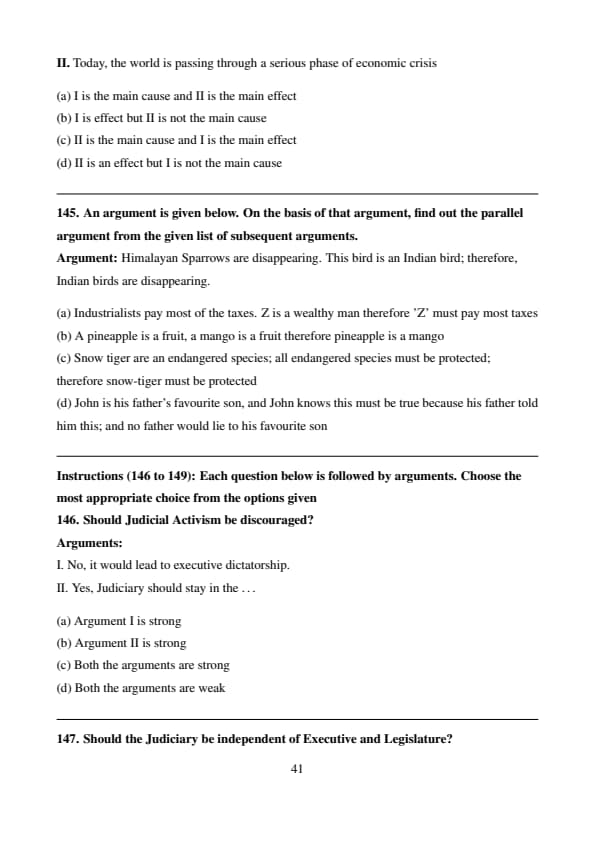
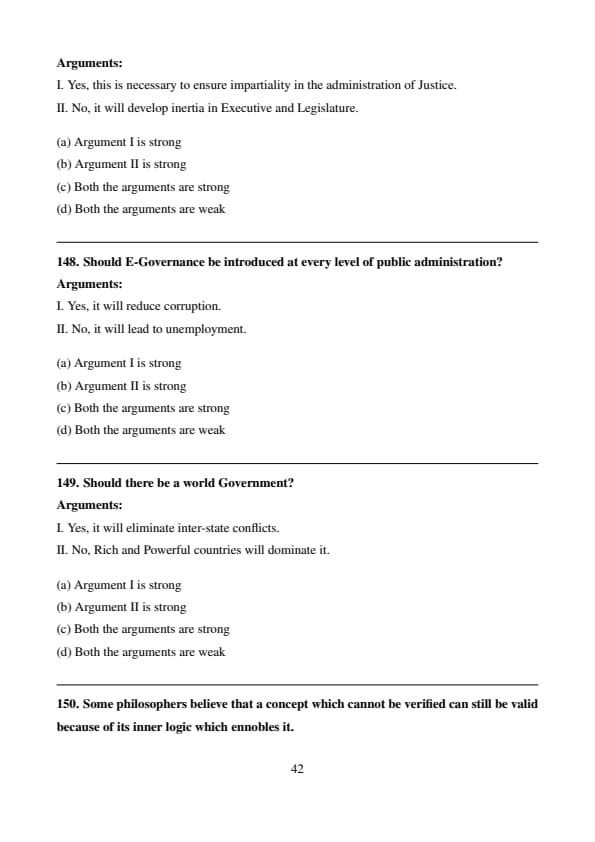
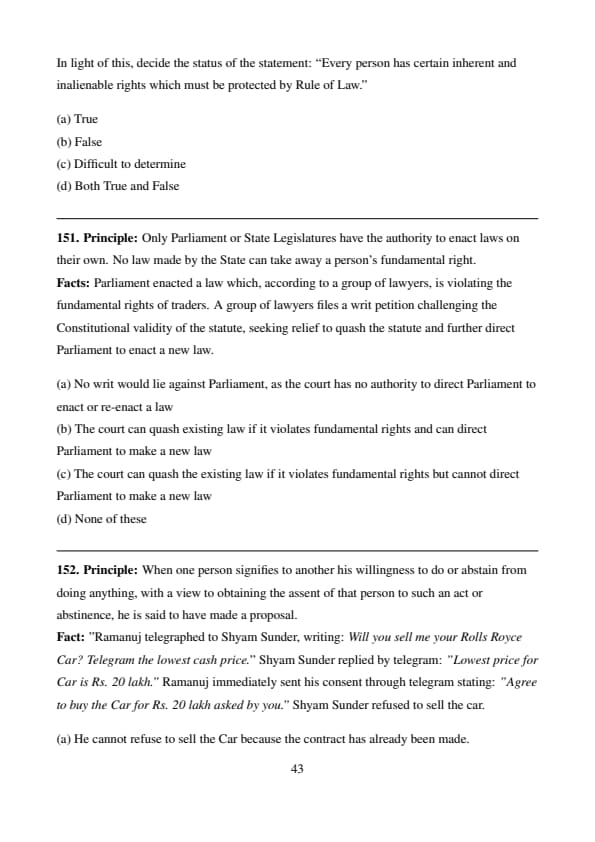
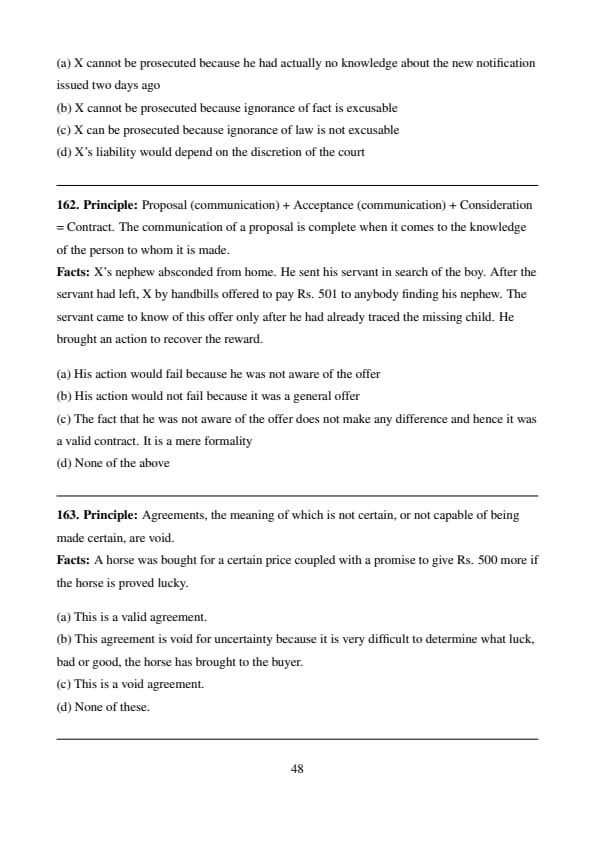
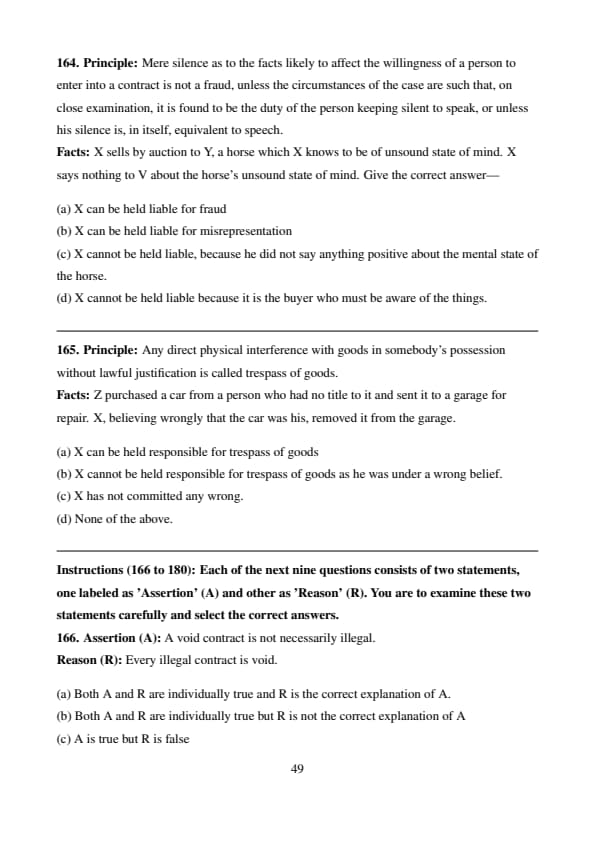
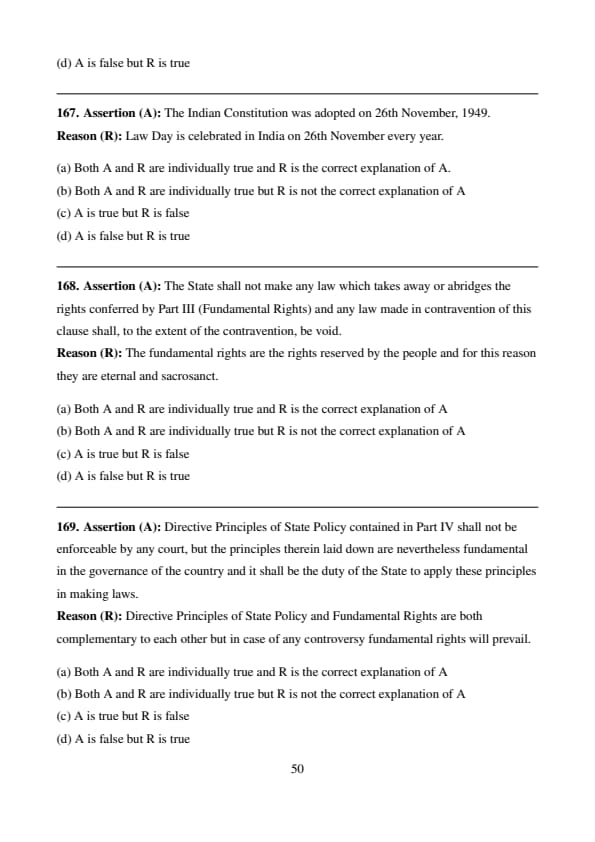
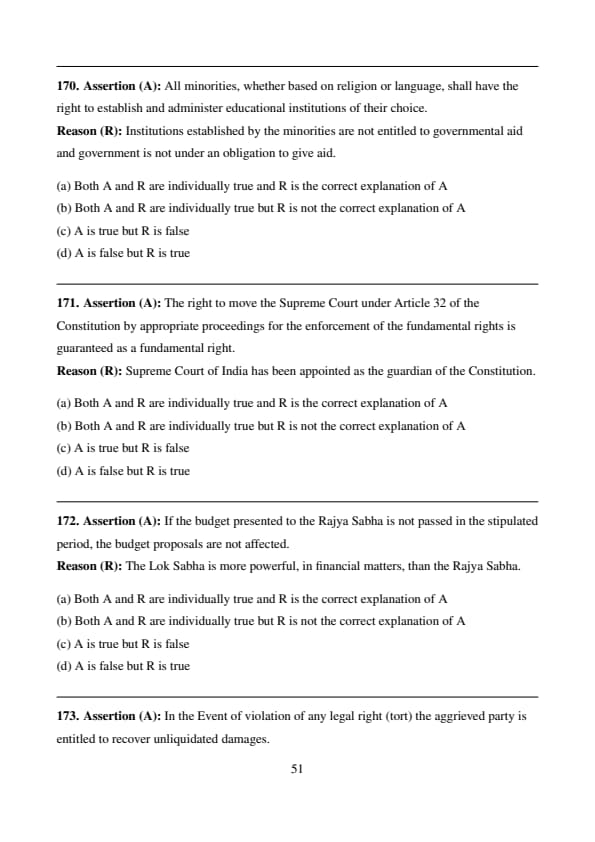
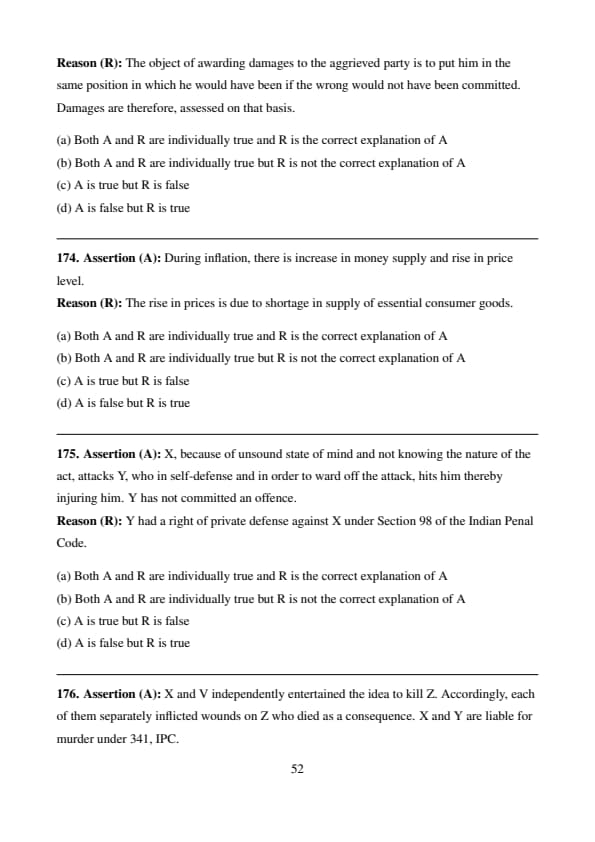
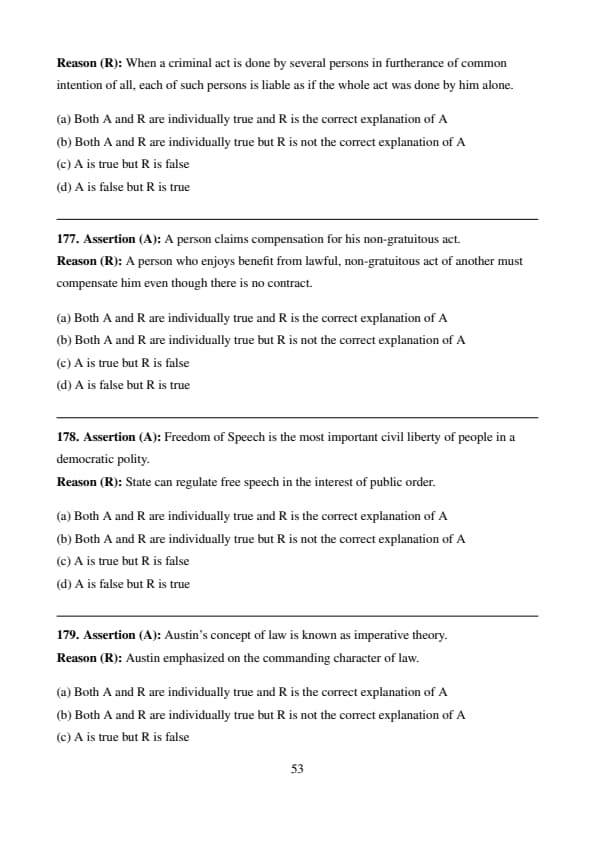
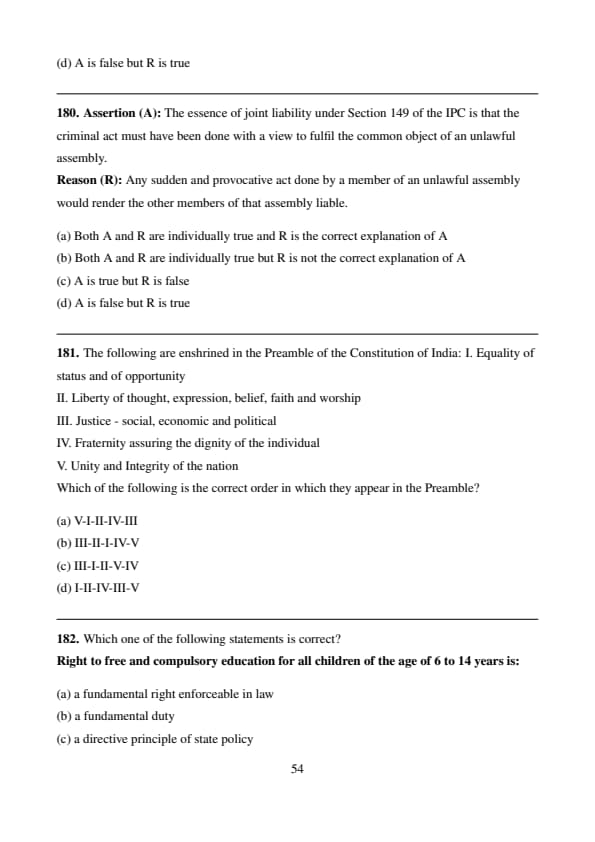
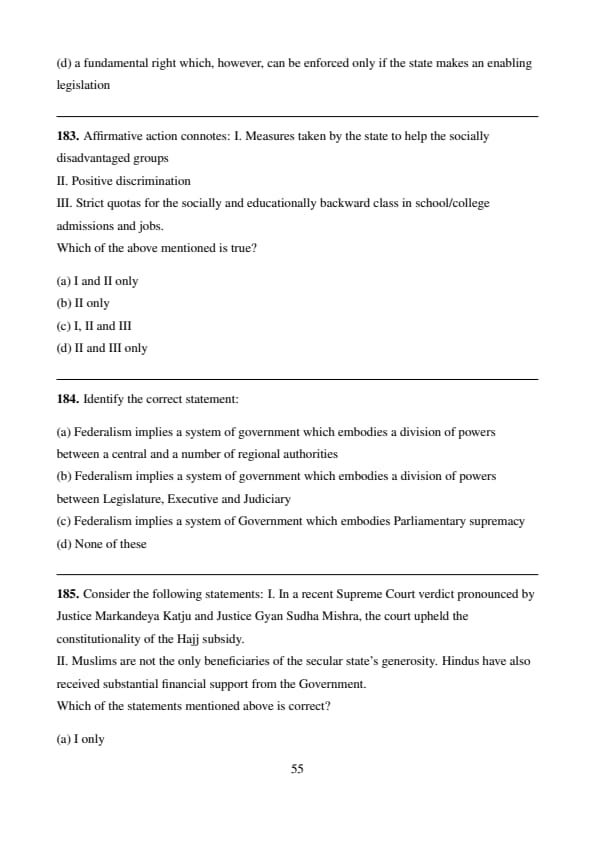
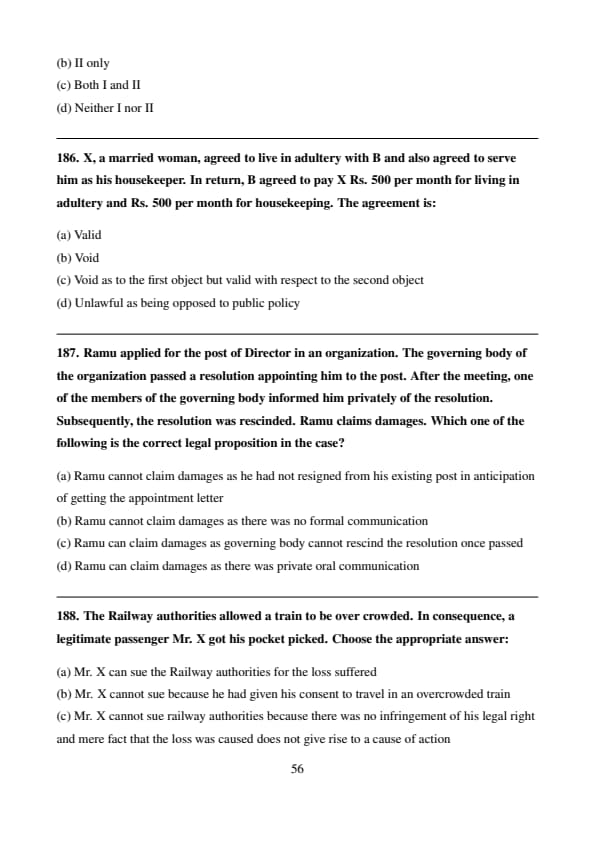
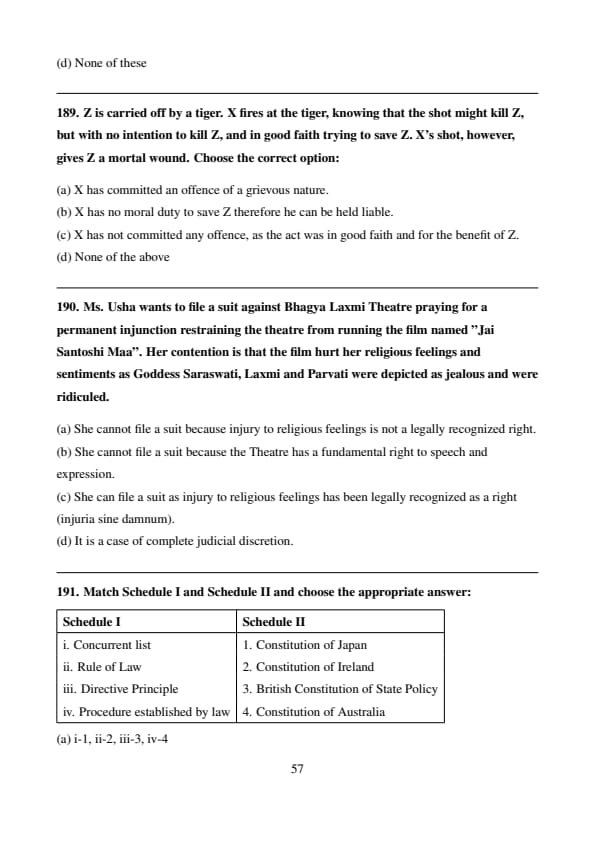
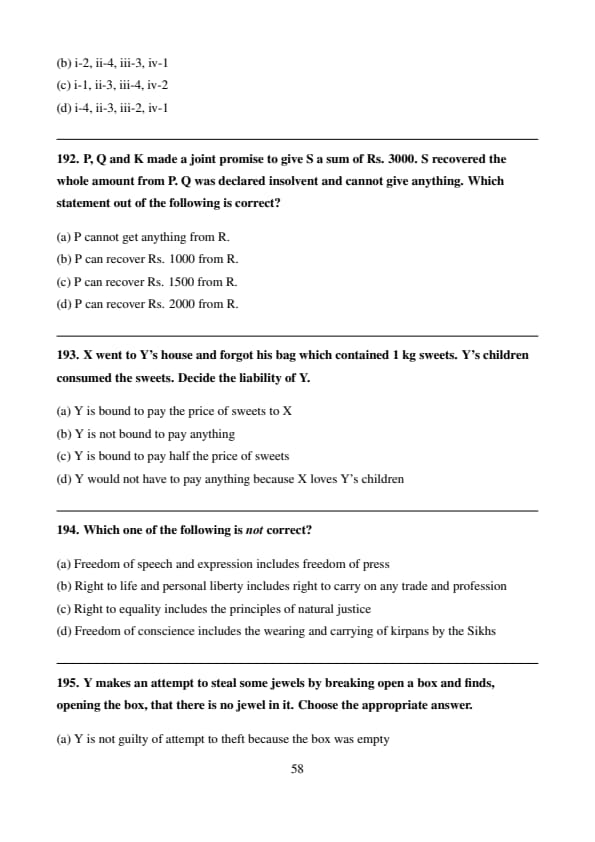
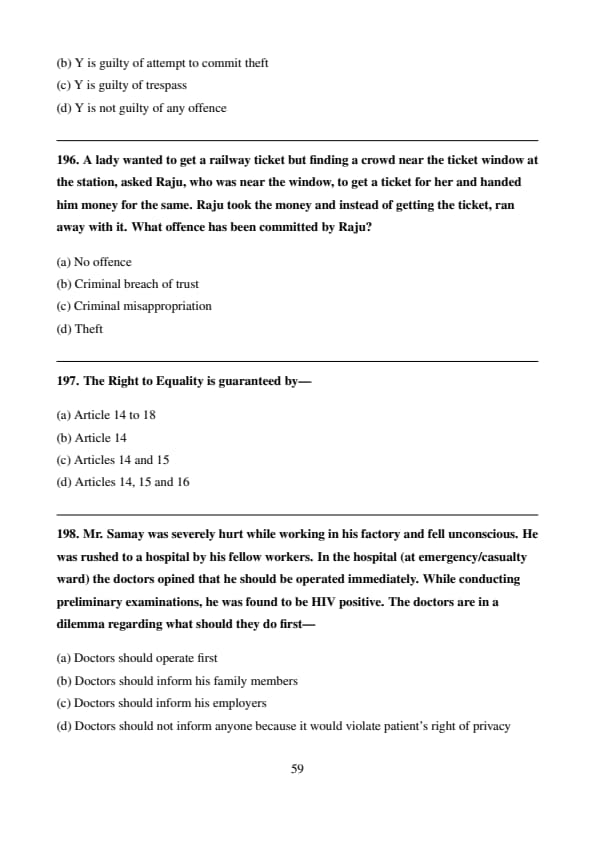
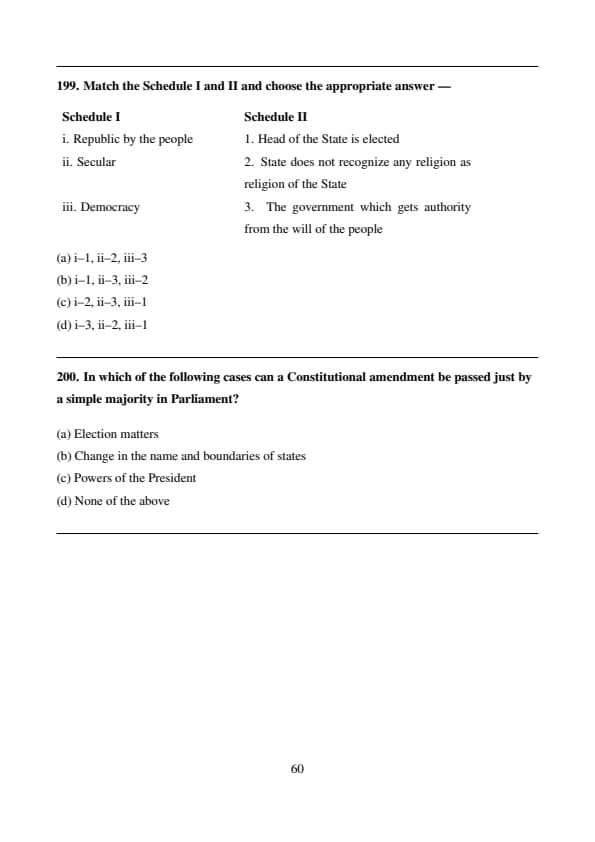
CLAT Previous Year Question Paper with Answer Key PDFs
Collegedunia has provided CLAT Previous Year Question paper pdf with answer key in the links given below:
| CLAT 2021 Question Paper | CLAT 2020 Question Paper | CLAT 2019 Question Paper |
| CLAT 2018 Question Paper | CLAT 2017 Question Paper | CLAT 2016 Question Paper |



Comments