GRE 2024 Quantitative Reasoning Practice Test Set 3 Question Paper with Solutions PDF

GRE 2024 Quantitative Reasoning Practice Test Set 3 Question Paper with Solutions PDF is available for download. The overall test time is about 1 hour and 58 minutes. GRE has total 5 sections:

  • Analytical Writing  (One "Analyze an Issue" task, Alloted time 30 minutes)
  • Verbal Reasoning  (Two Sections, with 12 questions and 15 questions respectively)
  • Quantitative Reasoning (Two Sections, with 12 questions and 15 questions respectively)

GRE 2024 Qantitative Reasoning Practice Test Set 3 Question Paper with Solutions PDF

GRE 2024 Quantitative Reasoning Set 3 Question Paper with Solutions PDF download iconDownload Check Solutions
GRE 2024 Qantitative Reasoning Practice Test Set 3 Question Paper with Solutions PDF

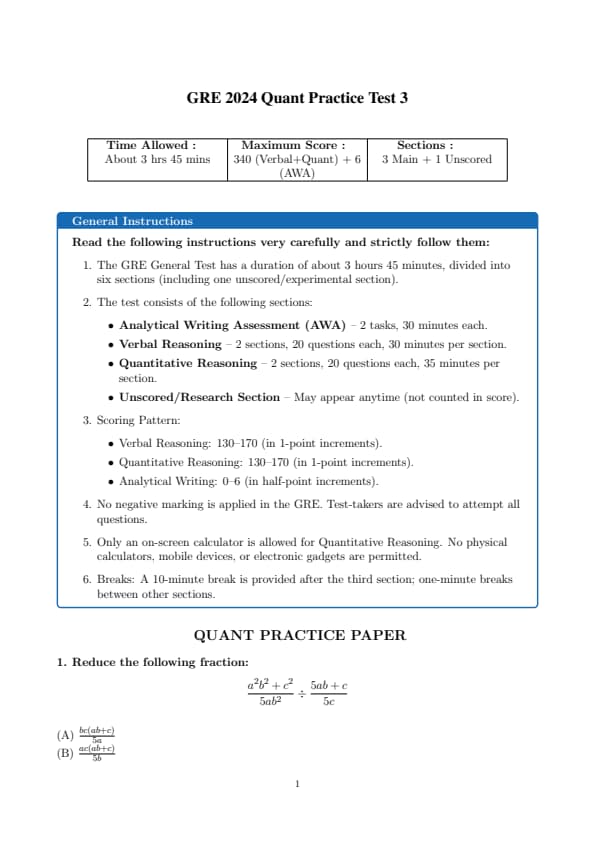
Question 1:

Reduce the following fraction: \[ \frac{a^2b^2 + c^2}{5ab^2} \div \frac{5ab + c}{5c} \]

  • (A) \( \frac{bc(ab + c)}{5a} \)
  • (B) \( \frac{ac(ab + c)}{5b} \)
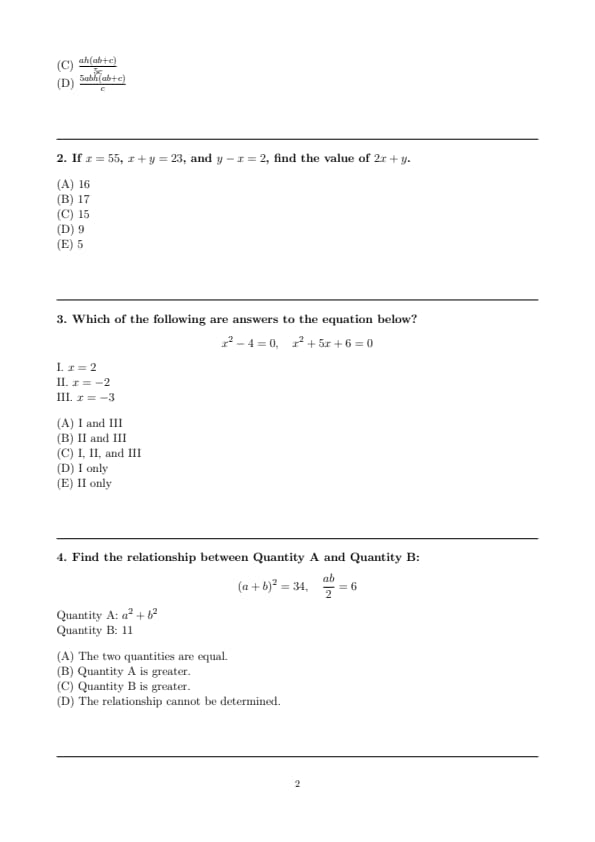
  • (C) \( \frac{ah(ab + c)}{5c} \)
  • (D) \( \frac{5abh(ab + c)}{c} \)

Question 2:

If \( x = 55 \), \( x + y = 23 \), and \( y - x = 2 \), find the value of \( 2x + y \).

  • (A) 16
  • (B) 17
  • (C) 15
  • (D) 9
  • (E) 5

Question 3:

Which of the following are answers to the equation below? \[ x^2 - 4 = 0, \quad x^2 + 5x + 6 = 0 \]
I. \( x = 2 \)

II. \( x = -2 \)

III. \( x = -3 \)

  • (A) I and III
  • (B) II and III
  • (C) I, II, and III
  • (D) I only
  • (E) II only

Question 4:

Find the relationship between Quantity A and Quantity B: \[ (a + b)^2 = 34, \quad \frac{ab}{2} = 6 \]
Quantity A: \( a^2 + b^2 \)

Quantity B: 11

  • (A) The two quantities are equal.
  • (B) Quantity A is greater.
  • (C) Quantity B is greater.
  • (D) The relationship cannot be determined.

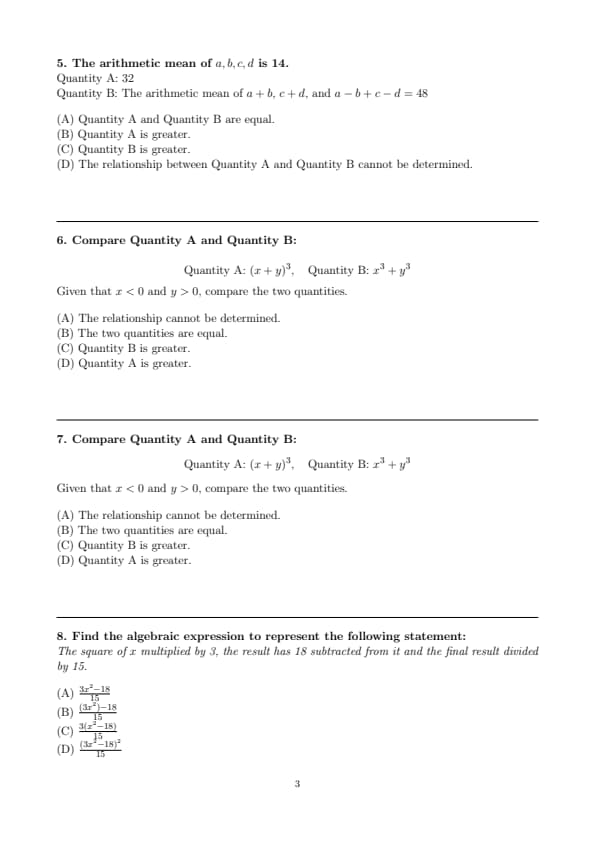
Question 5:

The arithmetic mean of \( a, b, c, d \) is 14.

Quantity A: 32

Quantity B: The arithmetic mean of \( a + b \), \( c + d \), and \( a - b + c - d = 48 \)

  • (A) Quantity A and Quantity B are equal.
  • (B) Quantity A is greater.
  • (C) Quantity B is greater.
  • (D) The relationship between Quantity A and Quantity B cannot be determined.

Question 6:

Compare Quantity A and Quantity B:
\[ Quantity A: (x + y)^3, \quad Quantity B: x^3 + y^3 \]
Given that \( x < 0 \) and \( y > 0 \), compare the two quantities.

  • (A) The relationship cannot be determined.
  • (B) The two quantities are equal.
  • (C) Quantity B is greater.
  • (D) Quantity A is greater.

Question 7:

Compare Quantity A and Quantity B: \[ Quantity A: (x + y)^3, \quad Quantity B: x^3 + y^3 \]
Given that \( x < 0 \) and \( y > 0 \), compare the two quantities.

  • (A) The relationship cannot be determined.
  • (B) The two quantities are equal.
  • (C) Quantity B is greater.
  • (D) Quantity A is greater.

Question 8:

Find the algebraic expression to represent the following statement:

The square of \( x \) multiplied by 3, the result has 18 subtracted from it and the final result divided by 15.

  • (A) \( \frac{3x^2 - 18}{15} \)
  • (B) \( \frac{(3x^2) - 18}{15} \)
  • (C) \( \frac{3(x^2 - 18)}{15} \)
  • (D) \( \frac{(3x^2 - 18)^2}{15} \)
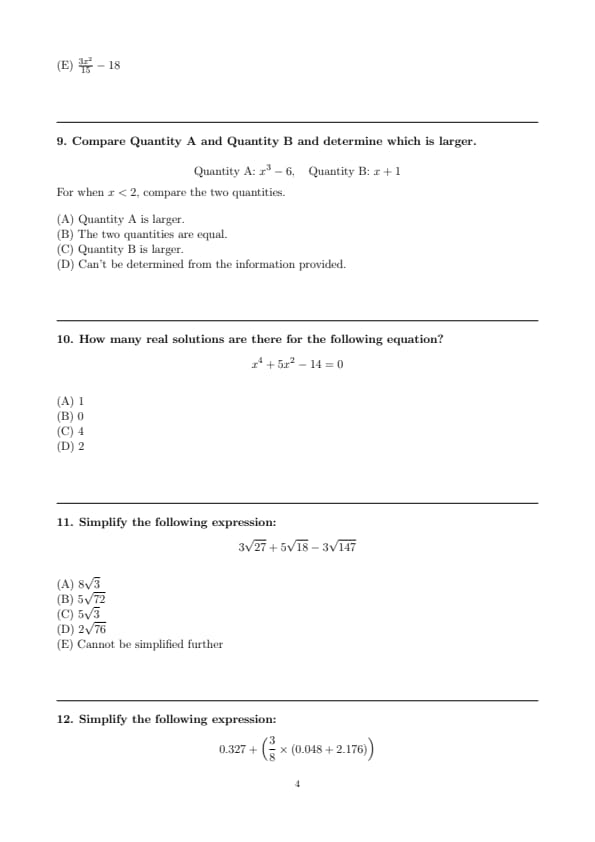
  • (E) \( \frac{3x^2}{15} - 18 \)

Question 9:

Compare Quantity A and Quantity B and determine which is larger.
\[ Quantity A: x^3 - 6, \quad Quantity B: x + 1 \]
For when \( x < 2 \), compare the two quantities.

  • (A) Quantity A is larger.
  • (B) The two quantities are equal.
  • (C) Quantity B is larger.
  • (D) Can't be determined from the information provided.

Question 10:

How many real solutions are there for the following equation? \[ x^4 + 5x^2 - 14 = 0 \]

  • (A) 1
  • (B) 0
  • (C) 4
  • (D) 2

Question 11:

Simplify the following expression: \[ 3\sqrt{27} + 5\sqrt{18} - 3\sqrt{147} \]

  • (A) \( 8\sqrt{3} \)
  • (B) \( 5\sqrt{72} \)
  • (C) \( 5\sqrt{3} \)
  • (D) \( 2\sqrt{76} \)
  • (E) Cannot be simplified further

Question 12:

Simplify the following expression: \[ 0.327 + \left( \frac{3}{8} \times (0.048 + 2.176) \right) \]

  • (A) 0.0532
  • (B) 1.242
  • (C) 0.793
  • (D) 1.522

Question 13:

Which of the following is true? \[ Quantity A: \frac{12}{11} \div \frac{7}{6}, \quad Quantity B: \frac{17}{8} \div \frac{7}{6} \]

  • (A) The relationship between the quantities cannot be determined.
  • (B) Quantity B is larger.
  • (C) The two quantities are equal.
  • (D) Quantity A is larger.

Question 14:

If the product of two distinct integers is 143, which of the following could not represent the sum of those two integers?

  • (A) 144
  • (B) -144
  • (C) 24
  • (D) -24
  • (E) 11

Question 15:

A cake order cost 45.40 before tax. If the tax rate is 6.5%, what is the price of the cake after tax is applied?

  • (A)48.99
  • (B)5.34
  • (C)49.42
  • (D)48.35
  • (E)2.95

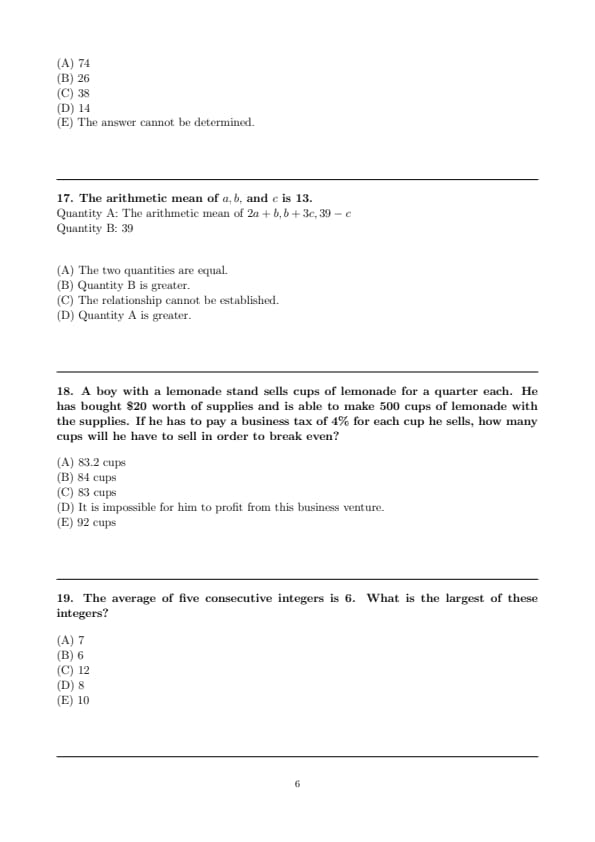
Question 16:

At an overpriced department store there are 112 customers. If 43 have purchased shirts, 57 have purchased pants, and 38 have purchased neither, how many purchased both shirts and pants?

  • (A) 74
  • (B) 26
  • (C) 38
  • (D) 14
  • (E) The answer cannot be determined.

Question 17:

The arithmetic mean of \( a, b, \) and \( c \) is 13.

Quantity A: The arithmetic mean of \( 2a + b, b + 3c, 39 - c \)

Quantity B: 39

  • (A) The two quantities are equal.
  • (B) Quantity B is greater.
  • (C) The relationship cannot be established.
  • (D) Quantity A is greater.

Question 18:

A boy with a lemonade stand sells cups of lemonade for a quarter each. He has bought 20 worth of supplies and is able to make 500 cups of lemonade with the supplies. If he has to pay a business tax of 4% for each cup he sells, how many cups will he have to sell in order to break even?

  • (A) 83.2 cups
  • (B) 84 cups
  • (C) 83 cups
  • (D) It is impossible for him to profit from this business venture.
  • (E) 92 cups

Question 19:

The average of five consecutive integers is 6. What is the largest of these integers?

  • (A) 7
  • (B) 6
  • (C) 12
  • (D) 8
  • (E) 10

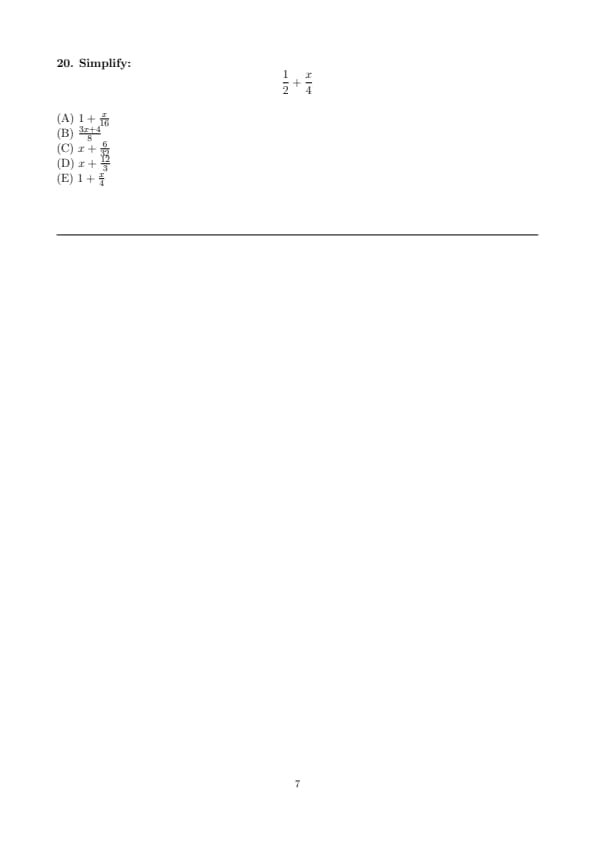
Question 20:

Simplify: \[ \frac{1}{2} + \frac{x}{4} \]
  • (A) \( 1 + \frac{x}{16} \)
  • (B) \( \frac{3x + 4}{8} \)
  • (C) \( x + \frac{6}{32} \)
  • (D) \( x + \frac{12}{3} \)
  • (E) \( 1 + \frac{x}{4} \)

GRE Questions

  • 1.
    The following appeared in a memorandum from the manager of WWAC radio station.
    “To reverse a decline in listener numbers, our owners have decided that WWAC must change from its current rock-music format. The decline has occurred despite population growth in our listening area, but that growth has resulted mainly from people moving here after their retirement. We must make listeners of these new residents. We could try playing music tailored to their tastes, but a continuing decline in local sales of recorded music suggests limited interest in music. Instead, we should change to a news and talk format, a form of radio that is increasingly popular in our area.”
    Write a response in which you discuss one or more alternative explanations that could rival the proposed explanation and explain how your explanation(s) can plausibly account for the facts presented in the argument.


      • 2.
        The following appeared in a health newsletter.
        "Nosinia is an herb that many users report to be as effective as prescription medications at fighting allergy symptoms. Researchers recently compared Nosinia to a placebo in 95 men and women with seasonal allergies to ragweed pollen. Participants in the study reported that neither Nosinia nor the placebo offered significant relief. However, for the most severe allergy symptoms, the researchers reported that Nosinia was more effective than the placebo in providing relief. Furthermore, at the end of the study, participants given Nosinia were more likely than participants given a placebo to report feeling healthier. We, therefore, recommend using Nosinia to help with your severe allergy symptoms."

          • How reliable is the study's sample size?
          • How does the severity of symptoms affect the results?
          • Was the placebo truly effective in reducing allergy symptoms?
          • Is there any independent evidence for Nosinia’s effectiveness?

        • 3.
          The best way to solve environmental problems caused by consumer-generated waste is for towns and cities to impose strict limits on the amount of trash they will accept from each household.
          Write a response in which you discuss the extent to which you agree or disagree with the claim. In developing and supporting your position, be sure to address the most compelling reasons and/or examples that could be used to challenge your position.


            • 4.
              Jean Valjean, the protagonist in Victor Hugo’s novel Les Misérables, spends the bulk of his lengthy _______ plotting a very clever set of revenge schemes, which he executes upon his escape.

                • ruination
                • peregrination
                • immolation
                • rumination

              • 5.
                Should we really care for the greatest actors of the past could we have them before us? Should we find them too different from our accent of thought, of feeling, of speech, in a thousand minute particulars which are of the essence of all three? Dr. Doran's long and interesting records of the triumphs of Garrick, and other less familiar, but in their day hardly less astonishing, players, do not relieve one of the doubt. Garrick himself, as sometimes happens with people who have been the subject of much anecdote and other conversation, here as elsewhere, bears no very distinct figure. One hardly sees the wood for the trees. On the other hand, the account of Betterton, "perhaps the greatest of English actors," is delightfully fresh. That intimate friend of Dryden, Tillatson, Pope, who executed a copy of the actor's portrait by Kneller which is still extant, was worthy of their friendship; his career brings out the best elements in stage life. The stage in these volumes presents itself indeed not merely as a mirror of life, but as an illustration of the utmost intensity of life, in the fortunes and characters of the players. Ups and downs, generosity, dark fates, the most delicate goodness, have nowhere been more prominent than in the private existence of those devoted to the public mimicry of men and women. Contact with the stage, almost throughout its history, presents itself as a kind of touchstone, to bring out the bizarrerie, the theatrical tricks and contrasts, of the actual world.


                  • 6.
                    The following appeared as a letter to the editor from the owner of a skate shop in Central Plaza.
                    "Two years ago the city council voted to prohibit skateboarding in Central Plaza. They claimed that skateboard users were responsible for litter and vandalism that were keeping other visitors from coming to the plaza. In the past two years, however, there has been only a small increase in the number of visitors to Central Plaza, and litter and vandalism are still problematic. Skateboarding is permitted in Monroe Park, however, and there is no problem with litter or vandalism there. In order to restore Central Plaza to its former glory, then, we recommend that the city lift its prohibition on skateboarding in the plaza."

                      • What is the current level of litter and vandalism in Central Plaza?
                      • How much foot traffic has increased in Monroe Park compared to Central Plaza?
                      • Has the local economy in the plaza improved since the ban on skateboarding?
                      • How successful has the Monroe Park skateboarding program been in other cities?

                    Comments


                    No Comments To Show