GRE 2025 Quantitative Reasoning Sample Paper Set 2 Question Paper with Solutions PDF

GRE 2025 Quantitative Reasoning Sample Paper Set 2 Question Paper with Solutions PDF is available for download. The overall test time is about 1 hour and 58 minutes. GRE has total 5 sections:

  • Analytical Writing  (One "Analyze an Issue" task, Alloted time 30 minutes)
  • Verbal Reasoning  (Two Sections, with 12 questions and 15 questions respectively)
  • Quantitative Reasoning (Two Sections, with 12 questions and 15 questions respectively)

GRE 2025 Quantitative Reasoning Sample Paper Set 2 Question Paper with Solutions PDF

GRE 2025 Quantitative Reasoning Set 2 Question Paper with Solutions PDF download iconDownload Check Solutions
GRE 2025 Quantitative Reasoning Sample Paper Set 2 Question Paper with Solutions PDF

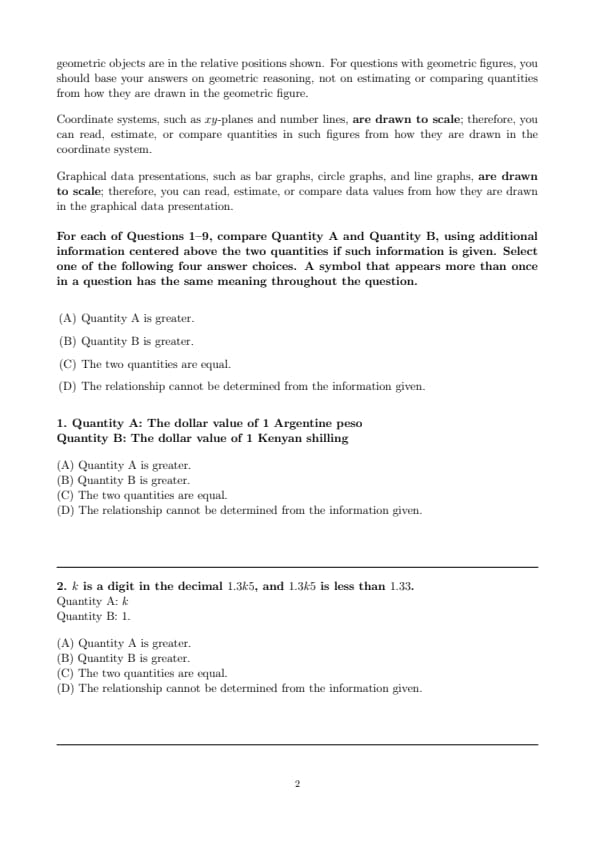
For each of Questions 1--9, compare Quantity A and Quantity B, using additional information centered above the two quantities if such information is given. Select one of the following four answer choices. A symbol that appears more than once in a question has the same meaning throughout the question.

Question 1:

Quantity A: The dollar value of 1 Argentine peso

Quantity B: The dollar value of 1 Kenyan shilling

  • (A) Quantity A is greater.
  • (B) Quantity B is greater.
  • (C) The two quantities are equal.
  • (D) The relationship cannot be determined from the information given.

Question 2:

\( k \) is a digit in the decimal \( 1.3k5 \), and \( 1.3k5 \) is less than \( 1.33 \).

Quantity A: \( k \)

Quantity B: \( 1 \).

  • (A) Quantity A is greater.
  • (B) Quantity B is greater.
  • (C) The two quantities are equal.
  • (D) The relationship cannot be determined from the information given.

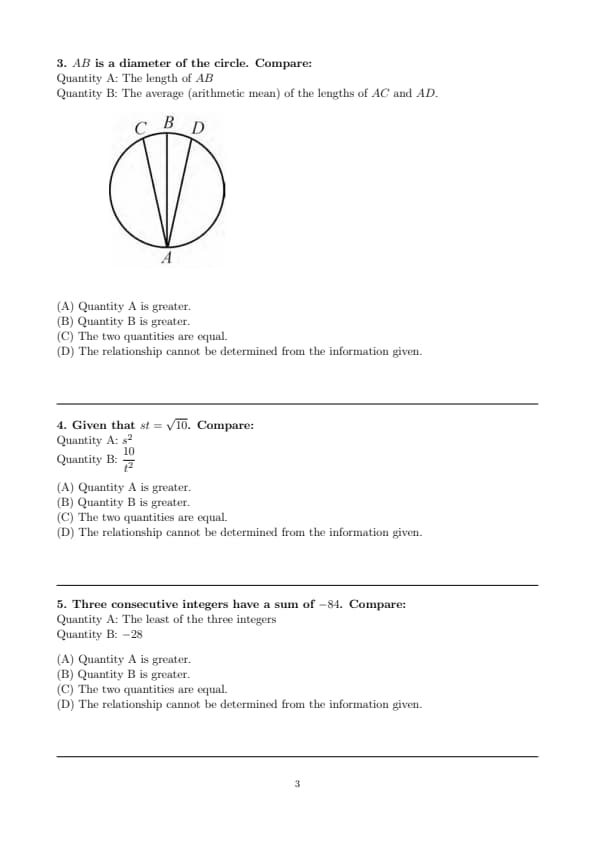
Question 3:

\( AB \) is a diameter of the circle. Compare:

Quantity A: The length of \( AB \)

Quantity B: The average (arithmetic mean) of the lengths of \( AC \) and \( AD \).


  • (A) Quantity A is greater.
  • (B) Quantity B is greater.
  • (C) The two quantities are equal.
  • (D) The relationship cannot be determined from the information given.

Question 4:

Given that \( st = \sqrt{10} \). Compare:

Quantity A: \( s^2 \)

Quantity B: \( \dfrac{10}{t^2} \)

  • (A) Quantity A is greater.
    (B) Quantity B is greater.
    (C) The two quantities are equal.
    (D) The relationship cannot be determined from the information given.

Question 5:

Three consecutive integers have a sum of \(-84\). Compare:

Quantity A: The least of the three integers

Quantity B: \(-28\)

  • (A) Quantity A is greater.
    (B) Quantity B is greater.
    (C) The two quantities are equal.
    (D) The relationship cannot be determined from the information given.

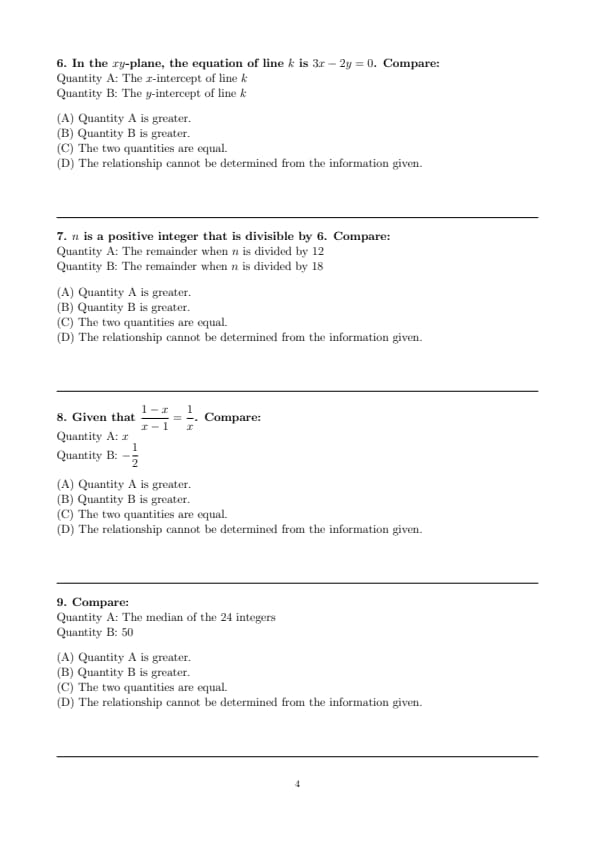
Question 6:

In the \( xy \)-plane, the equation of line \( k \) is \( 3x - 2y = 0 \). Compare:

Quantity A: The \( x \)-intercept of line \( k \)

Quantity B: The \( y \)-intercept of line \( k \)

  • (A) Quantity A is greater.
    (B) Quantity B is greater.
    (C) The two quantities are equal.
    (D) The relationship cannot be determined from the information given.

Question 7:

\( n \) is a positive integer that is divisible by 6. Compare:

Quantity A: The remainder when \( n \) is divided by 12

Quantity B: The remainder when \( n \) is divided by 18

  • (A) Quantity A is greater.
    (B) Quantity B is greater.
    (C) The two quantities are equal.
    (D) The relationship cannot be determined from the information given.

Question 8:

Given that \( \dfrac{1-x}{x-1} = \dfrac{1}{x} \). Compare:

Quantity A: \( x \)

Quantity B: \( -\dfrac{1}{2} \)

  • (A) Quantity A is greater.
    (B) Quantity B is greater.
    (C) The two quantities are equal.
    (D) The relationship cannot be determined from the information given.

Question 9:

Compare:

Quantity A: The median of the 24 integers

Quantity B: 50

  • (A) Quantity A is greater.
  • (B) Quantity B is greater.
  • (C) The two quantities are equal.
  • (D) The relationship cannot be determined from the information given.

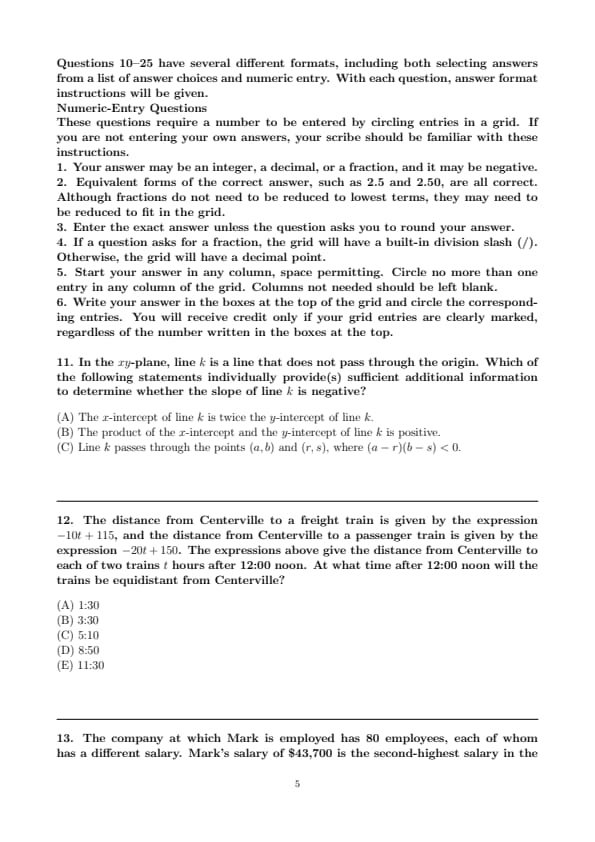
Question 10:

In the \( xy \)-plane, line \( k \) is a line that does not pass through the origin.
Which of the following statements individually provide(s) sufficient additional information to determine whether the slope of line \( k \) is negative?

  • (A) The \( x \)-intercept of line \( k \) is twice the \( y \)-intercept of line \( k \).
  • (B) The product of the \( x \)-intercept and the \( y \)-intercept of line \( k \) is positive.
  • (C) Line \( k \) passes through the points \( (a, b) \) and \( (r, s) \), where \( (a-r)(b-s) < 0 \).

Question 11:

The distance from Centerville to a freight train is given by the expression \(-10t + 115\), and the distance from Centerville to a passenger train is given by the expression \(-20t + 150\).
The expressions above give the distance from Centerville to each of two trains \( t \) hours after 12:00 noon. At what time after 12:00 noon will the trains be equidistant from Centerville?

  • (A) 1:30
  • (B) 3:30
  • (C) 5:10
  • (D) 8:50
  • (E) 11:30

Question 12:

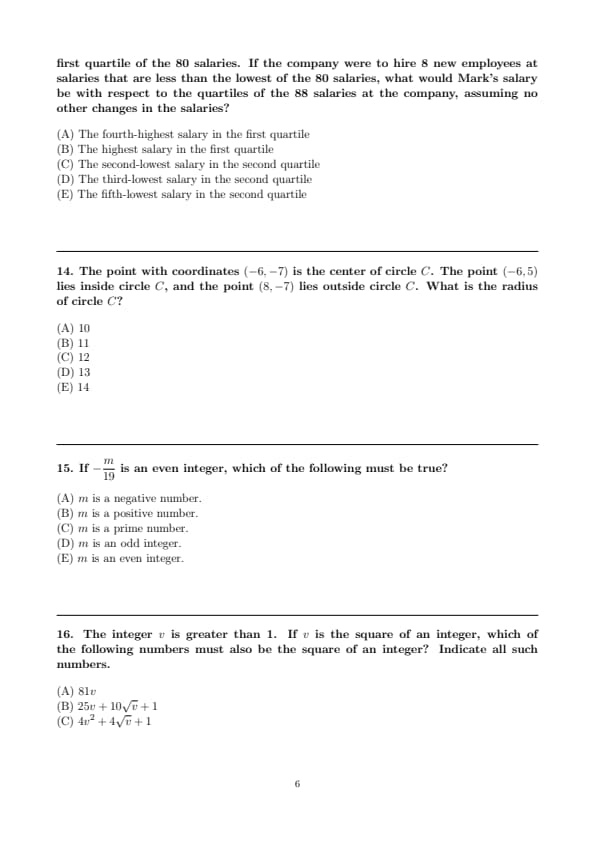
The company at which Mark is employed has 80 employees, each of whom has a different salary. Mark’s salary of
(43,700 is the second-highest salary in the first quartile of the 80 salaries.
If the company were to hire 8 new employees at salaries that are less than the lowest of the 80 salaries, what would Mark’s salary be with respect to the quartiles of the 88 salaries at the company, assuming no other changes in the salaries?

  • (A) The fourth-highest salary in the first quartile
  • (B) The highest salary in the first quartile
  • (C) The second-lowest salary in the second quartile
  • (D) The third-lowest salary in the second quartile
  • (E) The fifth-lowest salary in the second quartile

Question 13:

The point with coordinates \((-6,-7)\) is the center of circle \( C \). The point \((-6,5)\) lies inside circle \( C \), and the point \((8,-7)\) lies outside circle \( C \). What is the radius of circle \( C \)?

  • (A) 10
  • (B) 11
  • (C) 12
  • (D) 13
  • (E) 14

Question 14:

If \(-\dfrac{m}{19}\) is an even integer, which of the following must be true?

  • (A) \( m \) is a negative number.
  • (B) \( m \) is a positive number.
  • (C) \( m \) is a prime number.
  • (D) \( m \) is an odd integer.
  • (E) \( m \) is an even integer.

Question 15:

The integer \( v \) is greater than 1. If \( v \) is the square of an integer, which of the following numbers must also be the square of an integer? Indicate all such numbers.
  • (A) \( 81v \)
  • (B) \( 25v + 10\sqrt{v} + 1 \)
  • (C) \( 4v^2 + 4\sqrt{v} + 1 \)

Question 16:

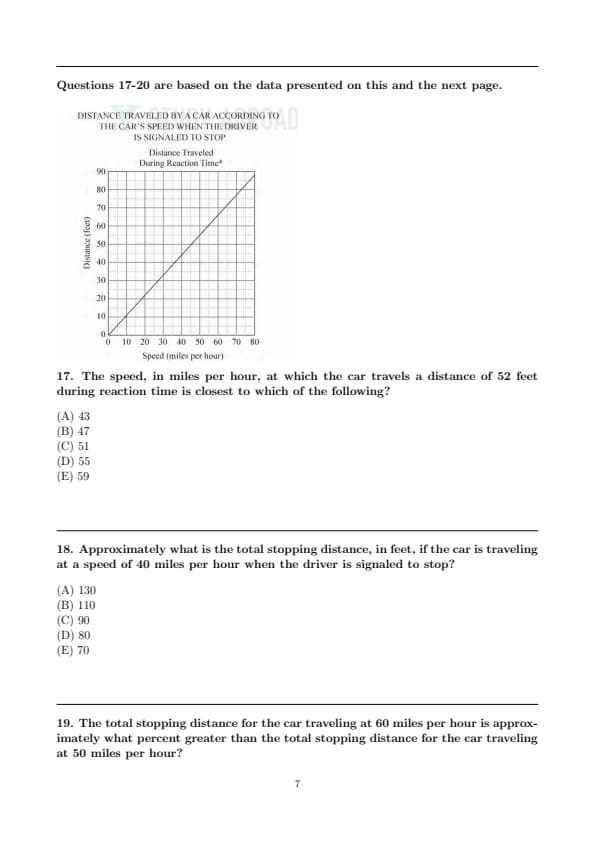
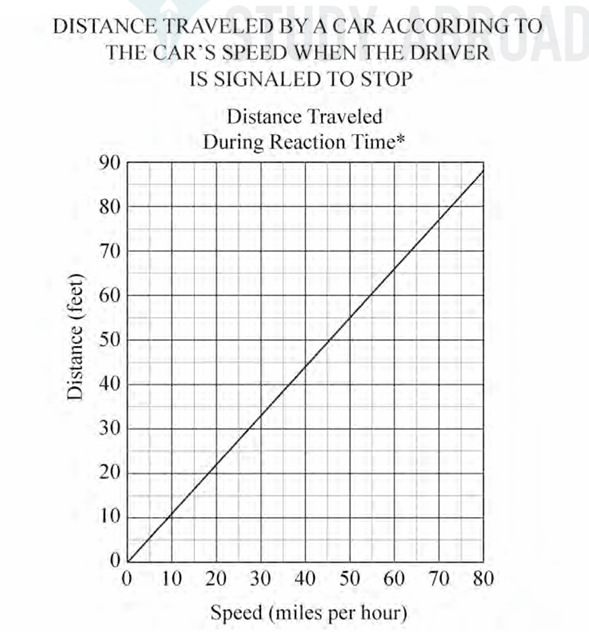
The speed, in miles per hour, at which the car travels a distance of 52 feet during reaction time is closest to which of the following?

  • (A) 43
  • (B) 47
  • (C) 51
  • (D) 55
  • (E) 59

Question 17:

Approximately what is the total stopping distance, in feet, if the car is traveling at a speed of 40 miles per hour when the driver is signaled to stop?

  • (A) 130
  • (B) 110
  • (C) 90
  • (D) 80
  • (E) 70

Question 18:

The total stopping distance for the car traveling at 60 miles per hour is approximately what percent greater than the total stopping distance for the car traveling at 50 miles per hour?

  • (A) 22%
  • (B) 30%
  • (C) 38%
  • (D) 45%
  • (E) 52%

Question 19:

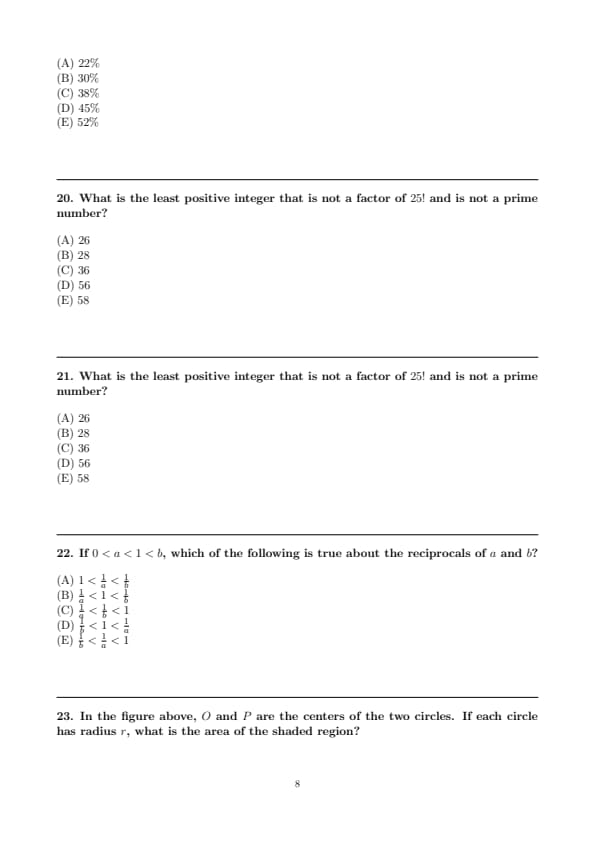
What is the least positive integer that is not a factor of \( 25! \) and is not a prime number?

  • (A) 26
  • (B) 28
  • (C) 36
  • (D) 56
  • (E) 58

Question 20:

What is the least positive integer that is not a factor of \( 25! \) and is not a prime number?

  • (A) 26
  • (B) 28
  • (C) 36
  • (D) 56
  • (E) 58

Question 21:

If \( 0 < a < 1 < b \), which of the following is true about the reciprocals of \( a \) and \( b \)?

  • (A) \( 1 < \frac{1}{a} < \frac{1}{b} \)
  • (B) \( \frac{1}{a} < 1 < \frac{1}{b} \)
  • (C) \( \frac{1}{a} < \frac{1}{b} < 1 \)
  • (D) \( \frac{1}{b} < 1 < \frac{1}{a} \)
  • (E) \( \frac{1}{b} < \frac{1}{a} < 1 \)

Question 22:

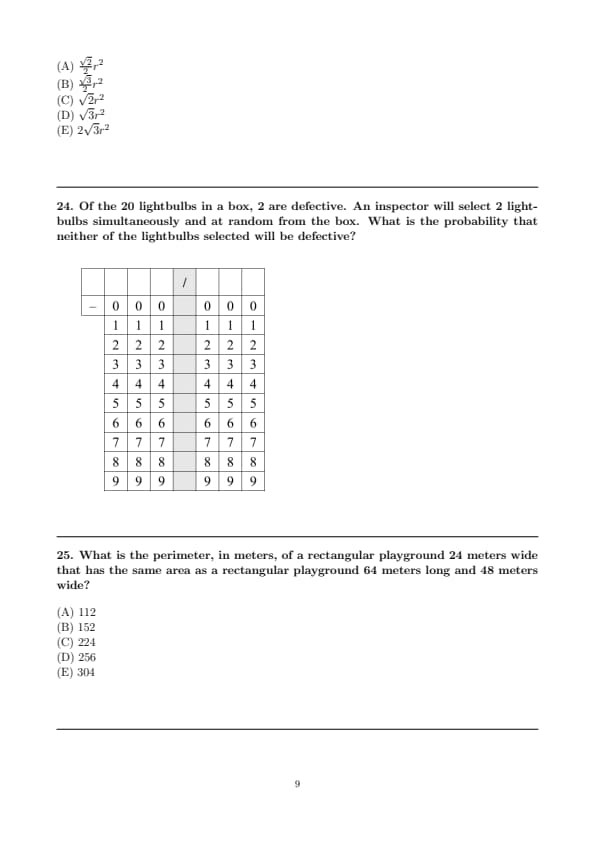
In the figure above, \( O \) and \( P \) are the centers of the two circles. If each circle has radius \( r \), what is the area of the shaded region?

  • (A) \( \frac{\sqrt{2}}{2} r^2 \)
  • (B) \( \frac{\sqrt{3}}{2} r^2 \)
  • (C) \( \sqrt{2} r^2 \)
  • (D) \( \sqrt{3} r^2 \)
  • (E) \( 2\sqrt{3} r^2 \)

Question 23:

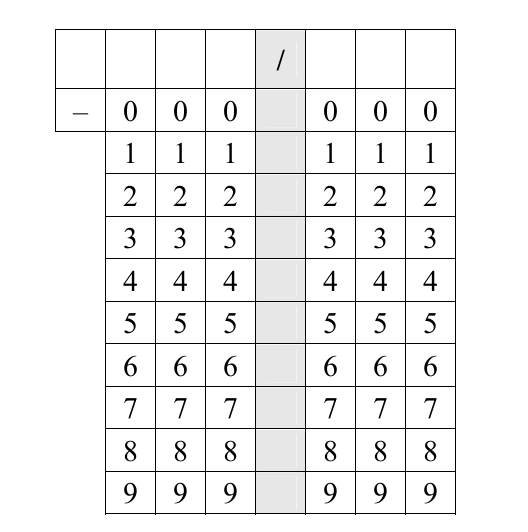
Of the 20 lightbulbs in a box, 2 are defective. An inspector will select 2 lightbulbs simultaneously and at random from the box. What is the probability that neither of the lightbulbs selected will be defective?


Question 24:

What is the perimeter, in meters, of a rectangular playground 24 meters wide that has the same area as a rectangular playground 64 meters long and 48 meters wide?
  • (A) 112
  • (B) 152
  • (C) 224
  • (D) 256
  • (E) 304

GRE Questions

  • 1.
    Claim: Though often considered an objective pursuit, learning about the historical past requires creativity.
    Reason: Because we can never know the past directly, we must reconstruct it by imaginatively interpreting historical accounts, documents, and artifacts.
    Write a response in which you discuss the extent to which you agree or disagree with the claim and the reason on which the claim is based.


      • 2.
        The best way to solve environmental problems caused by consumer-generated waste is for towns and cities to impose strict limits on the amount of trash they will accept from each household.
        Write a response in which you discuss the extent to which you agree or disagree with the claim. In developing and supporting your position, be sure to address the most compelling reasons and/or examples that could be used to challenge your position.


          • 3.
            Three years ago, because of flooding at the Western Palean Wildlife Preserve, 100 lions and 100 western gazelles were moved to the East Palean Preserve, an area that is home to most of the same species that are found in the western preserve, though in larger numbers, and to the eastern gazelle, a close relative of the western gazelle.
            Write a response in which you discuss one or more alternative explanations that could rival the proposed explanation and explain how your explanation(s) can plausibly account for the facts presented in the argument.


              • 4.
                Melvin’s little sister was so ________ that she would believe anything he told her, and his burgeoning sense of maturity rendered him increasingly loath to gull her.

                  • dogged
                  • tenable
                  • fractious
                  • frivolous
                  • credulous

                • 5.
                  It has been suggested that long-term prisoners, on release from jail, be given a reasonable state pension to reduce the likelihood of their resorting to crime. Most people instinctively reject the suggestion as they feel it would be like rewarding criminal activity. The supporters of the prisoners' pension scheme have criticized those who reject this possibility, by claiming that for the critics...
                  Which of the following is the most logical completion of the sentence above?

                    • emotion is more important than justice
                    • punishment for criminals is more important than crime prevention
                    • crime prevention is not an important issue
                    • money has too high a value
                    • the law should not be concerned with what happens after jail

                  • 6.
                    Should we really care for the greatest actors of the past could we have them before us? Should we find them too different from our accent of thought, of feeling, of speech, in a thousand minute particulars which are of the essence of all three? Dr. Doran's long and interesting records of the triumphs of Garrick, and other less familiar, but in their day hardly less astonishing, players, do not relieve one of the doubt. Garrick himself, as sometimes happens with people who have been the subject of much anecdote and other conversation, here as elsewhere, bears no very distinct figure. One hardly sees the wood for the trees. On the other hand, the account of Betterton, "perhaps the greatest of English actors," is delightfully fresh. That intimate friend of Dryden, Tillatson, Pope, who executed a copy of the actor's portrait by Kneller which is still extant, was worthy of their friendship; his career brings out the best elements in stage life. The stage in these volumes presents itself indeed not merely as a mirror of life, but as an illustration of the utmost intensity of life, in the fortunes and characters of the players. Ups and downs, generosity, dark fates, the most delicate goodness, have nowhere been more prominent than in the private existence of those devoted to the public mimicry of men and women. Contact with the stage, almost throughout its history, presents itself as a kind of touchstone, to bring out the bizarrerie, the theatrical tricks and contrasts, of the actual world.

                      Comments


                      No Comments To Show