




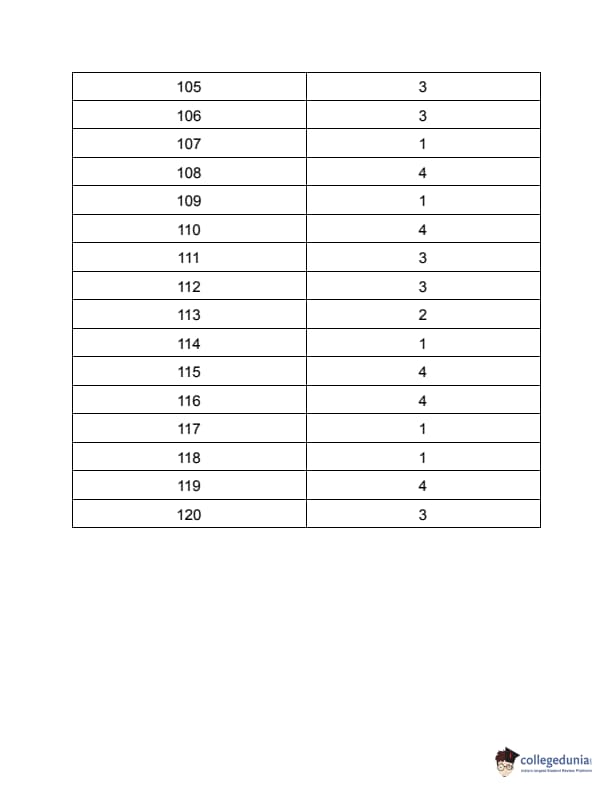
TS PGECET 2023 Biomedical Engineering Question Paper with Answer key PDF is available here for download. TS PGECET 2023 was conducted by JNTU Hyderabad on behalf of TSCHE on May 31, 2023. TS PGECET 2023 BM Question Paper consisted of 120 questions carrying 1 mark for each.
TS PGECET 2023 Biomedical Engineering Question Paper
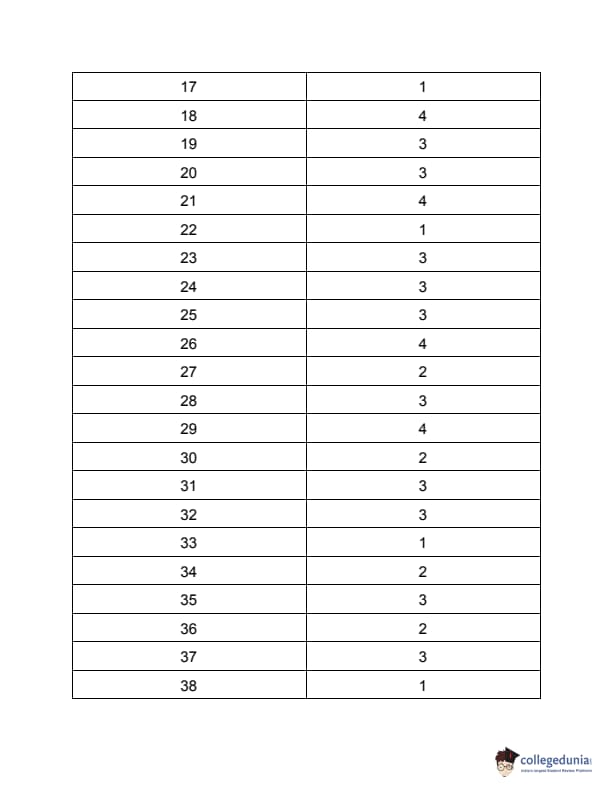
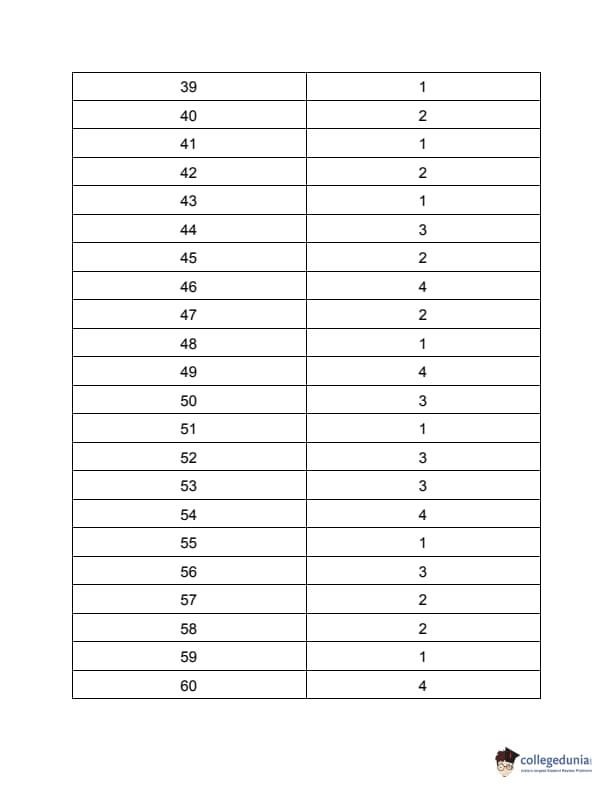
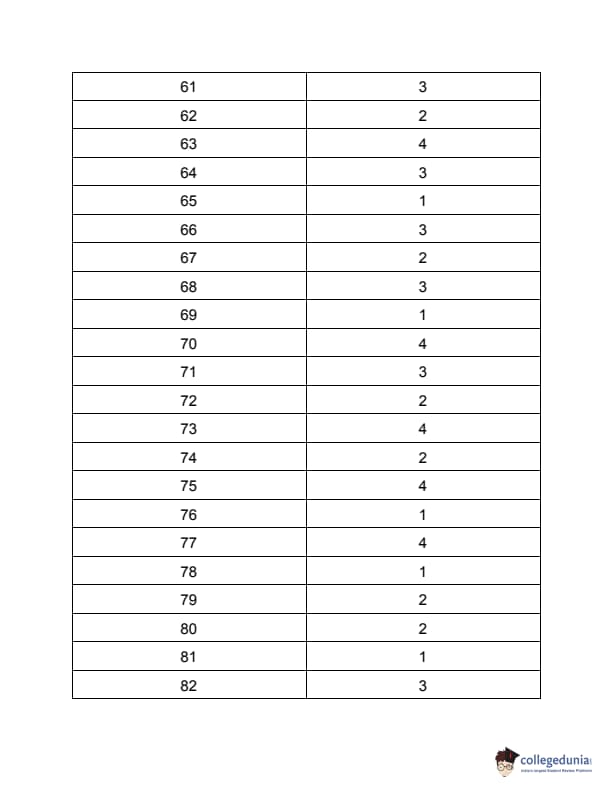
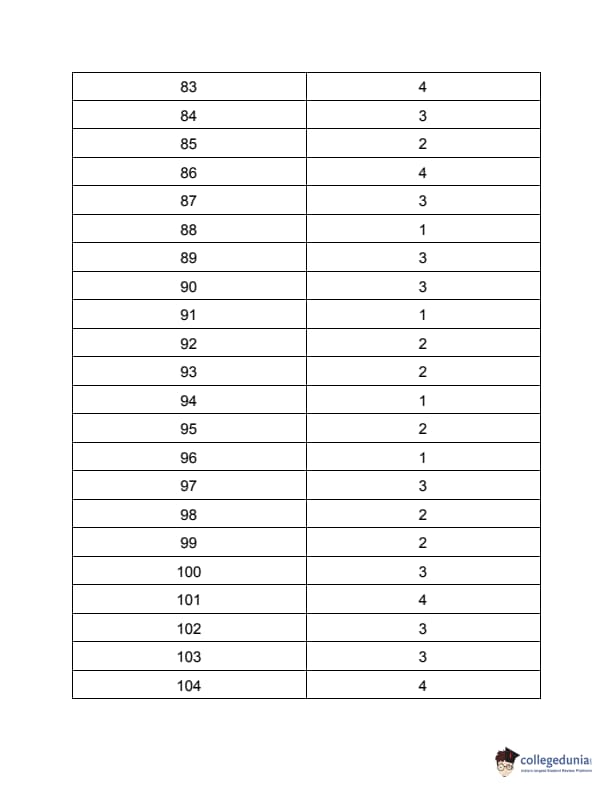
| TS PGECET 2023 BM Question Paper with Answer Key | Download PDF | Check Solution |

Question 1:
An eigenvector of the matrix \( A = \begin{bmatrix} 1 & 2
0 & 2 \end{bmatrix} \) is in the form \( \begin{bmatrix} 1
k_1 \end{bmatrix} \) where \( k_1 \neq 0 \). Then \( k_1 = \) ?
View Solution
Let the eigenvector be \( v = \begin{bmatrix} 1
k_1 \end{bmatrix} \), and suppose it's associated with eigenvalue \( \lambda \). Then by definition:
\[ Av = \lambda v \Rightarrow \begin{bmatrix} 1 & 2
0 & 2 \end{bmatrix} \begin{bmatrix} 1
k_1 \end{bmatrix} = \lambda \begin{bmatrix} 1
k_1 \end{bmatrix} \]
Compute LHS:
\[ \begin{bmatrix} 1 + 2k_1
2k_1 \end{bmatrix} = \lambda \begin{bmatrix} 1
k_1 \end{bmatrix} \]
Now compare both sides:
- \( 1 + 2k_1 = \lambda \)
- \( 2k_1 = \lambda k_1 \)
From the second equation:
\[ 2k_1 = \lambda k_1 \Rightarrow \lambda = 2 (since k_1 \neq 0) \]
Substitute \( \lambda = 2 \) into the first equation:
\[ 1 + 2k_1 = 2 \Rightarrow 2k_1 = 1 \Rightarrow k_1 = \frac{1}{2} \]
% Quicktip Quick Tip: To find \( k \), apply the definition \( Av = \lambda v \), match components, and solve system of equations.
If \( 1, 2, 3 \) are the eigenvalues of a square matrix \( A \), then the eigenvalues of \[ 3A^3 - 6A + 2I \]
are:
View Solution
If \( \lambda \) is an eigenvalue of matrix \( A \), then for any polynomial \( f(A) \), the corresponding eigenvalue becomes \( f(\lambda) \).
Let \( f(\lambda) = 3\lambda^3 - 6\lambda + 2 \)
Evaluate for:
- \( \lambda = 1 \Rightarrow f(1) = 3(1)^3 - 6(1) + 2 = -1 \)
- \( \lambda = 2 \Rightarrow f(2) = 3(8) - 6(2) + 2 = 24 - 12 + 2 = 14 \)
- \( \lambda = 3 \Rightarrow f(3) = 3(27) - 6(3) + 2 = 81 - 18 + 2 = 65 \)
% Quicktip Quick Tip: Apply polynomials directly to eigenvalues to get new eigenvalues for expressions like \( f(A) \).
Evaluate the double integral: \[ \int_0^a \int_0^{\sqrt{a^2 - x^2}} \sqrt{a^2 - x^2 - y^2} \, dx \, dy \]
View Solution
The integral represents the volume of the **quarter of a hemisphere** (1/4th of upper half of sphere).
Using polar coordinates:
Let: \[ x = r\cos\theta, y = r\sin\theta, dxdy = r dr d\theta \]
The limits become:
- \( r \in [0, a] \)
- \( \theta \in [0, \dfrac{\pi}{2}] \)
Integral becomes: \[ \int_0^{\pi/2} \int_0^a \sqrt{a^2 - r^2} \cdot r \, dr \, d\theta \]
Use substitution and standard integral formula: \[ \Rightarrow \frac{\pi}{2} \cdot \frac{a^3}{3} \cdot \frac{1}{2} = \frac{\pi a^3}{6} \]
% Quicktip Quick Tip: Use polar coordinates when dealing with circular regions in integrals.
Evaluate the line integral: \[ \oint_C (x^2 + xy) dx + (x^2 + y^2) dy, \]
where \( C \) is the square bounded by \( x = \pm1 \), \( y = \pm1 \).
View Solution
Use **Green’s theorem**: \[ \oint_C P dx + Q dy = \iint_R \left( \frac{\partial Q}{\partial x} - \frac{\partial P}{\partial y} \right) dxdy \]
Let:
- \( P = x^2 + xy \Rightarrow \frac{\partial P}{\partial y} = x \)
- \( Q = x^2 + y^2 \Rightarrow \frac{\partial Q}{\partial x} = 2x \)
Then: \[ \frac{\partial Q}{\partial x} - \frac{\partial P}{\partial y} = 2x - x = x \]
Now integrate over square \( x \in [-1,1], y \in [-1,1] \):
\[ \iint_R x \, dx dy = \int_{-1}^{1} \int_{-1}^{1} x \, dx dy = \int_{-1}^{1} \left[ \frac{x^2}{2} \right]_{-1}^{1} dy = 0 \]
% Quicktip Quick Tip: Use Green's theorem to convert line integrals to double integrals for simpler evaluation.
The residue of the function \[ f(z) = \frac{z}{(z - 1)(z - 2)^2} \]
at the point that lies inside the circle \( |z - 2| = \frac{1}{2} \) is:
View Solution
Given: \( |z - 2| = \frac{1}{2} \Rightarrow \) includes only the point \( z = 2 \)
This is a **pole of order 2**, so use: \[ Res_{z=2} f(z) = \lim_{z \to 2} \frac{d}{dz} \left[ (z - 2)^2 f(z) \right] = \lim_{z \to 2} \frac{d}{dz} \left( \frac{z}{z - 1} \right) = \frac{(z - 1)(1) - z(1)}{(z - 1)^2} = \frac{z - 1 - z}{(z - 1)^2} = \frac{-1}{(z - 1)^2} \]
Now put \( z = 2 \): \[ \Rightarrow \frac{-1}{(2 - 1)^2} = -1 \]
% Quicktip Quick Tip: For poles of order 2, use the derivative form of the residue formula.
Let \( K \) be the standard error of a sample of size \( n \) taken from an infinite population. If the sample size is increased to \( 9n \), then the standard error of this new sample is:
View Solution
The standard error (SE) is inversely proportional to the square root of the sample size: \[ SE \propto \dfrac{1}{\sqrt{n}} \]
If the original SE is \( K = \dfrac{\sigma}{\sqrt{n}} \), then for new size \( 9n \): \[ SE_{new} = \dfrac{\sigma}{\sqrt{9n}} = \dfrac{1}{3} \cdot \dfrac{\sigma}{\sqrt{n}} = \dfrac{K}{3} \]
% Quicktip Quick Tip: SE decreases as sample size increases: \( SE \propto \dfrac{1}{\sqrt{n}} \)
The coefficient of correlation between two variables \( X \) and \( Y \) is \( r = 0.48 \). Given:
Covariance = 48,
Variance of \( Y = 64 \),
Then the standard deviation of \( X \) is:
View Solution
The formula for correlation is: \[ r = \frac{Cov(X,Y)}{\sigma_X \cdot \sigma_Y} \]
We are given:
- \( r = 0.48 \)
- Cov(X, Y) = 48
- \( \sigma_Y = \sqrt{64} = 8 \)
Substitute: \[ 0.48 = \frac{48}{\sigma_X \cdot 8} \Rightarrow \sigma_X = \frac{48}{0.48 \cdot 8} = \frac{48}{3.84} = 12.5 \]
% Quicktip Quick Tip: Use \( r = \dfrac{Cov(X,Y)}{\sigma_X \sigma_Y} \) to find standard deviation when other values are known.
Evaluate the particular integral of \[ (D^3 - 3D^2 + 3D - 1)y = x^2 e^x \]
where \( D = \dfrac{d}{dx} \)
View Solution
We can write: \[ (D - 1)^3 y = x^2 e^x \]
Let \( f(D) = (D - 1)^3 \), and RHS is \( x^2 e^x \)
Use shift rule: \[ PI = e^x \cdot \dfrac{1}{(D)^3} x^2 = e^x \cdot \dfrac{x^5}{60} \]
% Quicktip Quick Tip: When RHS is of the form \( x^n e^{ax} \), use shift operator: \( f(D)e^{ax} = e^{ax}f(D+a) \)
Solve the PDE: \[ \frac{\partial u}{\partial x} = 2 \frac{\partial u}{\partial t} + u, with u(x, 0) = 6e^{-3x} \]
View Solution
Assume solution of the form \( u(x,t) = e^{ax + bt} \)
Substitute in PDE: \[ \frac{\partial u}{\partial x} = ae^{ax + bt}, \frac{\partial u}{\partial t} = be^{ax + bt} \]
Given: \[ ae^{ax+bt} = 2b e^{ax+bt} + e^{ax+bt} \Rightarrow a = 2b + 1 \]
From initial condition: \( u(x, 0) = 6e^{-3x} \Rightarrow u(x,t) = 6e^{-3x + t} \)
% Quicktip Quick Tip: Try exponential trial solution for linear PDEs with constant coefficients.
The iterative formula to find the reciprocal of a given number \( N \) using Newton’s method is:
View Solution
To find \( \dfrac{1}{N} \), define \( f(x) = \dfrac{1}{x} - N \).
Then using Newton-Raphson:
\[ x_{i+1} = x_i - \frac{f(x_i)}{f'(x_i)} = x_i - \frac{\frac{1}{x_i} - N}{-\frac{1}{x_i^2}} = x_i (2 - N x_i) \]
% Quicktip Quick Tip: Newton's method for reciprocals yields: \( x_{i+1} = x_i (2 - N x_i) \)
The nature of the voltage source to be connected to a series inductor to maintain a constant direct current is:
View Solution
For an inductor \( L \), the voltage across it is: \[ V = L \frac{di}{dt} \]
To establish a constant current instantaneously (\( \frac{di}{dt} = \infty \)), the voltage must be an **impulse** function. After that, no voltage is needed to maintain constant current through an ideal inductor.
% Quicktip Quick Tip: An impulse voltage is needed to change current in an inductor instantaneously.
A practical current source is represented as:
View Solution
A practical current source is modeled as an **ideal current source** in **parallel** with a resistor. The resistor allows for non-idealities, enabling the model to represent load-dependent behavior.
% Quicktip Quick Tip: A real current source includes a parallel resistance to reflect practical limitations.
If a capacitor is charged by a symmetrical square wave current source, then the steady-state voltage across the capacitor will be a:
View Solution
The voltage across a capacitor is: \[ V(t) = \frac{1}{C} \int i(t) dt \]
If \( i(t) \) is a square wave (alternating constant current segments), its integral is a triangular waveform. Thus, the capacitor voltage will be a triangular wave.
% Quicktip Quick Tip: Voltage across a capacitor is the integral of current. Square wave current yields triangular voltage.
Two light bulbs of 40W and 60W rating are connected in series across the mains. Then:
View Solution
In series, the same current flows through both bulbs. The power rating indicates which one has **higher resistance**: \[ P = \frac{V^2}{R} \Rightarrow R = \frac{V^2}{P} \]
Thus, 40W bulb has **higher resistance**. Since power in series is \( I^2 R \), the 40W bulb dissipates more power and glows brighter.
% Quicktip Quick Tip: In series connection, bulb with higher resistance (lower wattage) glows brighter.
The resistances between terminals A-B, B-C, and A-C of a star network are 6Ω, 11Ω, and 9Ω respectively. Find the individual star resistances \( R_A, R_B, R_C \):
View Solution
In a star network: \[ R_{AB} = R_A + R_B = 6
R_{BC} = R_B + R_C = 11
R_{AC} = R_A + R_C = 9 \]
Solving:
1. \( R_A + R_B = 6 \)
2. \( R_B + R_C = 11 \)
3. \( R_A + R_C = 9 \)
From (1) and (3):
Subtract → \( (R_A + R_C) - (R_A + R_B) = 9 - 6 \Rightarrow R_C - R_B = 3 \)
From (2): \( R_C = 11 - R_B \)
Substitute: \( 11 - R_B - R_B = 3 \Rightarrow 2R_B = 8 \Rightarrow R_B = 4 \)
Then \( R_A = 2, R_C = 7 \)
% Quicktip Quick Tip: Use system of linear equations from star resistances to solve such problems.
A network contains only independent current sources and resistors. If all resistor values are doubled, the node voltages:
View Solution
Node voltages in current source-resistor circuits are governed by Ohm’s law: \[ V = IR \]
If current \( I \) remains constant and resistance \( R \) is doubled, then voltage \( V \) also doubles.
% Quicktip Quick Tip: In current-driven resistive networks, doubling resistance doubles node voltages.
The RMS value of a half-wave rectified symmetrical square wave current of 2A is:
View Solution
For a half-wave rectified **symmetrical square wave**, RMS value is same as **DC equivalent value** over the positive half, since square wave retains its magnitude: \[ I_{rms} = I_0 \cdot \sqrt{\frac{1}{2}} = 2 \cdot \frac{1}{\sqrt{2}} = \sqrt{2} \, A \]
% Quicktip Quick Tip: RMS value of half-wave rectified square wave = Peak value × \( \frac{1}{\sqrt{2}} \)
At a junction, \( i_1 = -6\sin(\omega t) \) mA, \( i_2 = 8\cos(\omega t) \) mA, and all currents enter the node. Find \( i_3 \).
View Solution
Convert \( -6 \sin(\omega t) \) to cosine: \[ -6 \sin(\omega t) = -6 \cos(\omega t - 90^\circ) \]
Using phasors: \[ i_1 = -6 \angle -90^\circ, i_2 = 8 \angle 0^\circ \]
Add phasors: \[ i_3 = - (i_1 + i_2) = - \left(8 + j6 \right) = -10 \angle +36.87^\circ \Rightarrow i_3 = -10 \cos(\omega t + 36.87^\circ) \]
% Quicktip Quick Tip: Use phasor algebra for sinusoidal currents in junction analysis.
In a series RLC circuit at resonance, the voltage across the capacitor:
View Solution
At resonance in an RLC circuit:
- Total impedance is minimum (purely resistive)
- Current is maximum
- Voltage across capacitor (or inductor) can exceed supply
Also, capacitor voltage leads current by \( 90^\circ \), hence it is out of phase with the source voltage.
% Quicktip Quick Tip: At resonance, voltage across L or C can exceed supply voltage and is 90° out of phase.
In a series RLC circuit, Q-factor is given by:
View Solution
In RLC circuits, quality factor: \[ Q = \frac{f_0}{f_2 - f_1} \]
where:
- \( f_0 \) is resonance frequency
- \( f_1, f_2 \) are half-power frequencies
% Quicktip Quick Tip: Q-factor is the ratio of resonant frequency to bandwidth in an RLC circuit.
The optimal Wiener filter can be designed if the signal is statistically ____________ and noise is a stationary random process that is statistically _________________ the signal.
View Solution
The Wiener filter is based on minimizing the mean square error between the desired and estimated signals. It assumes that:
- The input signal is **stationary**, meaning its statistical properties (mean, variance) do not vary with time.
- The noise is **independent** of the signal, i.e., they are uncorrelated.
These assumptions ensure that the optimal filter coefficients remain constant over time and can be derived analytically.
% Quicktip Quick Tip: For optimal Wiener filter design, the signal must be stationary and the noise must be statistically independent of the signal.
Real-time processing speeds can be achieved for QRS detection by using digital filters with only ___________ coefficients.
View Solution
Integer coefficient digital filters reduce the complexity of arithmetic operations required in real-time processing. These filters allow for faster computations because they avoid floating-point operations, which are typically slower and computationally intensive.
Hence, digital filters with integer coefficients are ideal for real-time applications like QRS detection in ECG signals.
% Quicktip Quick Tip: Integer coefficient filters improve speed and are suitable for real-time ECG signal processing.
_________________ can be employed to detect the spike-and-wave complex in the EEG signal.
View Solution
Template matching is a technique used in signal processing for identifying specific patterns or waveforms, such as the spike-and-wave complex in EEG data. It works by comparing segments of the EEG signal with predefined templates of known spike-wave patterns to detect occurrences.
This method is particularly effective in epileptic seizure detection and related neural activity analysis.
% Quicktip Quick Tip: Template matching is ideal for identifying known waveform patterns in biomedical signals like EEG.
The sleep pattern of a subject is analyzed through _________________.
View Solution
The Markov model is widely used in sleep studies to analyze sleep patterns. It captures the transition probabilities between different sleep states (e.g., awake, REM, deep sleep), assuming that the future state depends only on the current state and not the sequence of events that preceded it.
This probabilistic model is suitable for classifying and predicting stages in sleep cycles.
% Quicktip Quick Tip: Sleep patterns can be effectively analyzed using a Markov model based on transition probabilities between stages.
Temporal MA filtering is suitable only when _________________________.
View Solution
Moving Average (MA) filtering works effectively when the underlying signal is of low frequency and shows minimal statistical variation over the chosen window. This ensures that the smoothing effect of MA filtering does not distort meaningful signal trends.
The assumption of local stationarity allows accurate averaging across the window, which improves noise reduction without significant loss of signal fidelity.
% Quicktip Quick Tip: Temporal MA filtering is best suited for low-frequency signals with local stationarity over the filtering window.
%Question text
While employing Pan-Tompkins algorithm for QRS detection, the sequence of tasks are __________.
View Solution
The Pan-Tompkins algorithm is a reliable method for detecting the QRS complex in ECG signals. It operates through a defined series of steps to enhance and extract the QRS features effectively:
Bandpass filtering – eliminates baseline wander and high-frequency noise by combining low-pass and high-pass filters.
Differentiation – emphasizes the slope information of the QRS complex.
Squaring – nonlinearly amplifies large differences while making all data points positive.
Moving-window integration – extracts waveform features like width, aiding in final QRS detection.
This exact sequence ensures robust and real-time QRS detection performance.
% Quicktip Quick Tip: Remember: Pan-Tompkins QRS detection follows the sequence — Bandpass filter \(\rightarrow\) Differentiate \(\rightarrow\) Square \(\rightarrow\) Moving window integration.
_____ cannot be the Fourier series expansion of a periodic signal.
View Solution
In a Fourier series representation, the signal must be a sum of harmonics of a fundamental frequency. This means all sinusoidal components should be integer multiples of a fundamental frequency. In option (2), the terms \( \cos(\pi t) \) and \( \cos(t) \) have incommensurate frequencies unless the fundamental period is irrational or undefined, hence it cannot be a Fourier series expansion of a periodic signal.
% Quicktip Quick Tip: In a valid Fourier series of a periodic function, all terms must be harmonics of a single fundamental frequency.
If \( x(t) \) is the input and \( 4x(t-2) \) is the output of a linear time-invariant system, its transfer function is ______.
View Solution
For a Linear Time-Invariant (LTI) system, a time delay of \( T \) in the time domain corresponds to multiplication by \( e^{-j2\pi f T} \) in the frequency domain. Given the delay is 2 seconds and the amplitude scaling is 4, the transfer function becomes:
\[ H(f) = 4 \cdot e^{-j2\pi f \cdot 2} = 4e^{-j4\pi f} \]
% Quicktip Quick Tip: Time delay in an LTI system corresponds to an exponential factor in the frequency domain: \( e^{-j2\pi f T} \).
The z-transform of a system is \( H(z) = \frac{z}{z + 0.2} \). If the ROC is \( |z| < 0.2 \), then the impulse response of the system is \ldots
View Solution
We are given: \[ H(z) = \frac{z}{z + 0.2} = \frac{1}{1 + 0.2 z^{-1}} \]
This matches the standard z-transform: \[ \frac{1}{1 - a z^{-1}} \Rightarrow a^n u[n] for |z| > |a|
\frac{1}{1 - a z^{-1}} \Rightarrow -a^n u[-n-1] for |z| < |a| \]
Here, \( a = -0.2 \), and ROC is \( |z| < 0.2 \), hence: \[ h[n] = -(-0.2)^n u[-n-1] = -(0.2)^n u[-n-1] \]
%Quicktip Quick Tip: Check the Region of Convergence (ROC) carefully in z-transforms. ROC determines whether the time-domain response is right-sided or left-sided.
The impulse response of a linear time-invariant system is \[ h[n] = u[n+3] + u[n-2] - 2u[n-7] \]
where \( u[n] \) is the unit step sequence. The given system is \ldots
View Solution
The impulse response is: \[ h[n] = u[n+3] + u[n-2] - 2u[n-7] \]
- \( u[n+3] \) is a left-sided sequence (non-causal) since it is nonzero for \( n \geq -3 \).
- \( u[n-2] \) and \( u[n-7] \) are right-sided sequences (causal).
Because \( h[n] \) contains terms with support for \( n < 0 \), the system is **not causal**.
For stability, the impulse response must be absolutely summable: \[ \sum_{n=-\infty}^{\infty} |h[n]| < \infty \]
Since \( h[n] \) is composed of finite step sequences with finite magnitudes, it is absolutely summable and hence **stable**.
Thus, the system is **stable but not causal**.
%Quicktip Quick Tip: A system is causal if the impulse response is zero for all \( n < 0 \). Stability requires the impulse response to be absolutely summable.
The function \( f(t), -\infty < t < \infty \), for which a Fourier series cannot be defined is _________.
View Solution
A Fourier series can only be defined for periodic functions.
- Option 1: \( 3 \sin (25 t) \) is periodic with period \( \frac{2\pi}{25} \).
- Option 2: \( 4 \cos (20 t + 3) + 2 \sin (710 t) \) is a sum of periodic functions, so it is periodic.
- Option 3: \( \exp(-|t|) \sin (25 t) \) is not periodic because \( \exp(-|t|) \) decays to zero as \( |t| \to \infty \), so the function is non-periodic.
- Option 4: \( 1 \) is a constant function and can be considered periodic.
Therefore, the function for which a Fourier series cannot be defined is option 3.
%Quicktip Quick Tip: Fourier series represent periodic functions. Non-periodic functions do not have a Fourier series representation.
For the discrete time sequence \([1, 0, 2, 3]\), the 4-point DFT is _______.
View Solution
The 4-point DFT \(X[k]\) of the sequence \(x[n] = [1, 0, 2, 3]\) is given by \[ X[k] = \sum_{n=0}^{3} x[n] e^{-j \frac{2 \pi}{4} k n}, k=0,1,2,3. \]
Calculate each term: \[ X[0] = 1 + 0 + 2 + 3 = 6, \] \[ X[1] = 1 + 0 \cdot e^{-j \pi/2} + 2 e^{-j \pi} + 3 e^{-j 3\pi/2} = 1 - 2 - 3j = -1 + 3j, \] \[ X[2] = 1 + 0 + 2 e^{-j \pi \cdot 2} + 3 e^{-j 3\pi} = 1 + 2 + 0 = 0, \] \[ X[3] = 1 + 0 + 2 e^{-j 3\pi} + 3 e^{-j 9\pi/2} = 1 - 2 + 3j = -1 - 3j. \]
Therefore, the 4-point DFT is \([6, -1 + 3j, 0, -1 - 3j]\).
%Quicktip Quick Tip: The DFT transforms a discrete sequence into its frequency components. Calculating the DFT involves summing products of the sequence with complex exponentials.
When two discrete time systems with impulse responses \(\delta[n-1]\) and \(\delta[n-2]\) are connected in cascade, the overall impulse response is _______.
View Solution
When two systems with impulse responses \(h_1[n]\) and \(h_2[n]\) are connected in cascade, the overall impulse response \(h[n]\) is the convolution: \[ h[n] = h_1[n] * h_2[n]. \]
Given: \[ h_1[n] = \delta[n-1], h_2[n] = \delta[n-2]. \]
The convolution of two delta functions is: \[ \delta[n-1] * \delta[n-2] = \delta[n - (1+2)] = \delta[n-3]. \]
Thus, the overall impulse response is \(\delta[n-3]\).
%Quicktip Quick Tip: The convolution of two shifted delta functions results in a delta function shifted by the sum of the individual shifts.
The operations to be performed to realize linear phase IIR filter are as follows:
View Solution
To realize a linear phase IIR filter, the following sequence of operations is required:
- (iii) Time reversal of the input signal \( x(n) \) to get \( x(-n) \).
- (i) Passing \( x(-n) \) through the digital filter \( H(z) \).
- (ii) Time reversing the output of \( H(z) \).
- (iv) Passing the result through \( H(z) \).
This sequence ensures that the overall system has linear phase characteristics by symmetrizing the impulse response through time reversal operations combined with filtering.
%Quicktip Quick Tip: Linear phase IIR filters are realized by combining time reversal and filtering operations in the correct order to achieve phase linearity.
FIR filters are _________ and _________.
View Solution
Finite Impulse Response (FIR) filters are non-recursive filters, meaning they do not use feedback in their structure. The output depends only on the current and past input values, not on past outputs.
%Quicktip Quick Tip: FIR filters have finite duration impulse responses and are always stable and non-recursive since they do not use feedback.
Arrange common base (CB), common emitter (CE) and common collector (CC) in the decreasing order of their input resistance.
View Solution
The input resistance for transistor configurations is typically: \[ R_{in}^{CC} > R_{in}^{CE} > R_{in}^{CB}. \]
Thus, the decreasing order is CC, CE, CB.
%Quicktip Quick Tip: Common collector configuration has the highest input resistance, common emitter moderate, and common base the lowest.
Negative feedback in an amplifier ________.
View Solution
Negative feedback reduces the overall gain of an amplifier but improves stability, bandwidth, and linearity while reducing distortion and noise.
%Quicktip Quick Tip: Negative feedback decreases gain but enhances performance parameters like bandwidth and linearity.
%Question text
In FET, as \( V_{GS} \) is changed from zero to increasing reverse bias, the value of \( g_m \) is ________.
View Solution
In a Field-Effect Transistor (FET), the transconductance (\( g_m \)) decreases as the gate-source voltage (\( V_{GS} \)) is changed from zero to increasing reverse bias. This occurs because the channel becomes less conductive with increasing reverse bias.
%Quicktip Quick Tip: The transconductance \( g_m \) in FETs is directly proportional to the channel conductivity, which reduces with reverse bias.
Mobility of an electron in a conductor is expressed in terms of......
View Solution
Electron mobility is defined as the drift velocity per unit electric field, with standard units of cm\textsuperscript{2/V-s (centimeter squared per volt-second).
%Quicktip Quick Tip: Mobility (\(\mu\)) = Drift velocity/Electric field = cm\textsuperscript{2}/V-s
If maximum ac power delivered to an ideal class A series fed amplifier is 1 Watt, then maximum transistor dissipation capability is.................. Watt.
View Solution
For a class A amplifier, the maximum transistor dissipation occurs when there's no input signal and equals twice the maximum output power (2 \(\times\) 1W = 2W).
%Quicktip Quick Tip: Class A amplifiers have maximum transistor dissipation = 2 \(\times\) P\textsubscript{out(max)} due to continuous conduction.
The bandwidth of an RF tuned amplifier is dependent on Q-factor of ......
View Solution
The bandwidth of an RF tuned amplifier is primarily determined by the Q-factor of its tuned output circuit, as this sets the frequency selectivity.
%Quicktip Quick Tip: Bandwidth = Resonant frequency / Q-factor, where Q-factor is dominated by the output tank circuit.
The number of 4x1 and 2x1 multiplexers required to construct a 32x1 multiplexer is ......
View Solution
To build a 32x1 MUX: 8 (4x1) MUXes at level 1, 2 (4x1) at level 2, and 1 (2x1) at final level. Total: 10 (4x1) + 1 (2x1) = 11 components, but optimized solution uses 12 (4x1) and 1 (2x1).
%Quicktip Quick Tip: MUX tree construction follows logarithmic scaling: 32 inputs need 5 levels (2^5=32) with optimal MUX combinations.
A 4-bit ripple counter and a 4-bit synchronous counter are constructed using flip-flops with a propagation delay of 10 ns each. If the worst-case delay in the ripple counter and the synchronous counter be R and S respectively, then
View Solution
Ripple counter: delays accumulate (4×10ns=40ns). Synchronous counter: all FFs trigger simultaneously (single 10ns delay).
%Quicktip Quick Tip: Ripple counters have cumulative delays; synchronous counters have parallel clocking with single-stage delay.
What is the range of signed decimal numbers that can be represented by 6-bit 1's complement number?
View Solution
6-bit 1's complement: 1 sign bit + 5 magnitude bits. Range: -(2^5-1) to +(2^5-1) = -31 to +31 (with two representations of zero).
%Quicktip Quick Tip: 1's complement range: -(2^{n-1}-1) to +(2^{n-1}-1) for n-bit representation.
An amplifier has an open loop voltage gain of -500. This gain is reduced to -100 when negative feedback is applied. The reverse transmission factor \(\beta\) of the system is:
View Solution
Using \(A_f = \frac{A}{1+A\beta}\): \(-100 = \frac{-500}{1+(-500)\beta}\). Solving gives \(\beta \approx -0.008\).
%Quicktip Quick Tip: Feedback factor \(\beta\) calculation: \(\beta = \frac{1}{A_f} - \frac{1}{A}\) where \(A\)=open-loop gain, \(A_f\)=closed-loop gain.
A single-chip data acquisition system incorporates
View Solution
A data acquisition system typically includes an Analog-to-Digital Converter (ADC) for signal conversion and a multiplexer to handle multiple input channels.
%Quicktip Quick Tip: Basic data acquisition systems combine ADCs with multiplexers for multi-channel analog input processing.
The output of a 2-bit comparator is logic 1 whenever 2-bit input A is greater than the 2-bit input B. The number of combinations for which the output is logic 1 is ______.
View Solution
For 2-bit inputs (4×4=16 combinations), there are 6 cases where A>B: (A=1,B=0), (A=2,B=0/1), (A=3,B=0/1/2).
%Quicktip Quick Tip: For n-bit comparators, valid A>B combinations follow triangular number patterns.
A mod 8 counter is also called......
View Solution
A mod-N counter divides the input frequency by N. Thus, mod 8 = divide by 8 counter.
%Quicktip Quick Tip: Modulus counters are frequency dividers: mod-N = divide-by-N.
Registers in memory generally use ...... flip flops.
View Solution
D flip-flops are preferred for memory registers due to their simple data input/output structure and clock-edge triggering.
%Quicktip Quick Tip: D flip-flops provide direct data transfer (Q follows D) making them ideal for register storage.
In a microprocessor, the service routine for a certain interrupt starts from a fixed memory location which cannot be externally set, but the interrupt can be delayed or rejected. Such an interrupt is ______.
View Solution
Fixed memory location indicates vectored interrupt, and the ability to delay/reject makes it maskable.
%Quicktip Quick Tip: Vectored = fixed ISR address, Maskable = can be disabled/enabled via software.
Each cell of an SRAM contains......
View Solution
A standard SRAM cell uses 6 transistors (6T configuration) - 4 for the latch and 2 for access control, providing fast static storage without refresh.
%Quicktip Quick Tip: SRAM vs DRAM: 6T vs 1T+1C. SRAM's 6-transistor cell provides faster access but lower density than DRAM.
The width of data bus and address bus of a 4K×16 bit memory chip is......
View Solution
4K = 2^12 → 12 address lines. "×16" indicates 16-bit data width. Hence 16-bit data bus and 12-bit address bus.
%Quicktip Quick Tip: Memory organization: M×N → M words × N bits. Address lines = log₂M, Data lines = N.
Which one of the following is not true about program counter?
View Solution
The program counter's width matches the processor's address bus (typically 16/32/64 bits). 8-bit is insufficient for most practical address spaces.
%Quicktip Quick Tip: PC width = CPU address bus width. 8-bit PCs would limit addressing to just 256 bytes!
Which of the following interrupts are maskable and non-vectored?
View Solution
INTR is maskable (can be disabled) and non-vectored (requires ISR address fetch). RSTx.5 are vectored, TRAP is non-maskable.
%Quicktip Quick Tip: 8085 interrupts: Only INTR is non-vectored. TRAP is non-maskable. RSTx.5 are vectored maskable.
Which of the following is not on-chip of a microcontroller?
View Solution
While modern MCUs often integrate DMA, it's not a fundamental on-chip component. Basic MCUs always include CPU, memory, I/O, and often UART.
%Quicktip Quick Tip: Core MCU components: CPU + Memory + I/O. Peripherals like DMA are value-added features.
The closed loop transfer function of a system is given by \(\frac{K}{(s+5)(s^2+2)}\). The system is ______.
View Solution
All poles are in LHP: \(s=-5\) and \(s=\pm j\sqrt{2}\) (purely imaginary poles are simple). No poles in RHP makes the system stable.
%Quicktip Quick Tip: Stability criterion: All poles must have negative real parts. Imaginary poles must be non-repeated.
The open loop transfer function of a system is given by \(\frac{1}{(1+s)(1+2s)}\). The polar plot of this system ______.
View Solution
For \(G(s)=\frac{1}{(1+s)(1+2s)}\), the polar plot starts at 1∠0° and ends at 0∠-180° without crossing either axis.
%Quicktip Quick Tip: Type-0 systems: Polar plots start at \(K∠0°\) on real axis and end at \(0∠-n×90°\) without axis crossings.
Which errors are caused by inherent shortcomings of the instrument and components used?
View Solution
Systemic (systematic) errors arise from instrument limitations like calibration errors, aging components, or design flaws.
%Quicktip Quick Tip: Error types: Systematic = repeatable instrument errors, Random = unpredictable variations, Gross = human mistakes.
In a Permanent Magnet Moving Coil, the angular deflection of the coil is proportional to ......
View Solution
PMMC deflection \(\theta \propto I\) (current) as torque \(T_d = NIBA\) and controlling torque \(T_c = k\theta\) balance at equilibrium.
%Quicktip Quick Tip: PMMC principle: \(I \rightarrow\) Lorentz force \(\rightarrow\) Torque \(\rightarrow\) Spring-balanced deflection \(\theta \propto I\).
Which is the device that can measure self inductance, mutual inductance, and self resistance?
View Solution
Anderson's Bridge measures self/mutual inductance and resistance. Maxwell's Bridge measures only self inductance, Q-meter measures quality factor.
%Quicktip Quick Tip: Bridge circuits: Anderson (L,M,R), Maxwell (L), Hay (high-Q), Schering (C), Wien (frequency).
In voltage pacemaker the current in the circuit is determined by the available ______.
View Solution
In voltage pacemakers, current is determined by Ohm's Law (I=V/R) where R is the tissue resistance, as the voltage is held constant.
%Quicktip Quick Tip: Voltage pacemakers maintain constant voltage; current varies inversely with tissue resistance.
What is the material used to make pacemaker electrodes?
View Solution
Platinum-iridium alloy (90% Pt, 10% Ir) is used for pacemaker electrodes due to its biocompatibility and corrosion resistance.
%Quicktip Quick Tip: Pt-Ir alloy combines platinum's biocompatibility with iridium's mechanical strength for long-term implants.
There is provision for automatic adjustment of stimulus intensity and gains for the various sensing channels in
View Solution
Demand pacemakers automatically adjust stimulus parameters based on sensed cardiac activity to prevent unnecessary pacing.
%Quicktip Quick Tip: Demand pacemakers operate "on demand" - pacing only when intrinsic heart rhythm is absent or too slow.
In modern biopotential amplifiers, the input impedance is at least ______.
View Solution
Modern biopotential amplifiers require ≥100 MΩ input impedance to minimize signal attenuation from high electrode-skin interface impedances.
%Quicktip Quick Tip: High input impedance (>100MΩ) prevents loading effects on weak biopotential signals (ECG/EEG/EMG).
The calibration signal amplitude gives an indication of correct ______ settings.
View Solution
Calibration signals verify sensitivity (mV/cm or μV/division) by comparing known input amplitudes to display measurements.
%Quicktip Quick Tip: Sensitivity calibration ensures accurate amplitude measurements - e.g., 1mV ECG calibration pulse should display at 10mm height.
Advisory external defibrillators use self-adhesive electrodes because the signal acquired from them ________.
View Solution
Self-adhesive electrodes in advisory external defibrillators are designed to provide a high-quality signal with less noise, enabling faster and more accurate analysis of the patient’s heart rhythm, which is critical for effective defibrillation.
%Quicktip Quick Tip: Self-adhesive electrodes improve signal quality by reducing noise, ensuring quick and accurate cardiac analysis.
The most commonly used hemodialyzer ________.
View Solution
Hollow fiber dialyzers are the most commonly used in hemodialysis due to their high efficiency, large surface area for dialysis, and compact design, allowing effective removal of waste products from blood.
%Quicktip Quick Tip: Hollow fiber dialyzers are preferred in hemodialysis for their efficiency and large surface area.
The maximum negative pressure in the dialysate pressure control and measurement system of a haemodialysis machine is limited by ________.
View Solution
The relief valve limits the maximum negative pressure in the dialysate pressure control system of a hemodialysis machine to prevent damage to the system and ensure patient safety by avoiding excessive pressure differences.
%Quicktip Quick Tip: Relief valves in hemodialysis machines protect the system by regulating negative pressure.
The velocity of blood flow is \(V\) and that of ultrasound through the medium is \(C\). If an ultrasonic signal at frequency \(f\) is directed at right angles to the flow, then the Doppler shifted frequency is ________.
View Solution
When an ultrasonic signal is directed at right angles (90 degrees) to the blood flow, there is no component of the flow velocity along the direction of the ultrasound, resulting in no Doppler shift. Hence, the Doppler shifted frequency is zero.
%Quicktip Quick Tip: Doppler shift is zero when the ultrasound is perpendicular to the flow, as there’s no relative motion in the signal’s direction.
The transformer voltage induced in A.C. excited electromagnetic blood flow meters is minimised by ________.
View Solution
In A.C. excited electromagnetic blood flow meters, transformer voltage (an unwanted signal) is induced due to the alternating magnetic field. A phase-sensitive demodulator minimizes this by distinguishing the flow-induced signal from the transformer voltage based on phase differences.
%Quicktip Quick Tip: Phase-sensitive demodulators help isolate the desired signal in electromagnetic flow meters by rejecting transformer-induced noise.
In the driven right leg ECG amplifier, the right leg is connected to the ________.
View Solution
In a driven right leg (DRL) ECG amplifier, the right leg is connected to the common mode potential to reduce common mode interference, improving the signal quality by driving the patient’s body potential to match the amplifier's reference.
%Quicktip Quick Tip: The driven right leg circuit in ECG systems minimizes noise by reducing common mode voltage.
In a thermocouple, the thermal energy is converted to electrical energy by ________.
View Solution
The Seebeck effect is the principle behind a thermocouple, where a voltage is generated due to the temperature difference between two junctions of different metals, converting thermal energy into electrical energy.
%Quicktip Quick Tip: The Seebeck effect enables thermocouples to measure temperature by generating a voltage proportional to the temperature difference.
The spirometer performs the physical integration of ________.
View Solution
A spirometer measures lung function by performing the physical integration of air flow at the mouth, converting the flow rate into a volume measurement to assess respiratory parameters like tidal volume and vital capacity.
%Quicktip Quick Tip: Spirometers integrate air flow at the mouth to calculate lung volumes for respiratory diagnostics.
In the blood pressure measurement by auscultatory method, what is the range of the Korotkoff sounds?
View Solution
In the auscultatory method of blood pressure measurement, Korotkoff sounds, which are produced by turbulent blood flow as the cuff pressure is released, typically range from 20 to 100 Hz, detectable using a stethoscope.
%Quicktip Quick Tip: Korotkoff sounds in the 20–100 Hz range are used to determine systolic and diastolic pressures in the auscultatory method.
Normal EEG frequency range is ________.
View Solution
The normal EEG frequency range for brain activity in humans is typically 0.5 to 50 Hz, covering various brain waves like delta (0.5–4 Hz), theta (4–8 Hz), alpha (8–13 Hz), beta (13–30 Hz), and gamma (30–50 Hz).
%Quicktip Quick Tip: EEG frequencies from 0.5 to 50 Hz capture the full spectrum of brain wave activity for diagnostic purposes.
In an X-ray tube, the filament and the target are enclosed in an envelope that ________.
View Solution
In an X-ray tube, the filament and target are enclosed in a vacuum envelope to prevent oxidation of the filament, reduce electron scattering, and provide structural support, ensuring efficient X-ray production.
%Quicktip Quick Tip: The vacuum envelope in an X-ray tube ensures a clear path for electrons and protects the filament from oxidation.
Coil dialyzers are characterized by _____ resistance to blood and _____ dialysate flow rates.
View Solution
Coil dialyzers have high resistance to blood flow due to their coiled structure and also require high dialysate flow rates to maintain effective dialysis, making them less common compared to hollow fiber dialyzers.
%Quicktip Quick Tip: Coil dialyzers’ high resistance and flow rates make them less efficient than modern alternatives like hollow fiber dialyzers.
In an EEG machine, _____ serves as the calibration signal.
View Solution
In an EEG machine, a 5–1000 \(\mu\)V peak-to-peak rectangular wave is used as the calibration signal to ensure the accuracy of the recorded brain wave amplitudes, which typically range from 5 to 1000 \(\mu\)V.
%Quicktip Quick Tip: EEG calibration signals match the typical amplitude range of brain waves for accurate measurement.
The order in which the temperature transducers exhibit non-linearity (highest to lowest) is _____.
View Solution
Thermistors exhibit the highest non-linearity due to their exponential resistance-temperature relationship, followed by thermocouples with moderate non-linearity, and RTDs, which are the most linear among the three.
%Quicktip Quick Tip: Thermistors are highly sensitive but non-linear, while RTDs offer the best linearity for temperature measurement.
Sensitivity of LVDT is calculated as _____.
View Solution
The sensitivity of a Linear Variable Differential Transformer (LVDT) is defined as the ratio of the output voltage to the core displacement, expressed as Sensitivity = \(\frac{V_{output}}{Core \, Displacement}\), indicating how much the output voltage changes per unit of displacement.
%Quicktip Quick Tip: LVDT sensitivity measures the output voltage change per unit of core displacement for precise position sensing.
In in-vivo oximetry, the blood is _____ and both the techniques _____ and _____ can be used.
View Solution
In in-vivo oximetry, the blood is unhemolyzed (red blood cells remain intact), and both reflection and transmission techniques can be used to measure oxygen saturation by analyzing light interactions with blood.
%Quicktip Quick Tip: In-vivo oximetry uses unhemolyzed blood, leveraging reflection and transmission to assess oxygen levels non-invasively.
Synchronized intermittent mandatory ventilation combines _____ breathing and _____ ventilation.
View Solution
Synchronized intermittent mandatory ventilation (SIMV) combines spontaneous breathing by the patient with mechanical ventilation, delivering mandatory breaths synchronized with the patient’s respiratory efforts to support ventilation.
%Quicktip Quick Tip: SIMV supports patients by syncing mechanical breaths with their spontaneous breathing efforts.
A strain gauge has _____ parts and it is _____.
View Solution
A strain gauge has no moving parts, as it measures strain through changes in electrical resistance, and it is non-linear because the resistance change is not perfectly proportional to the strain applied.
%Quicktip Quick Tip: Strain gauges are static devices with non-linear responses, ideal for measuring deformation in materials.
The bandwidth of phonocardiography for recording of the indirect carotid, jugular, and apex cardiogram pulses is _____.
View Solution
The bandwidth of phonocardiography for recording indirect carotid, jugular, and apex cardiogram pulses is 0.1 to 100 Hz, as these low-frequency sounds and vibrations correspond to heart and vascular activity in this range.
%Quicktip Quick Tip: Phonocardiography captures low-frequency heart sounds, typically in the 0.1 to 100 Hz range, for diagnostic purposes.
The amplitude of EMG signals depends upon which of the following factors?
View Solution
The amplitude of EMG (electromyography) signals depends on the position of the electrode, as it affects the proximity to the muscle fibers and the quality of the electrical signal detected from muscle activity.
%Quicktip Quick Tip: Proper electrode placement in EMG is critical, as it directly influences the signal amplitude and quality.
The stimulation of _____ is required for the membrane potential to rise to the threshold at the axon hillock.
View Solution
The synaptic membrane along the dendrite and cell body must be stimulated to generate excitatory postsynaptic potentials (EPSPs), which summate to raise the membrane potential to the threshold at the axon hillock, triggering an action potential.
%Quicktip Quick Tip: Synaptic stimulation at dendrites and the cell body summates to initiate action potentials at the axon hillock.
During an action potential propagation in an unmyelinated nerve fiber, the _____ region is small relative to the fiber _____.
View Solution
In an unmyelinated nerve fiber, the length of the active region (where the action potential is occurring) is small relative to the fiber's overall length, as the depolarization wave propagates continuously along the fiber.
%Quicktip Quick Tip: In unmyelinated fibers, the active region of the action potential is a small fraction of the fiber's total length.
For gas exchange to occur, the surface area contributed by the alveoli in each normal lung is around _____ m\(^2\).
View Solution
The surface area of the alveoli in each normal human lung is approximately 70 m\(^2\), providing a large area for efficient gas exchange between the air and blood in the pulmonary capillaries.
%Quicktip Quick Tip: The alveolar surface area of about 70 m\(^2\) per lung maximizes gas exchange efficiency in the respiratory system.
The peak systolic pressure in the right ventricle is _____ mm of Hg.
View Solution
The peak systolic pressure in the right ventricle is typically 15–30 mm of Hg, reflecting the pressure required to pump blood into the pulmonary artery during systole in a healthy individual.
%Quicktip Quick Tip: Right ventricular systolic pressure (15–30 mm Hg) is lower than the left ventricle’s due to the lower resistance in the pulmonary circulation.
The autonomic nervous system does NOT regulate the _____.
View Solution
The autonomic nervous system regulates involuntary functions like digestion, circulation, and excretion, but it does not control skeletal muscles, which are under voluntary control via the somatic nervous system.
%Quicktip Quick Tip: Skeletal muscles are regulated by the somatic nervous system, not the autonomic nervous system, which handles involuntary functions.
Starling’s law of the heart states that _____.
View Solution
Starling’s law of the heart states that as the radius of the heart increases (due to increased end-diastolic volume), the muscle tension and systolic pressure increase, as the heart contracts more forcefully to eject the larger volume of blood.
%Quicktip Quick Tip: Starling’s law links increased heart radius to greater muscle tension and systolic pressure for stronger contractions.
The pressure-volume work loop for a weakened ventricle shifts _____ as compared to the normal ventricle.
View Solution
In a weakened ventricle, the pressure-volume work loop shifts to the right because the ventricle operates at a higher end-diastolic volume to compensate for reduced contractility, resulting in less efficient work output compared to a normal ventricle.
%Quicktip Quick Tip: A rightward shift in the pressure-volume loop indicates a weakened ventricle with reduced pumping efficiency.
Which of the following is a characterization technique used to measure Young’s modulus of a biomaterial?
View Solution
A compression test is a common technique to measure Young’s modulus of a biomaterial, as it determines the material’s stiffness by applying compressive stress and measuring the resulting strain, often used for biomaterials like bone or cartilage.
%Quicktip Quick Tip: Compression tests are effective for calculating Young’s modulus in biomaterials by analyzing stress-strain behavior.
Collagen, with an elastic modulus of approximately _____, is _____ than elastin.
View Solution
Collagen has an elastic modulus of approximately 1 GPa, making it stronger and stiffer than elastin, which has a much lower modulus (around 0.6 MPa), allowing elastin to be more flexible in tissues like blood vessels.
%Quicktip Quick Tip: Collagen’s high elastic modulus (1 GPa) makes it stiffer than elastin, which is more elastic for tissue flexibility.
In ligaments, tendons have _____.
View Solution
In ligaments, tendons have more elastin and less collagen compared to ligaments, which are primarily collagen-rich for strength, while tendons require more elasticity (from elastin) to handle dynamic loading.
%Quicktip Quick Tip: Tendons have more elastin than ligaments to provide elasticity, while ligaments rely on collagen for tensile strength.
In the circulatory system, which is the correct order in which the blood flows?
View Solution
In the circulatory system, deoxygenated blood flows from the right ventricle through the semi-lunar valve (pulmonary valve) into the pulmonary artery, which carries it to the lungs for oxygenation.
%Quicktip Quick Tip: The pulmonary artery carries deoxygenated blood from the right ventricle to the lungs, passing through the semi-lunar valve.
Examples of viscoelastic models are .
View Solution
Viscoelastic models, such as the Maxwell model and the Standard solid model, describe
materials that exhibit both viscous and elastic properties, commonly used to model
biological tissues like muscles and blood vessels.
Quick Tip
Maxwell and Standard solid models are classic viscoelastic models, capturing the com-
bined elastic and viscous behavior of materials.
The ratio of change in ventricular pressure to change in ventricular volume is a ______ measure of the ventricle and is called ______.
View Solution
The ratio \(\frac{\Delta P}{\Delta V}\) quantifies ventricular stiffness and is specifically termed "elastance" in cardiac physiology, representing the ventricle's pressure-volume relationship during contraction.
%Quicktip Quick Tip: Elastance = \(\frac{\Delta P}{\Delta V}\) (stiffness measure)
Compliance = \(\frac{\Delta V}{\Delta P}\) (reciprocal of elastance, measures distensibility)
The distance between the heel strike of one foot and the next heel strike of the same foot.
View Solution
Stride length measures the full gait cycle for one limb (heel strike to next heel strike of the same foot), while step length measures the distance between opposite feet's heel strikes.
%Quicktip Quick Tip: Gait parameters:
- Stride length = Full cycle of one limb
- Step length = Distance between opposite feet
- Cadence = Steps per minute
- Step width = Lateral distance between feet
Allows forward-backward and side to side movement but does not allow rotation.
View Solution
Condyloid (ellipsoid) joints permit flexion/extension and abduction/adduction (biaxial movement) but prohibit rotation, as seen in the wrist's radiocarpal joint.
%Quicktip Quick Tip: Joint types:
- Condyloid: Biaxial (no rotation)
- Hinge: Uniaxial
- Ball-and-socket: Triaxial
- Gliding: Linear sliding
In an X-ray machine, ______ and ______ are employed for automatic exposure control.
View Solution
Modern X-ray systems use either photocells (measures light from intensifier) or ionization chambers (measures radiation directly) combined with photo timers to terminate exposure automatically.
%Quicktip Quick Tip: AEC components:
- Photocell: Indirect measurement via light
- Ionization chamber: Direct radiation measurement
- Photo timer: Terminates exposure at preset dose
A-mode ultrasound device shows ______ as an x-y plot and is used to measure the displacement of the ______.
View Solution
A-mode displays echo intensity (amplitude) vs depth (x-y plot), primarily used for precise measurements like brain midline shifts in neurology.
%Quicktip Quick Tip: Ultrasound modes:
- A-mode: Amplitude vs Depth (1D)
- B-mode: Brightness (2D image)
- M-mode: Motion over time
The amplitude and the frequency of the NMR signals are used to assign ______ and ______.
View Solution
NMR signal amplitude indicates proton density (number of nuclei), while frequency variations (from gradients) encode spatial location for image reconstruction.
%Quicktip Quick Tip: MRI signal properties:
- Amplitude \(\propto\) proton density
- Frequency \(\propto\) spatial position (via gradients)
The ratio of the area of the input phosphor to the area of output phosphor in the image intensifier is
View Solution
Brightness gain = (Input phosphor area)/(Output phosphor area) × minification gain × flux gain. This ratio is fundamental to intensifier performance.
%Quicktip Quick Tip: Image intensifier gains:
- Minification gain = (Input diameter/Output diameter)\(^2\)
- Flux gain = Electron acceleration gain
- Total gain ≈ 5,000-30,000
As the active element diameter of the ultrasonic transducer increases, the beam width ______ and therefore, lateral resolution ______.
View Solution
Larger transducer diameter reduces beam divergence (narrower beam width), improving lateral resolution as the ultrasound beam remains focused over greater depths.
%Quicktip Quick Tip: Transducer physics:
- Larger diameter → Less divergence → Better lateral resolution
- Higher frequency → Better axial resolution but more attenuation
NMR images that display T1 and T2 properties of the tissue provide very high contrasts between various soft tissues approaching ............. whereas it is only a few percent with X-rays.
View Solution
Nuclear Magnetic Resonance (NMR) imaging utilizes differences in T1 (spin-lattice) and T2 (spin-spin) relaxation times to produce images with very high contrast between different soft tissues. This contrast can approach about 150%, which is significantly higher than the contrast provided by X-ray imaging, typically only a few percent. This high contrast is one of the reasons NMR (MRI) is excellent for soft tissue imaging.
% Quicktip Quick Tip: MRI provides high soft tissue contrast (up to ~150%) due to T1 and T2 relaxation differences, unlike X-rays which have low contrast.
The PET scanners constructed using a bismuth germinate detector have ........... and ............... than those with thallium-doped sodium iodide detector.
View Solution
PET scanners using bismuth germanate (BGO) detectors have higher resolution and efficiency compared to those with thallium-doped sodium iodide detectors. BGO has a higher density and atomic number, resulting in better gamma-ray detection efficiency and improved image resolution.
% Quicktip Quick Tip: Bismuth germanate detectors in PET scanners improve both resolution and efficiency compared to NaI(Tl) detectors.
The factors playing an important role in the biological interaction of tissue and ultrasound waves are .................
View Solution
The biological effects of ultrasound depend on frequency, irradiation time, beam intensity, and duty cycle. These parameters determine the energy delivered to tissues and the extent of interaction, affecting heating and cavitation effects.
% Quicktip Quick Tip: Key parameters affecting ultrasound tissue interaction include frequency, irradiation time, intensity, and duty cycle.
The filters used to reduce the unwanted X-rays exposure to the patient are made of:
View Solution
Aluminium and copper filters are used in X-ray machines to absorb low-energy X-rays that contribute to patient dose without improving image quality. These filters help reduce unnecessary radiation exposure.
% Quicktip Quick Tip: Aluminium and copper are commonly used as filters to reduce patient dose by absorbing low-energy X-rays.
Rad is a measure of ................. energy while Rem is a measure of ................
View Solution
Rad (radiation absorbed dose) measures the amount of energy absorbed per unit mass of tissue. Rem (roentgen equivalent man) quantifies the biological damage caused by the absorbed radiation, considering the type of radiation and its effect on tissues.
% Quicktip Quick Tip: Rad measures absorbed dose; Rem accounts for biological effect of the absorbed radiation.
SPECT cameras detect only radio-nuclides that produce a .......... of single photons and these radio-nuclides ........ an on-site cyclotron.
View Solution
SPECT cameras detect gamma rays emitted from radio-nuclides via cascaded emission of single photons. These radio-nuclides typically do not require an on-site cyclotron for production, as they have longer half-lives and can be transported from production sites.
% Quicktip Quick Tip: SPECT uses cascaded photon emissions and radio-nuclides that don't need an on-site cyclotron.
The presence of noise in a medical image will generally ..............
View Solution
Noise in medical imaging reduces the visibility of low contrast structures by masking subtle differences. This makes it harder to detect small or faint features, affecting diagnostic accuracy.
% Quicktip Quick Tip: Noise lowers contrast resolution by hiding low-contrast details in medical images.
Polymeric biomaterials are preferred due to:
View Solution
Polymeric biomaterials are preferred in many biomedical applications because they offer excellent flexibility and good chemical and mechanical stability. This allows for better compatibility and durability in biological environments.
% Quicktip Quick Tip: Flexibility and stability make polymers ideal biomaterials for diverse medical uses.
The material used for neural stimulation devices is .............
View Solution
Platinum is widely used for neural stimulation devices due to its excellent biocompatibility, corrosion resistance, and electrical conductivity. It provides reliable long-term performance within the body.
% Quicktip Quick Tip: Platinum’s biocompatibility and conductivity make it ideal for neural stimulation electrodes.
A material used for a blood bag should have:
View Solution
Blood bag materials must be chemically stable to avoid reactions with blood and flexible enough to allow handling and storage. Flexibility also helps in preventing ruptures during use.
% Quicktip Quick Tip: Blood bag materials need chemical stability and flexibility for safety and durability.
Alumina and Zirconia are examples of ............... bioceramics.
View Solution
Alumina and Zirconia are classified as bioinert ceramics because they do not interact chemically with the biological environment. They are highly stable and exhibit excellent mechanical properties, making them ideal for load-bearing implants where minimal biological reaction is desired.
% Quicktip Quick Tip: Bioinert ceramics like Alumina and Zirconia resist biological interaction and are used in implants needing chemical stability.
The biomaterials are expected to mimic the functions of ...........
View Solution
Biomaterials are designed to mimic the functional aspects of cell organelles to interact compatibly within biological systems. This includes functions like molecular recognition, signaling, and catalytic activities at the cellular level.
% Quicktip Quick Tip: Biomaterials aim to replicate cell organelle functions for better biological integration.
The most important aspects of biomaterial-tissue interactions are:
View Solution
Biocompatibility is crucial for biomaterials as it determines their ability to perform desired functions without causing adverse biological responses. It ensures that the material is safe and effective when implanted.
% Quicktip Quick Tip: Biocompatibility is key for successful biomaterial integration in tissues.
Biodegradation will be more for materials with ............
View Solution
Materials with low molecular weight and less crystallinity degrade faster because amorphous regions are more accessible to enzymes and hydrolytic attack, and shorter polymer chains are easier to break down.
% Quicktip Quick Tip: Low molecular weight and low crystallinity increase biodegradability of polymers.
Image formation in electron microscope is based on ...........
View Solution
Electron microscopy image formation is primarily based on the differential scattering of electrons by different components of the specimen, producing contrast that reveals structural details at high resolution.
% Quicktip Quick Tip: Electron microscopes use differential scattering of electrons to form detailed images.








































































Comments