




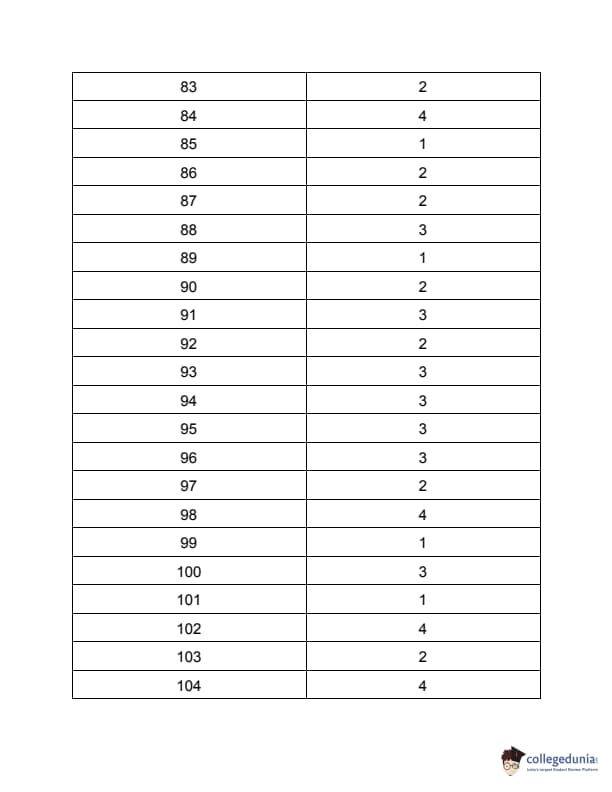
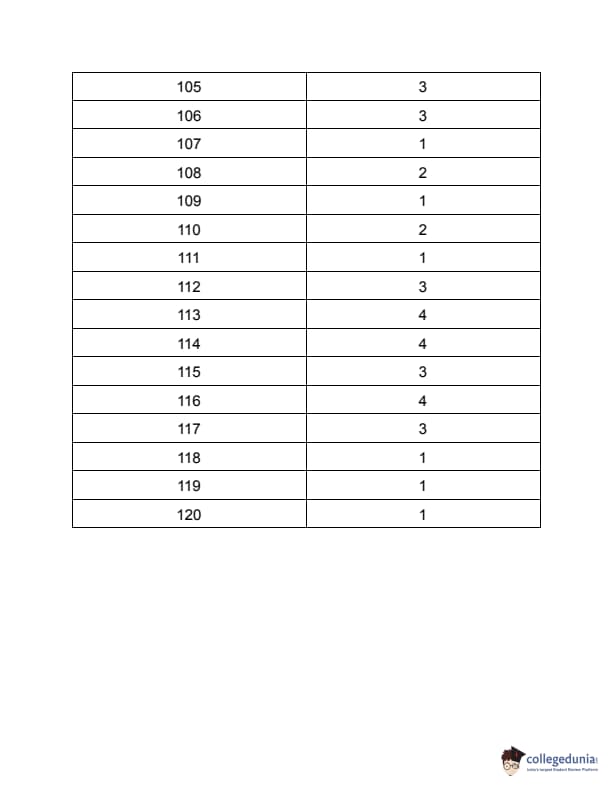
TS PGECET 2023 Food Technology Question Paper with Answer key PDF is available here for download. TS PGECET 2023 was conducted by JNTU Hyderabad on behalf of TSCHE on May 29, 2023. TS PGECET 2023 FT Question Paper consisted of 120 questions carrying 1 mark for each.
TS PGECET 2023 Food Technology Question Paper
| TS PGECET 2023 FT Question Paper with Answer Key | Download PDF | Check Solution |

Question 1:
The system of equations \[ \begin{bmatrix} 1 & 2 & 4
2 & 1 & 2
1 & 2 & a-4 \end{bmatrix} \begin{bmatrix} x
y
z \end{bmatrix} = \begin{bmatrix} 6
4
a \end{bmatrix} \]
will have a unique solution for:
View Solution
Step 1:
A system of linear equations has a unique solution if the determinant of its coefficient matrix is non-zero.
Step 2:
Compute the determinant: \[ \left| \begin{array}{ccc} 1 & 2 & 4
2 & 1 & 2
1 & 2 & a-4 \end{array} \right| \]
Step 3:
Expand the determinant using the first row: \[ = 1 \begin{vmatrix} 1 & 2
2 & a-4 \end{vmatrix} - 2 \begin{vmatrix} 2 & 2
1 & a-4 \end{vmatrix} + 4 \begin{vmatrix} 2 & 1
1 & 2 \end{vmatrix} \]
Step 4:
Simplify the minors: \[ = 1 \times (1 \times (a-4) - 2 \times 2) - 2 \times (2 \times (a-4) - 1 \times 2) + 4 \times (2 \times 2 - 1 \times 1) \]
\[ = (a-4 - 4) - 2 \times (2a-8 - 2) + 4 \times (4-1) \]
\[ = (a-8) - 2 \times (2a-10) + 4 \times 3 \]
\[ = a-8 - (4a-20) + 12 \]
\[ = a-8 - 4a + 20 + 12 \]
\[ = -3a + 24 \]
Step 5:
For unique solution: \[ -3a + 24 \neq 0 \] \[ \Rightarrow a \neq 8 \] Quick Tip: To check for unique solutions in a system of linear equations, always test if the determinant of the coefficient matrix is non-zero. A zero determinant means no or infinitely many solutions.
If \[ A = \begin{bmatrix} 1 & 2 & 2
2 & 1 & 2
2 & 2 & 1 \end{bmatrix} \]
satisfies the matrix equation \[ A^3 - 3A^2 + KA - 5I = 0 \]
then \( K = \)
View Solution
Step 1:
Use the Cayley-Hamilton theorem: A square matrix satisfies its own characteristic equation.
Step 2:
Find the characteristic equation of matrix \( A \): \[ |A - \lambda I| = 0 \]
\[ = \begin{vmatrix} 1-\lambda & 2 & 2
2 & 1-\lambda & 2
2 & 2 & 1-\lambda \end{vmatrix} \]
Step 3:
Expand the determinant: \[ = (1-\lambda)\left( (1-\lambda)^2 - 4 \right) - 2 \left( 2(1-\lambda) - 4 \right) + 2 \left( 4 - 2(1-\lambda) \right) \]
Simplify: \[ = (1-\lambda)\left( \lambda^2 - 2\lambda - 3 \right) \] \[ = (1-\lambda)(\lambda-3)(\lambda+1) \]
Step 4:
So, characteristic equation: \[ (\lambda-3)(\lambda-(-1))(\lambda-1) = 0 \]
Step 5:
Therefore, the characteristic polynomial is: \[ \lambda^3 - 3\lambda^2 - 9\lambda - 5 = 0 \]
Comparing with the given matrix equation: \[ A^3 - 3A^2 + KA - 5I = 0 \]
We find that: \[ K = -9 \] Quick Tip: When a matrix satisfies a polynomial equation, use the Cayley-Hamilton theorem to equate the characteristic equation with the given equation and compare coefficients directly.
The value of \[ \int_{0}^{1} \frac{35x^3}{32\sqrt{1-x}}\, dx \]
is:
View Solution
Step 1:
Consider the given integral: \[ I = \int_{0}^{1} \frac{35x^3}{32\sqrt{1-x}}\, dx \]
Step 2:
Use the Beta function identity: \[ \int_{0}^{1} x^{m-1}(1-x)^{n-1}\, dx = B(m,n) \]
where \[ B(m,n) = \frac{\Gamma(m)\Gamma(n)}{\Gamma(m+n)} \]
Step 3:
Compare: \[ \frac{35}{32} x^3 (1-x)^{-\frac{1}{2}} \]
with \[ x^{m-1}(1-x)^{n-1} \]
We have: \( m-1 = 3 \Rightarrow m = 4 \) \( n-1 = -\frac{1}{2} \Rightarrow n = \frac{1}{2} \)
Step 4:
Now apply the Beta function formula: \[ I = \frac{35}{32} \times B(4,\frac{1}{2}) \]
Step 5:
Use the Beta function value: \[ B(m,n) = \frac{\Gamma(m)\Gamma(n)}{\Gamma(m+n)} \]
and \[ \Gamma(4) = 3! = 6, \ \Gamma\left(\frac{1}{2}\right) = \sqrt{\pi}, \ \Gamma\left(4 + \frac{1}{2}\right) = \Gamma\left(\frac{9}{2}\right) \]
But it's better to use the property: \[ B(m,n) = \frac{\Gamma(m)\Gamma(n)}{\Gamma(m+n)} = \frac{\Gamma(4)\Gamma(\frac{1}{2})}{\Gamma(\frac{9}{2})} \]
Using \(\Gamma(\frac{9}{2}) = \frac{105\sqrt{\pi}}{16}\)
Now: \[ I = \frac{35}{32} \times \frac{6 \times \sqrt{\pi}}{\frac{105 \sqrt{\pi}}{16}} = \frac{35}{32} \times \frac{6 \times 16}{105} = \frac{35}{32} \times \frac{96}{105} = \frac{3360}{3360} = 1 \] Quick Tip: When integrating expressions of the form \( x^m (1-x)^n \) over \([0,1]\), consider using the Beta function for a quicker solution.
The greatest value of the directional derivative of the function \[ f = \frac{x^3}{3} + y + z^2 \]
at \( (-1, 1, 1) \) is:
View Solution
Step 1:
The greatest value of the directional derivative at a point is the magnitude of the gradient vector at that point: \[ |\nabla f| \]
Step 2:
Compute the gradient: \[ \nabla f = \left( \frac{\partial f}{\partial x}, \frac{\partial f}{\partial y}, \frac{\partial f}{\partial z} \right) \] \[ = (x^2, 1, 2z) \]
Step 3:
Evaluate at \( (-1, 1, 1) \): \[ \nabla f|_{(-1,1,1)} = (1, 1, 2) \]
Step 4:
Find the magnitude: \[ |\nabla f| = \sqrt{1^2 + 1^2 + 2^2} = \sqrt{1 + 1 + 4} = \sqrt{6} \] Quick Tip: The maximum value of the directional derivative at any point is simply the magnitude of the gradient vector at that point — no need to compute any direction vector.
If a random variable has a Poisson distribution such that \[ P(X=1) = P(X=2), \]
then \( P(X=4) \) is:
View Solution
Step 1:
The Poisson probability formula is: \[ P(X = k) = \frac{e^{-\lambda} \lambda^k}{k!} \]
Step 2:
Given \( P(X=1) = P(X=2) \) \[ \frac{e^{-\lambda} \lambda^1}{1!} = \frac{e^{-\lambda} \lambda^2}{2!} \]
Step 3:
Simplify and solve for \( \lambda \) \[ \lambda = \frac{\lambda^2}{2} \] \[ \lambda^2 - 2\lambda = 0 \] \[ \lambda(\lambda - 2) = 0 \]
Since \( \lambda \) cannot be 0 for a Poisson distribution, \[ \lambda = 2 \]
Step 4:
Now, find \( P(X=4) \) \[ P(X=4) = \frac{e^{-2} 2^4}{4!} = \frac{e^{-2} \times 16}{24} = \frac{2}{3} e^{-2} \] Quick Tip: For Poisson distribution problems, use the standard probability formula carefully and equate probabilities as given in the question to find the unknown parameter.
If the density function of continuous random variable \( X \) is given by \[ f(X=x) = \begin{cases} \frac{1}{\beta} e^{-\left(\frac{x}{\beta}\right)}, & x>0
0, & otherwise \end{cases} \]
then the mean of the distribution is:
View Solution
This is the probability density function (pdf) of an exponential distribution: \[ f(x) = \frac{1}{\beta} e^{-x/\beta}, \quad x > 0 \]
The mean (expected value) of an exponential distribution is: \[ E(X) = \beta \]
Hence, the mean of this distribution is \( \beta \). Quick Tip: For an exponential distribution with pdf \( f(x) = \frac{1}{\beta} e^{-x/\beta} \), the mean is always \( \beta \) and variance is \( \beta^2 \).
If \( D^n = \frac{d^n}{dx^n} \) then \[ \frac{1}{D^2 + 9} \sin 3x = \]
View Solution
We use the operator method for linear differential equations. Given: \[ \frac{1}{D^2 + 9} \sin 3x \]
Since \( D^2 \sin 3x = -9 \sin 3x \), substitute: \[ = \frac{1}{-9 + 9} \sin 3x \]
But the denominator becomes zero, so apply the method of inverse operators for repeated roots: \[ = \frac{x}{2 \cdot 3} \cdot \frac{\cos 3x}{3} = \frac{-x}{6} \cos 3x \] Quick Tip: When the auxiliary equation has a repeated root (like here \( D^2+9=0 \) for \( \sin 3x \)), use the method of inverse operators with an \( x \) multiplier to find a particular integral.
The Laplace transform of \( \left\{ t e^{2t} \sin 3t \right\} \) is:
View Solution
We use the formula: \[ \mathcal{L}\left\{ t e^{a t} \sin b t \right\} = \frac{2b (s-a)}{\left[ (s-a)^2 + b^2 \right]^2} \]
Given: \[ a = 2, \ b = 3 \]
Substituting: \[ = \frac{2 \times 3 \times (s-2)}{\left[(s-2)^2 + 9\right]^2} \]
Simplifying denominator: \[ (s-2)^2 + 9 = s^2 - 4s + 13 \]
So final Laplace transform: \[ = \frac{6(s-2)}{\left(s^2 - 4s + 13\right)^2} \] Quick Tip: Always remember to multiply by \( t \) in the Laplace transform formula increases the power of the denominator by 1 and multiplies the numerator by 2\( b \).
If \( \frac{dy}{dx} = x + y^2 \), \( y(0) = 1 \), then by Picard's method the second approximation \( y^{(2)}(x) \) is:
View Solution
Picard's successive approximations: \[ y^{(0)}(x) = 1 \] \[ y^{(1)}(x) = 1 + \int_0^x \left( t + 1^2 \right) dt = 1 + \frac{x^2}{2} + x \] \[ y^{(2)}(x) = 1 + \int_0^x \left( t + \left( 1 + t + \frac{t^2}{2} \right)^2 \right) dt \]
Expanding and integrating term-by-term gives: \[ = 1 + x + \frac{3}{2} x^2 + \frac{2}{3} x^3 + \frac{x^4}{4} + \frac{x^5}{20} \] Quick Tip: In Picard’s method, each iteration integrates the function of \( x \) and the previous approximation, so remember to expand and integrate carefully.
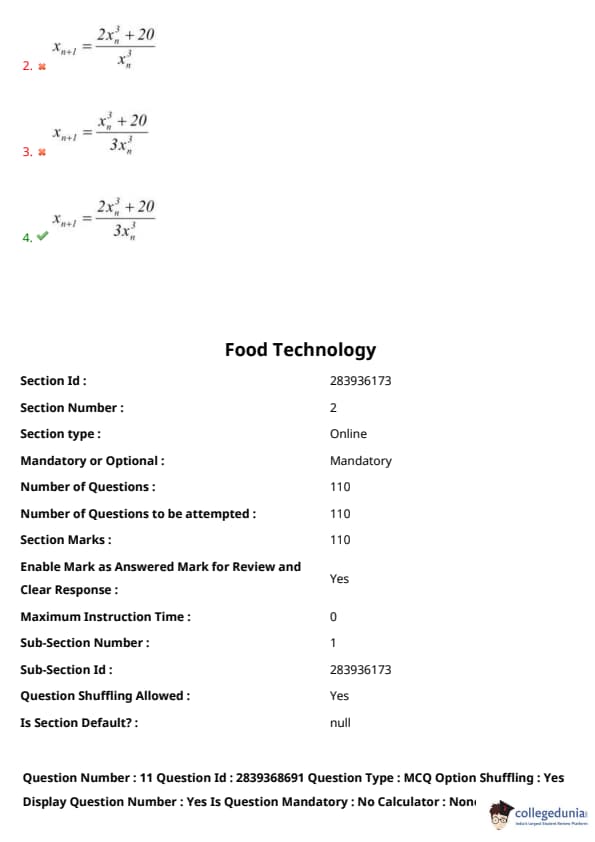
The Newton-Raphson iteration formula for finding \( \sqrt[3]{20} \) is
View Solution
Step 1: Let \( f(x) = x^3 - 20 \). We want to find the cube root of 20, i.e., solve \( f(x) = 0 \).
Step 2: The Newton-Raphson formula is: \[ x_{n+1} = x_n - \dfrac{f(x_n)}{f'(x_n)} \]
Step 3: Compute the derivative: \[ f'(x) = 3x^2 \]
Step 4: Substitute into the formula: \[ x_{n+1} = x_n - \dfrac{x_n^3 - 20}{3x_n^2} = \dfrac{3x_n^3 - (x_n^3 - 20)}{3x_n^2} = \dfrac{2x_n^3 + 20}{3x_n^2} \]
Step 5: This matches option (D). Quick Tip: For root-finding using Newton-Raphson, set \( f(x) = 0 \) and apply \( x_{n+1} = x_n - \frac{f(x_n)}{f'(x_n)} \). Use derivatives carefully.
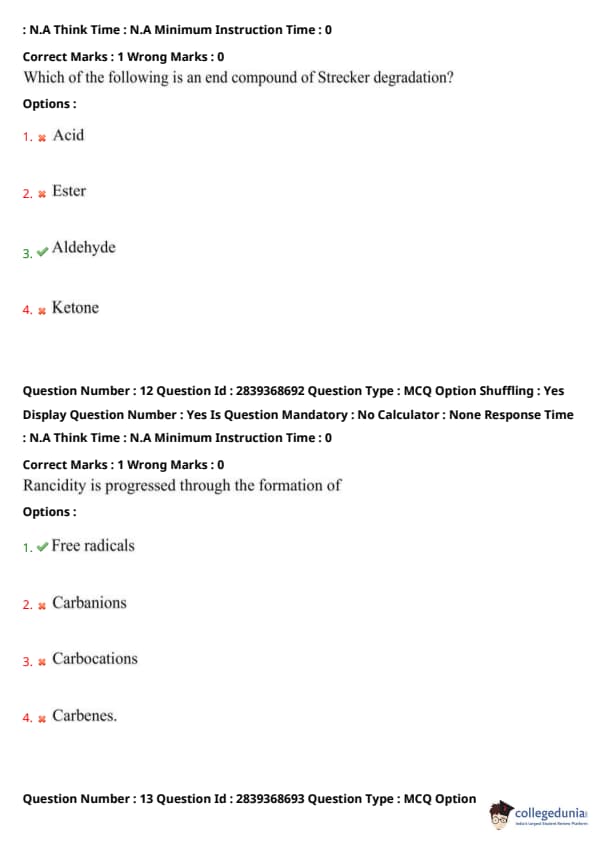
Which of the following is an end compound of Strecker degradation?
View Solution
Step 1: Strecker degradation involves the breakdown of amino acids in the presence of reducing sugars and heat.
Step 2: In this process, the amino group is removed, and the resulting compound is typically an aldehyde.
Step 3: Therefore, aldehydes are the end compounds formed in Strecker degradation. Quick Tip: Remember: Strecker degradation ends with the formation of aldehydes — useful in flavor chemistry and amino acid degradation pathways.
Rancidity is progressed through the formation of
View Solution
Step 1: Rancidity is the oxidation of fats and oils, especially unsaturated fatty acids.
Step 2: This process is initiated and propagated by free radical chain reactions.
Step 3: Free radicals react with oxygen, leading to peroxides and aldehydes, contributing to the unpleasant smell and taste. Quick Tip: Oxidative rancidity is a free radical-driven process—think of free radicals as the culprits behind spoilage of fats.
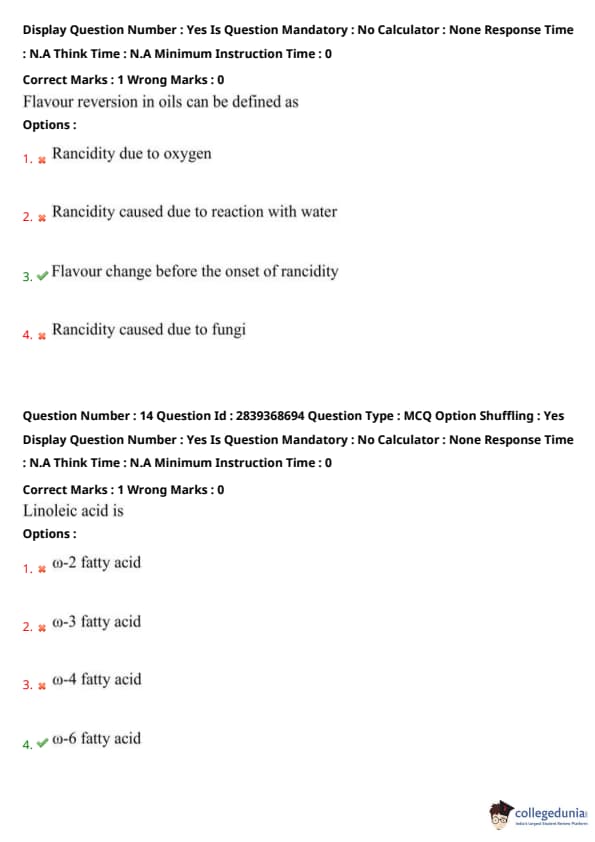
Flavour reversion in oils can be defined as
View Solution
Step 1: Flavour reversion refers to the early stage deterioration of edible oils and fats.
Step 2: It occurs before rancidity, involving minor chemical changes that affect taste and smell.
Step 3: It is not necessarily due to microbial or oxidative processes like true rancidity, but indicates initial degradation. Quick Tip: Flavour reversion is a warning sign — it occurs before oils become rancid. Watch for taste changes even when spoilage isn’t obvious.
Linoleic acid is
View Solution
Step 1: Linoleic acid is a polyunsaturated fatty acid with 18 carbon atoms and two double bonds.
Step 2: The first double bond occurs at the sixth carbon from the methyl (omega) end, classifying it as an \(\omega\)-6 fatty acid.
Step 3: Omega-6 fatty acids are essential nutrients important for cellular function and inflammation regulation. Quick Tip: To identify omega fatty acids, count from the methyl end to the first double bond. Linoleic acid’s first bond is at position 6 → \(\omega\)-6.
The product of heating sugar above its melting point in acidic condition is
View Solution
Step 1: When sugar is heated above its melting point, especially under acidic conditions, it undergoes decomposition.
Step 2: This leads to a process known as caramelization, producing a brown, sticky substance called caramel.
Step 3: Other options such as fructose or amylose are unrelated to this thermal degradation process. Quick Tip: Caramel is formed from sugar when heated — not a new sugar like fructose, but a breakdown product with a brown color and distinct aroma.
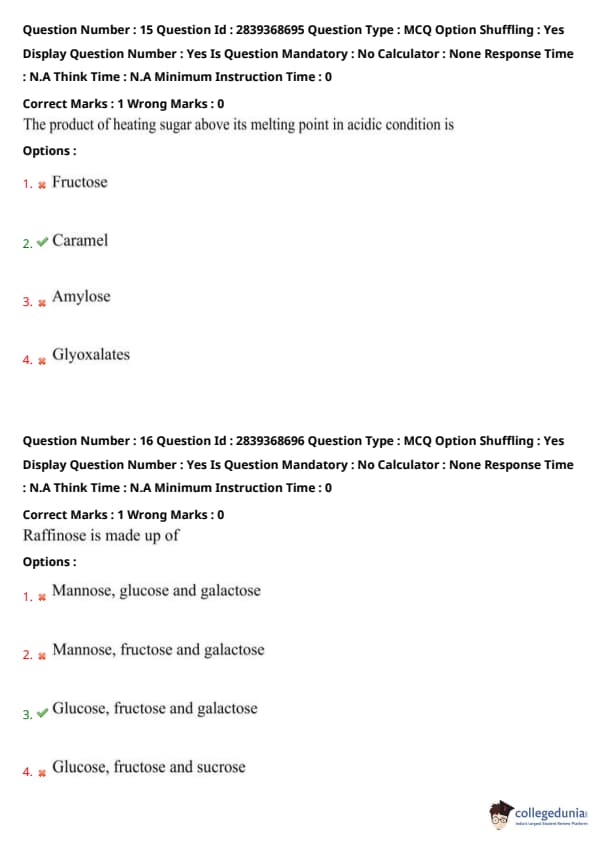
Raffinose is made up of
View Solution
Step 1: Raffinose is a trisaccharide made up of three monosaccharides: galactose, glucose, and fructose.
Step 2: Structurally, it consists of a galactose unit joined to a sucrose molecule (which is glucose + fructose).
Step 3: Therefore, the correct composition is glucose, fructose, and galactose. Quick Tip: Remember: raffinose = galactose + sucrose → and sucrose = glucose + fructose.
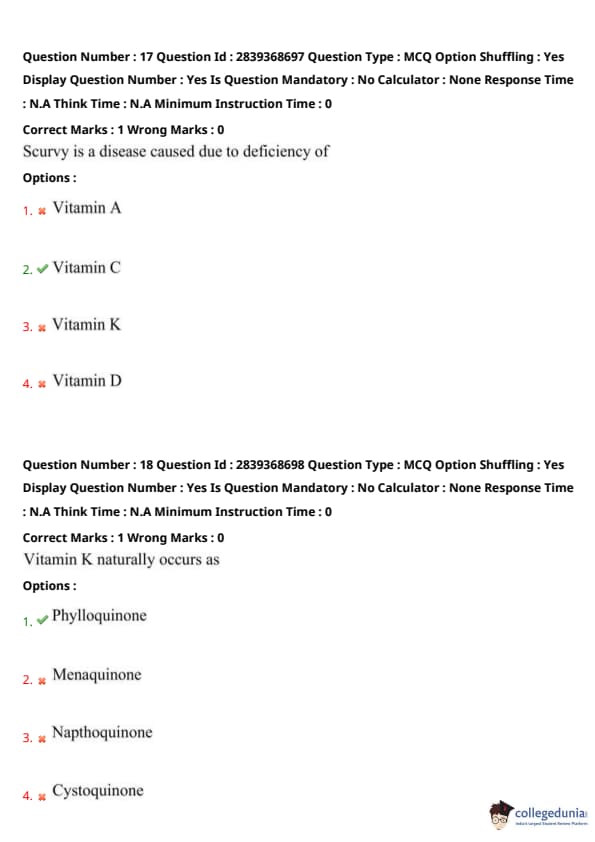
Scurvy is a disease caused due to deficiency of
View Solution
Step 1: Scurvy is a condition that results from a prolonged deficiency of Vitamin C (ascorbic acid).
Step 2: Vitamin C is essential for collagen synthesis, and its absence weakens connective tissues, leading to symptoms like bleeding gums, weakness, and joint pain.
Step 3: Hence, Vitamin C deficiency is the correct cause of scurvy. Quick Tip: Scurvy = Vitamin C deficiency. Think: C for Collagen, C for Citrus — both linked to Vitamin C!
Vitamin K naturally occurs as
View Solution
Step 1: Vitamin K exists primarily in two natural forms: Vitamin K\(_1\) (Phylloquinone) and Vitamin K\(_2\) (Menaquinone).
Step 2: Phylloquinone is the main form found in plants and is the primary dietary source.
Step 3: Therefore, the naturally occurring form of Vitamin K in most diets is Phylloquinone. Quick Tip: Vitamin K from leafy greens = Phylloquinone (K\(_1\)). Remember: “Phyto” = plants!
Zinc decreases the bioavailability of
View Solution
Step 1: Zinc and copper compete for absorption in the gastrointestinal tract.
Step 2: High levels of zinc induce the synthesis of metallothionein, a protein that binds copper and prevents its absorption.
Step 3: Therefore, increased zinc intake reduces the bioavailability of copper. Quick Tip: Remember: Excessive zinc intake can lead to copper deficiency due to competitive absorption.
Chemically Annatto is
View Solution
Step 1: Annatto is a natural food coloring derived from the seeds of the achiote tree.
Step 2: Its primary pigments are bixin and norbixin, which are carotenoids.
Step 3: Thus, chemically, annatto is classified under carotenoids. Quick Tip: Think of Annatto as a plant-based colorant rich in carotenoids like bixin — not a flavonoid!
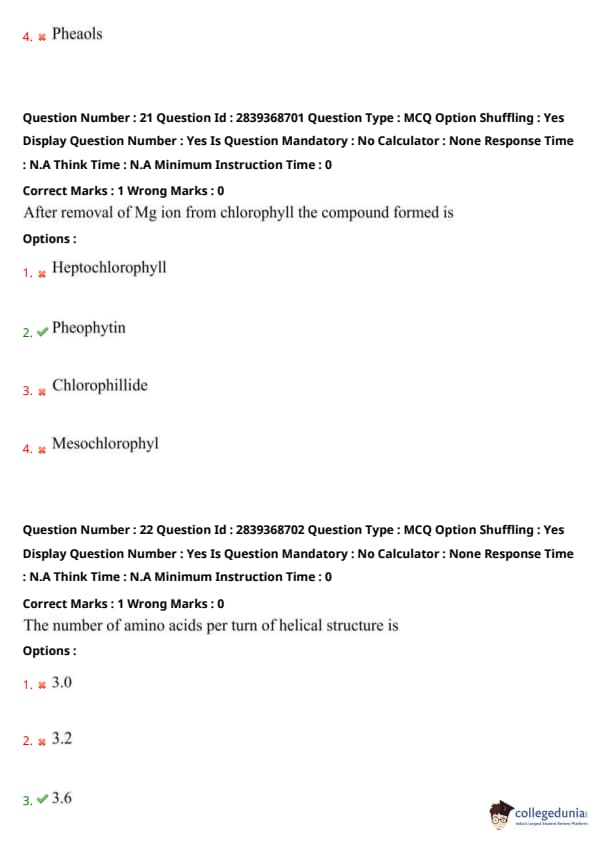
After removal of Mg ion from chlorophyll the compound formed is
View Solution
Step 1: Chlorophyll contains a central magnesium ion in its porphyrin ring.
Step 2: When Mg\(^{2+}\) is removed from chlorophyll, the resulting compound is pheophytin.
Step 3: Pheophytin is a magnesium-free derivative that plays a role in photosynthesis as an electron carrier. Quick Tip: Think: Mg\(^{2+}\) removal from chlorophyll always gives pheophytin — a key intermediate in electron transport.
The number of amino acids per turn of helical structure is
View Solution
Step 1: The alpha-helix is a common structural motif in proteins.
Step 2: Each full turn of the alpha-helix consists of approximately 3.6 amino acid residues.
Step 3: This structure is stabilized by hydrogen bonding between the \( N-H \) of one amino acid and the \( C=O \) of another four residues earlier. Quick Tip: Remember the magic number: 3.6 amino acids per turn in an alpha-helix structure.
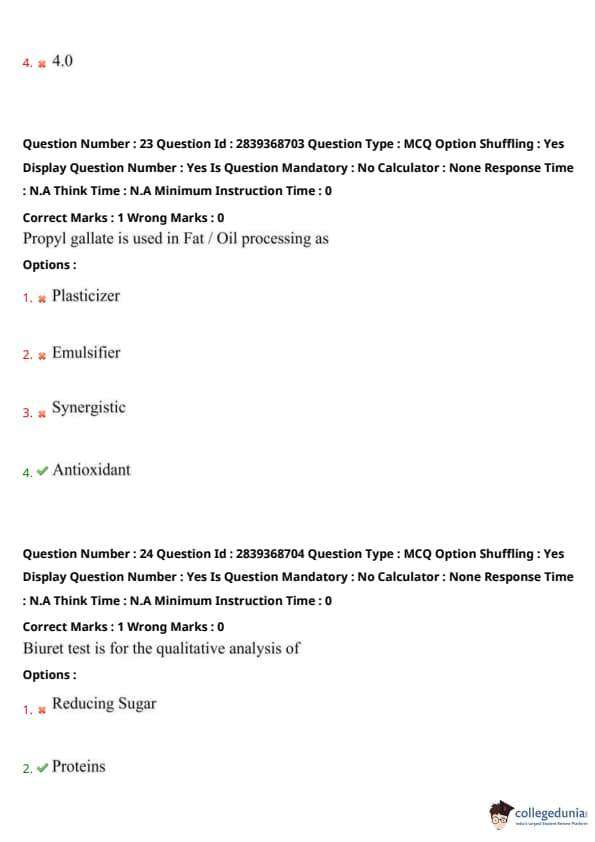
Propyl gallate is used in Fat / Oil processing as
View Solution
Step 1: Propyl gallate is a type of phenolic antioxidant.
Step 2: It is commonly added to edible oils and fats to prevent oxidation.
Step 3: This helps in extending shelf life and preserving food quality by preventing rancidity. Quick Tip: Remember: Propyl gallate = antioxidant used to prevent oxidation in oils/fats.
Biuret test is for the qualitative analysis of
View Solution
Step 1: The Biuret test is used to detect peptide bonds.
Step 2: Proteins contain peptide bonds, which react with copper(II) ions in alkaline conditions to give a violet/purple complex.
Step 3: The appearance of a violet color confirms the presence of proteins. Quick Tip: Biuret test = Protein test. Violet color = Peptide bonds detected.
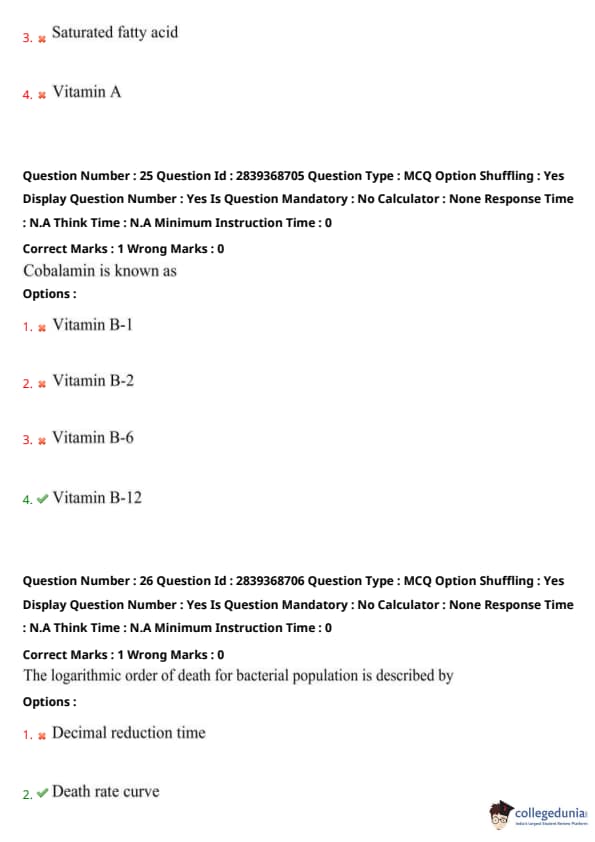
Cobalamin is known as
View Solution
Step 1: Cobalamin is the scientific name for Vitamin B-12.
Step 2: It plays a crucial role in red blood cell formation, neurological function, and DNA synthesis.
Step 3: Deficiency of Vitamin B-12 can cause megaloblastic anemia. Quick Tip: Cobalamin = Vitamin B-12. Important for red blood cells and nerve health.
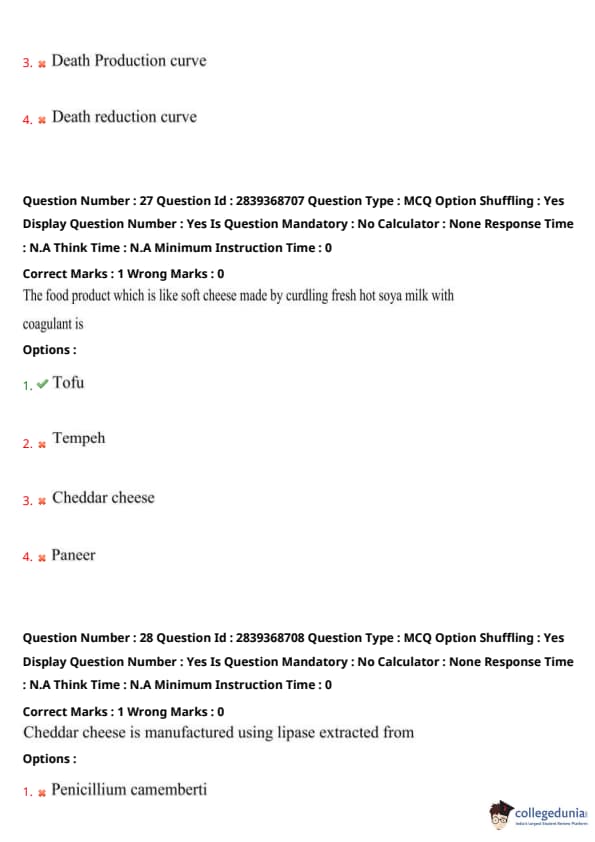
The logarithmic order of death for bacterial population is described by
View Solution
Step 1: A death rate curve plots the logarithmic decline in the number of viable microorganisms over time.
Step 2: It is used to study microbial inactivation kinetics during food processing and sterilization.
Step 3: This curve helps determine appropriate processing times for microbial safety. Quick Tip: Logarithmic microbial death → described by the death rate curve.
The food product which is like soft cheese made by curdling fresh hot soya milk with coagulant is
View Solution
Step 1: Tofu is made by curdling fresh hot soya milk, typically using a coagulant like calcium sulfate or magnesium chloride.
Step 2: This process is similar to how cheese is made from dairy milk, resulting in a soft, cheese-like product.
Step 3: Tempeh and paneer differ in source and method, while cheddar is a fermented dairy product. Quick Tip: Tofu = Soya milk + coagulant → curdled into soft cheese-like texture.
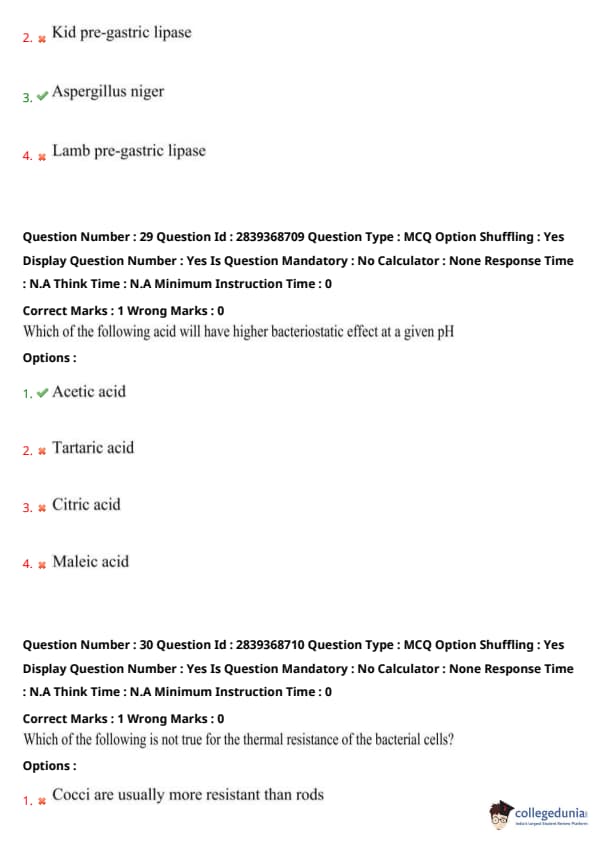
Cheddar cheese is manufactured using lipase extracted from
View Solution
Step 1: Lipases are enzymes that hydrolyze fats and are used in cheese manufacturing for flavor development.
Step 2: In cheddar cheese production, microbial lipases from Aspergillus niger are commonly used due to their efficiency and non-animal origin.
Step 3: Animal lipases (kid/lamb) are used in some cheeses but not typically in cheddar. Quick Tip: Cheddar cheese → uses microbial lipase from \textit{Aspergillus niger.
Which of the following acid will have higher bacteriostatic effect at a given pH
View Solution
Step 1: Bacteriostatic effect depends on the undissociated acid form at a specific pH.
Step 2: Acetic acid remains more undissociated and thus penetrates microbial membranes effectively.
Step 3: This enhances its ability to inhibit microbial growth compared to other listed acids. Quick Tip: More undissociated acid at given pH → Stronger bacteriostatic effect (e.g., Acetic acid).
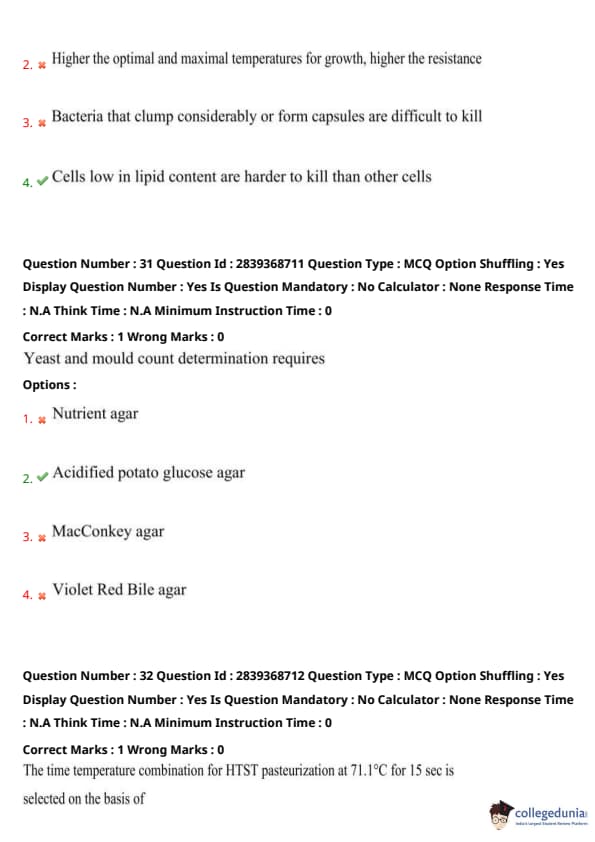
Which of the following is not true for the thermal resistance of the bacterial cells?
View Solution
Step 1: Rod-shaped bacteria, especially spore-forming types, tend to be more heat resistant.
Step 2: Cocci are generally less thermally resistant than rods.
Step 3: Statements (2), (3), and (4) are true and supported by microbial heat resistance principles. Quick Tip: Cocci are generally less heat resistant than rods — opposite of what's stated.
Yeast and mould count determination requires
View Solution
Step 1: Yeast and molds prefer acidic conditions for growth.
Step 2: Acidified potato glucose agar is a selective medium with low pH that favors fungi over bacteria.
Step 3: Other media like MacConkey and VRBA are selective for bacteria, not fungi. Quick Tip: Acidified media like potato glucose agar → ideal for fungal (yeast and mold) counts.
The time temperature combination for HTST pasteurization at 71.1°C for 15 sec is selected on the basis of
View Solution
Step 1: HTST (High Temperature Short Time) pasteurization targets the most heat-resistant non-spore-forming pathogen.
Step 2: Coxiella burnetii, the causative agent of Q-fever, is that organism.
Step 3: Eliminating \textit{C. burnetii ensures safety against other less heat-resistant pathogens. Quick Tip: HTST pasteurization → based on killing \textit{Coxiella burnetii.
Microorganisms used in biotechnology primarily shall not
View Solution
Step 1: Ideal biotech microbes must be safe and non-pathogenic to ensure safe handling.
Step 2: Traits like fast growth, low-cost media, and manipulability are desirable.
Step 3: Pathogenicity poses safety risks in industrial and research applications. Quick Tip: Biotech microbes → should be safe (non-pathogenic), easy to grow and modify.
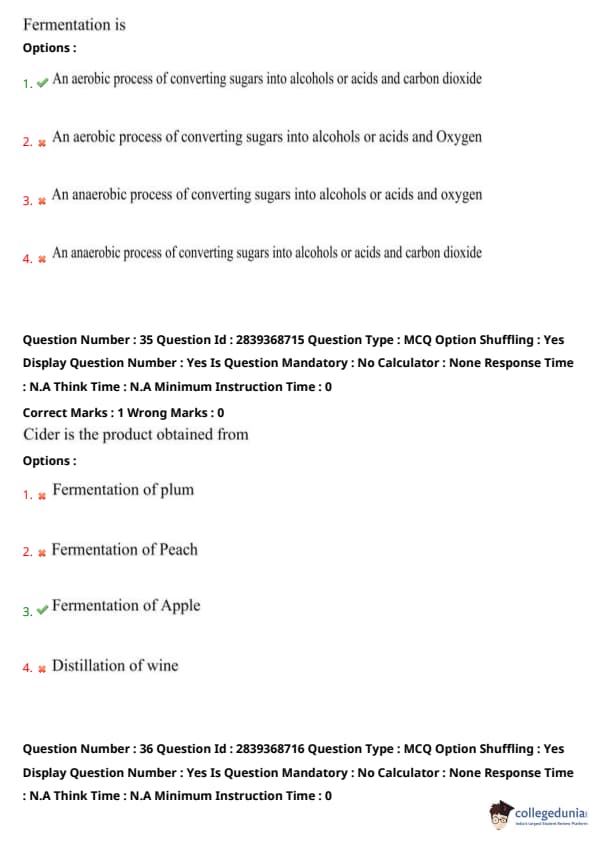
Fermentation is
View Solution
Step 1: Fermentation occurs in the absence of oxygen (anaerobic conditions).
Step 2: Microorganisms convert sugars into alcohols (e.g., ethanol) or acids (e.g., lactic acid).
Step 3: Carbon dioxide is often a by-product in many fermentative processes. Quick Tip: Fermentation = Anaerobic conversion of sugar → alcohol/acid + CO\textsubscript{2}.
Cider is the product obtained from
View Solution
Step 1: Cider is an alcoholic beverage derived from apples.
Step 2: It is made by fermenting apple juice using yeast.
Step 3: Other fruits like plum or peach are not typically used for cider. Quick Tip: Cider = Fermented apple juice.
Separating the outer hull from inner hull is called
View Solution
Step 1: Dehulling is the process of removing the outer husk from grains or seeds.
Step 2: It improves digestibility and processing quality.
Step 3: Commonly used in legumes, millets, and oilseeds. Quick Tip: Dehulling = Removing outer husk from seeds/grains.
Which of the following bioactive component is rich in Oats?
View Solution
Step 1: Oats are known for high \(\beta\)-glucan content, a soluble fiber.
Step 2: It helps lower cholesterol and supports heart health.
Step 3: Other options are either amino acids or enzymes not specifically abundant in oats. Quick Tip: Oats = Rich in \(\beta\)-glucan → key dietary fiber with heart benefits.
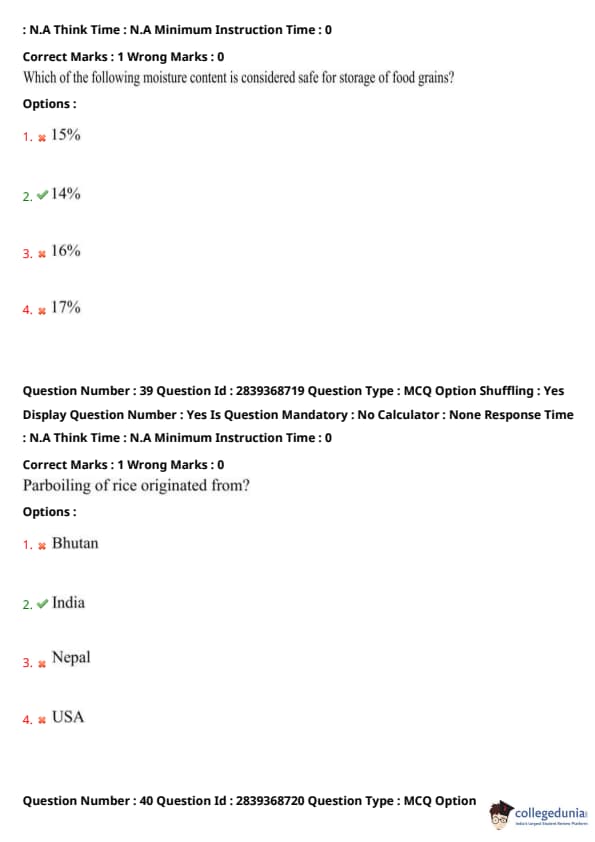
Which of the following moisture content is considered safe for storage of food grains?
View Solution
Step 1: Safe grain storage requires moisture content low enough to inhibit microbial and insect growth.
Step 2: 14% or lower is considered ideal for most cereals.
Step 3: Higher moisture levels promote spoilage and aflatoxin development. Quick Tip: Safe storage moisture for grains = ≤ 14%.
Parboiling of rice originated from?
View Solution
Step 1: Parboiling is a hydrothermal process applied to paddy before milling.
Step 2: The process was historically developed in the Indian subcontinent.
Step 3: It improves nutritional content and reduces grain breakage during milling. Quick Tip: India is the origin of the rice parboiling process.
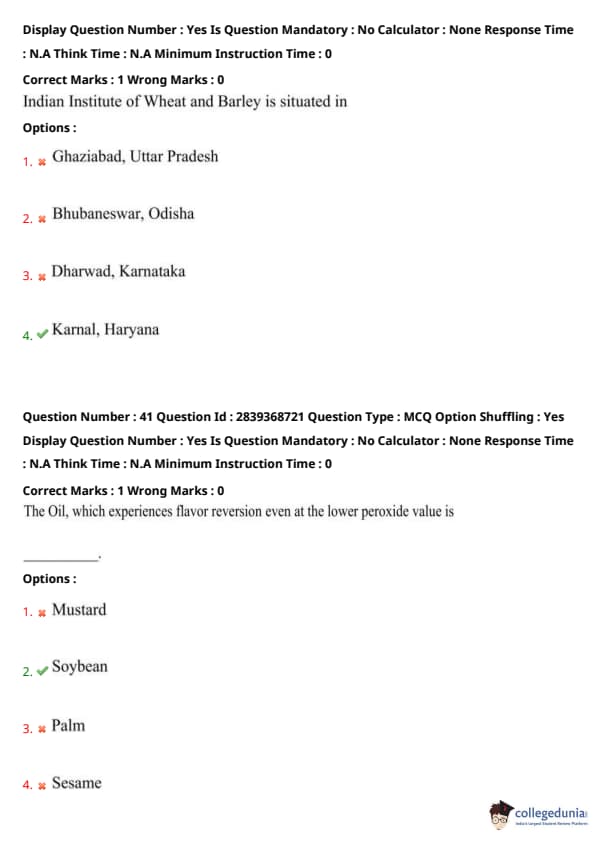
Indian Institute of Wheat and Barley is situated in
View Solution
Step 1: The Indian Institute of Wheat and Barley Research (IIWBR) is a premier institution under ICAR.
Step 2: It is located in Karnal, Haryana.
Step 3: It conducts advanced research and development in wheat and barley improvement and production. Quick Tip: IIWBR is located in Karnal, Haryana — focus: wheat & barley R\&D.
The oil, which experiences flavor reversion even at the lower peroxide value is _______.
View Solution
Step 1: Flavor reversion is the development of off-flavors in edible oils even at low levels of oxidation.
Step 2: Soybean oil is particularly prone to this, even at low peroxide values.
Step 3: This makes flavor stability a key challenge in soybean oil processing and storage. Quick Tip: Soybean oil undergoes flavor reversion at low peroxide values.
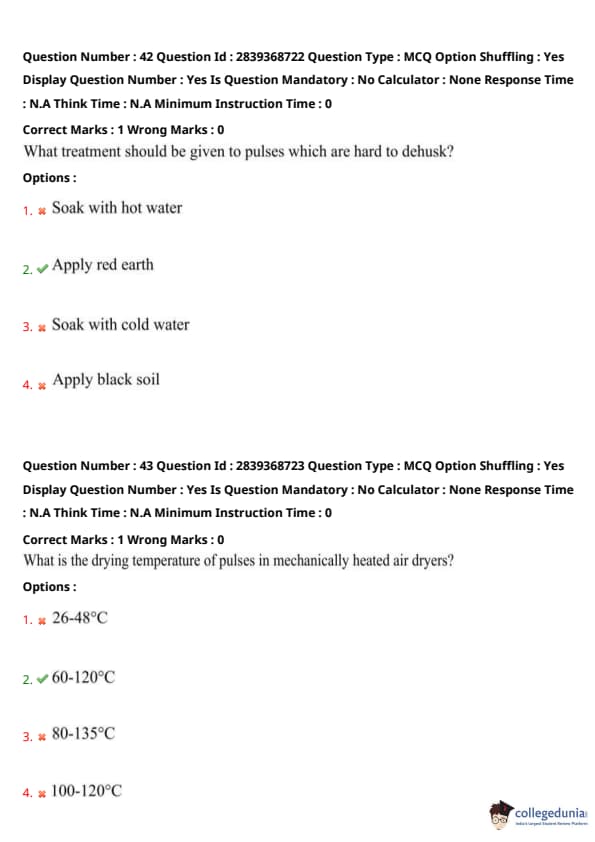
What treatment should be given to pulses which are hard to dehusk?
View Solution
Step 1: Pulses that are difficult to dehusk are treated before milling to improve husk removal.
Step 2: Applying red earth helps loosen the husk.
Step 3: This traditional method enhances milling efficiency and reduces losses. Quick Tip: Apply red earth to ease dehusking of hard pulses.
What is the drying temperature of pulses in mechanically heated air dryers?
View Solution
Step 1: Mechanical air dryers are used for controlled drying of pulses.
Step 2: The recommended drying temperature range is 60–120°C to prevent damage and preserve quality.
Step 3: Proper drying improves shelf life and milling performance. Quick Tip: Pulse drying in air dryers: 60–120°C is optimal.
Yellow Revolution is related to \hspace{1cm}.
View Solution
Step 1: The Yellow Revolution in India focused on increasing oilseed production.
Step 2: It aimed at achieving self-sufficiency in edible oils.
Step 3: It paralleled the Green and White revolutions in its impact on agriculture. Quick Tip: Yellow Revolution = Oilseed boom in India.
Pitambari is a variety of ___.
View Solution
Step 1: Pitambari is a popular cultivar known for its high yield.
Step 2: It belongs to the mustard group of oilseeds.
Step 3: It is widely cultivated in India. Quick Tip: Pitambari is a mustard variety.
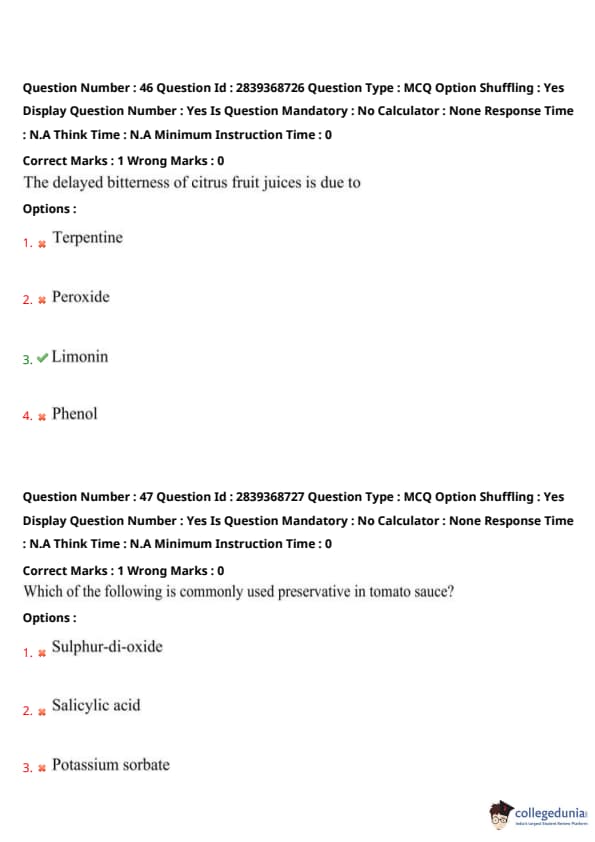
The delayed bitterness of citrus fruit juices is due to
View Solution
Step 1: Limonin is a bitter compound found in citrus fruits.
Step 2: It develops slowly after juice extraction, causing delayed bitterness.
Step 3: This compound is especially prevalent in oranges and lemons. Quick Tip: Limonin causes delayed bitterness in citrus juices.
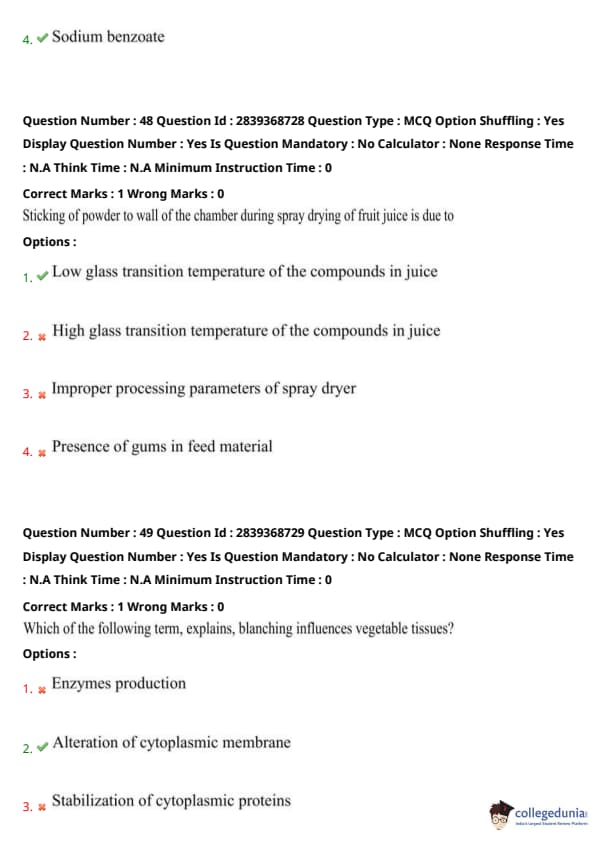
Which of the following is commonly used preservative in tomato sauce?
View Solution
Step 1: Preservatives are used to extend the shelf life of food.
Step 2: Sodium benzoate is a widely used preservative in acidic foods like tomato sauce.
Step 3: It inhibits the growth of bacteria, yeast, and fungi. Quick Tip: Sodium benzoate is the standard preservative in tomato sauce.
Sticking of powder to wall of the chamber during spray drying of fruit juice is due to
View Solution
Step 1: During spray drying, juice solids with low glass transition temperature tend to become sticky.
Step 2: This causes powder to adhere to the dryer walls.
Step 3: Proper formulation and carriers help mitigate this issue. Quick Tip: Low glass transition temperature leads to wall sticking in spray drying.
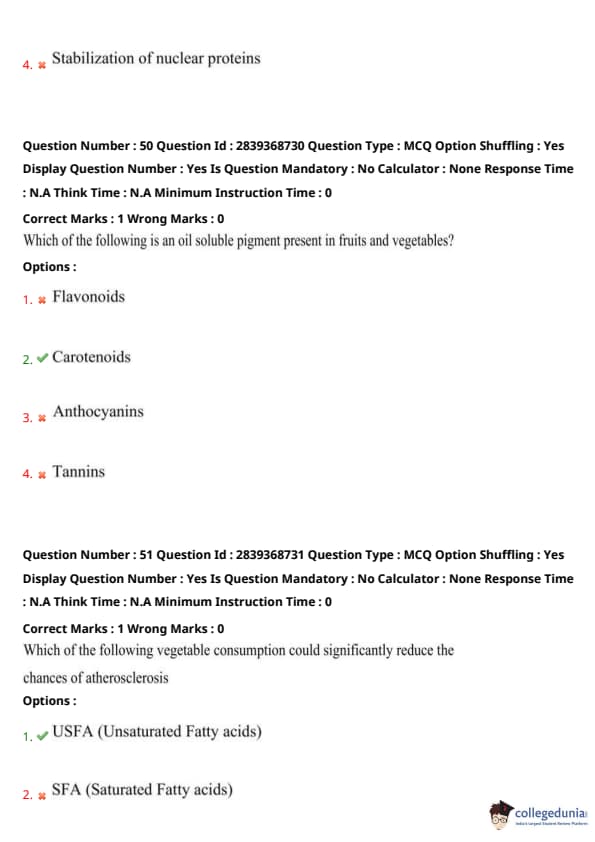
Which of the following term explains, blanching influences vegetable tissues?
View Solution
Step 1: Blanching causes physical changes in tissues.
Step 2: This includes alteration of cytoplasmic membranes to inactivate enzymes. Quick Tip: Blanching alters cytoplasmic membranes in vegetables.
Which of the following is an oil soluble pigment present in fruits and vegetables?
View Solution
Step 1: Carotenoids are lipid-soluble pigments.
Step 2: They are responsible for red, yellow, and orange coloration in produce. Quick Tip: Carotenoids are oil soluble pigments in fruits & veggies.
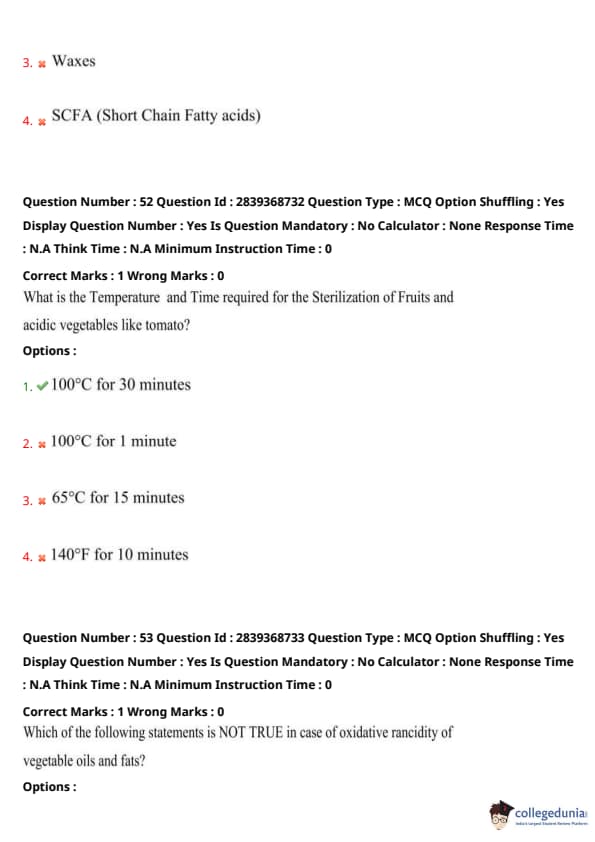
Which of the following vegetable consumption could significantly reduce the chances of atherosclerosis
View Solution
Step 1: Unsaturated fats help lower LDL cholesterol levels.
Step 2: This reduces the risk of arterial blockage and atherosclerosis. Quick Tip: USFAs are heart-friendly and reduce atherosclerosis risk.
What is the Temperature and Time required for the Sterilization of Fruits and acidic vegetables like tomato?
View Solution
Step 1: Acidic foods require lower sterilization temperature.
Step 2: 100\degree C for 30 minutes ensures safety and shelf stability. Quick Tip: Sterilize acidic vegetables at 100°C for 30 minutes.
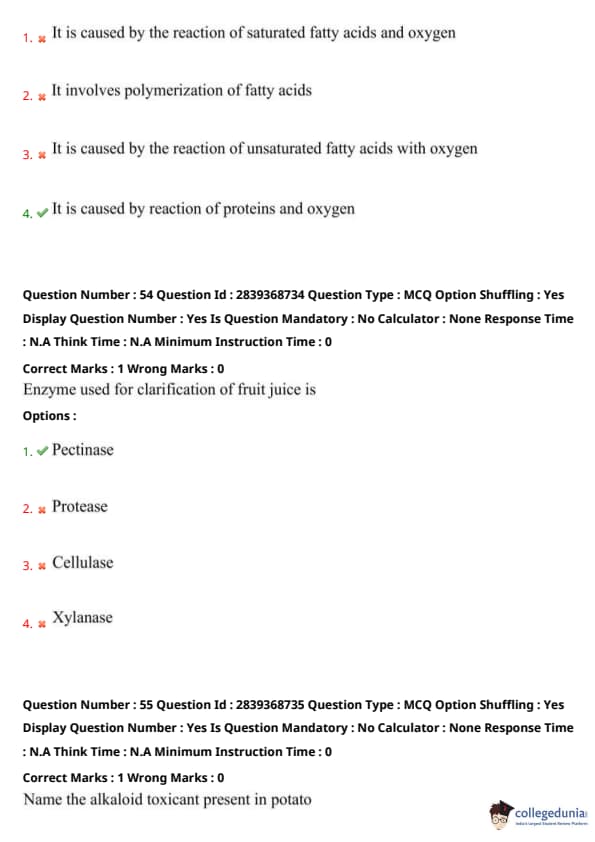
Which of the following statements is NOT TRUE in case of oxidative rancidity of vegetable oils and fats?
View Solution
Step 1: Oxidative rancidity primarily involves unsaturated fatty acids.
Step 2: Proteins are not involved in this process; hence the statement is incorrect. Quick Tip: Oxidative rancidity affects unsaturated fats, not proteins.
Enzyme used for clarification of fruit juice is
View Solution
Step 1: Pectinase breaks down pectin, a structural polysaccharide in fruit cell walls.
Step 2: This reduces viscosity and leads to clearer juice. Quick Tip: Pectinase helps clarify fruit juice by breaking pectin.
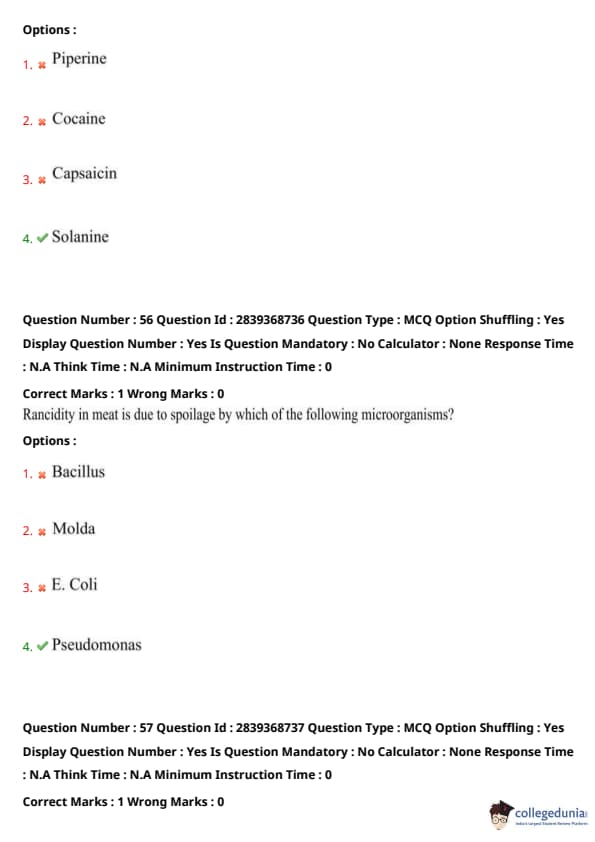
Name the alkaloid toxicant present in potato
View Solution
Step 1: Solanine is a naturally occurring toxic alkaloid found in potatoes.
Step 2: It can accumulate when potatoes are exposed to light. Quick Tip: Solanine is the toxic alkaloid found in potatoes.
Rancidity in meat is due to spoilage by which of the following microorganisms?
View Solution
Step 1: Pseudomonas species are known for spoiling meat through oxidative rancidity.
Step 2: They produce off-flavors and slime, especially under aerobic conditions. Quick Tip: Pseudomonas causes rancidity and spoilage in meat.
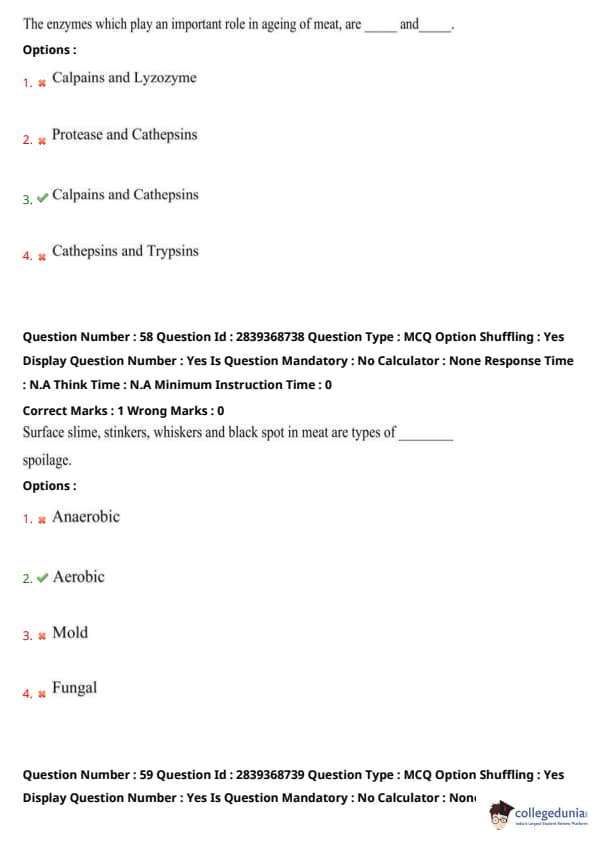
The enzymes which play an important role in ageing of meat, are ____ and ____.
View Solution
Step 1: Calpains and Cathepsins are proteolytic enzymes.
Step 2: They contribute to the breakdown of muscle proteins, improving meat tenderness during ageing. Quick Tip: Calpains and Cathepsins help tenderize meat during ageing.
Surface slime, stinkers, whiskers and black spot in meat are types of ______ spoilage.
View Solution
Step 1: Surface defects like slime and whiskers in meat typically occur due to aerobic bacterial activity.
Step 2: These microbes thrive in oxygen-rich environments causing visible spoilage. Quick Tip: Surface meat spoilage like slime and stinkers is aerobic.
Rigor mortis is caused due to ____________________.
View Solution
Step 1: After death, ATP synthesis stops.
Step 2: Lack of ATP prevents the detachment of actin and myosin filaments, causing stiffness. Quick Tip: Rigor mortis occurs due to lack of ATP postmortem.
Nitrate and Nitrite along with Sodium Chloride are used in meat is called
View Solution
Step 1: Nitrate and nitrite help in preserving meat and enhancing its flavor.
Step 2: When combined with salt, they form curing agents used in meat processing. Quick Tip: Nitrate + Nitrite + Salt = Curing agents in meat.
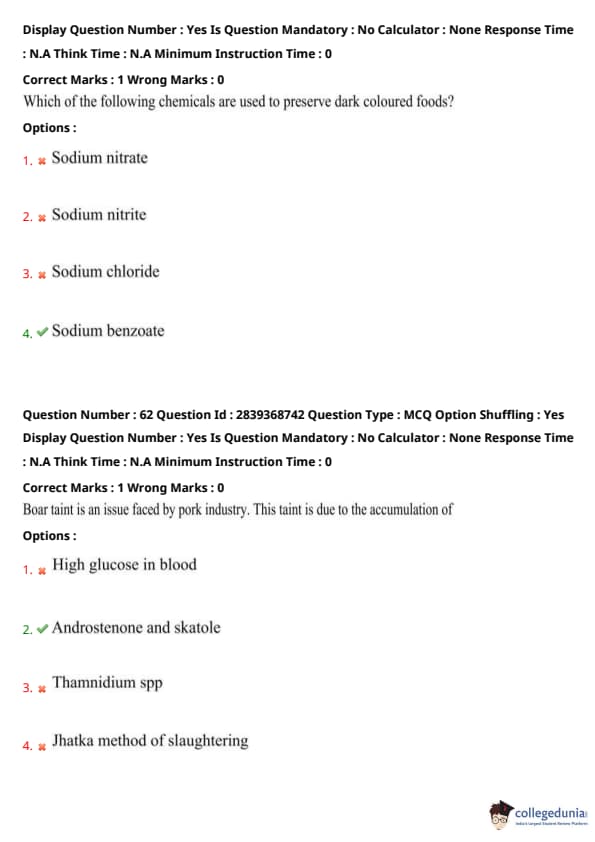
Which of the following chemicals are used to preserve dark coloured foods?
View Solution
Step 1: Sodium benzoate is a common preservative.
Step 2: It is especially effective in preserving acidic and dark-colored foods such as fruit juices, pickles, and sauces. Quick Tip: Sodium benzoate is widely used for preserving dark, acidic foods.
Boar taint is an issue faced by pork industry. This taint is due to the accumulation of
View Solution
Step 1: Boar taint is an unpleasant odor or taste in pork from non-castrated male pigs.
Step 2: It is primarily caused by the accumulation of androstenone and skatole in fat tissues. Quick Tip: Boar taint = Androstenone + Skatole buildup in male pigs.
Deposition of fat within the lean muscle is called
View Solution
Step 1: Marbling refers to the intramuscular fat deposits visible in meat cuts.
Step 2: This fat enhances flavor, juiciness, and tenderness of meat. Quick Tip: Marbling = Intramuscular fat → Better taste and tenderness.
Demersal fish are found in
View Solution
Step 1: Demersal fish are bottom dwellers in marine environments.
Step 2: They typically live near or on the seabed, such as cod and haddock. Quick Tip: Demersal fish = Bottom-dwelling sea fish.
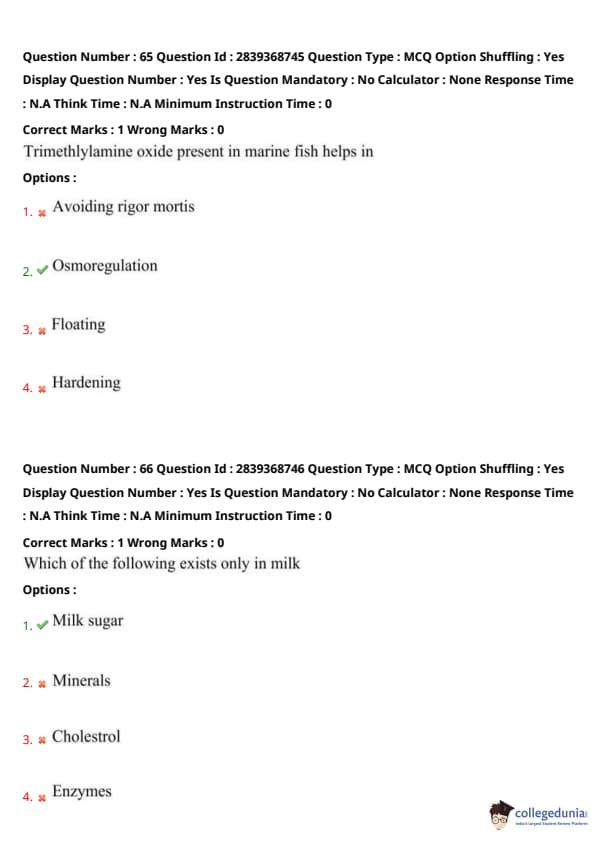
Trimethylamine oxide present in marine fish helps in
View Solution
Step 1: Trimethylamine oxide (TMAO) is found in marine organisms.
Step 2: It helps maintain osmotic balance in the cells under high salt concentrations. Quick Tip: TMAO = Osmoregulation in marine fish.
Which of the following exists only in milk
View Solution
Step 1: Milk sugar refers to lactose, a disaccharide found only in milk and dairy products.
Step 2: Other options (minerals, cholesterol, enzymes) are found in various other foods. Quick Tip: Milk sugar = Lactose → Only found in milk.
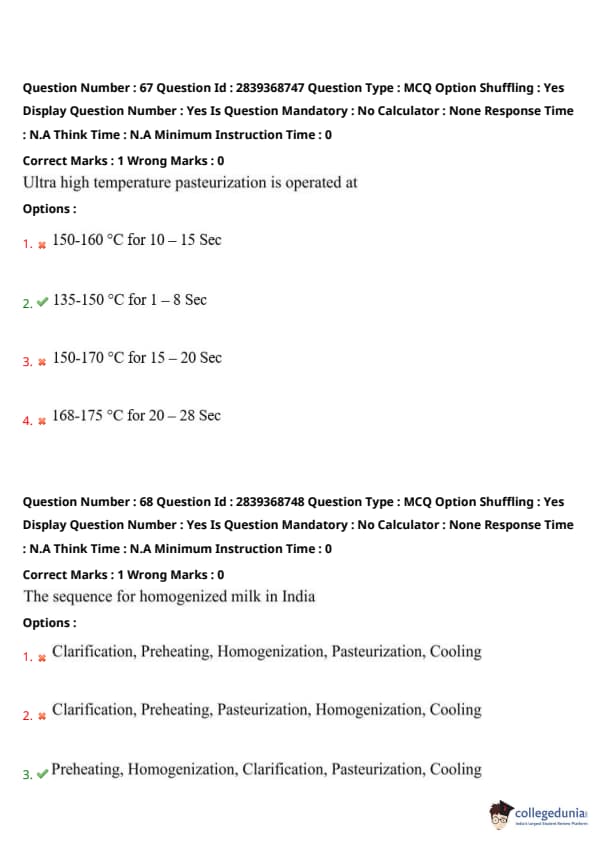
Ultra high temperature pasteurization is operated at
View Solution
Step 1: UHT (Ultra-High Temperature) pasteurization rapidly heats milk to 135--150°C.
Step 2: The short exposure time (1–8 seconds) kills microbes while preserving quality. Quick Tip: UHT = 135--150°C for 1--8 seconds.
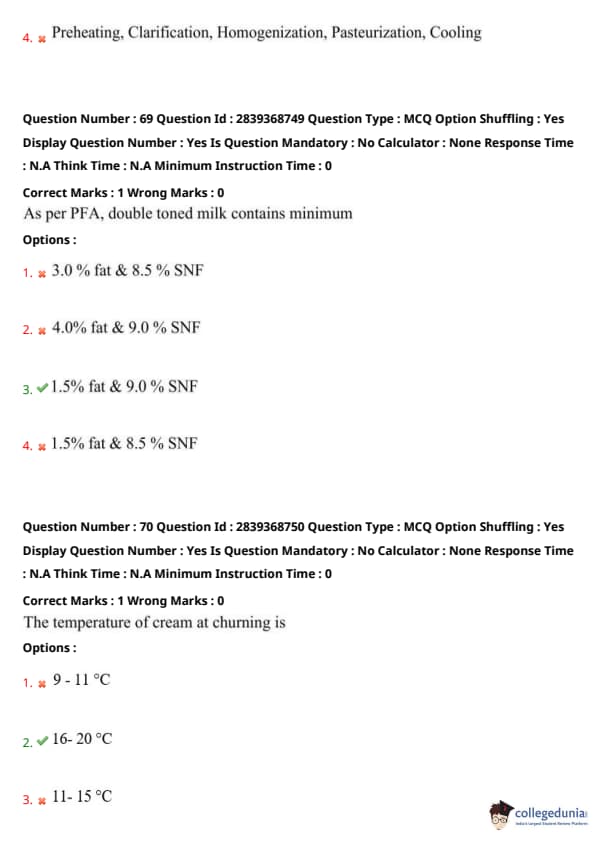
The sequence for homogenized milk in India
View Solution
Step 1: In India, the process of preparing homogenized milk follows a fixed sequence.
Step 2: Proper order ensures quality and safety: Preheating → Homogenization → Clarification → Pasteurization → Cooling. Quick Tip: Process = Preheat → Homogenize → Clarify → Pasteurize → Cool
As per PFA, double toned milk contains minimum
View Solution
Step 1: According to PFA (Prevention of Food Adulteration Act), double toned milk must meet specific minimum standards.
Step 2: It must contain at least 1.5% fat and 9.0% solids-not-fat (SNF). Quick Tip: Double toned milk = 1.5% fat + 9.0% SNF (PFA standard)
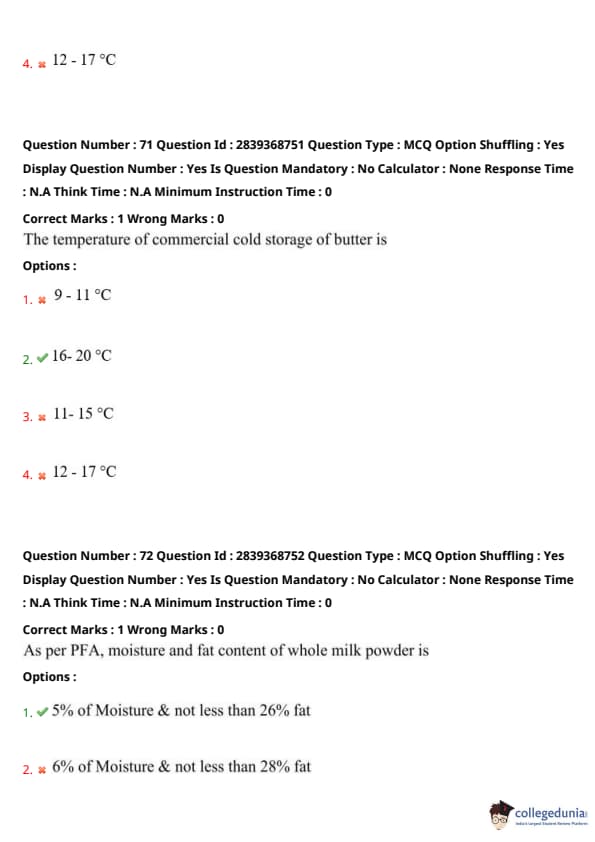
The temperature of cream at churning is
View Solution
Step 1: Churning temperature affects fat globule aggregation and butter formation.
Step 2: Optimal churning temperature is 9--11~°C to ensure proper phase inversion and butter yield. Quick Tip: Ideal churning temperature = 9--11~°C
The temperature of commercial cold storage of butter is
View Solution
Step 1: Butter requires a specific temperature range for commercial cold storage to maintain quality.
Step 2: The recommended storage range is 16--20~°C to prevent spoilage and rancidity. Quick Tip: Butter cold storage temperature = 16--20~°C
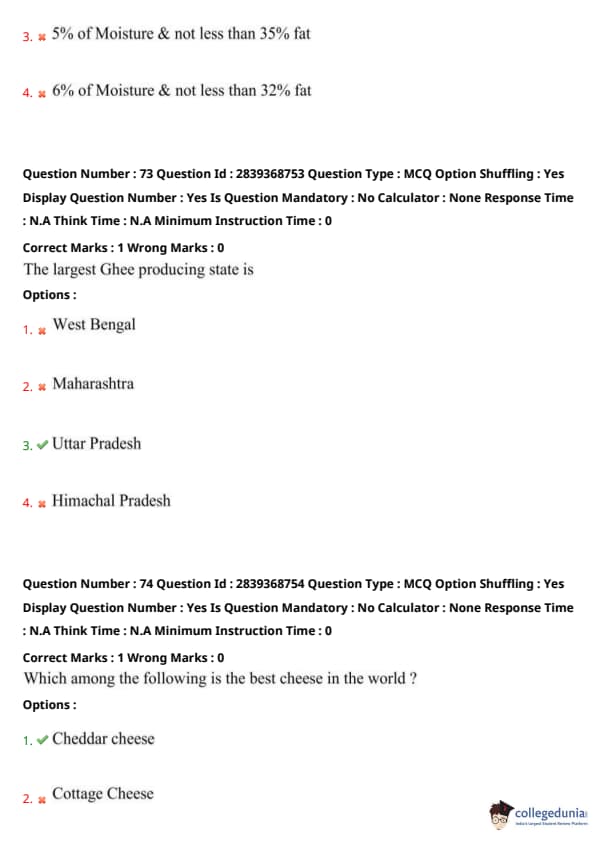
As per PFA, moisture and fat content of whole milk powder is
View Solution
Step 1: The Prevention of Food Adulteration (PFA) rules specify the quality standards for dairy products.
Step 2: For whole milk powder, maximum 5% moisture and minimum 26% fat is mandatory. Quick Tip: Whole milk powder (PFA) = Max 5% moisture \& Min 26% fat
The largest Ghee producing state is
View Solution
Step 1: Ghee production in India is highest in states with significant dairy activities.
Step 2: Uttar Pradesh has the largest milk production and hence leads in ghee output. Quick Tip: Largest ghee producing state = Uttar Pradesh
Which among the following is the best cheese in the world?
View Solution
Step 1: Cheddar cheese is widely acclaimed for its flavor, texture, and global popularity.
Step 2: It is considered one of the best and most consumed cheeses in the world. Quick Tip: Globally popular top cheese = Cheddar cheese
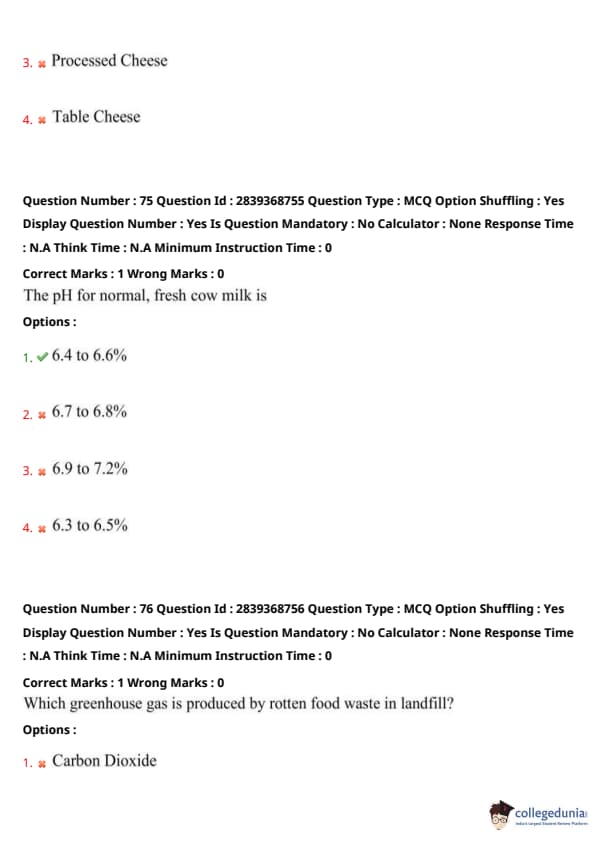
The pH for normal, fresh cow milk is
View Solution
Step 1: The natural pH of fresh cow milk is slightly acidic.
Step 2: The acceptable pH range is 6.4 to 6.6 for healthy milk. Quick Tip: Normal cow milk pH: 6.4 to 6.6
Which greenhouse gas is produced by rotten food waste in landfill?
View Solution
Step 1: Food waste decomposes anaerobically in landfills.
Step 2: This anaerobic decomposition produces methane, a potent greenhouse gas. Quick Tip: Rotten food waste → Anaerobic decay → Methane
Process of burning of non-biodegradable solid waste is called \hspace{2cm}
View Solution
Step 1: Non-biodegradable waste cannot be decomposed naturally.
Step 2: Such waste is burned at high temperatures in incinerators. Quick Tip: Incineration = Burning of non-biodegradable solid waste
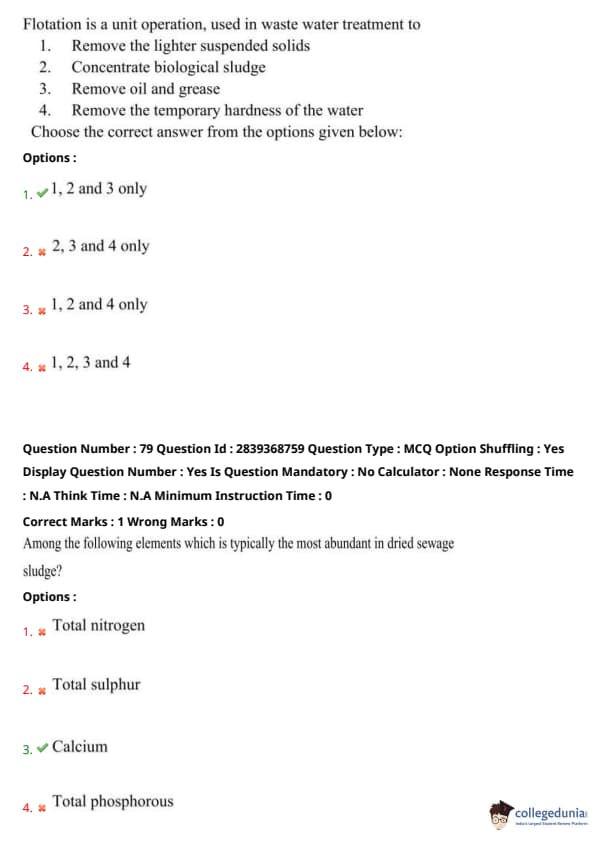
Flotation is a unit operation, used in waste water treatment to
1. Remove the lighter suspended solids
2. Concentrate biological sludge
3. Remove oil and grease
4. Remove the temporary hardness of the water
Choose the correct answer from the options given below:
View Solution
Step 1: Flotation is effective for separating light particles.
Step 2: It helps concentrate sludge and remove oil/grease.
Step 3: It does **not** remove hardness, which requires chemical treatment. Quick Tip: Flotation = Removes suspended solids, sludge, oil/grease — not water hardness
Among the following elements which is typically the most abundant in dried sewage sludge?
View Solution
Step 1: Dried sewage sludge consists of various elements including metals and nutrients.
Step 2: Among them, calcium is typically the most abundant due to lime and other calcium-containing compounds used in treatment. Quick Tip: Calcium is the dominant element in dried sewage sludge due to treatment additives.
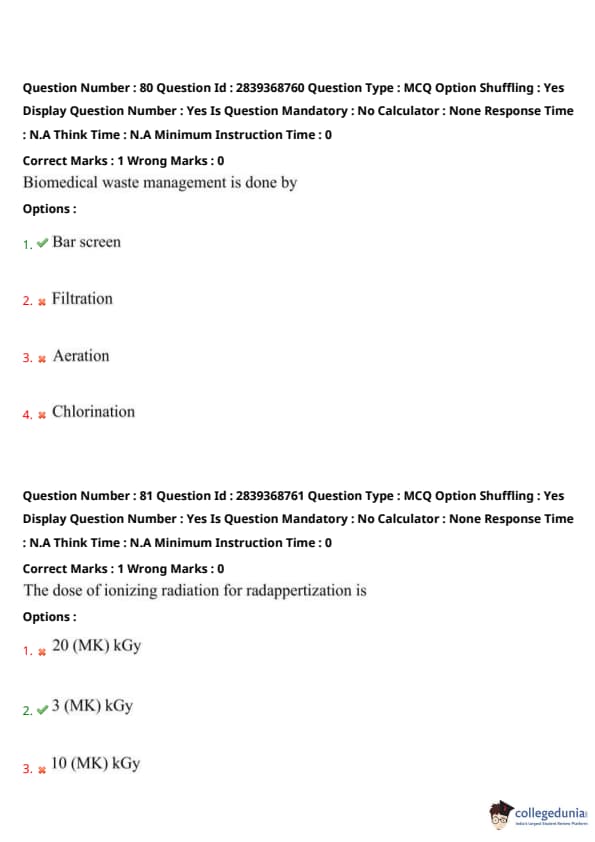
Biomedical waste management is done by
View Solution
Step 1: Biomedical waste often contains large particles or objects.
Step 2: Bar screens help in removing such large solid wastes from the system before further treatment. Quick Tip: Bar screen = Initial stage of biomedical waste management (removes solids).
The dose of ionizing radiation for radappertization is
View Solution
Step 1: Radappertization is a food irradiation process used to achieve commercial sterility.
Step 2: It typically requires a dose around 3 Mega Gray (kGy) to destroy all viable microorganisms. Quick Tip: Radappertization dose ≈ 3 kGy to sterilize food.
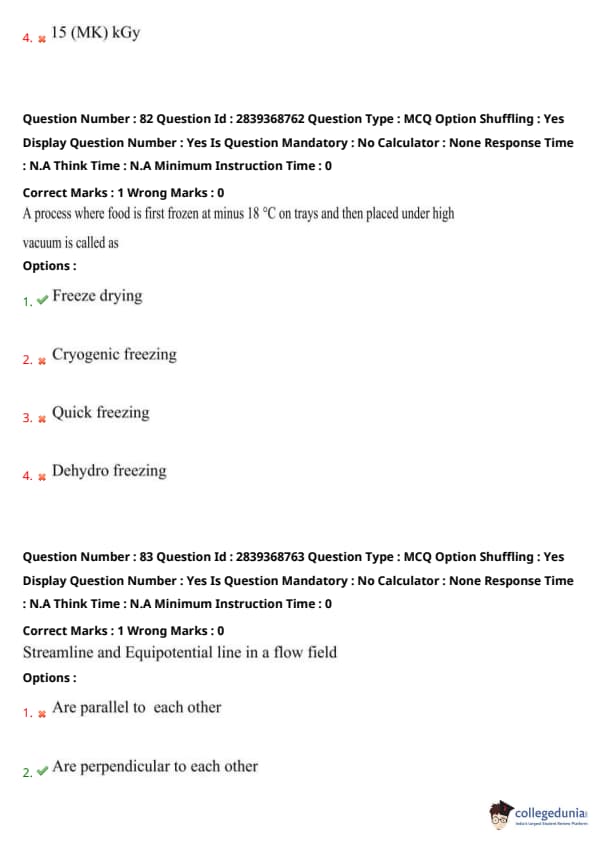
A process where food is first frozen at minus 18 °C on trays and then placed under high vacuum is called as
View Solution
Step 1: Freeze drying, or lyophilization, involves freezing the food and then removing moisture via sublimation under vacuum.
Step 2: It preserves food with minimal loss of quality and nutrients. Quick Tip: Freeze drying = Freeze at −18 °C + vacuum = sublimation drying.
Streamline and Equipotential line in a flow field
View Solution
Step 1: In a flow field, streamlines represent the path of fluid particles.
Step 2: Equipotential lines represent points of equal potential.
Step 3: These lines are always perpendicular in ideal flow. Quick Tip: Streamlines ⟂ Equipotential lines in ideal flow conditions.
A flow is called supersonic if the
View Solution
Step 1: Mach number = velocity of flow / speed of sound in medium.
Step 2: If Mach number > 1, the flow is supersonic.
Step 3: Supersonic range is generally between 1 and 5. Quick Tip: Supersonic flow: Mach number between 1 and 5.
Example of Non-Newtonian fluid is
View Solution
Step 1: Non-Newtonian fluids do not obey Newton’s law of viscosity.
Step 2: Emulsions like ketchup and paint exhibit shear-thinning or thickening behavior.
Step 3: Hence, emulsions are non-Newtonian. Quick Tip: Non-Newtonian fluids: Viscosity changes with applied force; examples include emulsions and toothpaste.
The dynamic viscosity of a liquid is \( 1.2 \times 10^{-4} \, Ns/m^2 \), whereas, the density is \( 600 \, kg/m^3 \).
The kinematic viscosity in \( m^2/s \) is
View Solution
Step 1: Use formula for kinematic viscosity: \( \nu = \frac{\mu}{\rho} \)
Step 2: \( \nu = \frac{1.2 \times 10^{-4}}{600} = 2.0 \times 10^{-7} \, m^2/s = 20 \times 10^{-8} \, m^2/s \) Quick Tip: Kinematic viscosity = Dynamic viscosity ÷ Density
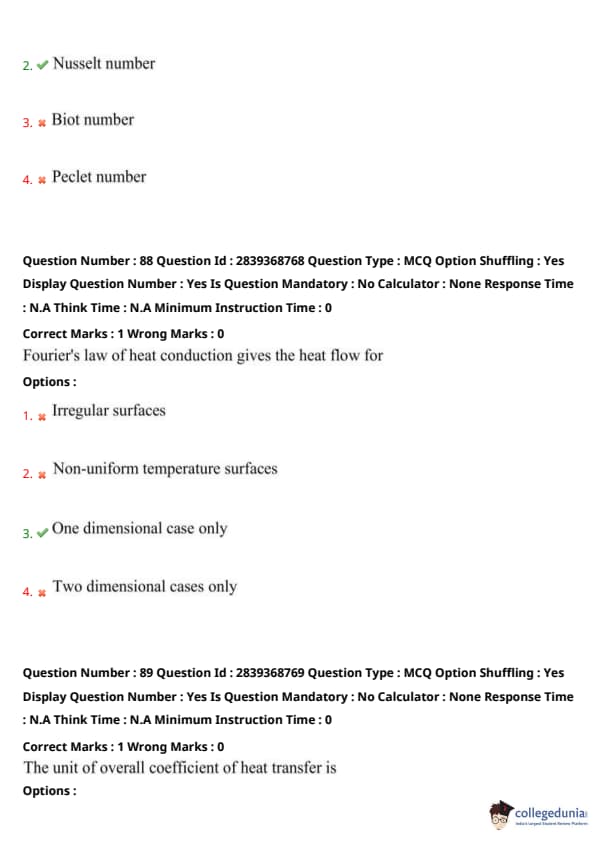
The rate of energy transferred by convection to that by conduction in a fluid is called
View Solution
Step 1: Nusselt number (\(Nu\)) is the ratio of convective to conductive heat transfer across a boundary.
Step 2: It is used to characterize convective heat transfer. Quick Tip: Nusselt number: \( Nu = \frac{hL}{k} \), higher values indicate dominance of convection.
Fourier's law of heat conduction gives the heat flow for
View Solution
Step 1: Fourier's law in its basic form applies to 1D steady-state heat conduction.
Step 2: For higher dimensions, the general form with gradient and vector calculus is used. Quick Tip: In 1D: \( q = -k \frac{dT}{dx} \); valid for steady-state with constant area.
The unit of overall coefficient of heat transfer is
View Solution
Step 1: The heat transfer coefficient is given by \( Q = U A \Delta T \)
Step 2: Rearranging gives unit of \( U \) as \( \frac{Q}{A \Delta T} \Rightarrow W/m^2K \) Quick Tip: Always check the dimensions using the basic heat transfer formula \( Q = UA\Delta T \).
Heat flux through several resistances in series is analogous to the current flowing through
View Solution
Step 1: In thermal systems, resistances in series imply heat must flow through each one successively.
Step 2: This is similar to electrical resistances in series where current remains same. Quick Tip: Use thermal-electric analogies: Heat flow is like current, thermal resistance is like electrical resistance.
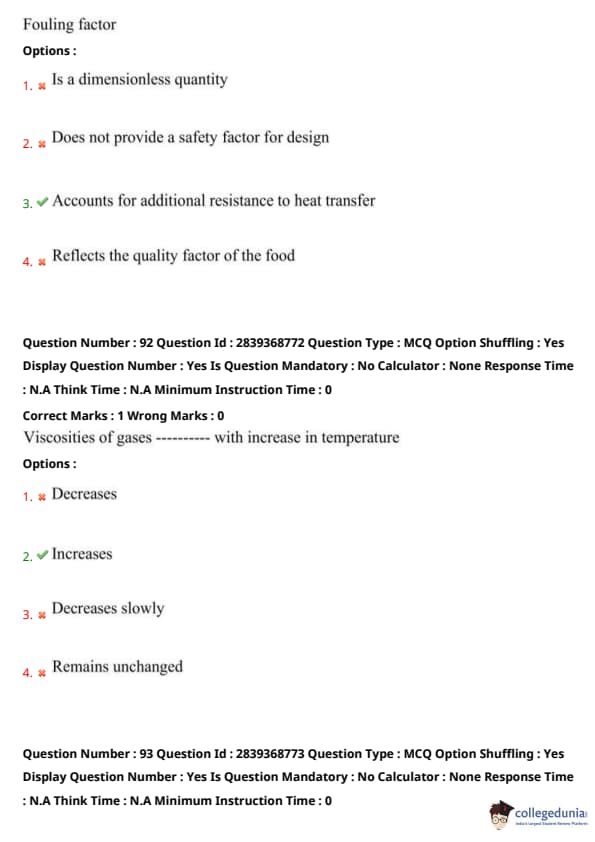
Fouling factor
View Solution
Step 1: Fouling factor quantifies the expected reduction in heat transfer due to deposit accumulation.
Step 2: It is used in design to ensure sufficient area and efficiency in heat exchangers. Quick Tip: Remember: Fouling factor = extra thermal resistance due to deposits on heat transfer surfaces.
Viscosities of gases ----------- with increase in temperature
View Solution
Step 1: As temperature increases, molecular movement increases.
Step 2: This leads to greater momentum transfer in gases, hence viscosity increases. Quick Tip: For gases: Higher temperature means higher viscosity. For liquids, it's usually the opposite.
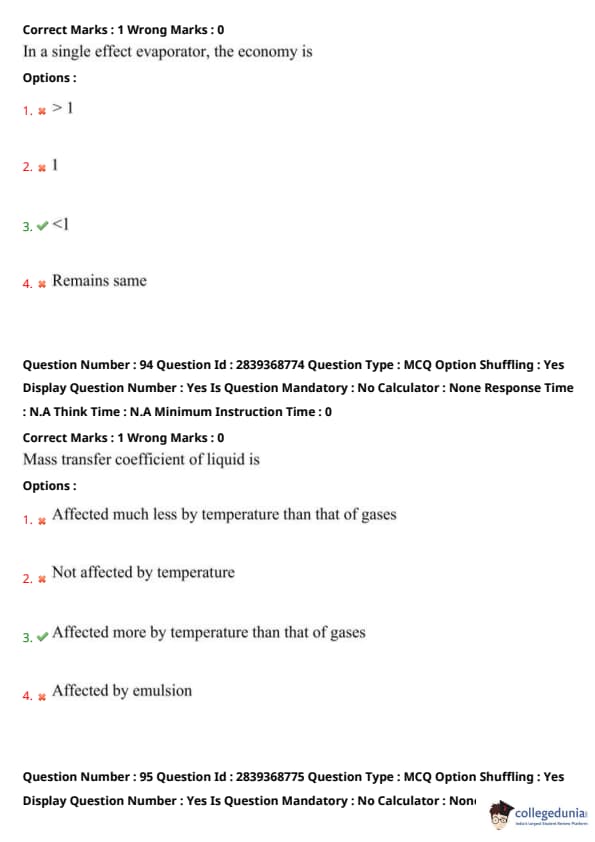
In a single effect evaporator, the economy is
View Solution
Step 1: Economy of an evaporator is defined as the amount of vapor produced per unit mass of steam used.
Step 2: In a single effect evaporator, this is usually less than 1 due to energy losses. Quick Tip: Multi-effect evaporators are used to increase economy beyond 1 by using vapor from one effect as heating medium for the next.
Mass transfer coefficient of liquid is
View Solution
Step 1: The viscosity and diffusivity of liquids are significantly affected by temperature.
Step 2: This results in a more noticeable change in mass transfer coefficient for liquids with temperature variations compared to gases. Quick Tip: Mass transfer in liquids is more sensitive to temperature due to stronger intermolecular interactions than in gases.
Molecular diffusion is caused by
View Solution
Step 1: Molecular diffusion is a result of random motion of particles driven by thermal energy.
Step 2: This movement causes the molecules to spread from regions of higher concentration to lower concentration. Quick Tip: Thermal energy increases molecular motion, which enhances diffusion.
_____ exploits the differences in aerodynamic properties of the food and the contaminants
View Solution
Step 1: Aspiration is a cleaning method used to separate lighter contaminants from food particles based on aerodynamic properties.
Step 2: Air flow carries away light particles (like husks or dust) while heavier food items fall due to gravity. Quick Tip: Aspiration is commonly used in grain cleaning processes to remove chaff and dust.
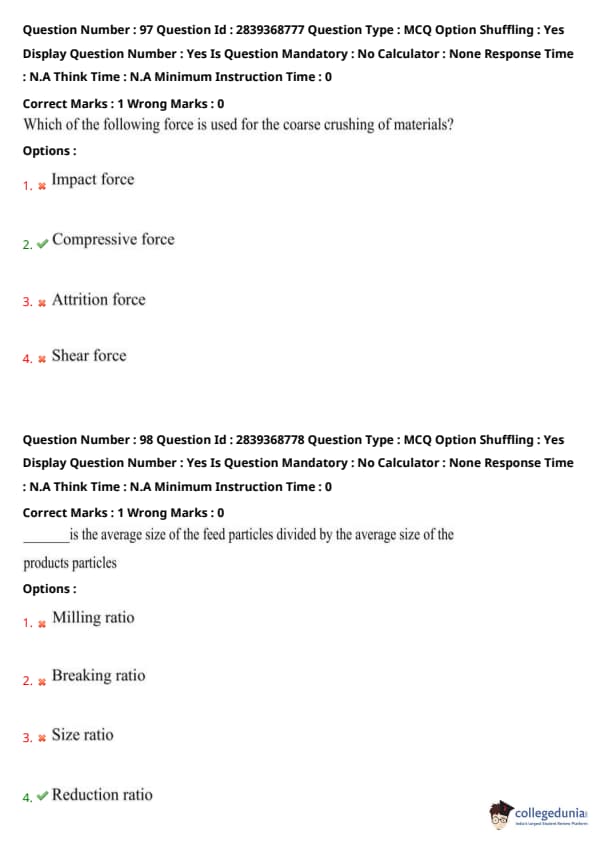
Which of the following force is used for the coarse crushing of materials?
View Solution
Step 1: Coarse crushing is typically carried out in jaw crushers or gyratory crushers.
Step 2: These devices primarily apply compressive force to reduce large chunks of material into smaller fragments. Quick Tip: Coarse crushing uses compressive force; fine grinding often involves attrition or impact.
_____ is the average size of the feed particles divided by the average size of the product particles.
View Solution
Step 1: The reduction ratio is a measure of the size reduction efficiency of a crusher or mill.
Step 2: It is calculated as the ratio of the average feed size to the average product size. Quick Tip: Higher reduction ratio means more efficient size reduction.
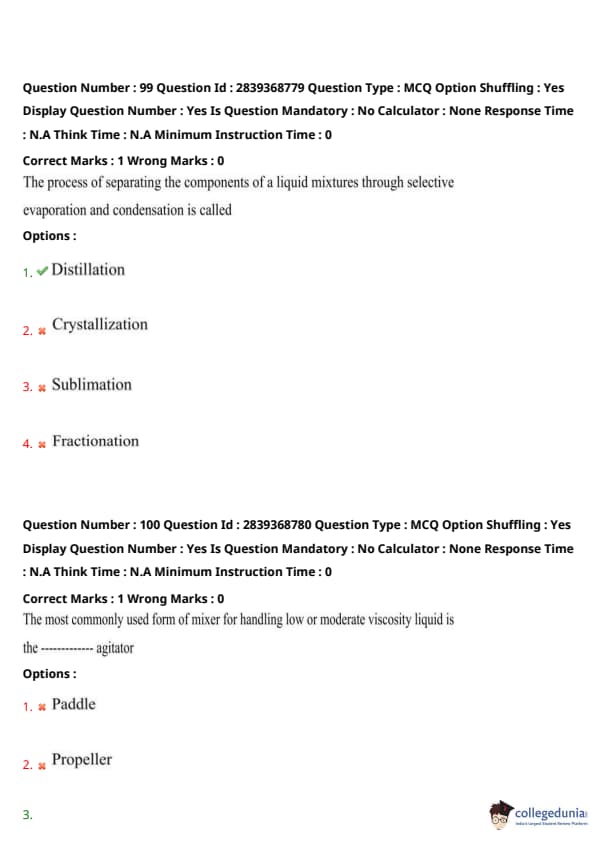
The process of separating the components of a liquid mixture through selective evaporation and condensation is called
View Solution
Step 1: Distillation is a technique used to separate components in a liquid mixture.
Step 2: It works by heating the mixture to evaporate the more volatile component and then condensing the vapor to collect the purified substance. Quick Tip: Distillation involves evaporation followed by condensation for separation based on boiling points.
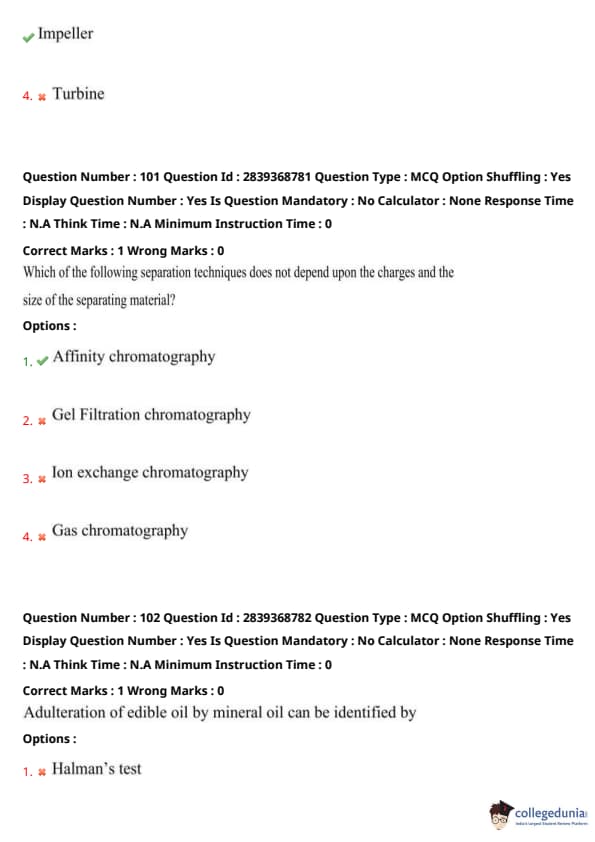
The most commonly used form of mixer for handling low or moderate viscosity liquid is the _________ agitator
View Solution
Step 1: Impeller agitators are effective for mixing low to moderately viscous liquids.
Step 2: They provide efficient circulation and shear, suitable for most general liquid mixing applications. Quick Tip: Impeller agitators are widely used in industries for liquid mixing tasks due to their versatility.
Which of the following separation techniques does not depend upon the charges and the size of the separating material?
View Solution
Step 1: Affinity chromatography relies on specific interactions between a molecule and a ligand attached to a stationary phase.
Step 2: It is highly selective and does not depend on charge or molecular size, unlike ion exchange or gel filtration. Quick Tip: Affinity chromatography is based on biological specificity, not physical properties like size or charge.
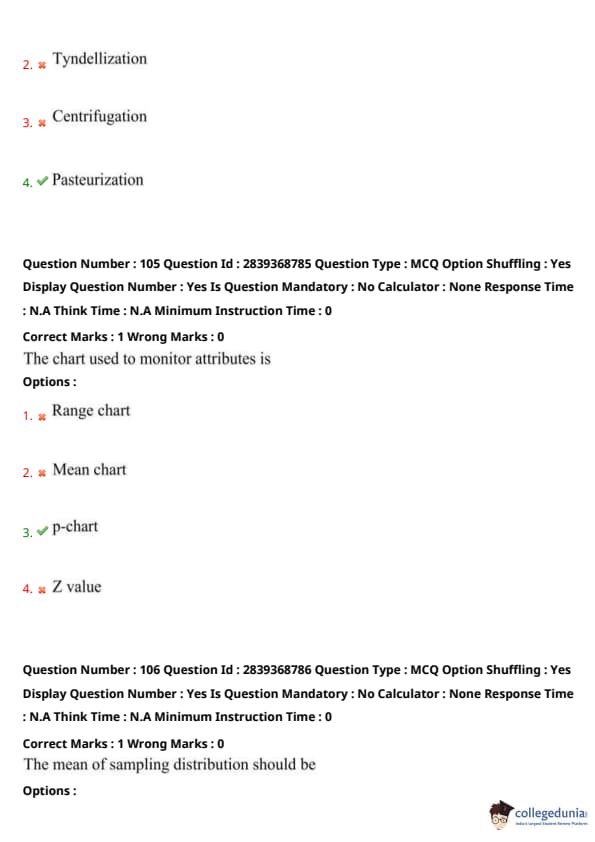
Adulteration of edible oil by mineral oil can be identified by
View Solution
Step 1: Holde’s test is a qualitative method used to detect mineral oils in edible oils.
Step 2: It relies on the solubility difference in petroleum ether, revealing mineral oil presence. Quick Tip: Holde’s test is a key method to ensure purity of edible oils and detect harmful adulterants.
Black pepper is adulterated by
View Solution
Step 1: Papaya seeds resemble black pepper in size and appearance.
Step 2: They are often used as an adulterant due to their similar look but lack of pungency. Quick Tip: To detect papaya seed adulteration, immerse pepper in water; papaya seeds float due to lower density.
Phosphatase test is used as an indicator for
View Solution
Step 1: The phosphatase enzyme is inactivated by proper pasteurization.
Step 2: Its presence indicates inadequate heat treatment. Quick Tip: A negative phosphatase test confirms successful pasteurization of milk.
The chart used to monitor attributes is
View Solution
Step 1: Attribute charts are used for monitoring qualitative data (e.g., pass/fail, yes/no).
Step 2: The p-chart is used to monitor the proportion of defective items in a sample. Quick Tip: Use p-charts when dealing with proportions or percentages of defective units.
The mean of sampling distribution should be
View Solution
Step 1: According to the Central Limit Theorem, the sampling distribution of the sample mean is centered at the population mean.
Step 2: Therefore, the mean of the sampling distribution equals the process (population) mean. Quick Tip: The mean of the sampling distribution is an unbiased estimator of the population mean.
CCP in HACCP stands for
View Solution
Step 1: HACCP stands for Hazard Analysis and Critical Control Points.
Step 2: A Critical Control Point (CCP) is a step at which control can be applied to prevent or eliminate a food safety hazard. Quick Tip: Remember: CCP is the step where control is essential to ensure food safety.
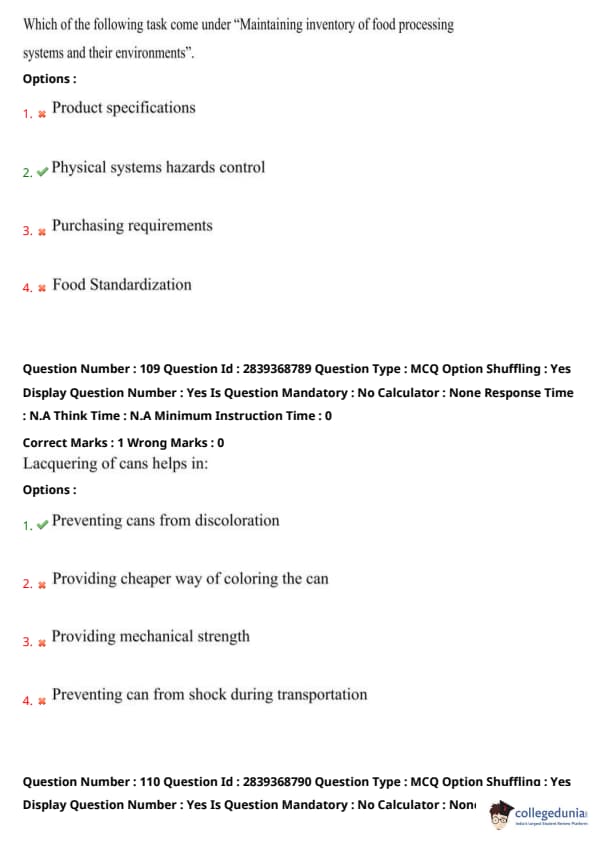
Which of the following task come under “Maintaining inventory of food processing systems and their environments”?
View Solution
Step 1: Inventory management in food processing includes monitoring physical conditions and hazard controls.
Step 2: Physical systems hazards control ensures that the processing environment remains safe and operational. Quick Tip: Physical systems hazards control involves ensuring machinery, tools, and facilities are not sources of contamination.
Lacquering of cans helps in:
View Solution
Step 1: Lacquering is the coating of cans with a protective layer.
Step 2: This coating prevents chemical reactions between the can material and the food content, thereby avoiding discoloration. Quick Tip: Lacquering prevents internal corrosion and staining of cans caused by acidic foods.
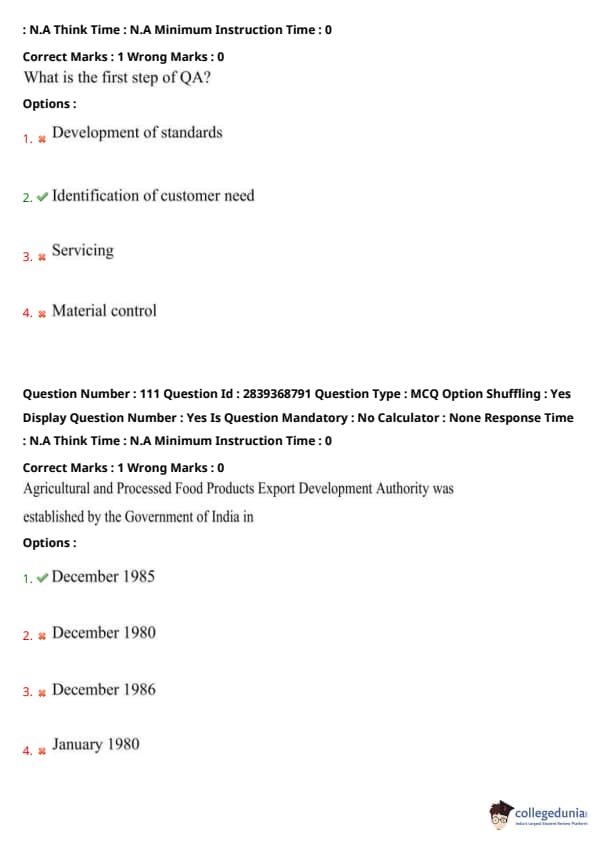
What is the first step of QA?
View Solution
Step 1: Quality Assurance (QA) begins by understanding the customer's expectations and requirements.
Step 2: Only after identifying these needs can quality planning and standard development follow. Quick Tip: In QA, identifying customer needs is foundational for setting benchmarks and ensuring satisfaction.
Agricultural and Processed Food Products Export Development Authority was established by the Government of India in
View Solution
Step 1: APEDA was established by the Government of India through an act passed in 1985.
Step 2: It aims to promote the export of agricultural and processed food products. Quick Tip: APEDA = Agricultural and Processed Food Products Export Development Authority; founded in December 1985.
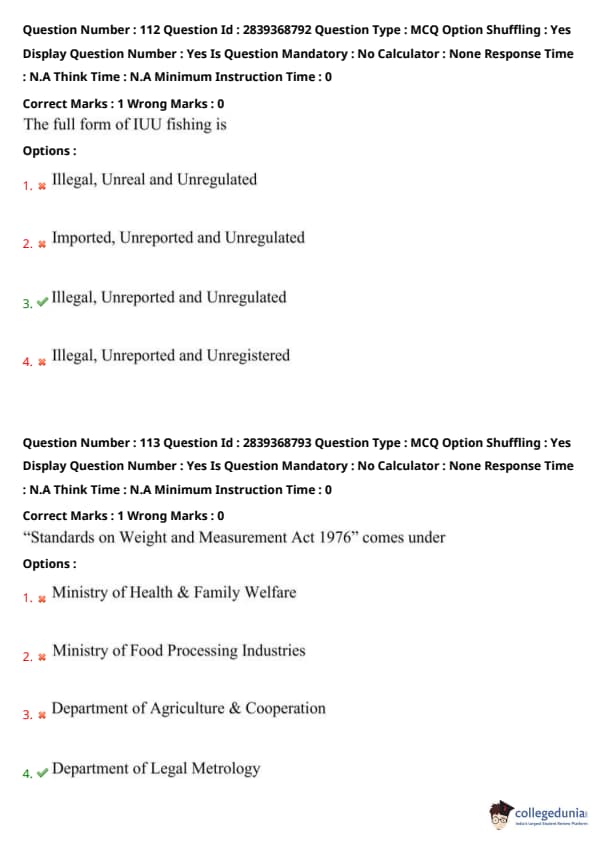
The full form of IUU fishing is
View Solution
Step 1: IUU fishing is a global problem affecting ocean sustainability.
Step 2: The acronym stands for Illegal, Unreported and Unregulated fishing, and it includes activities that violate conservation or management measures. Quick Tip: IUU fishing = Illegal, Unreported, Unregulated — key focus area in marine conservation.
"Standards on Weight and Measurement Act 1976" comes under
View Solution
Step 1: The “Standards of Weights and Measures Act, 1976” is enforced under the Legal Metrology framework.
Step 2: It deals with accurate weights and measures in trade and commerce, overseen by the Department of Legal Metrology. Quick Tip: Weight and Measurement Acts are under Legal Metrology — ensures fairness in trade practices.
FSSAI stands for
View Solution
Step 1: FSSAI is the regulatory body for food safety in India.
Step 2: The correct expansion is “Food Safety and Standards Authority of India.” Quick Tip: FSSAI = Food Safety and Standards Authority of India — responsible for food safety regulations.
Food Safety and Standards Authority of India (FSSAI) was formed in the year
View Solution
Step 1: FSSAI was established under the Food Safety and Standards Act, 2006.
Step 2: It became fully operational in the year 2011. Quick Tip: FSSAI started functioning fully in 2011, despite the act being passed in 2006.
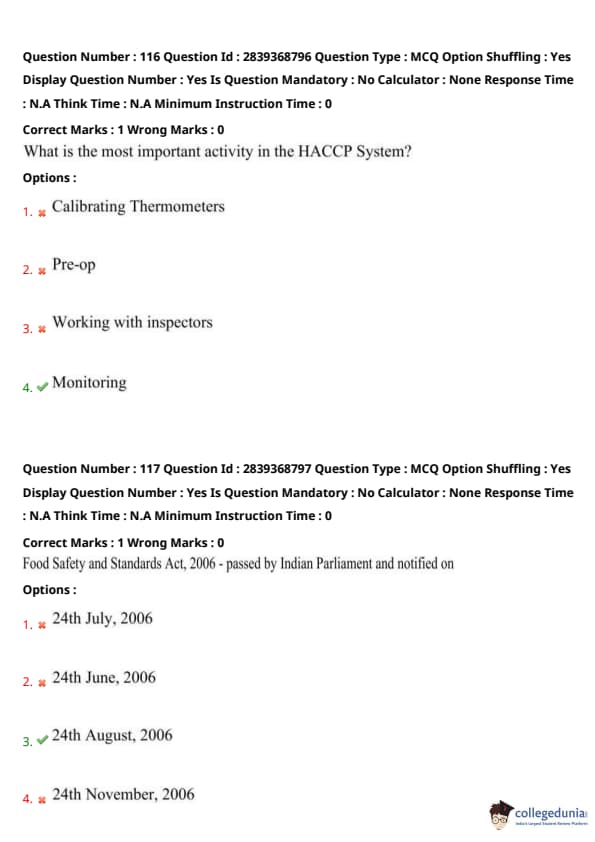
What is the most important activity in the HACCP System?
View Solution
Step 1: HACCP focuses on identifying critical control points in food processing.
Step 2: Monitoring ensures that these points stay within safety limits and is the core of HACCP. Quick Tip: In HACCP, monitoring is key to ensuring hazards are under control at critical points.
Food Safety and Standards Act, 2006 – passed by Indian Parliament and notified on
View Solution
Step 1: The Food Safety and Standards Act, 2006 was passed by the Indian Parliament.
Step 2: The official date of notification of the act was 24th August, 2006. Quick Tip: Always remember the FSS Act was notified on 24th August, 2006, even though passed earlier.
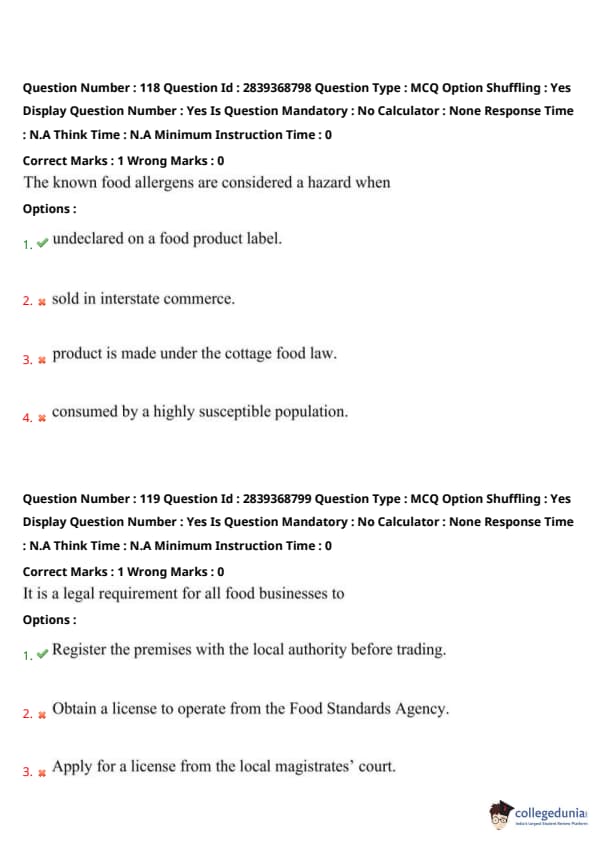
The known food allergens are considered a hazard when
View Solution
Step 1: Food allergens must be declared clearly to ensure consumer safety.
Step 2: Failure to declare known allergens can cause serious health risks, making it a hazard. Quick Tip: Label transparency is critical—undeclared allergens can lead to food safety violations.
It is a legal requirement for all food businesses to
View Solution
Step 1: According to food law, all food businesses must register with local authorities.
Step 2: This step ensures traceability and accountability before beginning operations. Quick Tip: Food business registration with the local authority is mandatory and usually free of charge.
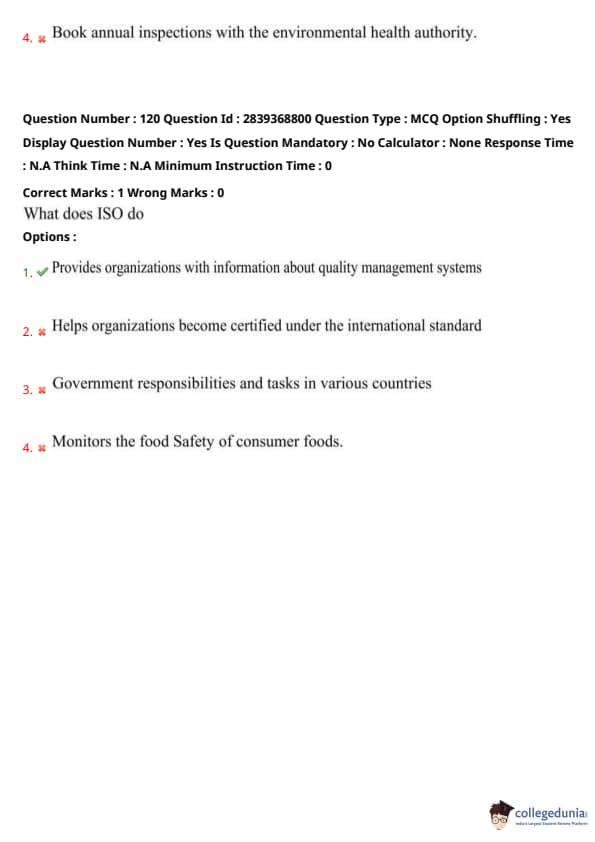
What does ISO do
View Solution
Step 1: ISO (International Organization for Standardization) sets out global standards.
Step 2: It provides frameworks and guidelines, especially for quality management. Quick Tip: Remember: ISO defines standards—it doesn’t certify; certification is done by accredited bodies.


























Comments