TS PGECET 2024 Aerospace Engineering Question Paper is available for download here. Jawaharlal Nehru Technological University Hyderabad on behalf of Telangana Council of Higher Education (TGCHE) conducted TS PGECET 2024 Aerospace Engineering on June 10 in Shift 2 from 2 PM to 4 PM. TS PGECET Question Paper 2024 consists of 120 MCQ-based questions in total carrying 1 mark each to be attempted in the duration of 2 hours.
TS PGECET 2024 Aerospace Engineering Question Paper with Answer Key PDF
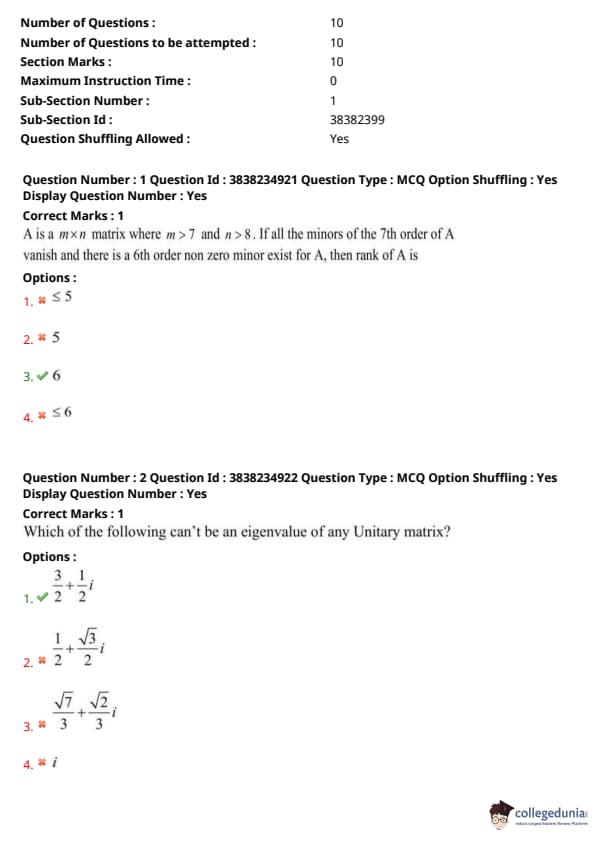
Question 1:
A is a \( m \times n \) matrix where \( m > 7 \) and \( n > 8 \). If all the minors of the 7th order of A vanish and there is a 6th order non-zero minor existing for A, then rank of A is
- (A) \( \leq 5 \)
- (B) 5
- (C) 6
- (D) \( \leq 6 \)
Question 2:
Which of the following can’t be an eigenvalue of any Unitary matrix?
- (A) \( \dfrac{3}{2} + \dfrac{i}{2} \)
- (B) \( \dfrac{1}{2} + \dfrac{\sqrt{3}}{2}i \)
- (C) \( \dfrac{\sqrt{7} + \sqrt{2}i}{3} \)
- (D) \( i \)
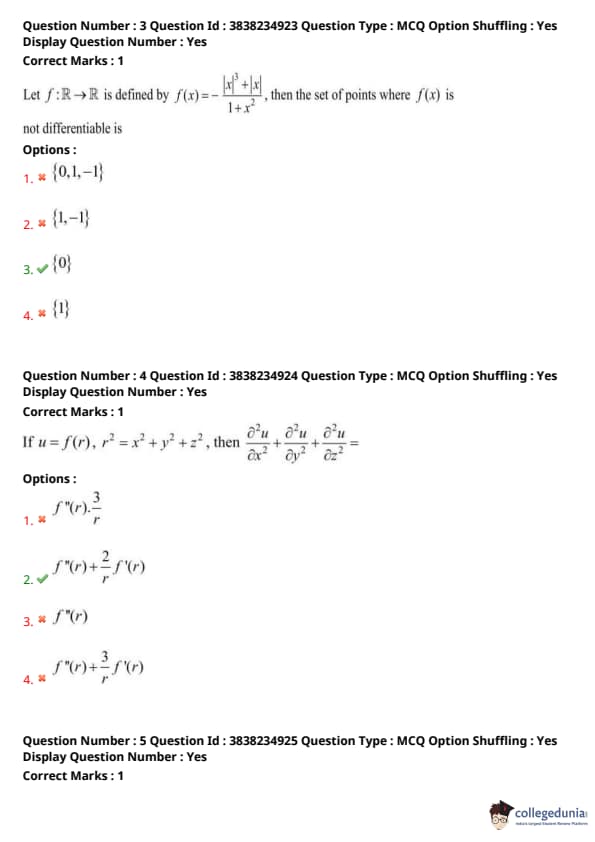
Question 3:
Let \( f : \mathbb{R} \to \mathbb{R} \) be defined by \( f(x) = \dfrac{|x| + |x|}{1 + x^2} \), then the set of points where \( f(x) \) is not differentiable is
- (A) \( \{0, 1, -1\} \)
- (B) \( \{-1\} \)
- (C) \( \{0\} \)
- (D) \( \{1\} \)
Question 4:
If \( u = f(r) \), \( r^2 = x^2 + y^2 + z^2 \), then \[ \frac{\partial^2 u}{\partial x^2} + \frac{\partial^2 u}{\partial y^2} + \frac{\partial^2 u}{\partial z^2} = ? \]
- (A) \( f''(r) \cdot \frac{3}{r} \)
- (B) \( f''(r) + \frac{2}{r} f'(r) \)
- (C) \( f''(r) \)
- (D) \( f''(r) + \frac{3}{r} f'(r) \)
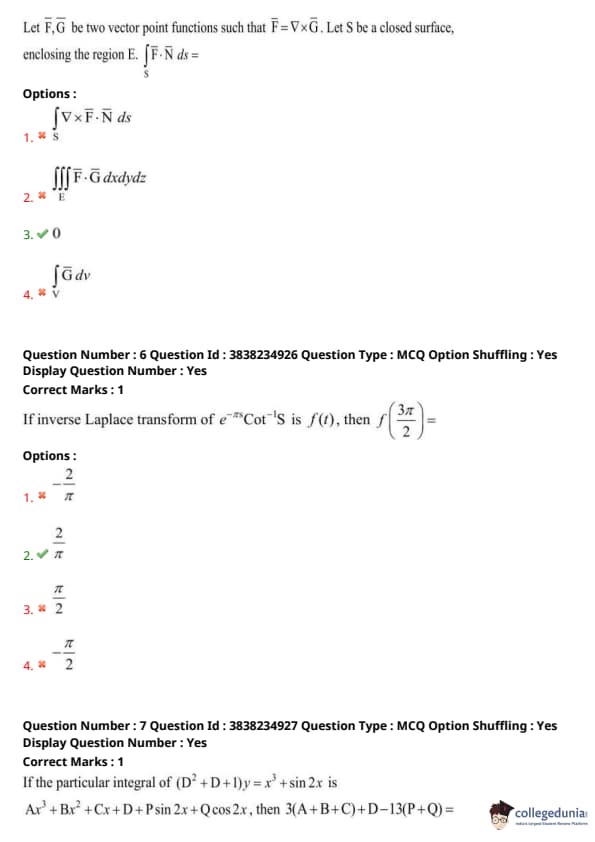
Question 5:
Let \( \vec{F}, \vec{G} \) be two vector point functions such that \( \vec{F} = \nabla \times \vec{G} \). Let \( S \) be a closed surface enclosing region \( E \).
Then \[ \iint_S \vec{F} \cdot \vec{n} \, ds = ? \]
- (A) \( \iiint_E \nabla \times \vec{F} \cdot \vec{n} \, ds \)
- (B) \( \iiint_E \vec{F} \cdot \vec{G} \, dx\,dy\,dz \)
- (C) \( 0 \)
- (D) \( \iiint_V \vec{G} \, dv \)
Question 6:
If the inverse Laplace transform of \( e^{-s} \cot^{-1}s \) is \( f(t) \), then \( f\left( \frac{3\pi}{2} \right) = \)
- (A) \( \frac{2}{\pi} \)
- (B) \( \frac{2}{\pi^2} \)
- (C) \( \frac{\pi}{2} \)
- (D) \( \frac{\pi}{2} \)
Question 7:
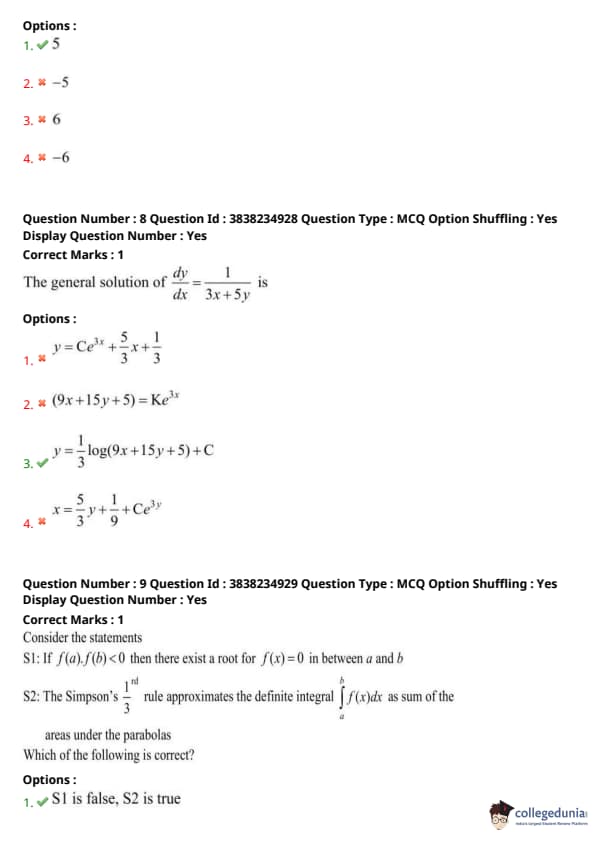
If the particular integral of \( (D^2 + D + 1)y = x^3 + \sin 2x \) is \[ Ax^3 + Bx^2 + Cx + D + P \sin 2x + Q \cos 2x \]
then \( 3(A + B + C) + D - 13(P + Q) = \)
- (A) \( 5 \)
- (B) \( -5 \)
- (C) \( 6 \)
- (D) \( -6 \)
Question 8:
The general solution of \[ \frac{dy}{dx} = \frac{1}{3x + 5y} \]
is
- (A) \( y = Ce^{3x} + \frac{5}{3}x + \frac{1}{3} \)
- (B) \( (9x + 15y + 5) = Ke^{3x} \)
- (C) \( y = \frac{1}{3} \log(9x + 15y + 5) + C \)
- (D) \( x = \frac{5}{3} y + \frac{1}{9} C e^{3y} \)
Question 9:
Consider the statements
S1: If \( f(a) \cdot f(b) < 0 \) then there exists a root for \( f(x) = 0 \) in between \( a \) and \( b \)
S2: The Simpson's \( \frac{1}{3} \) rule approximates the definite integral \[ \int_a^b f(x)\, dx \]
as sum of the areas under the parabolas.
Which of the following is correct?
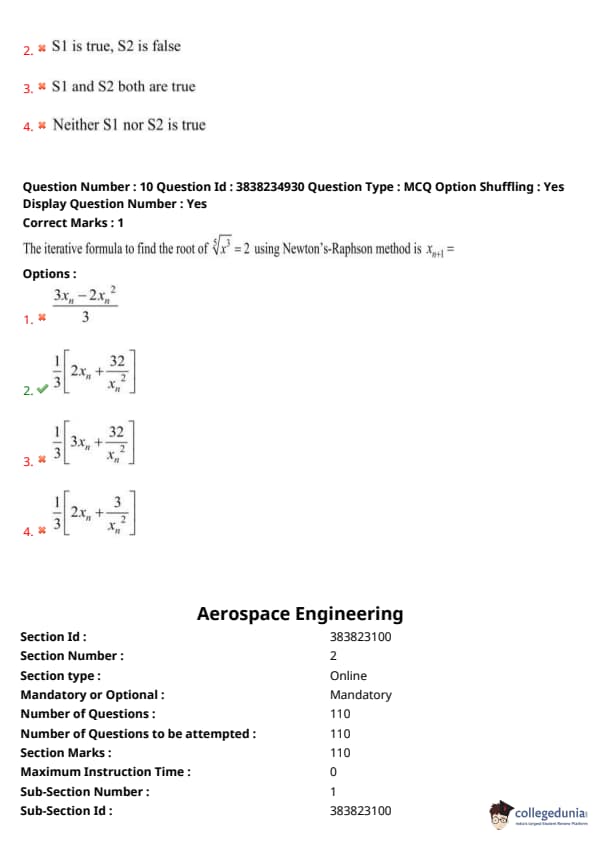
- (A) S1 is false, S2 is true
- (B) S1 is true, S2 is false
- (C) S1 and S2 both are true
- (D) Neither S1 nor S2 is true
Question 10:
The iterative formula to find the root of \( \sqrt[3]{x^2} = 2 \) using Newton-Raphson method is \( x_{n+1} = \)
- (A) \( \frac{3x_n - \frac{2x_n^2}{3}}{3} \)
- (B) \( \frac{1}{3} \left[ 2x_n + \frac{32}{x_n^2} \right] \)
- (C) \( \frac{1}{3} \left[ 3x_n + \frac{32}{x_n^2} \right] \)
- (D) \( \frac{1}{3} \left[ 3x_n - \frac{32}{x_n^2} \right] \)
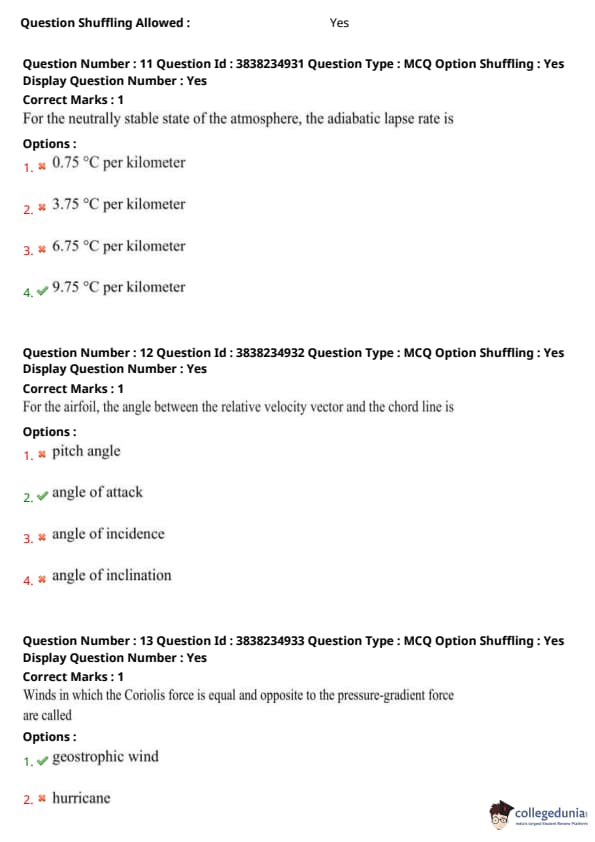
Question 11:
For the neutrally stable state of the atmosphere, the adiabatic lapse rate is
- (A) \( 0.75^\circ C \) per kilometer
- (B) \( 3.75^\circ C \) per kilometer
- (C) \( 6.75^\circ C \) per kilometer
- (D) \( 9.75^\circ C \) per kilometer
Question 12:
For the aircraft, the angle between the relative velocity vector and the chord line is
- (A) pitch angle
- (B) angle of attack
- (C) angle of incidence
- (D) angle of inclination
Question 13:
Winds in which the Coriolis force is equal and opposite to the pressure-gradient force are called:
- (A) geostrophic wind
- (B) hurricane
- (C) tornado
- (D) thunderstorm
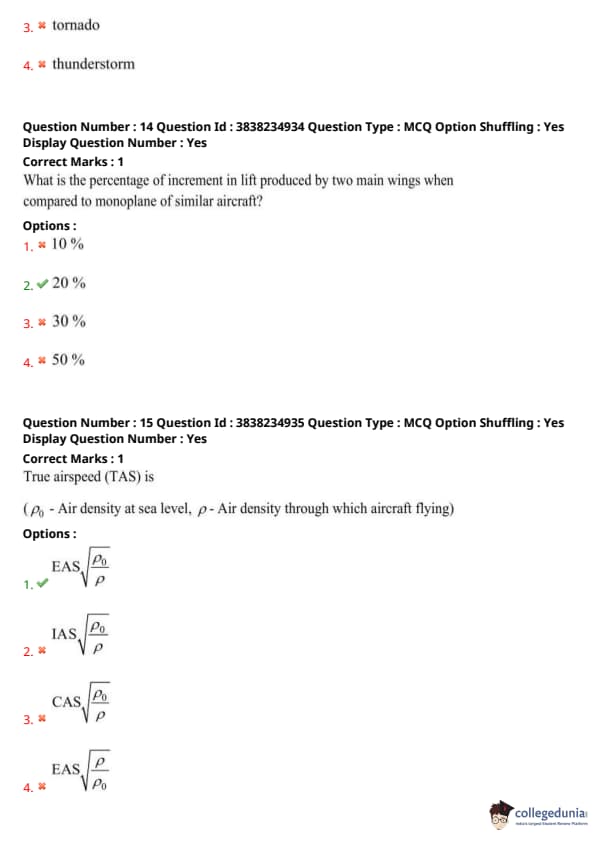
Question 14:
What is the percentage of increment in lift produced by two main wings when compared to monoplane of similar aircraft?
- (A) 10%
- (B) 20%
- (C) 30%
- (D) 50%
Question 15:
True airspeed (TAS) is
\[ (\rho_0 = Air density at sea level,\ \rho = Air density through which aircraft flying) \]
- (A) \( EAS \sqrt{\frac{\rho_0}{\rho}} \)
- (B) \( IAS \sqrt{\frac{\rho_0}{\rho}} \)
- (C) \( CAS \sqrt{\frac{\rho_0}{\rho}} \)
- (D) \( EAS \sqrt{\frac{\rho}{\rho_0}} \)
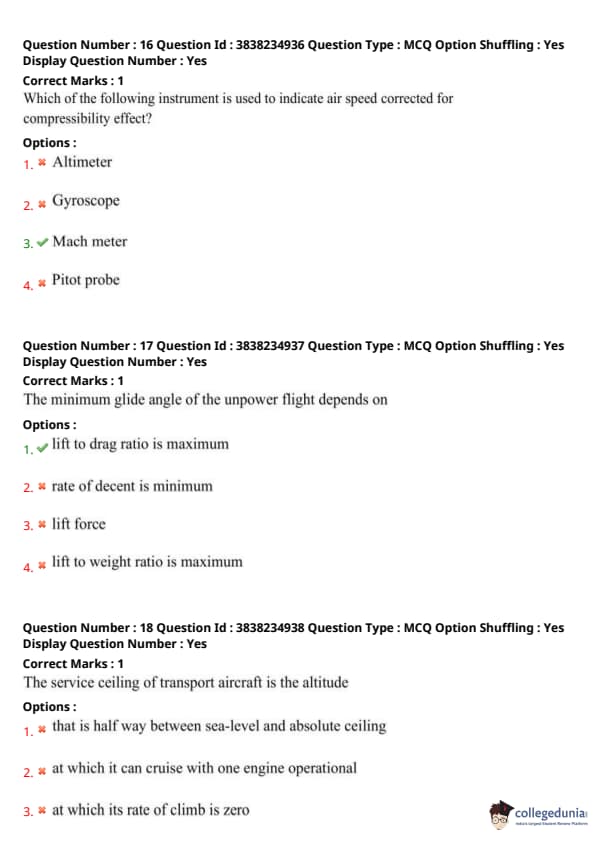
Question 16:
Which of the following instrument is used to indicate air speed corrected for compressibility effect?
- (A) Altimeter
- (B) Gyroscope
- (C) Mach meter
- (D) Pitot probe
Question 17:
The minimum glide angle of the unpowered flight depends on
- (A) lift to drag ratio is maximum
- (B) rate of descent is minimum
- (C) lift force
- (D) lift to weight ratio is maximum
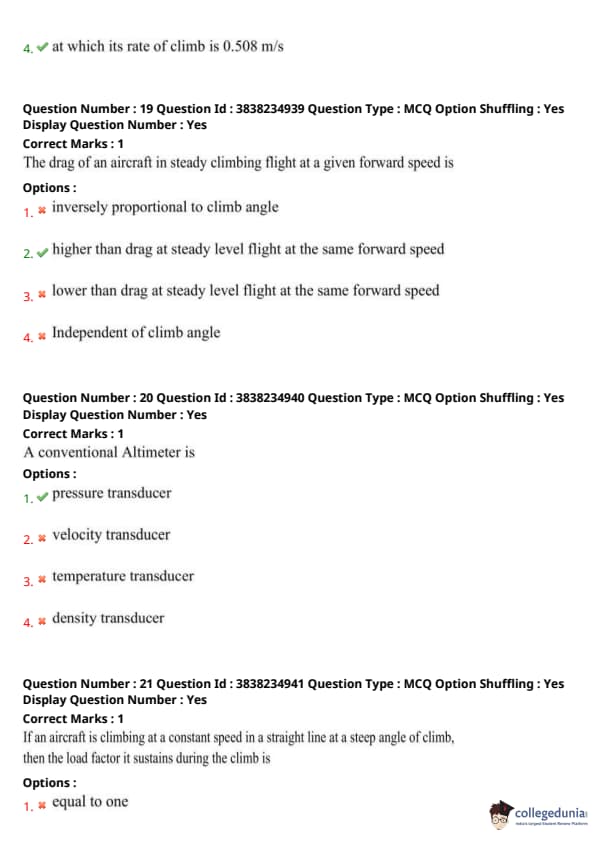
Question 18:
The service ceiling of transport aircraft is the altitude
- (A) that is half way between sea-level and absolute ceiling
- (B) at which it can cruise with one engine operational
- (C) at which its rate of climb is maximum
- (D) at which its rate of climb is 0.508 m/s
Question 19:
The drag of an aircraft in steady climbing flight at a given forward speed is
- (A) inversely proportional to climb angle
- (B) higher than drag at steady level flight at the same forward speed
- (C) lower than drag at steady level flight at the same forward speed
- (D) independent of climb angle
Question 20:
A conventional Altimeter is
- (A) pressure transducer
- (B) velocity transducer
- (C) temperature transducer
- (D) density transducer
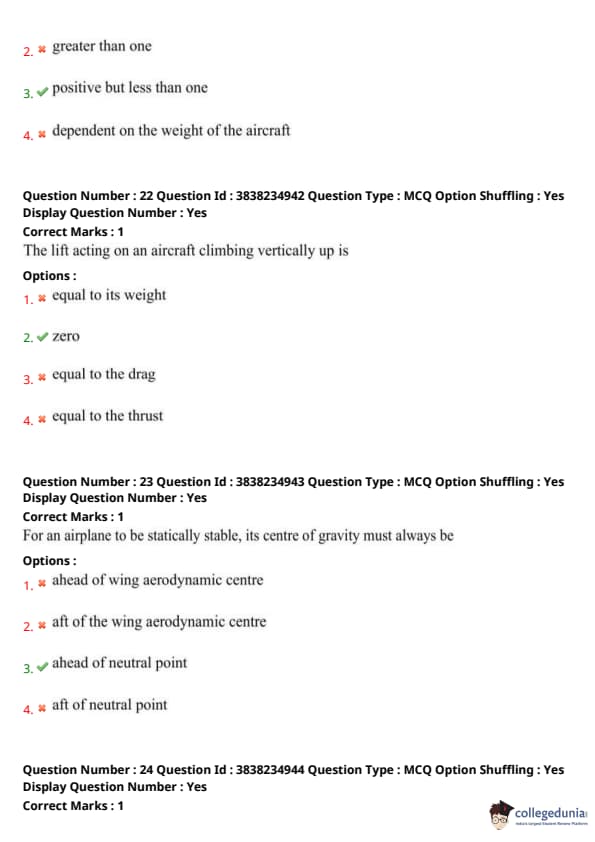
Question 21:
If an aircraft is climbing at a constant speed in a straight line at a steep angle of climb, the load factor it sustains during the climb is
- (A) equal to one
- (B) greater than one
- (C) positive but less than one
- (D) dependent on the weight of the aircraft
Question 22:
The lift acting on an aircraft climbing vertically up is
- (A) equal to its weight
- (B) zero
- (C) equal to the drag
- (D) equal to the thrust
Question 23:
For an airplane to be statically stable, its centre of gravity must always be
- (A) ahead of wing aerodynamic centre
- (B) aft of the wing aerodynamic centre
- (C) ahead of neutral point
- (D) aft of neutral point
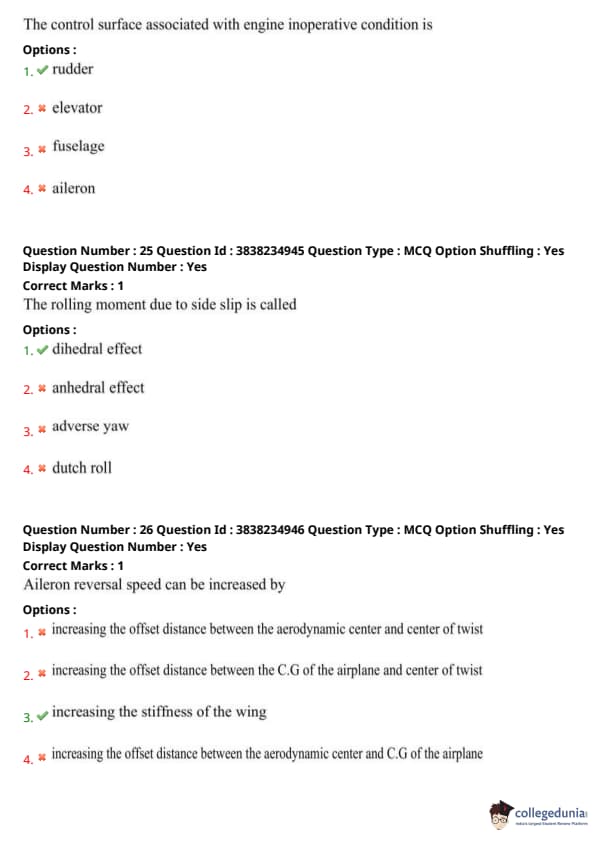
Question 24:
The control surface associated with engine inoperative condition is
- (A) rudder
- (B) elevator
- (C) fuselage
- (D) aileron
Question 25:
The rolling moment due to side slip is called
- (A) dihedral effect
- (B) anhedral effect
- (C) adverse yaw
- (D) dutch roll
Question 26:
Aileron reversal speed can be increased by
- (A) increasing the offset distance between the aerodynamic center and center of twist
- (B) increasing the offset distance between the C.G. of the airplane and center of twist
- (C) increasing the stiffness of the wing
- (D) increasing the offset distance between the aerodynamic center and C.G of the airplane
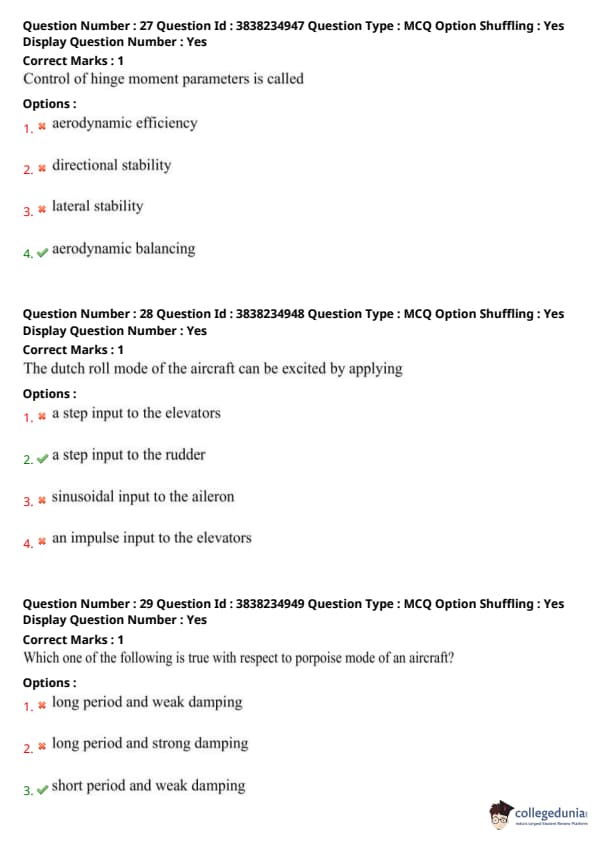
Question 27:
Control of hinge moment parameters is called
- (A) aerodynamic efficiency
- (B) directional stability
- (C) lateral stability
- (D) aerodynamic balancing
Question 28:
The dutch roll mode of the aircraft can be excited by applying
- (A) a step input to the elevators
- (B) a step input to the rudder
- (C) a sinusoidal input to the aileron
- (D) an impulse input to the elevators
Question 29:
Which one of the following is true with respect to the phugoid mode of an aircraft?
- (A) long period and weak damping
- (B) long period and strong damping
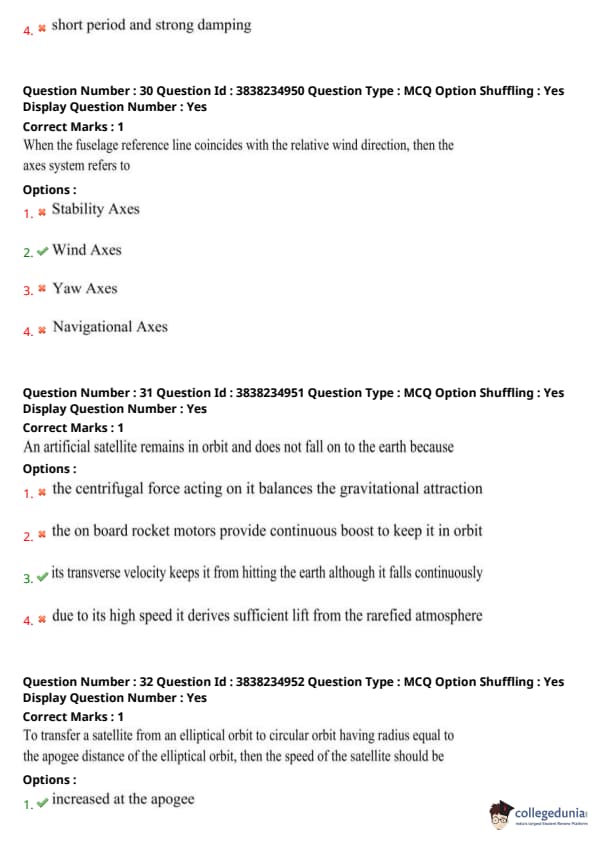
- (C) short period and weak damping
- (D) short period and strong damping
Question 30:
If the wind reference line coincides with the relative wind direction, then the axis system refers to
- (A) Stability Axes
- (B) Wind Axes
- (C) Yaw Axes
- (D) Navigational Axes
Question 31:
An artificial satellite remains in orbit and does not fall on to the Earth because
- (A) the centrifugal force acting on it balances the gravitational attraction
- (B) the on-board rocket motors provide continuous boost to keep it in orbit
- (C) its transverse velocity keeps it from hitting Earth although it falls continuously
- (D) due to its high speed it derives sufficient lift from the rarefied atmosphere
Question 32:
To transfer a satellite from an elliptical orbit into a circular orbit having a radius equal to the apogee distance of the elliptical orbit, then the speed of the satellite should be
- (A) increased at the apogee
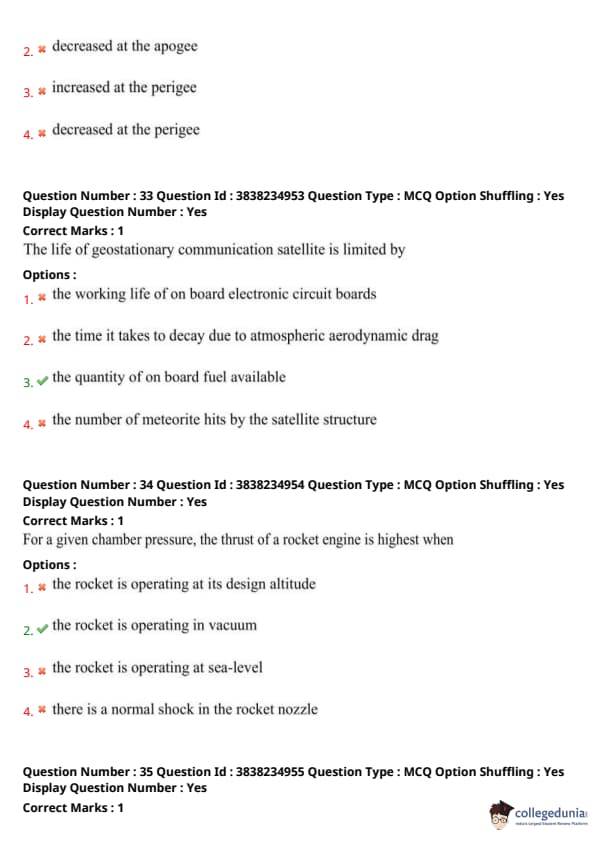
- (B) decreased at the apogee
- (C) increased at the perigee
- (D) decreased at the perigee
Question 33:
The life of a geostationary communication satellite is limited by
- (A) the working life of onboard electronic circuit boards
- (B) the time it takes to decay due to atmospheric aerodynamic drag
- (C) the quantity of onboard fuel available
- (D) the number of meteorite hits by the satellite structure
Question 34:
For a given chamber pressure, the thrust of a rocket engine is highest when
- (A) the rocket is operating at its design altitude
- (B) the rocket is operating in vacuum
- (C) the rocket is operating at sea-level
- (D) there is a normal shock in the rocket nozzle
Question 35:
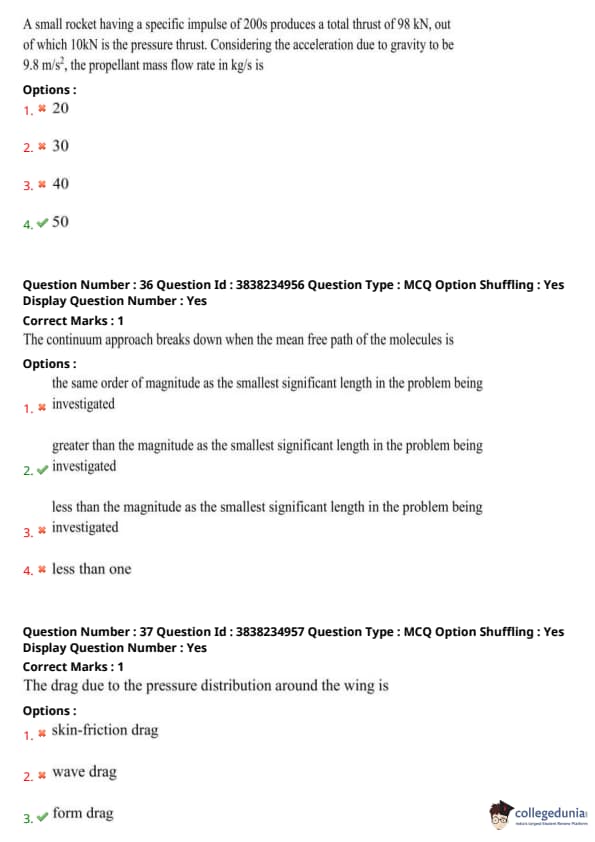
A small rocket having a specific impulse of 200s produces a total thrust of 980 N, out of which 100N is the pressure thrust. Considering the acceleration due to gravity to be \(9.8~m/s^2\), the propellant mass flow rate in kg/s is
- (A) 20
- (B) 30
- (C) 40
- (D) 50
Question 36:
The continuum approach breaks down when the mean free path of the molecules is
- (A) the same order of magnitude as the smallest significant length in the problem being investigated
- (B) greater than the magnitude as the smallest significant length in the problem being investigated
- (C) less than the magnitude as the smallest significant length in the problem being investigated
- (D) less than one
Question 37:
The drag due to the pressure distribution around the wing is
- (A) skin-friction drag
- (B) wave drag
- (C) form drag
- (D) profile drag
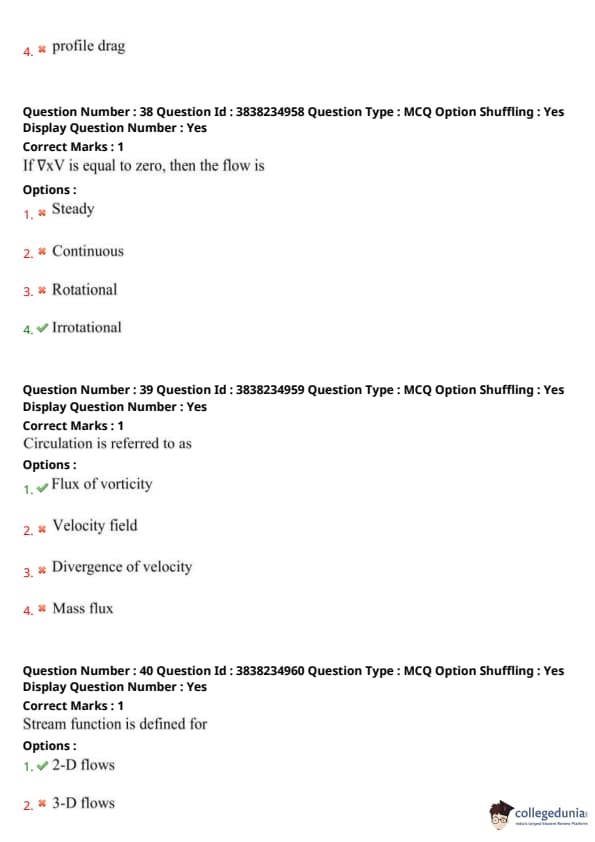
Question 38:
If \(\nabla \times \mathbf{V} = 0\), then the flow is
- (A) Steady
- (B) Continuous
- (C) Rotational
- (D) Irrotational
Question 39:
Circulation is referred to as
- (A) Flux of vorticity
- (B) Velocity field
- (C) Divergence of velocity
- (D) Mass flux
Question 40:
Stream function is defined for
- (A) 2-D flows
- (B) 3-D flows
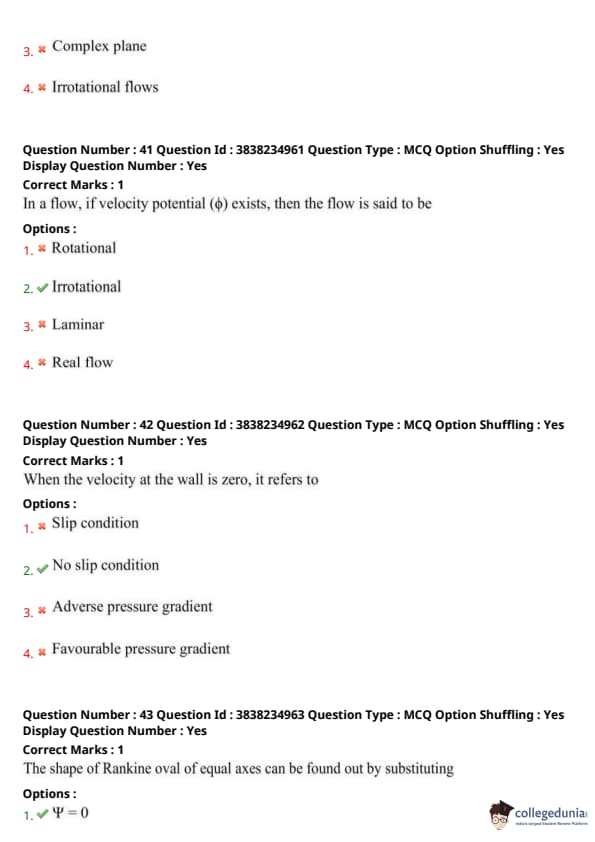
- (C) Complex plane
- (D) Irrotational flows
Question 41:
In a flow, if velocity potential (\(\phi\)) exists, then the flow is said to be
- (A) Rotational
- (B) Irrotational
- (C) Laminar
- (D) Real flow
Question 42:
When the velocity at the wall is zero, it refers to
- (A) Slip condition
- (B) No slip condition
- (C) Adverse pressure gradient
- (D) Favourable pressure gradient
Question 43:
The shape of Rankine oval of equal axes can be found out by substituting
- (A) \(\psi = 0\)
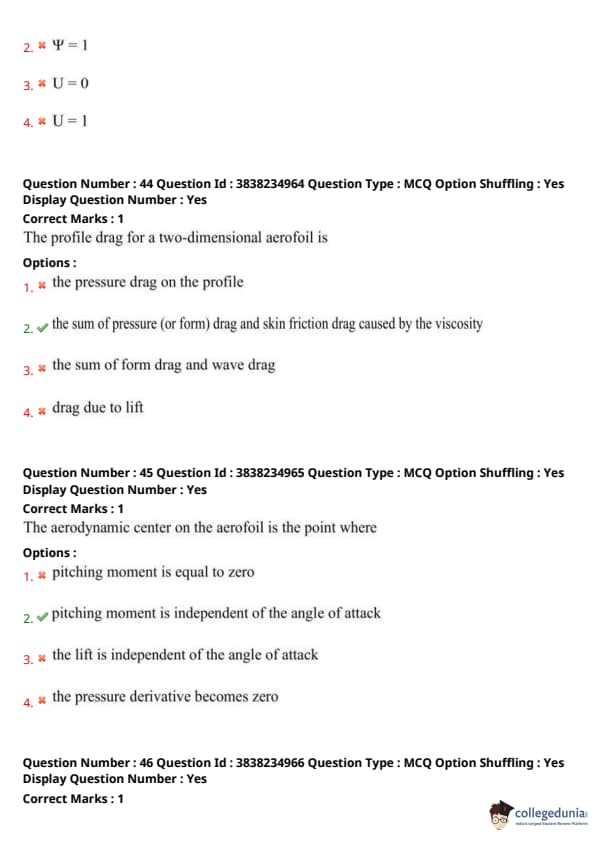
- (B) \(\psi = 1\)
- (C) \(U = 0\)
- (D) \(U = 1\)
Question 44:
The profile drag for a two-dimensional aerofoil is
- (A) the pressure drag on the profile
- (B) the sum of pressure (or form) drag and skin friction drag caused by the viscosity
- (C) the sum of form drag and wave drag
- (D) drag due to lift
Question 45:
The aerodynamic center on the aerofoil is the point where
- (A) pitching moment is equal to zero
- (B) pitching moment is independent of the angle of attack
- (C) the lift is independent of the angle of attack
- (D) the pressure derivative becomes zero
Question 46:
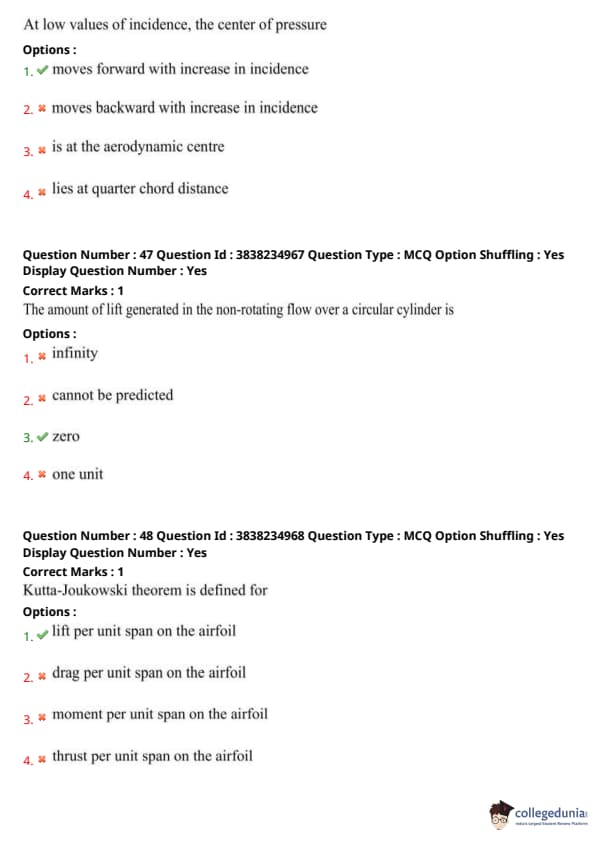
At low values of incidence, the center of pressure
- (A) moves forward with increase in incidence
- (B) moves backward with increase in incidence
- (C) is at the aerodynamic centre
- (D) lies at quarter chord distance
Question 47:
The amount of lift generated in the non-rotating flow over a circular cylinder is
- (A) infinity
- (B) cannot be predicted
- (C) zero
- (D) one unit
Question 48:
Kutta-Joukowski’s theorem is defined for
- (A) lift per unit span on the airfoil
- (B) drag per unit span on the airfoil
- (C) moment per unit span on the airfoil
- (D) thrust per unit span on the airfoil
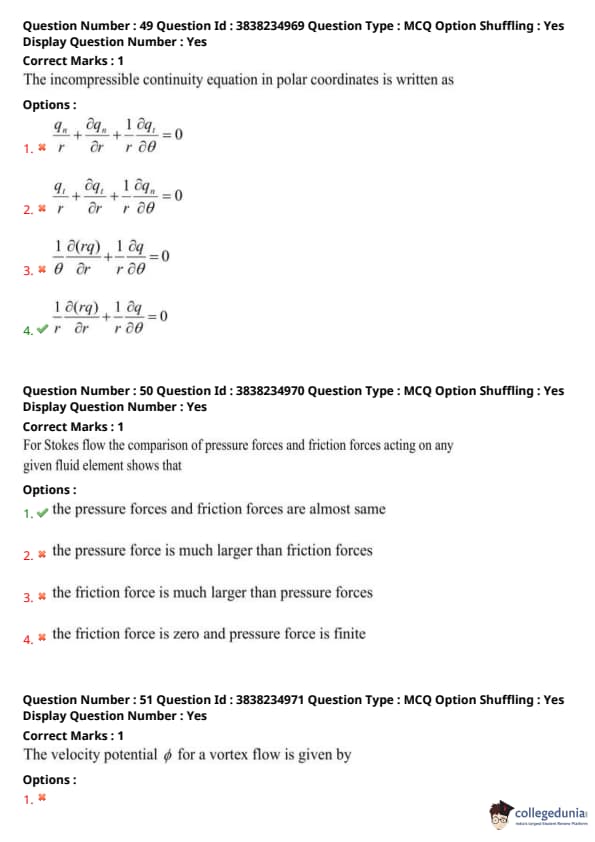
Question 49:
The incompressible continuity equation in polar coordinates is written as
- (A) \(\dfrac{\partial \rho}{\partial r} + \dfrac{1}{r} \dfrac{\partial \rho}{\partial \theta} = 0\)
- (B) \(\dfrac{\partial v_r}{\partial r} + \dfrac{\partial v_\theta}{\partial \theta} = 0\)
- (C) \(\dfrac{\partial v_r}{\partial r} + \dfrac{1}{r} \dfrac{\partial v_\theta}{\partial \theta} = 0\)
- (D) \(\dfrac{1}{r} \dfrac{\partial (r v_r)}{\partial r} + \dfrac{1}{r} \dfrac{\partial v_\theta}{\partial \theta} = 0\)
Question 50:
Fire Stoke’s 1st comparison of pressure forces and friction forces acting on any given fluid element shows that
- (A) the pressure forces and friction forces are almost same
- (B) the pressure force is much larger than friction forces
- (C) the friction force is much larger than pressure forces
- (D) the friction force is zero and pressure force is finite
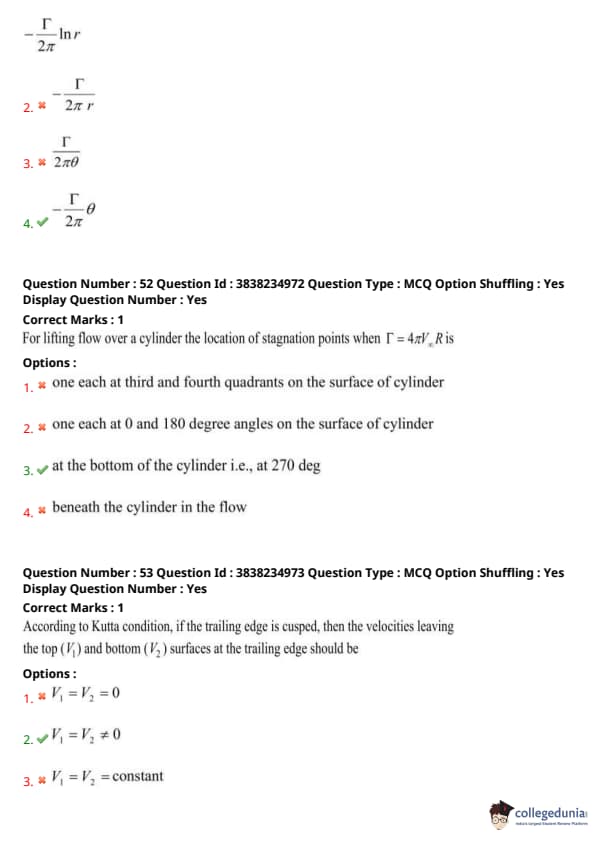
Question 51:
The velocity potential \(\phi\) for a vortex flow is given by
- (A) \(-\dfrac{\Gamma}{2\pi} \ln r\)
- (B) \(-\dfrac{\Gamma}{2\pi r}\)
- (C) \(\dfrac{\Gamma}{2\pi} \theta\)
- (D) \(\dfrac{\Gamma}{2\pi} r\)
Question 52:
In lifting flow over a cylinder the location of stagnation points when \(\Gamma = 4\pi U R\) is
- (A) one each at third and fourth quadrants on the surface of cylinder
- (B) one each at 0 and 180 degree angles on the surface of cylinder
- (C) on the bottom of the cylinder i.e., at 270 deg
- (D) beneath the cylinder in the flow
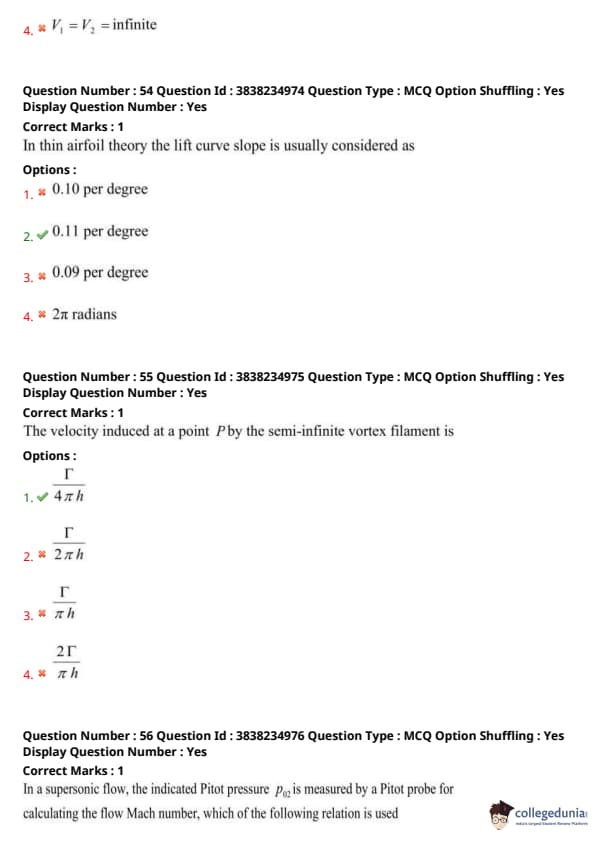
Question 53:
According to Kutta condition, if the trailing edge is cusped, then the velocities leaving the top (\(V_1\)) and bottom (\(V_2\)) surfaces at the trailing edge should be
- (A) \(V_1 \ne V_2 = 0\)
- (B) \(V_1 = V_2 \ne 0\)
- (C) \(V_1 \ne V_2 = constant\)
- (D) \(V_1 = V_2 = \infty\)
Question 54:
In thin airfoil theory the lift curve slope is usually considered as
- (A) \(0.10\) per degree
- (B) \(0.11\) per degree
- (C) \(0.09\) per degree
- (D) \(2\pi\) radians
Question 55:
The velocity induced at a point \(P\) by the semi-infinite vortex filament is
- (A) \(\dfrac{\Gamma}{4 \pi R}\)
- (B) \(\dfrac{\Gamma}{2 \pi R}\)
- (C) \(\dfrac{\Gamma}{\pi R}\)
- (D) \(\dfrac{2 \Gamma}{\pi R}\)
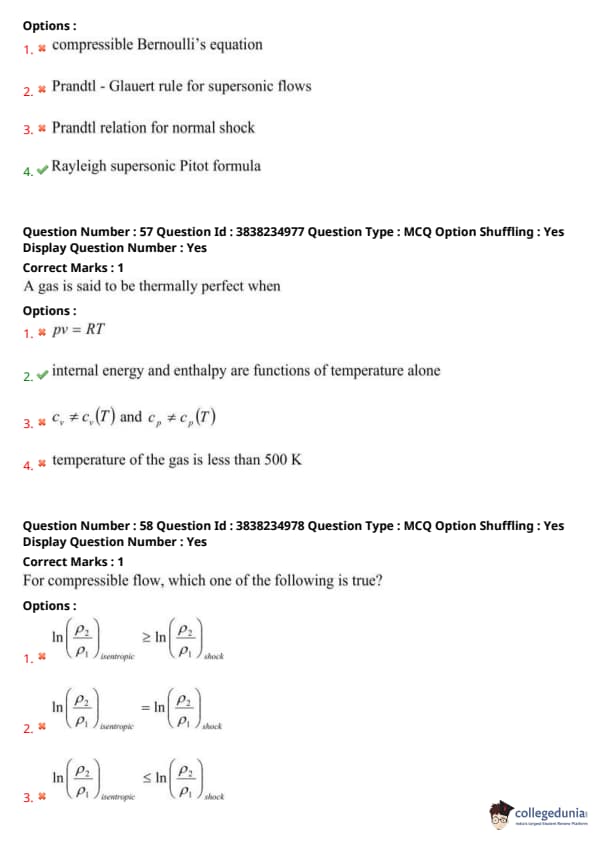
Question 56:
In a supersonic flow, the indicated Pitot pressure \(p_t\) is measured by a Pitot probe for calculating the flow Mach number, which of the following relation is used
- (A) compressible Bernoulli’s equation
- (B) Prandtl – Glauert rule for supersonic flows
- (C) Prandtl relation for normal shock
- (D) Rayleigh supersonic Pitot formula
Question 57:
A gas is said to be thermally perfect when
- (A) \(p = \rho R T\)
- (B) internal energy and enthalpy are functions of temperature alone
- (C) \(c_v + c_p(T)\) and \(c_p = c_p(T)\)
- (D) temperature of the gas is less than 500 K
Question 58:
For compressible flow, which one of the following is true?
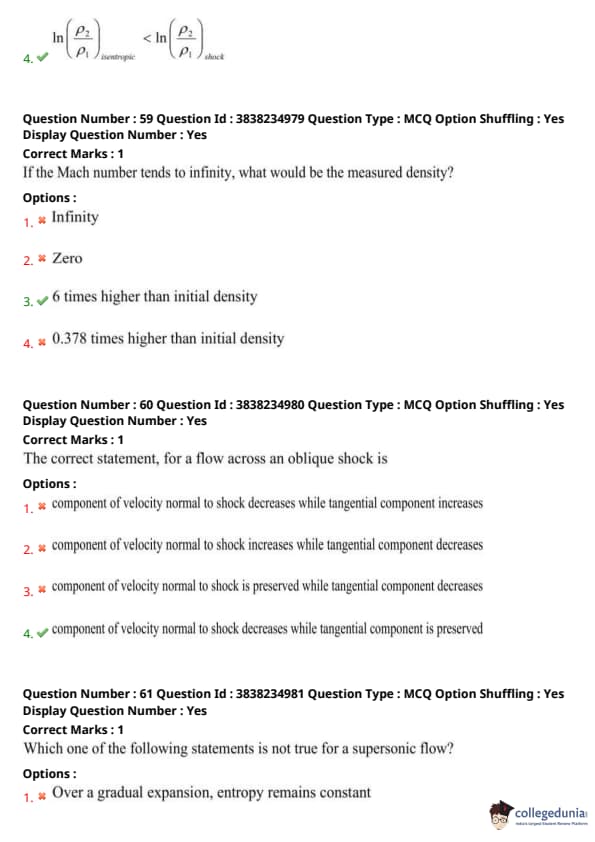
- (A) \(\left( \dfrac{\rho_2}{\rho_1} \right)_{average} > \ln\left( \dfrac{\rho_2}{\rho_1} \right)_{local}\)
- (B) \(\ln\left( \dfrac{\rho_2}{\rho_1} \right)_{average} > \left( \dfrac{\rho_2}{\rho_1} \right)_{local}\)
- (C) \(\ln\left( \dfrac{\rho_2}{\rho_1} \right)_{average} < \left( \dfrac{\rho_2}{\rho_1} \right)_{local}\)
- (D) None of the above
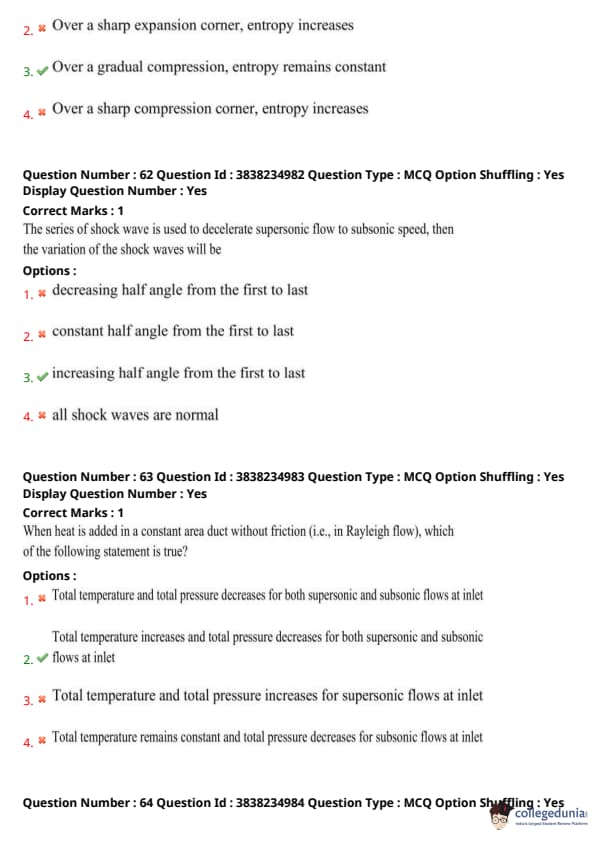
Question 59:
If the Mach number tends to infinity, what would be the measured density?
- (A) Infinity
- (B) Zero
- (C) \(\sqrt{6}\) times higher than initial density
- (D) 0.378 times higher than initial density
Question 60:
The correct statement, for a flow across an oblique shock is
- (A) component of velocity normal to shock decreases while tangential component increases
- (B) component of velocity normal to shock increases while tangential component decreases
- (C) component of velocity normal to shock is preserved while tangential component decreases
- (D) component of velocity normal to shock decreases while tangential component is constant
Question 61:
Which one of the following statements is not true for a supersonic flow?
- (A) Over a gradual expansion, entropy remains constant
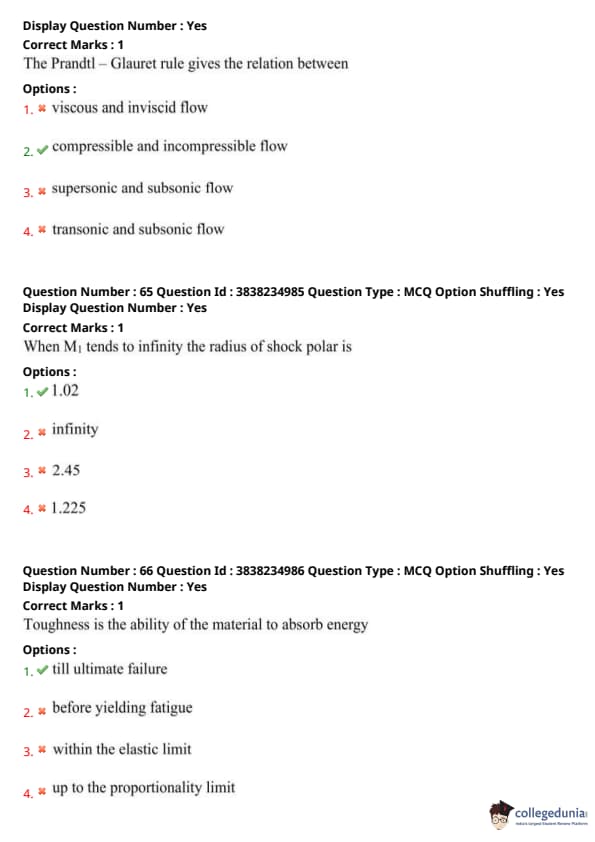
- (B) Over a sharp expansion corner, entropy increases
- (C) Over a gradual compression, entropy remains constant
- (D) Over a sharp compression corner, entropy increases
Question 62:
If a series of shock waves is used to decelerate supersonic flow to subsonic speed, then the variation of the shock wave will be
- (A) decreasing half angle from the first to last
- (B) constant half angle from the first to last
- (C) increasing half angle from the first to last
- (D) all shock waves are normal
Question 63:
When heat is added in a constant area duct without friction (i.e., in Rayleigh flow), which of the following statements is true?
- (A) Total temperature and total pressure decrease for both supersonic and subsonic flows at inlet
- (B) Total temperature increases and total pressure decreases for both supersonic and subsonic flows at inlet
- (C) Total temperature and total pressure increases for supersonic flows at inlet
- (D) Total temperature remains constant and total pressure decreases for subsonic flows at inlet
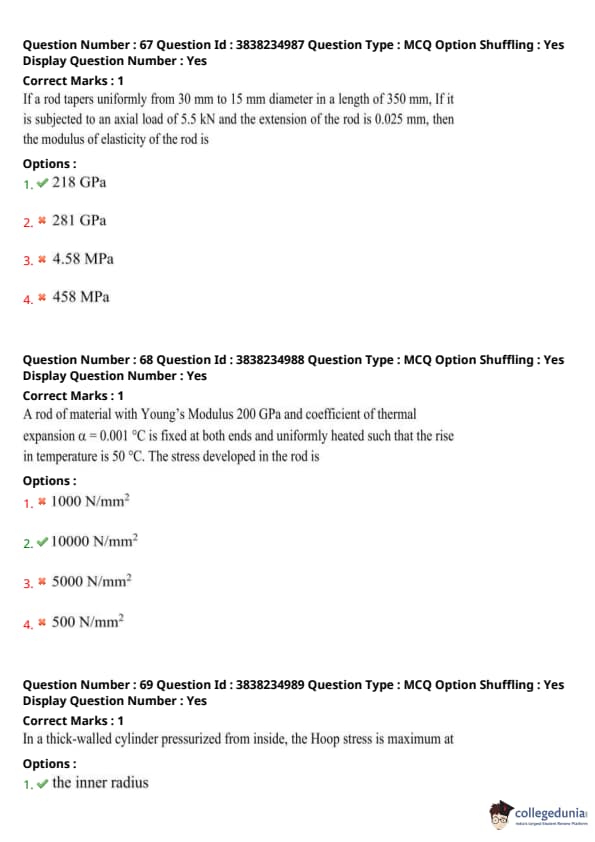
Question 64:
The Prandtl–Glauert rule gives the relation between
- (A) viscous and inviscid flow
- (B) compressible and incompressible flow
- (C) supersonic and subsonic flow
- (D) transonic and subsonic flow
Question 65:
When Mach tends to infinity the radius of shock polar is
- (A) \(-1/\sqrt{2}\)
- (B) infinity
- (C) 2.45
- (D) 1.225
Question 66:
Toughness is the ability of the material to absorb energy
- (A) till ultimate failure
- (B) before yielding fatigue
- (C) within the elastic limit
- (D) up to the proportionality limit
Question 67:
If a rod tapers uniformly from 30 mm to 15 mm diameter in a length of 350 mm, if it is subjected to an axial load of 5.6 kN and the extension of the rod is 0.025 mm, then the modulus of elasticity of the rod is
- (A) 221.8 GPa
- (B) 281 GPa
- (C) 4.58 MPa
- (D) 458 MPa
Question 68:
A rod of material with Young's Modulus 200 GPa and coefficient of thermal expansion = \(0.001 \, ^\circ \mathrm{C}^{-1}\) is fixed at both ends and uniformly heated such that the rise in temperature is \(50 \, ^\circ \mathrm{C}\). The stress developed in the rod is
- (A) 1000 N/mm\(^2\)
- (B) \(\geq\) 100000 N/mm\(^2\)
- (C) 5000 N/mm\(^2\)
- (D) 500 N/mm\(^2\)
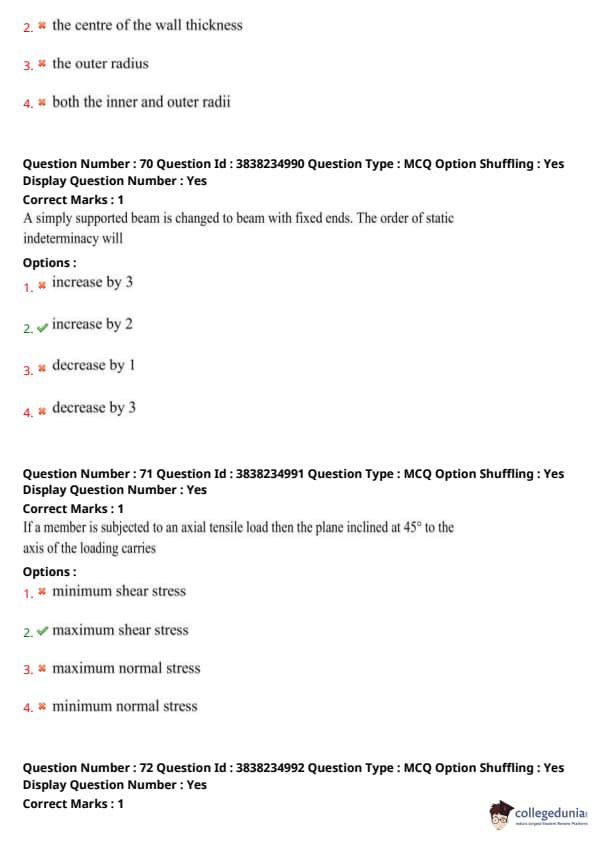
Question 69:
In a thick-walled cylinder pressurized from inside, the Hoop stress is maximum at
- (A) the inner radius
- (B) the centre of the wall thickness
- (C) the outer radius
- (D) both the inner and outer radii
Question 70:
A simply supported beam is changed to a beam with fixed ends. The order of static indeterminacy will
- (A) increase by 3
- (B) increase by 2
- (C) decrease by 1
- (D) decrease by 3
Question 71:
If a member is subjected to an axial tensile load then the plane inclined at \(45^\circ\) to the axis of the loading carries
- (A) minimum shear stress
- (B) maximum shear stress
- (C) maximum normal stress
- (D) minimum normal stress
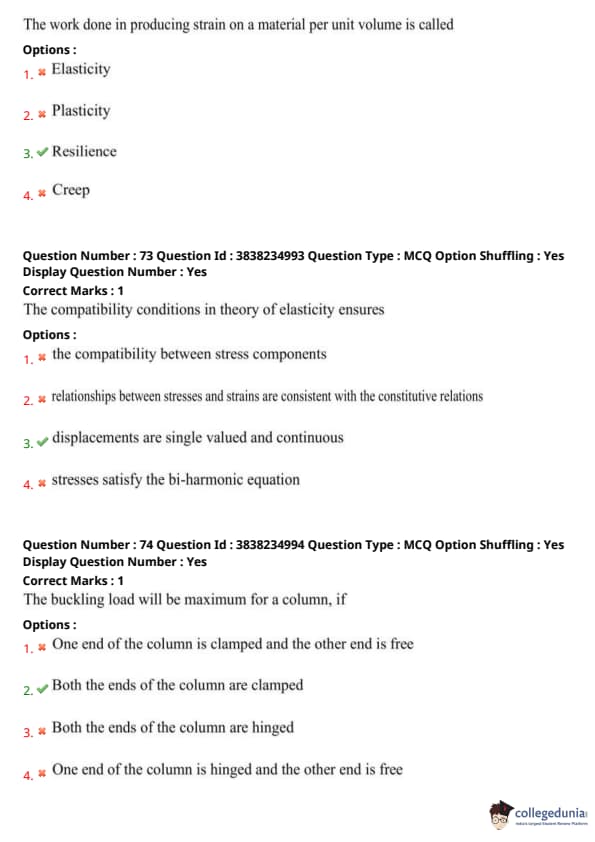
Question 72:
The work done in producing strain on a material per unit volume is called
- (A) Elasticity
- (B) Plasticity
- (C) Resilience
- (D) Creep
Question 73:
The compatibility conditions in theory of elasticity ensures
- (A) the compatibility between stress components
- (B) the relationships between stress and strain are consistent with the constitutive relations
- (C) displacements are single valued and continuous
- (D) stresses satisfy the bi-harmonic equation
Question 74:
The buckling load will be maximum for a column, if
- (A) One end of the column is clamped and the other end is free
- (B) Both the ends of the column are clamped
- (C) Both the ends of the column are hinged
- (D) One end of the column is hinged and the other end is free
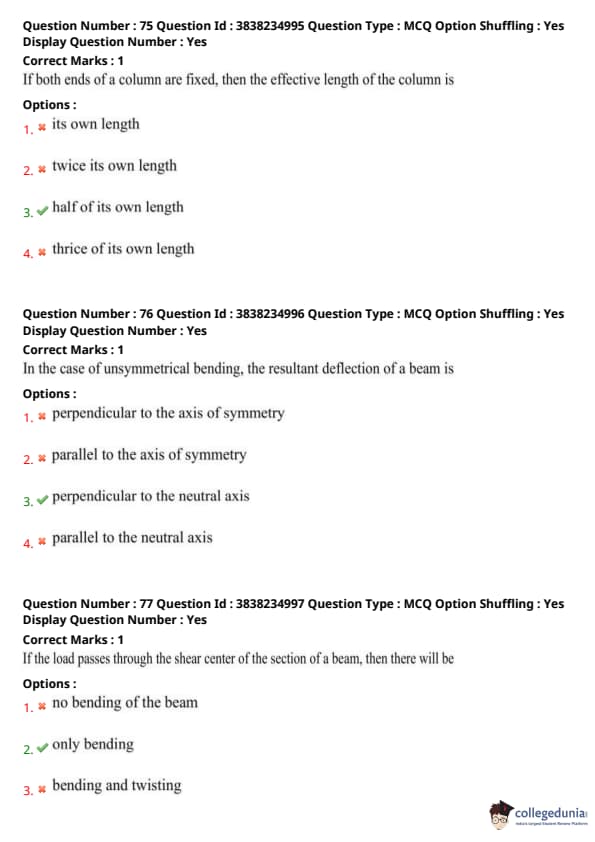
Question 75:
If both ends of a column are fixed, then the effective length of the column is
- (A) its own length
- (B) twice its own length
- (C) half of its own length
- (D) thrice of its own length
Question 76:
In the case of unsymmetrical bending, the resultant deflection of a beam is
- (A) perpendicular to the axis of symmetry
- (B) parallel to the axis of symmetry
- (C) perpendicular to the neutral axis
- (D) parallel to the neutral axis
Question 77:
If the load passes through the shear center of the section of a beam, then there will be
- (A) no bending of the beam
- (B) only bending
- (C) bending and twisting
- (D) only twisting
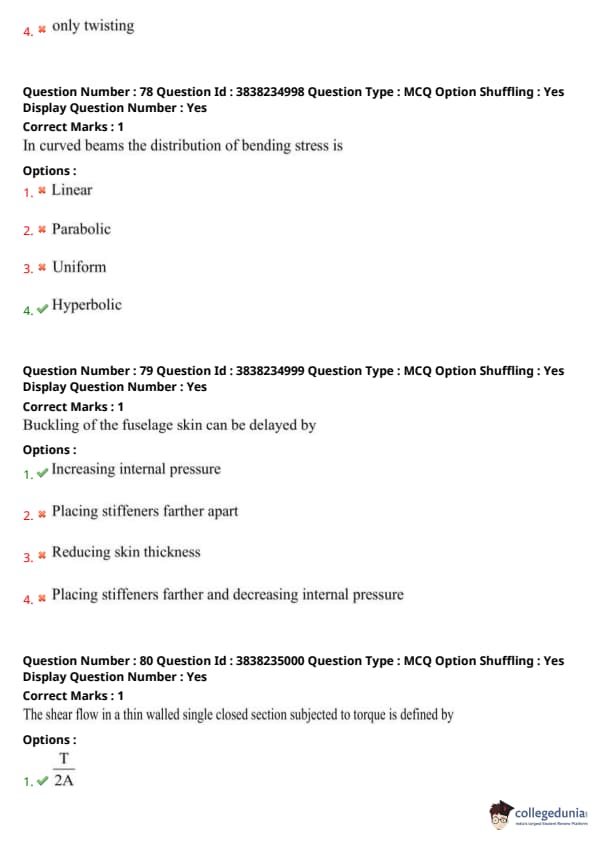
Question 78:
In curved beams the distribution of bending stress is
- (A) Linear
- (B) Parabolic
- (C) Uniform
- (D) Hyperbolic
Question 79:
Buckling of the fuselage skin can be delayed by
- (A) Increasing internal pressure
- (B) Placing stiffeners farther apart
- (C) Reducing skin thickness
- (D) Placing stiffeners farther and decreasing internal pressure
Question 80:
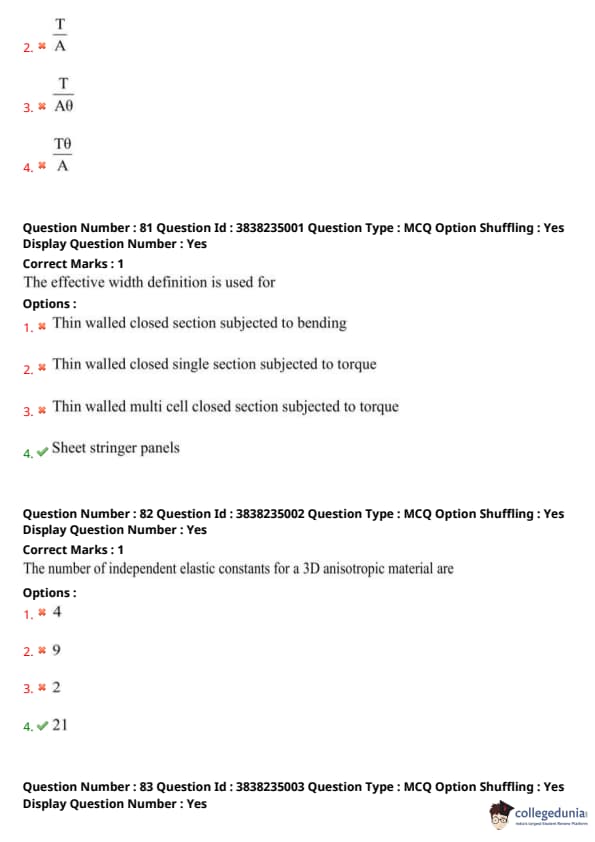
The shear flow in a thin walled single-closed section subjected to torque is defined by
- (A) \(\frac{T}{t}\)
- (B) \(A\)
- (C) \(\frac{T\theta}{A_0}\)
- (D) \(\frac{T}{2A}\)
Question 81:
The effective width definition is used for
- (A) Thin walled closed section subjected to bending
- (B) Thin walled closed single section subjected to torque
- (C) Thin walled multi cell closed section subjected to torque
- (D) Sheet stringer panels
Question 82:
The number of independent elastic constants for a 3D anisotropic material are
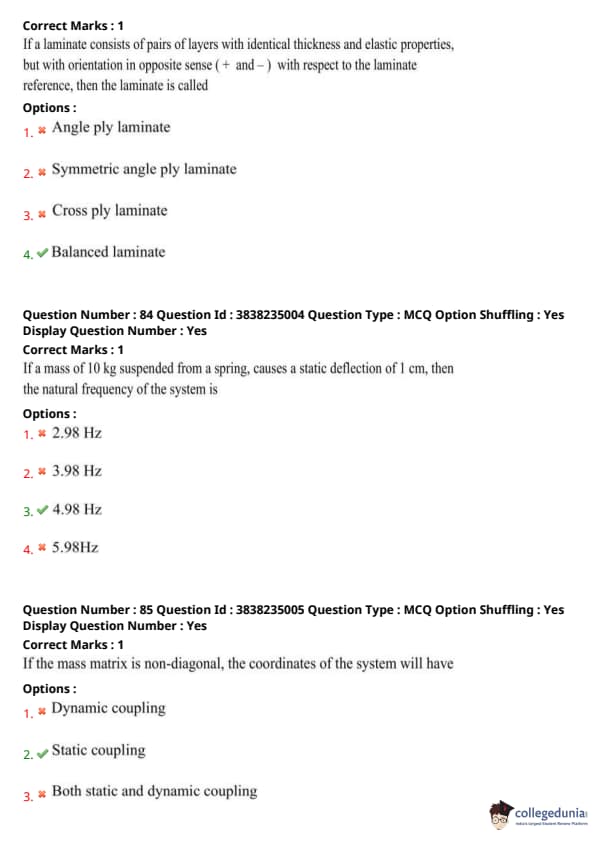
Question 83:
If a laminate consists of pairs of layers with identical thickness and elastic properties, but with orientation in opposite sense (+θ and –θ) with respect to the laminate reference, then the laminate is called
- (A) Angle ply laminate
- (B) Symmetric angle ply laminate
- (C) Cross ply laminate
- (D) Balanced laminate
Question 84:
If a mass of 10 kg suspended from a spring causes a static deflection of 1 cm, then the natural frequency of the system is
- (A) 2.98 Hz
- (B) 3.98 Hz
- (C) 4.98 Hz
- (D) 5.98 Hz
Question 85:
If the mass matrix is non-diagonal, the coordinates of the system will have
- (A) Dynamic coupling
- (B) Static coupling
- (C) Both static and dynamic coupling
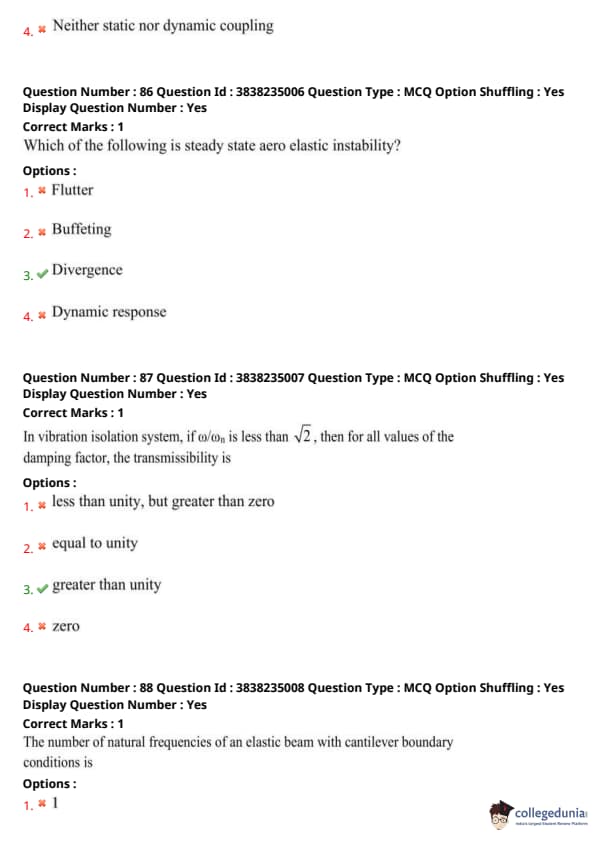
- (D) Neither static nor dynamic coupling
Question 86:
Which of the following is steady state aero elastic instability?
- (A) Flutter
- (B) Buffeting
- (C) Divergence
- (D) Dynamic response
Question 87:
In vibration isolation system, if \(\omega_r\) is less than \(\sqrt{2}\), then for all values of the damping factor, the transmissibility is
- (A) less than unity, but greater than zero
- (B) equal to unity
- (C) greater than unity
- (D) zero
Question 88:
The number of natural frequencies of an elastic beam with cantilever boundary conditions is
- (A) 1
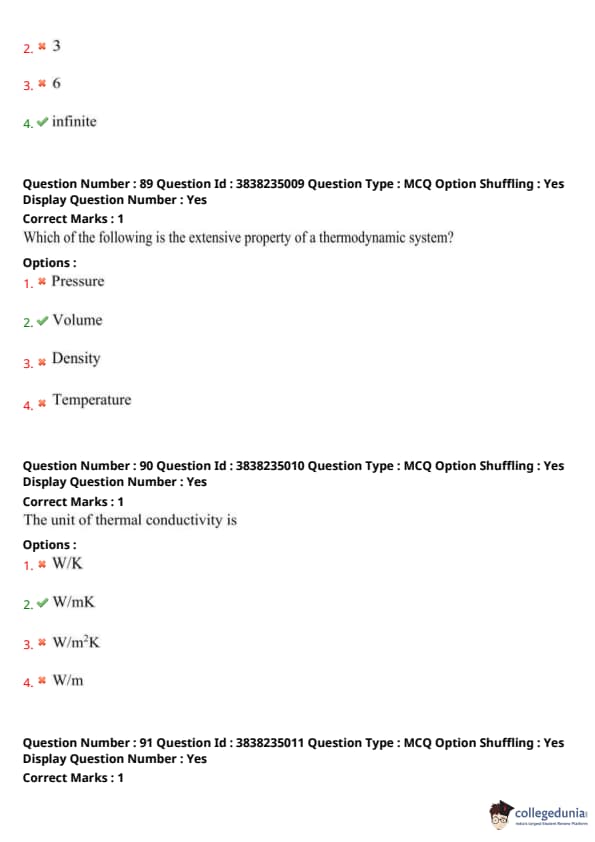
- (B) 3
- (C) 6
- (D) infinite
Question 89:
Which of the following is the extensive property of a thermodynamic system?
- (A) Pressure
- (B) Volume
- (C) Density
- (D) Temperature
Question 90:
The unit of thermal conductivity is
- (A) W/k
- (B) W/mK
- (C) W/m\(^2\)K
- (D) W/m
Question 91:
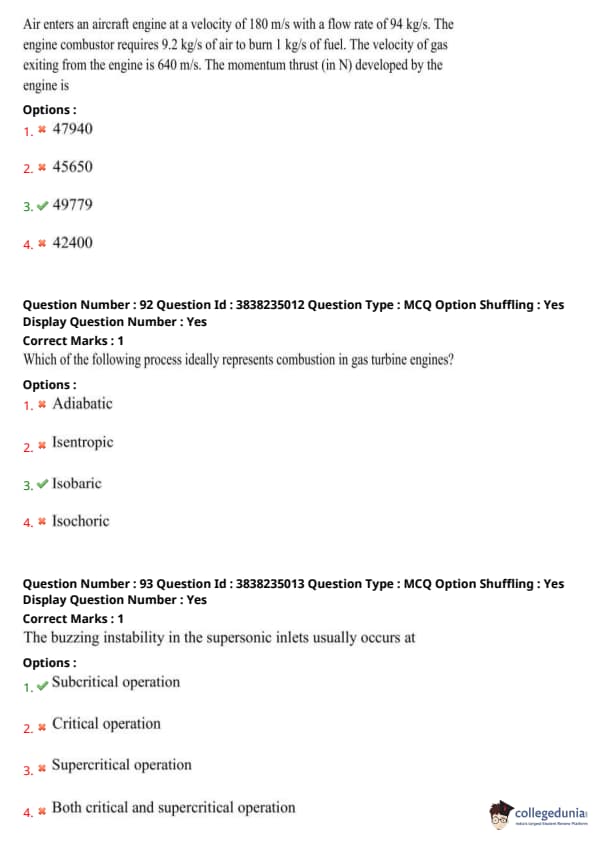
Air enters an aircraft engine at a velocity of 180 m/s with a flow rate of 94 kg/s. The engine combustor requires 9.2 kg/s of air to burn 1 kg/s of fuel. The velocity of gas exiting from the engine is 640 m/s. The momentum thrust (in N) developed by the engine is
- (A) 47540
- (B) 45660
- (C) 49779
- (D) 42400
Question 92:
Which of the following process ideally represents combustion in gas turbine engines?
- (A) Adiabatic
- (B) Isentropic
- (C) Isobaric
- (D) Isochoric
Question 93:
The buzzing instability in the supersonic inlets usually occurs at
- (A) Subcritical operation
- (B) Critical operation
- (C) Supercritical operation
- (D) Both critical and supercritical operation
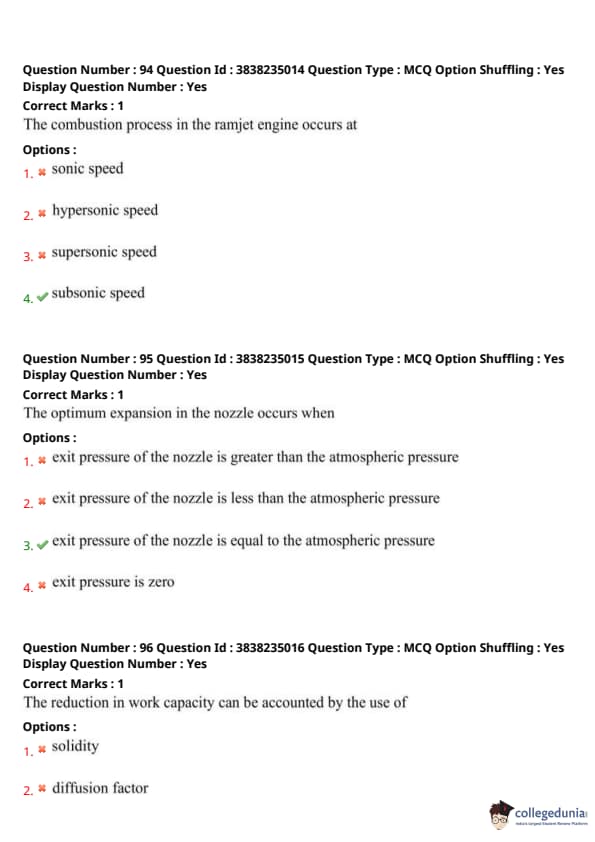
Question 94:
The combustion process in the ramjet engine occurs at
- (A) sonic speed
- (B) hypersonic speed
- (C) supersonic speed
- (D) subsonic speed
Question 95:
The optimum expansion in the nozzle occurs when
- (A) exit pressure of the nozzle is greater than the atmospheric pressure
- (B) exit pressure of the nozzle is less than the atmospheric pressure
- (C) exit pressure of the nozzle is equal to the atmospheric pressure
- (D) exit pressure is zero
Question 96:
The reduction in work capacity can be accounted by the use of
- (A) solidity
- (B) diffusion factor
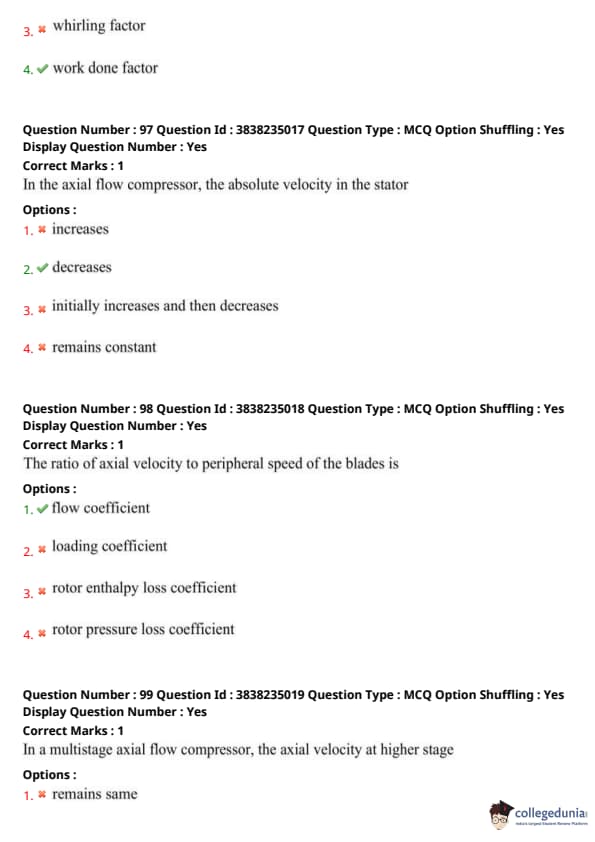
- (C) whirling factor
- (D) work done factor
Question 97:
In a flow compressor, the absolute velocity in the stator
- (A) increases
- (B) decreases
- (C) initially increases and then decreases
- (D) remains constant
Question 98:
The ratio of axial velocity to peripheral speed of the blades is
- (A) flow coefficient
- (B) loading coefficient
- (C) rotor enthalpy loss coefficient
- (D) rotor pressure loss coefficient
Question 99:
In a multistage axial flow compressor, the axial velocity at higher stage
- (A) remains same
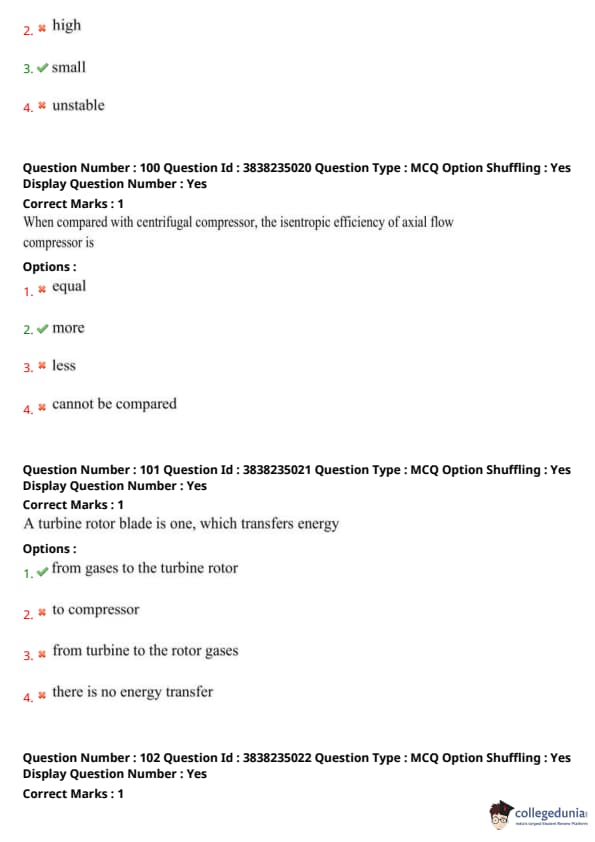
- (B) high
- (C) small
- (D) unstable
Question 100:
When compared with centrifugal compressor, the isentropic efficiency of axial flow compressor is
- (A) equal
- (B) more
- (C) less
- (D) cannot be compared
Question 101:
A turbine rotor blade is one, which transfers energy
- (A) from gases to the turbine rotor
- (B) to compressor
- (C) from turbine to the rotor gases
- (D) there is no energy transfer
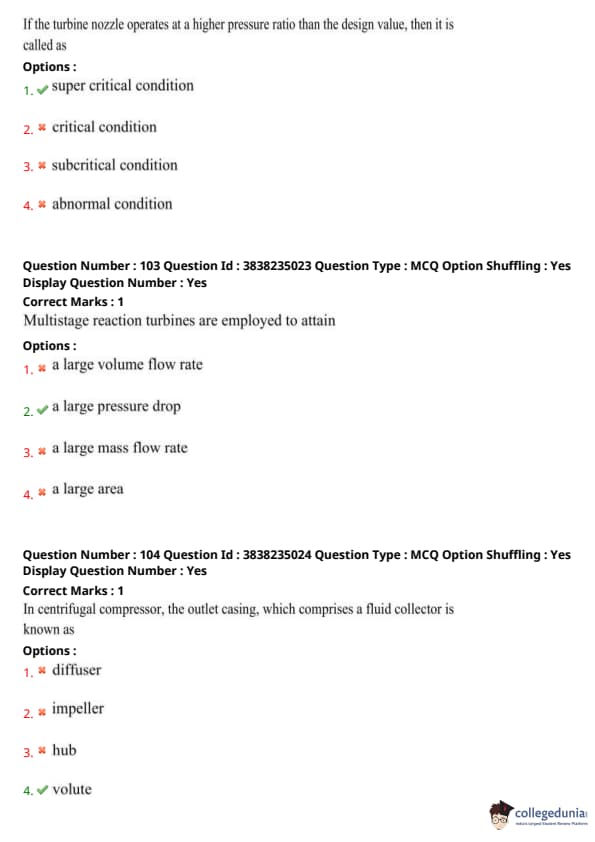
Question 102:
If the turbine nozzle operates at a higher pressure ratio than the design value, then it is called as
- (A) super critical condition
- (B) critical condition
- (C) subcritical condition
- (D) abnormal condition
Question 103:
Multistage reaction turbines are employed to attain
- (A) a large volume flow rate
- (B) a large pressure drop
- (C) a large mass flow rate
- (D) a large area
Question 104:
In centrifugal compressor, the outlet casing, which comprises a fluid collector is known as
- (A) diffuser
- (B) impeller
- (C) hub
- (D) volute
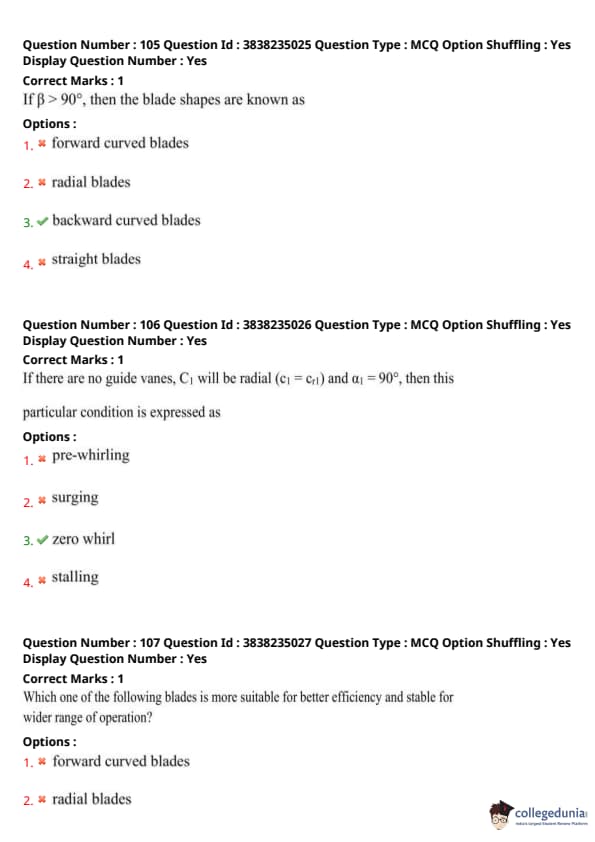
Question 105:
If \(\beta > 90^\circ\), then the blade shapes are known as
- (A) forward curved blades
- (B) radial blades
- (C) backward curved blades
- (D) straight blades
Question 106:
If there are no guide vanes, \( C_1 \) will be radial (\( \alpha_1 = 90^\circ \)), then this particular condition is expressed as
- (A) pre-whirling
- (B) surging
- (C) zero whirl
- (D) stalling
Question 107:
Which one of the following blades is more suitable for better efficiency and stable for wider range of operation?
- (A) forward curved blades
- (B) radial blades
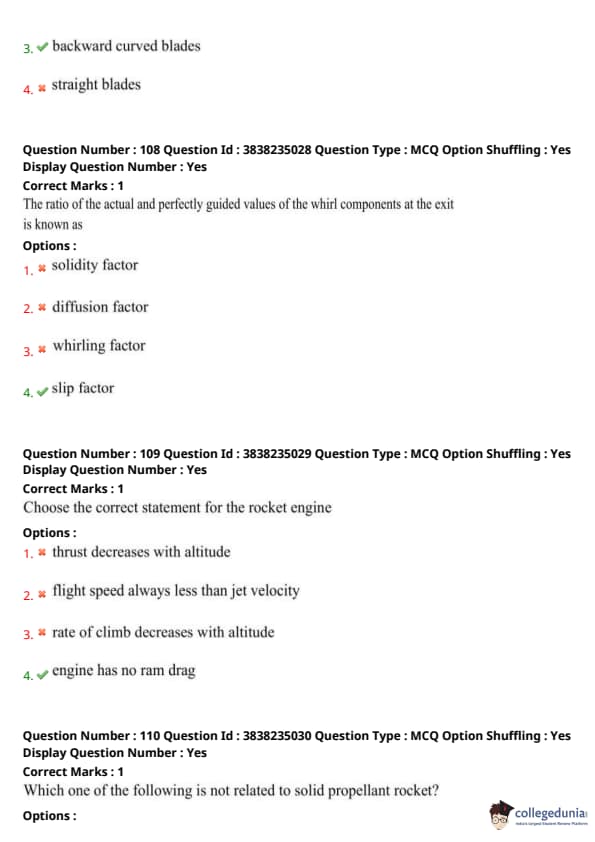
- (C) backward curved blades
- (D) straight blades
Question 108:
The ratio of the actual and perfectly guided values of the whirl components at the exit is known as
- (A) solidity factor
- (B) diffusion factor
- (C) whirling factor
- (D) slip factor
Question 109:
Choose the correct statement for the rocket engine
- (A) thrust decreases with altitude
- (B) flight speed always less than jet velocity
- (C) rate of climb decreases with altitude
- (D) engine has no ram drag
Question 110:
Which one of the following is not related to solid propellant rocket?
- (A) high density
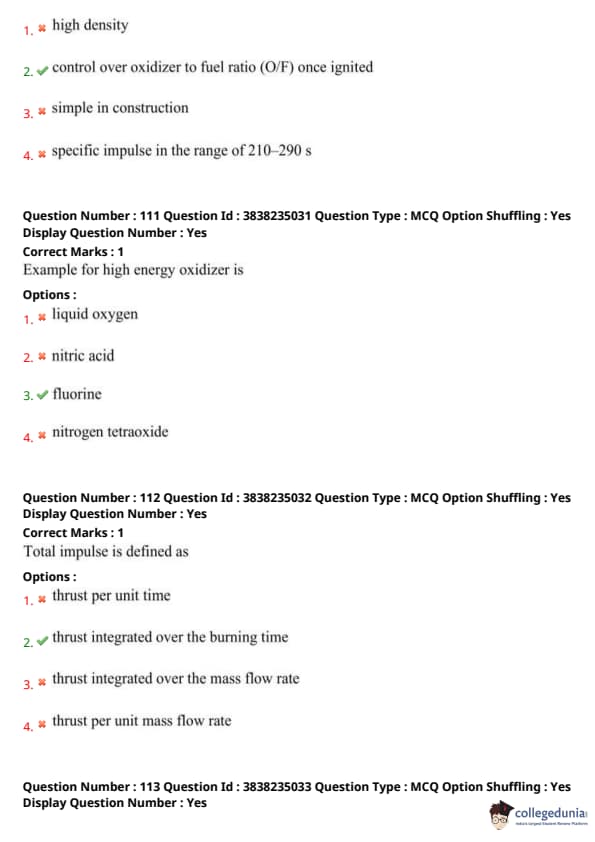
- (B) control over oxidizer to fuel ratio (O/F) once ignited
- (C) simple in construction
- (D) specific impulse in the range of 210–290 s
Question 111:
Example for high energy oxidizer is
- (A) liquid oxygen
- (B) nitric acid
- (C) fluorine
- (D) nitrogen tetroxide
Question 112:
Total impulse is defined as
- (A) thrust per unit time
- (B) thrust integrated over the burning time
- (C) thrust integrated over the mass flow rate
- (D) thrust per unit mass flow rate
Question 113:
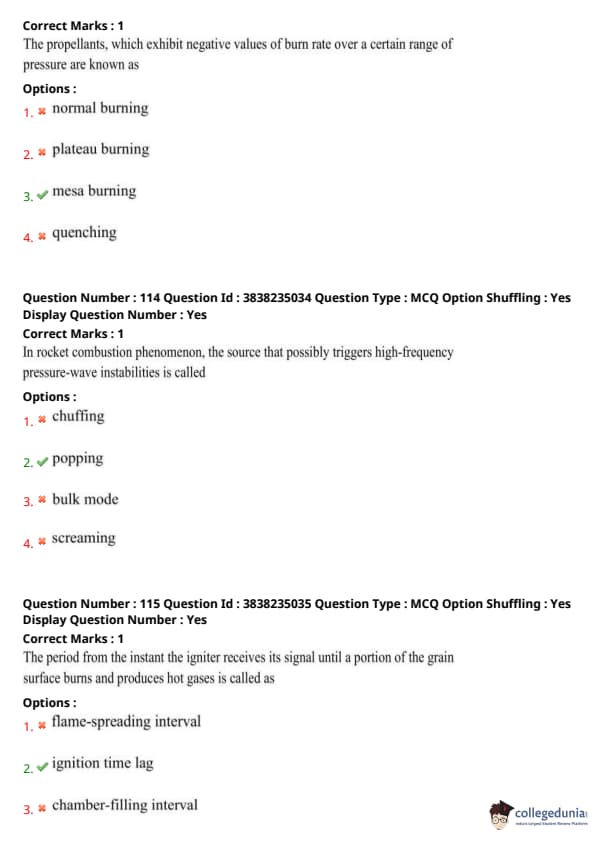
The propellants, which exhibit negative values of burn rate over a certain range of pressure are known as
- (A) normal burning
- (B) plateau burning
- (C) mesa burning
- (D) quenching
Question 114:
In rocket combustion phenomenon, the source that possibly triggers high-frequency pressure-wave instabilities is called
- (A) chuffing
- (B) popping
- (C) bulk mode
- (D) screaming
Question 115:
The period from the instant the igniter receives its signal until a portion of the grain surface burns and produces hot gases is called as
- (A) flame-spreading interval
- (B) ignition time lag
- (C) chamber-filling interval
- (D) burning time
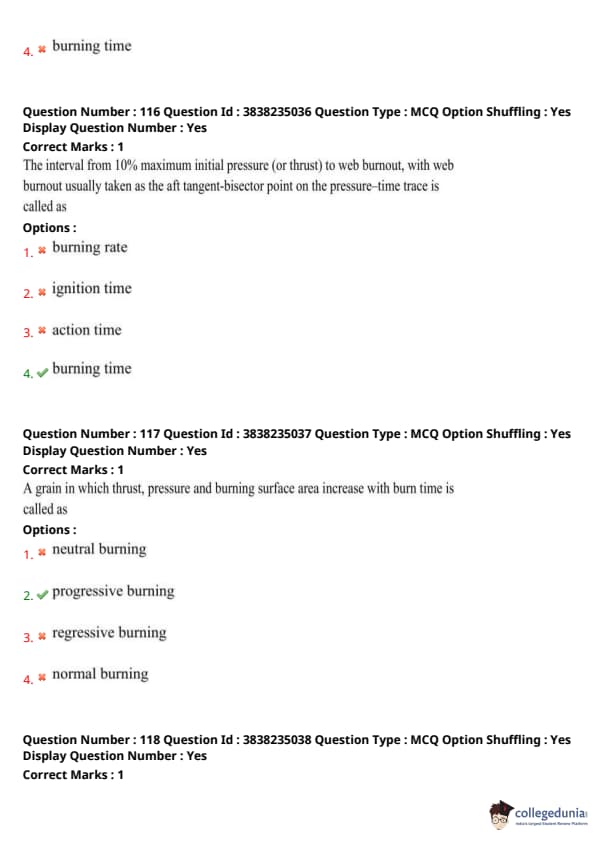
Question 116:
The interval from 10% maximum initial pressure (or thrust) to web burnout, with web burnout usually taken as the aft tangent-bisector point on the pressure–time trace is called as
- (A) burning rate
- (B) ignition time
- (C) action time
- (D) burning time
Question 117:
A grain in which thrust, pressure and burning surface area increase with burn time is called as
- (A) neutral burning
- (B) progressive burning
- (C) regressive burning
- (D) normal burning
Question 118:
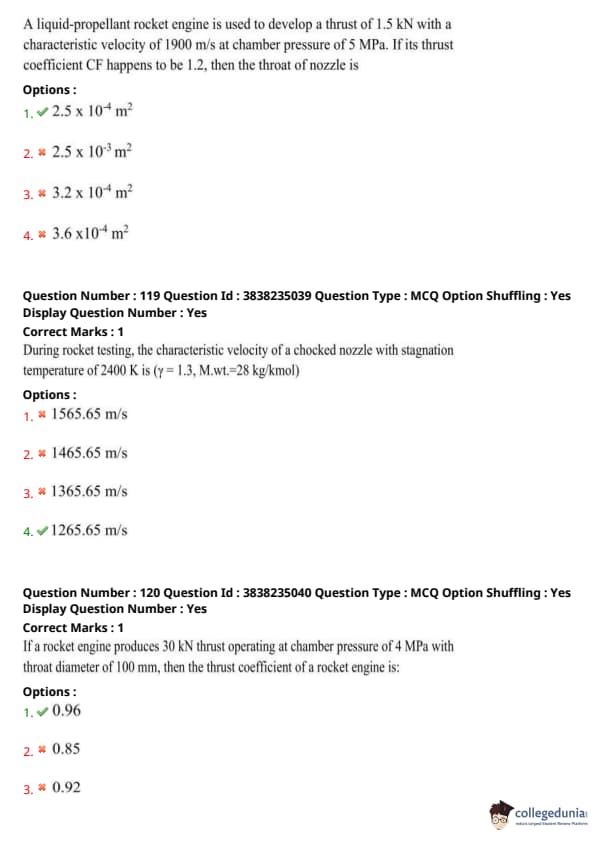
A liquid-propellant rocket engine is used to develop a thrust of 1.5 kN with a characteristic velocity of 1900 m/s at chamber pressure of 5 MPa. If its thrust coefficient CF happens to be 1.2, then the throat of nozzle is
- (A) \(2.5 \times 10^{-4}\ m^2\)
- (B) \(2.5 \times 10^{-3}\ m^2\)
- (C) \(3.2 \times 10^{-4}\ m^2\)
- (D) \(3.6 \times 10^{-4}\ m^2\)
Question 119:
During rocket testing, the characteristic velocity of a choked nozzle with stagnation temperature of 2400 K is (\(\gamma = 1.3\), \(M = 28\ kg/kmol\))
- (A) 1565.65 m/s
- (B) 1465.65 m/s
- (C) 1365.65 m/s
- (D) 1265.65 m/s
Question 120:
If a rocket engine produces 30 kN thrust operating at chamber pressure of 4 MPa with throat diameter of 100 mm, then the thrust coefficient of a rocket engine is:
- (A) 0.96
- (B) 0.85
- (C) 0.92
- (D) 0.94










Comments