TS PGECET 2024 Biomedical Engineering Question Paper is available for download here. Jawaharlal Nehru Technological University Hyderabad on behalf of Telangana Council of Higher Education (TGCHE) conducted TS PGECET 2024 Biomedical Engineering on June 12 in Shift 2 from 2 PM to 4 PM. TS PGECET Question Paper 2024 consists of 120 MCQ-based questions in total carrying 1 mark each to be attempted in the duration of 2 hours.
TS PGECET 2024 Biomedical Engineering Question Paper with Answer Key PDF
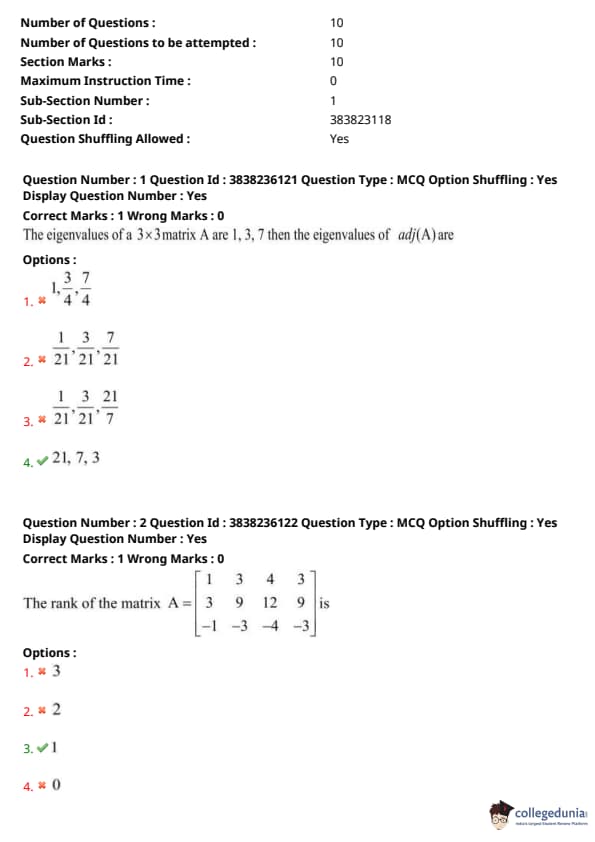
Question 1:
The eigenvalues of a \(3 \times 3\) matrix A are 1, 3, 7 then the eigenvalues of \(adj(A)\) are
- (A) \( 1, \frac{3}{4}, \frac{7}{4} \)
- (B) \( \frac{1}{21}, \frac{3}{21}, \frac{7}{21} \)
- (C) \( \frac{1}{21}, \frac{3}{21}, \frac{21}{7} \)
- (D) \( 21, 7, 3 \)
Question 2:
The rank of the matrix A = \( \begin{bmatrix} 1 & 3 & 4 & 3
3 & 9 & 12 & 9
-1 & -3 & -4 & -3 \end{bmatrix} \) is
- (A) \( 3 \)
- (B) \( 2 \)
- (C) \( 1 \)
- (D) \( 0 \)
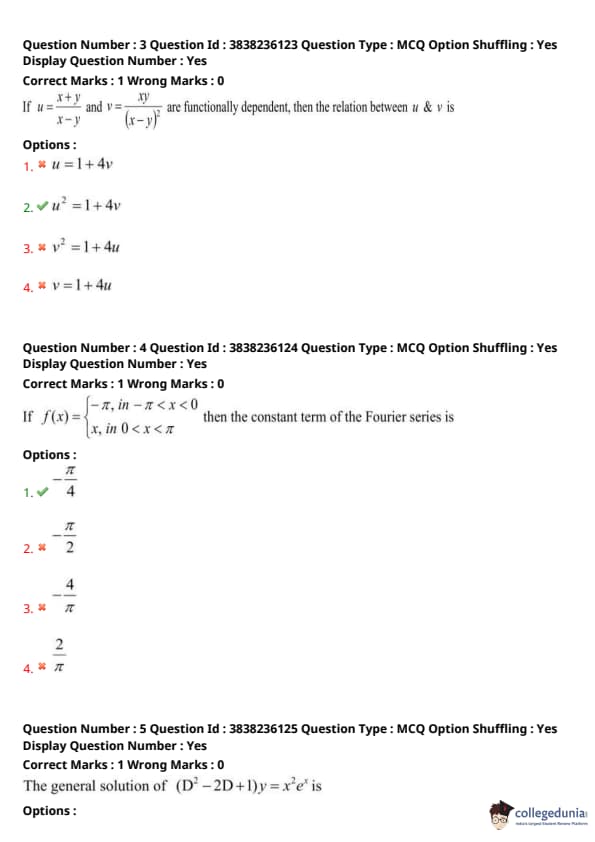
Question 3:
If \(u = \frac{x+y}{x-y}\) and \(v = \frac{xy}{(x-y)^2}\) are functionally dependent, then the relation between \(u\) \& \(v\) is
- (A) \( u = 1+4v \)
- (B) \( u^2 = 1+4v \)
- (C) \( v^2 = 1+4u \)
- (D) \( v = 1+4u \)
Question 4:
If \(f(x) = \begin{cases} -\pi, & in -\pi < x < 0
x, & in 0 < x < \pi \end{cases}\) then the constant term of the Fourier series is
- (A) \( -\frac{\pi}{4} \)
- (B) \( -\frac{\pi}{2} \)
- (C) \( -\frac{4}{\pi} \)
- (D) \( -\frac{2}{\pi} \)
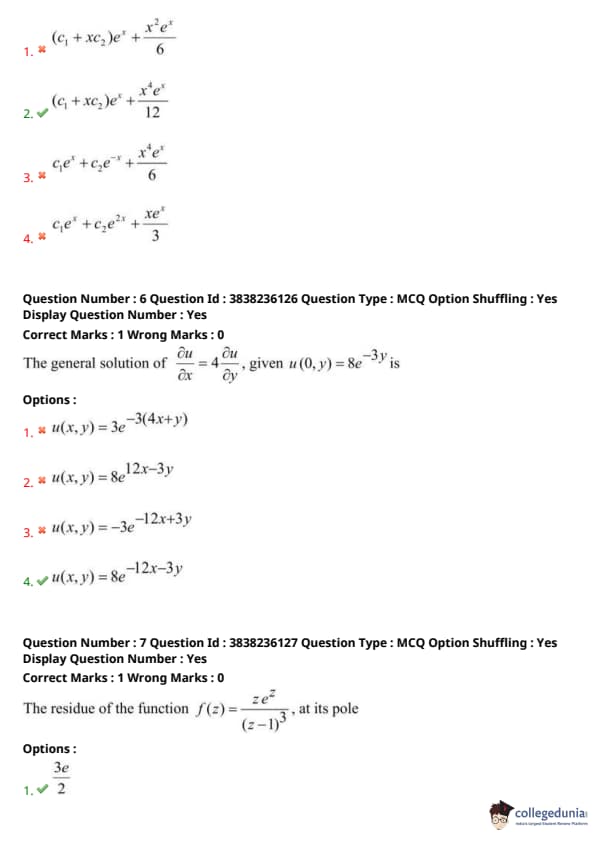
Question 5:
The general solution of \((D^2 - 2D + 1)y = x^2e^x\) is
- (A) \( (c_1 + xc_2)e^x + \frac{x^3e^x}{6} \)
- (B) \( (c_1 + xc_2)e^x + \frac{x^4e^x}{12} \)
- (C) \( c_1e^x + c_2e^{-x} + \frac{x^4e^x}{6} \)
- (D) \( c_1e^x + c_2e^{2x} + \frac{xe^x}{3} \)
Correct Answer: (B) \( (c_1 + xc_2)e^x + \frac{x^4e^x}{12} \)
View Solution
Question 6:
The general solution of \(\frac{\partial u}{\partial x} = 4\frac{\partial u}{\partial y}\), given \(u(0,y) = 8e^{-3y}\) is
- (A) \( u(x,y) = 3e^{-3(4x+y)} \)
- (B) \( u(x,y) = 8e^{12x-3y} \)
- (C) \( u(x,y) = -3e^{-12x+3y} \)
- (D) \( u(x,y) = 8e^{-12x-3y} \)
Question 7:
The residue of the function \(f(z) = \frac{ze^z}{(z-1)^3}\), at its pole is
- (A) \( \frac{3e}{2} \)
- (B) \( \frac{4e}{3} \)
- (C) \( \frac{e}{2} \)
- (D) \( e \)
Question 8:
The equation \(x^4 - x - 10 = 0\) is to be solved using the Newton-Raphson method. If \(x = 2\) is taken as the initial approximation of the equation, then the next approximation of the solution is
- (A) \( \frac{38}{31} \)
- (B) \( \frac{48}{31} \)
- (C) \( \frac{58}{31} \)
- (D) \( \frac{28}{31} \)
Question 9:
For two events A and B, let \(P(A)=\frac{1}{3}\), \(P(B)=\frac{1}{4}\) and \(P(A \cup B)=\frac{1}{2}\) then \(P(A/B)\) is
- (A) \( \frac{1}{2} \)
- (B) \( \frac{1}{3} \)
- (C) \( \frac{1}{12} \)
- (D) \( \frac{1}{4} \)
Question 10:
A biased coin was thrown 300 times and the tail turned up 120 times, then the standard error of the observed proportion of tails is
- (A) \( 0.028 \)
- (B) \( 0.28 \)
- (C) \( 0.82 \)
- (D) \( 0.082 \)
Question 11:
The voltage applied to a 212 mH inductor is given by \(V(t)=15e^{-5t}\) V. Calculate the current
- (A) \( 16.782e^{-10t} \)
- (B) \( 15.75e^{-5t} \)
- (C) \( 11.27e^{-10t} \)
- (D) \( 14.15e^{-5t} \)
Question 12:
The voltage across a capacitor of 0.5F is defined by \(V(t)=\begin{cases} 0, & t < 0
2t, & 0 < t < 2s
4e^{-(t-2)}, & t > 2s \end{cases}\). Find \(i(t)\)
- (A) \( -2e^{-(t-2)} \)
- (B) \( -4e^{-(t-2)} \)
- (C) \( -20e^{-(t-2)} \)
- (D) \( -12e^{-(t-2)} \)
Question 13:
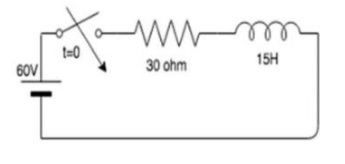
What is the voltage across the inductor at \(t=0\)? \newline (Circuit diagram provided: A 60V voltage source in series with a switch that closes at \(t=0\), a 30 ohm resistor, and a 15H inductor.)
![13.png]()
- (A) \( 0 V \)
- (B) \( 20 V \)
- (C) \( 60 V \)
- (D) \( 58 V \)
Question 14:
Which law states that the current flowing into junction must be equal to the current flowing out of it?
- (A) \( Boolean \)
- (B) \( Kirchhoff's \)
- (C) \( Laplace \)
- (D) \( Fourier \)
Question 15:
For a voltage source to be neglected, the terminals across the source should be
- (A) \( replaced by an inductor \)
- (B) \( short-circuited \)
- (C) \( replaced by some resistance \)
- (D) \( open circuited \)
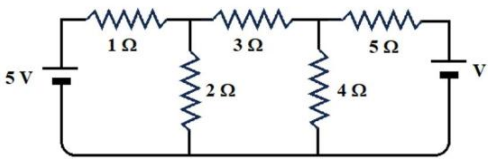
Question 16:
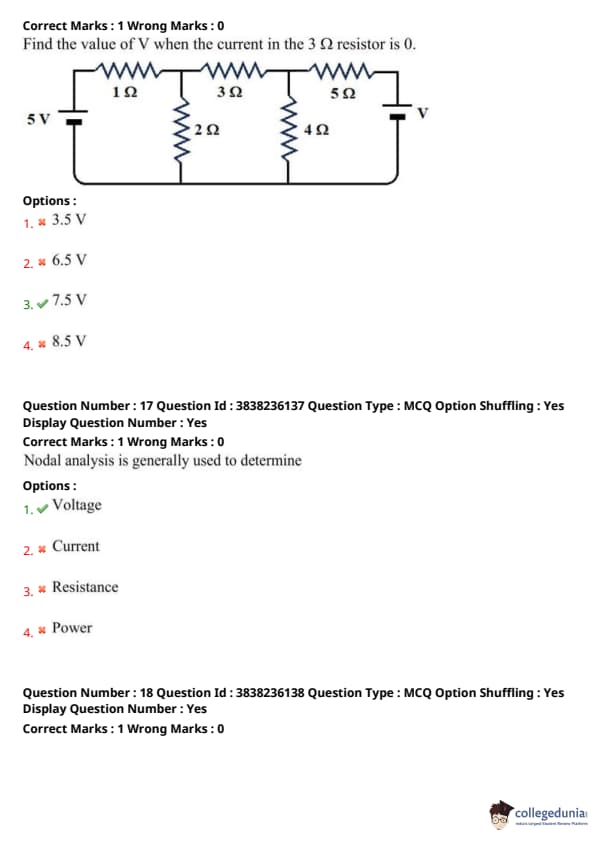
Find the value of \(V\) when the current in the 3 \(\Omega\) resistor is 0. \newline (Circuit diagram provided: A circuit with two voltage sources, 5V and V, and several resistors: 1\(\Omega\), 2\(\Omega\), 3\(\Omega\), 4\(\Omega\), 5\(\Omega\). The 1\(\Omega\) and 3\(\Omega\) resistors are in the top branch. The 2\(\Omega\) and 4\(\Omega\) resistors are in parallel branches.)
![16.png]()
- (A) \( 3.5 V \)
- (B) \( 6.5 V \)
- (C) \( 7.5 V \)
- (D) \( 8.5 V \)
Question 17:
Nodal analysis is generally used to determine
- (A) \( Voltage \)
- (B) \( Current \)
- (C) \( Resistance \)
- (D) \( Power \)
Question 18:
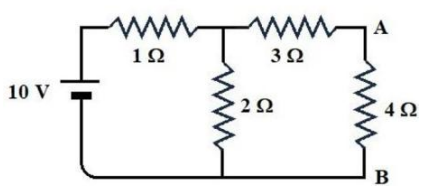
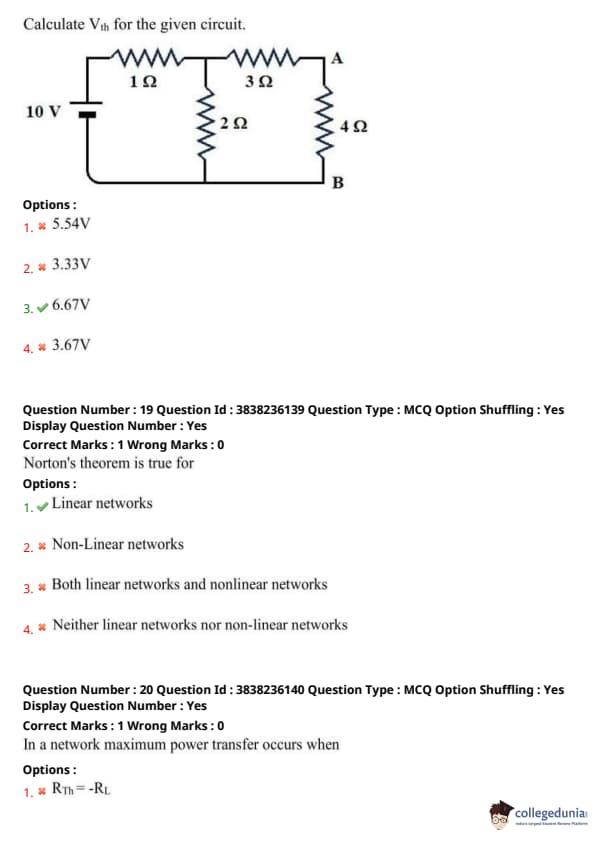
Calculate \(V_{th}\) for the given circuit.
![18.png]()
- (A) \( 5.54 V \)
- (B) \( 3.33 V \)
- (C) \( 6.67 V \)
- (D) \( 3.67 V \)
Question 19:
Norton's theorem is true for
- (A) \( Linear networks \)
- (B) \( Non-Linear networks \)
- (C) \( Both linear networks and nonlinear networks \)
- (D) \( Neither linear networks nor non-linear networks \)
Question 20:
In a network maximum power transfer occurs when
- (A) \( R_{Th} = -R_L \)
- (B) \( \frac{R_{Th}}{R_L} = 0 \)
- (C) \( R_{Th} = R_L \)
- (D) \( R_{Th} + R_L = 1 \)
Question 21:
A band-limited signal with a maximum frequency of 5 kHz is to be sampled. According to the sampling theorem, the sampling frequency which is not valid is
- (A) \( 12 kHz \)
- (B) \( 5 kHz \)
- (C) \( 15 kHz \)
- (D) \( 20 kHz \)
Question 22:
Consider two signals \(x(n)=\{0,1,1,2\}\) and \(h(n)=\{a,b,c\}\). The signal \(y(n)=x(n)\otimes h(n)\). The DFT of \(y(n)\) is given as \(Y(e^{j\omega})\). If \(Y(e^{j0})\) is 36, then which of the following relation is correct?
- (A) \( a \times b \times c = 27 \)
- (B) \( ab + c = 9 \)
- (C) \( a + b + c = 9 \)
- (D) \( a + b - c = 12 \)
Question 23:
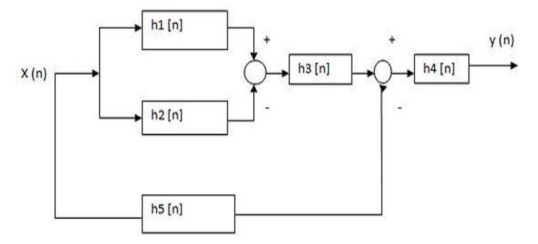
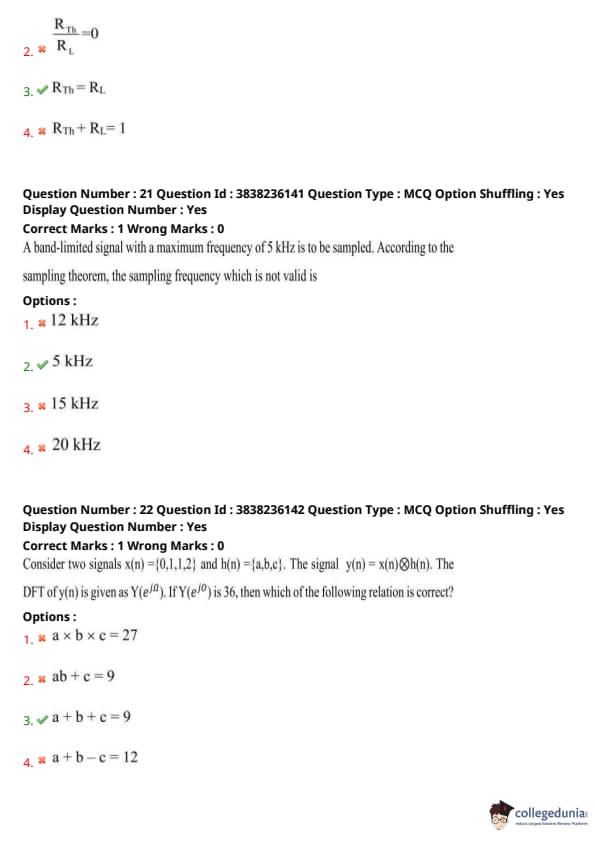
The overall impulse response of the system shown in figure is given by \newline (Block diagram provided: Input \(X(n)\) splits. One path goes to \(h_1[n]\), another to \(h_2[n]\). The outputs of \(h_1[n]\) and \(h_2[n]\) are subtracted. This result is convolved with \(h_3[n]\). Separately, \(X(n)\) also goes to \(h_5[n]\). The output of \(h_3[n]\) and \(h_5[n]\) are subtracted. This result is convolved with \(h_4[n]\) to produce \(y(n)\).)
![23.png]()
- (A) \( h[n] = ((h_1[n]-h_2[n])*h_3[n])-h_5[n])*h_4[n] \)
- (B) \( h[n] = ((h_1[n]-h_2[n])*h_3[n])-h_5[n])*h_4[n] \)
- (C) \( h[n] = ((h_1[n]-h_2[n])*h_3[n])+h_5[n])*h_4[n] \)
- (D) \( h[n] = (h_1[n]-h_2[n])*h_3[n]+h_5[n]]*h_4[n] \)
Correct Answer: (A) \( h[n] = ((h_1[n]-h_2[n])*h_3[n])-h_5[n])*h_4[n] \)
View Solution
Question 24:
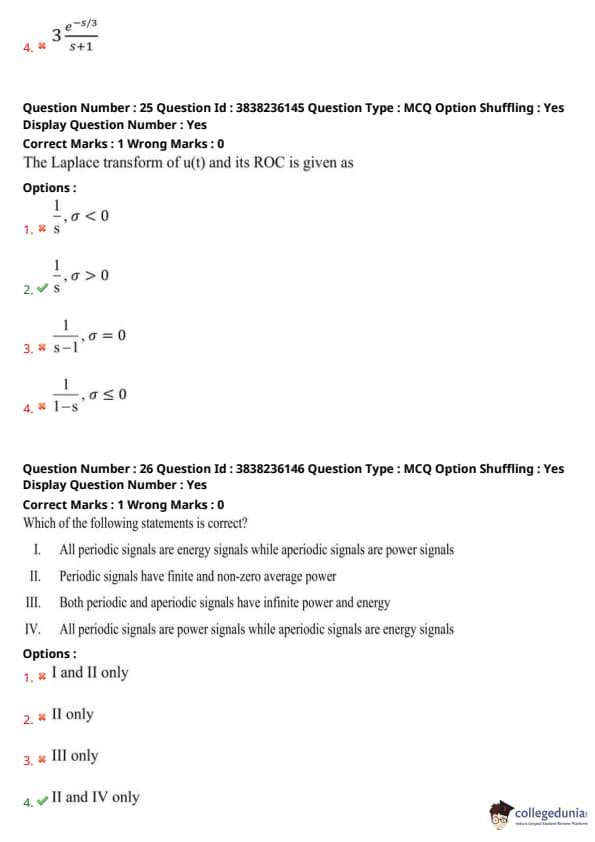
The input \( x(t) \) is related to its output \( y(t) \) as: \( \frac{dy(t)}{dt} + y(t) = 3x(t - 3)u(t - 3) \).
Here \( u(t) \) represents a step function. The transfer function of this system is
- (A) \( \frac{e^{-3s}}{s+3} \)
- (B) \( \frac{e^{-s/3}}{s+3} \)
- (C) \( \frac{3e^{-3s}}{s+1} \)
- (D) \( \frac{3e^{-s/3}}{s+1} \)
Question 25:
The Laplace transform of \( u(t) \) and its ROC is given as
- (A) \( \frac{1}{s}, \, \sigma < 0 \)
- (B) \( \frac{1}{s}, \, \sigma > 0 \)
- (C) \( \frac{1}{s - 1}, \, \sigma = 0 \)
- (D) \( \frac{1}{1 - s}, \, \sigma \leq 0 \)
Correct Answer: (B) \( \frac{1}{s}, \, \sigma > 0 \)
View Solution
Question 26:
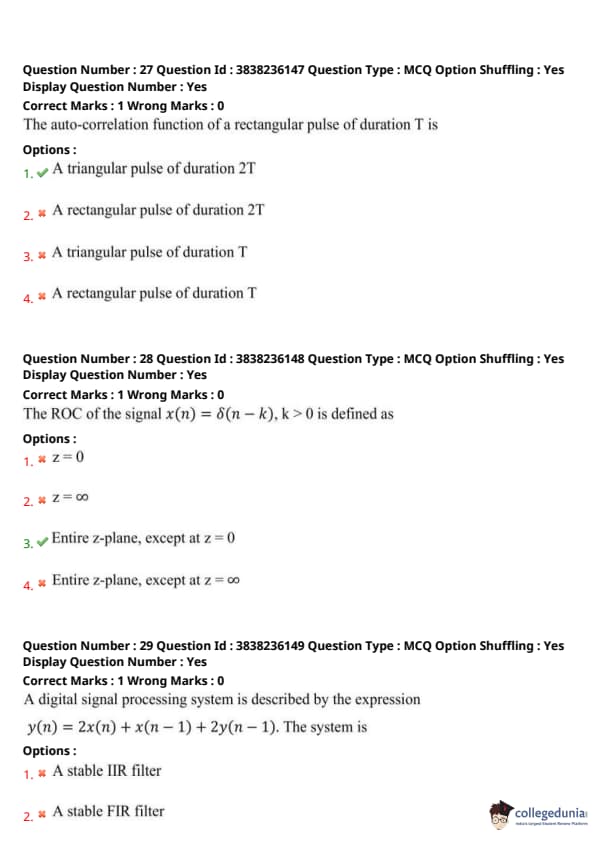
Which of the following statements is correct?
[I.] All periodic signals are energy signals while aperiodic signals are power signals
[II.] Periodic signals have finite and non-zero average power
[III.] Both periodic and aperiodic signals have infinite power and energy
[IV.] All periodic signals are power signals while aperiodic signals are energy signals
- (A) I and II only
- (B) II only
- (C) III only
- (D) III and IV only
Question 27:
The auto-correlation function of a rectangular pulse of duration \( T \) is
- (A) A triangular pulse of duration \( 2T \)
- (B) A rectangular pulse of duration \( 2T \)
- (C) A triangular pulse of duration \( T \)
- (D) A rectangular pulse of duration \( T \)
Correct Answer: (A) A triangular pulse of duration \( 2T \)
View Solution
Question 28:
The ROC of the signal \( x(n) = \delta(n - k), \, k > 0 \) is defined as
- (A) \( z = 0 \)
- (B) \( z = \infty \)
- (C) Entire z-plane, except at \( z = 0 \)
- (D) Entire z-plane, except at \( z = \infty \)
Correct Answer: (C) Entire z-plane, except at \( z = 0 \)
View Solution
Question 29:
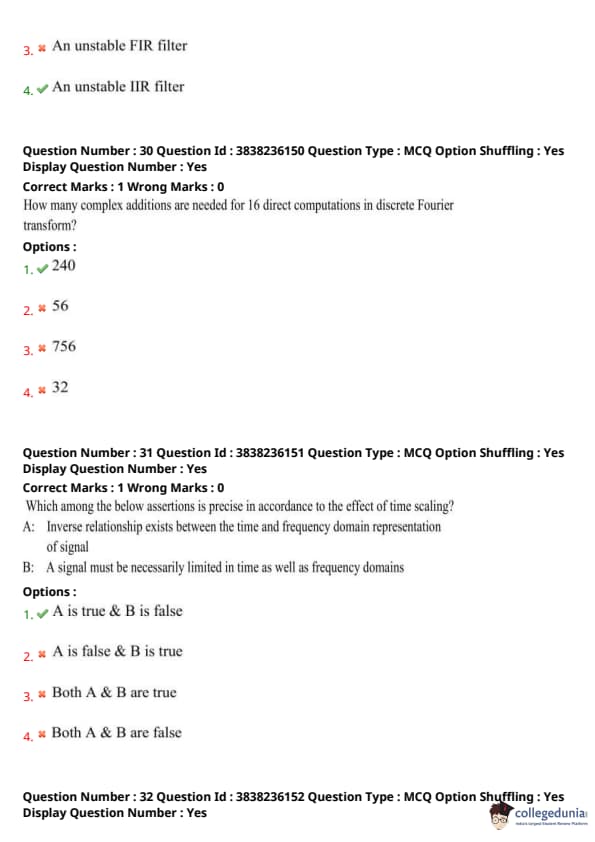
A digital signal processing system is described by the expression \[ y(n) = 2x(n) + x(n-1) + 2y(n-1) \]
The system is
- (A) A stable IIR filter
- (B) A stable FIR filter
- (C) An unstable FIR filter
- (D) An unstable IIR filter
Question 30:
How many complex additions are needed for 16 direct computations in discrete Fourier transform?
- (A) \( 240 \)
- (B) \( 56 \)
- (C) \( 756 \)
- (D) \( 32 \)
Question 31:
Which among the below assertions is precise in accordance to the effect of time scaling?
A: Inverse relationship exists between the time and frequency domain representation of signal
B: A signal must be necessarily limited in time as well as frequency domains
- (A) \( A is true \& B is false \)
- (B) \( A is false \& B is true \)
- (C) \( Both A \& B are true \)
- (D) \( Both A \& B are false \)
Correct Answer: (A) \( \text{A is true \& B is false} \)
View Solution
Question 32:
The most appropriate sequence of steps in the implementation of Pan-Tompkins algorithm is given by
- (A) \( Pre-processing, Differentiation, Integration, Squaring, Normalization, Thresholding \)
- (B) \( Pre-processing, Differentiation, Squaring, Integration, Normalization, Thresholding \)
- (C) \( Differentiation, pre-processing, Squaring, Integration, Normalization, Thresholding \)
- (D) \( Differentiation, pre-processing, Integration, Squaring, Thresholding, Normalization \)
Correct Answer: (B) \( \text{Pre-processing, Differentiation, Squaring, Integration, Normalization, Thresholding} \)
View Solution
Question 33:
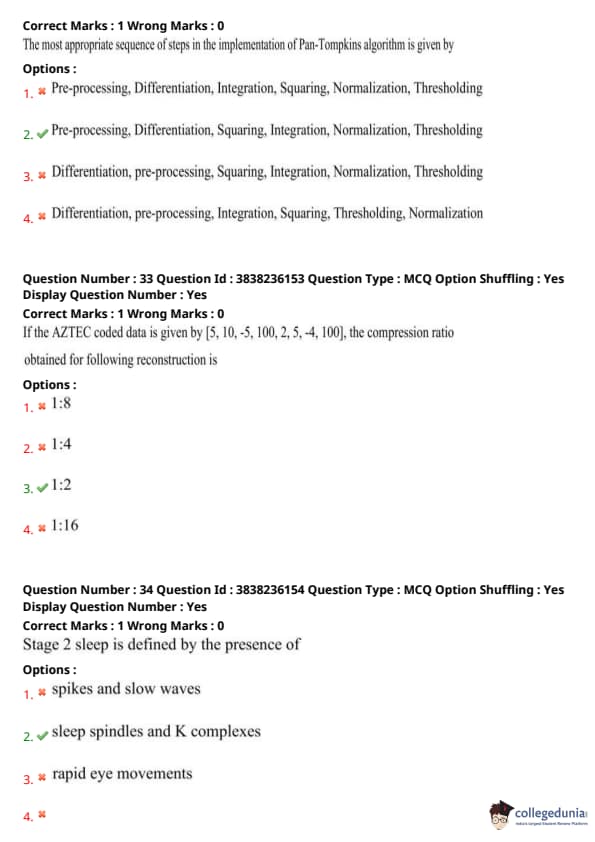
If the AZTEC coded data is given by \([5, 10, -5, 100, 2, 5, -4, 100]\), the compression ratio obtained for following reconstruction is
- (A) \( 1:8 \)
- (B) \( 1:4 \)
- (C) \( 1:2 \)
- (D) \( 1:16 \)
Question 34:
Stage 2 sleep is defined by the presence of
- (A) \( spikes and slow waves \)
- (B) \( sleep spindles and K complexes \)
- (C) \( rapid eye movements \)
- (D) \( 1 to 2 Hz delta frequencies \)
Correct Answer: (B) \( \text{sleep spindles and K complexes} \)
View Solution
Question 35:
Higher-order differentiation filter coefficients in Pan Tompkins algorithm is
- (A) \( [-1 -2 0 2 1] \)
- (B) \( [1 2 0 -2 -1] \)
- (C) \( [-2 -1 0 1 2] \)
- (D) \( [2 1 0 -1 -2] \)
Question 36:
Slew rate of an ideal op-amp is
- (A) \( Infinite \)
- (B) \( Very high \)
- (C) \( Low \)
- (D) \( Zero \)
Question 37:
A shunt regulator utilizing a zener diode with an incremental resistance of \(5\,\Omega\) is fed through an \(82\,\Omega\) resistor. If the raw supply changes by \(1.0\,V\), what is the corresponding change in the regulated output voltage?
- (A) \(72.7\,mV\)
- (B) \(73.7\,mV\)
- (C) \(74.7\,mV\)
- (D) \(75.7\,mV\)
Question 38:
In FET, as \( V_{GS} \) is changed from zero to increasing reverse bias, the value of \( g_m \) is
- (A) \( Decreased \)
- (B) \( Increased \)
- (C) \( Constant \)
- (D) \( Zero \)
Question 39:
An amplifier has an open loop voltage gain of -500. This gain is reduced to -100 when negative feedback is applied. The reverse transmission factor, \( \beta \), of the system is
- (A) \( 0.008 \)
- (B) \( -0.025 \)
- (C) \( 0.1 \)
- (D) \( -0.2 \)
Question 40:
The bandwidth of an RF tuned amplifier is dependent on Q-factor of
- (A) \( Tuned output circuit \)
- (B) \( Tuned input circuit \)
- (C) \( Operating point \)
- (D) \( Output, input circuits and quiescent point \)
Correct Answer: (A) \( \text{Tuned output circuit} \)
View Solution
Question 41:
An instrumentation amplifier has a high
- (A) \( Output impedance \)
- (B) \( CMRR \)
- (C) \( Input offset currents \)
- (D) \( Supply voltage \)
Question 42:
How many AND gates are required to realize Y = CD + EF + G
- (A) \( 4 \)
- (B) \( 5 \)
- (C) \( 3 \)
- (D) \( 2 \)
Question 43:
Determine the output frequency of a frequency division circuit which contains 12 flip-flops with an input clock frequency of 20.48 MHz.
- (A) \( 10.24 kHz \)
- (B) \( 05 kHz \)
- (C) \( 30.24 kHz \)
- (D) \( 15 kHz \)
Question 44:
Multivibrator which can produce a very short pulse or a much longer rectangular shaped waveform whose leading edge rises in time with an externally applied trigger pulse is called
- (A) \( Astable multivibrator \)
- (B) \( Distable multivibrator \)
- (C) \( Monostable multivibrator \)
- (D) \( Tristable multivibrator \)
Correct Answer: (C) \( \text{Monostable multivibrator} \)
View Solution
Question 45:
Which of the following is a function of shift register?
- (A) \( To convert digital information into analog signals \)
- (B) \( To control current levels according to data pulses \)
- (C) \( To translate serial digital information into parallel or parallel digital information into serial data \)
- (D) \( To control voltage levels according to clock pulses \)
Correct Answer: (C) \( \text{To translate serial digital information into parallel or parallel digital information into serial data} \)
View Solution
Question 46:
What is the maximum possible range of bit-count specifically in an n-bit binary counter consisting of 'n' number of flip-flops?
- (A) \( 0 to 2^n \)
- (B) \( 0 to 2^n - 1 \)
- (C) \( 0 to 2^{n+1/2} \)
- (D) \( 0 to 2^n + 1 \)
Question 47:
A 4-bit R/2R digital-to-analog (DAC) converter has a reference of 5 V. What is the analog output for the input code 0101?
- (A) \( 0.3125 V \)
- (B) \( 3.125 V \)
- (C) \( 0.78125 V \)
- (D) \( 31.25 V \)
Question 48:
Sample and hold circuits in A/D converters are designed to
- (A) \( Stabilize the comparator's threshold voltage during the conversion process \)
- (B) \( Sample and hold the output of the binary counter during the conversion process \)
- (C) \( Sample and hold the D/A converter staircase waveform during the conversion process \)
- (D) \( Stabilize the input analog signal during the conversion process \)
Correct Answer: (D) \( \text{Stabilize the input analog signal during the conversion process} \)
View Solution
Question 49:
What type of register would shift a complete binary number in one bit at a time and shift all the stored bits out one bit at a time?
- (A) \( PIPO \)
- (B) \( SISO \)
- (C) \( SIPO \)
- (D) \( PISO \)
Question 50:
What is the status of the carry, auxiliary carry and parity flag for the following instructions?
MOV A,\#9C
ADD A,\#64H
- (A) \( CY = 0, AC = 0, P = 0 \)
- (B) \( CY = 0, AC = 1, P = 0 \)
- (C) \( CY = 1, AC = 1, P = 0 \)
- (D) \( CY = 1, AC = 1, P = 1 \)
Correct Answer: (C) \( \text{CY = 1, AC = 1, P = 0} \)
View Solution
Question 51:
What registers are significantly incremented and decremented respectively for the transmission of each byte by Direct Memory Access (DMA)?
- (A) \( Address Register \& Byte Count Register \)
- (B) \( Control Register \& Byte Count Register \)
- (C) \( Transmitter Register \& Byte Count Register \)
- (D) \( Status- Register \& Byte Count Register \)
Correct Answer: (A) \( \text{Address Register \& Byte Count Register} \)
View Solution
Question 52:
Frequency range of 8257 is
- (A) \( 500Hz to 3MHz \)
- (B) \( 250Hz to 3MHz \)
- (C) \( 500Hz to 2MHz \)
- (D) \( 250Hz to 2MHz \)
Question 53:
A single-chip data acquisition system incorporates
- (A) \( An ADC and a multiplexer \)
- (B) \( An ADC and a DAC \)
- (C) \( A DAC and a demultiplexer \)
- (D) \( An ADC and a demultiplexer \)
Correct Answer: (A) \( \text{An ADC and a multiplexer} \)
View Solution
Question 54:
The external interrupts of 8051 microcontroller are
- (A) \( TRAP and INT1 \)
- (B) \( INT2 and INT1 \)
- (C) \( INT0 and INT1 \)
- (D) \( TRAP and INTR \)
Question 55:
Which of the following is a register-indirect addressing mode in instruction set?
- (A) \( LDA 2700H \)
- (B) \( ADI 36H \)
- (C) \( DAA \)
- (D) \( LDAX B \)
Question 56:
Systematic errors lead due to a lack of
- (A) \( Accuracy in the measurement \)
- (B) \( Significant digits in the measurement \)
- (C) \( Precision in the measurement \)
- (D) \( Gradation of the instrument \)
Correct Answer: (A) \( \text{Accuracy in the measurement} \)
View Solution
Question 57:
Starting position of an object is represented as \( x = 5.1 \pm 0.2 m \) and the finishing position as \( y = 6.9 \pm 0.3 m \). What will be the displacement and error in displacement?
- (A) \( Displacement = 1 m, Error = 0.5 m \)
- (B) \( Displacement = 2 m, Error = 0.36 m \)
- (C) \( Displacement = 1.8 m, Error = 0.36 m \)
- (D) \( Displacement = 1.5 m, Error = 0.4 m \)
Correct Answer: (C) \( \text{Displacement = 1.8 m, Error = 0.36 m} \)
View Solution
Question 58:
A Daniel cell is balanced at 240 cm in length of a potentiometer. Now the cell is short-circuited by a resistance of 0.25 ohm and the balance is obtained at 80 cm. The internal resistance of the Daniel cell is
- (A) \( 0.5 ohm \)
- (B) \( 2 ohms \)
- (C) \( 0.25 ohm \)
- (D) \( 1 ohm \)
Question 59:
In a Q Meter, the values of the tuning capacitor are \( C_3 \) and \( C_4 \) for resonant frequencies \( f \) and \( 2f \), respectively. The value of distributed capacitance is
- (A) \( \frac{(C_3 - C_4)}{2} \)
- (B) \( \frac{(C_3 - 2C_4)}{3} \)
- (C) \( \frac{(C_3 - 4C_4)}{3} \)
- (D) \( \frac{(C_3 - 4C_4)}{2} \)
Question 60:
In Maxwell's capacitance bridge for calculating unknown inductance, the various values at balance are \( R_2 = 300 \, \Omega \), \( R_3 = 700 \, \Omega \), \( R_4 = 1500 \, \Omega \), \( C_4 = 0.8 \, \muF \). Calculate \( R_1 \), \( L_1 \), and Q factor, if the frequency is 1100 Hz.
- (A) \( 240 \, \Omega,\ 0.12 \, H,\ 3.14 \)
- (B) \( 140 \, \Omega,\ 0.168 \, H,\ 8.29 \)
- (C) \( 140 \, \Omega,\ 0.12 \, H,\ 5.92 \)
- (D) \( 240 \, \Omega,\ 0.36 \, H,\ 8.29 \)
Correct Answer: (B) \( 140 \, \Omega,\ 0.168 \, \text{H},\ 8.29 \)
View Solution
Question 61:
Which of the following instrument is used for recording the movements imparted to the body with each beat of the heart cycle?
- (A) \( Apexcardiograph \)
- (B) \( Ballistocardiograph \)
- (C) \( Electro-oculograph \)
- (D) \( Electro-retinograph \)
Correct Answer: (B) \( \text{Ballistocardiograph} \)
View Solution
Question 62:
The amplitude of EMG signals depend upon which of the following factor?
- (A) \( Respiration \)
- (B) \( Position of electrode \)
- (C) \( Blood Resistivity \)
- (D) \( Ventricular Volume \)
Correct Answer: (B) \( \text{Position of electrode} \)
View Solution
Question 63:
There is provision for automatic adjustment of stimulus intensity and gains for the various sensing channels in
- (A) \( Fixed Pacemakers \)
- (B) \( Atrial Triggered Pacemakers \)
- (C) \( Demand Pacemakers \)
- (D) \( Dual Chamber Pacemakers \)
Question 64:
What should be CMRR of pre-amplifier up to 5 kHz?
- (A) \( 10 dB \)
- (B) \( 30 dB \)
- (C) \( 90 dB \)
- (D) \( greater than 90 dB \)
Correct Answer: (D) \( \text{greater than 90 dB} \)
View Solution
Question 65:
Linearity of transducer is closeness of the transducer’s calibration curve to a special
- (A) \( curved line within a given percentage of full scale output \)
- (B) \( straight line within a given percentage of full scale output \)
- (C) \( straight line within a given percentage of half scale output \)
- (D) \( curved line within a given percentage of half scale output \)
Correct Answer: (B) \( \text{straight line within a given percentage of full scale output} \)
View Solution
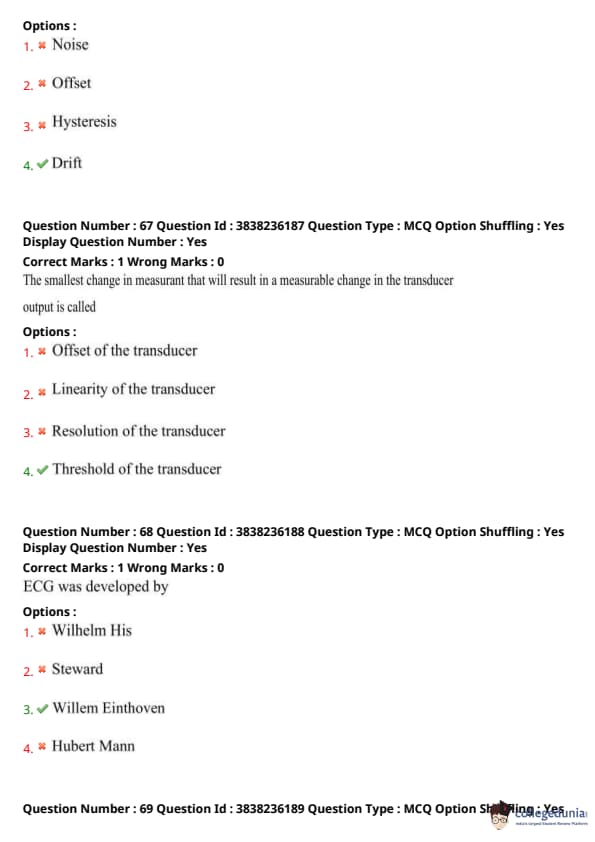
Question 66:
Change in signal over long period of time is called
- (A) \( Noise \)
- (B) \( Offset \)
- (C) \( Hysteresis \)
- (D) \( Drift \)
Question 67:
The smallest change in measurant that will result in a measurable change in the transducer output is called
- (A) \( Offset of the transducer \)
- (B) \( Linearity of the transducer \)
- (C) \( Resolution of the transducer \)
- (D) \( Threshold of the transducer \)
Correct Answer: (D) \( \text{Threshold of the transducer} \)
View Solution
Question 68:
ECG was developed by
- (A) \( Wilhelm His \)
- (B) \( Steward \)
- (C) \( Willem Einthoven \)
- (D) \( Hubert Mann \)
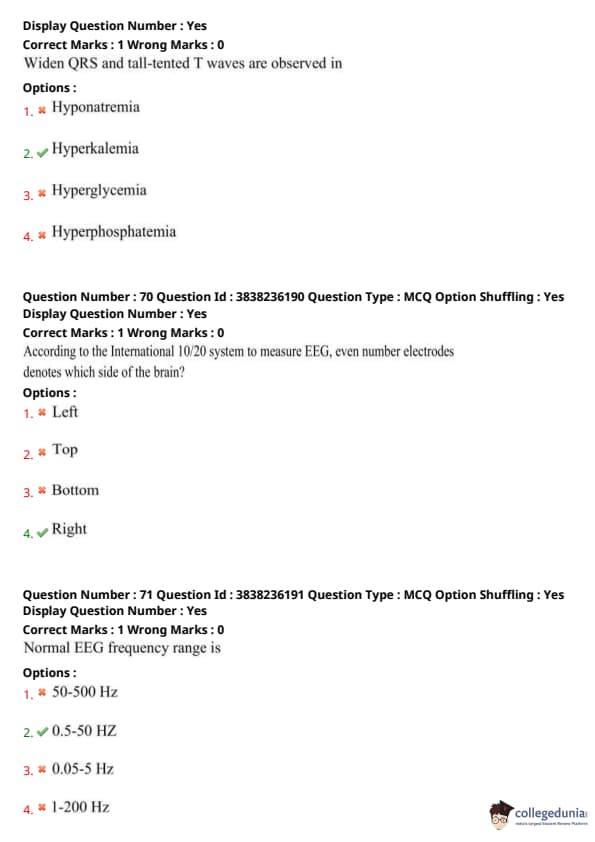
Question 69:
Widen QRS and tall-tented T waves are observed in
- (A) \( Hyponatremia \)
- (B) \( Hyperkalemia \)
- (C) \( Hyperglycemia \)
- (D) \( Hyperphosphatemia \)
Question 70:
According to the International 10/20 system to measure EEG, even number electrodes denotes which side of the brain?
- (A) \( Left \)
- (B) \( Top \)
- (C) \( Bottom \)
- (D) \( Right \)
Question 71:
Normal EEG frequency range is
- (A) \( 50-500 Hz \)
- (B) \( 0.5-50 Hz \)
- (C) \( 0.05-5 Hz \)
- (D) \( 1-200 Hz \)
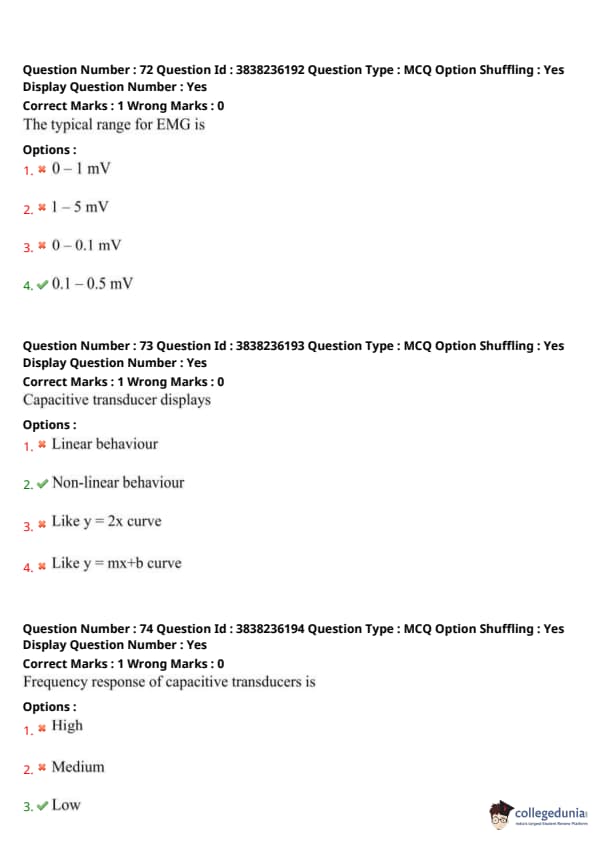
Question 72:
The typical range for EMG is
- (A) \( 0 - 1 mV \)
- (B) \( 1 - 5 mV \)
- (C) \( 0 - 0.1 mV \)
- (D) \( 0.1 - 0.5 mV \)
Question 73:
Capacitive transducer displays
- (A) \( Linear behaviour \)
- (B) \( Non-linear behaviour \)
- (C) \( Like y = 2x curve \)
- (D) \( Like y = mx+b curve \)
Correct Answer: (B) \( \text{Non-linear behaviour} \)
View Solution
Question 74:
Frequency response of capacitive transducers is
- (A) \( High \)
- (B) \( Medium \)
- (C) \( Low \)
- (D) \( Zero \)
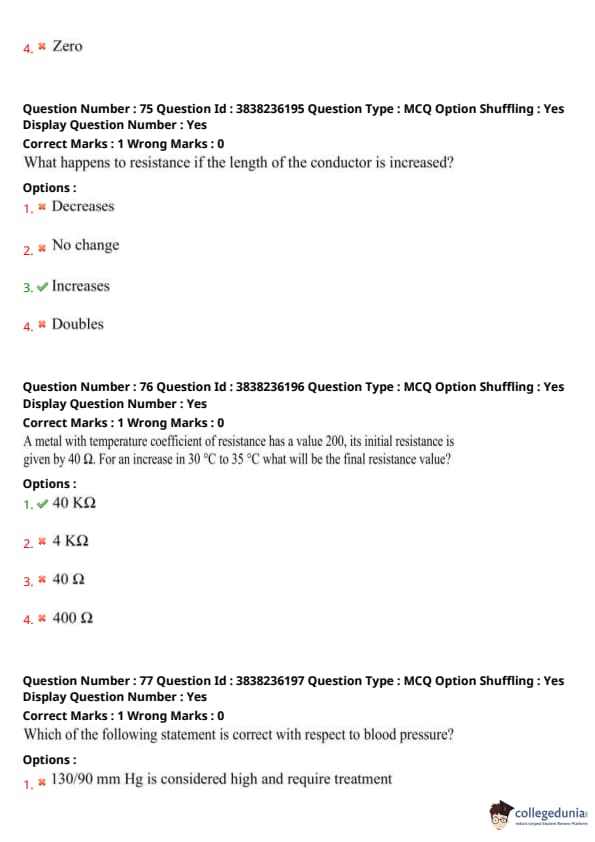
Question 75:
What happens to resistance if the length of the conductor is increased?
- (A) \( Decreases \)
- (B) \( No change \)
- (C) \( Increases \)
- (D) \( Doubles \)
Question 76:
A metal with temperature coefficient of resistance has a value 200, its initial resistance is given by 40 \( \Omega \). For an increase in 30 \( ^{\circ} \)C to 35 \( ^{\circ} \)C what will be the final resistance value?
- (A) \( 40 K\Omega \)
- (B) \( 4 K\Omega \)
- (C) \( 40 \Omega \)
- (D) \( 400 \Omega \)
Question 77:
Which of the following statement is correct with respect to blood pressure?
- (A) \( 130/90 mm Hg is considered high and require treatment \)
- (B) \( 100/55 mm Hg is considered an ideal \)
- (C) \( 105/50 mm Hg makes one active \)
- (D) \( 190/110 mm Hg harm vital organs \)
Correct Answer: (D) \( \text{190/110 mm Hg harm vital organs} \)
View Solution
Question 78:
Unhealthy growth of tissue due to higher pressures on the walls of the artery is termed as
- (A) \( Atheroma \)
- (B) \( Aroma \)
- (C) \( Adenoma \)
- (D) \( Aroma and Adenoma \)
Question 79:
Which mixture of gases are used in anesthesia?
- (A) \( O_2 and CO_2 \)
- (B) \( O_2 and N_2O \)
- (C) \( CO_2 and N_2O \)
- (D) \( O_2, CO_2 and N_2O \)
Correct Answer: (B) \( \text{O}_2 \text{ and N}_2\text{O} \)
View Solution
Question 80:
AEP stands for
- (A) \( Auditory Evoked Potential \)
- (B) \( Auxiliary Evoked Potential \)
- (C) \( Audiovisual Evoked Potential \)
- (D) \( Ambulatory Evoked Potential \)
Correct Answer: (A) \( \text{Auditory Evoked Potential} \)
View Solution
Question 81:
What causes the pre-selected volume of air to flow into the patient by communicating directly with a breathing circuit?
- (A) \( Nebulizer \)
- (B) \( Microcontroller \)
- (C) \( Bellows \)
- (D) \( Humidifier \)
Question 82:
What is the pH range of extracellular fluid?
- (A) \( 7.15 to 7.20 \)
- (B) \( 7.25 to 7.30 \)
- (C) \( 7.35 to 7.45 \)
- (D) \( 7.50 to 7.60 \)
Question 83:
With a \(1^\circC\) change in temperature, the emf changes by
- (A) \( 0.1 mV \)
- (B) \( 0.2 mV \)
- (C) \( 0.5 mV \)
- (D) \( 0.8 mV \)
Question 84:
Any disturbance in the heart's normal rhythmic contraction is called
- (A) \( Heart stroke \)
- (B) \( Cardiac arrest \)
- (C) \( Arrhythmias \)
- (D) \( Premature contraction \)
Question 85:
When the heartbeat is slower than the normal rate of the heart (less than 60), this type of arrhythmias called
- (A) \( Bradycardia \)
- (B) \( Tachycardia \)
- (C) \( Arterial contraction \)
- (D) \( Ventricular contraction \)
Question 86:
Which of the following type of cartilage is present at the joints of long bones in humans?
- (A) \( Fibrous \)
- (B) \( Hyaline \)
- (C) \( Elastic \)
- (D) \( Calcified \)
Question 87:
Which of the following clinical sign indicates ischaemia of forearm?
- (A) \( Carpal tunnel syndrome \)
- (B) \( Hand of benediction \)
- (C) \( Ulnar claw \)
- (D) \( Volkmann's Contracture \)
Correct Answer: (D) \( \text{Volkmann's Contracture} \)
View Solution
Question 88:
What does corpus callosum connects in human brain?
- (A) \( Two optic lobes \)
- (B) \( Bone and muscle \)
- (C) \( Two cerebral hemisphere \)
- (D) \( Two lobes of pituitary gland \)
Correct Answer: (C) \( \text{Two cerebral hemisphere} \)
View Solution
Question 89:
Which of the following taste bud is present on the lateral sides of the human tongue?
- (A) \( Bitter \)
- (B) \( Salty \)
- (C) \( Sour \)
- (D) \( Sweet \)
Question 90:
Which of the following is the largest gland in human body?
- (A) \( Thymus \)
- (B) \( Kidneys \)
- (C) \( Liver \)
- (D) \( Pancreas \)
Question 91:
The study of fluid at rest is
- (A) \( Fluid Dynamics \)
- (B) \( Fluid Mechanics \)
- (C) \( Fluid Statics \)
- (D) \( Fluid Kinematics \)
Question 92:
Which of the following method is used exclusively in fluid mechanics?
- (A) \( Eulerian method \)
- (B) \( Lagrangian method \)
- (C) \( Neither Lagrangian nor Eulerian method \)
- (D) \( Both Lagrangian and Eulerian methods \)
Question 93:
Cartilaginous joint is a joint between
- (A) \( Skull bones \)
- (B) \( Vertebrae \)
- (C) \( Phalanges \)
- (D) \( Elbow \)
Question 94:
Joints act as \hspace{1.5cm} during movement
- (A) \( Effort \)
- (B) \( Lever \)
- (C) \( Fulcrum \)
- (D) \( Load \)
Question 95:
Which of the following is an example of hinge joint?
- (A) \( Between the carpals \)
- (B) \( Between carpal and metacarpal of thumb \)
- (C) \( Knee joint \)
- (D) \( Between atlas and axis \)
Question 96:
Which of the following is an example of gliding joint?
- (A) \( Knee joint \)
- (B) \( Between the carpals \)
- (C) \( Between carpal and metacarpal of thumb \)
- (D) \( Between atlas and axis \)
Correct Answer: (B) \( \text{Between the carpals} \)
View Solution
Question 97:
A sprain is defined as
- (A) \( Acute pain in bone \)
- (B) \( Ligament tear \)
- (C) \( Muscle tear \)
- (D) \( Tendon tear \)
Question 98:
Group of cells, which is similar in structure and function are structured into
- (A) \( Organ system \)
- (B) \( Muscles \)
- (C) \( Bone \)
- (D) \( Tissues \)
Question 99:
What is the name of the tissues which helps in protection and support of the body?
- (A) \( Muscular tissue \)
- (B) \( Nervous tissue \)
- (C) \( Connective tissue \)
- (D) \( Epithelial tissue \)
Question 100:
Which of the following tissues has the most regenerative property?
- (A) \( Epithelial tissue \)
- (B) \( Connective tissue \)
- (C) \( Muscular tissue \)
- (D) \( Neural tissue \)
Question 101:
Production of X-rays for diagnostic applications requires voltage range of
- (A) \( 30-200 kV \)
- (B) \( 300-2000 kV \)
- (C) \( 2000-20000 kV \)
- (D) \( 2-20 kV \)
Question 102:
Angiography is used to check
- (A) \( Kidney stones \)
- (B) \( Blood vessels \)
- (C) \( Tumors \)
- (D) \( Breast cancer \)
Question 103:
X-rays are emitted by
- (A) \( Photons \)
- (B) \( Neutrons \)
- (C) \( Atoms \)
- (D) \( Electrons \)
Question 104:
What is the wavelength range of X-rays
- (A) \( 700 nm to 1 nm \)
- (B) \( 1 mm to 700 nm \)
- (C) \( 0.1 to 1 mm \)
- (D) \( 0.01 to 10 nm \)
Question 105:
What is the purpose of contrast in CT scan?
- (A) \( To suppress particular tissues \)
- (B) \( To enhance a particular tissue \)
- (C) \( To ensure correct tissue is being imaged \)
- (D) \( To reduce bone interference \)
Correct Answer: (B) \( \text{To enhance a particular tissue} \)
View Solution
Question 106:
The cooling agent for the MRI magnet is
- (A) \( Helium \)
- (B) \( Neon \)
- (C) \( Argon \)
- (D) \( Xenon \)
Question 107:
The smallest unit in the reconstruction/projection of an MRI image is called as
- (A) \( Pixel \)
- (B) \( Voxel \)
- (C) \( Binary unit \)
- (D) \( Dot \)
Question 108:
Which property of sound waves acts like the principle of ultrasound?
- (A) \( Reflection and Refraction \)
- (B) \( Reflection only \)
- (C) \( Refraction only \)
- (D) \( Propagation \)
Correct Answer: (A) \( \text{Reflection and Refraction} \)
View Solution
Question 109:
What kind of ultrasound is produced by piezoelectric crystal?
- (A) \( Pressure wave ultrasound \)
- (B) \( Electrical wave ultrasound \)
- (C) \( Sound wave ultrasound \)
- (D) \( Simple ultrasound \)
Correct Answer: (A) \( \text{Pressure wave ultrasound} \)
View Solution
Question 110:
How is a medium characterized?
- (A) \( By its thickness \)
- (B) \( By its acoustic impedance \)
- (C) \( By its water content \)
- (D) \( By its density \)
Correct Answer: (B) \( \text{By its acoustic impedance} \)
View Solution
Question 111:
The wave velocity of ultrasound in soft tissues is 1540 m/s and the impedance offered by it is \( 1.63 \times 10^6 \, kg/m^2s \). What is the density of the soft tissue?
- (A) \( 0.1058441 \, kg/m^3 \)
- (B) \( 10.58441 \, kg/m^3 \)
- (C) \( 1058.441 \, kg/m^3 \)
- (D) \( 105844.1 \, kg/m^3 \)
Correct Answer: (C) \( 1058.441 \, \text{kg/m}^3 \)
View Solution
Question 112:
What makes PET and SPECT so unique when it comes to nuclear imaging?
- (A) \( Do not require dyes \)
- (B) \( Do not require X-rays \)
- (C) \( They show the metabolic functions \)
- (D) \( They give more details about the imaged organ/tissue \)
Correct Answer: (C) \( \text{They show the metabolic functions} \)
View Solution
Question 113:
Which of the following is a characterization technique used to measure Young's modulus of a biomaterial?
- (A) \( Tensile test \)
- (B) \( Compression test \)
- (C) \( Three- and four-point bend test \)
- (D) \( Calculation from the stress-strain curve \)
Correct Answer: (D) \( \text{Calculation from the stress-strain curve} \)
View Solution
Question 114:
AFM stands for
- (A) \( Auto focusing microscope \)
- (B) \( Antenna focusing microscope \)
- (C) \( Atomic force microscope \)
- (D) \( Atomic focusing microscope \)
Correct Answer: (C) \( \text{Atomic force microscope} \)
View Solution
Question 115:
What is the first step in biomaterial-tissue interactions?
- (A) \( Cell Migration \)
- (B) \( Adsorption of proteins \)
- (C) \( Cell Development \)
- (D) \( Cell adhesion \)
Correct Answer: (B) \( \text{Adsorption of proteins} \)
View Solution
Question 116:
The biomaterials are expected to mimic the functions of
- (A) \( Extracellular Matrix (ECM) \)
- (B) \( Transmembrane proteins \)
- (C) \( Cytoplasm \)
- (D) \( Cell Organelles \)
Correct Answer: (A) \( \text{Extracellular Matrix (ECM)} \)
View Solution
Question 117:
Constant stress test is used for a biomaterial to measure
- (A) \( Ductility \)
- (B) \( Toughness \)
- (C) \( Creep \)
- (D) \( Fatigue \)
Question 118:
Which of the following gel/hydrogel is formed by a physical gelation mechanism?
- (A) \( Polyester gel \)
- (B) \( Gelatin \)
- (C) \( CMC-g-acrylic acid \)
- (D) \( Polydimethyl siloxane \)
Question 119:
Which of the following component of TEM focuses the beam of electrons on the sample?
- (A) \( Ocular lens \)
- (B) \( Condenser lens \)
- (C) \( Stage \)
- (D) \( Column \)
Question 120:
Image formation in electron microscope is based on
- (A) \( column length \)
- (B) \( electron number \)
- (C) \( differential scattering \)
- (D) \( specimen size \)
Correct Answer: (C) \( \text{differential scattering} \)
View Solution









Comments