TS PGECET 2024 Chemical Engineering Question Paper is available for download here. Jawaharlal Nehru Technological University Hyderabad on behalf of Telangana Council of Higher Education (TGCHE) conducted TS PGECET 2024 Chemical Engineering on June 12 in Shift 1 from 10 AM to 12 PM. TS PGECET Question Paper 2024 consists of 120 MCQ-based questions in total carrying 1 mark each to be attempted in the duration of 2 hours.
TS PGECET 2024 Chemical Engineering Question Paper with Answer Key PDF
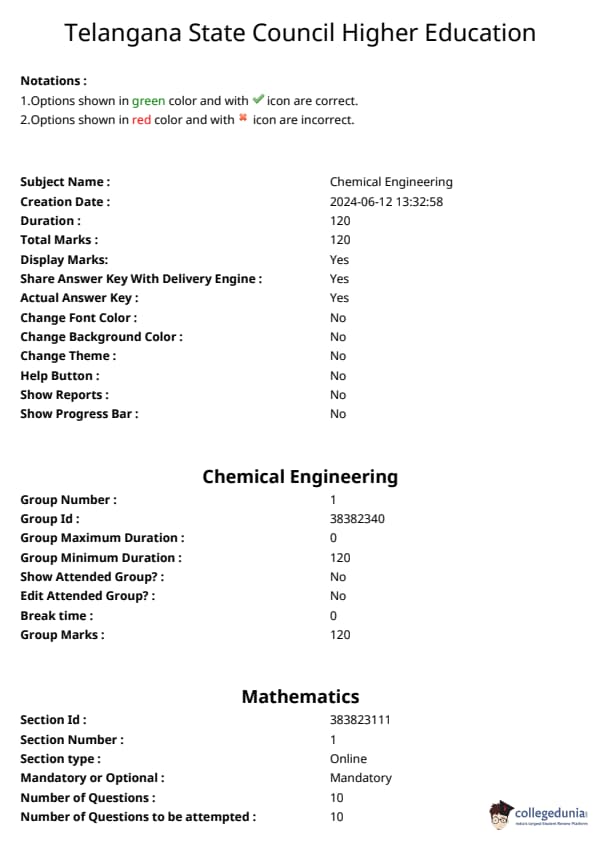
Question 1:
If the characteristic polynomial of the matrix \( A_{3\times3} \) is given by \( f(\lambda) = \lambda^3 - 10\lambda^2 + 27\lambda - 18 \), then trace of A and determinant of A respectively are
- (1) 10 and 18
- (2) 10 and -18
- (3) -10 and 18
- (4) -10 and -18
Question 2:
Evaluate \( \log_{e^{2000}} e^{2021} \cdot \log_{e^{2021}} e^{2022} \cdot \log_{e^{2022}} e^{2023} \cdot \log_{e^{2023}} e^{2024} \)
- (1) 2020
- (2) 0
- (3) 2024
- (4) 1
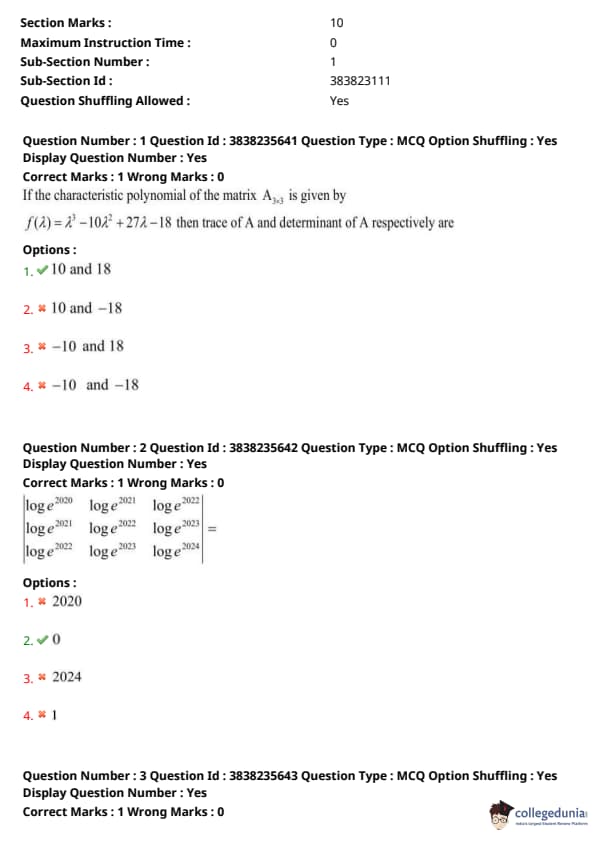
Question 3:
The value of \( \int_0^1 \int_y^{\sqrt{y}} yx \, dxdy \) is
- (1) \( \frac{1}{6} \)
- (2) \( \frac{3}{5} \)
- (3) \( \frac{2}{7} \)
- (4) \( \frac{7}{6} \)
Question 4:
The divergence of the vector field \( \vec{F} = yz\,\hat{i} - zx\,\hat{k} \) at \( (-2, 0, 1) \) is
- (1) -3
- (2) 4
- (3) -4
- (4) 3
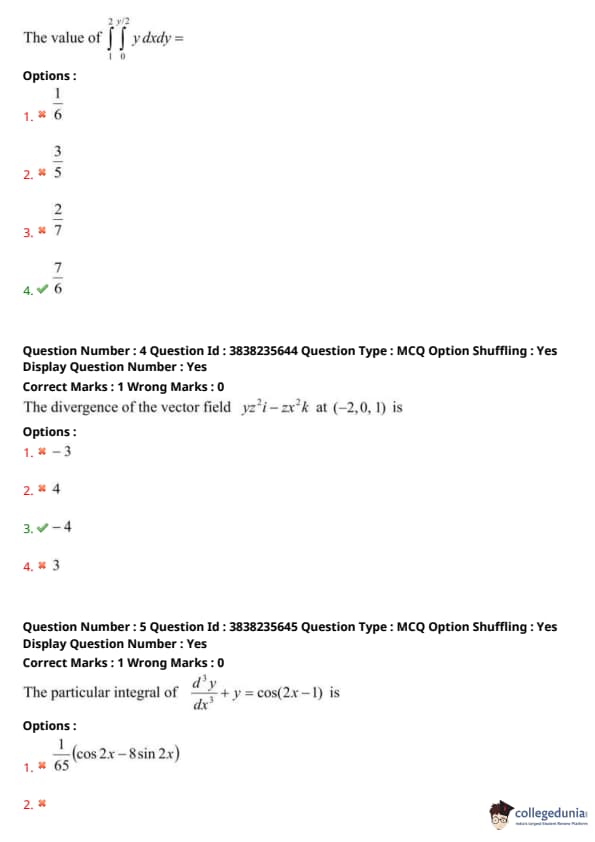
Question 5:
The particular integral of \( \frac{d^2y}{dx^2} + y = \cos(2x - 1) \) is
- (1) \( \frac{1}{65} (\cos(2x - 8\sin 2x)) \)
- (2) *
- (3) \( \frac{1}{65} (\cos(2x + 8\sin 2x)) \)
- (4) \( \frac{1}{65} (\cos(2x - 1) - 8\sin(2x - 1)) \)
Question 6:
The Laplace transform \( \mathcal{L}\{t^2 \sin 2t\} \) is
- (1) \( \frac{4(s - 3)}{(s^2 - 6s + 13)^3} \)
- (2) \( \frac{s - 3}{s^2 - 6s + 13} \)
- (3) \( \frac{s + 3}{(s^2 - 6s + 13)^2} \)
- (4) \( \frac{4(s + 3)}{(s^2 - 6s + 13)^3} \)
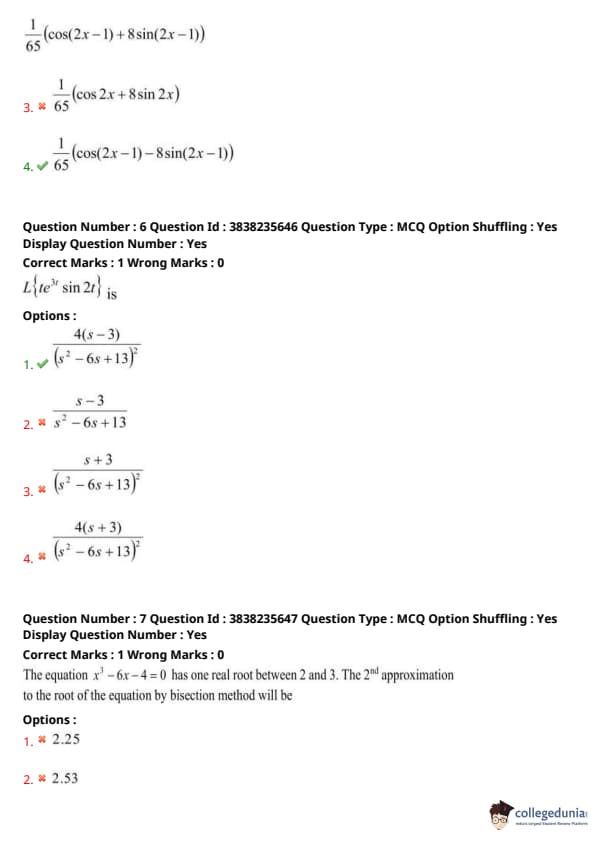
Question 7:
The equation \( x^3 - 6x - 4 = 0 \) has one real root between 2 and 3. The 2nd approximation to the root of the equation by bisection method will be
- (1) 2.25
- (2) 2.53
- (3) 2.75
- (4) 2.57
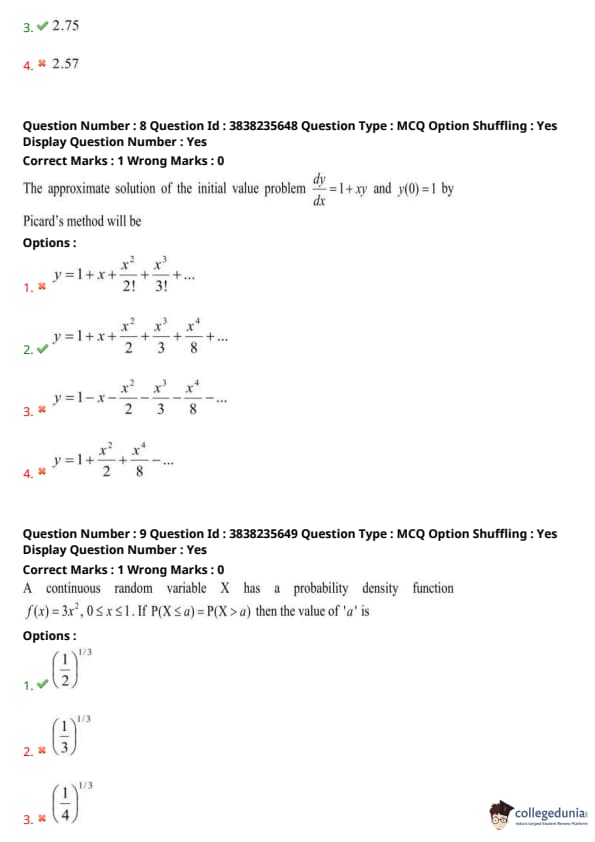
Question 8:
The approximate solution of the initial value problem \( \frac{dy}{dx} = 1 + xy \), \( y(0) = 1 \) by Picard’s method will be
- (1) \( y = 1 + x + \frac{x^2}{2!} + \frac{x^3}{3!} + \dots \)
- (2) \( y = 1 + x + \frac{x^2}{2} + \frac{x^3}{8} + \dots \)
- (3) \( y = 1 - x + \frac{x^2}{2!} - \frac{x^3}{3!} + \dots \)
- (4) \( y = 1 + \frac{x^2}{2} - \frac{x^4}{8} \dots \)
Question 9:
A continuous random variable \(X\) has a probability density function \( f(x) = 3x^2, \ 0 \leq x \leq 1 \). If \( P(X \leq a) = P(X > a) \), then the value of 'a' is
- (1) \( \left( \frac{1}{2} \right)^{1/3} \)
- (2) \( \left( \frac{1}{3} \right)^{1/3} \)
- (3) \( \left( \frac{1}{4} \right)^{1/3} \)
- (4) \( \left( \frac{1}{5} \right)^{1/3} \)
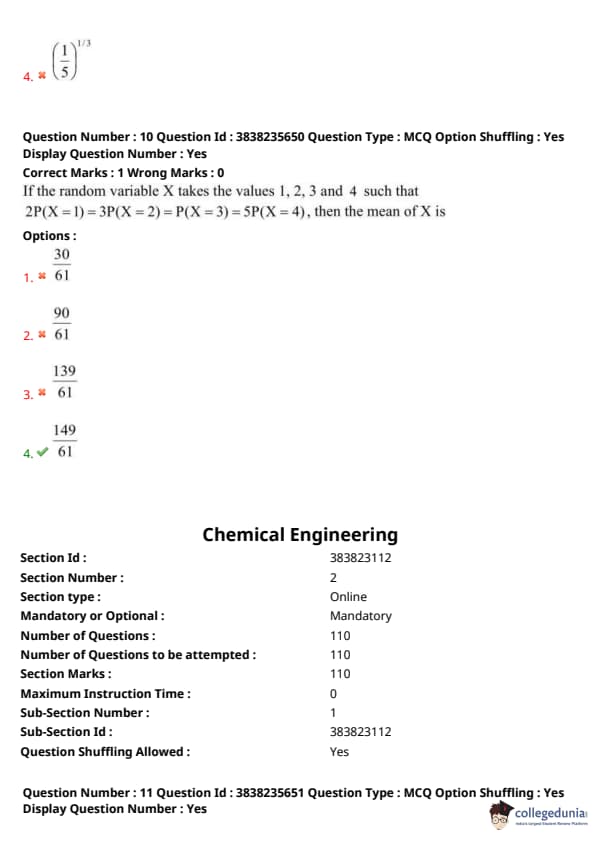
Question 10:
If the random variable \( X \) takes the values 1, 2, 3, and 4 such that \( 2P(X=1) = 3P(X=2) = P(X=3) = 5P(X=4) \), then the mean of \( X \) is
- (1) \( \frac{30}{61} \)
- (2) \( \frac{90}{61} \)
- (3) \( \frac{139}{61} \)
- (4) \( \frac{149}{61} \)
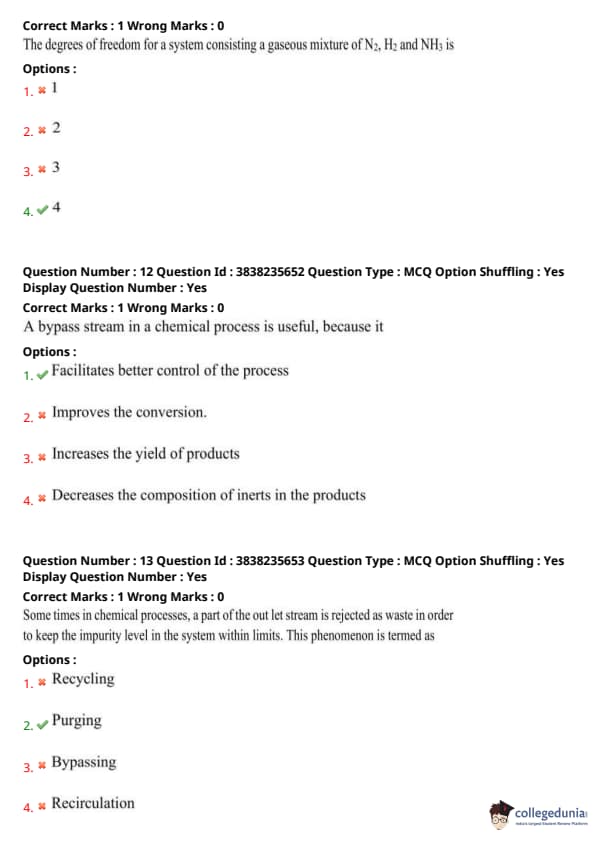
Question 11:
The degrees of freedom for a system consisting a gaseous mixture of \( N_2 \), \( H_2 \), and \( NH_3 \) is
Question 12:
A bypass stream in a chemical process is useful, because it
- (1) Facilitates better control of the process
- (2) Improves the conversion
- (3) Increases the yield of products
- (4) Decreases the composition of inerts in the products
Question 13:
Sometimes in chemical processes, a part of the outlet stream is rejected as waste in order to keep the impurity level in the system within limits. This phenomenon is termed as
- (1) Recycling
- (2) Purging
- (3) Bypassing
- (4) Recirculation
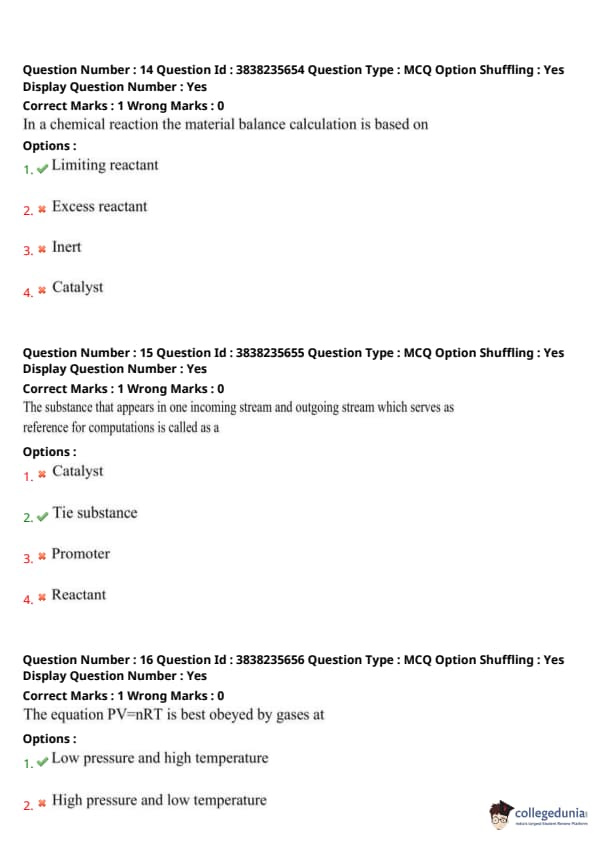
Question 14:
In a chemical reaction the material balance calculation is based on
- (1) Limiting reactant
- (2) Excess reactant
- (3) Inert
- (4) Catalyst
Question 15:
The substance that appears in one incoming stream and outgoing stream which serves as reference for computations is called as a
- (1) Catalyst
- (2) Tie substance
- (3) Promoter
- (4) Reactant
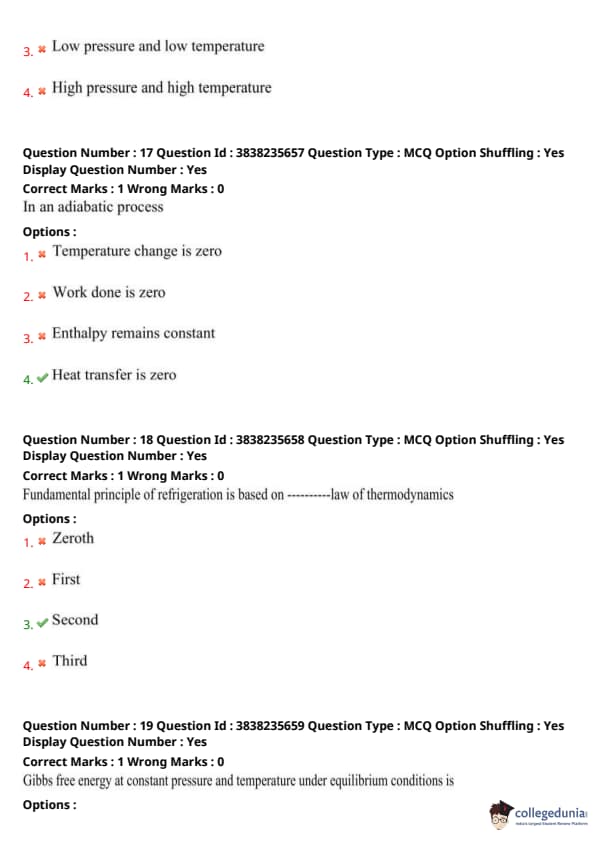
Question 16:
The equation \( PV = nRT \) is best obeyed by gases at
- (1) Low pressure and high temperature
- (2) High pressure and low temperature
- (3) Low pressure and low temperature
- (4) High pressure and high temperature
Question 17:
In an adiabatic process
- (1) Temperature change is zero
- (2) Work done is zero
- (3) Enthalpy remains constant
- (4) Heat transfer is zero
Question 18:
Fundamental principle of refrigeration is based on ------------ law of thermodynamics
- (1) Zeroth
- (2) First
- (3) Second
- (4) Third
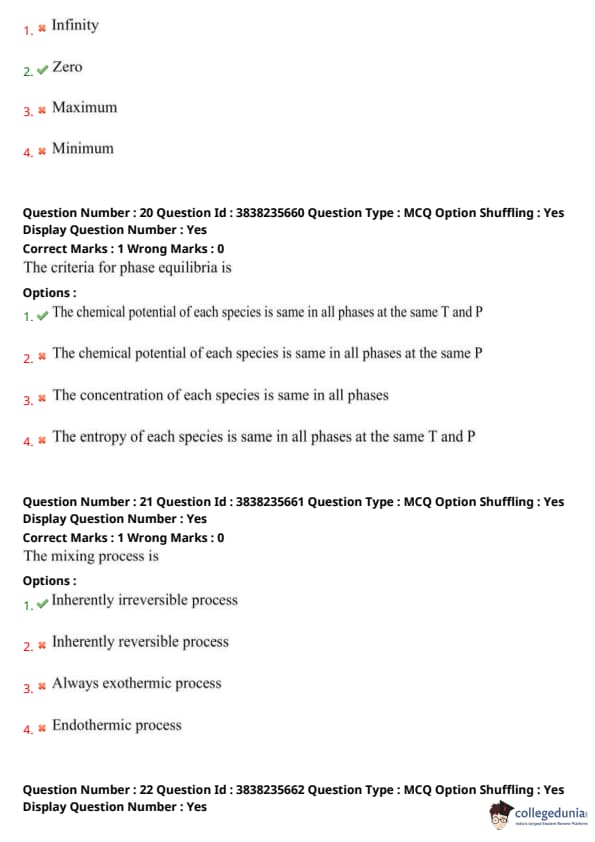
Question 19:
Gibbs free energy at constant pressure and temperature under equilibrium conditions is
- (1) Infinity
- (2) Zero
- (3) Maximum
- (4) Minimum
Question 20:
The criteria for phase equilibria is
- (1) The chemical potential of each species is same in all phases at the same T and P
- (2) The chemical potential of each species is same in all phases at the same P
- (3) The concentration of each species is same in all phases
- (4) The entropy of each species is same in all phases at the same T and P
Question 21:
The mixing process is
- (1) Inherently irreversible process
- (2) Inherently reversible process
- (3) Always exothermic process
- (4) Endothermic process
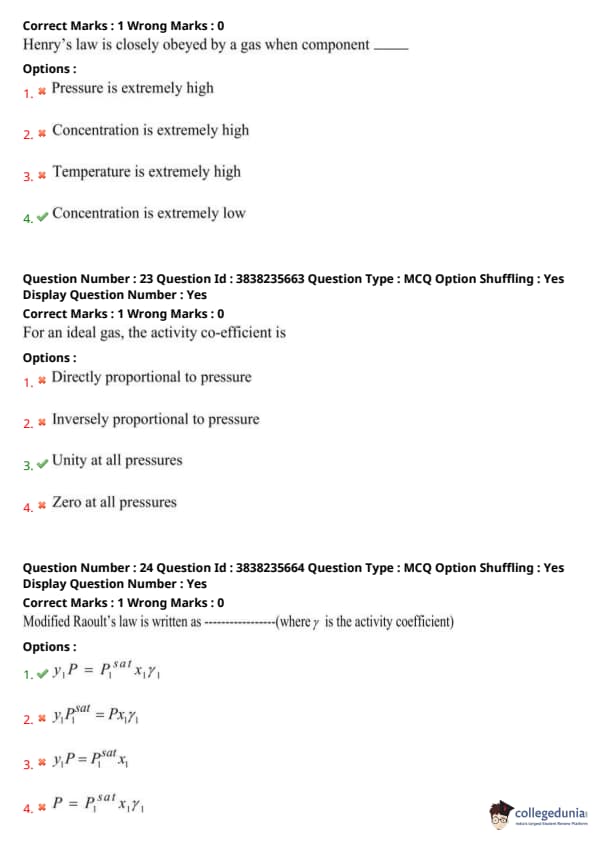
Question 22:
Henry’s law is closely obeyed by a gas when component
- (1) Pressure is extremely high
- (2) Concentration is extremely high
- (3) Temperature is extremely high
- (4) Concentration is extremely low
Question 23:
For an ideal gas, the activity co-efficient is
- (1) Directly proportional to pressure
- (2) Inversely proportional to pressure
- (3) Unity at all pressures
- (4) Zero at all pressures
Question 24:
Modified Raoult’s law is written as (where \( \gamma \) is the activity coefficient)
- (1) \( y_1 P = \gamma_1 P_1^{sat} x_1 \)
- (2) \( y_1 P^{sat}/\gamma_1 = Px_1 \)
- (3) \( y_1 P = P_1^{sat} x_1 \)
- (4) \( P = P_1^{sat} x_1 \gamma_1 \)
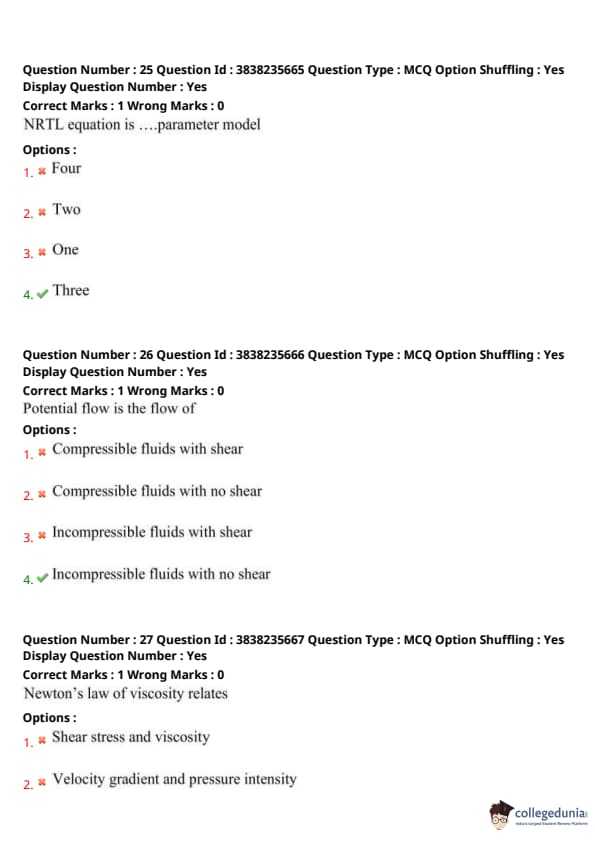
Question 25:
NRTL equation is a ....parameter model
- (1) Four
- (2) Two
- (3) One
- (4) Three
Question 26:
Potential flow is the flow of
- (1) Compressible fluids with shear
- (2) Compressible fluids with no shear
- (3) Incompressible fluids with shear
- (4) Incompressible fluids with no shear
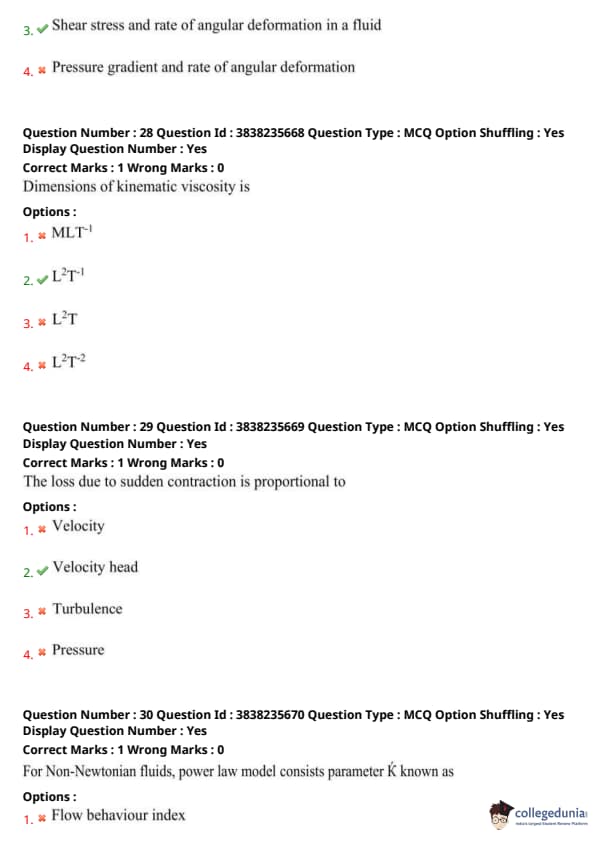
Question 27:
Newton’s law of viscosity relates
- (1) Shear stress and viscosity
- (2) Velocity gradient and pressure intensity
- (3) Shear stress and rate of angular deformation in a fluid
- (4) Pressure gradient and rate of angular deformation
Question 28:
Dimensions of kinematic viscosity is
- (1) \( MLT^{-1} \)
- (2) \( L^2T^{-1} \)
- (3) \( L^2T \)
- (4) \( L^2T^2 \)
Question 29:
The loss due to sudden contraction is proportional to
- (1) Velocity
- (2) Velocity head
- (3) Turbulence
- (4) Pressure
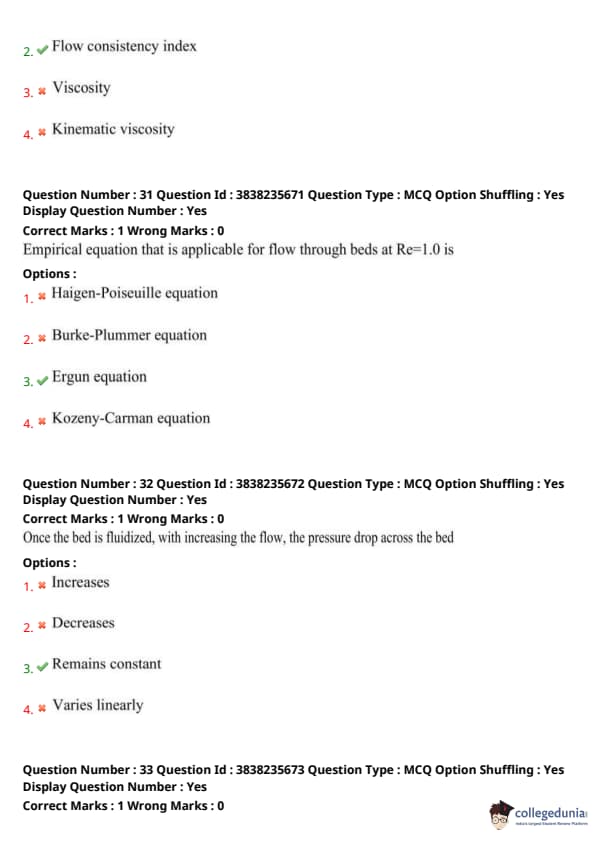
Question 30:
For Non-Newtonian fluids, power law model consists parameter \( K \) known as
- (1) Flow behaviour index
- (2) Flow consistency index
- (3) Viscosity
- (4) Kinematic viscosity
Question 31:
Empirical equation that is applicable for flow through beds at \( Re = 1.0 \) is
- (1) Haigen-Poiseuille equation
- (2) Burke-Plummer equation
- (3) Ergun equation
- (4) Kozeny-Carman equation
Question 32:
Once the bed is fluidized, with increasing the flow, the pressure drop across the bed
- (1) Increases
- (2) Decreases
- (3) Remains constant
- (4) Varies linearly
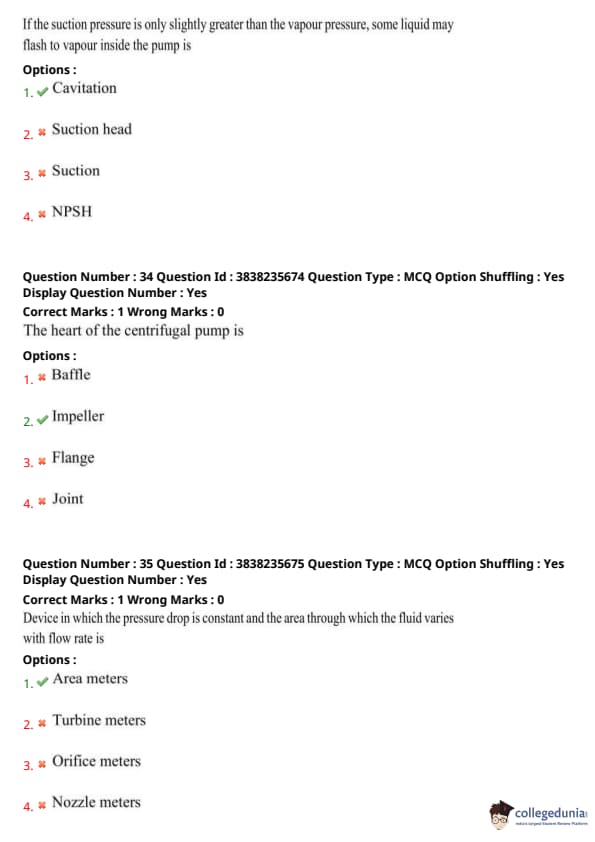
Question 33:
If the suction pressure is only slightly greater than the vapour pressure, some liquid may flash to vapour inside the pump is
- (1) Cavitation
- (2) Suction head
- (3) Suction
- (4) NPSH
Question 34:
The heart of the centrifugal pump is
- (1) Baffle
- (2) Impeller
- (3) Flange
- (4) Joint
Question 35:
Device in which the pressure drop is constant and the area through which the fluid varies with flow rate is
- (1) Area meters
- (2) Turbine meters
- (3) Orifice meters
- (4) Nozzle meters
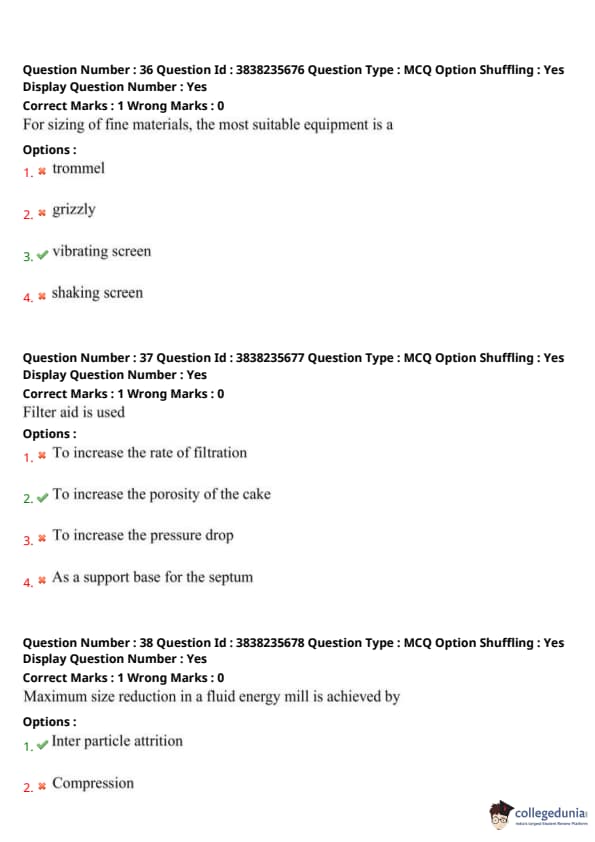
Question 36:
For sizing of fine materials, the most suitable equipment is a
- (1) Trommel
- (2) Grizzly
- (3) Vibrating screen
- (4) Shaking screen
Question 37:
Filter aid is used
- (1) To increase the rate of filtration
- (2) To increase the porosity of the cake
- (3) To increase the pressure drop
- (4) As a support base for the septum
Question 38:
Maximum size reduction in a fluid energy mill is achieved by
- (1) Inter particle attrition
- (2) Compression
- (3) Cutting
- (4) Impact
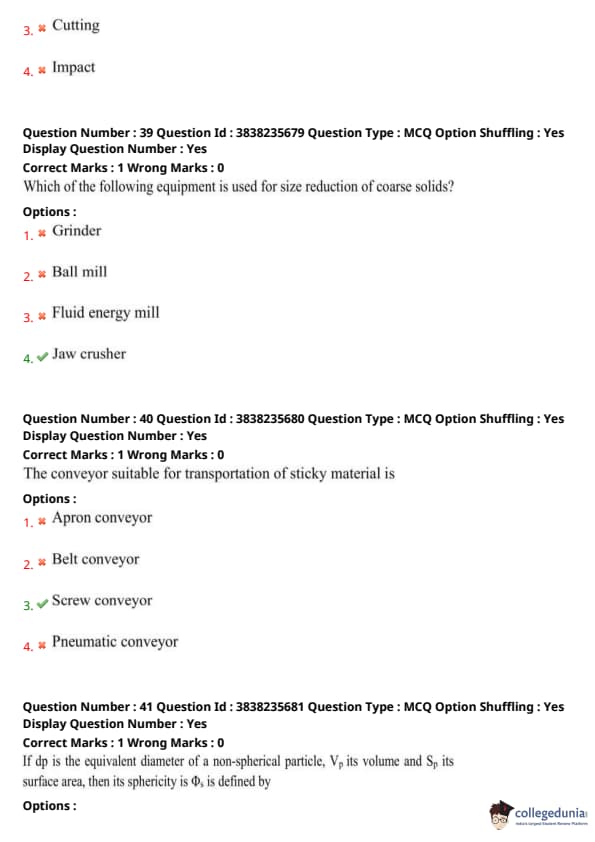
Question 39:
Which of the following equipment is used for size reduction of coarse solids?
- (1) Grinder
- (2) Ball mill
- (3) Fluid energy mill
- (4) Jaw crusher
Question 40:
The conveyor suitable for transportation of sticky material is
- (1) Apron conveyor
- (2) Belt conveyor
- (3) Screw conveyor
- (4) Pneumatic conveyor
Question 41:
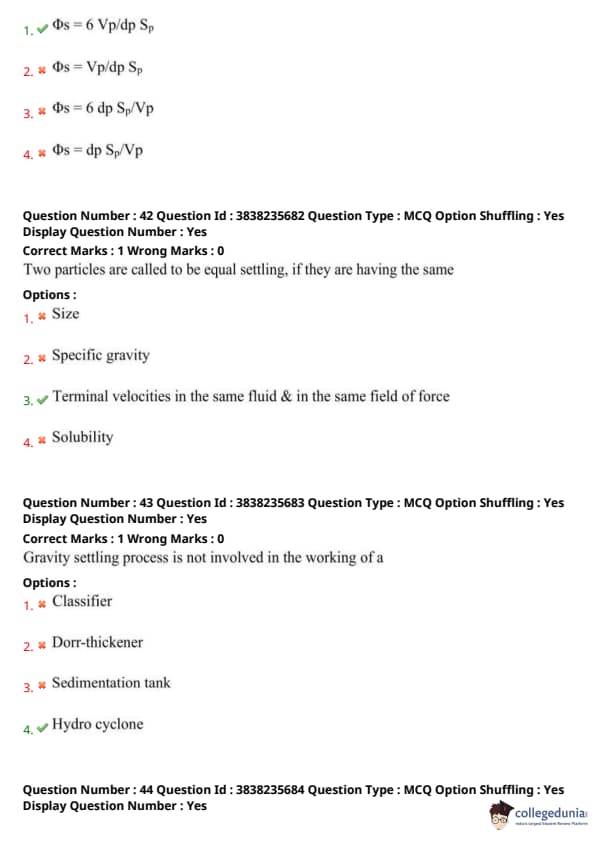
If \( d_p \) is the equivalent diameter of a non-spherical particle, \( V_p \) its volume and \( S_p \) its surface area, then its sphericity \( \Phi_s \) is defined by
- (1) \( \Phi_s = \frac{6 V_p}{d_p S_p} \)
- (2) \( \Phi_s = \frac{V_p}{d_p S_p} \)
- (3) \( \Phi_s = 6 d_p S_p \)
- (4) \( \Phi_s = \frac{d_p S_p}{V_p} \)
% Solution \textbf{Solution:}
Sphericity is a measure of how spherical a particle is.
It is defined as the ratio of surface area of a sphere (with same volume) to the actual particle surface area.
Using formula: \( \Phi_s = \frac{\text{Surface area of sphere with } V_p}{S_p} = \frac{6 V_p}{d_p S_p} \)
View Solution
Question 42:
Two particles are called to be equal settling, if they are having the same
- (1) Size
- (2) Specific gravity
- (3) Terminal velocities in the same fluid \& in the same field of force
- (4) Solubility
Question 43:
Gravity settling process is not involved in the working of a
- (1) Classifier
- (2) Dorr-thickener
- (3) Sedimentation tank
- (4) Hydro cyclone
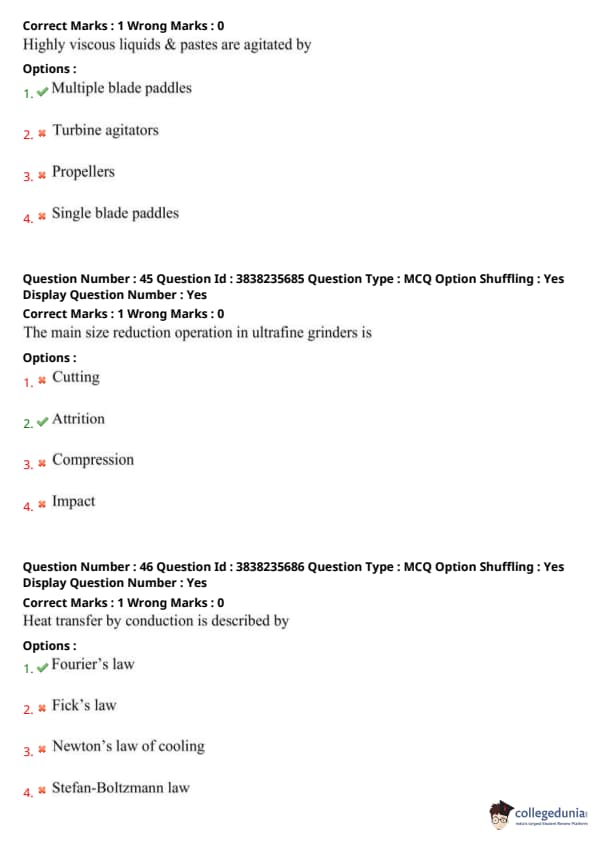
Question 44:
Highly viscous liquids and pastes are agitated by
- (1) Multiple blade paddles
- (2) Turbine agitators
- (3) Propellers
- (4) Single blade paddles
Question 45:
The main size reduction operation in ultrafine grinders is
- (1) Cutting
- (2) Attrition
- (3) Compression
- (4) Impact
Question 46:
Heat transfer by conduction is described by
- (1) Fourier’s law
- (2) Fick’s law
- (3) Newton’s law of cooling
- (4) Stefan-Boltzmann law
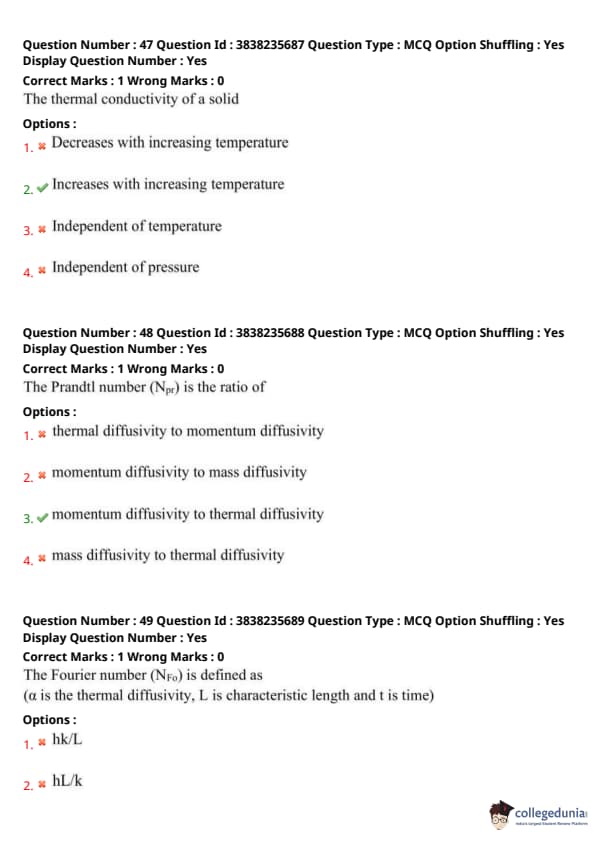
Question 47:
The thermal conductivity of a solid
- (1) Decreases with increasing temperature
- (2) Increases with increasing temperature
- (3) Independent of temperature
- (4) Independent of pressure
Question 48:
The Prandtl number (\(N_{Pr}\)) is the ratio of
- (1) Thermal diffusivity to momentum diffusivity
- (2) Momentum diffusivity to mass diffusivity
- (3) Momentum diffusivity to thermal diffusivity
- (4) Mass diffusivity to thermal diffusivity
Question 49:
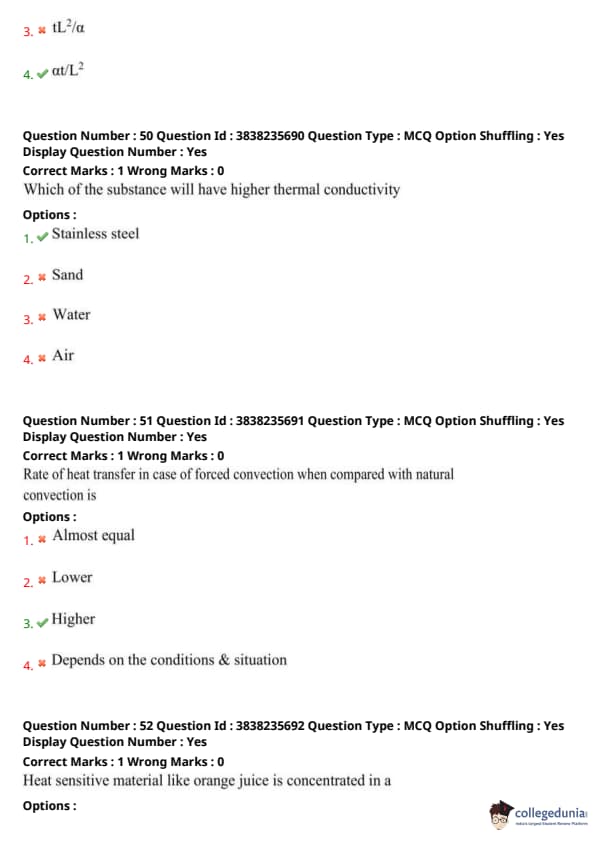
The Fourier number (\(N_{Fo}\)) is defined as (α is thermal diffusivity, L is characteristic length and t is time)
- (1) \( \frac{h k}{L} \)
- (2) \( \frac{h L}{k} \)
- (3) \( \frac{t L^2}{\alpha} \)
- (4) \( \frac{\alpha t}{L^2} \)
Question 50:
Which of the substance will have higher thermal conductivity
- (1) Stainless steel
- (2) Sand
- (3) Water
- (4) Air
Question 51:
Rate of heat transfer in case of forced convection when compared with natural convection is
- (1) Almost equal
- (2) Lower
- (3) Higher
- (4) Depends on the conditions \& situation
Question 52:
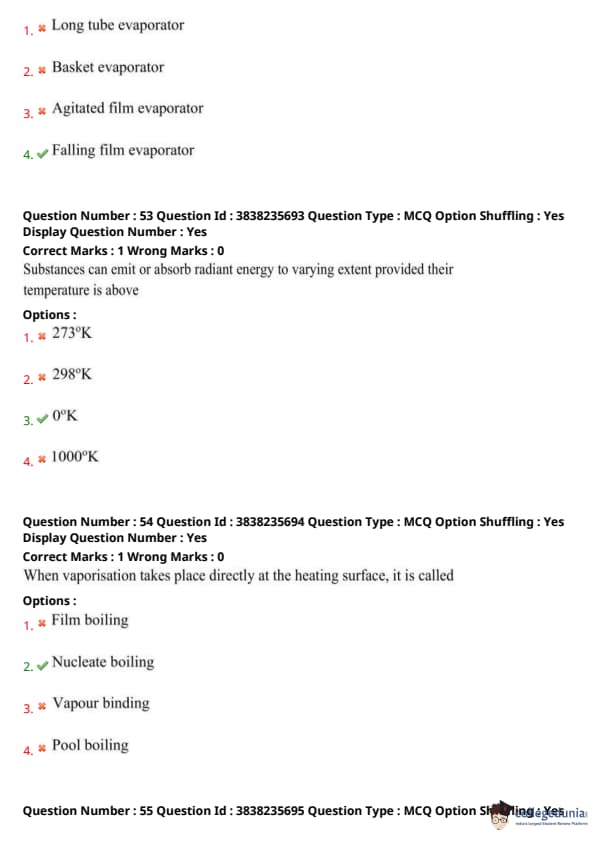
Heat sensitive material like orange juice is concentrated in a ____
- (1) Long tube evaporator
- (2) Basket evaporator
- (3) Agitated film evaporator
- (4) Falling film evaporator
Question 53:
Substances can emit or absorb radiant energy to varying extent provided their temperature is above ____
- (1) 273\(^\circ\)K
- (2) 298\(^\circ\)K
- (3) 0\(^\circ\)K
- (4) 1000\(^\circ\)K
Question 54:
When vaporisation takes place directly at the heating surface, it is called ____
- (1) Film boiling
- (2) Nucleate boiling
- (3) Vapour binding
- (4) Pool boiling
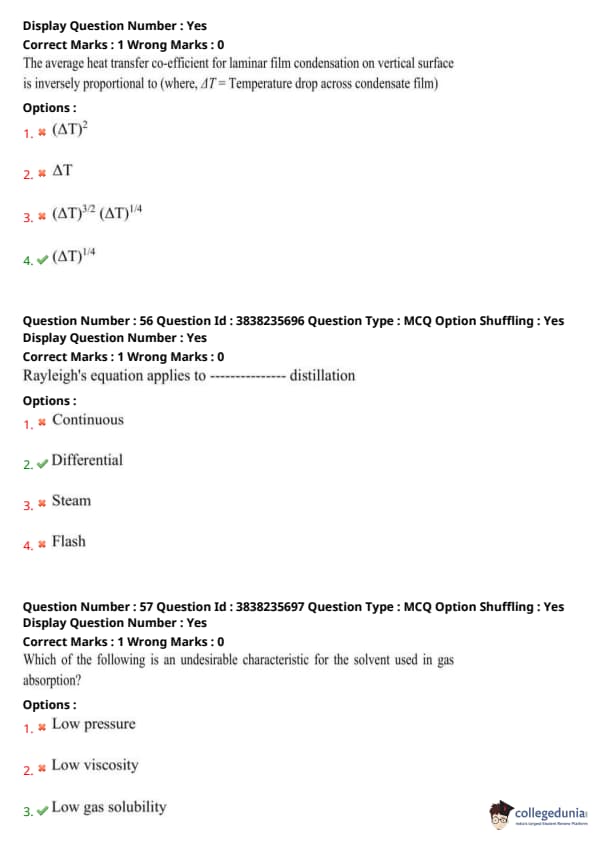
Question 55:
The average heat transfer co-efficient for laminar film condensation on vertical surface is inversely proportional to (where, \( \Delta T \) = temperature drop across condensate film)
- (1) \( (\Delta T)^2 \)
- (2) \( \Delta T \)
- (3) \( (\Delta T)^{1/2} \)
- (4) \( (\Delta T)^{1/4} \)
Question 56:
Rayleigh's equation applies to ____ distillation
- (1) Continuous
- (2) Differential
- (3) Steam
- (4) Flash
Question 57:
Which of the following is an undesirable characteristic for the solvent used in gas absorption?
- (1) Low pressure
- (2) Low viscosity
- (3) Low gas solubility
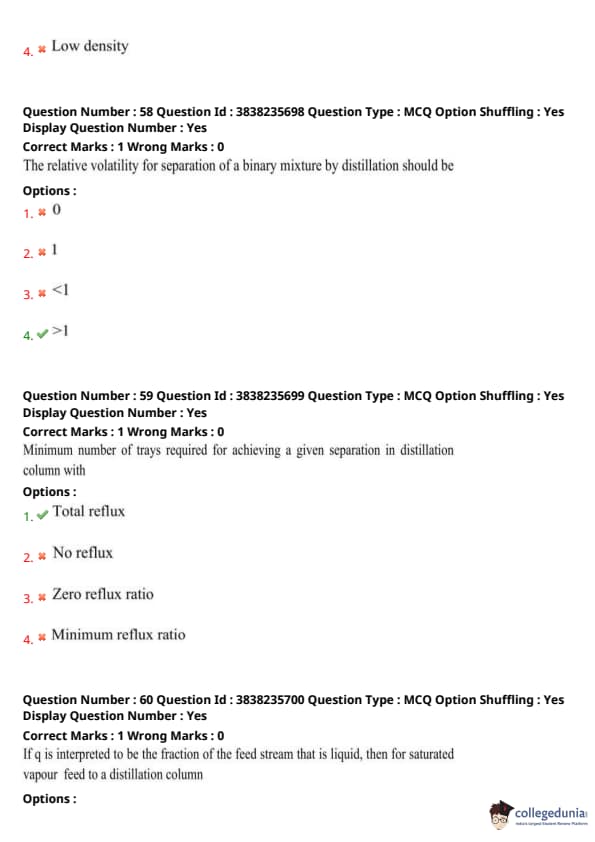
- (4) Low density
Question 58:
The relative volatility for separation of a binary mixture by distillation should be
- (1) 0
- (2) 1
- (3) \( <1 \)
- (4) \( >1 \)
Question 59:
Minimum number of trays required for achieving a given separation in distillation column with ____
- (1) Total reflux
- (2) No reflux
- (3) Zero reflux ratio
- (4) Minimum reflux ratio
Question 60:
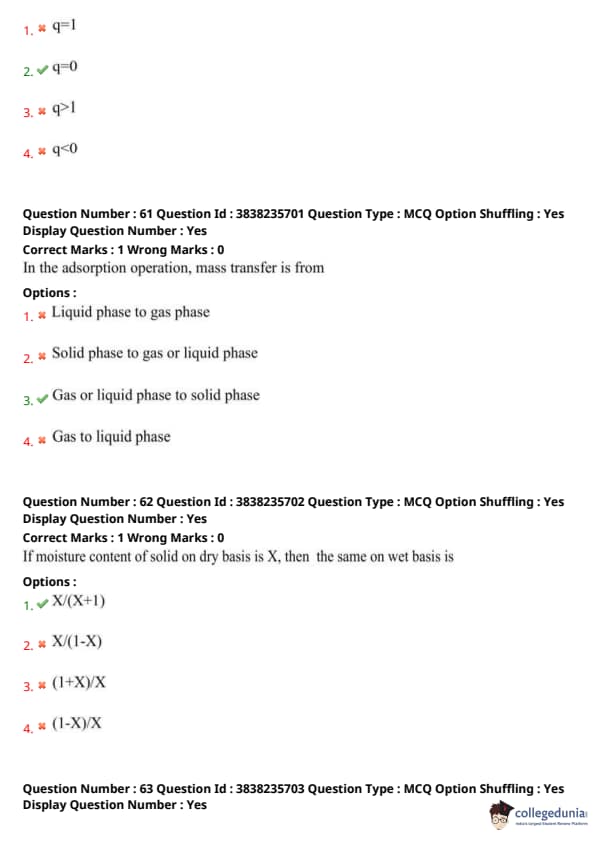
If \( q \) is interpreted to be the fraction of the feed stream that is liquid, then for saturated vapour feed to a distillation column, \( q = \_\_\_\_ \)
- (1) \( q = 1 \)
- (2) \( q = 0 \)
- (3) \( q > 1 \)
- (4) \( q < 0 \)
Question 61:
In the adsorption operation, mass transfer is from ____
- (1) Liquid phase to gas phase
- (2) Solid phase to gas or liquid phase
- (3) Gas or liquid phase to solid phase
- (4) Gas to liquid phase
Question 62:
If moisture content of solid on dry basis is \( X \), then the same on wet basis is ____
- (1) \( \frac{X}{(X+1)} \)
- (2) \( \frac{X}{1-X} \)
- (3) \( \frac{(1+X)}{X} \)
- (4) \( \frac{(1-X)}{X} \)
% Solution \textbf{Solution:}
Wet basis: \( X_w = \frac{\text{moisture}}{\text{moisture} + \text{dry matter}} \)
Dry basis: \( X_d = \frac{\text{moisture}}{\text{dry matter}} \Rightarrow X_w = \frac{X_d}{1 + X_d} \)
View Solution
Question 63:
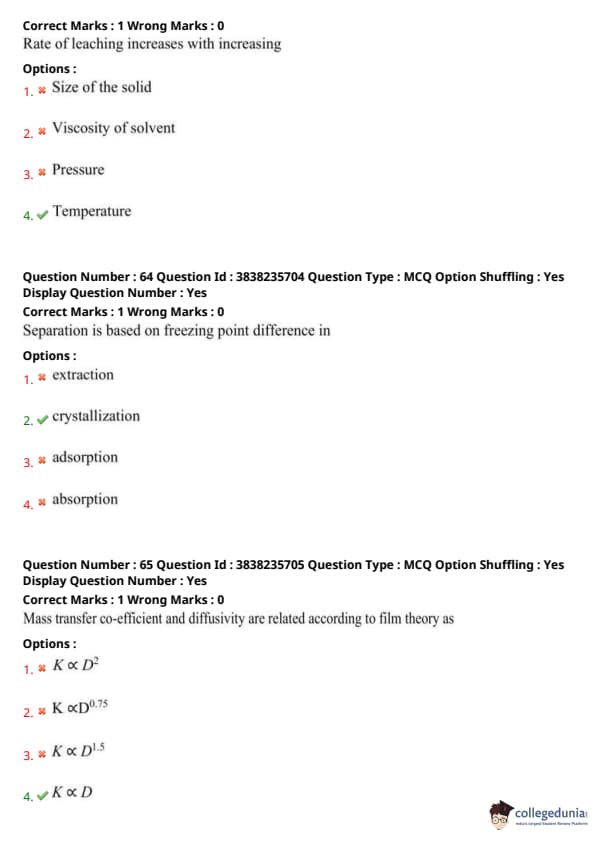
Rate of leaching increases with increasing ____
- (1) Size of the solid
- (2) Viscosity of solvent
- (3) Pressure
- (4) Temperature
Question 64:
Separation is based on freezing point difference in ____
- (1) Extraction
- (2) Crystallization
- (3) Adsorption
- (4) Absorption
Question 65:
Mass transfer co-efficient and diffusivity are related according to film theory as \( K \propto \_\_\_\_ \)
- (1) \( D^2 \)
- (2) \( D^{0.75} \)
- (3) \( D^{1.5} \)
- (4) \( D \)
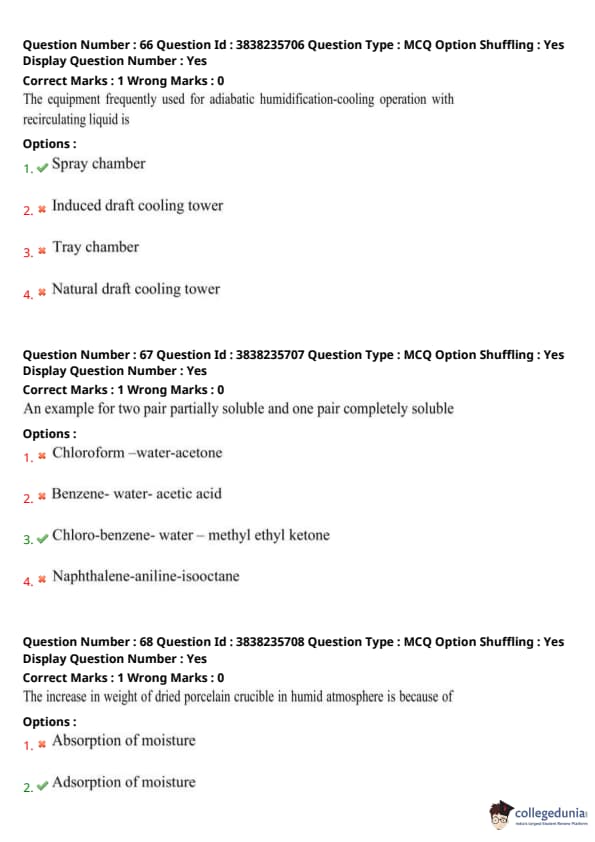
Question 66:
The equipment frequently used for adiabatic humidification-cooling operation with recirculating liquid is ____
- (1) Spray chamber
- (2) Induced draft cooling tower
- (3) Tray chamber
- (4) Natural draft cooling tower
Question 67:
An example for two pair partially soluble and one pair completely soluble is ____
- (1) Chloroform – water – acetone
- (2) Benzene – water – acetic acid
- (3) Chloro-benzene – water – methyl ethyl ketone
- (4) Naphthalene – aniline – isooctane
Question 68:
The increase in weight of dried porcelain crucible in humid atmosphere is because of ____
- (1) Absorption of moisture
- (2) Adsorption of moisture
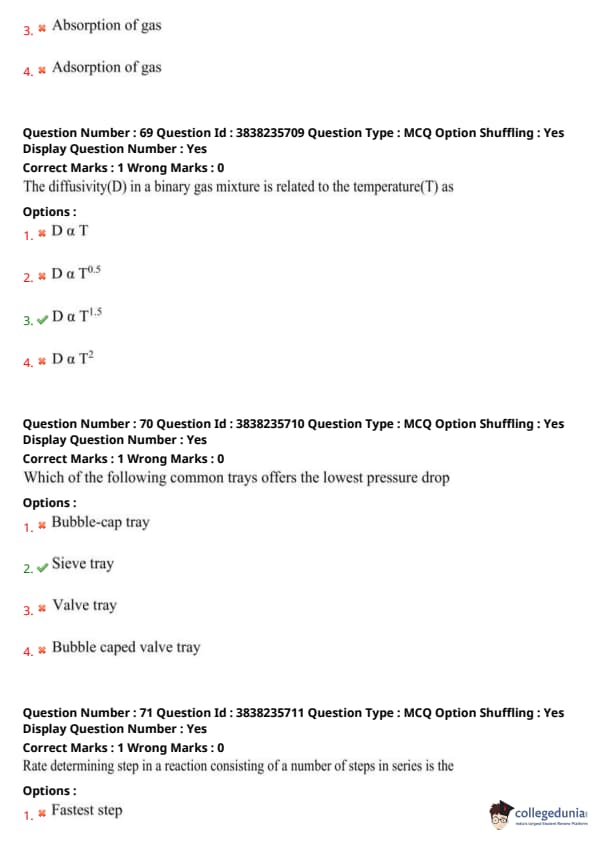
- (3) Absorption of gas
- (4) Adsorption of gas
Question 69:
The diffusivity (D) in a binary gas mixture is related to the temperature (T) as ____
- (1) \( D \propto T \)
- (2) \( D \propto T^{0.5} \)
- (3) \( D \propto T^{1.5} \)
- (4) \( D \propto T^2 \)
Question 70:
Which of the following common trays offers the lowest pressure drop ____
- (1) Bubble-cap tray
- (2) Sieve tray
- (3) Valve tray
- (4) Bubble caped valve tray
Question 71:
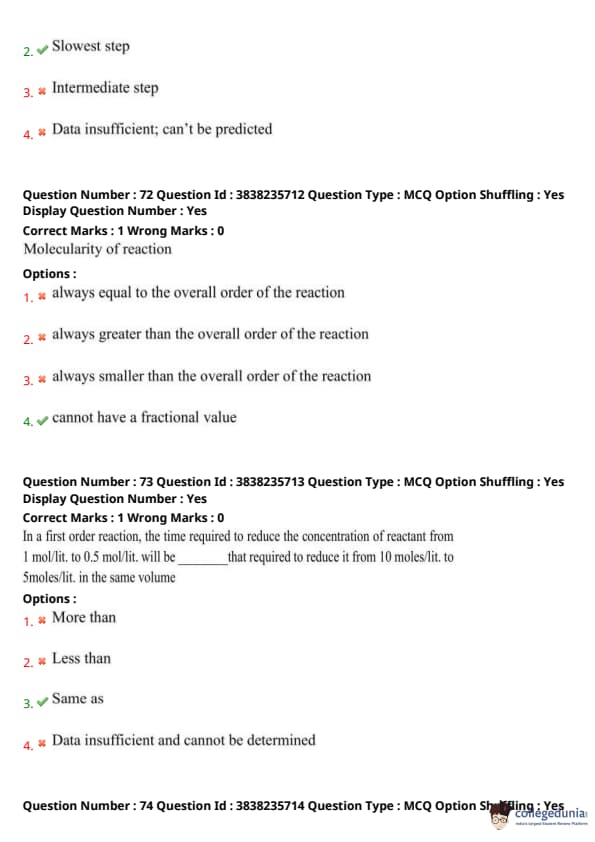
Rate determining step in a reaction consisting of a number of steps in series is the
- (1) Fastest step
- (2) Slowest step
- (3) Intermediate step
- (4) Data insufficient; can’t be predicted
Question 72:
Molecularity of reaction
- (1) Always equal to the overall order of the reaction
- (2) Always greater than the overall order of the reaction
- (3) Always smaller than the overall order of the reaction
- (4) Cannot have a fractional value
Question 73:
In a first order reaction, the time required to reduce the concentration of reactant from 1 mol/lit. to 0.5 mol/lit. will be ____ that required to reduce it from 10 mol/lit. to 5 mol/lit. in the same volume
- (1) More than
- (2) Less than
- (3) Same as
- (4) Data insufficient and cannot be determined
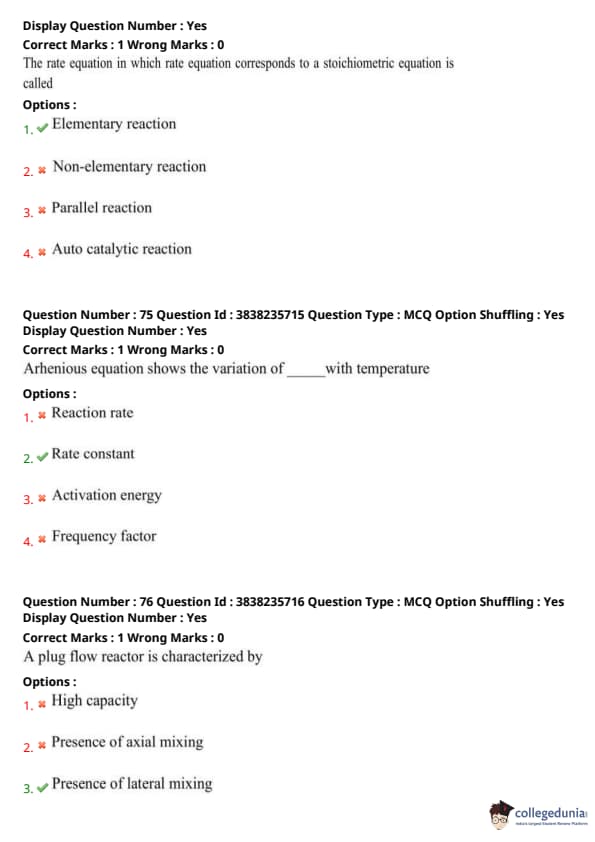
Question 74:
The rate equation in which rate equation corresponds to a stoichiometric equation is called
- (1) Elementary reaction
- (2) Non-elementary reaction
- (3) Parallel reaction
- (4) Auto catalytic reaction
Question 75:
Arrhenius equation shows the variation of ____ with temperature
- (1) Reaction rate
- (2) Rate constant
- (3) Activation energy
- (4) Frequency factor
Question 76:
A plug flow reactor is characterized by
- (1) High capacity
- (2) Presence of axial mixing
- (3) Presence of lateral mixing
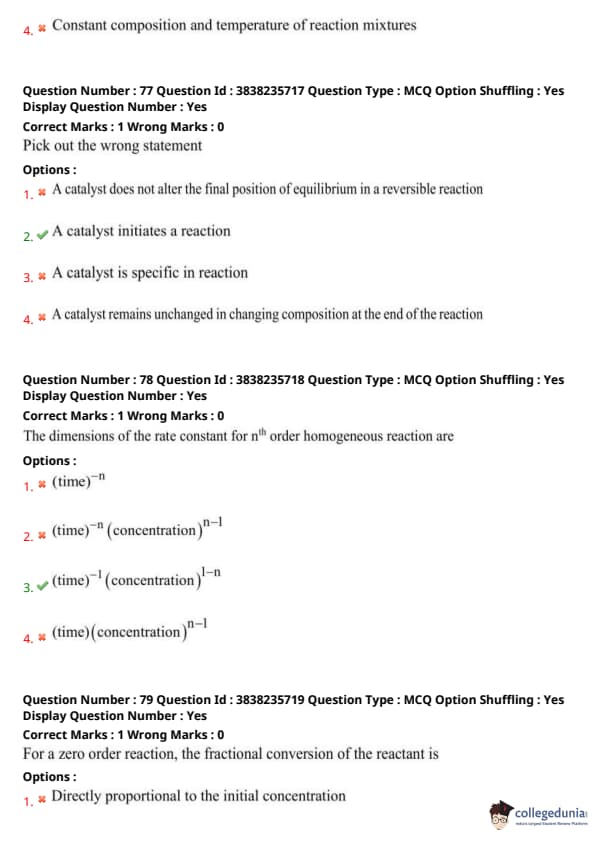
- (4) Constant composition and temperature of reaction mixtures
Question 77:
Pick out the wrong statement
- (1) A catalyst does not alter the final position of equilibrium in a reversible reaction
- (2) A catalyst initiates a reaction
- (3) A catalyst is specific in reaction
- (4) A catalyst remains unchanged in changing composition at the end of the reaction
Question 78:
The dimensions of the rate constant for \( n^{th} \) order homogeneous reaction are
- (1) (time)\(^n\)
- (2) (time)\(^{-n}\)(concentration)\(^{n-1}\)
- (3) (time)\(^{-1}\)(concentration)\(^{1-n}\)
- (4) (time)(concentration)\(^{-1}\)
Question 79:
For a zero order reaction, the fractional conversion of the reactant is
- (1) Directly proportional to the initial concentration
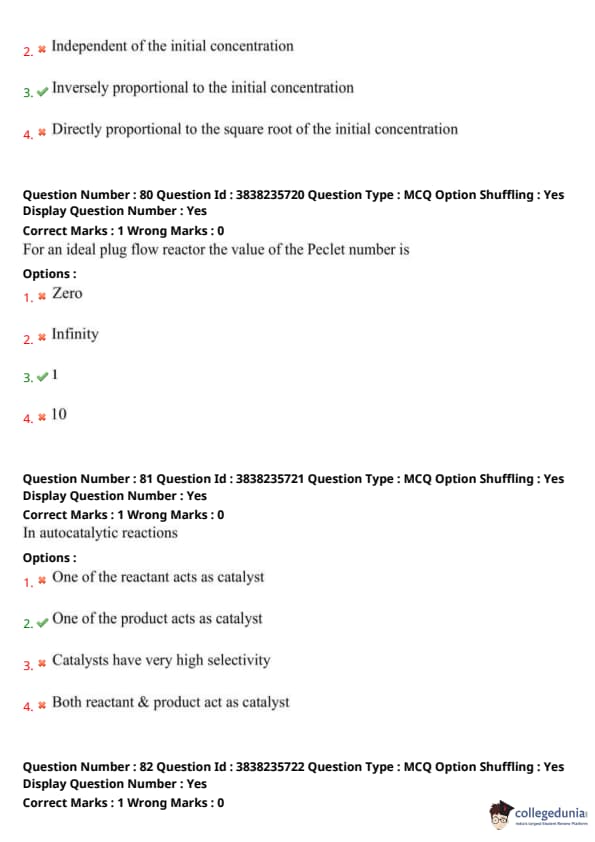
- (2) Independent of the initial concentration
- (3) Inversely proportional to the initial concentration
- (4) Directly proportional to the square root of the initial concentration
Question 80:
For an ideal plug flow reactor the value of the Peclet number is
- (1) Zero
- (2) Infinity
- (3) 1
- (4) 10
Question 81:
In autocatalytic reactions
- (1) One of the reactant acts as catalyst
- (2) One of the product acts as catalyst
- (3) Catalysts have very high selectivity
- (4) Both reactant \& product act as catalyst
Question 82:
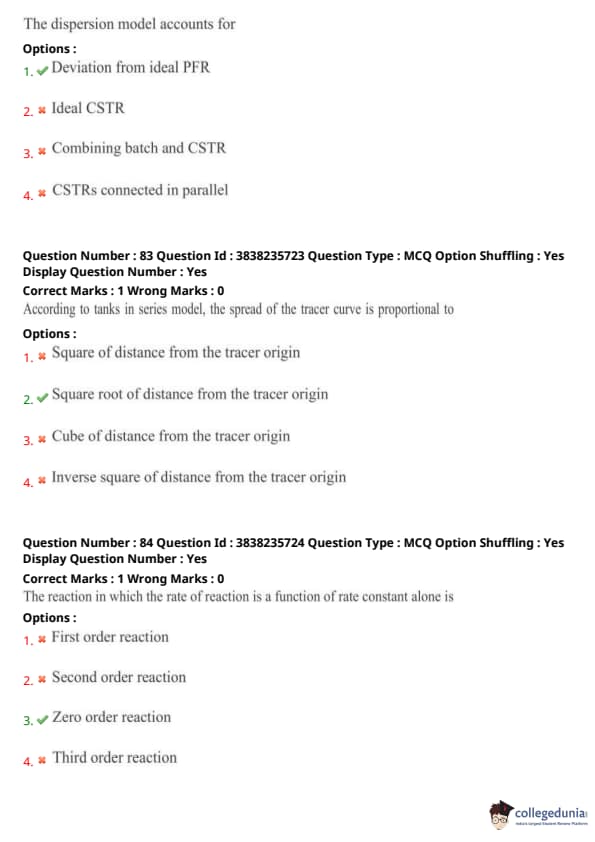
The dispersion model accounts for
- (1) Deviation from ideal PFR
- (2) Ideal CSTR
- (3) Combining batch and CSTR
- (4) CSTRs connected in parallel
Question 83:
According to tanks in series model, the spread of the tracer curve is proportional to
- (1) Square of distance from the tracer origin
- (2) Square root of distance from the tracer origin
- (3) Cube of distance from the tracer origin
- (4) Inverse square of distance from the tracer origin
Question 84:
The reaction in which the rate of reaction is a function of rate constant alone is
- (1) First order reaction
- (2) Second order reaction
- (3) Zero order reaction
- (4) Third order reaction
Question 85:
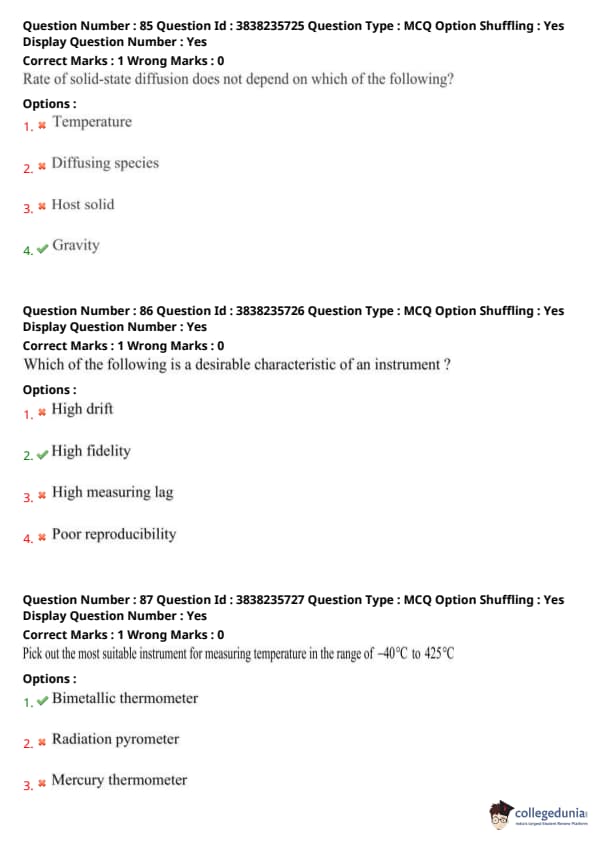
Rate of solid-state diffusion does not depend on which of the following?
- (1) Temperature
- (2) Diffusing species
- (3) Host solid
- (4) Gravity
Question 86:
Which of the following is a desirable characteristic of an instrument?
- (1) High drift
- (2) High fidelity
- (3) High measuring lag
- (4) Poor reproducibility
Question 87:
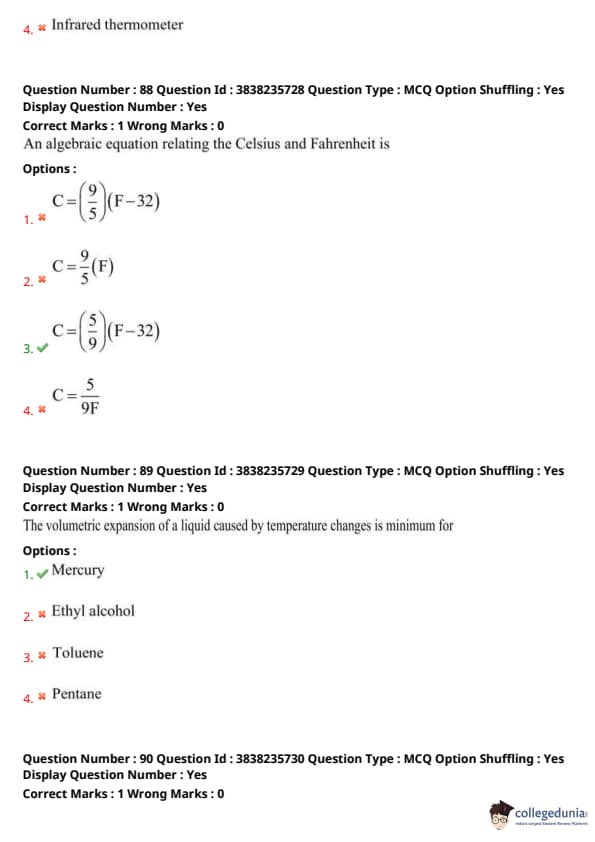
Pick out the most suitable instrument for measuring temperature in the range of \(-40^\circ C\) to \(425^\circ C\)
- (1) Bimetallic thermometer
- (2) Radiation pyrometer
- (3) Mercury thermometer
- (4) Infrared thermometer
Question 88:
An algebraic equation relating the Celsius and Fahrenheit is
- (1) \( C = \left( \frac{9}{5} \right)(F - 32) \)
- (2) \( C = \frac{9}{5}(F) \)
- (3) \( C = \left( \frac{5}{9} \right)(F - 32) \)
- (4) \( C = \frac{5}{9F} \)
Question 89:
The volumetric expansion of a liquid caused by temperature changes is minimum for
- (1) Mercury
- (2) Ethyl alcohol
- (3) Toluene
- (4) Pentane
Question 90:
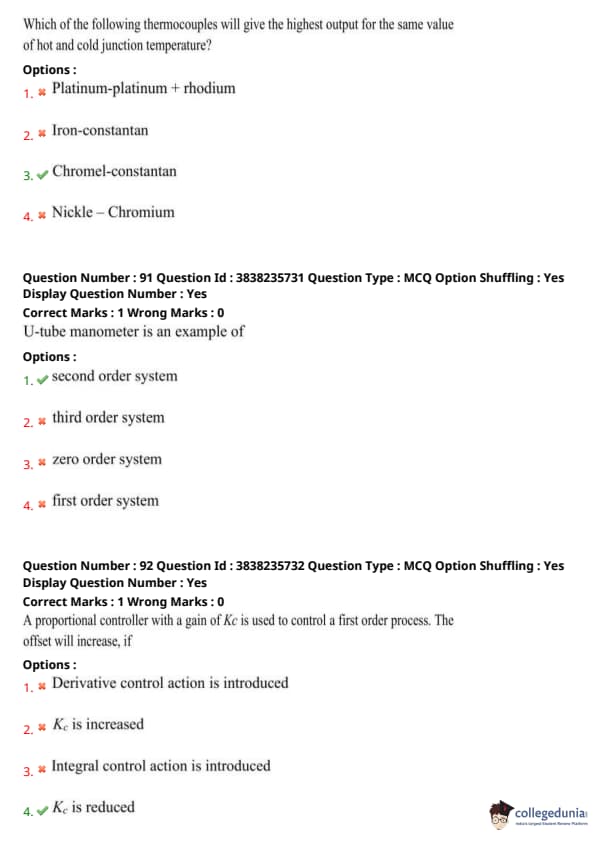
Which of the following thermocouples will give the highest output for the same value of hot and cold junction temperature?
- (1) Platinum–platinum + rhodium
- (2) Iron–constantan
- (3) Chromel–constantan
- (4) Nickle–Chromium
Question 91:
U-tube manometer is an example of
- (1) Second order system
- (2) Third order system
- (3) Zero order system
- (4) First order system
Question 92:
A proportional controller with a gain of \( K_c \) is used to control a first order process. The offset will increase, if
- (1) Derivative control action is introduced
- (2) \( K_c \) is increased
- (3) Integral control action is introduced
- (4) \( K_c \) is reduced
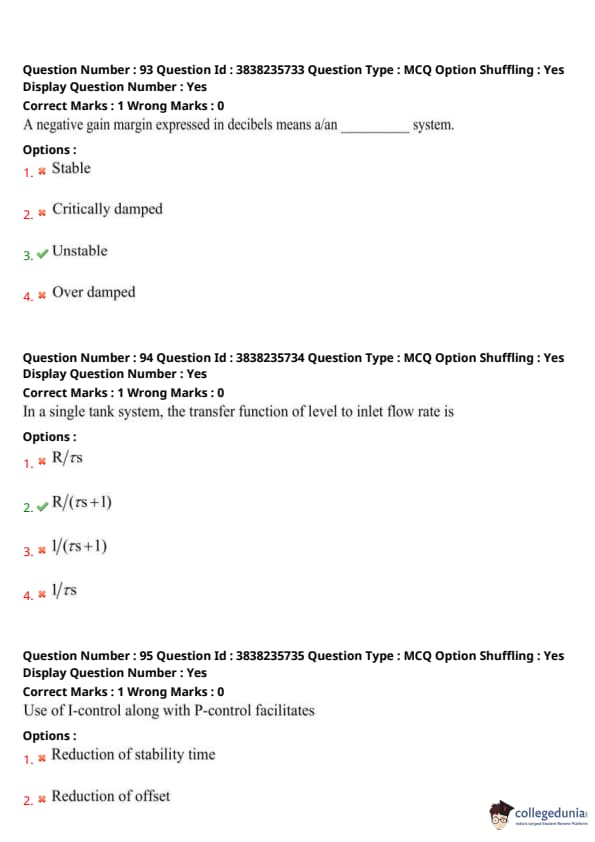
Question 93:
A negative gain margin expressed in decibels means a/an _____ system
- (1) Stable
- (2) Critically damped
- (3) Unstable
- (4) Over damped
Question 94:
In a single tank system, the transfer function of level to inlet flow rate is
- (1) \( \frac{R}{\tau s} \)
- (2) \( \frac{R}{\tau s + 1} \)
- (3) \( \frac{1}{\tau s + 1} \)
- (4) \( \frac{1}{\tau s} \)
Question 95:
Use of I-control along with P-control facilitates
- (1) Reduction of stability time
- (2) Reduction of offset
- (3) Elimination of offset
- (4) Increase of offset
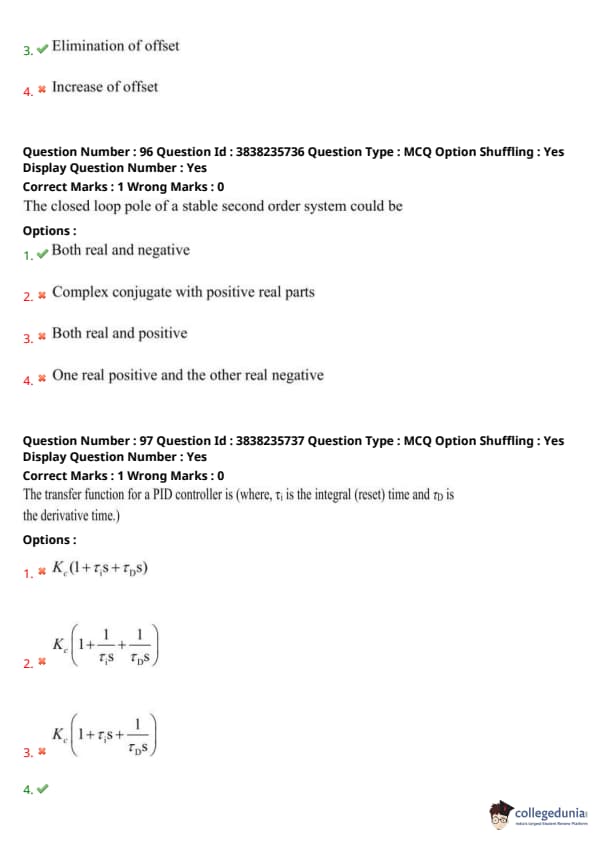
Question 96:
The closed loop pole of a stable second order system could be
- (1) Both real and negative
- (2) Complex conjugate with positive real parts
- (3) Both real and positive
- (4) One real positive and the other real negative
Question 97:
The transfer function for a PID controller is (where, \( \tau_I \) is the integral (reset) time and \( \tau_D \) is the derivative time.)
- (1) \( K_c (1 + \tau_I s + \tau_D s) \)
- (2) \( K_c \left( 1 + \frac{1}{\tau_I s} + \frac{1}{\tau_D s} \right) \)
- (3) \( K_c \left( 1 + \tau_I s + \frac{1}{\tau_D s} \right) \)
- (4) \( K_c \left( 1 + \frac{1}{\tau_I s} + \tau_D s \right) \)
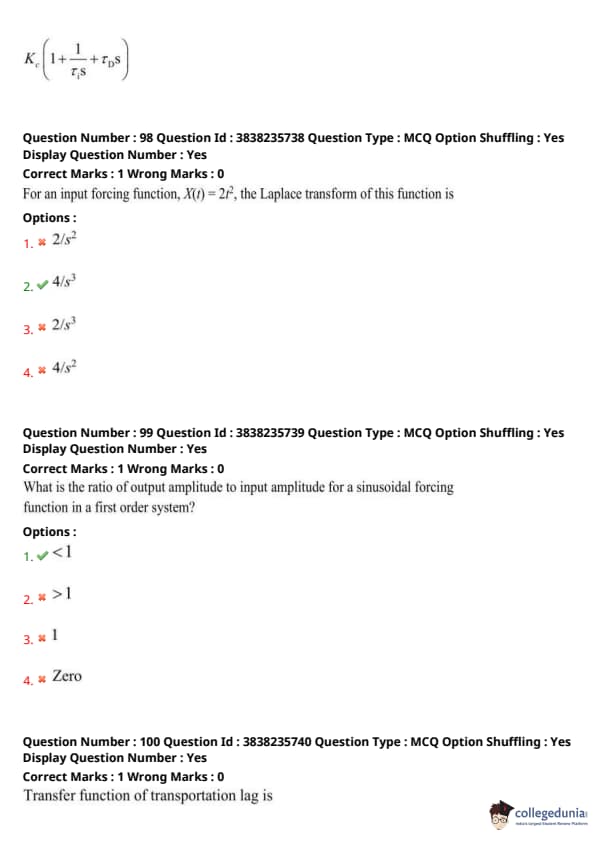
Question 98:
For an input forcing function, \( X(t) = 2t^2 \), the Laplace transform of this function is
- (1) \( \frac{2}{s^2} \)
- (2) \( \frac{4}{s^3} \)
- (3) \( \frac{2}{s^3} \)
- (4) \( \frac{4}{s^2} \)
Question 99:
What is the ratio of output amplitude to input amplitude for a sinusoidal forcing function in a first order system?
- (1) \( < 1 \)
- (2) \( > 1 \)
- (3) \( 1 \)
- (4) Zero
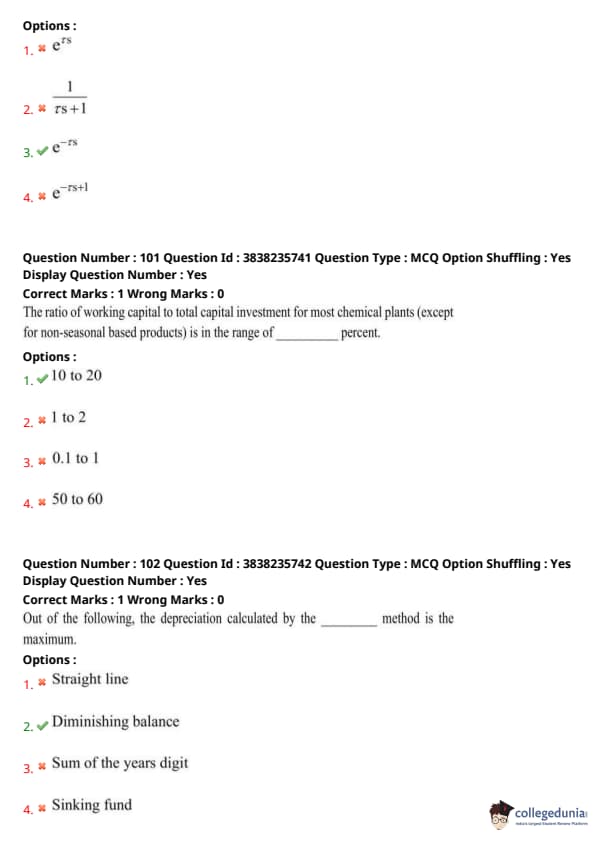
Question 100:
Transfer function of transportation lag is
- (1) \( e^{Ts} \)
- (2) \( \frac{1}{Ts+1} \)
- (3) \( e^{-Ts} \)
- (4) \( e^{-Ts+1} \)
Question 101:
The ratio of working capital to total capital investment for most chemical plants (except for non-seasonal based products) is in the range of ______ percent.
- (1) 10 to 20
- (2) 1 to 2
- (3) 0.1 to 1
- (4) 50 to 60
Question 102:
Out of the following, the depreciation calculated by the ______ method is the maximum.
- (1) Straight line
- (2) Diminishing balance
- (3) Sum of the years digit
- (4) Sinking fund
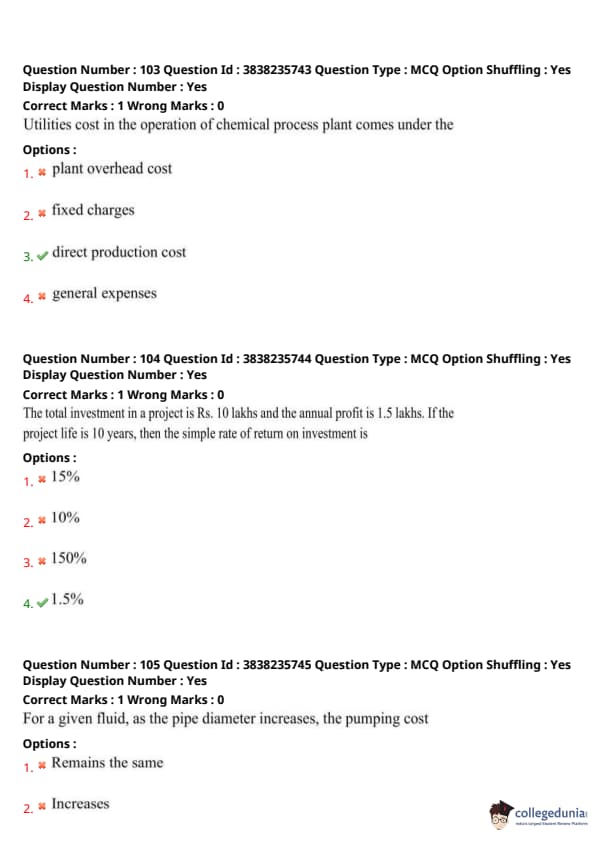
Question 103:
Utilities cost in the operation of chemical process plant comes under the
- (1) plant overhead cost
- (2) fixed charges
- (3) direct production cost
- (4) general expenses
Question 104:
The total investment in a project is Rs. 10 lakhs and the annual profit is 1.5 lakhs. If the project life is 10 years, then the simple rate of return on investment is
- (1) 15%
- (2) 10%
- (3) 150%
- (4) 1.5%
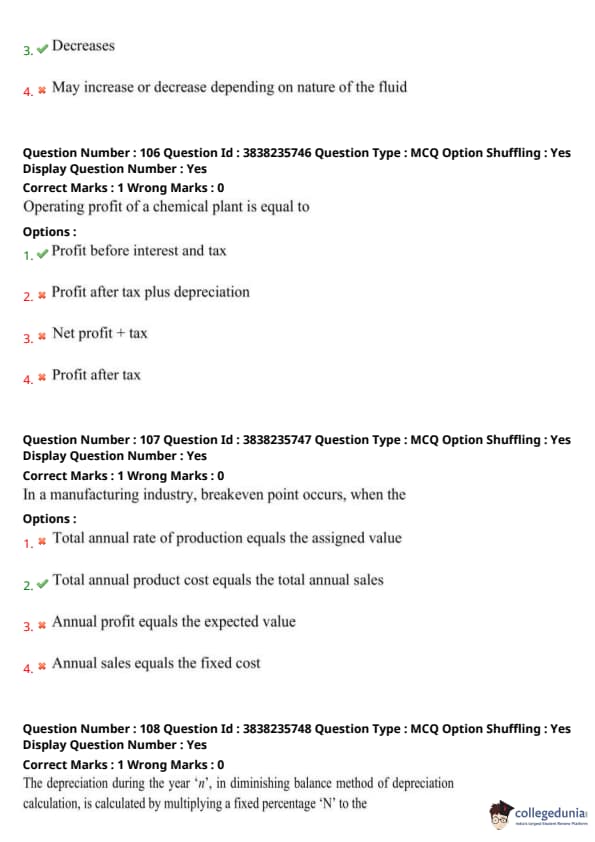
Question 105:
For a given fluid, as the pipe diameter increases, the pumping cost
- (1) Remains the same.
- (2) Increases.
- (3) Decreases.
- (4) May increase or decrease depending on nature of the fluid.
Question 106:
Operating profit of a chemical plant is equal to
- (1) Profit before interest and tax
- (2) Profit after tax plus depreciation
- (3) Net profit + tax
- (4) Profit after tax
Question 107:
In a manufacturing industry, breakeven point occurs, when the
- (1) Total annual rate of production equals the assigned value
- (2) Total annual product cost equals the total annual sales
- (3) Annual profit equals the expected value
- (4) Annual sales equals the fixed cost
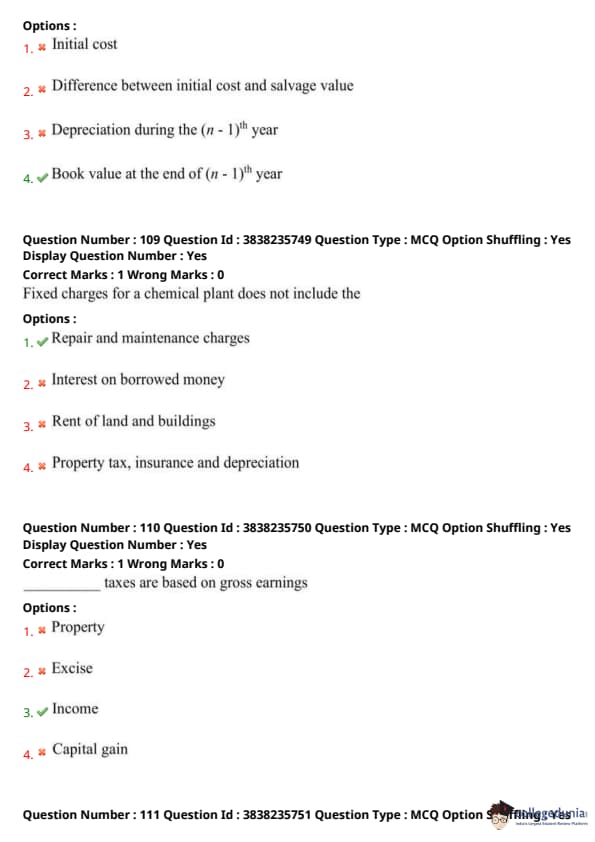
Question 108:
The depreciation during the year ‘n’, in diminishing balance method of depreciation calculation, is calculated by multiplying a fixed percentage ‘N’ to the
- (1) Initial cost
- (2) Difference between initial cost and salvage value
- (3) Depreciation during the (n-1)th year
- (4) Book value at the end of (n-1)th year
Question 109:
Fixed charges for a chemical plant does not include the
- (1) Repair and maintenance charges
- (2) Interest on borrowed money
- (3) Rent of land and buildings
- (4) Property tax, insurance and depreciation
Question 110:
_____ taxes are based on gross earnings
- (1) Property
- (2) Excise
- (3) Income
- (4) Capital gain
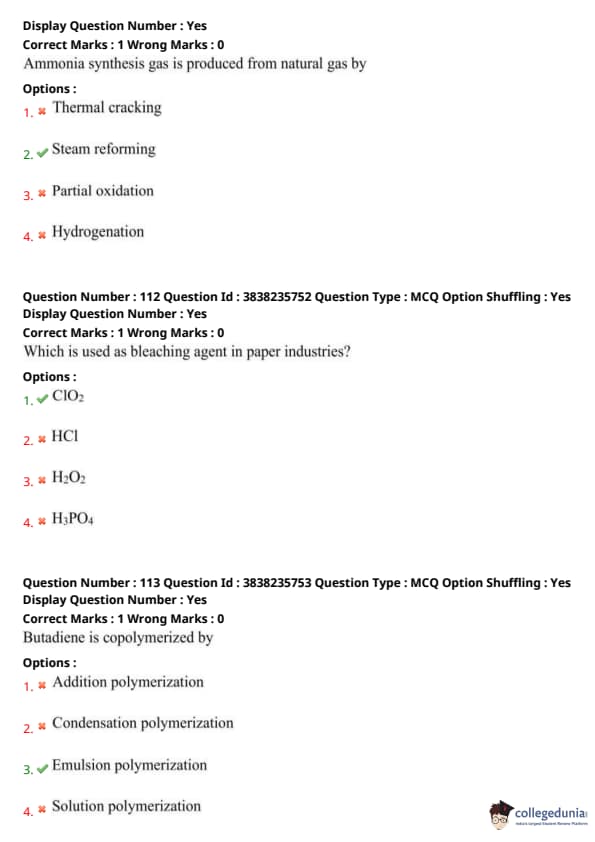
Question 111:
Ammonia synthesis gas is produced from natural gas by
- (1) Thermal cracking
- (2) Steam reforming
- (3) Partial oxidation
- (4) Hydrogenation
Question 112:
Which is used as bleaching agent in paper industries?
- (1) ClO\(_2\)
- (2) HCl
- (3) H\(_2\)O\(_2\)
- (4) H\(_3\)PO\(_4\)
Question 113:
Butadiene is copolymerized by
- (1) Addition polymerization
- (2) Condensation polymerization
- (3) Emulsion polymerization
- (4) Solution polymerization
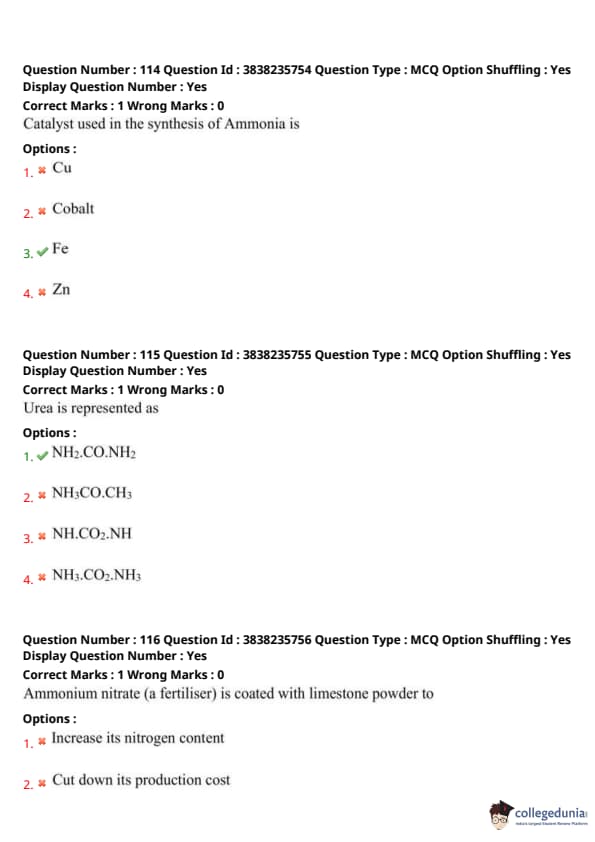
Question 114:
Catalyst used in the synthesis of Ammonia is
- (1) Cu
- (2) Cobalt
- (3) Fe
- (4) Zn
Question 115:
Urea is represented as
- (1) NH\(_2\).CO.NH\(_2\)
- (2) NH\(_3\)CO.CH\(_3\)
- (3) NH.CO\(_2\).NH
- (4) NH\(_3\).CO\(_2\).NH\(_3\)
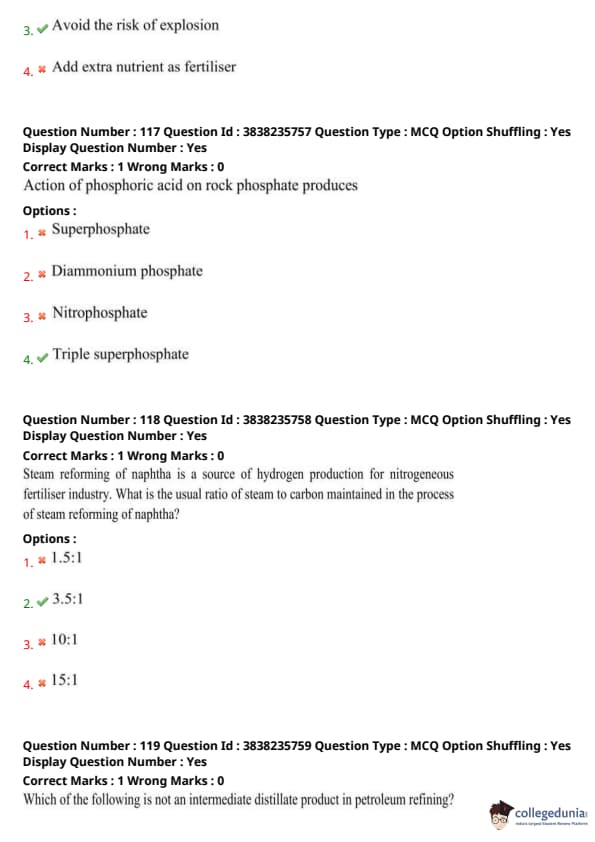
Question 116:
Ammonium nitrate (a fertiliser) is coated with limestone powder to
- (1) Increase its nitrogen content
- (2) Cut down its production cost
- (3) Avoid the risk of explosion
- (4) Add extra nutrient as fertiliser
Question 117:
Action of phosphoric acid on rock phosphate produces
- (1) Superphosphate
- (2) Diammonium phosphate
- (3) Nitrophosphate
- (4) Triple superphosphate
Question 118:
Steam reforming of naphtha is a source of hydrogen production for nitrogenous fertiliser industry. What is the usual ratio of steam to carbon maintained in the process of steam reforming of naphtha?
- (1) 1.5:1
- (2) 3.5:1
- (3) 10:1
- (4) 15:1
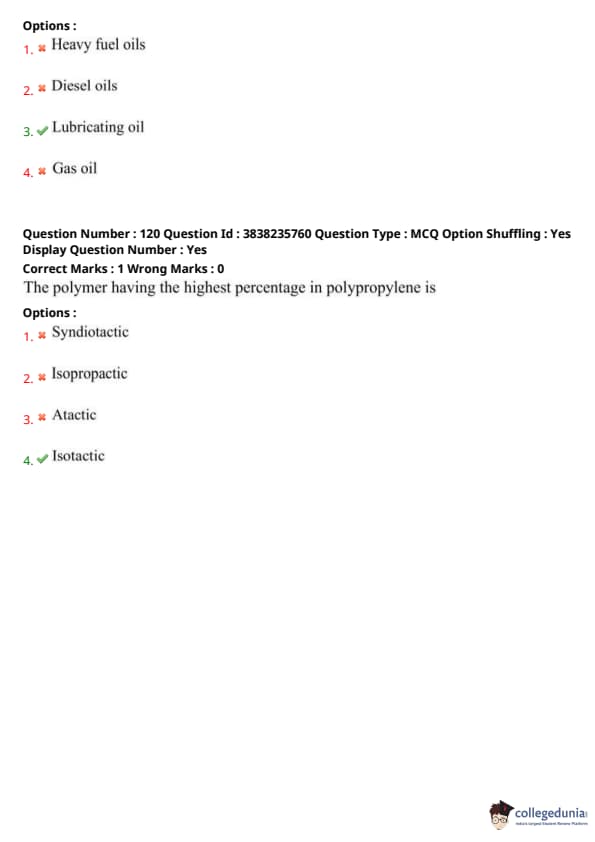
Question 119:
Which of the following is not an intermediate distillate product in petroleum refining?
- (1) Heavy fuel oils
- (2) Diesel oils
- (3) Lubricating oil
- (4) Gas oil
Question 120:
The polymer having the highest percentage in polypropylene is
- (1) Syndiotactic
- (2) Isoprapctic
- (3) Atactic
- (4) Isotactic









Comments