TS PGECET 2024 Civil Engineering Question Paper is available for download here. Jawaharlal Nehru Technological University Hyderabad on behalf of Telangana Council of Higher Education (TGCHE) conducted TS PGECET 2024 Civil Engineering on June 10 in Shift 2 from 2 PM to 4 PM. TS PGECET Question Paper 2024 consists of 120 MCQ-based questions in total carrying 1 mark each to be attempted in the duration of 2 hours.

TS PGECET 2024 Civil Engineering Question Paper with Answer Key PDF

TS PGECET 2024 CE Question Paper​ with Answer Key Download PDF Check Solution
07-17_27-TS PGECET 2024 Civil Engineering Question Paper

Question 1:

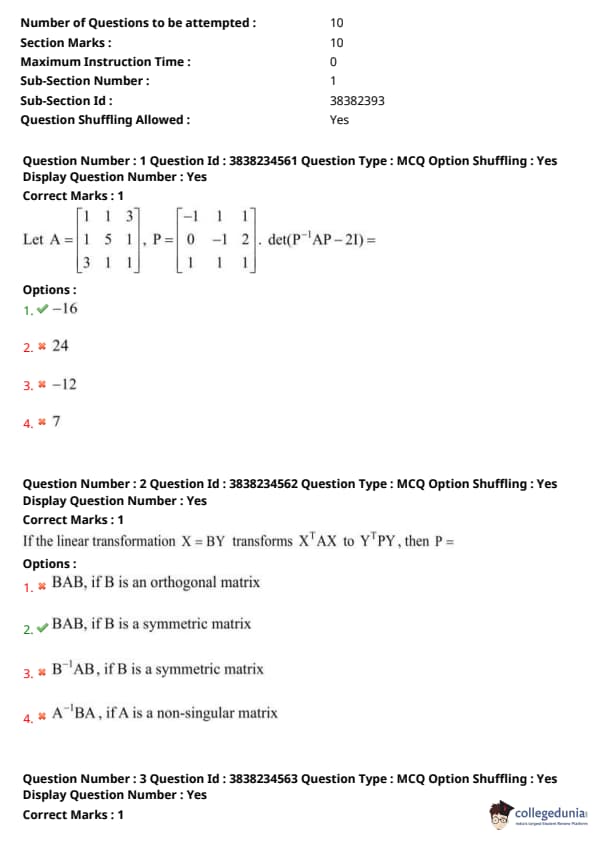
Let \( A = \begin{bmatrix} 1 & 1 & 3
1 & 5 & 1
3 & 1 & 1 \end{bmatrix} \), \( P = \begin{bmatrix} -1 & 1 & 1
0 & -1 & 2
1 & 1 & 1 \end{bmatrix} \). Then \( \det(P^{-1} A P - 2I) \) is equal to:

  • (1) \( -16 \)
  • (2) \( 24 \)
  • (3) \( -12 \)
  • (4) \( 7 \)

Question 2:

If the linear transformation \( X = BY \) transforms \( X^\top AX \) to \( Y^\top PY \), then \( P = \):

  • (1) \( BAB \), if \( B \) is an orthogonal matrix
  • (2) \( BAB \), if \( B \) is a symmetric matrix
  • (3) \( B^{-1}AB \), if \( B \) is a symmetric matrix
  • (4) \( A^{-1}BA \), if \( A \) is a non-singular matrix

Question 3:

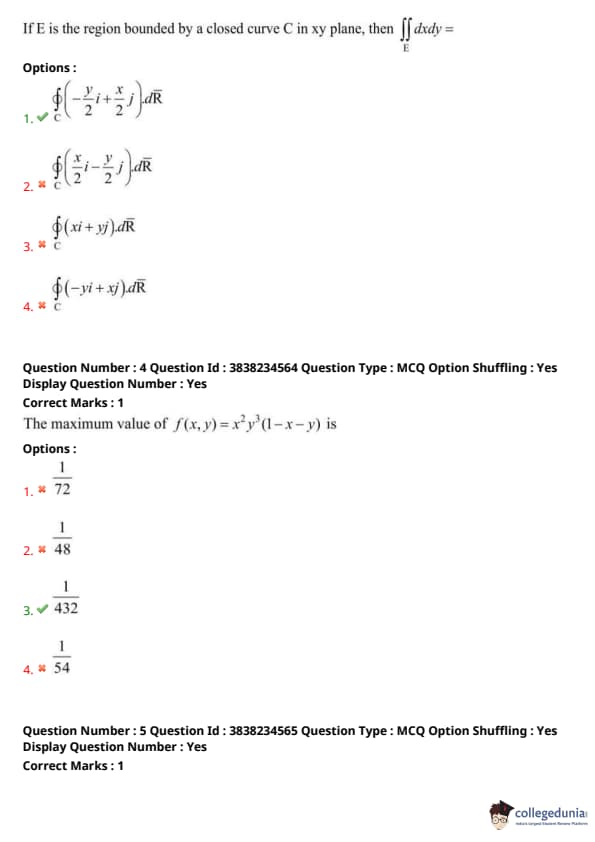
If \( E \) is the region bounded by a closed curve \( C \) in the \( xy \)-plane, then \( \iint_E dx\,dy = \)

  • (1) \( \displaystyle \oint_C \left( -\frac{y}{2} \, i + \frac{x}{2} \, j \right) \cdot d\vec{R} \)
  • (2) \( \displaystyle \oint_C \left( \frac{x}{2} \, i - \frac{y}{2} \, j \right) \cdot d\vec{R} \)
  • (3) \( \displaystyle \oint_C (xi + yj) \cdot d\vec{R} \)
  • (4) \( \displaystyle \oint_C (-yi + xj) \cdot d\vec{R} \)

Question 4:

The maximum value of \( f(x, y) = x^2 y^3 (1 - x - y) \) is:

  • (1) \( \dfrac{1}{72} \)
  • (2) \( \dfrac{1}{48} \)
  • (3) \( \dfrac{1}{432} \)
  • (4) \( \dfrac{1}{54} \)

Question 5:

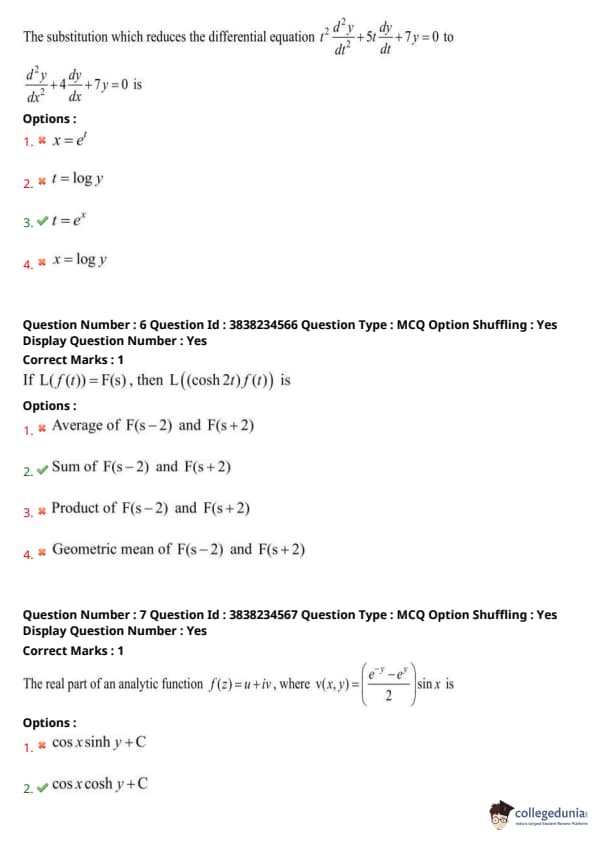
The substitution which reduces the differential equation \( t^2 \frac{d^2y}{dt^2} + 5t \frac{dy}{dt} + 7y = 0 \) to \( \frac{d^2y}{dx^2} + 4 \frac{dy}{dx} + 7y = 0 \) is:

  • (1) \( x = e^t \)
  • (2) \( t = \log y \)
  • (3) \( t = e^x \)
  • (4) \( x = \log y \)

Question 6:

If \( \mathcal{L}(f(t)) = F(s) \), then \( \mathcal{L}((\cosh 2t)f(t)) \) is:

  • (1) Average of \( F(s-2) \) and \( F(s+2) \)
  • (2) Sum of \( F(s-2) \) and \( F(s+2) \)
  • (3) Product of \( F(s-2) \) and \( F(s+2) \)
  • (4) Geometric mean of \( F(s-2) \) and \( F(s+2) \)

Question 7:

The real part of an analytic function \( f(z) = u + iv \), where \( v(x, y) = \left( \frac{e^{-y} - e^y}{2} \right) \sin x \), is:

  • (1) \( \cos x \sinh y + C \)
  • (2) \( \cos x \cosh y + C \)
  • (3) \( -\cos x \sinh y + C \)
  • (4) \( -\cos x \cosh y + C \)

Question 8:

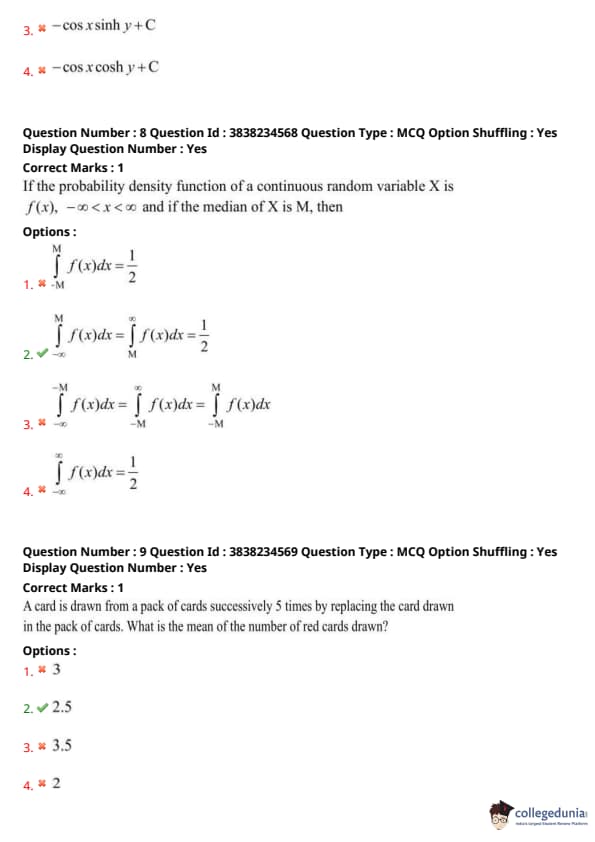
If the probability density function of a continuous random variable \( X \) is \( f(x) \), \( -\infty < x < \infty \), and if the median of \( X \) is \( M \), then:

  • (1) \( \displaystyle \int_{-M}^{M} f(x)\,dx = \frac{1}{2} \)
  • (2) \( \displaystyle \int_{-\infty}^{M} f(x)\,dx = \int_{M}^{\infty} f(x)\,dx = \frac{1}{2} \)
  • (3) \( \displaystyle \int_{-\infty}^{-M} f(x)\,dx = \int_{-M}^{M} f(x)\,dx = \int_{M}^{\infty} f(x)\,dx \)
  • (4) \( \displaystyle \int_{-\infty}^{\infty} f(x)\,dx = \frac{1}{2} \)

Question 9:

A card is drawn from a pack of cards successively 5 times by replacing the card drawn in the pack of cards. What is the mean of the number of red cards drawn?

  • (1) 3
  • (2) 2.5
  • (3) 3.5
  • (4) 2

Question 10:

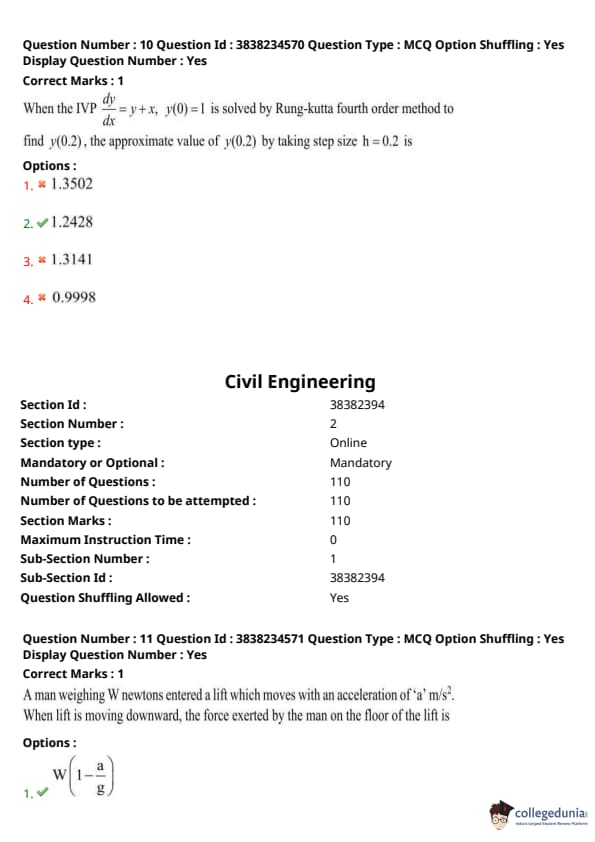
When the IVP \( \frac{dy}{dx} = y + x,\; y(0) = 1 \) is solved by Rung–Kutta fourth order method to find \( y(0.2) \), the approximate value of \( y(0.2) \) by taking step size \( h = 0.2 \) is:

  • (1) 1.3502
  • (2) 1.2428
  • (3) 1.3141
  • (4) 0.9998

Question 11:

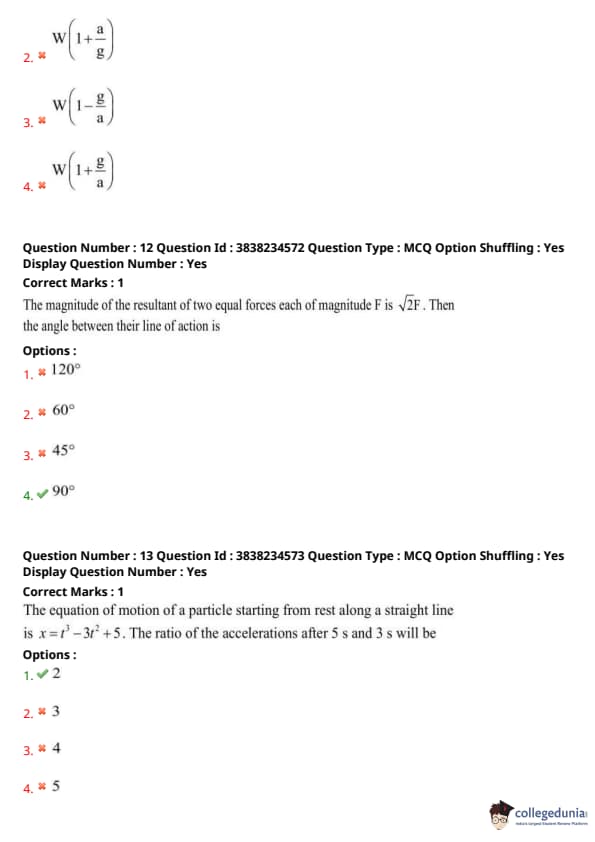
A man weighing \( W \) newtons entered a lift which moves with an acceleration of \( a \, m/s^2 \). When the lift is moving downward, the force exerted by the man on the floor of the lift is:

  • (1) \( W \left( 1 - \frac{a}{g} \right) \)
  • (2) \( W \left( 1 + \frac{a}{g} \right) \)
  • (3) \( W \left( 1 - \frac{g}{a} \right) \)
  • (4) \( W \left( 1 + \frac{g}{a} \right) \)

Question 12:

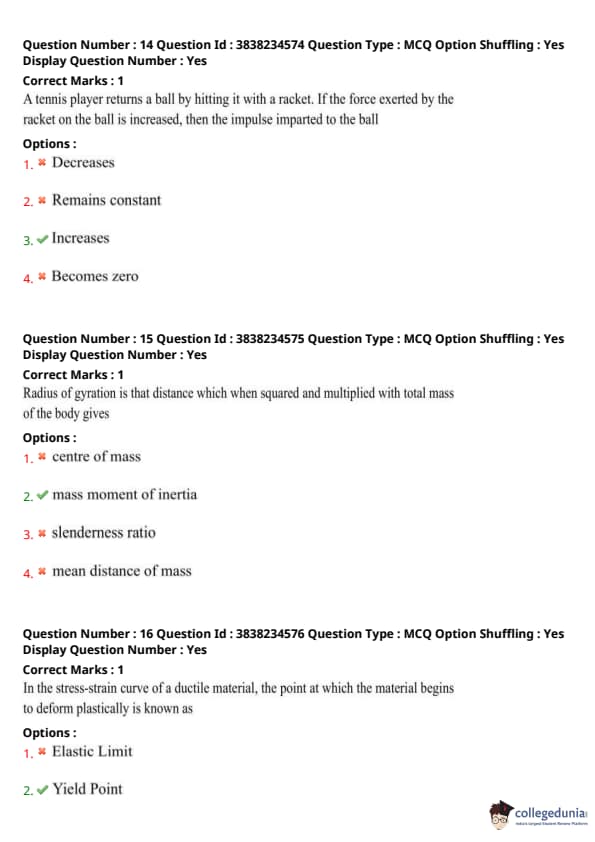
The magnitude of the resultant of two equal forces each of magnitude \( F \) is \( \sqrt{2}F \). Then the angle between their line of action is:

  • (1) \( 120^\circ \)
  • (2) \( 60^\circ \)
  • (3) \( 45^\circ \)
  • (4) \( 90^\circ \)

Question 13:

The equation of motion of a particle starting from rest along a straight line is \( x = t^3 - 3t^2 + 5 \). The ratio of the accelerations after 5 s and 3 s will be:

  • (1) 2
  • (2) 3
  • (3) 4
  • (4) 5

Question 14:

A tennis player returns a ball by hitting it with a racket. If the force exerted by the racket on the ball is increased, then the impulse imparted to the ball:

  • (1) Decreases
  • (2) Remains constant
  • (3) Increases
  • (4) Becomes zero

Question 15:

Radius of gyration is that distance which when squared and multiplied with total mass of the body gives

  • (1) centre of mass
  • (2) mass moment of inertia
  • (3) slenderness ratio
  • (4) mean distance of mass

Question 16:

In the stress-strain curve of a ductile material, the point at which the material begins to deform plastically is known as

  • (1) Elastic Limit
  • (2) Yield Point
  • (3) Ultimate Tensile Strength
  • (4) Modulus of Elasticity

Question 17:

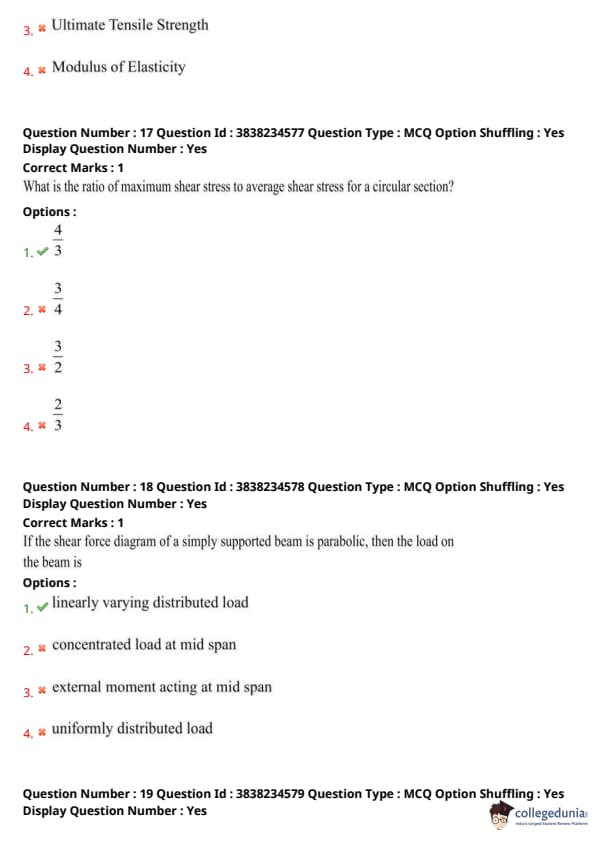
What is the ratio of maximum shear stress to average shear stress for a circular section?

  • (1) \(\frac{4}{3}\)
  • (2) \(\frac{3}{4}\)
  • (3) \(\frac{3}{2}\)
  • (4) \(\frac{2}{3}\)

Question 18:

In the simple bending theory, the stress distribution assumed across the cross-section of a beam is

  • (1) Uniform
  • (2) Linear
  • (3) Parabolic
  • (4) Exponential

Question 19:

A steel column has a length of 4 meters and a square cross-section with moment of inertia \(1.6 \times 10^{-4} m^4\). If the column is pinned at both ends and the modulus of elasticity of steel is 200 GPa, what is the critical buckling load? (take \(\pi^2\) value as 10)

  • (1) 200 kN
  • (2) 10000 kN
  • (3) 40000 kN
  • (4) 20000 kN

Question 20:

In the simple bending theory, the stress distribution assumed across the cross-section of a beam is:

  • (1) Uniform
  • (2) Linear
  • (3) Parabolic
  • (4) Exponential

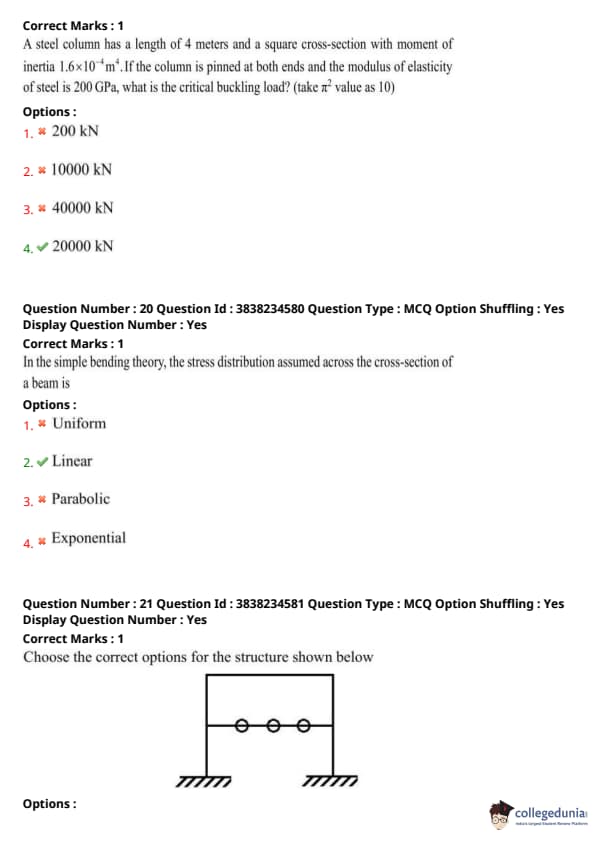
Question 21:

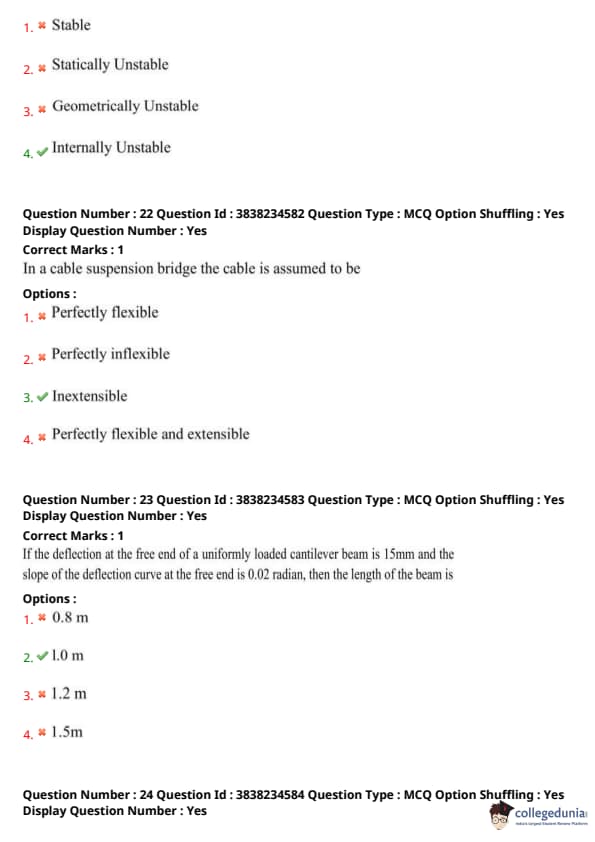
Choose the correct option for the structure shown below.


  • (1) Stable
  • (2) Statically Unstable
  • (3) Geometrically Unstable
  • (4) Internally Unstable

Question 22:

In a cable suspension bridge, the cable is assumed to be:

  • (1) Perfectly flexible
  • (2) Perfectly inflexible
  • (3) Inextensible
  • (4) Perfectly flexible and extensible

Question 23:

If the deflection at the free end of a uniformly loaded cantilever beam is 15mm and the slope of the deflection curve at the free end is 0.02 radian, then the length of the beam is

  1. 0.8 m
  2. 1.0 m
  3. 1.2 m
  4. 1.5 m

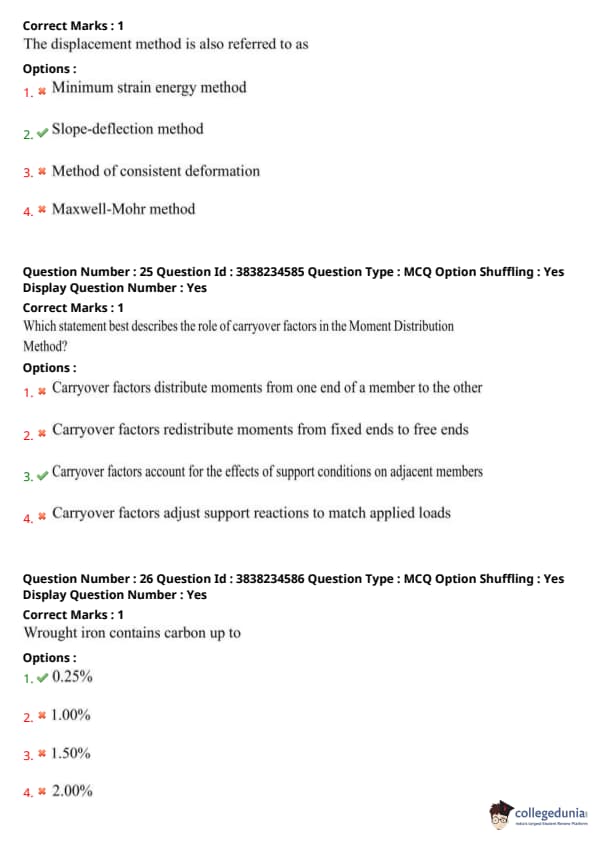
Question 24:

The displacement method is also referred to as

  • (1) Minimum strain energy method
  • (2) Slope-deflection method
  • (3) Method of consistent deformation
  • (4) Maxwell-Mohr method

Question 25:

Which statement best describes the role of carryover factors in the Moment Distribution Method?

  • (1) Carryover factors distribute moments from one end of a member to the other
  • (2) Carryover factors redistribute moments from fixed ends to free ends
  • (3) Carryover factors account for the effects of support conditions on adjacent members
  • (4) Carryover factors adjust support reactions to match applied loads

Question 26:

Wrought iron contains carbon up to

1. 0.25%
2. 1.00%
3. 1.50%
4. 2.00%


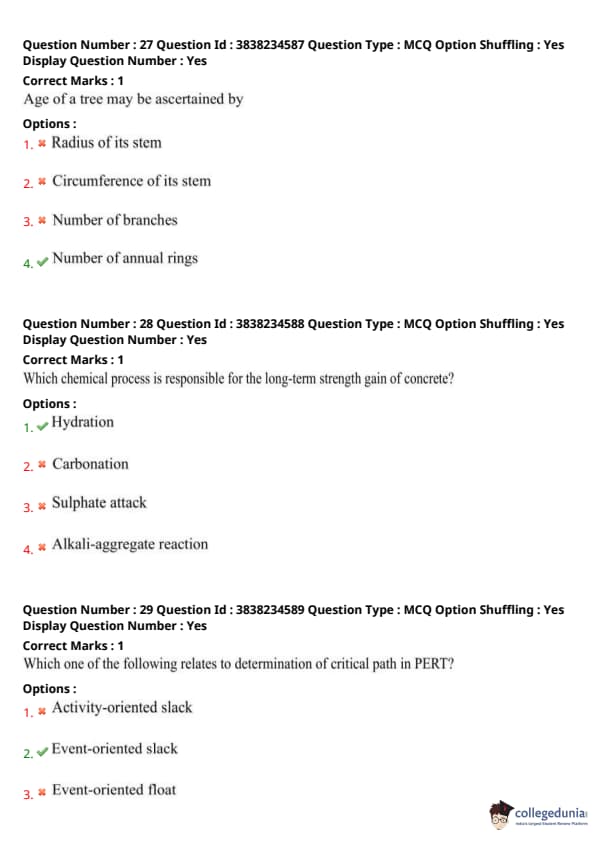
Question 27:

Age of a tree may be ascertained by

  • (1) Radius of its stem
  • (2) Circumference of its stem
  • (3) Number of branches
  • (4) Number of annual rings

Question 28:

Which chemical process is responsible for the long-term strength gain of concrete?

  • (1) Hydration
  • (2) Carbonation
  • (3) Sulphate attack
  • (4) Alkali-aggregate reaction

Question 29:

Which one of the following relates to determination of critical path in PERT?

  • (1) Activity-oriented slack
  • (2) Event-oriented slack
  • (3) Event-oriented float
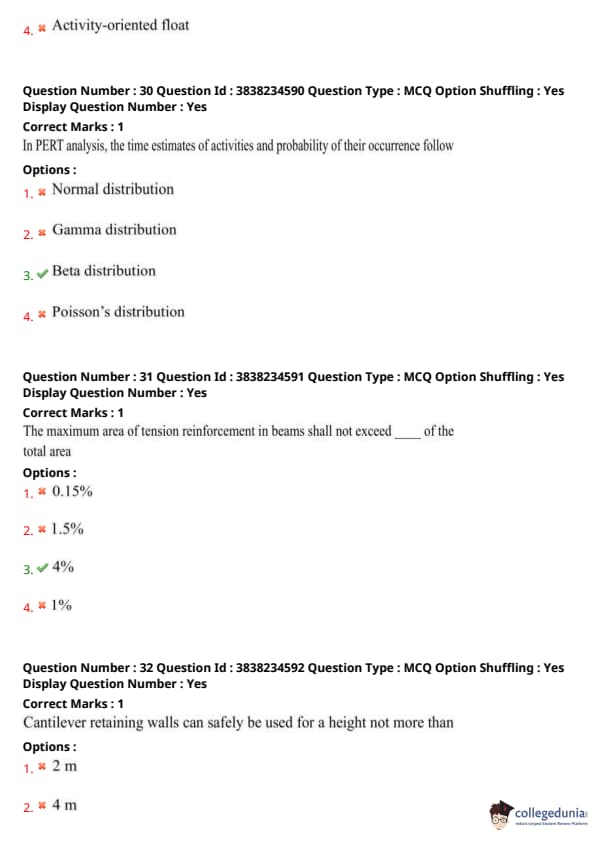
  • (4) Activity-oriented float

Question 30:

In PERT analysis, the time estimates of activities and probability of their occurrence follow

  • (1) Normal distribution
  • (2) Gamma distribution
  • (3) Beta distribution
  • (4) Poisson's distribution

Question 31:

The maximum area of tension reinforcement in beams shall not exceed ____ of the total area.

  • (1) \( 0.15% \)
  • (2) \( 1.5% \)
  • (3) \( 4% \)
  • (4) \( 1% \)

Question 32:

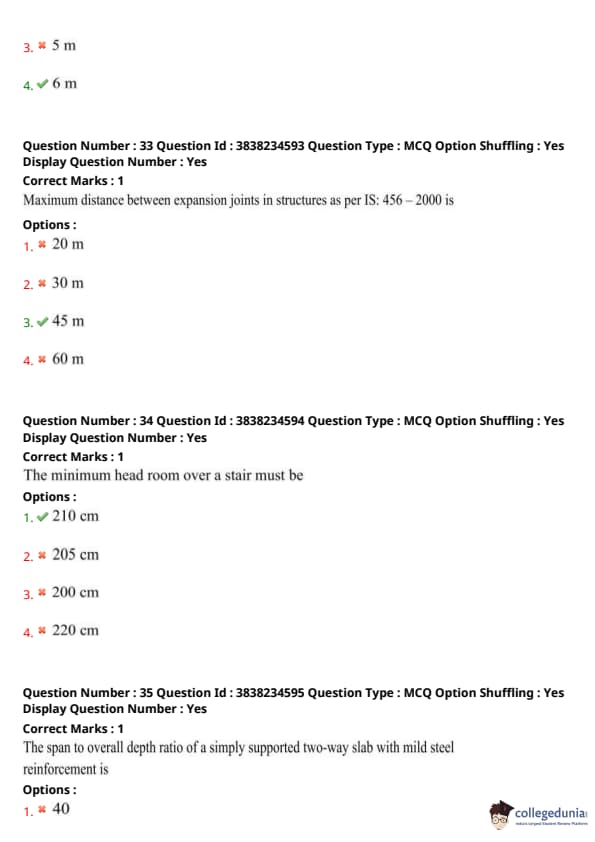
Cantilever retaining walls can safely be used for a height not more than:

  • (1) \( 2 \, m \)
  • (2) \( 4 \, m \)
  • (3) \( 5 \, m \)
  • (4) \( 6 \, m \)

Question 33:

Maximum distance between expansion joints in structures as per IS: 456–2000 is:

  • (1) \( 20 \, m \)
  • (2) \( 30 \, m \)
  • (3) \( 45 \, m \)
  • (4) \( 60 \, m \)

Question 34:

The minimum headroom over a stair must be

  • (1) \( 210 \, cm \)
  • (2) \( 205 \, cm \)
  • (3) \( 200 \, cm \)
  • (4) \( 220 \, cm \)

Question 35:

The span to overall depth ratio of a simply supported two-way slab with mild steel reinforcement is

  • (1) \( 40 \)
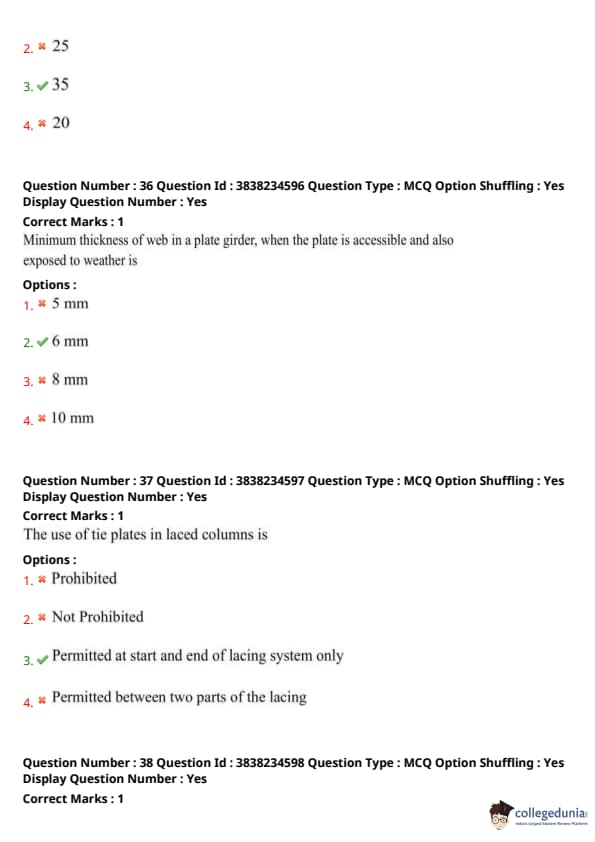
  • (2) \( 25 \)
  • (3) \( 35 \)
  • (4) \( 20 \)

Question 36:

The minimum thickness of the web in a plate girder, when the plate is accessible and also exposed to weather is

  • (1) \( 5 \, mm \)
  • (2) \( 6 \, mm \)
  • (3) \( 8 \, mm \)
  • (4) \( 10 \, mm \)

Question 37:

The use of tie plates in laced columns is:

  • (1) Prohibited
  • (2) Not Prohibited
  • (3) Permitted at start and end of lacing system only
  • (4) Permitted between two parts of the lacing

Question 38:

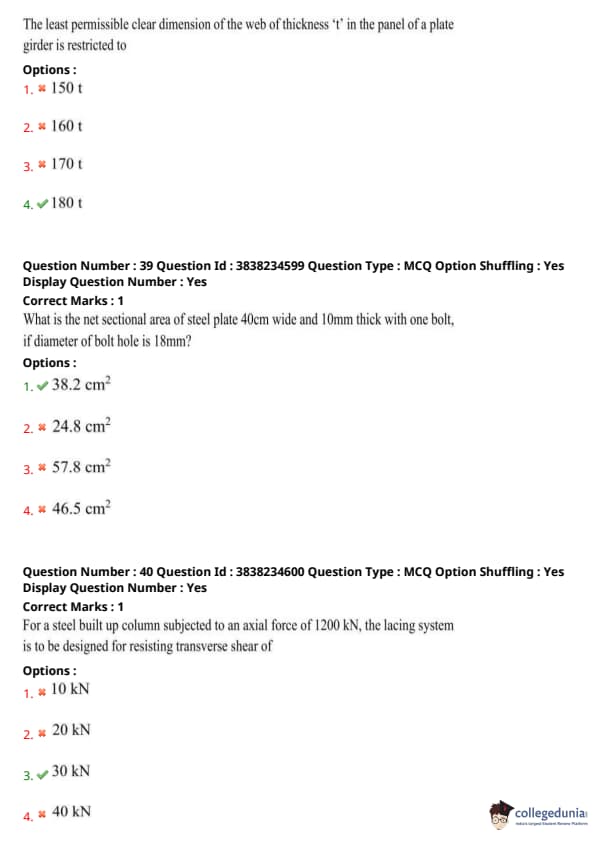
The least permissible clear dimension of the web of thickness \( t \) in the panel of a plate girder is restricted to

  • (1) \( 150t \)
  • (2) \( 160t \)
  • (3) \( 170t \)
  • (4) \( 180t \)

Question 39:

What is the net sectional area of a steel plate 40 cm wide and 10 mm thick with one bolt, if the diameter of the bolt hole is 18 mm?

Options:

  • (1) \( 38.2 \, cm^2 \)
  • (2) \( 24.8 \, cm^2 \)
  • (3) \( 57.8 \, cm^2 \)
  • (4) \( 46.5 \, cm^2 \)

Question 40:

For a steel built-up column subjected to an axial force of 1200 kN, the lacing system is to be designed for resisting transverse shear of

  • (1) \( 10 \, kN \)
  • (2) \( 20 \, kN \)
  • (3) \( 30 \, kN \)
  • (4) \( 40 \, kN \)

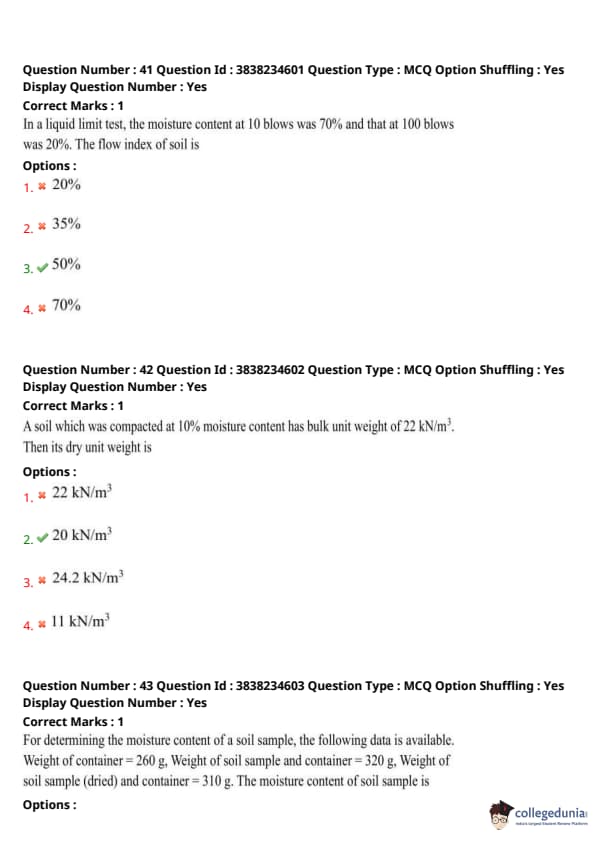
Question 41:

In a liquid limit test, the moisture content at 10 blows was 70% and that at 100 blows was 20%. The flow index of soil is

  • (1) \( 20% \)
  • (2) \( 35% \)
  • (3) \( 50% \)
  • (4) \( 70% \)

Question 42:

A soil which was compacted at 10% moisture content has bulk unit weight of \( 22 \, kN/m^3 \). Then its dry unit weight is

  • (1) \( 22 \, kN/m^3 \)
  • (2) \( 20 \, kN/m^3 \)
  • (3) \( 24.2 \, kN/m^3 \)
  • (4) \( 11 \, kN/m^3 \)

Question 43:

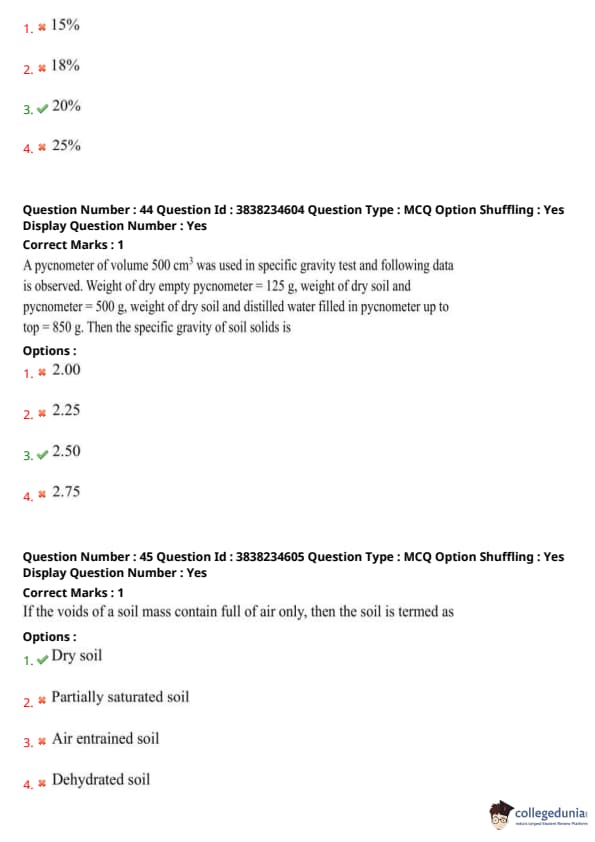
For determining the moisture content of a soil sample, the following data is available. Weight of container = \( 260 \, g \), Weight of soil sample and container = \( 320 \, g \), Weight of soil sample (dried) and container = \( 310 \, g \). The moisture content of soil sample is

  • (1) \( 15% \)
  • (2) \( 18% \)
  • (3) \( 20% \)
  • (4) \( 25% \)

Question 44:

A pycnometer of volume \( 500 \, cm^3 \) was used in specific gravity test and following data is observed. Weight of dry empty pycnometer = \( 125 \, g \), weight of dry soil and pycnometer = \( 500 \, g \), weight of dry soil and distilled water filled in pycnometer up to top = \( 850 \, g \). Then the specific gravity of soil solids is

  • (1) \( 2.00 \)
  • (2) \( 2.25 \)
  • (3) \( 2.50 \)
  • (4) \( 2.75 \)

Question 45:

If the voids of a soil mass contain full of air only, then the soil is termed as

  • (1) Dry soil
  • (2) Partially saturated soil
  • (3) Air entrained soil
  • (4) Dehydrated soil

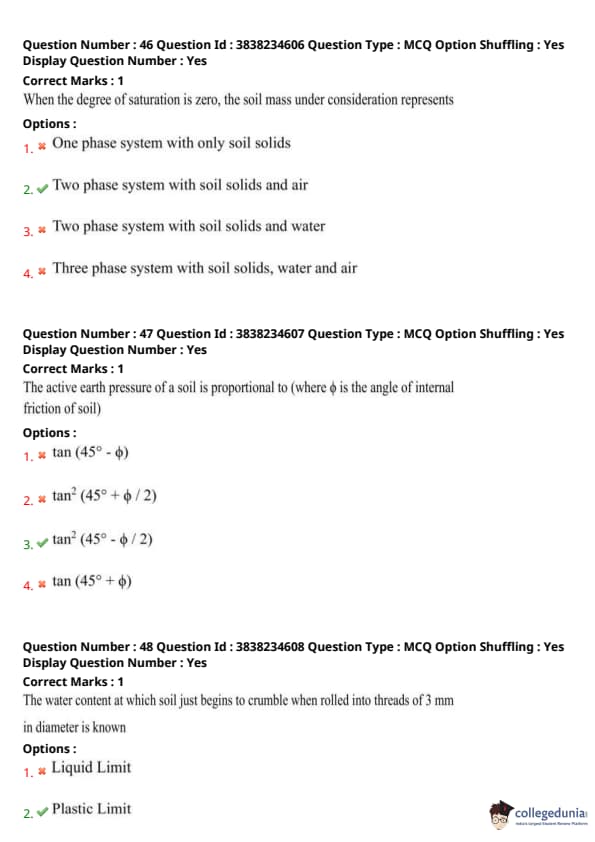
Question 46:

When the degree of saturation is zero, the soil mass under consideration represents

  • (1) One phase system with only soil solids
  • (2) Two phase system with soil solids and air
  • (3) Two phase system with soil solids and water
  • (4) Three phase system with soil solids, water and air

Question 47:

The active earth pressure of a soil is proportional to (where \( \phi \) is the angle of internal friction of soil)

  • (1) \( \tan (45^\circ - \phi) \)
  • (2) \( \tan^2 (45^\circ + \phi / 2) \)
  • (3) \( \tan^2 (45^\circ - \phi / 2) \)
  • (4) \( \tan (45^\circ + \phi) \)

Question 48:

The water content at which soil just begins to crumble when rolled into threads of 3 mm in diameter is known

  • (1) Liquid Limit
  • (2) Plastic Limit
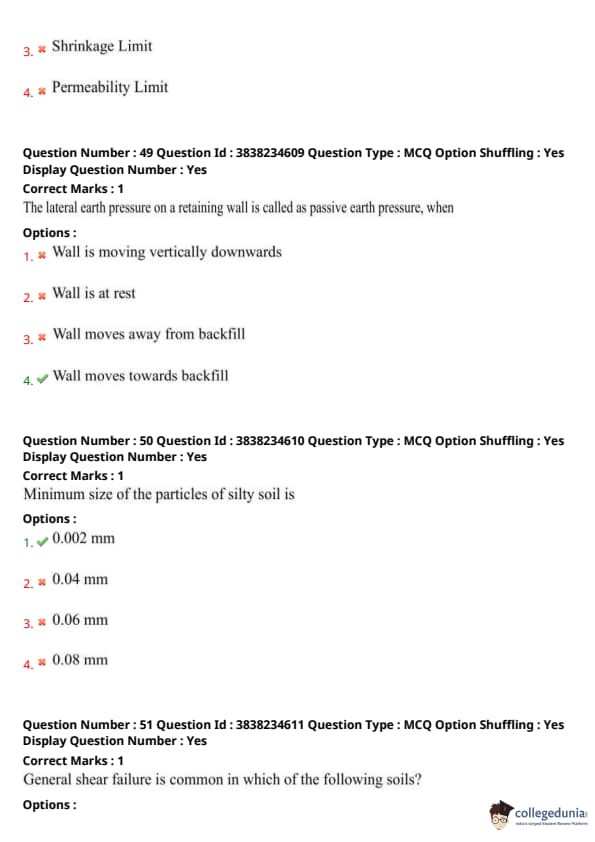
  • (3) Shrinkage Limit
  • (4) Permeability Limit

Question 49:

The lateral earth pressure on a retaining wall is called passive earth pressure when

  • (1) Wall is moving vertically downwards
  • (2) Wall is at rest
  • (3) Wall moves away from backfill
  • (4) Wall moves towards backfill

Question 50:

Minimum size of the particles of silty soil is

  • (1) \( 0.002 \, mm \)
  • (2) \( 0.04 \, mm \)
  • (3) \( 0.075 \, mm \)
  • (4) \( 0.005 \, mm \)

Question 51:

General shear failure is common in which of the following soils?

  • (1) loose silt
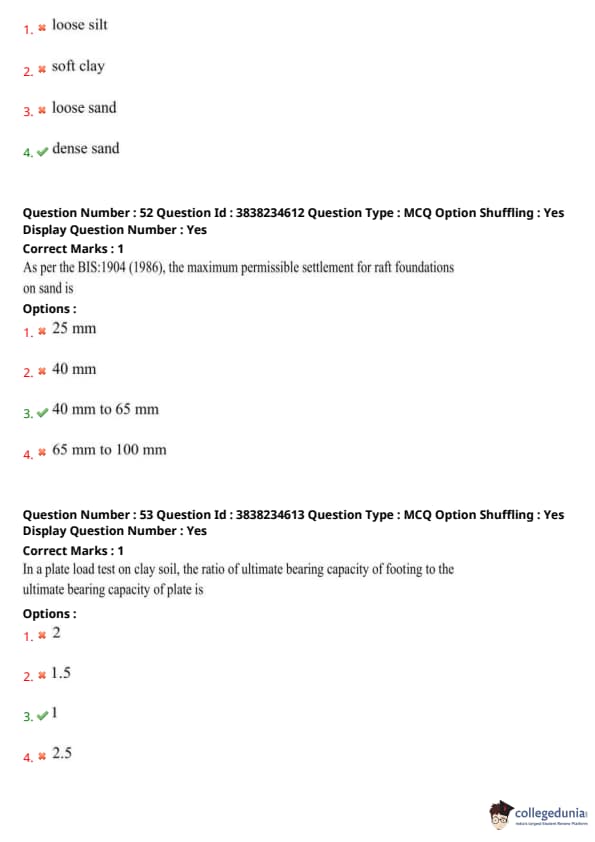
  • (2) soft clay
  • (3) loose sand
  • (4) dense sand

Question 52:

As per the BIS:1904 (1986), the maximum permissible settlement for raft foundations on sand is

  • (1) 25 mm
  • (2) 40 mm
  • (3) 40 mm to 65 mm
  • (4) 65 mm to 100 mm

Question 53:

In a plate load test on clay soil, the ratio of ultimate bearing capacity of footing to the ultimate bearing capacity of plate is

  • (1) 2
  • (2) 1.5
  • (3) 1
  • (4) 2.5

Question 54:

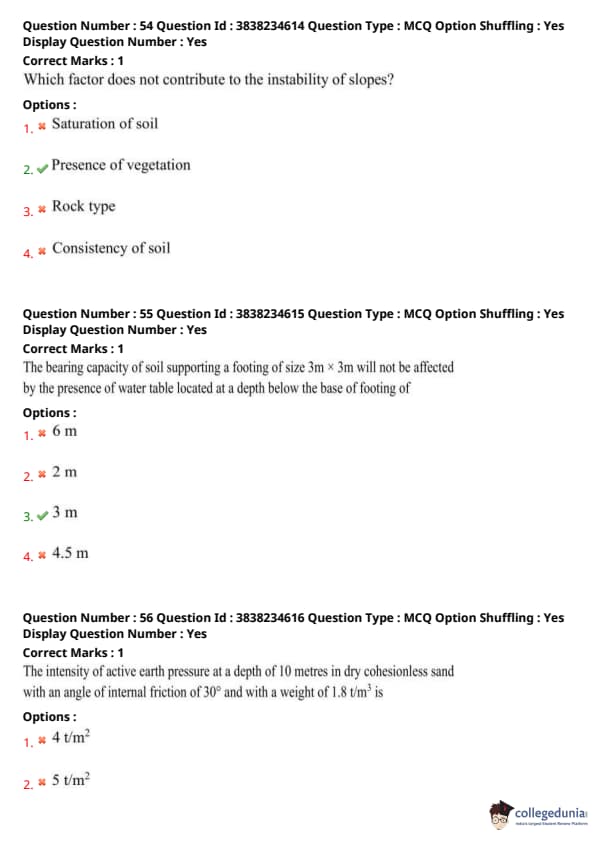
Which factor does not contribute to the instability of slopes?

  • (1) Saturation of soil
  • (2) Presence of vegetation
  • (3) Rock type
  • (4) Consistency of soil

Question 55:

The bearing capacity of soil supporting a footing of size \( 3 \, m \times 3 \, m \) will not be affected by the presence of water table located at a depth below the base of footing of

  • (1) \( 6 \, m \)
  • (2) \( 2 \, m \)
  • (3) \( 3 \, m \)
  • (4) \( 4.5 \, m \)

Question 56:

The intensity of active earth pressure at a depth of 10 metres in dry cohesionless sand with an angle of internal friction of \( 30^\circ \) and with a weight of \( 1.8 \, t/m^3 \) is

  • (1) \( 4 \, t/m^2 \)
  • (2) \( 5 \, t/m^2 \)
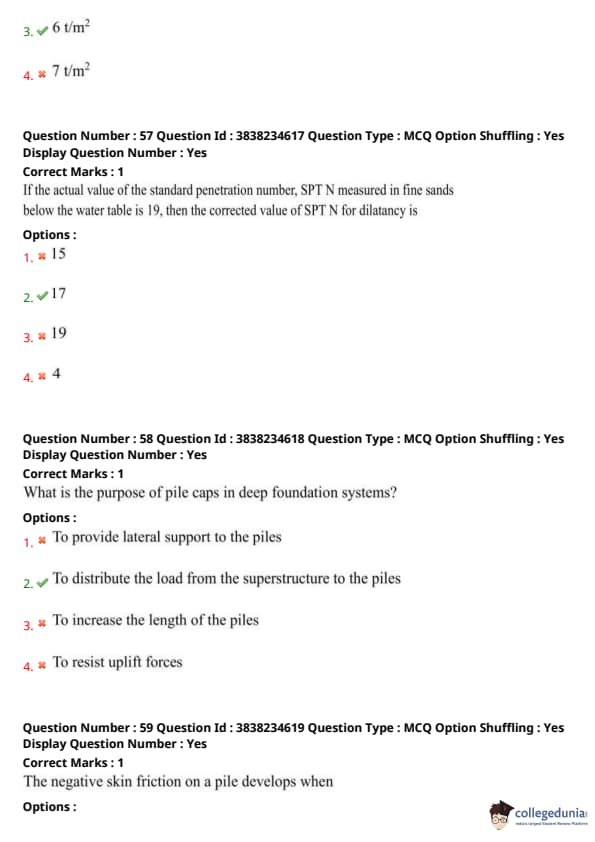
  • (3) \( 6 \, t/m^2 \)
  • (4) \( 7 \, t/m^2 \)

Question 57:

If the actual value of the standard penetration number, SPT N measured in fine sand below the water table is 19, then the corrected value of SPT N for dilatancy is

  • (1) \( 15 \)
  • (2) \( 17 \)
  • (3) \( 19 \)
  • (4) \( 4 \)

Question 58:

What is the purpose of pile caps in deep foundation systems?

  • (1) To provide lateral support to the piles
  • (2) To distribute the load from the superstructure to the piles
  • (3) To increase the length of the piles
  • (4) To resist uplift forces

Question 59:

The negative skin friction on a pile develops when

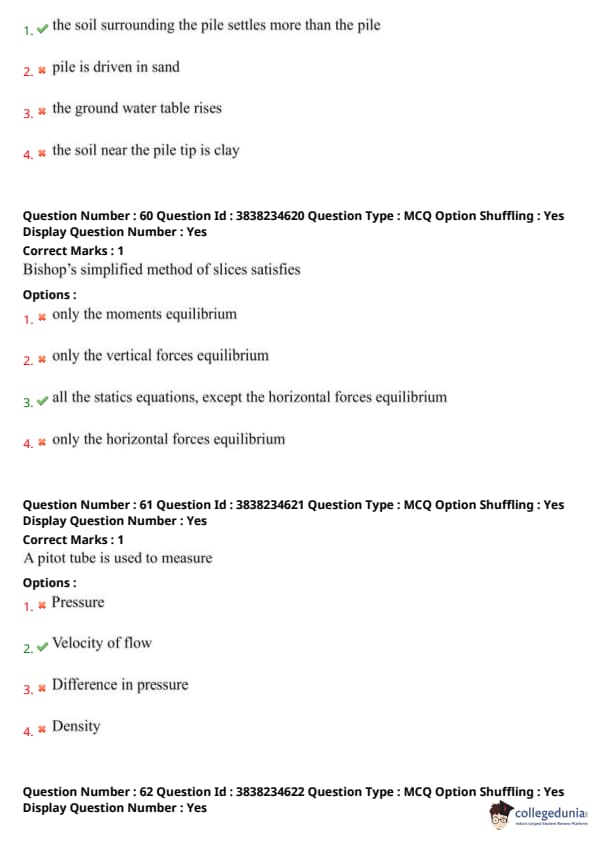
  • (1) the soil surrounding the pile settles more than the pile
  • (2) pile is driven in sand
  • (3) the ground water table rises
  • (4) the soil near the pile tip is clay

Question 60:

Bishop's simplified method of slices satisfies

  • (1) only the moments equilibrium
  • (2) only the vertical forces equilibrium
  • (3) all the statics equations, except the horizontal forces equilibrium
  • (4) only the horizontal forces equilibrium

Question 61:

A pitot tube is used to measure

  • (1) Pressure
  • (2) Velocity of flow
  • (3) Difference in pressure
  • (4) Density

Question 62:

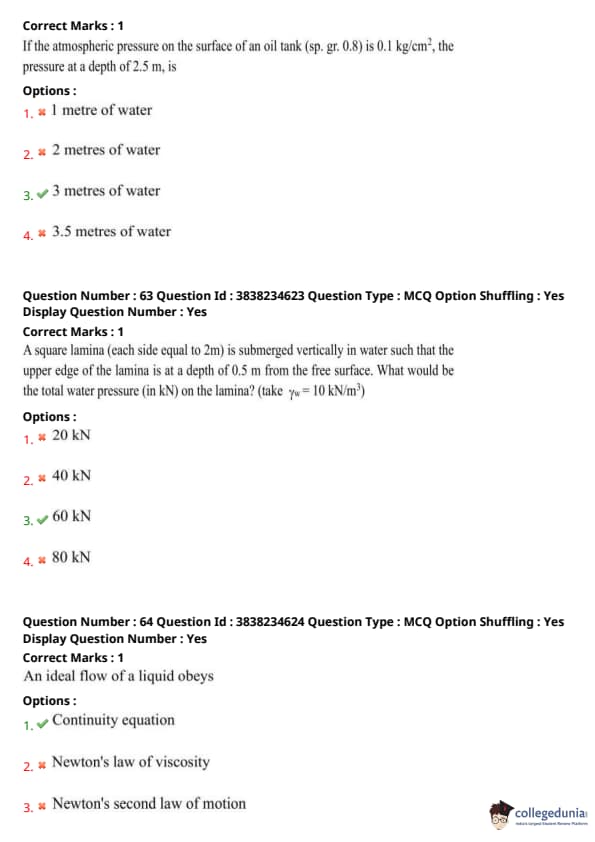
If the atmospheric pressure on the surface of an oil tank (sp. gr. 0.8) is \( 0.1 \, kg/cm^2 \), the pressure at a depth of \( 2.5 \, m \), is

  • (1) 1 metre of water
  • (2) 2 metres of water
  • (3) 3 metres of water
  • (4) 3.5 metres of water

Question 63:

A square lamina (each side equal to 2m) is submerged vertically in water such that the upper edge of the lamina is at a depth of 0.5 m from the free surface. What will be the total water pressure (in kN) on the lamina? (take \( \gamma_w = 10 \, kN/m^3 \))

  • (1) 20 kN
  • (2) 40 kN
  • (3) 60 kN
  • (4) 80 kN

Question 64:

An ideal flow of a liquid obeys:

  • (1) Continuity equation
  • (2) Newton's law of viscosity
  • (3) Newton's second law of motion
  • (4) Dynamic viscosity law

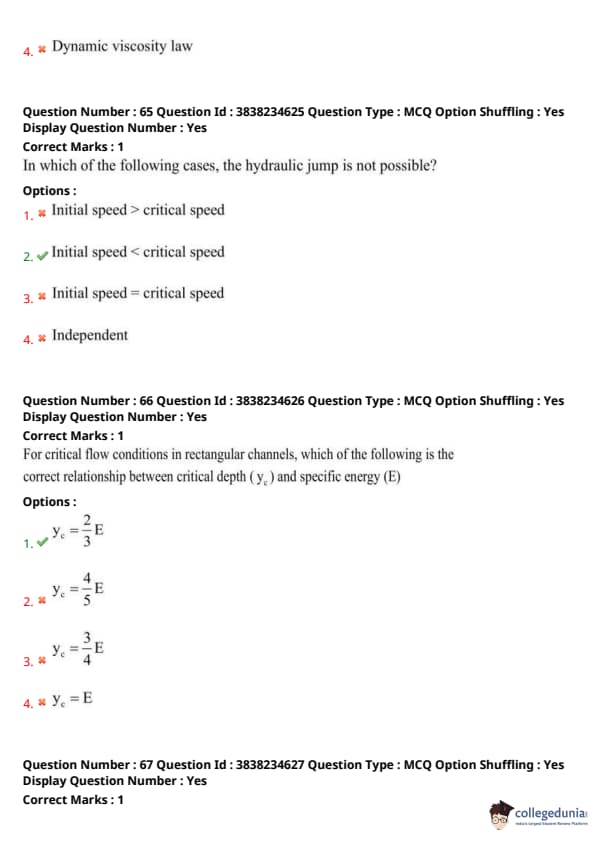
Question 65:

In which of the following cases, the hydraulic jump is not possible?

  • (1) Initial speed \(>\) critical speed
  • (2) Initial speed \(<\) critical speed
  • (3) Initial speed = critical speed
  • (4) Independent

Question 66:

For critical flow conditions in rectangular channels, which of the following is the correct relationship between critical depth \( y_c \) and specific energy \( E \)?

  • (1) \( y_c = \frac{2}{3}E \)
  • (2) \( y_c = \frac{4}{5}E \)
  • (3) \( y_c = \frac{3}{4}E \)
  • (4) \( y_c = E \)

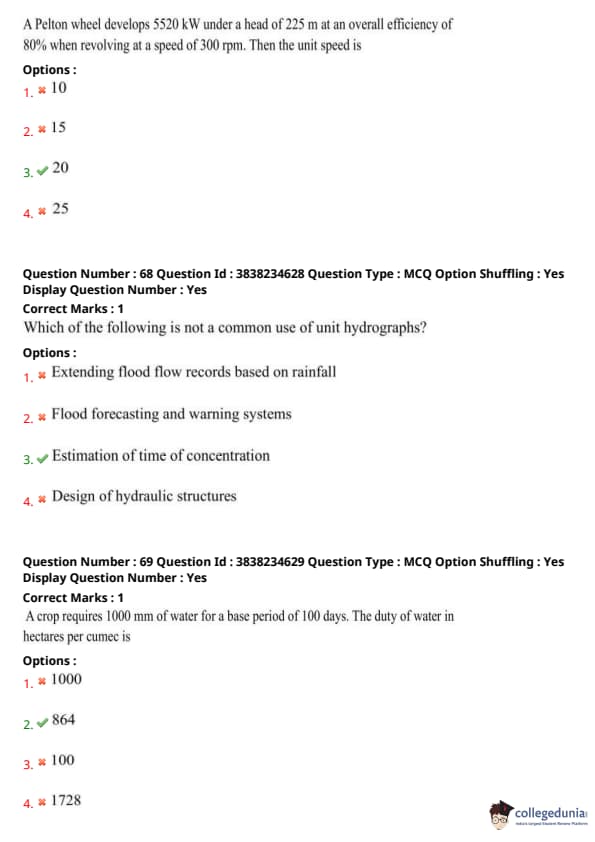
Question 67:

A Pelton wheel develops 5520 kW under a head of 225 m at an overall efficiency of 80% when revolving at a speed of 300 rpm. Then the unit speed is

  • (1) \( 10 \)
  • (2) \( 15 \)
  • (3) \( 20 \)
  • (4) \( 25 \)

Question 68:

Which of the following is not a common use of unit hydrographs?

  • (1) Extending flood flow records based on rainfall
  • (2) Flood forecasting and warning systems
  • (3) Estimation of time of concentration
  • (4) Design of hydraulic structures

Question 69:

A crop requires 1000 mm of water for a base period of 100 days. The duty of water in hectares per cumec is

  • (1) \( 1000 \)
  • (2) \( 864 \)
  • (3) \( 100 \)
  • (4) \( 1728 \)

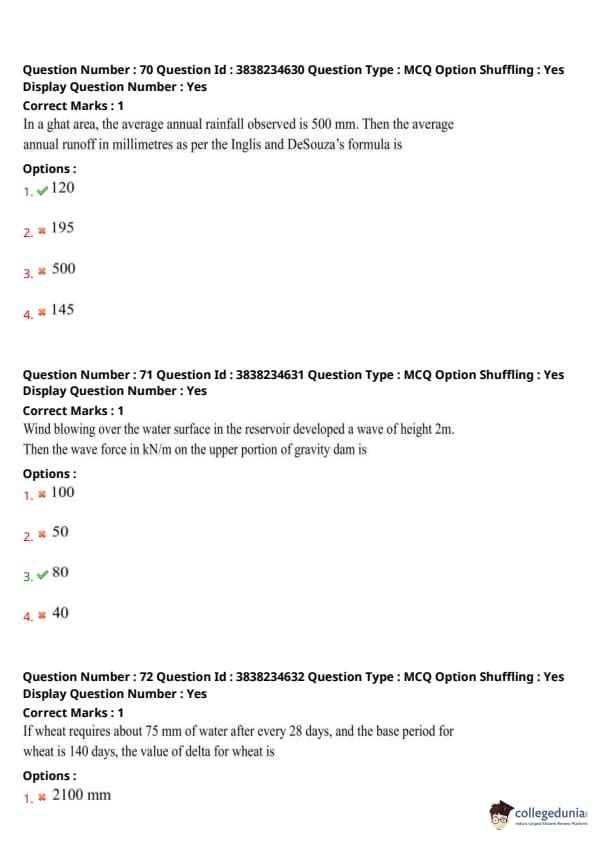
Question 70:

In a ghat area, the average annual rainfall observed is 500 mm. Then the average annual runoff in millimetres as per the Inglis and DeSouza's formula is

  • (1) \( 120 \)
  • (2) \( 195 \)
  • (3) \( 500 \)
  • (4) \( 145 \)

Question 71:

Wind blowing over the water surface in the reservoir developed a wave of height 2 m. Then the wave force in kN/m on the upper portion of gravity dam is

  • (1) 100
  • (2) 50
  • (3) 80
  • (4) 40

Question 72:

If wheat requires about 75 mm of water after every 28 days, and the base period for wheat is 140 days, the value of delta for wheat is

  • (1) 2100 mm
  • (2) 75 mm
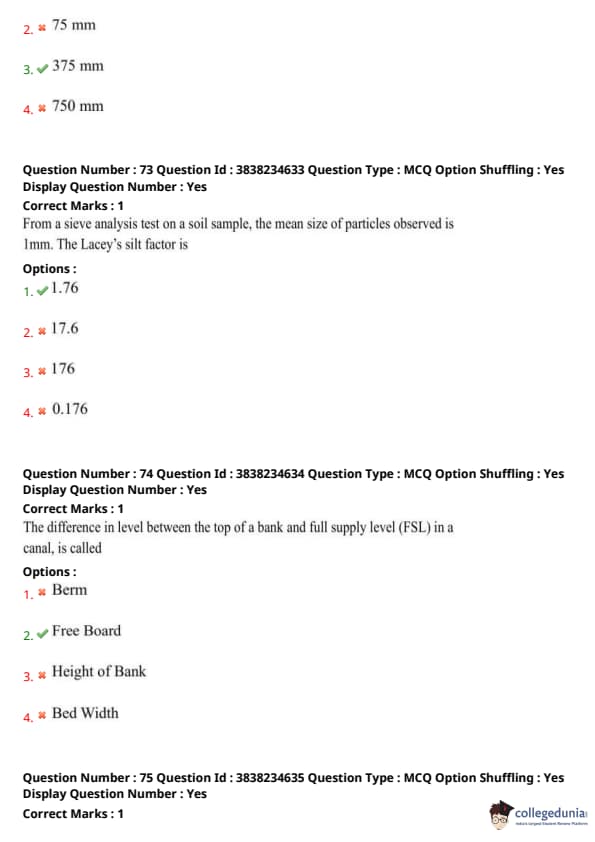
  • (3) 375 mm
  • (4) 750 mm

Question 73:

From a sieve analysis test on a soil sample, the mean size of particles observed is 1 mm. The Lacey’s silt factor is

  • (1) 1.76
  • (2) 17.6
  • (3) 176
  • (4) 0.176

Question 74:

The difference in level between the top of a bank and full supply level (FSL) in a canal is called

  • (1) Berm
  • (2) Free Board
  • (3) Height of Bank
  • (4) Bed Width

Question 75:

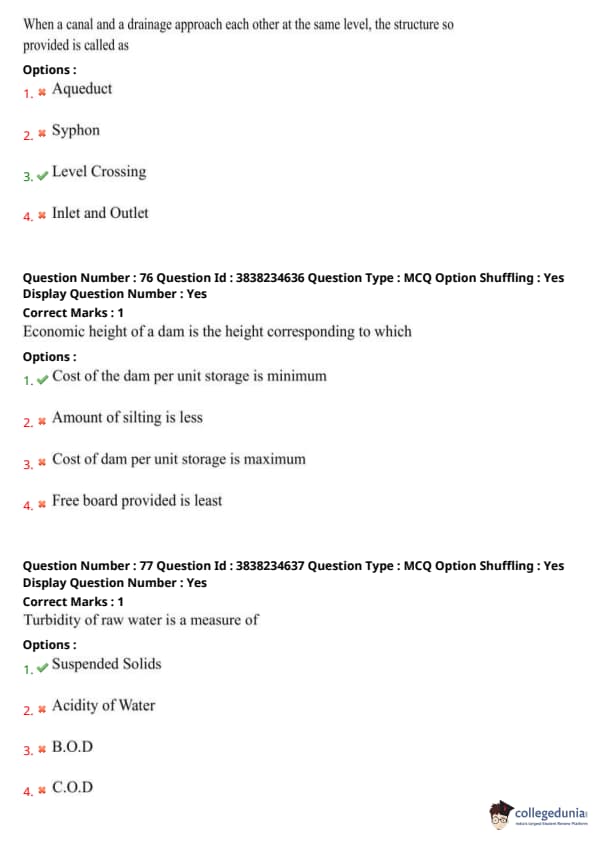
When a canal and a drainage approach each other at the same level, the structure so provided is called as

  • (1) Aqueduct
  • (2) Syphon
  • (3) Level Crossing
  • (4) Inlet and Outlet

Question 76:

Economic height of a dam is the height corresponding to which

  • (1) Cost of the dam per unit storage is minimum
  • (2) Amount of silting is less
  • (3) Cost of dam per unit storage is maximum
  • (4) Free board provided is least

Question 77:

Turbidity of raw water is a measure of

  • (1) Suspended Solids
  • (2) Acidity of Water
  • (3) B.O.D
  • (4) C.O.D

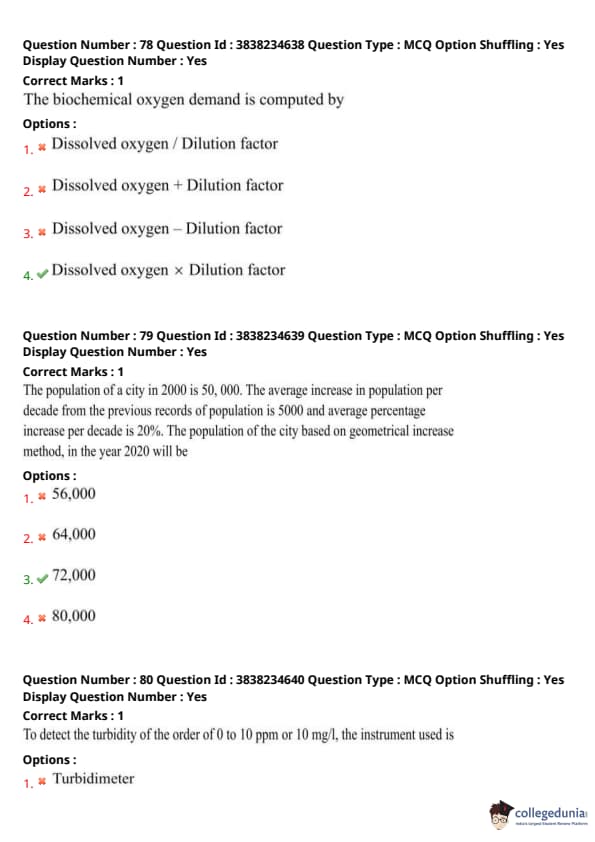
Question 78:

The biochemical oxygen demand is computed by

  • (1) Dissolved oxygen / Dilution factor
  • (2) Dissolved oxygen + Dilution factor
  • (3) Dissolved oxygen – Dilution factor
  • (4) Dissolved oxygen \( \times \) Dilution factor

Question 79:

The population of a city in 2000 is 50,000. The average increase in population per decade from the previous records of population is 5000 and average percentage increase per decade is 20%. The population of the city based on geometrical increase method, in the year 2020 will be

  • (1) \( 56,000 \)
  • (2) \( 64,000 \)
  • (3) \( 72,000 \)
  • (4) \( 80,000 \)

Question 80:

To detect the turbidity of the order of 0 to 10 ppm or 10 mg/l, the instrument used is

  • (1) Turbidimeter
  • (2) Jackson Turbidimeter
  • (3) Hallige Turbidimeter.
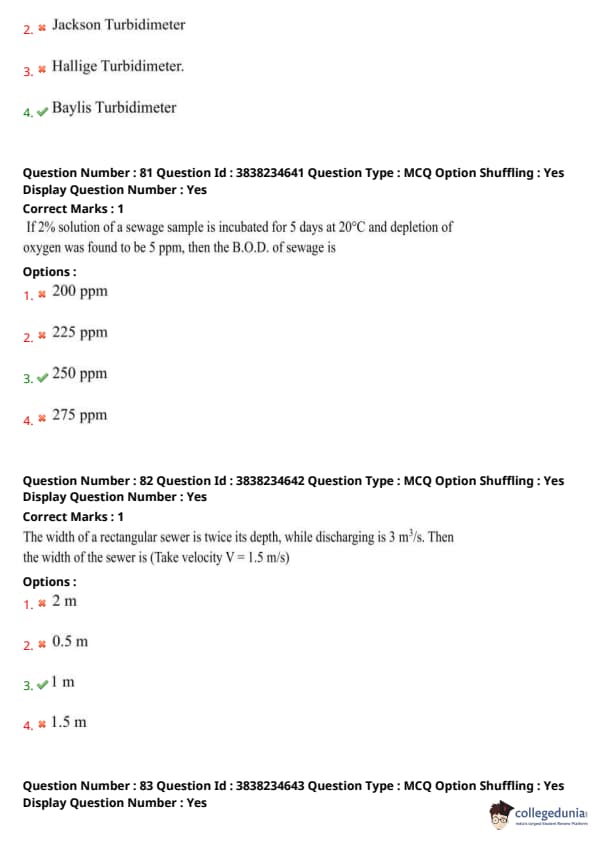
  • (4) Baylis Turbidimeter

Question 81:

If 2% solution of a sewage sample is incubated for 5 days at 20°C and depletion of oxygen was found to be 5 ppm, then the B.O.D. of sewage is

  • (1) 200 ppm
  • (2) 225 ppm
  • (3) 250 ppm
  • (4) 275 ppm

Question 82:

The width of a rectangular sewer is twice its depth while discharging 3 m³/s. Then the width of the sewer is (Take velocity V = 1.5 m/s)

  • (1) 2 m
  • (2) 0.5 m
  • (3) 1 m
  • (4) 1.5 m

Question 83:

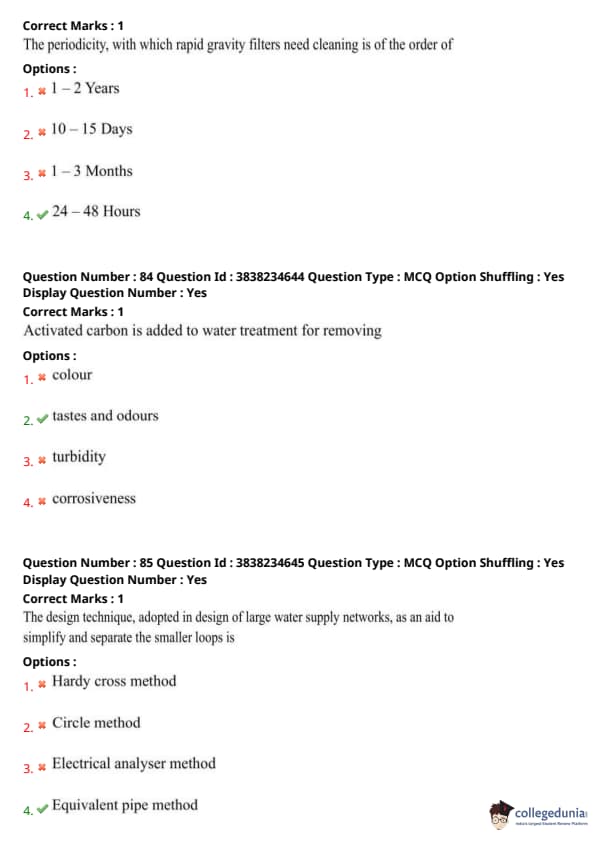
The periodicity, with which rapid gravity filters need cleaning is of the order of

  • (1) \( 1-2 \, Years \)
  • (2) \( 10-15 \, Days \)
  • (3) \( 1-3 \, Months \)
  • (4) \( \checkmark \, 24-48 \, Hours \)

Question 84:

Activated carbon is added to water treatment for removing

  • (1) colour
  • (2) tastes and odours
  • (3) turbidity
  • (4) corrosiveness

Question 85:

The design technique, adopted in design of large water supply networks, as an aid to simplify and separate the smaller loops is

  • (1) Hardy cross method
  • (2) Circle method
  • (3) Electrical analyser method
  • (4) Equivalent pipe method

Question 86:

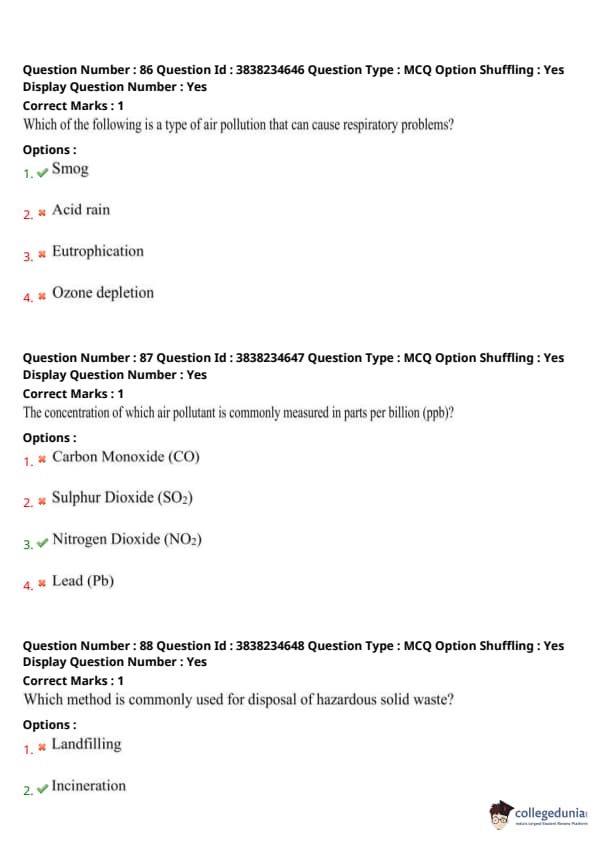
Which of the following is a type of air pollution that can cause respiratory problems?

  • (1) Smog
  • (2) Acid rain
  • (3) Eutrophication
  • (4) Ozone depletion

Question 87:

The concentration of which air pollutant is commonly measured in parts per billion (ppb)?

  • (1) Carbon Monoxide (CO)
  • (2) Sulphur Dioxide (\(SO_2\))
  • (3) Nitrogen Dioxide (\(NO_2\))
  • (4) Lead (Pb)

Question 88:

Which method is commonly used for disposal of hazardous solid waste?

  • (1) Landfilling
  • (2) Incineration
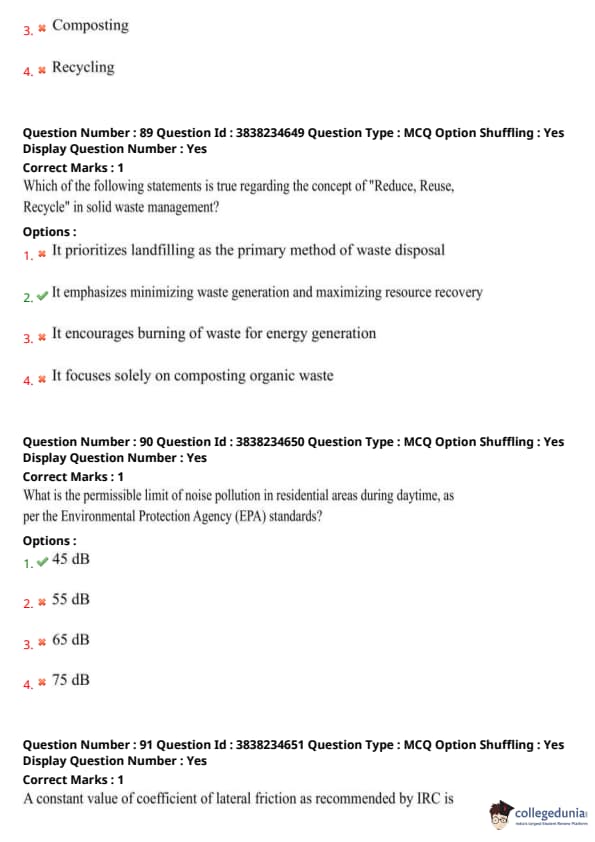
  • (3) Composting
  • (4) Recycling

Question 89:

Which of the following statements is true regarding the concept of "Reduce, Reuse, Recycle" in solid waste management?

  • (1) It prioritizes landfilling as the primary method of waste disposal
  • (2) It emphasizes minimizing waste generation and maximizing resource recovery
  • (3) It encourages burning of waste for energy generation
  • (4) It focuses solely on composting organic waste

Question 90:

What is the permissible limit of noise pollution in residential areas during daytime, as per the Environmental Protection Agency (EPA) standards?

  • (1) 45 dB
  • (2) 55 dB
  • (3) 65 dB
  • (4) 75 dB

Question 91:

A constant value of coefficient of lateral friction as recommended by IRC is

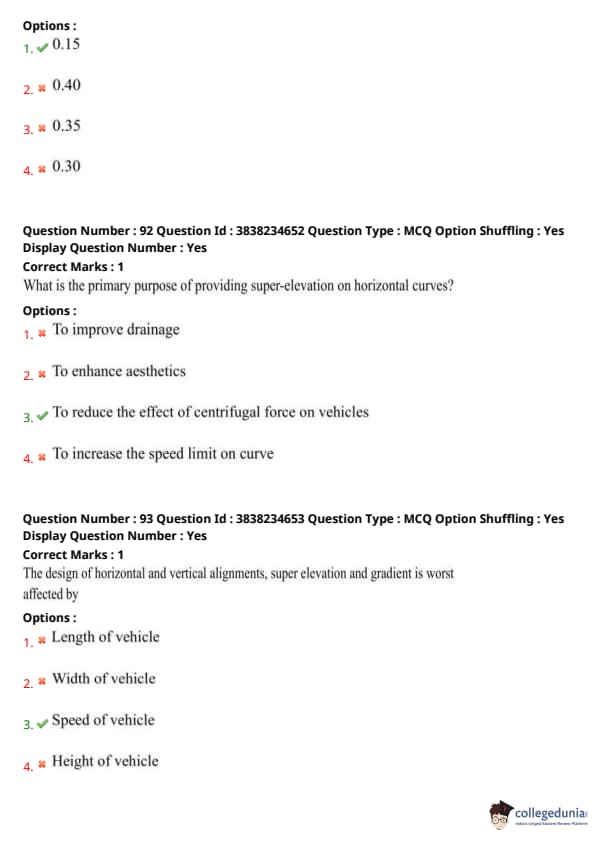
  • (1) 0.15
  • (2) 0.40
  • (3) 0.35
  • (4) 0.30

Question 92:

What is the primary purpose of providing super-elevation on horizontal curves?

  • (1) To improve drainage
  • (2) To enhance aesthetics
  • (3) To reduce the effect of centrifugal force on vehicles
  • (4) To increase the speed limit on curve

Question 93:

The design of horizontal and vertical alignments, super elevation and gradient is worst affected by

  • (1) Length of vehicle
  • (2) Width of vehicle
  • (3) Speed of vehicle
  • (4) Height of vehicle

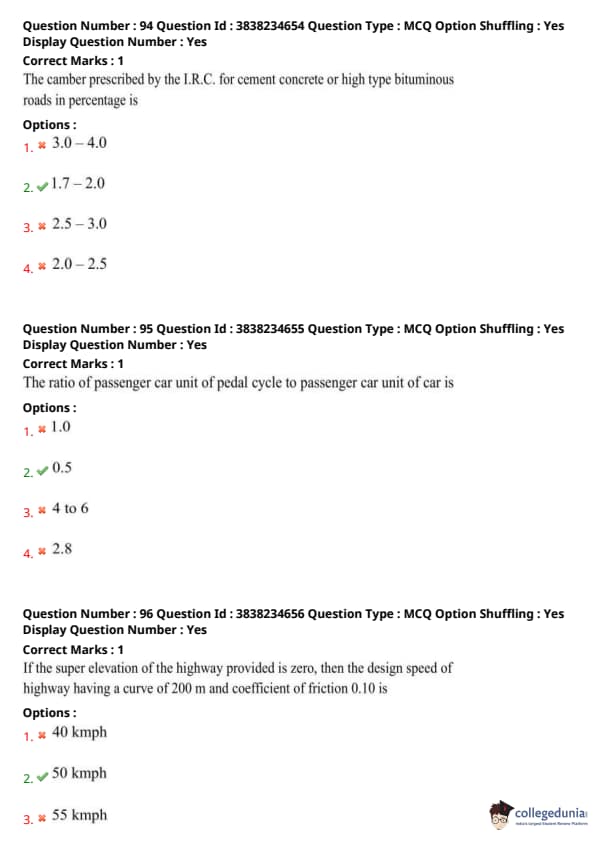
Question 94:

The camber prescribed by the I.R.C. for cement concrete or high type bituminous roads in percentage is

  • (1) \( 3.0 - 4.0 \)
  • (2) \( 1.7 - 2.0 \)
  • (3) \( 2.5 - 3.0 \)
  • (4) \( 2.0 - 2.5 \)

Question 95:

The ratio of passenger car unit of pedal cycle to passenger car unit of car is

  • (1) \( 1.0 \)
  • (2) \( 0.5 \)
  • (3) \( 4 \) to \( 6 \)
  • (4) \( 2.8 \)

Question 96:

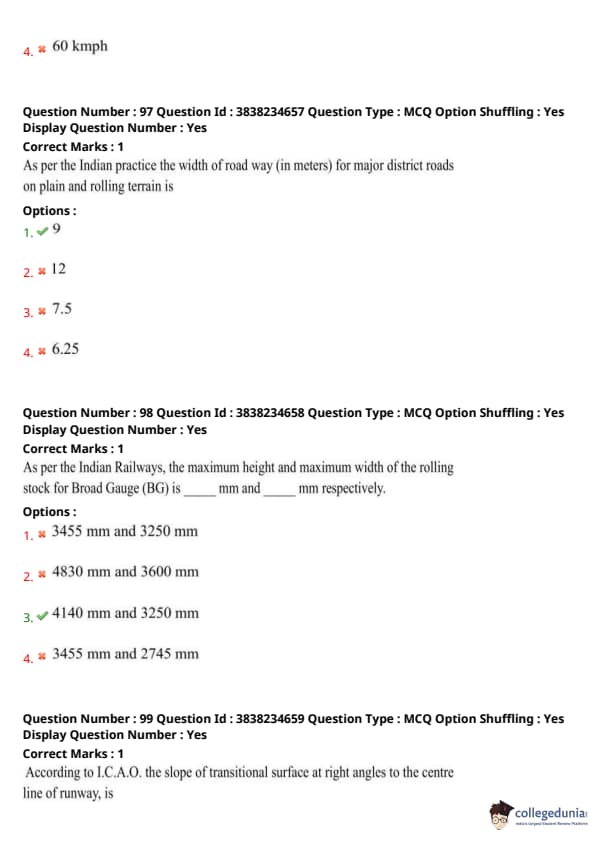
If the super elevation of the highway provided is zero, then the design speed of highway having a curve of 200 m and coefficient of friction 0.10 is

  • (1) 40 kmph
  • (2) 50 kmph
  • (3) 55 kmph
  • (4) 60 kmph

Question 97:

As per the Indian practice the width of road way (in meters) for major district roads on plain and rolling terrain is

  • (1) 9
  • (2) 12
  • (3) 7.5
  • (4) 6.25

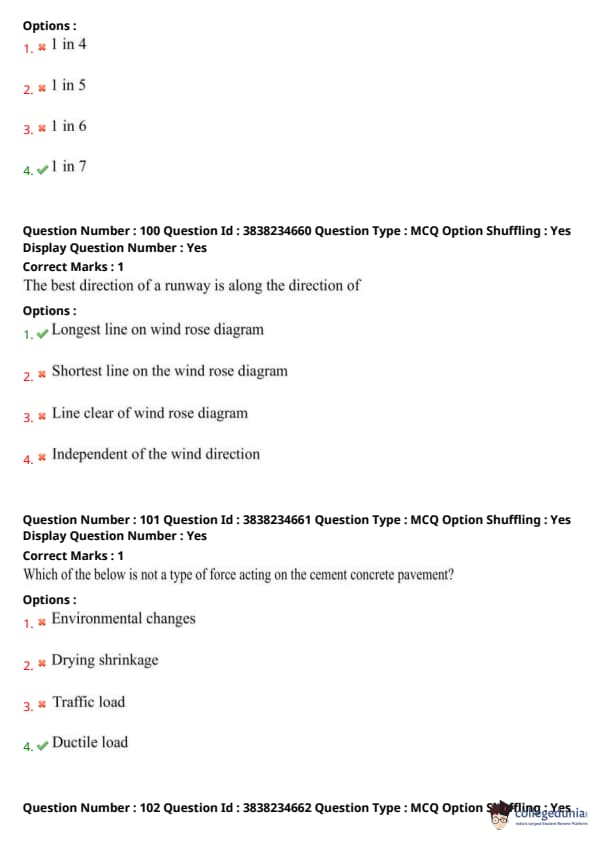
Question 98:

As per the Indian Railways, the maximum height and maximum width of the rolling stock for Broad Gauge (BG) is ___ mm and ___ mm respectively.

  • (1) 3455 mm and 3250 mm
  • (2) 4830 mm and 3600 mm
  • (3) 4140 mm and 3250 mm
  • (4) 3455 mm and 2745 mm

Question 99:

According to I.C.A.O, the slope of transitional surface at right angles to the centre line of runway, is

  • (1) 1 in 4
  • (2) 1 in 5
  • (3) 1 in 6
  • (4) 1 in 7

Question 100:

The best direction of a runway is along the direction of

  • (1) Longest line on wind rose diagram
  • (2) Shortest line on the wind rose diagram
  • (3) Line clear of wind rose diagram
  • (4) Independent of the wind direction

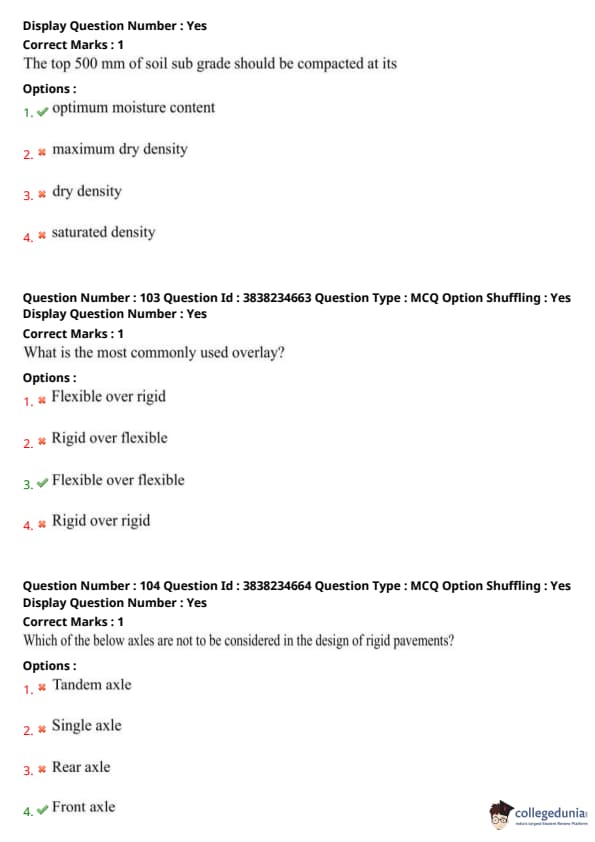
Question 101:

Which of the below is not a type of force acting on the cement concrete pavement?

  • (1) Environmental changes
  • (2) Drying shrinkage
  • (3) Traffic load
  • (4) Ductile load

Question 102:

The top 500 mm of soil sub grade should be compacted at its

  • (1) optimum moisture content
  • (2) maximum dry density
  • (3) dry density
  • (4) saturated density

Question 103:

What is the most commonly used overlay?

  • (1) Flexible over rigid
  • (2) Rigid over flexible
  • (3) Flexible over flexible
  • (4) Rigid over rigid

Question 104:

Which of the below axles are not to be considered in the design of rigid pavements?

  • (1) Tandem axle
  • (2) Single axle
  • (3) Rear axle
  • (4) Front axle

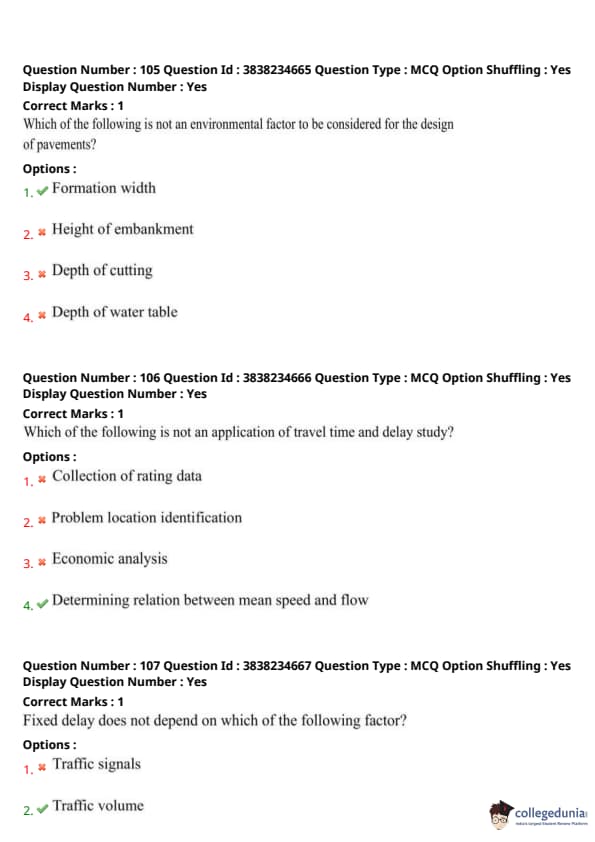
Question 105:

Which of the following is not an environmental factor to be considered for the design of pavements?

  • (1) Formation width
  • (2) Height of embankment
  • (3) Depth of cutting
  • (4) Depth of water table

Question 106:

Which of the following is not an application of travel time and delay study?

  • (1) Collection of rating data
  • (2) Problem location identification
  • (3) Economic analysis
  • (4) Determining relation between mean speed and flow

Question 107:

Fixed delay does not depend on which of the following factor?

  • (1) Traffic signals
  • (2) Traffic volume
  • (3) Markers
  • (4) Level crossing

Question 108:

What is the primary factor affecting the capacity of urban roads during peak hours?

  • (1) Vehicle type
  • (2) Traffic signals
  • (3) Pavement condition
  • (4) Pedestrian crossings

Question 109:

The enoscope is used to determine

  • (1) travel time
  • (2) running speed
  • (3) spot speed
  • (4) average speed

Question 110:

Which traffic sign is represented by a rectangular shape with a red border and a black diagonal line?

  • (1) No U-turn
  • (2) No overtaking
  • (3) No entry
  • (4) No parking

Question 111:

When distances are small, which of the following error is negligible in surveying?

  • (1) Error due to defective joint
  • (2) Atmospheric refraction
  • (3) Wind vibrations
  • (4) Earth's curvature

Question 112:

A 50 m tape is held 2 m out of line, then its true length is:

  • (1) 49.96 m
  • (2) 48.96 m
  • (3) 49.02 m
  • (4) 48.02 m

Question 113:

The least count of a self-reading levelling staff is

  • (1) 0.5 mm
  • (2) 0.15 cm
  • (3) 5.0 cm
  • (4) 5.0 mm

Question 114:

A level when set up 25 m from peg A and 50 m from peg B reads 2.847 on a staff held on A and 3.462 on a staff held on B, keeping the bubble at its centre while reading. If the reduced levels of A and B are 283.665 m and 284.295 m respectively, the collimation error per 100 m is

  • (1) \( 0.015 \, m \)
  • (2) \( 0.030 \, m \)
  • (3) \( 0.045 \, m \)
  • (4) \( 0.060 \, m \)

Question 115:

Profile leveling is usually done for determining

  • (1) Contours of an area
  • (2) Capacity of a reservoir
  • (3) Elevations along a straight line
  • (4) Boundaries of property

Question 116:

Which of the following is not the characteristic of contours?

  • (1) The contour lines of different elevations cannot cross each other
  • (2) The contour lines of different elevations can unite to form one line only in the case of a vertical cliff
  • (3) The contour lines close together indicate steep slope
  • (4) The contour lines cross a valley at right angles but they do not cross a watershed line at right angle

Question 117:

The angle between the direction of star and the direction of earth's axis of rotation is called as

  • (1) Co-declination
  • (2) Co-latitude
  • (3) Declination
  • (4) Latitude

Question 118:

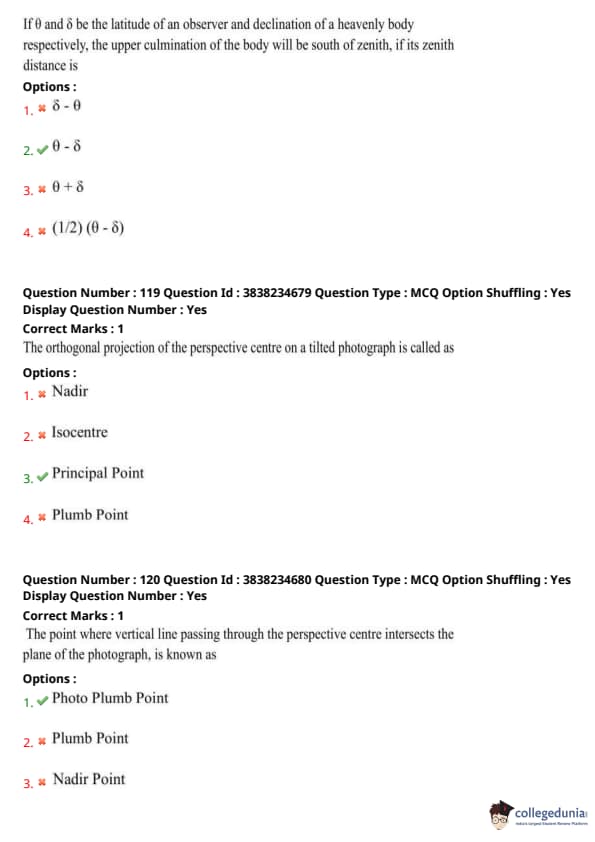
If \(\theta\) and \(\delta\) be the latitude of an observer and declination of a heavenly body respectively, the upper culmination of the body will be south of zenith, if its zenith distance is

  • (1) \(\delta - \theta\)
  • (2) \(\theta - \delta\)
  • (3) \(\theta + \delta\)
  • (4) \((1/2) (\theta - \delta)\)

Question 119:

The orthogonal projection of the perspective centre on a tilted photograph is called as

  • (1) Nadir
  • (2) Isocentre
  • (3) Principal Point
  • (4) Plumb Point

Question 120:

The point where vertical line passing through the perspective centre intersects the plane of the photograph, is known as

  • (1) Photo Plumb Point
  • (2) Plumb Point
  • (3) Nadir Point
  • (4) Isocentre