TS PGECET 2024 Electrical Engineering Question Paper is available for download here. Jawaharlal Nehru Technological University Hyderabad on behalf of Telangana Council of Higher Education (TGCHE) conducted TS PGECET 2024 Electrical Engineering on June 10 in Shift 2 from 2 PM to 4 PM. TS PGECET Question Paper 2024 consists of 120 MCQ-based questions in total carrying 1 mark each to be attempted in the duration of 2 hours.
TS PGECET 2024 Electrical Engineering Question Paper with Answer Key PDF
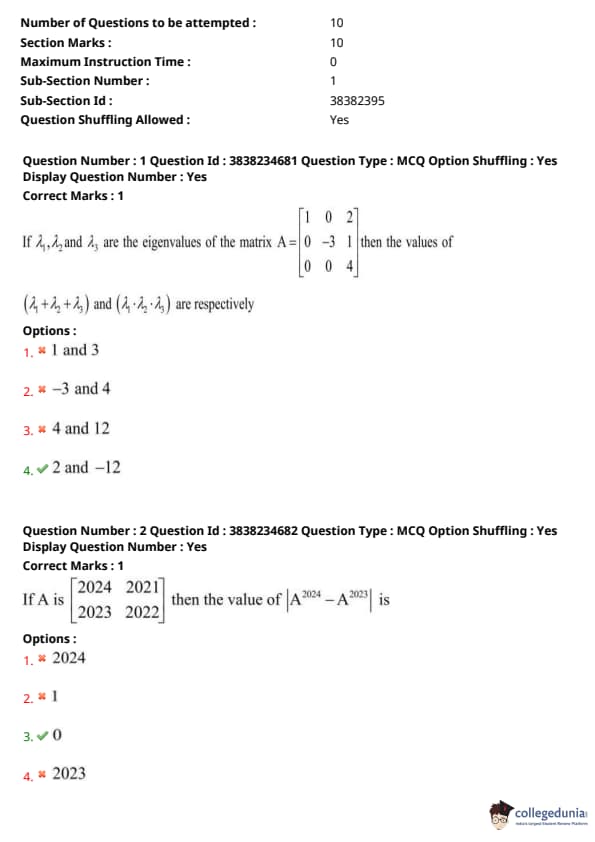
Question 1:
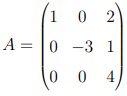
If \( \lambda_1, \lambda_2, \lambda_3 \) are the eigenvalues of the matrix ![image of matrix]() , then the values of \[ (\lambda_1 + \lambda_2 + \lambda_3) \ and \ (\lambda_1 \cdot \lambda_2 \cdot \lambda_3) \] are respectively
, then the values of \[ (\lambda_1 + \lambda_2 + \lambda_3) \ and \ (\lambda_1 \cdot \lambda_2 \cdot \lambda_3) \] are respectively
- (A) 1 and 3
- (B) -3 and 4
- (C) 4 and 12
- (D) 2 and -12
Question 2:
If \( A = \begin{pmatrix} 2024 & 2021
2023 & 2022 \end{pmatrix} \), then the value of \[ \left| A^{2024} - A^{2023} \right| \]
is
- (A) 2024
- (B) 1
- (C) 0
- (D) 2023
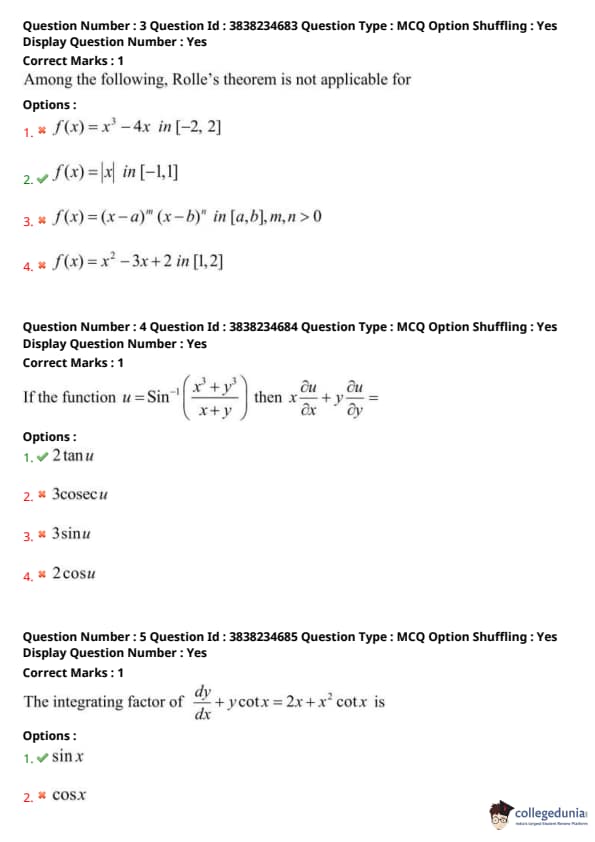
Question 3:
Among the following, Rolle's theorem is not applicable for
- (A) \( f(x) = x^3 - 4x \) in \([-2, 2]\)
- (B) \( f(x) = |x| \) in \([-1, 1]\)
- (C) \( f(x) = (x-a)^m (x-b)^n \) in \([a, b], m, n > 0\)
- (D) \( f(x) = x^2 - 3x + 2 \) in \([1, 2]\)
Question 4:
If the function \( u = \sin^{-1} \left( \frac{x^3 + y^3}{x + y} \right) \), then \[ x \frac{\partial u}{\partial x} + y \frac{\partial u}{\partial y} \]
is
- (A) \( 2 \tan u \)
- (B) \( 3 \csc u \)
- (C) \( 3 \sin u \)
- (D) \( 2 \cos u \)
Question 5:
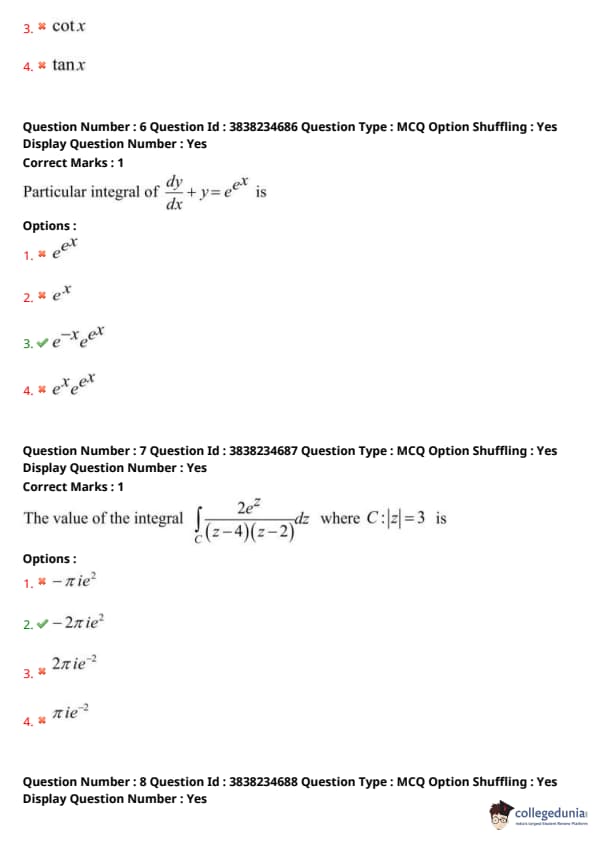
The integrating factor of \[ \frac{dy}{dx} + y \cot x = 2x + x^2 \cot x \]
is
- (A) \( \sin x \)
- (B) \( \cos x \)
- (C) \( \cot x \)
- (D) \( \tan x \)
Question 6:
Particular integral of \[ \frac{dy}{dx} + y = e^{x} \]
is
- (A) \( e^x \)
- (B) \( x e^x \)
- (C) \( e^{-x} e^x \)
- (D) \( e^{e^x} \)
Question 7:
The value of the integral \[ \int_C \frac{2e^z}{(z-4)(z-2)} \, dz \]
where \( C: |z| = 3 \) is
- (A) \( -\pi i e^2 \)
- (B) \( -2 \pi i e^2 \)
- (C) \( 2 \pi i e^2 \)
- (D) \( \pi i e^2 \)
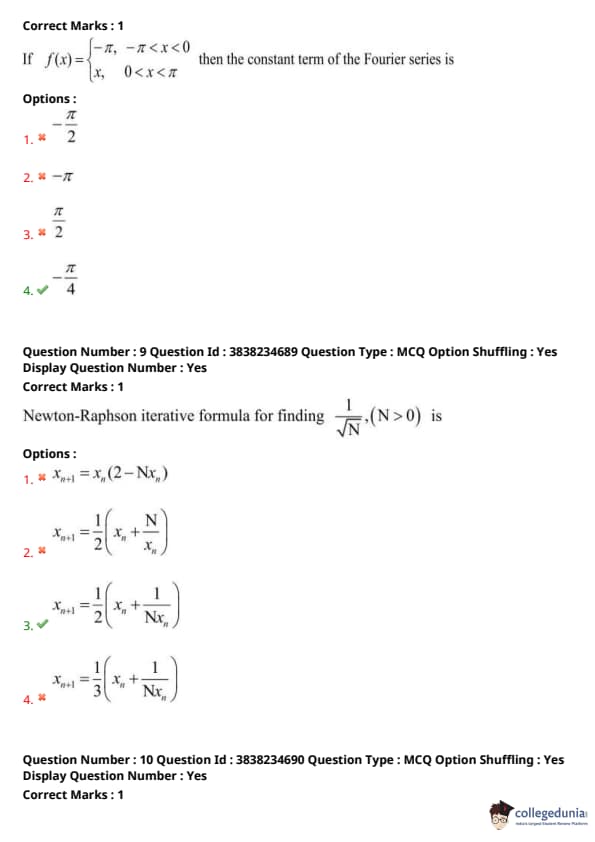
Question 8:
If \[ f(x) = \begin{cases} -\pi, & -\pi < x < 0
x, & 0 < x < \pi \end{cases} \]
then the constant term of the Fourier series is
- (A) \( \frac{\pi}{2} \)
- (B) \( -\pi \)
- (C) \( \frac{\pi}{2} \)
- (D) \( \frac{\pi}{4} \)
Question 9:
Newton-Raphson iterative formula for finding \[ \frac{1}{\sqrt{N}}, (N > 0) \]
is
- (A) \( x_{n+1} = x_n (2 - N x_n) \)
- (B) \( x_{n+1} = \frac{1}{2} \left( x_n + \frac{N}{x_n} \right) \)
- (C) \( x_{n+1} = \frac{1}{2} \left( x_n + \frac{1}{N x_n} \right) \)
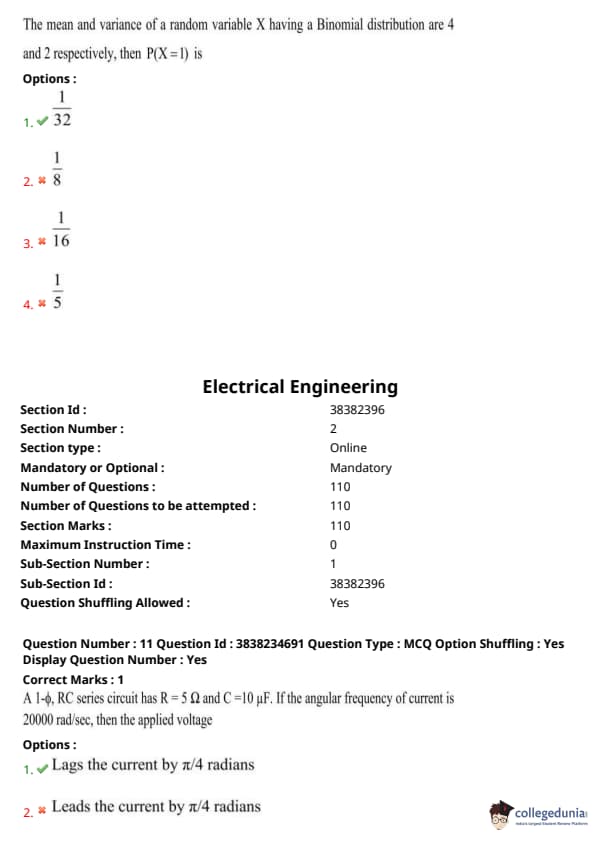
Question 10:
The mean and variance of a random variable \( X \) having a Binomial distribution are 4 and 2 respectively, then \( P(X=1) \) is
- (A) \( \frac{1}{32} \)
- (B) \( \frac{1}{8} \)
- (C) \( \frac{1}{16} \)
- (D) \( \frac{1}{4} \)
Question 11:
A 1-\(\phi\), RC series circuit has \( R = 5\, \Omega \) and \( C = 10\, \mu F \). If the angular frequency of current is 20000 rad/sec, then the applied voltage
- (A) Lags the current by \( \pi/4 \) radians
- (B) Leads the current by \( \pi/4 \) radians
- (C) Lags the current by \( \pi/2 \) radians
- (D) Leads the current by \( \pi/2 \) radians
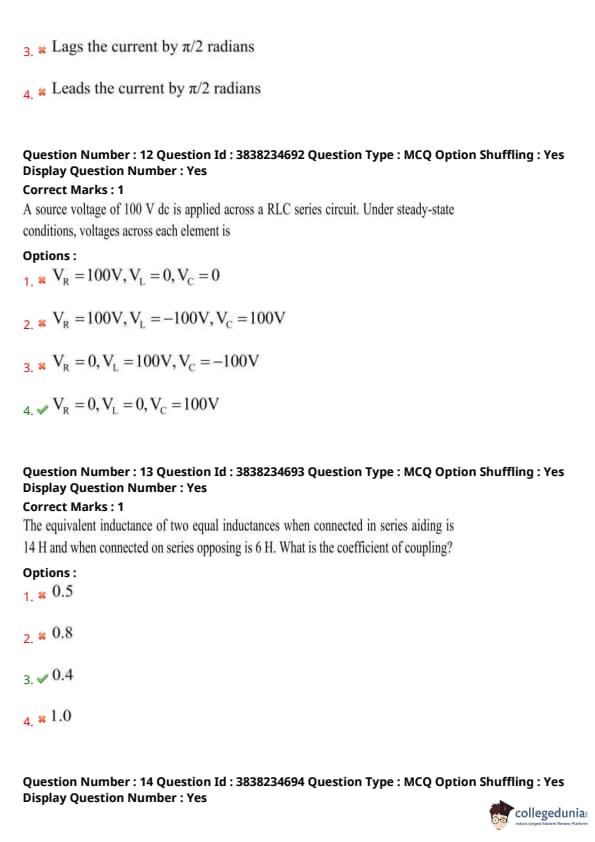
Question 12:
A source voltage of 100 V dc is applied across a RLC series circuit. Under steady-state conditions, voltages across each element is
- (A) \( V_R = 100V, V_L = 0, V_C = 0 \)
- (B) \( V_R = 100V, V_L = -100V, V_C = 100V \)
- (C) \( V_R = 0, V_L = 100V, V_C = -100V \)
- (D) \( V_R = 0, V_L = 0, V_C = -100V \)
Question 13:
The equivalent inductance of two equal inductances when connected in series aiding is 14 H and when connected in series opposing is 6 H. What is the coefficient of coupling?
- (A) 0.5
- (B) 0.8
- (C) 0.4
- (D) 1.0
Question 14:
Certain resistors connected in parallel and the equivalent resistance is \( X \). If one of the resistances is removed the equivalent resistance is \( Y \). What is the conductance value of removed resistance?
- (A) \( \frac{XY}{Y-X} \)
- (B) \( \frac{XY}{X-Y} \)
- (C) \( \frac{X-Y}{XY} \)
- (D) \( \frac{Y-X}{XY} \)
Question 15:
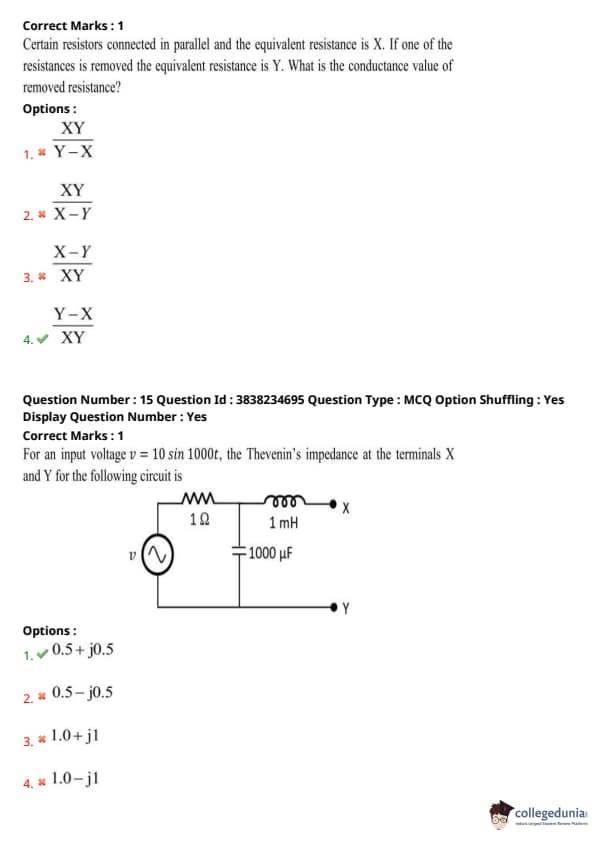
For an input voltage \( v = 10 \sin 1000t \), the Thevenin's impedance at the terminals X and Y for the following circuit is
![]()
- (A) \( 0.5 + j0.5 \)
- (B) \( 0.5 - j0.5 \)
- (C) \( 1.0 + j1 \)
- (D) \( 1.0 - j1 \)
Question 16:
A signal of \( v = 5 + 10 \sin \omega t \) is applied across a \( 2\, \Omega \) resistor. The power dissipated in the resistor is
- (A) \( 75\, W \)
- (B) \( 37.5\, W \)
- (C) \( 62.5\, W \)
- (D) \( 125\, W \)
Question 17:
Three impedances \( 6 + j(10/3)\, \Omega \) each are connected in delta. The per-phase impedance of equivalent star circuit will be
- (A) \( 18 + j(10/9)\, \Omega \)
- (B) \( 2 + j(10/3)\, \Omega \)
- (C) \( 2 + j(10/9)\, \Omega \)
- (D) \( 18 + j10\, \Omega \)
Question 18:
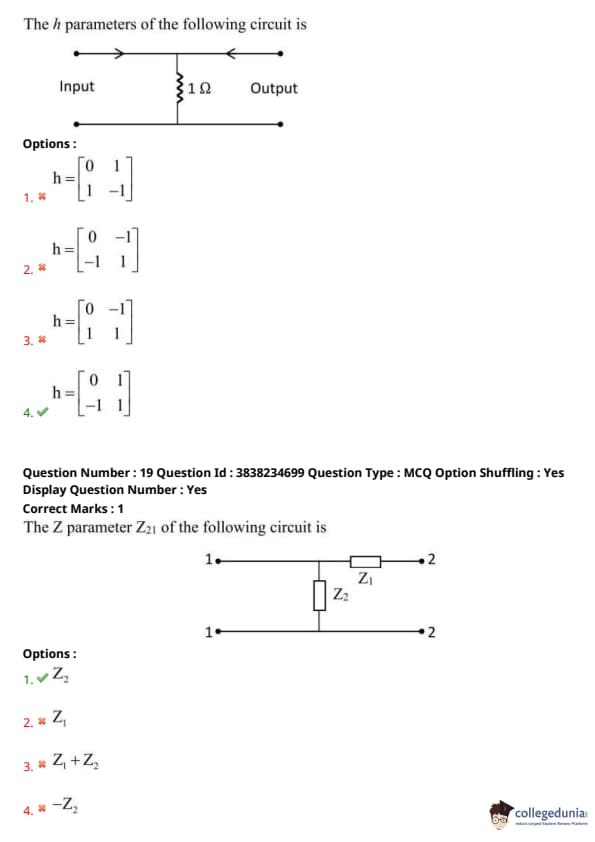
The \( h \) parameters of the following circuit is
![]()
- (A) \( h = \begin{bmatrix} 0 & 1
1 & -1 \end{bmatrix} \)
- (B) \( h = \begin{bmatrix} 0 & -1
-1 & 1 \end{bmatrix} \)
- (C) \( h = \begin{bmatrix} 0 & -1
1 & 1 \end{bmatrix} \)
- (D) \( h = \begin{bmatrix} 0 & 1
-1 & 1 \end{bmatrix} \)
Question 19:
The \( Z \) parameter \( Z_{21} \) of the following circuit is
![]()
- (A) \( Z_2 \)
- (B) \( Z_1 \)
- (C) \( Z_1 + Z_2 \)
- (D) \( -Z_2 \)
Question 20:
In a 3-\(\phi\) star connected balanced circuit, if angle between phase voltage \( V_p \) and phase current is \( \theta \) (leading), then the wattmeter readings in two wattmeter method are:
- (A) \( \sqrt{3} V_p I_p \cos(30^\circ + \theta) \) and \( \sqrt{3} V_p I_p \cos(60^\circ - \theta) \)
- (B) \( 3 V_p I_p \cos(30^\circ + \theta) \) and \( 3 V_p I_p \cos(60^\circ - \theta) \)
- (C) \( V_p I_p \cos(30^\circ + \theta) \) and \( V_p I_p \cos(30^\circ - \theta) \)
- (D) \( \sqrt{3} V_p I_p \cos(30^\circ + \theta) \) and \( \sqrt{3} V_p I_p \cos(30^\circ - \theta) \)
Question 21:
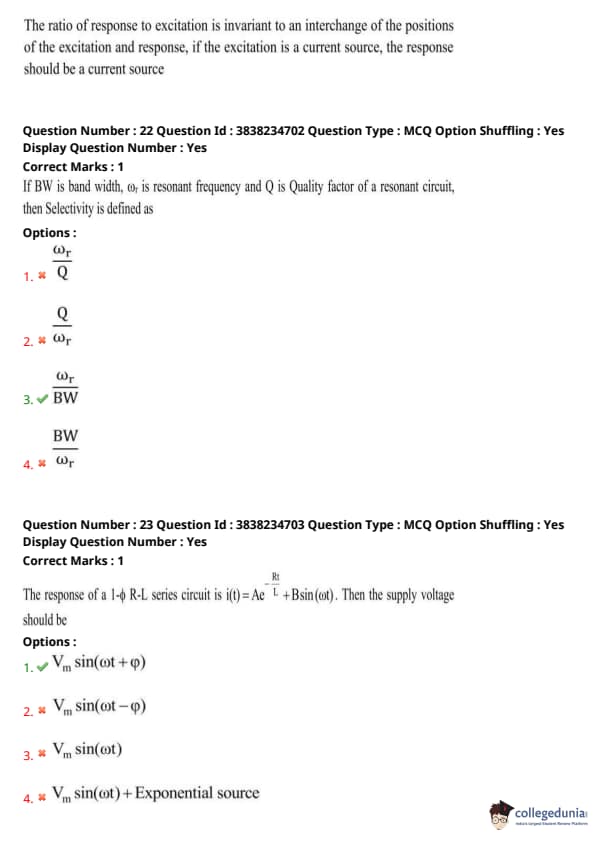
Choose the correct statement of Reciprocity theorem in single source network:
- (A) The ratio of response to excitation is invariant to an interchange of the positions of the excitation and response, if the excitation is a current source, the response should be a voltage source.
- (B) The ratio of response to excitation is invariant to an interchange of the positions of the excitation and response, if the excitation is a voltage source, the response should be a voltage source.
- (C) The ratio of response to excitation is invariant to an interchange of the positions of the excitation and response, if the excitation is a current source, the response should be a current source.
- (D) None of these
Question 22:
If BW is bandwidth, \( \omega_r \) is resonant frequency and Q is quality factor of a resonant circuit, then Selectivity is defined as:
- (A) \( \frac{\omega_r}{Q} \)
- (B) \( Q \)
- (C) \( \frac{\omega_r}{BW} \)
- (D) \( BW \)
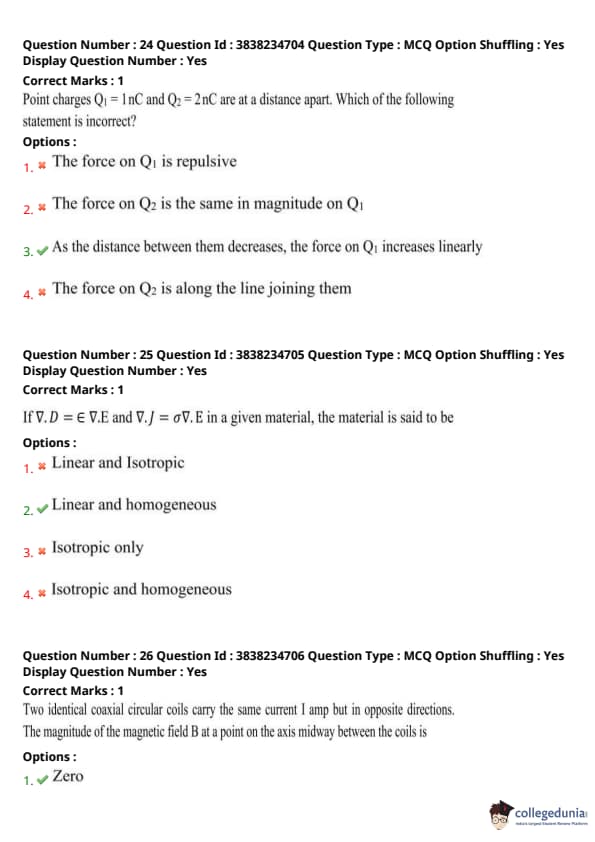
Question 23:
The response of a 1-\(\phi\) R-L series circuit is \( i(t) = Ae^{-\frac{R}{L}t} + I_m \sin(\omega t - \theta) \). Then the supply voltage should be:
- (A) \( V_m \sin(\omega t + \varphi) \)
- (B) \( V_m \sin(\omega t - \varphi) \)
- (C) \( V_m \sin(\omega t) \)
- (D) \( V_m \sin(\omega t) + Exponential source \)
Question 24:
Point charges \( Q_1 = 1nC \) and \( Q_2 = 2nC \) are at a distance apart. Which of the following statement is incorrect?
- (A) The force on \( Q_1 \) is repulsive
- (B) The force on \( Q_2 \) is the same in magnitude on \( Q_1 \)
- (C) As the distance between them decreases, the force on \( Q_1 \) increases linearly
- (D) The force on \( Q_2 \) is along the line joining them
Question 25:
If \( \vec{D} = \epsilon \vec{E} \) and \( \vec{V} = \sigma \vec{E} \) in a given material, the material is said to be:
- (A) Linear and Isotropic
- (B) Linear and homogeneous
- (C) Isotropic only
- (D) Isotropic and homogeneous
Question 26:
Two identical coaxial circular coils carry the same current 1 amp but in opposite directions. The magnitude of the magnetic field \( B \) at a point on the axis midway between the coils is
- (A) \( Zero \)
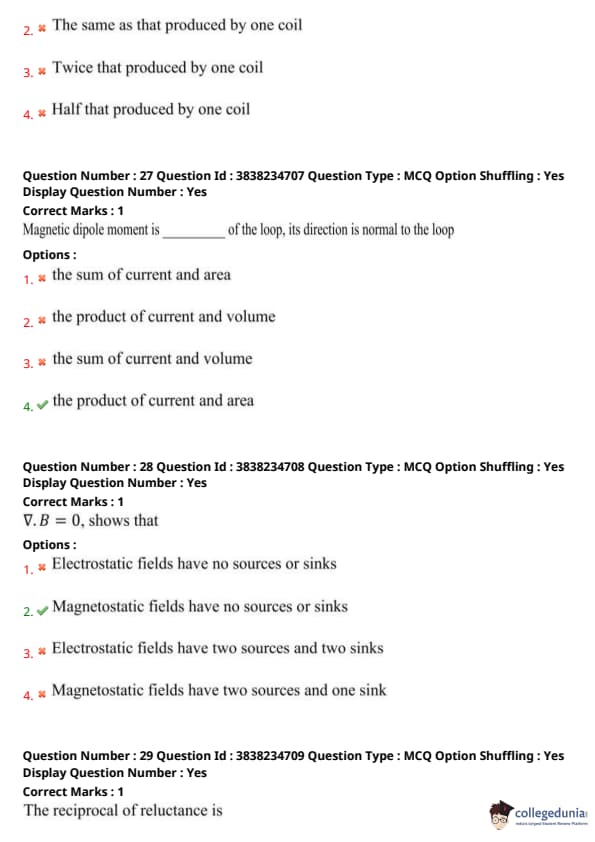
- (B) The same as that produced by one coil
- (C) Twice that produced by one coil
- (D) Half that produced by one coil
Question 27:
Magnetic dipole moment is ______ of the loop, its direction is normal to the loop
- (A) the sum of current and area
- (B) the product of current and volume
- (C) the sum of current and volume
- (D) the product of current and area
Question 28:
\( \nabla \cdot \vec{B} = 0 \), shows that
- (A) Electrostatic fields have no sources or sinks
- (B) Magnetostatic fields have no sources or sinks
- (C) Electrostatic fields have two sources and two sinks
- (D) Magnetostatic fields have two sources and one sink
Question 29:
The reciprocal of reluctance is
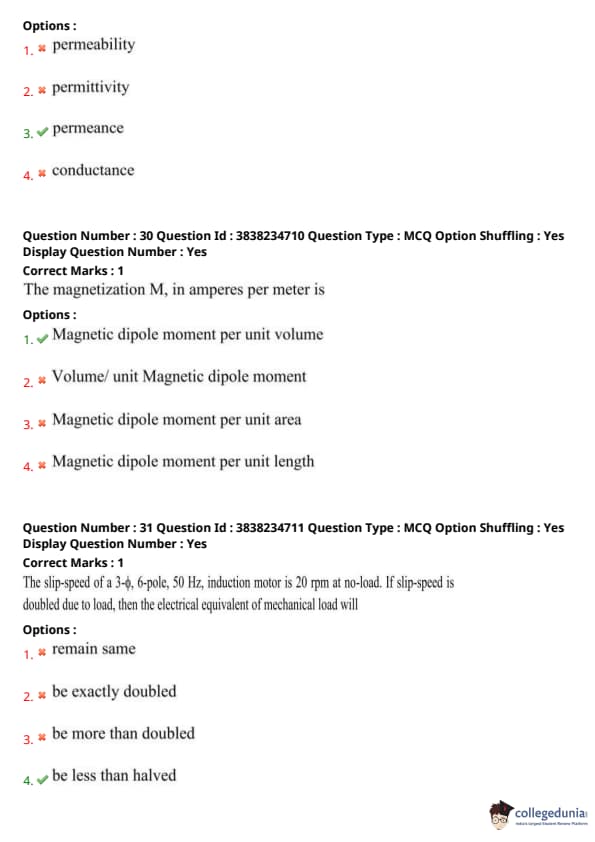
- (A) permeability
- (B) permittivity
- (C) permeance
- (D) conductance
Question 30:
The magnetization \( M \), in amperes per meter is
- (A) Magnetic dipole moment per unit volume
- (B) Volume/unit Magnetic dipole moment
- (C) Magnetic dipole moment per unit area
- (D) Magnetic dipole moment per unit length
Question 31:
The slip-speed of a 3-\(\phi\), cage, 50 Hz, induction motor is 20 rpm at no-load. If slip-speed is doubled due to load, then the electrical equivalent of mechanical load will
- (A) remain same
- (B) be exactly doubled
- (C) be more than doubled
- (D) be less than halved
Question 32:
The time period of rotor current of a 3-\(\phi\), 4-pole, 50 Hz, induction motor is 200 ms. Then slip speed of the motor is
- (A) 1425 rpm
- (B) 1350 rpm
- (C) 75 rpm
- (D) 150 rpm
Question 33:
The current and power factor of a 3–\(\phi\) induction motor at no-load are respectively
- (A) 1 to 2% of rated current and 0.2 lagging
- (B) 30 to 40% of rated current and 0.2 lagging
- (C) 2 to 6% of rated current and 0.8 lagging
- (D) 30 to 40% of rated current and 0.8 lagging
Question 34:
A 3-\(\phi\), 400 V, 50 Hz, 4 pole induction motor has rotor resistance and standstill reactance of 0.08 Ω and 0.4 Ω respectively. What is its approximate speed at maximum torque?
- (A) 600 rpm
- (B) 750 rpm
- (C) 150 rpm
- (D) 335 rpm
Question 35:
The external rotor resistance of a 3-\(\phi\) induction motor is increased more than the resistance required to get maximum starting torque. Then maximum torque occurs in \underline{\hspace{2cm of Torque (y-axis) – Speed (x-axis) characteristic plot.
- (A) Second Quadrant
- (B) Third Quadrant
- (C) Fourth Quadrant
- (D) First Quadrant
Question 36:
A 1-\(\phi\), 230 V, 50 Hz transformer is operated at 230 V, 60 Hz. Then its
- (A) Eddy current loss will remain same and Hysteresis loss will increase
- (B) Eddy current loss will remain same and Hysteresis loss will decrease
- (C) Eddy current loss will decrease and Hysteresis loss will remain same
- (D) Eddy current loss will increase and Hysteresis loss will also increase
Question 37:
Indicate a correct choice on currents during open circuit (OC) and short circuit (SC) tests of transformer
- (A) OC test at rated current \& SC test at rated current
- (B) OC test at rated current \& SC test at no-load current
- (C) OC test at no-load current \& SC test at no-load current
- (D) OC test at rated voltage \& SC test at rated current
Question 38:
A 11kV/3.3kV, 100 MVA, 3-phase transformer has equivalent impedance seen from LV side of (1.2 + j4.8) Ω. The per unit impedance of the transformer is
- (A) 0.5 + j2
- (B) 1 + j4
- (C) 2 + j8
- (D) 0.25 + j1
Question 39:
If R and X are equivalent resistance and equivalent reactance of a transformer respectively, then at maximum voltage regulation, the power factor is
- (A) R/\( \sqrt{X^2 - R^2} \) leading
- (B) R/\( \sqrt{X^2 - R^2} \) lagging
- (C) R/\( \sqrt{X^2 + R^2} \) lagging
- (D) R/\( \sqrt{X^2 + R^2} \) leading
Question 40:
On two sides of a 3-\(\phi\) star / delta transformer the
- (A) Voltages differ by 60° and currents differ by 30°
- (B) Voltages differ by 30° and currents differ by 60°
- (C) Both voltages and currents differ by 60°
- (D) Both voltages and currents differ by 30°
Question 41:
The input of a 98% efficiency, 2000 rpm separately excited dc motor is 5 kW. The torque output is
- (A) 28.1 Nm
- (B) 23.9 Nm
- (C) 20.3 Nm
- (D) 19.1 Nm
Question 42:
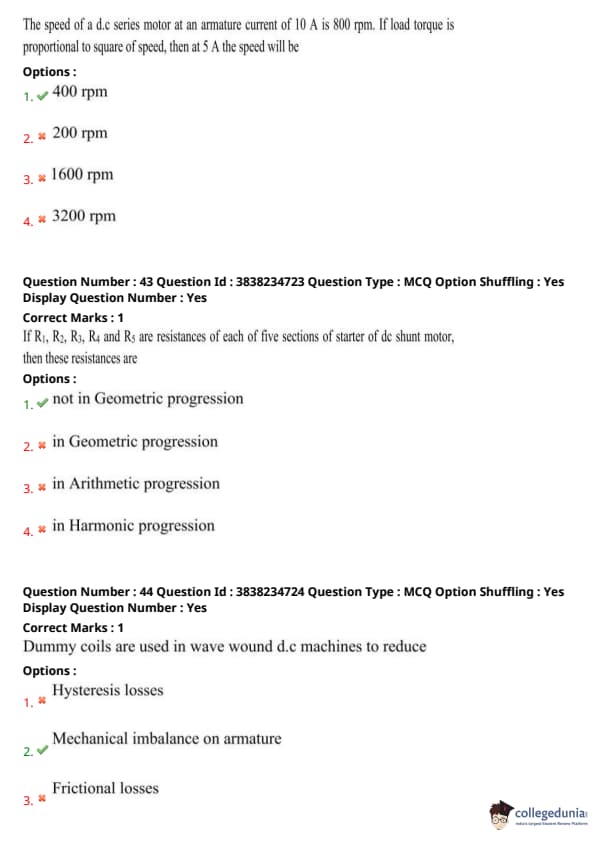
The speed of a d.c. series motor at an armature current of 10 A is 800 rpm. If load torque is proportional to square of speed, then at 5 A the speed will be
- (A) 4000 rpm
- (B) 200 rpm
- (C) 1600 rpm
- (D) 3200 rpm
Question 43:
If \( R_1, R_2, R_3, R_4, R_5 \) are resistances of each of five sections of starter of d.c. shunt motor, then these resistances are
- (A) not in Geometric progression
- (B) in Geometric progression
- (C) in Arithmetic progression
- (D) in Harmonic progression
Question 44:
Dummy coils are used in wave wound d.c. machines to reduce
- (A) Hysteresis losses
- (B) Mechanical imbalance on armature
- (C) Frictional losses
- (D) Mechanical imbalance on iron frame
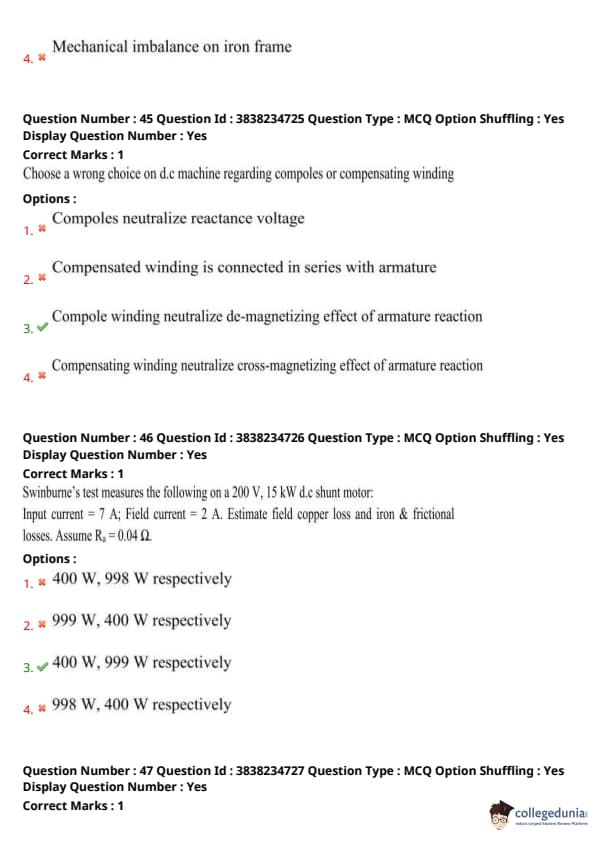
Question 45:
Choose a wrong choice on d.c. machine regarding compoles or compensating winding
- (A) Compoles neutralize reactance voltage
- (B) Compensated winding is connected in series with armature
- (C) Compole winding neutralize de-magnetizing effect of armature reaction
- (D) Compensating winding neutralize cross-magnetizing effect of armature reaction
Question 46:
Swinburne’s test measures the following on a 200 V, 15 kW dc shunt motor:
Input current = 7 A; Field current = 2 A. Estimate field copper loss and iron \& frictional losses. Assume \( R_a = 0.04 \Omega \)
- (A) 400 W, 998 W respectively
- (B) 999 W, 400 W respectively
- (C) 400 W, 999 W respectively
- (D) 998 W, 400 W respectively
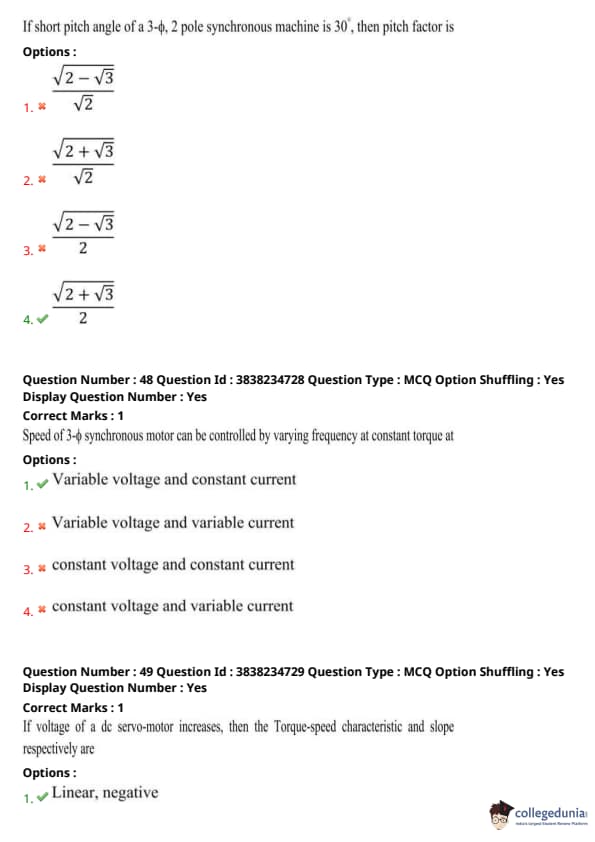
Question 47:
If short pitch angle of a 3-\(\phi\), 2 pole synchronous machine is \(30^\circ\), then pitch factor is
- (A) \( \frac{\sqrt{2} - \sqrt{3}}{\sqrt{2}} \)
- (B) \( \frac{\sqrt{2} + \sqrt{3}}{2} \)
- (C) \( \frac{\sqrt{2} - \sqrt{3}}{2} \)
- (D) \( \frac{\sqrt{2} + \sqrt{3}}{2} \)
Question 48:
Speed of 3-\(\phi\) synchronous motor can be controlled by varying frequency at constant torque at
- (A) Variable voltage and constant current
- (B) Variable voltage and variable current
- (C) Constant voltage and constant current
- (D) Constant voltage and variable current
Question 49:
If voltage of a d.c. servo-motor increases, then the Torque-speed characteristic and slope respectively are
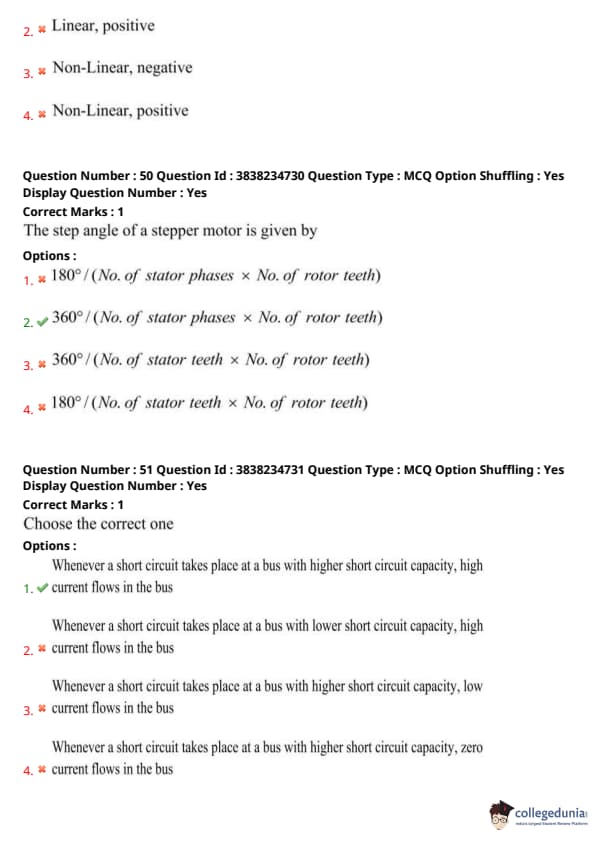
- (A) Linear, negative
- (B) Linear, positive
- (C) Non-Linear, negative
- (D) Non-Linear, positive
Question 50:
The step angle of a stepper motor is given by
- (A) \( \frac{180^\circ}{No. of stator phases \times No. of rotor teeth} \)
- (B) \( \frac{360^\circ}{No. of stator phases \times No. of rotor teeth} \)
- (C) \( \frac{360^\circ}{No. of stator teeth \times No. of rotor teeth} \)
- (D) \( \frac{180^\circ}{No. of stator teeth \times No. of rotor teeth} \)
Question 51:
Choose the correct one:
Whenever a short circuit takes place at a bus with higher short circuit capacity,
- (A) current flows in the bus
- (B) current flows in the bus
- (C) current flows in the bus
- (D) current flows in the bus
Question 52:
_____ is a voltage restrained directional relay.
- (A) Reactance
- (B) Over current
- (C) Mho
- (D) Impedance
Question 53:
A travelling wave of 500/1/55 means a crest value of
- (A) \(500\,kV\) with rise time of 1 ms and fall time of 55 ms
- (B) \(500\,kV\) with rise time of 1 \(\mu\)s and fall time of 55 ms
- (C) \(500\,kV\) with rise time of 1 \(\mu\)s and fall time of 55 \(\mu\)s
- (D) \(500\,kV\) with rise time of 1 ms and fall time of 55 \(\mu\)s
Question 54:
The quantities to be obtained at slack bus with usual notations are
- (A) \(Q,\, \delta\)
- (B) \(P,\, |V|\)
- (C) \(P,\, Q\)
- (D) \(|V|,\, \delta\)
Question 55:
Choose the correct one:
- (A) Ybus matrix and Zbus matrix are sparse
- (B) Jacobian matrix and Zbus matrix are not sparse
- (C) Ybus matrix and Jacobian matrix are sparse
- (D) Ybus matrix sparse and Jacobian matrix is not sparse
Question 56:
Typical values of time constants of a load frequency control system in case of thermal power generation system are related as (Tsg: speed governor, Tps: power system, Tt: turbine)
- (A) \(T_{sg} < T_{t} \ll T_{ps}\)
- (B) \(T_{sg} < T_{ps} < T_{t}\)
- (C) \(T_{sg} = T_{t} = T_{ps}\)
- (D) \(T_{sg} > T_{ps} \gg T_{t}\)
Question 57:
\rule{0pt}{4ex} ____ fault analysis is used to calculate the rupturing capacity of circuit breakers
- (A) Single line to Ground
- (B) Double line
- (C) Three phases
- (D) Double line to Ground
Question 58:
By using bundle conductor ______
- (A) The self GMD is decreased, the inductance is reduced, the surge impedance is reduced
- (B) The self GMD is increased, the inductance is reduced, the surge impedance is reduced
- (C) The self GMD is increased, the inductance is increased, the surge impedance is reduced
- (D) The self GMD is increased, the inductance is reduced, the surge impedance is increased
Question 59:
The typical values of voltage regulation and efficiency of a medium transmission line respectively are
- (A) 92% and 94%
- (B) 6% and 18%
- (C) 6% and 94%
- (D) 92% and 6%
Question 60:
In case of a transmission line, the corona ______
- (A) Reduces the magnitude of high voltage steep fronted waves due to lightning or switching
- (B) Increases the magnitude of high voltage steep fronted waves due to lightning or switching
- (C) First reduces and then decreases the magnitude of high voltage steep fronted waves due to lightning or switching
- (D) First reduces and then increases the magnitude of high voltage steep fronted waves due to lightning or switching
Question 61:
In case of overhead lines, normally ______ insulators are used at road crossings
- (A) Strain type
- (B) Pin type
- (C) Suspension type
- (D) Both Pin type and Suspension Type
Question 62:
In case of voltage control of a power system network, for the same voltage both the reactive power capacity of a shunt capacitor is _____ that of a series capacitor.
- (A) Smaller than
- (B) Higher than
- (C) 0.75 times
- (D) Equal to
Question 63:
Choose the correct one:
The zero sequence voltages are single phase voltages and they give rotating field in ___ space
- (A) space
- (B) give an alternating field
- (C) give an alternating field in space
- (D) space
Question 64:
Short circuit MVA of a 3-phase alternator is ______
- (A) Directly proportional to \( Z_{pu} \)
- (B) Inversely proportional to square of \( Z_{pu} \)
- (C) Inversely proportional to \( Z_{pu} \)
- (D) Directly proportional to square of \( Z_{pu} \)
Question 65:
The steady state stability limit of a power system can be increased by
- (A) Decreasing the excitation of a generator
- (B) Increasing the reactance
- (C) Reducing the reactance
- (D) Using shunt reactors
Question 66:
The line trap unit employed in carrier current relaying offers
- (A) High impedance to 50 Hz power frequency signals
- (B) High impedance to carrier frequency signals
- (C) Low impedance to carrier frequency signals
- (D) Low impedance to 50 Hz power frequency signals
Question 67:
The order of the lightning discharge current is
- (A) 100000 A
- (B) 100 A
- (C) 1 A
- (D) 1 μA
Question 68:
Consider the following statements:
1. By using bundled conductors in an overhead line, the corona loss is reduced
2. By using bundled conductors, the inductance of transmission line increases and capacitance reduces
3. Corona loss causes interference in adjoining communication lines
Which of these statements are correct?
- (A) 1 and 2
- (B) 2 and 3
- (C) 1 and 3
- (D) 1, 2 and 3
Question 69:
The maximum reactive power generation of a generator is limited because of
- (A) Stability limit of the machine
- (B) Overheating of the rotor
- (C) Flame instability of a boiler
- (D) Over heating of the stator windings
Question 70:
A stranded conductor is expressed as 19/1 where the first number corresponds to ........ and the second number corresponds to ........
- (A) Number of strands, radius of each strand
- (B) Number of strands, diameter of each strand
- (C) SWG of each strand, radius of each strand
- (D) SWG of each strand, diameter of each strand
Question 71:
For open loop system, the sensitivity of overall transfer function for a small change in forward path transfer function \( G(s) \) is
Question 72:
If \( R(s) \) is input signal, \( C(s) \) is output signal and \( G(s)H(s) \) is feedback signal, then the steady-state error is given by
- (A) \( \lim_{s \to 0} \frac{SR(s)}{1 + sG(s)H(s)} \)
- (B) \( \lim_{s \to 0} \frac{SR(s)}{1 + G(s)H(s)} \)
- (C) \( \lim_{s \to 0} \frac{R(s)}{1 + G(s)H(s)} \)
- (D) \( \lim_{s \to 0} \frac{sR(s)}{1 + G(s)H(s)} \)
Question 73:
If the phase angle at gain cross-over frequency of a system is -116°, then the phase margin will be
- (A) −64°
- (B) 116°
- (C) 64°
- (D) −116°
Question 74:
For the given transfer function \( G(s) = \frac{5(s+4)}{(1+4s)(1+0.25s)} \), for large values of \( \omega \), the slope of the transfer function on the Bode plot is
- (A) −20 dB/decade
- (B) −40 dB/decade
- (C) 40 dB/decade
- (D) +20 dB/decade
Question 75:
A unity feedback system has open loop transfer function \( \frac{1}{(s^2 + 5)} \), then the closed loop transfer function is
- (A) \( \frac{1}{s^2 + 5} \)
- (B) \( \frac{1}{(5^2 + s)} \)
- (C) \( \frac{1}{(s^2 + 5s + 1)} \)
- (D) \( \frac{s}{(s^2 + 5)} \)
Question 76:
The value of \( k \), where root locus cuts the jω axis in plotting root locus, is calculated by
- (A) taking \( \frac{dK}{ds} = 0 \)
- (B) where the first asymptote cuts the jω axis
- (C) Bode Plot
- (D) Routh-Hurwitz method
Question 77:
A system has the following characteristic polynomial equation and it has three sign changes in the first column of Routh array. Choose correct choice for the number of roots on right and left side of s-plane.
\[ s^4 + 3s^3 + 10s^2 + 5s + 10 = 0 \]
- (A) 3 roots on right side \& 2 roots on left side
- (B) 2 roots on right side \& 3 roots on left side
- (C) 4 roots on right side \& 1 root on left side
- (D) 1 root on right side \& 4 roots on left side
Question 78:
Choose the correct combination of the following:
(a) At break-away point the root locus breaks from real axis into complex plane
(b) At break-away point the root locus breaks from imaginary axis into complex plane
(c) At break-in point the root locus enters the real axis from the complex plane
(d) At break-in point the root locus enters the imaginary axis from the complex plane
- (A) (a), (b), and (c) are true
- (B) (b) and (c) are true
- (C) (b) and (d) are true
- (D) (a) and (d) are true
Question 79:
The transfer function of the following system is
![]()
- (A) \(\frac{C(s)}{R(s)} = \frac{G - H_1}{1 + GH_2}\)
- (B) \(\frac{C(s)}{R(s)} = \frac{G + H_1}{1 - GH_2}\)
- (C) \(\frac{C(s)}{R(s)} = \frac{G + H_1}{1 + GH_2}\)
- (D) \(\frac{C(s)}{R(s)} = \frac{G - H_1}{1 - GH_2}\)
Question 80:
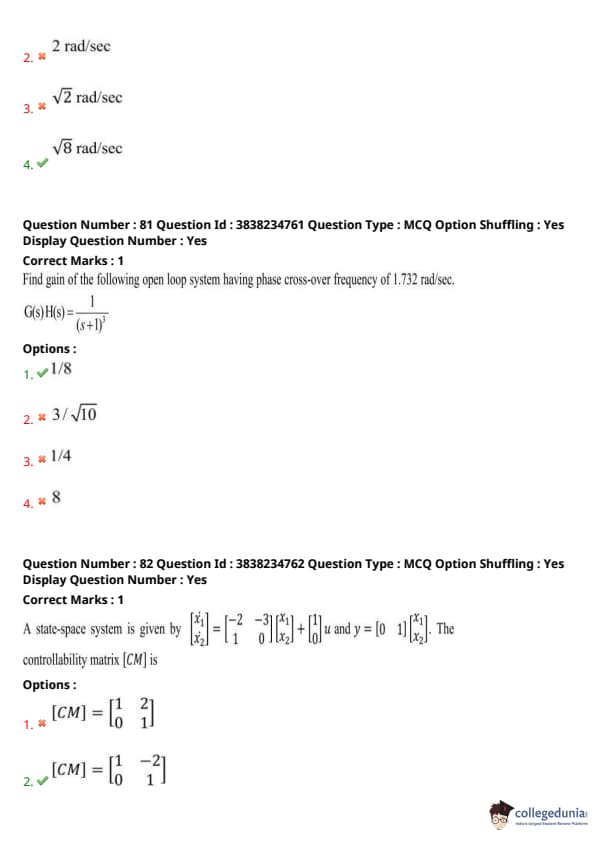
Find the frequency of sustained oscillations for the following system when \( K = 48 \):
\[ G(s)H(s) = \frac{K}{s(s^2 + 7s + 4)} \]
- (A) \( \sqrt{6} \ rad/sec \)
- (B) \( 2 \ rad/sec \)
- (C) \( \sqrt{2} \ rad/sec \)
- (D) \( \sqrt{8} \ rad/sec \)
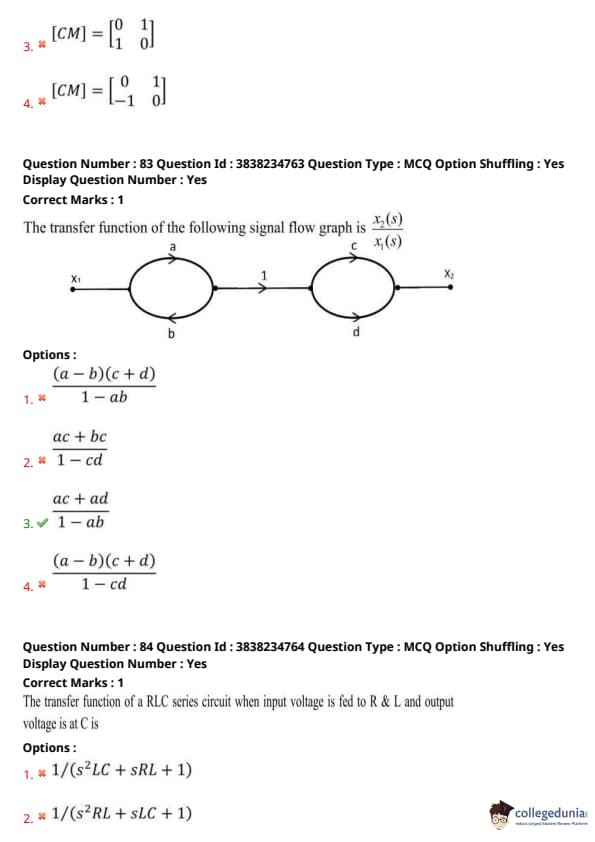
Question 81:
Find gain of the following open loop system having phase cross-over frequency of 1.732 rad/sec.
\[ G(s)H(s) = \frac{1}{s(1+s)} \]
- (A) \( \sqrt{1/8} \)
- (B) \( 3/\sqrt{10} \)
- (C) \( 1/4 \)
- (D) \( 8 \)
Question 82:
A state-space system is given by \[ \dot{x} = \begin{bmatrix}1 & -2
3 & -4\end{bmatrix}x + \begin{bmatrix}1
0\end{bmatrix}u, \quad y = \begin{bmatrix}1 & 2\end{bmatrix}x \]
The controllability matrix [CM] is
- (A) \( [CM] = \begin{bmatrix}1 & 2
0 & 2\end{bmatrix} \)
- (B) \( [CM] = \begin{bmatrix}1 & -2
0 & 1\end{bmatrix} \)
- (C) \( [CM] = \begin{bmatrix}0 & 1
1 & 0\end{bmatrix} \)
- (D) \( [CM] = \begin{bmatrix}1 & 1
0 & 1\end{bmatrix} \)
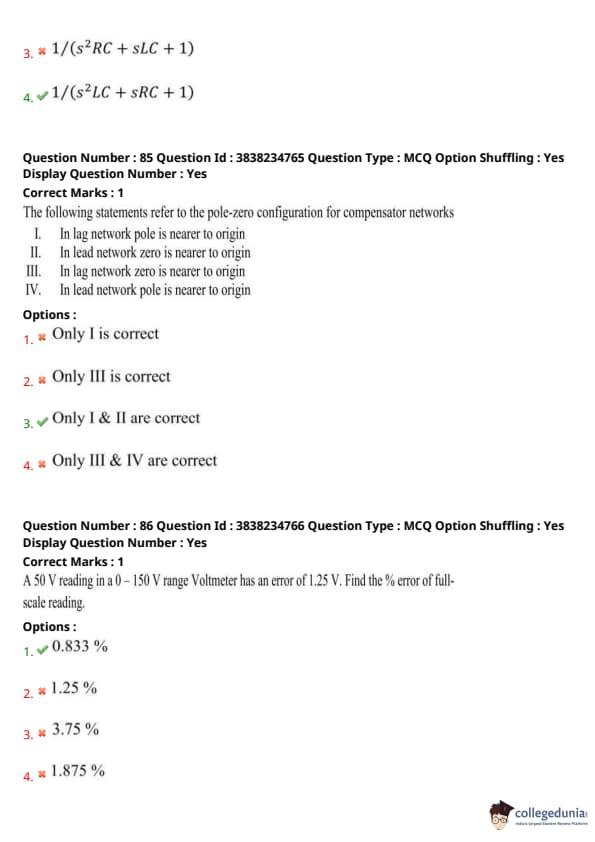
Question 83:
The transfer function of the following signal flow graph is \( \frac{x_3(s)}{x_1(s)} \):
![]()
- (A) \(\frac{(a - b)(c + d)}{1 - ab}\)
- (B) \(\frac{ac + bc}{1 - cd}\)
- (C) \(\frac{ac + ad}{1 - cd}\)
- (D) \(\frac{(a - b)(c + d)}{1 - cd}\)
Question 84:
The transfer function of an RLC series circuit when input voltage is fed to \( R, L \) and output voltage is across \( C \) is:
- (A) \( \frac{1}{s^2LC + sRL + 1} \)
- (B) \( \frac{1}{s^2RL + sLC + 1} \)
- (C) \( \frac{1}{s^2RC + sLC + 1} \)
- (D) \( \frac{1}{s^2LC + sRC + 1} \)
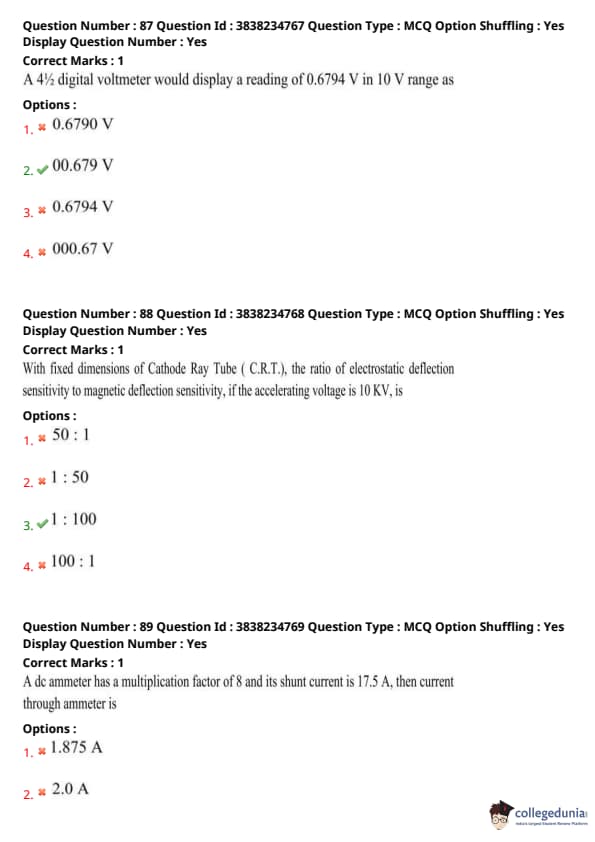
Question 85:
The following statements refer to the pole-zero configuration for compensator networks:
I. In lag network, pole is nearer to origin
II. In lag network, zero is nearer to origin
III. In lead network, zero is nearer to origin
IV. In lead network, pole is nearer to origin
Choose the correct combination:
- (A) Only I is correct
- (B) Only III is correct
- (C) Only I \& II are correct
- (D) Only III \& IV are correct
Question 86:
A 50 V reading in a 0 – 150 V range Voltmeter has an error of 1.25 V. Find the % error of full-scale reading.
- (A) \( 0.833% \)
- (B) \( 1.25% \)
- (C) \( 3.75% \)
- (D) \( 1.875% \)
Question 87:
A 4½ digit digital voltmeter would display a reading of 0.6794 V in 10 V range as:
- (A) 0.6790 V
- (B) 00.679 V
- (C) 0.6794 V
- (D) 000.67 V
Question 88:
With fixed dimensions of Cathode Ray Tube (C.R.T), the ratio of electrostatic deflection sensitivity to magnetic deflection sensitivity, if the accelerating voltage is 10 kV, is:
- (A) 50 : 1
- (B) 1 : 50
- (C) 1 : 100
- (D) 100 : 1
Question 89:
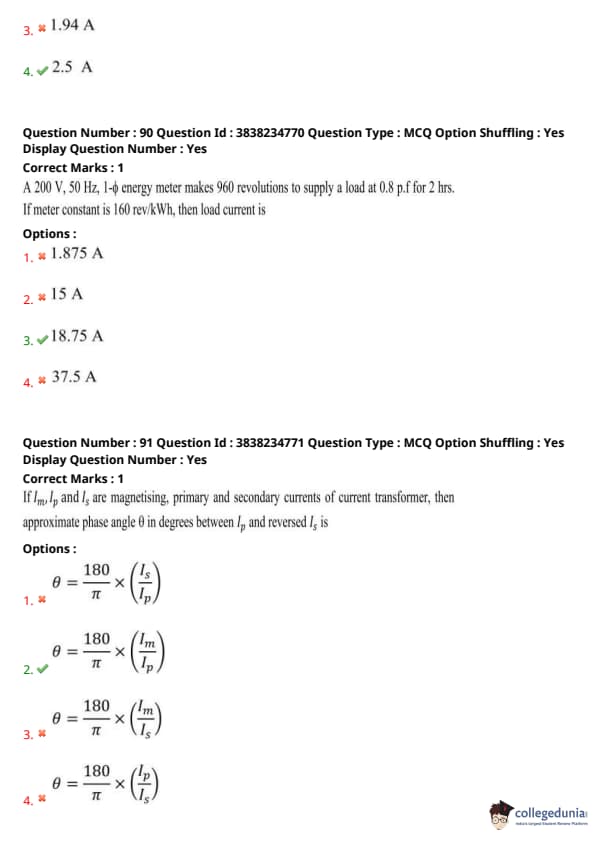
A dc ammeter has a multiplication factor of 8 and its shunt current is 17.5 A, then the current through ammeter is:
- (A) 1.875 A
- (B) 2.0 A
- (C) 1.94 A
- (D) 2.5 A
Question 90:
A 200 V, 50 Hz, 1-phase energy meter makes 960 revolutions to supply a load of 0.8 pf for 2 hrs.
If motor constant is 160 rev/kWh, then load current is:
- (A) 1.875 A
- (B) 15 A
- (C) 18.75 A
- (D) 37.5 A
Question 91:
If \( I_p, I_m, I_s \) are magnetising, primary and secondary currents of current transformer, then
approximate phase angle \( \theta \) in degrees between \( I_p \) and reversed \( I_s \) is:
- (A) \( \theta = \frac{180}{\pi} \times \left( \frac{I_m}{I_s} \right) \)
- (B) \( \theta = \frac{180}{\pi} \times \left( \frac{I_p}{I_s} \right) \)
- (C) \( \theta = \frac{180}{\pi} \times \left( \frac{I_s}{I_m} \right) \)
- (D) \( \theta = \frac{180}{\pi} \times \left( \frac{I_s}{I_p} \right) \)
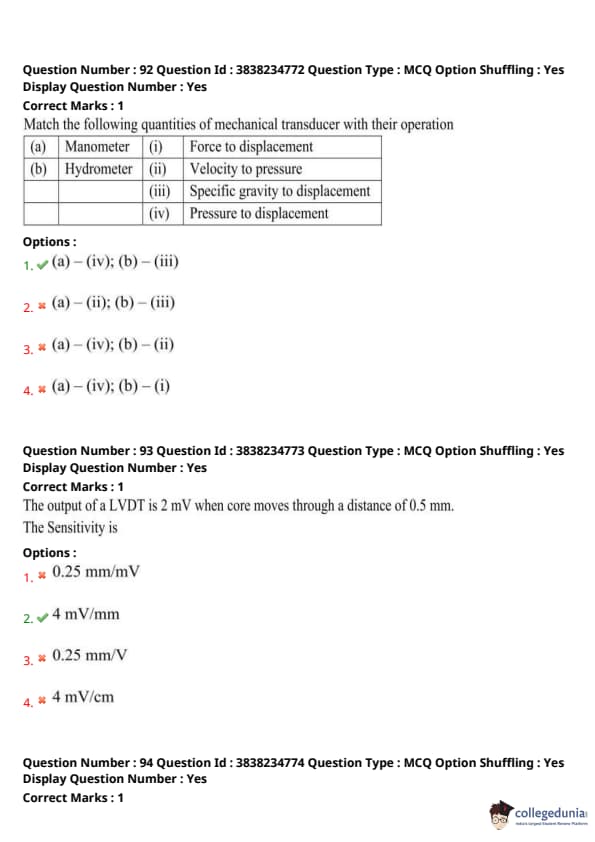
Question 92:
Match the following quantities of mechanical transducer with their operation:
(a) Manometer (i) Force to displacement
(b) Hydrometer (ii) Velocity to pressure
(c) Accelerometer (iii) Specific gravity to displacement
(d) Load cell (iv) Pressure to displacement
- (A) (a)–(iv); (b)–(iii); (c)–(ii); (d)–(i)
- (B) (a)–(ii); (b)–(iii); (c)–(iv); (d)–(i)
- (C) (a)–(iv); (b)–(ii); (c)–(iii); (d)–(i)
- (D) (a)–(iv); (b)–(i); (c)–(ii); (d)–(iii)
Question 93:
The output of an LVDT is ±2 mV when core moves through a distance of 0.5 mm.
The sensitivity is:
- (A) 0.25 mm/mV
- (B) 4 mV/mm
- (C) 0.25 mm/V
- (D) 4 mm/V
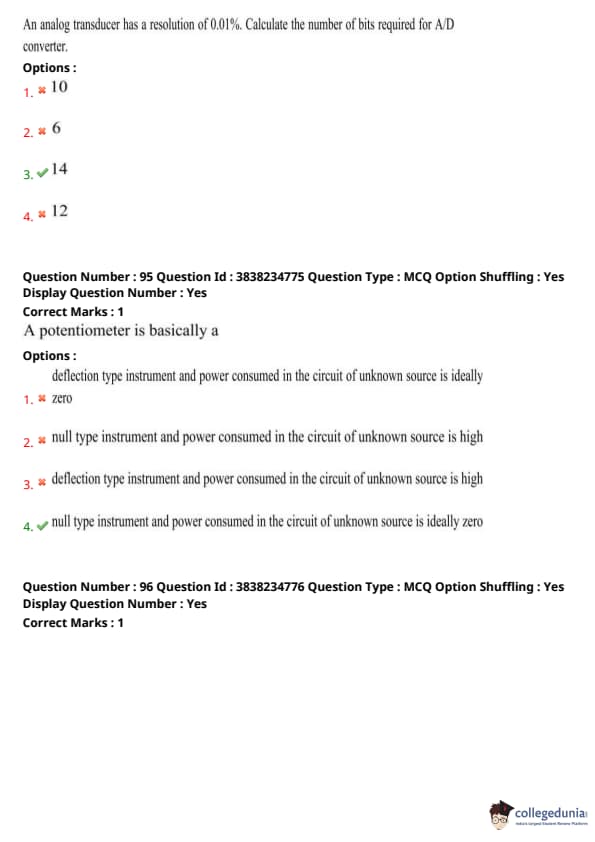
Question 94:
An analog transducer has a resolution of 0.01%. Calculate the number of bits required for A/D conversion.
- (A) 10
- (B) 6
- (C) 14
- (D) 12
Question 95:
A potentiometer is basically a
- (A) deflection type instrument and power consumed in the circuit of unknown source is ideally zero
- (B) null type instrument and power consumed in the circuit of unknown source is high
- (C) deflection type instrument and power consumed in the circuit of unknown source is high
- (D) null type instrument and power consumed in the circuit of unknown source is ideally zero
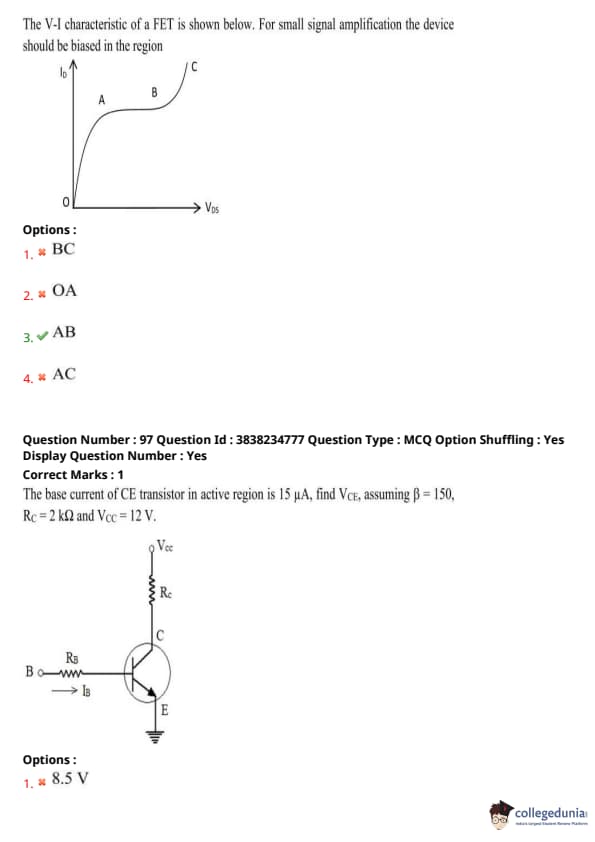
Question 96:
The V-I characteristic of a FET is shown below. For small signal amplification the device should be biased in the region
![]()
- (A) BC
- (B) OA
- (C) AB
- (D) AC
Question 97:
The base current of CE transistor in active region is 15 μA, find \( V_{CE} \), assuming \( \beta = 150 \), \( R_C = 2~k\Omega \) and \( V_{CC} = 12~V \).
![]()
- (A) 8.5 V
- (B) 9.0 V
- (C) 9.5 V
- (D) 7.5 V
Question 98:
If an inverting Op-Amp with \( R_f = 50~k\Omega \) and \( R = 200~k\Omega \) is reconfigured as non-inverting Op-Amp, then its voltage gain is
- (A) 4 with phase inversion
- (B) 5 without phase inversion
- (C) 5 with phase inversion
- (D) 4 without phase inversion
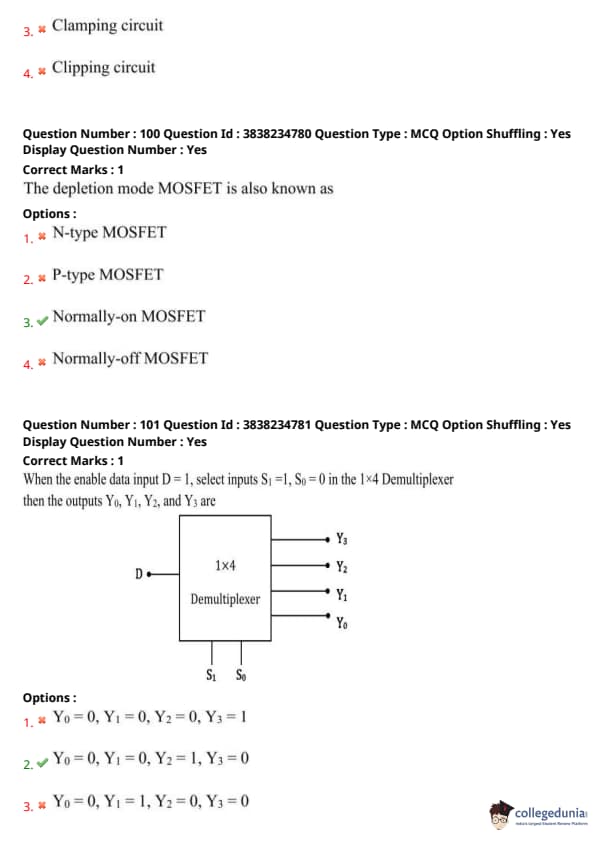
Question 99:
The Op-Amp circuit shown below is a (an)
![]()
- (A) Anti-log amplifier
- (B) Logarithmic amplifier
- (C) Clamping circuit
- (D) Clipping circuit
Question 100:
The depletion mode MOSFET is also known as
- (A) N-type MOSFET
- (B) P-type MOSFET
- (C) Normally-on MOSFET
- (D) Normally-off MOSFET
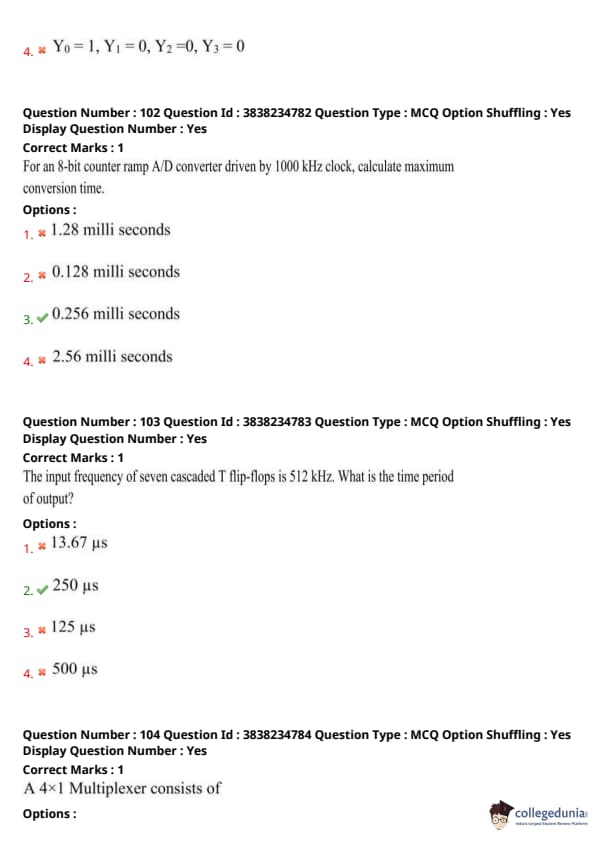
Question 101:
When the enable data input \( D = 1 \), select inputs \( S_1 = S_0 = 0 \) in the 1×4 Demultiplexer, then the outputs \( Y_0, Y_1, Y_2, Y_3 \) are
![]()
- (A) \( Y_0 = 0, Y_1 = 0, Y_2 = 0, Y_3 = 1 \)
- (B) \( Y_0 = 0, Y_1 = 1, Y_2 = 1, Y_3 = 0 \)
- (C) \( Y_0 = 1, Y_1 = 0, Y_2 = 0, Y_3 = 0 \)
- (D) \( Y_0 = 1, Y_1 = 0, Y_2 = 0, Y_3 = 1 \)
Question 102:
For an 8-bit counter ramp A/D converter driven by 1000 kHz clock, calculate maximum conversion time.
- (A) 1.28 milli seconds
- (B) 0.128 milli seconds
- (C) 0.256 milli seconds
- (D) 2.56 milli seconds
Question 103:
The input frequency of seven cascaded T flip-flops is 512 kHz. What is the time period of the output?
- (A) 13.67 μs
- (B) 250 μs
- (C) 125 μs
- (D) 500 μs
Question 104:
A 4×1 Multiplexer consists of
- (A) 2 NAND & 4 NOT gates
- (B) 2 NOT & 4 NAND gates
- (C) 2 AND & 4 NOT gates
- (D) 2 NOT & 4 AND gates
Question 105:
In 8085 μP, the NOP operation is
- (A) Machine control instruction
- (B) Branch instruction
- (C) Logical instruction
- (D) Arithmetic instruction
Question 106:
A snubber circuit used for protection of a power diode consists of
- (A) Parallel Resistance and Capacitance in parallel with diode
- (B) Parallel Resistance and Capacitance in series with diode
- (C) Series Resistance and Capacitance in parallel with diode
- (D) Series Resistance and Capacitance in series with diode
Question 107:
The sequence of devices in the order of decreasing frequency of operation are
- (A) GTO, MOSFET, IGBT
- (B) MOSFET, IGBT, GTO
- (C) GTO, IGBT, MOSFET
- (D) MOSFET, GTO, IGBT
Question 108:
A 1-\(\phi\) fully controlled bridge rectifier with a highly inductive load is fired at an angle of cos\(^{-1}(0.8)\). Assuming the load current is pure dc, the input power factor is
- (A) 0.64
- (B) 0.72
- (C) 0.80
- (D) 0.50
Question 109:
The instantaneous voltage wave-form of a 3-\(\phi\) fully controlled rectifier with R-L load is more negative and less positive when the firing angle ‘α’ lies between
- (A) 150\(^\circ\) and 180\(^\circ\)
- (B) 60\(^\circ\) and 90\(^\circ\)
- (C) 90\(^\circ\) and 120\(^\circ\)
- (D) 120\(^\circ\) and 150\(^\circ\)
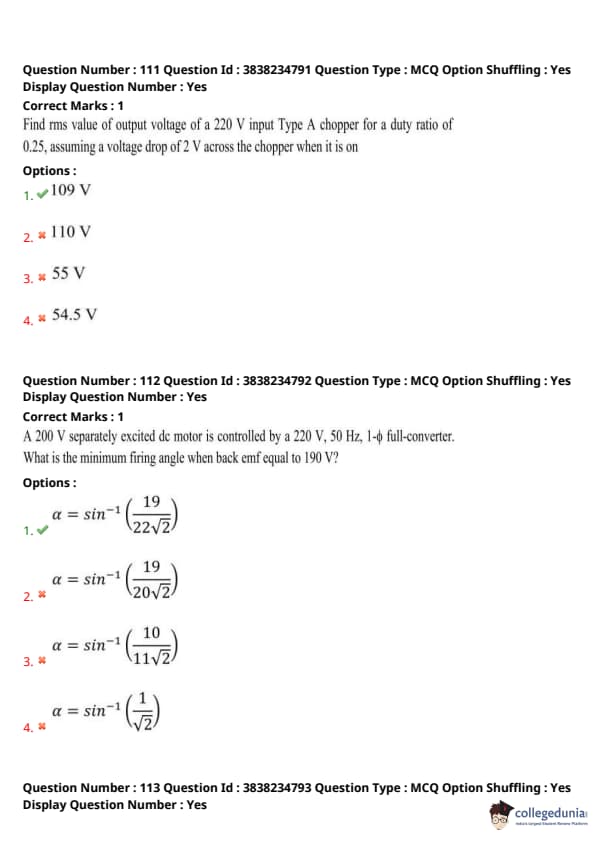
Question 110:
Choose the most correct Voltage vs. Frequency plot of a 3-phase variable speed Induction motor drive at constant flux operation
Question 111:
Find rms value of output voltage of a 220 V input Type A chopper for a duty ratio of 0.25, assuming a voltage drop of 2 V across the chopper when it is on.
- (A) 109 V
- (B) 110 V
- (C) 55 V
- (D) 54.5 V
Question 112:
A 230 V supply is excited into a motor controlled by a 220 V, 50 Hz, 1-\(\phi\), full-converter. What is the minimum firing angle when back emf equal to 190 V?
- (A) \( \alpha = \sin^{-1} \left( \frac{19}{22\sqrt{2}} \right) \)
- (B) \( \alpha = \sin^{-1} \left( \frac{19}{20\sqrt{2}} \right) \)
- (C) \( \alpha = \sin^{-1} \left( \frac{10}{11\sqrt{2}} \right) \)
- (D) \( \alpha = \sin^{-1} \left( \frac{1}{\sqrt{2}} \right) \)
Question 113:
A 1-\(\phi\) inverter is fed with an RLC series load of \( R = 1\,\Omega, X_L = 6\,\Omega \) and \( X_C = 7\,\Omega \). Then the phase angle between fundamental current and third harmonic voltage is
- (A) \( -\tan^{-1}(18) \)
- (B) \( -\tan^{-1}\left( \frac{47}{3} \right) \)
- (C) \( +\tan^{-1}(18) \)
- (D) \( +\tan^{-1}\left( \frac{47}{3} \right) \)
Question 114:
A 1-\(\phi\) AC voltage controller feeds a load resistance of \( R \). If firing angles of two switches are off set at \( 180^\circ \), then rms value of input current is
- (A) Equal to half the rms value of load current
- (B) Greater than rms value of load current
- (C) Equal to rms value of load current
- (D) Less than rms value of load current
Question 115:
A 3-\(\phi\) semi-converter drives a dc motor which runs at a rated speed of 1000 rpm at \( 0^\circ \) firing angle. Find the speed of the motor when firing angle is \( 60^\circ \).
- (A) 866 rpm
- (B) 933 rpm
- (C) 1333 rpm
- (D) 750 rpm
Question 116:
The ratio of latching current to holding current of SCR
- (A) is always more than one
- (B) always depends on gate current
- (C) is always less than one
- (D) is always equal to one
Question 117:
Design minimum value of capacitance \( C \) needed for a Buck converter with a frequency \( f = 100 \, kHz \) so that ripple voltage \( V_r \) is less than 1% of output voltage \( V_o \). Assume the duty ratio \( \delta = 0.6 \) and inductor \( L = 25 \, \mu H \).
- (A) 60 \( \mu F \)
- (B) 20 \( \mu F \)
- (C) 40 \( \mu F \)
- (D) 30 \( \mu F \)
Question 118:
The frequency modulation of a 3-\(\phi\) sinusoidal pulse width modulation is an odd multiple of 3. Then the output line voltage contains
- (A) \( 5^{th}, 7^{th}, 9^{th}, 11^{th}, \dots \) harmonics
- (B) \( 3^{rd}, 5^{th}, 7^{th}, 9^{th}, \dots \) harmonics
- (C) \( 5^{th}, 7^{th}, 11^{th}, 13^{th}, \dots \) harmonics
- (D) \( 7^{th}, 11^{th}, 15^{th}, \dots \) harmonics
Question 119:
Which of the following is not a feature of CSI fed AC motor drive?
- (A) Used in high power drives
- (B) Open loop control is not possible
- (C) Feed-back diodes are not required
- (D) Multi-motor operation is possible
Question 120:
Which of the following triggering circuits can be used in feed-back control systems?
- (A) UJT triggering circuit
- (B) R triggering circuit
- (C) RC half-wave triggering circuit
- (D) RC full-wave triggering circuit






 , then the values of \[ (\lambda_1 + \lambda_2 + \lambda_3) \ and \ (\lambda_1 \cdot \lambda_2 \cdot \lambda_3) \] are respectively






Comments