TS PGECET 2024 Food Technology Question Paper is available for download here. Jawaharlal Nehru Technological University Hyderabad on behalf of Telangana Council of Higher Education (TGCHE) conducted TS PGECET 2024 Food Technology on June 10 in Shift 2 from 2 PM to 4 PM. TS PGECET Question Paper 2024 consists of 120 MCQ-based questions in total carrying 1 mark each to be attempted in the duration of 2 hours.
TS PGECET 2024 Food Technology Question Paper with Answer Key PDF
Question 1:
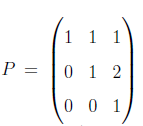
If ![matrix P]() is the modal matrix of
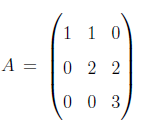
is the modal matrix of ![matrix A]() then the sum of all the elements of \( P^{-1}AP \) is
then the sum of all the elements of \( P^{-1}AP \) is
Question 2:
If the system of equations \( kx + y + z = k - 1 \), \( x + ky + z = k - 1 \), and \( x + y + kz = k - 1 \) has infinite solutions, then \( k \) is
Question 3:
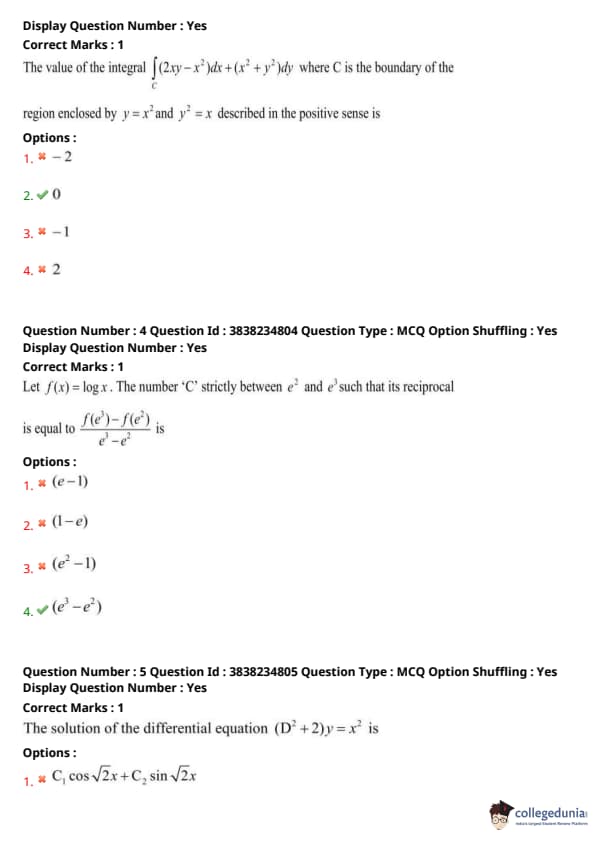
The value of the integral \( \int_C (2xy - x^2) \, dx + (x^2 + y^2) \, dy \) where \( C \) is the boundary of the region enclosed by \( y = x^2 \) and \( y^2 = x \), described in the positive sense, is
- (A) \(-2\)
- (B) \(0\)
- (C) \(-1\)
- (D) \(2\)
Question 4:
Let \( f(x) = \log x \). The number \( C \) strictly between \( e^2 \) and \( e^3 \) such that its reciprocal is equal to \( \frac{f(e^3) - f(e^2)}{e^3 - e^2} \) is
- (A) \(e - 1\)
- (B) \(1 - e\)
- (C) \(e^2 - 1\)
- (D) \(e^3 - e^2\)
Question 5:
The solution of the differential equation \( (D^2 + 2)y = x^2 \) is
- (A) \( C_1 \cos\sqrt{2}x + C_2 \sin\sqrt{2}x \)
- (B) \( C_1 \cos\sqrt{2}x + C_2 \sin\sqrt{2}x + \frac{1}{2}(x^2 - 1) \)
- (C) \( C_1 e^{\sqrt{2}x} + C_2 e^{-\sqrt{2}x} + \frac{1}{2}(x^2 - 1) \)
- (D) \( C_1 e^{\sqrt{2}x} + C_2 e^{\sqrt{2}x} + (x^2 + 1) \)
Question 6:
If \( \mathcal{L}\{f(t)\} = \frac{1 - e^{-1/s}}{s} \), then \( \mathcal{L}\{e^{-t}f(3t)\} \) is
- (A) \( \frac{e^{3/s + 1}}{s + 1} \)
- (B) \( \frac{e^{-3/s}}{s + 1} \)
- (C) \( \frac{e^{-1/s + 1}}{s + 1} \)
- (D) \( \frac{e^{3/s - 1}}{s + 1} \)
Question 7:
The table below gives values of the function \( f(x) = \frac{1}{x} \) at 5 points of \( x \).
x 1 1.25 1.5 1.75 2
f(x) 1 0.8 0.6667 0.57143 0.5
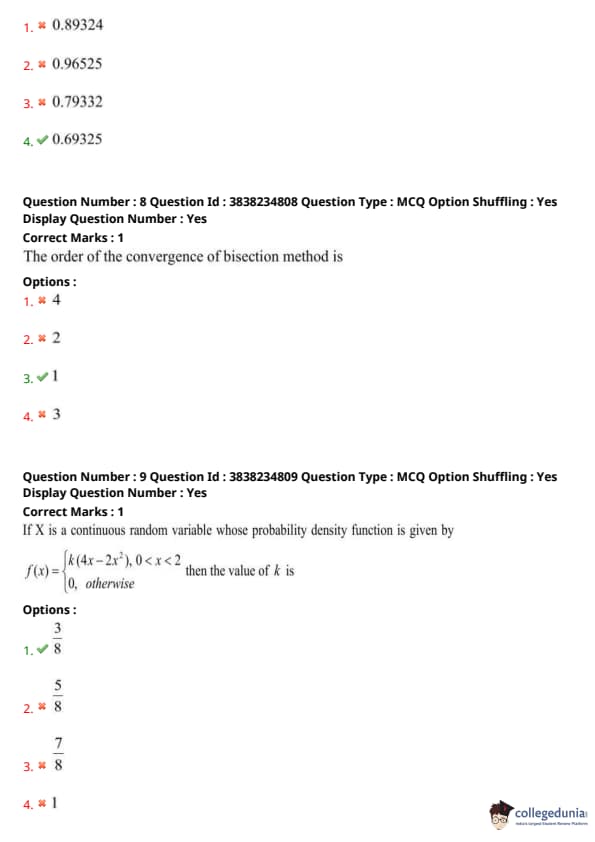
The approximate value of \( \int_1^2 \frac{1}{x} \, dx \) using Simpson’s \( \left( \frac{1}{3} \right) \)rd rule is:
- (A) \( 0.89324 \)
- (B) \( 0.96525 \)
- (C) \( 0.79332 \)
- (D) \( 0.69325 \)
Question 8:
The order of the convergence of the bisection method is
- (A) \( 4 \)
- (B) \( 2 \)
- (C) \( 1 \)
- (D) \( 3 \)
Question 9:
If \( X \) is a continuous random variable whose probability density function is given by \[ f(x) = \begin{cases} k(4x - 2x^2), & 0 < x < 2
0, & otherwise \end{cases} \quad then the value of k is: \]
- (A) \( \frac{3}{8} \)
- (B) \( \frac{5}{8} \)
- (C) \( \frac{7}{8} \)
- (D) \( 1 \)
Question 10:
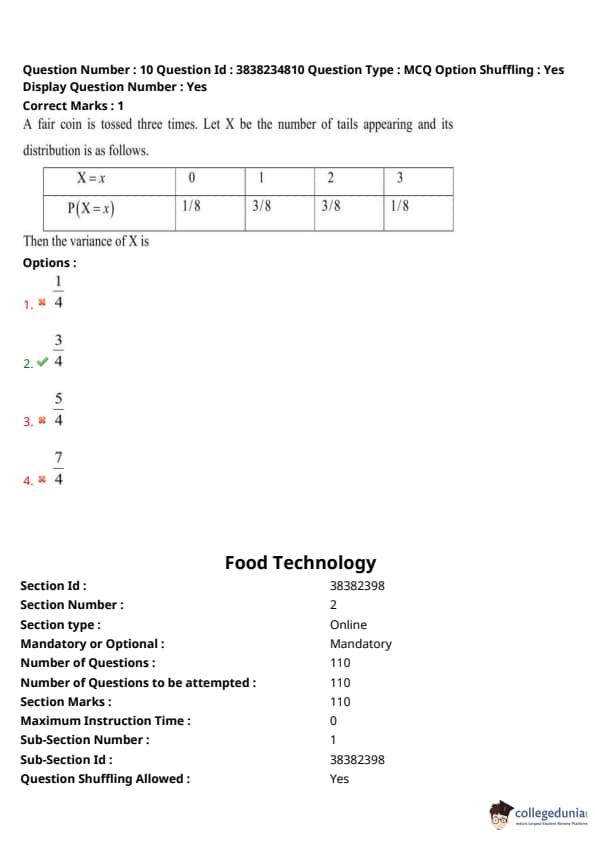
A fair coin is tossed three times. Let \( X \) be the number of tails appearing and its distribution is:
X = x 0 1 2 3
P(X = x) 1/8 3/8 3/8 1/8
Then the variance of \( X \) is:
- (A) \( \frac{1}{4} \)
- (B) \( \frac{3}{4} \)
- (C) \( \frac{5}{4} \)
- (D) \( \frac{7}{4} \)
Question 11:
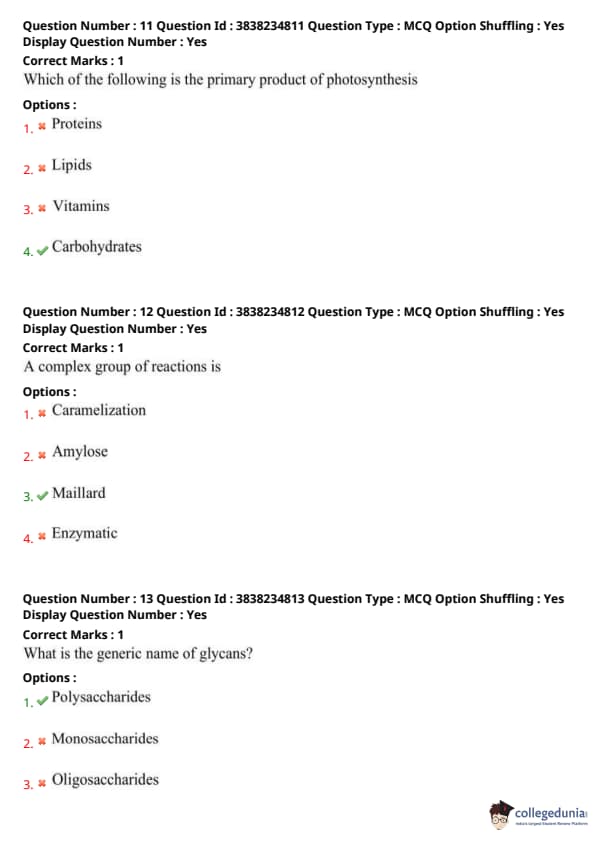
Which of the following is the primary product of photosynthesis?
- (A) Proteins
- (B) Lipids
- (C) Vitamins
- (D) Carbohydrates
Question 12:
A complex group of reactions is
- (A) Caramelization
- (B) Amylose
- (C) Maillard
- (D) Enzymatic
Question 13:
What is the generic name of glycans?
- (A) Polysaccharides
- (B) Monosaccharides
- (C) Oligosaccharides
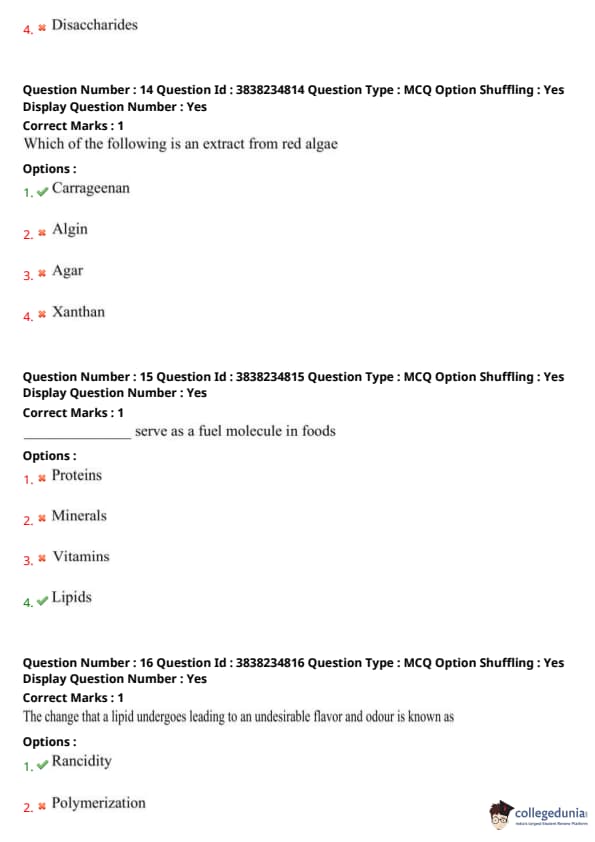
- (D) Disaccharides
Question 14:
Which of the following is an extract from red algae?
- (A) Carrageenan
- (B) Algin
- (C) Agar
- (D) Xanthan
Question 15:
.......... serve as a fuel molecule in foods
- (A) Proteins
- (B) Minerals
- (C) Vitamins
- (D) Lipids
Question 16:
The change that a lipid undergoes leading to an undesirable flavor and odour is known as
- (A) Rancidity
- (B) Polymerization
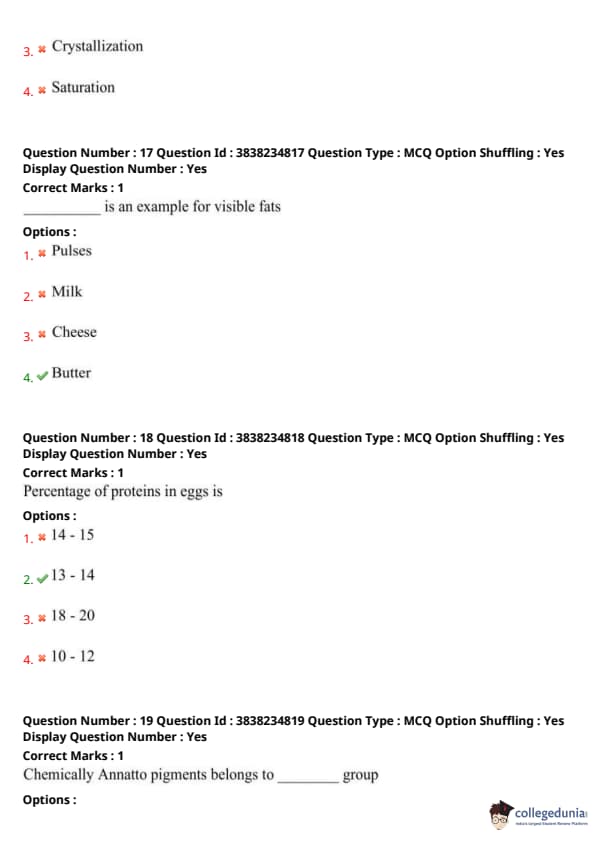
- (C) Crystallization
- (D) Saturation
Question 17:
____ is an example for visible fats
- (A) Pulses
- (B) Milk
- (C) Cheese
- (D) Butter
Question 18:
Percentage of proteins in eggs is
- (A) 14 - 15
- (B) 13 - 14
- (C) 18 - 20
- (D) 10 - 12
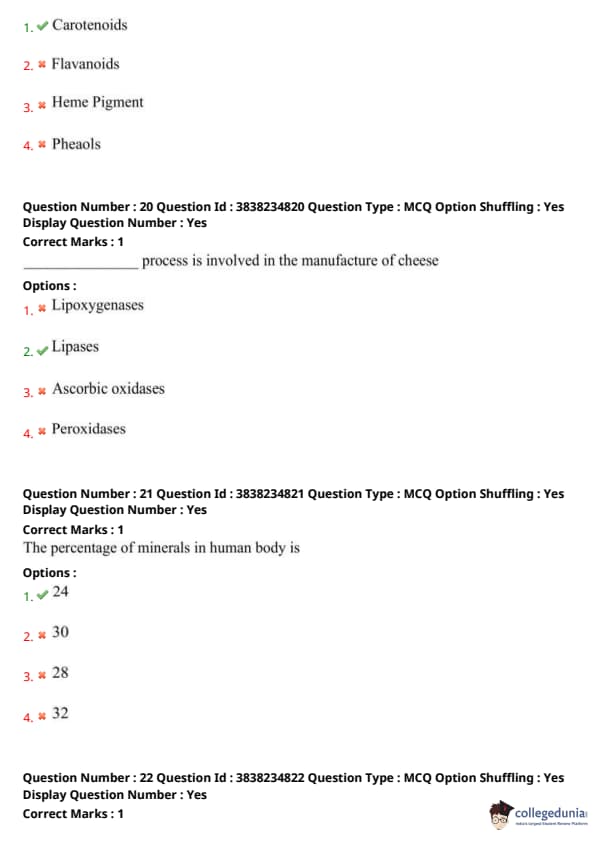
Question 19:
Chemically Annatto pigments belongs to ____ group
- (A) Carotenoids
- (B) Flavanoids
- (C) Heme Pigment
- (D) Pheaols
Question 20:
________ process is involved in the manufacture of cheese
- (A) Lipoxygenases
- (B) Lipases
- (C) Ascorbic oxidases
- (D) Peroxidases
Question 21:
The percentage of minerals in human body is
- (A) 24
- (B) 30
- (C) 28
- (D) 32
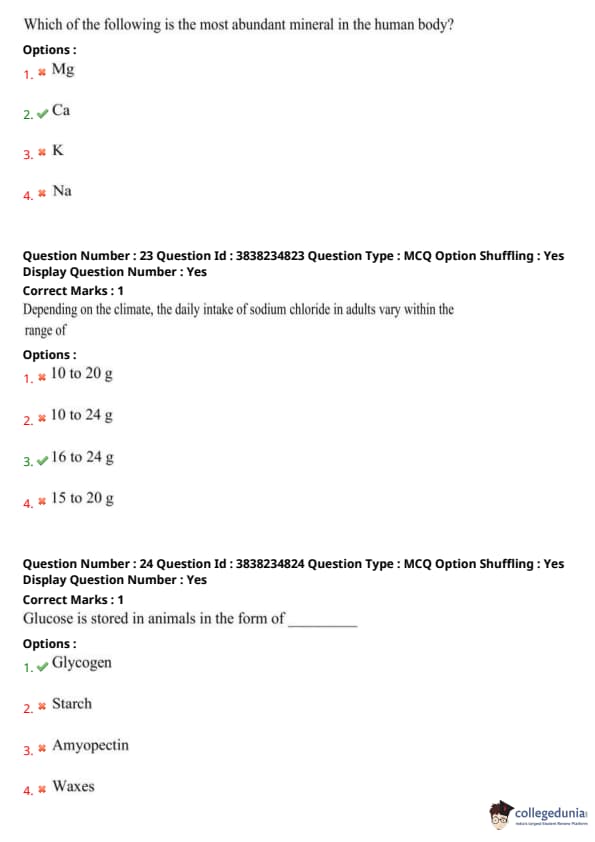
Question 22:
Which of the following is the most abundant mineral in the human body?
- (A) Mg
- (B) Ca
- (C) K
- (D) Na
Question 23:
Depending on the climate, the daily intake of sodium chloride in adults vary within the range of
- (A) 10 to 20 g
- (B) 10 to 24 g
- (C) 16 to 24 g
- (D) 15 to 20 g
Question 24:
Glucose is stored in animals in the form of _______
- (A) Glycogen
- (B) Starch
- (C) Amylopectin
- (D) Waxes
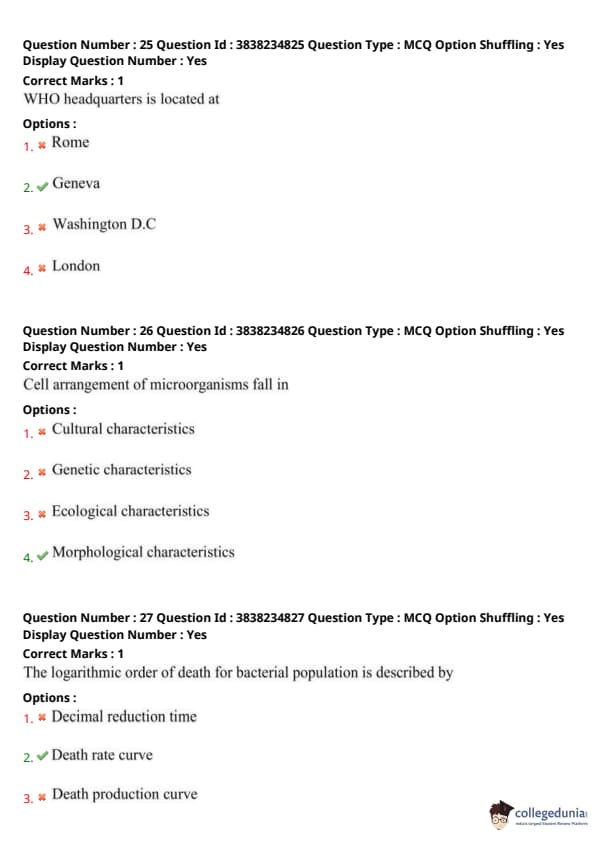
Question 25:
WHO headquarters is located at
- (A) Rome
- (B) Geneva
- (C) Washington D.C
- (D) London
Question 26:
Cell arrangement of microorganisms fall in
- (A) Cultural characteristics
- (B) Genetic characteristics
- (C) Ecological characteristics
- (D) Morphological characteristics
Question 27:
The logarithmic order of death for bacterial population is described by
- (A) Decimal reduction time
- (B) Death rate curve
- (C) Death production curve
- (D) Death reduction curve
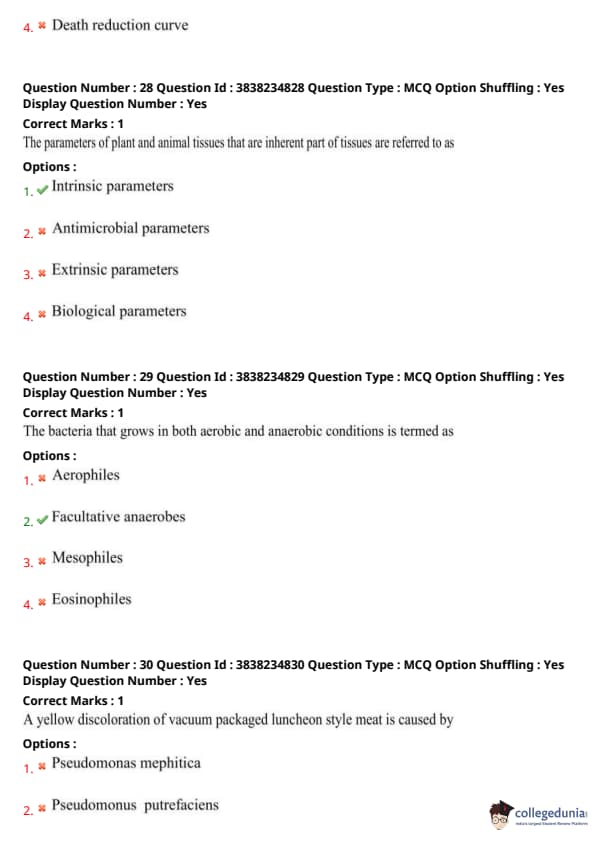
Question 28:
The parameters of plant and animal tissues that are inherent part of tissues are referred to as
- (A) Intrinsic parameters
- (B) Antimicrobial parameters
- (C) Extrinsic parameters
- (D) Biological parameters
Question 29:
The bacteria that grows in both aerobic and anaerobic conditions is termed as
- (A) Aerophiles
- (B) Facultative anaerobes
- (C) Mesophiles
- (D) Eosinophiles
Question 30:
A yellow discoloration of vacuum packaged luncheon style meat is caused by
- (A) Pseudomonas mephitica
- (B) Pseudomonas putrefaciens
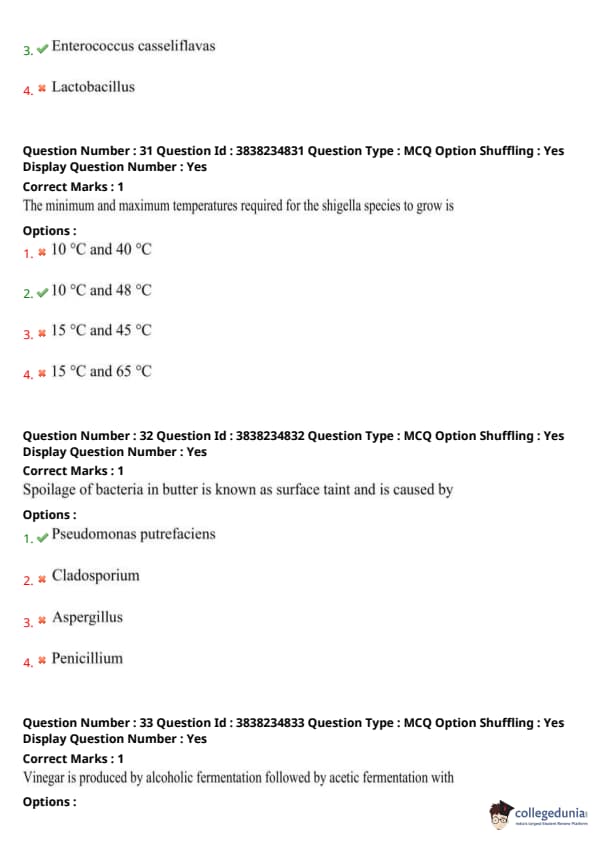
- (C) Enterococcus caseiflavans
- (D) Lactobacillus
Question 31:
The minimum and maximum temperatures required for the shigella species to grow is
- (A) 10°C and 40°C
- (B) 10°C and 48°C
- (C) 15°C and 45°C
- (D) 15°C and 65°C
Question 32:
Spoilage of bacteria in butter is known as surface taint and is caused by
- (A) Pseudomonas putrefaciens
- (B) Cladosporium
- (C) Aspergillus
- (D) Penicillium
Question 33:
Vinegar is produced by alcoholic fermentation followed by acetic fermentation with
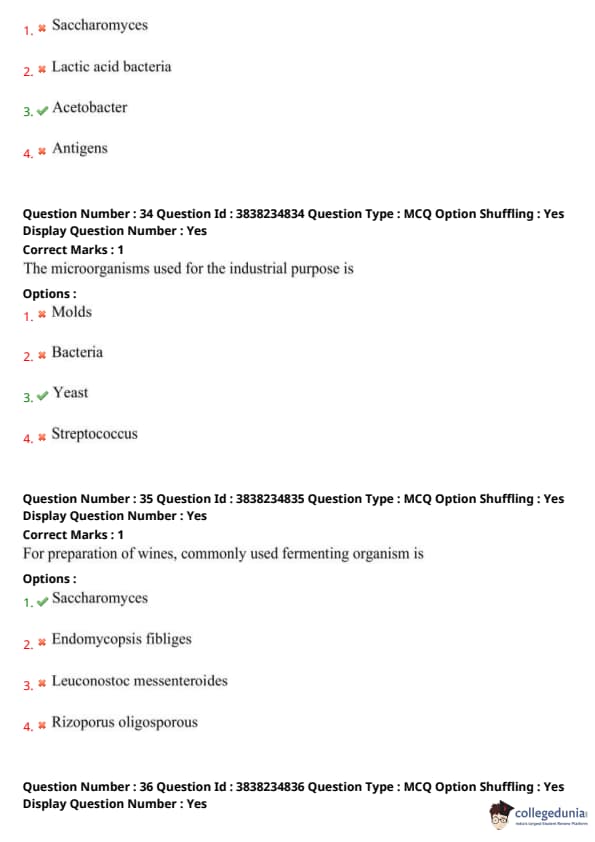
- (A) Saccharomyces
- (B) Lactic acid bacteria
- (C) Acetobacter
- (D) Antigens
Question 34:
The microorganisms used for the industrial purpose is
- (A) Molds
- (B) Bacteria
- (C) Yeast
- (D) Streptococcus
Question 35:
For preparation of wines, commonly used fermenting organism is
- (A) Saccharomyces
- (B) Endomycopsis fibuliges
- (C) Leuconostoc mesenteroides
- (D) Rhizopus oligosporous
Question 36:
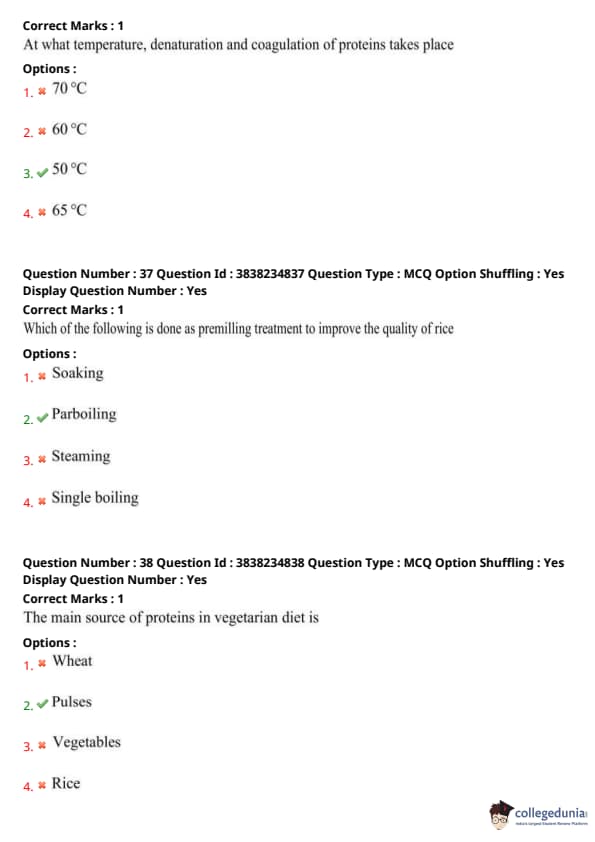
At what temperature, denaturation and coagulation of proteins takes place
- (A) 70°C
- (B) 60°C
- (C) 50°C
- (D) 65°C
Question 37:
Which of the following is done as premilling treatment to improve the quality of rice
- (A) Soaking
- (B) Parboiling
- (C) Steaming
- (D) Single boiling
Question 38:
The main source of proteins in vegetarian diet is
- (A) Wheat
- (B) Pulses
- (C) Vegetables
- (D) Rice
Question 39:
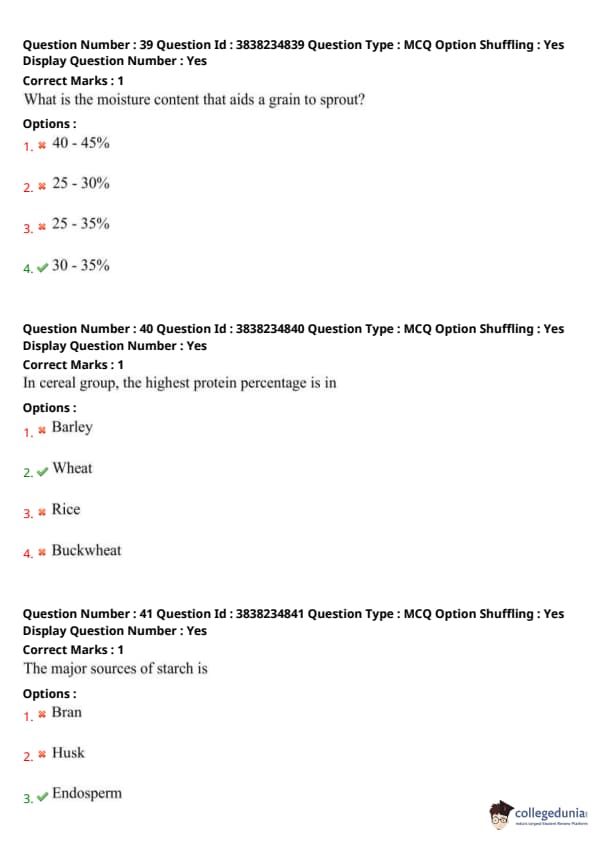
What is the moisture content that aids a grain to sprout?
- (A) 40 – 45%
- (B) 25 – 30%
- (C) 25 – 35%
- (D) 30 – 35%
Question 40:
In cereal group, the highest protein percentage is in
- (A) Barley
- (B) Wheat
- (C) Rice
- (D) Buckwheat
Question 41:
The major source of starch is
- (A) Bran
- (B) Husk
- (C) Endosperm
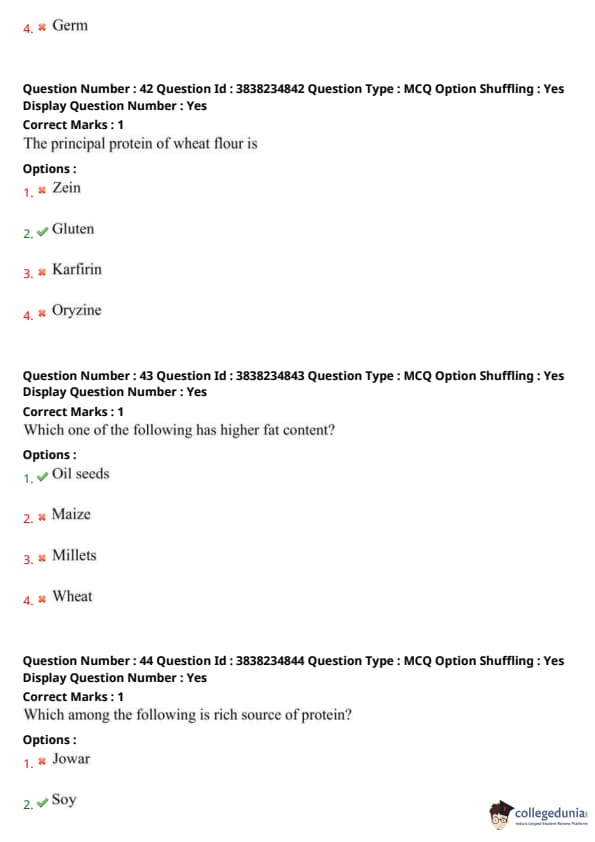
- (D) Germ
Question 42:
The principal protein of wheat flour is
- (A) Zein
- (B) Gluten
- (C) Karifirin
- (D) Oryzine
Question 43:
Which one of the following has higher fat content?
- (A) Oil seeds
- (B) Maize
- (C) Millets
- (D) Wheat
Question 44:
Which among the following is rich source of protein?
- (A) Jowar
- (B) Soy
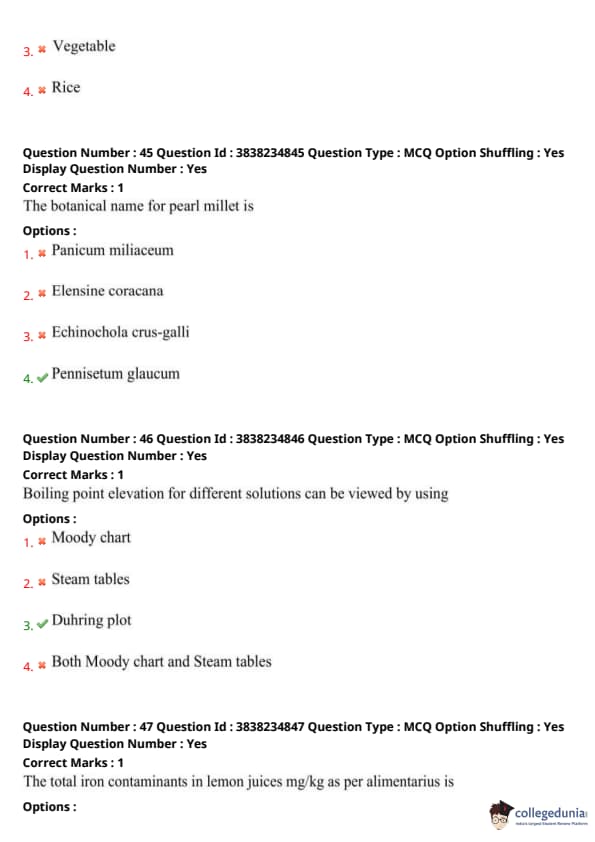
- (C) Vegetable
- (D) Rice
Question 45:
The botanical name for pearl millet is
- (A) Panicum miliaceum
- (B) Eleusine coracana
- (C) Echinochloa crus-galli
- (D) Pennisetum glaucum
Question 46:
Boiling point elevation for different solutions can be viewed by using
- (A) Moody chart
- (B) Steam tables
- (C) Dubring plot
- (D) Both Moody chart and Steam tables
Question 47:
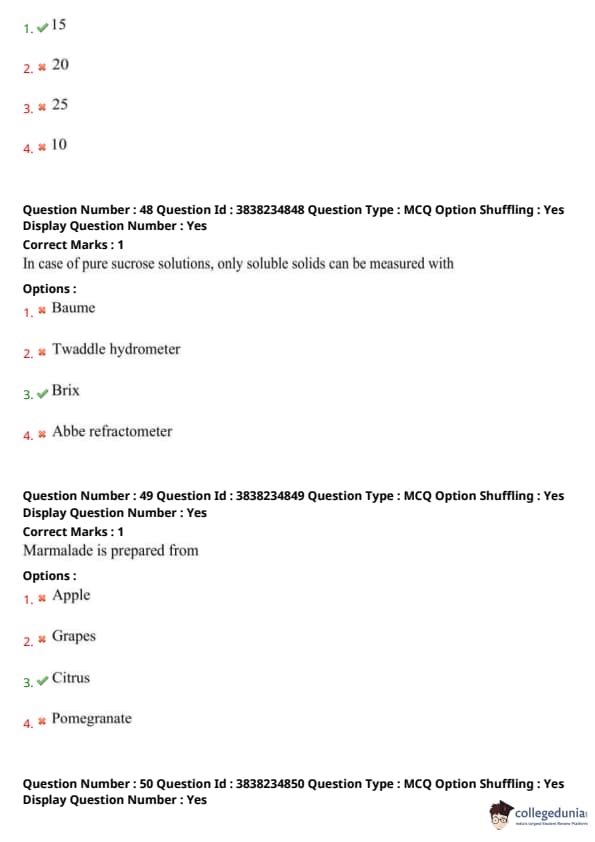
The total iron contaminants in lemon juices mg/kg as per alimentarius is
- (A) 15
- (B) 20
- (C) 25
- (D) 10
Question 48:
In case of pure sucrose solutions, only soluble solids can be measured with
- (A) Baume
- (B) Twaddle hydrometer
- (C) Brix
- (D) Abbe refractometer
Question 49:
Marmalade is prepared from
- (A) Apples
- (B) Grapes
- (C) Citrus
- (D) Pomegranate
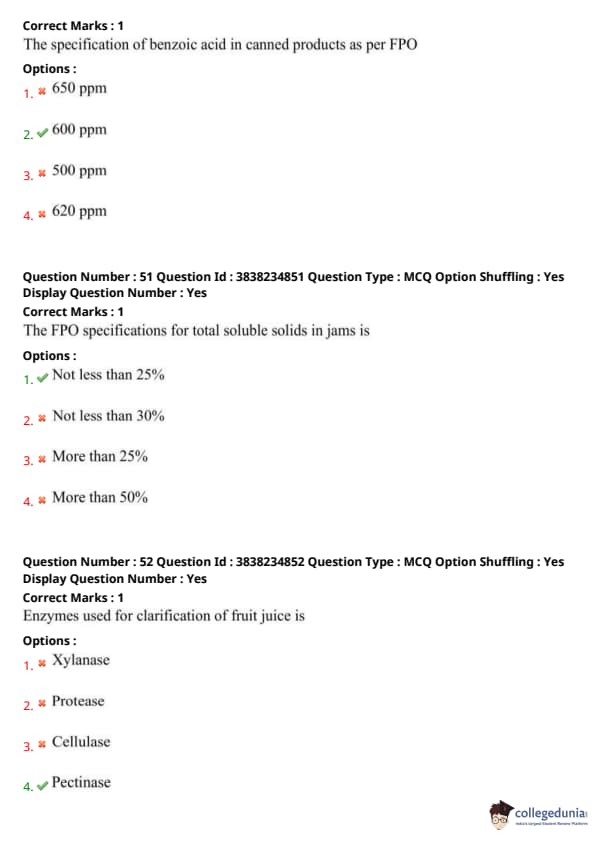
Question 50:
The specification of benzoic acid in canned products as per FPO is
- (A) 650 ppm
- (B) 600 ppm
- (C) 500 ppm
- (D) 620 ppm
Question 51:
The FPO specifications for total soluble solids in jams is
- (A) Not less than 25%
- (B) Not less than 30%
- (C) More than 25%
- (D) More than 50%
Question 52:
Enzymes used for clarification of fruit juice is
- (A) Xylanase
- (B) Protease
- (C) Cellulase
- (D) Pectinase
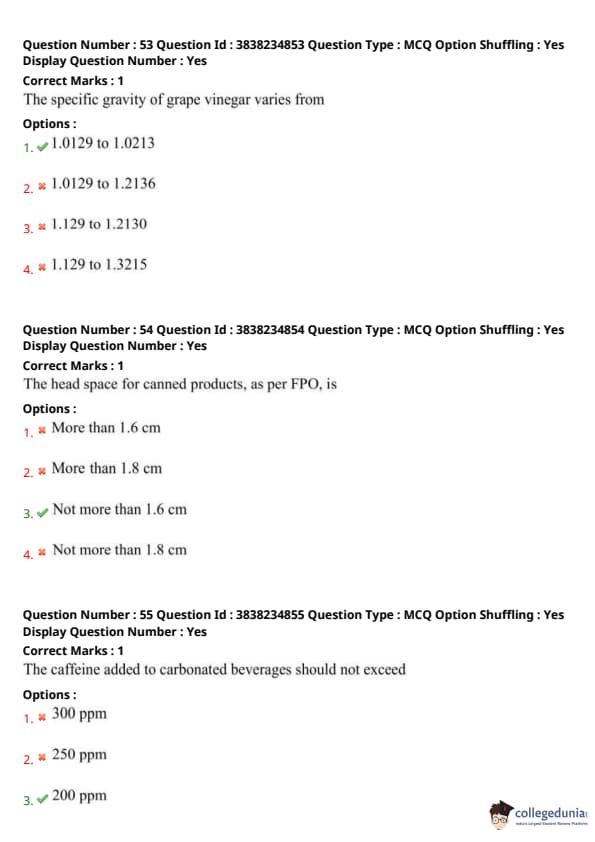
Question 53:
The specific gravity of grape vinegar varies from
- (A) 1.0129 to 1.0213
- (B) 1.0129 to 1.2136
- (C) 1.129 to 1.213
- (D) 1.129 to 1.3215
Question 54:
Headspace for canned products, as per FPO, is
- (A) More than 1.6 cm
- (B) More than 1.8 cm
- (C) Not more than 1.6 cm
- (D) Not more than 1.8 cm
Question 55:
The caffeine added to carbonated beverages should not exceed
- (A) 300 ppm
- (B) 250 ppm
- (C) 200 ppm
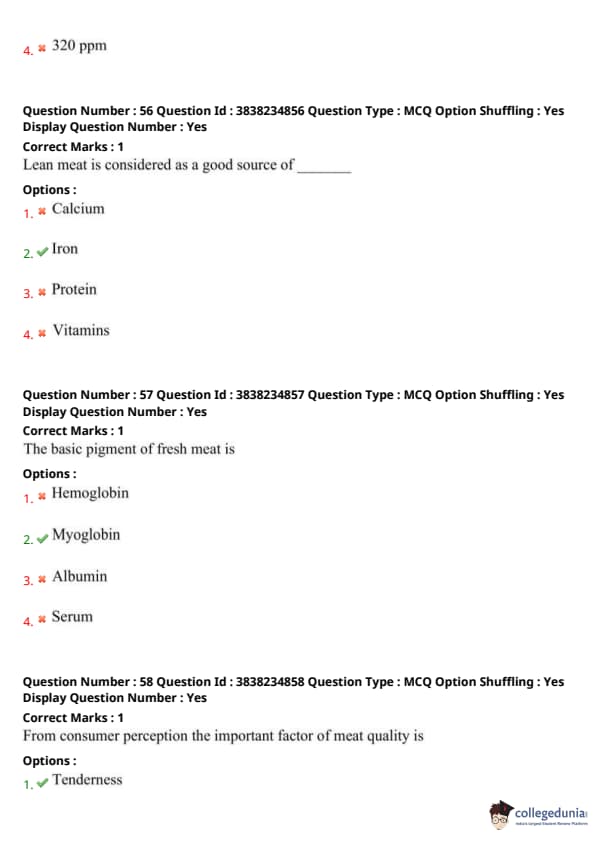
- (D) 320 ppm
Question 56:
Lean meat is considered as a good source of ______
- (A) Calcium
- (B) Iron
- (C) Protein
- (D) Vitamins
Question 57:
The basic pigment of fresh meat is
- (A) Hemoglobin
- (B) Myoglobin
- (C) Albumin
- (D) Serum
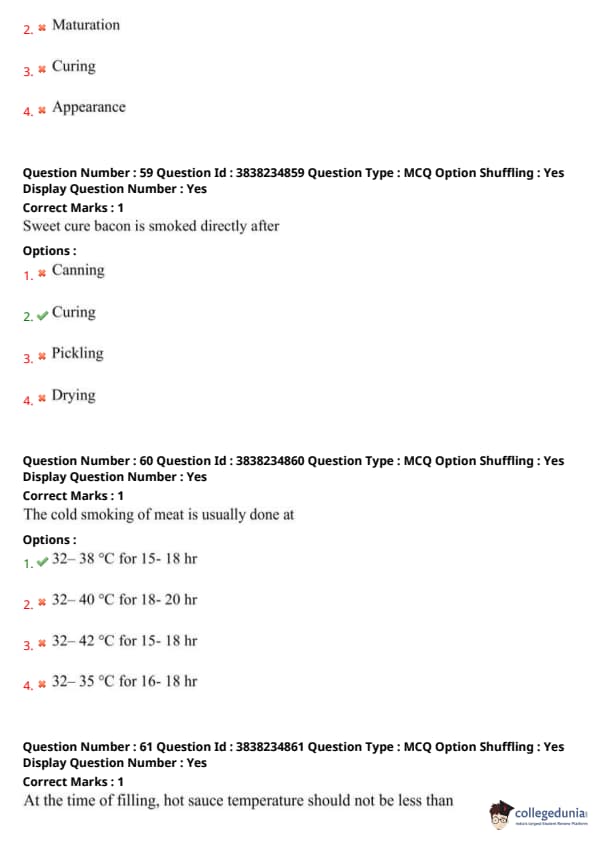
Question 58:
From consumer perception the important factor of meat quality is
- (A) Tenderness
- (B) Maturation
- (C) Curing
- (D) Appearance
Question 59:
Sweet cure bacon is smoked directly after
- (A) Canning
- (B) Curing
- (C) Pickling
- (D) Drying
Question 60:
The cold smoking of meat is usually done at
- (A) 32–38°C for 15–18 hr
- (B) 32–40°C for 18–20 hr
- (C) 32–42°C for 15–18 hr
- (D) 32–35°C for 16–18 hr
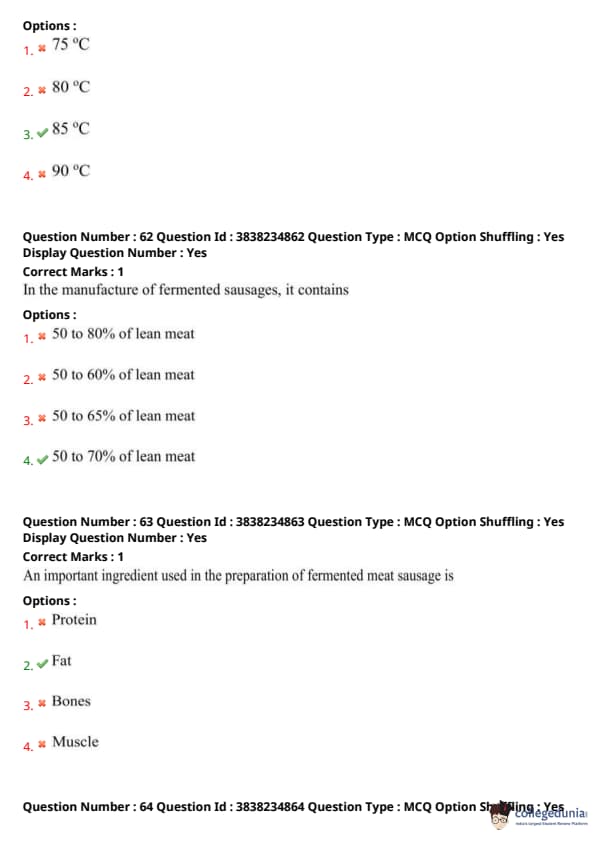
Question 61:
At the time of filling, hot sauce temperature should not be less than
- (A) 75°C
- (B) 80°C
- (C) 85°C
- (D) 90°C
Question 62:
In the manufacture of fermented sausages, it contains
- (A) 50 to 80% of lean meat
- (B) 50 to 60% of lean meat
- (C) 50 to 65% of lean meat
- (D) 50 to 70% of lean meat
Question 63:
An important ingredient used in the preparation of fermented meat sausage is
- (A) Protein
- (B) Fat
- (C) Bones
- (D) Muscle
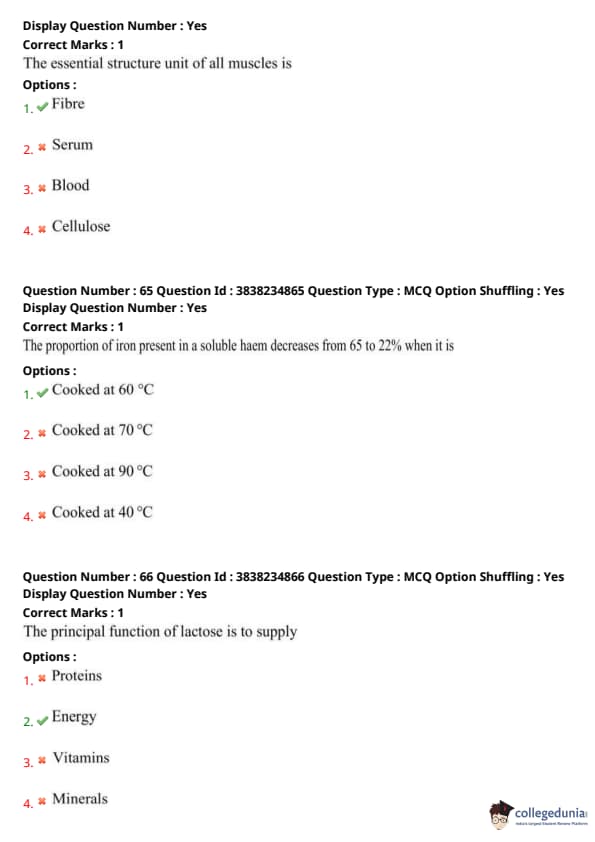
Question 64:
The essential structure unit of all muscles is
- (A) Fibre
- (B) Serum
- (C) Blood
- (D) Cellulose
Question 65:
The proportion of iron present in a soluble form decreases from 65 to 22% when it is
- (A) Cooked at 60°C
- (B) Cooked at 70°C
- (C) Cooked at 90°C
- (D) Cooked at 40°C
Question 66:
The principal function of lactose is to supply
- (A) Proteins
- (B) Energy
- (C) Vitamins
- (D) Minerals
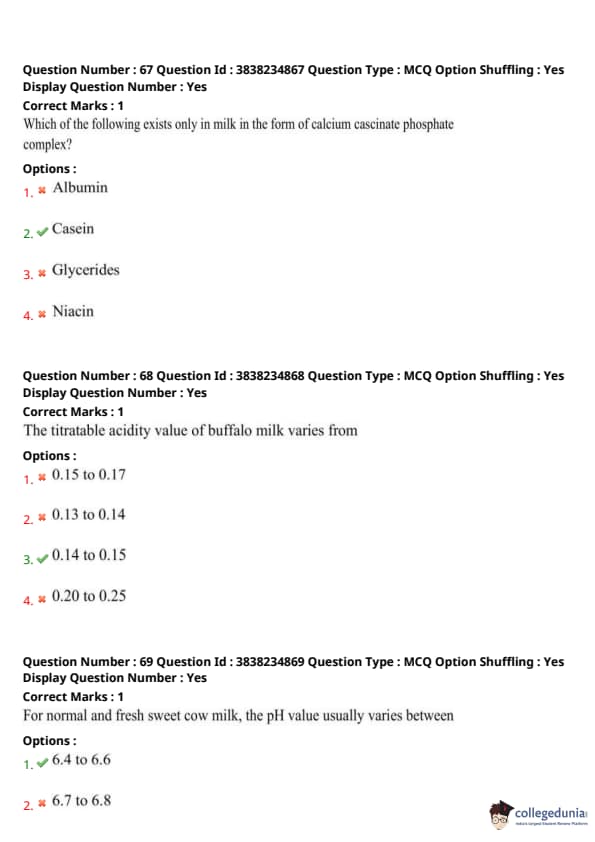
Question 67:
Which of the following exists only in milk in the form of calcium caseinate phosphate complex?
- (A) Albumin
- (B) Casein
- (C) Glycerides
- (D) Niacin
Question 68:
The titratable acidity value of buffalo milk varies from
- (A) 0.15 to 0.17
- (B) 0.13 to 0.14
- (C) 0.14 to 0.15
- (D) 0.20 to 0.25
Question 69:
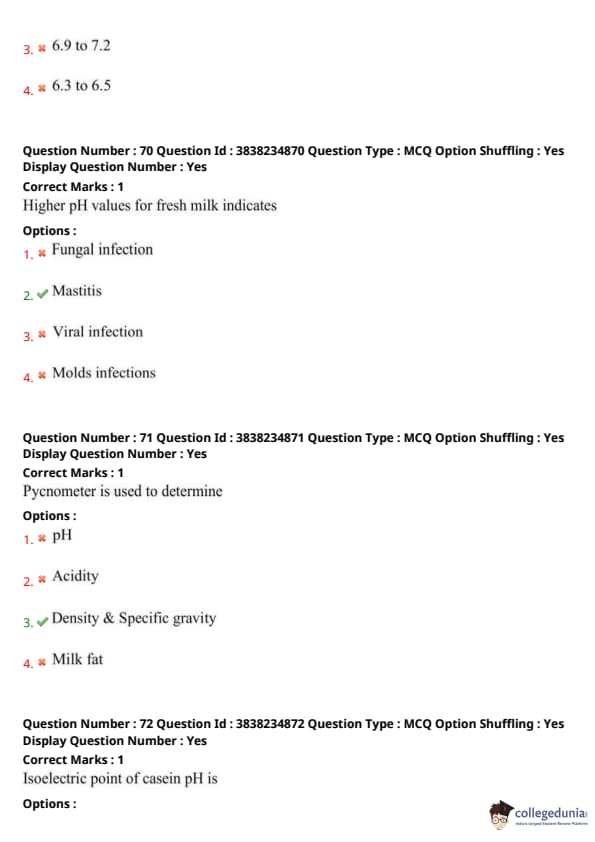
For normal and fresh sweet cow milk, the pH value usually varies between
- (A) 6.4 to 6.6
- (B) 6.7 to 6.8
- (C) 6.9 to 7.2
- (D) 6.3 to 6.5
Question 70:
Higher pH values for fresh milk indicates
- (A) Fungal infection
- (B) Mastitis
- (C) Viral infection
- (D) Mold infections
Question 71:
Pycnometer is used to determine
- (A) pH
- (B) Acidity
- (C) Density \& Specific gravity
- (D) Milk fat
Question 72:
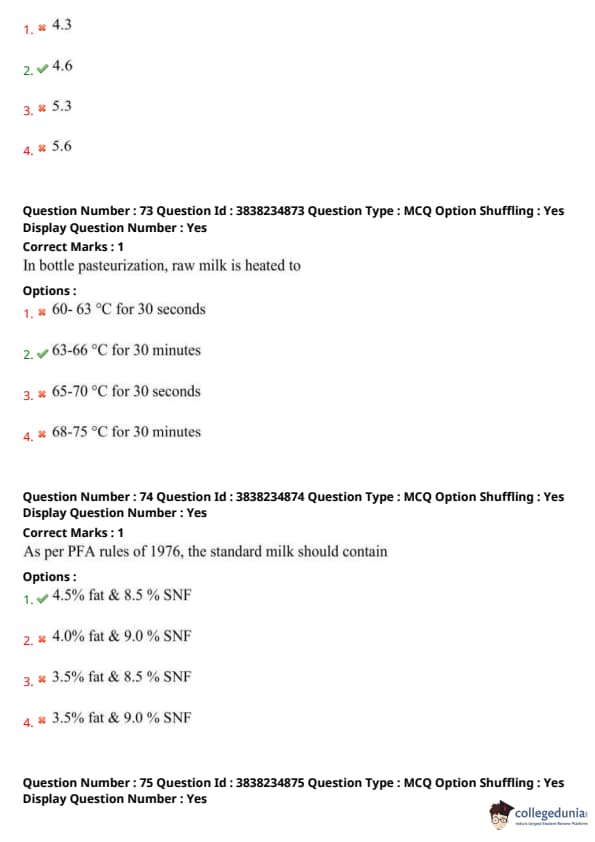
Isoelectric point of casein pH is
- (A) 4.3
- (B) 4.6
- (C) 5.3
- (D) 5.6
Question 73:
In bottle pasteurization, raw milk is heated to
- (A) 60–63°C for 30 seconds
- (B) 60–63°C for 30 minutes
- (C) 65–70°C for 30 seconds
- (D) 68–75°C for 30 minutes
Question 74:
As per PFA rules of 1976, the standard milk should contain
- (A) 4.5% fat \& 8.5% SNF
- (B) 4.0% fat \& 9.0% SNF
- (C) 3.5% fat \& 8.5% SNF
- (D) 3.5% fat \& 9.0% SNF
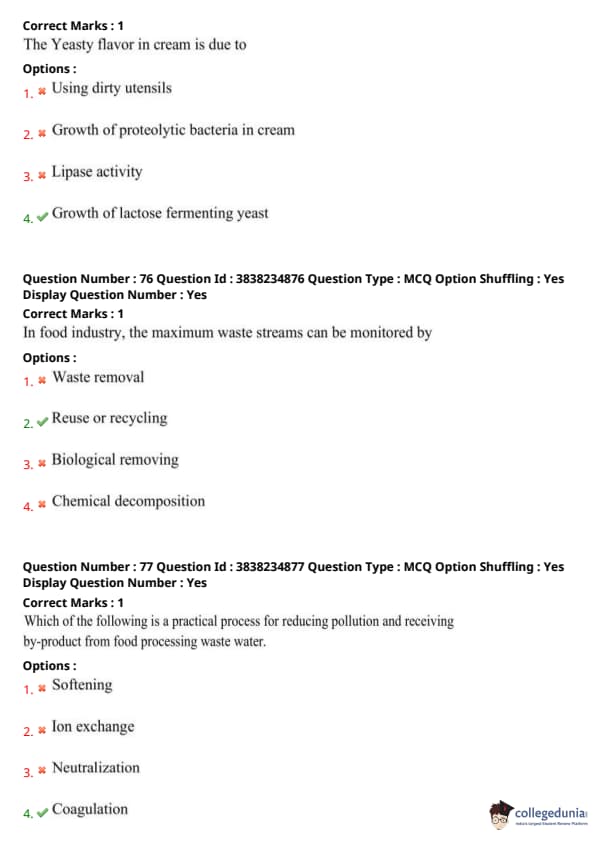
Question 75:
The Yeasty flavor in cream is due to
- (A) Using dirty utensils
- (B) Growth of proteolytic bacteria in cream
- (C) Lipase activity
- (D) Growth of lactose fermenting yeast
Question 76:
In food industry, the maximum waste streams can be monitored by
- (A) Waste removal
- (B) Reuse or recycling
- (C) Biological removing
- (D) Chemical decomposition
Question 77:
Which of the following is a practical process for reducing pollution and recovering by-product from food processing waste water.
- (A) Softening
- (B) Ion exchange
- (C) Neutralization
- (D) Coagulation
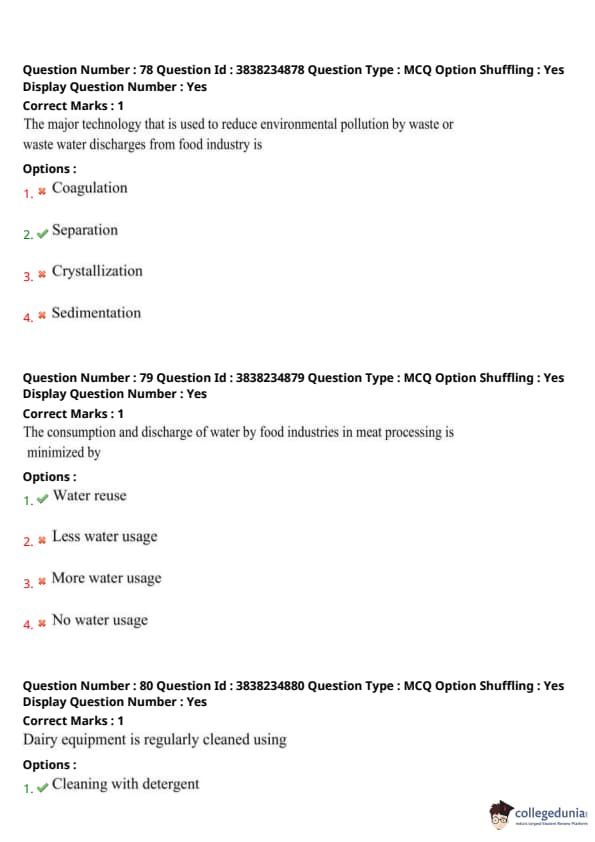
Question 78:
The major technology that is used to reduce environmental pollution by waste or waste water discharges from food industry is
- (A) Coagulation
- (B) Separation
- (C) Crystallization
- (D) Sedimentation
Question 79:
The consumption and discharge of water by food industries in meat processing is minimized by
- (A) Water reuse
- (B) Less water usage
- (C) More water usage
- (D) No water usage
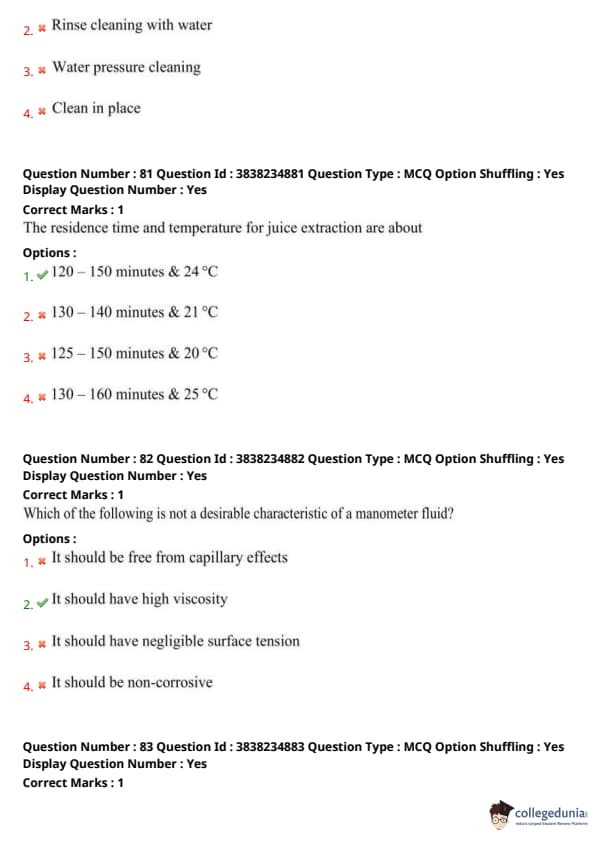
Question 80:
Dairy equipment is regularly cleaned using
- (A) Cleaning with detergent
- (B) Rinse cleaning with water
- (C) Water pressure cleaning
- (D) Clean in place
Question 81:
The residence time and temperature for juice extraction are about
- (A) 120–150 minutes \& 24°C
- (B) 140–160 minutes \& 21°C
- (C) 125–150 minutes \& 20°C
- (D) 130–160 minutes \& 25°C
Question 82:
Which of the following is not a desirable characteristic of a manometer fluid?
- (A) It should be free from capillary effects
- (B) It should have high viscosity
- (C) It should have negligible surface tension
- (D) It should be non-corrosive
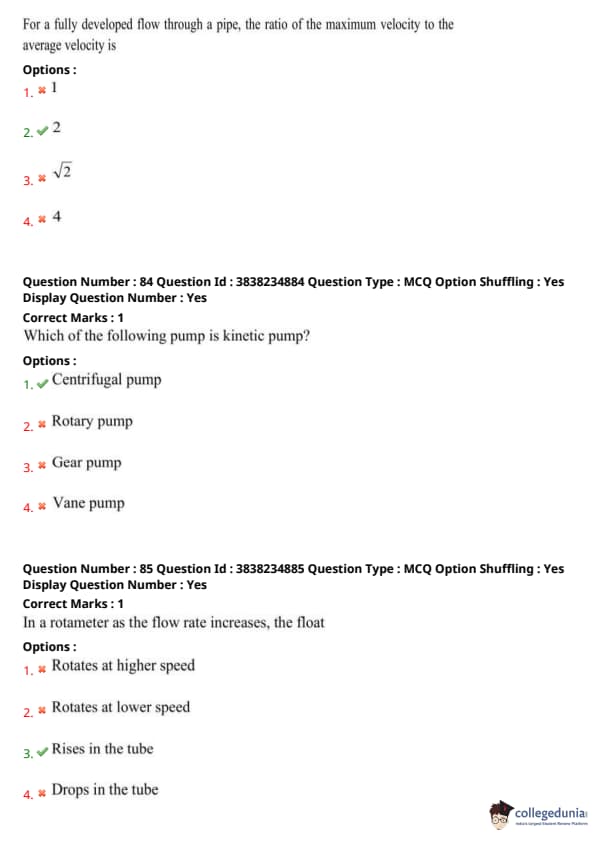
Question 83:
For a fully developed flow through a pipe, the ratio of the maximum velocity to the average velocity is
- (A) 1
- (B) 2
- (C) \(\sqrt{2}\)
- (D) 4
Question 84:
Which of the following pump is kinetic pump?
- (A) Centrifugal pump
- (B) Rotary pump
- (C) Gear pump
- (D) Vane pump
Question 85:
In a rotameter as the flow rate increases, the float
- (A) Rotates at higher speed
- (B) Rotates at lower speed
- (C) Rises in the tube
- (D) Drops in the tube
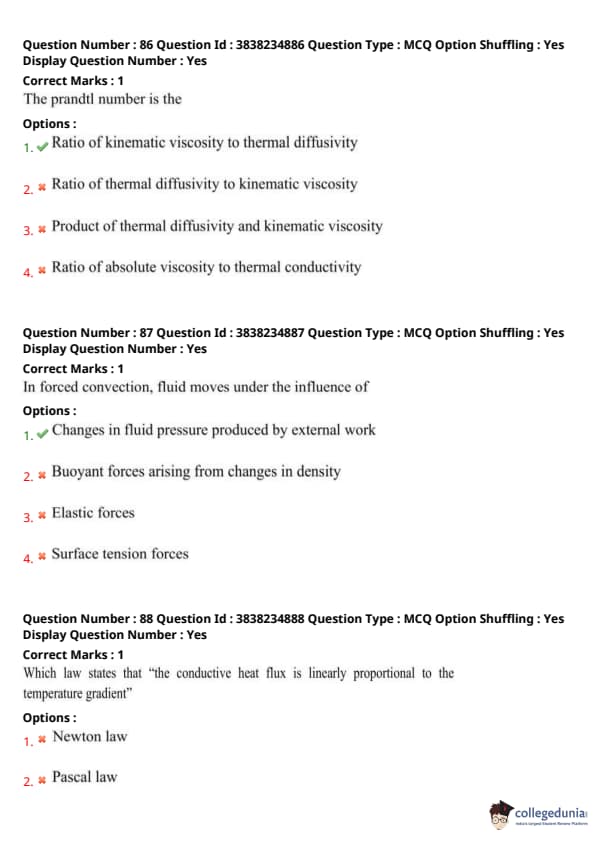
Question 86:
The Prandtl number is the
- (A) Ratio of kinematic viscosity to thermal diffusivity
- (B) Ratio of thermal diffusivity to kinematic viscosity
- (C) Product of thermal diffusivity and kinematic viscosity
- (D) Ratio of absolute viscosity to thermal conductivity
Question 87:
In forced convection, fluid moves under the influence of
- (A) Changes in fluid pressure produced by external work
- (B) Buoyant forces arising from changes in density
- (C) Elastic forces
- (D) Surface tension forces
Question 88:
Which law states that "the conductive heat flux is linearly proportional to the temperature gradient"?
- (A) Newton law
- (B) Pascal law
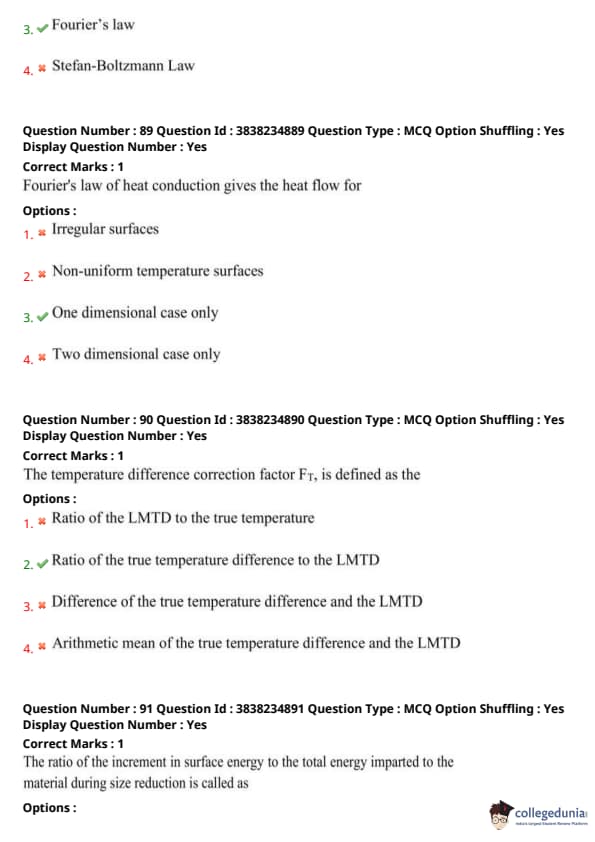
- (C) Fourier’s law
- (D) Stefan-Boltzmann Law
Question 89:
Fourier’s law of heat conduction gives the heat flow for
- (A) Irregular surfaces
- (B) Non-uniform temperature surfaces
- (C) One dimensional case only
- (D) Two dimensional case only
Question 90:
The temperature difference correction factor \(F_T\) is defined as the
- (A) Ratio of the LMTD to the true temperature
- (B) Ratio of the true temperature difference to the LMTD
- (C) Difference of the true temperature difference and the LMTD
- (D) Arithmetic mean of the true temperature difference and the LMTD
Question 91:
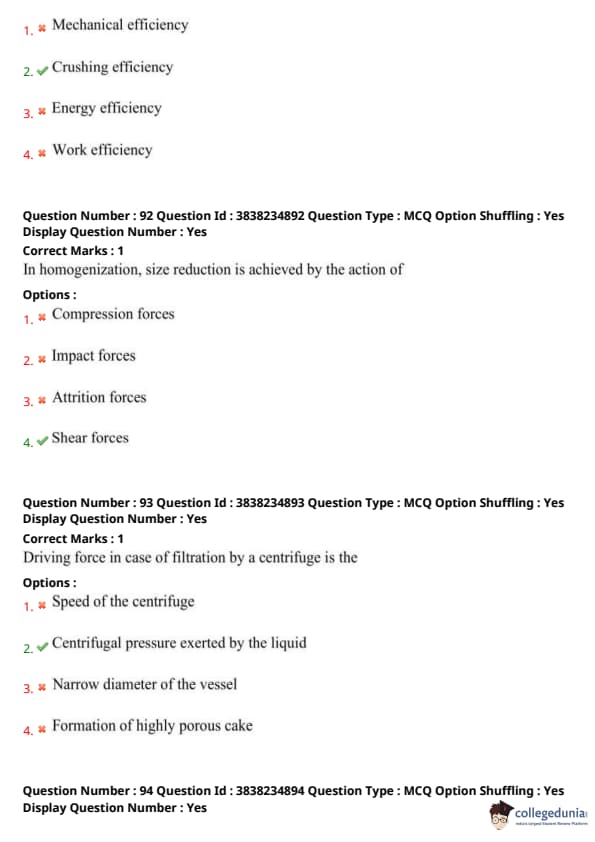
The ratio of the increment in surface energy to the total energy imparted to the material during size reduction is called as
- (A) Mechanical efficiency
- (B) Crushing efficiency
- (C) Energy efficiency
- (D) Work efficiency
Question 92:
In homogenization, size reduction is achieved by the action of
- (A) Compression forces
- (B) Impact forces
- (C) Attrition forces
- (D) Shear forces
Question 93:
Driving force in case of filtration by a centrifuge is the
- (A) Speed of the centrifuge
- (B) Centrifugal pressure exerted by the liquid
- (C) Narrow diameter of the vessel
- (D) Formation of highly porous cake
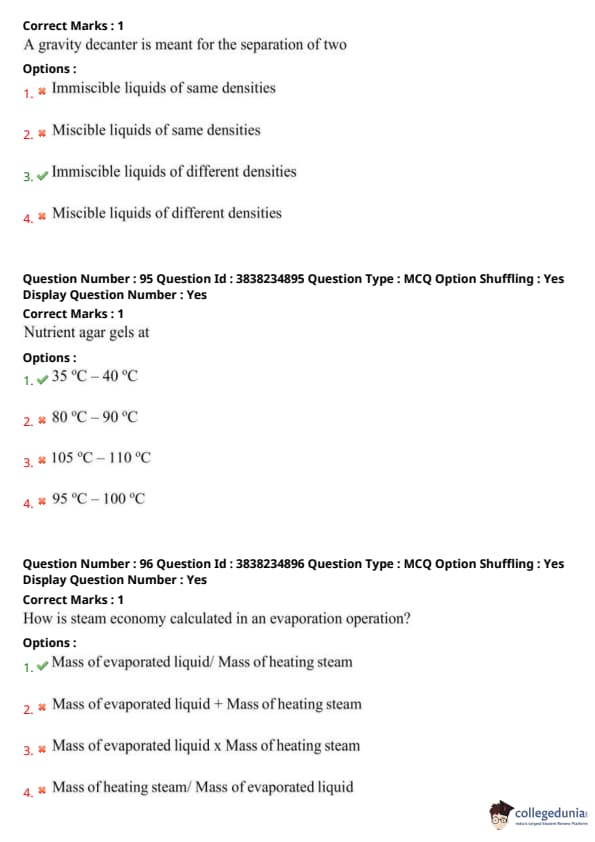
Question 94:
A gravity decanter is meant for the separation of two
- (A) Immiscible liquids of same densities
- (B) Miscible liquids of same densities
- (C) Immiscible liquids of different densities
- (D) Miscible liquids of different densities
Question 95:
Nutrient agar gels at
- (A) 35°C – 40°C
- (B) 80°C – 90°C
- (C) 105°C – 110°C
- (D) 95°C – 100°C
Question 96:
How is steam economy calculated in an evaporation operation?
- (A) Mass of evaporated liquid / Mass of heating steam
- (B) Mass of evaporated liquid + Mass of heating steam
- (C) Mass of evaporated liquid × Mass of heating steam
- (D) Mass of heating steam / Mass of evaporated liquid
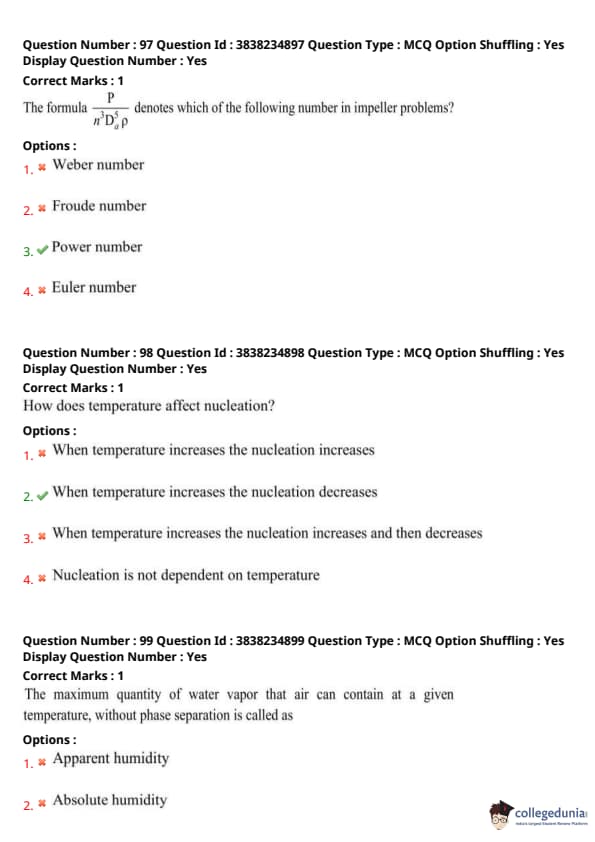
Question 97:
The formula \(\dfrac{P}{D^2N^3}\) denotes which of the following number in impeller problems?
- (A) Weber number
- (B) Froude number
- (C) Power number
- (D) Euler number
Question 98:
How does temperature affect nucleation?
- (A) When temperature increases the nucleation increases
- (B) When temperature increases the nucleation decreases
- (C) When temperature increases the nucleation increases and then decreases
- (D) Nucleation is not dependent on temperature
Question 99:
The maximum quantity of water vapor that air can contain at a given temperature, without saturation is called as
- (A) Apparent humidity
- (B) Absolute humidity
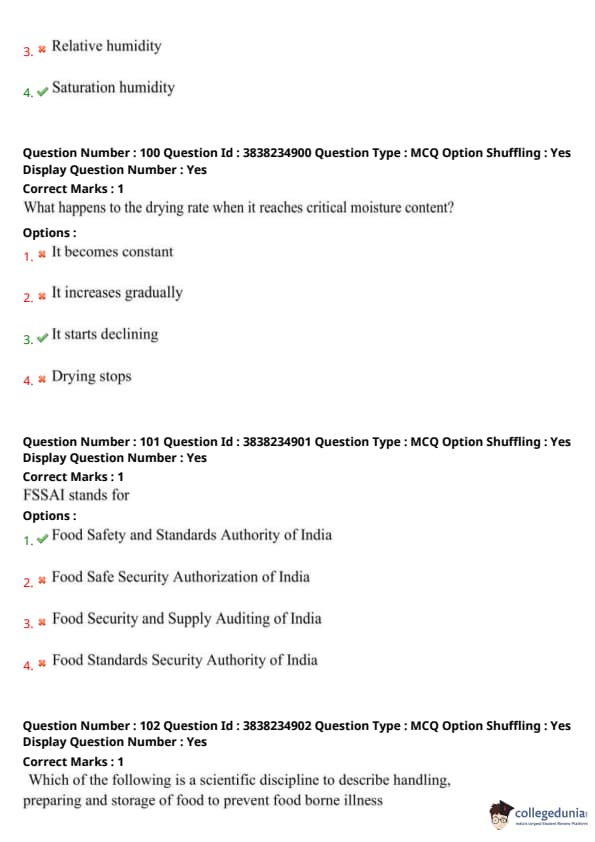
- (C) Relative humidity
- (D) Saturation humidity
Question 100:
What happens to the drying rate when it reaches critical moisture content?
- (A) It becomes constant
- (B) It increases gradually
- (C) It starts declining
- (D) Drying stops
Question 101:
FSSAI stands for
- (A) Food Safety and Standards Authority of India
- (B) Food Safe Security Authorization of India
- (C) Food Security and Supply Auditing of India
- (D) Food Standards Security Authority of India
Question 102:
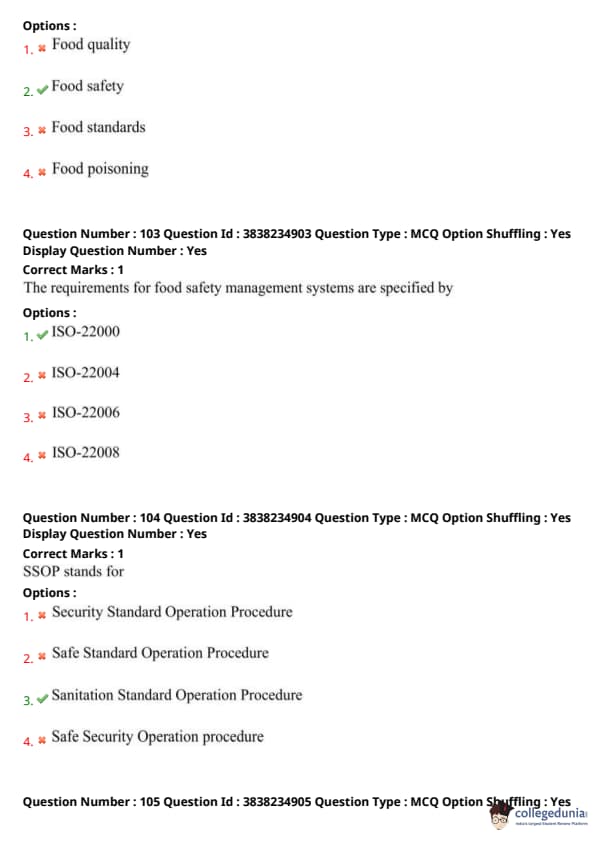
Which of the following is a scientific discipline to describe handling, preparing and storage of food to prevent food borne illness
- (A) Food quality
- (B) Food safety
- (C) Food standards
- (D) Food poisoning
Question 103:
The requirements for food safety management systems are specified by
- (A) ISO-22000
- (B) ISO-22004
- (C) ISO-22006
- (D) ISO-22008
Question 104:
SSOP stands for
- (A) Security Standard Operation Procedure
- (B) Safe Standard Operation Procedure
- (C) Sanitation Standard Operation Procedure
- (D) Safe Security Operation procedure
Question 105:
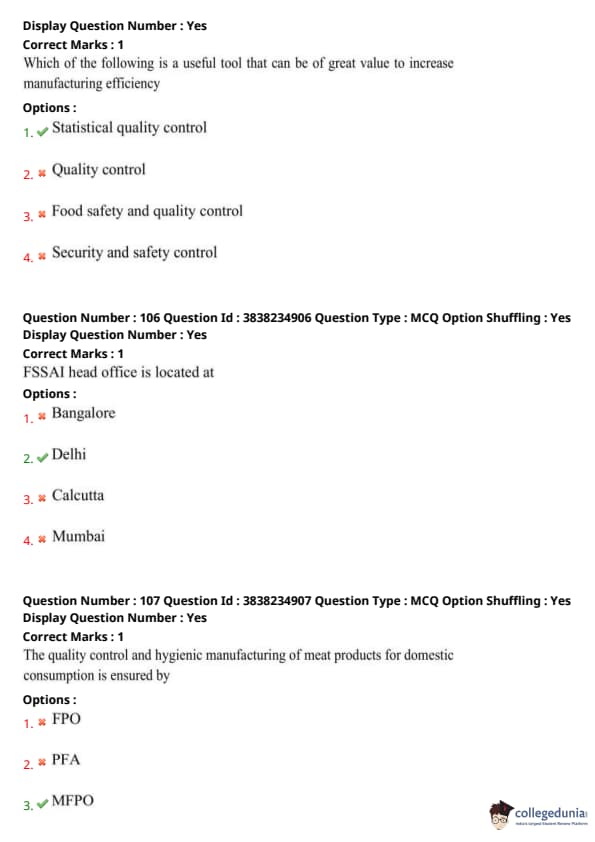
Which of the following is a useful tool that can be of great value to increase manufacturing efficiency?
- (A) Statistical quality control
- (B) Quality control
- (C) Food safety and quality control
- (D) Security and safety control
Question 106:
FSSAI head office is located at
- (A) Bangalore
- (B) Delhi
- (C) Calcutta
- (D) Mumbai
Question 107:
The quality control and hygienic manufacturing of meat products for domestic consumption is ensured by
- (A) FFPO
- (B) PFA
- (C) MFPO
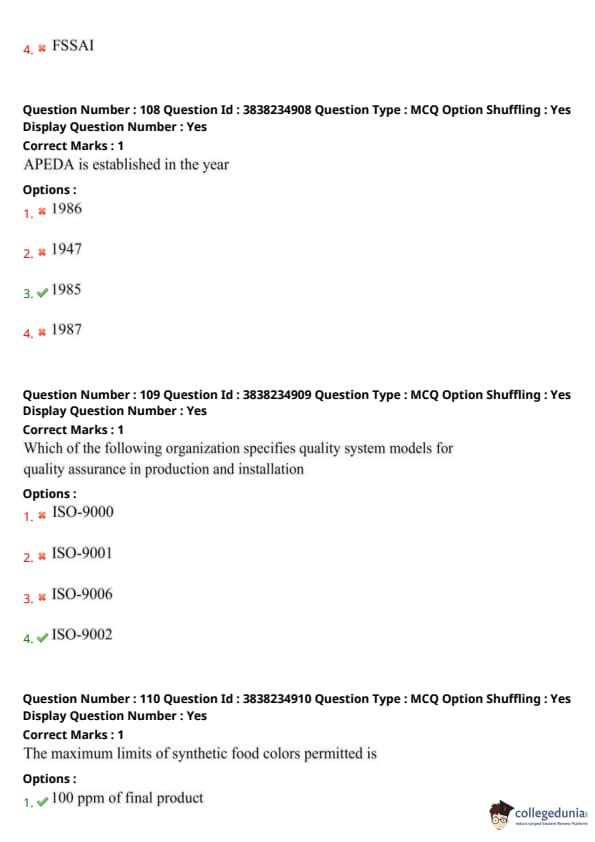
- (D) FSSAI
Question 108:
APEDA is established in the year
- (A) 1986
- (B) 1947
- (C) 1985
- (D) 1987
Question 109:
Which of the following organization specifies quality system models for quality assurance in production and installation
- (A) ISO-9000
- (B) ISO-9001
- (C) ISO-9006
- (D) ISO-9002
Question 110:
The maximum limits of synthetic food colors permitted is
- (A) 100 ppm of final product
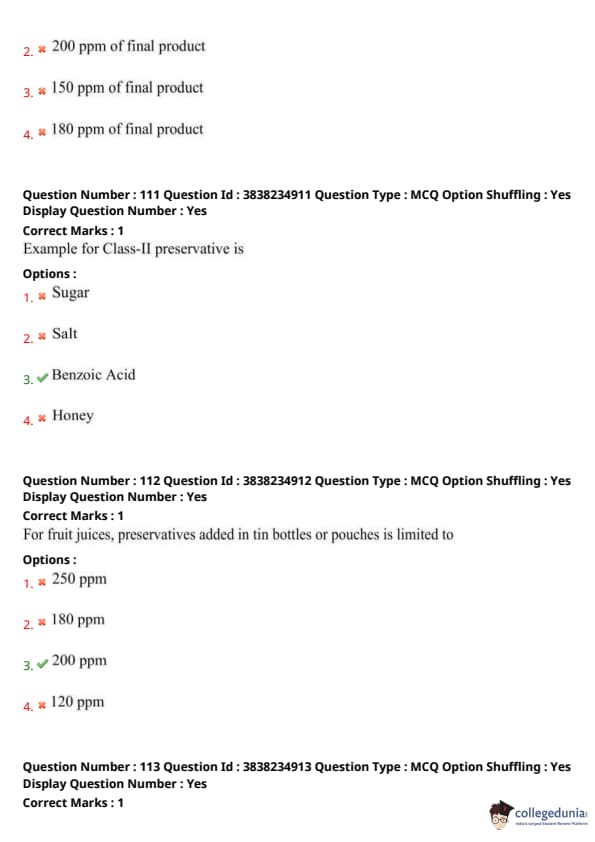
- (B) 200 ppm of final product
- (C) 150 ppm of final product
- (D) 180 ppm of final product
Question 111:
Example for Class-II preservative is
- (A) Sugar
- (B) Salt
- (C) Benzoic Acid
- (D) Honey
Question 112:
For fruit juices, preservatives added in tin bottles or pouches is limited to
- (A) 250 ppm
- (B) 180 ppm
- (C) 200 ppm
- (D) 120 ppm
Question 113:
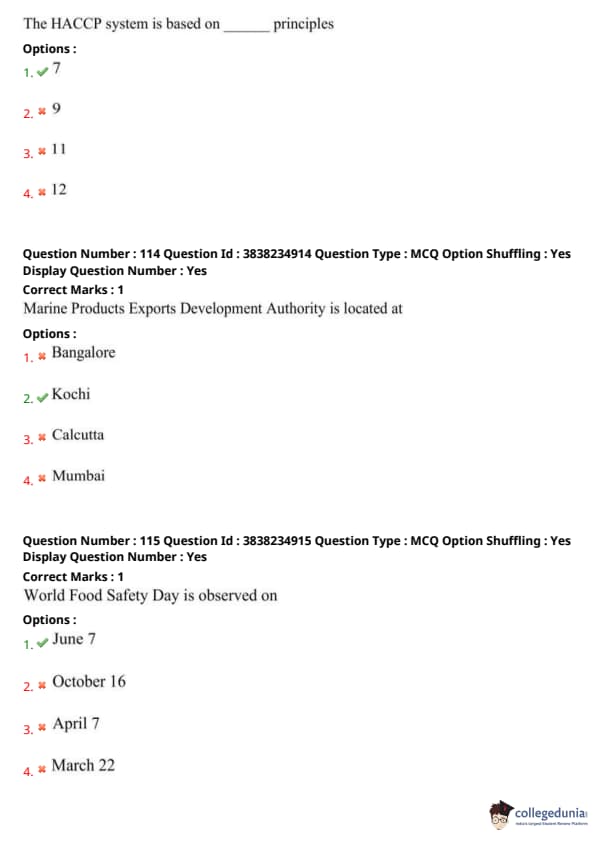
The HACCP system is based on ____ principles
- (A) 7
- (B) 9
- (C) 11
- (D) 12
Question 114:
Marine Products Exports Development Authority is located at
- (A) Bangalore
- (B) Kochi
- (C) Calcutta
- (D) Mumbai
Question 115:
World Food Safety Day is observed on
- (A) June 7
- (B) October 16
- (C) April 7
- (D) March 22
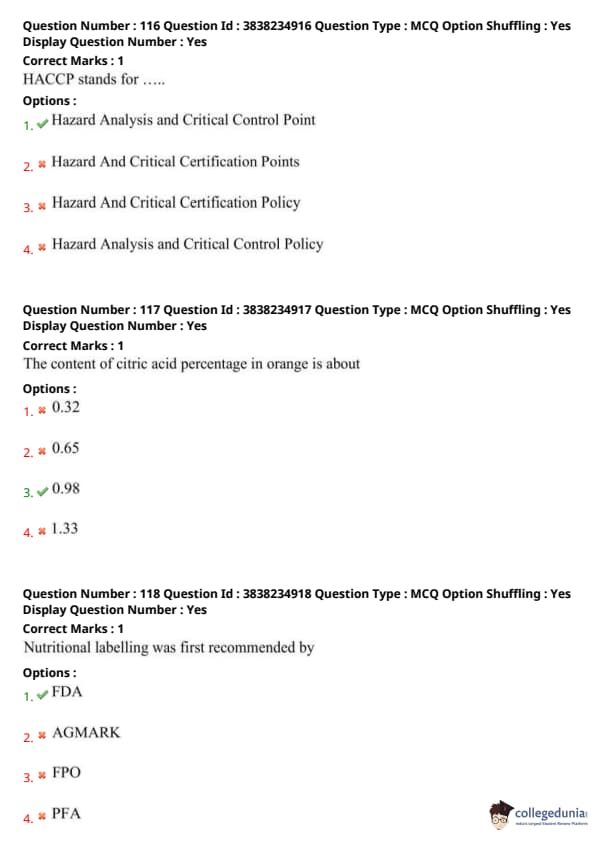
Question 116:
HACCP stands for \ldots
- (A) Hazard Analysis and Critical Control Point
- (B) Hazard And Critical Certification Points
- (C) Hazard And Critical Certification Policy
- (D) Hazard Analysis and Critical Control Policy
Question 117:
The content of citric acid percentage in orange is about
- (A) 0.32
- (B) 0.65
- (C) 0.98
- (D) 1.33
Question 118:
Nutritional labelling was first recommended by
- (A) FDA
- (B) AGMARK
- (C) FPO
- (D) PFA
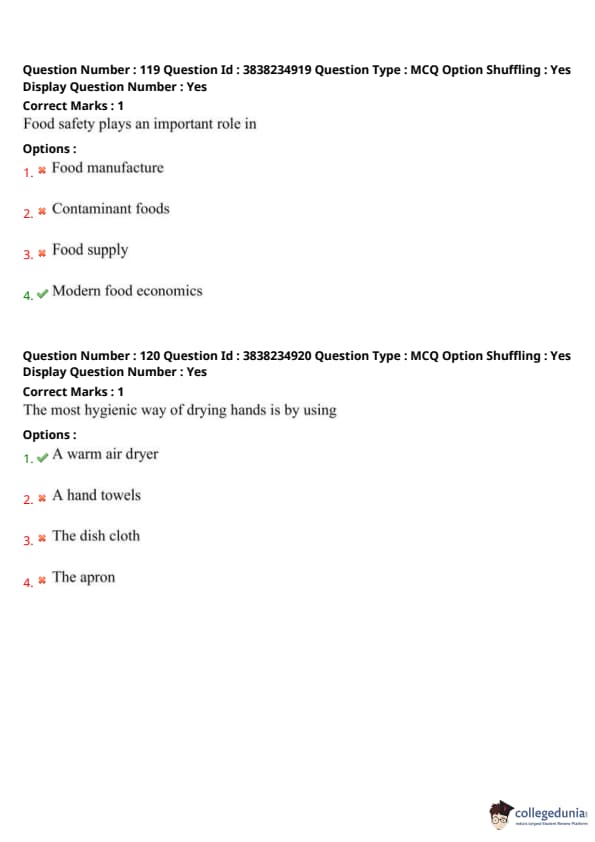
Question 119:
Food safety plays an important role in
- (A) Food manufacture
- (B) Contaminant foods
- (C) Food supply
- (D) Modern food economics
Question 120:
The most hygienic way of drying hands is by using
- (A) A warm air dryer
- (B) A hand towels
- (C) The dish cloth
- (D) The apron






 is the modal matrix of
  then the sum of all the elements of \( P^{-1}AP \) is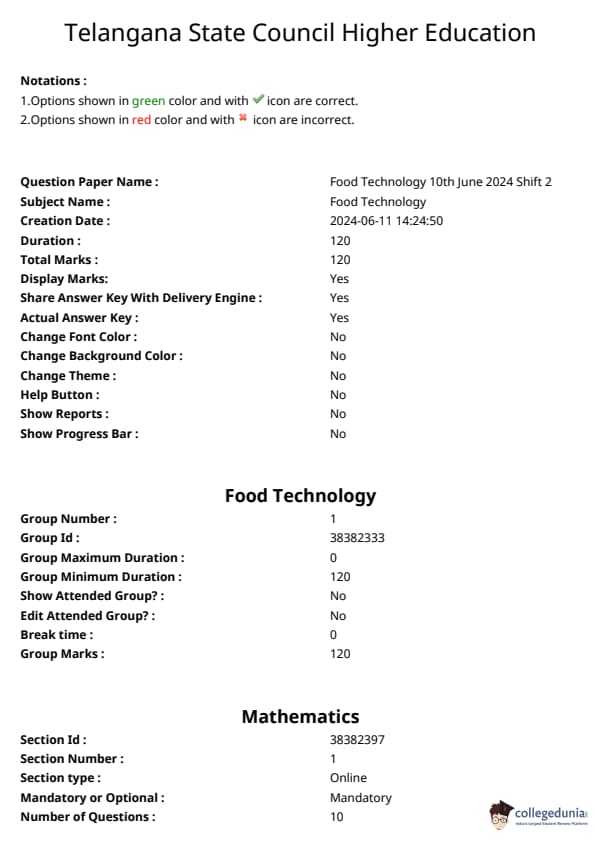




Comments