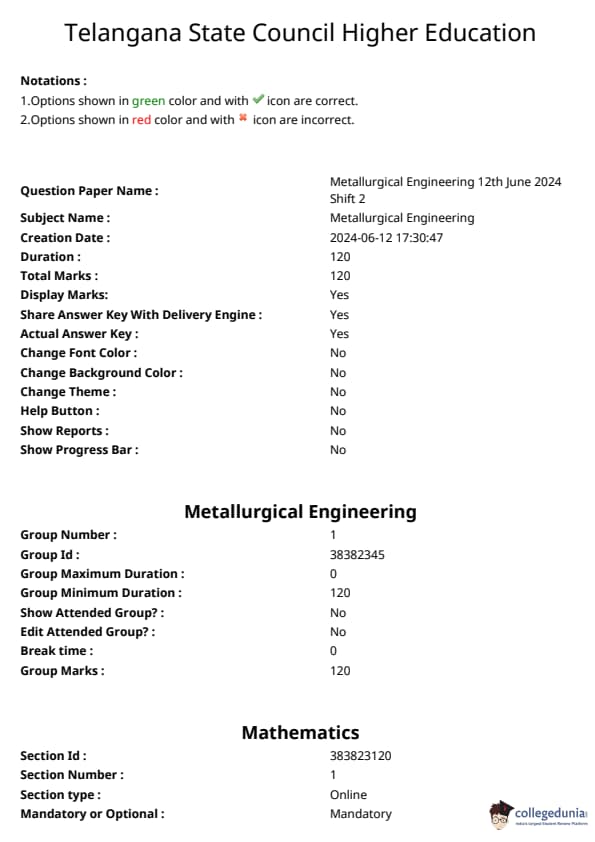
TS PGECET 2024 Metallurgical Engineering Question Paper is available for download here. Jawaharlal Nehru Technological University Hyderabad on behalf of Telangana Council of Higher Education (TGCHE) conducted TS PGECET 2024 Metallurgical Engineering on June 12 in Shift 2 from 2 PM to 4 PM. TS PGECET Question Paper 2024 consists of 120 MCQ-based questions in total carrying 1 mark each to be attempted in the duration of 2 hours.
TS PGECET 2024 Metallurgical Engineering Question Paper with Answer Key PDF
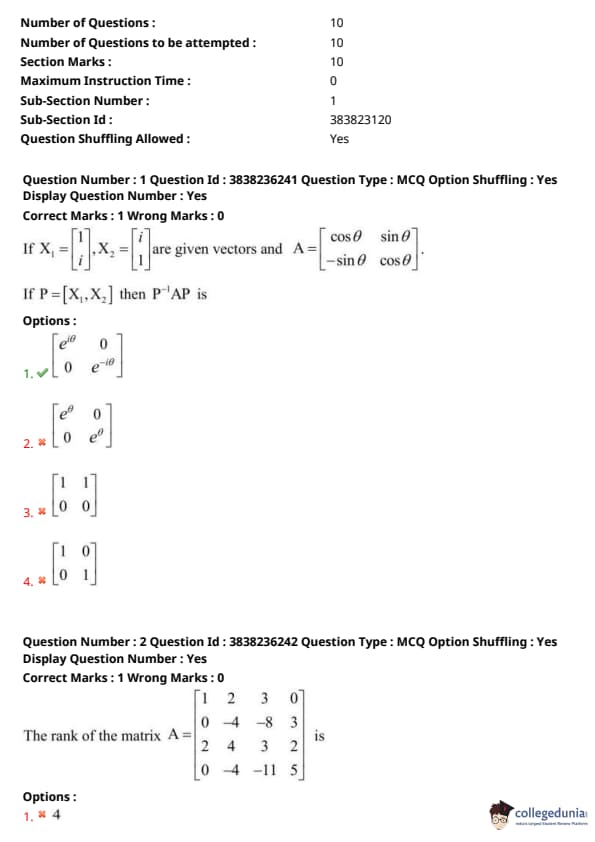
Question 1:
If \( X_1 = \begin{bmatrix} 1
i \end{bmatrix} \), \( X_2 = \begin{bmatrix} i
1 \end{bmatrix} \) are given vectors and \( A = \begin{bmatrix} \cos \theta & \sin \theta
-\sin \theta & \cos \theta \end{bmatrix} \).
If \( P = [X_1, X_2] \), then \( P^{-1} A P \) is:
- (A) \( \begin{bmatrix} e^{i\theta} & 0
0 & e^{-i\theta} \end{bmatrix} \)
- (B) \( \begin{bmatrix} e^{\theta} & 0
0 & e^{\theta} \end{bmatrix} \)
- (C) \( \begin{bmatrix} 1 & 1
0 & 0 \end{bmatrix} \)
- (D) \( \begin{bmatrix} 1 & 0
0 & 1 \end{bmatrix} \)
Correct Answer: (A) \( \begin{bmatrix} e^{i\theta} & 0
0 & e^{-i\theta} \end{bmatrix} \)
View Solution
Question 2:
The rank of the matrix \( A = \begin{bmatrix} 1 & 2 & 3 & 0
0 & -4 & -8 & 3
2 & 4 & 3 & 2
0 & -4 & -11 & 5 \end{bmatrix} \)
is:
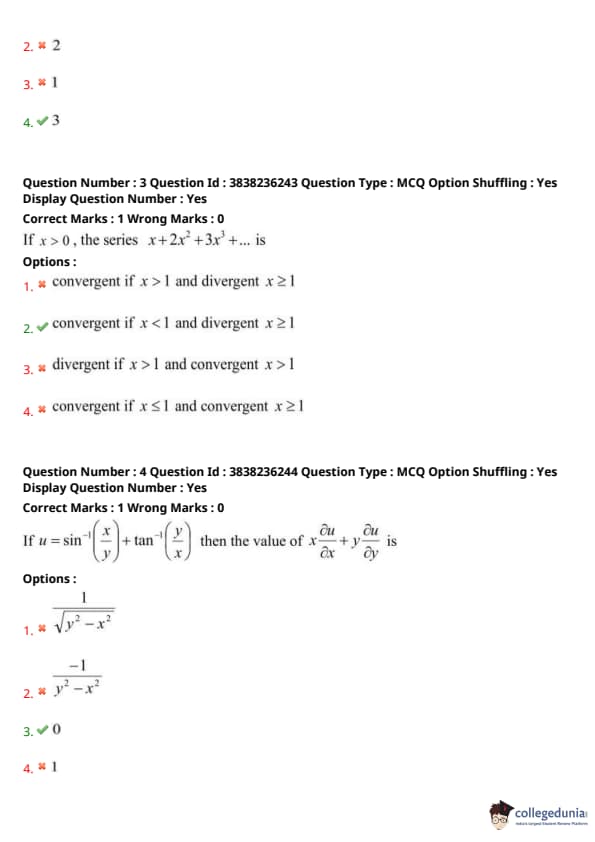
Question 3:
If \( x > 0 \), the series \( x + 2x^2 + 3x^3 + \ldots \) is:
- (A) convergent if \( x > 1 \) and divergent \( x \geq 1 \)
- (B) convergent if \( x < 1 \) and divergent \( x \geq 1 \)
- (C) divergent if \( x > 1 \) and convergent \( x > 1 \)
- (D) convergent if \( x \leq 1 \) and convergent \( x \geq 1 \)
Correct Answer: (B) convergent if \( x < 1 \) and divergent \( x \geq 1 \)
View Solution
Question 4:
If \( u = \sin^{-1}\left(\frac{x}{y}\right) + \tan^{-1}\left(\frac{y}{x}\right) \), then the value of \( x \frac{\partial u}{\partial x} + y \frac{\partial u}{\partial y} \) is:
- (A) \( \frac{1}{\sqrt{y^2 - x^2}} \)
- (B) \( \frac{-1}{y^2 - x^2} \)
- (C) \( 0 \)
- (D) \( 1 \)
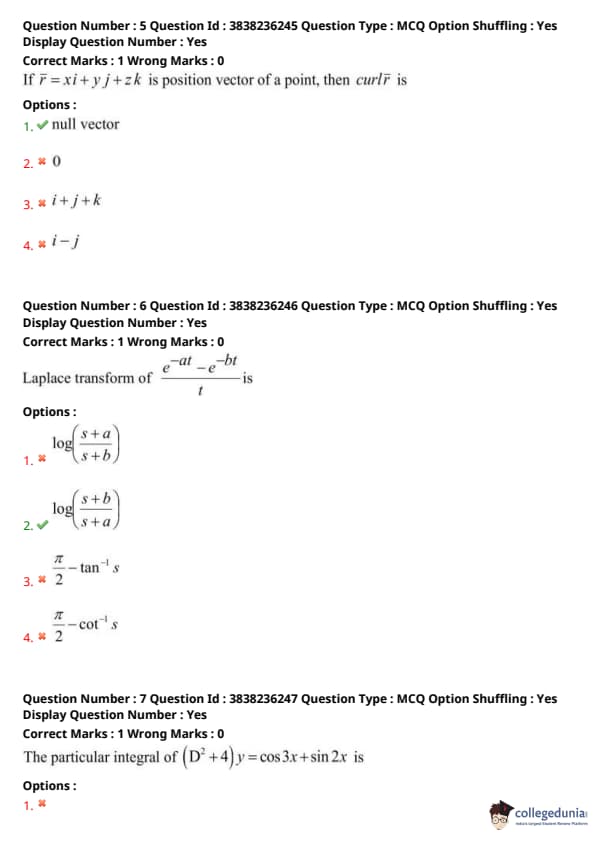
Question 5:
If \( \vec{r} = x \hat{i} + y \hat{j} + z \hat{k} \) is the position vector of a point, then \( curl(\vec{r}) \) is:
- (A) null vector
- (B) \( 0 \)
- (C) \( \hat{i} + \hat{j} + \hat{k} \)
- (D) \( \hat{i} - \hat{j} \)
Question 6:
Laplace transform of \( \frac{e^{-at} - e^{-bt}}{t} \) is:
- (A) \( \log\left( \frac{s+a}{s+b} \right) \)
- (B) \( \log\left( \frac{s+b}{s+a} \right) \)
- (C) \( \frac{\pi}{2} - \tan^{-1}(s) \)
- (D) \( \frac{\pi}{2} - \cot^{-1}(s) \)
Correct Answer: (B) \( \log\left( \frac{s+b}{s+a} \right) \)
View Solution
Question 7:
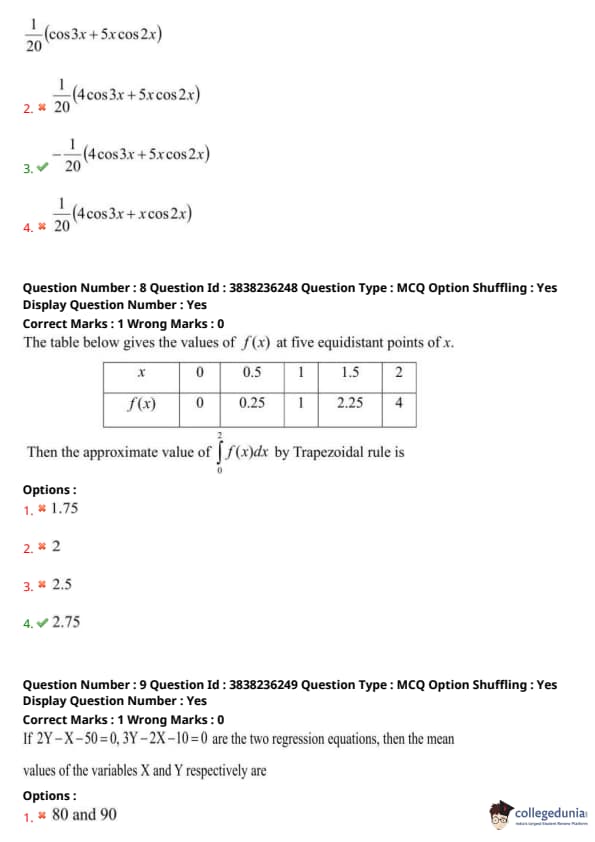
The particular integral of \( (D^2 + 4)y = \cos 3x + \sin 2x \) is:
- (A) \( \frac{1}{20}(\cos 3x + 5x \cos 2x) \)
- (B) \( \frac{1}{20}(4 \cos 3x + 5x \cos 2x) \)
- (C) \( \frac{-1}{20}(4 \cos 3x + 5x \cos 2x) \)
- (D) \( \frac{1}{20}(4 \cos 3x + x \cos 2x) \)
Correct Answer: (C) \( \frac{-1}{20}(4 \cos 3x + 5x \cos 2x) \)
View Solution
Question 8:
The table below gives the values of \( f(x) \) at five equidistant points of \( x \):
x 0 0.5 1.0 1.5 2.0
f(x) 0 0.25 1 2.25 4
Then the approximate value of \( \int_0^2 f(x) \, dx \) by Trapezoidal Rule is:
- (A) \(1.75\)
- (B) \(2\)
- (C) \(2.5\)
- (D) \(2.75\)
Question 9:
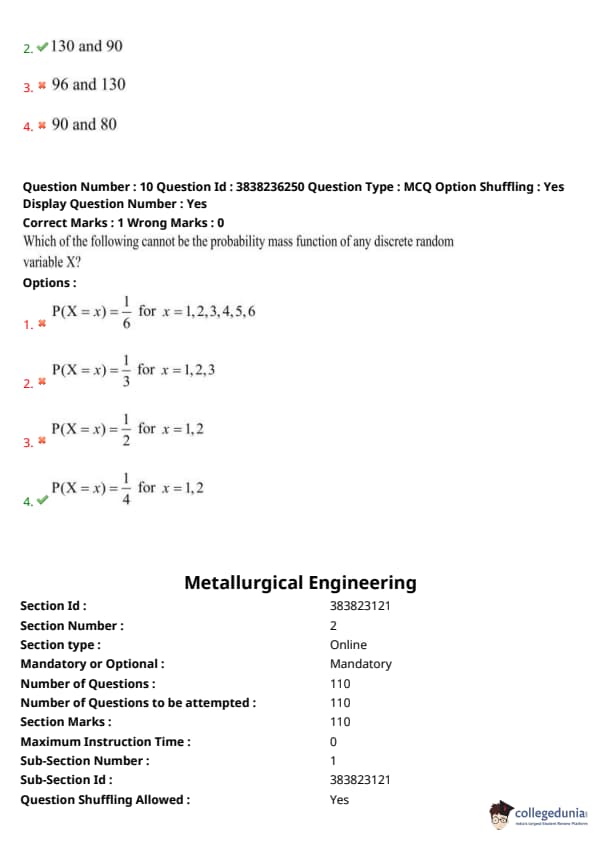
If \(2Y - X - 50 = 0\), \(3Y - 2X - 10 = 0\) are the two regression equations, then the mean values of the variables \(X\) and \(Y\) respectively are:
- (A) \(80 and 90\)
- (B) \(130 and 90\)
- (C) \(96 and 130\)
- (D) \(90 and 80\)
Question 10:
Which of the following cannot be the probability mass function of any discrete random variable \(X\)?
- (A) \(P(X = x) = \frac{1}{6} for x = 1,2,3,4,5,6\)
- (B) \(P(X = x) = \frac{1}{3} for x = 1,2,3\)
- (C) \(P(X = x) = \frac{1}{2} for x = 1,2\)
- (D) \(P(X = x) = \frac{1}{4} for x = 1,2\)
Correct Answer: (D) \(P(X = x) = \frac{1}{4} \text{ for } x = 1,2\)
View Solution
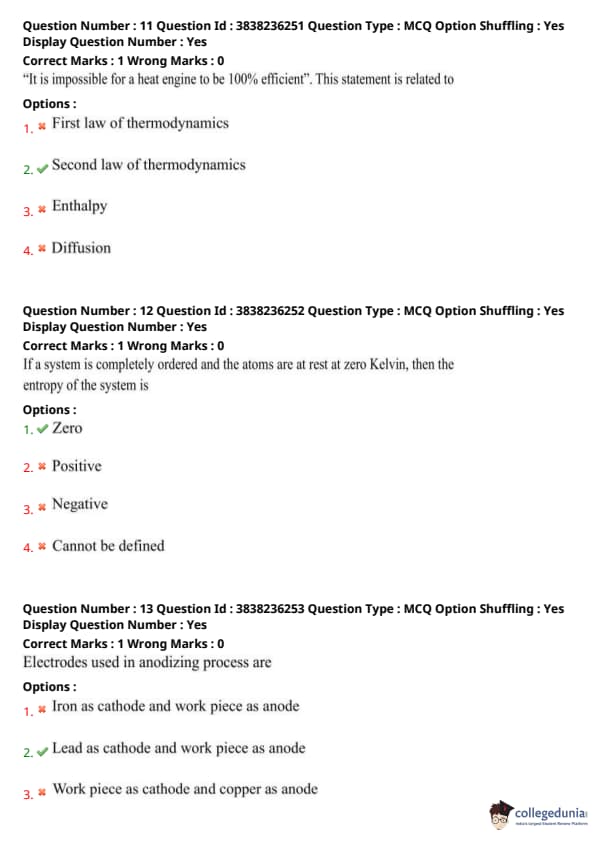
Question 11:
“It is impossible for a heat engine to be 100% efficient.” This statement is related to:
- (A) First law of thermodynamics
- (B) Second law of thermodynamics
- (C) Enthalpy
- (D) Diffusion
Question 12:
If a system is completely ordered and the atoms are at rest at zero Kelvin, then the entropy of the system is:
- (A) Zero
- (B) Positive
- (C) Negative
- (D) Cannot be defined
Question 13:
Electrodes used in anodizing process are:
- (A) Iron as cathode and work piece as anode
- (B) Lead as cathode and work piece as anode
- (C) Work piece as cathode and copper as anode
- (D) Work piece as cathode and zinc as anode
Correct Answer: (2) Lead as cathode and work piece as anode
View Solution
Question 14:
Units for quantity of electricity are:
- (A) Volt
- (B) Ampere
- (C) Joule
- (D) Coulomb
Question 15:
Identify the wrong statement:
- (A) Alkali halides are highly conductive
- (B) Mercury chloride is very good conductor of electricity
- (C) Fused salts are good conductor of electricity
- (D) Easily polarizable ions in the fused salt mixtures reduces the ionic mobility
Correct Answer: (2) Mercury chloride is very good conductor of electricity
View Solution
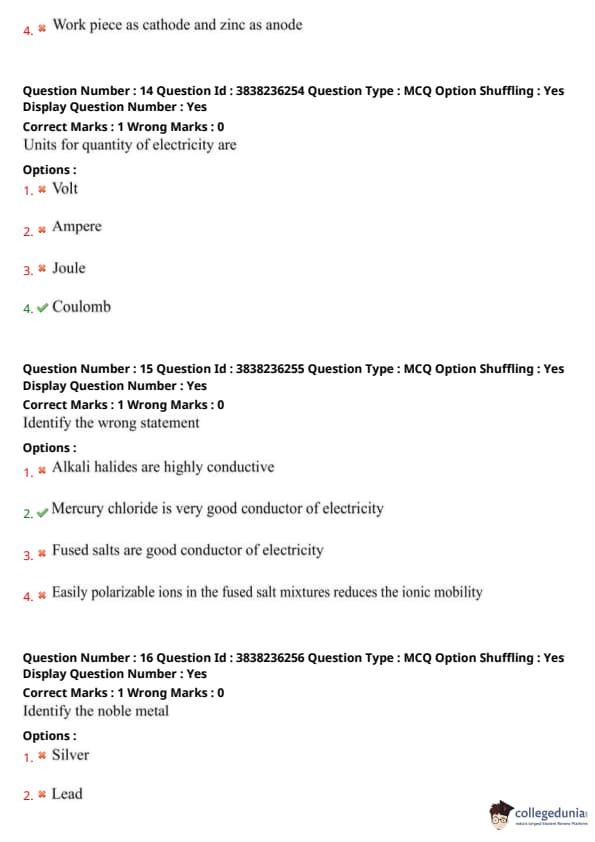
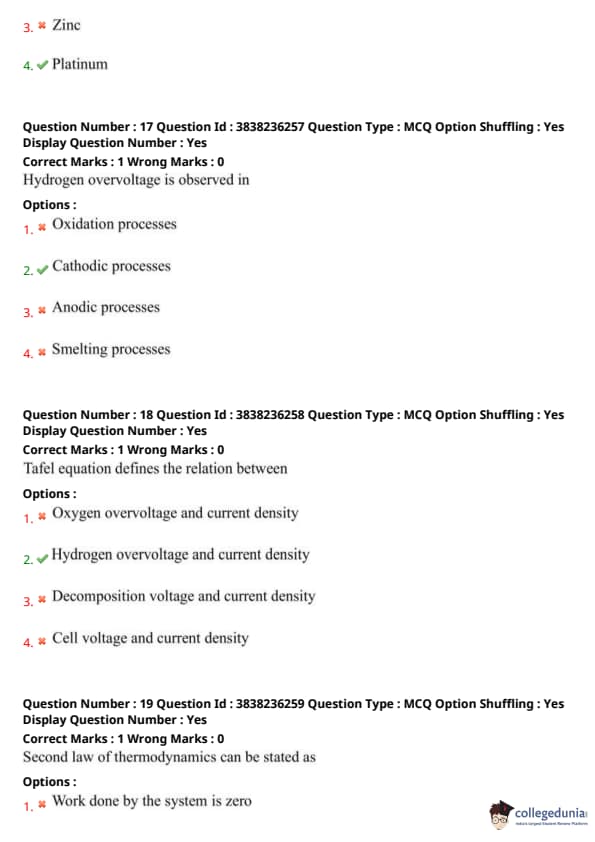
Question 16:
Identify the noble metal:
- (A) Silver
- (B) Lead
- (C) Zinc
- (D) Platinum
Question 17:
Hydrogen overvoltage is observed in:
- (A) Oxidation processes
- (B) Cathodic processes
- (C) Anodic processes
- (D) Smelting processes
Question 18:
Tafel equation defines the relation between:
- (A) Oxygen overvoltage and current density
- (B) Hydrogen overvoltage and current density
- (C) Decomposition voltage and current density
- (D) Cell voltage and current density
Correct Answer: (2) Hydrogen overvoltage and current density
View Solution
Question 19:
Second law of thermodynamics can be stated as:
- (A) Work done by the system is zero
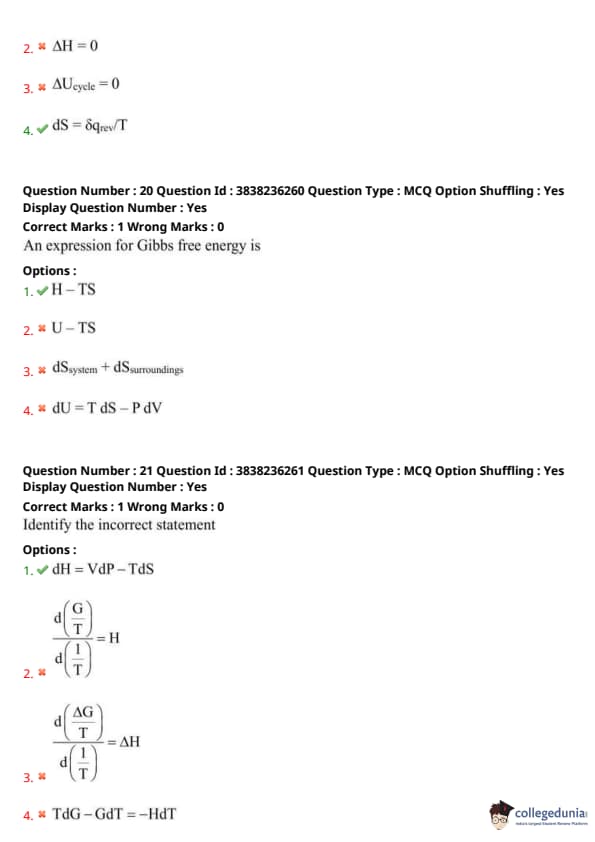
- (B) \( \Delta H = 0 \)
- (C) \( \Delta U_{cycle} = 0 \)
- (D) \( dS = \frac{\delta q_{rev}}{T} \)
Correct Answer: (4) \( dS = \frac{\delta q_{\text{rev}}}{T} \)
View Solution
Question 20:
An expression for Gibbs free energy is:
- (A) \( H - TS \)
- (B) \( U - TS \)
- (C) \( dS_{system} + dS_{surroundings} \)
- (D) \( dU = T dS - P dV \)
Question 21:
Identify the incorrect statement:
- (A) \( dH = V dP - T dS \)
- (B) \( \displaystyle \frac{d\left(\frac{G}{T}\right)}{d\left(\frac{1}{T}\right)} = H \)
- (C) \( \displaystyle \frac{d\left(\frac{\Delta G}{T}\right)}{d\left(\frac{1}{T}\right)} = \Delta H \)
- (D) \( T dG - G dT = -H dT \)
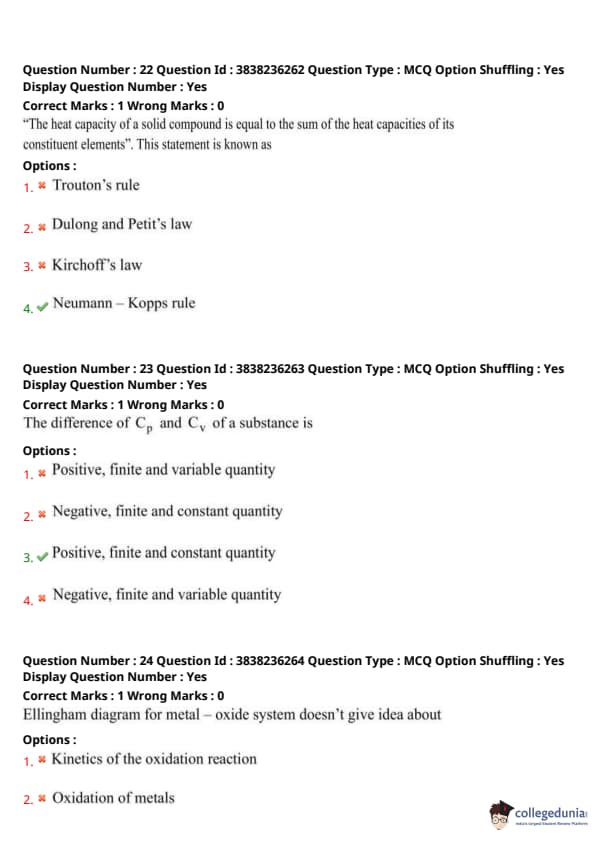
Question 22:
“The heat capacity of a solid compound is equal to the sum of the heat capacities of its constituent elements”. This statement is known as:
- (A) Trouton’s rule
- (B) Dulong and Petit’s law
- (C) Kirchhoff’s law
- (D) Neumann–Kopps rule
Question 23:
The difference of \( C_P \) and \( C_V \) of a substance is:
- (A) Positive, finite and variable quantity
- (B) Negative, finite and constant quantity
- (C) Positive, finite and constant quantity
- (D) Negative, finite and variable quantity
Correct Answer: (3) Positive, finite and constant quantity
View Solution
Question 24:
Ellingham diagram for metal–oxide system doesn’t give idea about:
- (A) Kinetics of the oxidation reaction
- (B) Oxidation of metals
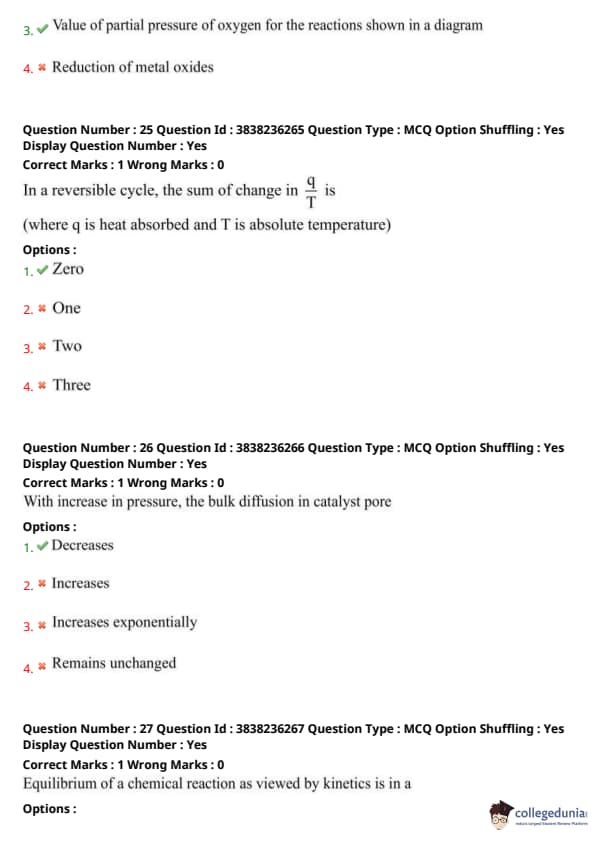
- (C) Value of partial pressure of oxygen for the reactions shown in a diagram
- (D) Reduction of metal oxides
Correct Answer: (3) Value of partial pressure of oxygen for the reactions shown in a diagram
View Solution
Question 25:
In a reversible cycle, the sum of change in \( \frac{q}{T} \) is
(where \( q \) is heat absorbed and \( T \) is absolute temperature):
- (A) Zero
- (B) One
- (C) Two
- (D) Three
Question 26:
With increase in pressure, the bulk diffusion in catalyst pore:
- (A) Decreases
- (B) Increases
- (C) Increases exponentially
- (D) Remains unchanged
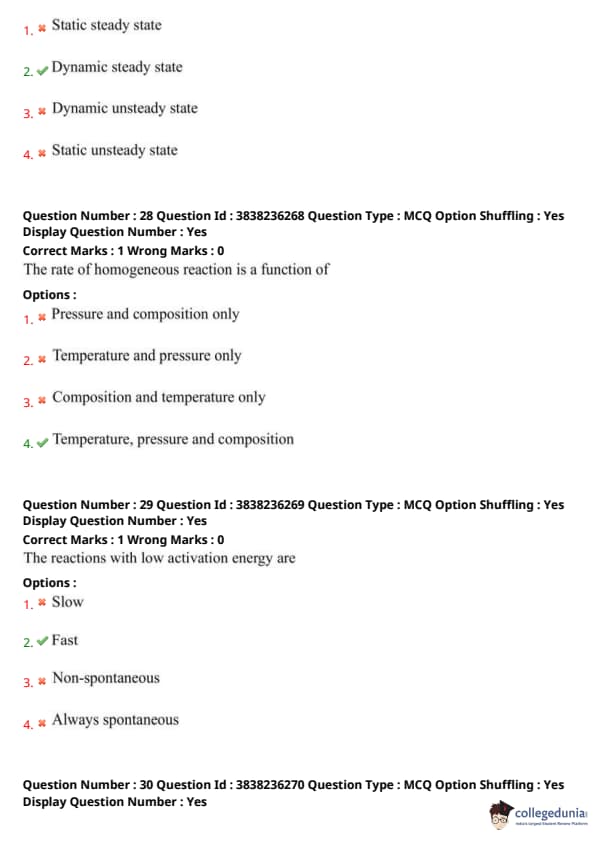
Question 27:
Equilibrium of a chemical reaction as viewed by kinetics is in a:
- (A) Static steady state
- (B) Dynamic steady state
- (C) Dynamic unsteady state
- (D) Static unsteady state
Question 28:
The rate of homogeneous reaction is a function of:
- (A) Pressure and composition only
- (B) Temperature and pressure only
- (C) Composition and temperature only
- (D) Temperature, pressure and composition
Correct Answer: (4) Temperature, pressure and composition
View Solution
Question 29:
The reactions with low activation energy are:
- (A) Slow
- (B) Fast
- (C) Non-spontaneous
- (D) Always spontaneous
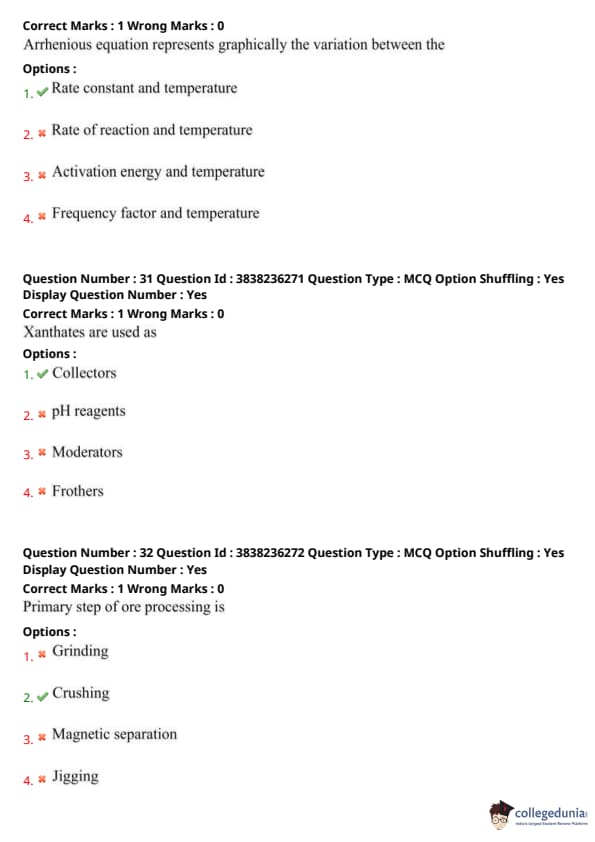
Question 30:
Arrhenius equation represents graphically the variation between the:
- (A) Rate constant and temperature
- (B) Rate of reaction and temperature
- (C) Activation energy and temperature
- (D) Frequency factor and temperature
Question 31:
Xanthates are used as:
- (A) Collectors
- (B) pH reagents
- (C) Moderators
- (D) Frothers
Question 32:
Primary step of ore processing is:
- (A) Grinding
- (B) Crushing
- (C) Magnetic separation
- (D) Jigging
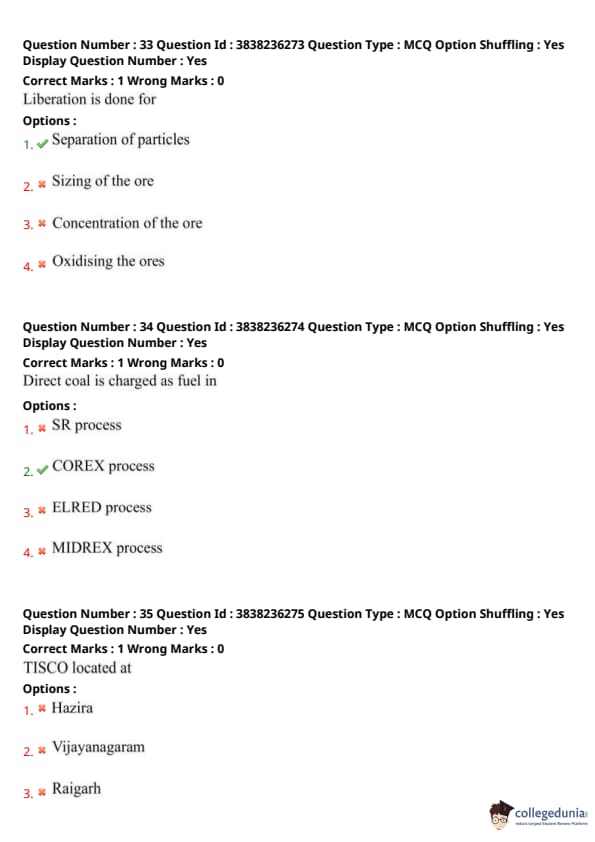
Question 33:
Liberation is done for:
- (A) Separation of particles
- (B) Sizing of the ore
- (C) Concentration of the ore
- (D) Oxidising the ores
Question 34:
Direct coal is charged as fuel in:
- (A) SR process
- (B) COREX process
- (C) ELRED process
- (D) MIDREX process
Question 35:
TISCO located at:
- (A) Hazira
- (B) Vijayanagaram
- (C) Raigarh
- (D) Jamshedpur
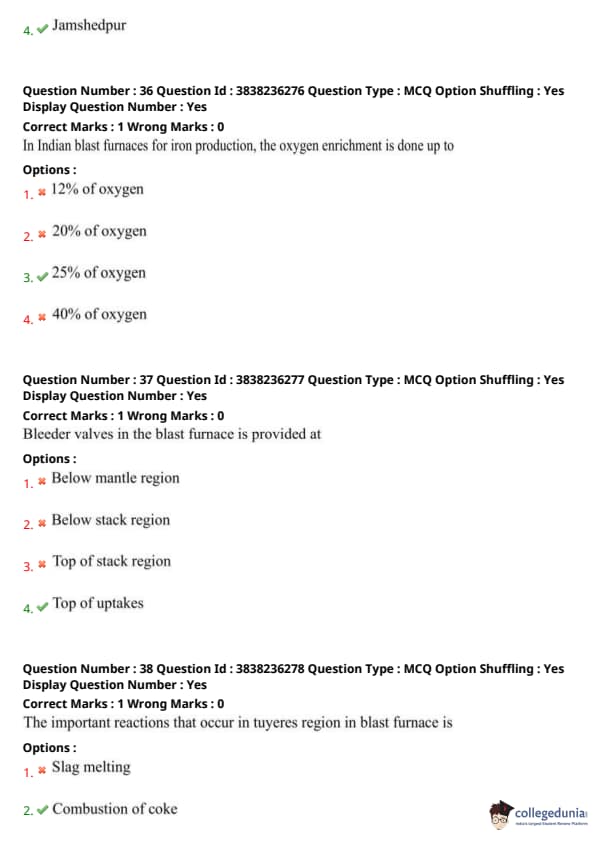
Question 36:
In Indian blast furnaces for iron production, the oxygen enrichment is done up to:
- (A) 12% of oxygen
- (B) 20% of oxygen
- (C) 25% of oxygen
- (D) 40% of oxygen
Question 37:
Bleeder valves in the blast furnace is provided at:
- (A) Below mantle region
- (B) Below stack region
- (C) Top of stack region
- (D) Top of uptakes
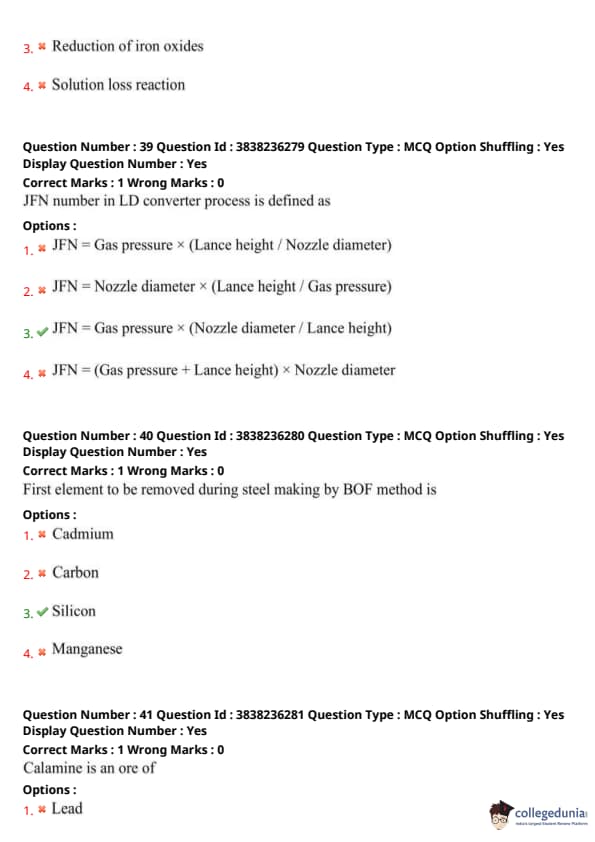
Question 38:
The important reactions that occur in tuyeres region in blast furnace is:
- (A) Slag melting
- (B) Combustion of coke
- (C) Reduction of iron oxides
- (D) Solution loss reaction
Question 39:
JFN number in LD converter process is defined as:
- (A) \( JFN = Gas pressure \times \left(\frac{Lance height}{Nozzle diameter}\right) \)
- (B) \( JFN = Nozzle diameter \times \left(\frac{Lance height}{Gas pressure}\right) \)
- (C) \( JFN = Gas pressure \times \left(\frac{Nozzle diameter}{Lance height}\right) \)
- (D) \( JFN = (Gas pressure + Lance height) \times Nozzle diameter \)
Correct Answer: (3) \( \text{JFN} = \text{Gas pressure} \times \left(\frac{\text{Nozzle diameter}}{\text{Lance height}}\right) \)
View Solution
Question 40:
First element to be removed during steel making by BOF method is:
- (A) Cadmium
- (B) Carbon
- (C) Silicon
- (D) Manganese
Question 41:
Calamine is an ore of:
- (A) Lead
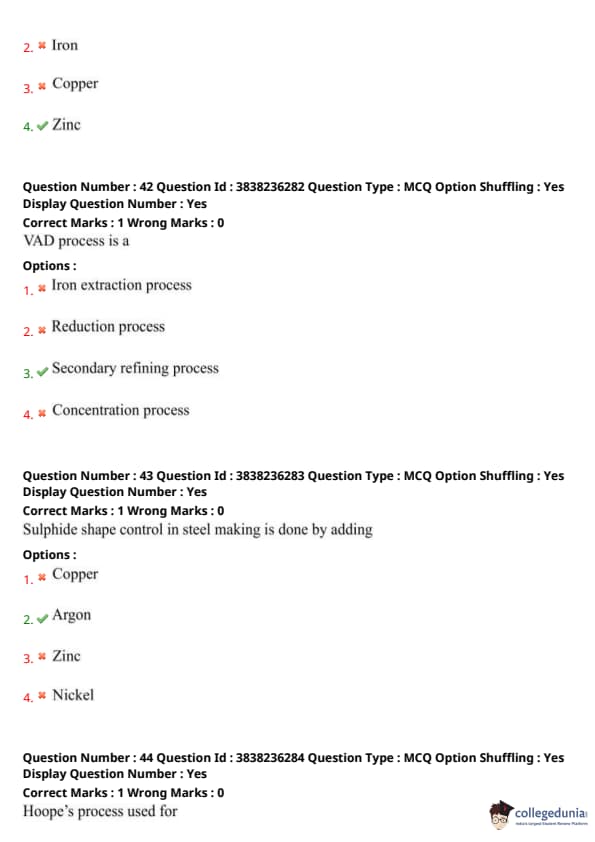
- (B) Iron
- (C) Copper
- (D) Zinc
Question 42:
VAD process is a:
- (A) Iron extraction process
- (B) Reduction process
- (C) Secondary refining process
- (D) Concentration process
Question 43:
Sulphide shape control in steel making is done by adding:
- (A) Copper
- (B) Argon
- (C) Zinc
- (D) Nickel
Question 44:
Hoopes’ process used for:
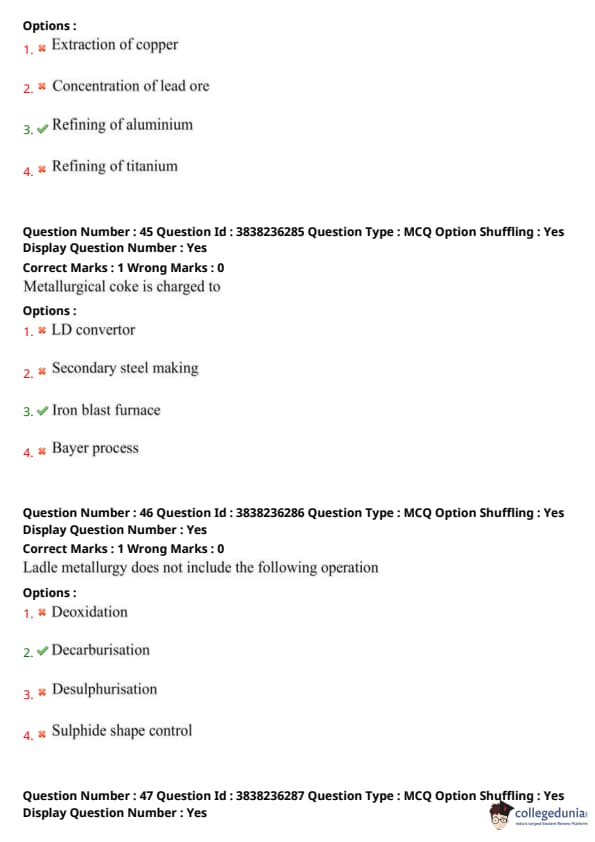
- (A) Extraction of copper
- (B) Concentration of lead ore
- (C) Refining of aluminium
- (D) Refining of titanium
Question 45:
Metallurgical coke is charged to:
- (A) LD convertor
- (B) Secondary steel making
- (C) Iron blast furnace
- (D) Bayer process
Question 46:
Ladle metallurgy does not include the following operation:
- (A) Deoxidation
- (B) Decarburisation
- (C) Desulphurisation
- (D) Sulphide shape control
Question 47:
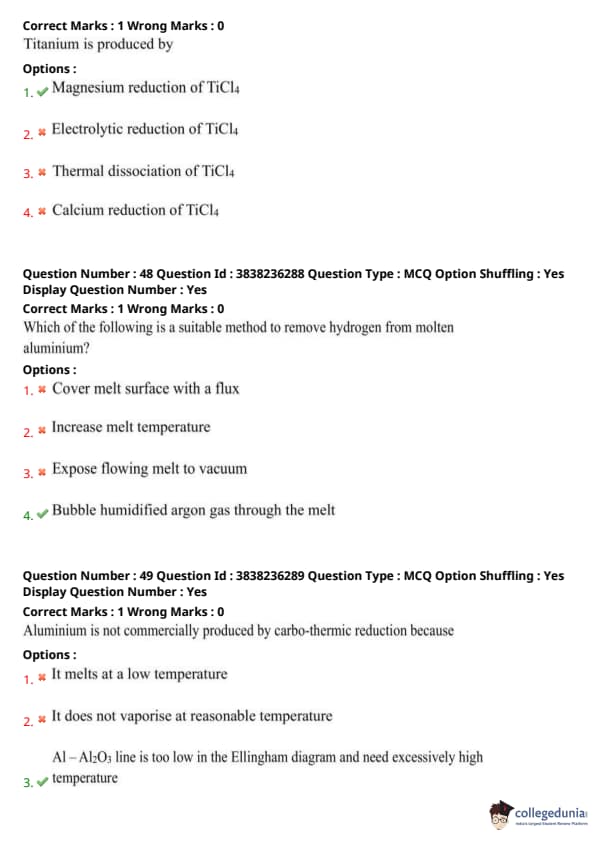
Titanium is produced by:
- (A) Magnesium reduction of TiCl\(_4\)
- (B) Electrolytic reduction of TiCl\(_4\)
- (C) Thermal dissociation of TiCl\(_4\)
- (D) Calcium reduction of TiCl\(_4\)
Correct Answer: (1) Magnesium reduction of TiCl\(_4\)
View Solution
Question 48:
Which of the following is a suitable method to remove hydrogen from molten aluminium?
- (A) Cover melt surface with a flux
- (B) Increase melt temperature
- (C) Expose flowing melt to vacuum
- (D) Bubble humidified argon gas through the melt
Correct Answer: (4) Bubble humidified argon gas through the melt
View Solution
Question 49:
Aluminium is not commercially produced by carbo-thermic reduction because:
- (A) It melts at a low temperature
- (B) It does not vaporise at reasonable temperature
- (C) Al–Al\(_2\)O\(_3\) line is too low in the Ellingham diagram and need excessively high temperature
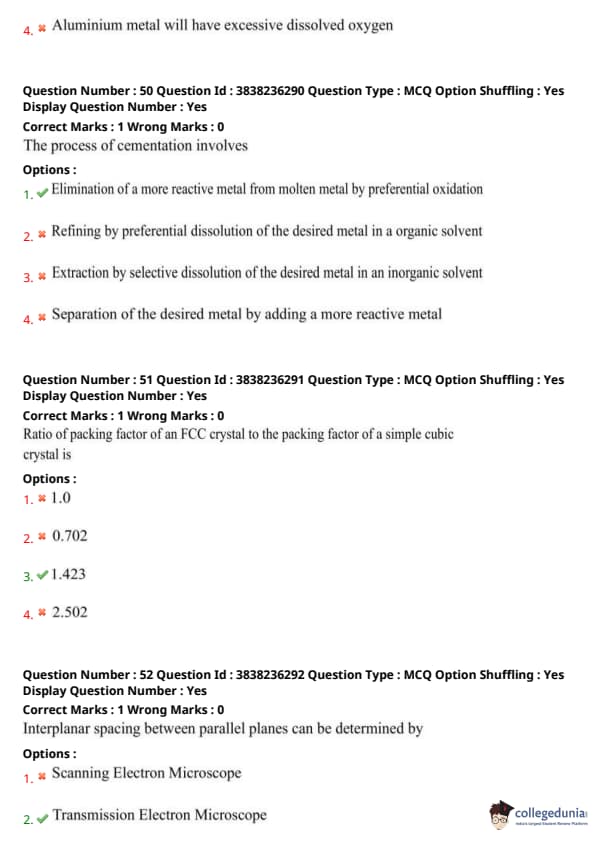
- (D) Aluminium metal will have excessive dissolved oxygen
Correct Answer: (3) Al–Al\(_2\)O\(_3\) line is too low in the Ellingham diagram and need excessively high temperature
View Solution
Question 50:
The process of cementation involves:
- (A) Elimination of a more reactive metal from molten metal by preferential oxidation
- (B) Refining by preferential dissolution of the desired metal in an organic solvent
- (C) Extraction by selective dissolution of the desired metal in an inorganic solvent
- (D) Separation of the desired metal by adding a more reactive metal
Correct Answer: (1) Elimination of a more reactive metal from molten metal by preferential oxidation
View Solution
Question 51:
Ratio of packing factor of an FCC crystal to the packing factor of a simple cubic crystal is:
- (A) 1.0
- (B) 0.702
- (C) 1.423
- (D) 2.502
Question 52:
Interplanar spacing between parallel planes can be determined by:
- (A) Scanning Electron Microscope
- (B) Transmission Electron Microscope
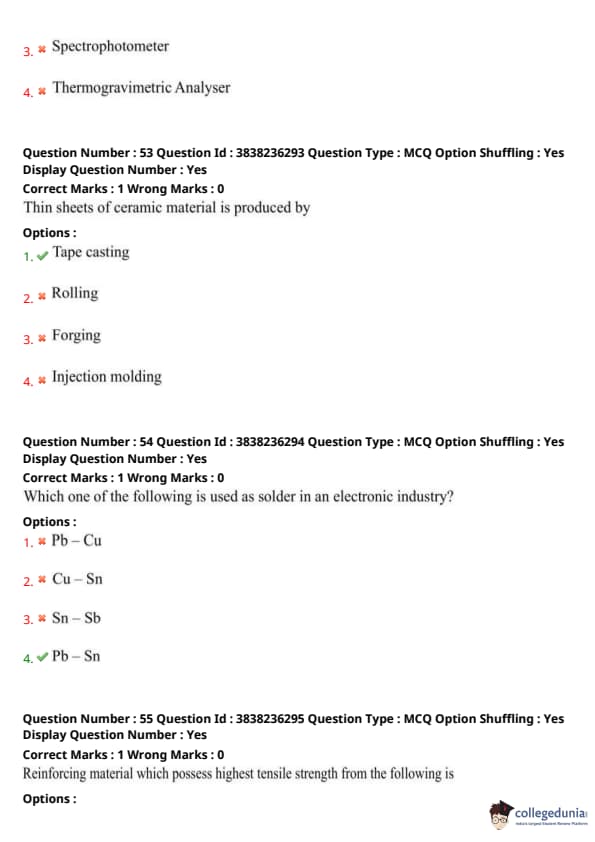
- (C) Spectrophotometer
- (D) Thermogravimetric Analyser
Correct Answer: (2) Transmission Electron Microscope
View Solution
Question 53:
Thin sheets of ceramic material is produced by:
- (A) Tape casting
- (B) Rolling
- (C) Forging
- (D) Injection molding
Question 54:
Which one of the following is used as solder in an electronic industry?
- (A) Pb–Cu
- (B) Cu–Sn
- (C) Sn–Sb
- (D) Pb–Sn
Question 55:
Reinforcing material which possesses highest tensile strength from the following is:
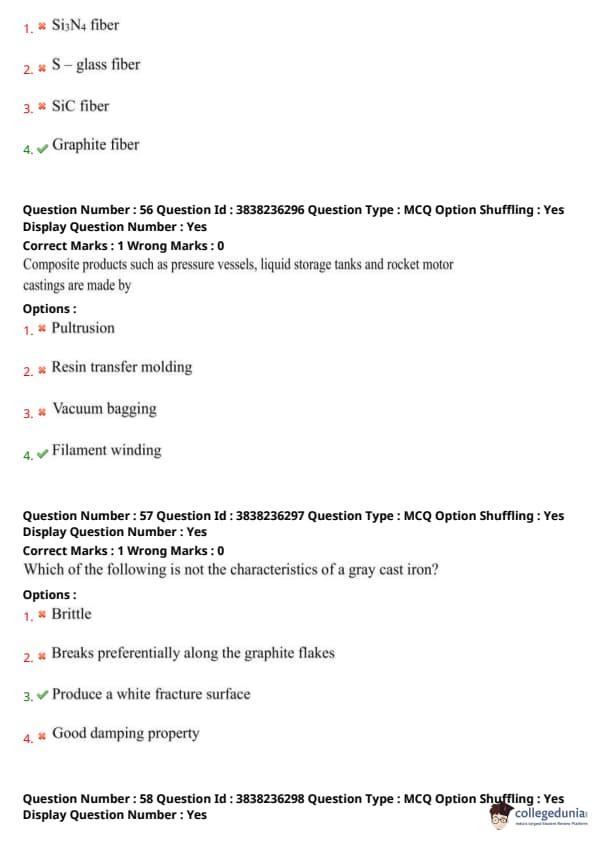
- (A) Si\(_3\)N\(_4\) fiber
- (B) S-glass fiber
- (C) SiC fiber
- (D) Graphite fiber
Question 56:
Composite products such as pressure vessels, liquid storage tanks and rocket motor castings are made by:
- (A) Pultrusion
- (B) Resin transfer molding
- (C) Vacuum bagging
- (D) Filament winding
Question 57:
Which of the following is not the characteristics of a gray cast iron?
- (A) Brittle
- (B) Breaks preferentially along the graphite flakes
- (C) Produce a white fracture surface
- (D) Good damping property
Correct Answer: (3) Produce a white fracture surface
View Solution
Question 58:
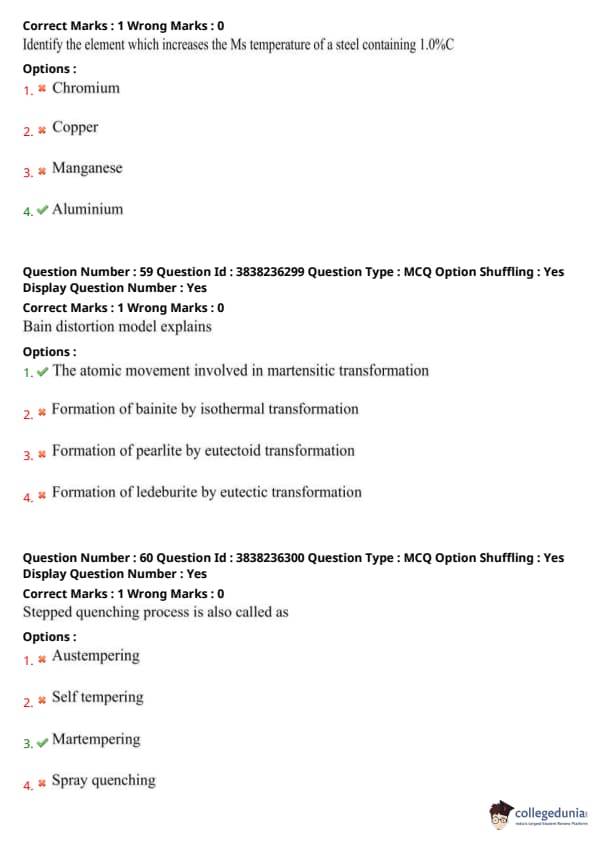
Identify the element which increases the Ms temperature of a steel containing 1.0% C:
- (A) Chromium
- (B) Copper
- (C) Manganese
- (D) Aluminium
Question 59:
Bain distortion model explains:
- (A) The atomic movement involved in martensitic transformation
- (B) Formation of bainite by isothermal transformation
- (C) Formation of pearlite by eutectoid transformation
- (D) Formation of ledeburite by eutectic transformation
Correct Answer: (1) The atomic movement involved in martensitic transformation
View Solution
Question 60:
Stepped quenching process is also called as:
- (A) Austempering
- (B) Self tempering
- (C) Martempering
- (D) Spray quenching
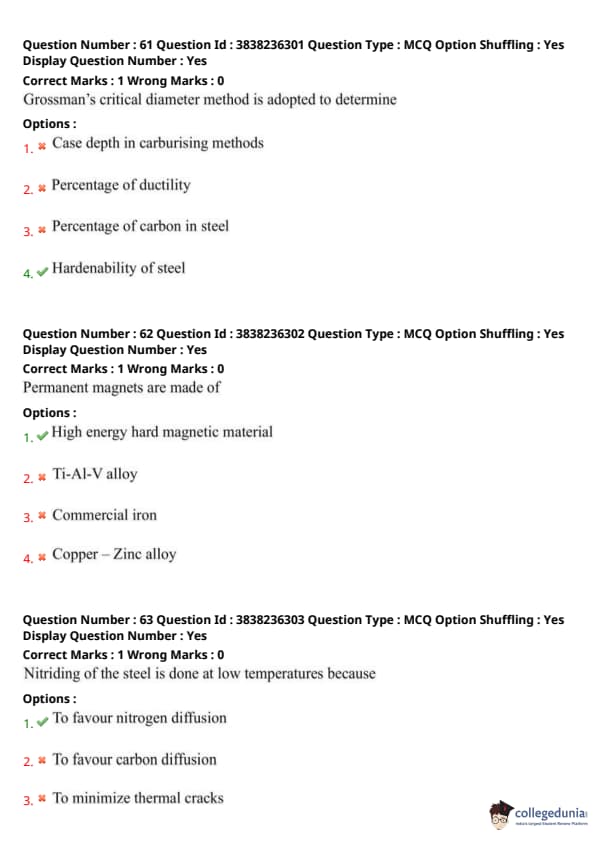
Question 61:
Grossman’s critical diameter method is adopted to determine:
- (A) Case depth in carburising methods
- (B) Percentage of ductility
- (C) Percentage of carbon in steel
- (D) Hardenability of steel
Question 62:
Permanent magnets are made of:
- (A) High energy hard magnetic material
- (B) Ti–Al–V alloy
- (C) Commercial iron
- (D) Copper–Zinc alloy
Correct Answer: (1) High energy hard magnetic material
View Solution
Question 63:
Nitriding of the steel is done at low temperatures because:
- (A) To favour nitrogen diffusion
- (B) To favour carbon diffusion
- (C) To minimize thermal cracks
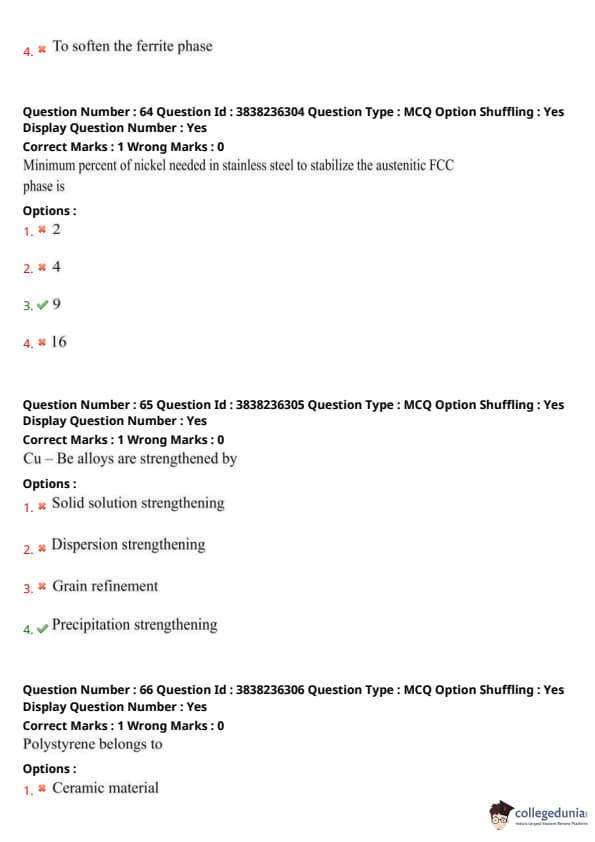
- (D) To soften the ferrite phase
Question 64:
Minimum percent of nickel needed in stainless steel to stabilize the austenitic FCC phase is:
Question 65:
Cu–Be alloys are strengthened by:
- (A) Solid solution strengthening
- (B) Dispersion strengthening
- (C) Grain refinement
- (D) Precipitation strengthening
Question 66:
Polystyrene belongs to:
- (A) Ceramic material
- (B) Composite material
- (C) Thermoplastic material
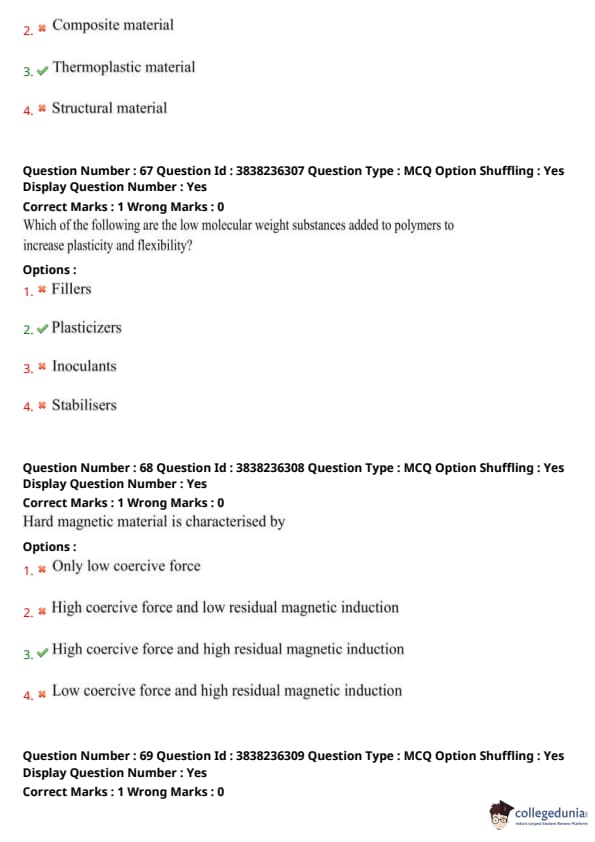
- (D) Structural material
Question 67:
Which of the following are the low molecular weight substances added to polymers to increase plasticity and flexibility?
- (A) Fillers
- (B) Plasticizers
- (C) Inoculants
- (D) Stabilisers
Question 68:
Hard magnetic material is characterised by:
- (A) Only low coercive force
- (B) High coercive force and low residual magnetic induction
- (C) High coercive force and high residual magnetic induction
- (D) Low coercive force and high residual magnetic induction
Correct Answer: (3) High coercive force and high residual magnetic induction
View Solution
Question 69:
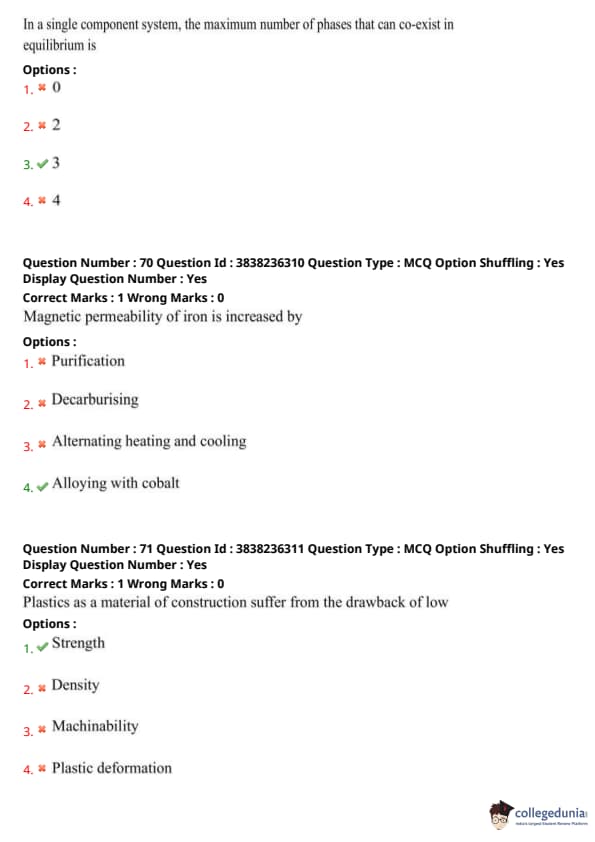
In a single component system, the maximum number of phases that can co-exist in equilibrium is:
Question 70:
Magnetic permeability of iron is increased by:
- (A) Purification
- (B) Decarburising
- (C) Alternating heating and cooling
- (D) Alloying with cobalt
Question 71:
Plastics as a material of construction suffer from the drawback of low:
- (A) Strength
- (B) Density
- (C) Machinability
- (D) Plastic deformation
Question 72:
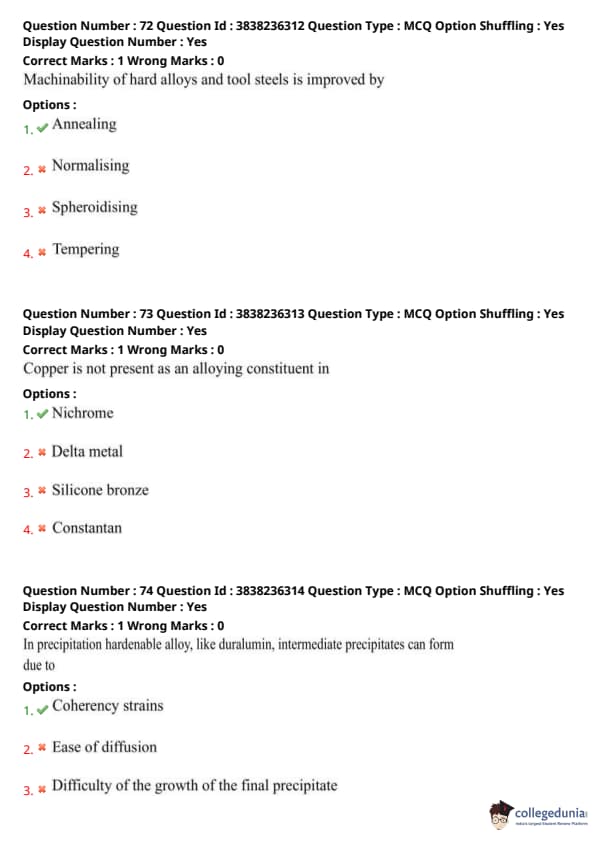
Machinability of hard alloys and tool steels is improved by:
- (A) Annealing
- (B) Normalising
- (C) Spheroidising
- (D) Tempering
Question 73:
Copper is not present as an alloying constituent in:
- (A) Nichrome
- (B) Delta metal
- (C) Silicone bronze
- (D) Constantan
Question 74:
In precipitation hardenable alloy, like duralumin, intermediate precipitates can form due to:
- (A) Coherency strains
- (B) Ease of diffusion
- (C) Difficulty of the growth of the final precipitate
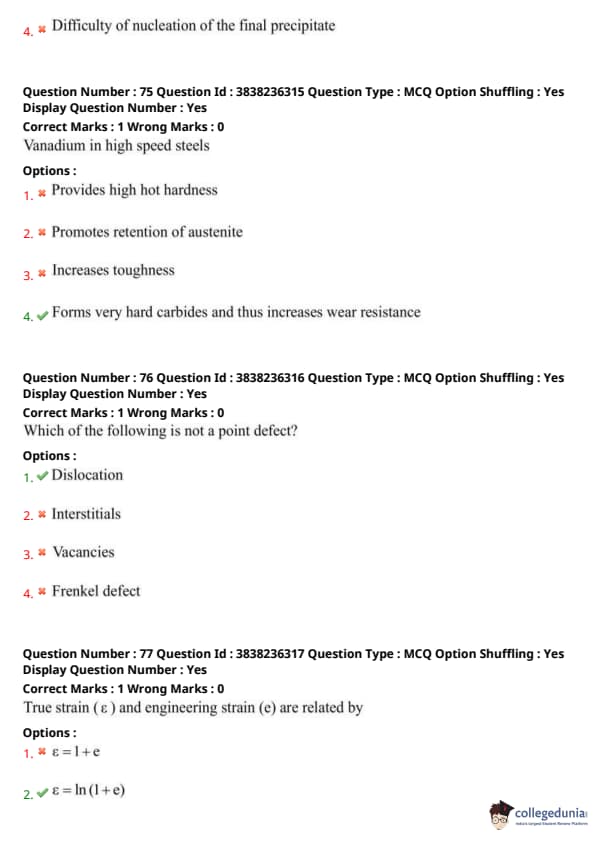
- (D) Difficulty of nucleation of the final precipitate
Question 75:
Vanadium in high speed steels:
- (A) Provides high hot hardness
- (B) Promotes retention of austenite
- (C) Increases toughness
- (D) Forms very hard carbides and thus increases wear resistance
Correct Answer: (4) Forms very hard carbides and thus increases wear resistance
View Solution
Question 76:
Which of the following is not a point defect?
- (A) Dislocation
- (B) Interstitials
- (C) Vacancies
- (D) Frenkel defect
Question 77:
True strain (\( \varepsilon \)) and engineering strain (\( e \)) are related by
- (A) \( \varepsilon = 1 + e \)
- (B) \( \varepsilon = \ln(1 + e) \)
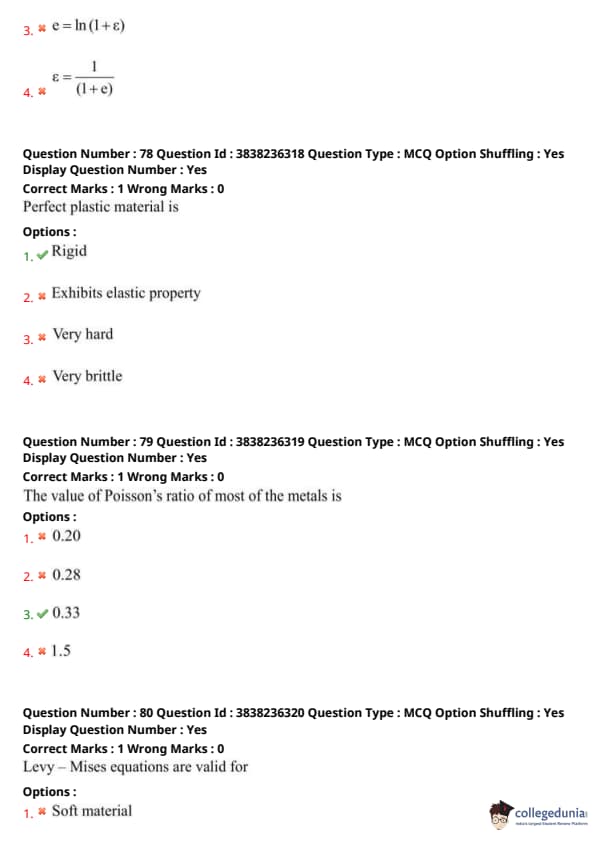
- (C) \( e = \ln(1 + \varepsilon) \)
- (D) \( \varepsilon = \dfrac{1}{1 + e} \)
Question 78:
Perfect plastic material is
- (A) Rigid
- (B) Exhibits elastic property
- (C) Very hard
- (D) Very brittle
Question 79:
The value of Poisson’s ratio of most of the metals is
- (A) \( 0.20 \)
- (B) \( 0.28 \)
- (C) \( 0.33 \)
- (D) \( 1.5 \)
Question 80:
Levy–Mises equations are valid for
- (A) Soft material
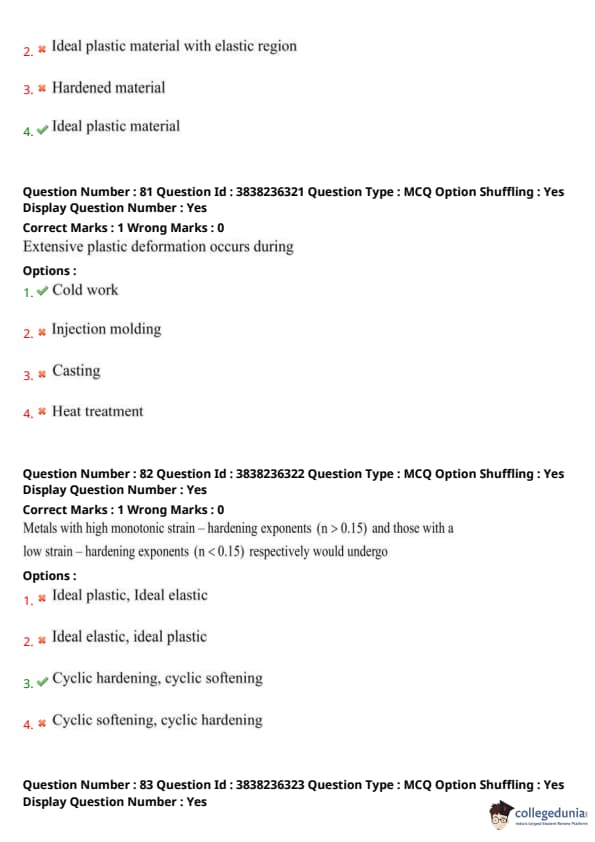
- (B) Ideal plastic material with elastic region
- (C) Hardened material
- (D) Ideal plastic material
Question 81:
Extensive plastic deformation occurs during
- (A) Cold work
- (B) Injection molding
- (C) Casting
- (D) Heat treatment
Question 82:
Metals with high monotonic strain-hardening exponents (\(n > 0.15\)) and those with a low strain-hardening exponent (\(n < 0.15\)) respectively would undergo
- (A) Ideal plastic, Ideal elastic
- (B) Ideal elastic, Ideal plastic
- (C) Cyclic hardening, cyclic softening
- (D) Cyclic softening, cyclic hardening
Correct Answer: (3) Cyclic hardening, cyclic softening
View Solution
Question 83:
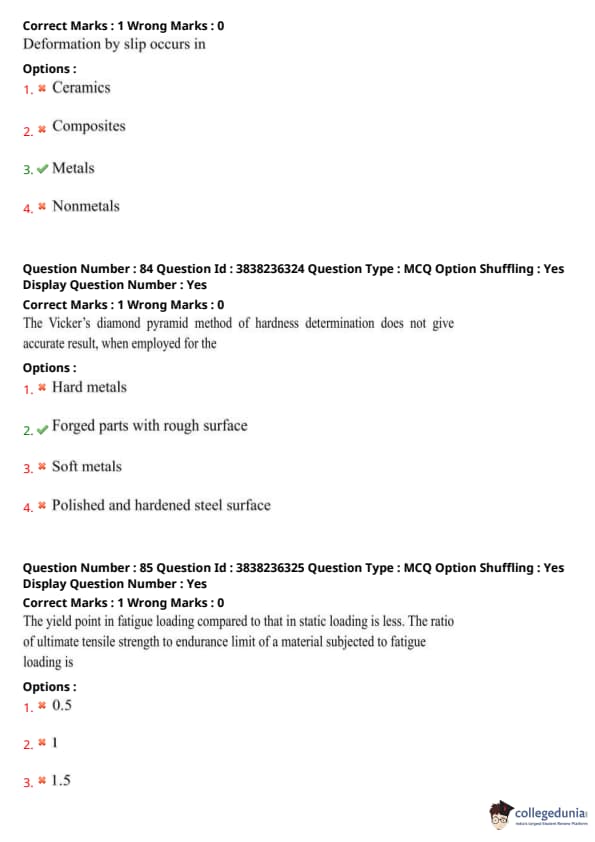
Deformation by slip occurs in
- (A) Ceramics
- (B) Composites
- (C) Metals
- (D) Nonmetals
Question 84:
The Vicker’s diamond pyramid method of hardness determination does not give accurate result, when employed for the
- (A) Hard metals
- (B) Forged parts with rough surface
- (C) Soft metals
- (D) Polished and hardened steel surface
Correct Answer: (2) Forged parts with rough surface
View Solution
Question 85:
The yield point in fatigue loading compared to that in static loading is less. The ratio of ultimate tensile strength to endurance limit of a material subjected to fatigue loading is
- (A) 0.5
- (B) 1
- (C) 1.5
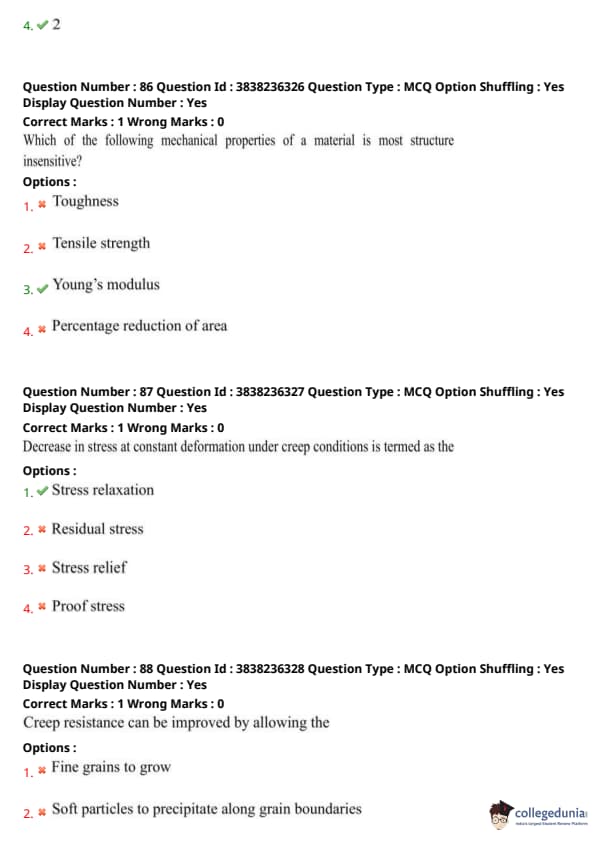
- (D) 2
Question 86:
Which of the following mechanical properties of a material is most structure insensitive?
- (A) Toughness
- (B) Tensile strength
- (C) Young’s modulus
- (D) Percentage reduction of area
Question 87:
Decrease in stress at constant deformation under creep conditions is termed as the
- (A) Stress relaxation
- (B) Residual stress
- (C) Stress relief
- (D) Proof stress
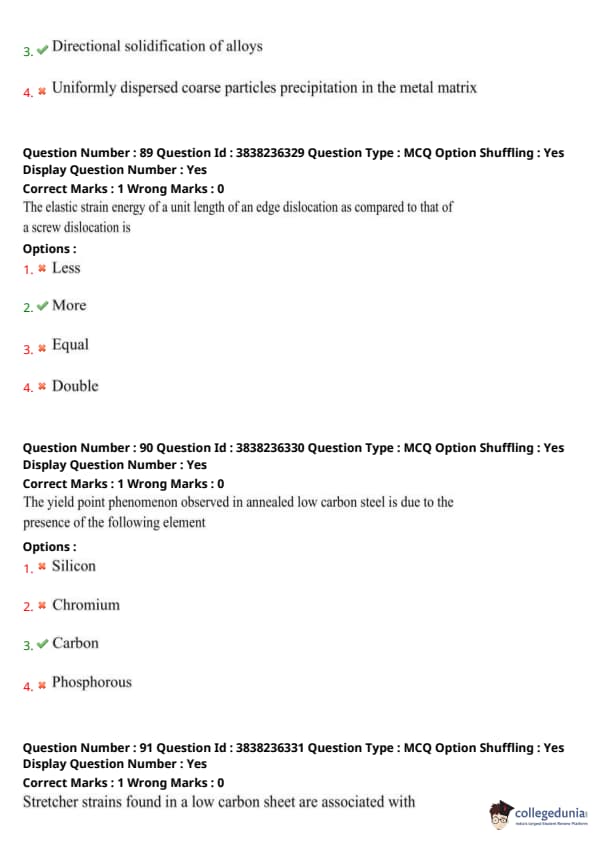
Question 88:
Creep resistance can be improved by allowing the
- (A) Fine grains to grow
- (B) Soft particles to precipitate along grain boundaries
- (C) Directional solidification of alloys
- (D) Uniformly dispersed coarse particles precipitation in the metal matrix
Correct Answer: (3) Directional solidification of alloys
View Solution
Question 89:
The elastic strain energy of a unit length of an edge dislocation as compared to that of a screw dislocation is
- (A) Less
- (B) More
- (C) Equal
- (D) Double
Question 90:
The yield point phenomenon observed in annealed low carbon steel is due to the presence of the following element
- (A) Silicon
- (B) Chromium
- (C) Carbon
- (D) Phosphorous
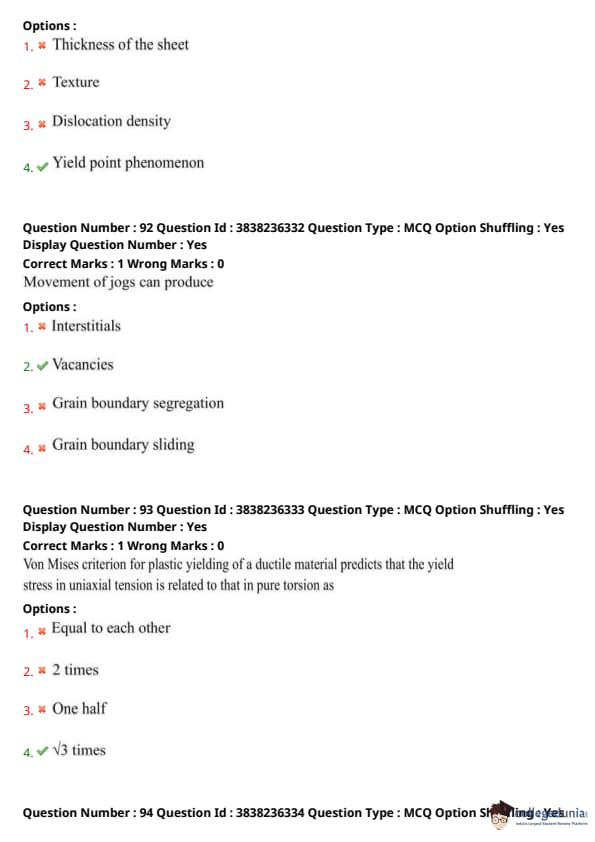
Question 91:
Stretcher strains found in a low carbon sheet are associated with
- (A) Thickness of the sheet
- (B) Texture
- (C) Dislocation density
- (D) Yield point phenomenon
Question 92:
Movement of jogs can produce
- (A) Interstitials
- (B) Vacancies
- (C) Grain boundary segregation
- (D) Grain boundary sliding
Question 93:
Von Mises criterion for plastic yielding of a ductile material predicts that the yield stress in uniaxial tension is related to that in pure torsion as
- (A) Equal to each other
- (B) 2 times
- (C) One half
- (D) \( \sqrt{3} \) times
Question 94:
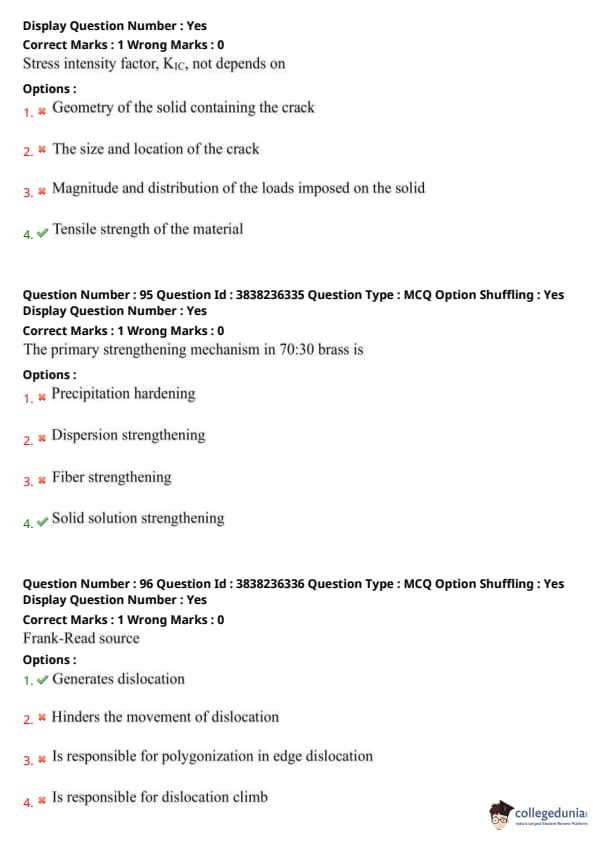
Stress intensity factor, \( K_{IC} \), not depends on
- (A) Geometry of the solid containing the crack
- (B) The size and location of the crack
- (C) Magnitude and distribution of the loads imposed on the solid
- (D) Tensile strength of the material
Correct Answer: (4) Tensile strength of the material
View Solution
Question 95:
The primary strengthening mechanism in 70:30 brass is
- (A) Precipitation hardening
- (B) Dispersion strengthening
- (C) Fiber strengthening
- (D) Solid solution strengthening
Question 96:
Frank–Read source
- (A) Generates dislocation
- (B) Hinders the movement of dislocation
- (C) Is responsible for polygonization in edge dislocation
- (D) Is responsible for dislocation climb
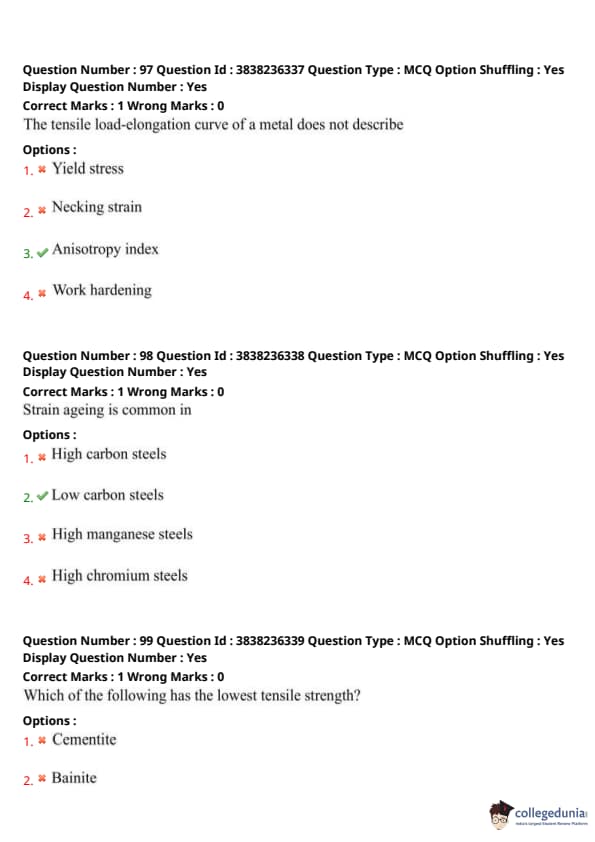
Question 97:
The tensile load-elongation curve of a metal does not describe
- (A) Yield stress
- (B) Necking strain
- (C) Anisotropy index
- (D) Work hardening
Question 98:
Strain ageing is common in
- (A) High carbon steels
- (B) Low carbon steels
- (C) High manganese steels
- (D) High chromium steels
Question 99:
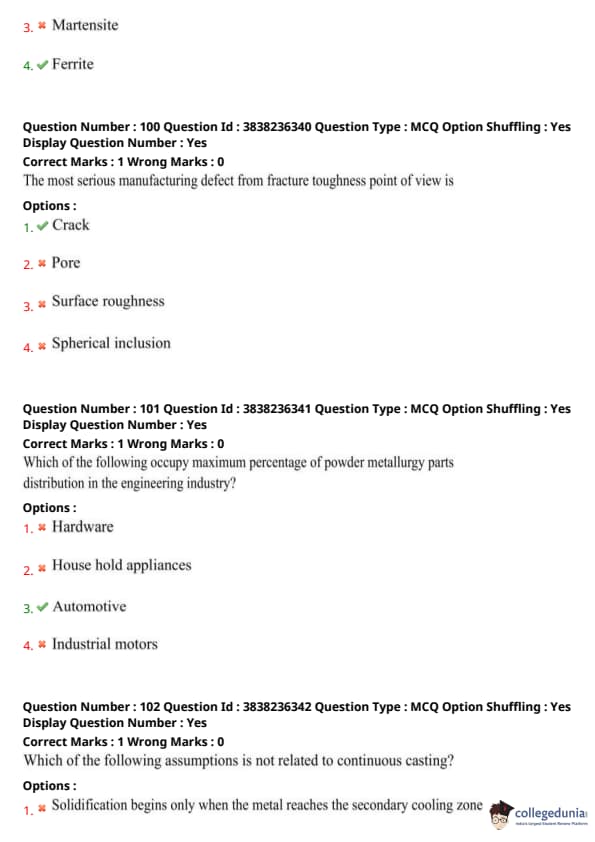
Which of the following has the lowest tensile strength?
- (A) Cementite
- (B) Bainite
- (C) Martensite
- (D) Ferrite
Question 100:
The most serious manufacturing defect from fracture toughness point of view is
- (A) Crack
- (B) Pore
- (C) Surface roughness
- (D) Spherical inclusion
Question 101:
Which of the following occupy maximum percentage of powder metallurgy parts distribution in the engineering industry?
- (A) Hardware
- (B) Household appliances
- (C) Automotive
- (D) Industrial motors
Question 102:
Which of the following assumptions is not related to continuous casting?
- (A) Solidification begins only when the metal reaches the secondary cooling zone
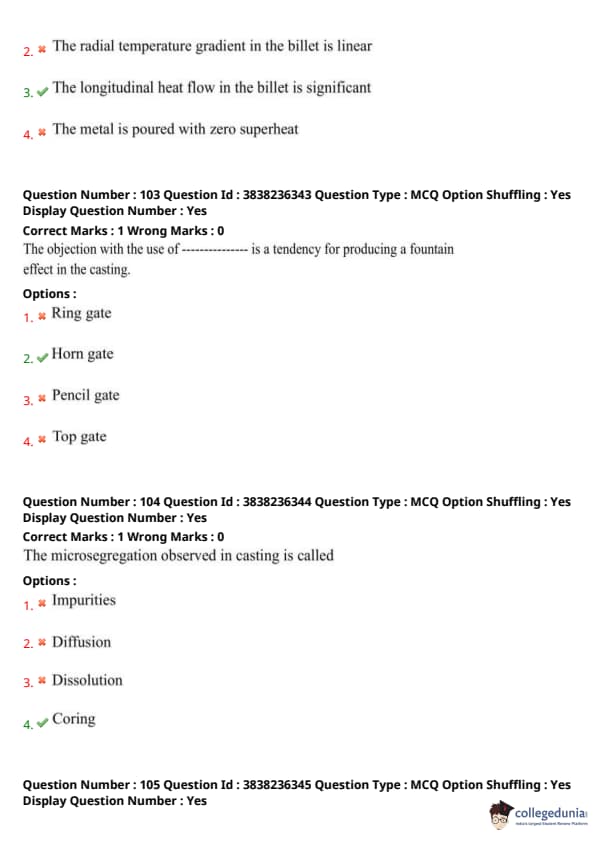
- (B) The radial temperature gradient in the billet is linear
- (C) The longitudinal heat flow in the billet is significant
- (D) The metal is poured with zero superheat
Correct Answer: (3) The longitudinal heat flow in the billet is significant
View Solution
Question 103:
The objection with the use of ------------- is a tendency for producing a fountain effect in the casting.
- (A) Ring gate
- (B) Horn gate
- (C) Pencil gate
- (D) Top gate
Question 104:
The microsegregation observed in casting is called
- (A) Impurities
- (B) Diffusion
- (C) Dissolution
- (D) Coring
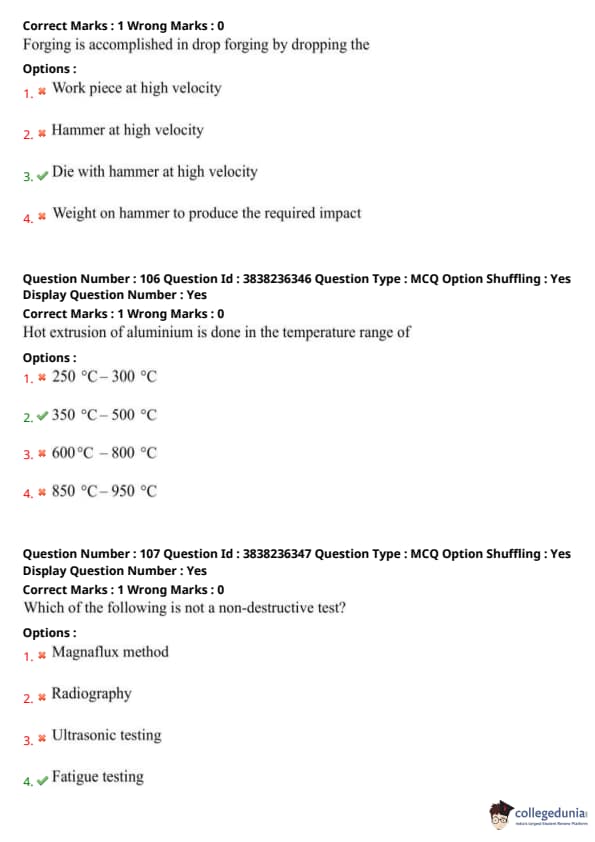
Question 105:
Forging is accomplished in drop forging by dropping the
- (A) Work piece at high velocity
- (B) Hammer at high velocity
- (C) Die with hammer at high velocity
- (D) Weight on hammer to produce the required impact
Correct Answer: (3) Die with hammer at high velocity
View Solution
Question 106:
Hot extrusion of aluminium is done in the temperature range of
- (A) \(250^\circ C - 300^\circ C\)
- (B) \(350^\circ C - 500^\circ C\)
- (C) \(600^\circ C - 800^\circ C\)
- (D) \(850^\circ C - 950^\circ C\)
Correct Answer: (2) \(350^\circ \text{C} - 500^\circ \text{C}\)
View Solution
Question 107:
Which of the following is \textbf{not} a non-destructive test?
- (A) Magnaflux method
- (B) Radiography
- (C) Ultrasonic testing
- (D) Fatigue testing
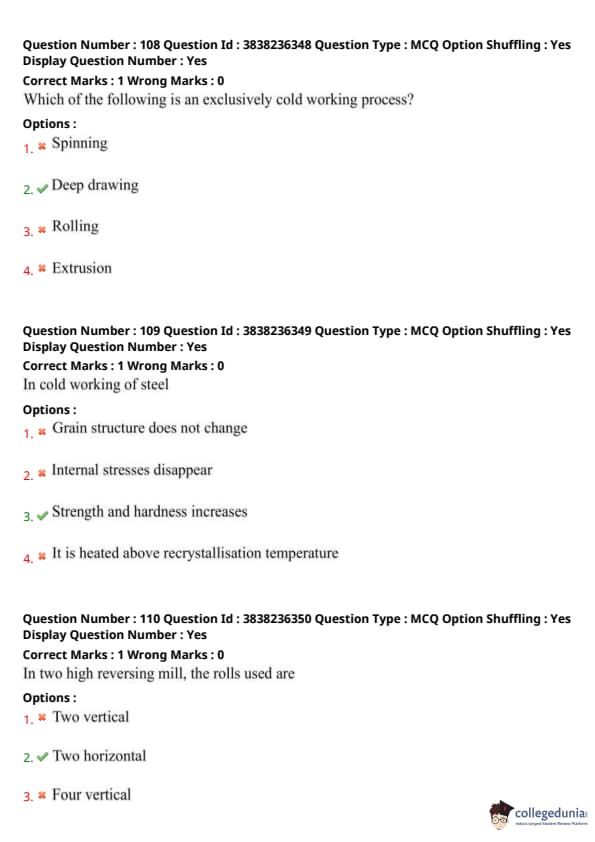
Question 108:
Which of the following is an exclusively cold working process?
- (A) Spinning
- (B) Deep drawing
- (C) Rolling
- (D) Extrusion
Question 109:
In cold working of steel
- (A) Grain structure does not change
- (B) Internal stresses disappear
- (C) Strength and hardness increases
- (D) It is heated above recrystallisation temperature
Correct Answer: (3) Strength and hardness increases
View Solution
Question 110:
In two high reversing mill, the rolls used are
- (A) Two vertical
- (B) Two horizontal
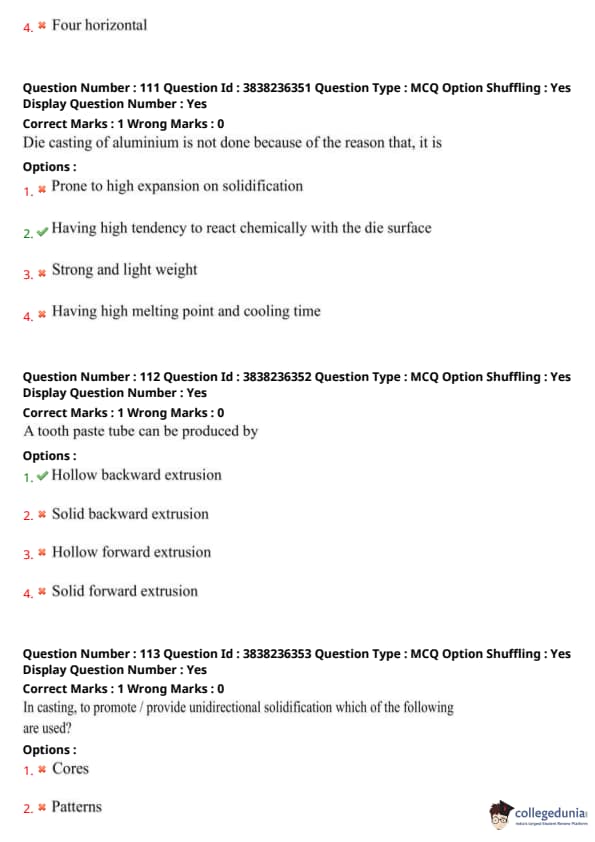
- (C) Four vertical
- (D) Four horizontal
Question 111:
Die casting of aluminium is not done because of the reason that, it is
- (A) Prone to high expansion on solidification
- (B) Having high tendency to react chemically with the die surface
- (C) Strong and light weight
- (D) Having high melting point and cooling time
Correct Answer: (2) Having high tendency to react chemically with the die surface
View Solution
Question 112:
A tooth paste tube can be produced by
- (A) Hollow backward extrusion
- (B) Solid backward extrusion
- (C) Hollow forward extrusion
- (D) Solid forward extrusion
Question 113:
In casting, to promote / provide unidirectional solidification which of the following are used?
- (A) Cores
- (B) Patterns
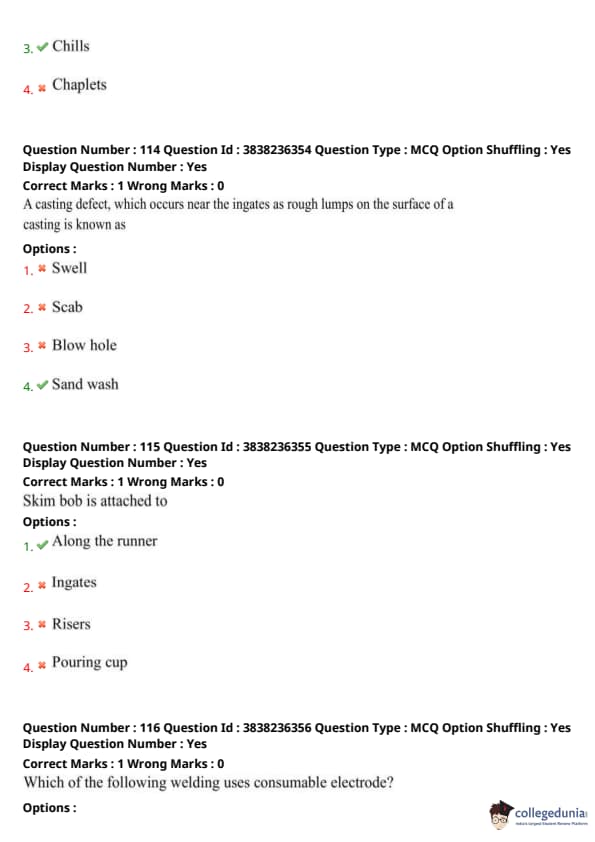
- (C) Chills
- (D) Chaplets
Question 114:
A casting defect, which occurs near the ingates as rough lumps on the surface of a casting is known as
- (A) Swell
- (B) Scab
- (C) Blow hole
- (D) Sand wash
Question 115:
Skim bob is attached to
- (A) Along the runner
- (B) Ingates
- (C) Risers
- (D) Pouring cup
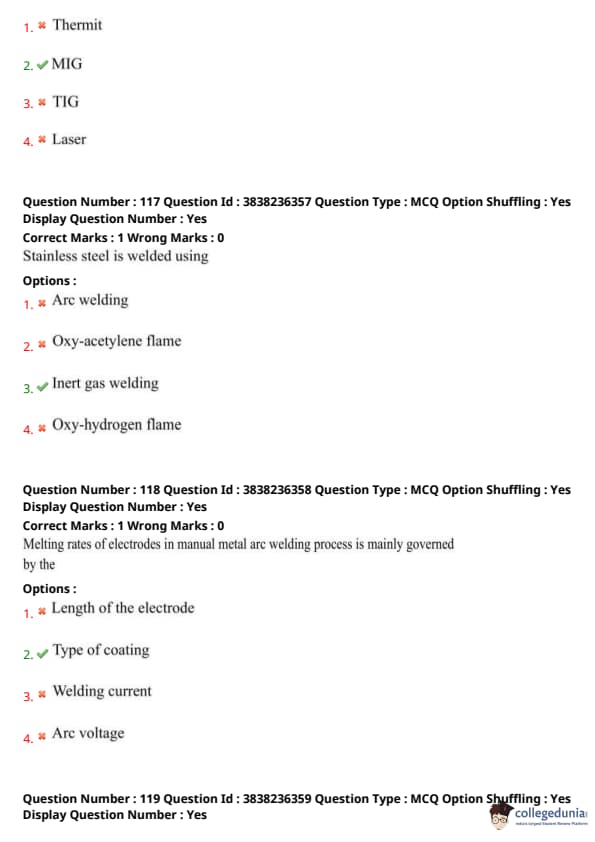
Question 116:
Which of the following welding uses consumable electrode?
- (A) Thermit
- (B) MIG
- (C) TIG
- (D) Laser
Question 117:
Stainless steel is welded using
- (A) Arc welding
- (B) Oxy-acetylene flame
- (C) Inert gas welding
- (D) Oxy-hydrogen flame
Question 118:
Melting rates of electrodes in manual metal arc welding process is mainly governed by the
- (A) Length of the electrode
- (B) Type of coating
- (C) Welding current
- (D) Arc voltage
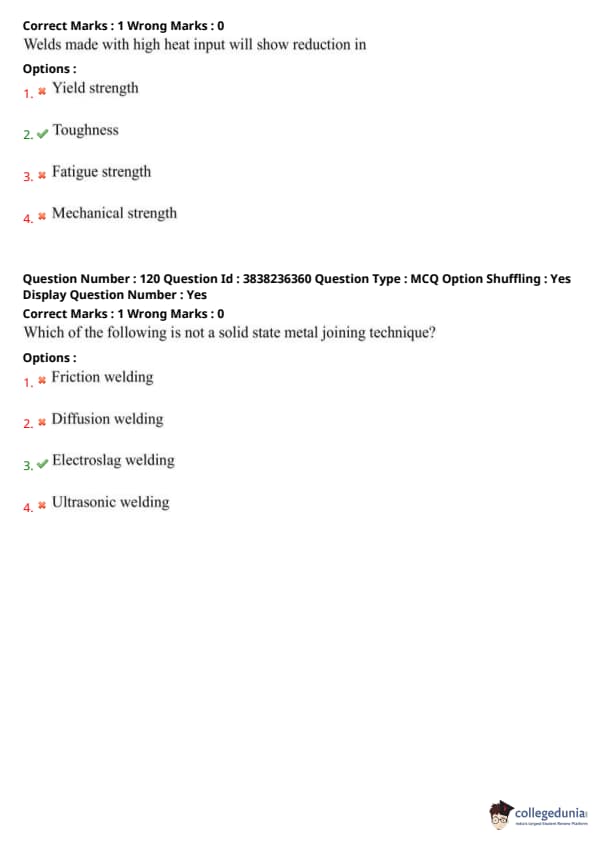
Question 119:
Welds made with high heat input will show reduction in
- (A) Yield strength
- (B) Toughness
- (C) Fatigue strength
- (D) Mechanical strength
Question 120:
Which of the following is not a solid state metal joining technique?
- (A) Friction welding
- (B) Diffusion welding
- (C) Electroslag welding
- (D) Ultrasonic welding









Comments