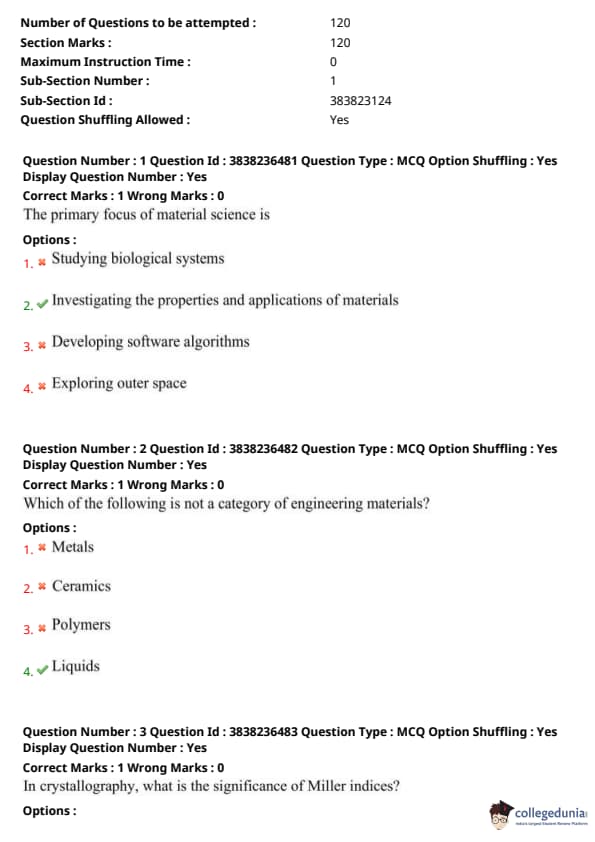
TS PGECET 2024 Nano Technology Question Paper is available for download here. Jawaharlal Nehru Technological University Hyderabad on behalf of Telangana Council of Higher Education (TGCHE) conducted TS PGECET 2024 Nano Technology on June 13 in Shift 2 from 2 PM to 4 PM. TS PGECET Question Paper 2024 consists of 120 MCQ-based questions in total carrying 1 mark each to be attempted in the duration of 2 hours.
TS PGECET 2024 Nano Technology Question Paper with Answer Key PDF
Question 1:
The primary focus of material science is:
- (A) Studying biological systems
- (B) Investigating the properties and applications of materials
- (C) Developing software algorithms
- (D) Exploring outer space
Question 2:
Which of the following is not a category of engineering materials?
- (A) Metals
- (B) Ceramics
- (C) Polymers
- (D) Liquids
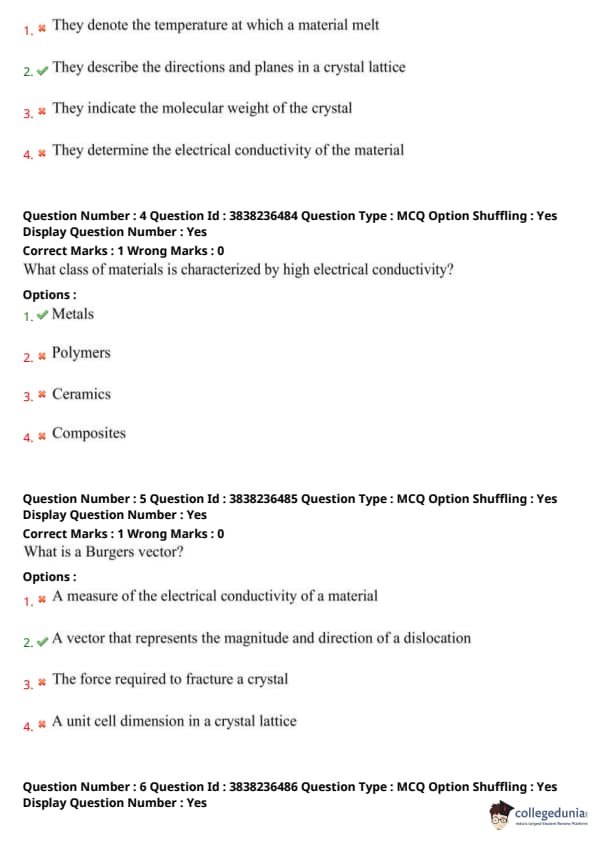
Question 3:
In crystallography, what is the significance of Miller indices?
- (A) They denote the temperature at which a material melts
- (B) They describe the directions and planes in a crystal lattice
- (C) They indicate the molecular weight of the crystal
- (D) They determine the electrical conductivity of the material
Question 4:
What class of materials is characterized by high electrical conductivity?
- (A) Metals
- (B) Polymers
- (C) Ceramics
- (D) Composites
Question 5:
What is a Burgers vector?
- (A) A measure of the electrical conductivity of a material
- (B) A vector that represents the magnitude and direction of a dislocation
- (C) The force required to fracture a crystal
- (D) A unit cell dimension in a crystal lattice
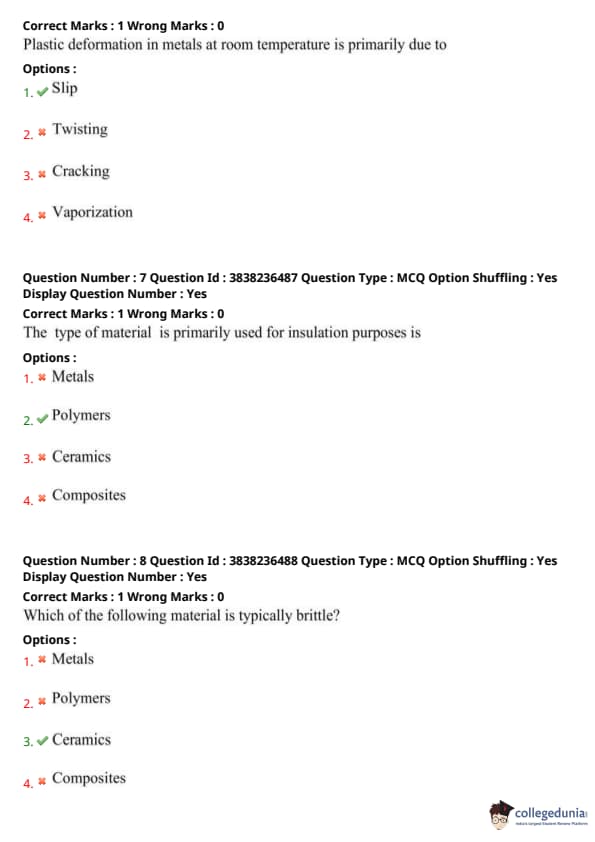
Question 6:
Plastic deformation in metals at room temperature is primarily due to:
- (A) Slip
- (B) Twisting
- (C) Cracking
- (D) Vaporization
Question 7:
The type of material primarily used for insulation purposes is:
- (A) Metals
- (B) Polymers
- (C) Ceramics
- (D) Composites
Question 8:
Which of the following materials is typically brittle?
- (A) Metals
- (B) Polymers
- (C) Ceramics
- (D) Composites
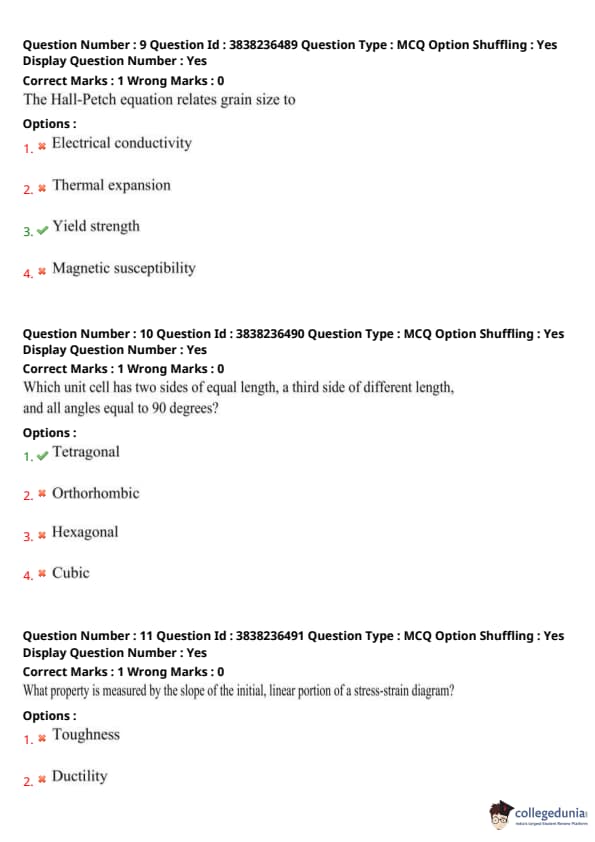
Question 9:
The Hall-Petch equation relates grain size to:
- (A) Electrical conductivity
- (B) Thermal expansion
- (C) Yield strength
- (D) Magnetic susceptibility
Question 10:
Which unit cell has two sides of equal length, a third side of different length, and all angles equal to 90 degrees?
- (A) Tetragonal
- (B) Orthorhombic
- (C) Hexagonal
- (D) Cubic
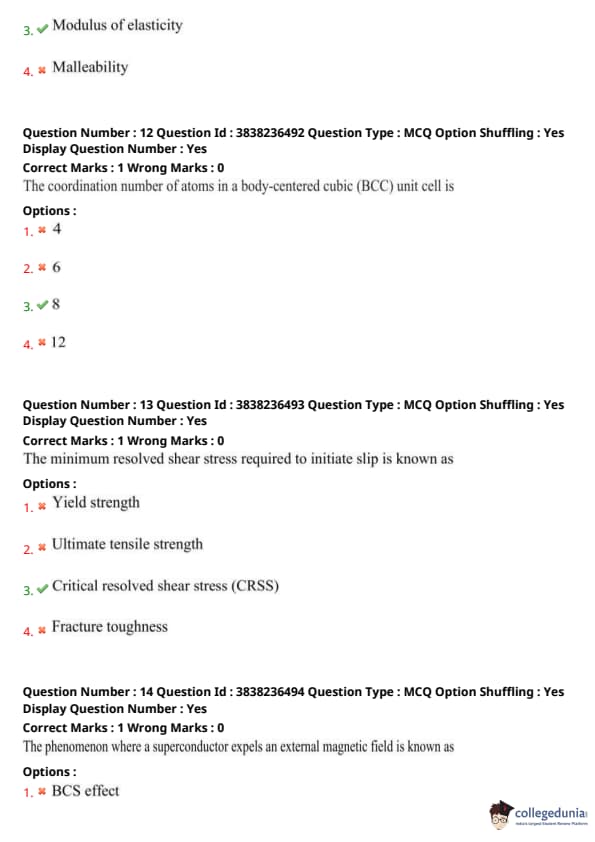
Question 11:
What property is measured by the slope of the initial, linear portion of a stress-strain diagram?
- (A) Toughness
- (B) Ductility
- (C) Modulus of elasticity
- (D) Malleability
Question 12:
The coordination number of atoms in a body-centered cubic (BCC) unit cell is:
Question 13:
The minimum resolved shear stress required to initiate slip is known as:
- (A) Yield strength
- (B) Ultimate tensile strength
- (C) Critical resolved shear stress (CRSS)
- (D) Fracture toughness
Question 14:
The phenomenon where a superconductor expels an external magnetic field is known as:
- (A) BCS effect
- (B) Meissner effect
- (C) Josephson effect
- (D) Hall effect
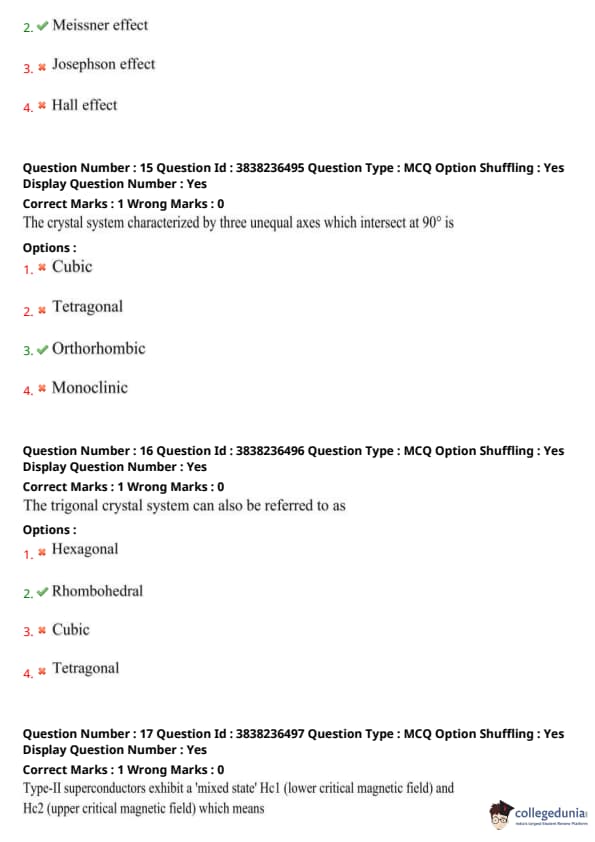
Question 15:
The crystal system characterized by three unequal axes which intersect at 90° is:
- (A) Cubic
- (B) Tetragonal
- (C) Orthorhombic
- (D) Monoclinic
Question 16:
The trigonal crystal system can also be referred to as:
- (A) Hexagonal
- (B) Rhombohedral
- (C) Cubic
- (D) Tetragonal
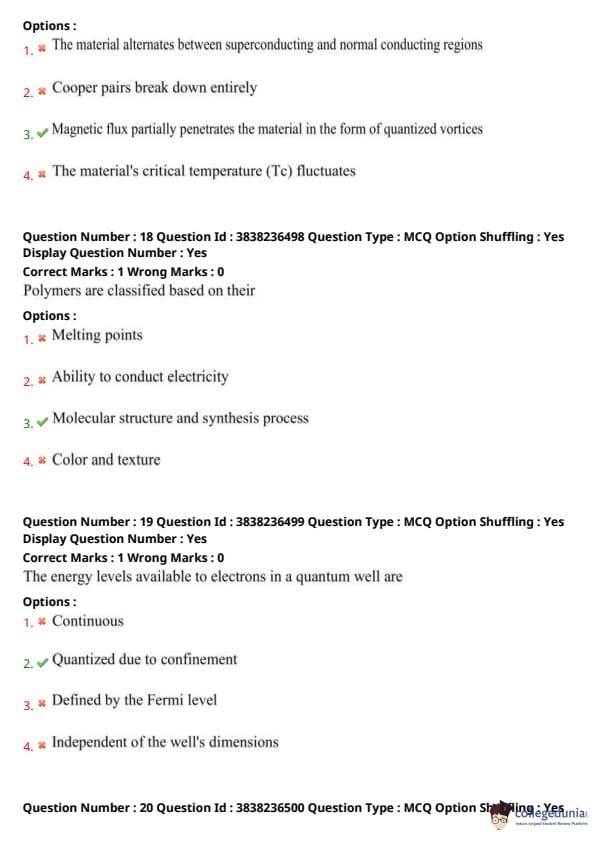
Question 17:
Type-II superconductors exhibit a 'mixed state' between \( H_{c1} \) (lower critical magnetic field) and \( H_{c2} \) (upper critical magnetic field), which means:
- (A) The material alternates between superconducting and normal conducting regions
- (B) Cooper pairs break down entirely
- (C) Magnetic flux partially penetrates the material in the form of quantized vortices
- (D) The material's critical temperature (Tc) fluctuates
Question 18:
Polymers are classified based on their:
- (A) Melting points
- (B) Ability to conduct electricity
- (C) Molecular structure and synthesis process
- (D) Color and texture
Question 19:
The energy levels available to electrons in a quantum well are:
- (A) Continuous
- (B) Quantized due to confinement
- (C) Defined by the Fermi level
- (D) Independent of the well's dimensions
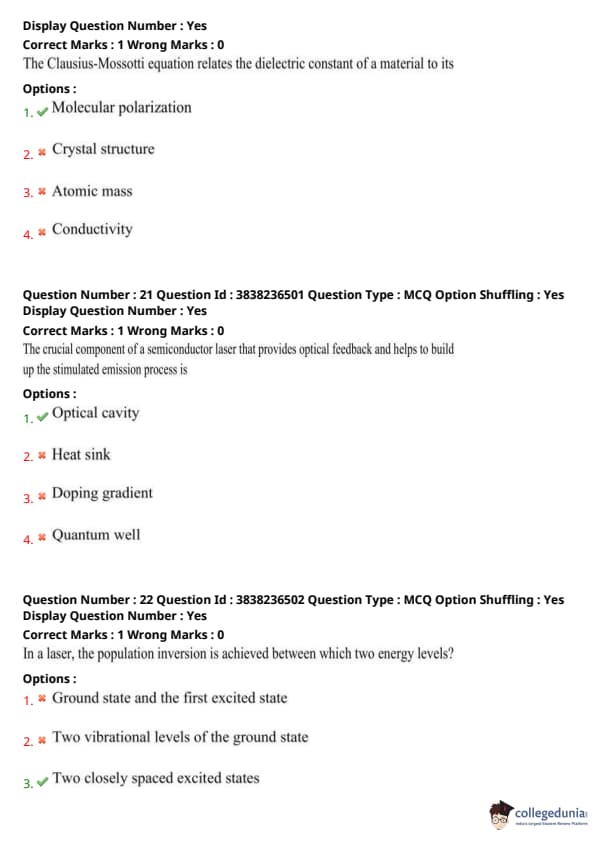
Question 20:
The Clausius-Mossotti equation relates the dielectric constant of a material to its:
- (A) Molecular polarization
- (B) Crystal structure
- (C) Atomic mass
- (D) Conductivity
Question 21:
The crucial component of a semiconductor laser that provides optical feedback and helps to build up the stimulated emission process is:
- (A) Optical cavity
- (B) Heat sink
- (C) Doping gradient
- (D) Quantum well
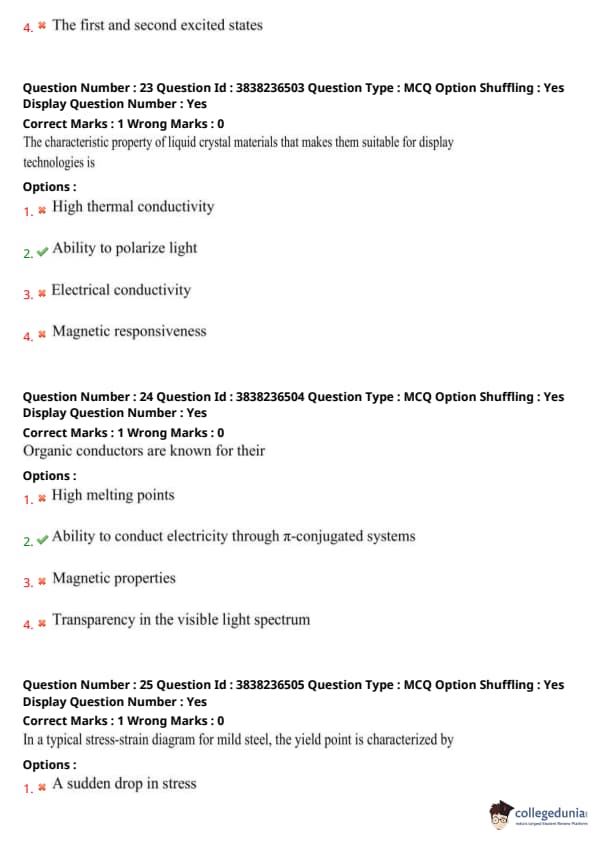
Question 22:
In a laser, the population inversion is achieved between which two energy levels?
- (A) Ground state and the first excited state
- (B) Two vibrational levels of the ground state
- (C) Two closely spaced excited states
- (D) The first and second excited states
Question 23:
The characteristic property of liquid crystal materials that makes them suitable for display technologies is:
- (A) High thermal conductivity
- (B) Ability to polarize light
- (C) Electrical conductivity
- (D) Magnetic responsiveness
Question 24:
Organic conductors are known for their:
- (A) High melting points
- (B) Ability to conduct electricity through \(\pi\)-conjugated systems
- (C) Magnetic properties
- (D) Transparency in the visible light spectrum
Question 25:
In a typical stress-strain diagram for mild steel, the yield point is characterized by:
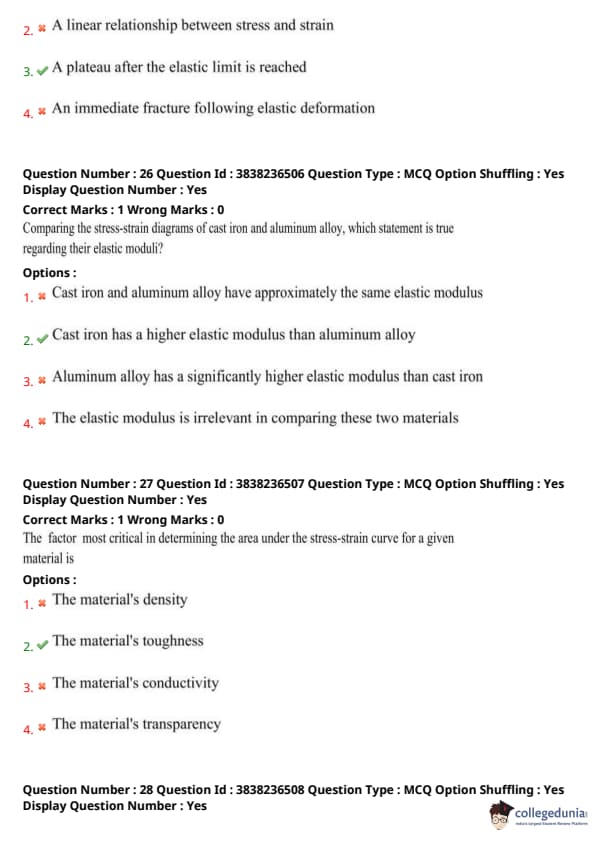
- (A) A sudden drop in stress
- (B) A linear relationship between stress and strain
- (C) A plateau after the elastic limit is reached
- (D) An immediate fracture following elastic deformation
Question 26:
Comparing the stress-strain diagrams of cast iron and aluminum alloy, which statement is true regarding their elastic moduli?
- (A) Cast iron and aluminum alloy have approximately the same elastic modulus
- (B) Cast iron has a higher elastic modulus than aluminum alloy
- (C) Aluminum alloy has a significantly higher elastic modulus than cast iron
- (D) The elastic modulus is irrelevant in comparing these two materials
Question 27:
The factor most critical in determining the area under the stress-strain curve for a given material is:
- (A) The material's density
- (B) The material's toughness
- (C) The material's conductivity
- (D) The material's transparency
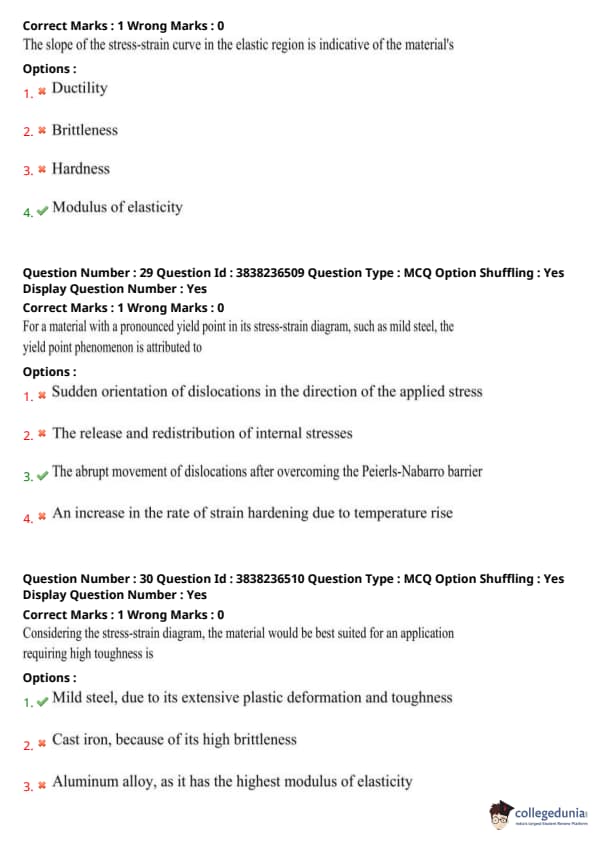
Question 28:
The slope of the stress-strain curve in the elastic region is indicative of the material's:
- (A) Ductility
- (B) Brittleness
- (C) Hardness
- (D) Modulus of elasticity
Question 29:
For a material with a pronounced yield point in its stress-strain diagram, such as mild steel, the yield point phenomenon is attributed to:
- (A) Sudden orientation of dislocations in the direction of the applied stress
- (B) The release and redistribution of internal stresses
- (C) The abrupt movement of dislocations after overcoming the Peierls-Nabarro barrier
- (D) An increase in the rate of strain hardening due to temperature rise
Question 30:
Considering the stress-strain diagram, the material would be best suited for an application requiring high toughness is:
- (A) Mild steel, due to its extensive plastic deformation and toughness
- (B) Cast iron, because of its high brittleness
- (C) Aluminum alloy, as it has the highest modulus of elasticity
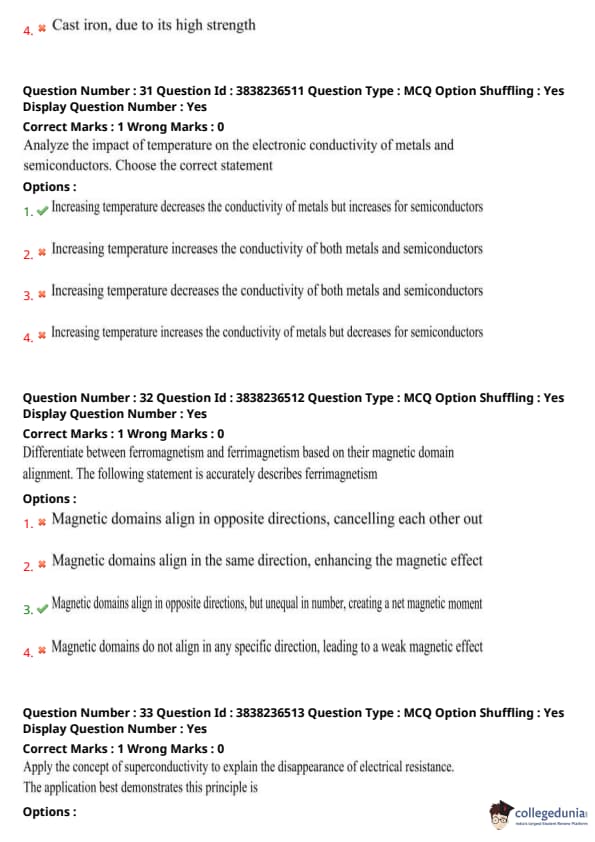
- (D) Cast iron, due to its high strength
Question 31:
Analyze the impact of temperature on the electronic conductivity of metals and semiconductors. Choose the correct statement:
- (A) Increasing temperature decreases the conductivity of metals but increases for semiconductors
- (B) Increasing temperature increases the conductivity of both metals and semiconductors
- (C) Increasing temperature decreases the conductivity of both metals and semiconductors
- (D) Increasing temperature increases the conductivity of metals but decreases for semiconductors
Question 32:
Differentiate between ferromagnetism and ferrimagnetism based on their magnetic domain alignment. The following statement accurately describes ferrimagnetism:
- (A) Magnetic domains align in opposite directions, cancelling each other out
- (B) Magnetic domains align in the same direction, enhancing the magnetic effect
- (C) Magnetic domains align in opposite directions, but unequal in number, creating a net magnetic moment
- (D) Magnetic domains do not align in any specific direction, leading to a weak magnetic effect
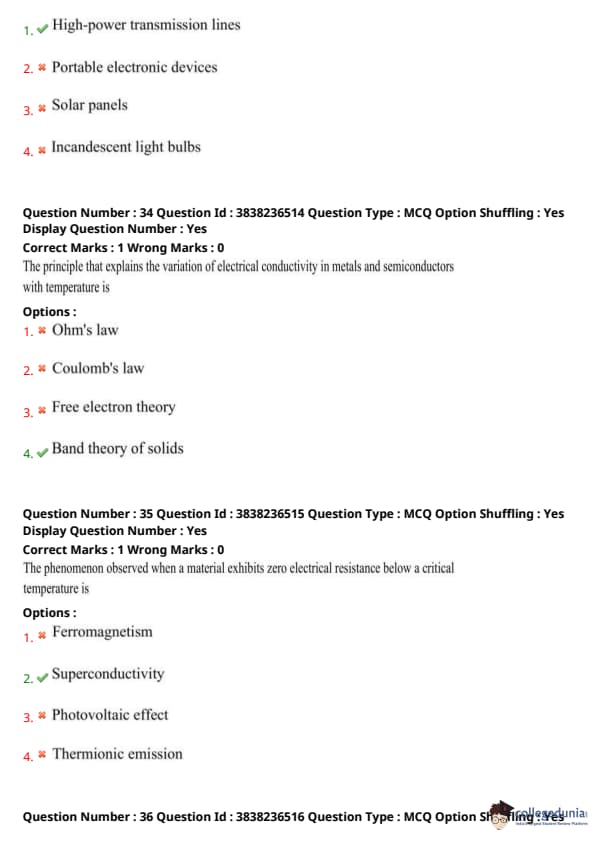
Question 33:
Apply the concept of superconductivity to explain the disappearance of electrical resistance. The application that best demonstrates this principle is:
- (A) High-power transmission lines
- (B) Portable electronic devices
- (C) Solar panels
- (D) Incandescent light bulbs
Question 34:
The principle that explains the variation of electrical conductivity in metals and semiconductors with temperature is:
- (A) Ohm's law
- (B) Coulomb's law
- (C) Free electron theory
- (D) Band theory of solids
Question 35:
The phenomenon observed when a material exhibits zero electrical resistance below a critical temperature is:
- (A) Ferromagnetism
- (B) Superconductivity
- (C) Photovoltaic effect
- (D) Thermionic emission
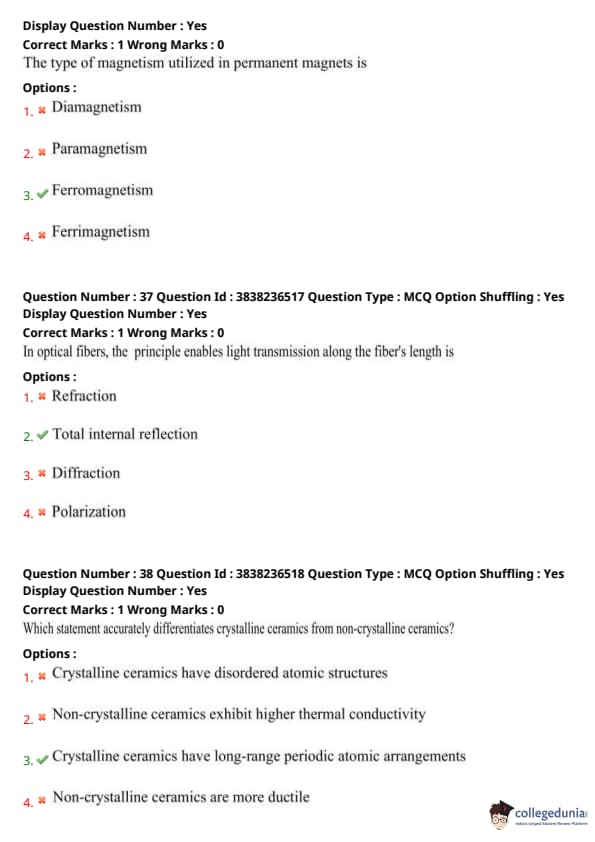
Question 36:
The type of magnetism utilized in permanent magnets is:
- (A) Diamagnetism
- (B) Paramagnetism
- (C) Ferromagnetism
- (D) Ferrimagnetism
Question 37:
In optical fibers, the principle that enables light transmission along the fiber's length is:
- (A) Refraction
- (B) Total internal reflection
- (C) Diffraction
- (D) Polarization
Question 38:
Which statement accurately differentiates crystalline ceramics from non-crystalline ceramics?
- (A) Crystalline ceramics have disordered atomic structures
- (B) Non-crystalline ceramics exhibit higher thermal conductivity
- (C) Crystalline ceramics have long-range periodic atomic arrangements
- (D) Non-crystalline ceramics are more ductile
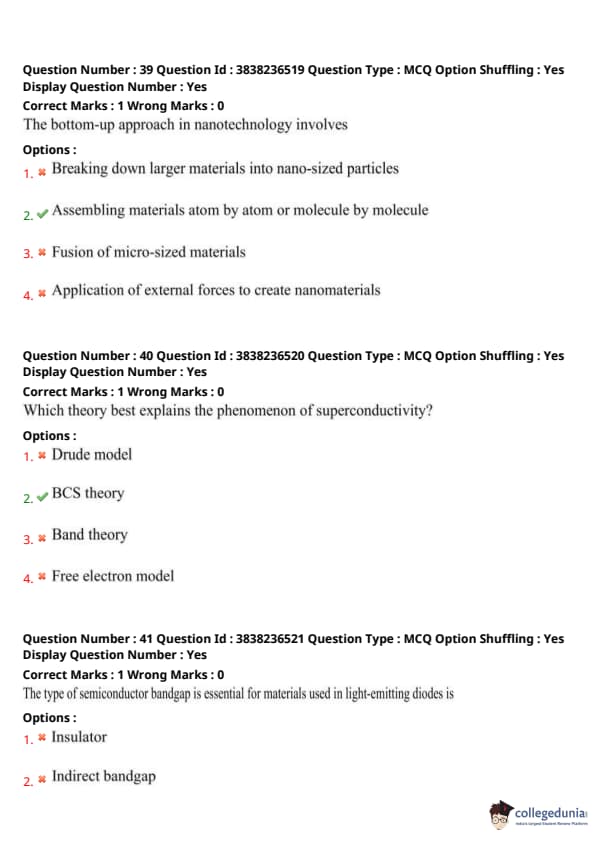
Question 39:
The bottom-up approach in nanotechnology involves:
- (A) Breaking down larger materials into nano-sized particles
- (B) Assembling materials atom by atom or molecule by molecule
- (C) Fusion of micro-sized materials
- (D) Application of external forces to create nanomaterials
Question 40:
Which theory best explains the phenomenon of superconductivity?
- (A) Drude model
- (B) BCS theory
- (C) Band theory
- (D) Free electron model
Question 41:
The type of semiconductor bandgap essential for materials used in light-emitting diodes is:
- (A) Insulator
- (B) Indirect bandgap
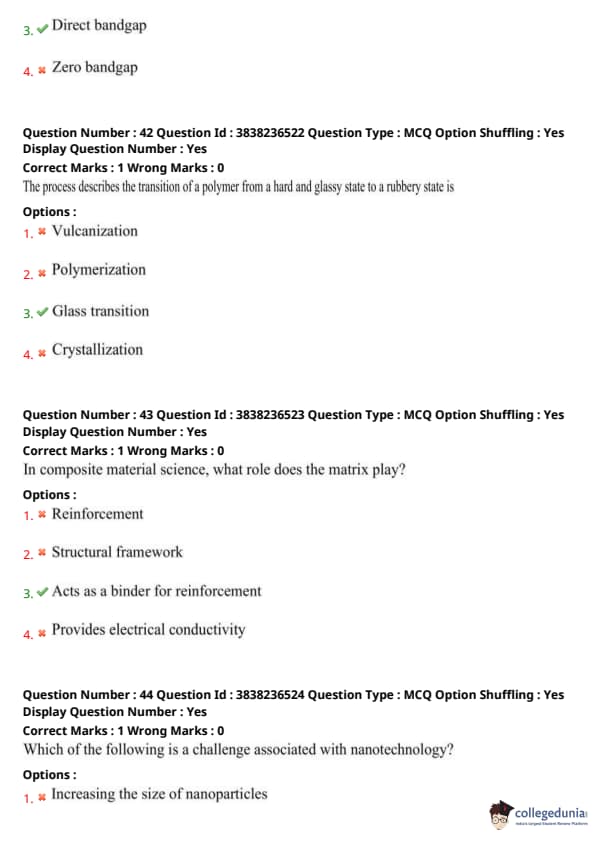
- (C) Direct bandgap
- (D) Zero bandgap
Question 42:
The process that describes the transition of a polymer from a hard and glassy state to a rubbery state is:
- (A) Vulcanization
- (B) Polymerization
- (C) Glass transition
- (D) Crystallization
Question 43:
In composite material science, what role does the matrix play?
- (A) Reinforcement
- (B) Structural framework
- (C) Acts as a binder for reinforcement
- (D) Provides electrical conductivity
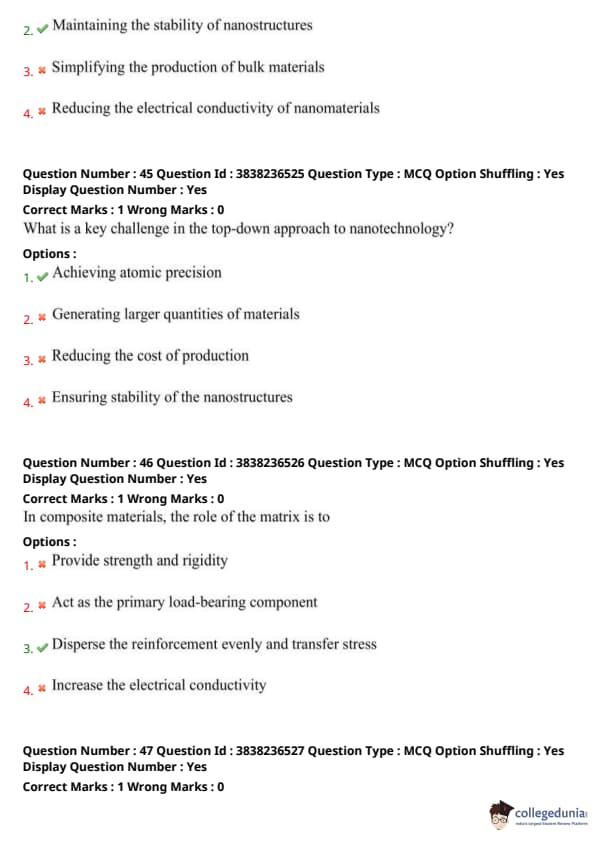
Question 44:
Which of the following is a challenge associated with nanotechnology?
- (A) Increasing the size of nanoparticles
- (B) Maintaining the stability of nanostructures
- (C) Simplifying the production of bulk materials
- (D) Reducing the electrical conductivity of nanomaterials
Question 45:
What is a key challenge in the top-down approach to nanotechnology?
- (A) Achieving atomic precision
- (B) Generating larger quantities of materials
- (C) Reducing the cost of production
- (D) Ensuring stability of the nanostructures
Question 46:
In composite materials, the role of the matrix is to:
- (A) Provide strength and rigidity
- (B) Act as the primary load-bearing component
- (C) Disperse the reinforcement evenly and transfer stress
- (D) Increase the electrical conductivity
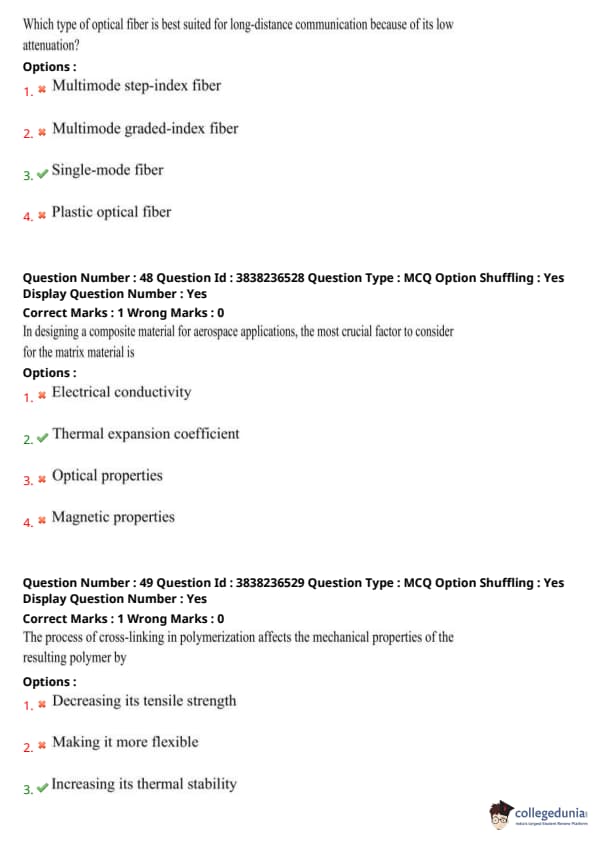
Question 47:
Which type of optical fiber is best suited for long-distance communication because of its low attenuation?
- (A) Multimode step-index fiber
- (B) Multimode graded-index fiber
- (C) Single-mode fiber
- (D) Plastic optical fiber
Question 48:
In designing a composite material for aerospace applications, the most crucial factor to consider for the matrix material is:
- (A) Electrical conductivity
- (B) Thermal expansion coefficient
- (C) Optical properties
- (D) Magnetic properties
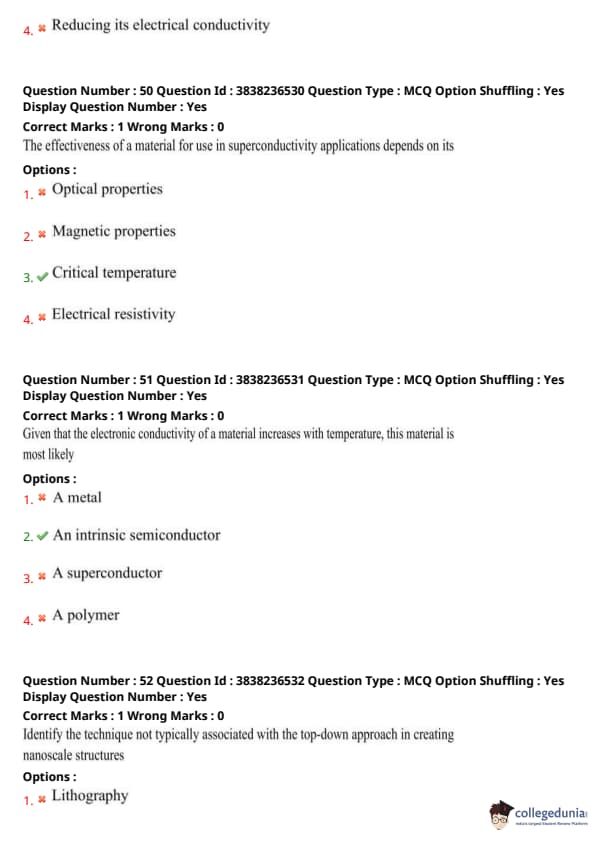
Question 49:
The process of cross-linking in polymerization affects the mechanical properties of the resulting polymer by:
- (A) Decreasing its tensile strength
- (B) Making it more flexible
- (C) Increasing its thermal stability
- (D) Reducing its electrical conductivity
Question 50:
The effectiveness of a material for use in superconductivity applications depends on its:
- (A) Optical properties
- (B) Magnetic properties
- (C) Critical temperature
- (D) Electrical resistivity
Question 51:
Given that the electronic conductivity of a material increases with temperature, this material is most likely:
- (A) A metal
- (B) An intrinsic semiconductor
- (C) A superconductor
- (D) A polymer
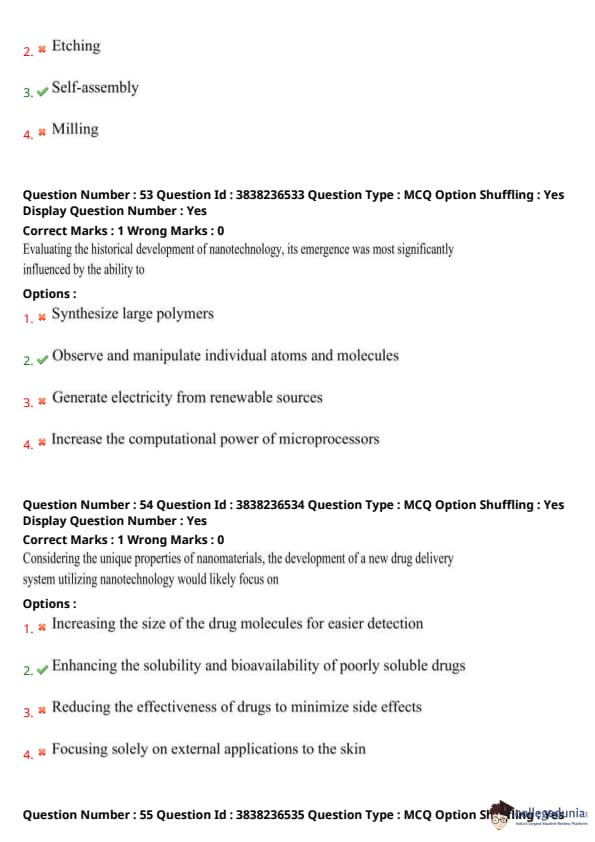
Question 52:
Identify the technique not typically associated with the top-down approach in creating nanoscale structures:
- (A) Lithography
- (B) Etching
- (C) Self-assembly
- (D) Milling
Question 53:
Evaluating the historical development of nanotechnology, its emergence was most significantly influenced by the ability to:
- (A) Synthesize large polymers
- (B) Observe and manipulate individual atoms and molecules
- (C) Generate electricity from renewable sources
- (D) Increase the computational power of microprocessors
Question 54:
Considering the unique properties of nanomaterials, the development of a new drug delivery system utilizing nanotechnology would likely focus on:
- (A) Increasing the size of the drug molecules for easier detection
- (B) Enhancing the solubility and bioavailability of poorly soluble drugs
- (C) Reducing the effectiveness of drugs to minimize side effects
- (D) Focusing solely on external applications to the skin
Question 55:
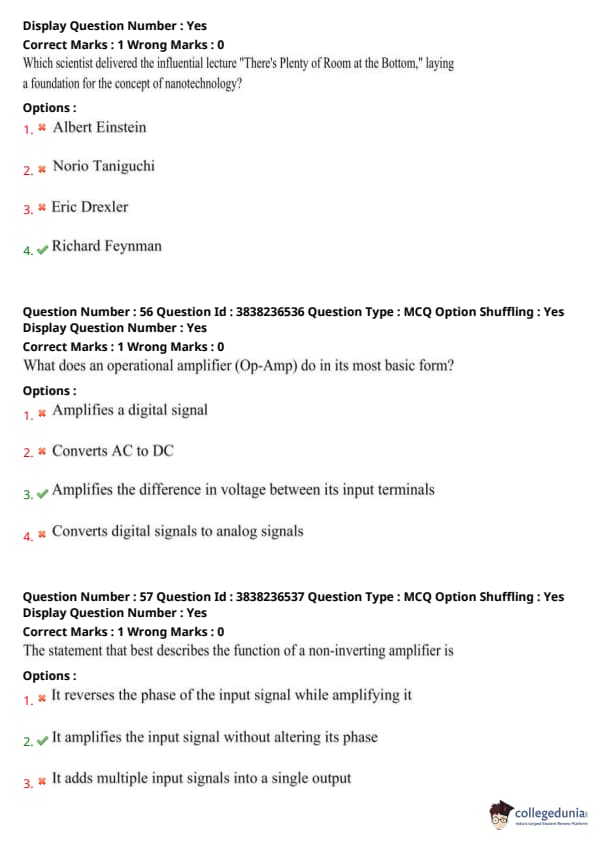
Which scientist delivered the influential lecture "There's Plenty of Room at the Bottom," laying a foundation for the concept of nanotechnology?
- (A) Albert Einstein
- (B) Norio Taniguchi
- (C) Eric Drexler
- (D) Richard Feynman
Question 56:
What does an operational amplifier (Op-Amp) do in its most basic form?
- (A) Amplifies a digital signal
- (B) Converts AC to DC
- (C) Amplifies the difference in voltage between its input terminals
- (D) Converts digital signals to analog signals
Question 57:
The statement that best describes the function of a non-inverting amplifier is:
- (A) It reverses the phase of the input signal while amplifying it
- (B) It amplifies the input signal without altering its phase
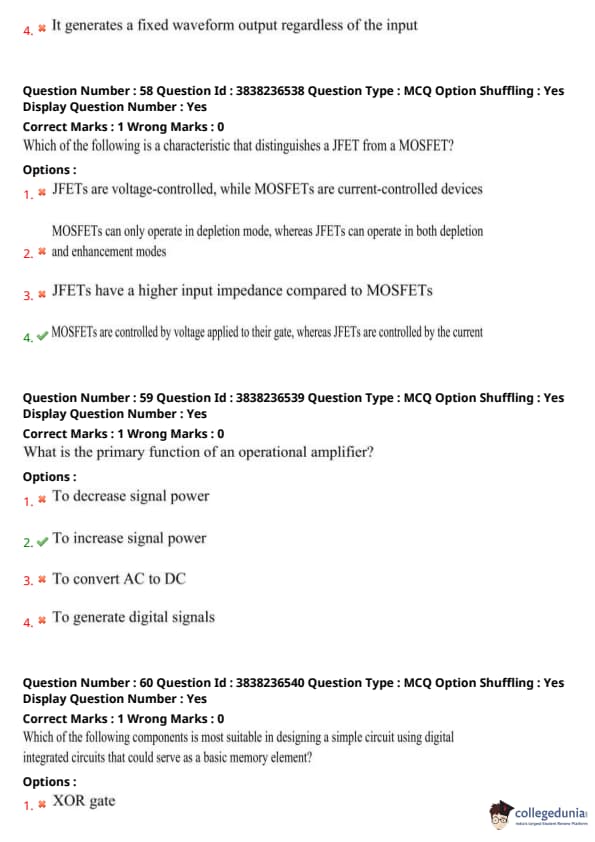
- (C) It adds multiple input signals into a single output
- (D) It generates a fixed waveform output regardless of the input
Question 58:
Which of the following is a characteristic that distinguishes a JFET from a MOSFET?
- (A) JFETs are voltage-controlled, while MOSFETs are current-controlled devices
- (B) MOSFETs can only operate in depletion mode, whereas JFETs can operate in both depletion and enhancement modes
- (C) JFETs have a higher input impedance compared to MOSFETs
- (D) MOSFETs are controlled by voltage applied to their gate, whereas JFETs are controlled by the current
Question 59:
What is the primary function of an operational amplifier?
- (A) To decrease signal power
- (B) To increase signal power
- (C) To convert AC to DC
- (D) To generate digital signals
Question 60:
Which of the following components is most suitable in designing a simple circuit using digital integrated circuits that could serve as a basic memory element?
- (A) XOR gate
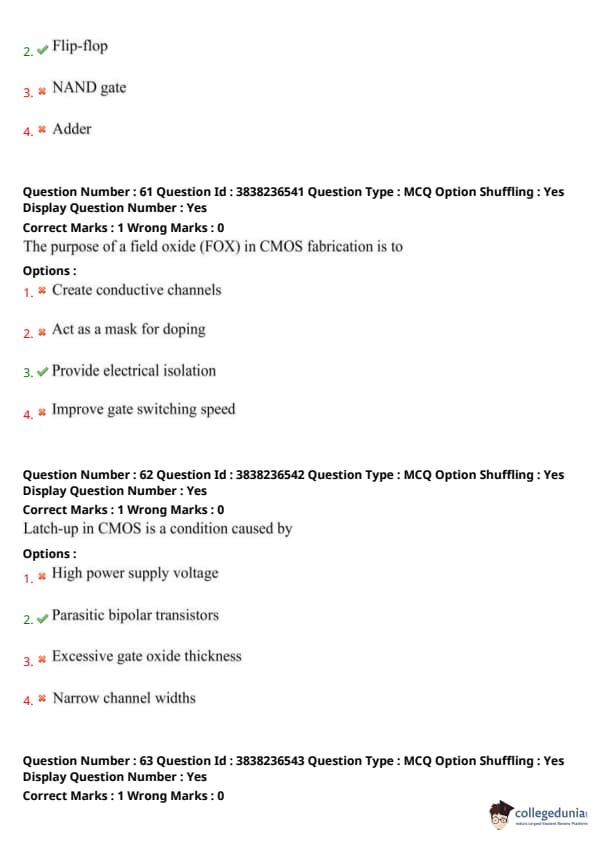
- (B) Flip-flop
- (C) NAND gate
- (D) Adder
Question 61:
The purpose of a field oxide (FOX) in CMOS fabrication is to:
- (A) Create conductive channels
- (B) Act as a mask for doping
- (C) Provide electrical isolation
- (D) Improve gate switching speed
Question 62:
Latch-up in CMOS is a condition caused by:
- (A) High power supply voltage
- (B) Parasitic bipolar transistors
- (C) Excessive gate oxide thickness
- (D) Narrow channel widths
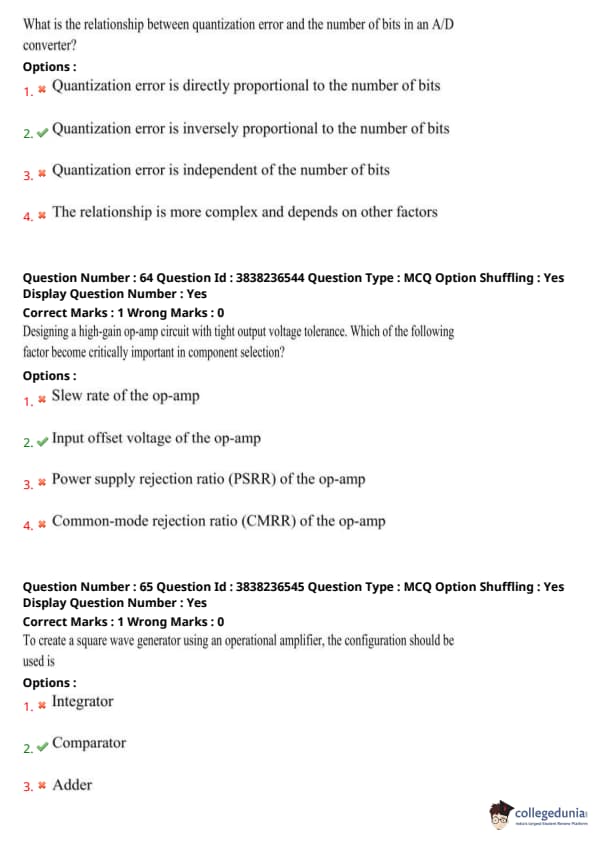
Question 63:
What is the relationship between quantization error and the number of bits in an A/D converter?
- (A) Quantization error is directly proportional to the number of bits
- (B) Quantization error is inversely proportional to the number of bits
- (C) Quantization error is independent of the number of bits
- (D) The relationship is more complex and depends on other factors
Question 64:
Designing a high-gain op-amp circuit with tight output voltage tolerance. Which of the following factors becomes critically important in component selection?
- (A) Slew rate of the op-amp
- (B) Input offset voltage of the op-amp
- (C) Power supply rejection ratio (PSRR) of the op-amp
- (D) Common-mode rejection ratio (CMRR) of the op-amp
Question 65:
To create a square wave generator using an operational amplifier, the configuration that should be used is:
- (A) Integrator
- (B) Comparator
- (C) Adder
- (D) Differentiator
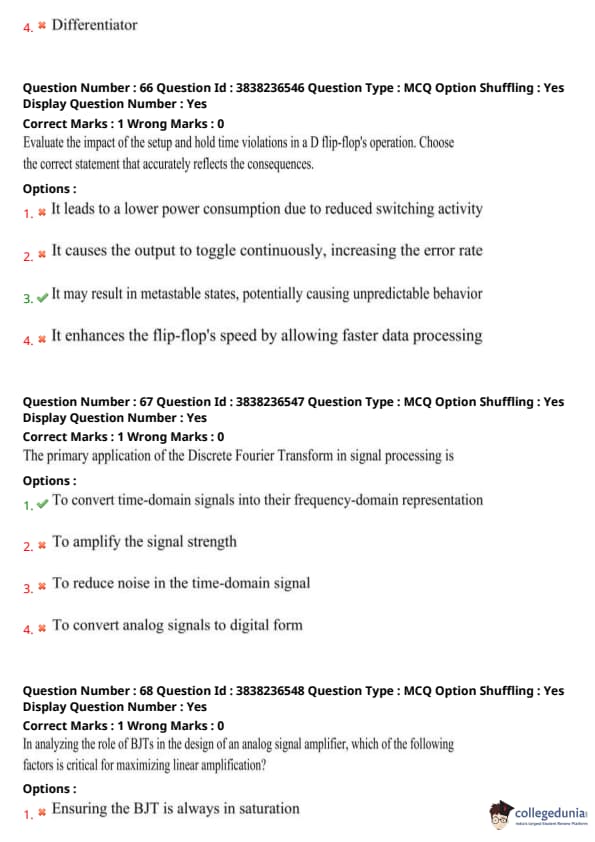
Question 66:
Evaluate the impact of the setup and hold time violations in a D flip-flop's operation. Choose the correct statement that accurately reflects the consequences.
- (A) It leads to a lower power consumption due to reduced switching activity
- (B) It causes the output to toggle continuously, increasing the error rate
- (C) It may result in metastable states, potentially causing unpredictable behavior
- (D) It enhances the flip-flop's speed by allowing faster data processing
Question 67:
The primary application of the Discrete Fourier Transform in signal processing is:
- (A) To convert time-domain signals into their frequency-domain representation
- (B) To amplify the signal strength
- (C) To reduce noise in the time-domain signal
- (D) To convert analog signals to digital form
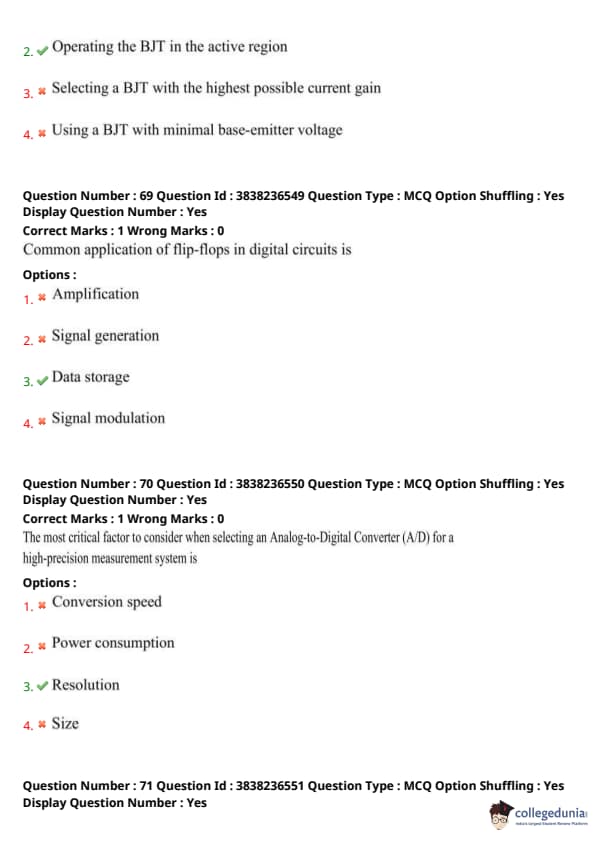
Question 68:
In analyzing the role of BJTs in the design of an analog signal amplifier, which of the following factors is critical for maximizing linear amplification?
- (A) Ensuring the BJT is always in saturation
- (B) Operating the BJT in the active region
- (C) Selecting a BJT with the highest possible current gain
- (D) Using a BJT with minimal base-emitter voltage
Question 69:
Common application of flip-flops in digital circuits is:
- (A) Amplification
- (B) Signal generation
- (C) Data storage
- (D) Signal modulation
Question 70:
The most critical factor to consider when selecting an Analog-to-Digital Converter (A/D) for a high-precision measurement system is:
- (A) Conversion speed
- (B) Power consumption
- (C) Resolution
- (D) Size
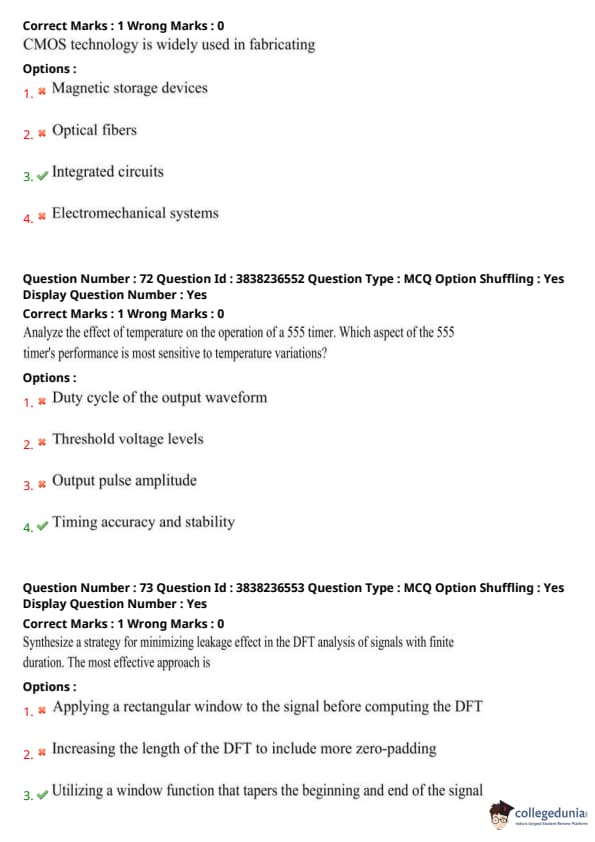
Question 71:
CMOS technology is widely used in fabricating:
- (A) Magnetic storage devices
- (B) Optical fibers
- (C) Integrated circuits
- (D) Electromechanical systems
Question 72:
Analyze the effect of temperature on the operation of a 555 timer. Which aspect of the 555 timer's performance is most sensitive to temperature variations?
- (A) Duty cycle of the output waveform
- (B) Threshold voltage levels
- (C) Output pulse amplitude
- (D) Timing accuracy and stability
Question 73:
Synthesize a strategy for minimizing leakage effect in the DFT analysis of signals with finite duration. The most effective approach is:
- (A) Applying a rectangular window to the signal before computing the DFT
- (B) Increasing the length of the DFT to include more zero-padding
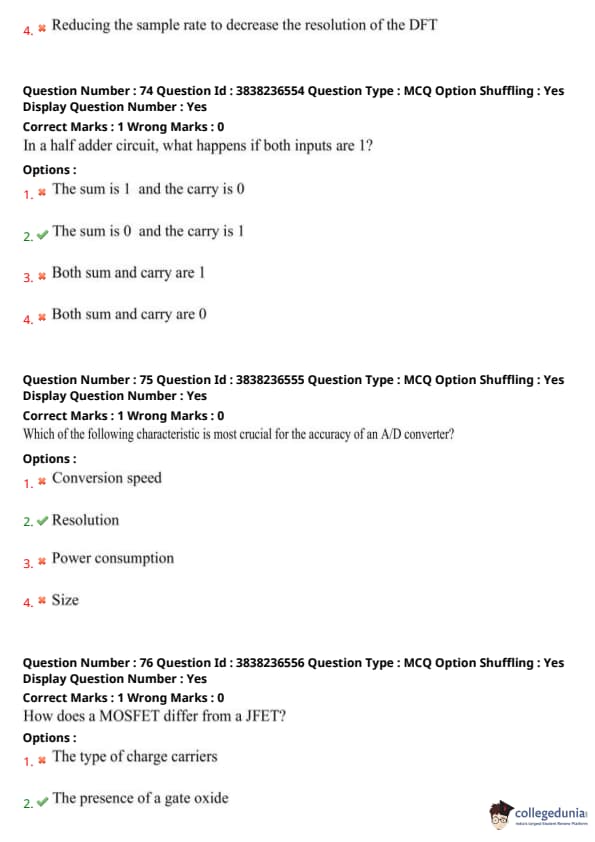
- (C) Utilizing a window function that tapers the beginning and end of the signal
- (D) Reducing the sample rate to decrease the resolution of the DFT
Question 74:
In a half adder circuit, what happens if both inputs are 1?
- (A) The sum is 1 and the carry is 0
- (B) The sum is 0 and the carry is 1
- (C) Both sum and carry are 1
- (D) Both sum and carry are 0
Question 75:
Which of the following characteristics is most crucial for the accuracy of an A/D converter?
- (A) Conversion speed
- (B) Resolution
- (C) Power consumption
- (D) Size
Question 76:
How does a MOSFET differ from a JFET?
- (A) The type of charge carriers
- (B) The presence of a gate oxide
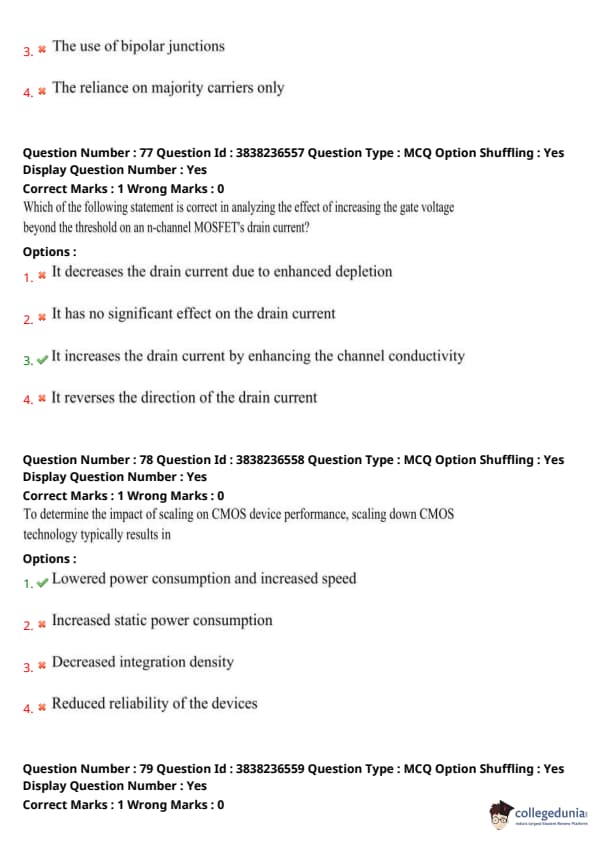
- (C) The use of bipolar junctions
- (D) The reliance on majority carriers only
Question 77:
Which of the following statement is correct in analyzing the effect of increasing the gate voltage beyond the threshold on an n-channel MOSFET's drain current?
- (A) It decreases the drain current due to enhanced depletion
- (B) It has no significant effect on the drain current
- (C) It increases the drain current by enhancing the channel conductivity
- (D) It reverses the direction of the drain current
Question 78:
To determine the impact of scaling on CMOS device performance, scaling down CMOS technology typically results in
- (A) Lowered power consumption and increased speed
- (B) Increased static power consumption
- (C) Decreased integration density
- (D) Reduced reliability of the devices
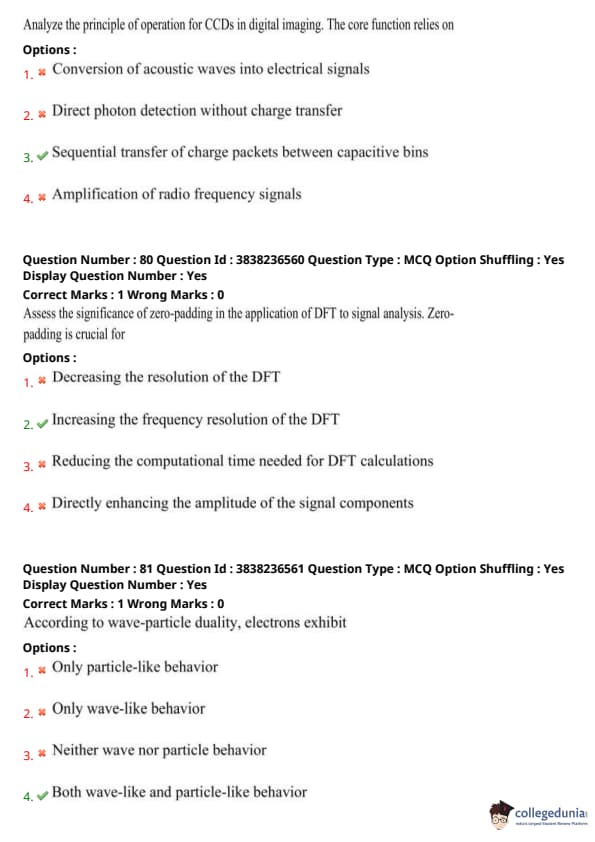
Question 79:
Analyze the principle of operation for CCDs in digital imaging. The core function relies on
- (A) Conversion of acoustic waves into electrical signals
- (B) Direct photon detection without charge transfer
- (C) Sequential transfer of charge packets between capacitive bins
- (D) Amplification of radio frequency signals
Question 80:
Assess the significance of zero-padding in the application of DFT to signal analysis. Zero-padding is crucial for
- (A) Decreasing the resolution of the DFT
- (B) Increasing the frequency resolution of the DFT
- (C) Reducing the computational time needed for DFT calculations
- (D) Directly enhancing the amplitude of the signal components
Question 81:
According to wave-particle duality, electrons exhibit
- (A) Only particle-like behavior
- (B) Only wave-like behavior
- (C) Neither wave nor particle behavior
- (D) Both wave-like and particle-like behavior
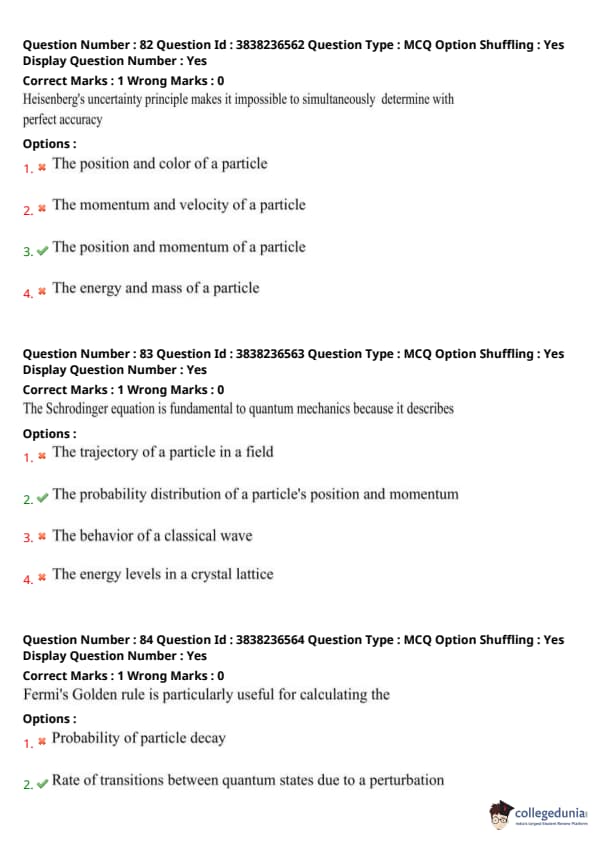
Question 82:
Heisenberg's uncertainty principle makes it impossible to simultaneously determine with perfect accuracy
- (A) The position and color of a particle
- (B) The momentum and velocity of a particle
- (C) The position and momentum of a particle
- (D) The energy and mass of a particle
Question 83:
The Schrödinger equation is fundamental to quantum mechanics because it describes
- (A) The trajectory of a particle in a field
- (B) The probability distribution of a particle's position and momentum
- (C) The behavior of a classical wave
- (D) The energy levels in a crystal lattice
Question 84:
Fermi's Golden Rule is particularly useful for calculating the
- (A) Probability of particle decay
- (B) Rate of transitions between quantum states due to a perturbation
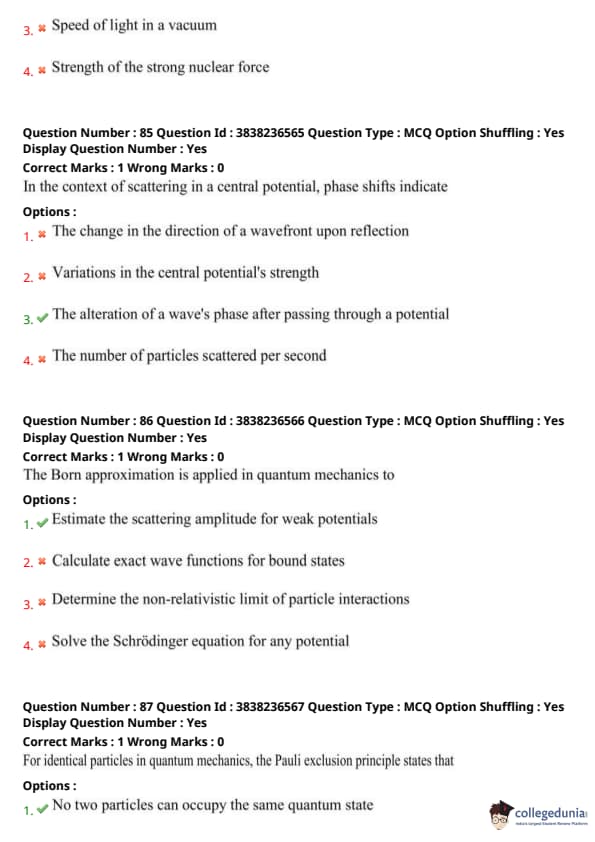
- (C) Speed of light in a vacuum
- (D) Strength of the strong nuclear force
Question 85:
In the context of scattering in a central potential, phase shifts indicate
- (A) The change in the direction of a wavefront upon reflection
- (B) Variations in the central potential's strength
- (C) The alteration of a wave's phase after passing through a potential
- (D) The number of particles scattered per second
Question 86:
The Born approximation is applied in quantum mechanics to:
- (A) Estimate the scattering amplitude for weak potentials
- (B) Calculate exact wave functions for bound states
- (C) Determine the non-relativistic limit of particle interactions
- (D) Solve the Schrödinger equation for any potential
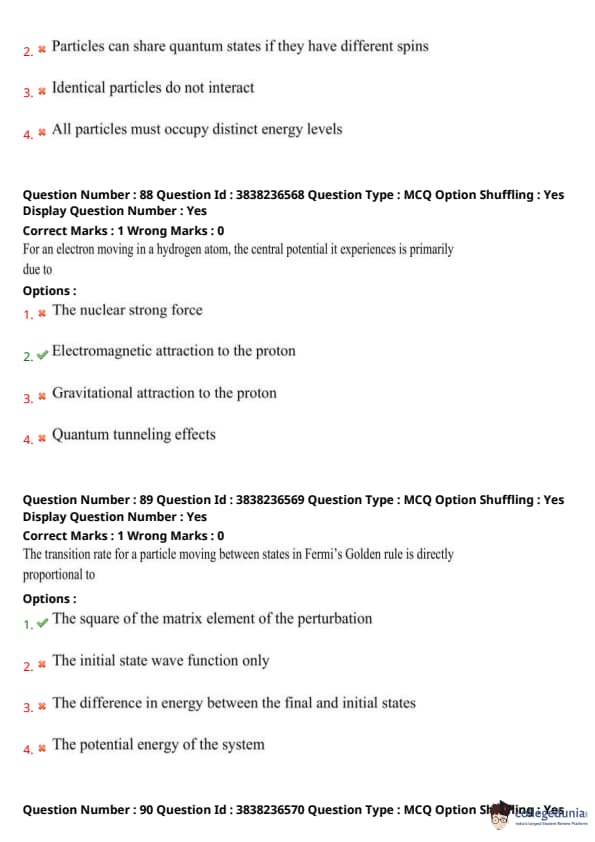
Question 87:
For identical particles in quantum mechanics, the Pauli exclusion principle states that:
- (A) No two particles can occupy the same quantum state
- (B) Particles can share quantum states if they have different spins
- (C) Identical particles do not interact
- (D) All particles must occupy distinct energy levels
Question 88:
For an electron moving in a hydrogen atom, the central potential it experiences is primarily due to:
- (A) The nuclear strong force
- (B) Electromagnetic attraction to the proton
- (C) Gravitational attraction to the proton
- (D) Quantum tunneling effects
Question 89:
The transition rate for a particle moving between states in Fermi’s Golden rule is directly proportional to:
- (A) The square of the matrix element of the perturbation
- (B) The initial state wave function only
- (C) The difference in energy between the final and initial states
- (D) The potential energy of the system
Question 90:
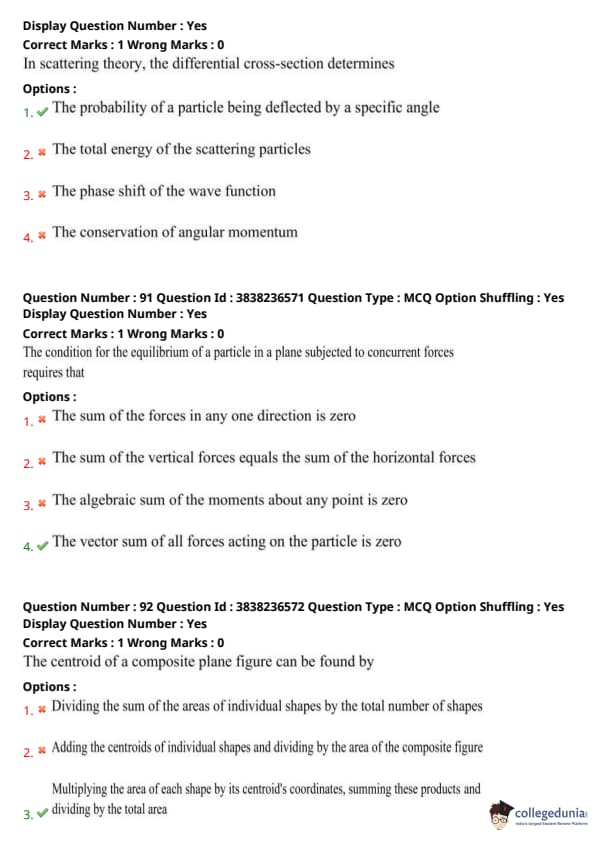
In scattering theory, the differential cross-section determines:
- (A) The probability of a particle being deflected by a specific angle
- (B) The total energy of the scattering particles
- (C) The phase shift of the wave function
- (D) The conservation of angular momentum
Question 91:
The condition for the equilibrium of a particle in a plane subjected to concurrent forces requires that:
- (A) The sum of the forces in any one direction is zero
- (B) The sum of the vertical forces equals the sum of the horizontal forces
- (C) The algebraic sum of the moments about any point is zero
- (D) The vector sum of all forces acting on the particle is zero
Question 92:
The centroid of a composite plane figure can be found by:
- (A) Dividing the sum of the areas of individual shapes by the total number of shapes
- (B) Adding the centroids of individual shapes and dividing by the area of the composite figure
- (C) Multiplying the area of each shape by its centroid's coordinates, summing these products and dividing by the total area
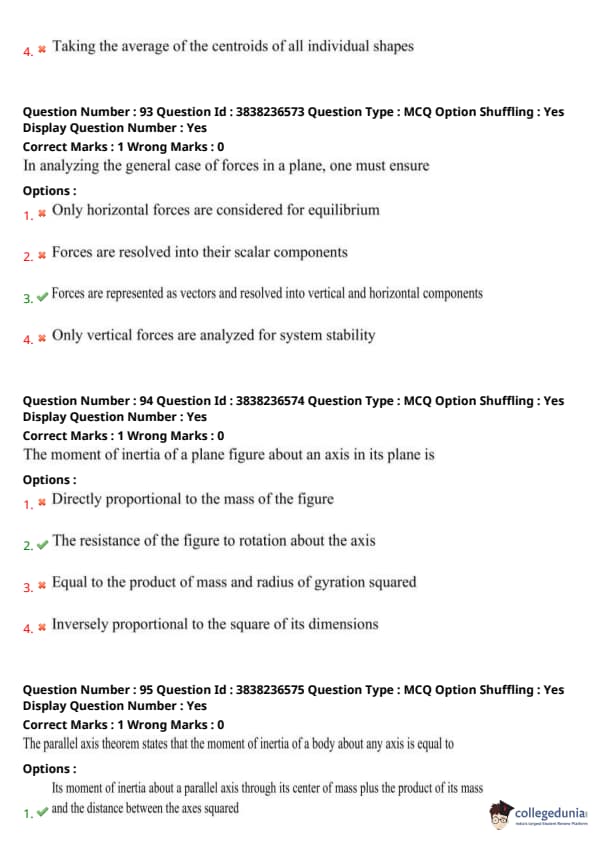
- (D) Taking the average of the centroids of all individual shapes
Question 93:
In analyzing the general case of forces in a plane, one must ensure:
- (A) Only horizontal forces are considered for equilibrium
- (B) Forces are resolved into their scalar components
- (C) Forces are represented as vectors and resolved into vertical and horizontal components
- (D) Only vertical forces are analyzed for system stability
Question 94:
The moment of inertia of a plane figure about an axis in its plane is:
- (A) Directly proportional to the mass of the figure
- (B) The resistance of the figure to rotation about the axis
- (C) Equal to the product of mass and radius of gyration squared
- (D) Inversely proportional to the square of its dimensions
Question 95:
The parallel axis theorem states that the moment of inertia of a body about any axis is equal to:
- (A) Its moment of inertia about a parallel axis through its center of mass plus the product of its mass and the distance between the axes squared
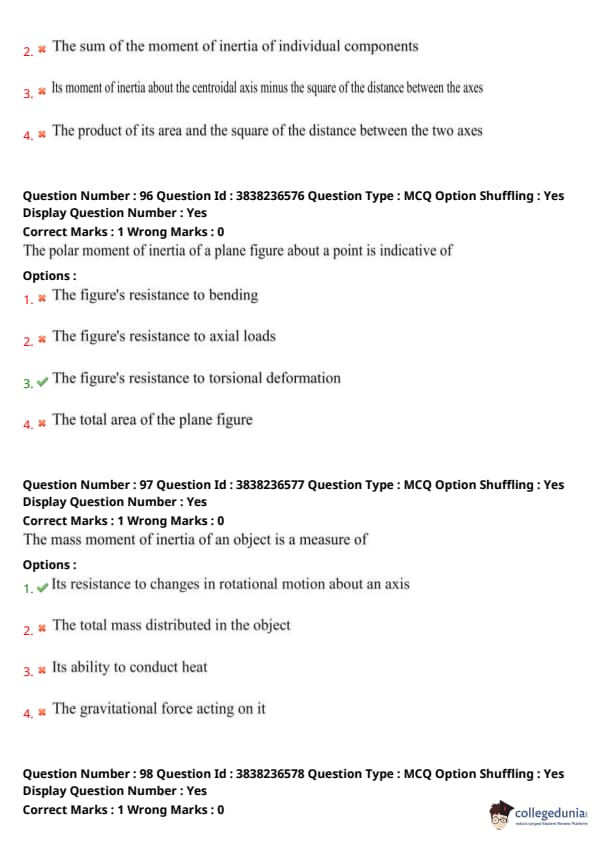
- (B) The sum of the moment of inertia of individual components
- (C) Its moment of inertia about the centroidal axis minus the square of the distance between the axes
- (D) The product of its area and the square of the distance between the two axes
Question 96:
The polar moment of inertia of a plane figure about a point is indicative of:
- (A) The figure's resistance to bending
- (B) The figure's resistance to axial loads
- (C) The figure's resistance to torsional deformation
- (D) The total area of the plane figure
Question 97:
The mass moment of inertia of an object is a measure of:
- (A) Its resistance to changes in rotational motion about an axis
- (B) The total mass distributed in the object
- (C) Its ability to conduct heat
- (D) The gravitational force acting on it
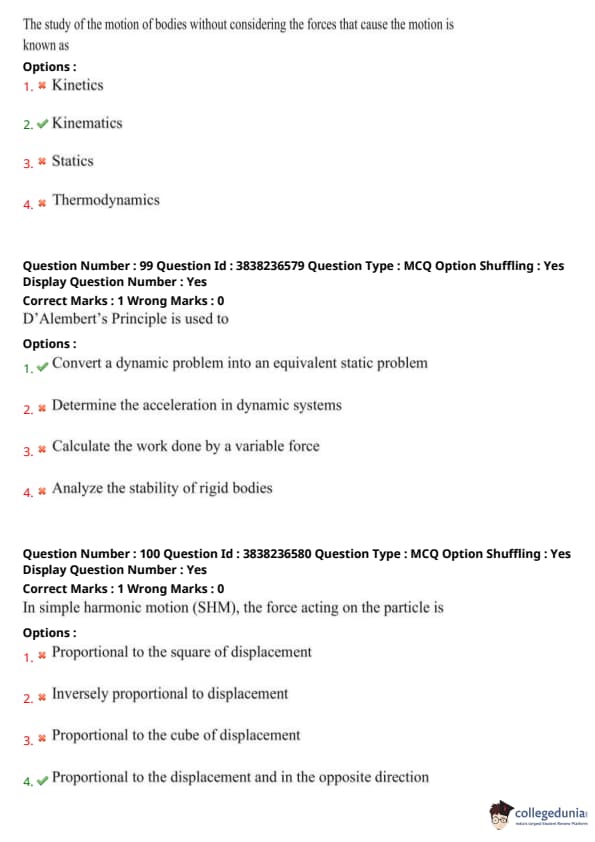
Question 98:
The study of the motion of bodies without considering the forces that cause the motion is known as:
- (A) Kinetics
- (B) Kinematics
- (C) Statics
- (D) Thermodynamics
Question 99:
D’Alembert’s Principle is used to:
- (A) Convert a dynamic problem into an equivalent static problem
- (B) Determine the acceleration in dynamic systems
- (C) Calculate the work done by a variable force
- (D) Analyze the stability of rigid bodies
Question 100:
In simple harmonic motion (SHM), the force acting on the particle is:
- (A) Proportional to the square of displacement
- (B) Inversely proportional to displacement
- (C) Proportional to the cube of displacement
- (D) Proportional to the displacement and in the opposite direction
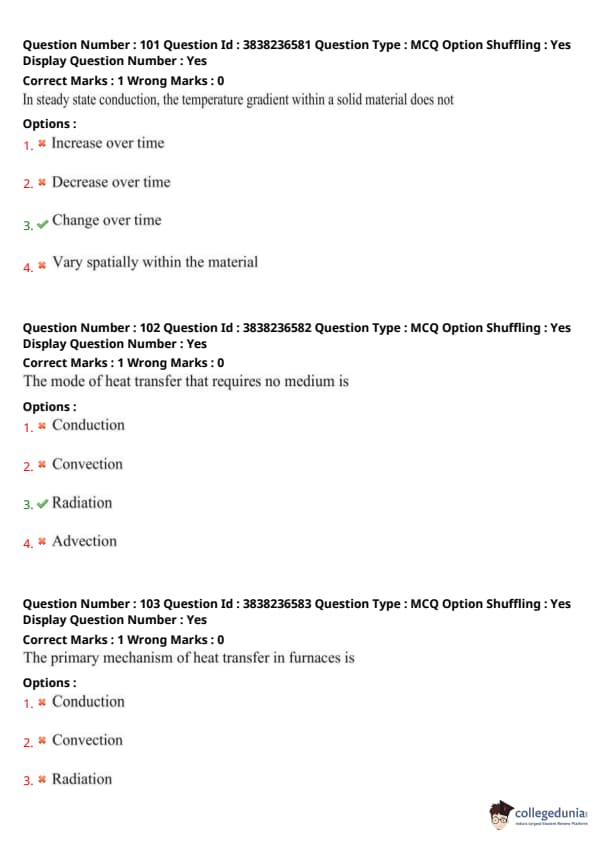
Question 101:
In steady state conduction, the temperature gradient within a solid material does not:
- (A) Increase over time
- (B) Decrease over time
- (C) Change over time
- (D) Vary spatially within the material
Question 102:
The mode of heat transfer that requires no medium is:
- (A) Conduction
- (B) Convection
- (C) Radiation
- (D) Advection
Question 103:
The primary mechanism of heat transfer in furnaces is:
- (A) Conduction
- (B) Convection
- (C) Radiation
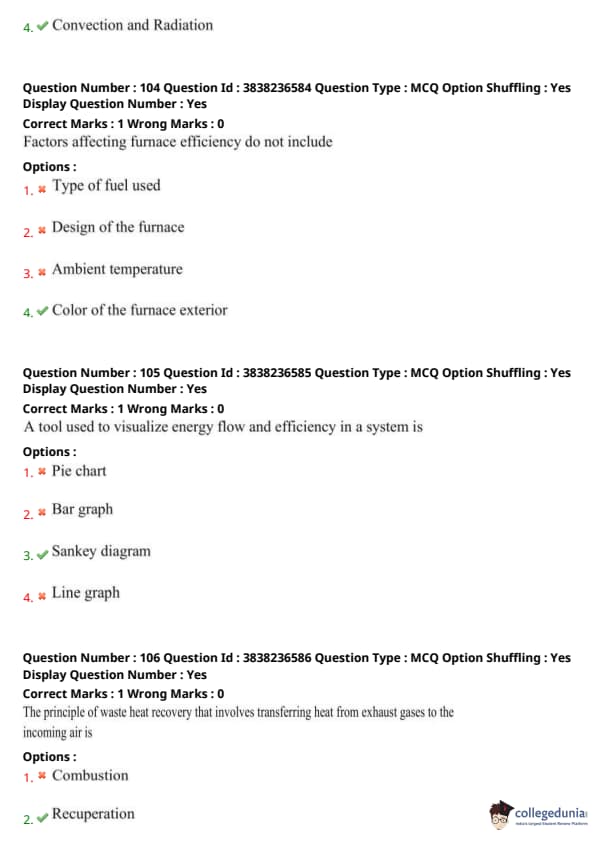
- (D) Convection and Radiation
Question 104:
Factors affecting furnace efficiency do not include:
- (A) Type of fuel used
- (B) Design of the furnace
- (C) Ambient temperature
- (D) Color of the furnace exterior
Question 105:
A tool used to visualize energy flow and efficiency in a system is:
- (A) Pie chart
- (B) Bar graph
- (C) Sankey diagram
- (D) Line graph
Question 106:
The principle of waste heat recovery that involves transferring heat from exhaust gases to the incoming air is:
- (A) Combustion
- (B) Recuperation
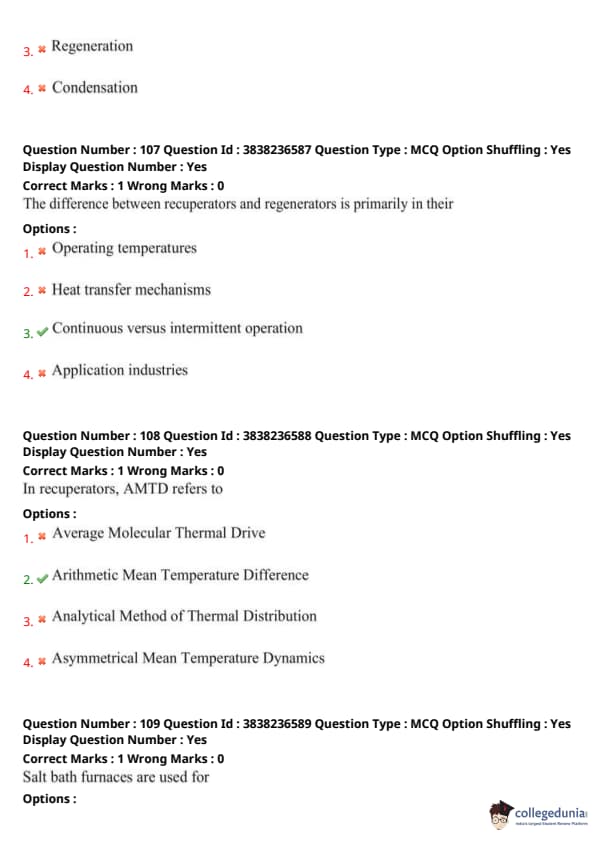
- (C) Regeneration
- (D) Condensation
Question 107:
The difference between recuperators and regenerators is primarily in their:
- (A) Operating temperatures
- (B) Heat transfer mechanisms
- (C) Continuous versus intermittent operation
- (D) Application industries
Question 108:
In recuperators, AMTD refers to:
- (A) Average Molecular Thermal Drive
- (B) Arithmetic Mean Temperature Difference
- (C) Analytical Method of Thermal Distribution
- (D) Asymmetrical Mean Temperature Dynamics
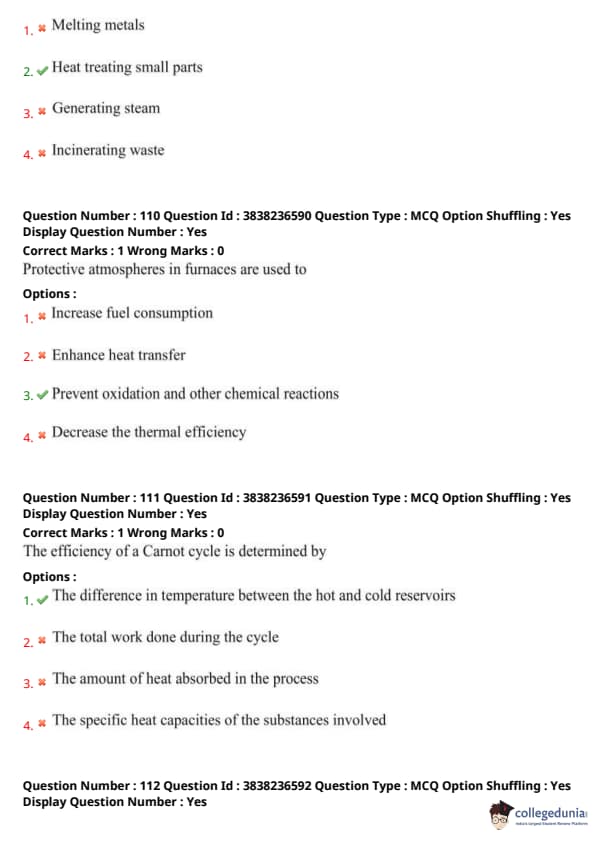
Question 109:
Salt bath furnaces are used for:
- (A) Melting metals
- (B) Heat treating small parts
- (C) Generating steam
- (D) Incinerating waste
Question 110:
Protective atmospheres in furnaces are used to:
- (A) Increase fuel consumption
- (B) Enhance heat transfer
- (C) Prevent oxidation and other chemical reactions
- (D) Decrease the thermal efficiency
Question 111:
The efficiency of a Carnot cycle is determined by:
- (A) The difference in temperature between the hot and cold reservoirs
- (B) The total work done during the cycle
- (C) The amount of heat absorbed in the process
- (D) The specific heat capacities of the substances involved
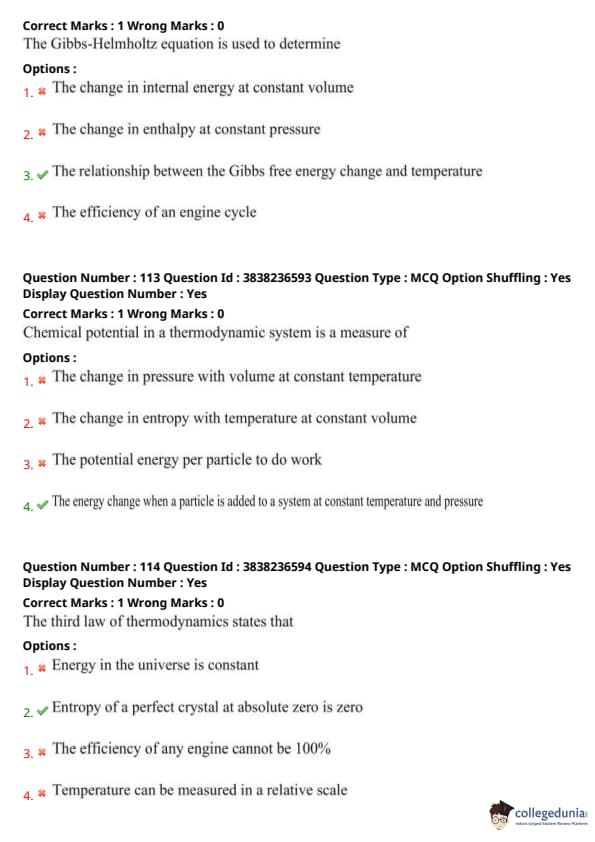
Question 112:
The Gibbs-Helmholtz equation is used to determine:
- (A) The change in internal energy at constant volume
- (B) The change in enthalpy at constant pressure
- (C) The relationship between the Gibbs free energy change and temperature
- (D) The efficiency of an engine cycle
Question 113:
Chemical potential in a thermodynamic system is a measure of:
- (A) The change in pressure with volume at constant temperature
- (B) The change in entropy with temperature at constant volume
- (C) The potential energy per particle to do work
- (D) The energy change when a particle is added to a system at constant temperature and pressure
Question 114:
The third law of thermodynamics states that:
- (A) Energy in the universe is constant
- (B) Entropy of a perfect crystal at absolute zero is zero
- (C) The efficiency of any engine cannot be 100%
- (D) Temperature can be measured in a relative scale
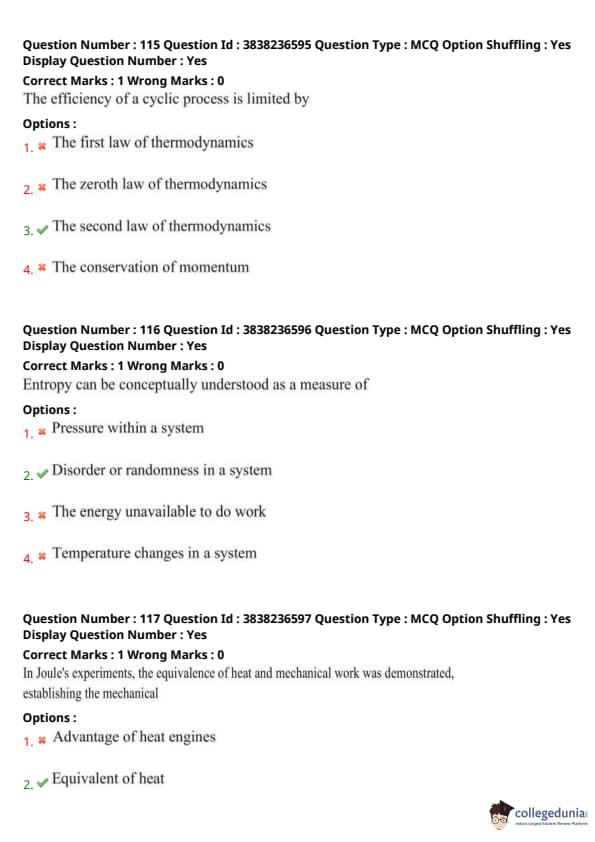
Question 115:
The efficiency of a cyclic process is limited by:
- (A) The first law of thermodynamics
- (B) The zeroth law of thermodynamics
- (C) The second law of thermodynamics
- (D) The conservation of momentum
Question 116:
Entropy can be conceptually understood as a measure of:
- (A) Pressure within a system
- (B) Disorder or randomness in a system
- (C) The energy unavailable to do work
- (D) Temperature changes in a system
Question 117:
In Joule's experiments, the equivalence of heat and mechanical work was demonstrated, establishing the mechanical:
- (A) Advantage of heat engines
- (B) Equivalent of heat
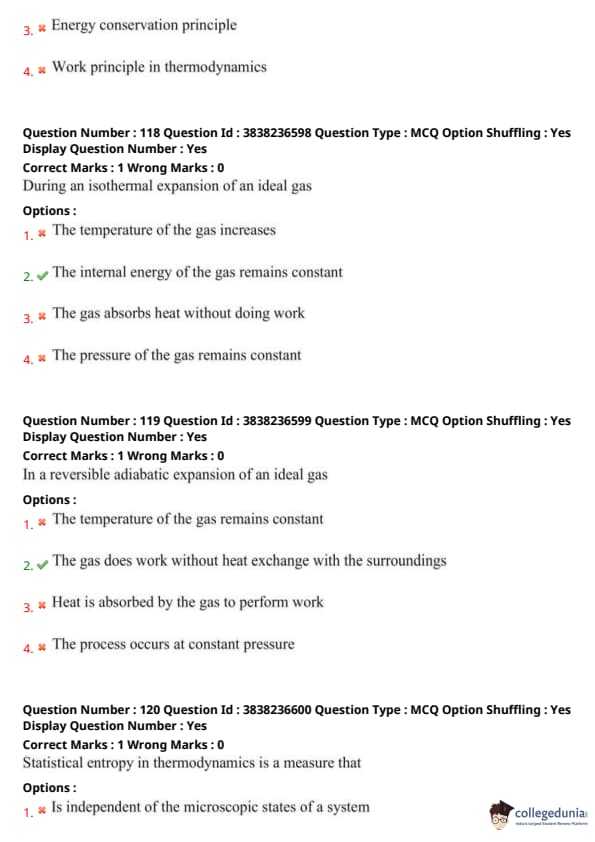
- (C) Energy conservation principle
- (D) Work principle in thermodynamics
Question 118:
During an isothermal expansion of an ideal gas:
- (A) The temperature of the gas increases
- (B) The internal energy of the gas remains constant
- (C) The gas absorbs heat without doing work
- (D) The pressure of the gas remains constant
Question 119:
In a reversible adiabatic expansion of an ideal gas:
- (A) The temperature of the gas remains constant
- (B) The gas does work without heat exchange with the surroundings
- (C) Heat is absorbed by the gas to perform work
- (D) The process occurs at constant pressure
Question 120:
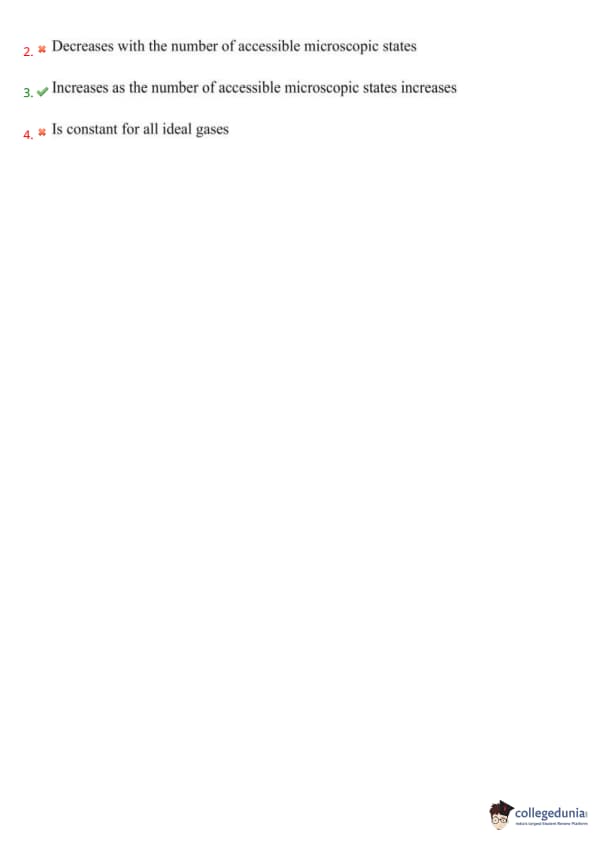
Statistical entropy in thermodynamics is a measure that:
- (A) Is independent of the microscopic states of a system
- (B) Decreases with the number of accessible microscopic states
- (C) Increases as the number of accessible microscopic states increases
- (D) Is constant for all ideal gases










Comments