




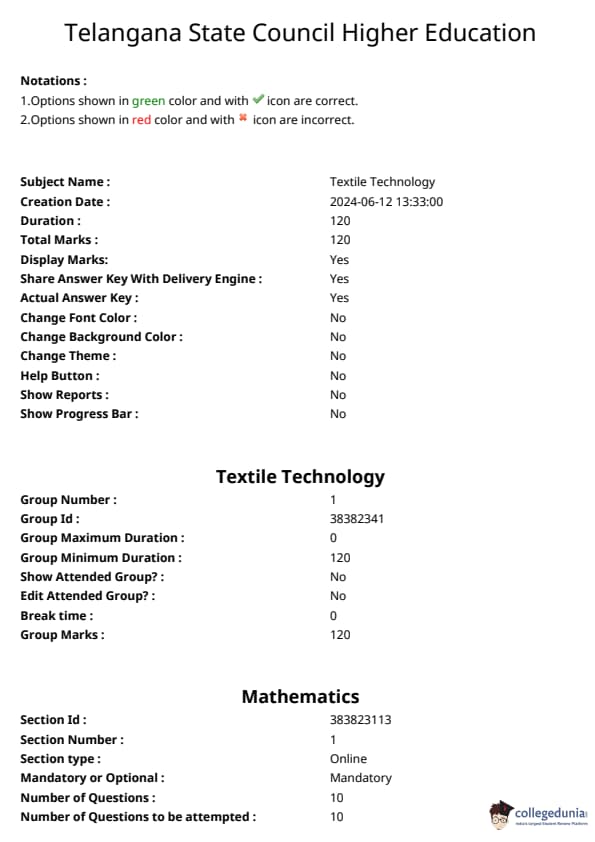
TS PGECET 2024 Textile Technology Question Paper is available for download here. Jawaharlal Nehru Technological University Hyderabad on behalf of Telangana Council of Higher Education (TGCHE) conducted TS PGECET 2024 Textile Technology on June 12 in Shift 1 from 10 AM to 12 PM. TS PGECET Question Paper 2024 consists of 120 MCQ-based questions in total carrying 1 mark each to be attempted in the duration of 2 hours.
TS PGECET 2024 Textile Technology Question Paper with Answer Key PDF
| TS PGECET 2024 TX Question Paper with Answer Key | Download PDF | Check Solution |

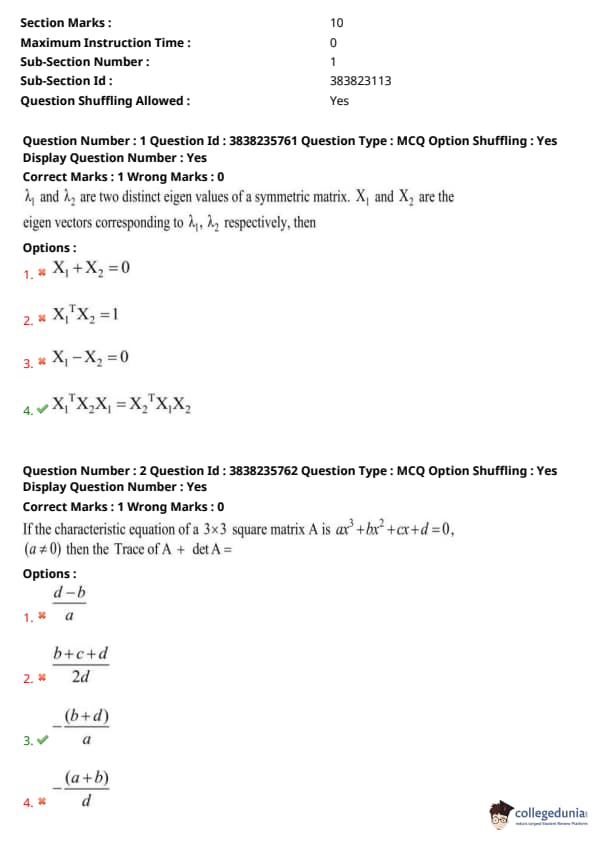
Question 1:
If \(\lambda_1\) and \(\lambda_2\) are two distinct eigen values of a symmetric matrix, \(X_1\) and \(X_2\) are the eigen vectors corresponding to \(\lambda_1, \lambda_2\) respectively, then
View Solution
If the characteristic equation of a \(3 \times 3\) square matrix A is \(ax^3+bx^2+cx+d=0\), \((a \neq 0)\) then the Trace of A + det A =
View Solution
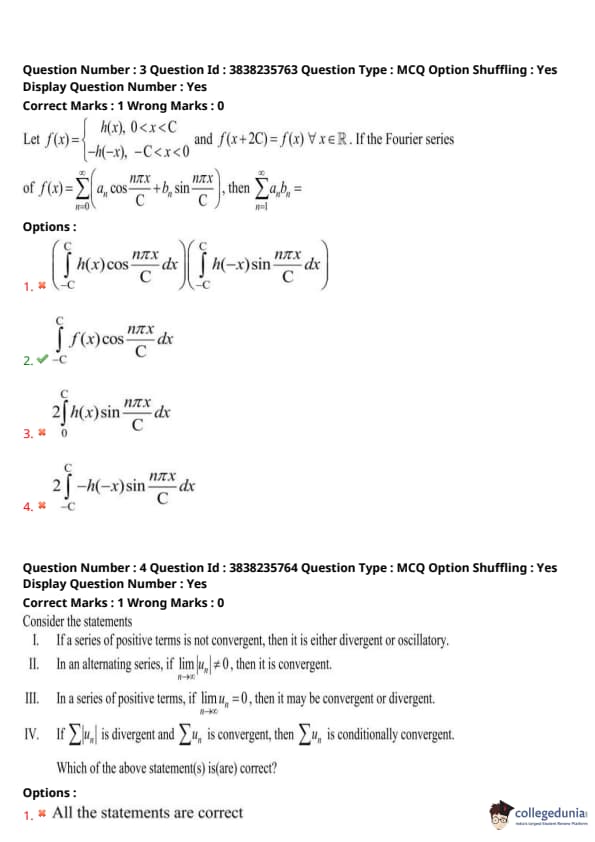
Let \(f(x) = \begin{cases} h(x), & 0 < x < C
-h(-x), & -C < x < 0 \end{cases}\) and \(f(x+2C)=f(x) \; \forall x \in \mathbb{R}\). If the Fourier series of \(f(x) = \sum_{n=0}^\infty \left(a_n \cos\frac{n\pi x}{C} + b_n \sin\frac{n\pi x}{C}\right)\) then \(\sum_{n=0}^\infty a_n b_n =\)
% (The summation for Fourier series is usually from n=1 for b_n, and a_0/2 + sum(a_n cos + b_n sin) from n=1. The sum here \(\sum_{n=0}^\infty a_n b_n\) is unusual, as \(b_0\) is not standardly defined or is 0. Let's assume standard definitions where \(b_0=0\).)
View Solution
Consider the statements
I. If a series of positive terms is not convergent, then it is either divergent or oscillatory.
II. In an alternating series, if \(\lim_{n\to\infty} |u_n| \neq 0\), then it is convergent.
III. In a series of positive terms, if \(\lim_{n\to\infty} u_n = 0\), then it may be convergent or divergent.
IV. If \(\sum |u_n|\) is divergent and \(\sum u_n\) is convergent, then \(\sum u_n\) is conditionally convergent.
Which of the above statement(s) is(are) correct?
View Solution
Let's analyze each statement:
I. If a series of positive terms is not convergent, then it is either divergent or oscillatory.
A series of positive terms \(\sum u_n\) (where \(u_n \ge 0\)) has partial sums \(S_N = \sum_{k=1}^N u_k\) that are monotonically non-decreasing (\(S_{N+1} \ge S_N\)).
Such a sequence of partial sums can either converge to a finite limit (if bounded above) or diverge to \(+\infty\) (if not bounded above). It cannot oscillate without converging, because it's monotonic.
So, if a series of positive terms is not convergent, it must be divergent (to \(+\infty\)). It cannot be oscillatory in the sense of finite oscillation (like \((-1)^n\)).
Thus, statement I is incorrect because it includes "oscillatory" as an alternative for non-convergent series of positive terms. A series of positive terms can only converge or diverge to \(+\infty\).
II. In an alternating series, if \(\lim_{n\to\infty} |u_n| \neq 0\), then it is convergent.
This statement refers to an alternating series \(\sum (-1)^n u_n\) or \(\sum (-1)^{n-1} u_n\) where \(u_n > 0\). (The question states \(|u_n|\), maybe it means general series \(u_n\) that alternates).
For any series \(\sum a_n\) (alternating or not), if \(\lim_{n\to\infty} a_n \neq 0\) (or \(\lim_{n\to\infty} |a_n| \neq 0\)), then the series diverges by the \(n\)-th term test for divergence.
So, if \(\lim_{n\to\infty} |u_n| \neq 0\), the alternating series diverges, it is not convergent.
Statement II is incorrect. (It would be correct if it said "divergent"). Leibniz test for alternating series requires \(\lim u_n = 0\) AND \(u_n\) is decreasing for convergence.
III. In a series of positive terms, if \(\lim_{n\to\infty} u_n = 0\), then it may be convergent or divergent.
This is correct. The condition \(\lim_{n\to\infty} u_n = 0\) is a necessary condition for convergence of any series, but it is not sufficient.
For series of positive terms:
Example of convergent: \(\sum_{n=1}^\infty \frac{1}{n^2}\). Here \(u_n = 1/n^2\), \(\lim_{n\to\infty} 1/n^2 = 0\). This series converges (p-series with \(p=2>1\)).
Example of divergent: \(\sum_{n=1}^\infty \frac{1}{n}\). Here \(u_n = 1/n\), \(\lim_{n\to\infty} 1/n = 0\). This series (harmonic series) diverges (p-series with \(p=1\)).
So, statement III is correct.
IV. If \(\sum |u_n|\) is divergent and \(\sum u_n\) is convergent, then \(\sum u_n\) is conditionally convergent.
This is the definition of conditional convergence. A series \(\sum u_n\) is said to be:
Absolutely convergent if \(\sum |u_n|\) converges. (This implies \(\sum u_n\) also converges).
Conditionally convergent if \(\sum u_n\) converges but \(\sum |u_n|\) diverges.
So, statement IV is correct by definition.
Correct statements are III and IV.
This matches option (c). \[ \boxed{Statements III and IV are correct} \] Quick Tip: \textbf{Series of positive terms:} If not convergent, it diverges to \(+\infty\). It cannot oscillate finitely. \textbf{\(n\)-th term test for divergence:} For any series \(\sum a_n\), if \(\lim_{n\to\infty} a_n \neq 0\) or the limit does not exist, the series diverges. \textbf{Necessary condition for convergence:} If \(\sum a_n\) converges, then \(\lim_{n\to\infty} a_n = 0\). The converse is not always true (e.g., harmonic series). \textbf{Conditional convergence:} A series \(\sum u_n\) converges conditionally if \(\sum u_n\) converges AND \(\sum |u_n|\) diverges. \textbf{Absolute convergence:} A series \(\sum u_n\) converges absolutely if \(\sum |u_n|\) converges. Absolute convergence implies convergence.
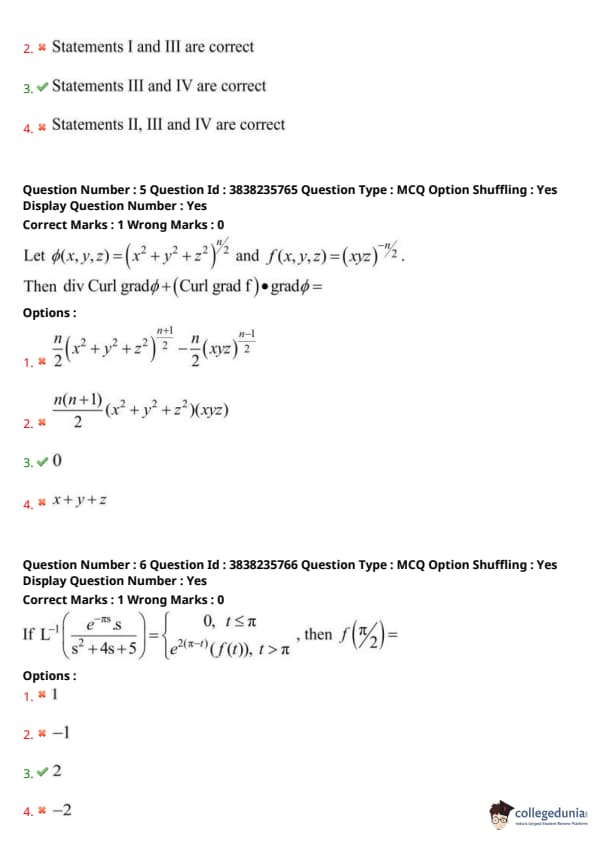
Let \(\phi(x,y,z) = (x^2+y^2+z^2)^{n/2}\) and \(f(x,y,z)=(xyz)^{-n/2}\). Then div Curl grad\(\phi\) + (Curl grad \(f\)) \(\cdot\) grad\(\phi =\)
% Note: (Curl grad f) is a vector. grad\(\phi\) is a vector. Their dot product is a scalar. div (Curl G) is a scalar.
View Solution
If \(L^{-1}\left\{\frac{e^{-\pi s}}{s^2+4s+5}\right\} = \begin{cases} 0, & t \le \pi
e^{a(t-\pi)}(f(t)), & t > \pi \end{cases}\), then \(f(\pi/2)=\)
% Note: The form \(e^{a(t-\pi)}(f(t))\) for \(t>\pi\) seems unusual. Standard form using Heaviside \(u(t-\pi)\) would be \(g(t-\pi)u(t-\pi)\) where \(L\{g(t)\} = F(s)\) and \(L^{-1}\{e^{-cs}F(s)\} = g(t-c)u(t-c)\). Here \(F(s) = 1/(s^2+4s+5)\).
View Solution
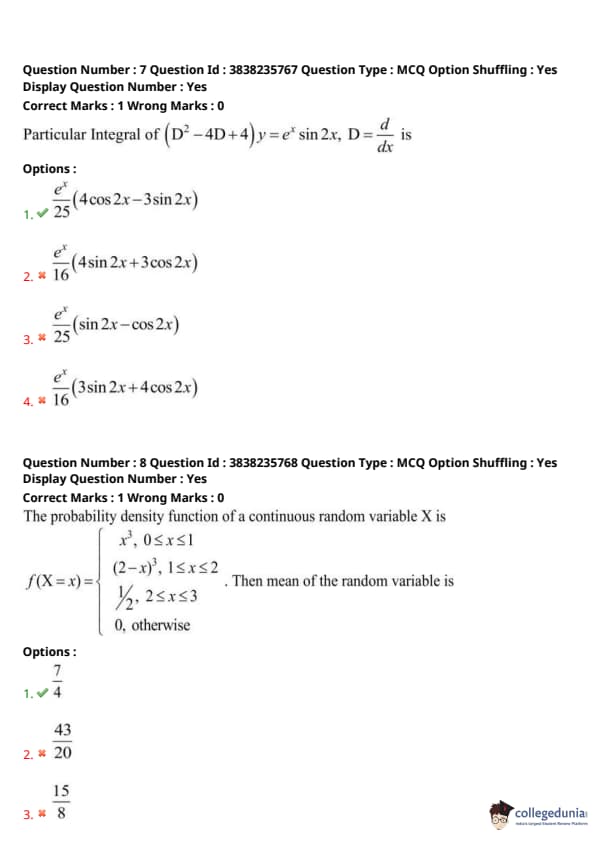
Particular Integral of \((D^2-4D+4)y = e^x \sin 2x\), \(D=\frac{d}{dx}\) is
View Solution
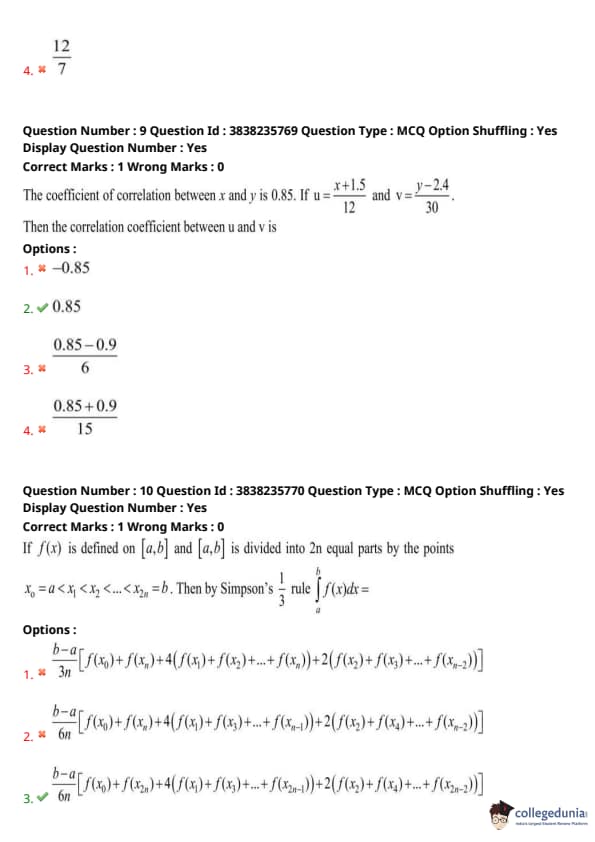
The probability density function of a continuous random variable X is \(f(X=x) = \begin{cases} x^3, & 0 \le x \le 1
(2-x)^3, & 1 \le x \le 2
1/2, & 2 \le x \le 3
0, & otherwise \end{cases}\). Then mean of the random variable is
View Solution
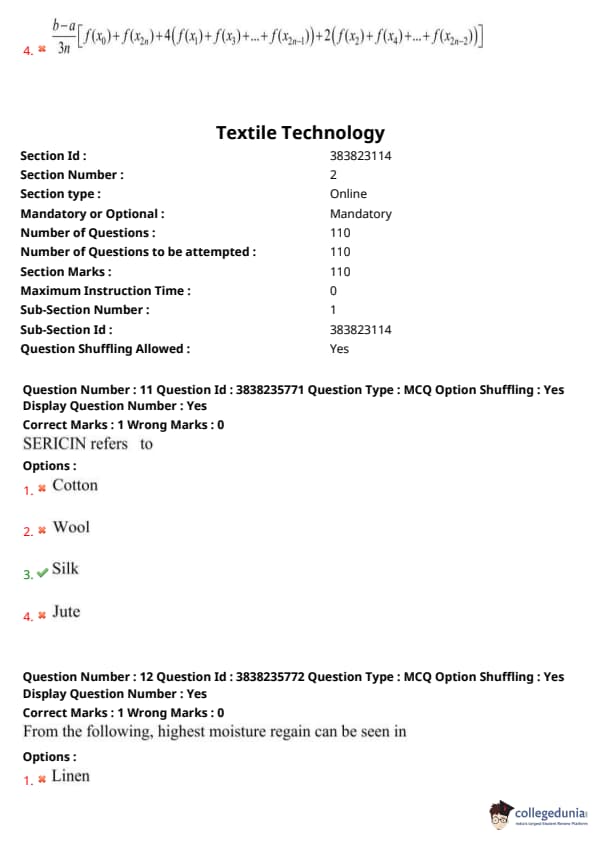
The coefficient of correlation between x and y is 0.85. If \(u = \frac{x+1.5}{12}\) and \(v = \frac{y-2.4}{30}\) Then the correlation coefficient between u and v is
View Solution
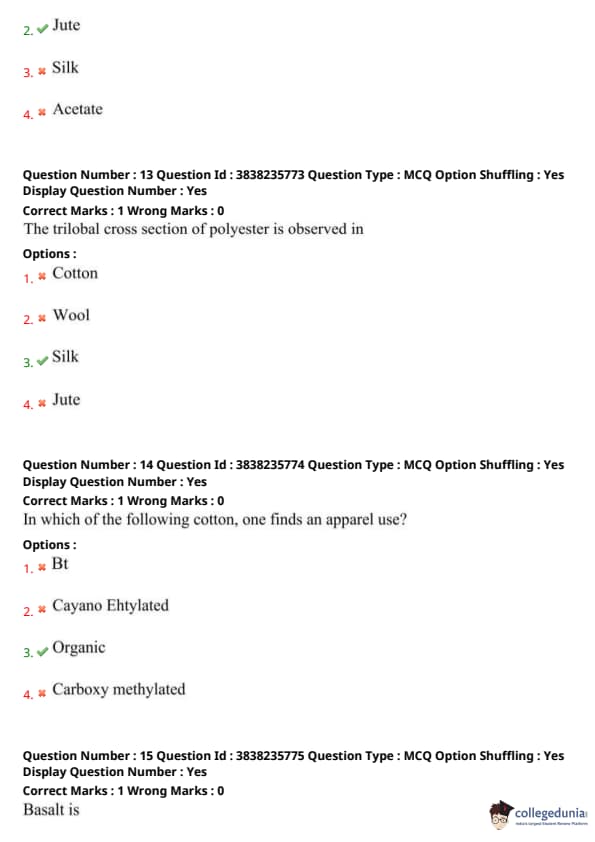
If \(f(x)\) is defined on \([a,b]\) and \([a,b]\) is divided into \(2n\) equal parts by the points \(x_0=a < x_1 < x_2 < \dots < x_{2n}=b\). Then by Simpson's \(\frac{1}{3}\) rule \(\int_a^b f(x)dx =\)
View Solution
SERICIN refers to
View Solution
From the following, highest moisture regain can be seen in
View Solution
The trilobal cross section of polyester is observed in
View Solution
In which of the following cotton, one finds an apparel use?
View Solution
Basalt is
View Solution
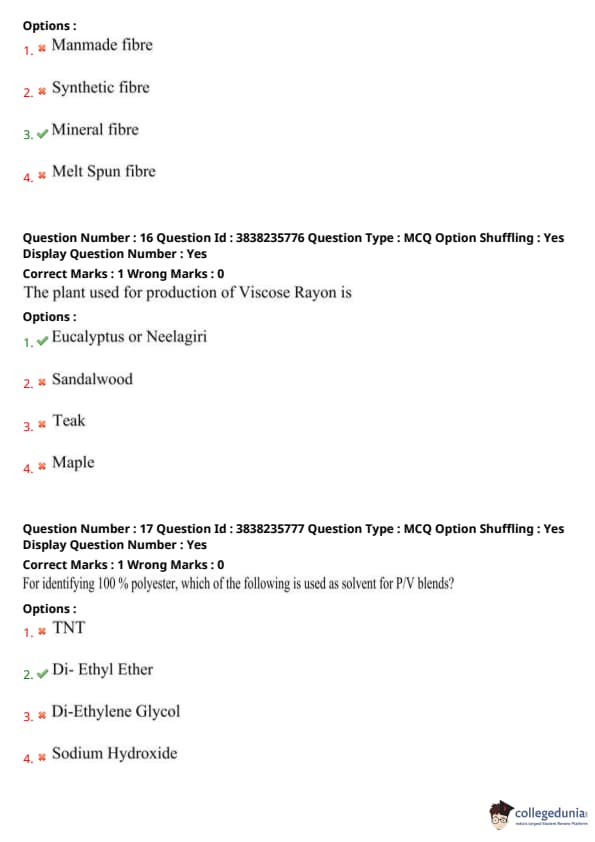
The plant used for production of Viscose Rayon is
View Solution
For identifying 100 % polyester, which of the following is used as solvent for P/V blends?
% P/V blends usually means Polyester/Viscose blends. The question asks for a solvent to identify 100% polyester, possibly by dissolving other components in a blend or by dissolving polyester itself. "Solvent for P/V blends" might mean a solvent that can differentiate or separate P and V.
View Solution
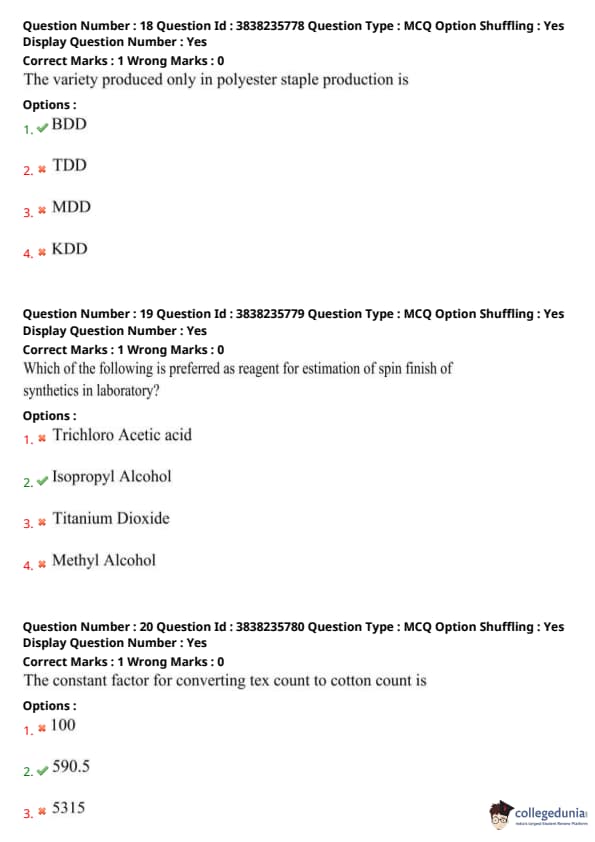
The variety produced only in polyester staple production is
View Solution
Which of the following is preferred as reagent for estimation of spin finish of synthetics in laboratory?
View Solution
The constant factor for converting tex count to cotton count is
View Solution
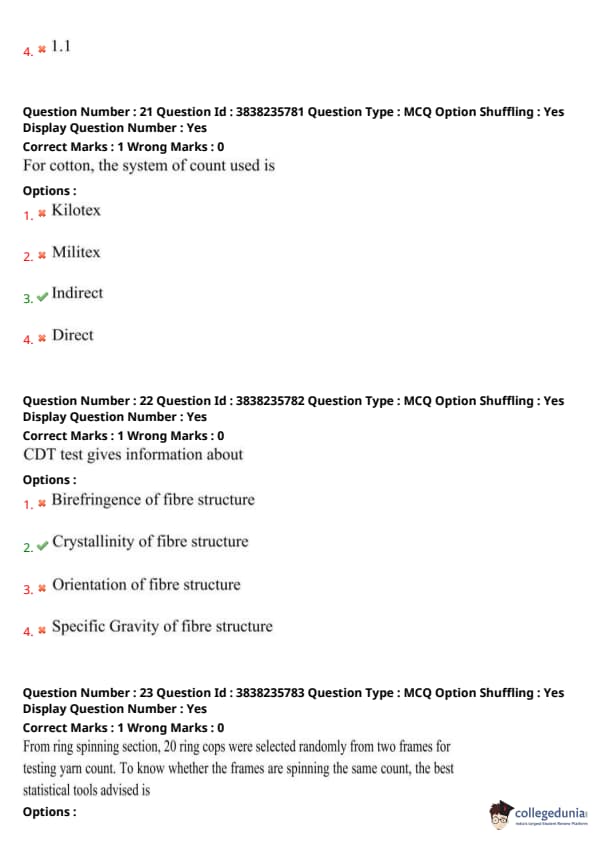
For cotton, the system of count used is
View Solution
CDT test gives information about
View Solution
From ring spinning section, 20 ring cops were selected randomly from two frames for testing yarn count. To know whether the frames are spinning the same count, the best statistical tools advised is
View Solution
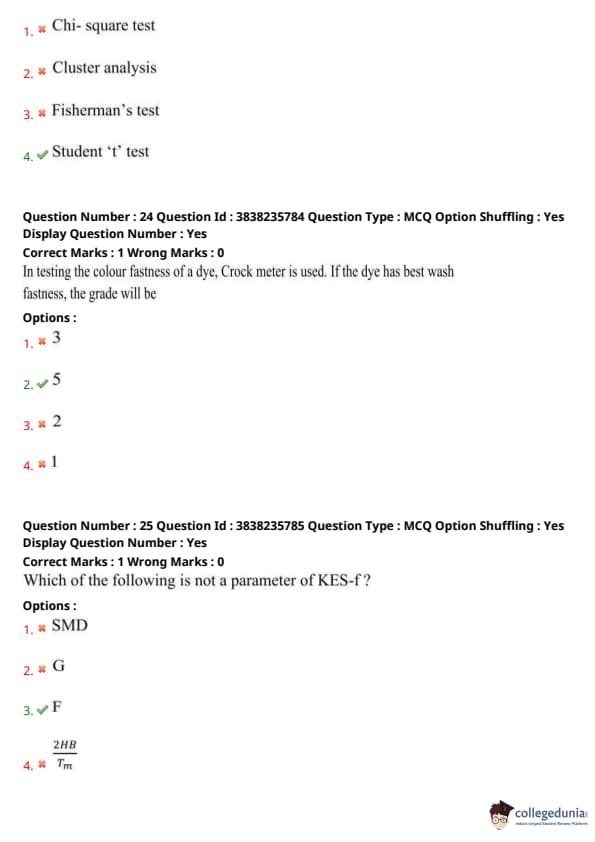
In testing the colour fastness of a dye, Crock meter is used. If the dye has best wash fastness, the grade will be
View Solution
Which of the following is not a parameter of KES-f?
View Solution
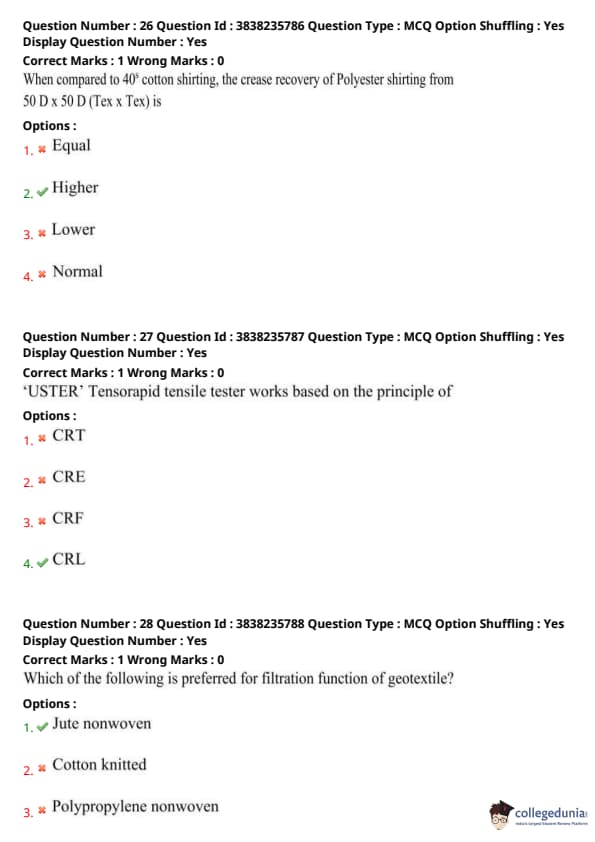
When compared to \(40^s\) cotton shirting, the crease recovery of Polyester shirting from 50 D x 50 D (Tex x Tex) is
% Note: "50 D x 50 D (Tex x Tex)" means 50 Denier warp and 50 Denier weft. The (Tex x Tex) in parenthesis is likely a typo or misunderstanding, as Denier and Tex are different unit systems. 50 Denier is a typical filament yarn size. \(40^s\) cotton is a medium count cotton spun yarn.
View Solution
'USTER' Tensorapid tensile tester works based on the principle of
View Solution
Which of the following is preferred for filtration function of geotextile?
View Solution
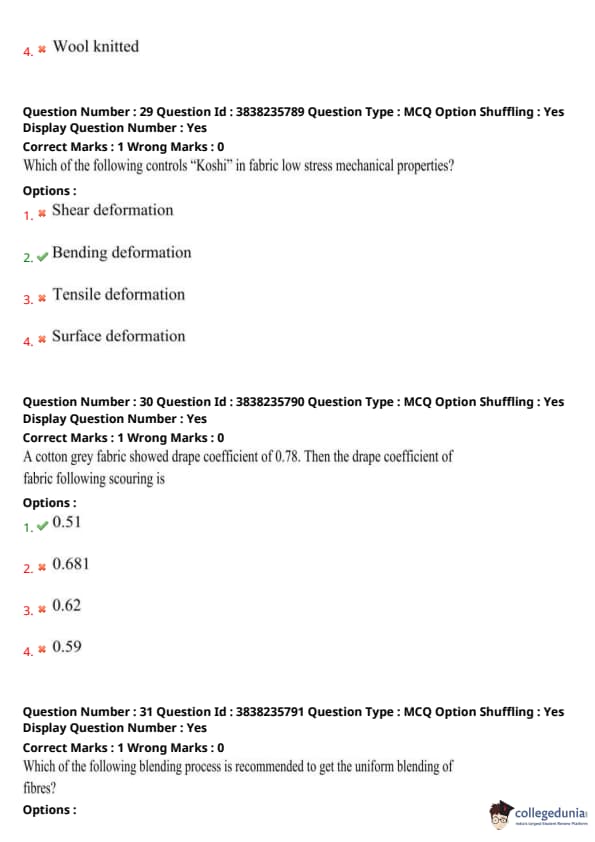
Which of the following controls "Koshi" in fabric low stress mechanical properties?
View Solution
A cotton grey fabric showed drape coefficient of 0.78. Then the drape coefficient of fabric following scouring is
View Solution
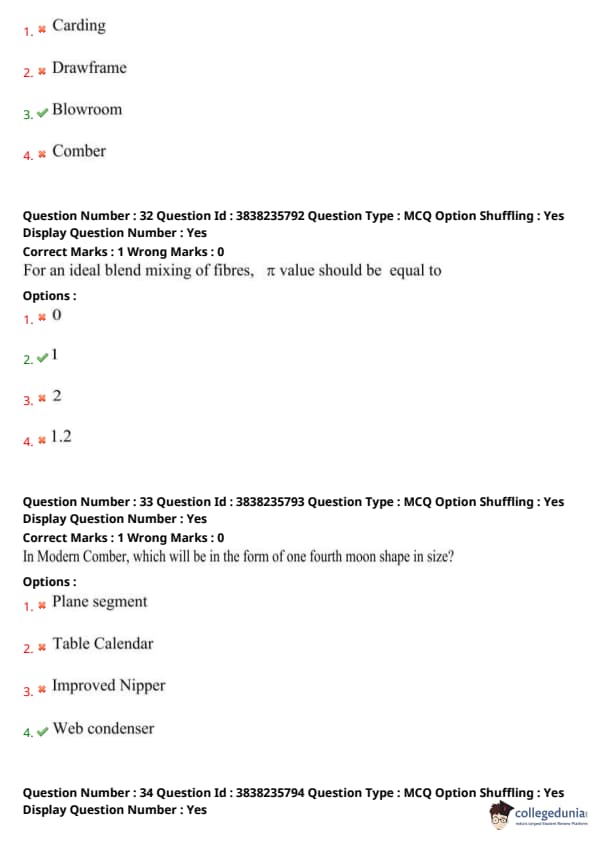
Which of the following blending process is recommended to get the uniform blending of fibres?
View Solution
For an ideal blend mixing of fibres, \(\pi\) value should be equal to
View Solution
In Modern Comber, which will be in the form of one fourth moon shape in size?
View Solution
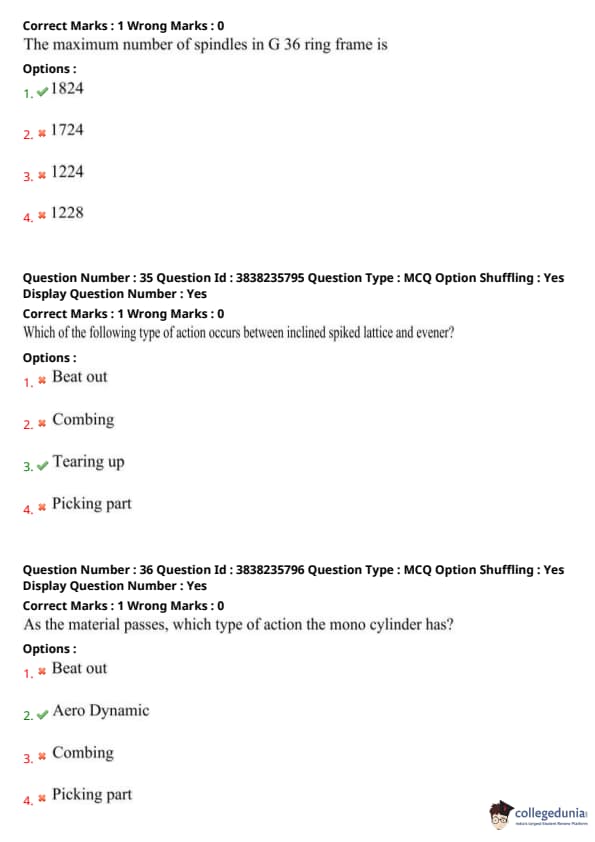
The maximum number of spindles in G 36 ring frame is
View Solution
Which of the following type of action occurs between inclined spiked lattice and evener?
View Solution
As the material passes, which type of action the mono cylinder has?
View Solution
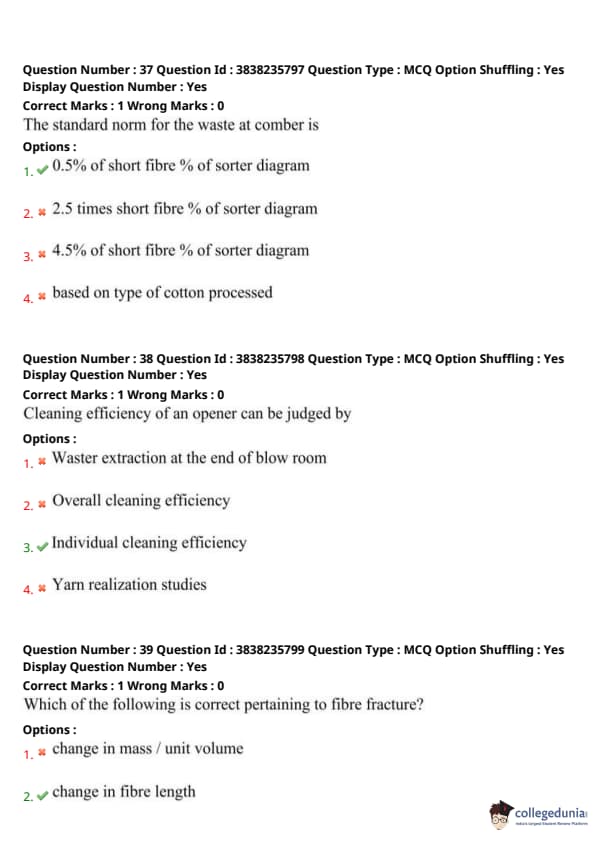
The standard norm for the waste at comber is
View Solution
Cleaning efficiency of an opener can be judged by
View Solution
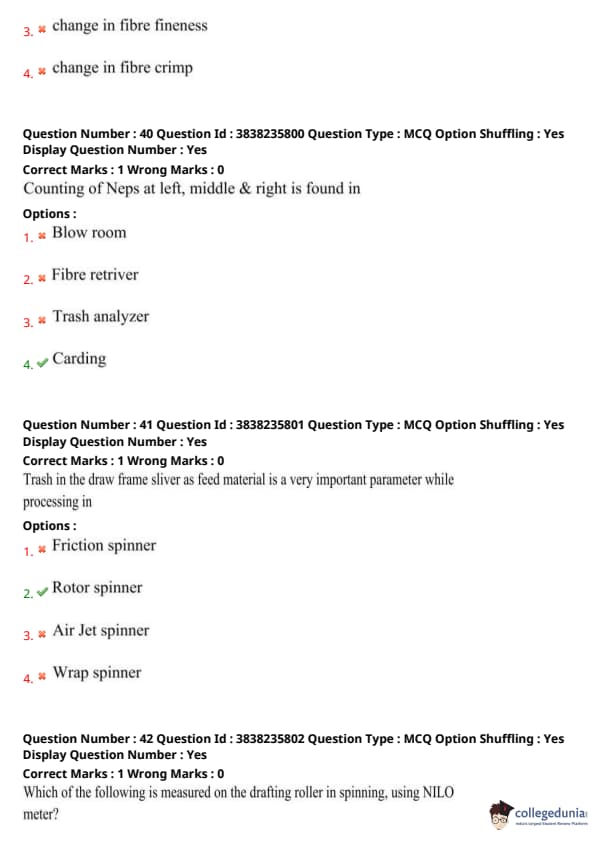
Which of the following is correct pertaining to fibre fracture?
View Solution
Counting of Neps at left, middle \& right is found in
View Solution
Trash in the draw frame sliver as feed material is a very important parameter while processing in
View Solution
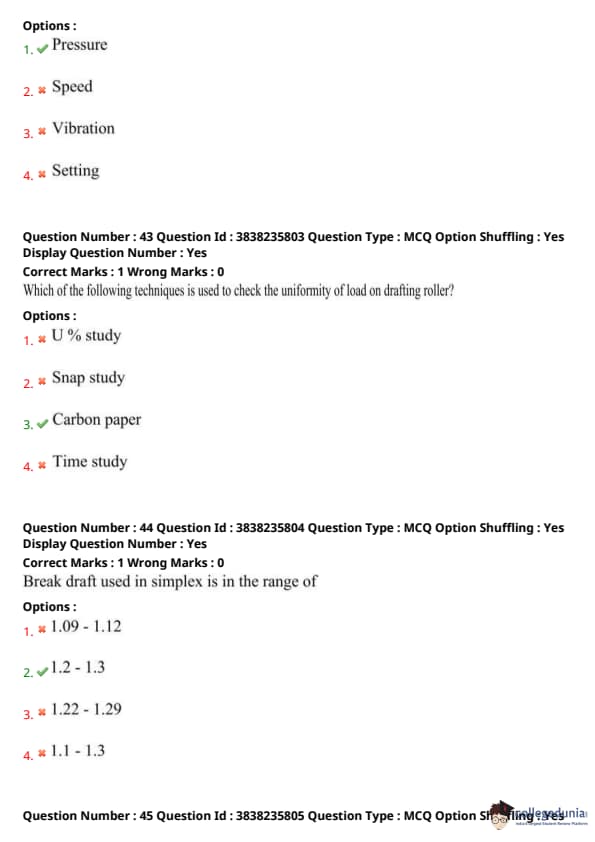
Which of the following is measured on the drafting roller in spinning, using NILO meter?
View Solution
Which of the following techniques is used to check the uniformity of load on drafting roller?
View Solution
Break draft used in simplex is in the range of
% Simplex = Roving Frame / Fly Frame
View Solution
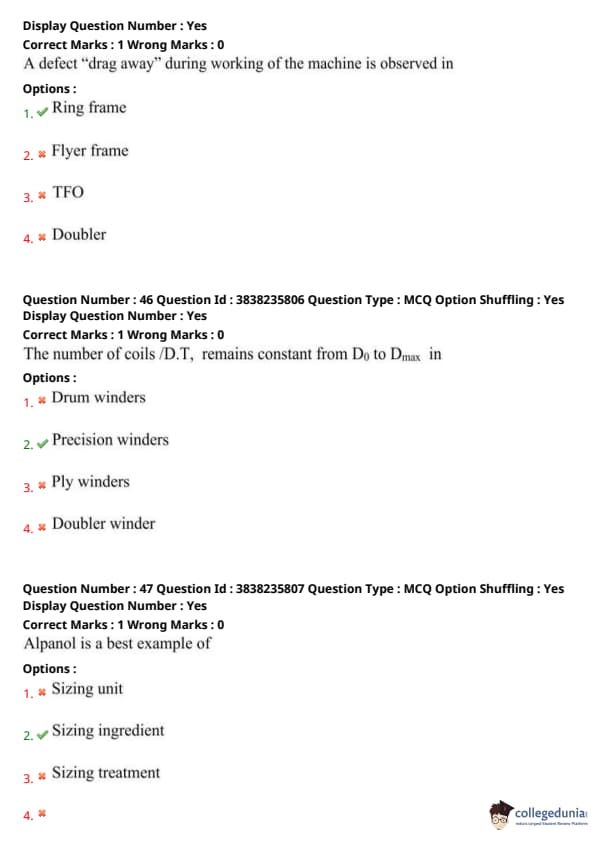
A defect "drag away" during working of the machine is observed in
View Solution
The number of coils /D.T\(_t\) remains constant from D\(_0\) to D\(_{max}\) in
% D.T_t likely means Double Traverse. Number of coils per double traverse.
View Solution
Alpanol is a best example of
View Solution
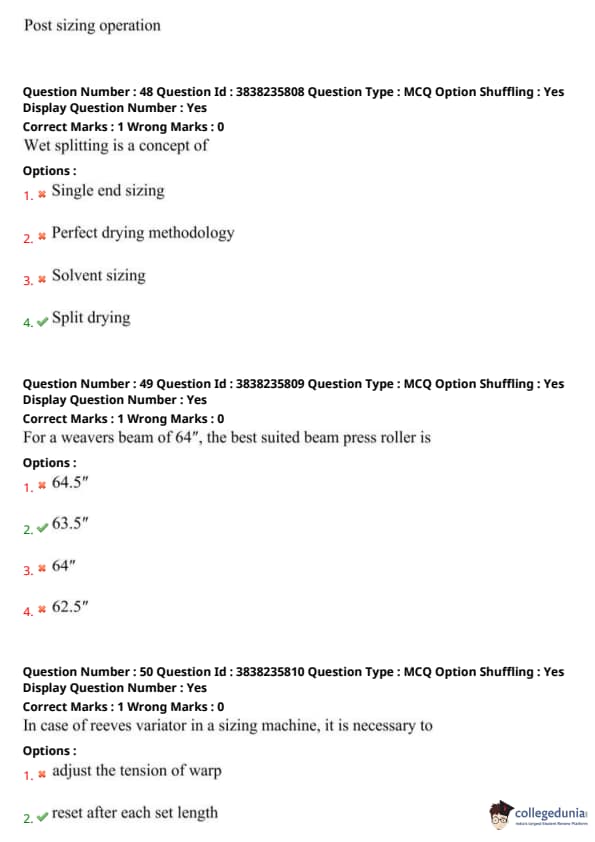
Wet splitting is a concept of
View Solution
For a weavers beam of 64", the best suited beam press roller is
View Solution
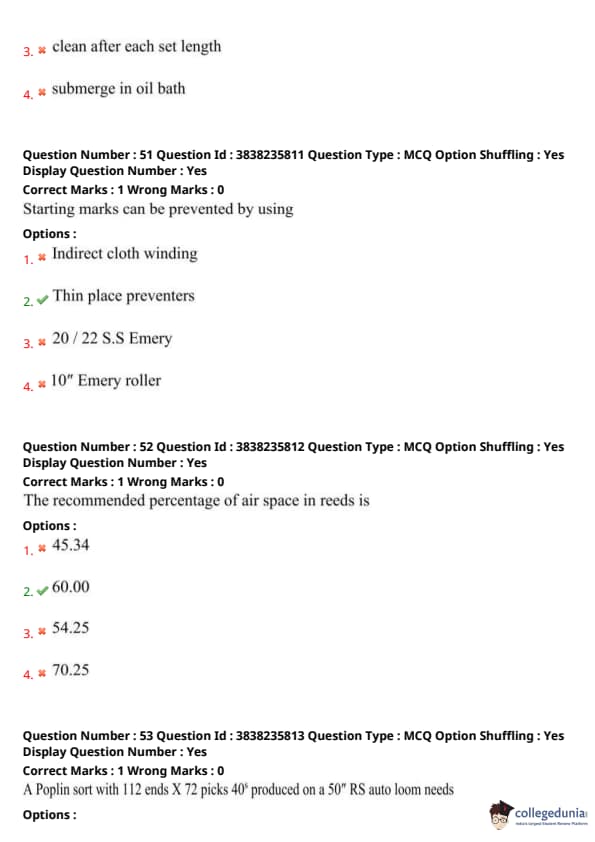
In case of reeves variator in a sizing machine, it is necessary to
View Solution
Starting marks can be prevented by using
View Solution
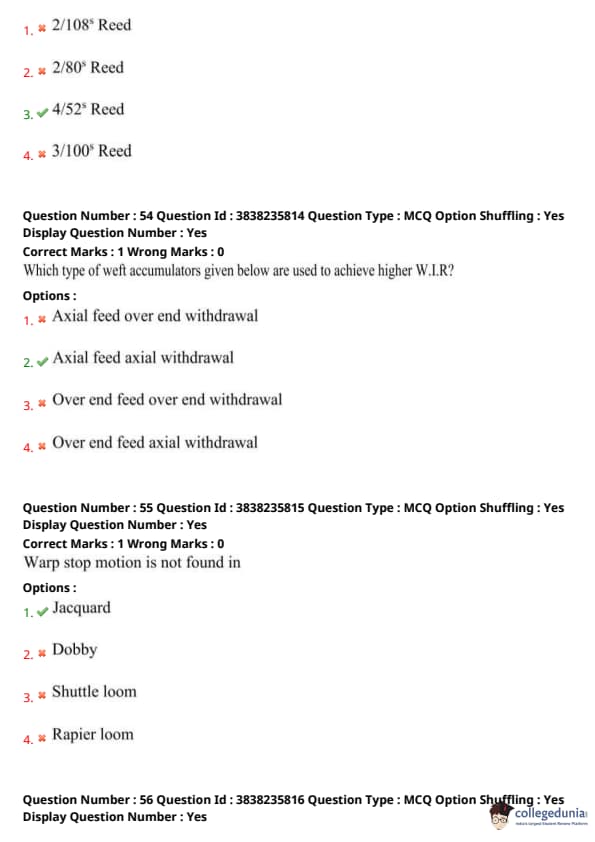
The recommended percentage of air space in reeds is
View Solution
A Poplin sort with 112 ends X 72 picks 40\(^s\) produced on a 50" RS auto loom needs
% Construction: 112 EPI, 72 PPI, 40s NeC yarn. RS (Reed Space) = 50 inches.
View Solution
Which type of weft accumulators given below are used to achieve higher W.I.R?
% W.I.R = Weft Insertion Rate
View Solution
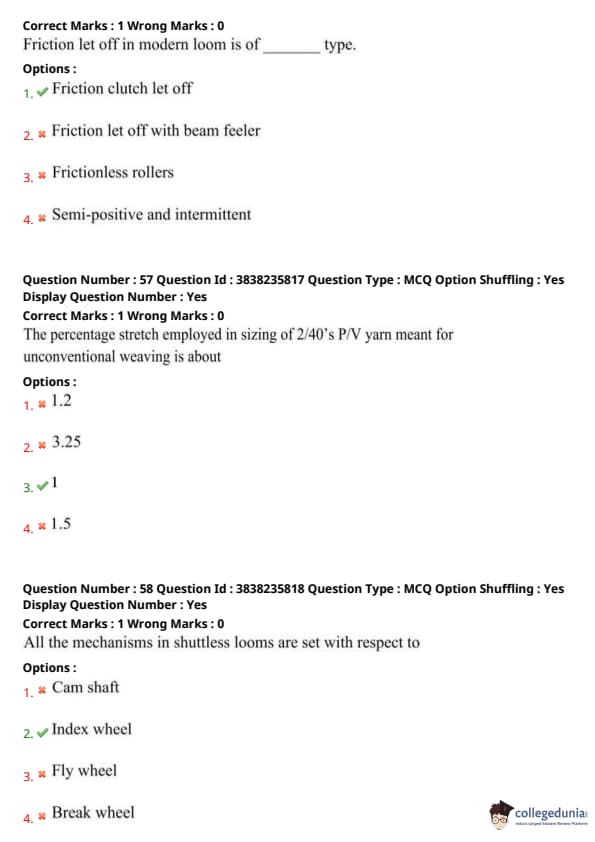
Warp stop motion is not found in
View Solution
Friction let off in modern loom is of \hspace{3cm} type.
View Solution
The percentage stretch employed in sizing of 2/40's P/V yarn meant for unconventional weaving is about
% 2/40's P/V yarn: A plied yarn, likely two 40s NeC yarns plied. P/V means Polyester/Viscose blend.
% Unconventional weaving: Could refer to shuttleless looms (rapier, projectile, air jet, water jet) which often require higher quality warp with specific stretch properties.
View Solution
All the mechanisms in shuttleless looms are set with respect to
View Solution
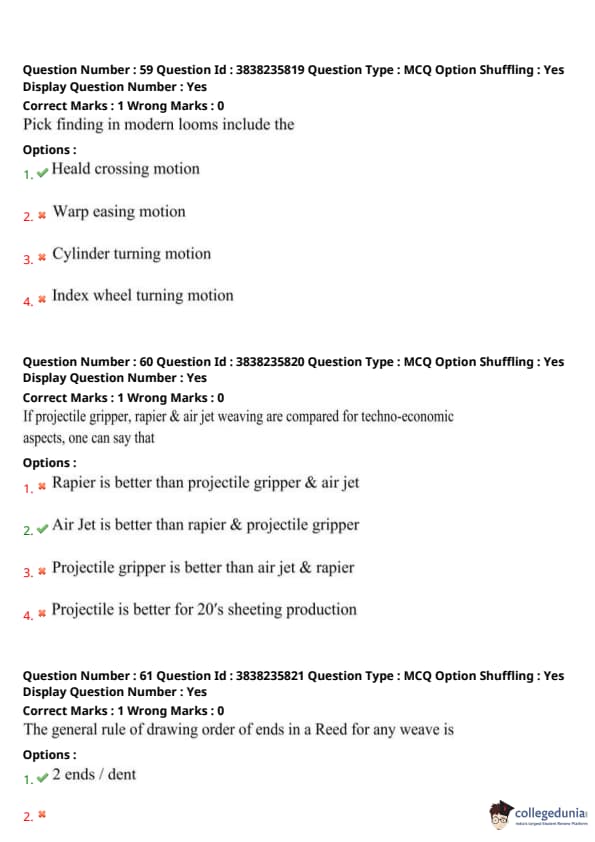
Pick finding in modern looms include the
View Solution
If projectile gripper, rapier \& air jet weaving are compared for techno-economic aspects, one can say that
View Solution
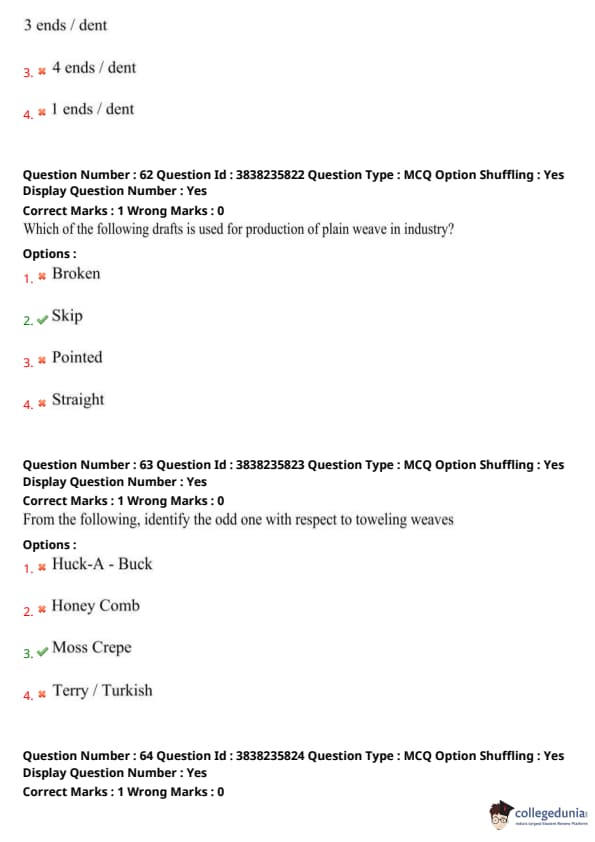
The general rule of drawing order of ends in a Reed for any weave is
View Solution
Which of the following drafts is used for production of plain weave in industry?
% "Drafts" here refers to "drawing-in drafts" or "heald drafts," which specify how warp yarns are threaded through heald eyes on different heald shafts.
View Solution
From the following, identify the odd one with respect to toweling weaves
View Solution
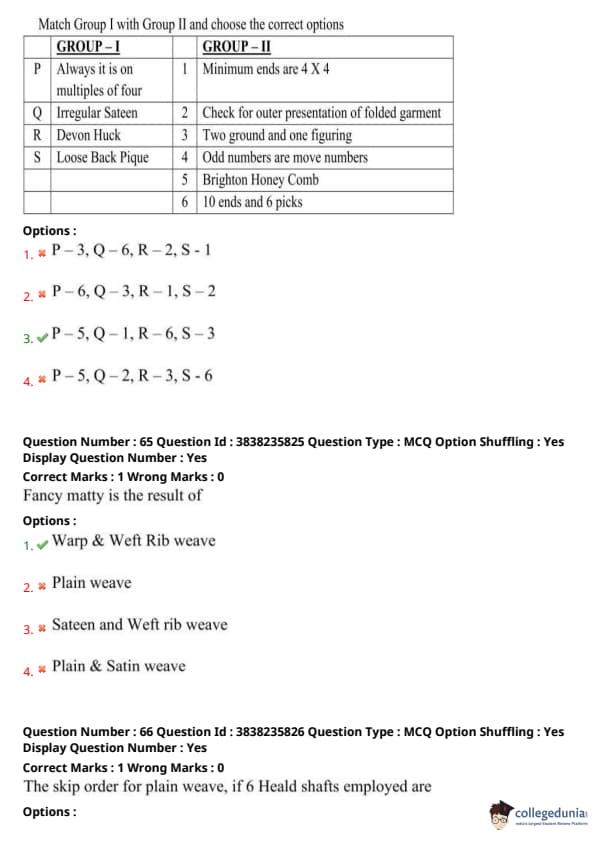
Match Group I with Group II and choose the correct options
GROUP - I GROUP - II
P Always it is on multiples of four 1 Minimum ends are 4 X 4
Q Irregular Sateen 2 Check for outer presentation of folded garment
R Devon Huck 3 Two ground and one figuring
S Loose Back Pique 4 Odd numbers are move numbers
5 Brighton Honey Comb
6 10 ends and 6 picks
View Solution
Fancy matty is the result of
% Matty weave is also known as Basket weave or Hopsack weave.
View Solution
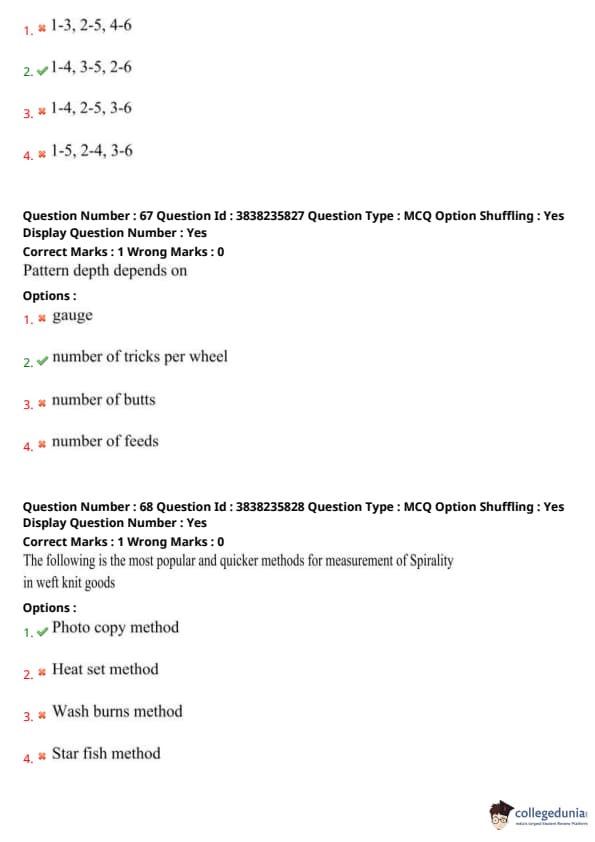
The skip order for plain weave, if 6 Heald shafts employed are
"Skip order" here means drawing-in draft (heald draft). Plain weave needs minimum 2 distinct movements.
View Solution
Pattern depth depends on
This likely refers to Jacquard weaving or Dobby weaving, where pattern depth means the number of picks in the pattern repeat.
View Solution
The following is the most popular and quicker methods for measurement of Spirality in weft knit goods
View Solution
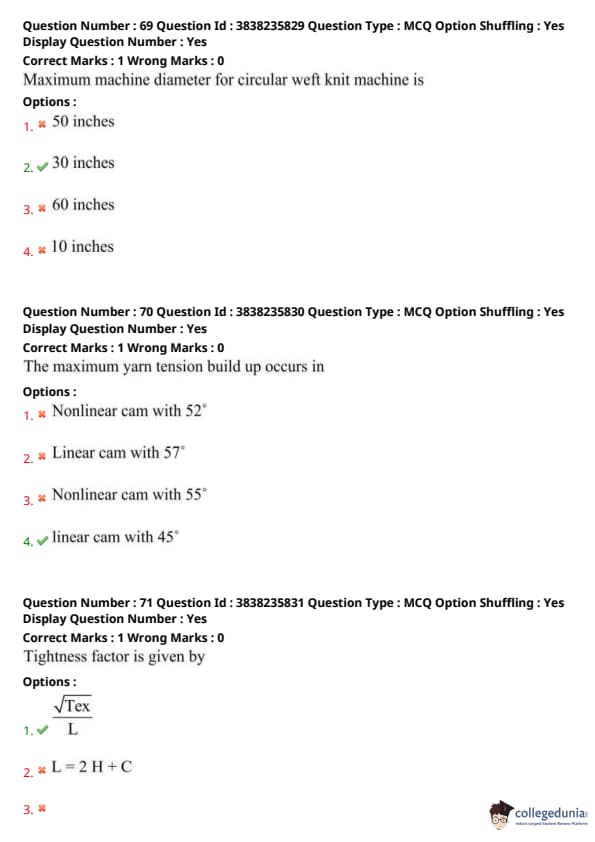
Maximum machine diameter for circular weft knit machine is
View Solution
The maximum yarn tension build up occurs in
View Solution
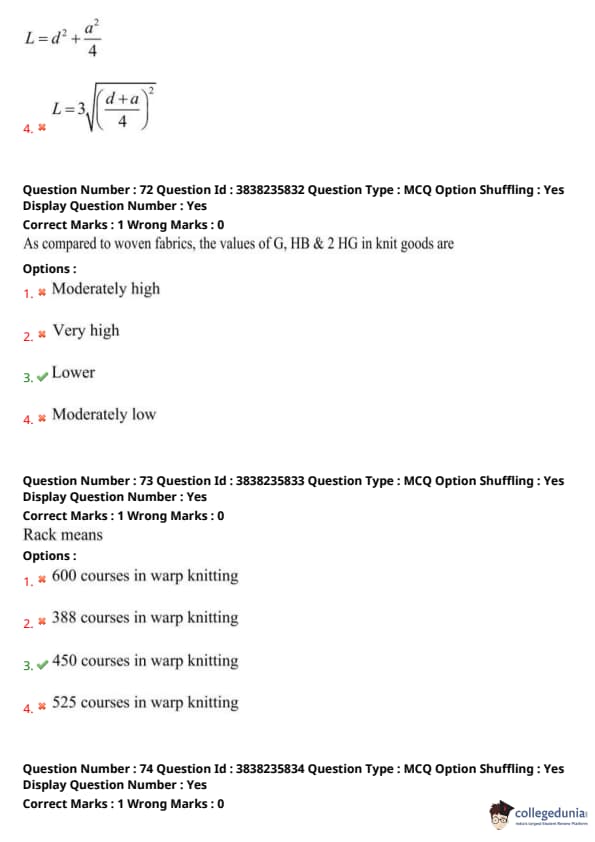
Tightness factor is given by
View Solution
As compared to woven fabrics, the values of G, HB \& 2 HG in knit goods are
% G = Shear stiffness, HB = Bending rigidity (often just B), 2HG = Shear hysteresis. (2HB is bending hysteresis).
% Question probably means comparing G, B (bending rigidity), and 2HG (shear hysteresis) or 2HB (bending hysteresis).
View Solution
Rack means
View Solution
Which of the following governs the Run-in Ratio in warp knitting?
View Solution
The following has excellent elastic recovery
View Solution
Use of scrambler roller in condenser card gives
View Solution
In needle punching, the DPN, ND and WW will influence
% DPN = Depth of Penetration of needles
% ND = Needle Density (needles per unit area of needle board)
% WW = Working Width (related to machine size, or could mean web width if it influences something) - or possibly needle stroke or frequency if it's not width.
View Solution
In Needle punching a Crown needle has ......... number of barbs
View Solution
If carding machines are placed parallel to each other, the web doffed from the final card gives
View Solution
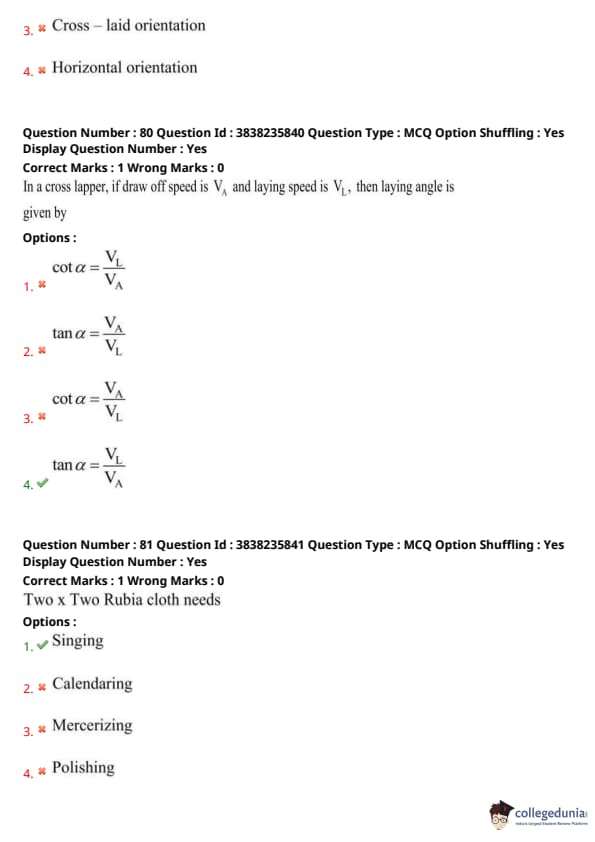
In a cross lapper, if draw off speed is V\(_A\) and laying speed is V\(_L\), then laying angle is given by
% Laying angle \(\alpha\).
View Solution
Two x Two Rubia cloth needs
% "Two x Two Rubia" (2/2 Rubia) is a type of fabric, often cotton, known for its use in blouses or specific traditional wear. It implies a certain weave structure and finish.
View Solution
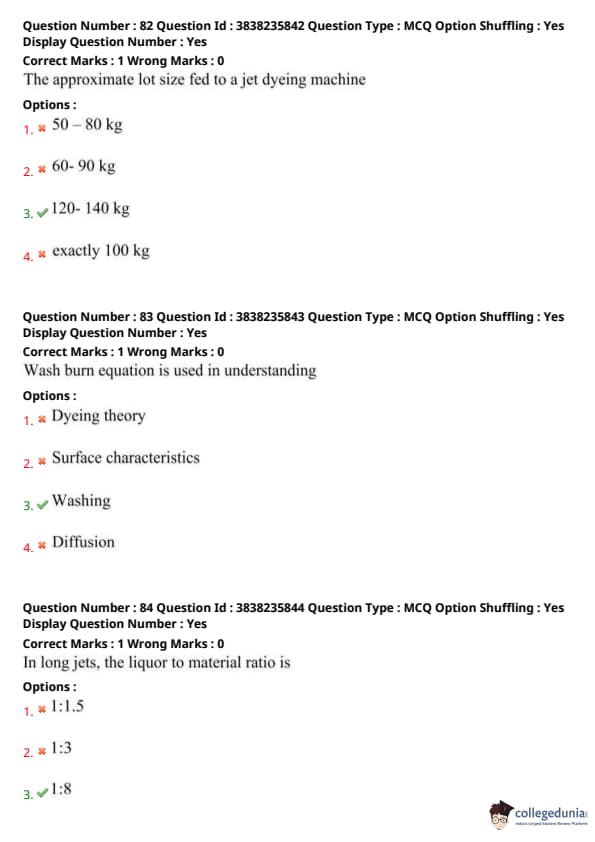
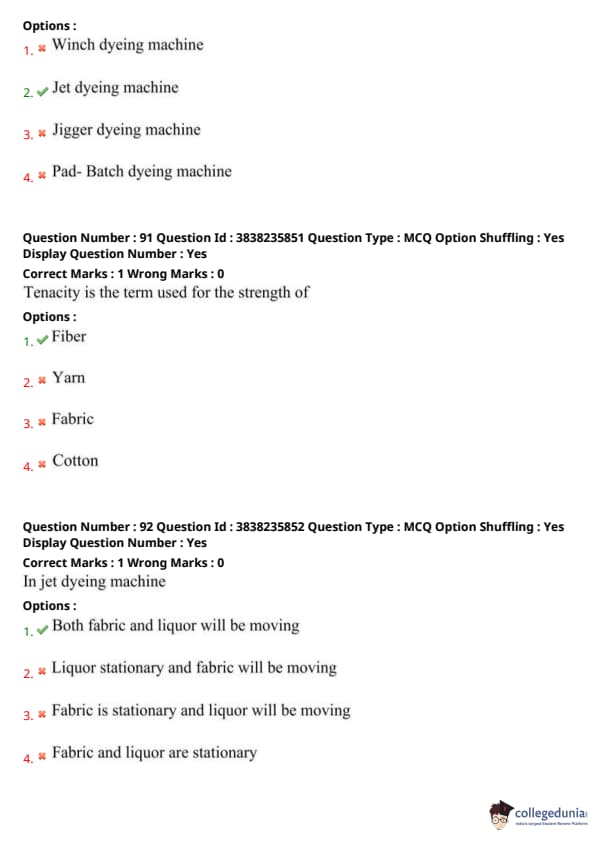
The approximate lot size fed to a jet dyeing machine
View Solution
Wash bum equation is used in understanding
% "Wash bum" is likely a typo for "Washburn Equation".
View Solution
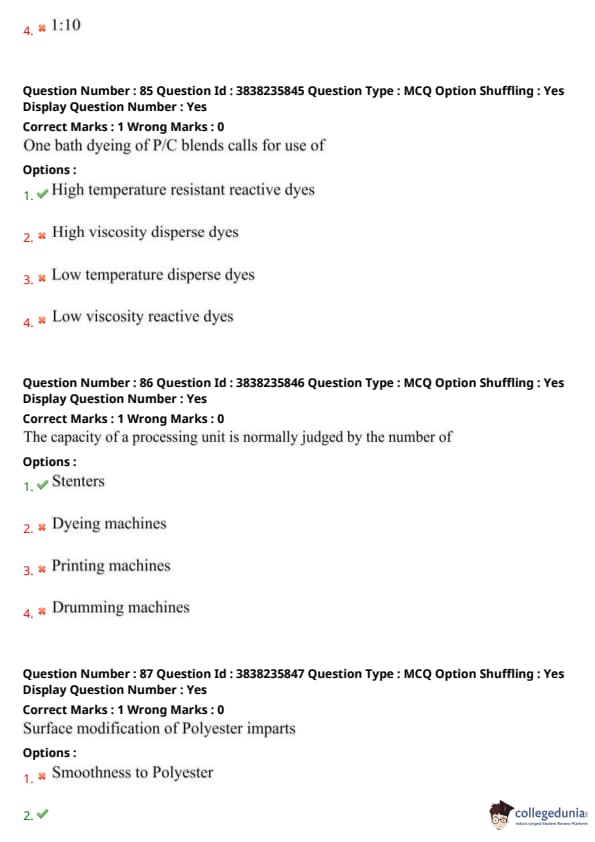
In long jets, the liquor to material ratio is
% "Long jets" likely refers to long-tube or older generation jet dyeing machines.
View Solution
One bath dyeing of P/C blends calls for use of
% P/C blend = Polyester/Cotton blend.
View Solution
The capacity of a processing unit is normally judged by the number of
View Solution
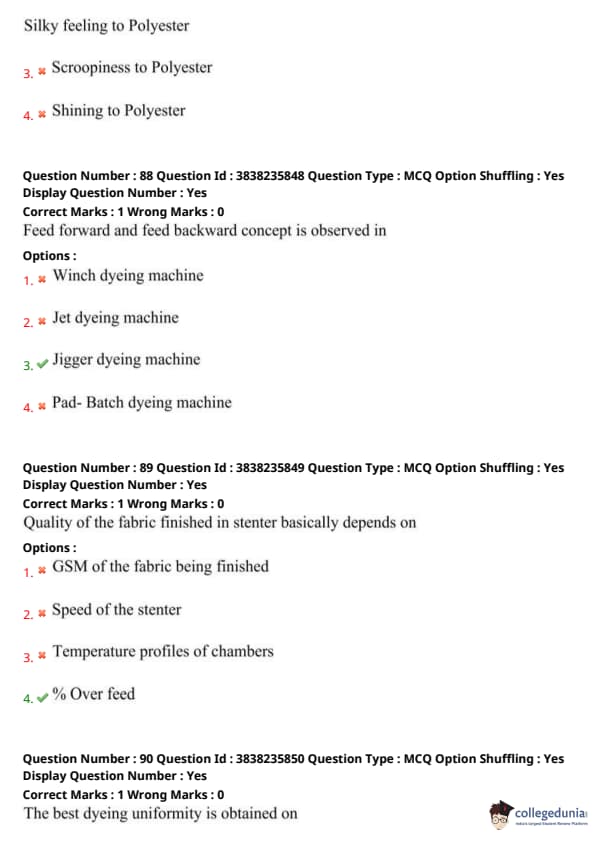
Surface modification of Polyester imparts
View Solution
Feed forward and feed backward concept is observed in
View Solution
Quality of the fabric finished in stenter basically depends on
View Solution
The best dyeing uniformity is obtained on
View Solution
Tenacity is the term used for the strength of
View Solution
In jet dyeing machine
View Solution
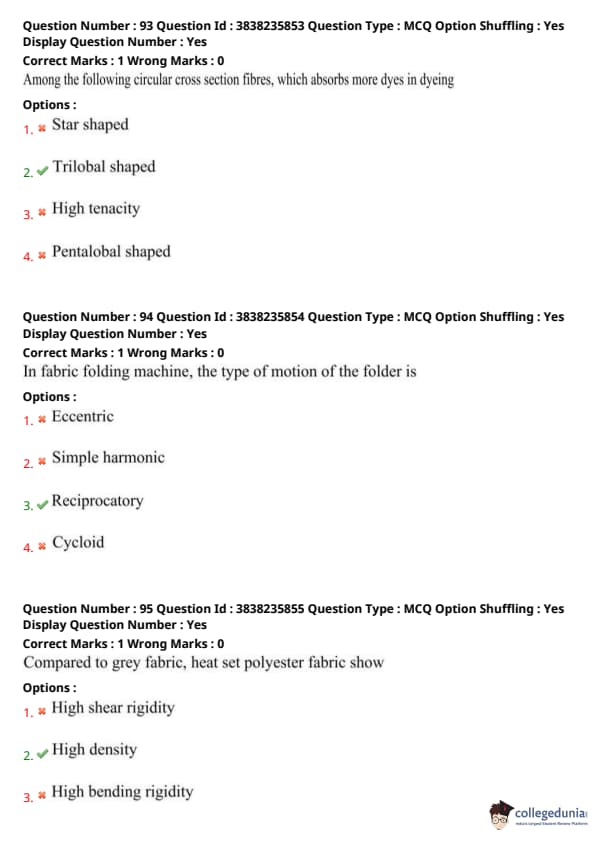
Among the following circular cross section fibres, which absorbs more dyes in dyeing
% The premise "circular cross section fibres" is given, then options are shapes or properties. This is confusing.
% It likely means "Among fibers which *can have* circular cross-sections, or among fibers in general, which of these characteristics leads to absorbing more dye".
% Or "Among the following [listed fiber types/shapes], which absorbs more dye..." assuming they can be circular or are compared generally.
View Solution
In fabric folding machine, the type of motion of the folder is
View Solution
Compared to grey fabric, heat set polyester fabric show
View Solution
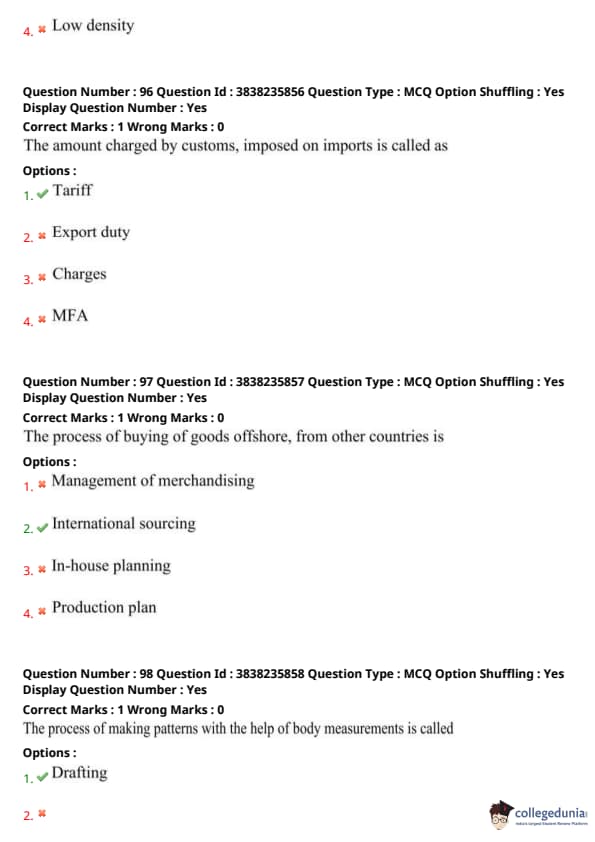
The amount charged by customs, imposed on imports is called as
View Solution
The process of buying of goods offshore, from other countries is
View Solution
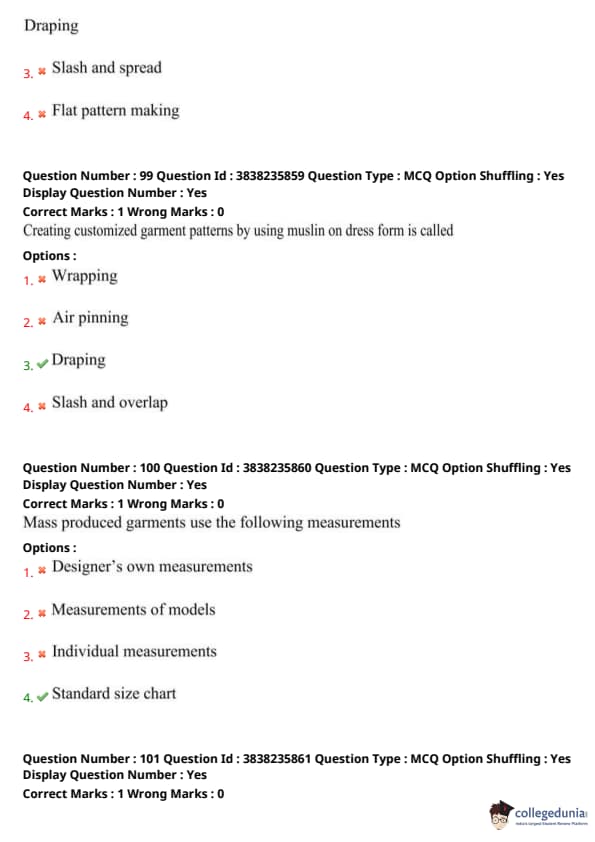
The process of making patterns with the help of body measurements is called
View Solution
Creating customized garment patterns by using muslin on dress form is called
View Solution
Mass produced garments use the following measurements
View Solution
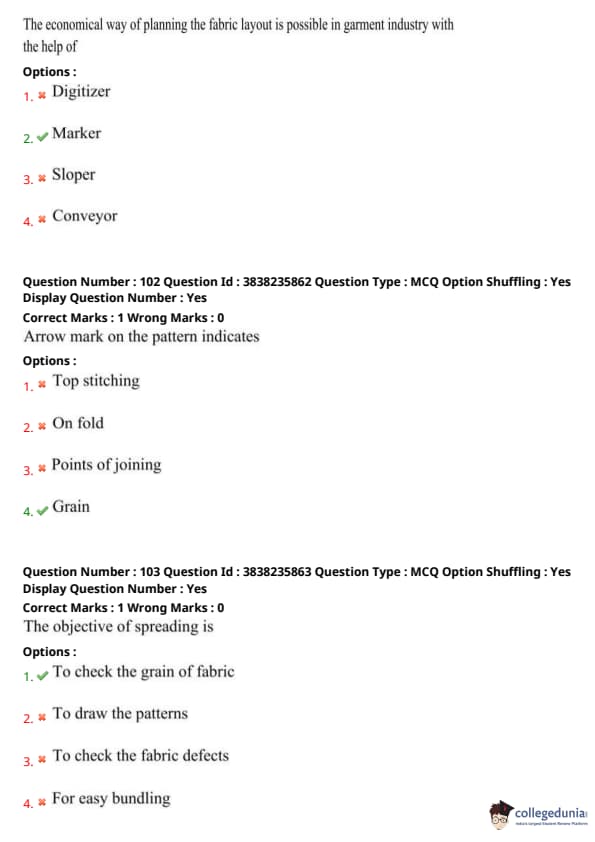
The economical way of planning the fabric layout is possible in garment industry with the help of
View Solution
Arrow mark on the pattern indicates
View Solution
The objective of spreading is
View Solution
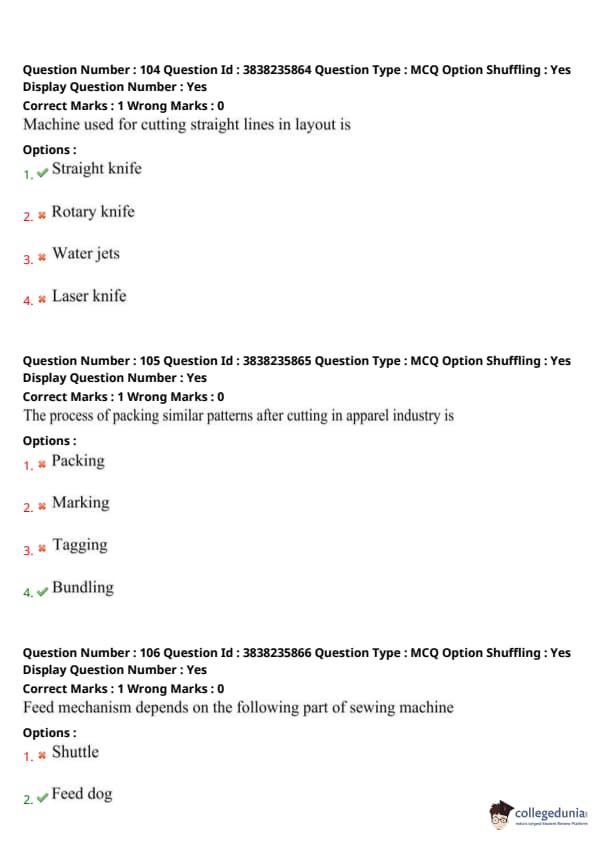
Machine used for cutting straight lines in layout is
% "Layout" here refers to the fabric lay (stack of plies) with a marker on top.
View Solution
The process of packing similar patterns after cutting in apparel industry is
% "similar patterns" means cut pieces of the same garment part and size.
View Solution
Feed mechanism depends on the following part of sewing machine
View Solution
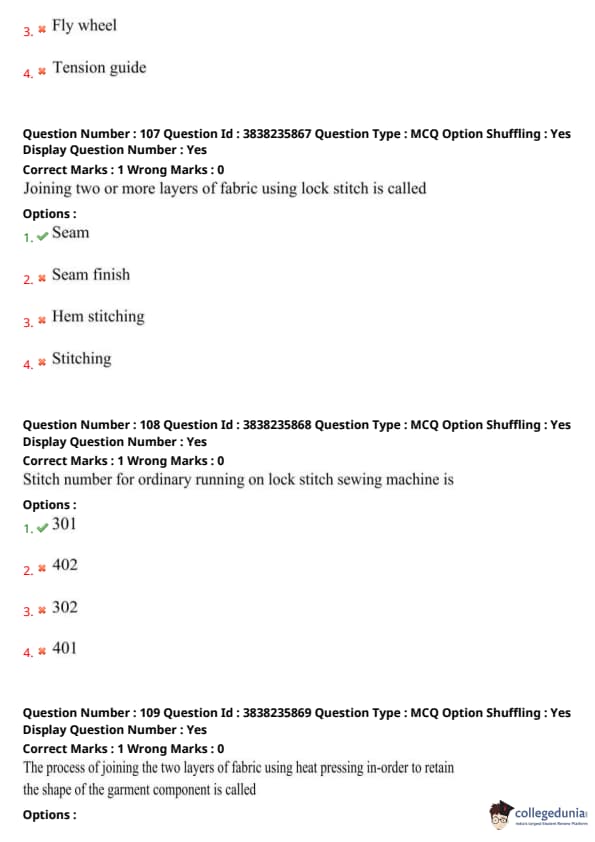
Joining two or more layers of fabric using lock stitch is called
View Solution
Stitch number for ordinary running on lock stitch sewing machine is
% "Stitch number" often refers to Stitch Type Number from standards like ISO 4915 or Federal Standard 751a.
View Solution
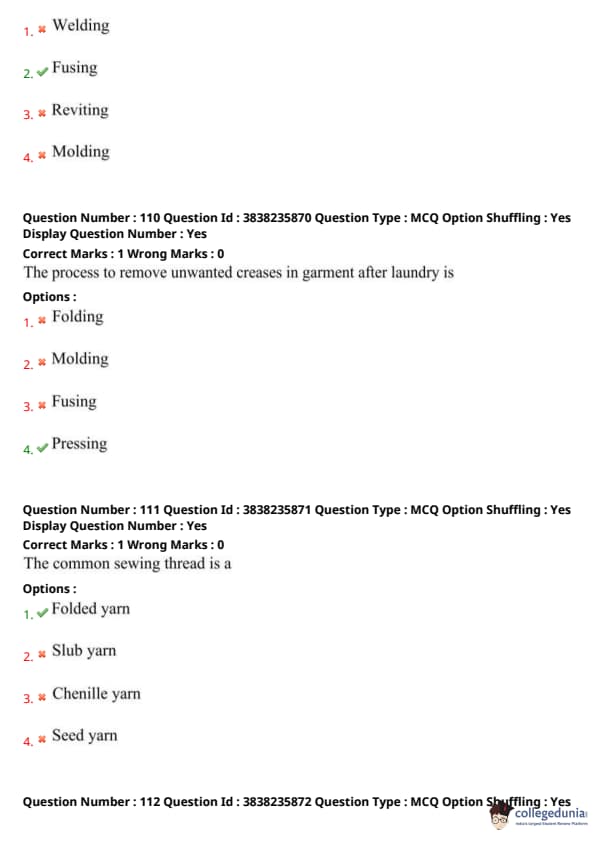
The process of joining the two layers of fabric using heat pressing in-order to retain the shape of the garment component is called
View Solution
The process to remove unwanted creases in garment after laundry is
View Solution
The common sewing thread is a
View Solution
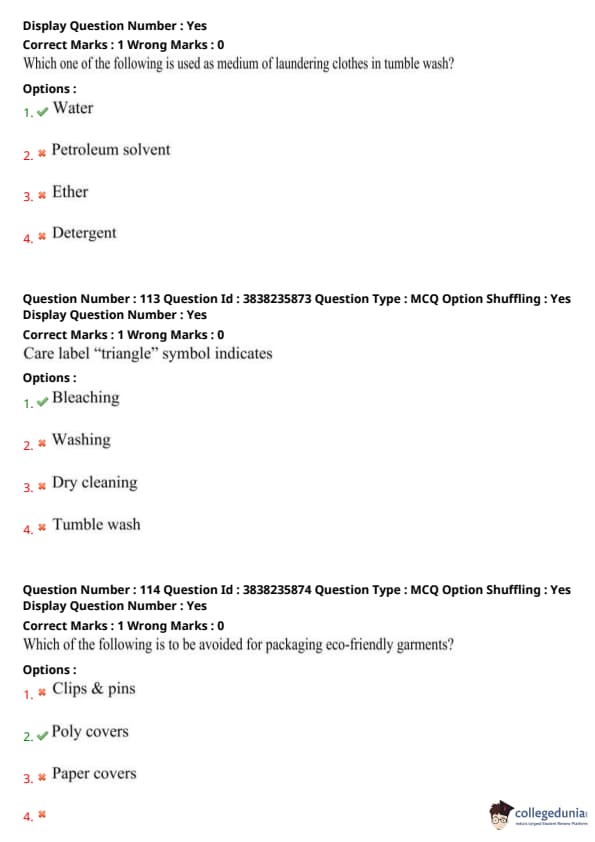
Which one of the following is used as medium of laundering clothes in tumble wash?
View Solution
Care label "triangle" symbol indicates
View Solution
Which of the following is to be avoided for packaging eco-friendly garments?
View Solution
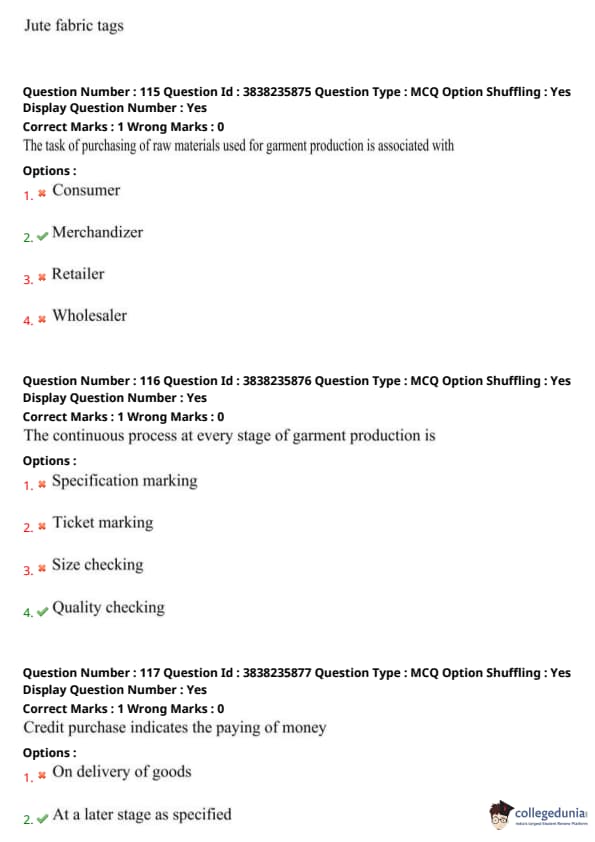
The task of purchasing of raw materials used for garment production is associated with
View Solution
The continuous process at every stage of garment production is
View Solution
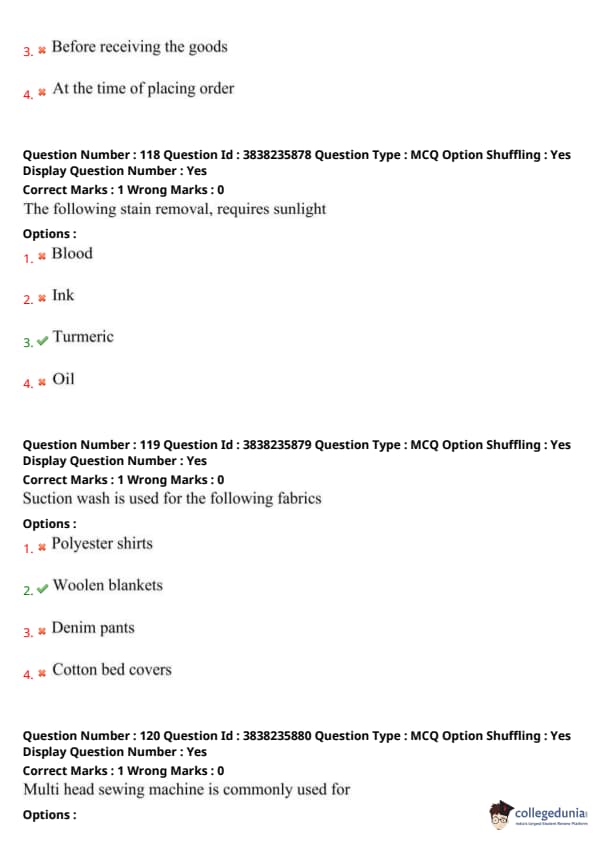
Credit purchase indicates the paying of money
View Solution
The following stain removal, requires sunlight
View Solution
Suction wash is used for the following fabrics
View Solution
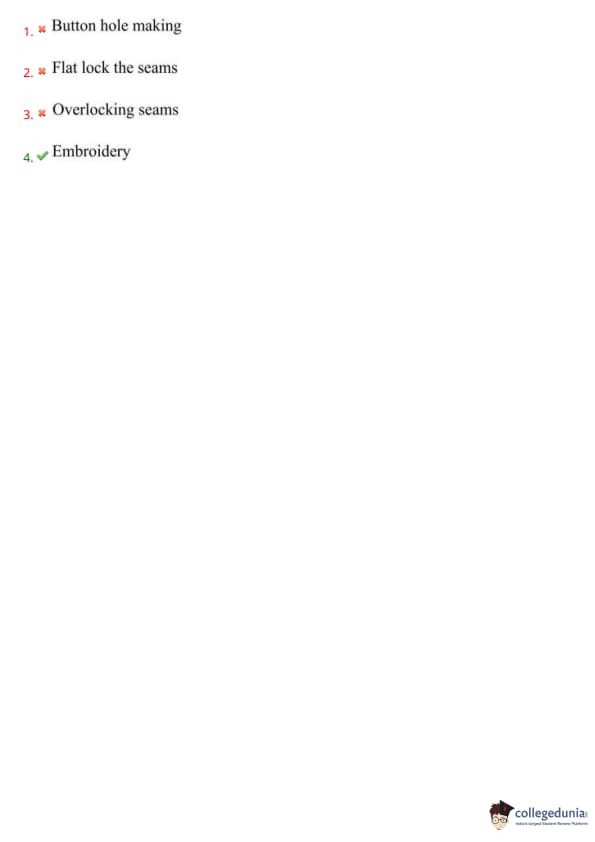
Multi head sewing machine is commonly used for
View Solution



Comments