




GUJCET 2026 Mathematics Question Paper with Solution PDF is available for download here. The GSEB conducted the GUJCET 2026 Exam for Mathematics in the Second Shift in PBT mode.
The GUJCET Mathematics Question Paper 2026 includes 40 questions to be completed in 1 hour. As per the Marking Scheme +1 mark for every correct answer and -0.25 marks will be deducted for every wrong answer
GUJCET 2026 Mathematics Question Paper with Solution PDF
| GUJCET 2026 Mathematics Question Paper with Solution PDF | Download PDF | Check Solution |
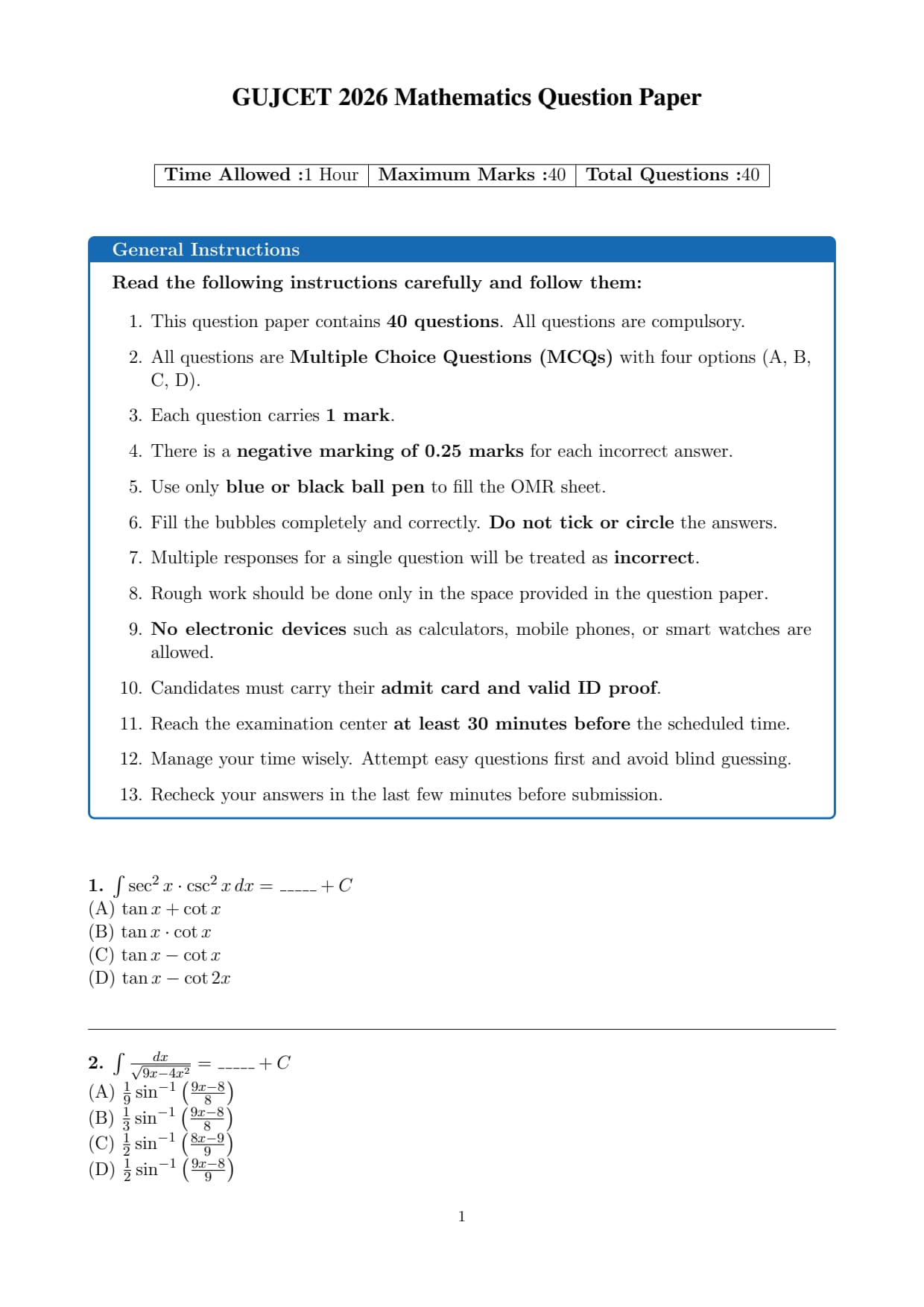
\( \int \sec^2 x \cdot \csc^2 x \, dx = \_\_\_\_\_ + C \)
\( \int \frac{dx}{\sqrt{9x - 4x^2}} = \_\_\_\_\_ + C \)
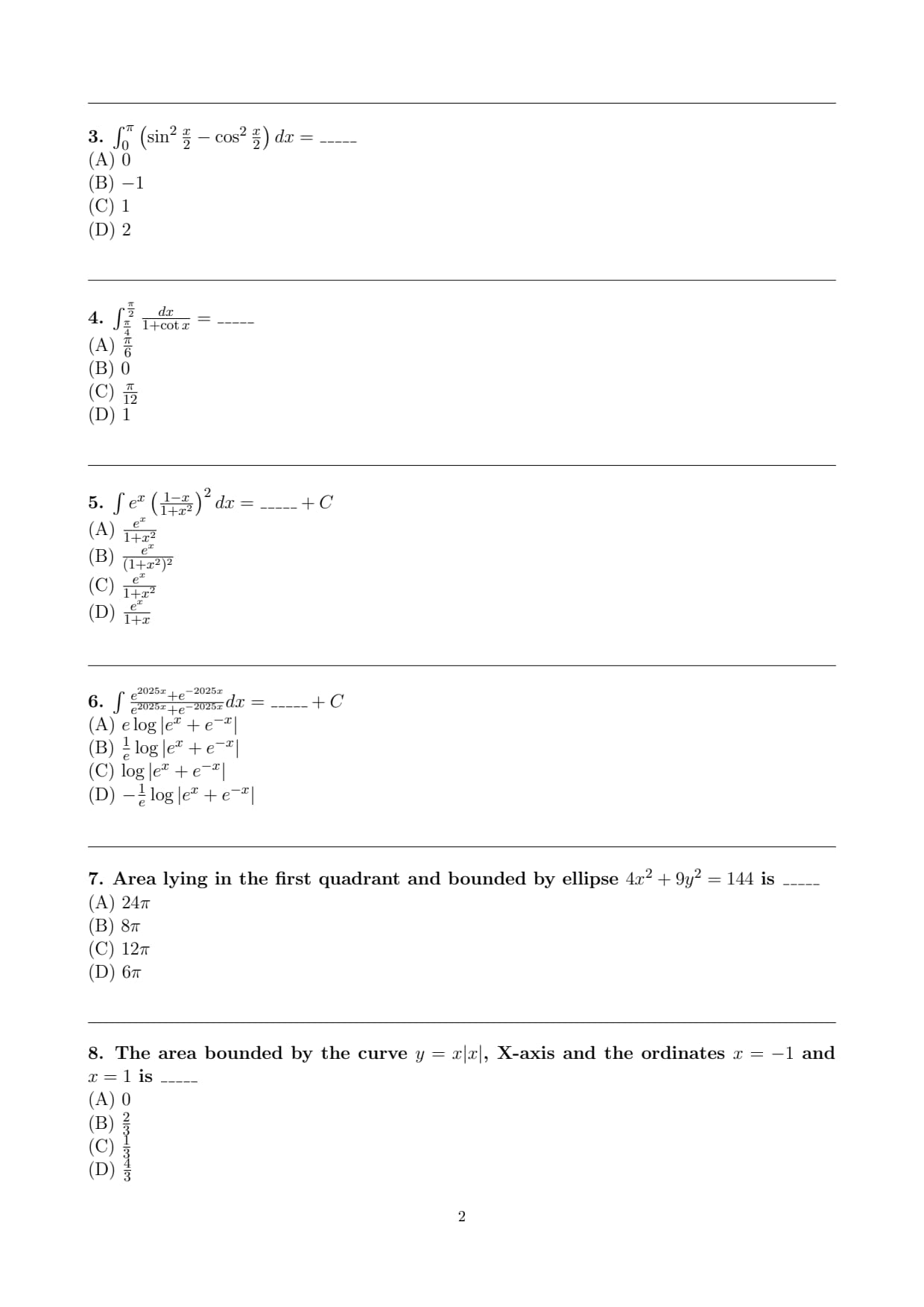
\( \int_{0}^{\pi} \left(\sin^2 \frac{x}{2} - \cos^2 \frac{x}{2}\right) dx = \_\_\_\_\_ \)
\( \int_{\frac{\pi}{4}}^{\frac{\pi}{2}} \frac{dx}{1+\cot x} = \_\_\_\_\_ \)
\( \int e^x \left(\frac{1-x}{1+x^2}\right)^2 dx = \_\_\_\_\_ + C \)
\( \int \frac{e^{2025x} + e^{-2025x}}{e^{2025x} + e^{-2025x}} dx = \_\_\_\_\_ + C \)
Area lying in the first quadrant and bounded by ellipse \(4x^2 + 9y^2 = 144\) is _____
The area bounded by the curve \(y = x|x|\), X-axis and the ordinates \(x = -1\) and \(x = 1\) is _____
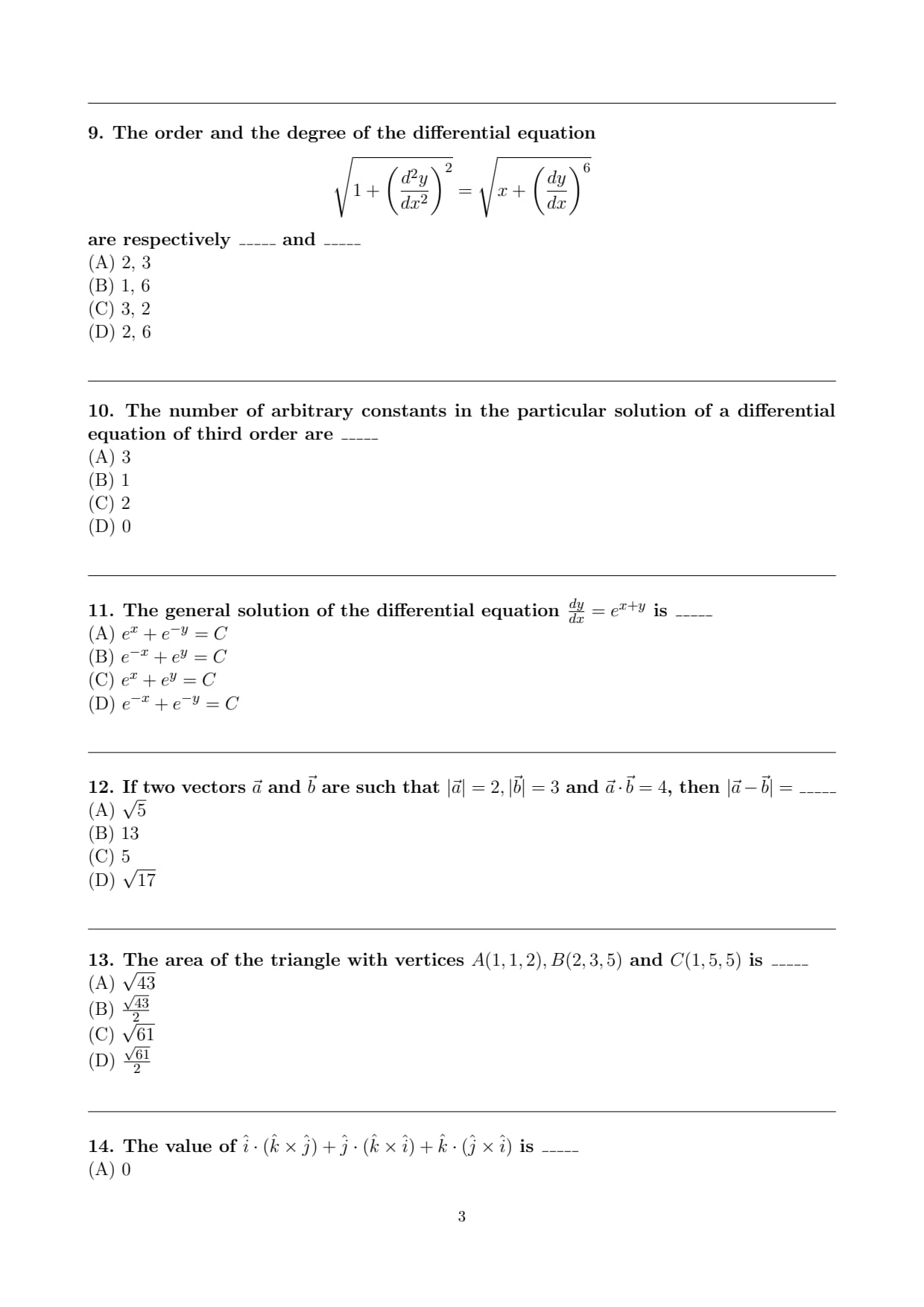
The order and the degree of the differential equation \[ \sqrt{1 + \left(\frac{d^2y}{dx^2}\right)^2} = \sqrt{x + \left(\frac{dy}{dx}\right)^6} \]
are respectively _____ and _____
The number of arbitrary constants in the particular solution of a differential equation of third order are _____
The general solution of the differential equation \( \frac{dy}{dx} = e^{x+y} \) is _____
If two vectors \( \vec{a} \) and \( \vec{b} \) are such that \( |\vec{a}| = 2, |\vec{b}| = 3 \) and \( \vec{a} \cdot \vec{b} = 4 \), then \( |\vec{a} - \vec{b}| = \_\_\_\_\_ \)
The area of the triangle with vertices \( A(1,1,2), B(2,3,5) \) and \( C(1,5,5) \) is _____
The value of \( \hat{i} \cdot (\hat{k} \times \hat{j}) + \hat{j} \cdot (\hat{k} \times \hat{i}) + \hat{k} \cdot (\hat{j} \times \hat{i}) \) is _____
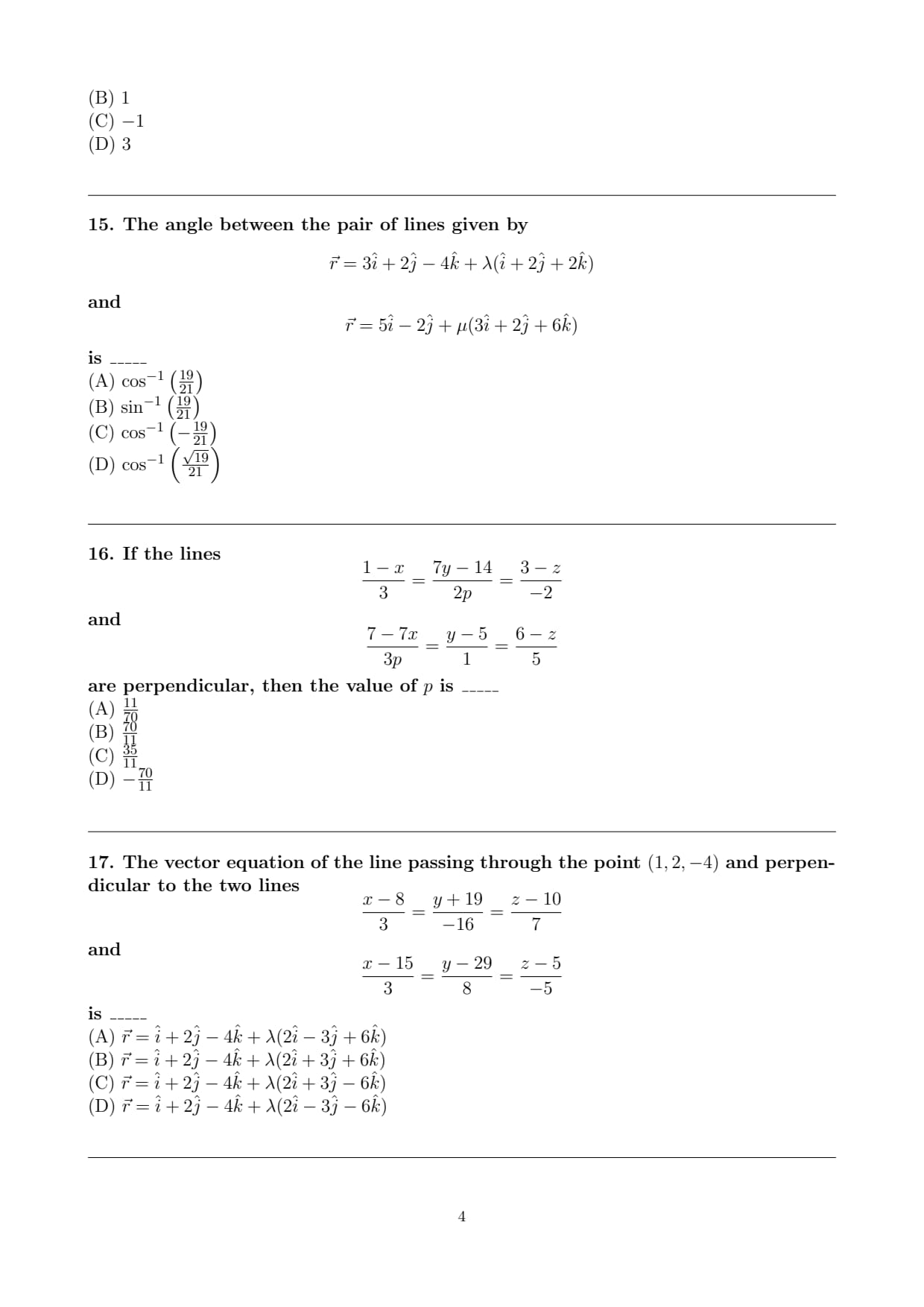
The angle between the pair of lines given by \[ \vec{r} = 3\hat{i} + 2\hat{j} - 4\hat{k} + \lambda(\hat{i} + 2\hat{j} + 2\hat{k}) \]
and \[ \vec{r} = 5\hat{i} - 2\hat{j} + \mu(3\hat{i} + 2\hat{j} + 6\hat{k}) \]
is _____
If the lines \[ \frac{1-x}{3} = \frac{7y-14}{2p} = \frac{3-z}{-2} \]
and \[ \frac{7-7x}{3p} = \frac{y-5}{1} = \frac{6-z}{5} \]
are perpendicular, then the value of \( p \) is _____
The vector equation of the line passing through the point \( (1,2,-4) \) and perpendicular to the two lines \[ \frac{x-8}{3} = \frac{y+19}{-16} = \frac{z-10}{7} \]
and \[ \frac{x-15}{3} = \frac{y-29}{8} = \frac{z-5}{-5} \]
is _____
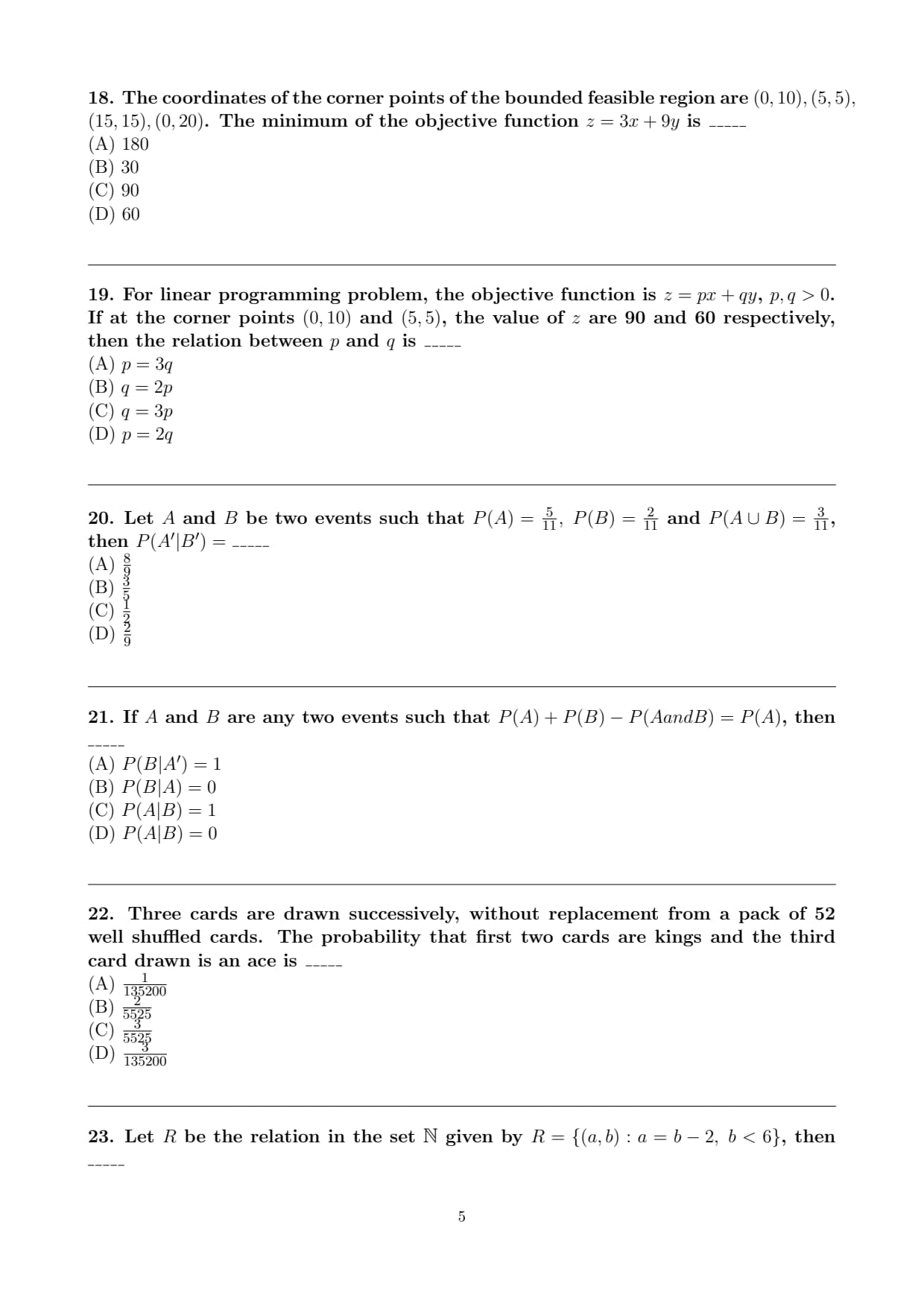
The coordinates of the corner points of the bounded feasible region are \( (0,10), (5,5),
(15,15), (0,20) \). The minimum of the objective function \( z = 3x + 9y \) is _____
For linear programming problem, the objective function is \( z = px + qy \), \( p,q > 0 \). If at the corner points \( (0,10) \) and \( (5,5) \), the value of \( z \) are 90 and 60 respectively, then the relation between \( p \) and \( q \) is _____
Let \(A\) and \(B\) be two events such that \( P(A) = \frac{5}{11}, \; P(B) = \frac{2}{11} \) and \( P(A \cup B) = \frac{3}{11} \), then \( P(A'|B') = \_\_\_\_\_ \)
If \(A\) and \(B\) are any two events such that \( P(A) + P(B) - P(A and B) = P(A) \), then _____
Three cards are drawn successively, without replacement from a pack of 52 well shuffled cards. The probability that first two cards are kings and the third card drawn is an ace is _____
Let \( R \) be the relation in the set \( \mathbb{N} \) given by \( R = \{(a,b) : a = b - 2, \; b < 6\} \), then _____
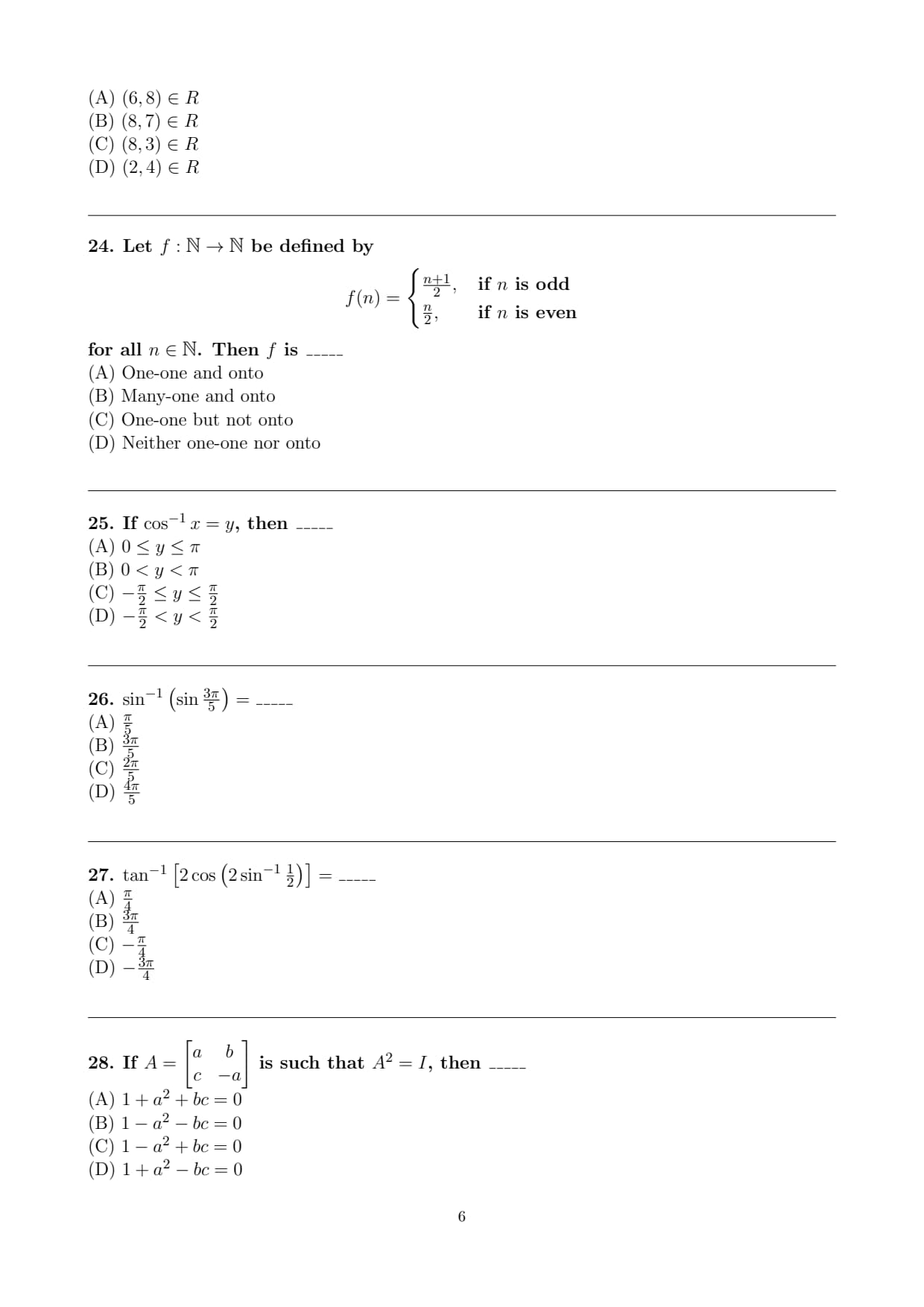
Let \( f : \mathbb{N} \rightarrow \mathbb{N} \) be defined by \[ f(n) = \begin{cases} \frac{n+1}{2}, & if n is odd
\frac{n}{2}, & if n is even \end{cases} \]
for all \( n \in \mathbb{N} \). Then \( f \) is _____
If \( \cos^{-1} x = y \), then _____
\( \sin^{-1} \left(\sin \frac{3\pi}{5}\right) = \_\_\_\_\_ \)
\( \tan^{-1} \left[ 2\cos \left( 2\sin^{-1} \frac{1}{2} \right) \right] = \_\_\_\_\_ \)
If \( A = \begin{bmatrix} a & b \\ c & -a \end{bmatrix} \) is such that \( A^2 = I \), then _____
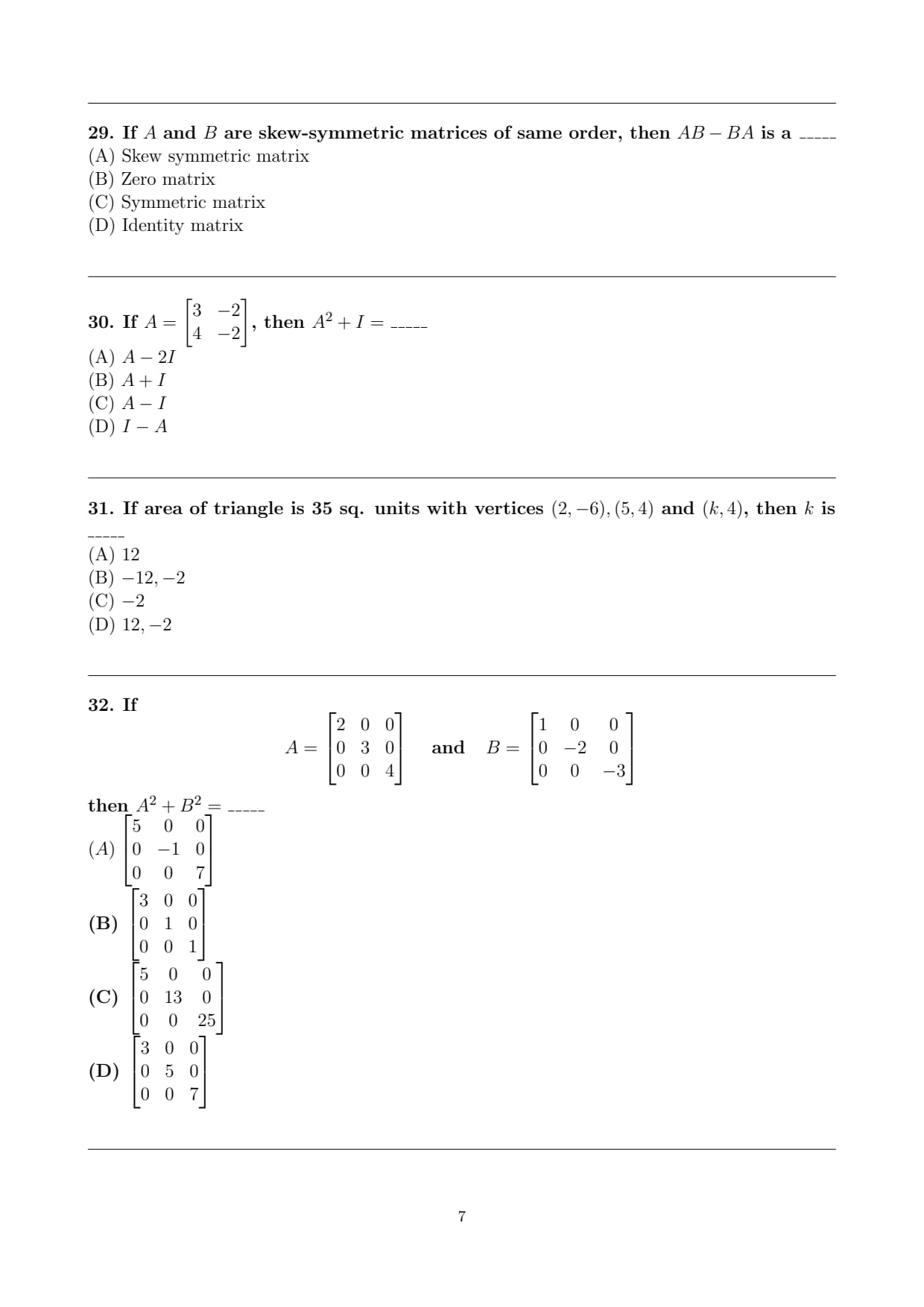
If \( A \) and \( B \) are skew-symmetric matrices of same order, then \( AB - BA \) is a _____
If \( A = \begin{bmatrix} 3 & -2 \\ 4 & -2 \end{bmatrix} \), then \( A^2 + I = \_\_\_\_\_ \)
If area of triangle is 35 sq. units with vertices \( (2,-6), (5,4) \) and \( (k,4) \), then \( k \) is _____
If \[ A = \begin{bmatrix} 2 & 0 & 0 \\ 0 & 3 & 0 \\ 0 & 0 & 4 \end{bmatrix} \quad \text{and} \quad B = \begin{bmatrix} 1 & 0 & 0 \\ 0 & -2 & 0 \\ 0 & 0 & -3 \end{bmatrix} \] then \( A^2 + B^2 = \_\_\_\_\_ \)
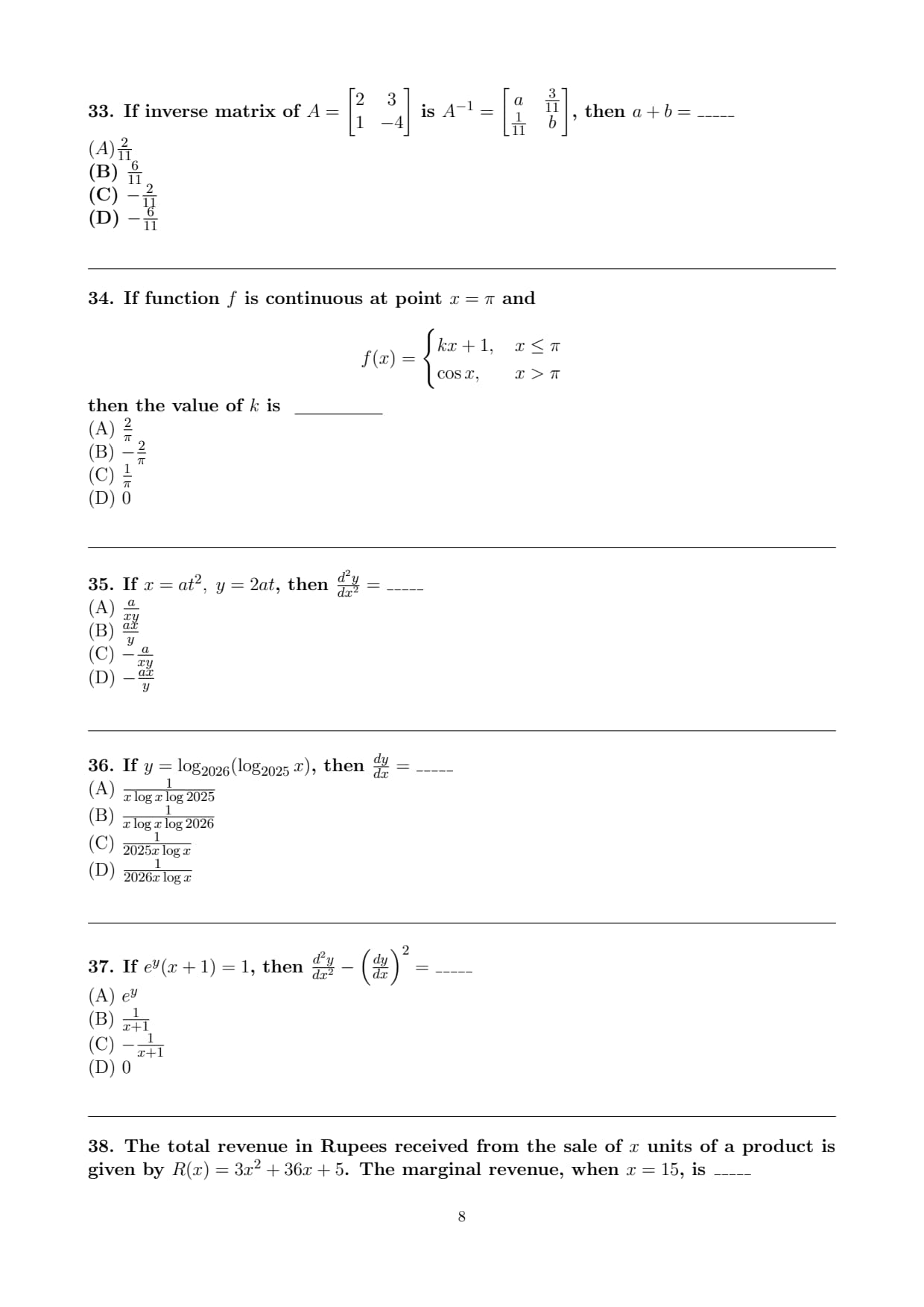
If inverse matrix of \( A = \begin{bmatrix} 2 & 3 \\ 1 & -4 \end{bmatrix} \) is \( A^{-1} = \begin{bmatrix} a & \frac{3}{11} \\ \frac{1}{11} & b \end{bmatrix} \), then \( a + b = \_\_\_\_\_ \)
If function \( f \) is continuous at point \( x = \pi \) and
\[ f(x) = \begin{cases} kx + 1, & x \le \pi
\cos x, & x > \pi \end{cases} \]
then the value of \( k \) is \( \hspace{2cm} \)
\normalfont
If \( x = a t^2, \; y = 2at \), then \( \frac{d^2 y}{dx^2} = \_\_\_\_\_ \)
If \( y = \log_{2026}(\log_{2025} x) \), then \( \frac{dy}{dx} = \_\_\_\_\_ \)
If \( e^y (x+1) = 1 \), then \( \frac{d^2 y}{dx^2} - \left(\frac{dy}{dx}\right)^2 = \_\_\_\_\_ \)
The total revenue in Rupees received from the sale of \( x \) units of a product is given by \( R(x) = 3x^2 + 36x + 5 \). The marginal revenue, when \( x = 15 \), is _____
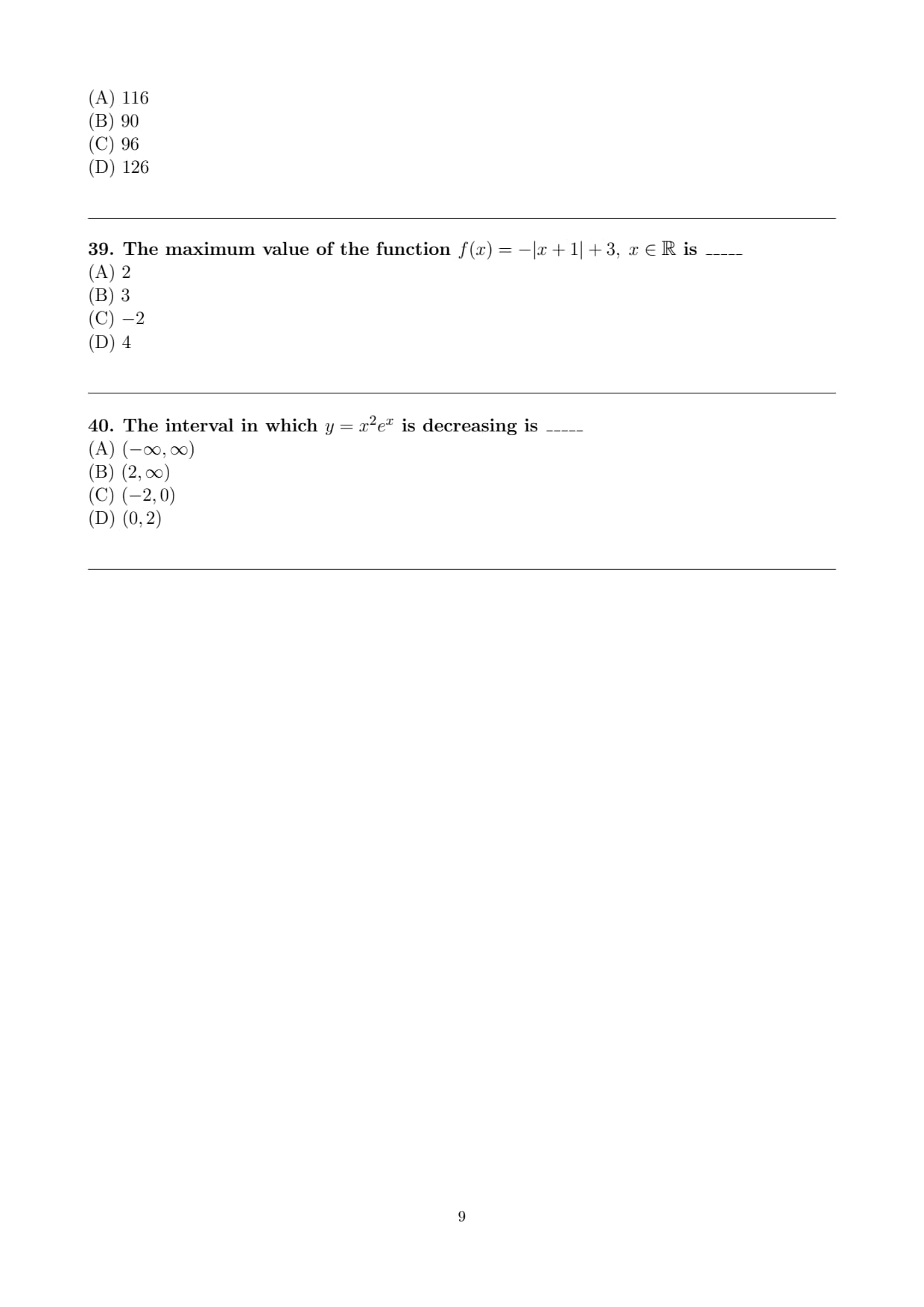
The maximum value of the function \( f(x) = -|x+1| + 3, \; x \in \mathbb{R} \) is _____
The interval in which \( y = x^2 e^x \) is decreasing is _____



Comments