




JNTU Hyderabad conducted the TS EAMCET 2025 Agriculture and Pharmacy exam on behalf of the Telangana Council of Higher Education. The TS EAMCET 2025 Agriculture and Pharmacy (BiPC) exam was held on 30 April 2025.
The TS EAMCET 2025 Agriculture and Pharmacy exam was held in online CBT mode with a total of 160 questions divided between the three subjects. Physics (40 questions), Chemistry (40 questions) and Biology (Zoology-40, Botany-40) to be completed in 180 minutes (3 hours) for a total of 160 marks. As per the TS EAMCET 2025 marking scheme, +1 marks is given for every correct answer with no negative marking for incorrect answers.
The TS EAMCET 2025 30 April, 2025 Agriculture and Pharmacy exam Question Paper with Solution PDF is available to download here.
Related Links:
TS EAMCET 2025 Agriculture and Pharmacy April 30 Shift 1 Question Paper with Solutions
| TS EAMCET 2025 April 30 Shift 1 Question Paper | Download PDF | Check Solution |

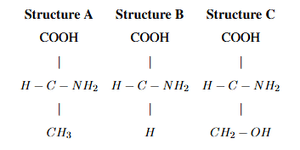
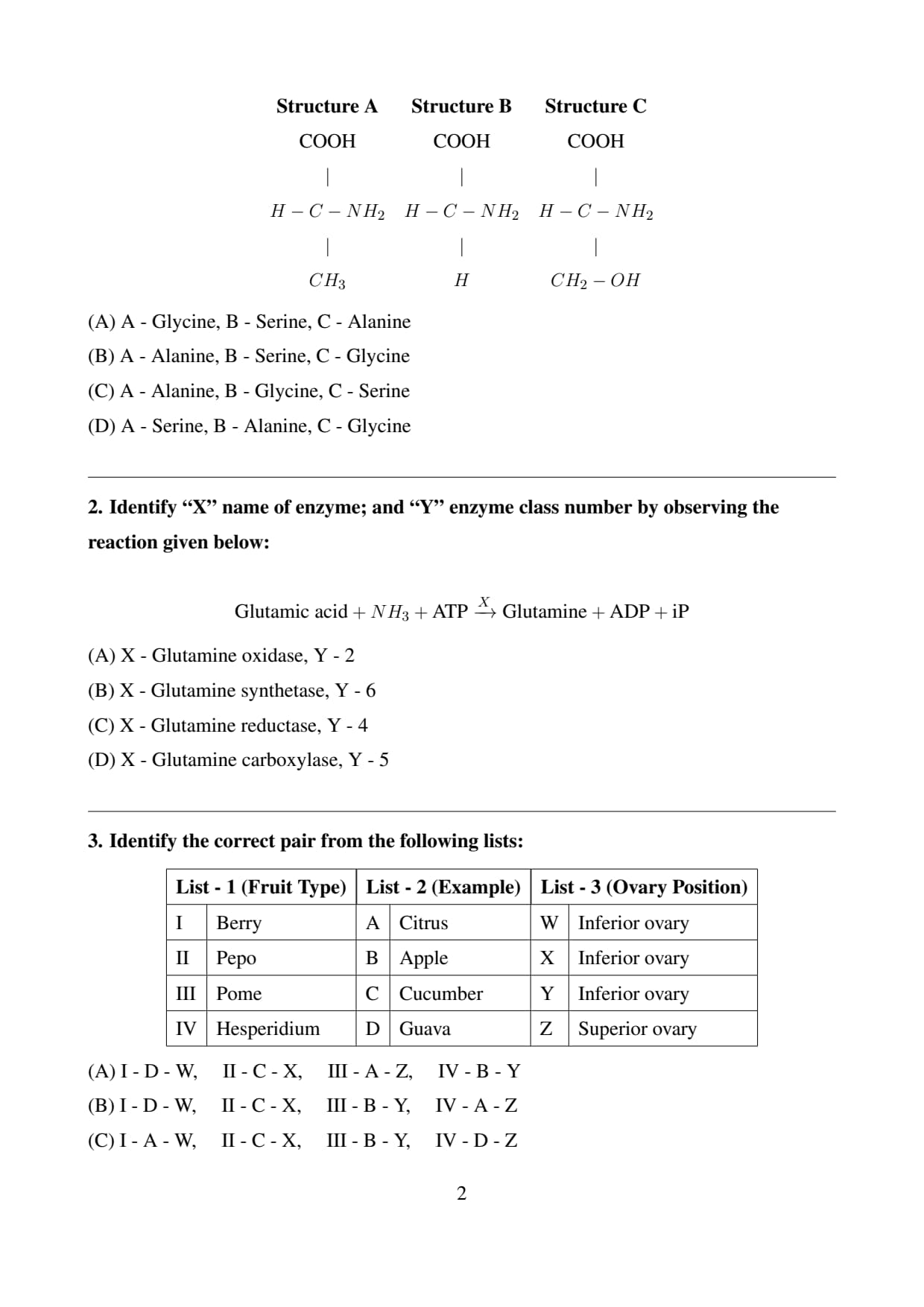
Identify the amino acids given below and select the correct option:
Identify ``X'' name of enzyme; and ``Y'' enzyme class number by observing the reaction given below:
\[ Glutamic acid + NH_3 + ATP \xrightarrow{X} Glutamine + ADP + iP \]
Identify the correct pair from the following lists:

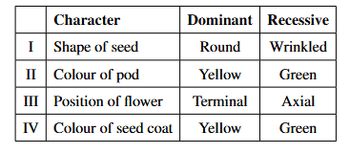
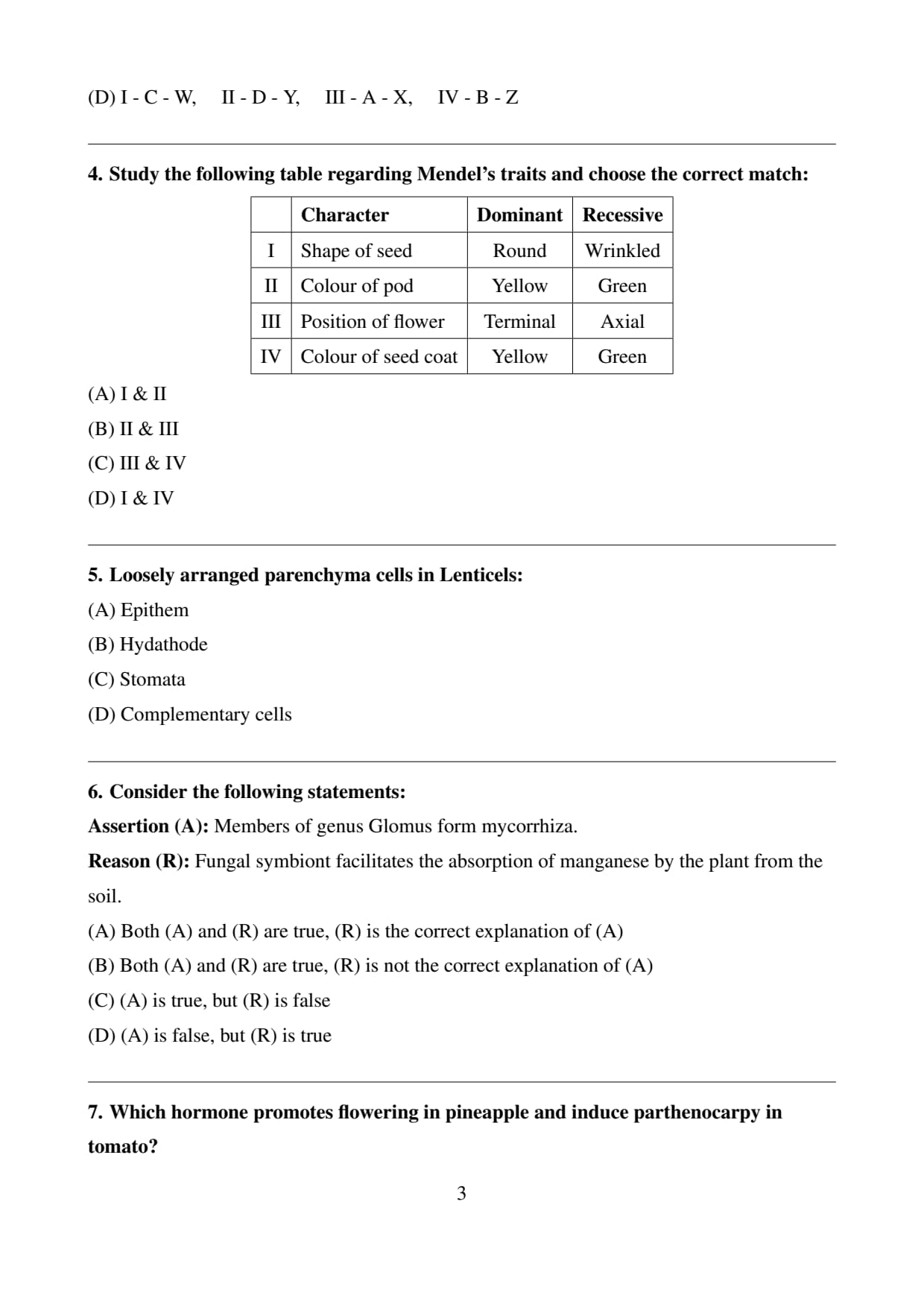
Study the following table regarding Mendel's traits and choose the correct match:
Loosely arranged parenchyma cells in Lenticels:
Consider the following statements:
Assertion (A): Members of genus Glomus form mycorrhiza.
Reason (R): Fungal symbiont facilitates the absorption of manganese by the plant from the soil.
Which hormone promotes flowering in pineapple and induce parthenocarpy in tomato?
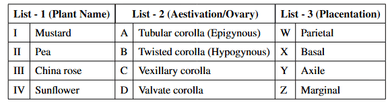
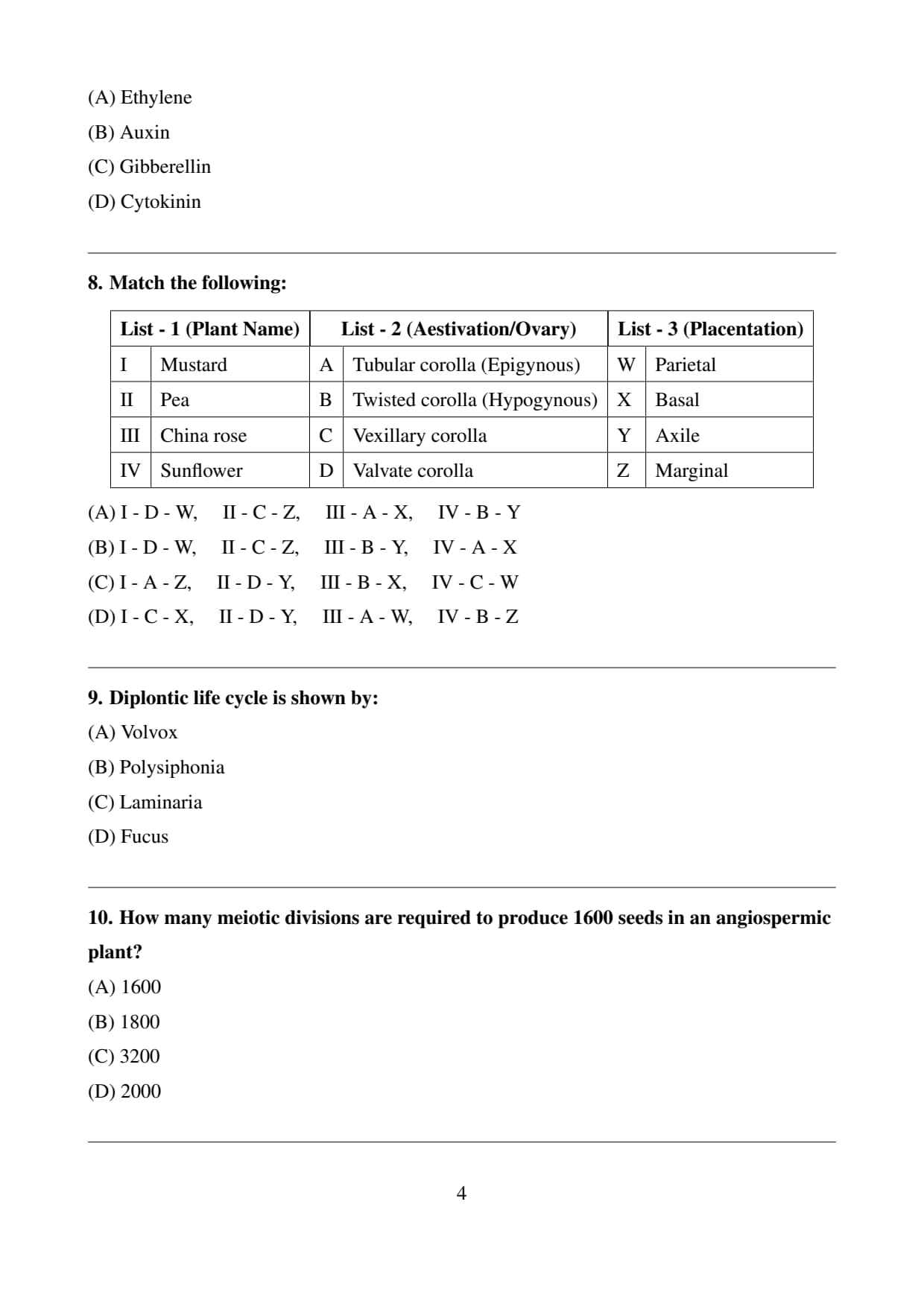
Match the following:
Diplontic life cycle is shown by:
How many meiotic divisions are required to produce 1600 seeds in an angiospermic plant?
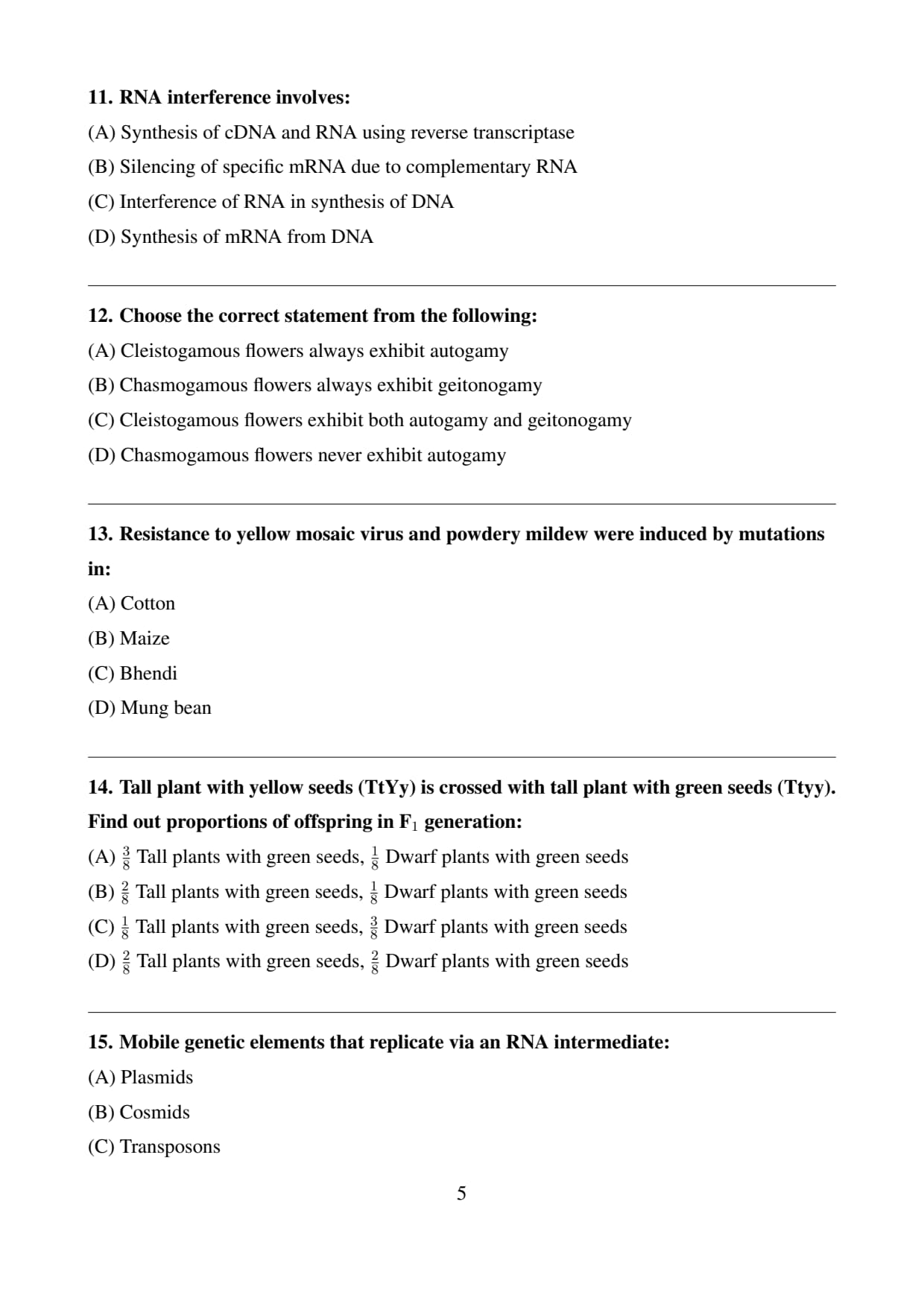
RNA interference involves:
Choose the correct statement from the following:
Resistance to yellow mosaic virus and powdery mildew were induced by mutations in:
Tall plant with yellow seeds (TtYy) is crossed with tall plant with green seeds (Ttyy). Find out proportions of offspring in F\(_1\) generation:
Mobile genetic elements that replicate via an RNA intermediate:
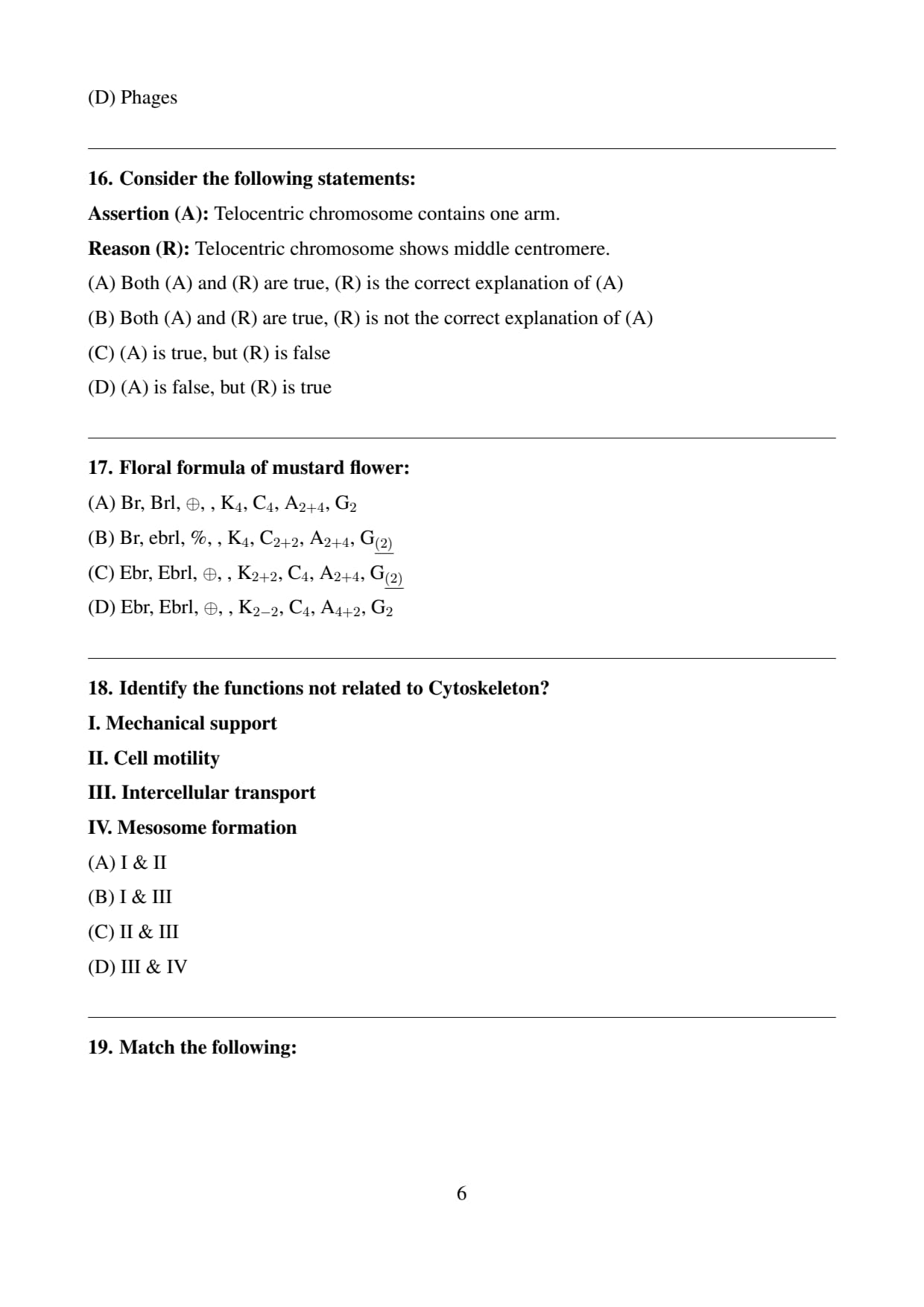
Consider the following statements:
Assertion (A): Telocentric chromosome contains one arm.
Reason (R): Telocentric chromosome shows middle centromere.
Floral formula of mustard flower:
Identify the functions not related to Cytoskeleton?
I. Mechanical support
II. Cell motility
III. Intercellular transport
IV. Mesosome formation
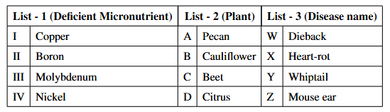
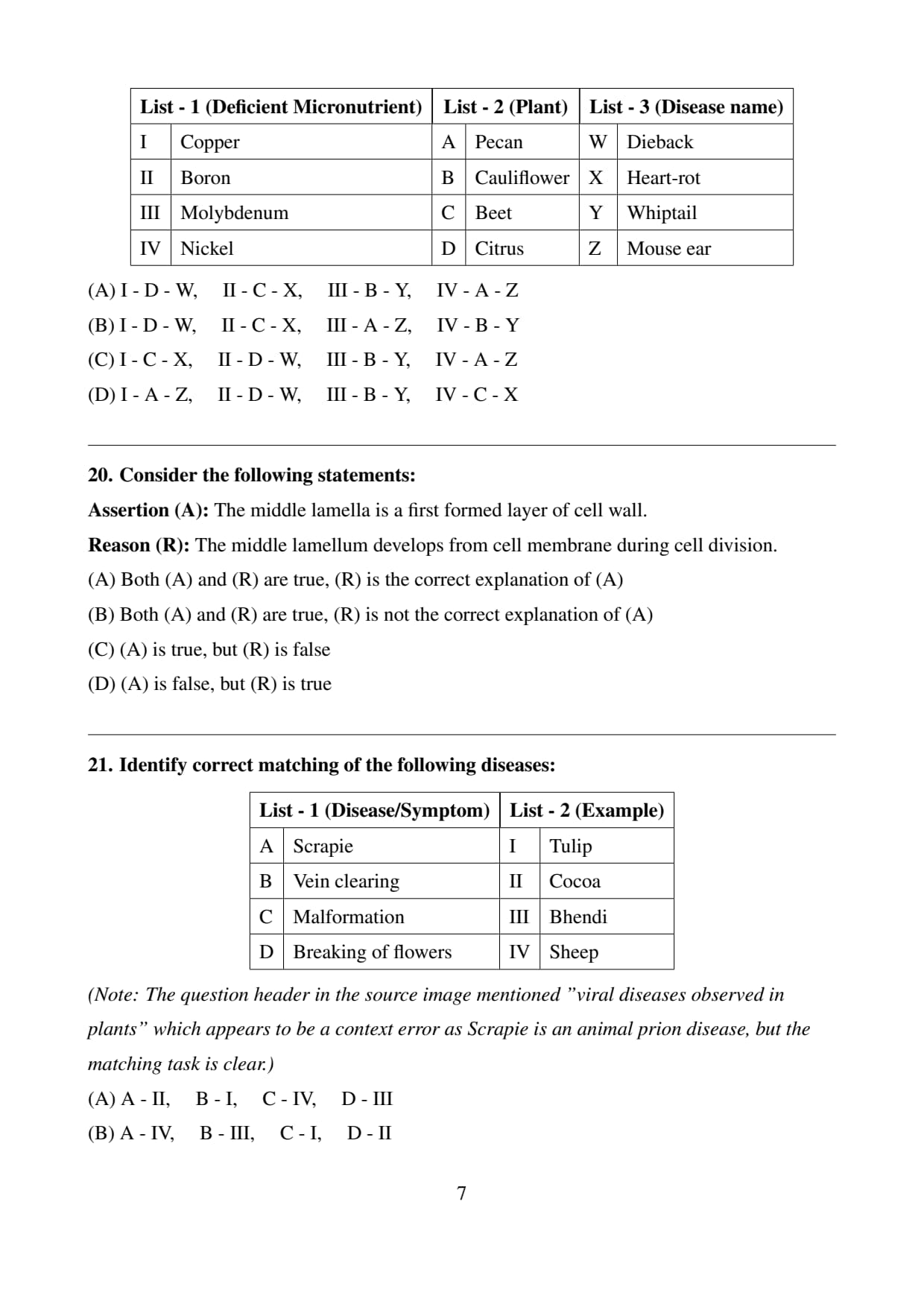
Match the following:
Consider the following statements:
Assertion (A): The middle lamella is a first formed layer of cell wall.
Reason (R): The middle lamellum develops from cell membrane during cell division.
Identify correct matching of the following diseases:
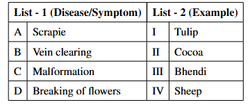
(Note: The question header in the source image mentioned "viral diseases observed in plants" which appears to be a context error as Scrapie is an animal prion disease, but the matching task is clear.)
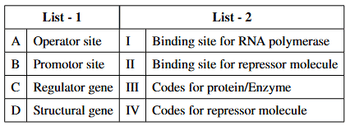
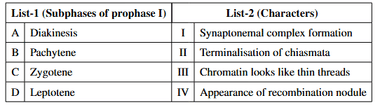
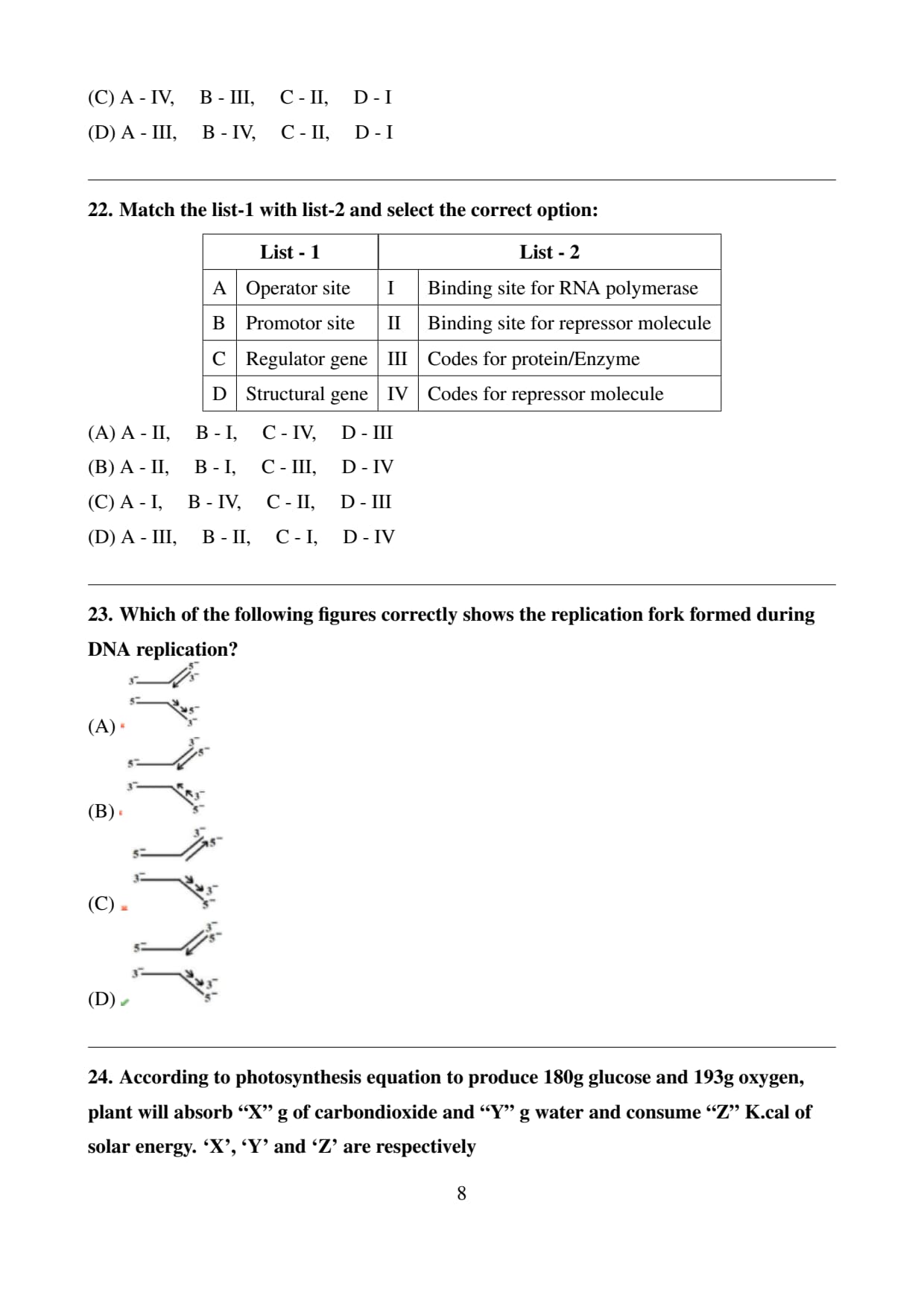
Match the list-1 with list-2 and select the correct option:
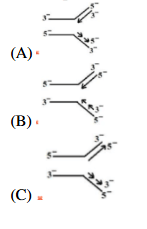
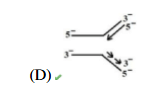
Which of the following figures correctly shows the replication fork formed during DNA replication?
According to photosynthesis equation to produce 180g glucose and 193g oxygen, plant will absorb ``X'' g of carbondioxide and ``Y'' g water and consume ``Z'' K.cal of solar energy. `X', `Y' and `Z' are respectively
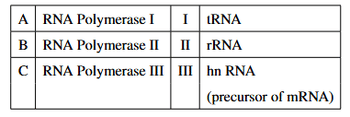
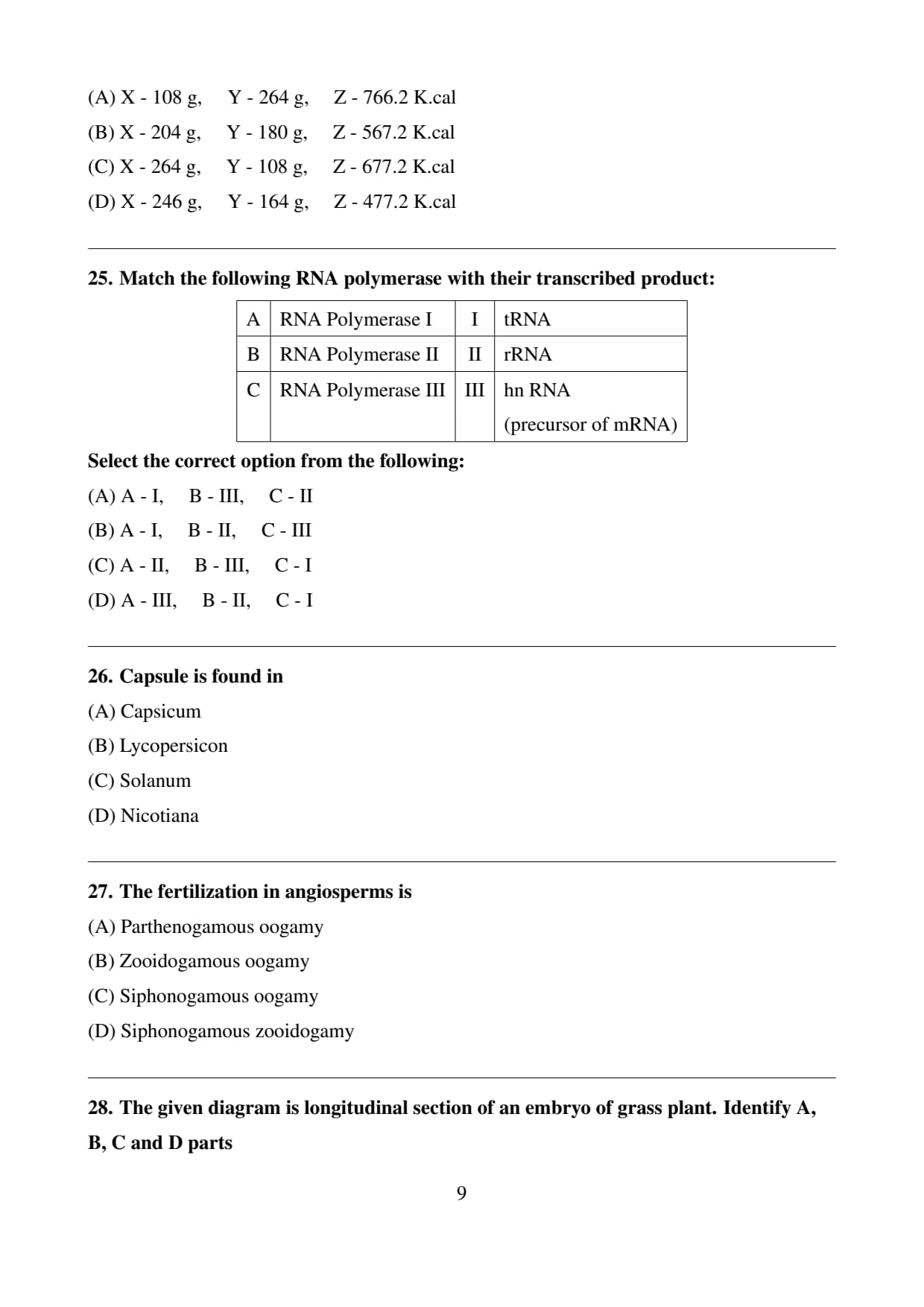
Match the following RNA polymerase with their transcribed product:
Select the correct option from the following:
Capsule is found in
The fertilization in angiosperms is
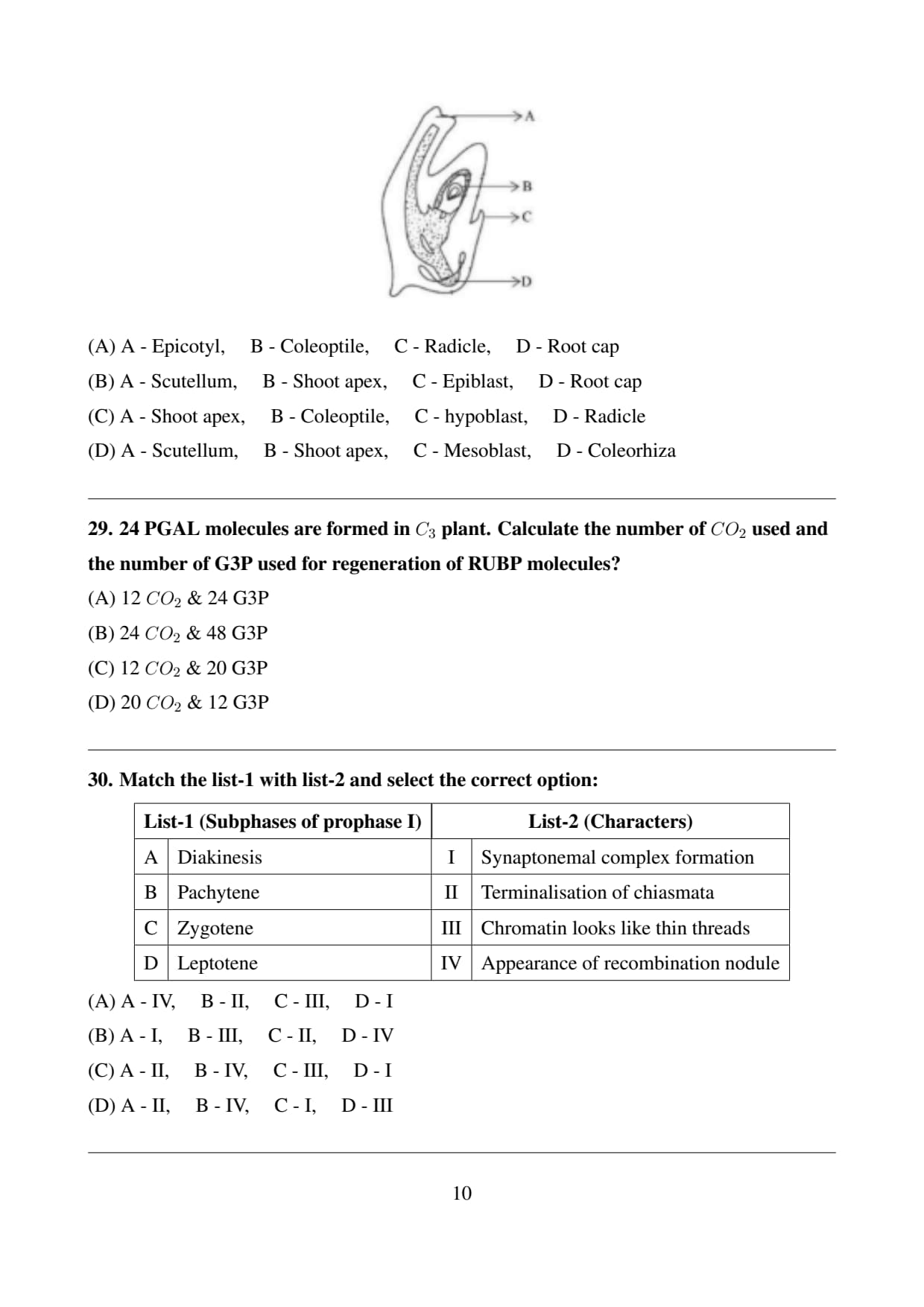
The given diagram is longitudinal section of an embryo of grass plant. Identify A, B, C and D parts

24 PGAL molecules are formed in \(C_3\) plant. Calculate the number of \(CO_2\) used and the number of G3P used for regeneration of RUBP molecules?
Match the list-1 with list-2 and select the correct option:
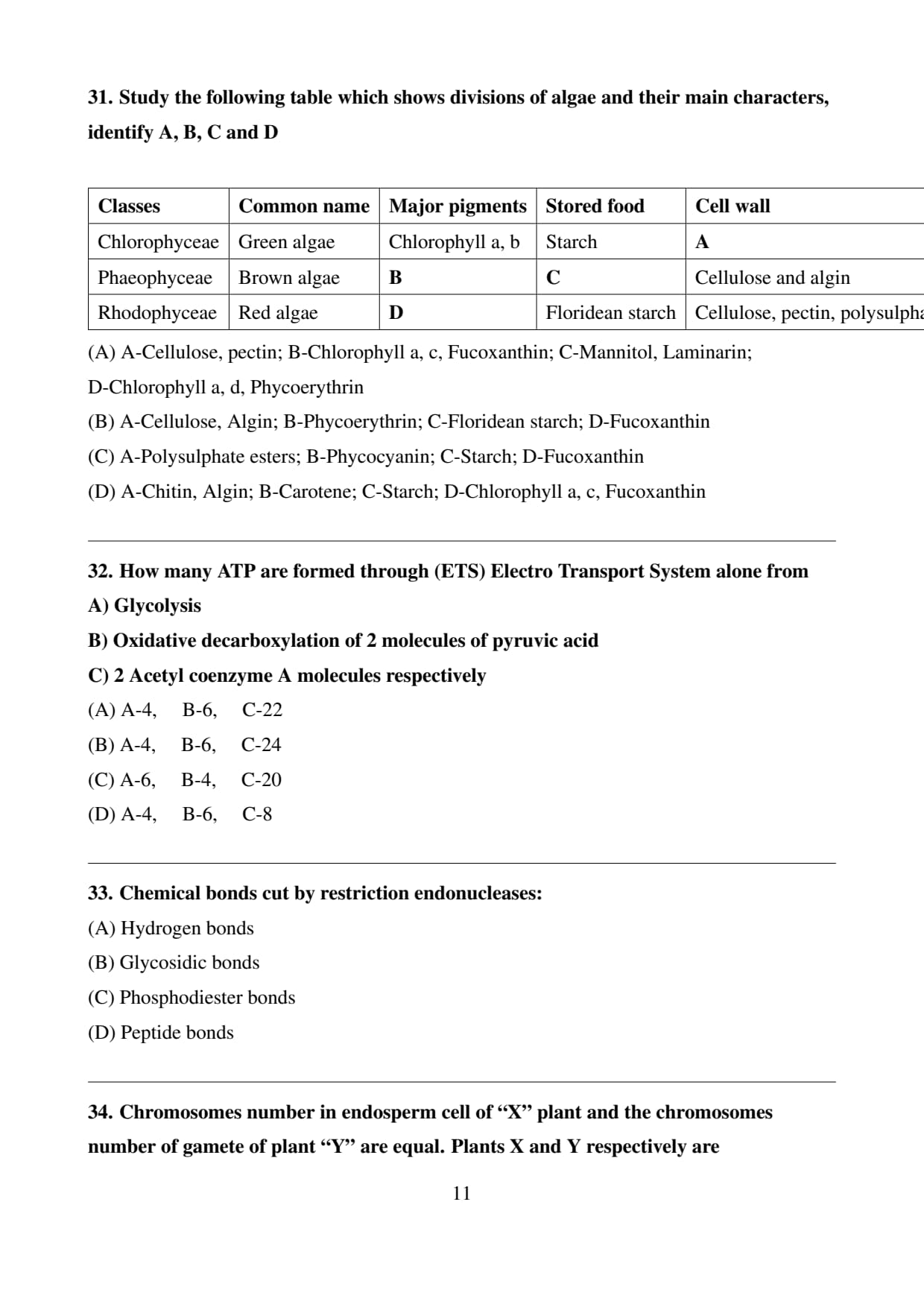
Study the following table which shows divisions of algae and their main characters, identify A, B, C and D

How many ATP are formed through (ETS) Electro Transport System alone from
A) Glycolysis
B) Oxidative decarboxylation of 2 molecules of pyruvic acid
C) 2 Acetyl coenzyme A molecules respectively
Chemical bonds cut by restriction endonucleases:
Chromosomes number in endosperm cell of ``X'' plant and the chromosomes number of gamete of plant ``Y'' are equal. Plants X and Y respectively are
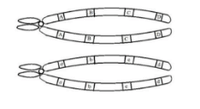
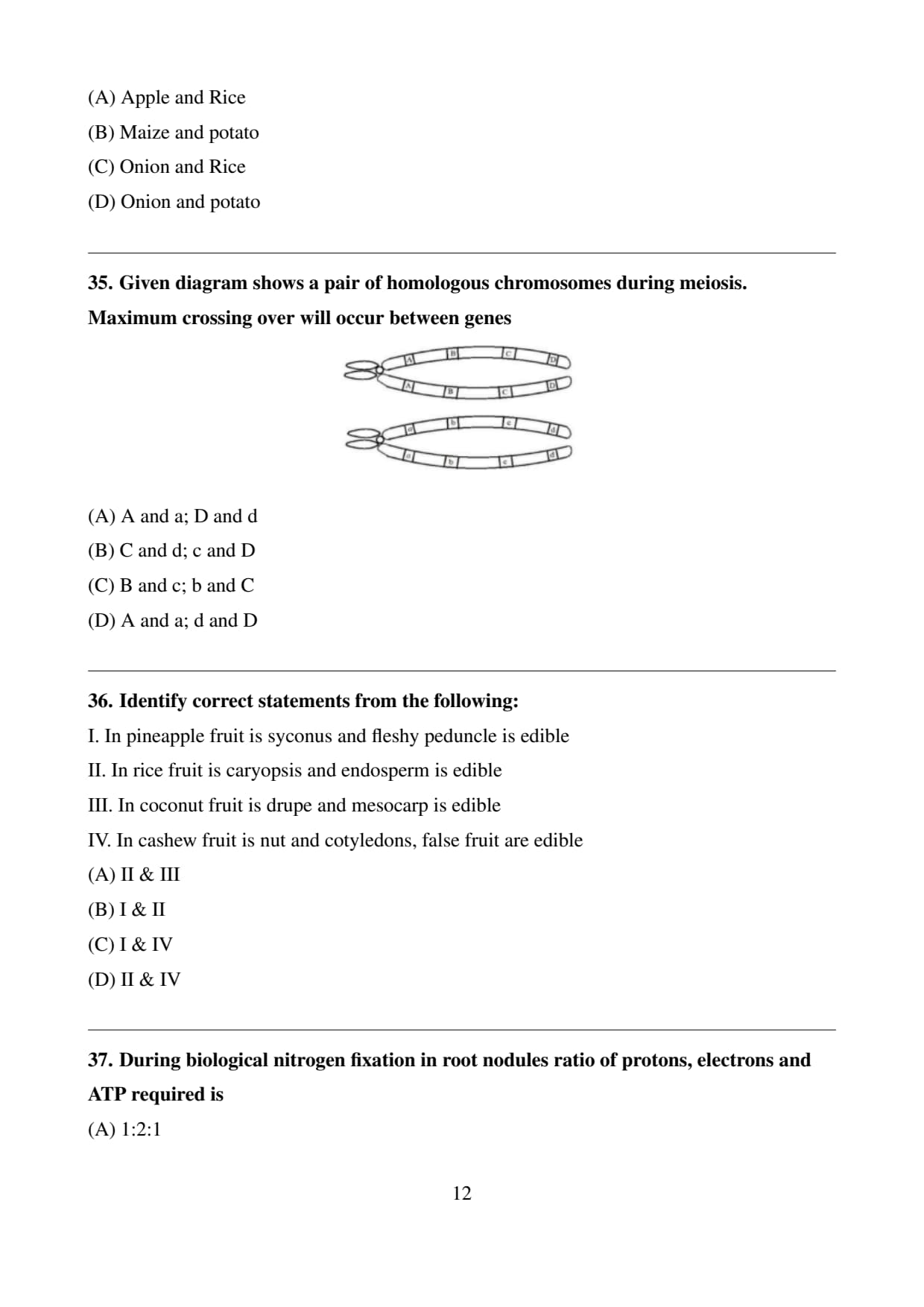
Given diagram shows a pair of homologous chromosomes during meiosis. Maximum crossing over will occur between genes
Identify correct statements from the following:
I. In pineapple fruit is syconus and fleshy peduncle is edible
II. In rice fruit is caryopsis and endosperm is edible
III. In coconut fruit is drupe and mesocarp is edible
IV. In cashew fruit is nut and cotyledons, false fruit are edible
During biological nitrogen fixation in root nodules ratio of protons, electrons and ATP required is
Structurally Centrale diatoms are ``X'' symmetrical and Pennales diatoms are ``Y'' symmetrical. `X' and `Y' respectively are
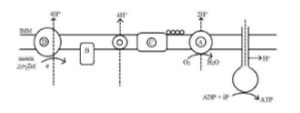
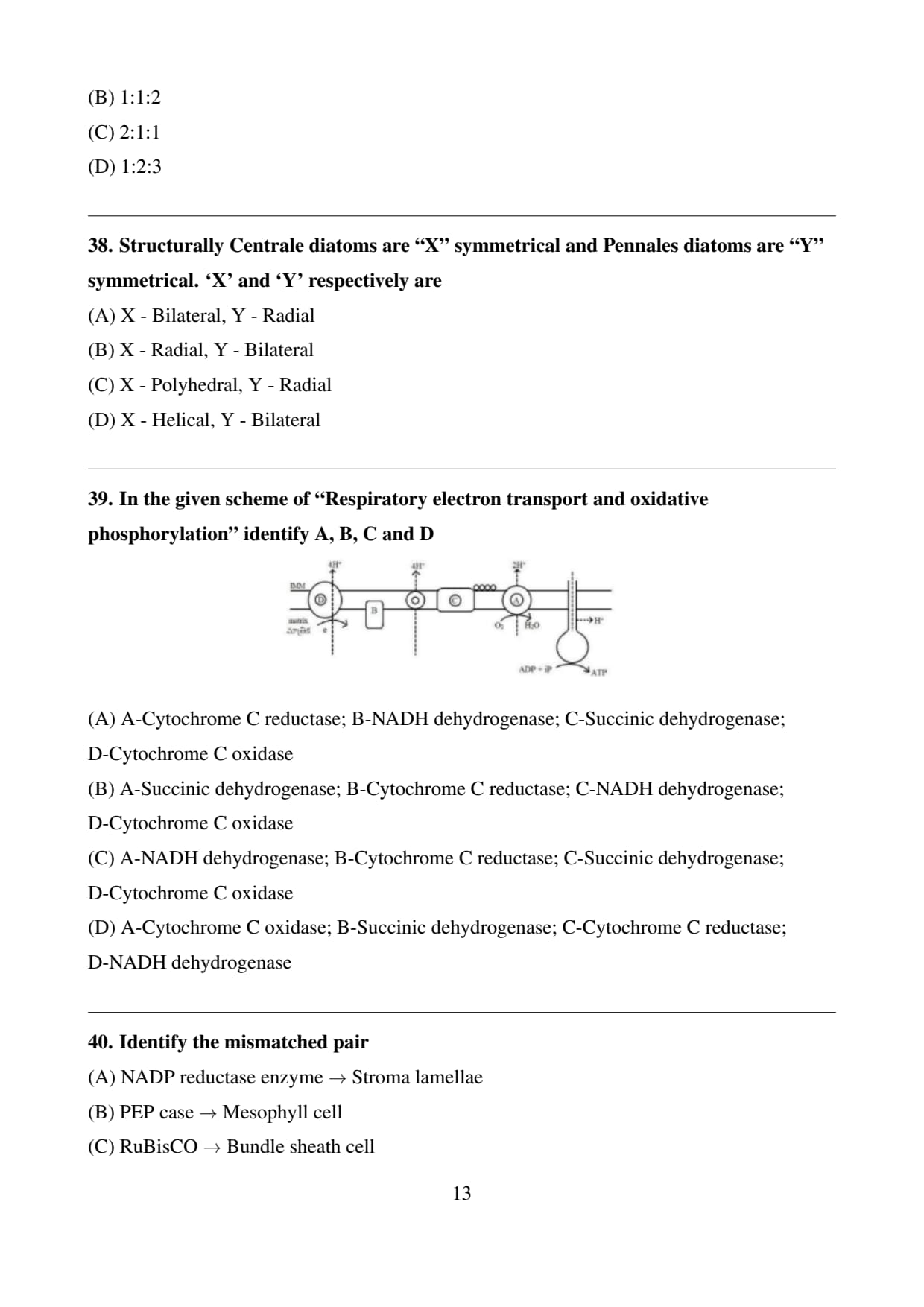
In the given scheme of ``Respiratory electron transport and oxidative phosphorylation'' identify A, B, C and D
Identify the mismatched pair
Microanatomy deals with
Choose the threatened species in India from the following:
I. Corvus splendens
II.Panthera tigris
III. Oryctolagus cuniculus
IV. Antelope cervicapra
V. Loris tardigradus
VI. Macaca mullata
Consider the following statements:
Assertion (A): Kidneys of vertebrates are called retroperitoneal organs.
Reason (R): They are lined by visceral peritoneum only on their ventral side.
The correct answer is
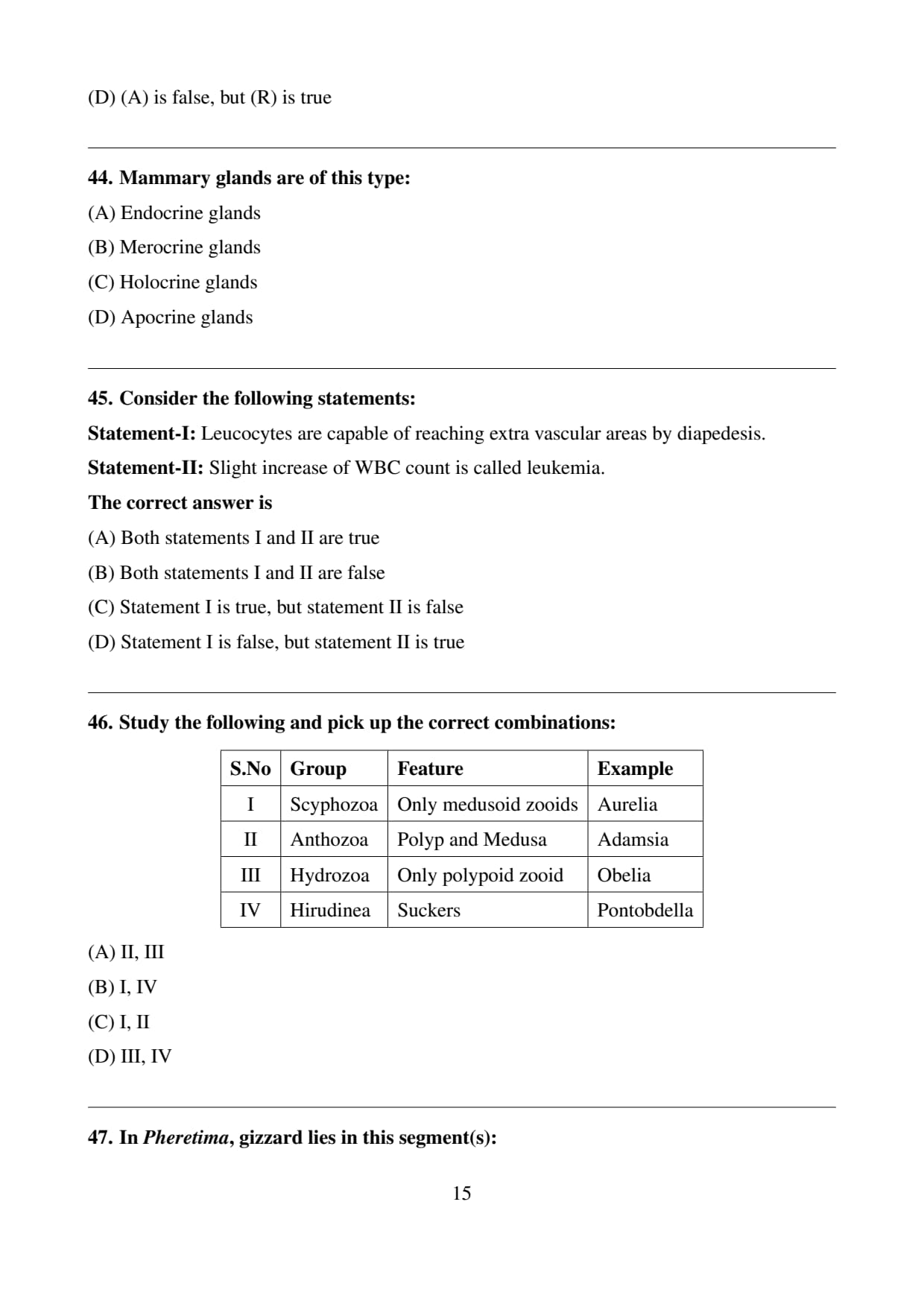
Mammary glands are of this type:
Consider the following statements:
Statement-I: Leucocytes are capable of reaching extra vascular areas by diapedesis.
Statement-II: Slight increase of WBC count is called leukemia.
The correct answer is
Study the following and pick up the correct combinations:
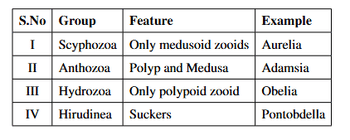
In Pheretima, gizzard lies in this segment(s):
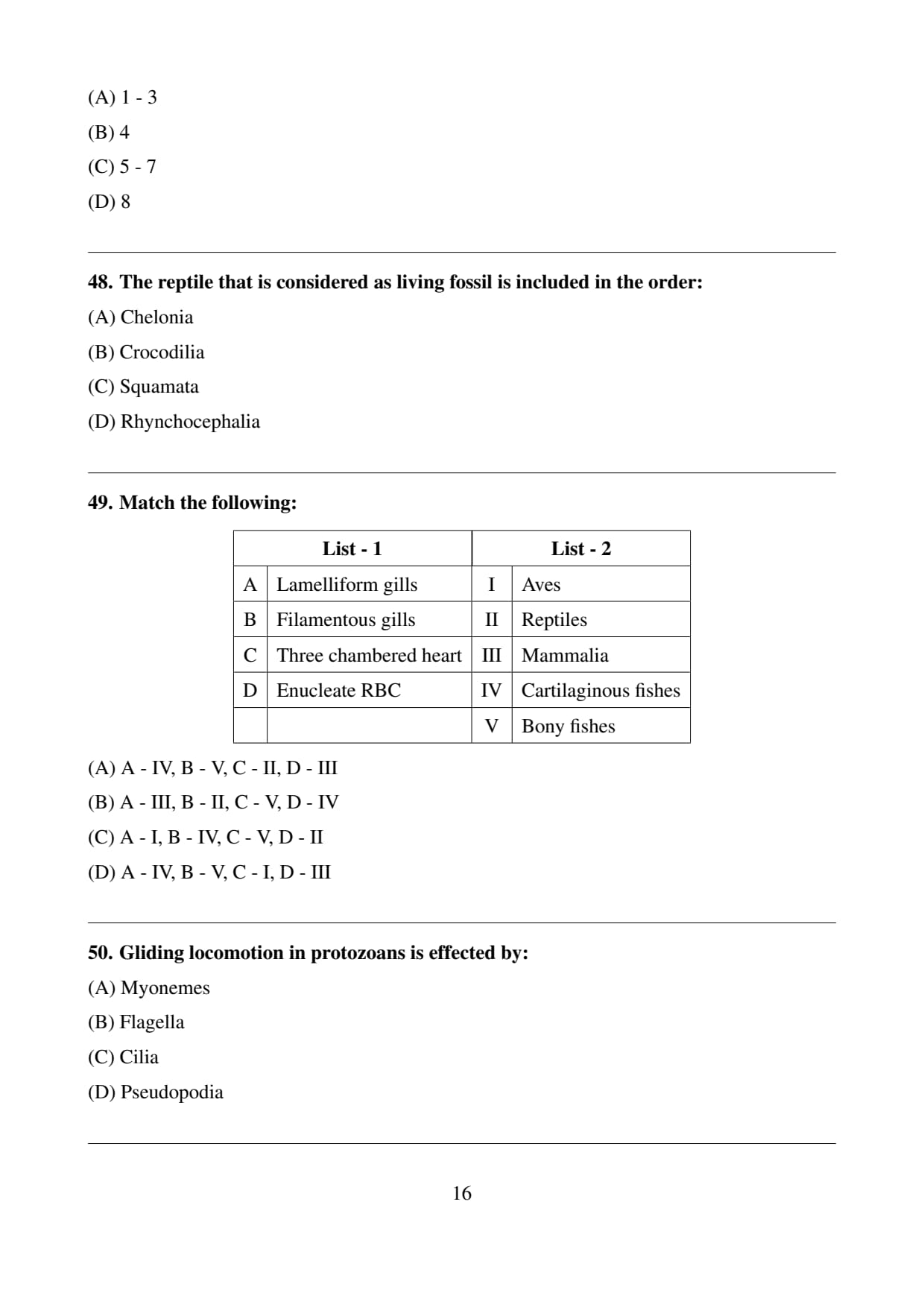
The reptile that is considered as living fossil is included in the order:
Match the following:
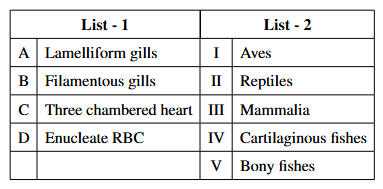
Gliding locomotion in protozoans is effected by:
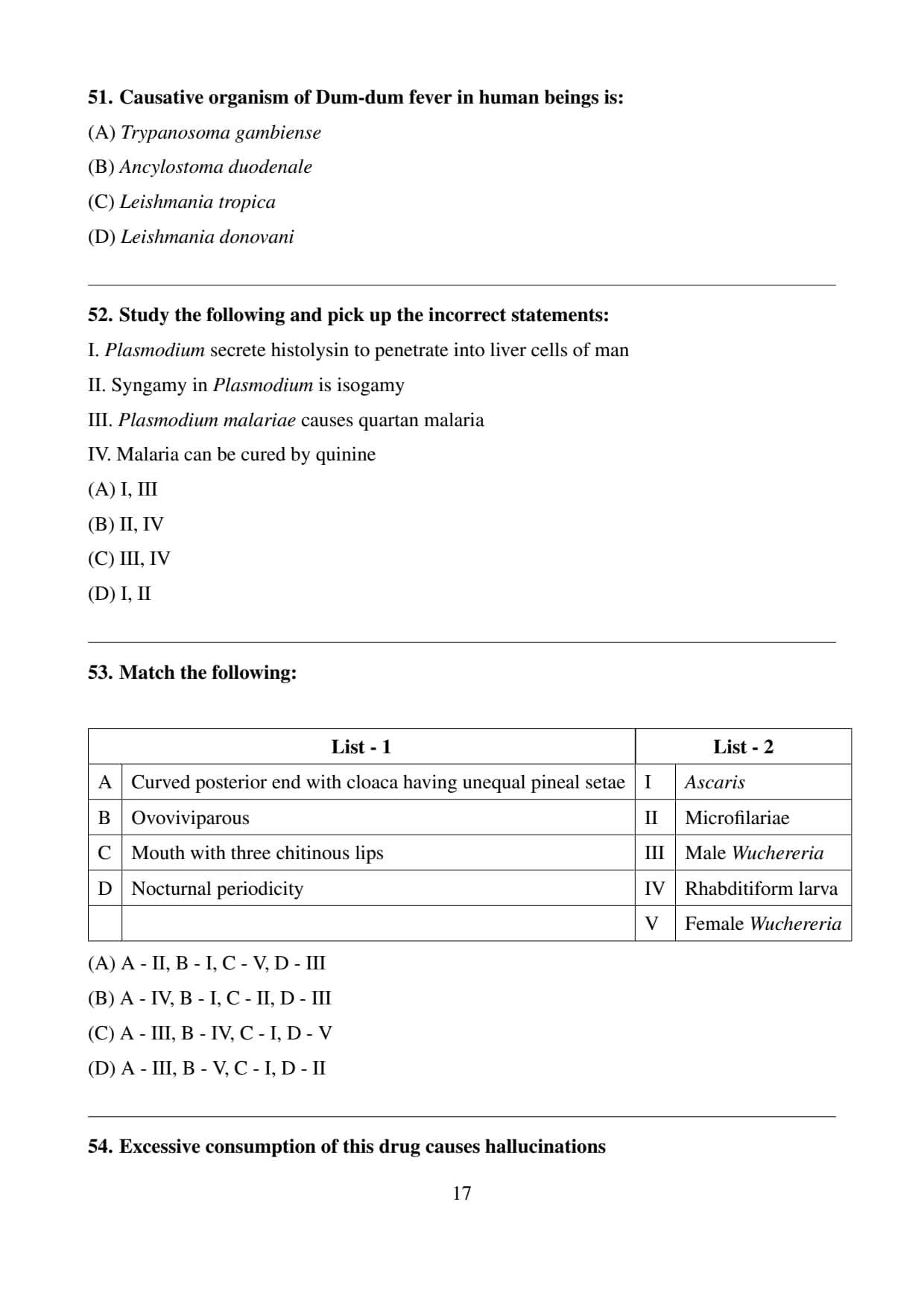
Causative organism of Dum-dum fever in human beings is:
Study the following and pick up the incorrect statements:
I. Plasmodium secrete histolysin to penetrate into liver cells of man
II. Syngamy in \textit{Plasmodium is isogamy
III. Plasmodium malariae causes quartan malaria
IV. Malaria can be cured by quinine
Match the following:
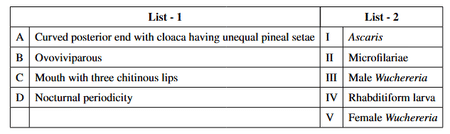
Excessive consumption of this drug causes hallucinations
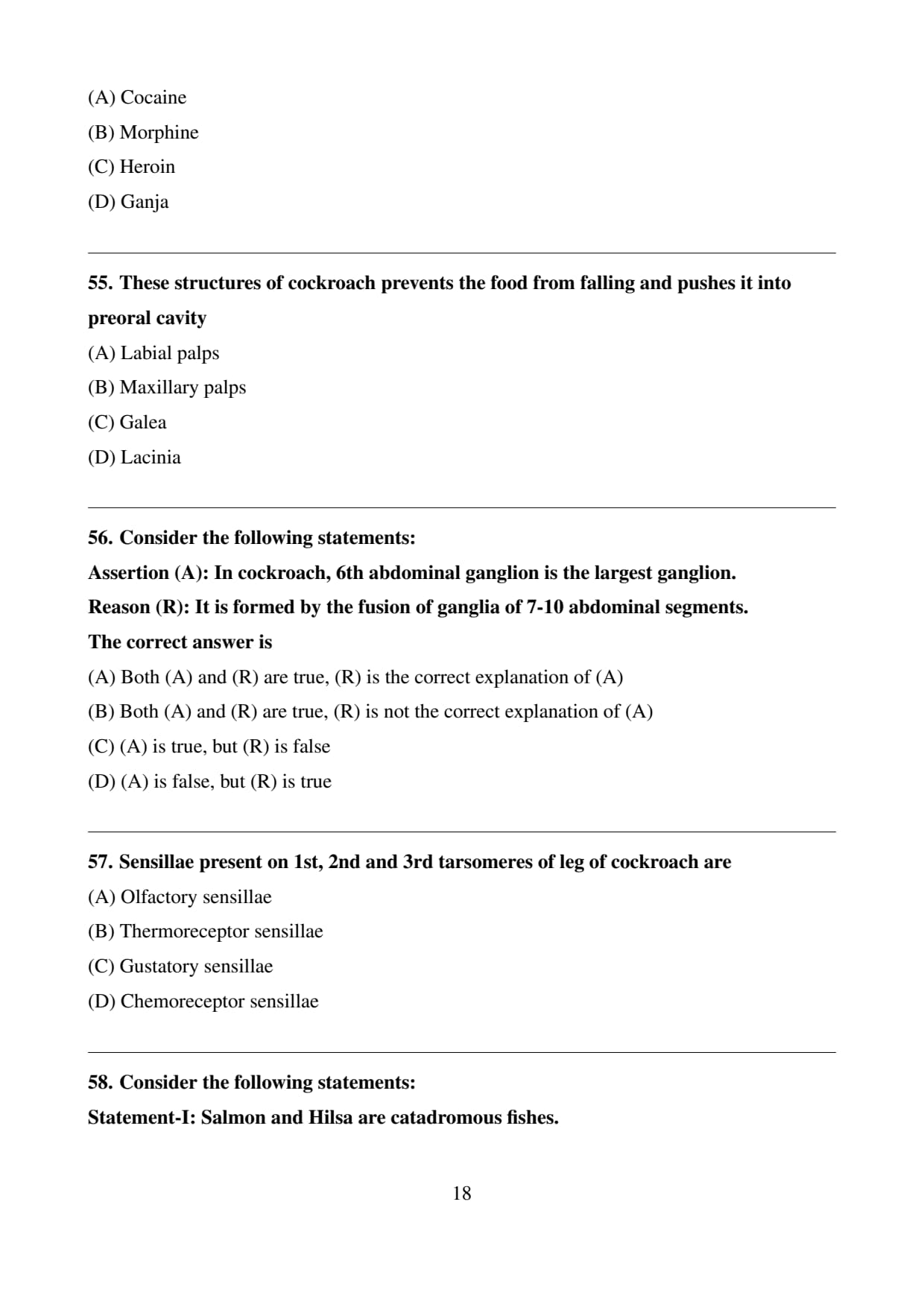
These structures of cockroach prevents the food from falling and pushes it into preoral cavity
Consider the following statements:
Assertion (A): In cockroach, 6th abdominal ganglion is the largest ganglion.
Reason (R): It is formed by the fusion of ganglia of 7-10 abdominal segments.
The correct answer is
Sensillae present on 1st, 2nd and 3rd tarsomeres of leg of cockroach are
Consider the following statements:
Statement-I: Salmon and Hilsa are catadromous fishes.
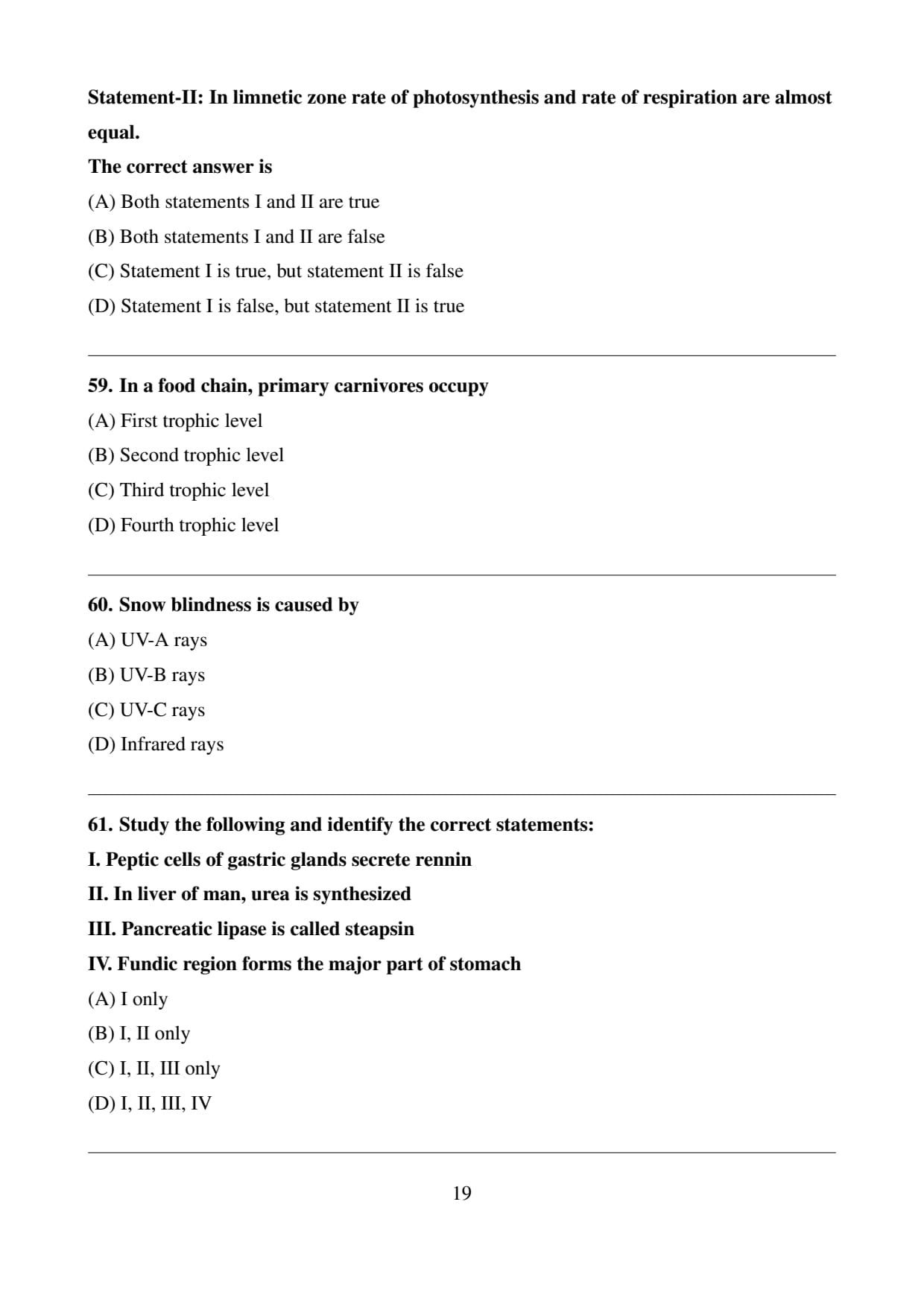
Statement-II: In limnetic zone rate of photosynthesis and rate of respiration are almost equal.
The correct answer is
In a food chain, primary carnivores occupy
Snow blindness is caused by
Study the following and identify the correct statements:
I. Peptic cells of gastric glands secrete rennin
II. In liver of man, urea is synthesized
III. Pancreatic lipase is called steapsin
IV. Fundic region forms the major part of stomach
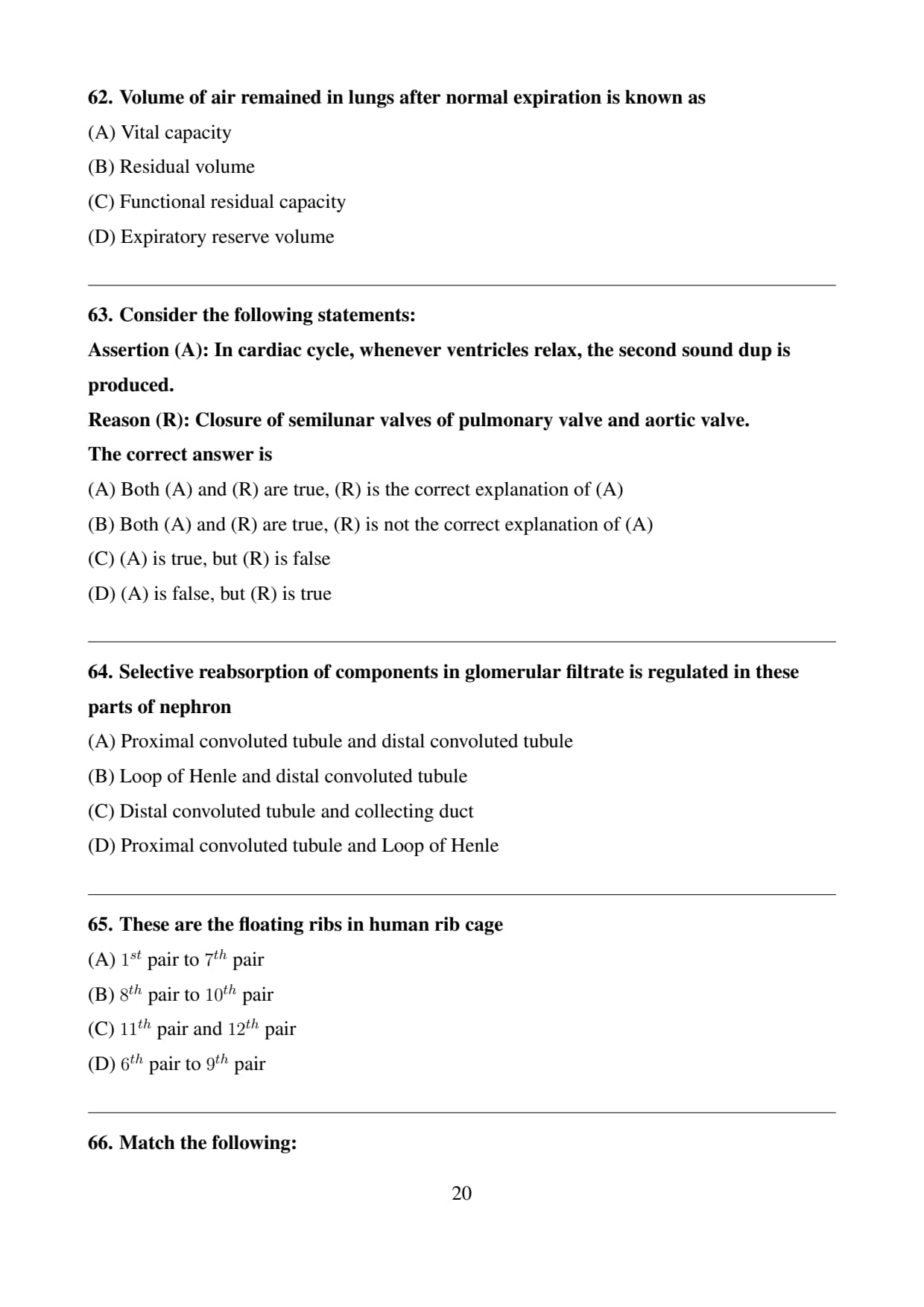
Volume of air remained in lungs after normal expiration is known as
Consider the following statements:
Assertion (A): In cardiac cycle, whenever ventricles relax, the second sound dup is produced.
Reason (R): Closure of semilunar valves of pulmonary valve and aortic valve.
The correct answer is
Selective reabsorption of components in glomerular filtrate is regulated in these parts of nephron
These are the floating ribs in human rib cage
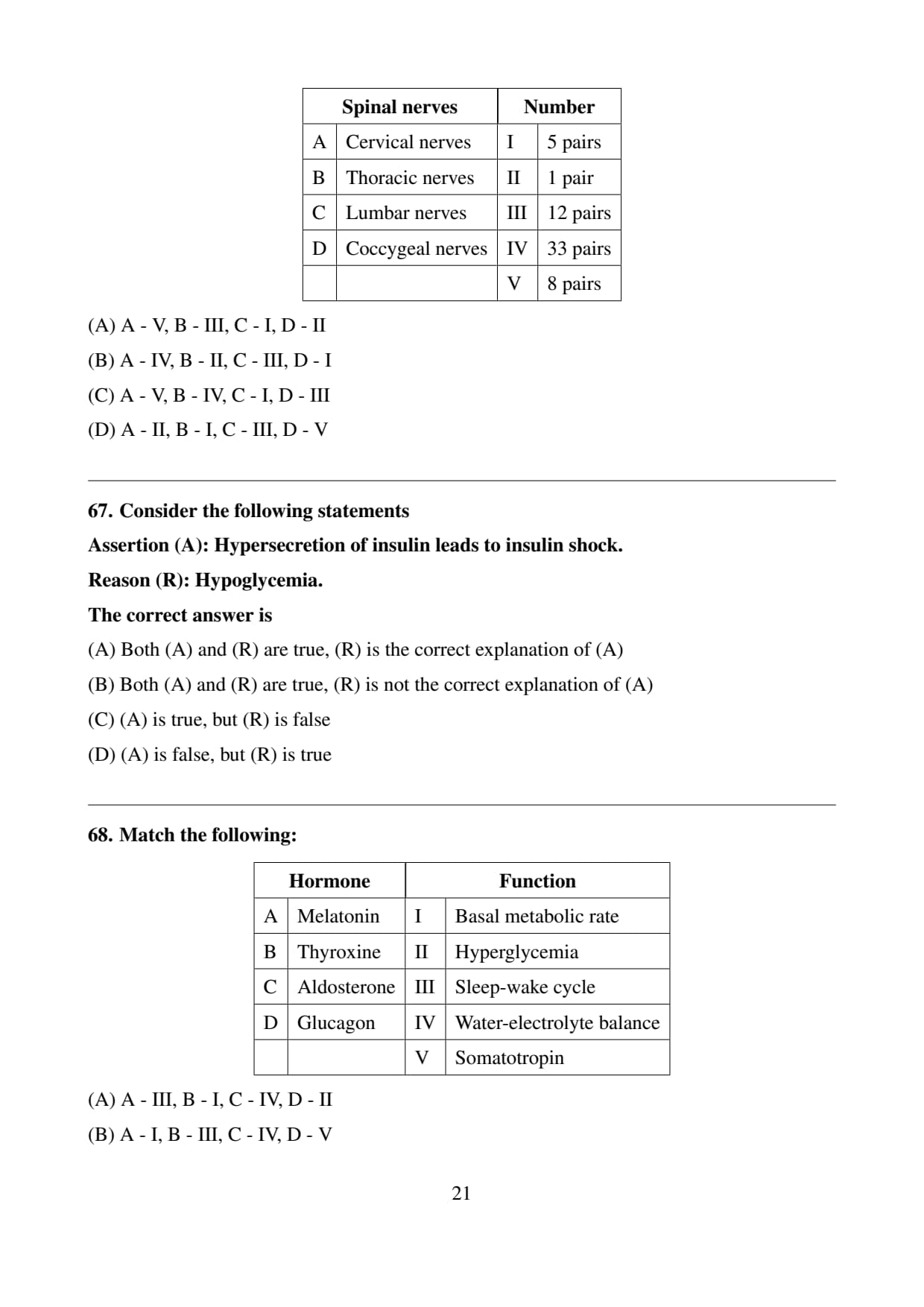
Match the following:
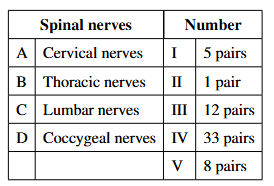
Consider the following statements
Assertion (A): Hypersecretion of insulin leads to insulin shock.
Reason (R): Hypoglycemia.
The correct answer is
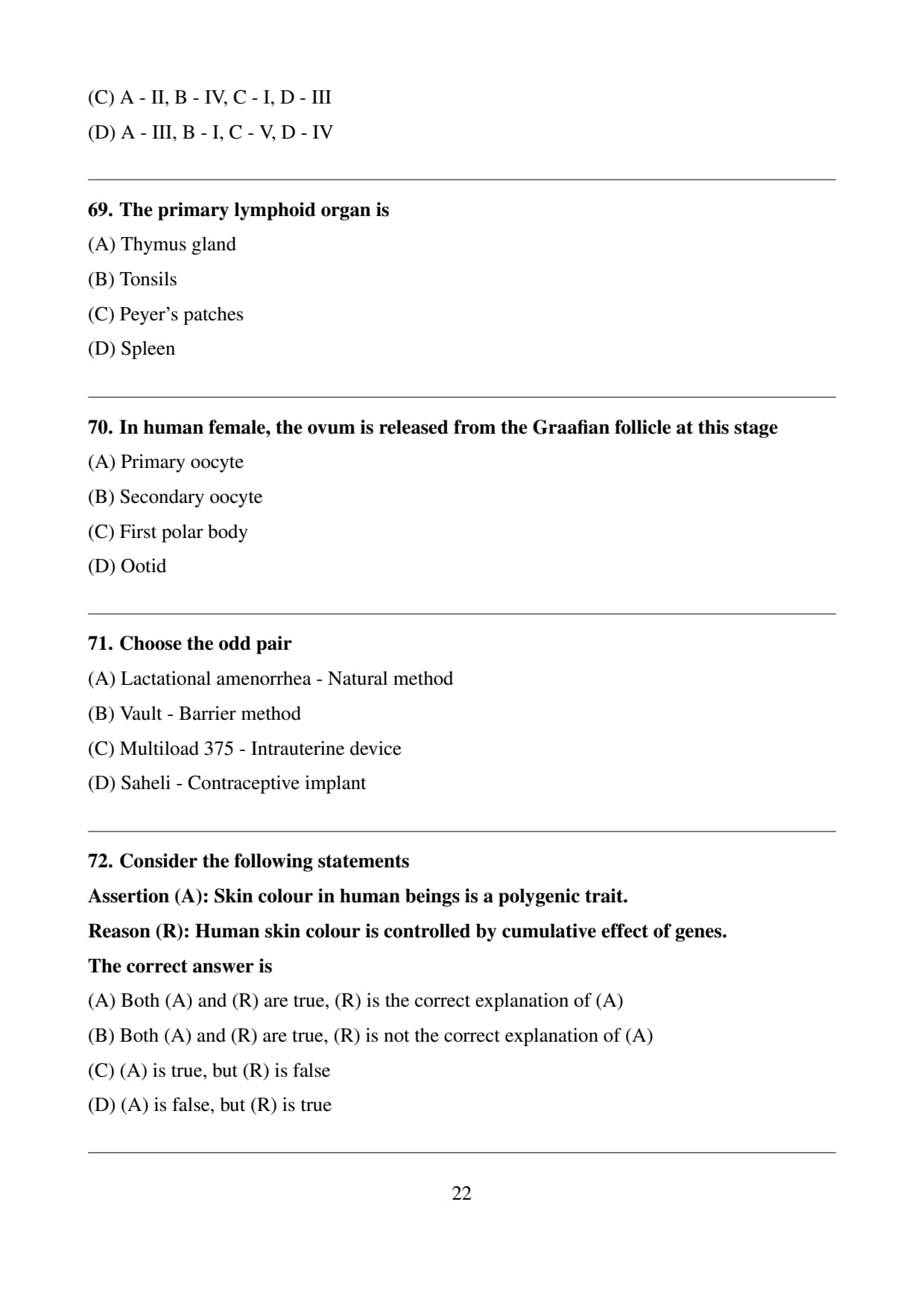
Match the following:
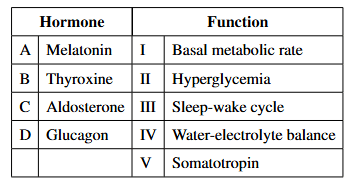
The primary lymphoid organ is
In human female, the ovum is released from the Graafian follicle at this stage
Choose the odd pair
Consider the following statements
Assertion (A): Skin colour in human beings is a polygenic trait.
Reason (R): Human skin colour is controlled by cumulative effect of genes.
The correct answer is
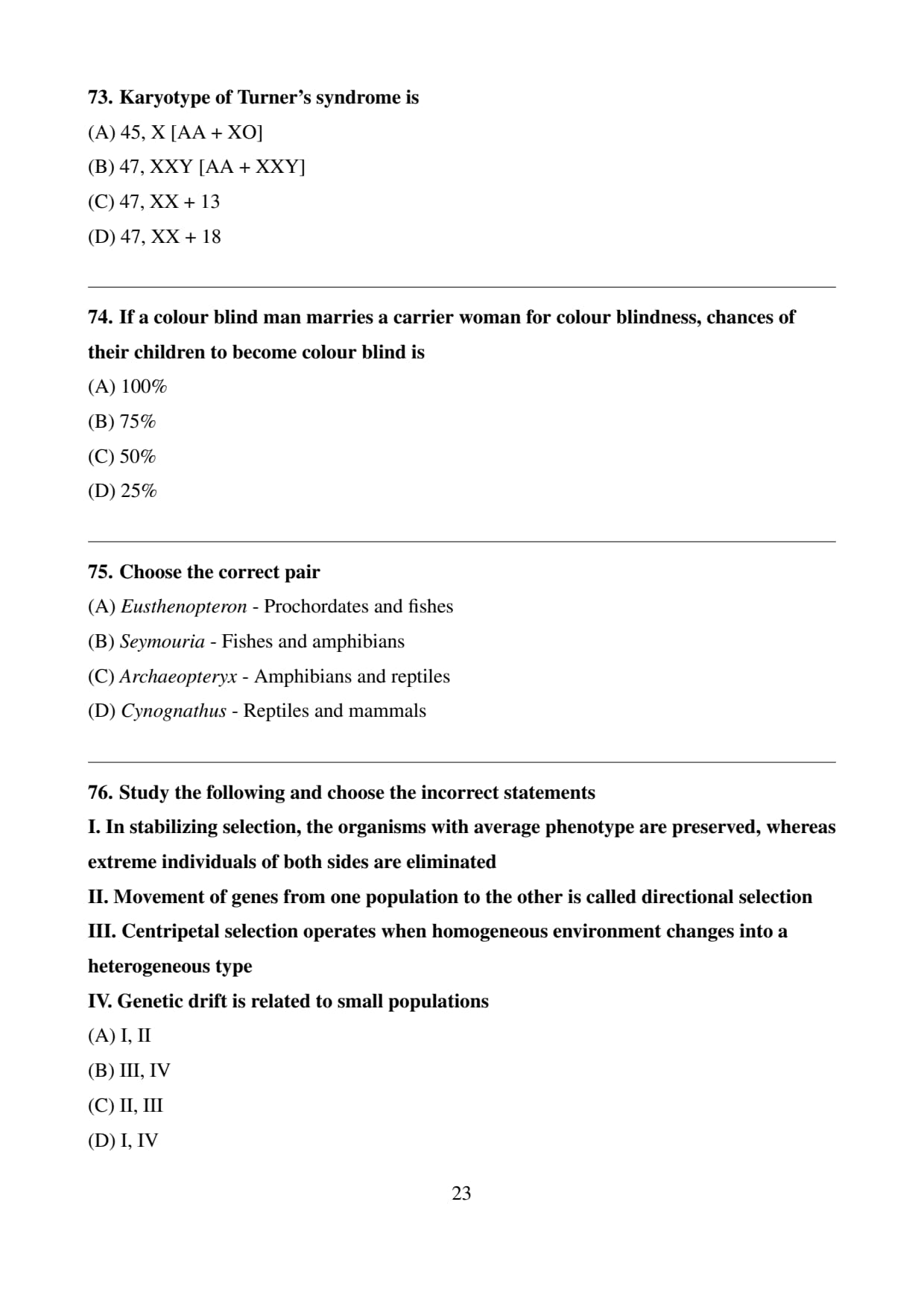
Karyotype of Turner's syndrome is
If a colour blind man marries a carrier woman for colour blindness, chances of their children to become colour blind is
Choose the correct pair
Study the following and choose the incorrect statements
I. In stabilizing selection, the organisms with average phenotype are preserved, whereas extreme individuals of both sides are eliminated
II. Movement of genes from one population to the other is called directional selection
III. Centripetal selection operates when homogeneous environment changes into a heterogeneous type
IV. Genetic drift is related to small populations
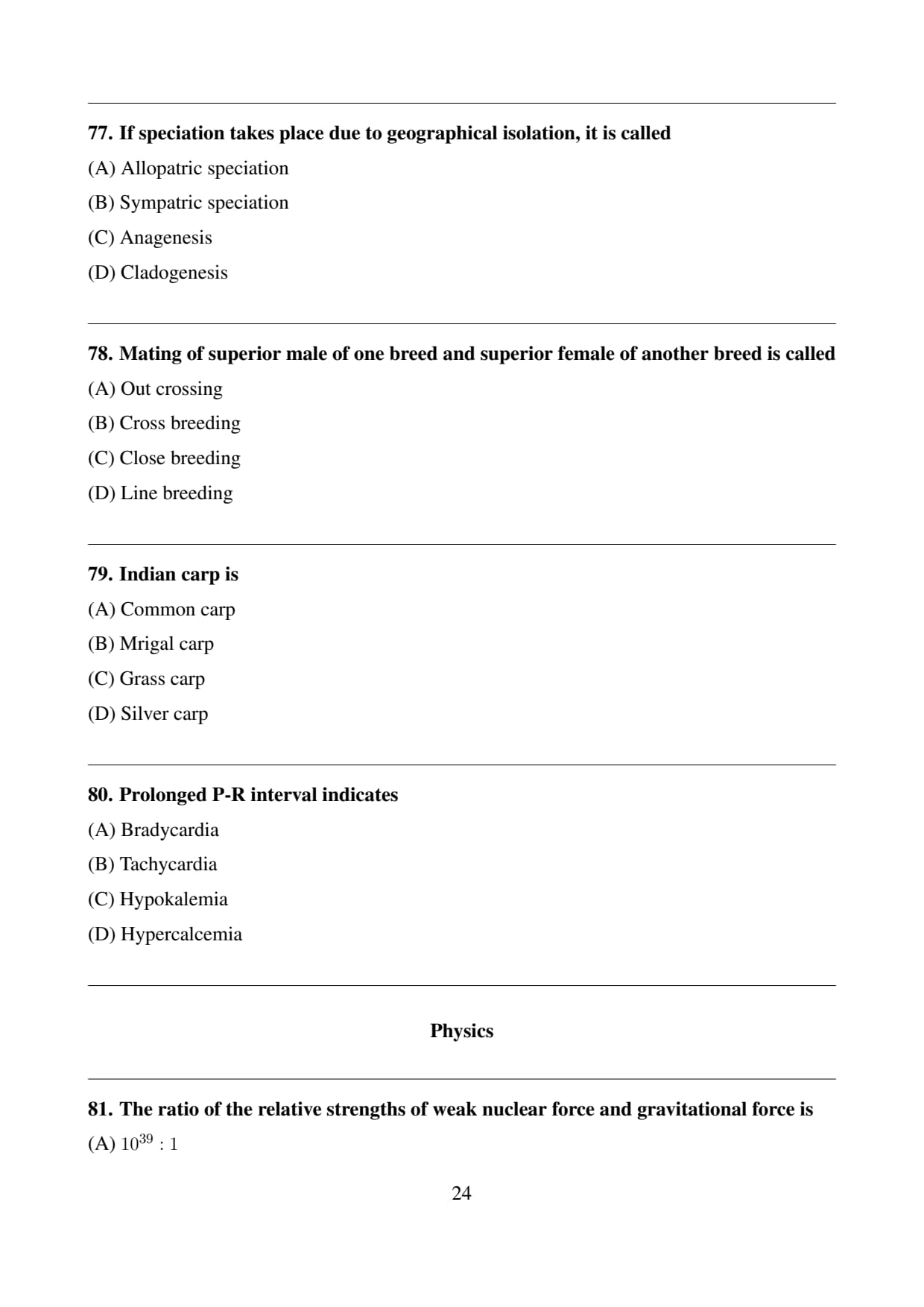
If speciation takes place due to geographical isolation, it is called
Mating of superior male of one breed and superior female of another breed is called
Indian carp is
Prolonged P-R interval indicates
The ratio of the relative strengths of weak nuclear force and gravitational force is
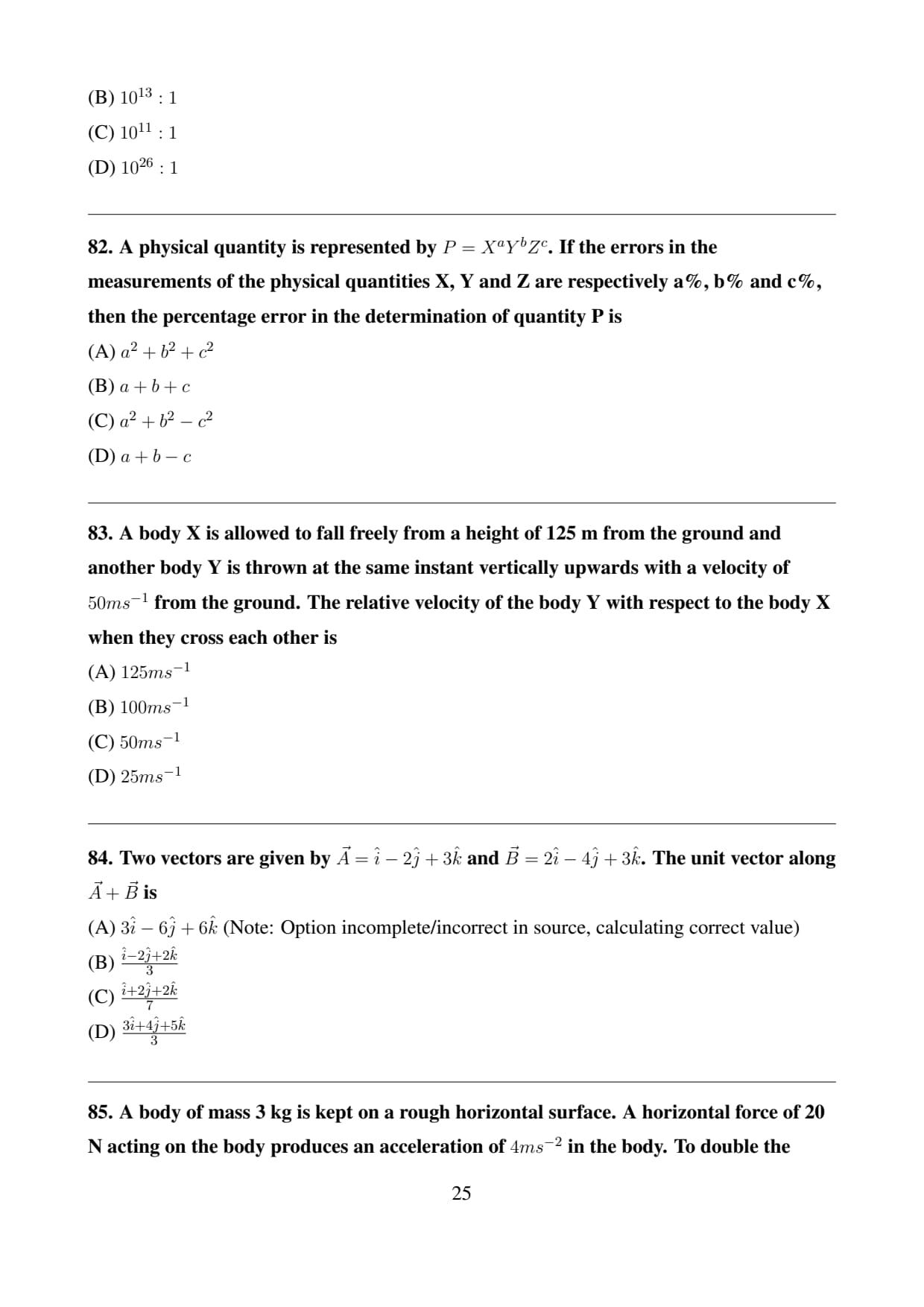
A physical quantity is represented by \(P = X^aY^bZ^c\). If the errors in the measurements of the physical quantities X, Y and Z are respectively a%, b% and c%, then the percentage error in the determination of quantity P is
A body X is allowed to fall freely from a height of 125 m from the ground and another body Y is thrown at the same instant vertically upwards with a velocity of \(50 ms^{-1}\) from the ground. The relative velocity of the body Y with respect to the body X when they cross each other is
Two vectors are given by \(\vec{A} = \hat{i} - 2\hat{j} + 3\hat{k}\) and \(\vec{B} = 2\hat{i} - 4\hat{j} + 3\hat{k}\). The unit vector along \(\vec{A} + \vec{B}\) is
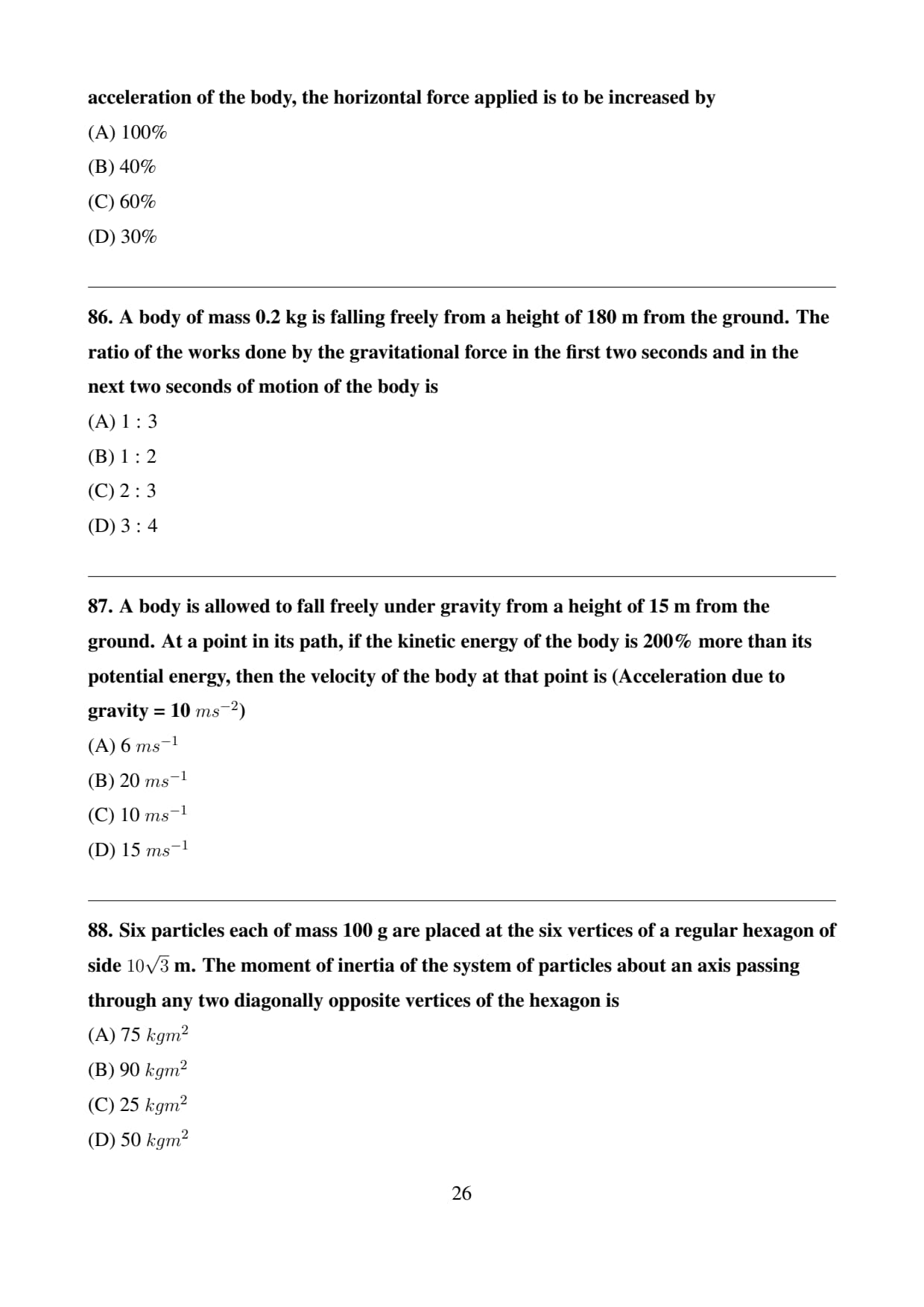
A body of mass 3 kg is kept on a rough horizontal surface. A horizontal force of 20 N acting on the body produces an acceleration of \(4 ms^{-2}\) in the body. To double the acceleration of the body, the horizontal force applied is to be increased by
A body of mass 0.2 kg is falling freely from a height of 180 m from the ground. The ratio of the works done by the gravitational force in the first two seconds and in the next two seconds of motion of the body is
A body is allowed to fall freely under gravity from a height of 15 m from the ground. At a point in its path, if the kinetic energy of the body is 200% more than its potential energy, then the velocity of the body at that point is (Acceleration due to gravity = 10 \(ms^{-2}\))
Six particles each of mass 100 g are placed at the six vertices of a regular hexagon of side \(10\sqrt{3}\) m. The moment of inertia of the system of particles about an axis passing through any two diagonally opposite vertices of the hexagon is
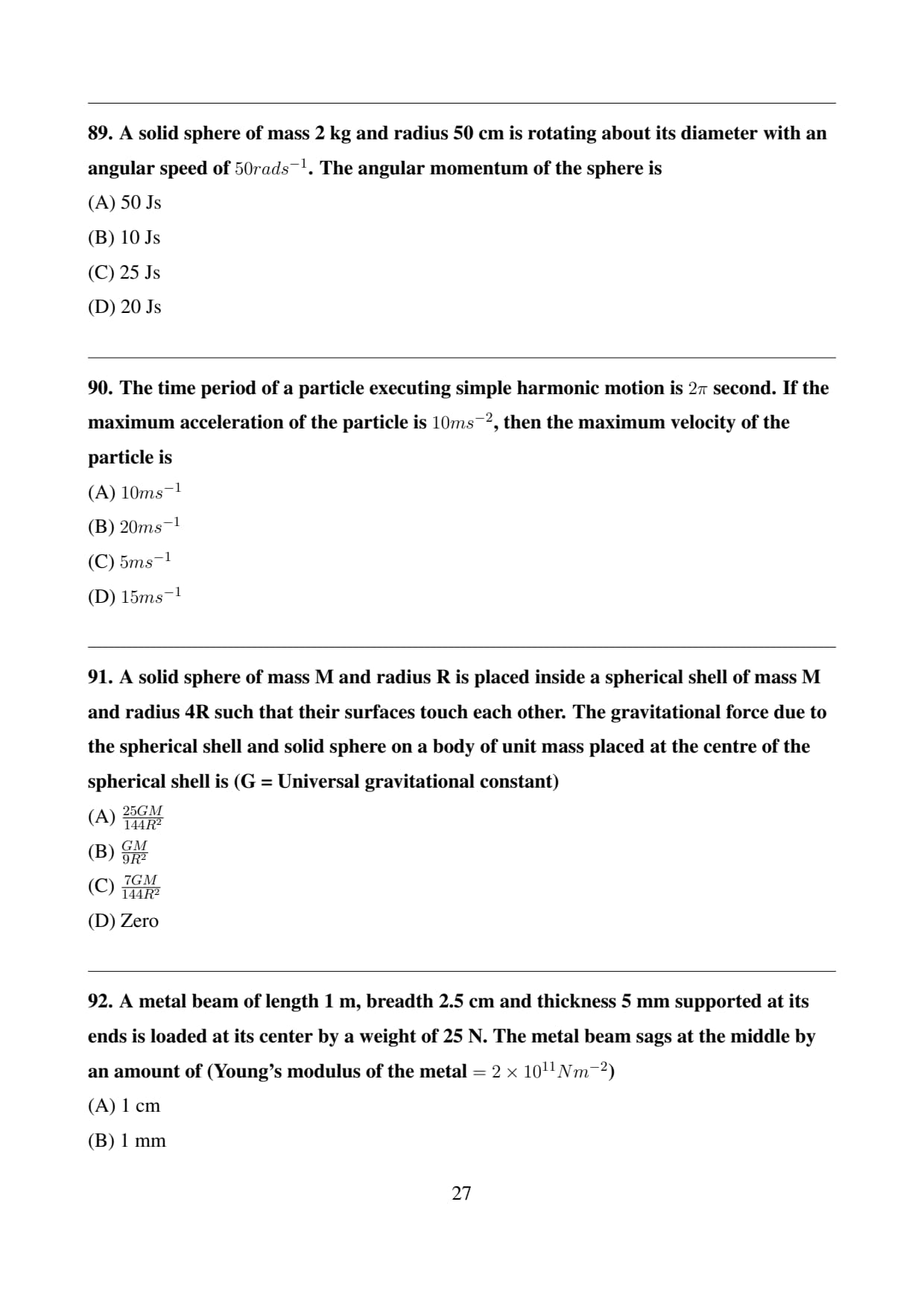
A solid sphere of mass 2 kg and radius 50 cm is rotating about its diameter with an angular speed of \(50 rad s^{-1}\). The angular momentum of the sphere is
The time period of a particle executing simple harmonic motion is \(2\pi\) second. If the maximum acceleration of the particle is \(10 ms^{-2}\), then the maximum velocity of the particle is
A solid sphere of mass M and radius R is placed inside a spherical shell of mass M and radius 4R such that their surfaces touch each other. The gravitational force due to the spherical shell and solid sphere on a body of unit mass placed at the centre of the spherical shell is (G = Universal gravitational constant)
A metal beam of length 1 m, breadth 2.5 cm and thickness 5 mm supported at its ends is loaded at its center by a weight of 25 N. The metal beam sags at the middle by an amount of (Young's modulus of the metal \(= 2\times10^{11} Nm^{-2}\))
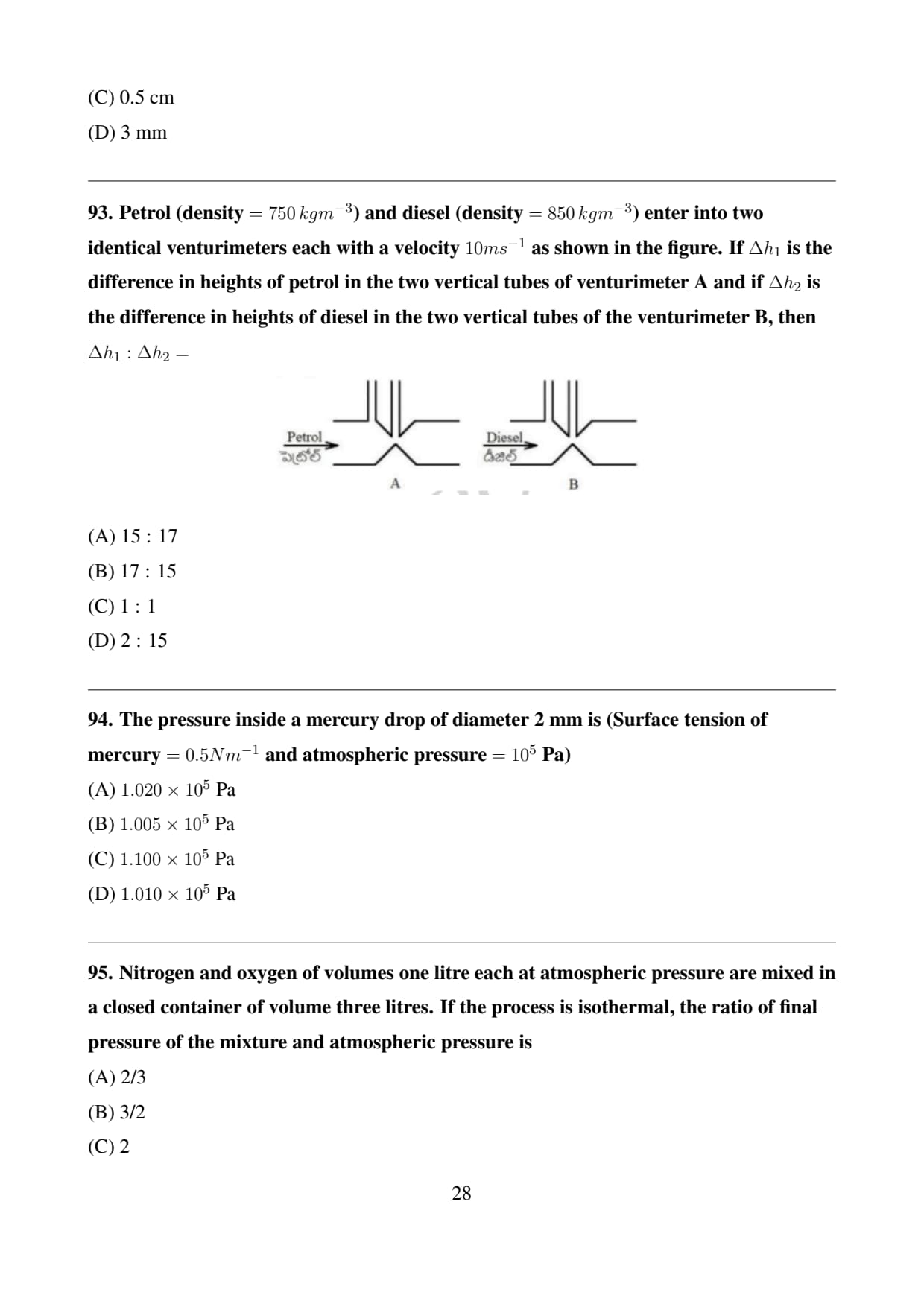
Petrol (density \(= 750 \, kg m^{-3}\)) and diesel (density \(= 850 \, kg m^{-3}\)) enter into two identical venturimeters each with a velocity \(10 ms^{-1}\) as shown in the figure. If \(\Delta h_1\) is the difference in heights of petrol in the two vertical tubes of venturimeter A and if \(\Delta h_2\) is the difference in heights of diesel in the two vertical tubes of the venturimeter B, then \(\Delta h_1 : \Delta h_2 =\)
The pressure inside a mercury drop of diameter 2 mm is (Surface tension of mercury \(= 0.5 Nm^{-1}\) and atmospheric pressure \(= 10^5\) Pa)
Nitrogen and oxygen of volumes one litre each at atmospheric pressure are mixed in a closed container of volume three litres. If the process is isothermal, the ratio of final pressure of the mixture and atmospheric pressure is
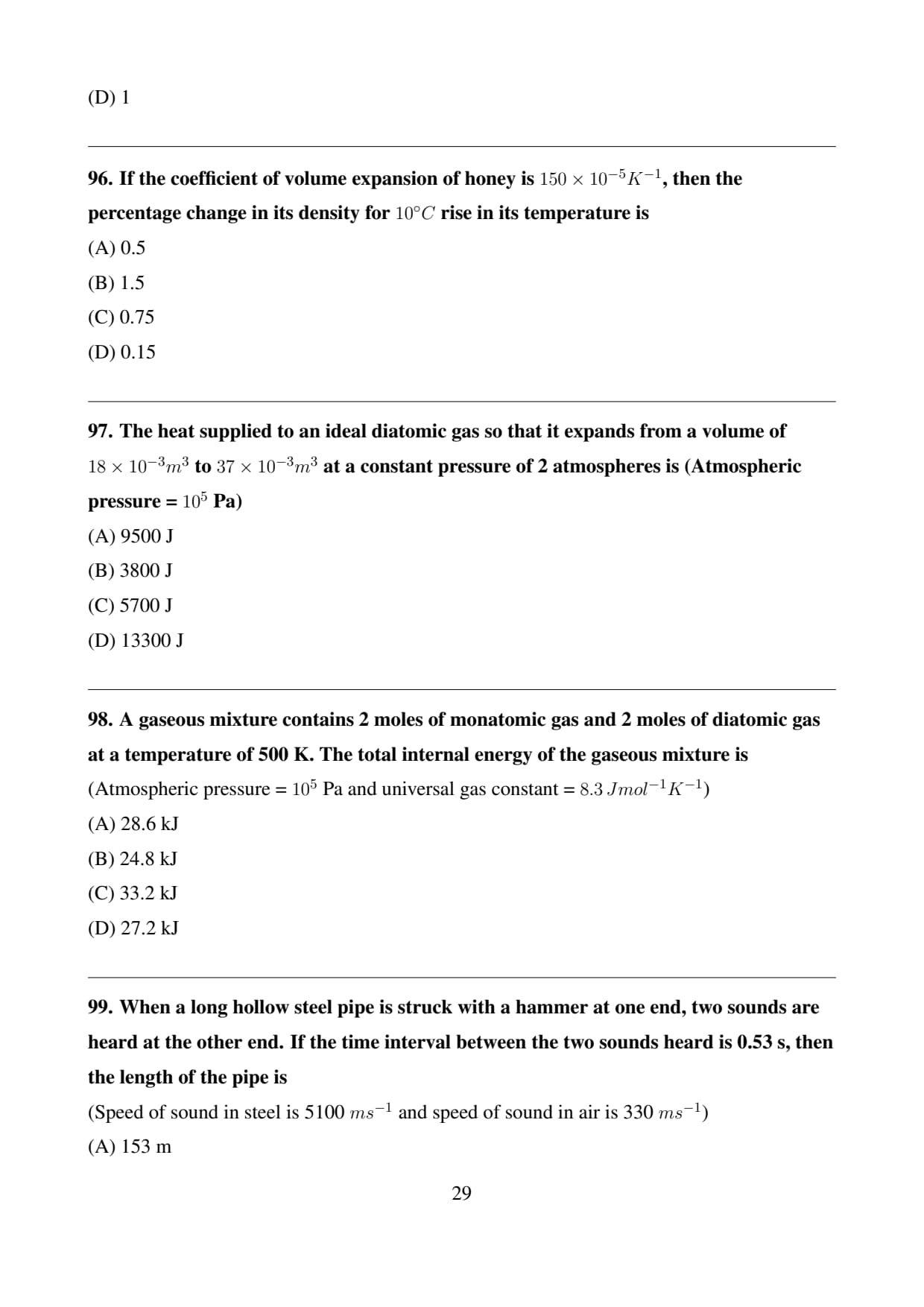
If the coefficient of volume expansion of honey is \(150 \times 10^{-5} K^{-1}\), then the percentage change in its density for \(10^{\circ}C\) rise in its temperature is
The heat supplied to an ideal diatomic gas so that it expands from a volume of \(18 \times 10^{-3} m^3\) to \(37 \times 10^{-3} m^3\) at a constant pressure of 2 atmospheres is (Atmospheric pressure = \(10^5\) Pa)
A gaseous mixture contains 2 moles of monatomic gas and 2 moles of diatomic gas at a temperature of 500 K. The total internal energy of the gaseous mixture is
(Atmospheric pressure = \(10^5\) Pa and universal gas constant = \(8.3 \, J mol^{-1} K^{-1}\))
When a long hollow steel pipe is struck with a hammer at one end, two sounds are heard at the other end. If the time interval between the two sounds heard is 0.53 s, then the length of the pipe is
(Speed of sound in steel is 5100 \(ms^{-1}\) and speed of sound in air is 330 \(ms^{-1}\))
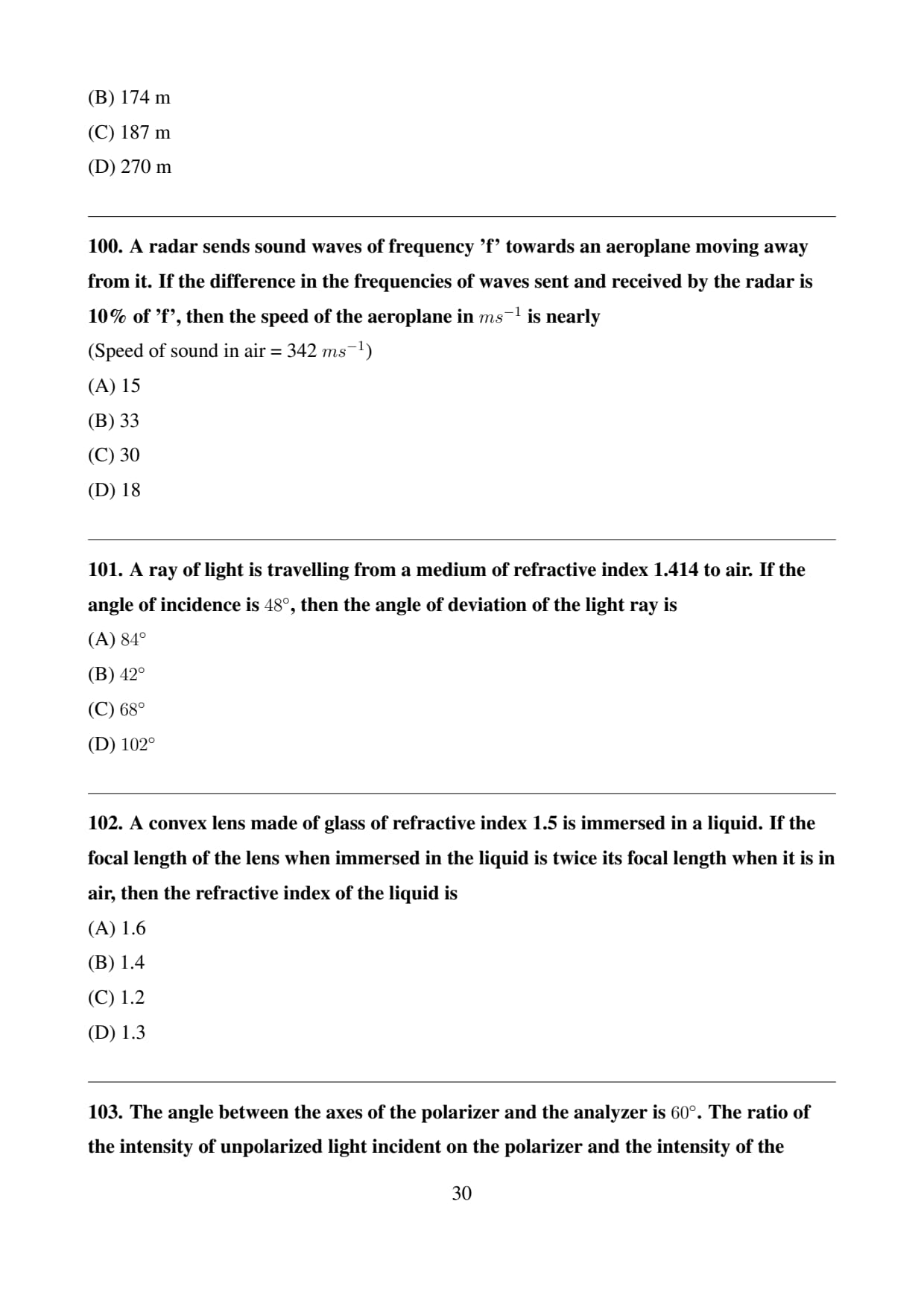
A radar sends sound waves of frequency 'f' towards an aeroplane moving away from it. If the difference in the frequencies of waves sent and received by the radar is 10% of 'f', then the speed of the aeroplane in \(ms^{-1}\) is nearly
(Speed of sound in air = 342 \(ms^{-1}\))
A ray of light is travelling from a medium of refractive index 1.414 to air. If the angle of incidence is \(48^{\circ}\), then the angle of deviation of the light ray is
A convex lens made of glass of refractive index 1.5 is immersed in a liquid. If the focal length of the lens when immersed in the liquid is twice its focal length when it is in air, then the refractive index of the liquid is
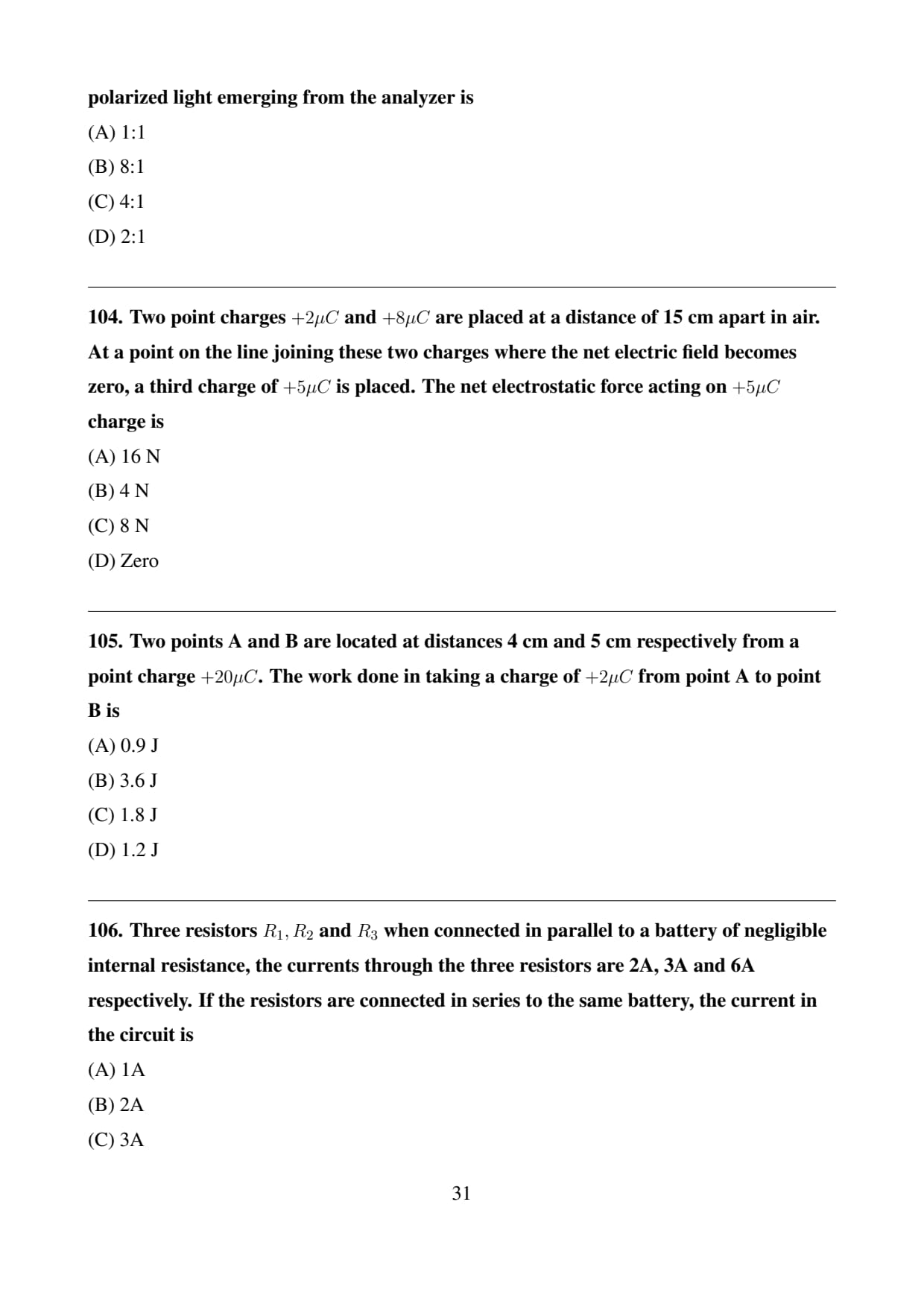
The angle between the axes of the polarizer and the analyzer is \(60^{\circ}\). The ratio of the intensity of unpolarized light incident on the polarizer and the intensity of the polarized light emerging from the analyzer is
Two point charges \(+2\mu C\) and \(+8\mu C\) are placed at a distance of 15 cm apart in air. At a point on the line joining these two charges where the net electric field becomes zero, a third charge of \(+5\mu C\) is placed. The net electrostatic force acting on \(+5\mu C\) charge is
Two points A and B are located at distances 4 cm and 5 cm respectively from a point charge \(+20\mu C\). The work done in taking a charge of \(+2\mu C\) from point A to point B is
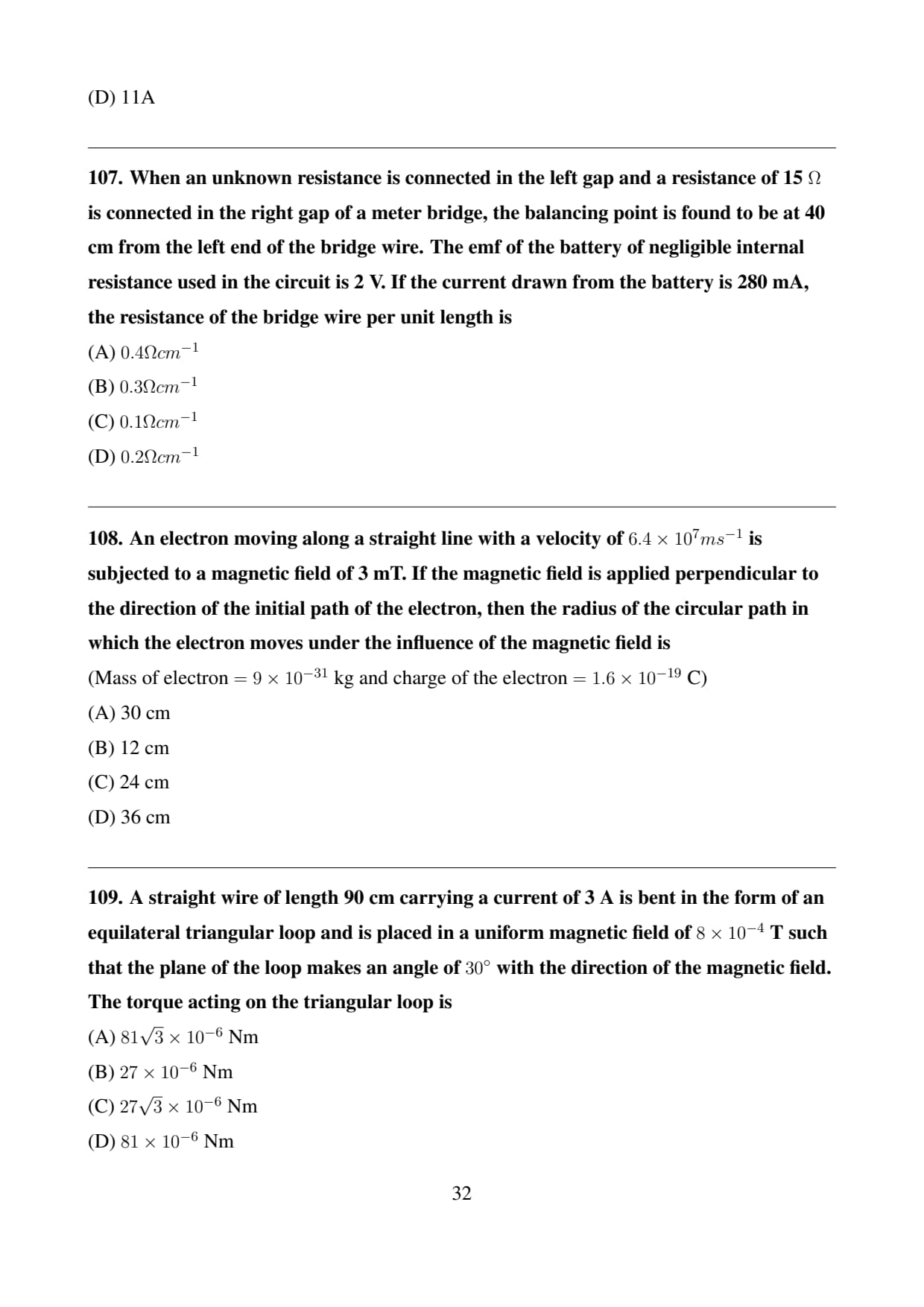
Three resistors \(R_1, R_2\) and \(R_3\) when connected in parallel to a battery of negligible internal resistance, the currents through the three resistors are 2A, 3A and 6A respectively. If the resistors are connected in series to the same battery, the current in the circuit is
When an unknown resistance is connected in the left gap and a resistance of 15 \(\Omega\) is connected in the right gap of a meter bridge, the balancing point is found to be at 40 cm from the left end of the bridge wire. The emf of the battery of negligible internal resistance used in the circuit is 2 V. If the current drawn from the battery is 280 mA, the resistance of the bridge wire per unit length is
An electron moving along a straight line with a velocity of \(6.4 \times 10^7 ms^{-1}\) is subjected to a magnetic field of 3 mT. If the magnetic field is applied perpendicular to the direction of the initial path of the electron, then the radius of the circular path in which the electron moves under the influence of the magnetic field is
(Mass of electron \(= 9 \times 10^{-31}\) kg and charge of the electron \(= 1.6 \times 10^{-19}\) C)
A straight wire of length 90 cm carrying a current of 3 A is bent in the form of an equilateral triangular loop and is placed in a uniform magnetic field of \(8 \times 10^{-4}\) T such that the plane of the loop makes an angle of \(30^{\circ}\) with the direction of the magnetic field. The torque acting on the triangular loop is
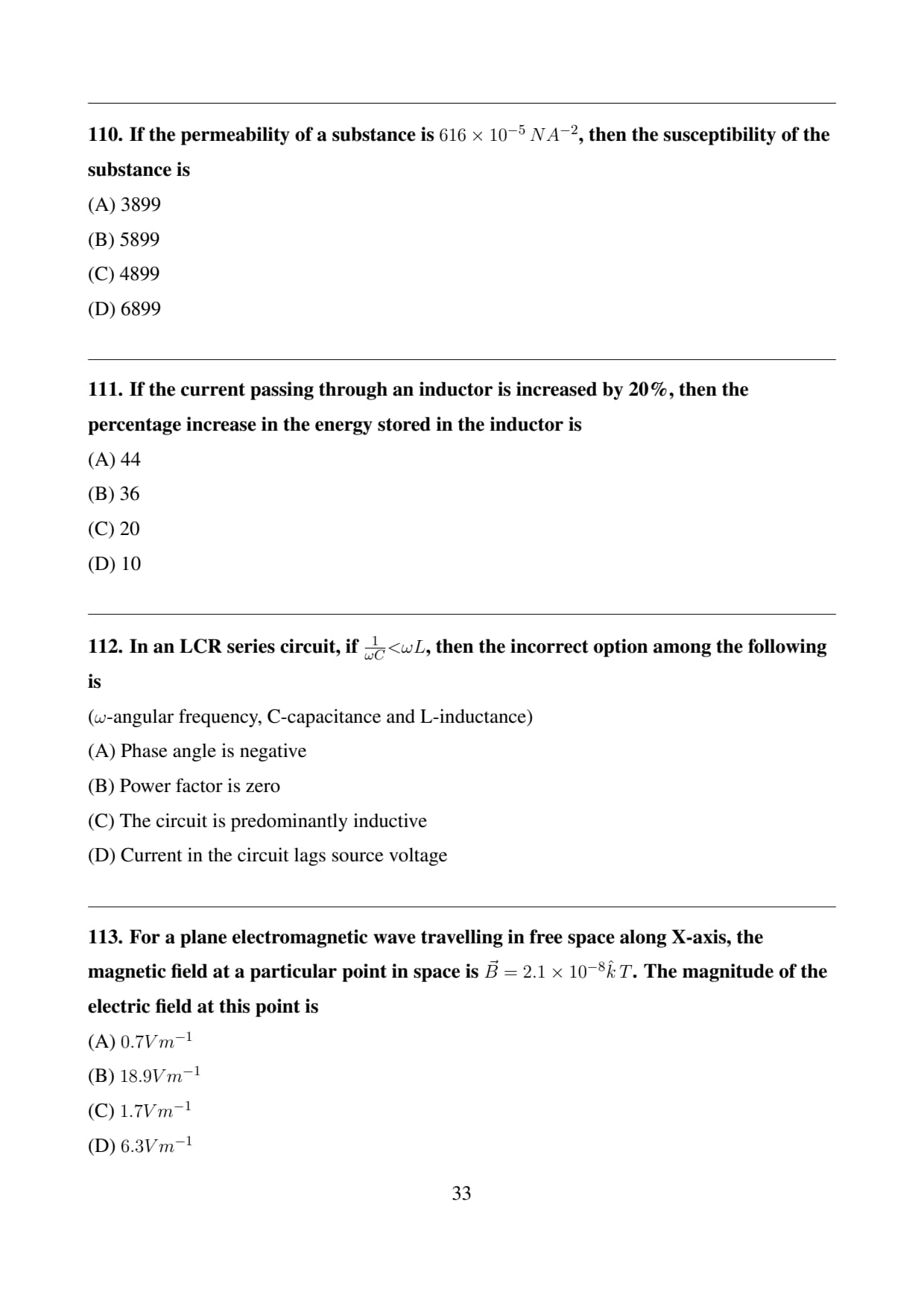
If the permeability of a substance is \(616 \times 10^{-5} \, NA^{-2}\), then the susceptibility of the substance is
If the current passing through an inductor is increased by 20%, then the percentage increase in the energy stored in the inductor is
In an LCR series circuit, if \(\frac{1}{\omega C} \textless \omega L\), then the incorrect option among the following is
(\(\omega\)-angular frequency, C-capacitance and L-inductance)
For a plane electromagnetic wave travelling in free space along X-axis, the magnetic field at a particular point in space is \(\vec{B} = 2.1 \times 10^{-8} \hat{k} \, T\). The magnitude of the electric field at this point is
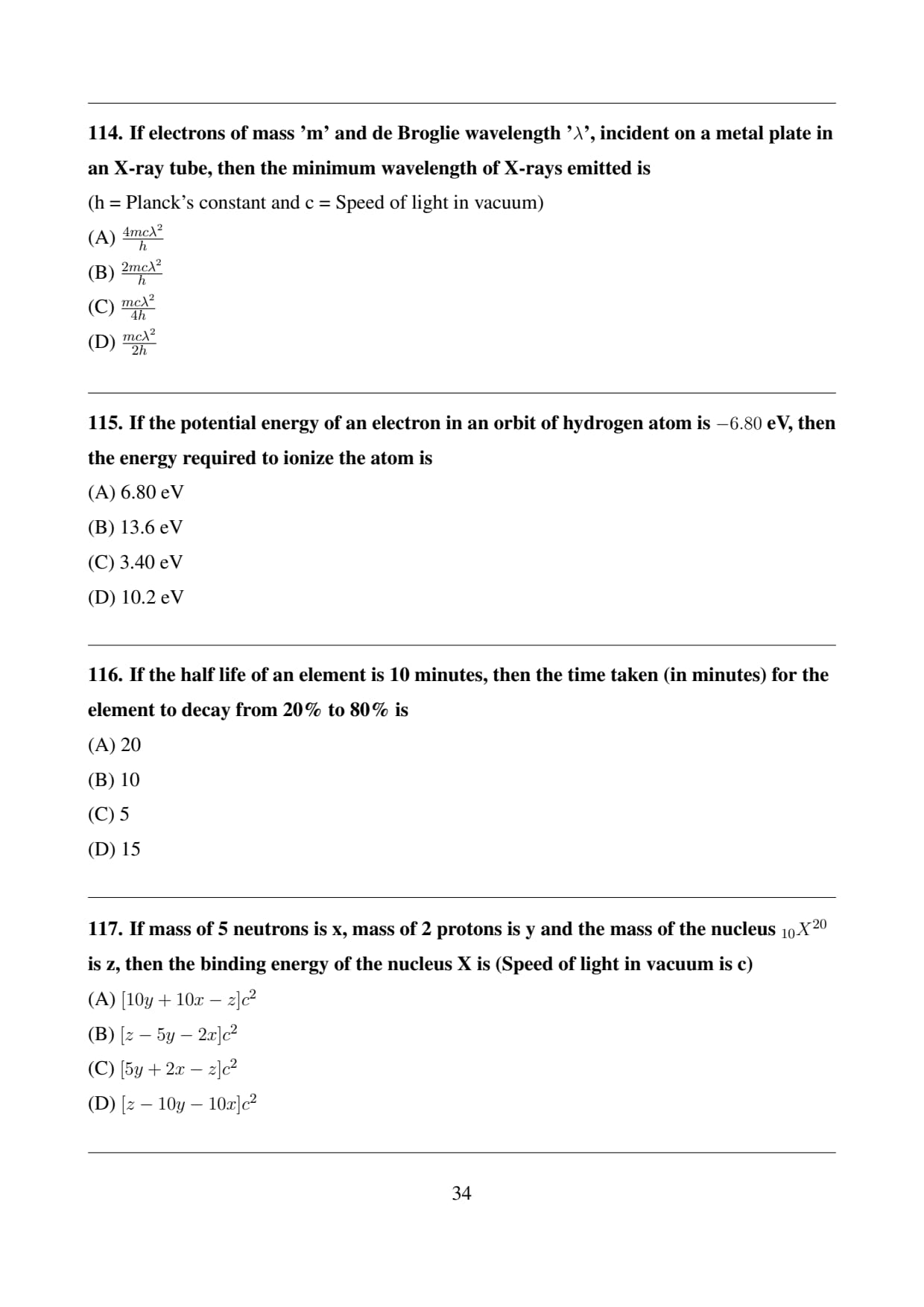
If electrons of mass 'm' and de Broglie wavelength '\(\lambda\)', incident on a metal plate in an X-ray tube, then the minimum wavelength of X-rays emitted is
(h = Planck's constant and c = Speed of light in vacuum)
If the potential energy of an electron in an orbit of hydrogen atom is \(-6.80\) eV, then the energy required to ionize the atom is
If the half life of an element is 10 minutes, then the time taken (in minutes) for the element to decay from 20% to 80% is
If mass of 5 neutrons is x, mass of 2 protons is y and the mass of the nucleus \(_{10}X^{20}\) is z, then the binding energy of the nucleus X is (Speed of light in vacuum is c)
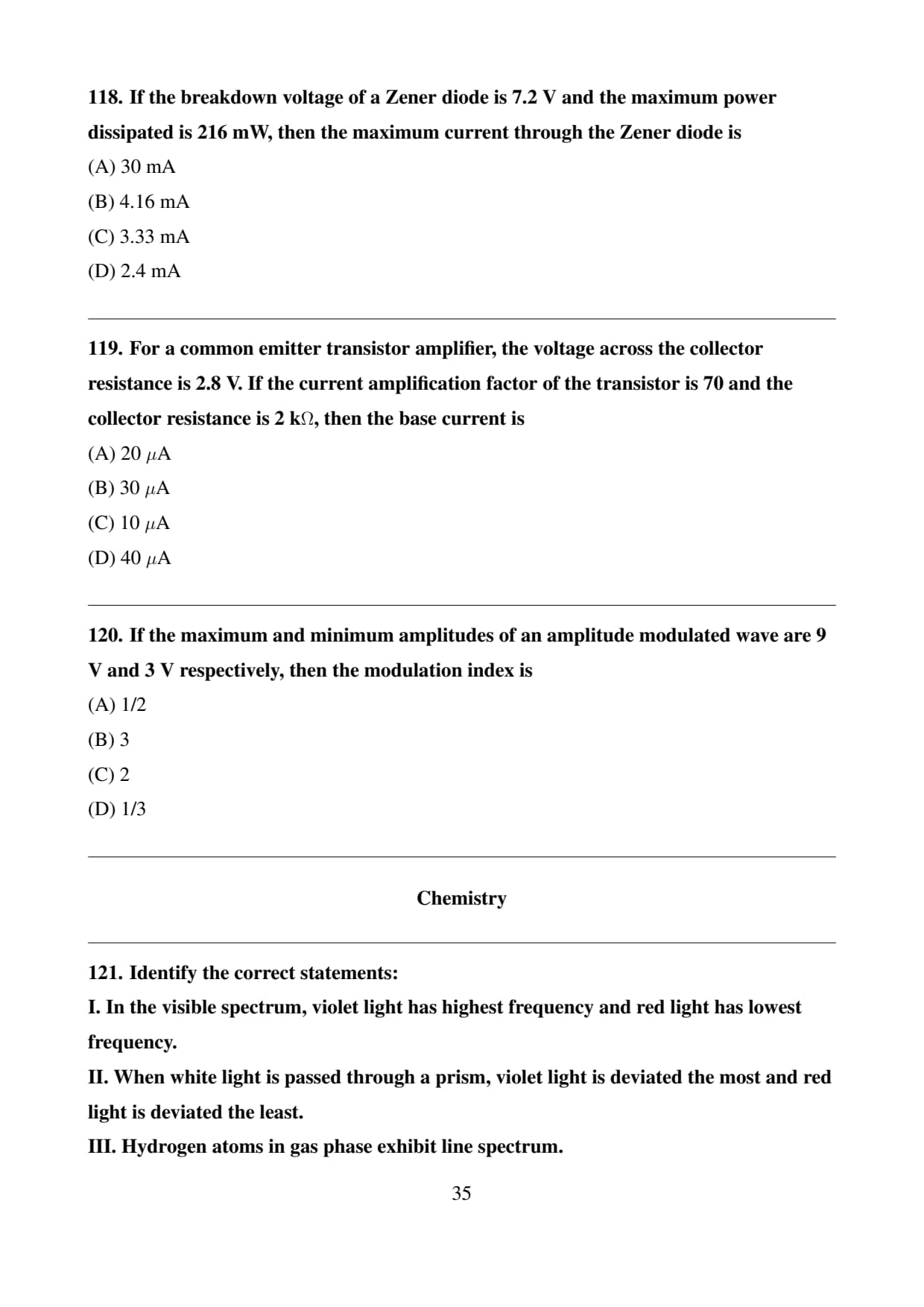
If the breakdown voltage of a Zener diode is 7.2 V and the maximum power dissipated is 216 mW, then the maximum current through the Zener diode is
For a common emitter transistor amplifier, the voltage across the collector resistance is 2.8 V. If the current amplification factor of the transistor is 70 and the collector resistance is 2 k\(\Omega\), then the base current is
If the maximum and minimum amplitudes of an amplitude modulated wave are 9 V and 3 V respectively, then the modulation index is
Identify the correct statements:
I. In the visible spectrum, violet light has highest frequency and red light has lowest frequency.
II. When white light is passed through a prism, violet light is deviated the most and red light is deviated the least.
III. Hydrogen atoms in gas phase exhibit line spectrum.
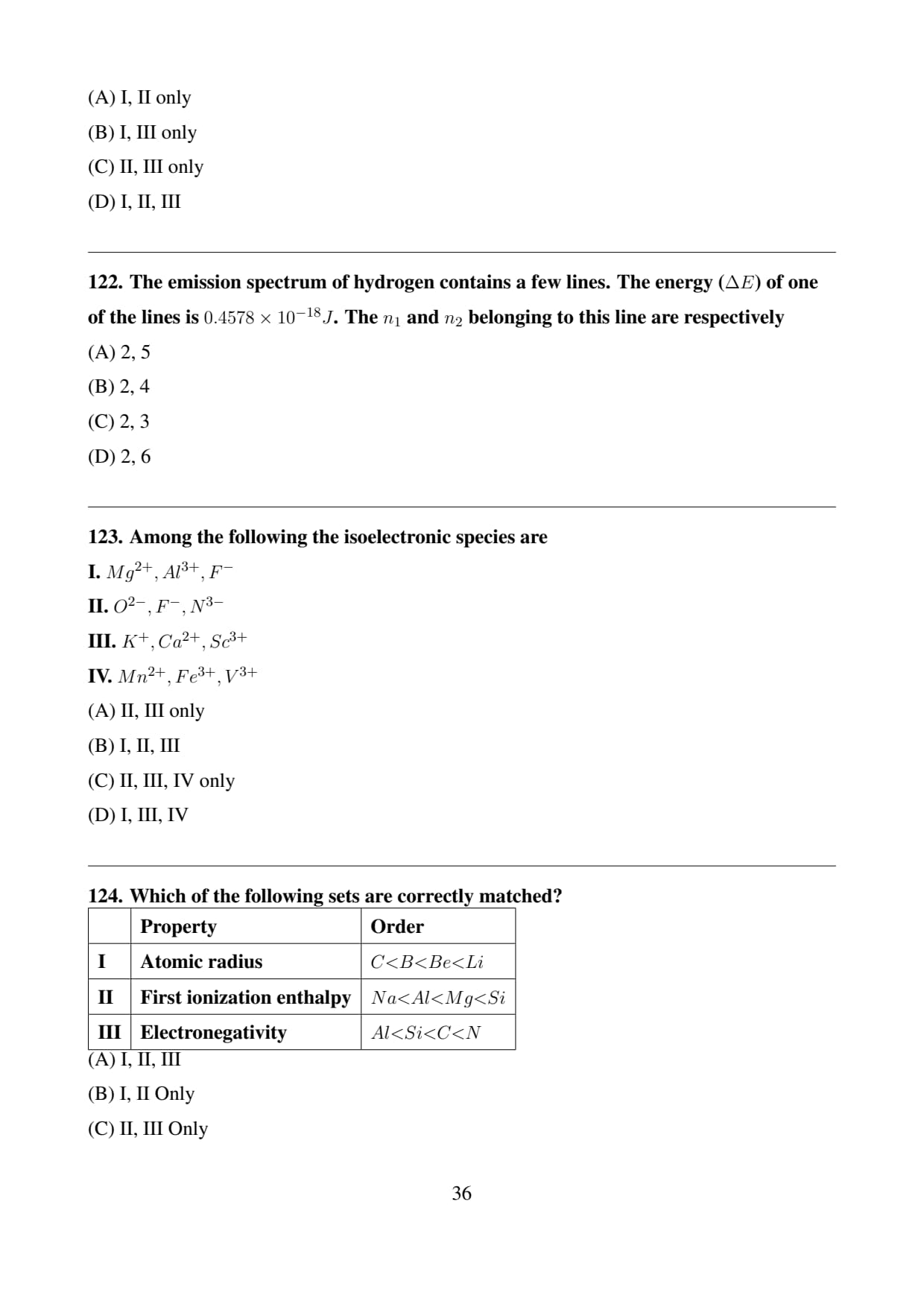
The emission spectrum of hydrogen contains a few lines. The energy (\(\Delta E\)) of one of the lines is \(0.4578 \times 10^{-18} J\). The \(n_1\) and \(n_2\) belonging to this line are respectively
Among the following the isoelectronic species are
I. \(Mg^{2+}, Al^{3+}, F^-\)
II. \(O^{2-}, F^-, N^{3-}\)
III. \(K^+, Ca^{2+}, Sc^{3+}\)
IV. \(Mn^{2+}, Fe^{3+}, V^{3+}\)
Which of the following sets are correctly matched?
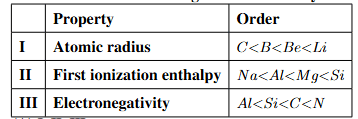
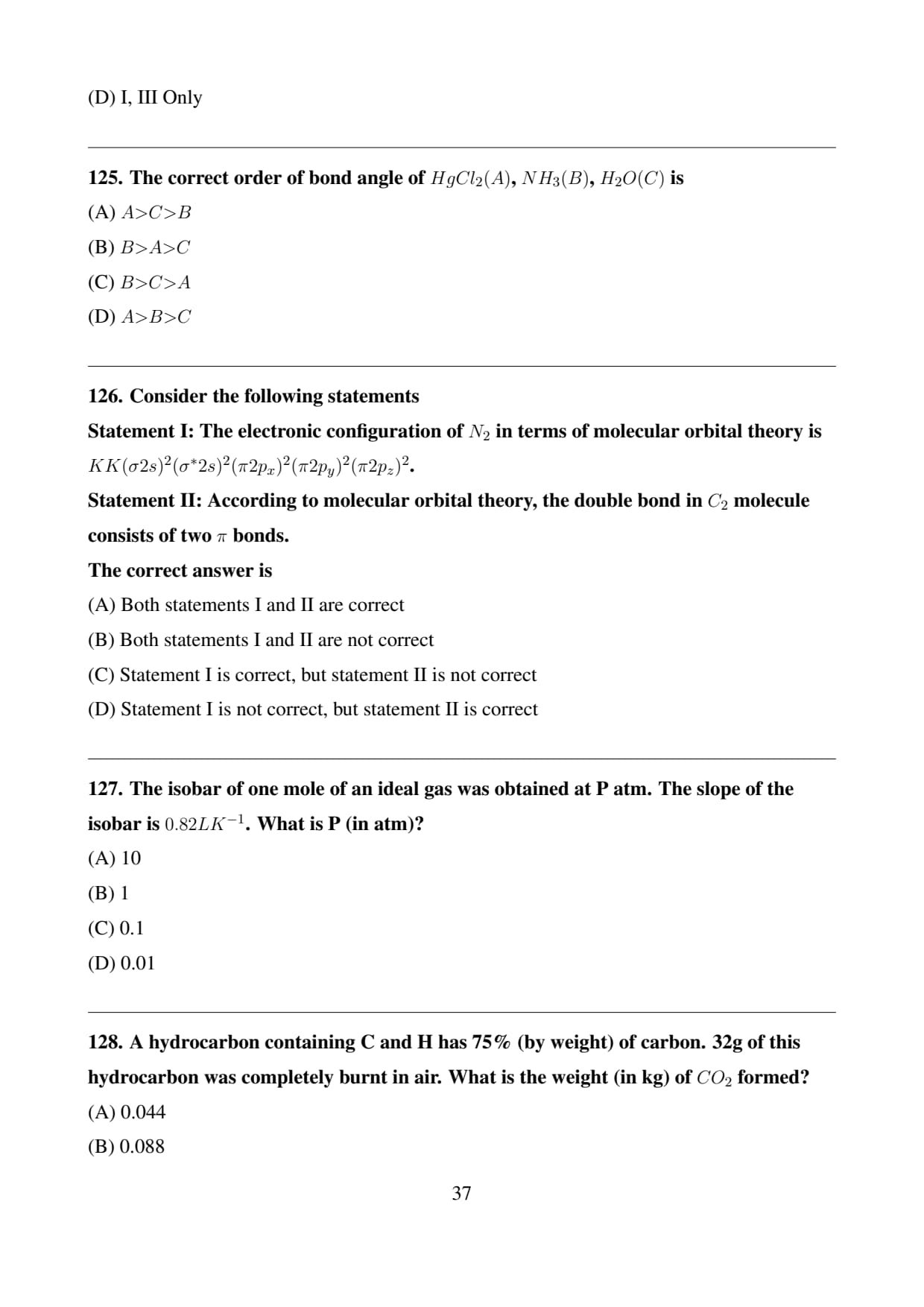
The correct order of bond angle of \(HgCl_2 (A)\), \(NH_3 (B)\), \(H_2O (C)\) is
Consider the following statements
Statement I: The electronic configuration of \(N_2\) in terms of molecular orbital theory is \(KK (\sigma 2s)^2 (\sigma^* 2s)^2 (\pi 2p_x)^2 (\pi 2p_y)^2 (\pi 2p_z)^2\).
Statement II: According to molecular orbital theory, the double bond in \(C_2\) molecule consists of two \(\pi\) bonds.
The correct answer is
The isobar of one mole of an ideal gas was obtained at P atm. The slope of the isobar is \(0.82 L K^{-1}\). What is P (in atm)?
A hydrocarbon containing C and H has 75% (by weight) of carbon. 32g of this hydrocarbon was completely burnt in air. What is the weight (in kg) of \(CO_2\) formed?
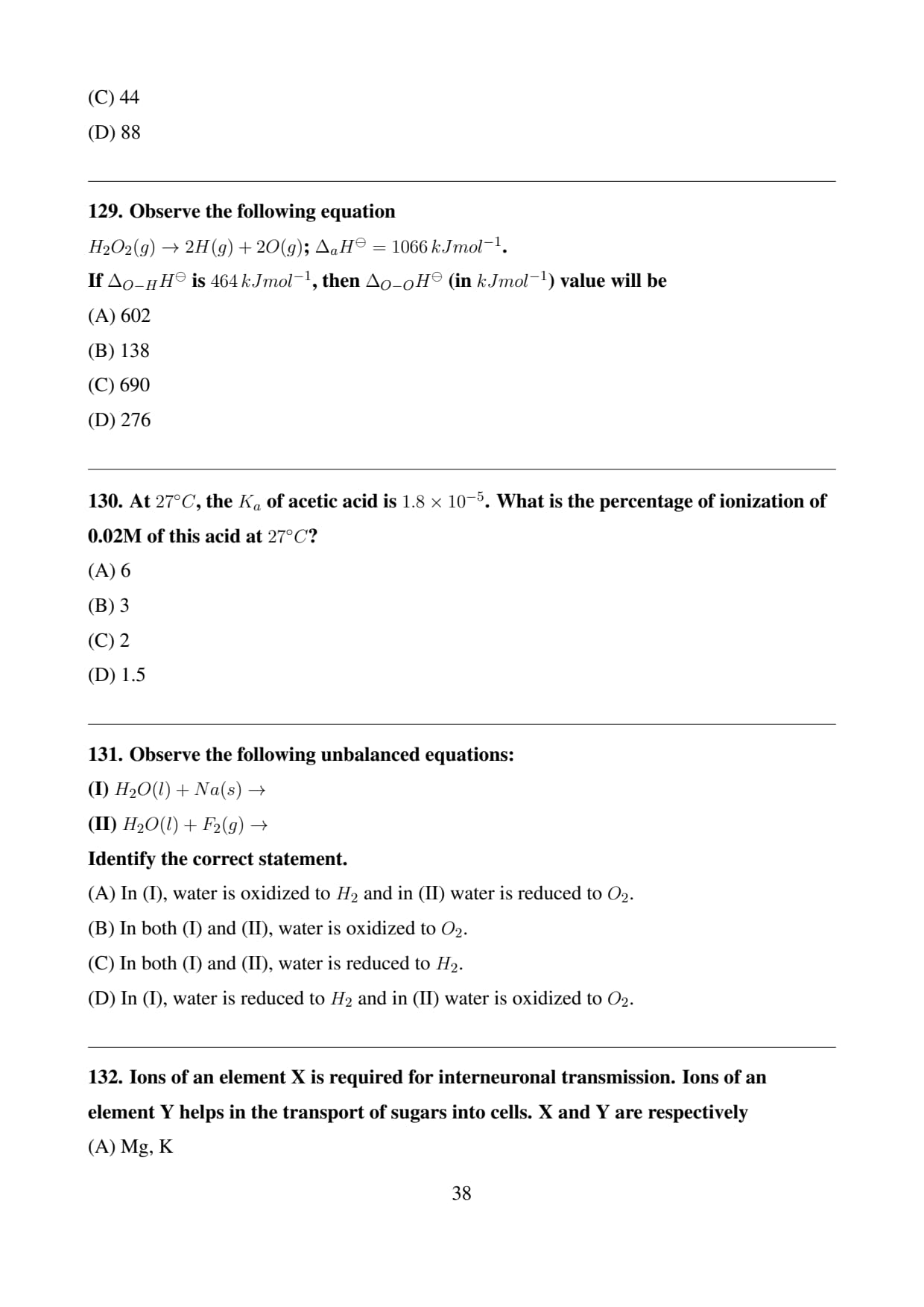
Observe the following equation
\(H_2O_2(g) \rightarrow 2H(g) + 2O(g)\); \(\Delta_a H^\ominus = 1066 \, kJ mol^{-1}\).
If \(\Delta_{O-H} H^\ominus\) is \(464 \, kJ mol^{-1}\), then \(\Delta_{O-O} H^\ominus\) (in \(kJ mol^{-1}\)) value will be
At \(27^\circ C\), the \(K_a\) of acetic acid is \(1.8 \times 10^{-5}\). What is the percentage of ionization of 0.02M of this acid at \(27^\circ C\)?
Observe the following unbalanced equations:
(I) \(H_2O(l) + Na(s) \rightarrow\)
(II) \(H_2O(l) + F_2(g) \rightarrow\)
Identify the correct statement.
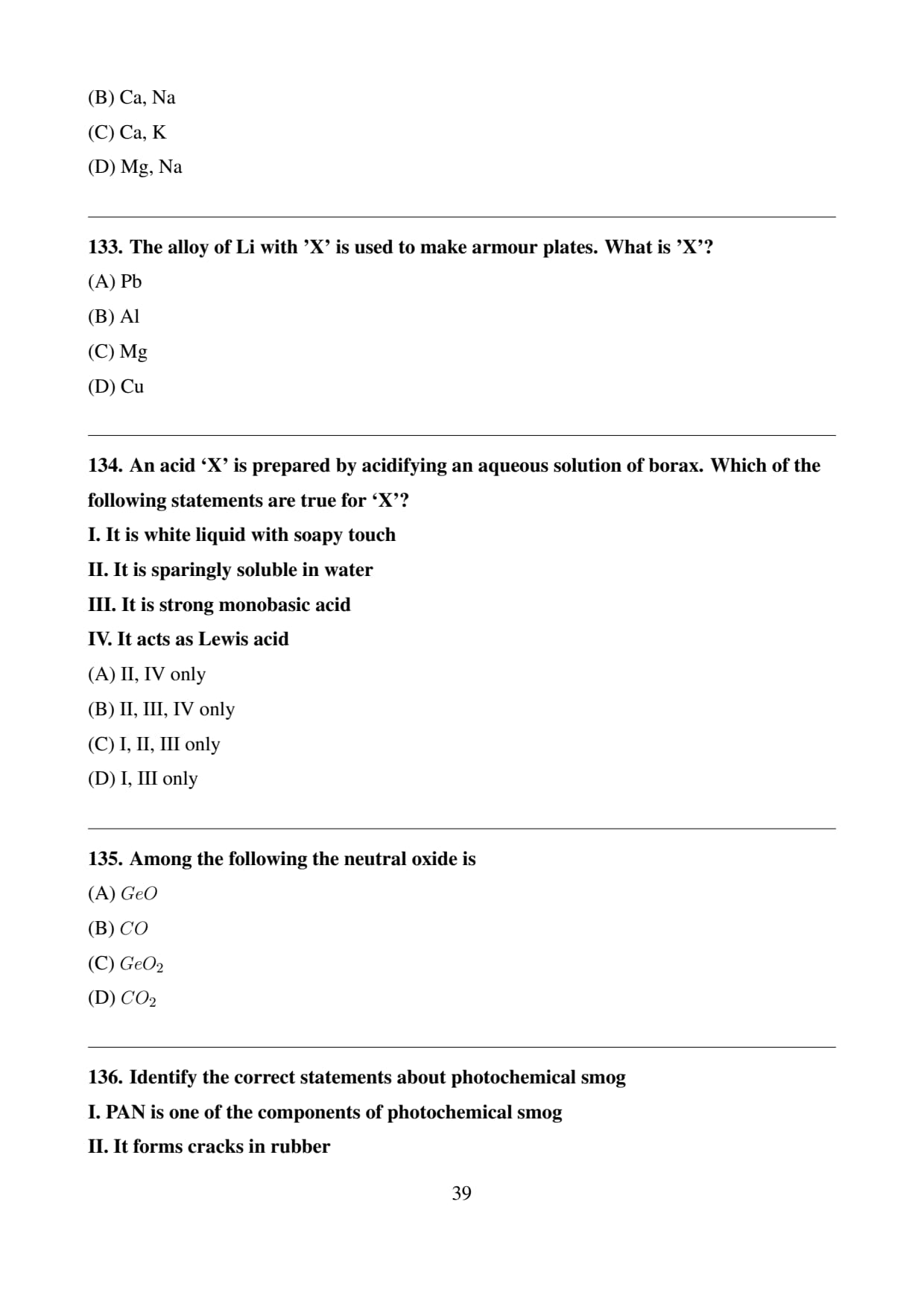
Ions of an element X is required for interneuronal transmission. Ions of an element Y helps in the transport of sugars into cells. X and Y are respectively
The alloy of Li with 'X' is used to make armour plates. What is 'X'?
An acid `X' is prepared by acidifying an aqueous solution of borax. Which of the following statements are true for `X'?
I. It is white liquid with soapy touch
II. It is sparingly soluble in water
III. It is strong monobasic acid
IV. It acts as Lewis acid
Among the following the neutral oxide is
Identify the correct statements about photochemical smog
I. PAN is one of the components of photochemical smog
II. It forms cracks in rubber
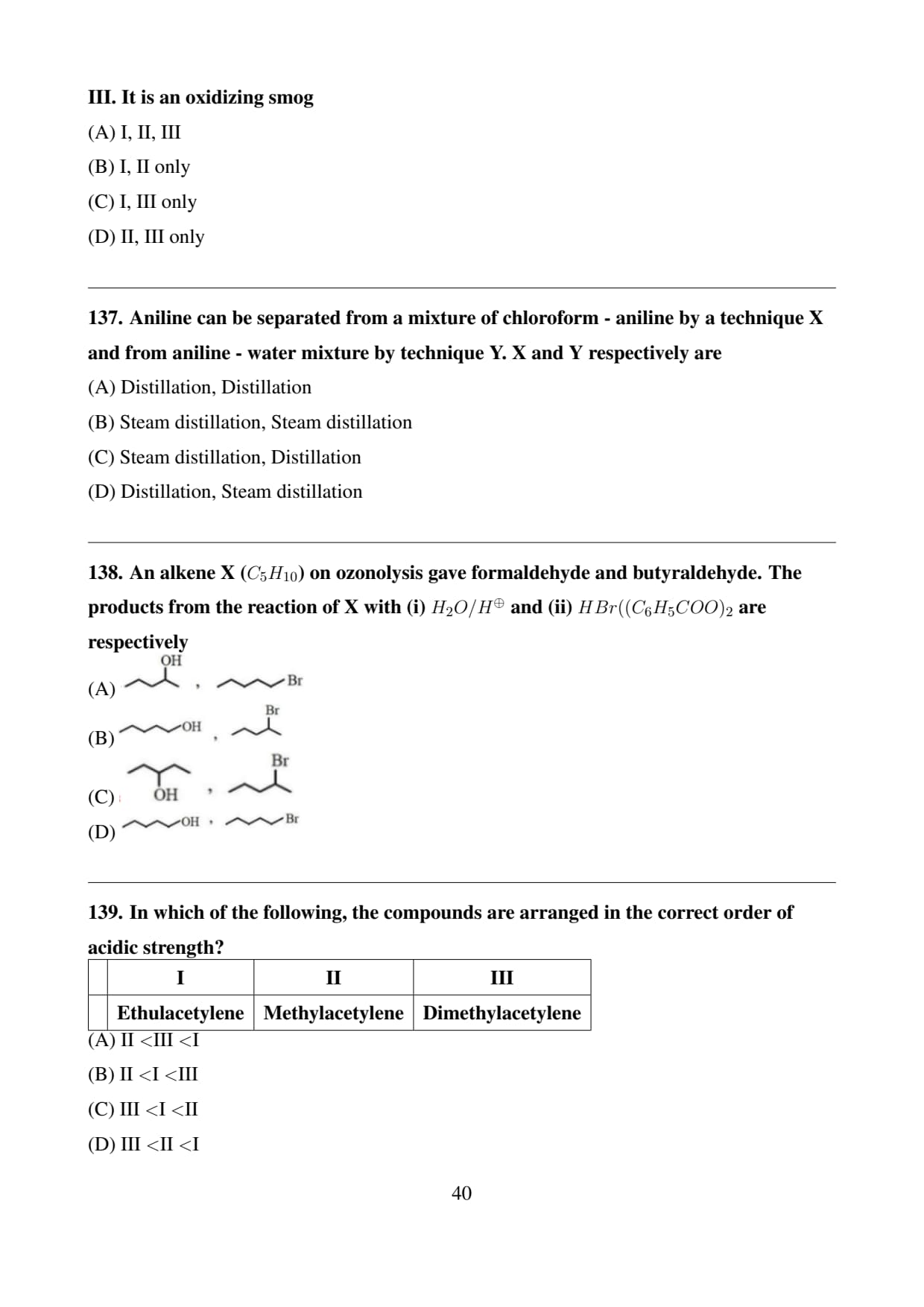
III. It is an oxidizing smog
Aniline can be separated from a mixture of chloroform - aniline by a technique X and from aniline - water mixture by technique Y. X and Y respectively are
An alkene X (\(C_5H_{10}\)) on ozonolysis gave formaldehyde and butyraldehyde. The products from the reaction of X with (i) \(H_2O/H^{\oplus}\) and (ii) \(HBr((C_6H_5COO)_2\) are respectively
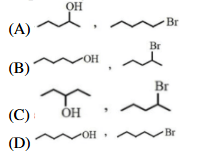
In which of the following, the compounds are arranged in the correct order of acidic strength?


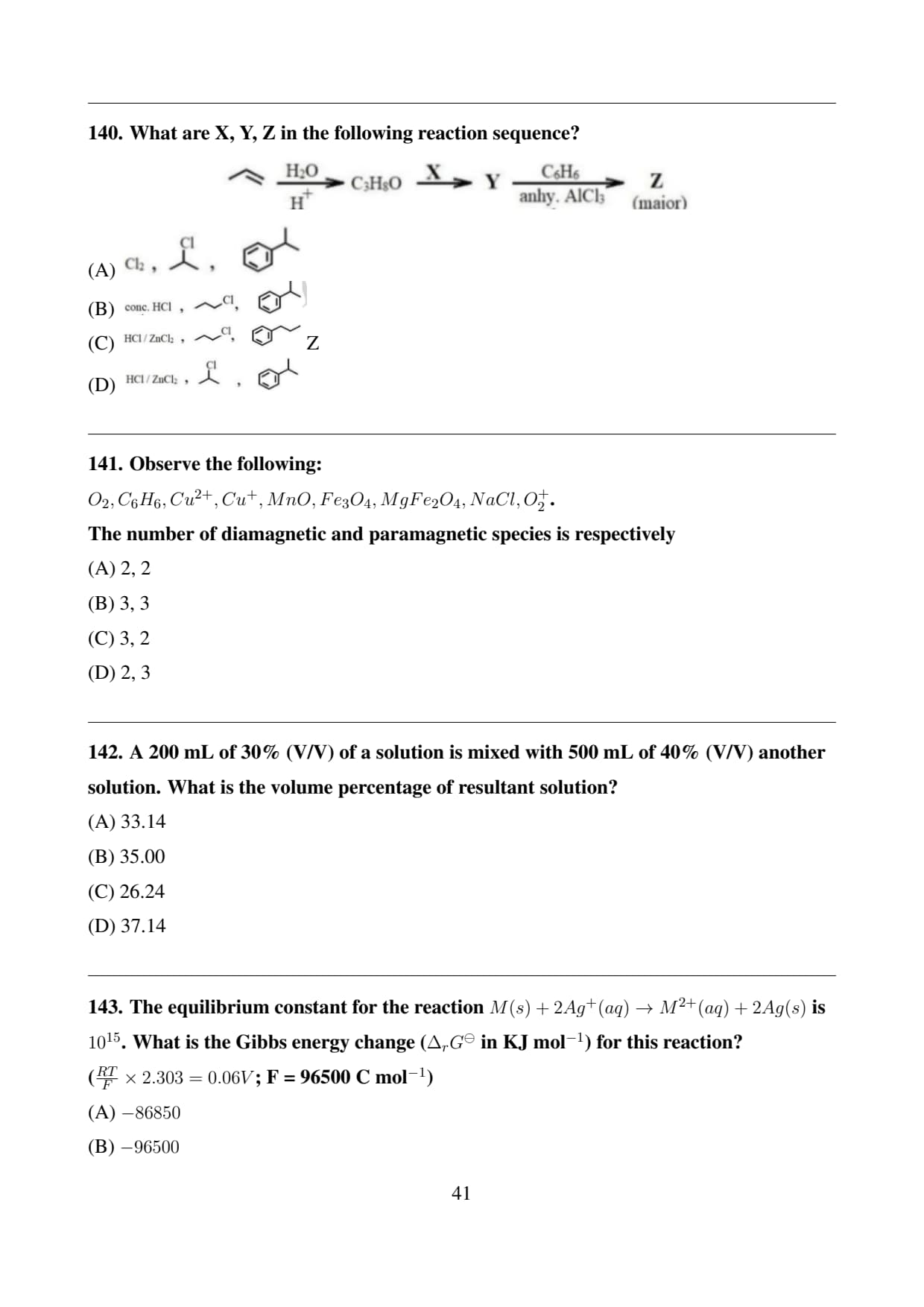
Observe the following:
\(O_2, C_6H_6, Cu^{2+}, Cu^+, MnO, Fe_3O_4, MgFe_2O_4, NaCl, O_2^+\).
The number of diamagnetic and paramagnetic species is respectively
A 200 mL of 30% (V/V) of a solution is mixed with 500 mL of 40% (V/V) another solution. What is the volume percentage of resultant solution?
The equilibrium constant for the reaction \(M(s) + 2Ag^{+}(aq) \rightarrow M^{2+}(aq) + 2Ag(s)\) is \(10^{15}\). What is the Gibbs energy change (\(\Delta_r G^{\ominus}\) in KJ mol\(^{-1}\)) for this reaction?
(\(\frac{RT}{F} \times 2.303 = 0.06V\); F = 96500 C mol\(^{-1}\))
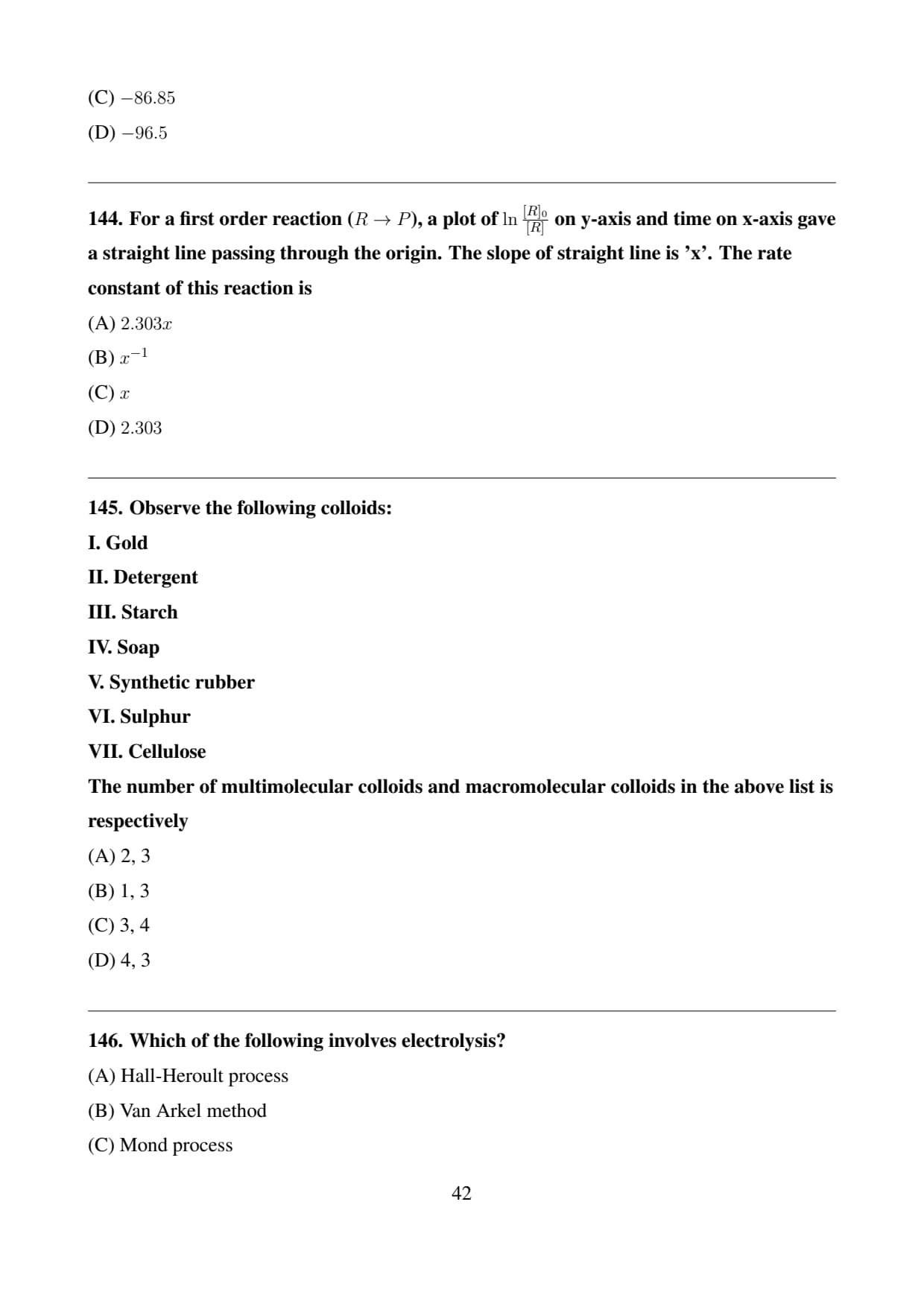
For a first order reaction (\(R \rightarrow P\)), a plot of \(\ln \frac{[R]_0}{[R]}\) on y-axis and time on x-axis gave a straight line passing through the origin. The slope of straight line is 'x'. The rate constant of this reaction is
Observe the following colloids:
I. Gold
II. Detergent
III. Starch
IV. Soap
V. Synthetic rubber
VI. Sulphur
VII. Cellulose
The number of multimolecular colloids and macromolecular colloids in the above list is respectively
Which of the following involves electrolysis?
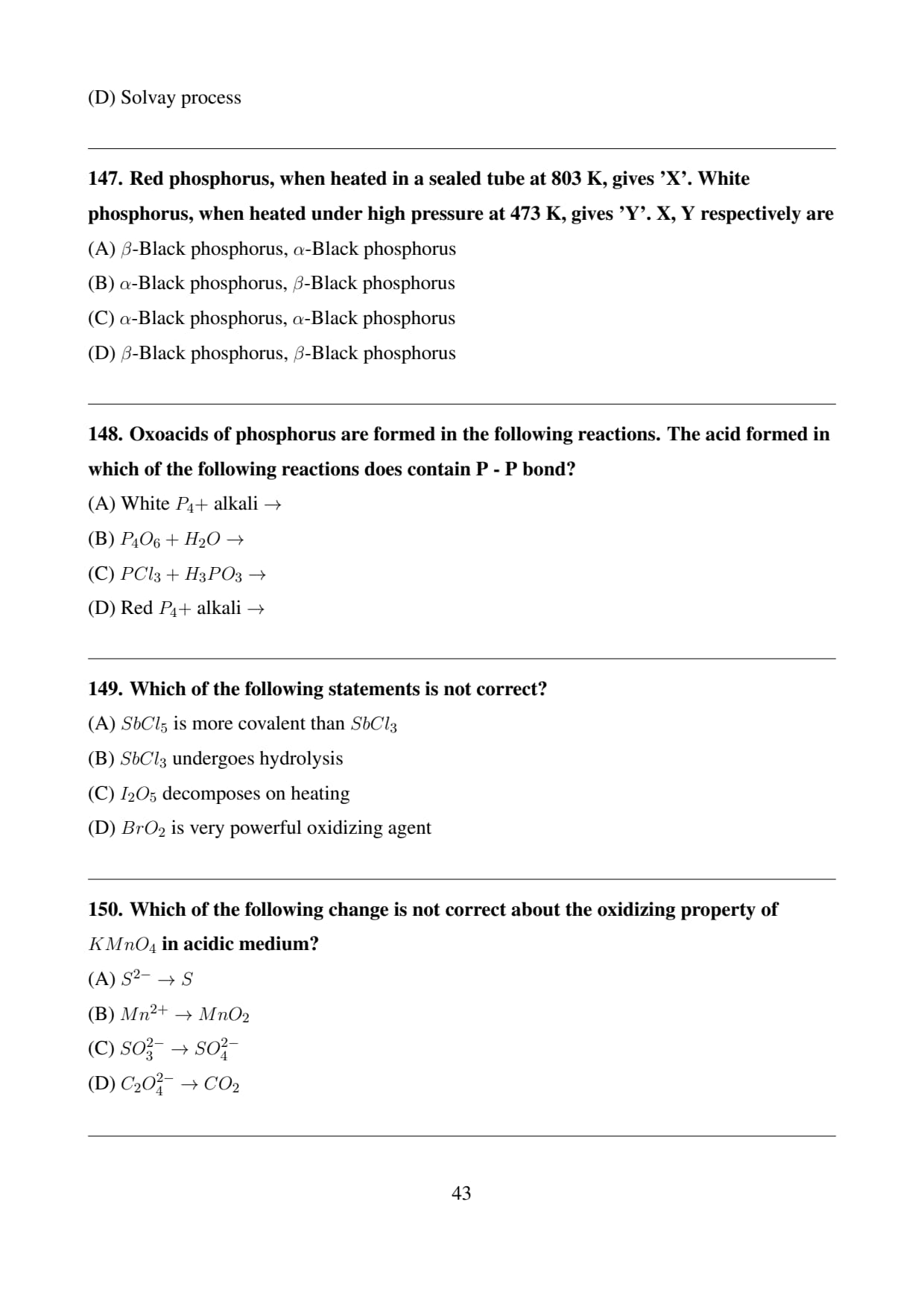
Red phosphorus, when heated in a sealed tube at 803 K, gives 'X'. White phosphorus, when heated under high pressure at 473 K, gives 'Y'. X, Y respectively are
Oxoacids of phosphorus are formed in the following reactions. The acid formed in which of the following reactions does contain P - P bond?
Which of the following statements is not correct?
Which of the following change is not correct about the oxidizing property of \(KMnO_4\) in acidic medium?
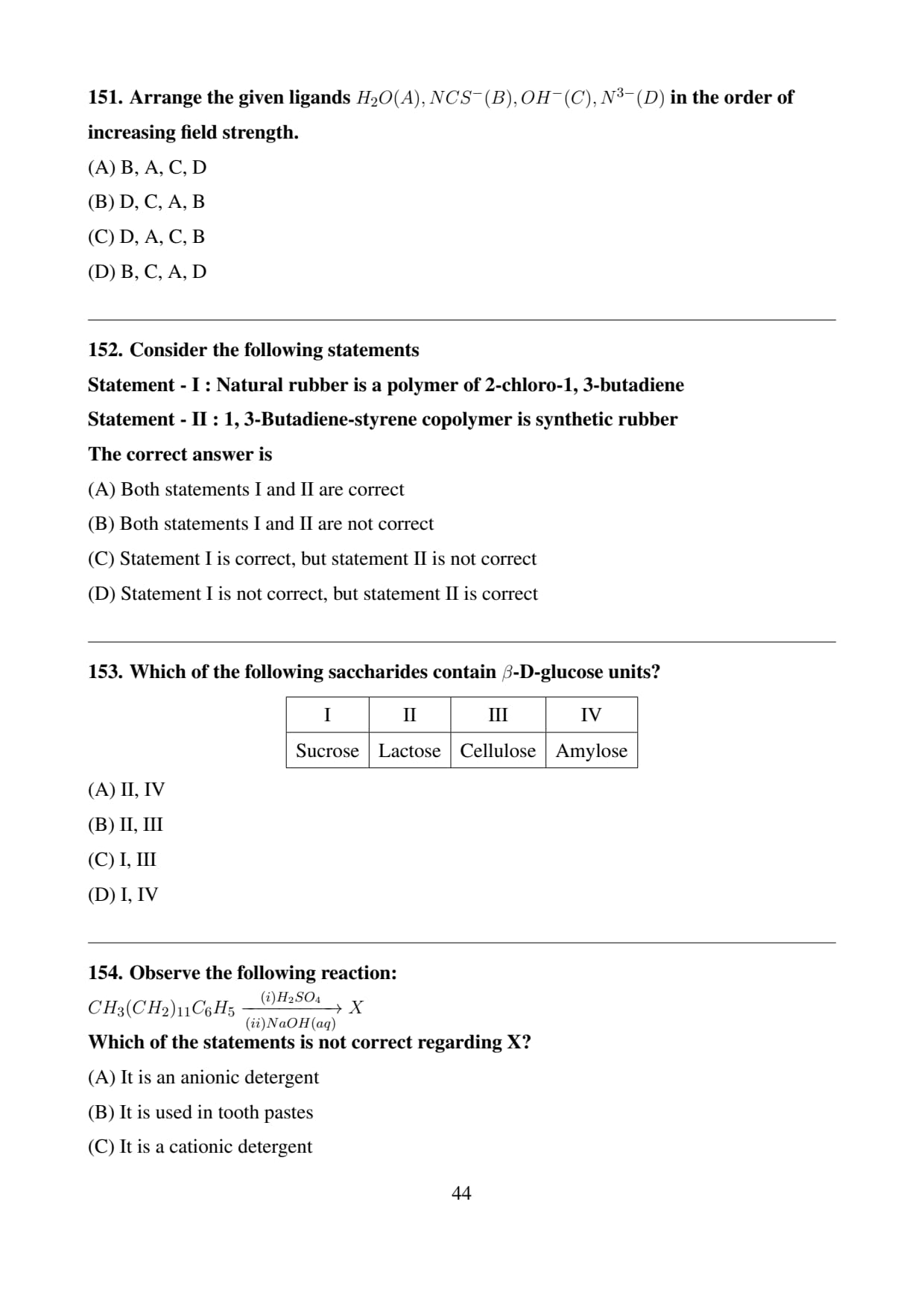
Arrange the given ligands \(H_2O (A), NCS^- (B), OH^- (C), N^{3-} (D)\) in the order of increasing field strength.
Consider the following statements
Statement - I : Natural rubber is a polymer of 2-chloro-1, 3-butadiene
Statement - II : 1, 3-Butadiene-styrene copolymer is synthetic rubber
The correct answer is
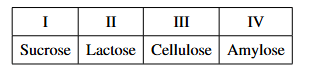
Which of the following saccharides contain \(\beta\)-D-glucose units?
Observe the following reaction:
\(CH_3(CH_2)_{11}C_6H_5 \xrightarrow[(ii) NaOH(aq)]{(i) H_2SO_4} X\)
Which of the statements is not correct regarding X?
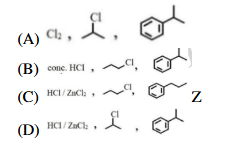
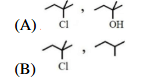
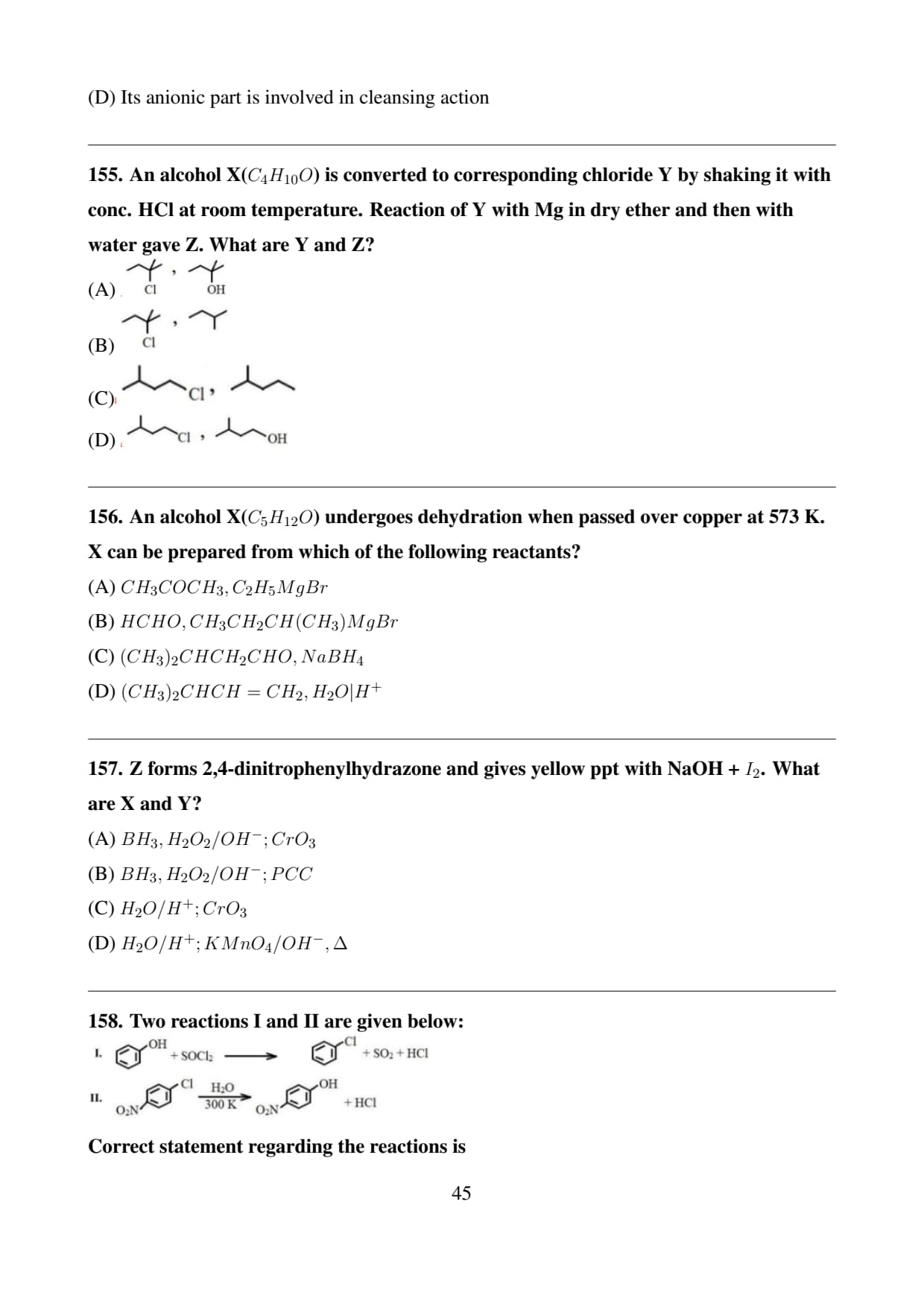
An alcohol X(\(C_4H_{10}O\)) is converted to corresponding chloride Y by shaking it with conc. HCl at room temperature. Reaction of Y with Mg in dry ether and then with water gave Z. What are Y and Z?
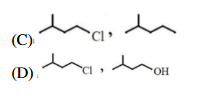
An alcohol X(\(C_5H_{12}O\)) undergoes dehydration when passed over copper at 573 K. X can be prepared from which of the following reactants?
Z forms 2,4-dinitrophenylhydrazone and gives yellow ppt with NaOH + \(I_2\). What are X and Y?
Two reactions I and II are given below:
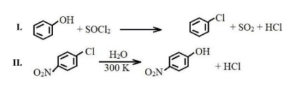
Correct statement regarding the reactions is
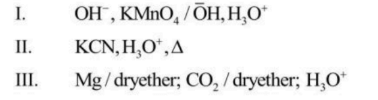
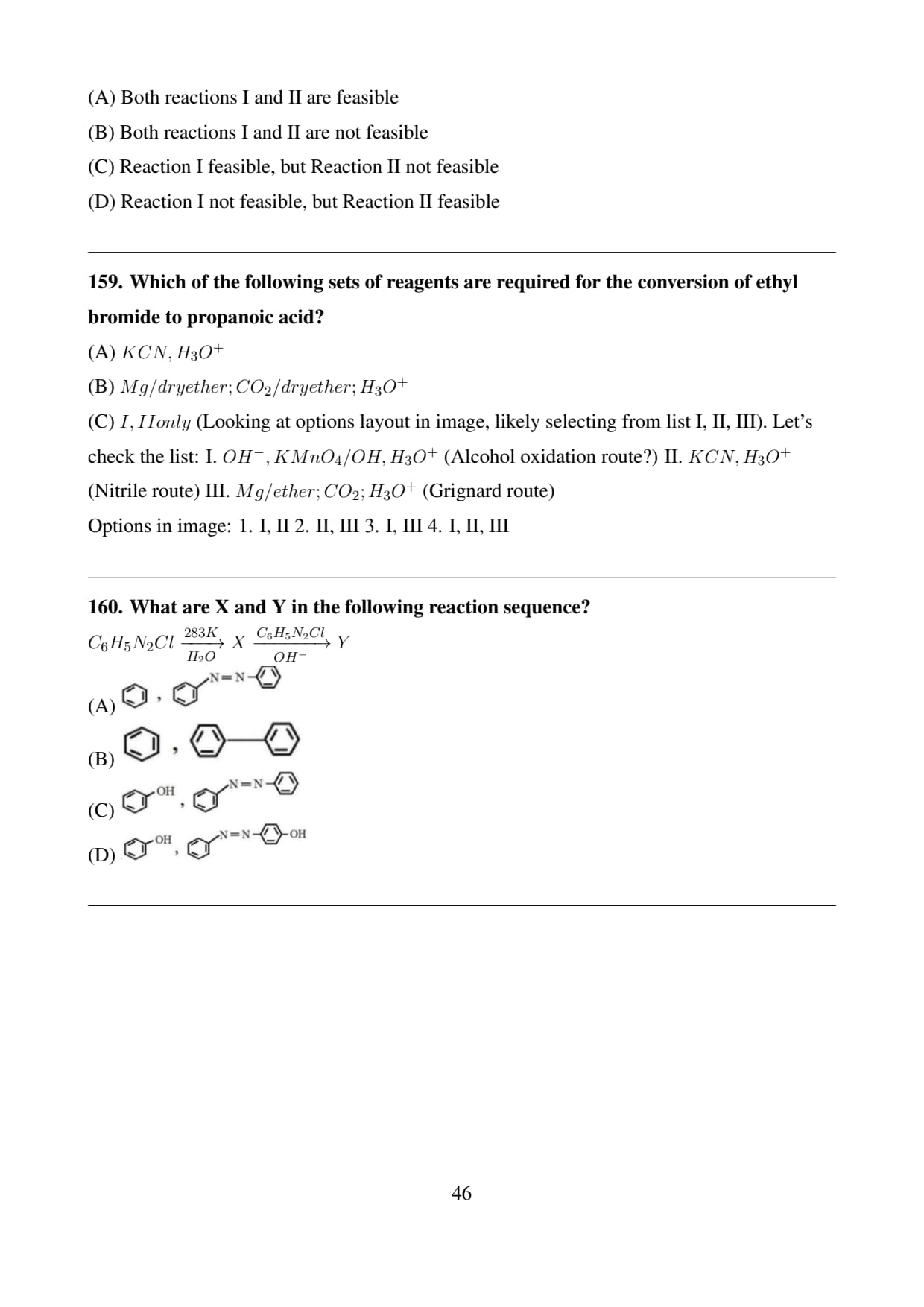
Which of the following sets of reagents are required for the conversion of ethyl bromide to propanoic acid?
![]()
(A). I, II
(B) II, III- (C) I, III
(D) I, II, III
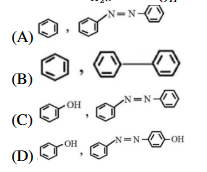
What are X and Y in the following reaction sequence?
\(C_6H_5N_2Cl \xrightarrow[H_2O]{283K} X \xrightarrow[OH^-]{C_6H_5N_2Cl} Y\)
TS EAMCET 2025 BiPC Exam Difficulty Level (Expected)
According to TG EAPCET 2025 past year trends:
Botany and Zoology (Biology) is expected to be of moderate difficulty level with mostly NCERT based questions. Plant Physiology, Human Anatomy, Genetics and Animal Diversity will be some of the most asked topics.
Physics is expected to be tough and lengthy due to the numerical problems. The most asked questions are expected from Thermodynamics and Mechanics and they might be slightly tough.
Chemistry is expected to be the easiest section and the most scoring. The questions are expected to be mostly direct with some tricky questions from Organic Chemistry. Most asked topics include Chemical Bonding, Hydrocarbons and Thermodynamics.
| Subject | Expected Difficulty Level | Most Asked Topics |
| Botany | Easy to Moderate | Plant Physiology, Genetics, Cell Structure, Ecology |
| Zoology | Moderate | Human Physiology, Reproduction, Genetics, Structural Organisation in Animals |
| Physics | Moderate to Tough | Thermodynamics, Work-Energy-Power, Laws of Motion, Oscillations |
| Chemistry | Easy to Moderate | Atomic Structure, Chemical Bonding, Thermodynamics, Organic Chemistry (Hydrocarbons, Alcohols, Phenols) |



Comments