




VITEEE 2016 Question Paper is available for download here. VITEEE 2016 Question Paper includes 40 questions from Mathematics/Biology, 35 questions from Physics, 35 questions from Chemistry, 5 questions from English, 10 questions from Aptitude to be attempted in 150 minutes. Candidates can download the VITEEE 2016 Question Paper with Solution PDF using the link below.
VITEEE 2016 Question Paper with Solution PDF
| VITEEE 2016 Question Paper with Solution PDF | Download PDF | Check Solution |
The potential energy of a system increases if work is done
In photoelectric effect, initially when energy of electrons emitted is \( E_0 \), de-Broglie wavelength associated with them is \( \lambda_0 \). Now, energy is doubled then associated de-Broglie wavelength \( \lambda' \) is
In Wheatstone bridge, 4 resistors \( P = 10 \, \Omega \), \( Q = 5 \, \Omega \), \( R = 4 \, \Omega \), \( S = 4 \, \Omega \) are connected in cyclic order. To ensure no current through galvanometer,
In given circuit, \( C_1 = C_2 = C_3 = C \) initially. Now, a dielectric slab of dielectric constant \( K = \frac{3}{2} \) is inserted in \( C_2 \). The equivalent capacitance becomes

If the terminal speed of a sphere of gold (density \(19.5 \, g/cm^3\)) is \(0.2 \, m/s\) in a viscous liquid (density \(1.5 \, kg/m^3\)), find the terminal speed of a sphere of silver (density \(10.5 \, g/cm^3\)) of the same size in the same liquid.
In shown fig, the circular loop of wire is moved with velocity towards the infinite current carrying wire. Then

For a current carrying inductor, emf associated is 20mV. Now, current through it changes from 6A to 2A in 2s. The coefficient of mutual inductance is
A square current carrying loop is changed to a circular loop in time \( t_1 \). Then
Holography is based on phenomenon of
In given circuit, all resistances are of \( 1 \, \Omega \). Current flowing through ammeter is

The wavelength of an electron for transition from a state \(n_1\) to \(n_2\) is \( \frac{9}{8R} \). Which of the following wavelengths is possible for a transition from \(n_2\) to \(n_1\)?
Two solenoids are given – 1st has 1 turn per unit length and 2nd has \(n\) turns per unit length. Ratio of magnetic fields at their centres is
Which statement is correct for the given circuit?

A positively charged particle is placed near an infinitely long straight conductor where there is zero gravity. Then
A metallic bar is heated from \(0^\circ \, C\) to \(100^\circ \, C\). The coefficient of linear expansion is \(10^{-5} \, K^{-1}\). What will be the percentage increase in length?
If the wavelength is brought down from 6000 Å to 4000 Å in a photoelectric experiment then what will happen?
For what value of \( A \), \( B \), and \( C \), the output \( Y = 1 \)?

Let the energy of an emitted photoelectron be \( E \) and the wavelength of incident light be \( \lambda_0 \). What will be the change in \( E \) if \( \lambda_0 \) is doubled?
A solid sphere of radius \( R \) carries a uniform volume charge density \( \rho \). The magnitude of electric field inside the sphere at a distance \( r \) from the centre is
Two point dipoles \( \mathbf{p_k} \) and \( \mathbf{L_k} \) are located at \( (0,0,0) \) and \( (1m, 0, 2m) \) respectively. The resultant electric field due to the two dipoles at the point \( (1m, 0, 0) \) is
An iron rod of length 2m and cross-sectional area of 50mm² stretched by 0.5mm, when a mass of 250 kg is hung from its lower end. Young’s modulus of iron rod is
Two resistances equal at \( 0^\circ \, C \) with temperature coefficient of resistance \( \alpha_1 \) and \( \alpha_2 \) joined in series
Current density varies with radial distance \( r \) as \( J = a r^2 \), in a cylindrical wire of radius \( R \). The current passing through the wire between radial distance \( R/3 \) and \( R/2 \) is
A potentiometer circuit shown in the figure is set up to measure emf of cell E. As the point P moves from X to Y, the galvanometer G shows deflection always in one direction, but the deflection decreases continuously until Y is reached. The balance point between X and Y may be obtained by

A current \( I \) flows in the anticlockwise direction through a square loop of side \( a \) lying in the \( xoy \)-plane with its center at the origin. The magnetic induction at the center of the square loop is given by
A particle of charge \( q \) and mass \( m \) moves in a circular orbit of radius \( r \) with angular speed \( \omega \). The ratio of the magnitude of its magnetic moment to that of its angular momentum depends on
A long straight wire of radius \( R \) carries current \( i \). The magnetic field inside the wire at distance \( r \) from its centre is expressed as:
If \( i_1 = 3 \sin(\omega t) \) and \( i_2 = 4 \cos(\omega t) \), then \( i_3 \) is

The equation of AC voltage is \( E = 220 \sin(\omega t + \frac{\pi}{6}) \) and the AC current is \( I = 10 \sin(\omega t + \frac{\pi}{6}) \). The average power dissipated is
The current in an \( L-R \) circuit builds up to \( 3/4 \) of its steady state value in 4 seconds. The time constant of this circuit is
The magnetic flux in a closed circuit of resistance \(10 \, \Omega\) varies with time as \( \phi = (2t - 4t^2 + 1) \). The current in the loop will change its direction after a time of
A fish looking up through the water sees the outside world contained in a circular horizon. If the refractive index of water is \( 4/3 \) and the fish is 12 cm below the surface, the radius of this circle (in cm) is
A metal ball of mass 2 kg moving with a velocity of 36 km/h has a head on collision with a stationary ball of mass 3 kg. If after the collision, the two balls move together, the loss in kinetic energy due to collision is
Two lenses of focal length \( f_1 = 10 \, cm \) and \( f_2 = -20 \, cm \) are kept as shown. The resultant power of combination will be

When a plastic thin film of refractive index 1.45 is placed in the path of one of the interfering waves then the central fringe is displaced through width of five fringes. The thickness of the film, if the wavelength of light is \( 5890 \, Å \), will be
An unpolarised beam of intensity \( I_0 \) is incident on a pair of nicols making an angle of \( 60^\circ \) with each other. The intensity of light emerging from the pair is
The half-life of radioactive Radon is 3.8 days.
The time at the end of which \( \frac{1}{20} \)th of the radon sample will remain undecayed is given (using \( \log_e = 0.4343 \))
If the nuclear radius of \( ^{27}Al \) is 3.6 Fermi, the approximate nuclear radius of \( ^{64}Cu \) in Fermi is
A hydrogen atom is in an excited state of principal quantum number \( n \), it emits a photon of wavelength \( \lambda \), when it returns to the ground state. The value of \( n \) is
A marble block of mass 2 kg lying on ice when given a velocity of 6 m/s is stopped by friction in 10 s. Then the coefficient of friction is (Take \( g = 10 \, m/s^2 \))
IUPAC name of valeric acid is
The product \( P \) for the above given reaction will be

Coordination number of Co in \( [Co(NH_3)_6]Cl_3 \) is
Which of the following complex will show fac & mer isomerism?
Which of these undergo polymerisation?
Which of the following graph represents variation of 2p-orbital wave function with distance from the nucleus?

Name the catalyst used to bring down the reaction

The correct set of quantum numbers for Rb (atomic no. 37) is
\( XeF_4 \) disproportionate in water to give
An ionic compound has a unit cell consisting of A ions at the corners of a cube and B ions on the centres of the faces of the cube. The empirical formula for this compound would be
Among the following the incorrect statement is
The correct order of electrophilic substitution for the compounds given above will be

For meso tartaric acid, the correct configuration for chiral carbon is
Which of the two acids form anhydrides?
(I) Oxalic acid
(II) Succinic acid
(III) Benzoic acid
(IV) Phthalic acid
By which reaction ketal is formed?
Which one of the following show stereoisomerism?
Acetophenone and Benzophenone can be distinguished by which of the following test
The product P in this reaction is \[ R - NC - LiAlH_4 \quad \longrightarrow \quad P \]
The protein present in the hair is
One mole of an ideal gas at 300 K is expanded isothermally from an initial volume of 1 litre to 10 litres. Then \( \Delta S \) (cal deg\(^{-1}\) mol\(^{-1}\)) for this process is: \( R = 2 \, cal K^{-1} mol^{-1} \)
For a reaction A \( \rightarrow \) B; \( \Delta H = 20 \, kJ mol^{-1} \), the activation energy of the forward reaction is 85 kJ/mol. The activation energy of the backward reaction will be
If the reaction \( N_2 + 3H_2 \rightarrow 2NH_3 \) occurs at 200°C and 1000 atm then the graph showing the correct equilibrium yield at 400°C is

Group 15 elements have more electron gain enthalpy than group 16 elements. The correct reason for this is
\( t-butyl - CH_3 C - CH_2 OH \) can’t give decarboxylation while normally \( \alpha-\beta \) unsaturated acid give this reaction because
Which type of carbocation is/are formed when \( OH \) is treated with an acid?
For hydrogen-oxygen fuel cell, the cell reaction is \[ 2H_2(g) + O_2(g) \rightarrow 2H_2O(l) \]
If \( \Delta G^\circ (H_2O) = -237.2 \, kJ mol^{-1} \), then emf of this cell is
At 298 K, the conductivity of a saturated solution of AgCl in water is \( 2.6 \times 10^{-5} \, S cm^{-1} \). Its solubility product at 298 K is
Standard entropy of X2, Y2 and X3Y is 60, 40 and 50 J K\(^{-1}\) mol\(^{-1}\), respectively. For the reaction, \[ 1/2 \, X_2 + 3/2 \, Y_2 \rightarrow X_3Y, \, \Delta H = -30 \, kJ, \, T = 1250 \, K \]
the equilibrium temperature will be
The enthalpy change for a given reaction at 298 K is \( -x \, J mol^{-1} \). For the reaction to be spontaneous at 298 K, the entropy change at that temperature
\( a \) moles of \( PCl_5 \) is heated in a closed container to equilibrate \[ PCl_5 (g) \rightleftharpoons PCl_3 (g) + Cl_2 (g) \]
at a pressure of \( P \) atm. If \( x \) moles of \( PCl_5 \) dissociate at equilibrium, then the correct expression for the equilibrium constant is
A plot of \( \ln K \) against \( 1/T \) (abscissa) is expected to be a straight line with intercept on ordinate axis equal to
In a reaction \( A \to \) Products, when start is made from \( 8.0 \times 10^{-2} \) M of A, half-life is found to be 120 minutes. For the initial concentration \( 4.0 \times 10^{-2} \) M, the half-life of the reaction becomes 240 minutes. The order of the reaction is:
A reaction \( A_2 + B \to \) Products, involves the following mechanism: \[ A_2 \rightleftharpoons 2A (fast) \quad (A being the intermediate) \] \[ A + B \xrightarrow{k_2} Products (slow). \]
The rate law consistent to this mechanism is:
The following data were obtained for a given reaction at 300 K.

The factor by which the rate of catalysed reaction is increased is
The wave number of the first emission line in the Balmer series of H-Spectrum is: \[ (R = Rydberg constant) \]
Which of the following reactions of xenon compounds is not feasible?
Anisole is treated with HI under two different conditions. \[ C_6H_5OCH_3 + D \xrightarrow{conc. HI} A + B \]
The nature of A and B will be
Phenol undergoes electrophilic substitution more easily than benzene because
Which of the following name reaction is not used for introducing a \( -COOH \) group?
Esterification of acid chloride with ethanol is usually carried out in the presence of pyridine. The function of pyridine is
The solution of the differential equation \[ (1 + y^2) + (x - e^{\tan^{-1}y}) \frac{dy}{dx} = 0 \]
is
A tetrahedron has vertices at \( O(0,0,0), A(1,2,1), B(2,1,3) \) and \( C(-1,1,2) \). Then the angle between the faces \( OAB \) and \( ABC \) will be
The foci of the ellipse \( \frac{x^2}{144} + \frac{y^2}{81} = 1 \) and the hyperbola \( \frac{x^2}{144} - \frac{y^2}{81} = 1 \) coincide then value of \( b^2 \) is
If the tangent to the function \( y = f(x) \) at \( (3, 4) \) makes an angle of \( \frac{3\pi}{4} \) with the positive direction of the x-axis in anticlockwise direction, then \( f'(3) \) is
The probability of India winning a test match against Australia is \( \frac{1}{2} \), assuming independence from match to match. The probability that in a match series India’s second win occurs at third test match is
If \( |a| = 3, |b| = 2, |c| = 1 \) then the value of \[ |a \cdot b + b \cdot c + c \cdot c| is \]
If \( A \) and \( B \) are matrices and \( AB = BA = A^{-1} \) then the value of \( (A + B)(A - B) \) is
The value of \( (1 + \omega)^3 \), where \( \omega = e^{i 2\pi/3} \) is
The moment about the point \( 2i + 3j + k \) of a force represented by \( i + j + k \) acting through the point \( 2i + 3j + k \) is
The equation of one of the common tangents to the parabola \( y^2 = 8x \) and \( x^2 = 4y - 4 \) is
The distance moved by the particle in time \( t \) is given by \[ s = t^3 - 12t^2 + 6t + 8 \]
At the instant, when its acceleration is zero, its velocity is
The equation of one of the common tangents to the parabola \( y^2 = 8x \) and \( x^2 = 4y - 4 \) is
If \( e^x = y + \sqrt{1 + y^2} \), then the value of \( y \) is
What is the area of a loop of the curve \( y = \sin 30^\circ \)?
Convert the hexadecimal numeral ABCD into binary numeral
The normal at the point \( (t_1, t_2) \) on the parabola, cuts the parabola again at the point whose parameter is
The distance moved by the particle in time \( t \) is given by \[ s = t^3 - 12t^2 + 6t + 8 \]
At the instant, when its acceleration is zero, its velocity is
The logical expression \( X \), in its simplest form for the truth table
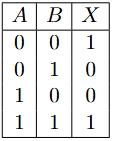
is
The value of \( \cos \left( \cos^{-1} \left( \frac{1}{3} \right) \right) \) is equal to
Consider the objective function \( Z = 40x + 50y \). The minimum number of constraints that are required to maximize \( Z \) are
In a culture the bacteria count is 1,00,000. The number is increased by 10% in 2 hours. In how many hours will the count reach 2,00,000 if the rate of growth of bacteria is proportional to the number present?
The value of \( \sin^{-1} \left( \frac{1}{\sqrt{5}} \right) + \cot^{-1}(3) \) is
If \( a = \cos 2\alpha + \sin 2\alpha, b = \cos 2\beta + \sin 2\beta, c = \cos 2\gamma + \sin 2\gamma \) and \( \cos 2\alpha + \cos 2\beta + \cos 2\gamma = 1 \), then \[ \sqrt{abc} = ? \]
The mean of a binomial distribution is 25, then its standard deviation lies in the interval
Number of ways of selecting three squares on a chessboard so that all the three be on a diagonal line of the board or parallel to it is
If \( a = 1 \), \( b = 2 \), \( c = 3 \), and \( d = 4 \), then \[ abc = d \]
While shuffling a pack of 52 playing cards, 2 are accidentally dropped. The probability that the missing cards to be of different colours is
Which of the following is INCORRECT for the hyperbola \( x^2 - 2y^2 + 2x + 8y - 1 = 0 \)?
The foci of the ellipse \( \frac{x^2}{144} + \frac{y^2}{81} = 1 \) and the hyperbola \( \frac{x^2}{144} - \frac{y^2}{81} = 1 \) coincide then value of \( b^2 \) is
A box contains 20 identical balls of which 10 are blue and 10 are green. The balls are drawn at random from the box one at a time with replacement. The probability that a blue ball is drawn 4th time on the 7th draw is
The number of common tangents to the circles \( x^2 + y^2 = 16 \) and \( x^2 + y^2 - 6x = 0 \) is
The solution of the equation \[ \sin^2\theta + \cos^2\theta = 1 \]
lies in the interval
If \( f(x) = (1 + x)^2 \) for \( x > 0 \), then \( f(x) \) is
If \( y = 2^x \), then \[ \frac{dy}{dx} \, at \, x = e \, is \]
\[ \int x^2 (x^4 + 1)^{3/4} \, dx is equal to \]
If the letters of the word KRISNA are arranged in all possible ways and these words are written out as in a dictionary, then the rank of the word KRISNA is
The shortest distance between the lines \( x = y + 2 = 6z - 6 \) and \( x + 1 = 2y = -12z \) is
The domain and range of the function \( f(x) = 2 - |x - 5| \) is
The number of surjective functions from \( A \) to \( B \) where \( A = \{1,2,3,4\} \) and \( B = \{a, b\} \) is
If \( f(a + b - x) = f(x), \) then \( \int_a^b f(x) \, dx \) is
Direction (Qs. 121-123)
Read the passage carefully and answer the questions given below.
Laws of nature are not commands but statements of acts. The use of the word "law" in this context is rather unfortunate. It would be better to speak of uniformities in nature. This would do away with the elementary fallacy that a law implies a law giver. If a piece of matter does not obey a law of nature, it is punished. On the contrary, we say that the law has been incorrectly started.
121.
If a piece of matter violates nature's law, it is not punished because
Laws of nature differ from man-made laws because
The laws of nature based on observation are conclusion about the nature of the universe.
Direction: This question presents a sentence, part of which or all of which is underlined. Beneath the sentence you will find four ways of phrasing the underlined part. The first of these repeats the original; the other three are different. If you think the original is best, choose the first answer; otherwise choose one of the others.
The administration discussed whether the number of students studying European languages was likely to decline when the senior lecturer retired.
Choose the best pronunciation of the word, Restaurant, from the following options.



Comments