




VITEEE 2025 25 April Shift 2 Question Paper is available here with solutions pdf. Vellore Institute of Technology is conducting VITEEE 2025 from April 20 to April 27. VITEEE 2025 Question Paper includes 40 questions from Mathematics/Biology, 35 questions from Physics, 35 questions from Chemistry, 5 questions from English, and 10 questions from Aptitude to be attempted in 150 minutes.
Related Links:
VITEEE 2025 April 25 Shift 2 Question Paper PDF Download
| VITEEE 2025 25 April Shift 2 Question Paper With Answer Key | Download | Check Solution |

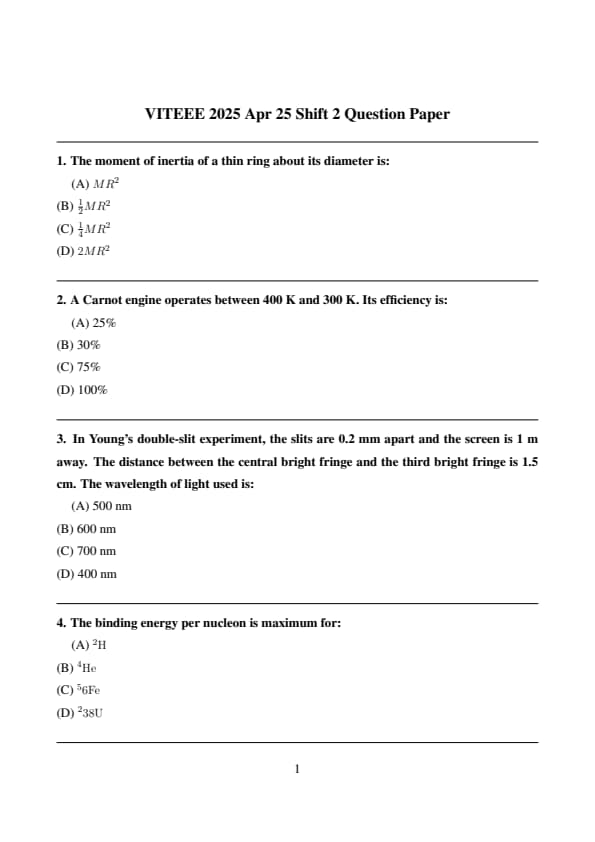
The moment of inertia of a thin ring about its diameter is:
View Solution
For a ring, \(I_{diameter} = \frac{1}{2}MR^2\) using perpendicular axis theorem. Quick Tip: Ring: \(I_{center} = MR^2\), diameter = half of it.
A Carnot engine operates between 400 K and 300 K. Its efficiency is:
View Solution
\[ \eta = 1-\frac{T_2}{T_1}=1-\frac{300}{400}=0.25 \] Quick Tip: Carnot efficiency depends only on temperatures.
In Young's double-slit experiment, the slits are 0.2 mm apart and the screen is 1 m away. The distance between the central bright fringe and the third bright fringe is 1.5 cm. The wavelength of light used is:
View Solution
\[ y_n = n\frac{\lambda D}{d} \Rightarrow \lambda = \frac{yd}{nD} = \frac{0.015\times0.0002}{3\times1}=5\times10^{-7}\ m \] Quick Tip: Fringe distance is proportional to order number.
The binding energy per nucleon is maximum for:
View Solution
Iron (\(^56\mathrm{Fe}\)) has the highest binding energy per nucleon. Quick Tip: Peak of binding energy curve is around iron.
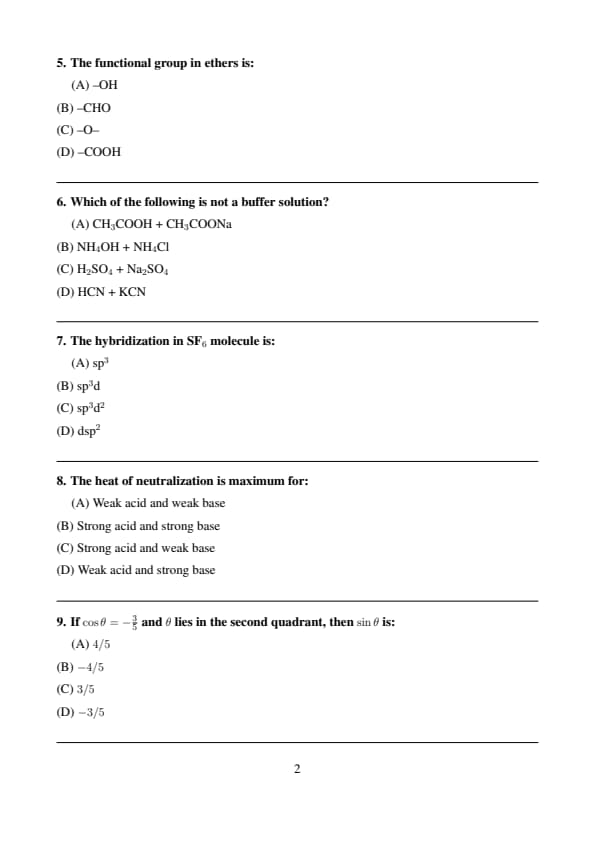
The functional group in ethers is:
View Solution
Ethers have an oxygen atom bonded to two alkyl/aryl groups. Quick Tip: Ether group = R–O–R.
Which of the following is not a buffer solution?
View Solution
Strong acid + its salt does not form a buffer. Quick Tip: Buffers = weak acid/base + its salt.
The hybridization in SF\(_6\) molecule is:
View Solution
SF\(_6\) has six bond pairs → octahedral geometry → sp\(^3\)d\(^2\). Quick Tip: Six bond pairs → sp\(^3\)d\(^2\).
The heat of neutralization is maximum for:
View Solution
Strong acid–strong base neutralization releases maximum heat (≈57 kJ/mol). Quick Tip: Complete ionization gives maximum heat.
If \(\cos\theta=-\frac{3}{5}\) and \(\theta\) lies in the second quadrant, then \(\sin\theta\) is:
View Solution
In second quadrant, sine is positive: \[ \sin\theta=\sqrt{1-\cos^2\theta}=\frac{4}{5} \] Quick Tip: Remember signs of trigonometric ratios in quadrants.
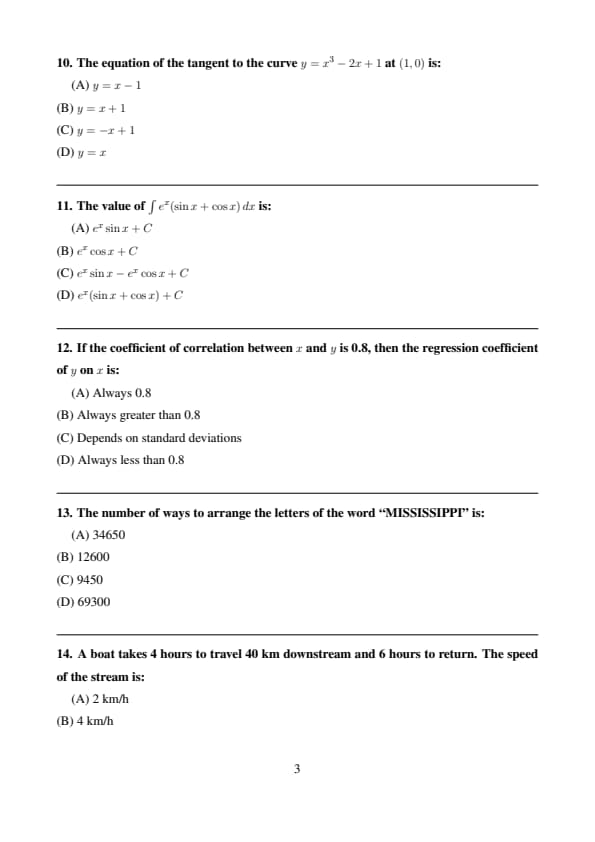
The equation of the tangent to the curve \(y=x^3-2x+1\) at \((1,0)\) is:
View Solution
\[ \frac{dy}{dx}=3x^2-2 \Rightarrow m=1 \]
Equation: \(y-0=1(x-1)\Rightarrow y=x-1\) Quick Tip: Tangent slope = derivative at the point.
The value of \(\int e^x(\sin x+\cos x)\,dx\) is:
View Solution
Differentiate \(e^x\sin x\) to verify. Quick Tip: Check by differentiation when in doubt.
If the coefficient of correlation between \(x\) and \(y\) is 0.8, then the regression coefficient of \(y\) on \(x\) is:
View Solution
\[ b_{yx}=r\frac{\sigma_y}{\sigma_x} \]
Hence it depends on standard deviations. Quick Tip: Regression coefficient ≠ correlation coefficient.
The number of ways to arrange the letters of the word ``MISSISSIPPI'' is:
View Solution
\[ \frac{11!}{4!4!2!}=34650 \] Quick Tip: Use factorial formula for repeated letters.
A boat takes 4 hours to travel 40 km downstream and 6 hours to return. The speed of the stream is:
View Solution
Downstream speed = 10 km/h, upstream = 6.67 km/h \[ Stream speed=\frac{10-6.67}{2}=2\ km/h \] Quick Tip: Stream speed = half of speed difference.
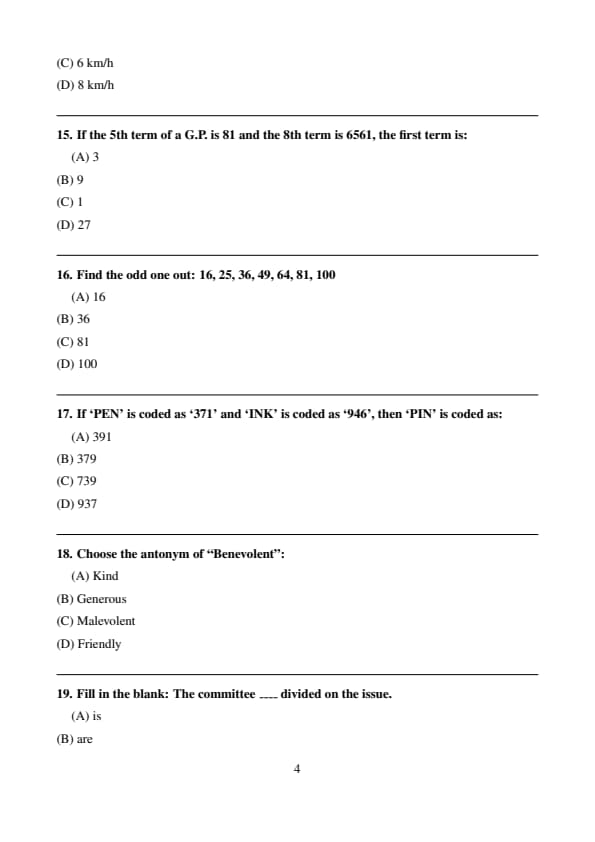
If the 5th term of a G.P. is 81 and the 8th term is 6561, the first term is:
View Solution
\[ \frac{T_8}{T_5}=r^3=\frac{6561}{81}=81 \Rightarrow r=3 \] \[ a=\frac{81}{3^4}=9 \] Quick Tip: Divide terms to eliminate first term.
Find the odd one out: 16, 25, 36, 49, 64, 81, 100
View Solution
All are squares of even numbers except 81. Quick Tip: Look for hidden patterns like parity.
If `PEN' is coded as `371' and `INK' is coded as `946', then `PIN' is coded as:
View Solution
Using the same letter–digit mapping gives PIN = 937. Quick Tip: Preserve letter order in coding.
Choose the antonym of ``Benevolent'':
View Solution
Benevolent means kind; its opposite is malevolent. Quick Tip: Prefix male- indicates bad or evil.
Fill in the blank: The committee ____ divided on the issue.
View Solution
Collective noun takes plural verb when members act individually. Quick Tip: Collective noun + divided → plural verb.
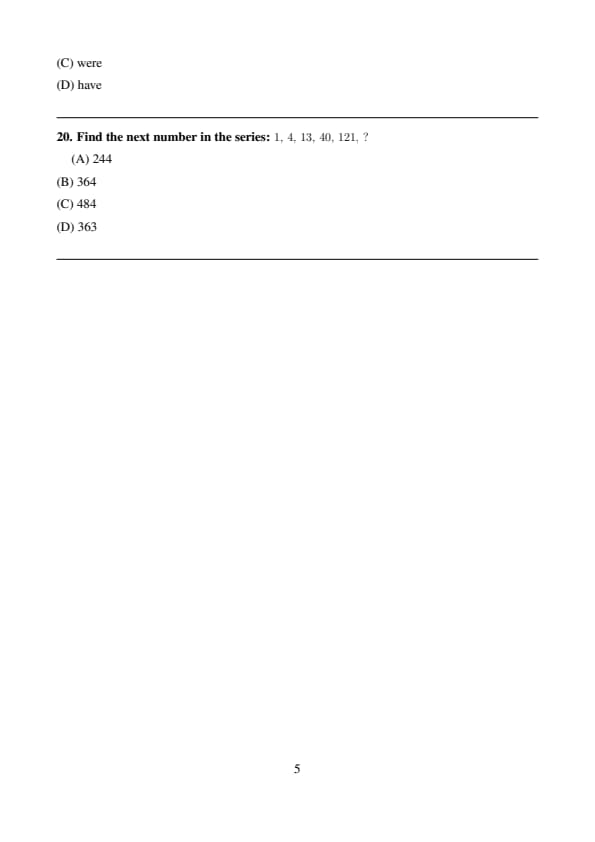
Find the next number in the series: \(1,\,4,\,13,\,40,\,121,\,?\)
View Solution
Pattern: \(\times3+1\) \[ 121\times3+1=364 \] Quick Tip: Check multiplication-based patterns.
VITEEE 2025 Expected Difficulty Level
According to the exam pattern, candidates must attempt 125 questions in 150 minutes across 5 major sections: Mathematics/Biology, Physics, Chemistry, English, and Aptitude.
As per the past year's trends, this is the expected difficulty level of VITEEE 2025:
| Section | No. of Questions | Expected Difficulty Level | Remarks |
|---|---|---|---|
| Mathematics / Biology | 40 | Moderate to Difficult | Maths will have more application-based questions, and biology will have more NCERT-based questions. |
| Physics | 35 | Moderate | It will be conceptual and related to formulas with few calculations. |
| Chemistry | 35 | Easy to Moderate | Questions will be direct theory-based, with a focus on NCERT and a few tricky numerical problems |
| English | 5 | Easy | This section will focus on Grammar and comprehension-based questions. |
| Aptitude | 10 | Moderate | Basic logical reasoning and pattern questions |
VITEEE 2025: Expected Section-Wise Weightage
Below is the expected section-wise topic weightage for VITEEE 2025:
Mathematics (40 Questions) – For PCM Candidates
| Important Topics | Expected No. of Questions |
|---|---|
| Calculus | 8–10 |
| Coordinate Geometry | 5–6 |
| Algebra (Quadratic, Complex No.) | 6–7 |
| Trigonometry | 4–5 |
| Probability & Statistics | 4–5 |
| Matrices and Determinants | 3–4 |
| Vectors and 3D Geometry | 4–5 |
Physics (35 Questions)
| Important Topics | Expected No. of Questions |
|---|---|
| Mechanics | 6–8 |
| Electrostatics & Current Electricity | 5–6 |
| Optics | 4–5 |
| Thermodynamics & Heat Transfer | 4–5 |
| Modern Physics | 4–5 |
| Waves & Oscillations | 3–4 |
| Magnetism & EMI | 4–5 |
Chemistry (35 Questions)
| Important Topics | Expected No. of Questions |
|---|---|
| Organic Chemistry (Reactions, Mechanisms) | 10–12 |
| Physical Chemistry (Thermo, Equilibrium) | 10–12 |
| Inorganic Chemistry (p/d/f block, Coordination) | 8–10 |
| Environmental Chemistry, Biomolecules | 2–3 |
English (5 Questions)
| Type of Questions | Expected questions |
|---|---|
| Reading Comprehension | 1–2 |
| Grammar (Tense, Voice, Error Spotting) | 2–3 |
| Vocabulary (Synonyms/Antonyms) | 1 |
Aptitude (10 Questions)
| Important Topics | Expected No. of Questions |
| Number Series & Coding-Decoding | 2–3 |
| Data Interpretation | 2–3 |
| Syllogism & Logical Reasoning | 2–3 |
| Basic Arithmetic | 2 |



Comments