




VITEEE 2025 26 April Shift 2 Question Paper is available here with solutions pdf. Vellore Institute of Technology is conducting VITEEE 2025 from April 20 to April 27. VITEEE 2025 Question Paper includes 40 questions from Mathematics/Biology, 35 questions from Physics, 35 questions from Chemistry, 5 questions from English, and 10 questions from Aptitude to be attempted in 150 minutes.
Related Links:
VITEEE 2025 April 26 Shift 2 Question Paper PDF Download
| VITEEE 2025 April 26 Shift 2 Question Paper With Answer Key | Download | Check Solution |
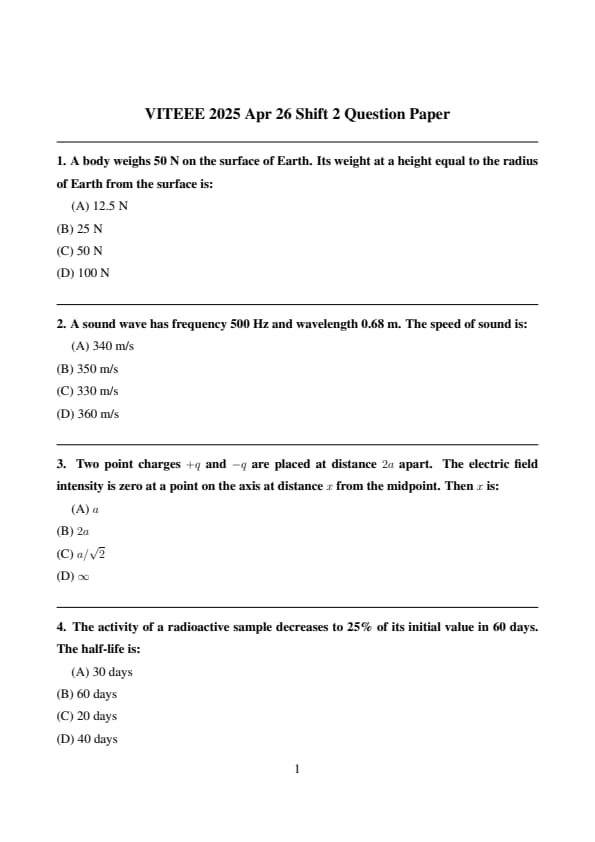
A body weighs 50 N on the surface of Earth. Its weight at a height equal to the radius of Earth from the surface is:
View Solution
At height \(h=R\), distance from Earth’s centre \(=2R\). \[ W' = W\left(\frac{R}{2R}\right)^2 = \frac{W}{4} = \frac{50}{4}=12.5\ N \] Quick Tip: Weight varies inversely as the square of distance from Earth’s centre.
A sound wave has frequency 500 Hz and wavelength 0.68 m. The speed of sound is:
View Solution
\[ v=f\lambda=500\times0.68=340\ m/s \] Quick Tip: Speed of wave = frequency × wavelength.
Two point charges \(+q\) and \(-q\) are placed at distance \(2a\) apart. The electric field intensity is zero at a point on the axis at distance \(x\) from the midpoint. Then \(x\) is:
View Solution
For equal and opposite charges, electric fields on the axial line add in the same direction at all finite points.
They cancel only at infinity. Quick Tip: For an electric dipole, axial field is never zero at finite distance.
The activity of a radioactive sample decreases to 25% of its initial value in 60 days. The half-life is:
View Solution
25% = \((1/2)^2\), so 2 half-lives = 60 days. \[ T_{1/2} = 30\ days \] Quick Tip: 25% remaining means two half-lives have passed.
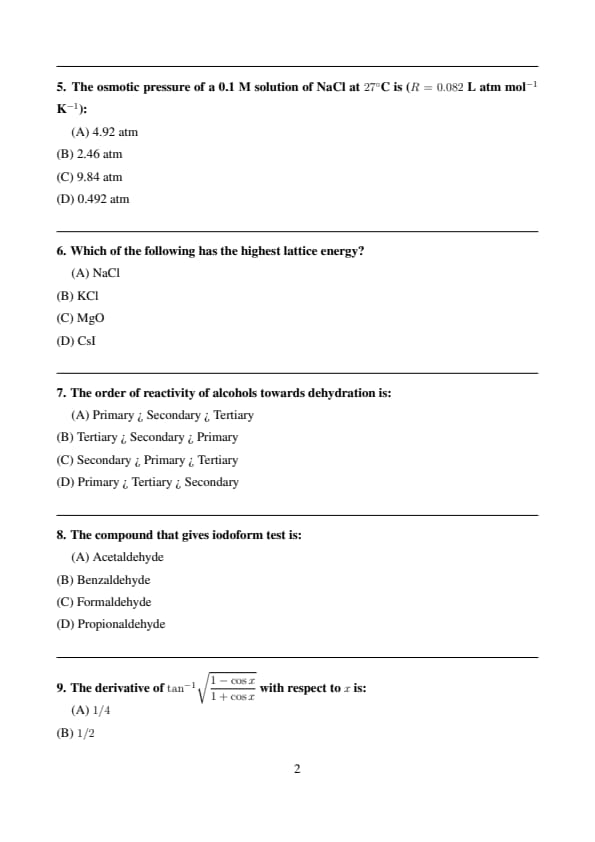
The osmotic pressure of a 0.1 M solution of NaCl at \(27^\circ\)C is (\(R=0.082\) L atm mol\(^{-1}\) K\(^{-1}\)):
View Solution
NaCl dissociates into 2 ions, so \(i=2\). \[ \pi=iMRT=2\times0.1\times0.082\times300=4.92\ atm \] Quick Tip: Electrolytes require van’t Hoff factor.
Which of the following has the highest lattice energy?
View Solution
Lattice energy increases with higher ionic charge and smaller ionic radius.
MgO has \(2^+\) and \(2^-\) ions. Quick Tip: Higher charge → higher lattice energy.
The order of reactivity of alcohols towards dehydration is:
View Solution
Dehydration proceeds via carbocation stability: \[ tertiary>secondary>primary \] Quick Tip: More stable carbocation reacts faster.
The compound that gives iodoform test is:
View Solution
Compounds containing \(\ce{CH3CO-}\) group give iodoform test.
Acetaldehyde satisfies this condition. Quick Tip: Iodoform test → presence of \(\ce{CH3CO-}\).
The derivative of \(\tan^{-1}\!\sqrt{\dfrac{1-\cos x}{1+\cos x}}\) with respect to \(x\) is:
View Solution
\[ \sqrt{\frac{1-\cos x}{1+\cos x}}=\tan\frac{x}{2} \Rightarrow y=\tan^{-1}\!\left(\tan\frac{x}{2}\right)=\frac{x}{2} \] \[ \frac{dy}{dx}=\frac12 \] Quick Tip: Use half-angle identities to simplify.
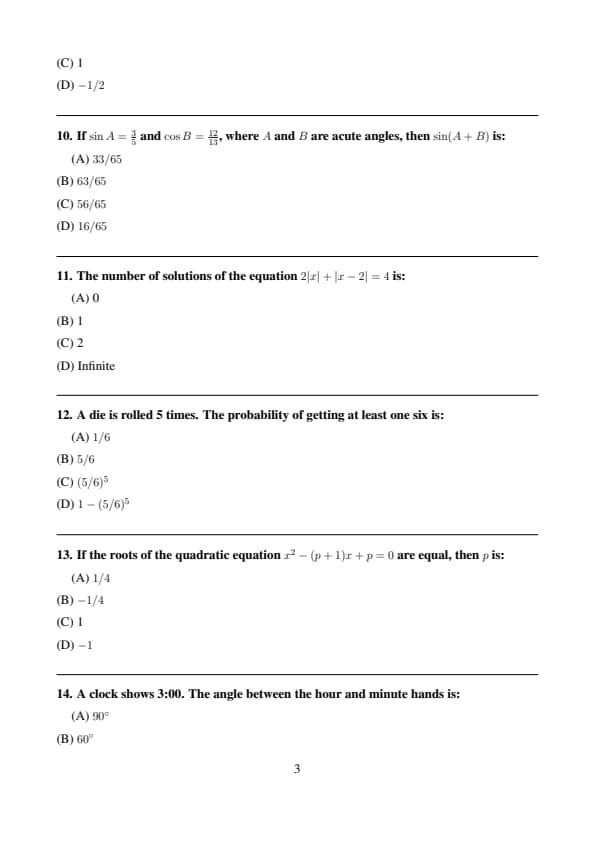
If \(\sin A=\frac{3}{5}\) and \(\cos B=\frac{12}{13}\), where \(A\) and \(B\) are acute angles, then \(\sin(A+B)\) is:
View Solution
\[ \cos A=\frac{4}{5},\quad \sin B=\frac{5}{13} \] \[ \sin(A+B)=\sin A\cos B+\cos A\sin B =\frac{36+20}{65}=\frac{56}{65} \] Quick Tip: Use sine addition formula.
The number of solutions of the equation \(2|x|+|x-2|=4\) is:
View Solution
Solving in different intervals gives two real solutions. Quick Tip: Break modulus equations into intervals.
A die is rolled 5 times. The probability of getting at least one six is:
View Solution
\[ P(at least one six)=1-P(no six) =1-\left(\frac56\right)^5 \] Quick Tip: Use complementary probability.
If the roots of the quadratic equation \(x^2-(p+1)x+p=0\) are equal, then \(p\) is:
View Solution
Equal roots ⇒ discriminant \(=0\): \[ (p+1)^2-4p=0 \Rightarrow (p-1)^2=0 \Rightarrow p=1 \] Quick Tip: Equal roots ⇒ discriminant zero.
A clock shows 3:00. The angle between the hour and minute hands is:
View Solution
At 3:00, minute hand at 12 and hour hand at 3. \[ \theta=90^\circ \] Quick Tip: Each hour mark = \(30^\circ\).
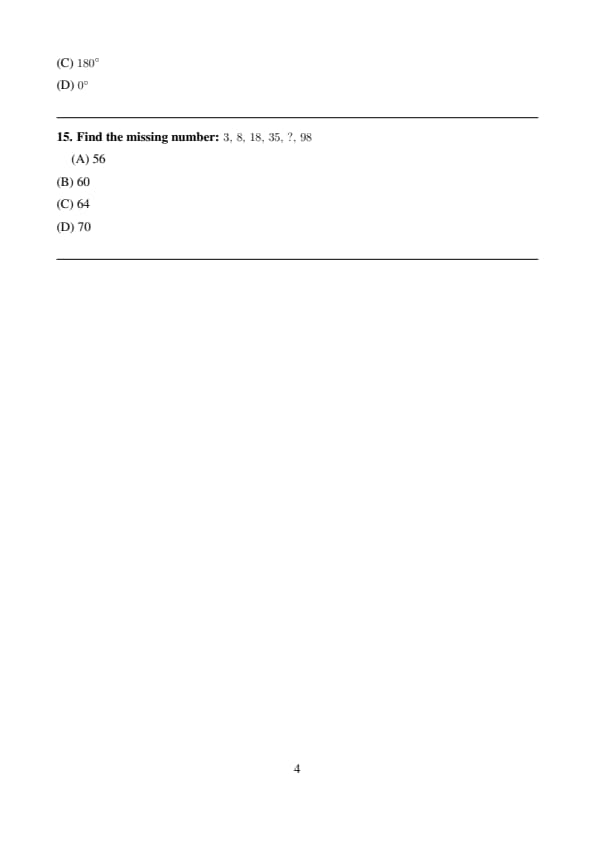
Find the missing number: \(3,\,8,\,18,\,35,\,?,\,98\)
View Solution
Differences: \[ 5,\ 10,\ 17,\ 25,\ 38 \]
Second differences: \[ 5,\ 7,\ 8,\ 13 \]
Hence missing term \(=35+25=60\). Quick Tip: Check first and second differences in number series.
VITEEE 2025 Expected Difficulty Level
According to the exam pattern, candidates must attempt 125 questions in 150 minutes across 5 major sections: Mathematics/Biology, Physics, Chemistry, English, and Aptitude.
As per the past year's trends, this is the expected difficulty level of VITEEE 2025:
| Section | No. of Questions | Expected Difficulty Level | Remarks |
|---|---|---|---|
| Mathematics / Biology | 40 | Moderate to Difficult | Maths will have more application-based questions, and biology will have more NCERT-based questions. |
| Physics | 35 | Moderate | It will be conceptual and related to formulas with few calculations. |
| Chemistry | 35 | Easy to Moderate | Questions will be direct theory-based, with a focus on NCERT and a few tricky numerical problems |
| English | 5 | Easy | This section will focus on Grammar and comprehension-based questions. |
| Aptitude | 10 | Moderate | Basic logical reasoning and pattern questions |
VITEEE 2025: Expected Section-Wise Weightage
Below is the expected section-wise topic weightage for VITEEE 2025:
Mathematics (40 Questions) – For PCM Candidates
| Important Topics | Expected No. of Questions |
|---|---|
| Calculus | 8–10 |
| Coordinate Geometry | 5–6 |
| Algebra (Quadratic, Complex No.) | 6–7 |
| Trigonometry | 4–5 |
| Probability & Statistics | 4–5 |
| Matrices and Determinants | 3–4 |
| Vectors and 3D Geometry | 4–5 |
Physics (35 Questions)
| Important Topics | Expected No. of Questions |
|---|---|
| Mechanics | 6–8 |
| Electrostatics & Current Electricity | 5–6 |
| Optics | 4–5 |
| Thermodynamics & Heat Transfer | 4–5 |
| Modern Physics | 4–5 |
| Waves & Oscillations | 3–4 |
| Magnetism & EMI | 4–5 |
Chemistry (35 Questions)
| Important Topics | Expected No. of Questions |
|---|---|
| Organic Chemistry (Reactions, Mechanisms) | 10–12 |
| Physical Chemistry (Thermo, Equilibrium) | 10–12 |
| Inorganic Chemistry (p/d/f block, Coordination) | 8–10 |
| Environmental Chemistry, Biomolecules | 2–3 |
English (5 Questions)
| Type of Questions | Expected questions |
|---|---|
| Reading Comprehension | 1–2 |
| Grammar (Tense, Voice, Error Spotting) | 2–3 |
| Vocabulary (Synonyms/Antonyms) | 1 |
Aptitude (10 Questions)
| Important Topics | Expected No. of Questions |
| Number Series & Coding-Decoding | 2–3 |
| Data Interpretation | 2–3 |
| Syllogism & Logical Reasoning | 2–3 |
| Basic Arithmetic | 2 |



Comments