




NEET SS 2024 DrNB Neuro Anaesthesia Paper 3 Question Paper with Solutions PDF is available for download. NEET SS 2024 exam is conducted by the National Board of Examinations in Medical Sciences (NBEMS). NEET SS 2024 question paper consists of 10 questions to be attempted in 3 hours. The paper is divided into broad-specialty topics (40%) and super-specialty topics (60%).
You can download NEET SS 2024 question paper with answer key and solutions PDF using the links given below.
NEET SS 2024 DrNB Neuro Anaesthesia Paper 3 Question Paper with Solutions
| NEET SS 2024 DrNB Neuro Anaesthesia Paper 3 Question Paper |  Download Download |
Check Solutions |

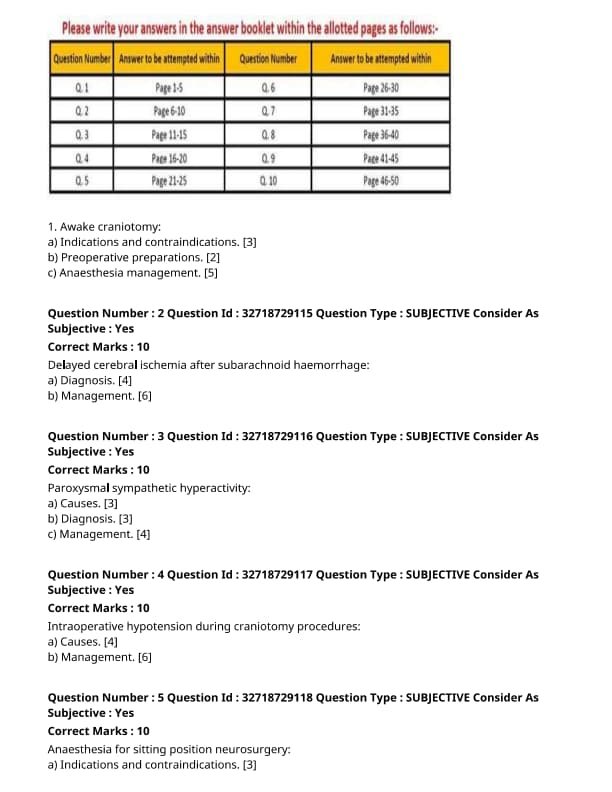
Indications and contraindications of awake craniotomy.
Preoperative preparations for awake craniotomy.
Anaesthesia management in awake craniotomy.
Delayed cerebral ischemia after subarachnoid hemorrhage:
Diagnosis
Delayed cerebral ischemia after subarachnoid hemorrhage:
Management
Causes of Paroxysmal Sympathetic Hyperactivity.
Diagnosis of Paroxysmal Sympathetic Hyperactivity.
Management of Paroxysmal Sympathetic Hyperactivity.
Causes of intraoperative hypotension during craniotomy procedures.
Management of intraoperative hypotension during craniotomy procedures.
Indications and contraindications for anaesthesia in sitting position neurosurgery.
Advantages of anaesthesia in sitting position neurosurgery.
Complications of anaesthesia in sitting position neurosurgery.
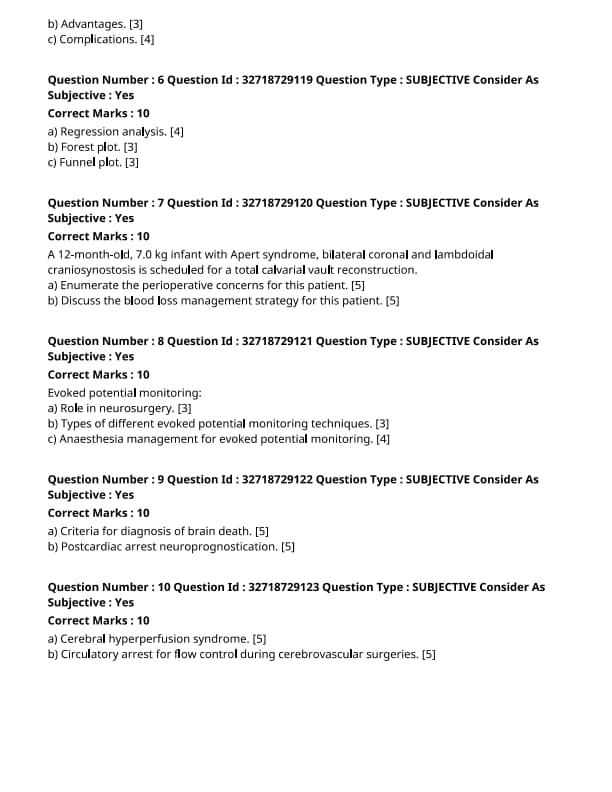
Regression analysis.
Forest plot.
Funnel plot.
A 12-month-old, 7.0 kg infant with Apert syndrome, bilateral coronal and lambdoidal craniosynostosis is scheduled for a total calvarial vault reconstruction.
Enumerate the perioperative concerns for this patient.
A 12-month-old, 7.0 kg infant with Apert syndrome, bilateral coronal and lambdoidal craniosynostosis is scheduled for a total calvarial vault reconstruction.
Discuss the blood loss management strategy for this patient.
Evoked potential monitoring:
Role in Neurosurgery.
Evoked potential monitoring:
Types of Different Evoked Potential Monitoring Techniques.
Evoked potential monitoring:
Anaesthesia Management for Evoked Potential Monitoring.
Criteria for diagnosis of brain death.
Postcardiac arrest neuroprognostication.
Cerebral hyperperfusion syndrome.



Comments