




Mizoram Board is conducting the Class 12 Accountancy Board Exam 2026 on February 23, 2026. Class 12 Accountancy Question Paper with Solution PDF is available here for download.
The official question paper of Mizoram Board Class 12 Accountancy Board Exam 2026 is provided below. Students can download the official paper in PDF format for reference.
Mizoram Board Class 12, 2026 Accountancy Question Paper with Solution PDF
| Mizoram Board Class 12 Accountancy Question Paper 2026 | Download PDF | Check Solutions |

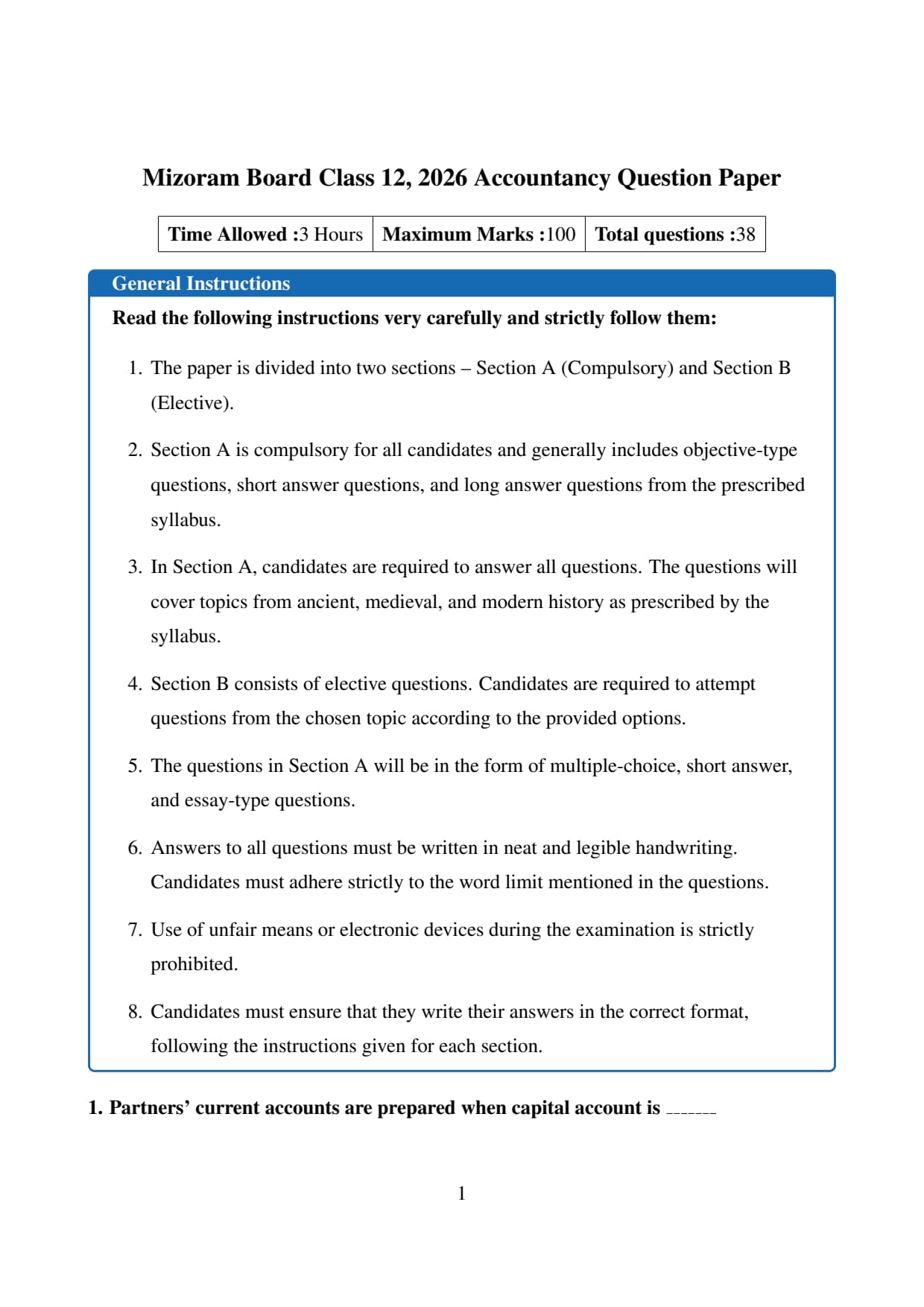
Partners' current accounts are prepared when capital account is _______
View Solution
We need to identify under which capital account method partners' current accounts are prepared.
Step 1: Understand the two methods of maintaining partners' capital accounts.
In partnership accounting, there are two methods to maintain partners' capital accounts:
1. Fixed Capital Method: Under this method, the capital account of each partner remains fixed (constant) unless additional capital is introduced or capital is withdrawn permanently. All transactions like salaries, interest on capital, interest on drawings, share of profit/loss, etc., are recorded in a separate account called the "Partner's Current Account."
2. Fluctuating Capital Method: Under this method, all transactions (including salaries, interest, drawings, share of profit/loss, etc.) are recorded directly in the capital account itself. No separate current account is maintained. The capital account balance keeps fluctuating with each transaction.
Step 2: Analyze the relationship.
- Current accounts are prepared only when the Fixed Capital Method is followed.
- Under the Fluctuating Capital Method, there is no separate current account; all entries are made directly in the capital account.
Step 3: Evaluate each option.
- (A) fixed — Correct. Current accounts are prepared when capital accounts are fixed.
- (B) fluctuating — Incorrect. Under fluctuating method, no current account is maintained.
- (C) both (A) and (B) — Incorrect because current accounts are not prepared under the fluctuating method.
- (D) none of these — Incorrect since option (A) is correct.
Step 4: Conclusion.
Partners' current accounts are prepared only when the capital account is maintained under the fixed capital method.
Final Answer: (A) fixed Quick Tip: Fixed Capital Method → Capital Account (fixed) + Current Account (for all adjustments). Fluctuating Capital Method → Only one Capital Account that records all transactions.
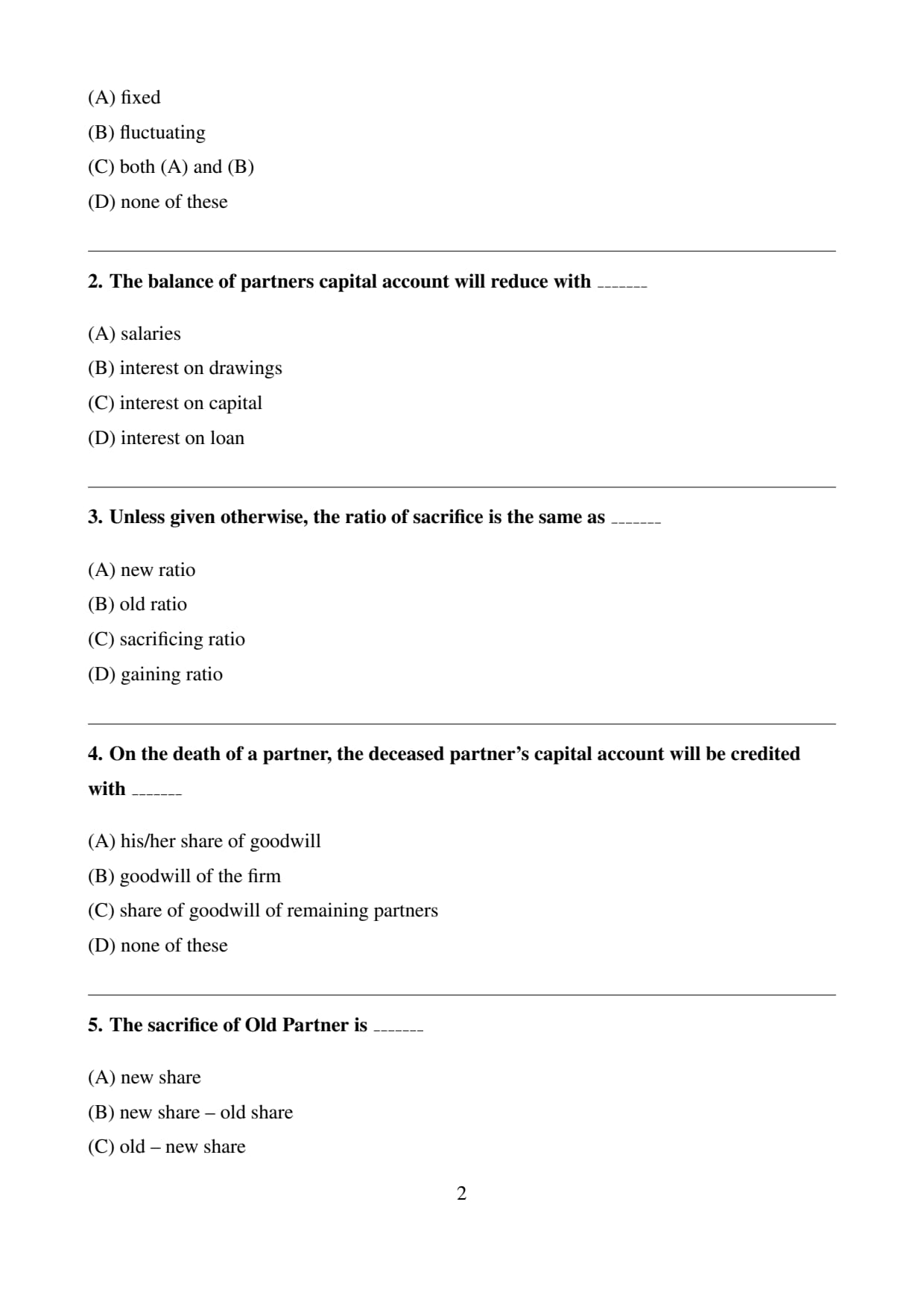
The balance of partners capital account will reduce with _______
View Solution
We need to identify which item reduces the balance of a partner's capital account.
Step 1: Understand what affects the capital account balance.
The capital account balance can increase or decrease based on various transactions:
- Increases (Credits): Additional capital introduced, interest on capital, salary to partner, commission to partner, share of profit.
- Decreases (Debits): Drawings made by the partner, interest on drawings, share of loss.
Step 2: Analyze each option.
- (A) salaries — Salary to a partner is an expense for the firm but an income for the partner. It increases the partner's capital account balance (credited). Incorrect.
- (B) interest on drawings — Drawings are withdrawals made by the partner from the firm. Interest on drawings is charged to discourage excessive withdrawals. This amount is deducted from the partner's capital account (debited), thus reducing its balance. Correct.
- (C) interest on capital — Interest on capital is payable to the partner for the capital contributed. It increases the partner's capital account balance (credited). Incorrect.
- (D) interest on loan — Interest on loan is paid to a partner on any loan advanced by the partner to the firm. This is separate from the capital account and is recorded as an expense in the Profit \& Loss Account, not as a reduction in the capital account balance. Incorrect.
Step 3: Conclusion.
Among the given options, only interest on drawings reduces the balance of a partner's capital account.
Final Answer: (B) interest on drawings Quick Tip: Remember: Drawings and interest on drawings are debited to the partner's capital/current account, reducing its balance. Salaries, interest on capital, and share of profit are credited, increasing the balance.
Unless given otherwise, the ratio of sacrifice is the same as _______
View Solution
We need to identify what the sacrificing ratio is equal to unless specified otherwise.
Step 1: Understand the relationship between old ratio, new ratio, and sacrificing ratio.
The sacrificing ratio is calculated as:
\[ Sacrificing Ratio = Old Ratio - New Ratio \]
Step 2: Analyze the default scenario.
When a new partner is admitted, the new profit-sharing ratio is agreed upon. However, if the problem does not explicitly state the new ratio or the sacrificing ratio, it is assumed that the old partners sacrifice in their old profit-sharing ratio.
This means:
- If nothing is specified about how the old partners sacrifice, they are presumed to sacrifice in their old ratio.
- In such a case, the sacrificing ratio becomes equal to the old ratio.
Step 3: Evaluate each option.
- (A) new ratio — Incorrect. The new ratio includes the new partner and is different from the old ratio.
- (B) old ratio — Correct. Unless given otherwise, the sacrificing ratio is the same as the old ratio.
- (C) sacrificing ratio — This is the ratio itself, not what it equals. The question asks for what it is the same as.
- (D) gaining ratio — Incorrect. Gaining ratio is used at the time of retirement or death, not admission.
Step 4: Conclusion.
Unless otherwise specified, it is assumed that old partners sacrifice in their old profit-sharing ratio, making the sacrificing ratio equal to the old ratio.
Final Answer: (B) old ratio Quick Tip: When a new partner is admitted and no specific sacrifice ratio is given, assume the old partners sacrifice in their old profit-sharing ratio. Therefore, Sacrificing Ratio = Old Ratio.
On the death of a partner, the deceased partner's capital account will be credited with _______
View Solution
We need to identify what is credited to the deceased partner's capital account regarding goodwill at the time of death.
Step 1: Understand the treatment of goodwill on the death of a partner.
When a partner dies, the surviving partners gain the share of the deceased partner. As compensation, the deceased partner is entitled to their share of goodwill. The accounting treatment involves:
- Calculating the deceased partner's share of goodwill based on the firm's total goodwill
- Crediting this amount to the deceased partner's capital account
- Debiting the remaining partners' capital accounts in their gaining ratio
Step 2: Recall the journal entry.
The journal entry for goodwill adjustment on death is:
Remaining Partners' Capital A/cs \hfill Dr. (in gaining ratio)
\hspace{1cm To Deceased Partner's Capital A/c
(Being deceased partner's share of goodwill adjusted)
Step 3: Evaluate each option.
- (A) his/her share of goodwill — Correct. The deceased partner's capital account is credited with their share of the firm's goodwill.
- (B) goodwill of the firm — Incorrect. The entire goodwill of the firm is not credited to one deceased partner; only their share is credited.
- (C) share of goodwill of remaining partners — Incorrect. The remaining partners' goodwill is not credited to the deceased partner.
- (D) none of these — Incorrect since option (A) is correct.
Step 4: Conclusion.
On the death of a partner, the deceased partner's capital account is credited with their share of the firm's goodwill.
Final Answer: (A) his/her share of goodwill Quick Tip: On death, the deceased partner is entitled to their share of goodwill. This is credited to their capital account and debited to the remaining partners' capital accounts in their gaining ratio.
The sacrifice of Old Partner is _______
View Solution
We need to identify the correct formula for calculating the sacrifice made by an old partner when a new partner is admitted.
Step 1: Understand the concept of sacrifice in partnership.
When a new partner is admitted into a partnership firm, the existing (old) partners may have to give up a portion of their profit-sharing ratio in favor of the new partner. This portion given up is called the "sacrifice."
Step 2: Recall the formula for calculating sacrifice.
The sacrifice made by an old partner is calculated as: \[ Sacrifice = Old Share - New Share \]
Where:
- Old Share = The profit-sharing ratio of the old partner before admission
- New Share = The profit-sharing ratio of the old partner after admission
If the result is positive, it means the partner has sacrificed that portion. If the result is negative, it means the partner has gained (gaining ratio).
Step 3: Evaluate each option.
- (A) new share — This is incorrect. Sacrifice is not simply the new share.
- (B) new share – old share — This would give a negative value (if new share < old share), which would represent gain, not sacrifice. Incorrect.
- (C) old – new share — This is the correct formula for sacrifice.
- (D) old share — This is incorrect. Sacrifice is the difference, not just the old share.
Step 4: Conclusion.
The sacrifice of an old partner is calculated as Old Share minus New Share.
Final Answer: (C) old – new share Quick Tip: Sacrifice Ratio = Old Ratio – New Ratio. If the result is positive, it's sacrifice; if negative, it's gain. This ratio is used to compensate sacrificing partners through goodwill.
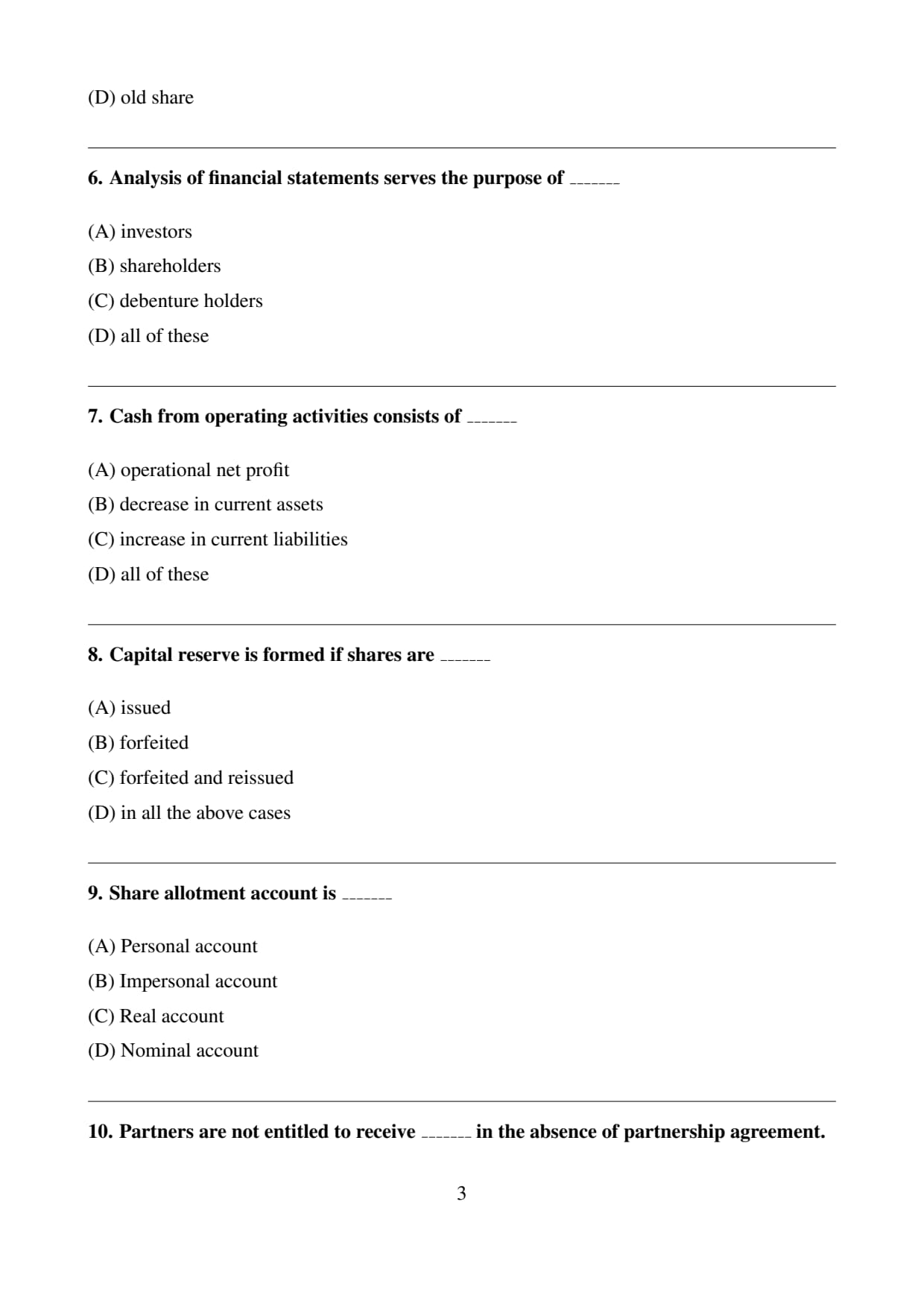
Analysis of financial statements serves the purpose of _______
View Solution
We need to identify who is served by the analysis of financial statements.
Step 1: Understand the purpose of financial statement analysis.
Financial statement analysis is the process of reviewing and evaluating a company's financial statements (Balance Sheet, Income Statement, Cash Flow Statement, etc.) to make better economic decisions. It helps various stakeholders assess the financial health, performance, and position of the business.
Step 2: Identify the stakeholders who use financial statement analysis.
Different stakeholders use financial analysis for different purposes:
- Investors: Use analysis to evaluate the profitability, growth potential, and safety of their investment. They assess ratios like ROI, EPS, P/E ratio, etc.
- Shareholders: As owners of the company, shareholders analyze financial statements to check the company's performance, dividend-paying capacity, and future prospects.
- Debenture holders: As long-term lenders, debenture holders are interested in the company's ability to pay interest and repay the principal. They analyze solvency ratios, interest coverage ratio, etc.
- Other stakeholders: Creditors, bankers, employees, government, and researchers also use financial analysis.
Step 3: Evaluate each option.
- (A) investors — Correct, but not comprehensive.
- (B) shareholders — Correct, but not comprehensive.
- (C) debenture holders — Correct, but not comprehensive.
- (D) all of these — Correct because investors, shareholders, and debenture holders all use financial statement analysis for their respective decision-making.
Step 4: Conclusion.
Financial statement analysis serves the purpose of all stakeholders, including investors, shareholders, and debenture holders.
Final Answer: (D) all of these Quick Tip: Financial statement analysis is useful for all stakeholders: investors (for returns), shareholders (for performance), debenture holders (for safety), creditors, employees, government, and researchers.
Cash from operating activities consists of _______
View Solution
We need to identify what components make up cash from operating activities.
Step 1: Understand operating activities.
Operating activities are the principal revenue-producing activities of the enterprise. Cash flow from operating activities primarily includes cash effects of transactions that determine net profit.
Step 2: Recall how cash from operating activities is calculated.
According to Accounting Standard-3 (AS-3) and Ind AS-7, cash flow from operating activities can be calculated using either the direct method or indirect method.
Under the indirect method, cash from operating activities is calculated as:
Net Profit Before Tax
Adjustments for:
+ Non-cash expenses (Depreciation, amortization, etc.)
+ Losses on sale of assets
- Gains on sale of assets
+ Decrease in current assets
+ Increase in current liabilities
- Increase in current assets
- Decrease in current liabilities
Step 3: Analyze each option.
- (A) operational net profit — This is the starting point for calculating cash from operating activities under the indirect method. Correct.
- (B) decrease in current assets — A decrease in current assets (like debtors, inventory) means cash has been realized, so it increases cash from operating activities. Correct.
- (C) increase in current liabilities — An increase in current liabilities (like creditors, outstanding expenses) means cash has been saved or retained, so it increases cash from operating activities. Correct.
- (D) all of these — Since operational net profit, decrease in current assets, and increase in current liabilities are all components considered in determining cash from operating activities, this option is correct.
Step 4: Conclusion.
Cash from operating activities consists of operational net profit (as base) adjusted for changes in current assets and current liabilities, among other items. Therefore, all the given options are correct.
Final Answer: (D) all of these Quick Tip: Cash from operating activities = Net Profit + Non-cash expenses + Decrease in Current Assets + Increase in Current Liabilities - Increase in Current Assets - Decrease in Current Liabilities.
Capital reserve is formed if shares are _______
View Solution
We need to identify the scenario in which capital reserve is formed in relation to shares.
Step 1: Understand what capital reserve is.
Capital reserve is a reserve created out of capital profits that are not available for distribution as dividends to shareholders. It is shown on the liabilities side of the balance sheet under "Reserves and Surplus."
Step 2: Recall when capital reserve is created in share transactions.
In the context of shares, capital reserve is created when:
- Shares are forfeited and then reissued at a price higher than their face value
- The profit on reissue (premium received on reissue) is transferred to capital reserve
Specifically, when shares are forfeited and reissued, the amount originally received on forfeited shares (which was credited to Share Forfeiture Account) is utilized. After adjusting the discount on reissue (if any), the remaining balance in the Share Forfeiture Account is transferred to Capital Reserve.
Step 3: Evaluate each option.
- (A) issued — Incorrect. Mere issuance of shares does not create capital reserve. It may create securities premium if issued at premium.
- (B) forfeited — Incorrect. Forfeiture alone creates Share Forfeiture Account, not Capital Reserve. The forfeited amount is transferred to Capital Reserve only upon reissue.
- (C) forfeited and reissued — Correct. When forfeited shares are reissued, the profit on forfeiture (after adjusting reissue discount) is transferred to Capital Reserve.
- (D) in all the above cases — Incorrect because issuance alone or forfeiture alone does not create capital reserve.
Step 4: Conclusion.
Capital reserve is formed when shares are forfeited and then reissued.
Final Answer: (C) forfeited and reissued Quick Tip: Capital reserve from share forfeiture arises only when forfeited shares are reissued. The profit remaining in Share Forfeiture Account after reissue is transferred to Capital Reserve.
Share allotment account is _______
View Solution
We need to classify the Share Allotment Account according to the traditional classification of accounts.
Step 1: Understand the three traditional classifications of accounts.
According to the traditional approach, accounts are classified into:
- Personal Accounts: Related to persons (individuals, firms, companies) - Rule: Debit the receiver, Credit the giver
- Real Accounts: Related to assets and properties - Rule: Debit what comes in, Credit what goes out
- Nominal Accounts: Related to expenses, losses, incomes, gains - Rule: Debit all expenses and losses, Credit all incomes and gains
Step 2: Understand what Share Allotment Account represents.
Share Allotment Account is an account opened when a company calls for allotment money from shareholders. It is a temporary account used to record the amount due and received on allotment of shares. It is neither a personal account (as it does not represent a specific person) nor a real account (as it is not an asset), nor a nominal account (as it is not an expense or income).
Step 3: Introduce the concept of Impersonal Account.
Impersonal Accounts are accounts that are not personal accounts. They include both Real and Nominal accounts. However, in a broader sense, Share Allotment Account is often classified as an impersonal account because:
- It is not a personal account
- It is a nominal account in nature (temporary) but specifically called an impersonal account in company accounts
Many textbooks classify Share Allotment, Share Call, Share Forfeiture accounts as impersonal accounts.
Step 4: Evaluate each option.
- (A) Personal account — Incorrect. Share Allotment Account does not represent any specific person.
- (B) Impersonal account — Correct. It is neither personal nor real/nominal in the strict sense; it is an impersonal account used in company accounting.
- (C) Real account — Incorrect. It is not an asset account.
- (D) Nominal account — Incorrect. While it has some nominal features, it is specifically called an impersonal account in company accounts.
Step 5: Conclusion.
Share Allotment Account is classified as an Impersonal Account.
Final Answer: (B) Impersonal account Quick Tip: In company accounts, Share Allotment, Share Call, and Share Forfeiture accounts are considered impersonal accounts. They are temporary accounts used to record transactions related to share capital.
Partners are not entitled to receive _______ in the absence of partnership agreement.
View Solution
We need to identify what partners are not entitled to receive in the absence of a partnership agreement (i.e., when the partnership deed is silent).
Step 1: Understand the rules applicable in the absence of partnership agreement.
According to the Indian Partnership Act, 1932 (and similar laws in other jurisdictions), if there is no partnership deed or the deed is silent on certain matters, the following rules apply:
No interest is allowed on capital (partners are not entitled to interest on capital).
No salary or remuneration is allowed to any partner (partners are not entitled to salaries).
No fees or commission are payable to partners for their services.
Partners are entitled to interest on loans advanced to the firm at 6% p.a.
Profits and losses are shared equally among partners.
Step 2: Analyze each option.
- (A) salaries — In the absence of an agreement, partners are not entitled to any salary or remuneration. Correct.
- (B) interest on capital — In the absence of an agreement, no interest is payable on capital. Correct.
- (C) fees and commission — In the absence of an agreement, partners are not entitled to any fees or commission. Correct.
- (D) all of these — Since (A), (B), and (C) are all correct, this option is correct.
Step 3: Conclusion.
In the absence of a partnership agreement, partners are not entitled to salaries, interest on capital, or fees and commission. Therefore, "all of these" is the correct answer.
Final Answer: (D) all of these Quick Tip: Remember the default rules: No interest on capital, no salary, no commission, but 6% interest on loans. Profits and losses are shared equally. These apply when the partnership deed is silent.
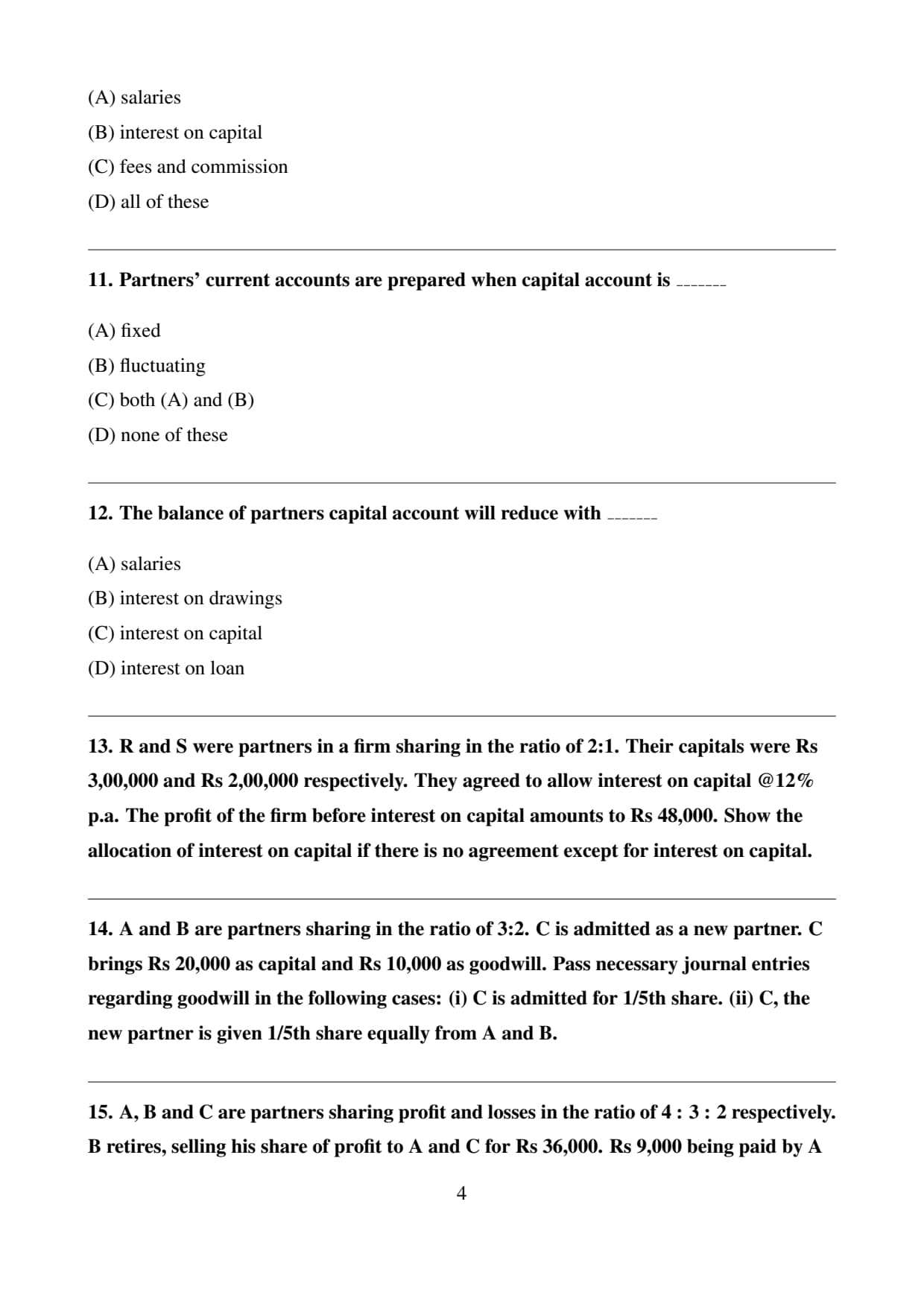
Partners' current accounts are prepared when capital account is _______
View Solution
We need to identify under which capital account method partners' current accounts are prepared.
Step 1: Understand the two methods of maintaining partners' capital accounts.
In partnership accounting, there are two methods to maintain partners' capital accounts:
1. Fixed Capital Method: Under this method, the capital account of each partner remains fixed (constant) unless additional capital is introduced or capital is withdrawn permanently. All transactions like salaries, interest on capital, interest on drawings, share of profit/loss, etc., are recorded in a separate account called the "Partner's Current Account."
2. Fluctuating Capital Method: Under this method, all transactions (including salaries, interest, drawings, share of profit/loss, etc.) are recorded directly in the capital account itself. No separate current account is maintained. The capital account balance keeps fluctuating with each transaction.
Step 2: Analyze the relationship.
- Current accounts are prepared only when the Fixed Capital Method is followed.
- Under the Fluctuating Capital Method, there is no separate current account; all entries are made directly in the capital account.
Step 3: Evaluate each option.
- (A) fixed — Correct. Current accounts are prepared when capital accounts are fixed.
- (B) fluctuating — Incorrect. Under fluctuating method, no current account is maintained.
- (C) both (A) and (B) — Incorrect because current accounts are not prepared under the fluctuating method.
- (D) none of these — Incorrect since option (A) is correct.
Step 4: Conclusion.
Partners' current accounts are prepared only when the capital account is maintained under the fixed capital method.
Final Answer: (A) fixed Quick Tip: Fixed Capital Method → Capital Account (fixed) + Current Account (for all adjustments). Fluctuating Capital Method → Only one Capital Account that records all transactions.
The balance of partners capital account will reduce with _______
View Solution
We need to identify which item reduces the balance of a partner's capital account.
Step 1: Understand what affects the capital account balance.
The capital account balance can increase or decrease based on various transactions:
- Increases (Credits): Additional capital introduced, interest on capital, salary to partner, commission to partner, share of profit.
- Decreases (Debits): Drawings made by the partner, interest on drawings, share of loss.
Step 2: Analyze each option.
- (A) salaries — Salary to a partner is an expense for the firm but an income for the partner. It increases the partner's capital account balance (credited). Incorrect.
- (B) interest on drawings — Drawings are withdrawals made by the partner from the firm. Interest on drawings is charged to discourage excessive withdrawals. This amount is deducted from the partner's capital account (debited), thus reducing its balance. Correct.
- (C) interest on capital — Interest on capital is payable to the partner for the capital contributed. It increases the partner's capital account balance (credited). Incorrect.
- (D) interest on loan — Interest on loan is paid to a partner on any loan advanced by the partner to the firm. This is separate from the capital account and is recorded as an expense in the Profit \& Loss Account, not as a reduction in the capital account balance. Incorrect.
Step 3: Conclusion.
Among the given options, only interest on drawings reduces the balance of a partner's capital account.
Final Answer: (B) interest on drawings Quick Tip: Remember: Drawings and interest on drawings are debited to the partner's capital/current account, reducing its balance. Salaries, interest on capital, and share of profit are credited, increasing the balance.
R and S were partners in a firm sharing in the ratio of 2:1. Their capitals were Rs 3,00,000 and Rs 2,00,000 respectively. They agreed to allow interest on capital @12% p.a. The profit of the firm before interest on capital amounts to Rs 48,000. Show the allocation of interest on capital if there is no agreement except for interest on capital.
View Solution
Step 1: Calculate Interest on Capital for each partner
\[ Interest on Capital = Capital \times \frac{Rate}{100} \]
For Partner R: \[ Interest = 3,00,000 \times \frac{12}{100} = Rs\ 36,000 \]
For Partner S: \[ Interest = 2,00,000 \times \frac{12}{100} = Rs\ 24,000 \]
Step 2: Calculate Total Interest on Capital
\[ Total Interest = 36,000 + 24,000 = Rs\ 60,000 \]
Step 3: Compare Total Interest with Available Profit
Profit before interest = Rs 48,000
Total interest claimed = Rs 60,000
Since profit is less than total interest, interest cannot be paid in full
Step 4: Apply the Rule when Profit is Insufficient
Since there is no agreement except for interest on capital, the interest on capital will be allowed only to the extent of profits available. The profits will be distributed in the ratio of interest on capital (as per the partnership law in the absence of any agreement).
\[ Ratio of Interest: \quad 36,000 : 24,000 = 3 : 2 \]
Step 5: Distribute Profit in the Ratio of Interest on Capital
\[ Profit available = Rs\ 48,000 \]
\[ R's share = 48,000 \times \frac{3}{5} = Rs\ 28,800 \]
\[ S's share = 48,000 \times \frac{2}{5} = Rs\ 19,200 \]
Step 6: Allocation of Interest on Capital
\begin{tabular{|c|c|c|c|
\hline
Partner & Interest Due & Interest Allowed & Unpaid Interest
\hline
R & 36,000 & 28,800 & 7,200
\hline
S & 24,000 & 19,200 & 4,800
\hline
Total & 60,000 & 48,000 & 12,000
\hline
\end{tabular
Final Answer:
Interest allowed to R = Rs 28,800
Interest allowed to S = Rs 19,200
Unpaid interest (Rs 12,000) will not be carried forward or paid in subsequent years as there is no agreement for this Quick Tip: \textbf{Key Points:} When profit is insufficient, interest on capital is allowed only to the extent of profits Profits are distributed in the ratio of interest on capital (not profit-sharing ratio) if only interest on capital is agreed upon Unpaid interest is not carried forward unless specifically agreed
A and B are partners sharing in the ratio of 3:2. C is admitted as a new partner. C brings Rs 20,000 as capital and Rs 10,000 as goodwill. Pass necessary journal entries regarding goodwill in the following cases:
(i) C is admitted for 1/5th share.
(ii) C, the new partner is given 1/5th share equally from A and B.
View Solution
Case (i): C is admitted for 1/5th share
Step 1: Calculate Sacrificing Ratio
When C is admitted for 1/5th share without any specific agreement, the old partners sacrifice in their old profit-sharing ratio.
Old ratio of A and B = 3 : 2
Sacrificing ratio = Old ratio = 3 : 2
Step 2: Distribution of Goodwill
Goodwill brought by C = Rs 10,000
A's share of goodwill = \(10,000 \times \frac{3}{5} = Rs\ 6,000\)
B's share of goodwill = \(10,000 \times \frac{2}{5} = Rs\ 4,000\)
Step 3: Journal Entries
\begin{tabular{|p{2cm|p{6cm|p{2.5cm|p{2.5cm|
\hline
Date & Particulars & LF & Dr. (Rs) & Cr. (Rs)
\hline
& Bank A/c Dr. & & 30,000 &
& \hspace{1cm To C's Capital A/c & & & 20,000
& \hspace{1cm To Goodwill A/c & & & 10,000
& (Being capital and goodwill brought by C) & & &
\hline
& Goodwill A/c Dr. & & 10,000 &
& \hspace{1cm To A's Capital A/c & & & 6,000
& \hspace{1cm To B's Capital A/c & & & 4,000
& (Being goodwill distributed among old partners in sacrificing ratio 3:2) & & &
\hline
\end{tabular
Case (ii): C is given 1/5th share equally from A and B
Step 1: Calculate Sacrificing Ratio
C's share = 1/5, taken equally from A and B.
Sacrifice by A = \(\frac{1}{5} \times \frac{1}{2} = \frac{1}{10}\)
Sacrifice by B = \(\frac{1}{5} \times \frac{1}{2} = \frac{1}{10}\)
Sacrificing ratio = \(\frac{1}{10} : \frac{1}{10} = 1 : 1\)
Step 2: Distribution of Goodwill
Goodwill brought by C = Rs 10,000
A's share of goodwill = \(10,000 \times \frac{1}{2} = Rs\ 5,000\)
B's share of goodwill = \(10,000 \times \frac{1}{2} = Rs\ 5,000\)
Step 3: Journal Entries
\begin{tabular{|p{2cm|p{6cm|p{2.5cm|p{2.5cm|
\hline
Date & Particulars & LF & Dr. (Rs) & Cr. (Rs)
\hline
& Bank A/c Dr. & & 30,000 &
& \hspace{1cm To C's Capital A/c & & & 20,000
& \hspace{1cm To Goodwill A/c & & & 10,000
& (Being capital and goodwill brought by C) & & &
\hline
& Goodwill A/c Dr. & & 10,000 &
& \hspace{1cm To A's Capital A/c & & & 5,000
& \hspace{1cm To B's Capital A/c & & & 5,000
& (Being goodwill distributed among old partners in sacrificing ratio 1:1) & & &
\hline
\end{tabular
Summary of Goodwill Distribution:
\begin{tabular{|c|c|c|
\hline
Case & A's Share of Goodwill & B's Share of Goodwill
\hline
(i) C admitted for 1/5th share & Rs 6,000 & Rs 4,000
\hline
(ii) 1/5th share equally from A and B & Rs 5,000 & Rs 5,000
\hline
\end{tabular Quick Tip: \textbf{Key Points:} Goodwill is distributed in sacrificing ratio, not old ratio When no specific sacrifice is mentioned, sacrificing ratio = old ratio When share is given equally, sacrifice is equal Journal entries: First record receipt, then distribute goodwill
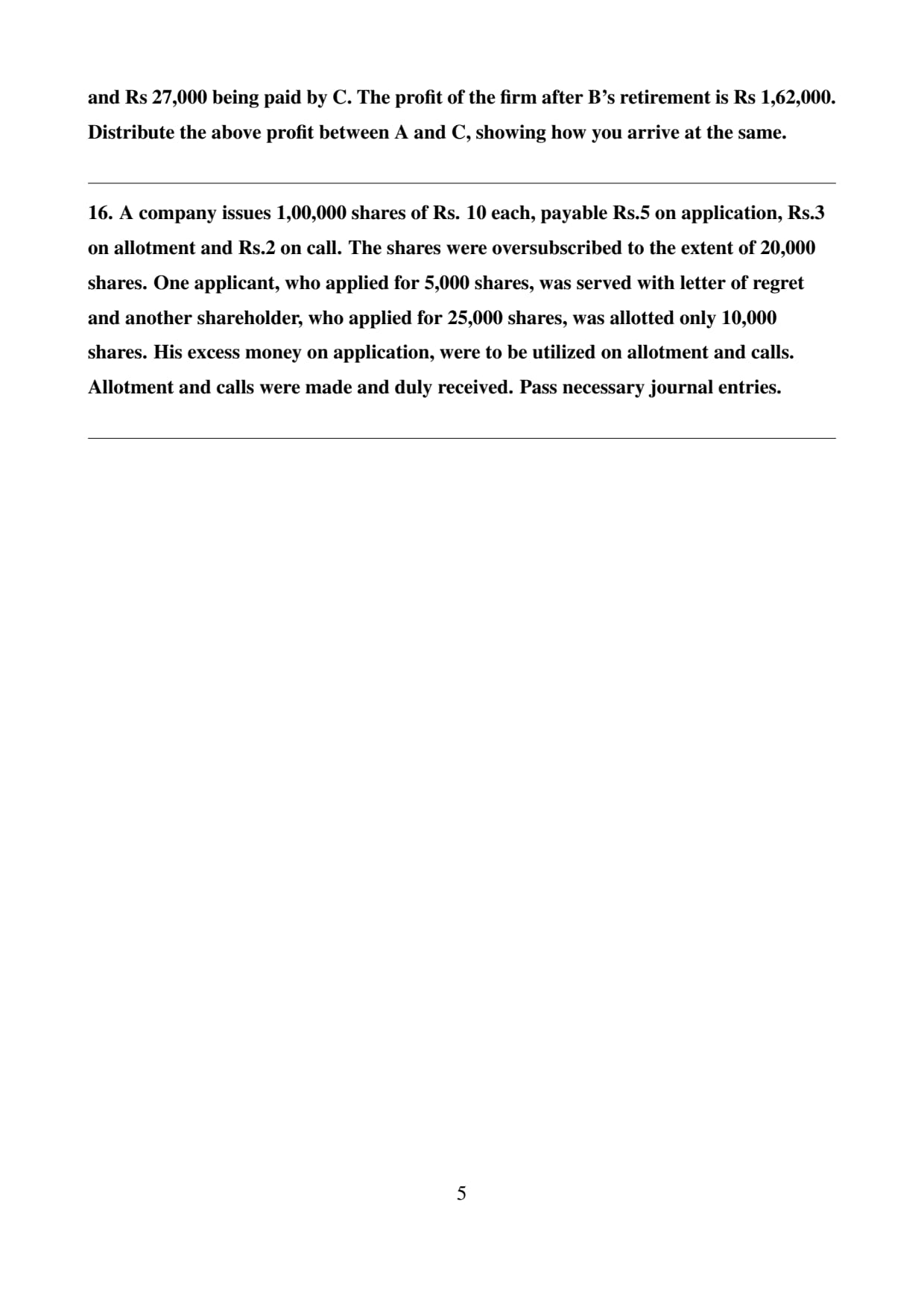
A, B and C are partners sharing profit and losses in the ratio of 4 : 3 : 2 respectively. B retires, selling his share of profit to A and C for Rs 36,000. Rs 9,000 being paid by A and Rs 27,000 being paid by C. The profit of the firm after B's retirement is Rs 1,62,000. Distribute the above profit between A and C, showing how you arrive at the same.
View Solution
Step 1: Find the Old Profit Sharing Ratio
A : B : C = 4 : 3 : 2
Step 2: Calculate B's Share
Total parts = 4 + 3 + 2 = 9
B's share = \(\frac{3}{9} = \frac{1}{3}\)
Step 3: Determine the Share of B acquired by A and C
Amount paid for B's share = Rs 36,000
Paid by A = Rs 9,000
Paid by C = Rs 27,000
The payment is in proportion to the share acquired from B.
\[ Ratio of acquisition = 9,000 : 27,000 = 1 : 3 \]
Step 4: Calculate Share Acquired by A and C from B
B's share = \(\frac{1}{3}\)
Share acquired by A from B = \(\frac{1}{3} \times \frac{1}{4} = \frac{1}{12}\)
Share acquired by C from B = \(\frac{1}{3} \times \frac{3}{4} = \frac{3}{12} = \frac{1}{4}\)
Step 5: Calculate New Profit Sharing Ratio
A's new share = Old share + Share acquired from B \[ A = \frac{4}{9} + \frac{1}{12} \] \[ \frac{4}{9} = \frac{16}{36}, \quad \frac{1}{12} = \frac{3}{36} \] \[ A = \frac{16 + 3}{36} = \frac{19}{36} \]
C's new share = Old share + Share acquired from B \[ C = \frac{2}{9} + \frac{1}{4} \] \[ \frac{2}{9} = \frac{8}{36}, \quad \frac{1}{4} = \frac{9}{36} \] \[ C = \frac{8 + 9}{36} = \frac{17}{36} \]
New ratio of A and C = \(19 : 17\)
Step 6: Distribute Profit after B's Retirement
Profit after B's retirement = Rs 1,62,000
\[ A's \ share = 1,62,000 \times \frac{19}{36} \] \[ = 1,62,000 \times \frac{19}{36} = 4,500 \times 19 = Rs\ 85,500 \]
\[ C's \ share = 1,62,000 \times \frac{17}{36} \] \[ = 1,62,000 \times \frac{17}{36} = 4,500 \times 17 = Rs\ 76,500 \]
Final Answer:
A's share of profit = Rs 85,500
C's share of profit = Rs 76,500
New profit sharing ratio = 19 : 17 Quick Tip: \textbf{Key Points:} Amount paid for goodwill determines acquisition ratio New share = Old share + Acquired share from retiring partner Distribute future profits in new ratio Verify: 85,500 + 76,500 = 1,62,000 ✓
A company issues 1,00,000 shares of Rs. 10 each, payable Rs.5 on application, Rs.3 on allotment and Rs.2 on call. The shares were oversubscribed to the extent of 20,000 shares. One applicant, who applied for 5,000 shares, was served with letter of regret and another shareholder, who applied for 25,000 shares, was allotted only 10,000 shares. His excess money on application, were to be utilized on allotment and calls. Allotment and calls were made and duly received. Pass necessary journal entries.
View Solution
Step 1: Understanding the Problem
Shares issued: 1,00,000 shares of Rs 10 each
Payment terms: Application Rs 5, Allotment Rs 3, Call Rs 2
Oversubscription: 20,000 shares (Total applications = 1,20,000 shares)
Case 1: One applicant applied for 5,000 shares → fully rejected (letter of regret)
Case 2: One applicant applied for 25,000 shares → allotted only 10,000 shares
Excess application money of this applicant to be adjusted towards allotment and calls
Step 2: Calculate Total Application Money Received
Total applications received = 1,20,000 shares
Application money per share = Rs 5
\[ Total application money received = 1,20,000 \times 5 = Rs\ 6,00,000 \]
Step 3: Calculate Application Money Due on Allotted Shares
Shares allotted = 1,00,000 shares
Application money due = \(1,00,000 \times 5 = Rs\ 5,00,000\)
Step 4: Calculate Excess Application Money
\[ Excess application money = 6,00,000 - 5,00,000 = Rs\ 1,00,000 \]
This excess money will be adjusted towards allotment and calls.
Step 5: Analyze the Rejected Applicant
Applicant applied for 5,000 shares → fully rejected
Application money received = \(5,000 \times 5 = Rs\ 25,000\)
This amount will be refunded.
Step 6: Analyze the Partially Allotted Applicant
This applicant applied for 25,000 shares, allotted only 10,000 shares.
Application money paid = \(25,000 \times 5 = Rs\ 1,25,000\)
Application money due for allotted shares = \(10,000 \times 5 = Rs\ 50,000\)
Excess application money = \(1,25,000 - 50,000 = Rs\ 75,000\)
This Rs 75,000 will be adjusted towards allotment and calls as per company policy.
Step 7: Calculate Allotment Money Due and Adjustment
Allotment money per share = Rs 3
Total allotment money due on 1,00,000 shares = \(1,00,000 \times 3 = Rs\ 3,00,000\)
From the partially allotted applicant:
Allotment money due on his 10,000 shares = \(10,000 \times 3 = Rs\ 30,000\)
This will be adjusted from his excess application money of Rs 75,000
After allotment adjustment, remaining excess = \(75,000 - 30,000 = Rs\ 45,000\)
This Rs 45,000 will be adjusted towards the final call.
Step 8: Calculate Call Money Due and Adjustment
Call money per share = Rs 2
Total call money due on 1,00,000 shares = \(1,00,000 \times 2 = Rs\ 2,00,000\)
From the partially allotted applicant:
Call money due on his 10,000 shares = \(10,000 \times 2 = Rs\ 20,000\)
This will be adjusted from his remaining excess of Rs 45,000
After call adjustment, remaining excess = \(45,000 - 20,000 = Rs\ 25,000\)
This Rs 25,000 will be refunded to the applicant.
Step 9: Journal Entries
\begin{tabular{|p{2cm|p{7cm|p{2cm|p{2cm|
\hline
Date & Particulars & Dr. (Rs) & Cr. (Rs)
\hline
& 1. On receipt of application money & &
\hline
& Bank A/c Dr. & 6,00,000 &
& \hspace{1cm To Share Application A/c & & 6,00,000
& (Being application money received on 1,20,000 shares @ Rs 5 each) & &
\hline
& 2. On transfer of application money to share capital & &
\hline
& Share Application A/c Dr. & 5,00,000 &
& \hspace{1cm To Share Capital A/c & & 5,00,000
& (Being application money on 1,00,000 shares transferred to share capital) & &
\hline
& 3. On refund of application money to rejected applicant & &
\hline
& Share Application A/c Dr. & 25,000 &
& \hspace{1cm To Bank A/c & & 25,000
& (Being application money refunded to applicant of 5,000 shares who was rejected) & &
\hline
& 4. On making allotment due & &
\hline
& Share Allotment A/c Dr. & 3,00,000 &
& \hspace{1cm To Share Capital A/c & & 3,00,000
& (Being allotment money due on 1,00,000 shares @ Rs 3 each) & &
\hline
& 5. On adjustment of excess application money towards allotment & &
\hline
& Share Application A/c Dr. & 75,000 &
& \hspace{1cm To Share Allotment A/c & & 30,000
& \hspace{1cm To Calls in Advance A/c & & 45,000
& (Being excess application money of one applicant adjusted towards allotment and balance transferred to calls in advance) & &
\hline
& 6. On receipt of allotment money & &
\hline
& Bank A/c Dr. & 2,70,000 &
& \hspace{1cm To Share Allotment A/c & & 2,70,000
& (Being allotment money received after adjustment, 3,00,000 - 30,000) & &
\hline
& 7. On making call due & &
\hline
& Share Call A/c Dr. & 2,00,000 &
& \hspace{1cm To Share Capital A/c & & 2,00,000
& (Being call money due on 1,00,000 shares @ Rs 2 each) & &
\hline
& 8. On adjustment of calls in advance towards call & &
\hline
& Calls in Advance A/c Dr. & 20,000 &
& \hspace{1cm To Share Call A/c & & 20,000
& (Being calls in advance adjusted towards call money due) & &
\hline
& 9. On receipt of call money & &
\hline
& Bank A/c Dr. & 1,80,000 &
& \hspace{1cm To Share Call A/c & & 1,80,000
& (Being call money received after adjustment, 2,00,000 - 20,000) & &
\hline
& 10. On refund of remaining excess to the applicant & &
\hline
& Calls in Advance A/c Dr. & 25,000 &
& \hspace{1cm To Bank A/c & & 25,000
& (Being remaining excess money refunded to the partially allotted applicant) & &
\hline
\end{tabular
Verification:
Total share capital raised = 1,00,000 × Rs 10 = Rs 10,00,000
Amount received through:
Application: Rs 5,00,000 (after adjustments)
Allotment: Rs 2,70,000
Call: Rs 1,80,000
Total = Rs 9,50,000 (excluding adjustments and refunds)
Adjustments and refunds: Rs 25,000 (rejected) + Rs 25,000 (excess refund) = Rs 50,000
Net amount with company = Rs 10,00,000 ✓ Quick Tip: \textbf{Key Points:} Always separate application, allotment, and call accounts Track excess application money carefully for partial allotment Adjust excess towards future calls through Calls in Advance Refund any remaining excess after all adjustments



Comments