




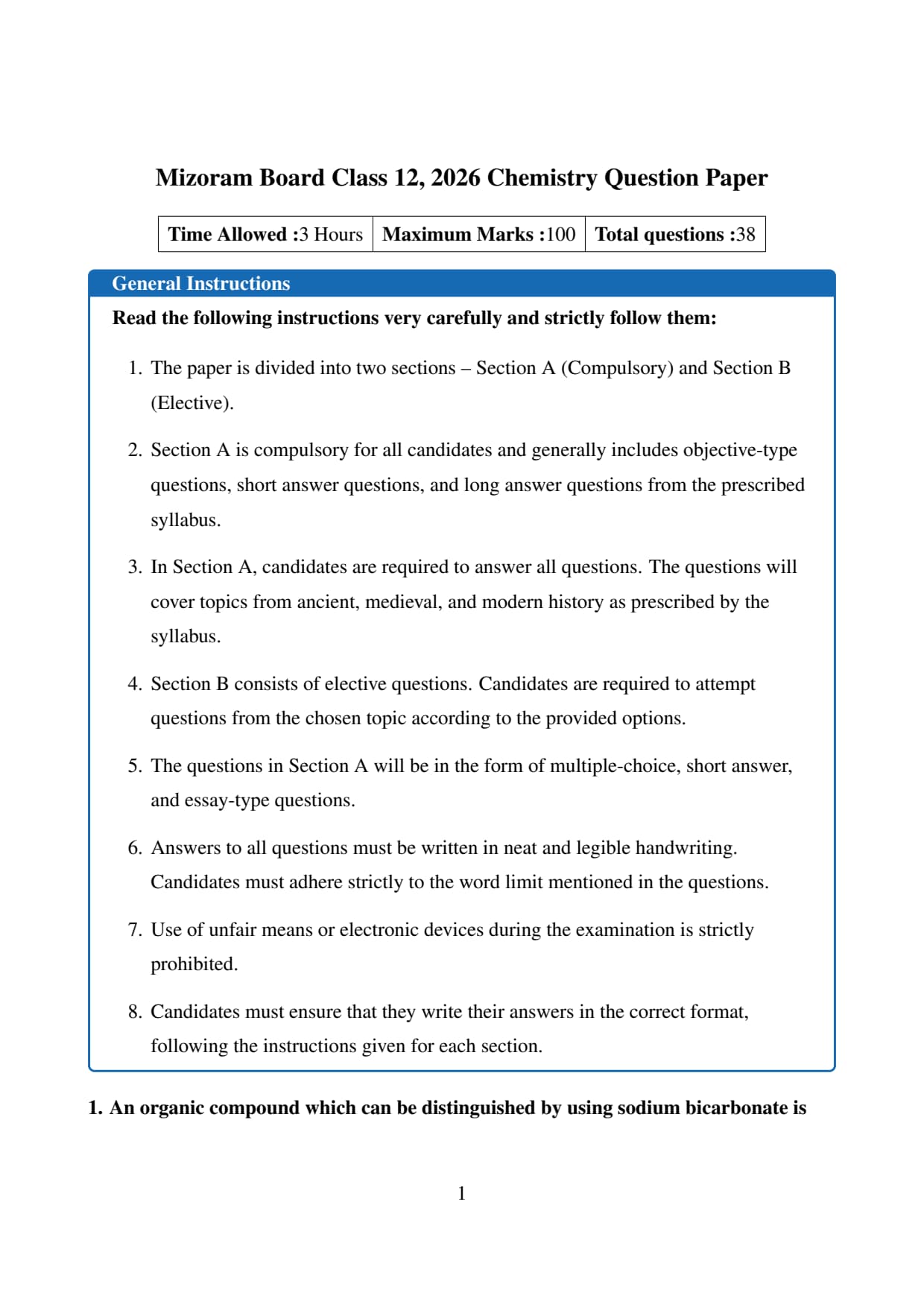
Mizoram Board is conducting the Class 12 Chemistry Board Exam 2026 on February 23, 2026. Class 12 Chemistry Question Paper with Solution PDF is available here for download.
The official question paper of Mizoram Board Class 12 Chemistry Board Exam 2026 is provided below. Students can download the official paper in PDF format for reference.
Mizoram Board Class 12, 2026 Chemistry Question Paper with Solution PDF
| Mizoram Board Class 12 Chemistry Question Paper 2026 | Download PDF | Check Solutions |

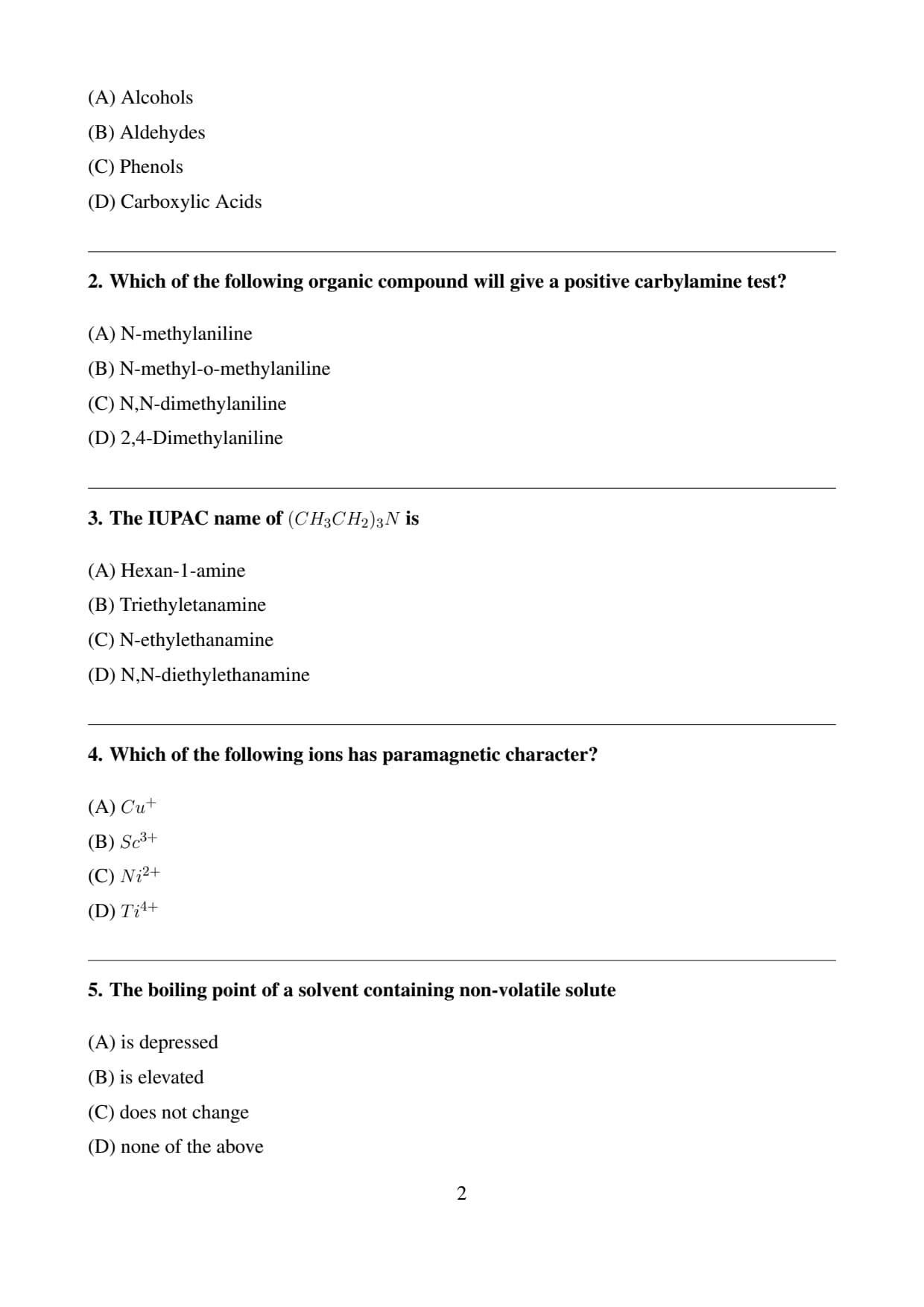
An organic compound which can be distinguished by using sodium bicarbonate is
View Solution
We need to identify which organic compound can be distinguished using sodium bicarbonate (NaHCO\(_3\)).
Step 1: Understand the sodium bicarbonate test.
Sodium bicarbonate (baking soda) is a weak base. It reacts with acids to produce carbon dioxide gas, which is observed as effervescence (bubbling). The reaction is: \[ R-COOH + NaHCO_3 \rightarrow R-COONa + H_2O + CO_2 \uparrow \]
Step 2: Analyze each option.
- (A) Alcohols — Alcohols are neutral and do not react with NaHCO\(_3\). No effervescence is observed. Incorrect.
- (B) Aldehydes — Aldehydes are neutral and do not react with NaHCO\(_3\). No effervescence. Incorrect.
- (C) Phenols — Phenols are weakly acidic but weaker than carboxylic acids. They do not react with NaHCO\(_3\) to produce CO\(_2\) gas. Phenols require stronger bases like NaOH to react. Incorrect.
- (D) Carboxylic Acids — Carboxylic acids are stronger acids and readily react with NaHCO\(_3\) to produce CO\(_2\) gas, showing effervescence. This test distinguishes carboxylic acids from phenols and other compounds. Correct.
Step 3: Conclusion.
Carboxylic acids give effervescence with sodium bicarbonate due to the release of CO\(_2\) gas, while alcohols, aldehydes, and phenols do not.
Final Answer: (D) Carboxylic Acids Quick Tip: The sodium bicarbonate test is used to distinguish carboxylic acids from phenols. Carboxylic acids produce CO\(_2\) effervescence with NaHCO\(_3\), while phenols do not.
Which of the following organic compound will give a positive carbylamine test?
View Solution
We need to identify which compound will give a positive carbylamine test (also known as the isocyanide test).
Step 1: Understand the carbylamine test.
The carbylamine test is used to detect primary amines (\(1^\circ\) amines). The reaction involves heating the amine with chloroform (CHCl\(_3\)) and alcoholic KOH, producing a foul-smelling isocyanide (carbylamine). The test is positive only for primary amines. Secondary and tertiary amines do not give this test.
Step 2: Analyze each option.
- (A) N-methylaniline — This is a secondary amine (C\(_6\)H\(_5\)-NH-CH\(_3\)). Secondary amines do not give a positive carbylamine test. Incorrect.
- (B) N-methyl-o-methylaniline — This is also a secondary amine (methyl group on nitrogen and ortho position). Secondary amines do not give the test. Incorrect.
- (C) N,N-dimethylaniline — This is a tertiary amine (C\(_6\)H\(_5\)-N(CH\(_3\))\(_2\)). Tertiary amines do not give the carbylamine test. Incorrect.
- (D) 2,4-Dimethylaniline — This is a primary amine. The amino group (-NH\(_2\)) is directly attached to the benzene ring with two methyl substituents at positions 2 and 4. Primary amines give a positive carbylamine test. Correct.
Step 3: Conclusion.
Only primary amines give a positive carbylamine test. Among the given options, 2,4-dimethylaniline is the only primary amine.
Final Answer: (D) 2,4-Dimethylaniline Quick Tip: The carbylamine test is specific for primary amines. Secondary and tertiary amines do not respond to this test. Look for the -NH\(_2\) group directly attached to carbon.
The IUPAC name of \( (CH_3CH_2)_3N \) is
View Solution
We need to determine the correct IUPAC name for the compound (CH\(_3\)CH\(_2\))\(_3\)N.
Step 1: Identify the structure.
The formula (CH\(_3\)CH\(_2\))\(_3\)N represents a nitrogen atom bonded to three ethyl groups. This is a tertiary amine with the structure: \[ CH_3CH_2 - N - CH_2CH_3 \] \[ \hspace{2.5cm} | \] \[ \hspace{2.5cm} CH_2CH_3 \]
Step 2: Apply IUPAC naming rules for amines.
For symmetrical tertiary amines, the IUPAC name is written as N,N-diethyl + the name of the largest alkyl group as the parent amine. The largest alkyl group here is ethyl, so the parent is ethanamine. The two other ethyl groups are treated as substituents on the nitrogen atom, indicated by the prefix "N,N-diethyl."
Thus, the name is: N,N-diethylethanamine.
Step 3: Evaluate each option.
- (A) Hexan-1-amine — This would be CH\(_3\)CH\(_2\)CH\(_2\)CH\(_2\)CH\(_2\)CH\(_2\)NH\(_2\), a primary amine with a six-carbon chain. Incorrect.
- (B) Triethyletanamine — This is not standard IUPAC nomenclature. The "triethyl" prefix is not used in this way; the correct form uses "N,N-diethyl" for the nitrogen substituents. Incorrect.
- (C) N-ethylethanamine — This would be CH\(_3\)CH\(_2\)-NH-CH\(_2\)CH\(_3\), which is a secondary amine (diethylamine). Incorrect.
- (D) N,N-diethylethanamine — This correctly represents the tertiary amine with three ethyl groups: one ethyl as the parent (ethanamine) and two ethyls on the nitrogen (N,N-diethyl). Correct.
Final Answer: (D) N,N-diethylethanamine Quick Tip: For tertiary amines, name the largest alkyl group as the parent amine. The other alkyl groups attached to nitrogen are indicated by "N-alkyl" or "N,N-dialkyl" prefixes.
Which of the following ions has paramagnetic character?
View Solution
We need to identify which ion among the given options exhibits paramagnetic character. Paramagnetic substances have unpaired electrons and are attracted by magnetic fields. Diamagnetic substances have all electrons paired and are weakly repelled by magnetic fields.
Step 1: Determine the electronic configuration of each ion.
We need to find the number of unpaired electrons in each ion.
- (A) \( Cu^+ \)
Atomic number of Cu = 29
Electronic configuration of Cu atom: \([Ar] 3d^{10} 4s^1\) (exception due to stability of fully filled d-subshell)
\( Cu^+ \) loses one electron from 4s orbital: \([Ar] 3d^{10}\)
All electrons are paired in the 3d subshell.
Unpaired electrons = 0 → Diamagnetic.
- (B) \( Sc^{3+} \)
Atomic number of Sc = 21
Electronic configuration of Sc atom: \([Ar] 3d^1 4s^2\)
\( Sc^{3+} \) loses three electrons (two from 4s and one from 3d): \([Ar]\)
Noble gas configuration, all electrons paired.
Unpaired electrons = 0 → Diamagnetic.
- (C) \( Ni^{2+} \)
Atomic number of Ni = 28
Electronic configuration of Ni atom: \([Ar] 3d^8 4s^2\)
\( Ni^{2+} \) loses two electrons from 4s orbital: \([Ar] 3d^8\)
The 3d subshell with 8 electrons has the following arrangement according to Hund's rule:
\[ \uparrow \downarrow \; \uparrow \downarrow \; \uparrow \downarrow \; \uparrow \; \uparrow \]
(Three orbitals are fully paired with two electrons each, and two orbitals have one unpaired electron each)
Unpaired electrons = 2 → Paramagnetic.
- (D) \( Ti^{4+} \)
Atomic number of Ti = 22
Electronic configuration of Ti atom: \([Ar] 3d^2 4s^2\)
\( Ti^{4+} \) loses four electrons (two from 4s and two from 3d): \([Ar]\)
Noble gas configuration, all electrons paired.
Unpaired electrons = 0 → Diamagnetic.
Step 2: Conclusion.
Only \( Ni^{2+} \) has unpaired electrons (2 unpaired electrons) and therefore exhibits paramagnetic character.
Final Answer: (C) \( Ni^{2+} \) Quick Tip: To determine paramagnetic or diamagnetic character, find the number of unpaired electrons in the ion. Ions with unpaired electrons are paramagnetic; ions with all electrons paired are diamagnetic.
The boiling point of a solvent containing non-volatile solute
View Solution
We need to determine what happens to the boiling point of a solvent when a non-volatile solute is added.
Step 1: Understand colligative properties.
When a non-volatile solute is added to a solvent, it exhibits colligative properties that depend on the number of solute particles. One such property is boiling point elevation.
Step 2: Recall the boiling point elevation phenomenon.
The boiling point of a solution containing a non-volatile solute is higher than that of the pure solvent. This is because the solute particles lower the vapor pressure of the solvent, requiring a higher temperature to reach the boiling point (where vapor pressure equals atmospheric pressure).
The elevation in boiling point is given by: \[ \Delta T_b = K_b \cdot m \]
where \(K_b\) is the ebullioscopic constant and \(m\) is the molality of the solution.
Step 3: Evaluate each option.
- (A) is depressed — Boiling point depression occurs in freezing point, not boiling point. Incorrect.
- (B) is elevated — Correct. The boiling point increases when a non-volatile solute is added.
- (C) does not change — Incorrect. The boiling point definitely changes.
- (D) none of the above — Incorrect since option (B) is correct.
Final Answer: (B) is elevated Quick Tip: Remember: Addition of non-volatile solute causes boiling point elevation and freezing point depression. These are colligative properties that depend on the number of solute particles.
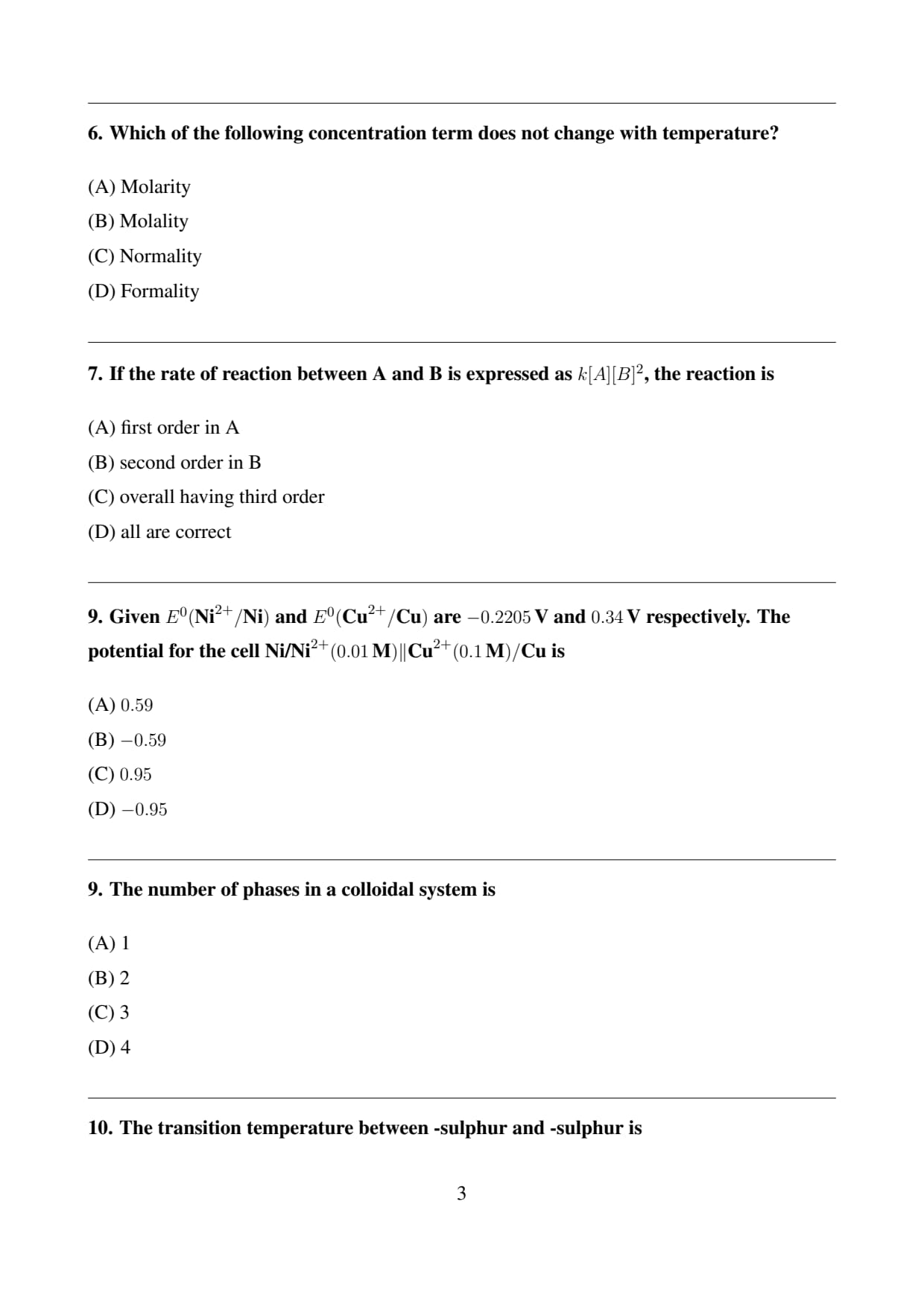
Which of the following concentration term does not change with temperature?
View Solution
We need to identify which concentration term is independent of temperature.
Step 1: Understand how temperature affects concentration terms.
Concentration terms that involve volume (which changes with temperature due to expansion/contraction) are temperature-dependent. Terms based on mass (which remains constant with temperature) are temperature-independent.
Step 2: Analyze each option.
- (A) Molarity (M) — Molarity = moles of solute / volume of solution (in liters). Volume changes with temperature, so molarity changes with temperature. Incorrect.
- (B) Molality (m) — Molality = moles of solute / mass of solvent (in kg). Mass does not change with temperature, so molality is temperature-independent. Correct.
- (C) Normality (N) — Normality = number of gram equivalents / volume of solution (in liters). Since it involves volume, normality changes with temperature. Incorrect.
- (D) Formality (F) — Formality = number of formula masses / volume of solution (in liters). It is similar to molarity for ionic compounds and involves volume, so it changes with temperature. Incorrect.
Step 3: Conclusion.
Molality is the only concentration term among the given options that does not change with temperature because it is based on mass, not volume.
Final Answer: (B) Molality Quick Tip: Concentration terms based on volume (molarity, normality, formality) change with temperature. Terms based on mass (molality, mole fraction) are temperature-independent.
If the rate of reaction between A and B is expressed as \( k[A][B]^2 \), the reaction is
View Solution
We need to determine the order of the reaction from the given rate law expression.
Step 1: Understand rate law and order of reaction.
The rate law is given as: \[ Rate = k[A][B]^2 \]
The order of a reaction with respect to a reactant is the exponent of its concentration term in the rate law. The overall order is the sum of all exponents.
Step 2: Determine the order with respect to each reactant.
- With respect to A: The exponent of [A] is 1. So, the reaction is first order in A.
- With respect to B: The exponent of [B] is 2. So, the reaction is second order in B.
Step 3: Determine the overall order.
Overall order = order in A + order in B = 1 + 2 = 3. So, the reaction is overall third order.
Step 4: Evaluate each option.
- (A) first order in A — True, as explained.
- (B) second order in B — True, as explained.
- (C) overall having third order — True, as explained.
- (D) all are correct — Since (A), (B), and (C) are all true, this option is correct.
Final Answer: (D) all are correct Quick Tip: The order of a reaction with respect to a reactant is the power of its concentration term in the rate law. The overall order is the sum of all individual orders.
Given \( E^0 (Ni^{2+}/Ni) \) and \( E^0 (Cu^{2+}/Cu) \) are \(-0.2205 \, V\) and \( 0.34 \, V \) respectively. The potential for the cell \(Ni/Ni^{2+}(0.01 \, M)\| Cu^{2+}(0.1 \, M)/Cu\) is
View Solution
We need to calculate the cell potential for the given electrochemical cell.
Step 1: Identify the anode and cathode.
Given cell notation: \(Ni/Ni^{2+}(0.01 \, M)\| Cu^{2+}(0.1 \, M)/Cu\)
- Left electrode: Ni | Ni²⁺ (oxidation occurs here) → Anode
- Right electrode: Cu²⁺ | Cu (reduction occurs here) → Cathode
Step 2: Write the half-cell reactions and standard electrode potentials.
Given: \[ E^0_{Ni^{2+}/Ni} = -0.2205 \, V \] \[ E^0_{Cu^{2+}/Cu} = +0.34 \, V \]
Step 3: Calculate the standard cell potential \(E^0_{cell}\).
\[ E^0_{cell} = E^0_{cathode} - E^0_{anode} \] \[ E^0_{cell} = E^0_{Cu^{2+}/Cu} - E^0_{Ni^{2+}/Ni} \] \[ E^0_{cell} = 0.34 - (-0.2205) = 0.34 + 0.2205 = 0.5605 \, V \]
Step 4: Apply the Nernst equation to find the cell potential at given concentrations.
For the cell reaction: \[ Ni + Cu^{2+} \rightarrow Ni^{2+} + Cu \]
The Nernst equation is: \[ E_{cell} = E^0_{cell} - \frac{0.0591}{n} \log \frac{[Ni^{2+}]}{[Cu^{2+}]} \]
where \(n = 2\) (number of electrons transferred).
Given: \[ [Ni^{2+}] = 0.01 \, M, \quad [Cu^{2+}] = 0.1 \, M \]
\[ E_{cell} = 0.5605 - \frac{0.0591}{2} \log \frac{0.01}{0.1} \] \[ \frac{0.01}{0.1} = 0.1 \] \[ \log(0.1) = \log(10^{-1}) = -1 \] \[ E_{cell} = 0.5605 - \frac{0.0591}{2} \times (-1) \] \[ E_{cell} = 0.5605 + \frac{0.0591}{2} \] \[ \frac{0.0591}{2} = 0.02955 \] \[ E_{cell} = 0.5605 + 0.02955 = 0.59005 \, V \approx 0.59 \, V \]
Step 5: Conclusion.
The cell potential is approximately 0.59 V.
Final Answer: (A) \( 0.59 \) Quick Tip: In Nernst equation calculations, remember: \(E_{cell} = E^0_{cell} - \frac{0.0591}{n} \log Q\). For concentration cells or dissimilar electrodes, identify the correct anode and cathode first.
The number of phases in a colloidal system is
View Solution
We need to determine the number of phases in a colloidal system.
Step 1: Understand what a colloidal system is.
A colloidal system (colloidal dispersion) consists of two components:
- Dispersed phase: The substance that is distributed as particles (colloidal particles)
- Dispersion medium: The continuous medium in which the dispersed phase is distributed
Step 2: Define a phase in chemistry.
A phase is a physically distinct, homogeneous part of a system that is separated from other parts by definite boundaries. Each phase has uniform physical and chemical properties throughout.
Step 3: Analyze a colloidal system in terms of phases.
In a colloidal system:
- The dispersed phase consists of small particles (1-1000 nm) that are not visible to the naked eye but form a separate phase
- The dispersion medium is the continuous phase
- These two are distinct and separated by interfaces, even though the particles are small
Therefore, a colloidal system always has two phases: the dispersed phase and the dispersion medium.
Step 4: Evaluate each option.
- (A) 1 — Incorrect. A colloidal system cannot be a single phase; it is heterogeneous at the microscopic level.
- (B) 2 — Correct. Colloidal systems are biphasic (dispersed phase + dispersion medium).
- (C) 3 — Incorrect. There are only two phases in a simple colloidal system.
- (D) 4 — Incorrect.
Final Answer: (B) 2 Quick Tip: Colloidal systems are biphasic: they consist of a dispersed phase (particles) and a dispersion medium (continuous phase). Examples include fog (liquid in gas), milk (liquid in liquid), and smoke (solid in gas).
The transition temperature between α-sulphur and β-sulphur is
View Solution
We need to recall the transition temperature between α-sulphur (rhombic sulphur) and β-sulphur (monoclinic sulphur).
Step 1: Understand the allotropes of sulphur.
Sulphur exists in two main crystalline allotropes:
- α-sulphur (Rhombic sulphur): Stable below 369 K (96°C)
- β-sulphur (Monoclinic sulphur): Stable above 369 K (96°C)
Step 2: Define transition temperature.
The transition temperature is the temperature at which one crystalline form converts into another. For sulphur, rhombic sulphur transforms into monoclinic sulphur when heated above 369 K (96°C). Conversely, monoclinic sulphur transforms back to rhombic sulphur when cooled below 369 K.
Step 3: Evaluate each option.
- (A) 269K — This is too low (-4°C). Incorrect.
- (B) 296K — This is 23°C, room temperature. Incorrect.
- (C) 369K — This is 96°C, the correct transition temperature. Correct.
- (D) 396K — This is 123°C, above the melting point of sulphur. Incorrect.
Step 4: Conclusion.
The transition temperature between α-sulphur (rhombic) and β-sulphur (monoclinic) is 369 K (96°C).
Final Answer: (C) 369K Quick Tip: Remember: Rhombic sulphur (α-form) is stable below 96°C (369K) and monoclinic sulphur (β-form) is stable above 96°C. At 96°C, both forms coexist in equilibrium.
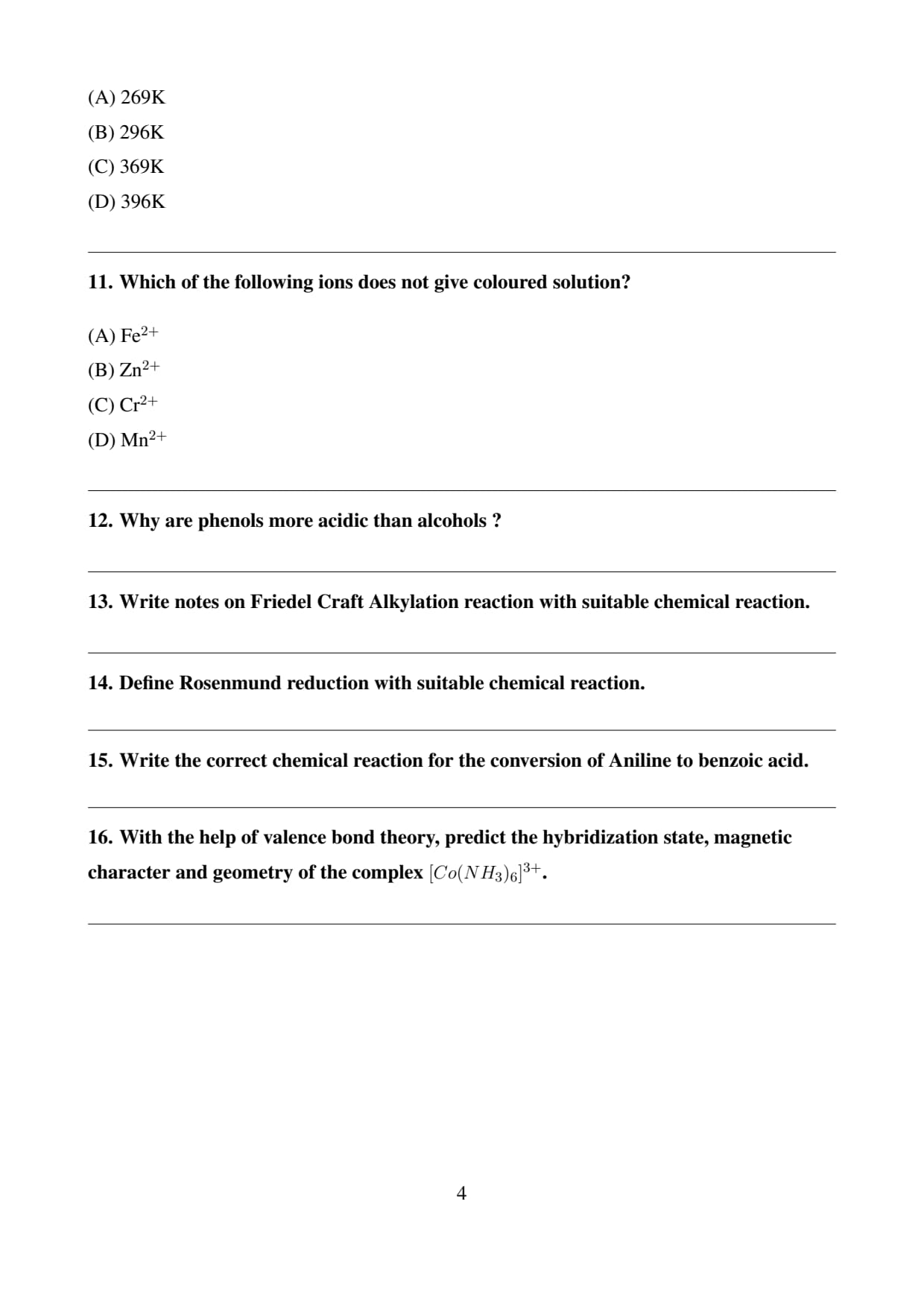
Which of the following ions does not give coloured solution?
View Solution
We need to identify which ion does not form a coloured solution. Colour in transition metal ions arises due to d-d transitions, which occur when there are unpaired electrons in the d-orbitals. Ions with completely filled or empty d-orbitals (d⁰ or d¹⁰ configuration) are usually colourless.
Step 1: Determine the electronic configuration of each ion.
- (A) Fe\(^{2+}\)
Atomic number of Fe = 26
Electronic configuration of Fe atom: \([Ar] 3d^6 4s^2\)
Fe\(^{2+}\) loses two electrons from 4s: \([Ar] 3d^6\)
d⁶ configuration has unpaired electrons → Coloured (pale green).
- (B) Zn\(^{2+}\)
Atomic number of Zn = 30
Electronic configuration of Zn atom: \([Ar] 3d^{10} 4s^2\)
Zn\(^{2+}\) loses two electrons from 4s: \([Ar] 3d^{10}\)
d¹⁰ configuration is completely filled → No unpaired electrons → No d-d transitions possible → Colourless.
- (C) Cr\(^{2+}\)
Atomic number of Cr = 24
Electronic configuration of Cr atom: \([Ar] 3d^5 4s^1\) (exception)
Cr\(^{2+}\) loses two electrons (one from 4s and one from 3d): \([Ar] 3d^4\)
d⁴ configuration has unpaired electrons → Coloured (blue).
- (D) Mn\(^{2+}\)
Atomic number of Mn = 25
Electronic configuration of Mn atom: \([Ar] 3d^5 4s^2\)
Mn\(^{2+}\) loses two electrons from 4s: \([Ar] 3d^5\)
d⁵ configuration has five unpaired electrons → Coloured (very pale pink, almost colourless in dilute solutions but theoretically coloured).
Step 2: Conclusion.
Zn\(^{2+}\) has a d¹⁰ configuration with all orbitals completely filled. It does not undergo d-d transitions and therefore gives a colourless solution.
Final Answer: (B) Zn\(^{2+}\) Quick Tip: Ions with d⁰ (e.g., Sc³⁺, Ti⁴⁺) or d¹⁰ (e.g., Zn²⁺, Cd²⁺) configurations are colourless because there are no unpaired electrons for d-d transitions. Most other transition metal ions with partially filled d-orbitals are coloured.
Why are phenols more acidic than alcohols ?
View Solution
Phenols are more acidic than alcohols due to the greater stability of the phenoxide ion compared to the alkoxide ion. This stability arises from resonance delocalization of the negative charge in the phenoxide ion.
Explanation:
Resonance Stabilization of Phenoxide Ion:
When phenol loses a proton (H⁺), it forms the phenoxide ion (C₆H₅O⁻).
The negative charge on the oxygen atom is delocalized into the benzene ring through resonance.
The phenoxide ion has multiple resonance structures where the negative charge is distributed on different carbon atoms of the ring.
This delocalization spreads the charge over several atoms, making the ion more stable.
Lack of Resonance in Alkoxide Ion:
When alcohol loses a proton, it forms the alkoxide ion (RO⁻).
The negative charge is localized on the oxygen atom only.
There is no resonance delocalization because the alkyl group (R) does not participate in resonance.
The localized negative charge makes the alkoxide ion less stable.
Inductive Effect:
In phenols, the oxygen atom is sp² hybridized (more electronegative), while in alcohols, oxygen is sp³ hybridized (less electronegative).
The greater electronegativity of sp² hybridized oxygen in phenol further stabilizes the phenoxide ion.
Resonance Structures of Phenoxide Ion:
\[ \chemfig{6(-=-(-[::+60]O^{-})-=-)} \quad \longleftrightarrow \quad \chemfig{6(-=-(-[::+60]O)-=(-[:+120])-)} \quad \longleftrightarrow \quad (and other resonance structures) \]
Comparison of pKa Values:
\begin{tabular{|l|c|
\hline
Compound & pKa Value
\hline
Phenol & 10
\hline
Ethanol & 16
\hline
\end{tabular
Lower pKa value indicates stronger acidity. Phenol (pKa = 10) is significantly more acidic than ethanol (pKa = 16).
Summary:
Phenol \(\xrightarrow{-H⁺}\) Phenoxide ion (stabilized by resonance)
Alcohol \(\xrightarrow{-H⁺}\) Alkoxide ion (no resonance, localized charge)
Greater stability of phenoxide ion makes phenol more acidic
Thus, phenols are more acidic than alcohols due to resonance stabilization of the conjugate base (phenoxide ion). Quick Tip: \textbf{Key Point:} More stable the conjugate base, stronger the acid. Phenoxide ion is resonance-stabilized; alkoxide ion is not. Hence, phenol is more acidic than alcohol.
Write notes on Friedel Craft Alkylation reaction with suitable chemical reaction.
View Solution
Friedel-Crafts Alkylation is an electrophilic aromatic substitution reaction used to introduce alkyl groups into aromatic rings.
Definition:
Friedel-Crafts Alkylation involves the attachment of an alkyl group to an aromatic ring using an alkyl halide in the presence of a Lewis acid catalyst (typically AlCl₃).
General Reaction:
\[ \chemfig{6(-=-=-=)} + R-X \xrightarrow{AlCl_3} \chemfig{6(-=-(-R)=-=)} + HX \]
Mechanism:
Generation of Electrophile:
\[ R-Cl + AlCl_3 \longrightarrow R^+ + [AlCl_4]^- \]
The Lewis acid (AlCl₃) forms a complex with the alkyl halide, generating a carbocation (R⁺) which acts as the electrophile.
Electrophilic Attack:
The carbocation attacks the electron-rich benzene ring, forming a resonance-stabilized arenium ion (σ-complex).
Deprotonation:
Loss of a proton from the arenium ion restores aromaticity, yielding the alkylated benzene product.
Suitable Chemical Reaction Example:
\[ \chemfig{6(-=-=-=)} + CH_3CH_2Cl \xrightarrow{AlCl_3} \chemfig{6(-=-(-CH_2CH_3)=-=)} + HCl \]
Benzene + Ethyl chloride \(\xrightarrow{AlCl_3}\) Ethylbenzene + HCl
Another Example (with different alkyl halide):
\[ \chemfig{6(-=-=-=)} + (CH_3)_3C-Cl \xrightarrow{AlCl_3} \chemfig{6(-=-(-C(CH_3)_3)=-=)} + HCl \]
Benzene + tert-Butyl chloride \(\xrightarrow{AlCl_3}\) tert-Butylbenzene + HCl
Limitations and Important Points:
Carbocation Rearrangement: If the alkyl halide can form a primary carbocation, rearrangement may occur to form a more stable carbocation, leading to rearranged products.
Polyalkylation: The product (alkylbenzene) is more reactive than benzene, so multiple alkylations can occur unless excess benzene is used.
Limitation with Deactivating Groups: The reaction fails if the aromatic ring contains strong electron-withdrawing groups (like -NO₂, -CN, -SO₃H) as they deactivate the ring.
Catalyst Requirement: Anhydrous AlCl₃ is required; even traces of moisture destroy the catalyst.
Catalysts Used:
Lewis acids: AlCl₃, FeCl₃, BF₃, ZnCl₂
AlCl₃ is the most commonly used
Thus, Friedel-Crafts Alkylation is an important reaction for introducing alkyl groups into aromatic rings, though it has certain limitations to consider. Quick Tip: \textbf{Key Points:} Electrophile = Carbocation from R-X + AlCl₃ Product = Alkylbenzene Limitation: No reaction with deactivated rings ( -NO₂, -CN) Risk: Polyalkylation and carbocation rearrangement
Define Rosenmund reduction with suitable chemical reaction.
View Solution
Rosenmund reduction is a hydrogenation reaction used to convert acid chlorides (acyl chlorides) into aldehydes.
Definition:
Rosenmund reduction is the selective catalytic hydrogenation of acid chlorides to aldehydes using hydrogen gas in the presence of a poisoned palladium catalyst (palladium on barium sulfate with a poison like quinoline or sulfur).
Why Poisoned Catalyst is Used:
Palladium alone is too reactive and would further reduce the aldehyde to primary alcohol.
The poison (quinoline/sulfur) partially deactivates the catalyst, stopping the reduction at the aldehyde stage.
General Reaction:
\[ R-COCl + H_2 \xrightarrow{Pd/BaSO_4, poison} R-CHO + HCl \]
Suitable Chemical Reaction Example:
\[ CH_3COCl + H_2 \xrightarrow{Pd/BaSO_4, quinoline} CH_3CHO + HCl \]
Acetyl chloride + Hydrogen \(\xrightarrow{Rosenmund reduction}\) Acetaldehyde + HCl
Another Example:
\[ C_6H_5COCl + H_2 \xrightarrow{Pd/BaSO_4, poison} C_6H_5CHO + HCl \]
Benzoyl chloride + Hydrogen \(\xrightarrow{Rosenmund reduction}\) Benzaldehyde + HCl
Mechanism:
Hydrogen gas is adsorbed on the surface of the palladium catalyst.
The acid chloride molecule interacts with the catalyst surface.
Hydrogen atoms are transferred to the acid chloride, replacing the chlorine atom with hydrogen.
The poisoned catalyst prevents further reduction of the aldehyde formed.
Key Features:
\begin{tabular{|l|l|
\hline
Feature & Description
\hline
Starting Material & Acid chloride (acyl chloride)
\hline
Product & Aldehyde
\hline
Catalyst & Pd/BaSO₄ (palladium on barium sulfate)
\hline
Poison & Quinoline or sulfur (to prevent over-reduction)
\hline
Reducing Agent & Hydrogen gas (H₂)
\hline
By-product & HCl (hydrogen chloride)
\hline
\end{tabular
Advantages:
Provides a direct method to prepare aldehydes from acid chlorides
Selective reduction stops at aldehyde stage
Works for both aliphatic and aromatic acid chlorides
Limitations:
Requires carefully poisoned catalyst
Moisture-sensitive (acid chlorides hydrolyze easily)
Not suitable for acid chlorides with other reducible groups (like -NO₂, -CN)
Thus, Rosenmund reduction is a valuable method for preparing aldehydes through controlled hydrogenation of acid chlorides. Quick Tip: \textbf{Remember:} \textbf{Start:} Acid chloride (R-COCl) \textbf{End:} Aldehyde (R-CHO) \textbf{Catalyst:} Pd/BaSO₄ + poison (quinoline) \textbf{Why poison?} Prevents over-reduction to alcohol
Write the correct chemical reaction for the conversion of Aniline to benzoic acid.
View Solution
The conversion of aniline (C₆H₅NH₂) to benzoic acid (C₆H₅COOH) involves multiple steps. Here is the complete reaction sequence:
Step 1: Diazotization of Aniline
Aniline is first converted to benzene diazonium chloride by treatment with sodium nitrite (NaNO₂) and hydrochloric acid (HCl) at 0-5°C.
\[ \chemfig{6(-=-(-NH_2)=-=)} + NaNO_2 + 2HCl \xrightarrow{0-5^\circ C} \chemfig{6(-=-(-N_2^+Cl^-)=-=)} + NaCl + 2H_2O \]
Aniline \(\xrightarrow{NaNO_2/HCl, 0-5°C}\) Benzene diazonium chloride
Step 2: Replacement of Diazonium Group with Cyano Group
The diazonium group is replaced by a cyano group (-CN) through a Sandmeyer reaction using cuprous cyanide (CuCN).
\[ \chemfig{6(-=-(-N_2^+Cl^-)=-=)} + CuCN \xrightarrow{\Delta} \chemfig{6(-=-(-C≡N)=-=)} + N_2 + CuCl \]
Benzene diazonium chloride \(\xrightarrow{CuCN}\) Benzonitrile
Step 3: Hydrolysis of Benzonitrile to Benzoic Acid
Benzonitrile is hydrolyzed (acidic or basic hydrolysis) to yield benzoic acid.
\[ \chemfig{6(-=-(-C≡N)=-=)} + 2H_2O \xrightarrow{H^+ or OH^-} \chemfig{6(-=-(-COOH)=-=)} + NH_3 \]
Benzonitrile \(\xrightarrow{Hydrolysis}\) Benzoic acid
Complete Reaction Sequence (Combined):
\[ \chemfig{6(-=-(-NH_2)=-=)} \xrightarrow{NaNO_2/HCl, 0-5°C} \chemfig{6(-=-(-N_2^+Cl^-)=-=)} \xrightarrow{CuCN} \chemfig{6(-=-(-C≡N)=-=)} \xrightarrow{H_2O/H^+} \chemfig{6(-=-(-COOH)=-=)} \]
Aniline \(\longrightarrow\) Benzene diazonium chloride \(\longrightarrow\) Benzonitrile \(\longrightarrow\) Benzoic acid
Alternative Route (using Grignard reagent - less common from aniline):
Aniline can also be converted to benzoic acid via bromobenzene (through Sandmeyer) followed by Grignard formation and carboxylation, but the cyano route shown above is more direct.
Summary of Reactions:
\begin{tabular{|c|c|c|
\hline
Step & Reaction & Reagents
\hline
1 & Diazotization & NaNO₂ + HCl, 0-5°C
\hline
2 & Cyano substitution (Sandmeyer) & CuCN, heat
\hline
3 & Hydrolysis & H₂O/H⁺ or OH⁻, heat
\hline
\end{tabular
Thus, aniline is converted to benzoic acid through diazotization, cyano substitution, and hydrolysis. Quick Tip: \textbf{Reaction Path:} Aniline (\(-NH_2\)) \(\rightarrow\) Diazonium salt (\(-N_2^+Cl^-\)) Diazonium \(\rightarrow\) Benzonitrile (\(-C≡N\)) [Sandmeyer] Benzonitrile \(\rightarrow\) Benzoic acid (\(-COOH\)) [Hydrolysis]
With the help of valence bond theory, predict the hybridization state, magnetic character and geometry of the complex \([Co(NH_3)_6]^{3+}\).
3
View Solution
We will analyze the complex \([Co(NH_3)_6]^{3+}\) using Valence Bond Theory (VBT) to determine its hybridization, magnetic character, and geometry.
Step 1: Determine the Oxidation State of Cobalt
Let the oxidation state of Co be \(x\).
\[ x + 6(0) = +3 \quad (NH_3 is neutral ligand) \] \[ x = +3 \]
Thus, Cobalt is in the \(+3\) oxidation state: \(Co^{3+}\).
Step 2: Electronic Configuration of Co and Co\(^{3+}\)
Atomic number of Cobalt (Co) = 27
Ground state electronic configuration of Co:
\[ [Ar] 3d^7 4s^2 \]
Electronic configuration of Co\(^{3+}\):
Removal of three electrons (two from 4s and one from 3d)
\[ [Ar] 3d^6 \]
Step 3: Arrangement of Electrons in d-orbitals for Co\(^{3+}\)
\[ Co^{3+}: 3d^6 \]
The d-orbital splitting depends on the ligand field strength. NH\(_3\) is a strong field ligand and causes pairing of electrons.
Step 4: Hybridization and Pairing under Strong Field Ligand (NH\(_3\))
Since NH\(_3\) is a strong field ligand, it causes the 3d electrons to pair up, making two 3d orbitals empty for hybridization.
\begin{tabular{c|c|c|c|c|c
\multicolumn{6{c{3d orbitals
\hline
↑↓ & ↑↓ & ↑↓ & ___ & ___
\hline
\end{tabular
All six 3d electrons are paired in three orbitals.
Two 3d orbitals are empty.
These two empty 3d orbitals will hybridize with one 4s and three 4p orbitals to form six \(d^2sp^3\) hybrid orbitals.
Step 5: Hybridization State
\[ Hybridization = d^2sp^3 \]
Step 6: Geometry
\(d^2sp^3\) hybridization corresponds to octahedral geometry.
Step 7: Magnetic Character
In \(d^2sp^3\) hybridization, all six electrons are paired (no unpaired electrons).
Number of unpaired electrons (n) = 0
Magnetic moment (\(\mu\)) = \(\sqrt{n(n+2)}\) BM = \(\sqrt{0(2)}\) = 0 BM
Therefore, the complex is diamagnetic (no unpaired electrons).
Final Answer:
Oxidation state of Co: +3
Electronic configuration of Co\(^{3+}\): \(3d^6\)
Hybridization: \(d^2sp^3\)
Geometry: Octahedral
Magnetic character: Diamagnetic (no unpaired electrons)
Explanation Summary:
In \([Co(NH_3)_6]^{3+}\), Co is in +3 state with \(3d^6\) configuration. NH\(_3\) being a strong field ligand causes pairing of electrons, leaving two empty 3d orbitals. These hybridize with 4s and 4p orbitals to form six \(d^2sp^3\) hybrid orbitals, giving octahedral geometry. All electrons are paired, so the complex is diamagnetic. Quick Tip: \textbf{Key Points:} Co\(^{3+}\) = \(3d^6\) NH\(_3\) = Strong field ligand → pairing occurs Empty 3d orbitals (2) + 4s + 4p (3) = \(d^2sp^3\) Geometry = Octahedral All paired electrons → Diamagnetic



Comments