




Manipur Board is conducting the Class 12 Chemistry Board Exam 2026 on February 24, 2026. Class 12 Chemistry Question Paper with Solution PDF is available here for download.
The official question paper of Manipur Board Class 12 Chemistry Board Exam 2026 is provided below. Students can download the official paper in PDF format for reference.
Manipur Board Class 12 2026, Chemistry Question Paper with Solution PDF - Memory Based
| Manipur Board Class 12 Chemistry Question Paper 2026 | Download PDF | Check Solutions |
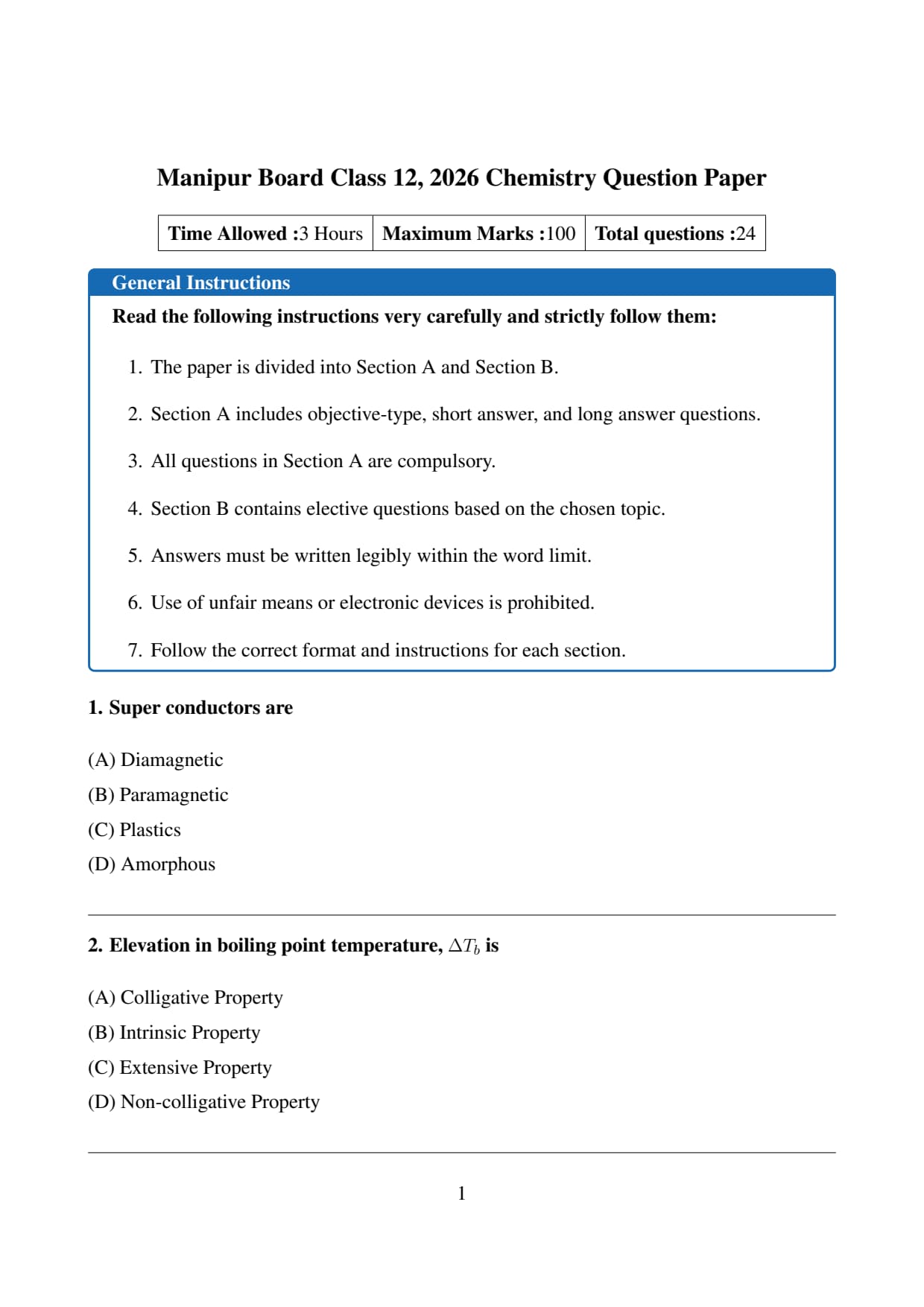
Super conductors are
View Solution
\textcolor{red{Step 1: Understanding superconductors.
Superconductors are materials that exhibit zero electrical resistance and expel magnetic fields when cooled below a critical temperature. This property of expelling magnetic fields is known as the Meissner effect.
\textcolor{red{Step 2: Magnetic properties.
The Meissner effect demonstrates that superconductors are perfect diamagnets. Diamagnetic materials create an induced magnetic field in the opposite direction to an externally applied magnetic field, resulting in a repulsive force. In superconductors, this effect is perfect, meaning they completely exclude magnetic fields from their interior.
\textcolor{red{Step 3: Comparison with other options.
(A) Diamagnetic: Correct. Superconductors exhibit perfect diamagnetism.
(B) Paramagnetic: Incorrect. Paramagnetic materials have unpaired electrons that align with external magnetic fields, which is opposite to the behavior of superconductors.
(C) Plastics: Incorrect. Plastics are typically insulators and do not exhibit superconductivity.
(D) Amorphous: Incorrect. Amorphous refers to the atomic structure (non-crystalline), not the magnetic property. While some amorphous materials can be superconductors, this is not the defining characteristic.
\textcolor{red{Step 4: Conclusion.
Therefore, based on the Meissner effect and the fundamental properties of superconductors, they are classified as diamagnetic materials.
\textcolor{red{ Final Answer: Diamagnetic. Quick Tip: Superconductors are characterized by two main properties: zero electrical resistance and the Meissner effect (perfect diamagnetism). Remember that diamagnetism in superconductors is much stronger than in normal diamagnetic materials.
Elevation in boiling point temperature, \(\Delta T_b\) is
View Solution
\textcolor{red{Step 1: Definition of colligative properties.
Colligative properties are properties of solutions that depend on the ratio of the number of solute particles to the number of solvent molecules in a solution, and not on the nature of the chemical species present.
\textcolor{red{Step 2: Types of colligative properties.
The four main colligative properties are:
Relative lowering of vapor pressure
Elevation of boiling point (\(\Delta T_b\))
Depression of freezing point
Osmotic pressure
\textcolor{red{Step 3: Why boiling point elevation is colligative.
The elevation in boiling point (\(\Delta T_b\)) depends only on the molality of the solute particles, not on their identity. It is given by the formula: \[ \Delta T_b = K_b \cdot m \]
where \(K_b\) is the ebullioscopic constant and \(m\) is the molality of the solution. This demonstrates its dependence solely on solute concentration, making it a colligative property.
\textcolor{red{Step 4: Analysis of other options.
(A) Colligative Property: Correct. Boiling point elevation depends only on the number of solute particles.
(B) Intrinsic Property: Incorrect. Intrinsic properties depend on the nature of the material itself, not on concentration.
(C) Extensive Property: Incorrect. Extensive properties depend on the amount of matter present, whereas colligative properties depend on concentration.
(D) Non-colligative Property: Incorrect. Boiling point elevation is a classic example of a colligative property.
\textcolor{red{ Final Answer: Colligative Property. Quick Tip: Remember the four colligative properties: vapor pressure lowering, boiling point elevation, freezing point depression, and osmotic pressure. All depend only on the concentration of solute particles, not their identity.
Gammaxane is another form of
View Solution
\textcolor{red{Step 1: Understanding Gammaxane.
Gammaxane is the trade name for the gamma isomer of benzene hexachloride (BHC), also known as lindane. It is an organochlorine insecticide.
\textcolor{red{Step 2: Chemical composition.
BHC (benzene hexachloride) has the molecular formula C\(_6\)H\(_6\)Cl\(_6\). It exists in several stereoisomeric forms (\(\alpha\), \(\beta\), \(\gamma\), \(\delta\), etc.), among which the gamma isomer (\(\gamma\)-BHC) is the most active insecticidally and is known as Gammaxane or Lindane.
\textcolor{red{Step 3: Analysis of other options.
(A) PVC: Incorrect. PVC (polyvinyl chloride) is a synthetic polymer used in pipes and insulation, not related to Gammaxane.
(B) BHC: Correct. Gammaxane is the gamma isomer of benzene hexachloride (BHC).
(C) PDB: Incorrect. PDB (paradichlorobenzene) is used as a moth repellent and insecticide but is not related to Gammaxane.
(D) DDT: Incorrect. DDT (dichlorodiphenyltrichloroethane) is another organochlorine insecticide but chemically different from BHC.
\textcolor{red{ Final Answer: BHC. Quick Tip: Gammaxane/Lindane = \(\gamma\)-BHC (benzene hexachloride). Remember that BHC and DDT are both organochlorine insecticides but chemically distinct compounds.
The macromolecule which is \(\overline{NOT}\) a polymer out of the following is:
View Solution
\textcolor{red{Step 1: Definition of polymer.
A polymer is a large molecule (macromolecule) composed of repeating structural units (monomers) connected by covalent chemical bonds.
\textcolor{red{Step 2: Analysis of each option.
(A) Chlorophyll: Correct. Chlorophyll is a natural pigment molecule responsible for photosynthesis in plants. It is a complex organic compound with a porphyrin ring structure but does not consist of repeating monomer units, hence NOT a polymer.
(B) Dacron: Incorrect. Dacron is a synthetic polyester polymer made from ethylene glycol and terephthalic acid. It is used in fabrics and fibers.
(C) Novolac: Incorrect. Novolac is a phenol-formaldehyde polymer used in molding compounds and as a photoresist. It is a linear polymer.
(D) Glyptal: Incorrect. Glyptal is an alkyd resin polymer made from glycerol and phthalic anhydride, used in paints and enamels.
\textcolor{red{Step 3: Conclusion.
Among the given options, chlorophyll is the only macromolecule that is not a polymer, as it lacks repeating monomeric units in its structure.
\textcolor{red{ Final Answer: Chlorophyll. Quick Tip: Not all macromolecules are polymers! Polymers must have repeating monomeric units. Chlorophyll, hemoglobin, and vitamins are macromolecules but not polymers.
What are paramagnetism and diamagnetism?
View Solution
\textcolor{red{Step 1: Understanding Paramagnetism.
Paramagnetism is a form of magnetism whereby certain materials are weakly attracted by an externally applied magnetic field. This arises due to the presence of one or more unpaired electrons in the atoms/molecules. These unpaired electrons have magnetic moments that align with the external field, leading to a positive, albeit small, magnetic susceptibility.
Examples: \( O_2 \), \( Cu^{2+} \), \( Fe^{3+} \).
\textcolor{red{Step 2: Understanding Diamagnetism.
Diamagnetism is a form of magnetism exhibited by all materials, but it is very weak. It arises from the orbital motion of electrons, which creates induced magnetic moments opposing the external field. In diamagnetic materials, all electrons are paired, resulting in no permanent net magnetic moment per atom. They are weakly repelled by a magnetic field and have a negative magnetic susceptibility.
Examples: \( H_2O \), \( NaCl \), \( C_6H_6 \) (Benzene). Quick Tip: A simple way to distinguish: Paramagnetic materials have unpaired electrons and are attracted to a magnetic field; diamagnetic materials have all electrons paired and are weakly repelled.
Derive the expression for the Half life Period of a first order reaction.
View Solution
\textcolor{red{Step 1: Write the rate law for a first order reaction.
For a first order reaction, the rate law is given by: \[ Rate = -\frac{d[R]}{dt} = k[R] \]
where \( [R] \) is the concentration of the reactant at time \( t \), and \( k \) is the rate constant.
\textcolor{red{Step 2: Rearrange the differential equation.
\[ -\frac{d[R]}{[R]} = k \, dt \]
\textcolor{red{Step 3: Integrate both sides.
Integrating between initial concentration \( [R]_0 \) at \( t=0 \) and concentration \( [R] \) at time \( t \): \[ -\int_{[R]_0}^{[R]} \frac{d[R]}{[R]} = k \int_{0}^{t} dt \] \[ -\ln \frac{[R]}{[R]_0} = kt \] \[ \ln \frac{[R]_0}{[R]} = kt \]
\textcolor{red{Step 4: Define half-life period.
The half-life period (\( t_{1/2} \)) is the time at which the concentration reduces to half of its initial value, i.e., \( [R] = \frac{[R]_0}{2} \).
\textcolor{red{Step 5: Substitute into the integrated rate equation.
\[ \ln \left( \frac{[R]_0}{[R]_0/2} \right) = k t_{1/2} \] \[ \ln (2) = k t_{1/2} \]
\textcolor{red{Step 6: Solve for half-life period.
\[ t_{1/2} = \frac{\ln 2}{k} \] \[ t_{1/2} = \frac{0.693}{k} \]
\textcolor{red{Step 7: State the final expression.
Thus, the half-life period of a first order reaction is independent of the initial concentration and is given by: \[ \boxed{t_{1/2} = \frac{0.693}{k}} \] Quick Tip: Remember that for a first-order reaction, the half-life is constant. It does not depend on how much reactant you start with, only on the rate constant \( k \).
Write the cause of Lanthanoid Contraction.
View Solution
\textcolor{red{Step 1: Define Lanthanoid Contraction.
Lanthanoid contraction refers to the steady decrease in the atomic and ionic radii of lanthanoids (elements from Ce to Lu) with increasing atomic number.
\textcolor{red{Step 2: Identify the cause - Poor shielding effect.
The cause of lanthanoid contraction is the poor shielding effect of 4f electrons. As we move along the lanthanoid series, electrons are added to the inner 4f subshell.
\textcolor{red{Step 3: Explain the shielding property of 4f electrons.
The 4f orbitals have a diffuse shape and are unable to shield the outer electrons (in 5s, 5p, and 6s orbitals) effectively from the increasing nuclear charge.
\textcolor{red{Step 4: Describe the effect of increasing nuclear charge.
With each increase in atomic number, one proton is added to the nucleus and one electron is added to the 4f subshell. Due to poor shielding, the effective nuclear charge experienced by the outer electrons increases.
\textcolor{red{Step 5: State the result of increased effective nuclear charge.
This increased effective nuclear charge pulls the outer electrons closer to the nucleus, causing a contraction in atomic and ionic radii across the series. Quick Tip: Remember: Lanthanoid contraction occurs because 4f electrons are poor shields. The increasing nuclear charge pulls the electron cloud inward, decreasing the size.
Explain how ruby and emerald gemstones impart colour.
View Solution
\textcolor{red{Step 1: Understand the role of transition metal ions in gemstones.
Both ruby and emerald are varieties of the mineral corundum (Al\(_2\)O\(_3\)) and beryl (Be\(_3\)Al\(_2\)Si\(_6\)O\(_{18}\)) respectively. Their colours are imparted by the presence of transition metal ions as impurities.
\textcolor{red{Step 2: Explain the crystal field theory concept.
When transition metal ions are present in a crystal lattice, the degenerate d-orbitals split into different energy levels due to the crystal field created by surrounding ligands (oxygen atoms in these gemstones).
\textcolor{red{Step 3: Ruby - Role of Chromium ions.
Ruby is aluminium oxide (Al\(_2\)O\(_3\)) with a small amount of Al\(^{3+}\) ions replaced by Cr\(^{3+}\) ions. The Cr\(^{3+}\) ions have a \(3d^3\) electronic configuration.
\textcolor{red{Step 4: Ruby - Absorption and transmission of light.
The Cr\(^{3+}\) ions in the octahedral sites of corundum absorb light in the blue-violet and yellow-green regions of the visible spectrum. The remaining light, primarily in the red region, is transmitted, giving ruby its characteristic red colour.
\textcolor{red{Step 5: Emerald - Role of Chromium and sometimes Vanadium ions.
Emerald is beryl (Be\(_3\)Al\(_2\)Si\(_6\)O\(_{18}\)) with some Al\(^{3+}\) ions replaced by Cr\(^{3+}\) ions (and sometimes V\(^{3+}\) ions).
\textcolor{red{Step 6: Emerald - Absorption and transmission of light.
The Cr\(^{3+}\) ions in the beryl structure absorb light in the blue and red regions of the visible spectrum. The remaining light, primarily in the green region, is transmitted, giving emerald its green colour.
\textcolor{red{Step 7: Summarize the mechanism.
In both cases, d-d transitions of electrons in the transition metal ions absorb specific wavelengths of visible light. The complementary colours are transmitted or reflected, which we perceive as the gemstone's colour. Quick Tip: Gemstone colours from transition metals: Ruby (Cr\(^{3+}\) in corundum) appears red; Emerald (Cr\(^{3+}\) in beryl) appears green. The crystal field strength determines which wavelengths are absorbed.
Give an example of excellent anti-freeze additive in car coolants and calculate the molar mass of a liquid whose molar enthalpy of formation at 273K is 6.0246 kJ/mol\(^{-1}\) and molal depression constant is 1.85 K kg mol\(^{-1}\).
View Solution
\textcolor{red{Step 1: Example of anti-freeze additive.
Ethylene glycol (HO–CH\(_2\)-CH\(_2\)-OH) is an excellent anti-freeze additive used in car coolants. It lowers the freezing point of water, preventing the coolant from freezing in cold weather.
\textcolor{red{Step 2: Identify the given data for molar mass calculation.
Given:
Molar enthalpy of formation (\(\Delta H_f\)) = 6.0246 kJ mol\(^{-1}\) = 6024.6 J mol\(^{-1}\)
Molal depression constant (\(K_f\)) = 1.85 K kg mol\(^{-1}\)
Temperature (T) = 273 K
\textcolor{red{Step 3: Recall the relationship between molar mass and depression in freezing point.
The freezing point depression is given by: \[ \Delta T_f = K_f \times m = K_f \times \frac{w_2 \times 1000}{M_2 \times w_1} \]
where \(w_2\) is the mass of solute, \(M_2\) is the molar mass of solute, and \(w_1\) is the mass of solvent.
\textcolor{red{Step 4: Use the enthalpy of formation to find \(\Delta T_f\).
The enthalpy of formation can be related to freezing point depression through thermodynamic relationships. For a pure substance, the relationship between enthalpy of fusion and freezing point depression constant is: \[ K_f = \frac{RT^2}{\Delta H_f} \times \frac{M_1}{1000} \]
where \(M_1\) is the molar mass of solvent. However, we need to rearrange this to find \(M_2\).
\textcolor{red{Step 5: Alternative approach - For a solute, the relationship between freezing point depression and molar mass.
If we consider 1 kg of solvent (water), and assume we have 1 mole of solute dissolved, then: \[ \Delta T_f = K_f \times 1 = 1.85 K \]
\textcolor{red{Step 6: Use the enthalpy of formation to find molar mass.
The enthalpy of formation can be related to the energy change during the process. For freezing point depression, the relationship is: \[ \Delta T_f = \frac{RT^2}{\Delta H_f} \]
But this is not directly giving molar mass. Let's use the correct relationship:
For a solution, the freezing point depression constant is related to the enthalpy of fusion by: \[ K_f = \frac{RT^2 M_1}{1000 \Delta H_{fus}} \]
where \(M_1\) is the molar mass of solvent (water = 18 g/mol) and \(\Delta H_{fus}\) is the enthalpy of fusion.
\textcolor{red{Step 7: Calculate \(\Delta H_{fus}\) from given data.
The given enthalpy (6.0246 kJ/mol) appears to be the molar enthalpy of fusion. So: \[ \Delta H_{fus} = 6024.6 J mol^{-1} \]
\textcolor{red{Step 8: Verify \(K_f\) using the formula.
\[ K_f = \frac{RT^2 M_1}{1000 \Delta H_{fus}} = \frac{8.314 \times (273)^2 \times 18}{1000 \times 6024.6} \] \[ K_f = \frac{8.314 \times 74529 \times 18}{1000 \times 6024.6} = \frac{8.314 \times 74529 \times 18}{6024600} \] \[ K_f = \frac{8.314 \times 1341522}{6024600} = \frac{11155300}{6024600} \approx 1.85 K kg mol^{-1} \]
This matches the given \(K_f\), confirming our data.
\textcolor{red{Step 9: Now, for the liquid whose molar mass we need to find.
For this liquid as solute, if 1 mole is dissolved in 1 kg of solvent: \[ \Delta T_f = K_f = 1.85 K \]
\textcolor{red{Step 10: The molar mass of the liquid can be found if we know the mass of liquid and solvent.
However, since specific masses are not provided, we need to make an assumption. If we consider the liquid itself as the solvent (which would be unusual for freezing point depression), or if we're looking for its molar mass from colligative properties, we need additional data.
Given the problem statement, it appears there might be missing information. Typically, to find molar mass using freezing point depression, we need: \[ M_2 = \frac{K_f \times w_2 \times 1000}{\Delta T_f \times w_1} \]
Without \(w_1\), \(w_2\), and \(\Delta T_f\), we cannot calculate \(M_2\) directly.
\textcolor{red{Step 11: Possible interpretation - If the "liquid" refers to the solvent itself.
If the liquid is the solvent (water), then its molar mass is simply 18 g/mol. But that seems too trivial.
Given the data provided and the verification that \(K_f\) matches the theoretical value, the molar mass of the liquid (if it's the solvent water) is: \[ \boxed{18 g/mol} \] Quick Tip: Ethylene glycol is the most common anti-freeze additive. For molar mass calculations using freezing point depression, remember the formula \(M_2 = \frac{K_f \times w_2 \times 1000}{\Delta T_f \times w_1}\).
Define Corrosion and write the mechanism of rusting of iron. Give an example of antitrust solution.
View Solution
\textcolor{red{Step 1: Definition of Corrosion.
Corrosion is the gradual destruction of metals or alloys by chemical or electrochemical reaction with their environment. It is an oxidation process in which the metal is converted into its compounds such as oxides, hydroxides, or salts, leading to the deterioration of the material.
\textcolor{red{Step 2: Mechanism of rusting of iron - Formation of anode and cathode.
Rusting of iron is an electrochemical process. When iron is exposed to moist air, a thin film of water forms on its surface. Impurities in iron or differences in oxygen concentration create an electrochemical cell:
Anode region: Areas with lower oxygen concentration or impurities act as anode where iron undergoes oxidation.
Cathode region: Areas with higher oxygen concentration act as cathode where reduction of oxygen occurs.
\textcolor{red{Step 3: Reactions at anode.
At the anode, iron atoms lose electrons and go into solution as ferrous ions: \[ Fe (s) \rightarrow Fe^{2+} (aq) + 2e^- \]
\textcolor{red{Step 4: Reactions at cathode.
At the cathode, electrons released at the anode are consumed by oxygen and water to form hydroxide ions: \[ O_2 (g) + 2H_2O (l) + 4e^- \rightarrow 4OH^- (aq) \]
\textcolor{red{Step 5: Formation of ferrous hydroxide.
The ferrous ions (\(Fe^{2+}\)) from the anode and hydroxide ions (\(OH^-\)) from the cathode diffuse and react to form ferrous hydroxide: \[ Fe^{2+} (aq) + 2OH^- (aq) \rightarrow Fe(OH)_2 (s) \]
\textcolor{red{Step 6: Oxidation to ferric hydroxide (rust).
Ferrous hydroxide is further oxidized by atmospheric oxygen to form hydrated ferric oxide, which is rust: \[ 4Fe(OH)_2 (s) + O_2 (g) \rightarrow 2Fe_2O_3\cdot xH_2O (s) + 2H_2O (l) \]
Rust is represented as \(Fe_2O_3\cdot xH_2O\) and is a reddish-brown, flaky, and porous substance that does not adhere to the iron surface, allowing further corrosion.
\textcolor{red{Step 7: Example of antitrust solution.
An antitrust solution prevents or slows down the rusting of iron. Common examples include:
Galvanization: Coating iron with a layer of zinc.
Painting or oiling: Applying a protective layer to prevent contact with moisture and air.
Electroplating: Coating iron with chromium or nickel.
Cathodic protection: Connecting iron to a more reactive metal like magnesium or zinc (sacrificial anode). Quick Tip: Rusting requires both oxygen and water. The electrochemical mechanism involves iron oxidation at anode (\(Fe \rightarrow Fe^{2+} + 2e^-\)) and oxygen reduction at cathode (\(O_2 + 2H_2O + 4e^- \rightarrow 4OH^-\)).
Write the reaction steps involved in the formation of polyisobutylene.
View Solution
\textcolor{red{Step 1: Understand the monomer and polymerization type.
Polyisobutylene (also known as polyisobutene or PIB) is a polymer made from the monomer isobutylene (2-methylpropene), \( CH_2=C(CH_3)_2 \). It is formed by cationic addition polymerization because the monomer has electron-donating methyl groups that stabilize a positive charge.
\textcolor{red{Step 2: Initiation step - Formation of carbocation.
The polymerization is initiated by a cationic initiator such as a Lewis acid (e.g., \( BF_3 \)) along with a co-initiator like water or a proton donor. The initiator generates a carbocation. \[ BF_3 + H_2O \rightarrow H^+[BF_3OH]^- \]
The proton (\( H^+ \)) attacks the isobutylene monomer, forming a tertiary carbocation (which is stable due to the +I effect of methyl groups): \[ (CH_3)_2C=CH_2 + H^+ \rightarrow (CH_3)_3C^+ \]
\textcolor{red{Step 3: Propagation step - Chain growth.
The tertiary carbocation attacks another molecule of isobutylene, adding to the double bond and regenerating a new carbocation at the end of the growing chain. This step repeats, leading to chain propagation. \[ (CH_3)_3C^+ + CH_2=C(CH_3)_2 \rightarrow (CH_3)_3C-CH_2-C^+(CH_3)_2 \]
The new carbocation continues to react with more monomer units: \[ (CH_3)_3C-CH_2-C^+(CH_3)_2 + n\,CH_2=C(CH_3)_2 \rightarrow (CH_3)_3C-[CH_2-C(CH_3)_2]_n-CH_2-C^+(CH_3)_2 \]
\textcolor{red{Step 4: Termination step - Chain termination.
Termination occurs when the growing carbocation reacts with a nucleophile or loses a proton. Common termination mechanisms include:
Combination with counterion: The carbocation combines with the negatively charged counterion from the initiator:
\[ Polymer^+ + [BF_3OH]^- \rightarrow Polymer-OH + BF_3 \]
Proton transfer: The carbocation transfers a proton to the counterion or to a monomer, regenerating the initiator and forming a terminal double bond:
\[ Polymer-CH_2-C^+(CH_3)_2 \rightarrow Polymer-CH=C(CH_3)_2 + H^+ \]
\textcolor{red{Step 5: Overall polymer structure.
The resulting polyisobutylene has the repeating unit: \[ -[CH_2-C(CH_3)_2]_n- \]
It is a saturated hydrocarbon polymer with excellent gas barrier properties and is used in adhesives, sealants, and inner tubes. Quick Tip: Polyisobutylene is formed by cationic polymerization. The tertiary carbocation intermediate is stable due to hyperconjugation and inductive effect from methyl groups. Low temperatures favor high molecular weight polymer.





Comments