




Manipur Board is conducting the Class 12 Education Board Exam 2026 on February 24, 2026. Class 12 Education Question Paper with Solution PDF is available here for download.
The official question paper of Manipur Board Class 12 Education Board Exam 2026 is provided below. Students can download the official paper in PDF format for reference.
Manipur Board Class 12, 2026 Education Question Paper with Solution PDF - Memory Based
| Manipur Board Class 12 Education Question Paper 2026 | Download PDF | Check Solutions |
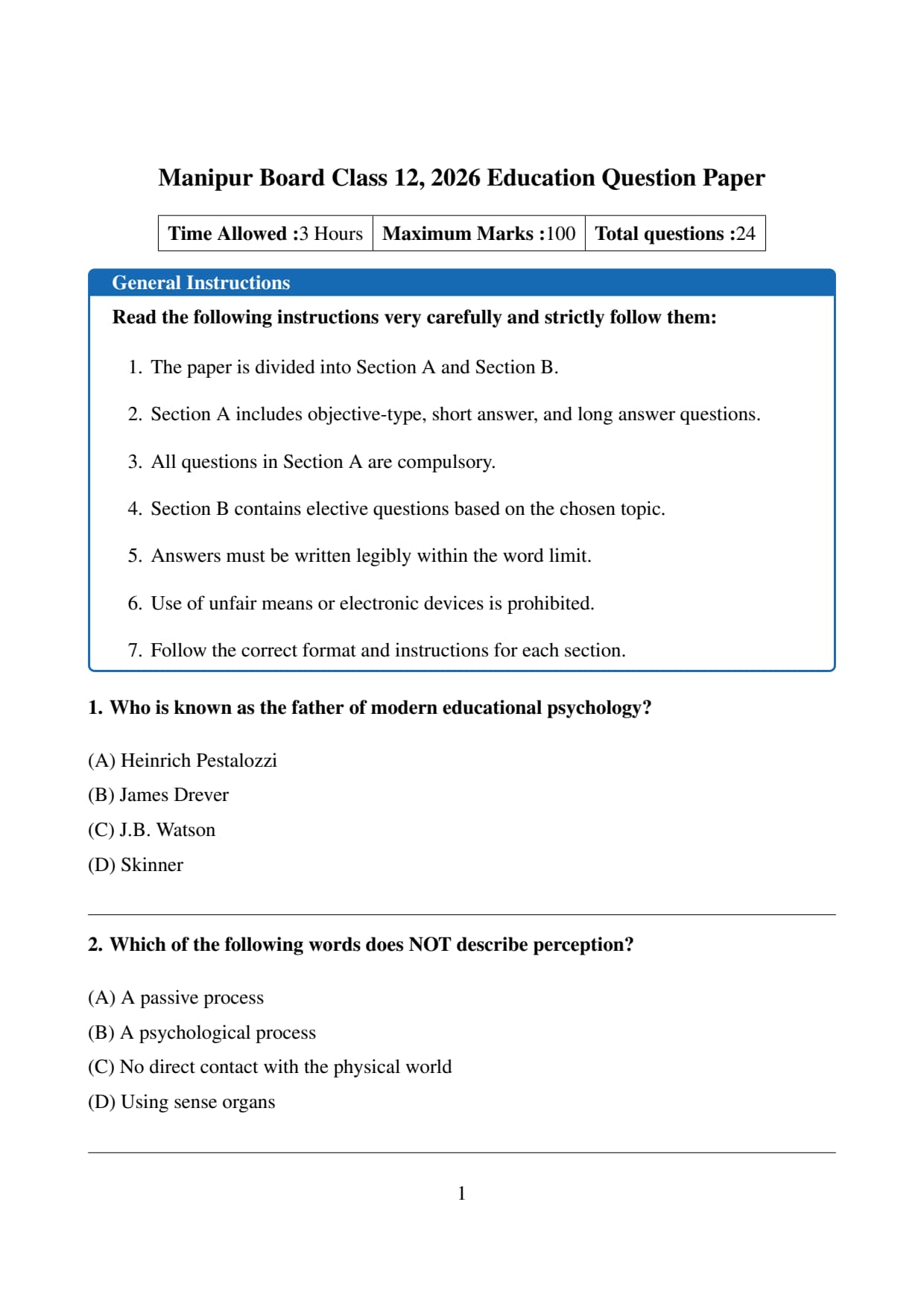
Who is known as the father of modern educational psychology?
View Solution
\textcolor{red{Step 1: Understanding educational psychology.
Educational psychology is the branch of psychology concerned with the scientific study of human learning and development in educational settings.
\textcolor{red{Step 2: Heinrich Pestalozzi's contribution.
Johann Heinrich Pestalozzi (1746-1827) was a Swiss pedagogue and educational reformer who emphasized child-centered education and the importance of psychological principles in teaching. He is widely regarded as the "father of modern educational psychology" because he integrated psychological concepts into educational practice and emphasized the natural development of the child.
\textcolor{red{Step 3: Analysis of other options.
(A) Heinrich Pestalozzi: Correct. His methods and philosophy laid the foundation for modern educational psychology.
(B) James Drever: Incorrect. James Drever was a Scottish psychologist known for his work in experimental psychology, but not considered the father of modern educational psychology.
(C) J.B. Watson: Incorrect. John B. Watson founded behaviorism but focused primarily on observable behavior rather than educational psychology specifically.
(D) Skinner: Incorrect. B.F. Skinner contributed to behaviorism and operant conditioning but came later and is not considered the founder of educational psychology.
\textcolor{red{ Final Answer: (A) Heinrich Pestalozzi. Quick Tip: Remember: Pestalozzi emphasized "learning by head, heart, and hands" and believed in following the natural development of the child.
Which of the following words does NOT describe perception?
View Solution
\textcolor{red{Step 1: Definition of perception.
Perception is the process by which individuals organize and interpret their sensory impressions to give meaning to their environment. It is an active, psychological process involving the selection, organization, and interpretation of sensory information.
\textcolor{red{Step 2: Key characteristics of perception.
Perception is an active process, not passive.
It involves sense organs (eyes, ears, etc.) to receive sensory input.
It is a psychological process that involves interpretation and meaning-making.
It requires contact with the physical world through sensations.
\textcolor{red{Step 3: Analysis of each option.
(A) A passive process: \textcolor{red{Correct answer choice. Perception is NOT passive; it requires active interpretation and organization by the brain. This option does NOT describe perception.
(B) A psychological process: Incorrect choice. Perception IS a psychological process involving cognitive functions.
(C) No direct contact with the physical world: Incorrect choice. Perception begins with sensory contact with the physical world through sense organs.
(D) Using sense organs: Incorrect choice. Perception DOES involve using sense organs to receive sensory information.
\textcolor{red{Step 4: Conclusion.
Since perception is an active process requiring interpretation, the option that describes it as "a passive process" is incorrect and therefore the answer.
\textcolor{red{ Final Answer: (A) A passive process. Quick Tip: Perception is active, selective, and interpretive. It involves both bottom-up (sensory) and top-down (cognitive) processing.
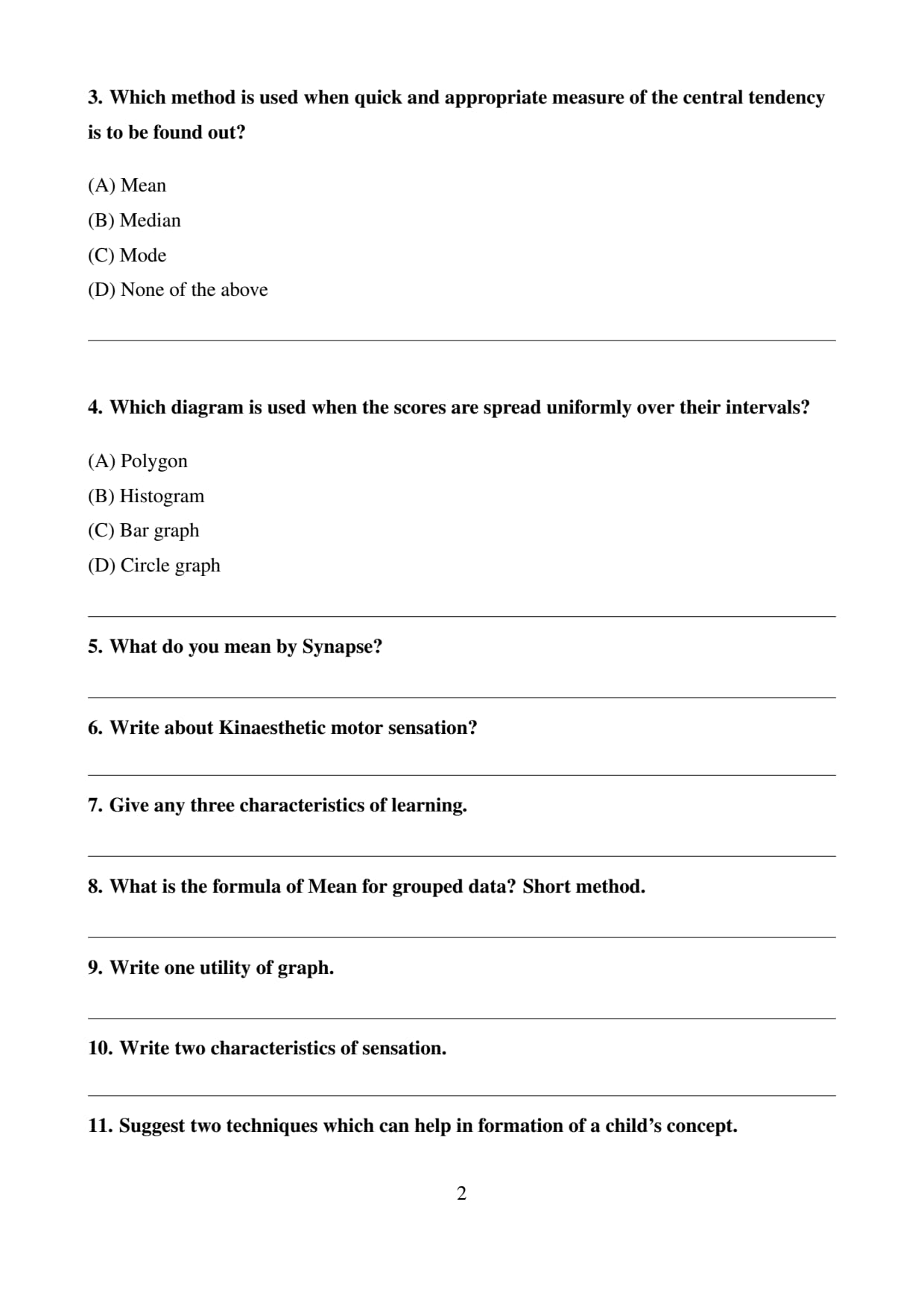
Which method is used when quick and appropriate measure of the central tendency is to be found out?
View Solution
\textcolor{red{Step 1: Understanding measures of central tendency.
Measures of central tendency are statistical values that represent the center or typical value of a dataset. The three main measures are mean, median, and mode.
\textcolor{red{Step 2: Characteristics of each measure.
Mean: The arithmetic average; requires calculation using all values; time-consuming for large datasets.
Median: The middle value when data is arranged in order; requires sorting of data.
Mode: The most frequently occurring value; can be determined by quick inspection without calculation.
\textcolor{red{Step 3: Identifying the quickest measure.
When a quick and appropriate measure of central tendency is needed, the mode is the most suitable because:
It can be found by simple observation or inspection
No mathematical calculations are required
It is particularly useful for categorical data
It gives the most typical or common value immediately
\textcolor{red{Step 4: Analysis of options.
(A) Mean: Incorrect. Calculating the mean requires adding all values and dividing by the number of values, which is time-consuming.
(B) Median: Incorrect. Finding the median requires arranging data in ascending or descending order, which takes time.
(C) Mode: Correct. The mode can be identified quickly by looking for the most frequent value in the dataset.
(D) None of the above: Incorrect. Since mode serves this purpose, this option is not valid.
\textcolor{red{ Final Answer: (C) Mode. Quick Tip: Use mode for quick estimates and for nominal/categorical data. Use mean for interval/ratio data without extreme outliers. Use median when outliers are present or for ordinal data.
Which diagram is used when the scores are spread uniformly over their intervals?
View Solution
\textcolor{red{Step 1: Understanding different types of diagrams.
Various graphical representations are used in statistics to display data distributions, including histograms, frequency polygons, bar graphs, and circle graphs (pie charts).
\textcolor{red{Step 2: Characteristics of a histogram.
A histogram is a graphical representation of a frequency distribution for continuous data. Key features include:
Bars are adjacent (touching each other) with no gaps
The area of each bar represents the frequency
Used for grouped continuous data
Shows the distribution of data over continuous intervals
Particularly effective when scores are spread uniformly over intervals
\textcolor{red{Step 3: Analysis of each option.
(A) Polygon: Incorrect. A frequency polygon uses lines connecting points above class midpoints; it's useful for comparing distributions but not specifically for uniform spread over intervals.
(B) Histogram: Correct. Histograms are specifically designed to show how data is distributed across continuous intervals, making them ideal when scores are spread uniformly over their intervals.
(C) Bar graph: Incorrect. Bar graphs are used for categorical/discrete data with gaps between bars; they don't represent continuous interval data effectively.
(D) Circle graph: Incorrect. Circle graphs (pie charts) show parts of a whole (percentages) and are not suitable for displaying score distribution over intervals.
\textcolor{red{Step 4: Conclusion.
When scores are spread uniformly over their intervals, a histogram is the most appropriate diagram as it visually represents the frequency distribution across continuous class intervals with adjacent bars.
\textcolor{red{ Final Answer: (B) Histogram. Quick Tip: Histograms = continuous data, bars touch; Bar graphs = discrete/categorical data, bars have gaps; Frequency polygons = line graph for trend comparison; Pie charts = parts of a whole.
What do you mean by Synapse?
View Solution
\textcolor{red{Step 1: Definition of Synapse.
A synapse is the specialized junction between two neurons or between a neuron and an effector cell (such as a muscle or gland cell) where nerve impulses are transmitted from one cell to another. It is not a physical connection but a microscopic gap that allows for communication between neurons.
\textcolor{red{Step 2: Structure of a synapse.
A typical synapse consists of three main components:
Presynaptic terminal: The swollen end of an axon that contains synaptic vesicles filled with neurotransmitters.
Synaptic cleft: The narrow gap (about 20-40 nm wide) between the presynaptic and postsynaptic membranes.
Postsynaptic membrane: The membrane of the dendrite or cell body of the next neuron, containing receptor proteins.
\textcolor{red{Step 3: Types of synapses.
Synapses can be classified into two main types:
Chemical synapse: Most common type. Impulse transmission occurs through chemical messengers called neurotransmitters.
Electrical synapse: Less common. Direct physical connection through gap junctions allows ionic current to flow directly from one neuron to another.
\textcolor{red{Step 4: Mechanism of synaptic transmission (Chemical synapse).
When an action potential reaches the presynaptic terminal:
Voltage-gated calcium channels open, allowing \( Ca^{2+} \) ions to enter.
Increased \( Ca^{2+} \) causes synaptic vesicles to fuse with the presynaptic membrane.
Neurotransmitters are released into the synaptic cleft by exocytosis.
Neurotransmitters diffuse across the cleft and bind to specific receptors on the postsynaptic membrane.
This binding opens ion channels, causing either depolarization (excitatory) or hyperpolarization (inhibitory) of the postsynaptic membrane.
\textcolor{red{Step 5: Importance of synapse.
Synapses are crucial for:
Directional transmission of nerve impulses (from presynaptic to postsynaptic neuron)
Integration of multiple signals (excitatory and inhibitory)
Memory formation and learning through synaptic plasticity
Filtering out background noise in neural circuits Quick Tip: Synapse = junction between neurons. Chemical synapses use neurotransmitters; electrical synapses use gap junctions. The synaptic cleft is the gap where chemical transmission occurs.
Write about Kinaesthetic motor sensation?
View Solution
\textcolor{red{Step 1: Definition of Kinaesthetic motor sensation.
Kinaesthetic motor sensation (or kinesthesia) is the sense that enables us to perceive the position, movement, and orientation of our body parts in space without relying on vision. It is often called the "muscle sense" or "movement sense."
\textcolor{red{Step 2: Components of kinaesthetic sensation.
Kinaesthetic sensation consists of two main components:
Position sense: Awareness of the static position of limbs and body parts.
Movement sense: Awareness of the direction, speed, and range of movement.
Force sense: Perception of the force or effort generated during muscle contraction.
\textcolor{red{Step 3: Receptors involved in kinaesthetic sensation.
Kinaesthetic information is detected by specialized sensory receptors called proprioceptors located in muscles, tendons, and joints:
Muscle spindles: Located within skeletal muscles, they detect changes in muscle length and the rate of stretching.
Golgi tendon organs: Located at the junction of muscles and tendons, they detect changes in muscle tension and force.
Joint receptors: Located in and around joint capsules, they detect joint position, angle, and movement.
Skin stretch receptors: Contribute to the perception of joint position, especially in fingers and hands.
\textcolor{red{Step 4: Neural pathway of kinaesthetic sensation.
Sensory information from proprioceptors travels to the brain through:
Spinal cord: Afferent neurons carry signals from receptors to the spinal cord.
Dorsal column-medial lemniscus pathway: Carries conscious proprioceptive information to the thalamus.
Thalamus: Relays information to the cerebral cortex.
Somatosensory cortex: Processes the information, creating awareness of body position and movement.
The spinocerebellar tract carries unconscious proprioceptive information to the cerebellum for coordination of movement.
\textcolor{red{Step 5: Importance of kinaesthetic sensation.
Kinaesthetic sensation is essential for:
Coordinated and smooth voluntary movements
Maintaining posture and balance
Performing fine motor skills (writing, playing instruments)
Learning new motor skills
Adjusting movements based on feedback without visual input
\textcolor{red{Step 6: Disorders related to kinaesthetic sensation.
Damage to kinaesthetic pathways can result in:
Sensory ataxia: Loss of coordination due to lack of proprioceptive feedback
Impaired movement control: Difficulty performing precise movements without visual guidance
Romberg's sign: Increased unsteadiness when standing with eyes closed Quick Tip: Kinaesthetic sensation = sense of body position and movement. Receptors: muscle spindles (muscle length), Golgi tendon organs (tension), joint receptors (position). Essential for coordinated movement without looking.
Give any three characteristics of learning.
View Solution
\textcolor{red{Step 1: Definition of learning.
Learning is a relatively permanent change in behavior, knowledge, or understanding that occurs as a result of experience, practice, or training. It involves the acquisition of new information or skills through experience.
\textcolor{red{Step 2: Characteristic 1 - Learning is a continuous process.
Learning begins at birth and continues throughout life. It is an ongoing process that occurs in various settings (school, home, workplace) and through various experiences. Every new experience provides an opportunity for learning, and the process never truly ends.
\textcolor{red{Step 3: Characteristic 2 - Learning involves change in behavior.
Learning results in a relatively permanent change in behavior, thoughts, or feelings. This change can be:
Observable (learning to ride a bicycle, speaking a new language)
Latent or hidden (change in attitude, beliefs, or understanding that may not be immediately visible)
The change must be relatively permanent; temporary changes due to fatigue, drugs, or illness are not considered learning.
\textcolor{red{Step 4: Characteristic 3 - Learning is an active process.
Learning requires active participation and engagement of the learner. It is not a passive reception of information but involves:
Attention and concentration
Processing and organizing information
Making connections with prior knowledge
Practice and reinforcement
Problem-solving and critical thinking
The learner must be mentally and often physically active for effective learning to occur.
\textcolor{red{Step 5: Additional characteristics (for reference).
Other important characteristics of learning include:
Learning is purposeful: Directed towards goals or satisfying needs
Learning is transferable: Skills learned in one situation can be applied to another
Learning is influenced by motivation: Motivated learners learn more effectively
Learning is individualistic: Each person learns at their own pace and style
Learning involves experience: Direct or indirect experiences form the basis of learning Quick Tip: Three key characteristics of learning: (1) Continuous process throughout life, (2) Relatively permanent change in behavior, (3) Active process requiring learner engagement. Learning = Experience + Change + Permanence.
What is the formula of Mean for grouped data? Short method.
View Solution
\textcolor{red{Step 1: Understanding grouped data.
Grouped data is data that has been organized into frequency distributions, where values are grouped into classes or intervals. For such data, we cannot use the simple arithmetic mean formula because individual values are not known.
\textcolor{red{Step 2: Define the terms used in the short method.
In the short method (also called the assumed mean method or step-deviation method), we use:
\( x_i \) = mid-value of each class interval
\( f_i \) = frequency of each class
\( A \) = assumed mean (usually the mid-value of any class)
\( d_i = x_i - A \) = deviation of mid-values from assumed mean
\( h \) = class size (width of class interval)
\( u_i = \frac{x_i - A}{h} = \frac{d_i}{h} \) = step deviation
\textcolor{red{Step 3: Short method formula for mean.
The formula for mean using the short method (step-deviation method) is: \[ \boxed{\bar{x} = A + \frac{\sum f_i u_i}{\sum f_i} \times h} \]
where:
\( A \) = assumed mean
\( \sum f_i \) = total frequency (N)
\( u_i = \frac{x_i - A}{h} \)
\( h \) = class size
\textcolor{red{Step 4: Alternative formula without step deviation.
If we use direct deviations without dividing by class size, the formula becomes: \[ \bar{x} = A + \frac{\sum f_i d_i}{\sum f_i} \]
where \( d_i = x_i - A \).
\textcolor{red{Step 5: Working rule for short method.
Choose any class mid-value as assumed mean \( A \) (preferably from the middle of the distribution).
Calculate \( d_i = x_i - A \) for each class.
Calculate \( u_i = \frac{d_i}{h} \) (where \( h \) is the class size).
Multiply each \( u_i \) by its corresponding frequency \( f_i \) and find \( \sum f_i u_i \).
Find total frequency \( \sum f_i \).
Apply the formula \( \bar{x} = A + \frac{\sum f_i u_i}{\sum f_i} \times h \).
\textcolor{red{Step 6: Example illustration.
For example, if we have class intervals with mid-values \( x_i \), assumed mean \( A = 25 \), class size \( h = 10 \), and we calculate \( \sum f_i u_i = 15 \) with \( \sum f_i = 50 \), then: \[ \bar{x} = 25 + \frac{15}{50} \times 10 = 25 + 3 = 28 \] Quick Tip: The short method (step-deviation) simplifies mean calculation for grouped data: \( \bar{x} = A + \frac{\sum f_i u_i}{\sum f_i} \times h \). Choose \( A \) wisely to make deviations small.
Write one utility of graph.
View Solution
\textcolor{red{Step 1: Understanding graphs in statistics.
A graph is a visual representation of data that shows relationships between variables, trends, patterns, and distributions. It transforms numerical data into a visual format that is easier to understand and interpret.
\textcolor{red{Step 2: Utility 1 - Visual presentation for quick understanding.
Graphs provide an immediate visual impression of data. They make complex data sets easier to comprehend at a glance compared to raw numbers or tables. For example, a line graph showing sales over months instantly reveals whether sales are increasing, decreasing, or fluctuating.
\textcolor{red{Step 3: Utility 2 - Identification of trends and patterns.
Graphs help in identifying trends, cycles, and patterns in data that might not be apparent from tabular data. For instance, a time series graph can show seasonal variations in temperature or stock market movements.
\textcolor{red{Step 4: Utility 3 - Comparison of data sets.
Multiple data sets can be plotted on the same graph for easy comparison. For example, bar graphs can compare the performance of different students or the sales of different products in the same period.
\textcolor{red{Step 5: Utility 4 - Forecasting and prediction.
By extending trend lines in graphs, we can make predictions about future values. This is widely used in business, economics, and scientific research.
\textcolor{red{Step 6: Utility 5 - Attracting attention and memorability.
Visual information is processed faster and remembered longer than textual information. Graphs make reports, presentations, and publications more engaging and impactful.
\textcolor{red{Step 7: One specific utility (as requested).
If we need to mention only one utility, the most fundamental one is: \[ \boxed{Graphs provide a visual representation of data that makes it easier to understand patterns, trends, and relationships at a glance.} \] Quick Tip: The main utility of graphs: They transform numerical data into visual form, revealing patterns and relationships that are difficult to see in tables, making data interpretation faster and more intuitive.
Write two characteristics of sensation.
View Solution
\textcolor{red{Step 1: Definition of Sensation.
Sensation is the process by which our sense organs (eyes, ears, skin, nose, tongue) receive and detect stimuli from the external environment and transmit this information to the brain. It is the raw data that forms the basis for perception.
\textcolor{red{Step 2: Characteristic 1 - Sensation requires a stimulus.
Sensation always requires the presence of a stimulus. A stimulus is any form of energy (light, sound, heat, pressure, chemical) that activates a sense organ. Without an adequate stimulus, sensation cannot occur. For example:
Light waves stimulate the eyes for vision
Sound waves stimulate the ears for hearing
Pressure or temperature stimulates the skin for touch
Each sense organ is specialized to respond to a particular type of stimulus (doctrine of specific nerve energies).
\textcolor{red{Step 3: Characteristic 2 - Sensation is a physical process.
Sensation is primarily a physiological or physical process. It involves:
Reception of stimulus by sense organs
Transduction (conversion of stimulus energy into electrical signals)
Transmission of nerve impulses along sensory neurons to the brain
Unlike perception, which involves interpretation and is psychological, sensation is mechanical and occurs automatically when a stimulus is present.
\textcolor{red{Step 4: Additional characteristics (for reference).
Other important characteristics of sensation include:
Thresholds: Sensation occurs only when the stimulus intensity is between absolute threshold (minimum detectable) and terminal threshold (maximum detectable).
Adaptation: Continuous stimulation leads to decreased sensitivity (e.g., getting used to a smell).
Modality: Different sensations have different qualities (e.g., sweet, sour in taste; warm, cold in temperature).
Intensity: Sensations vary in strength depending on stimulus intensity. Quick Tip: Two key characteristics: (1) Sensation requires an external stimulus (light, sound, etc.), (2) Sensation is a physiological process of detecting and transmitting sensory information to the brain.
Suggest two techniques which can help in formation of a child’s concept.
View Solution
\textcolor{red{Step 1: Understanding concept formation in children.
A concept is a mental representation or idea that helps children categorize objects, events, or ideas based on shared characteristics. Concept formation is the process by which children learn to identify, differentiate, and generalize these categories. It is fundamental to cognitive development.
\textcolor{red{Step 2: Technique 1 - Use of concrete examples and实物 (real objects).
Children learn concepts best when they can see, touch, and interact with real objects. This technique involves:
Showing actual objects rather than just pictures or descriptions
Allowing children to handle and explore objects
Providing multiple examples of the same concept
Using实物 (realia) to make abstract concepts concrete
For example, to teach the concept of "fruit," show children actual apples, bananas, and oranges. Let them hold, smell, and taste them. This multi-sensory experience helps form a clear and lasting concept.
\textcolor{red{Step 3: Technique 2 - Classification and sorting activities.
This technique involves providing children with a collection of objects or pictures and asking them to group similar items together. This helps children:
Identify common attributes
Discriminate between different categories
Understand hierarchical relationships
Develop logical thinking skills
For example, give children a set of pictures containing animals, vehicles, and furniture. Ask them to sort these into groups. Through this activity, they develop concepts of "animal," "vehicle," and "furniture" by identifying shared characteristics.
\textcolor{red{Step 4: Additional techniques (for reference).
Other effective techniques for concept formation include:
Storytelling and examples: Using stories that illustrate concepts
Questioning and discussion: Asking "what is this?" and "why?"
Drawing and art activities: Representing concepts visually
Games and puzzles: Making learning enjoyable and interactive
Field trips: Experiencing concepts in real-world settings Quick Tip: Two techniques: (1) Use concrete examples/real objects for hands-on experience, (2) Classification/sorting activities to identify common attributes. Children learn concepts through active exploration and categorization.
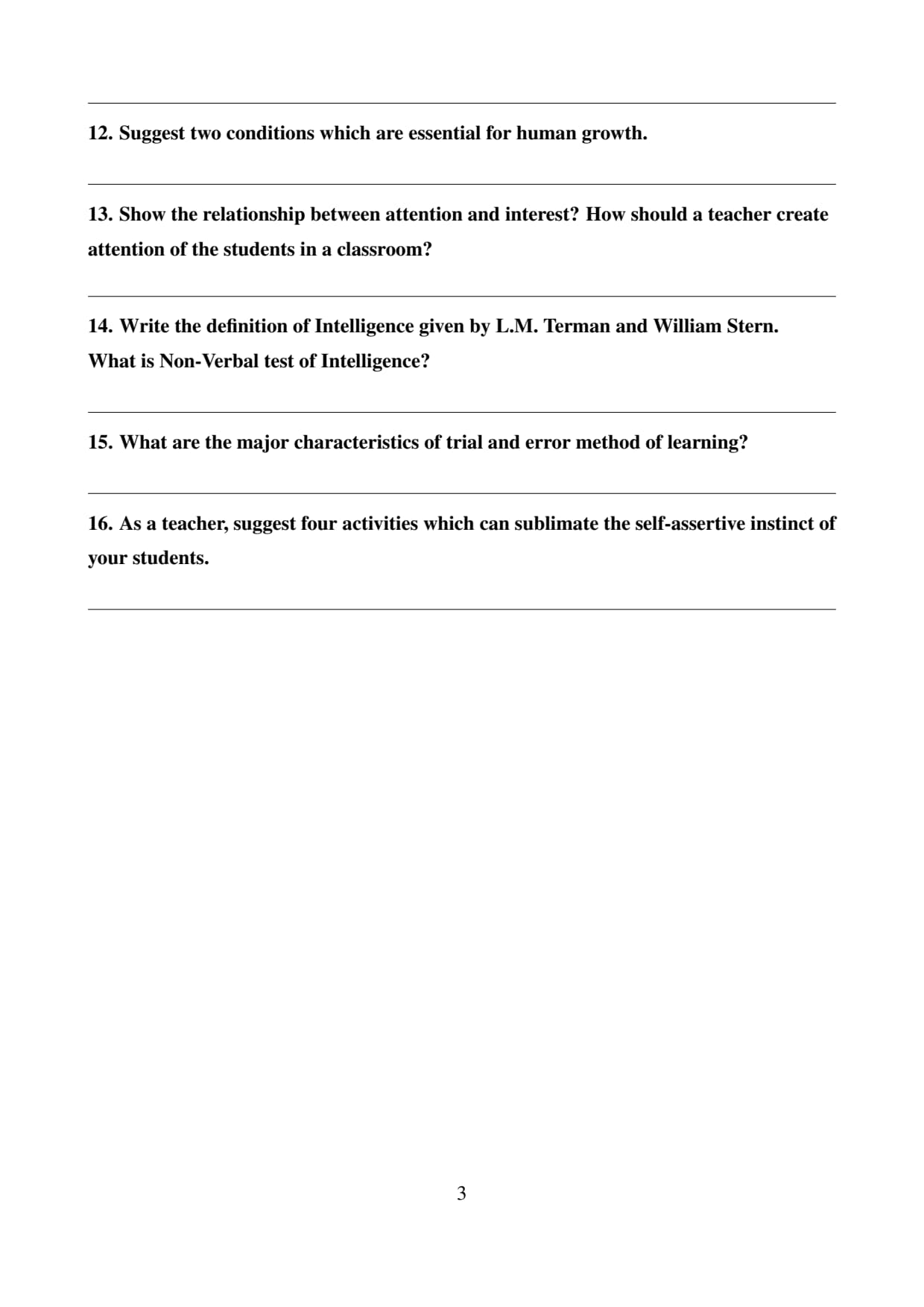
Suggest two conditions which are essential for human growth.
View Solution
\textcolor{red{Step 1: Understanding human growth.
Human growth refers to the physical increase in size, height, weight, and body proportions. It is quantitative in nature and is influenced by both genetic and environmental factors. Growth is a fundamental aspect of development from infancy through adolescence.
\textcolor{red{Step 2: Condition 1 - Adequate nutrition.
Proper nutrition is the most essential physical condition for growth. It includes:
Proteins: Building blocks for tissues, muscles, and organs
Carbohydrates and fats: Provide energy for growth processes
Vitamins and minerals: Essential for bone development (calcium, vitamin D), blood formation (iron), and various metabolic processes
Water: Crucial for all bodily functions
Malnutrition or undernutrition during childhood can lead to stunted growth, delayed development, and permanent physical impairments. Breast milk provides ideal nutrition for infants, while a balanced diet is essential for older children.
\textcolor{red{Step 3: Condition 2 - Hormonal balance.
Proper functioning of the endocrine system is essential for growth. Key hormones include:
Growth hormone (GH): Secreted by the pituitary gland, it directly stimulates growth of bones and tissues
Thyroid hormones: Regulate metabolic rate and are essential for normal growth and brain development
Sex hormones: (Testosterone, estrogen) Promote growth spurts during puberty
Insulin: Helps in utilization of nutrients for growth
Hormonal deficiencies (e.g., growth hormone deficiency, hypothyroidism) can result in growth disorders like dwarfism, while excess can cause gigantism or acromegaly.
\textcolor{red{Step 4: Additional essential conditions (for reference).
Other important conditions for growth include:
Genetics: Determines growth potential and ultimate height
Adequate sleep: Growth hormone is primarily secreted during deep sleep
Physical activity and exercise: Stimulates bone and muscle development
Healthy environment: Freedom from diseases, pollution, and stress
Emotional security and care: Stress and neglect can impair growth (psychosocial dwarfism) Quick Tip: Two essential conditions: (1) Adequate nutrition (proteins, vitamins, minerals) for physical development, (2) Hormonal balance (especially growth hormone and thyroid hormones) for regulating growth processes.
Show the relationship between attention and interest? How should a teacher create attention of the students in a classroom?
View Solution
\textcolor{red{Part 1: Relationship between Attention and Interest
\textcolor{red{Step 1: Define Attention and Interest.
Attention is the process of selectively focusing consciousness on a particular stimulus or object while ignoring others. It is the mental ability to concentrate on a specific task or information.
Interest is a feeling of liking or curiosity towards an activity, object, or subject. It is an intrinsic motivator that makes an individual want to engage with something.
\textcolor{red{Step 2: Interest attracts attention.
When a person is interested in something, their attention is automatically drawn towards it. For example, a student interested in science will naturally pay attention during a physics lesson. Interest acts as a magnet that pulls attention towards its object.
\textcolor{red{Step 3: Attention can create interest.
Sometimes, even if a student is not initially interested, sustained attention to a topic can gradually develop interest. As they understand more, curiosity grows, leading to interest. For example, a student who pays attention to a mathematics problem may eventually develop interest in solving such problems.
\textcolor{red{Step 4: Reciprocal relationship.
Attention and interest have a bidirectional or cyclic relationship:
Interest \(\rightarrow\) Attention (voluntary and sustained)
Attention \(\rightarrow\) Understanding \(\rightarrow\) Interest
They reinforce each other: More interest leads to better attention, and better attention leads to deeper interest
\textcolor{red{Step 5: Educational implications.
In teaching, this relationship means that teachers should:
Connect lessons to students' existing interests to capture attention
Use attention-grabbing methods to develop new interests
Create a positive cycle where attention and interest feed each other
\textcolor{red{Part 2: How a teacher can create attention in the classroom
\textcolor{red{Step 1: Use novelty and variety.
Novel stimuli automatically attract attention. Teachers can:
Use interesting teaching aids (models, charts, multimedia)
Vary teaching methods (lecture, discussion, activity, demonstration)
Change voice modulation, pace, and gestures
Introduce surprising facts or demonstrations
\textcolor{red{Step 2: Connect with students' interests and experiences.
Relate the lesson to students' daily lives, hobbies, and existing knowledge:
Use examples from their environment
Ask about their experiences related to the topic
Show how the topic is relevant to their lives and future
\textcolor{red{Step 3: Use questioning techniques.
Questions stimulate thinking and focus attention:
Start with thought-provoking questions
Ask questions throughout the lesson to keep students engaged
Use divergent questions that encourage multiple answers
Praise good responses to encourage participation
\textcolor{red{Step 4: Create a conducive classroom environment.
The physical and psychological environment affects attention:
Ensure proper lighting, ventilation, and comfortable seating
Minimize distractions (noise, outside interference)
Establish a positive and supportive classroom climate
Use appropriate voice level and clarity
\textcolor{red{Step 5: Use audio-visual aids and technology.
Multimedia elements capture and hold attention:
Use videos, animations, and PowerPoint presentations
Show models, charts, and diagrams
Use smart boards and educational apps
\textcolor{red{Step 6: Incorporate activities and participation.
Active involvement maintains attention:
Include hands-on activities and experiments
Use group discussions and collaborative learning
Encourage students to come to the board or demonstrate
Use games and role-play where appropriate
\textcolor{red{Step 7: Vary stimulus and avoid monotony.
Monotony leads to inattention:
Change activities every 10-15 minutes
Use a mix of individual and group work
Include breaks or movement activities for young learners
Use humor and anecdotes to refresh attention
\textcolor{red{Step 8: Provide clear goals and feedback.
Students pay attention when they know what is expected:
State learning objectives at the beginning
Give clear instructions
Provide regular feedback on performance
Recognize and reward attentive behavior Quick Tip: Attention and interest are reciprocal: interest attracts attention, and sustained attention creates interest. Teachers can create attention through novelty, relevance, questioning, activities, and a positive environment.
Write the definition of Intelligence given by L.M. Terman and William Stern.
What is Non-Verbal test of Intelligence?
View Solution
\textcolor{red{Part 1: Definition of Intelligence by L.M. Terman
\textcolor{red{Step 1: About L.M. Terman.
Lewis Madison Terman (1877-1956) was an American psychologist and pioneer in educational psychology. He is best known for revising the Stanford-Binet Intelligence Scales and for his longitudinal study of gifted children.
\textcolor{red{Step 2: Terman's definition of Intelligence.
L.M. Terman defined intelligence as: \[ \boxed{"Intelligence is the ability to think abstractly."} \]
According to Terman, an intelligent person can deal effectively with abstract ideas, symbols, concepts, and relationships. This ability to manipulate abstract concepts distinguishes intelligent individuals from others.
\textcolor{red{Step 3: Explanation of Terman's definition.
Terman emphasized that abstract thinking is the core of intelligence. This includes:
Understanding and using symbols (language, mathematics)
Grasping complex concepts and relationships
Solving problems through reasoning rather than trial and error
Thinking beyond concrete, immediate situations
His Stanford-Binet test heavily measures verbal and abstract reasoning abilities.
\textcolor{red{Part 2: Definition of Intelligence by William Stern
\textcolor{red{Step 1: About William Stern.
William Stern (1871-1938) was a German psychologist and philosopher who coined the term "Intelligence Quotient" (IQ). He made significant contributions to differential psychology and intelligence testing.
\textcolor{red{Step 2: Stern's definition of Intelligence.
William Stern defined intelligence as: \[ \boxed{"Intelligence is the general capacity of an individual to consciously adjust his thinking to new requirements."} \]
\textcolor{red{Step 3: Explanation of Stern's definition.
Stern's definition emphasizes:
General capacity: Intelligence is not specific to one area but a overall mental ability
Conscious adjustment: Intelligent behavior involves deliberate, aware adaptation
New requirements: Intelligence is tested by novel situations, not routine tasks
Adaptability: The ability to modify thinking to meet changing demands
Stern viewed intelligence as adaptive thinking - how well a person can adjust to new challenges and problems.
\textcolor{red{Step 4: Stern's contribution to IQ.
Stern proposed the concept of Mental Age (MA) and Chronological Age (CA) and formulated the Intelligence Quotient as: \[ IQ = \frac{Mental Age}{Chronological Age} \times 100 \]
\textcolor{red{Part 3: Non-Verbal Test of Intelligence
\textcolor{red{Step 1: Definition of Non-Verbal Test.
A non-verbal test of intelligence is an assessment tool that measures cognitive abilities without using language. It uses figures, pictures, patterns, and objects instead of words to assess intelligence, making it suitable for individuals with language barriers or communication difficulties.
\textcolor{red{Step 2: Purpose and need for non-verbal tests.
Non-verbal tests are used when:
Testing individuals with language or speech disabilities
Assessing people from different linguistic backgrounds
Testing young children who have not developed language skills
Evaluating illiterate individuals
Cross-cultural research where language differs
Assessing hearing-impaired individuals
\textcolor{red{Step 3: Types of non-verbal tests.
Common types include:
Performance tests: Require manipulation of objects (e.g., block design, puzzle solving)
Picture-based tests: Identify missing parts, complete patterns, find odd one out
Matrix tests: Complete visual patterns (e.g., Raven's Progressive Matrices)
Maze tests: Find path through mazes
Figure classification: Group similar figures
\textcolor{red{Step 4: Examples of non-verbal intelligence tests.
Raven's Progressive Matrices: Most famous non-verbal test; measures abstract reasoning through pattern completion
Bhatia's Battery of Performance Tests: Indian adaptation including block design, picture completion
Porteus Maze Test: Measures planning and foresight through mazes
Goodenough-Harris Drawing Test: Child draws a person; scored based on details
Kohs Block Design Test: Arrange blocks to match patterns
\textcolor{red{Step 5: Advantages of non-verbal tests.
Culture-fair or culture-reduced (minimize cultural bias)
Language-free (no reading or writing required)
Suitable for diverse populations
Measure abstract reasoning and problem-solving directly
Useful for international comparisons
\textcolor{red{Step 6: Limitations of non-verbal tests.
May not capture verbal reasoning abilities
Some still have cultural elements (familiarity with pictures/objects)
Can be influenced by prior exposure to similar puzzles
May require manual dexterity for performance items Quick Tip: Terman: Intelligence = ability to think abstractly. Stern: Intelligence = capacity to consciously adjust to new requirements. Non-verbal tests assess intelligence without language (e.g., Raven's Matrices), useful for cross-cultural and language-free assessment.
What are the major characteristics of trial and error method of learning?
View Solution
\textcolor{red{Step 1: Definition of Trial and Error Learning.
Trial and error learning is a fundamental method of learning where an individual attempts multiple responses to a situation, eliminates unsuccessful ones, and eventually discovers the correct response. This theory was first proposed by E.L. Thorndike based on his experiments with cats in puzzle boxes.
\textcolor{red{Step 2: Characteristic 1 - Multiple attempts and random responses.
In trial and error learning, the learner makes several random or varied attempts to solve a problem. Initially, these attempts are not systematic but rather exploratory. The learner tries different responses without knowing which one will work. For example, a child trying to open a box may push, pull, twist, or shake it in various ways until one method succeeds.
\textcolor{red{Step 3: Characteristic 2 - Gradual elimination of errors.
As learning progresses, the learner gradually eliminates unsuccessful or incorrect responses. Responses that do not lead to success are abandoned. This process of error elimination is progressive - with each trial, the number of errors decreases. The learner learns from mistakes and avoids repeating them in subsequent attempts.
\textcolor{red{Step 4: Characteristic 3 - Accidental success and stamping in.
Success in trial and error learning often occurs accidentally or by chance. When a correct response is accidentally discovered, it leads to a satisfying consequence (reward). According to Thorndike's Law of Effect, this satisfying consequence strengthens or "stamps in" the connection between the stimulus and the correct response, making it more likely to be repeated.
\textcolor{red{Step 5: Characteristic 4 - Learning curve showing gradual improvement.
Trial and error learning shows a characteristic learning curve where:
Initially, there are many errors and time taken is high
With repeated trials, errors decrease progressively
The time taken to achieve success also decreases
The curve typically shows negative acceleration (rapid improvement initially, then slower as mastery approaches)
This curve demonstrates that learning is gradual and incremental.
\textcolor{red{Step 6: Additional characteristics (for reference).
Other important characteristics include:
Motivation: A drive or need initiates the trial and error behavior
Exploratory behavior: The learner actively explores the environment
Repetition: Repeated trials are essential for learning to occur
Reinforcement: Success reinforces the correct response
Automaticity: After sufficient practice, the correct response becomes automatic Quick Tip: Four major characteristics: (1) Multiple random attempts, (2) Gradual elimination of errors, (3) Accidental success followed by stamping in, (4) Learning curve showing progressive improvement with practice.
As a teacher, suggest four activities which can sublimate the self-assertive instinct of your students.
View Solution
\textcolor{red{Step 1: Understanding self-assertive instinct and sublimation.
Self-assertive instinct is the innate tendency in individuals to assert themselves, seek dominance, compete, and gain recognition. It is a natural drive that, if expressed negatively, can lead to aggression, bullying, or conflict. Sublimation is the process of channeling this primitive instinct into socially acceptable and constructive activities. Instead of suppressing the instinct, sublimation redirects it into positive expressions.
\textcolor{red{Step 2: Activity 1 - Organize healthy competitive sports and games.
Sports provide an excellent outlet for self-assertion:
Team games (cricket, football, basketball) channel assertiveness into cooperative competition
Individual sports (athletics, swimming, badminton) allow students to compete and excel
Emphasis on sportsmanship, fair play, and respect for opponents
Recognition through awards, certificates, and appreciation
Physical activity also releases pent-up energy in positive ways
Through sports, students learn to assert themselves within rules and develop leadership qualities.
\textcolor{red{Step 3: Activity 2 - Conduct debates, elocution, and quiz competitions.
Intellectual competitions channel assertiveness into academic excellence:
Debates allow students to assert their viewpoints articulately
Elocution competitions develop confident self-expression
Quiz competitions channel competitiveness into knowledge acquisition
Provide platforms for students to showcase their talents
Recognize and celebrate achievements publicly
These activities satisfy the need for recognition while developing communication and critical thinking skills.
\textcolor{red{Step 4: Activity 3 - Assign leadership roles and responsibilities.
Giving students responsible positions sublimates assertiveness into constructive leadership:
Class monitors, house captains, and student council members
Leaders for group projects and activities
Responsibilities like organizing events or managing class libraries
Peer tutoring or mentoring younger students
Leading morning assemblies or school clubs
When students are given legitimate authority and responsibility, their need to assert themselves is fulfilled in socially valuable ways.
\textcolor{red{Step 5: Activity 4 - Encourage participation in creative and performing arts.
Artistic expression provides a positive outlet for self-assertion:
Drama and theatre performances allow students to express themselves on stage
Art exhibitions showcase individual creativity
Music competitions (singing, instrumental) provide recognition
Dance performances channel energy into aesthetic expression
Writing competitions (essays, stories, poetry) for literary expression
Creative activities allow students to assert their uniqueness and gain appreciation from others in a constructive manner.
\textcolor{red{Step 6: Additional activities (for reference).
Other activities that can sublimate self-assertive instinct include:
Science fairs and exhibitions: Showcase innovative projects
Community service projects: Lead social initiatives
Adventure camps and trekking: Challenge oneself physically
Student newspapers and magazines: Editorial leadership
Cultural festivals: Organize and perform
\textcolor{red{Step 7: Role of the teacher in sublimation.
Teachers should:
Identify students with strong self-assertive tendencies
Provide ample opportunities for positive expression
Recognize and appreciate constructive assertion
Guide students when assertiveness becomes aggressive
Create a classroom culture where healthy competition is valued
Ensure all students get opportunities, not just the naturally dominant ones Quick Tip: Four activities to sublimate self-assertive instinct: (1) Competitive sports and games, (2) Debates and intellectual competitions, (3) Leadership roles and responsibilities, (4) Creative and performing arts. Channel assertiveness into constructive achievements.



Comments