




The Rajasthan Board 2026 Class 12 English Question Paper with Solution PDF is available to help students evaluate their performance and prepare for upcoming sessions. The English Compulsory exam was conducted during the Morning Session from 8:30 AM to 11:45 AM.
Initial feedback and paper analysis suggest the English exam was moderate in difficulty. The paper featured a balanced mix of Reading Comprehension, Writing Tasks, and Literature questions based on the latest RBSE Class 12 English Syllabus. Students who practiced with the official RBSE Model Papers and focused on sections like Report Writing, Flamingo, and Vistas found the paper well-structured and manageable.
Rajasthan Board 2026 Class 12 English Question Paper with Solution PDF – Memory Based
| Rajasthan Board 2026 Class 12 English Question Paper with Solution PDF | Download | Check Solutions |
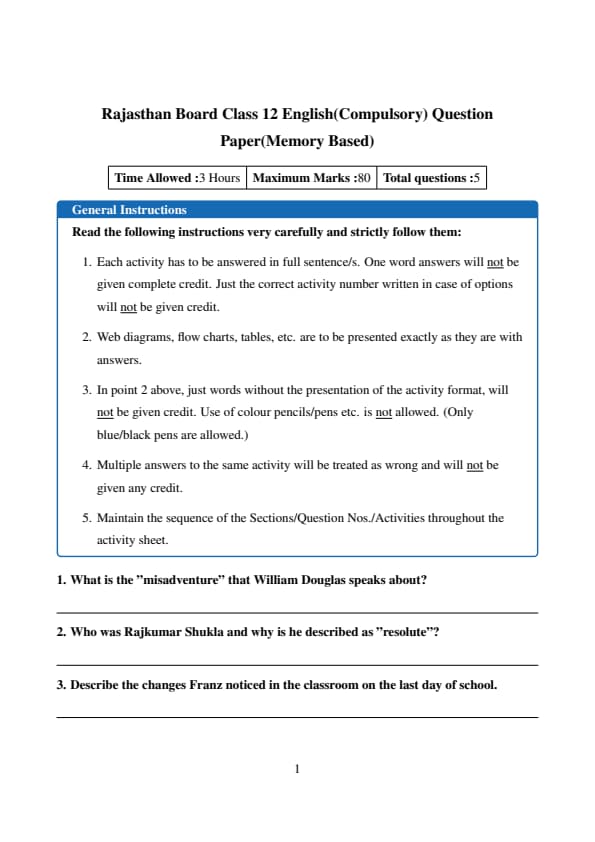
What is the "misadventure" that William Douglas speaks about?
View Solution
Concept:
The lesson "Deep Water" by William Douglas narrates the author’s terrifying childhood experience that developed into a deep-rooted fear of water. The term "misadventure" refers to an unfortunate and dangerous incident that happens unexpectedly.
Explanation:
The “misadventure” that William Douglas speaks about occurred when he was about ten or eleven years old. He had gone to the YMCA swimming pool in Yakima. While he was sitting alone at the edge of the pool, a big boy suddenly picked him up and threw him into the deep end of the pool.
Douglas did not know how to swim. He sank to the bottom of the pool and felt completely helpless. He tried to push himself upward but failed repeatedly. He inhaled water, became terrified, and thought he would drown. Although he was eventually saved, the incident left a lasting impact on him. It created an intense fear of water that stayed with him for many years.
Thus, the “misadventure” refers to this frightening experience of nearly drowning in the swimming pool. Quick Tip: In literature questions, understand the context of the term used in the chapter. Words like “misadventure” often refer to a specific incident that shapes the character’s emotions or personality.
Who was Rajkumar Shukla and why is he described as "resolute"?
View Solution
Concept:
The chapter "Indigo" describes how determination and persistence can bring about social change. A resolute person is someone who is firm and determined in purpose.
Explanation:
Rajkumar Shukla was a poor peasant from Champaran in Bihar. He was one of the sharecroppers who suffered under the oppressive indigo plantation system imposed by the British landlords.
He is described as “resolute” because of his unwavering determination to seek justice for the peasants of Champaran. He persistently followed Mahatma Gandhi everywhere — from Lucknow to Kanpur, then to Sabarmati, and finally to Calcutta — requesting him to visit Champaran and look into the grievances of the indigo farmers.
Despite being poor and uneducated, Shukla did not give up. His firmness and dedication ultimately convinced Gandhi to visit Champaran, which led to the historic Champaran Movement. Thus, he is called “resolute” because of his strong will and determined nature. Quick Tip: When a character is described using a quality like “resolute,” focus on their actions. Persistence and consistency in action usually demonstrate determination.
Describe the changes Franz noticed in the classroom on the last day of school.
View Solution
Concept:
In the chapter "The Last Lesson" by Alphonse Daudet, the change in the classroom atmosphere highlights the emotional impact of losing one's language and freedom. The unusual silence and seriousness symbolize the importance of the last French lesson.
Explanation:
On reaching the classroom, Franz noticed several unusual changes that surprised him.
First, the classroom was very quiet. Usually, there would be a great bustle before the lesson began, with students repeating their lessons loudly and the teacher’s ruler tapping on the desk. But that day, everything was silent, as if it were a Sunday morning.
Second, the village elders were sitting on the back benches of the classroom. Among them were old Hauser, the former mayor, the former postmaster, and several other villagers. They had come to attend the last French lesson as a mark of respect and regret for not learning their language seriously earlier.
Third, M. Hamel was dressed in his special green coat, frilled shirt, and a little black silk cap — clothes he usually wore only on inspection or prize days. This showed that the day was special and important.
All these changes made Franz realize that something serious and significant was happening — it was the last lesson in French, as the order had come from Berlin that only German would be taught in the schools of Alsace and Lorraine. Quick Tip: When describing changes in a story, compare the usual situation with the unusual one. This contrast helps clearly explain the significance of the event.
Write a detailed character sketch of Dr. Sadao, highlighting his dilemma between duty and humanity.
View Solution
Concept:
In the chapter "The Enemy" by Pearl S. Buck, Dr. Sadao represents the conflict between national duty and human compassion. His character highlights the moral struggle between being a loyal citizen and being a humanitarian doctor.
Explanation:
Dr. Sadao Hoki is a skilled and dedicated Japanese surgeon who studied medicine in America. He is intelligent, disciplined, and highly respected in his profession. Despite his loyalty to Japan during the war, he possesses a deep sense of humanity and professional ethics.
As a doctor, Sadao strongly believes in saving lives. When a wounded American prisoner of war washes ashore near his house, he faces a serious moral dilemma. On one hand, as a patriotic Japanese citizen, he knows that helping the enemy could be considered treason. On the other hand, as a doctor, he cannot ignore a dying man who needs medical attention.
Initially, he hesitates and thinks of handing the soldier over to the authorities. However, his conscience does not allow him to let the man die. His medical oath and humanitarian instincts overpower his sense of national duty. He performs a risky surgery and saves the soldier’s life, even though he knows it may endanger his own position and safety.
Throughout the story, Sadao’s inner conflict is evident. He struggles with fear, doubt, and responsibility. Yet, he never compromises on his professional ethics. Even after saving the soldier, he finds a practical solution by helping him escape, thereby balancing his duty to his country and his duty as a doctor.
Thus, Dr. Sadao is portrayed as compassionate, ethical, courageous, and morally upright. His character beautifully reflects the triumph of humanity over narrow nationalism. Quick Tip: In a character sketch, focus on qualities, actions, internal conflicts, and how the character’s decisions reveal their personality.
How does the story satirize the pride and arrogance of those in power?
View Solution
Concept:
In the chapter "The Tiger King" by Kalki, satire is used as a literary device to criticize the foolishness, pride, and arrogance of rulers. Satire exposes the weaknesses of people in authority by presenting them in a humorous yet critical manner.
Explanation:
The story satirizes the pride and arrogance of those in power through the character of the Tiger King, the Maharaja of Pratibandapuram. From his birth, astrologers predict that he will die because of a tiger. Instead of accepting fate, the king arrogantly challenges it and decides to kill all the tigers in his kingdom.
His excessive pride is shown in his obsession with hunting. He believes that by killing a hundred tigers, he can defeat destiny itself. This exaggeration mocks the foolish belief of powerful rulers that they can control everything, even fate.
The king’s arrogance also leads him to misuse his authority. He threatens officials, marries for political advantage to gain access to more tigers, and prioritizes his personal ambition over the welfare of his people. The ministers and courtiers blindly support him, highlighting how those in power are often surrounded by flatterers who encourage their foolish decisions.
Ironically, despite killing ninety-nine tigers, the king is eventually killed by a wooden toy tiger. This humorous and unexpected ending intensifies the satire, showing that pride and overconfidence ultimately lead to downfall.
Thus, the story cleverly criticizes the vanity, superstition, and misuse of authority by those in power, using humour and irony to convey a deeper message. Quick Tip: When answering satire-based questions, identify exaggeration, irony, and the final outcome of the character. These elements usually highlight the author’s criticism.




Comments