




The Rajasthan Board 2026 Class 12 Geography Question Paper with Solution PDF is now available to help students evaluate their performance and prepare for future sessions. The Geography exam was conducted during the Morning Session from 8:30 AM to 11:45 AM.
Initial feedback and paper analysis suggest the Geography exam was moderate in difficulty. The paper effectively balanced theoretical concepts with practical applications, featuring a mix of multiple-choice, short-answer, and map-based questions. Students who focused on the official RBSE syllabus and units such as Human Geography, World Population, and Data Processing found the paper manageable.
Rajasthan Board 2026 Class 12 Geography Question Paper with Solutions PDF – Memory Based
| Rajasthan Board 2026 Class 12 Geography Question Paper with Solutions PDF | Download | Check Solutions |
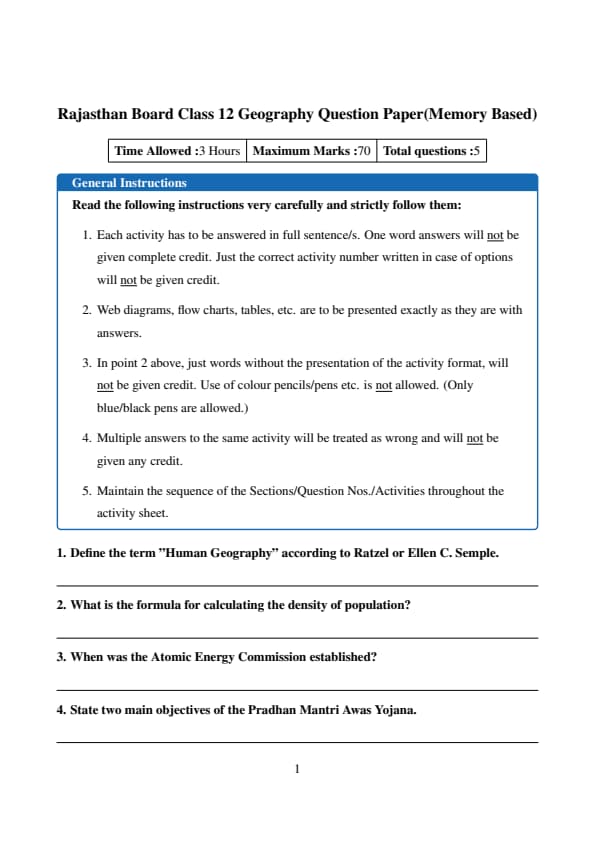
Define the term "Human Geography" according to Ratzel or Ellen C. Semple.
View Solution
Concept:
Human Geography is a branch of geography that studies the spatial distribution and interaction of human populations with their natural environment. Early geographers like Friedrich Ratzel and Ellen Churchill Semple emphasized environmental influence on human life.
Step 1: Definition by Friedrich Ratzel
Ratzel, a German geographer and founder of anthropogeography, defined Human Geography as:
\[ The study of the relationship between man and his natural environment. \]
He emphasized environmental determinism, where nature strongly influences human activities.
Step 2: Definition by Ellen C. Semple
Ellen Churchill Semple, a follower of Ratzel, expanded the idea and defined Human Geography as:
\[ The study of the changing relationship between the unstable earth and active man. \]
She highlighted the dynamic interaction between humans and their surroundings.
Step 3: Core Idea
Both definitions stress:
- Interaction between humans and environment
- Influence of nature on human development
- Dynamic human-environment relationship Quick Tip: Ratzel: Man and environment relationship. Semple: Changing relationship between earth and man. Both are classic environmental determinism views.
What is the formula for calculating the density of population?
View Solution
Concept:
Population density refers to the number of people living per unit area of land. It helps measure how crowded or sparsely populated a region is.
Step 1: Understanding the components
To calculate population density, we need:
- Total population of the region
- Total land area of the region
Step 2: Formula
Population density is calculated as:
\[ Population Density = \frac{Number of people}{Land area} \]
Step 3: Units
Common units include:
- Persons per square kilometre (\(persons/km^2\))
- Persons per square mile
Step 4: Interpretation
- High density → overcrowded area
- Low density → sparsely populated area Quick Tip: Population density tells how crowded a place is. Just remember: \[ People \div Area \]
When was the Atomic Energy Commission established?
View Solution
Concept:
The Atomic Energy Commission (AEC) of India was established to oversee and promote the development of atomic energy for peaceful purposes such as power generation, research, and national development.
Step 1: Historical background
After independence, India recognized the importance of nuclear science and technology for development and energy security.
Step 2: Establishment
The Government of India established the Atomic Energy Commission in:
\[ 1948 \]
under the Atomic Energy Act.
Step 3: Leadership
Dr. Homi J. Bhabha, known as the father of India’s nuclear program, became the first chairman of the commission.
Step 4: Purpose
The main objectives included:
- Development of nuclear energy
- Scientific research
- Peaceful use of atomic power Quick Tip: India’s Atomic Energy Commission was established in 1948, soon after independence, under the leadership of Homi J. Bhabha.
State two main objectives of the Pradhan Mantri Awas Yojana.
View Solution
Concept:
Pradhan Mantri Awas Yojana (PMAY) is a flagship housing scheme launched by the Government of India to ensure “Housing for All” by providing affordable and permanent houses to the poor.
Step 1: Affordable housing for all
One of the primary objectives of PMAY is to provide affordable housing to economically weaker sections (EWS), low-income groups (LIG), and middle-income groups (MIG), reducing homelessness and slum conditions.
Step 2: Pucca houses with basic amenities
The scheme aims to construct durable (pucca) houses equipped with essential facilities such as:
- Water supply
- Sanitation
- Electricity
- Clean cooking facilities
Step 3: Inclusive development
It also promotes inclusive urban and rural development by improving living standards and ensuring social security through better housing infrastructure. Quick Tip: PMAY = Housing for All. Focus areas: Affordable homes + Basic amenities for poor families.
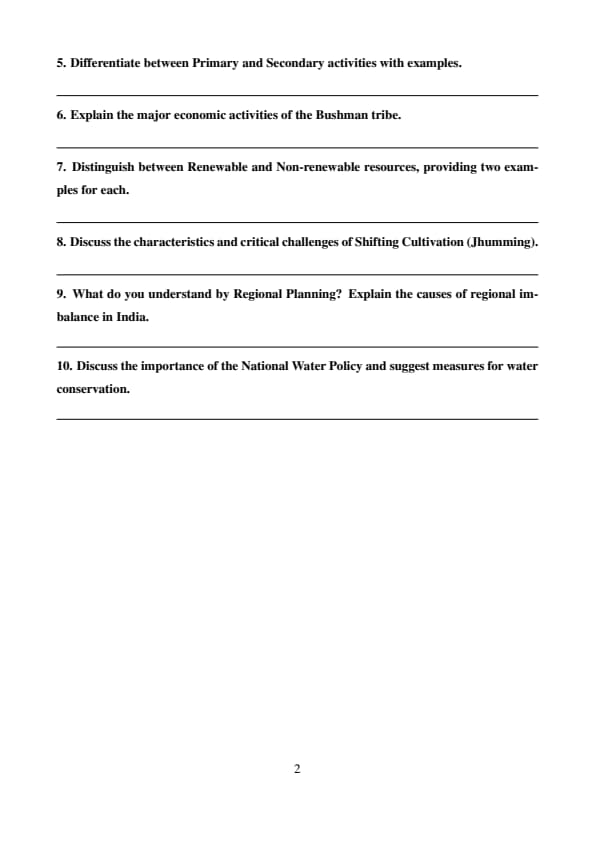
Differentiate between Primary and Secondary activities with examples.
View Solution
Concept:
Economic activities are broadly classified into primary and secondary sectors based on the nature of work and the stage of production.
Step 1: Primary Activities
Primary activities are directly related to the extraction and use of natural resources from the earth.
Features:
- Depend on natural resources
- Mostly rural-based
- Provide raw materials
Examples:
- Agriculture
- Fishing
- Mining
- Forestry
Step 2: Secondary Activities
Secondary activities involve processing and manufacturing raw materials into finished or semi-finished products.
Features:
- Add value to raw materials
- Mostly industrial and urban-based
- Use machinery and technology
Examples:
- Manufacturing textiles from cotton
- Steel production from iron ore
- Car manufacturing
- Food processing
Step 3: Key Differences
\begin{tabular{|c|c|c|
\hline
Basis & Primary Activities & Secondary Activities
\hline
Nature & Resource extraction & Processing/manufacturing
\hline
Output & Raw materials & Finished goods
\hline
Location & Rural areas & Industrial/urban areas
\hline
Example & Farming & Textile industry
\hline
\end{tabular Quick Tip: Primary = Extraction from nature Secondary = Manufacturing goods Think: Farm → Factory
Explain the major economic activities of the Bushman tribe.
View Solution
Concept:
The Bushman (San) tribes are indigenous people of the Kalahari Desert in Southern Africa. Their economy is based on subsistence activities closely linked with nature and survival in a harsh desert environment.
Step 1: Hunting
Hunting is one of the primary economic activities of the Bushmen.
They hunt wild animals such as antelopes, rabbits, and birds using:
- Bows and poisoned arrows
- Traps and snares
This provides meat, bones, and skins for daily use.
Step 2: Gathering
Women mainly collect wild plant resources, including:
- Fruits and berries
- Roots and tubers
- Nuts and edible seeds
This ensures a stable food supply even when hunting is unsuccessful.
Step 3: Fishing (where available)
In regions with seasonal water sources, Bushmen also practice small-scale fishing using simple tools.
Step 4: Use of natural resources
They utilize available materials for daily needs:
- Animal skins for clothing
- Wood and grass for shelters
- Bones for tools and ornaments
Step 5: Barter and trade
In some areas, Bushmen engage in limited barter trade with neighboring tribes, exchanging:
- Animal products
- Honey or forest produce Quick Tip: Bushman economy = Hunting + Gathering. They are classic examples of a food-gathering tribe adapted to desert life.
Distinguish between Renewable and Non-renewable resources, providing two examples for each.
View Solution
Concept:
Natural resources are classified based on their availability and regeneration capacity into renewable and non-renewable resources.
Step 1: Renewable Resources
Renewable resources are those that can be regenerated or replenished naturally within a human lifespan.
Features:
- Naturally replenishable
- Sustainable if used properly
- Less environmental impact
Examples:
- Solar energy
- Wind energy
Step 2: Non-renewable Resources
Non-renewable resources are those that cannot be replenished quickly and exist in limited quantities.
Features:
- Exhaustible in nature
- Formed over millions of years
- Overuse leads to depletion
Examples:
- Coal
- Petroleum
Step 3: Key Differences
\begin{tabular{|c|c|c|
\hline
Basis & Renewable Resources & Non-renewable Resources
\hline
Availability & Replenished naturally & Limited supply
\hline
Exhaustion & Not easily exhausted & Can be depleted
\hline
Formation time & Short period & Millions of years
\hline
Examples & Solar, Wind & Coal, Petroleum
\hline
\end{tabular Quick Tip: Renewable = Refillable (Sun, Wind) Non-renewable = Exhaustible (Coal, Oil)
Discuss the characteristics and critical challenges of Shifting Cultivation (Jhumming).
View Solution
Concept:
Shifting cultivation, locally called Jhumming (or Jhum cultivation), is a primitive agricultural practice mainly found in tropical forest regions such as Northeast India, Southeast Asia, and parts of Africa and South America.
Step 1: Characteristics of Shifting Cultivation
1. Slash and burn method
Forests are cut and burned to clear land. Ash acts as a natural fertilizer.
2. Temporary farming
The land is cultivated for a few years (2–3 years) until soil fertility declines, after which farmers move to a new plot.
3. Subsistence agriculture
Production is mainly for self-consumption rather than commercial purposes.
4. Simple tools and techniques
Farmers use basic tools like hoes, digging sticks, and machetes with minimal technology.
5. Low population density areas
Practiced in sparsely populated forested and hilly regions.
Step 2: Critical Challenges
1. Deforestation
Continuous clearing of forests leads to loss of biodiversity and ecological imbalance.
2. Soil degradation
Repeated burning reduces soil fertility and increases erosion.
3. Low agricultural productivity
Yields are low compared to modern farming methods.
4. Environmental impact
Causes air pollution, carbon emissions, and habitat destruction.
5. Increasing population pressure
Shorter fallow periods due to population growth reduce land recovery time, worsening sustainability.
Step 3: Present Scenario
Many governments are encouraging alternatives such as:
- Settled agriculture
- Agroforestry
- Sustainable farming practices Quick Tip: Jhumming = Slash + Burn + Shift farming. Traditional but environmentally unsustainable if fallow periods shorten.
What do you understand by Regional Planning? Explain the causes of regional imbalance in India.
View Solution
Concept:
Regional planning is a strategy aimed at achieving balanced economic and social development across different regions of a country by reducing disparities in income, infrastructure, and opportunities.
Step 1: Meaning of Regional Planning
Regional planning involves:
- Identification of backward and developed regions
- Planned allocation of resources
- Development of infrastructure and industries
- Reduction of regional inequalities
Its main objective is balanced and inclusive national development.
Step 2: Causes of Regional Imbalance in India
1. Unequal distribution of natural resources
Some regions are rich in minerals, water, and fertile soil (e.g., coastal and river valleys), while others lack such advantages (e.g., arid and hilly areas).
2. Historical factors
During the colonial period, development was concentrated in port cities and resource-rich areas, leading to long-term disparities.
3. Uneven industrial development
Industries are concentrated in states like Maharashtra, Gujarat, and Tamil Nadu, while eastern and northeastern regions lag behind.
4. Infrastructural disparities
Backward regions suffer from poor transport, electricity, education, and healthcare facilities.
5. Agricultural differences
Green Revolution benefits were limited to certain regions (Punjab, Haryana, Western UP), widening rural disparities.
6. Political and administrative factors
Inefficient governance, corruption, and lack of proper planning have hindered development in some regions.
7. Social factors
Low literacy, poverty, and lack of skilled labor in certain regions slow down economic growth.
Step 3: Need for Regional Planning
To address imbalances, regional planning focuses on:
- Balanced resource utilization
- Special development programs for backward areas
- Inclusive and sustainable growth Quick Tip: Regional Planning = Balanced regional development. Regional imbalance arises due to unequal resources, infrastructure, and historical development patterns.
Discuss the importance of the National Water Policy and suggest measures for water conservation.
View Solution
Concept:
Water is a vital natural resource essential for agriculture, industry, and domestic use. The National Water Policy of India aims to ensure sustainable utilization, conservation, and equitable distribution of water resources in the country.
Step 1: Importance of the National Water Policy
1. Sustainable water management
It promotes long-term planning for conservation and efficient use of water to meet future needs.
2. Equitable distribution
Ensures fair allocation of water among regions, sectors, and communities, reducing regional disparities.
3. Integrated water resource management
Encourages coordinated development of surface water, groundwater, and rainwater resources.
4. Priority to drinking water
Gives highest priority to safe drinking water and sanitation for all citizens.
5. Environmental protection
Focuses on maintaining ecological balance by protecting rivers, wetlands, and aquatic ecosystems.
6. Flood and drought management
Provides strategies to manage floods and mitigate drought impacts through planning and infrastructure.
Step 2: Measures for Water Conservation
1. Rainwater harvesting
Collecting and storing rainwater for domestic and agricultural use helps recharge groundwater.
2. Efficient irrigation methods
Adoption of drip and sprinkler irrigation reduces water wastage in agriculture.
3. Recycling and reuse
Treatment and reuse of wastewater for irrigation and industrial purposes conserve freshwater resources.
4. Watershed management
Afforestation and soil conservation improve water retention and reduce runoff.
5. Preventing water pollution
Proper waste management and industrial regulation help maintain water quality.
6. Public awareness and participation
Educating people about water-saving practices encourages community involvement in conservation.
Step 3: Overall Significance
The National Water Policy provides a framework for balanced water use and promotes sustainable development by ensuring water security for present and future generations. Quick Tip: National Water Policy = Sustainable and equitable water use. Key conservation tools: Rainwater harvesting, efficient irrigation, reuse, and public awareness.



Comments