




The Board of Secondary Education, Rajasthan (BSER/RBSE) successfully conducted the Class 12 Physical Education Exam 2026 on March 11, 2026. For students looking to check their accuracy, the complete RBSE Class 12 Physical Education Question Paper with Solution PDF is now available for download.
The RBSE Class 12 Physical Education paper covered key topics from fitness, yoga, sports psychology, and physical education principles. The MCQ section tested basic knowledge of physical education concepts, while the descriptive questions required clear explanations, application of fitness techniques, and understanding of sports principles. To score well, students should focus on understanding key concepts, fitness routines, sports strategies, and providing structured answers. The question paper of RBSE Class 12 Physical Education Board Exam 2026 is provided below. Students can download the official paper in PDF format for reference.
RBSE Class 12 2026 Physical Education Question Paper with Solution PDF
| RBSE Class 12 2026 Physical Education Question Paper with Solution PDF | Download PDF | Check Solution |
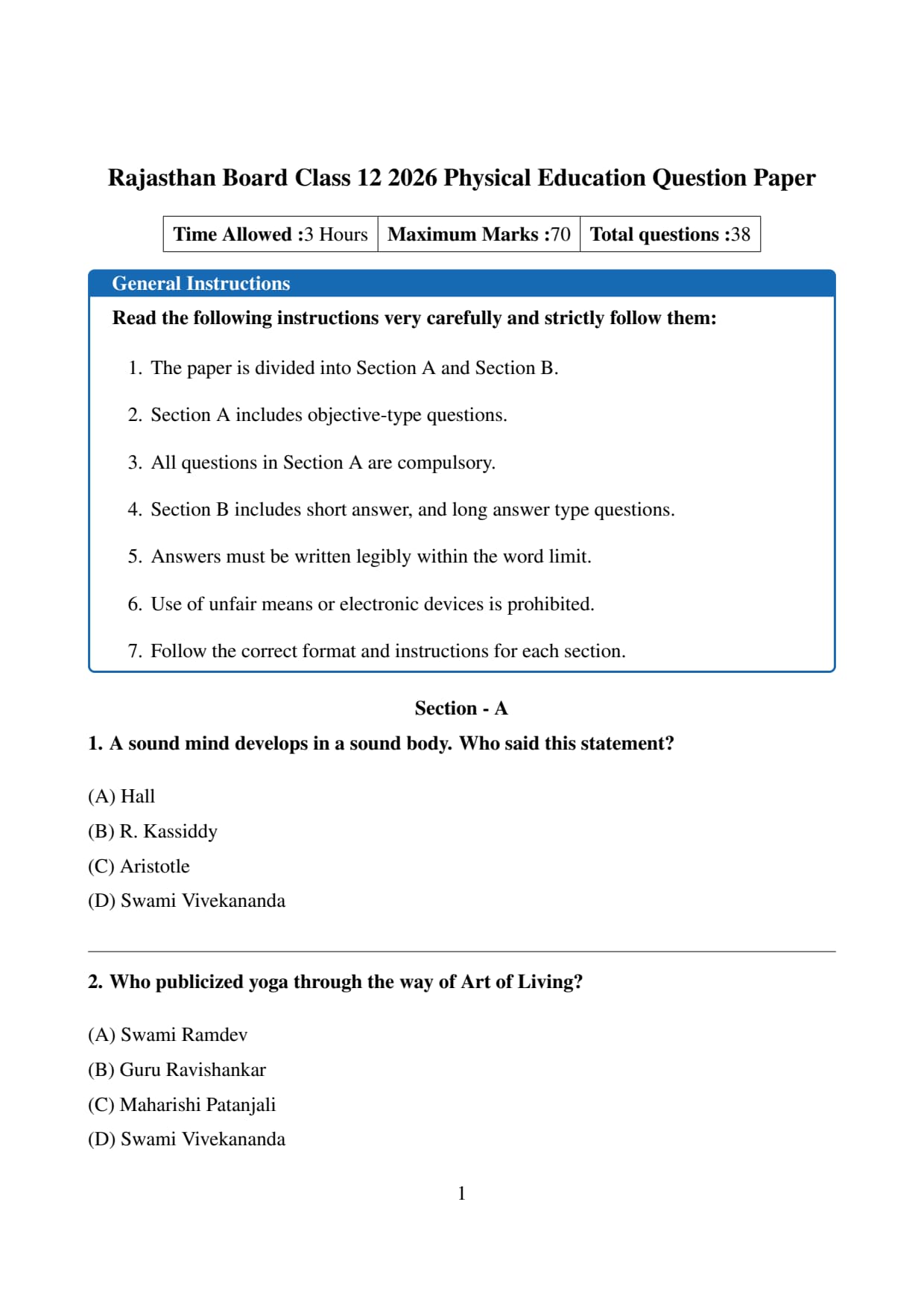
A sound mind develops in a sound body. Who said this statement?
View Solution
Step 1: Understanding the quote.
The phrase "A sound mind develops in a sound body" emphasizes the importance of physical health for mental well-being. It highlights that physical exercise, proper nutrition, and overall well-being are crucial for maintaining a healthy mind.
Step 2: Identifying the author.
This statement was made by Swami Vivekananda, an Indian philosopher and spiritual leader, known for his contributions to promoting the importance of both physical and mental health. He emphasized the connection between mind and body in his teachings.
Step 3: Comparison with other options.
(A) Hall: Incorrect. While Hall was a psychologist, the quote is not attributed to him.
(B) R. Kassiddy: Incorrect. R. Kassiddy is not associated with this famous statement.
(C) Aristotle: Incorrect. Aristotle, though influential in many fields, did not make this statement.
(D) Swami Vivekananda: Correct. Swami Vivekananda is the author of this well-known quote.
Step 4: Conclusion.
The quote "A sound mind develops in a sound body" is correctly attributed to Swami Vivekananda, who often spoke about the connection between physical fitness and mental clarity.
Final Answer: Swami Vivekananda. Quick Tip: A healthy body leads to a healthy mind. Incorporating physical activity and proper nutrition into your routine enhances mental performance and well-being.
Who publicized yoga through the way of Art of Living?
View Solution
Step 1: Understanding the Art of Living.
The Art of Living is a global humanitarian and educational organization founded by Sri Sri Ravi Shankar, which promotes the practice of yoga, meditation, and breathing techniques for personal development.
Step 2: The role of Guru Ravishankar.
Guru Ravishankar is known for spreading yoga through the Art of Living organization. His teachings focus on simple but powerful practices to enhance mental and physical well-being.
Step 3: Comparison with other options.
(A) Swami Ramdev: Incorrect. Swami Ramdev is also a prominent figure in yoga but is not associated with the Art of Living.
(C) Maharishi Patanjali: Incorrect. Patanjali is known for the ancient texts on yoga but did not publicize yoga through the Art of Living.
(D) Swami Vivekananda: Incorrect. Swami Vivekananda is known for his work on spiritual and religious teachings, but not for the Art of Living.
Step 4: Conclusion.
The correct answer is Guru Ravishankar, who is the founder of the Art of Living and is responsible for publicizing yoga in modern times through this organization.
Final Answer: Guru Ravishankar. Quick Tip: Yoga is not just physical exercise; it is a complete system for personal transformation. The Art of Living focuses on holistic well-being through yoga, meditation, and breathing exercises.
When was Laxmi Bai National College of Physical Education established?
View Solution
Step 1: Understanding the Laxmi Bai National College of Physical Education.
Laxmi Bai National College of Physical Education (LNCPE) is located in Gwalior, India. It was established to promote the study and practice of physical education and sports.
Step 2: Establishment year.
The college was founded in 1958 to cater to the need for professional education in physical education. It is named after the warrior queen of Jhansi, Laxmi Bai.
Step 3: Comparison with other options.
(A) 1957: Incorrect. The college was not established in 1957.
(C) 1959: Incorrect. The correct year of establishment is 1958.
(D) 1960: Incorrect. The correct year is 1958.
Step 4: Conclusion.
Laxmi Bai National College of Physical Education was established in 1958.
Final Answer: 1958. Quick Tip: LNCPE is one of the premier institutions for physical education in India, offering specialized training and degrees in physical education and sports.
How many years of M.P.Ed. course?
View Solution
Step 1: Understanding the M.P.Ed. course.
M.P.Ed. (Master of Physical Education) is a postgraduate course focused on physical education and sports sciences. The course duration typically varies between 1 to 4 years, depending on the institution and structure.
Step 2: Duration of M.P.Ed. course.
Most institutions in India offer a 2-year M.P.Ed. course. This duration allows for comprehensive learning in physical education, sports psychology, and other related fields.
Step 3: Comparison with other options.
(A) 1 year: Incorrect. While there might be some institutions offering a 1-year course, the standard duration is typically 2 years.
(C) 3 years: Incorrect. A 3-year course is not common for M.P.Ed.
(D) 4 years: Incorrect. A 4-year M.P.Ed. program is not typically offered.
Step 4: Conclusion.
The correct answer is (B) 2 years, as most M.P.Ed. courses are offered for 2 years in India.
Final Answer: 2 years. Quick Tip: M.P.Ed. is a 2-year postgraduate course in physical education that prepares students for careers in sports teaching, coaching, and management.
Where is Indira Gandhi Physical Education and Sports Science Institute situated?
View Solution
Step 1: Understanding the Institute.
Indira Gandhi Institute of Physical Education and Sports Science is a premier institute dedicated to physical education and sports science research. It offers degree programs and training in physical education.
Step 2: Location of the institute.
The institute is situated in Gwalior, Madhya Pradesh, India. It is recognized for its high academic standards and contribution to sports education in India.
Step 3: Comparison with other options.
(A) Gwalior: Correct. Indira Gandhi Institute of Physical Education and Sports Science is located in Gwalior.
(B) Patiala: Incorrect. Patiala is home to other educational institutions, but this institute is not based there.
(C) New Delhi: Incorrect. New Delhi does not host this particular institute.
(D) Amravati: Incorrect. This institute is not located in Amravati.
Step 4: Conclusion.
The correct answer is (A) Gwalior, where the Indira Gandhi Institute of Physical Education and Sports Science is situated.
Final Answer: Gwalior. Quick Tip: The Indira Gandhi Physical Education and Sports Science Institute in Gwalior is a leading center for training in sports education and physical sciences.
What are the components of Pranayama?
View Solution
Step 1: Understanding Pranayama.
Pranayama is a practice in yoga that involves the regulation of breath. It has three main components: Purak (inhalation), Rechak (exhalation), and Kumbhak (breath retention). These components work together to control the flow of prana (vital life energy) in the body.
Step 2: Explanation of the components.
(A) Purak: This is the inhalation process, where air is drawn into the lungs.
(B) Rechak: This is the exhalation process, where air is expelled from the lungs.
(C) Kumbhak: This is the retention of breath, either after inhalation (Antar Kumbhak) or exhalation (Bahya Kumbhak).
(D) All of the above: Correct. All three components—Purak, Rechak, and Kumbhak—are essential elements of Pranayama practice.
Step 3: Conclusion.
The components of Pranayama are all of the above—Purak, Rechak, and Kumbhak—which together form the foundation of this breathing technique.
Final Answer: All of the above. Quick Tip: Pranayama is a holistic practice that helps in controlling breath, which directly influences the mind and body. It is a key component of yoga and enhances concentration and overall well-being.
Water soluble vitamins are
View Solution
Step 1: Understanding water-soluble vitamins.
Water-soluble vitamins are those that dissolve in water and are not stored in the body. These vitamins must be replenished regularly through diet. B-vitamins are a group of water-soluble vitamins that play important roles in cell metabolism.
Step 2: Explanation of the options.
(A) B-1 (Thiamine): Thiamine is a water-soluble vitamin that is essential for carbohydrate metabolism.
(B) B-6 (Pyridoxine): Pyridoxine is another water-soluble vitamin involved in amino acid metabolism.
(C) B-12 (Cobalamin): Cobalamin is a water-soluble vitamin important for red blood cell production and neurological function.
(D) All of the above: Correct. B-1, B-6, and B-12 are all water-soluble vitamins.
Step 3: Conclusion.
Since B-1, B-6, and B-12 are all water-soluble vitamins, the correct answer is (D) All of the above.
Final Answer: All of the above. Quick Tip: Water-soluble vitamins must be consumed regularly as the body does not store them. They are essential for energy production and proper cell function.
Who developed the circuit training method?
View Solution
Step 1: Understanding circuit training.
Circuit training involves performing a series of exercises in a sequence, targeting different muscle groups with minimal rest in between. It is used to improve overall fitness and endurance.
Step 2: Identifying the correct answer.
(A) R.E. Morgan: Correct. R.E. Morgan, along with his colleague, developed the circuit training method in the 1950s.
(B) Holmer: Incorrect. While Holmer contributed to exercise science, he did not develop circuit training.
(C) Boldemor: Incorrect. There is no evidence linking Boldemor to the development of circuit training.
(D) Bikila: Incorrect. Bikila was an Ethiopian Olympic marathoner, not associated with circuit training.
Step 3: Conclusion.
R.E. Morgan is credited with the development of the circuit training method, making (A) the correct answer.
Final Answer: R.E. Morgan. Quick Tip: Circuit training is an efficient way to improve cardiovascular fitness and muscular endurance by combining different exercises with minimal rest between them.
Write about Slow Stretch and Holiday Method?
View Solution
Step 1: Define Slow Stretch.
Slow Stretch is a rehabilitation method used to improve the flexibility and range of motion of muscles and joints. In this method, muscles are stretched gradually and held for a longer period, allowing them to elongate without causing strain.
Step 2: Explain how Slow Stretch works.
This technique involves applying a mild stretch to a muscle, holding it for 15-30 seconds, and then gradually increasing the intensity of the stretch. It allows the muscle fibers to adjust to the elongation process, promoting long-term flexibility improvements.
Step 3: Define Holiday Method.
The Holiday Method is an approach where specific periods of rest are incorporated into a training regimen. This method emphasizes recovery and helps in preventing overtraining by giving the body sufficient time to repair and recover from intense physical activity.
Step 4: How the Holiday Method works.
The Holiday Method involves alternating periods of intense training with rest periods. These rest periods, known as "holidays," can vary in length and are essential for muscle recovery, energy restoration, and preventing fatigue buildup during training cycles. Quick Tip: Remember: Slow Stretch involves gradual elongation of muscles for flexibility, while the Holiday Method helps prevent overtraining by incorporating rest periods into a training regimen.
Discuss about Co-ordinate Ability.
View Solution
Step 1: Define Co-ordinate Ability.
Co-ordinate ability refers to the number of ligand atoms that can coordinate to a central metal atom in a complex. It determines the stability and structure of the coordination compound.
Step 2: Describe the coordination process.
In a coordination compound, a metal ion or atom is surrounded by a set of molecules or ions known as ligands. The ligands donate electron pairs to the metal to form coordinate bonds.
Step 3: Factors affecting Co-ordinate Ability.
The co-ordinate ability of a metal ion depends on its size, charge, and the electronic configuration. For example, transition metals often have high co-ordinate ability due to the availability of vacant orbitals for bonding.
Step 4: Examples of Co-ordinate Ability.
For instance, in the complex \([Fe(CO)_5]\), the iron atom exhibits a co-ordinate ability of 5, as it is surrounded by five carbon monoxide ligands. Similarly, \([Cu(NH_3)_4]^{2+}\) has a co-ordinate ability of 4 due to four ammonia ligands coordinating with the copper ion.
Step 5: Importance of Co-ordinate Ability.
The co-ordinate ability of a metal ion plays a crucial role in the formation and stability of coordination compounds. It influences the geometry of the compound and its chemical reactivity. Quick Tip: Remember: The co-ordinate ability is determined by the number of ligands that can coordinate to a metal ion, which influences the stability and geometry of the complex.
Explain Personality Development in detail?
View Solution
Step 1: Define Personality Development.
Personality development refers to the process of enhancing an individual's characteristics, behavior patterns, and social skills. It involves cultivating traits like confidence, communication skills, emotional intelligence, and adaptability to various life situations.
Step 2: Factors affecting Personality Development.
The development of personality is influenced by various factors such as heredity, environment, education, experiences, and social interactions. Each of these factors contributes to shaping a person's mental, emotional, and physical characteristics.
Step 3: Components of Personality Development.
The key components of personality development include self-awareness, self-esteem, communication skills, emotional intelligence, and stress management. Each of these aspects plays a vital role in developing a well-rounded personality.
Step 4: Importance of Personality Development.
A well-developed personality helps individuals in various aspects of life, including personal growth, professional success, and building meaningful relationships. It enhances a person's ability to handle challenges and communicate effectively with others.
Step 5: Ways to develop Personality.
Personality development can be achieved through continuous learning, setting goals, developing positive habits, seeking feedback, and improving interpersonal skills. Participating in activities that foster creativity, public speaking, and leadership also aid in personality growth. Quick Tip: Remember: Personality development is a lifelong process. Consistent effort towards improving communication, emotional intelligence, and self-confidence leads to a positive change in one's personality.
Write importance of sports nutrition in Modern Life.
View Solution
Step 1: Define Sports Nutrition.
Sports nutrition involves the consumption of foods and drinks that help athletes maintain performance, enhance recovery, and promote overall well-being. It focuses on providing the body with the necessary nutrients to fuel physical activity and optimize health.
Step 2: Importance of Sports Nutrition.
Sports nutrition is essential in modern life because it helps athletes and fitness enthusiasts achieve peak performance. Proper nutrition can improve strength, endurance, and recovery, which in turn aids in achieving fitness goals and enhancing overall health.
Step 3: Nutrients involved in Sports Nutrition.
The primary nutrients required for sports nutrition include carbohydrates for energy, protein for muscle repair, fats for endurance, and vitamins and minerals for optimal bodily functions. Hydration is equally important for maintaining electrolyte balance and preventing fatigue.
Step 4: Role of Sports Nutrition in Preventing Injuries.
Sports nutrition helps in preventing injuries by improving the body's resistance to physical stress. A balanced diet helps in building strong bones, muscles, and joints, which reduces the risk of strain and injury during physical activity. Quick Tip: Remember: Proper sports nutrition is essential for maximizing performance, enhancing recovery, and maintaining overall health, especially for athletes.
Explain Yogic Exercises in detail.
View Solution
Step 1: Define Yogic Exercises.
Yogic exercises are physical postures and breathing techniques that originate from the ancient practice of Yoga. These exercises are designed to improve flexibility, strength, balance, and mental clarity. They are often performed alongside meditation and controlled breathing to promote overall well-being.
Step 2: Types of Yogic Exercises.
Yogic exercises include various asanas (postures) such as Surya Namaskar (Sun Salutation), Padmasana (Lotus Position), and Tadasana (Mountain Pose). These exercises involve stretching, balancing, and strengthening the body to improve both physical and mental health.
Step 3: Benefits of Yogic Exercises.
Yogic exercises offer numerous benefits, including increased flexibility, enhanced physical endurance, stress reduction, and improved mental clarity. They also contribute to better posture, enhanced circulation, and detoxification of the body.
Step 4: Breathing Techniques in Yoga.
Breathing techniques, known as pranayama, are an essential part of yogic exercises. Controlled breathing helps in calming the mind, improving oxygen intake, and enhancing the flow of energy throughout the body. It also aids in relaxation and reduces stress.
Step 5: Yogic Exercises for Mental Health.
Yogic exercises not only benefit physical health but also play a significant role in mental well-being. Regular practice can help reduce anxiety, depression, and stress, and increase mindfulness and concentration. Quick Tip: Remember: Yogic exercises combine physical postures, breathing techniques, and meditation to improve overall well-being, both physically and mentally.
How can Nutrient be classified on the basis of Chemicals?
View Solution
Step 1: Understand the concept of Nutrients.
Nutrients are substances required by plants and animals to carry out essential functions like growth, energy production, and maintenance. These include both organic and inorganic compounds.
Step 2: Classification based on Chemicals.
Nutrients can be classified on the basis of chemicals into two broad categories: Macronutrients and Micronutrients.
Step 3: Macronutrients.
Macronutrients are needed in large quantities and include:
- Carbon (C), Hydrogen (H), and Oxygen (O): Elements that form the basic structure of all living organisms.
- Nitrogen (N): Essential for protein synthesis.
- Phosphorus (P): Involved in energy transfer and storage.
- Potassium (K): Helps in enzyme activation and regulation of water balance.
- Calcium (Ca), Magnesium (Mg), and Sulfur (S): Important for various biochemical processes.
Step 4: Micronutrients.
Micronutrients are required in smaller quantities but are equally important for health. They include:
- Iron (Fe), Zinc (Zn), Copper (Cu), Manganese (Mn), Boron (B), Molybdenum (Mo), and others.
Step 5: Conclusion.
Both macronutrients and micronutrients are essential for the growth, development, and functioning of organisms. Their deficiency or imbalance can lead to various health problems. Quick Tip: Remember: Nutrients are classified as macronutrients (needed in large quantities) and micronutrients (needed in small quantities), but both are essential for proper functioning.





Comments