

.jpg?h=56&w=56&mode=stretch)


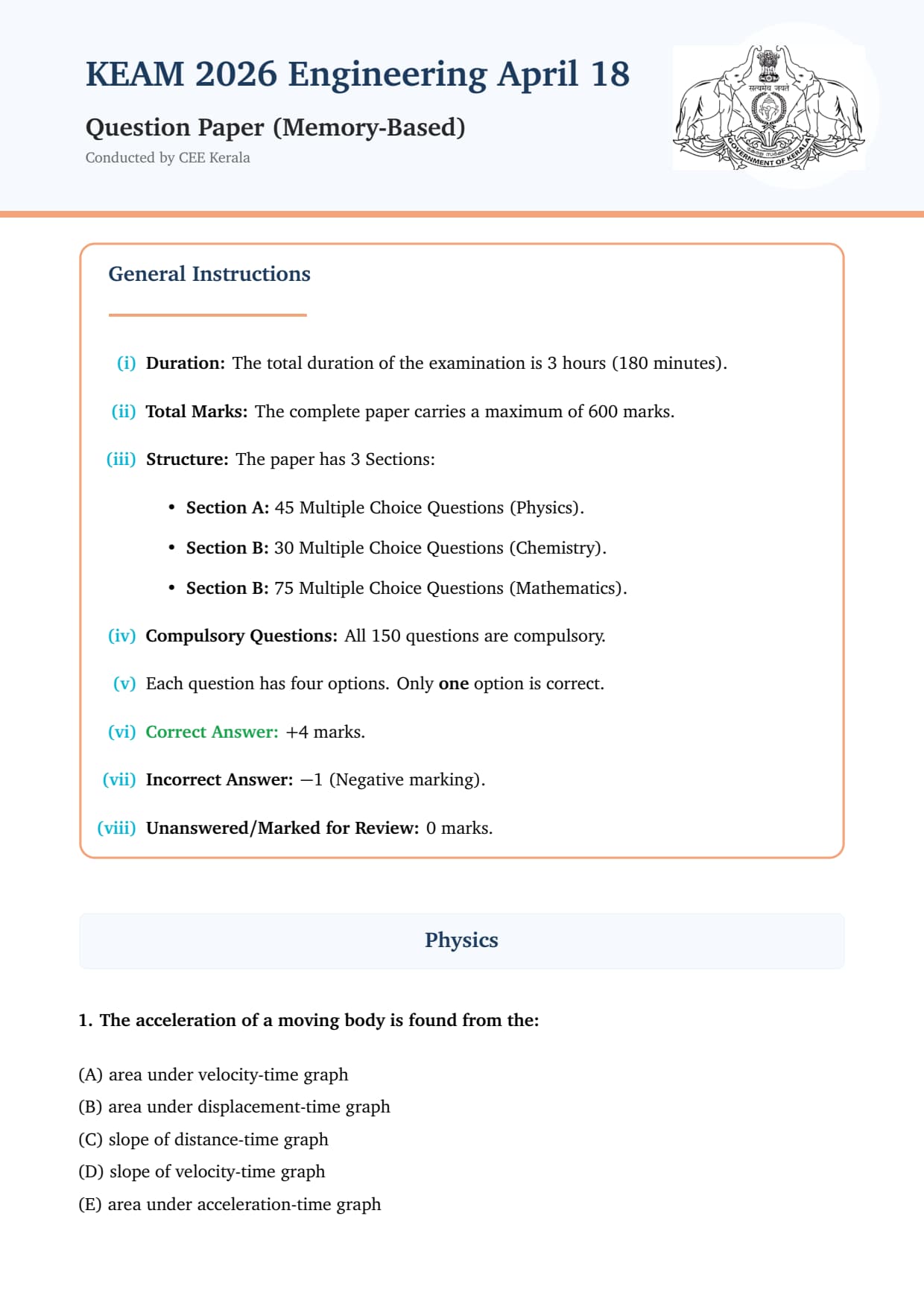
KEAM 2026 Engineering Question Paper for April 18 is available for download here. CEE Kerala conducted KEAM 2026 Engineering exam on April 18 in session 2 from 2 PM to 5 PM. KEAM 2026 Engineering exam is an online CBT with a total of 150 questions carrying a maximum of 600 marks.
- The KEAM Engineering exam is divided into 3 subjects- Physics (45 questions), Chemistry (30 questions) and Mathematics (75 questions).
- 4 marks are given for every correct answer and 1 mark is deducted for every incorrect answer
Candidates can download KEAM 2026 April 18 Engineering Question Paper with Solution PDF from the links provided below.
KEAM 2026 Engineering April 18 Question Paper with Solution PDF
| KEAM 2026 Engineering Question Paper April 18 | Download PDF | Check Solution |

The acceleration of a moving body is found from the:
View Solution
Step 1: Understanding acceleration.
Acceleration is the rate of change of velocity with respect to time, and it can be mathematically expressed as:
\[ a = \frac{dv}{dt} \]
where \( v \) is the velocity and \( t \) is the time. The acceleration is represented by the slope of the velocity-time graph.
Step 2: Analyzing the options.
- (A) Area under velocity-time graph: This represents displacement, not acceleration.
- (B) Area under displacement-time graph: This represents distance, not acceleration.
- (C) Slope of distance-time graph: This represents velocity, not acceleration.
- (D) Slope of velocity-time graph: This gives acceleration because acceleration is the rate of change of velocity.
- (E) Area under acceleration-time graph: This represents the change in velocity, not the acceleration itself.
Step 3: Conclusion.
The correct answer is (D) because acceleration is the slope of the velocity-time graph.
Final Answer: (D) slope of velocity-time graph
Quick Tip: To find acceleration from a graph, look for the slope of the velocity-time graph. The steeper the slope, the greater the acceleration.
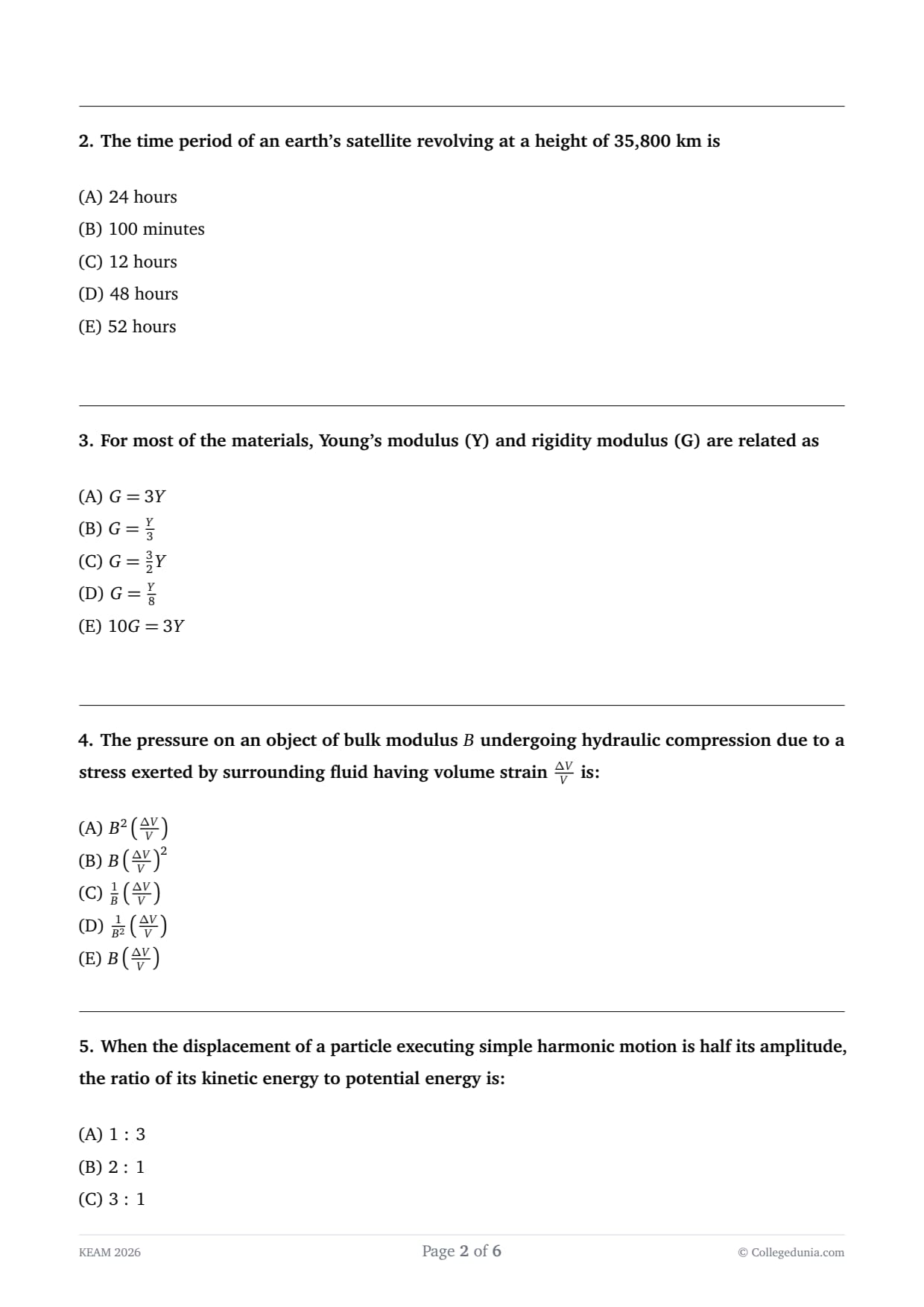
The time period of an earth’s satellite revolving at a height of 35,800 km is
View Solution
The formula for the time period \( T \) of a satellite in orbit is given by:
\[ T = 2\pi \sqrt{\frac{r^3}{GM}} \]
Where:
- \( T \) is the time period of the satellite,
- \( r \) is the distance from the center of the Earth to the satellite (i.e., the radius of the orbit),
- \( G \) is the universal gravitational constant (\( 6.674 \times 10^{-11} \, N \, m^2 \, kg^{-2} \)),
- \( M \) is the mass of the Earth (\( 5.972 \times 10^{24} \, kg \)).
Step 1: Calculate the radius of the satellite's orbit.
The radius of the satellite’s orbit is the sum of the radius of the Earth and the height of the satellite. Given:
- Radius of the Earth \( R_{earth} = 6,378 \, km \),
- Height of the satellite \( h = 35,800 \, km \).
So, the total radius \( r \) is:
\[ r = R_{earth} + h = 6,378 \, km + 35,800 \, km = 42,178 \, km = 4.2178 \times 10^7 \, m \]
Step 2: Substitute values into the orbital period formula.
Now that we have \( r \), we can substitute the values into the orbital period formula. We know:
\[ G = 6.674 \times 10^{-11} \, N \, m^2 \, kg^{-2}, \quad M = 5.972 \times 10^{24} \, kg \]
So, the orbital period \( T \) is:
\[ T = 2\pi \sqrt{\frac{(4.2178 \times 10^7)^3}{(6.674 \times 10^{-11})(5.972 \times 10^{24})}} \]
Step 3: Perform the calculation.
Let’s calculate the value of \( T \). First, compute \( r^3 \):
\[ r^3 = (4.2178 \times 10^7)^3 = 7.514 \times 10^{22} \, m^3 \]
Next, calculate the denominator:
\[ GM = (6.674 \times 10^{-11})(5.972 \times 10^{24}) = 3.986 \times 10^{14} \, N \, m^2 \, kg^{-1} \]
Now substitute into the formula for \( T \):
\[ T = 2\pi \sqrt{\frac{7.514 \times 10^{22}}{3.986 \times 10^{14}}} \]
\[ T = 2\pi \sqrt{1.884 \times 10^8} \]
\[ T = 2\pi \times 1.373 \times 10^4 \]
\[ T \approx 8.63 \times 10^4 \, seconds \]
Convert seconds to hours:
\[ T = \frac{8.63 \times 10^4}{3600} \approx 24 \, hours \]
Step 4: Conclusion.
The calculated time period of the satellite is approximately 24 hours.
Final Answer: (A) 24 hours
Quick Tip: The time period of a satellite depends on the radius of its orbit and the mass of the Earth. The formula is independent of the satellite’s mass.
For most of the materials, Young's modulus (Y) and rigidity modulus (G) are related as
View Solution
Step 1: Understanding the relation between Young's modulus and rigidity modulus.
Young's modulus \( Y \) and rigidity modulus \( G \) (also known as shear modulus) are related by the following formula for most materials:
\[ G = \frac{Y}{3} \]
This relationship is valid for isotropic materials and is derived from the fact that the material's bulk properties relate these two moduli.
Step 2: Explanation of options.
- (A) \( G = 3Y \): Incorrect. This is the reverse relationship and is not valid for most materials.
- (B) \( G = \frac{Y}{3} \): Correct. This is the correct relation between Young's modulus and rigidity modulus for most materials.
- (C) \( G = \frac{3}{2}Y \): Incorrect. This is not the standard relation between these two moduli.
- (D) \( G = \frac{Y}{8} \): Incorrect. This relation does not hold true for most materials.
- (E) \( 10G = 3Y \): Incorrect. This is not a valid relation between \( Y \) and \( G \).
Step 3: Conclusion.
Based on the standard relation for isotropic materials, the correct answer is:
\[ \boxed{G = \frac{Y}{3}} \]
Final Answer: \( G = \frac{Y}{3} \)
Quick Tip: For most materials, the relation \( G = \frac{Y}{3} \) holds true. Remember that Young's modulus measures the material's stiffness under tension/compression, while rigidity modulus measures the stiffness under shear stress.
The pressure on an object of bulk modulus \( B \) undergoing hydraulic compression due to a stress exerted by surrounding fluid having volume strain \( \frac{\Delta V}{V} \) is:
View Solution
Step 1: Understanding the bulk modulus.
The bulk modulus \( B \) of an object is a measure of its resistance to uniform compression and is defined by the relation:
\[ B = -\frac{V}{\Delta V} \cdot \frac{\Delta P}{P} \]
where \( V \) is the volume, \( \Delta V \) is the change in volume, and \( \Delta P \) is the change in pressure. Rearranging the formula gives the expression for the change in pressure \( \Delta P \) in terms of the bulk modulus and volume strain:
\[ \Delta P = B \cdot \frac{\Delta V}{V} \]
Step 2: Applying the volume strain.
The volume strain is \( \frac{\Delta V}{V} \), and it represents the fractional change in volume. Therefore, the pressure exerted on the object is:
\[ \Delta P = B \cdot \frac{\Delta V}{V} \]
Step 3: Conclusion.
Thus, the pressure on the object is \( B \left( \frac{\Delta V}{V} \right) \), which corresponds to option (E).
Final Answer: (E) \( B \left( \frac{\Delta V}{V} \right) \)
Quick Tip: The pressure due to hydraulic compression is directly proportional to the bulk modulus \( B \) and the volume strain \( \frac{\Delta V}{V} \).
When the displacement of a particle executing simple harmonic motion is half its amplitude, the ratio of its kinetic energy to potential energy is:
View Solution
For a particle executing simple harmonic motion, the total mechanical energy is the sum of kinetic energy \( K \) and potential energy \( U \). The total energy remains constant throughout the motion.
Step 1: Energy expressions.
The total energy in SHM is given by:
\[ E = \frac{1}{2} m \omega^2 A^2 \]
where \( m \) is the mass of the particle, \( \omega \) is the angular frequency, and \( A \) is the amplitude of the motion. The kinetic energy is given by:
\[ K = \frac{1}{2} m \omega^2 (A^2 - x^2) \]
where \( x \) is the displacement of the particle.
The potential energy is given by:
\[ U = \frac{1}{2} m \omega^2 x^2 \]
Step 2: Condition when displacement is half the amplitude.
When the displacement \( x \) is half of the amplitude \( A \), we have \( x = \frac{A}{2} \). Substituting this into the expressions for kinetic and potential energy:
- Kinetic energy:
\[ K = \frac{1}{2} m \omega^2 \left( A^2 - \left(\frac{A}{2}\right)^2 \right) = \frac{1}{2} m \omega^2 \left( A^2 - \frac{A^2}{4} \right) = \frac{3}{4} \times \frac{1}{2} m \omega^2 A^2 \]
- Potential energy:
\[ U = \frac{1}{2} m \omega^2 \left(\frac{A}{2}\right)^2 = \frac{1}{2} m \omega^2 \frac{A^2}{4} = \frac{1}{4} \times \frac{1}{2} m \omega^2 A^2 \]
Step 3: Ratio of kinetic energy to potential energy.
Now, the ratio of kinetic energy to potential energy is:
\[ \frac{K}{U} = \frac{\frac{3}{4} \times \frac{1}{2} m \omega^2 A^2}{\frac{1}{4} \times \frac{1}{2} m \omega^2 A^2} = 3 \]
Thus, the correct ratio is \( 3 : 1 \).
Final Answer: (C) 3 : 1
Quick Tip: When the displacement is half the amplitude in simple harmonic motion, the ratio of kinetic energy to potential energy is 2:1.
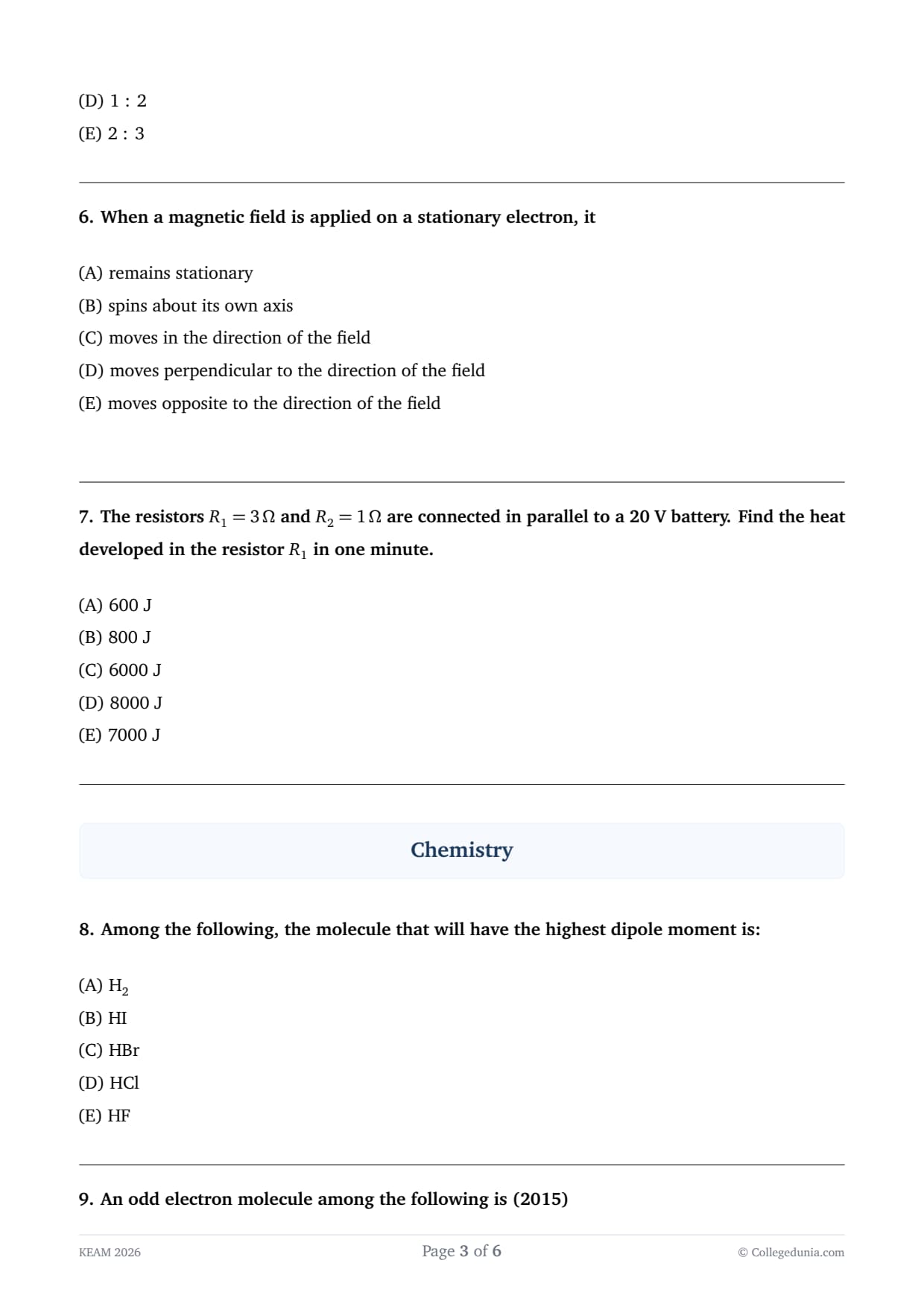
When a magnetic field is applied on a stationary electron, it
View Solution
Step 1: Understanding the effect of magnetic field on a moving electron.
When a magnetic field is applied to a charged particle like an electron, it experiences a force known as the Lorentz force. The force \( \vec{F} \) acting on a moving charged particle in a magnetic field is given by the equation:
\[ \vec{F} = q(\vec{v} \times \vec{B}) \]
Where:
- \( q \) is the charge of the electron,
- \( \vec{v} \) is the velocity of the electron,
- \( \vec{B} \) is the magnetic field.
Since the electron is stationary initially, the velocity \( \vec{v} = 0 \), but as soon as the electron begins to move, it will start to experience a force perpendicular to both its velocity and the magnetic field.
Step 2: Explanation of options.
- (A) remains stationary: Incorrect. A stationary electron will experience a force when the magnetic field is applied, leading to motion.
- (B) spins about its own axis: Incorrect. This option suggests angular motion, but the electron doesn't start spinning due to the magnetic field.
- (C) moves in the direction of the field: Incorrect. The electron does not move directly in the direction of the magnetic field. The motion is perpendicular to the magnetic field.
- (D) moves perpendicular to the direction of the field: Correct. The Lorentz force acts perpendicular to both the velocity and the magnetic field, causing the electron to move in a circular or spiral path.
- (E) moves opposite to the direction of the field: Incorrect. The electron's motion will not be directly opposite to the field direction. The force is perpendicular to the field.
Step 3: Conclusion.
The correct answer is (D) because the magnetic force on a charged particle always acts perpendicular to both the velocity of the particle and the magnetic field, resulting in motion perpendicular to the field.
\[ \boxed{D) moves perpendicular to the direction of the field} \]
Final Answer: moves perpendicular to the direction of the field.
Quick Tip: When a magnetic field is applied to a charged particle, the motion is always perpendicular to both the velocity of the particle and the direction of the magnetic field. This results in circular or helical motion.
The resistors \( R_1 = 3 \, \Omega \) and \( R_2 = 1 \, \Omega \) are connected in parallel to a 20 V battery. Find the heat developed in the resistor \( R_1 \) in one minute.
View Solution
The heat developed in a resistor is given by the formula:
\[ H = \frac{V^2}{R} \times t \]
Where:
- \( V = 20 \, V \) is the voltage of the battery,
- \( R_1 = 3 \, \Omega \) is the resistance in the upper branch,
- \( t = 60 \, s \) is the time (1 minute).
The total current in the circuit is divided between the two resistors because they are connected in parallel. However, the heat developed in the resistor \( R_1 \) is calculated using the formula for the heat developed due to current passing through it.
Step 1: Apply the formula for heat.
Using the formula:
\[ H = \frac{V^2}{R_1} \times t \]
Substitute the values:
\[ H = \frac{(20)^2}{3} \times 60 = \frac{400}{3} \times 60 = 8000 \, J \]
So, the heat developed in the resistor \( R_1 \) in one minute is 8000 J.
Final Answer: (D) 8000 J
Quick Tip: When resistors are in parallel, calculate the heat developed in each resistor individually using \( H = \frac{V^2}{R} \times t \).
Among the following, the molecule that will have the highest dipole moment is:
View Solution
The dipole moment of a molecule is a measure of the separation of positive and negative charges in the molecule. The dipole moment is given by:
\[ \mu = Q \times d \]
where \( \mu \) is the dipole moment, \( Q \) is the charge, and \( d \) is the distance between the charges (bond length). The dipole moment depends on the electronegativity difference between the atoms and the bond length.
Step 1: Electronegativity difference.
- In \( H_2 \), both atoms are hydrogen, so the electronegativity difference is zero, meaning it has no dipole moment (\( \mu = 0 \)).
- In HI, the electronegativity difference between H and I is relatively small, so the dipole moment will be smaller than in HF.
- In HBr, the dipole moment is also smaller than in HF due to the smaller electronegativity difference between H and Br.
- In HCl, the dipole moment is larger than in HI and HBr but still smaller than in HF.
- In HF, fluorine is the most electronegative element, and the electronegativity difference between H and F is very large, leading to the largest dipole moment among the given molecules.
Step 2: Conclusion.
Thus, the molecule with the highest dipole moment is HF, which corresponds to option (E).
Final Answer: (E) HF
Quick Tip: The dipole moment is strongest when the electronegativity difference is greatest, as seen in HF, where fluorine is the most electronegative element.
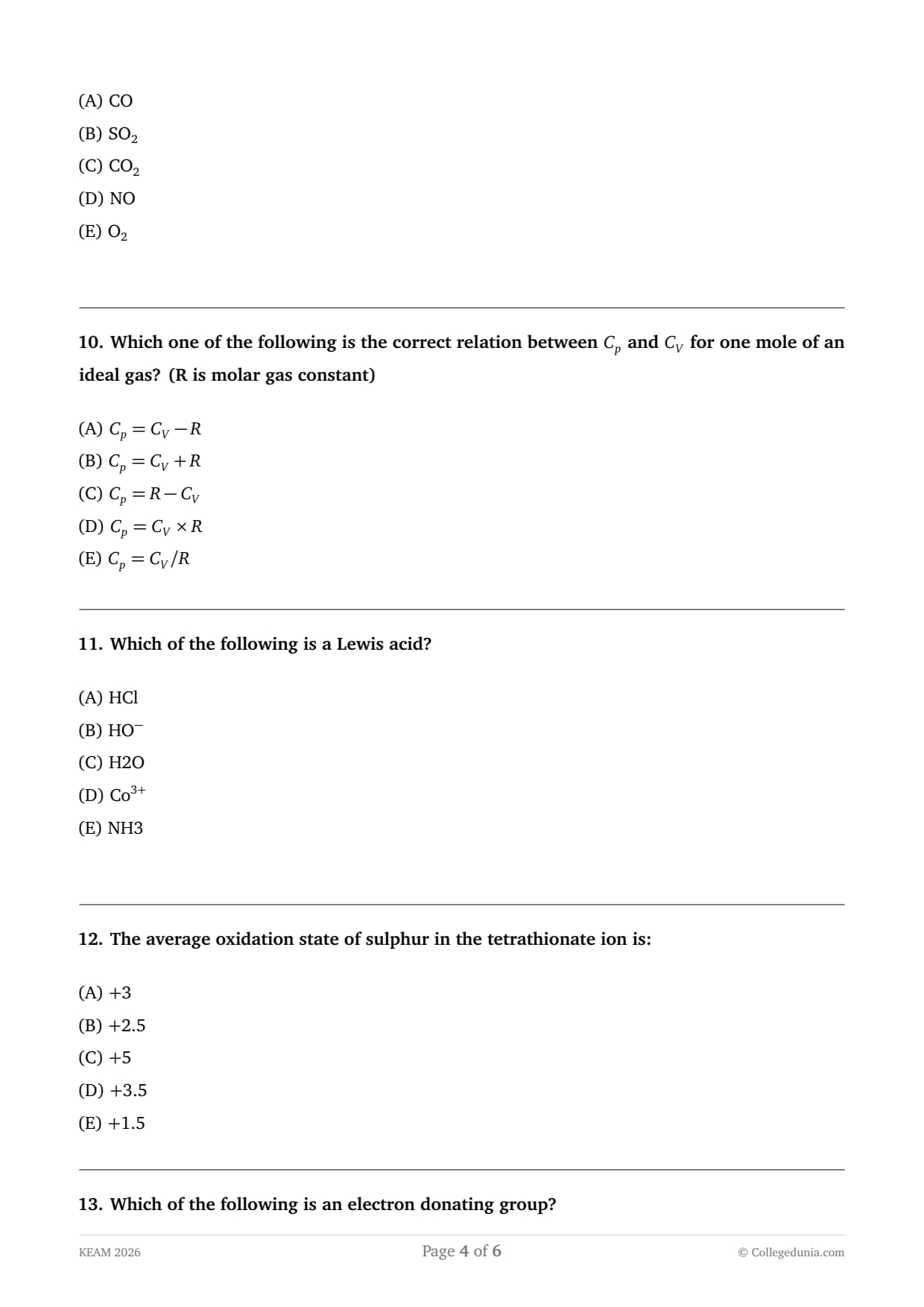
An odd electron molecule among the following is (2015)
View Solution
Step 1: Understanding odd and even electron molecules.
An odd electron molecule is one that has an odd number of electrons in its molecular orbitals. This can happen when the molecule has an odd total number of valence electrons. Odd electron molecules are often free radicals, which are molecules with unpaired electrons.
Step 2: Analysis of the options.
- (A) CO: Carbon monoxide (CO) has an even number of electrons and is not an odd electron molecule.
- (B) \( SO_2 \): Sulfur dioxide (SO2) has an even number of electrons and is not an odd electron molecule.
- (C) \( CO_2 \): Carbon dioxide (CO2) also has an even number of electrons and is not an odd electron molecule.
- (D) NO: Nitric oxide (NO) has an odd number of electrons, making it an odd electron molecule. NO is a free radical with one unpaired electron.
- (E) \( O_2 \): Oxygen (O2) has an even number of electrons, but it is a molecule with a bond order of 2, and is not considered an odd electron molecule.
Step 3: Conclusion.
Therefore, the odd electron molecule among the options is NO, which has an odd number of electrons and is a free radical.
\[ \boxed{NO} \]
Final Answer: (D) NO
Quick Tip: An odd electron molecule (free radical) has an odd number of valence electrons, which often results in an unpaired electron in the molecule's orbitals.
Which one of the following is the correct relation between \( C_p \) and \( C_V \) for one mole of an ideal gas? (R is molar gas constant)
View Solution
For an ideal gas, the relationship between the specific heat at constant pressure (\( C_p \)) and at constant volume (\( C_V \)) is given by:
\[ C_p - C_V = R \]
where \( R \) is the molar gas constant. This equation is derived from the first law of thermodynamics and the ideal gas law. Rearranging the equation gives:
\[ C_p = C_V + R \]
Step 1: Understand the relationship.
This relationship shows that the specific heat at constant pressure is greater than the specific heat at constant volume by an amount equal to the molar gas constant \( R \).
Step 2: Conclusion.
Thus, the correct relation is \( C_p = C_V + R \), which corresponds to option (B).
Final Answer: (B) \( C_p = C_V + R \)
Quick Tip: For an ideal gas, the difference between the specific heat at constant pressure and constant volume is equal to the molar gas constant: \( C_p - C_V = R \).
Which of the following is a Lewis acid?
View Solution
Step 1: Understanding Lewis acids.
A Lewis acid is defined as a substance that can accept a pair of electrons. This definition expands the concept of acids beyond the traditional Brønsted-Lowry definition, which is limited to proton (H+) donors. A Lewis acid is often a metal cation or a molecule that has an empty orbital to accept electron pairs.
Step 2: Analysis of the options.
- (A) HCl: HCl is a strong Brønsted-Lowry acid, but it does not act as a Lewis acid since it does not have an empty orbital to accept electron pairs.
- (B) \( HO^- \): Hydroxide ion is a strong Brønsted-Lowry base, but it does not act as a Lewis acid since it can donate electrons, not accept them.
- (C) H2O: Water is a neutral molecule and can act as a Lewis base by donating electrons, but it does not act as a Lewis acid.
- (D) \( Co^{3+} \): The \( Co^{3+} \) ion is a Lewis acid. It has an empty orbital that can accept electron pairs, which makes it a Lewis acid.
- (E) NH3: Ammonia is a Lewis base because it has a lone pair of electrons that it can donate, but it does not act as a Lewis acid.
Step 3: Conclusion.
The correct answer is \( Co^{3+} \) because it can accept electron pairs, making it a Lewis acid.
\[ \boxed{Co^{3+}} \]
Final Answer: \( Co^{3+} \)
Quick Tip: Lewis acids are substances that can accept a pair of electrons. Metal cations with a positive charge and an empty orbital often act as Lewis acids.
The average oxidation state of sulphur in the tetrathionate ion is:
View Solution
The tetrathionate ion is \( S_4 O_6^{2-} \). The total charge on the ion is -2.
Step 1: Oxidation state of oxygen.
The oxidation state of oxygen in the tetrathionate ion is -2, as in most compounds.
Step 2: Determine the oxidation states of sulfur.
Let the oxidation state of sulfur in the tetrathionate ion be \( x \). Since there are 4 sulfur atoms, the total oxidation state for sulfur will be \( 4x \).
Now, we can use the fact that the sum of the oxidation states must equal the overall charge of the ion (-2):
\[ 4x + 6(-2) = -2 \]
Simplifying the equation:
4x - 12 = -2
4x = 10
x = +2.5
Step 3: Conclusion.
The average oxidation state of sulfur in the tetrathionate ion is \( +2.5 \), which corresponds to option (B).
Final Answer: (B) +2.5
Quick Tip: When calculating the oxidation state of an element in a polyatomic ion, set up an equation where the sum of the oxidation states equals the total charge of the ion.
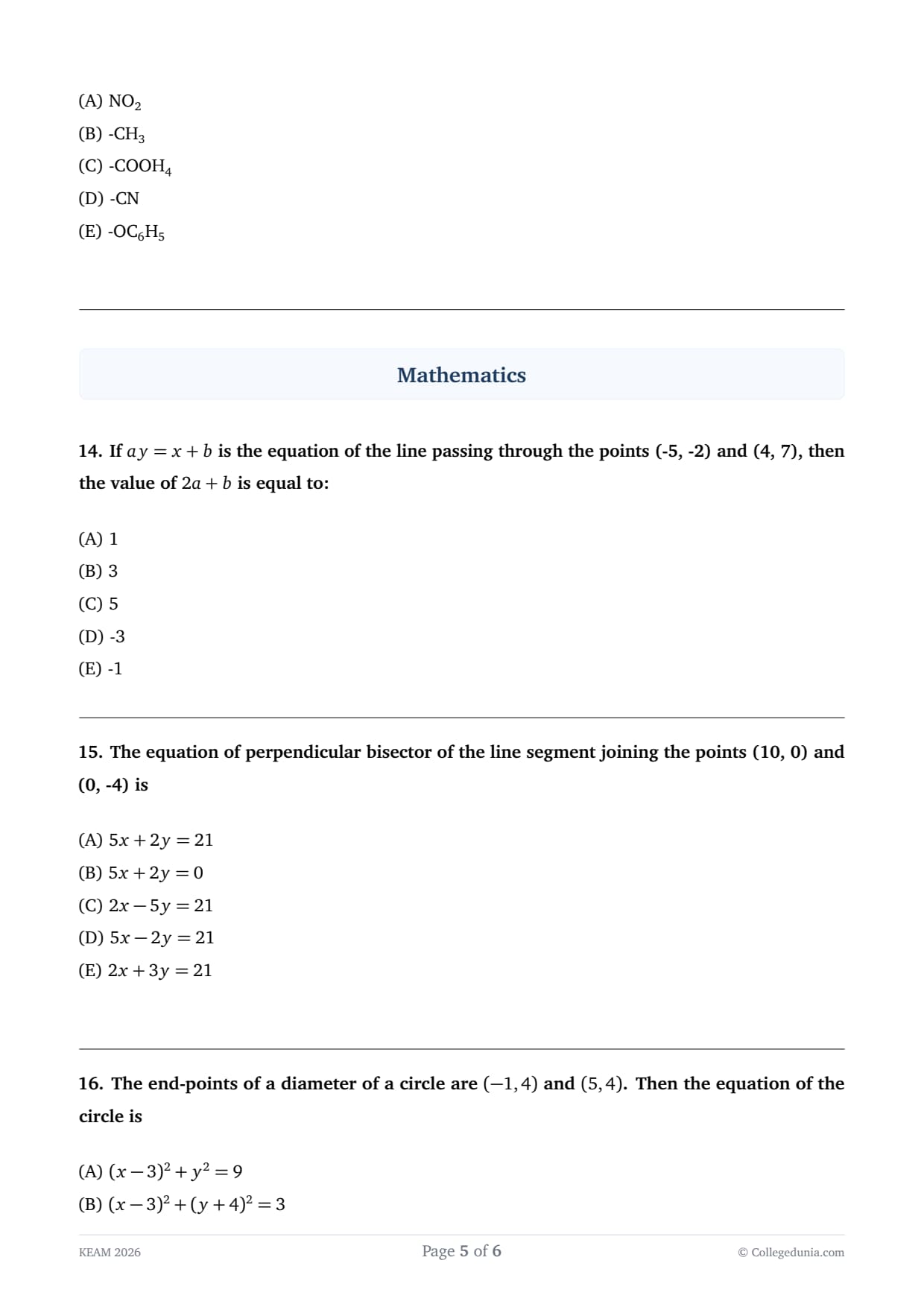
Which of the following is an electron donating group?
View Solution
Step 1: Understanding electron donating groups.
Electron donating groups (EDGs) are groups that increase the electron density on the aromatic ring by donating electron pairs. These groups are usually characterized by their ability to donate electrons through resonance or induction. They generally have lone pairs of electrons or are capable of donating electrons to the ring, making the ring more reactive towards electrophiles.
Step 2: Analysis of the options.
- (A) \( NO_2 \): Nitrogen dioxide (\( NO_2 \)) is an electron withdrawing group (EWG) due to its resonance structure. It pulls electron density away from the aromatic ring, making it less reactive towards electrophiles.
- (B) \( -CH_3 \): The methyl group (\( -CH_3 \)) is an electron donating group. It donates electrons through its inductive effect, increasing the electron density on the aromatic ring.
- (C) \( -COOH_4 \): The carboxyl group (\( -COOH \)) is an electron withdrawing group due to the resonance effect, making the ring less reactive towards electrophiles.
- (D) \( -CN \): The cyano group (\( -CN \)) is an electron withdrawing group because of its strong inductive effect and resonance, which pulls electron density away from the ring.
- (E) \( -OC_6H_5 \): The phenoxy group (\( -OC_6H_5 \)) is an electron donating group through resonance, but it is weaker compared to other typical electron donors like \( -CH_3 \).
Step 3: Conclusion.
The correct answer is \( -CH_3 \), as the methyl group is a classic electron donating group that increases the electron density on the aromatic ring.
\[ \boxed{-CH_3} \]
Final Answer: \( -CH_3 \)
Quick Tip: Electron donating groups (EDGs) increase electron density on the aromatic ring, making it more reactive towards electrophiles. Common EDGs include alkyl groups like \( -CH_3 \).
If \( ay = x + b \) is the equation of the line passing through the points (-5, -2) and (4, 7), then the value of \( 2a + b \) is equal to:
View Solution
The equation of the line is given as \( ay = x + b \), which we can rewrite as:
\[ y = \frac{1}{a}x + \frac{b}{a} \]
This is in the slope-intercept form, where \( \frac{1}{a} \) is the slope \( m \) of the line and \( \frac{b}{a} \) is the y-intercept. We are given two points on the line: (-5, -2) and (4, 7).
Step 1: Find the slope.
The slope \( m \) of a line passing through two points \( (x_1, y_1) \) and \( (x_2, y_2) \) is given by:
\[ m = \frac{y_2 - y_1}{x_2 - x_1} \]
Substituting the points (-5, -2) and (4, 7):
\[ m = \frac{7 - (-2)}{4 - (-5)} = \frac{7 + 2}{4 + 5} = \frac{9}{9} = 1 \]
So, the slope of the line is \( m = 1 \). From the equation \( y = \frac{1}{a}x + \frac{b}{a} \), we have \( \frac{1}{a} = 1 \), which gives \( a = 1 \).
Step 2: Find \( b \).
Now that we know \( a = 1 \), substitute one of the points into the equation to solve for \( b \). Using the point (4, 7):
\[ 7 = \frac{1}{1} \times 4 + \frac{b}{1} \]
\[ 7 = 4 + b \]
\[ b = 7 - 4 = 3 \]
Step 3: Calculate \( 2a + b \).
Now, substitute \( a = 1 \) and \( b = 3 \) into \( 2a + b \):
\[ 2a + b = 2(1) + 3 = 2 + 3 = 5 \]
Final Answer: (C) 5
Quick Tip: The equation of the line in slope-intercept form is useful for calculating the slope and intercept. The formula for the slope between two points is \( m = \frac{y_2 - y_1}{x_2 - x_1} \).
The equation of perpendicular bisector of the line segment joining the points (10, 0) and (0, -4) is
View Solution
Step 1: Find the midpoint of the segment.
The midpoint of the line segment joining the points \( (10, 0) \) and \( (0, -4) \) is calculated using the midpoint formula:
\[ Midpoint = \left( \frac{x_1 + x_2}{2}, \frac{y_1 + y_2}{2} \right) \]
Substituting the coordinates of the points:
\[ Midpoint = \left( \frac{10 + 0}{2}, \frac{0 + (-4)}{2} \right) = \left( 5, -2 \right) \]
Step 2: Find the slope of the line.
The slope of the line joining the points \( (10, 0) \) and \( (0, -4) \) is given by the formula:
\[ Slope = \frac{y_2 - y_1}{x_2 - x_1} = \frac{-4 - 0}{0 - 10} = \frac{-4}{-10} = \frac{2}{5} \]
Step 3: Find the slope of the perpendicular bisector.
The slope of the perpendicular bisector is the negative reciprocal of the slope of the line. Since the slope of the line is \( \frac{2}{5} \), the slope of the perpendicular bisector is \( -\frac{5}{2} \).
Step 4: Use the point-slope form of the equation of the line.
The equation of the perpendicular bisector can be written in point-slope form as:
\[ y - y_1 = m(x - x_1) \]
Where \( m \) is the slope and \( (x_1, y_1) \) is the midpoint. Substituting \( m = -\frac{5}{2} \), \( x_1 = 5 \), and \( y_1 = -2 \):
\[ y + 2 = -\frac{5}{2}(x - 5) \]
Simplifying the equation:
\[ y + 2 = -\frac{5}{2}x + \frac{25}{2} \]
Multiply through by 2 to eliminate the fraction:
\[ 2y + 4 = -5x + 25 \]
Rearranging to get the equation in standard form:
\[ 5x + 2y = 21 \]
Step 5: Conclusion.
The equation of the perpendicular bisector is \( 5x + 2y = 21 \), which corresponds to option (A).
\[ \boxed{5x + 2y = 21} \]
Final Answer: \( 5x + 2y = 21 \)
Quick Tip: The perpendicular bisector of a line segment passes through the midpoint of the segment and has a slope that is the negative reciprocal of the slope of the line segment.
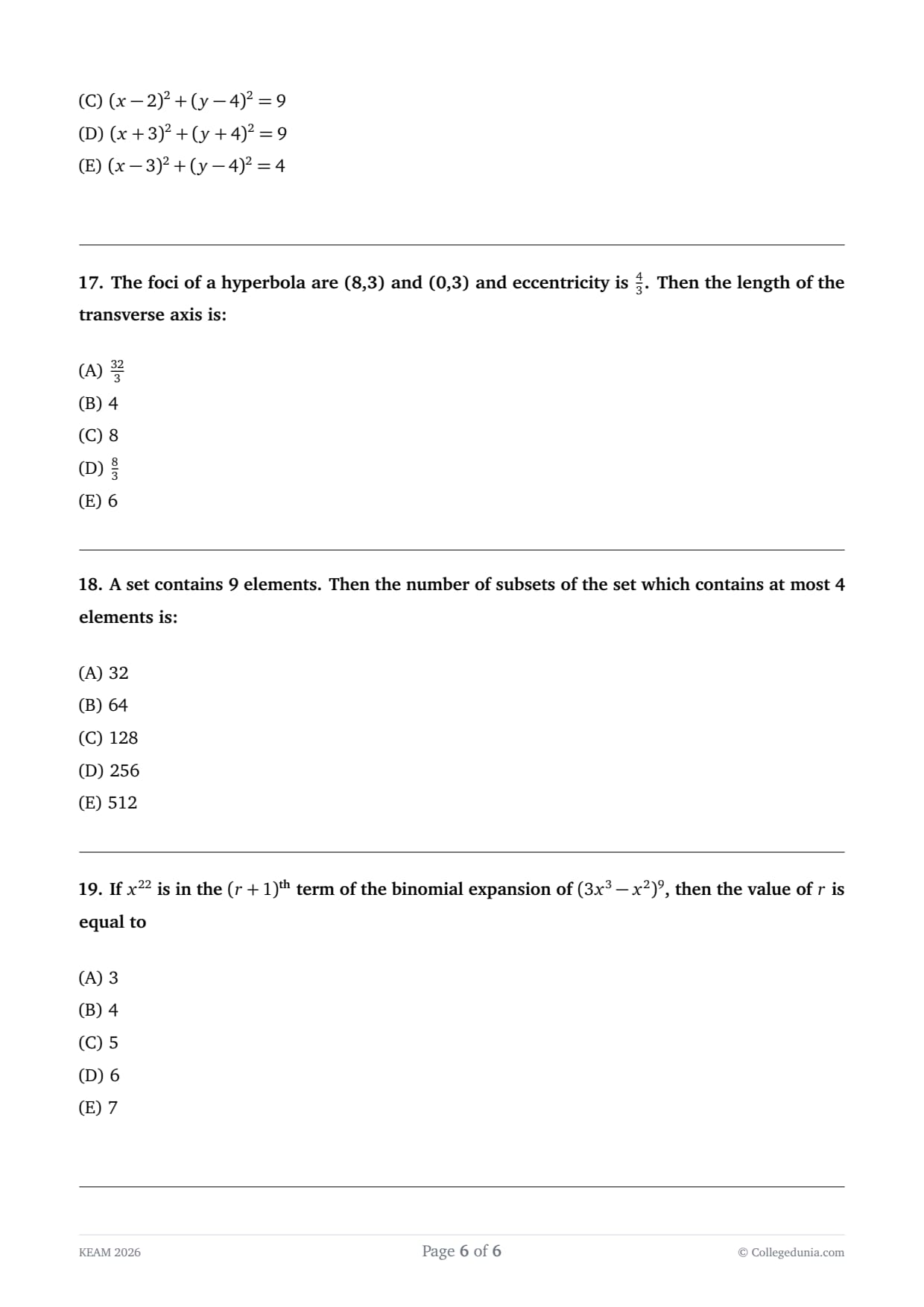
The end-points of a diameter of a circle are \( (-1, 4) \) and \( (5, 4) \). Then the equation of the circle is
View Solution
Step 1: Find the midpoint of the diameter.
The center of the circle lies at the midpoint of the diameter. The midpoint of the line segment joining the points \( (-1, 4) \) and \( (5, 4) \) is calculated using the midpoint formula:
\[ Midpoint = \left( \frac{x_1 + x_2}{2}, \frac{y_1 + y_2}{2} \right) \]
Substituting the coordinates of the points:
\[ Midpoint = \left( \frac{-1 + 5}{2}, \frac{4 + 4}{2} \right) = \left( 2, 4 \right) \]
Thus, the center of the circle is \( (2, 4) \).
Step 2: Calculate the radius of the circle.
The radius is the distance from the center of the circle \( (2, 4) \) to either endpoint of the diameter. We can use the distance formula to find this distance. Using the point \( (-1, 4) \) as one endpoint:
\[ Radius = \sqrt{(x_2 - x_1)^2 + (y_2 - y_1)^2} \]
Substituting \( (x_1, y_1) = (2, 4) \) and \( (x_2, y_2) = (-1, 4) \):
\[ Radius = \sqrt{(-1 - 2)^2 + (4 - 4)^2} = \sqrt{(-3)^2 + 0^2} = \sqrt{9} = 3 \]
Thus, the radius is 3.
Step 3: Write the equation of the circle.
The general equation of a circle with center \( (h, k) \) and radius \( r \) is:
\[ (x - h)^2 + (y - k)^2 = r^2 \]
Substituting \( h = 2 \), \( k = 4 \), and \( r = 3 \):
\[ (x - 2)^2 + (y - 4)^2 = 9 \]
Step 4: Conclusion.
The equation of the circle is \( (x - 2)^2 + (y - 4)^2 = 9 \), which corresponds to option (C).
\[ \boxed{(x - 2)^2 + (y - 4)^2 = 9} \]
Final Answer: \( (x - 2)^2 + (y - 4)^2 = 9 \)
Quick Tip: The equation of a circle can be derived from the center and radius. The center is the midpoint of the diameter, and the radius is the distance from the center to any endpoint of the diameter.
The foci of a hyperbola are (8,3) and (0,3) and eccentricity is \( \frac{4}{3} \). Then the length of the transverse axis is:
View Solution
The general equation of a hyperbola with horizontal transverse axis is:
\[ \frac{x^2}{a^2} - \frac{y^2}{b^2} = 1 \]
where \( 2a \) is the length of the transverse axis, and \( 2c \) is the distance between the foci. The relationship between the eccentricity \( e \), the semi-major axis \( a \), and the semi-minor axis \( b \) for a hyperbola is:
\[ e = \frac{c}{a} \]
We are given that the foci are at \( (8,3) \) and \( (0,3) \), which means the distance between the foci is:
\[ 2c = 8 \quad \Rightarrow \quad c = 4 \]
The eccentricity is given as \( \frac{4}{3} \), so we can write:
\[ e = \frac{c}{a} = \frac{4}{3} \]
Substituting \( c = 4 \) into this equation:
\[ \frac{4}{a} = \frac{4}{3} \quad \Rightarrow \quad a = 3 \]
Now, we can use the equation \( c^2 = a^2 + b^2 \) to find \( b^2 \):
\[ c^2 = a^2 + b^2 \quad \Rightarrow \quad 16 = 9 + b^2 \quad \Rightarrow \quad b^2 = 7 \]
The length of the transverse axis is \( 2a \), so:
\[ 2a = 2 \times 3 = 6 \]
Thus, the length of the transverse axis is \( 6 \), which corresponds to option (E).
Final Answer: (E) 6
Quick Tip: For a hyperbola, use the relationship \( e = \frac{c}{a} \) and \( c^2 = a^2 + b^2 \) to find the necessary parameters for calculating the length of the transverse axis.
A set contains 9 elements. Then the number of subsets of the set which contains at most 4 elements is:
View Solution
The total number of subsets of a set with \( n \) elements is \( 2^n \). For a set of 9 elements, the total number of subsets is:
\[ 2^9 = 512 \]
Now, we need to find the number of subsets that contain at most 4 elements. This includes subsets of 0, 1, 2, 3, or 4 elements. The number of subsets containing exactly \( k \) elements from a set of 9 elements is given by the combination formula:
\[ \binom{9}{k} \]
Thus, the total number of subsets containing at most 4 elements is:
\[ \binom{9}{0} + \binom{9}{1} + \binom{9}{2} + \binom{9}{3} + \binom{9}{4} \]
Now, we calculate each combination:
\[ \binom{9}{0} = 1, \quad \binom{9}{1} = 9, \quad \binom{9}{2} = 36, \quad \binom{9}{3} = 84, \quad \binom{9}{4} = 126 \]
Adding these values:
\[ 1 + 9 + 36 + 84 + 126 = 256 \]
Therefore, the number of subsets containing at most 4 elements is 256.
Final Answer: (D) 256
Quick Tip: To find the number of subsets with at most \( k \) elements, use the combination formula and sum up the subsets for \( 0, 1, 2, \dots, k \) elements.
If \( x^{22} \) is in the \( (r + 1)^{th} \) term of the binomial expansion of \( (3x^3 - x^2)^9 \), then the value of \( r \) is equal to
View Solution
Step 1: Understanding the binomial expansion.
The general term of the binomial expansion of \( (a + b)^n \) is given by:
\[ T_{r+1} = \binom{n}{r} a^{n-r} b^r \]
For the expression \( (3x^3 - x^2)^9 \), we identify \( a = 3x^3 \) and \( b = -x^2 \), and the expansion is:
\[ T_{r+1} = \binom{9}{r} (3x^3)^{9-r} (-x^2)^r \]
Simplifying the powers of \( x \):
\[ T_{r+1} = \binom{9}{r} 3^{9-r} x^{3(9-r)} (-1)^r x^{2r} \]
Thus, the exponent of \( x \) in the general term is:
\[ x^{3(9 - r) + 2r} = x^{27 - 3r + 2r} = x^{27 - r} \]
Step 2: Setting the exponent equal to 22.
We are given that \( x^{22} \) is in the \( (r+1)^{th} \) term, so we set the exponent equal to 22:
\[ 27 - r = 22 \]
Solving for \( r \):
\[ r = 5 \]
Step 3: Conclusion.
Therefore, the value of \( r \) is 5.
\[ \boxed{5} \]
Final Answer: 5
Quick Tip: In a binomial expansion, the exponent of \( x \) in each term can be found by adding the exponents of \( x \) in the expanded forms of the two terms. For \( (3x^3 - x^2)^9 \), the exponent is \( 27 - r \).
Also Check: KEAM 2026 Marks vs Rank out of 600
KEAM 2026 Exam Pattern
| Particulars | Details |
|---|---|
| Paper | Engineering |
| Mode of Exam | Online CBT |
| Subjects | Physics- 45 questions Chemistry- 30 questions Mathematics- 75 questions |
| Type of Question | Objective Type |
| Total Number of questions | 150 |
| Marks are awarded for each correct answer | 4 marks |
| Marks are awarded for each incorrect answer | 1 marks |
| KEAM total marks for Engineering | 600 marks |
| Duration of KEAM Engineering exam | 3 hours |




Comments