




The PSEB Class 12 Biology Sample Question Paper exam will be conducted with the question paper and solutions made available after the exam. The exam will assess students' understanding through a combination of multiple-choice, objective, short, and long answer questions within a 3-hour duration. The paper will total 100 marks, with 80 marks allotted for the theory component and 20 marks for internal assessment. There will be no negative marking for incorrect answers.
PSEB Class 12 Biology Sample Question Paper 2026 Question Paper with Solutions PDF
| PSEB Class 12 Biology Sample Question Paper 2026 Question Paper with Solutions PDF | Download PDF | Check Solutions |
The nuclei present in central cell of embryo sac is called
View Solution
Step 1: In a typical angiosperm embryo sac, the central cell is the largest cell located in the middle.
Step 2: This cell contains two nuclei, which are referred to as polar nuclei.
Step 3: During triple fusion, these two polar nuclei fuse with a male gamete to form the triploid primary endosperm nucleus (PEN). Quick Tip: The embryo sac is often described as "7-celled but 8-nucleate" because the large central cell contains two separate polar nuclei before they fuse.
Delivery of developed fetus is scientifically called
View Solution
Step 1: Parturition is the scientific term for the process of giving birth or the expulsion of the fetus from the uterus.
Step 2: It is induced by a complex neuroendocrine mechanism involving hormones like cortisol, estrogens, and oxytocin.
Step 3: The signals for parturition originate from the fully developed fetus and the placenta, which induce mild uterine contractions called the fetal ejection reflex. Quick Tip: Oxytocin is often called the "birth hormone" because it acts on the uterine muscle to cause stronger contractions during parturition.
Disadvantages of amniocentesis is
View Solution
Step 1: Amniocentesis is a medical procedure used to test for chromosomal abnormalities and genetic defects in a fetus by analyzing amniotic fluid.
Step 2: While determining diseases (Option a) is a major medical advantage, the procedure also reveals the chromosomal sex of the fetus.
Step 3: The misuse of this information for female foeticide is considered a significant social disadvantage and has led to a statutory ban on sex determination in many countries. Quick Tip: Amniocentesis is legally permitted only for detecting genetic disorders like Down syndrome, hemophilia, or sickle-cell anemia.
A cross between F1 hybrid and any one of parent is
View Solution
Step 1: A back cross is a cross between an \(F_1\) individual (hybrid) and any of its original parents (dominant or recessive).
Step 2: If the \(F_1\) hybrid is crossed specifically with the recessive parent, it is called a test cross.
Step 3: Therefore, every test cross is a back cross, but not every back cross is a test cross. Quick Tip: Use a Back Cross to recover elite parental traits in breeding, and use a Test Cross specifically to determine the genotype of an unknown dominant phenotype.
Vertebrate forelimbs are example of
View Solution
Step 1: Homologous organs are those that share a similar anatomical structure and origin but perform different functions.
Step 2: The forelimbs of vertebrates (e.g., human arm, bat wing, cheetah leg, whale flipper) all have the same basic bone structure (humerus, radius, ulna, carpals, metacarpals, and phalanges).
Step 3: This similarity indicates common ancestry and is a result of divergent evolution. Quick Tip: Remember: Homology = Common Anatomy + Different Functions (Divergent Evolution). Analogy = Different Anatomy + Similar Functions (Convergent Evolution).
The genes causing cancer are
View Solution
Step 1: Normal cells have genes called cellular oncogenes (c-onc) or proto-oncogenes.
Step 2: When these genes are activated under certain conditions (like mutations or exposure to carcinogens), they transform into viral oncogenes or active oncogenes.
Step 3: These activated oncogenes lead to the uncontrolled cell division characteristic of cancer. Quick Tip: Carcinogens are the physical, chemical, or biological agents (like UV rays or tobacco smoke) that trigger the transformation of proto-oncogenes into oncogenes.
If BOD of water sample is very high, the sample is
View Solution
Step 1: BOD (Biochemical Oxygen Demand) is the amount of oxygen required by bacteria to decompose the organic matter in one liter of water.
Step 2: A high BOD value indicates that there is a large amount of organic waste present, which requires more oxygen for breakdown.
Step 3: Therefore, the higher the BOD of a water sample, the greater is its polluting potential. Quick Tip: BOD is directly proportional to the amount of organic matter in water. As organic matter increases, BOD increases, and Dissolved Oxygen (DO) decreases.
Plasmids are used as cloning vectors because they
View Solution
Step 1: Plasmids are extra-chromosomal, circular, double-stranded DNA molecules found in bacteria.
Step 2: They possess an "Origin of Replication" (ori) sequence, which allows them to replicate independently of the bacterial chromosomal DNA.
Step 3: This self-replicating property makes them ideal for carrying and multiplying foreign DNA fragments (genes of interest) within a host cell. Quick Tip: To be an effective vector, a plasmid must have an 'ori', selectable markers (like antibiotic resistance genes), and unique cloning sites.
Golden rice is enriched with
View Solution
Step 1: Golden rice is a genetically modified (transgenic) variety of rice (Oryza sativa).
Step 2: It has been engineered to biosynthesize beta-carotene, which is a precursor of Vitamin A, in the edible parts of the rice.
Step 3: This was developed as a fortified food to be grown and consumed in areas with a shortage of dietary Vitamin A, which causes night blindness. Quick Tip: Golden rice gets its name from its yellow-orange color, which comes from the high concentration of beta-carotene.
Mycohhroezais example of
View Solution
Step 1: Mycorrhiza (misspelled as Mycohhroeza in the question) is a symbiotic association between a fungus and the roots of higher plants.
Step 2: The fungus helps the plant in the absorption of essential nutrients (like phosphorus) from the soil, while the plant provides the fungus with energy-yielding carbohydrates.
Step 3: Since both organisms benefit from this interaction (+/+), it is a classic example of mutualism. Quick Tip: In Mutualism, the interaction is obligatory or beneficial for both species. Other examples include Lichens (Algae and Fungi) and Fig trees and Wasps.
At each tropic level in which form energy is lost
View Solution
Step 1: According to Lindeman's 10% law, only 10% of the energy is transferred from one trophic level to the next.
Step 2: The remaining 90% of the energy is consumed by the organism for metabolic activities (like respiration) or lost during the process.
Step 3: This lost energy is primarily released into the environment in the form of heat, which cannot be recycled back into the food chain. Quick Tip: Energy flow in an ecosystem is always unidirectional and follows the Laws of Thermodynamics.
In national park protection is given to
View Solution
Step 1: A National Park is an in-situ conservation area strictly reserved for the betterment of wildlife.
Step 2: Unlike a Sanctuary (which may focus on a particular species of fauna), a National Park protects the entire ecosystem.
Step 3: This includes all biological components: the plants (flora), the animals (fauna), and the landscape. Human activities like grazing or cultivation are strictly prohibited. Quick Tip: In-situ conservation means protecting the species in their natural habitat. Examples include National Parks, Biosphere Reserves, and Sacred Groves.
Copper T is used as birth control device by women
View Solution
Step 1: Copper T (CuT) is a type of Intrauterine Device (IUD) inserted by doctors or expert nurses in the uterus through the vagina.
Step 2: It acts as an effective contraceptive by releasing copper ions.
Step 3: These copper ions suppress sperm motility and the fertilizing capacity of sperms, thereby preventing conception. Quick Tip: IUDs like Copper T are the most widely accepted method of contraception in India for women who want to delay pregnancy or space children.
Sickle cell anaemia is an example of point mutation.
View Solution
Step 1: A point mutation is a change in a single base pair of DNA.
Step 2: In sickle cell anaemia, there is a substitution of Glutamic acid by Valine at the sixth position of the beta globin chain of haemoglobin.
Step 3: This is caused by a single base substitution at the sixth codon of the mRNA from GAG to GUG. Quick Tip: Because of this mutation, the shape of the Red Blood Cell changes from a biconcave disc to an elongated, sickle-like structure under low oxygen tension.
Vaccination is a type of innate immunity
View Solution
Step 1: Innate immunity is non-specific defense that is present at the time of birth (e.g., skin, mucus, stomach acid).
Step 2: Vaccination provides acquired (adaptive) immunity because it involves the administration of an antigen to stimulate the body's immune system to recognize a specific pathogen.
Step 3: It relies on the property of "memory" of the immune system to protect the individual during future exposures. Quick Tip: Acquired immunity is characterized by memory and is pathogen-specific, whereas innate immunity is the body's first line of natural, non-specific defense.
In gel electrophoresis DNA fragments separate according to their charge
View Solution
Step 1: Since DNA fragments are negatively charged molecules, they all move towards the positive electrode (anode) during electrophoresis.
Step 2: Although the movement is driven by charge, the separation occurs according to their size (length).
Step 3: The agarose gel acts as a sieve; hence, smaller fragments move faster and farther than larger ones. Quick Tip: Remember: DNA always moves toward the ANODE (positive electrode) because DNA is ACIDIC and NEGATIVE. Separation is based on SIZE.
Zygote divides to form ……….which is implanted in uterine wall
View Solution
Step 1: After fertilization, the zygote undergoes rapid mitotic divisions called cleavage as it moves through the fallopian tube toward the uterus.
Step 2: It passes through the morula stage (8–16 cells) and finally transforms into a blastocyst.
Step 3: It is the blastocyst stage that attaches to and becomes embedded in the endometrium of the uterus, a process called implantation. Quick Tip: The blastocyst consists of an outer layer called the trophoblast and an inner cell mass which later differentiates into the embryo.
Substances which cause allergy are called ……..
View Solution
Step 1: Allergy is an exaggerated response of the immune system to certain antigens present in the environment.
Step 2: The specific substances that trigger this immune response are called allergens (e.g., pollen, dust mites, animal dander).
Step 3: The immune system produces IgE type antibodies in response to these allergens. Quick Tip: Allergic reactions involve the release of chemicals like histamine and serotonin from mast cells in the body.
Dragonflies are used as biocontrol agents to protect the crops from …………….
View Solution
Step 1: Biocontrol refers to the use of biological methods for controlling plant diseases and pests.
Step 2: This method relies on natural predation rather than toxic chemicals.
Step 3: Familiar examples include Ladybirds used to control aphids and Dragonflies used to control mosquitoes. Quick Tip: Using biocontrol agents reduces our dependence on chemical pesticides, which are often harmful to the environment and non-target organisms.
Sacred groves is an example of…………….conservation
View Solution
Step 1: In-situ (on-site) conservation is the protection of an entire ecosystem so that the species are protected in their natural habitat.
Step 2: Sacred groves are tracts of forest that are protected through cultural or religious beliefs, often found in regions like the Khasi hills of Meghalaya or Aravalli hills of Rajasthan.
Step 3: Because the plants and animals are protected within their own natural environment, it is categorized as in-situ conservation. Quick Tip: Common In-situ methods: National Parks, Biosphere Reserves, Sacred Groves. Common Ex-situ methods: Zoological Parks, Botanical Gardens, Cryopreservation.
Write two functions of tapetum.
View Solution
Step 1: The tapetum is the innermost layer of the microsporangium (anther wall) and consists of cells with dense cytoplasm and generally more than one nucleus.
Step 2: Its primary function is to provide nutrition to the developing microspores (pollen grains).
Step 3: It also secretes various enzymes, hormones, and the fatty substance sporopollenin, which forms the tough outer layer (exine) of the pollen grain. Quick Tip: The tapetum is the only layer of the anther wall that is physiologically active in nourishing the pollen; the outer three layers (epidermis, endothecium, and middle layers) are primarily protective.
What are the major components of seminal plasma?
View Solution
Step 1: Seminal plasma is the fluid part of the semen, produced by the secretions of the male accessory glands.
Step 2: These glands include the paired seminal vesicles, the prostate gland, and the paired bulbourethral glands.
Step 3: It is rich in fructose (which provides energy to sperm), calcium ions, and various enzymes that facilitate sperm motility and survival within the female reproductive tract. Quick Tip: Fructose in seminal plasma is unique to these secretions and is often used in forensic tests to confirm the presence of semen.
Name two permanent methods of birth control.
View Solution
Step 1: Permanent methods, also known as sterilization, are surgical procedures that block gamete transport.
Step 2: In Vasectomy, a small part of the vas deferens is removed or tied up through a small incision on the scrotum.
Step 3: In Tubectomy, a small part of the fallopian tubes is removed or tied up through a small incision in the abdomen or through the vagina. Quick Tip: While these methods are highly effective (nearly 100%), their reversibility is very poor, making them suitable only for those who have completed their family.
Expand: ZIFT and ICSI
View Solution
Step 1: These are Assisted Reproductive Technologies (ART) used to help infertile couples.
Step 2: ZIFT involves transferring the zygote (up to 8 blastomeres stage), formed via IVF, into the fallopian tube.
Step 3: ICSI is a specialized procedure where a single sperm is directly injected into the ovum in the laboratory to form an embryo. Quick Tip: If the embryo has more than 8 blastomeres, it is transferred into the uterus instead of the fallopian tube; this is called IUT (Intra Uterine Transfer).
What do you mean by law of segregation.
View Solution
Step 1: This law states that during the formation of gametes, the two factors (alleles) of a character separate or segregate from each other.
Step 2: A gamete receives only one of the two factors, ensuring it is always "pure" for a specific trait.
Step 3: This explains why the recessive trait, which remains hidden in the \(F_1\) generation, reappears in the \(F_2\) generation. Quick Tip: The Law of Segregation is also known as the "Law of Purity of Gametes" because it is a universal law of inheritance with no known exceptions.
What will the progeny be if a woman carrier for haemophilia marries a normal man?
View Solution
Step 1: Haemophilia is an X-linked recessive disorder. The genotype of the carrier woman is \(X^H X^h\) and the normal man is \(X^H Y\).
Step 2: The possible gametes are: Woman (\(X^H, X^h\)) and Man (\(X^H, Y\)).
Step 3: The Punnett square results in: \(X^H X^H\) (Normal daughter), \(X^H Y\) (Normal son), \(X^H X^h\) (Carrier daughter), and \(X^h Y\) (Haemophilic son).
Step 4: Conclusion: Half of the male offspring will suffer from the disease, while all female offspring will have normal vision/phenotype (though half will be carriers). Quick Tip: In X-linked recessive traits like haemophilia, the disease is transmitted from a carrier mother to her sons (Criss-cross inheritance).
What is convergent evolution. Give an example
View Solution
Step 1: Convergent evolution occurs when different species, often living in similar habitats or facing similar environmental pressures, develop analogous structures.
Step 2: Analogous structures are those that perform similar functions but have different anatomical origins and structures.
Step 3: Example: The eye of an octopus and a mammal, or the flippers of penguins and dolphins. These structures did not evolve from a common ancestor but evolved independently to serve the same purpose. Quick Tip: Convergent evolution leads to Analogy (similar function, different origin), while Divergent evolution leads to Homology (different function, common origin).
Differentiate between innate and acquired immunity.
View Solution
Step 1: Innate Immunity is the first line of defense. It includes physical barriers (skin), physiological barriers (stomach acid), cellular barriers (WBCs), and cytokine barriers (interferons).
Step 2: Acquired Immunity is the second line of defense developed during an individual's lifetime. It involves specialized B-lymphocytes and T-lymphocytes.
Step 3: A key difference is "memory": Acquired immunity remembers a pathogen so that a second encounter triggers a highly intensified (secondary/anamnestic) response. Quick Tip: Innate immunity is like a general security guard (protects against everything), whereas Acquired immunity is like a specialized detective (targets specific criminals).
Define sewage. Why is it harmful to us?
View Solution
Step 1: Sewage is the municipal wastewater generated daily in cities and towns. It contains large amounts of organic matter and microbes.
Step 2: Many of these microbes are pathogenic (disease-causing), leading to outbreaks of water-borne diseases like cholera, typhoid, and dysentery.
Step 3: When discharged into water bodies, the high organic content leads to high BOD, which depletes dissolved oxygen, causing the death of fish and other aquatic organisms. Quick Tip: Sewage must be treated in Sewage Treatment Plants (STPs) using heterotrophic microbes before it can be safely released into natural water bodies.
What are bioreactors. Name its two types.
View Solution
Step 1: Bioreactors provide the optimal conditions (temperature, pH, substrate, salts, vitamins, oxygen) for achieving the desired product using microbial, plant, animal, or human cells.
Step 2: They allow for large-scale production which is not possible in laboratory flasks.
Step 3: The most commonly used bioreactors are of the stirring type, which ensures even mixing and oxygen availability throughout the reactor. Quick Tip: A stirred-tank bioreactor is usually cylindrical or has a curved base to facilitate the mixing of the reactor contents.
Expand PCR. Mention its any one importance in biotechnology.
View Solution
Step 1: PCR stands for Polymerase Chain Reaction. It is a technique used to make multiple copies of a specific DNA sequence in vitro.
Step 2: It involves three main steps: Denaturation, Annealing, and Extension, using a thermostable DNA polymerase called Taq polymerase.
Step 3: Importance: It is crucial for early diagnosis of diseases (like AIDS or cancer), DNA fingerprinting, and gene cloning when only a very small amount of DNA is available. Quick Tip: The enzyme Taq polymerase is isolated from the bacterium Thermus aquaticus, which remains active during the high-temperature denaturation step.
Write two advantages of GM crops.
View Solution
Step 1: Genetically Modified (GM) crops are plants whose DNA has been manipulated using genetic engineering.
Step 2: Advantage 1: They can be engineered to be more resilient to environmental conditions like salinity, drought, or extreme temperatures.
Step 3: Advantage 2: They help reduce environmental pollution by decreasing the need for chemical pesticides (e.g., Bt cotton). They can also enhance nutritional value (e.g., Vitamin 'A' enriched Golden Rice). Quick Tip: GM crops also help to reduce post-harvest losses and increase the efficiency of mineral usage by plants.
Write any two points of differences between grazing and detritus food chain.
View Solution
Step 1: Grazing Food Chain (GFC) begins with green plants (producers) at the first trophic level. Energy is captured from sunlight.
Step 2: Detritus Food Chain (DFC) begins with dead organic matter (detritus). It is made up of decomposers (saprotrophs) like fungi and bacteria.
Step 3: In terrestrial ecosystems, a much larger fraction of energy flows through the DFC than through the GFC. Quick Tip: In aquatic ecosystems, GFC is the major conduit for energy flow, whereas in terrestrial ecosystems, DFC is more significant.
What do you mean by hotspots of biodiversity?
View Solution
Step 1: Biodiversity hotspots are areas characterized by a high number of species (richness) and species that are found nowhere else (endemism).
Step 2: These regions are also designated because they are experiencing significant habitat loss.
Step 3: Originally 25, there are now 34 biodiversity hotspots identified globally. In India, examples include the Western Ghats, Sri Lanka, Indo-Burma, and the Himalayas. Quick Tip: Although hotspots cover less than 2% of the Earth's land area, strict protection of these areas could reduce the ongoing mass extinctions by almost 30%.
What is DNA fingerprinting? Mention its two applications.
View Solution
Step 1: DNA Fingerprinting is a technique to identify the variations in the DNA of individuals. It focuses on satellite DNA, which shows a high degree of polymorphism.
Step 2: These polymorphic regions are called Variable Number of Tandem Repeats (VNTRs). Since every individual (except identical twins) has a unique pattern of VNTRs, it serves as a "fingerprint."
Step 3: Applications: It is extensively used in forensic science to identify criminals using samples like blood or hair, and in population genetics to study genetic diversity. Quick Tip: DNA fingerprinting was originally developed by Alec Jeffreys. He used a satellite DNA as a probe that showed a very high degree of polymorphism.
Explain the structure of transcription unit with diagram.
View Solution
Step 1: Promoter: Located towards the 5'-end (upstream) of the coding strand. It provides the binding site for RNA polymerase.
Step 2: Structural Gene: The region between the promoter and terminator where the actual transcription of DNA into RNA takes place.
Step 3: Terminator: Located towards the 3'-end (downstream) of the coding strand. It defines the end of the process of transcription. Quick Tip: By convention, the sequence of the "coding strand" (5' to 3') is used to describe the locations in a transcription unit, even though it is the "template strand" (3' to 5') that is actually transcribed.
Write a short note on industrial melanism.
View Solution
Step 1: Before industrialization, white-winged moths were more numerous because they could camouflage against lichen-covered trees, while dark moths were eaten by birds.
Step 2: After industrialization, tree trunks became dark due to soot and the death of lichens. This allowed dark-winged moths to survive better (camouflage), while white moths were easily predated.
Step 3: This observation proved that in a changing environment, those variations that provide a survival advantage are selected by nature, leading to a change in the population's characteristics. Quick Tip: Industrial melanism demonstrates that evolution is not a directed process but is based on chance events and natural selection of existing variations.
Name the causing agent of Typhoid. Also write down its symptoms and modes of transmission.
View Solution
Step 1: Pathogen: Salmonella typhi is a pathogenic bacterium that enters the small intestine.
Step 2: Transmission: It generally enters through food and water contaminated with the faeces of an infected person and migrates to other organs through blood.
Step 3: Symptoms: High fever, weakness, stomach pain, constipation, and loss of appetite. In severe cases, intestinal perforation and death may occur. The Widal test is used for its confirmation. Quick Tip: The classic case of "Typhoid Mary" (Mary Mallon) is often cited in medicine; she was a cook and a carrier who unknowingly spread the disease for years.
With help of diagram, show the steps of recombinant DNA technology.
View Solution
Step 1: The DNA of interest and a vector (plasmid) are cut using the same restriction enzyme to create compatible "sticky ends."
Step 2: The gene of interest is joined to the vector using the enzyme DNA Ligase, forming Recombinant DNA (rDNA).
Step 3: The rDNA is introduced into a host cell (like E. coli) through transformation. The host cells are then cultured at a large scale to produce the desired protein. Quick Tip: Restriction enzymes are called "molecular scissors" because they cut DNA at specific palindromic sequences.
What is gene therapy? Illustrate using the example of adenosine deaminase deficiency.
View Solution
Step 1: Gene therapy involves the delivery of a normal gene into the individual or embryo to take over the function of and compensate for the non-functional gene.
Step 2: In the first clinical case (1990), a 4-year-old girl with ADA deficiency was treated. ADA is crucial for the immune system to function.
Step 3: Lymphocytes from the patient's blood were grown in culture, and a functional ADA cDNA was introduced into them using a retroviral vector. These cells were then returned to the patient. Quick Tip: While periodic infusion of genetically engineered lymphocytes is a treatment, a permanent cure is possible only if the gene is introduced into marrow cells at early embryonic stages.
Name and explain the type of interaction between clown fish and sea anemone.
View Solution
Step 1: Commensalism is an interaction where one species benefits and the other is neither harmed nor benefited.
Step 2: The clownfish lives among the stinging tentacles of the sea anemone. The stinging tentacles provide the fish protection from predators, which stay away from the anemone.
Step 3: The sea anemone does not appear to derive any benefit or suffer any harm from the presence of the clownfish. Quick Tip: Other examples of Commensalism include an orchid growing as an epiphyte on a mango branch and barnacles growing on the back of a whale.
Define Oogenesis. Briefly describe the process of Oogenesis with the help of labelled diagram.
View Solution
Step 1: Oogenesis begins during the fetal stage where millions of oogonia are formed within each fetal ovary; no more oogonia are formed or added after birth.
Step 2: These cells enter meiosis I and get temporarily arrested at the prophase-I stage, called primary oocytes. Each primary oocyte is surrounded by granulosa cells to form a primary follicle.
Step 3: At puberty, a primary oocyte completes its first unequal meiotic division, resulting in a large haploid secondary oocyte and a tiny first polar body.
Step 4: The secondary oocyte undergoes meiosis II only upon the entry of a sperm, resulting in a large ootid (ovum) and a second polar body. Quick Tip: Unlike spermatogenesis, which starts at puberty, oogenesis is initiated during embryonic development but is only completed if fertilization occurs.
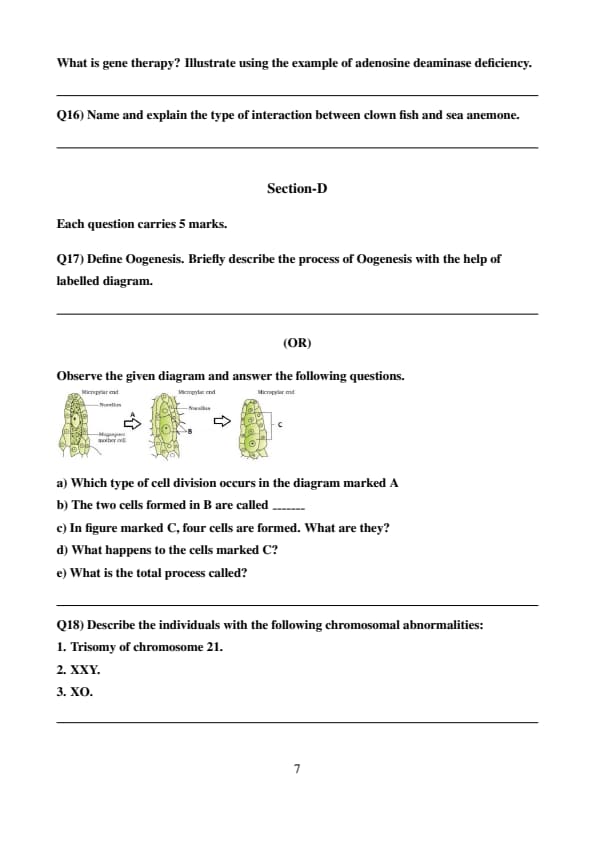
Observe the given diagram and answer the following questions.
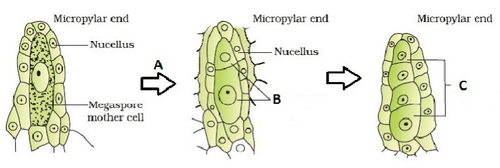
a) Which type of cell division occurs in the diagram marked A
b) The two cells formed in B are called _______
c) In figure marked C, four cells are formed. What are they?
d) What happens to the cells marked C?
e) What is the total process called?
View Solution
Step 1: (a) The process starts with a diploid Microspore Mother Cell (MMC) undergoing Meiosis to reduce the chromosome number to haploid.
Step 2: (b) After the first meiotic division (Meiosis I), two cells are formed, which are known as a Microspore Dyad.
Step 3: (c) After the second meiotic division (Meiosis II), four haploid cells are produced, arranged in a group called the Microspore Tetrad.
Step 4: (d) As the anthers mature and dehydrate, the microspores in the tetrad dissociate from each other and develop into pollen grains.
Step 5: (e) The entire process of formation of microspores from a pollen mother cell through meiosis is called Microsporogenesis. Quick Tip: In angiosperms, the microspore tetrad is usually tetrahedral in shape. Each microspore eventually develops a hard outer layer called the exine and an inner layer called the intine.
Describe the individuals with the following chromosomal abnormalities:
1. Trisomy of chromosome 21.
2. XXY.
3. XO.
View Solution
Step 1: Trisomy of 21 (Down's Syndrome): Caused by the presence of an additional copy of chromosome number 21. Affected individuals have a short stature, small round head, furrowed tongue, partially open mouth, and broad palm with a characteristic palm crease. Physical and mental development is retarded.
Step 2: XXY (Klinefelter's Syndrome): Caused by an extra X chromosome in males (47, XXY). Such individuals have overall masculine development but also express feminine characters like development of breasts (Gynaecomastia). They are sterile.
Step 3: XO (Turner's Syndrome): Caused by the absence of one of the X chromosomes in females (45, XO). Such females are sterile as ovaries are rudimentary, and they lack other secondary sexual characters. Quick Tip: These conditions are examples of Aneuploidy, which arises due to the failure of segregation of chromatids during cell division (non-disjunction).
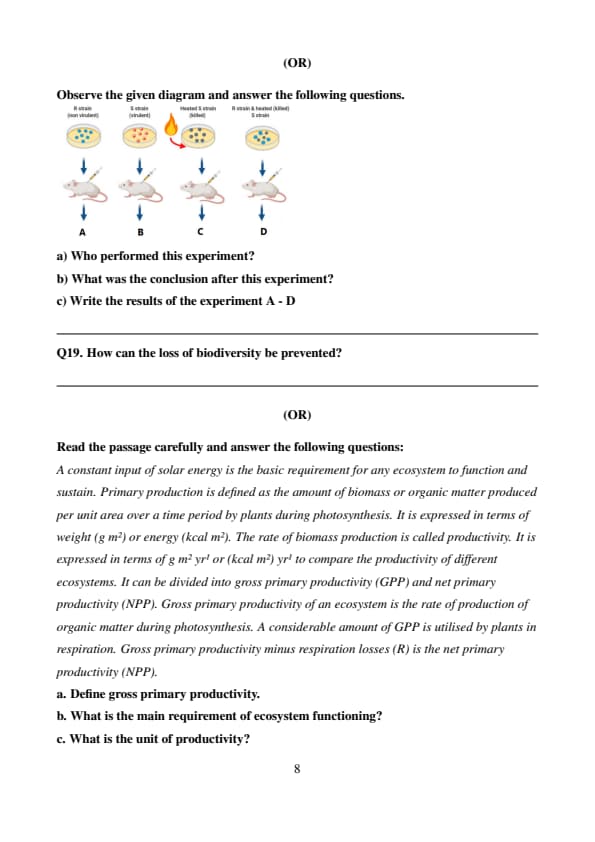
Observe the given diagram and answer the following questions.
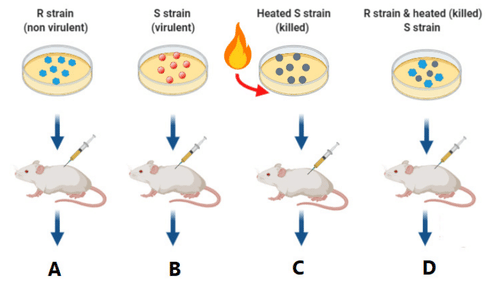
a) Who performed this experiment?
b) What was the conclusion after this experiment?
c) Write the results of the experiment A - D
View Solution
Step 1: (a) This experiment was performed by Frederick Griffith in 1928 using Streptococcus pneumoniae bacteria and mice.
Step 2: (b) The conclusion was that the R-strain bacteria had somehow been transformed by the heat-killed S-strain bacteria. He stated that some "transforming principle" transferred from the heat-killed S-strain enabled the R-strain to synthesize a smooth polysaccharide coat and become virulent.
Step 3: (c) In Experiment A, when mice were injected with the virulent S-strain (smooth, polysaccharide coat), they developed pneumonia and died. Quick Tip: Griffith's experiment did not identify the biochemical nature of the transforming principle (DNA). That was later discovered by Avery, MacLeod, and McCarty.
How can the loss of biodiversity be prevented?
View Solution
Step 1: In-situ Conservation: This involves protecting the endangered species in their natural habitat. Examples include the establishment of National Parks, Wildlife Sanctuaries, Biosphere Reserves, and Sacred Groves.
Step 2: Ex-situ Conservation: This involves taking threatened animals and plants out of their natural habitat and placing them in special settings where they can be protected and given special care. Examples include Zoological Parks, Botanical Gardens, and Wildlife Safari Parks.
Step 3: Advanced Methods: Gametes of threatened species can be preserved in viable and fertile condition for long periods using cryopreservation; eggs can be fertilized in vitro, and plants can be propagated using tissue culture methods (Seed banks).
Step 4: International Efforts: Biodiversity knows no political boundaries. Strategies include strict legislation and international conventions like the Earth Summit (Rio de Janeiro, 1992) and the World Summit (Johannesburg, 2002). Quick Tip: The most effective way to protect biodiversity is to identify "hotspots"—regions with very high levels of species richness and high degree of endemism—and prioritize them for strict protection.
Read the passage carefully and answer the following questions:
A constant input of solar energy is the basic requirement for any ecosystem to function and sustain. Primary production is defined as the amount of biomass or organic matter produced per unit area over a time period by plants during photosynthesis. It is expressed in terms of weight (g m⁻²) or energy (kcal m⁻²). The rate of biomass production is called productivity. It is expressed in terms of g m⁻² yr⁻¹ or (kcal m⁻²) yr⁻¹ to compare the productivity of different ecosystems. It can be divided into gross primary productivity (GPP) and net primary productivity (NPP). Gross primary productivity of an ecosystem is the rate of production of organic matter during photosynthesis. A considerable amount of GPP is utilised by plants in respiration. Gross primary productivity minus respiration losses (R) is the net primary productivity (NPP).
a. Define gross primary productivity.
b. What is the main requirement of ecosystem functioning?
c. What is the unit of productivity?
d. GPP \(-\) Respiration = ___________
View Solution
Step 1: (a) As stated in the passage, Gross Primary Productivity (GPP) of an ecosystem is the rate of production of organic matter during photosynthesis.
Step 2: (b) The passage mentions that a constant input of solar energy is the basic requirement for any ecosystem to function and sustain.
Step 3: (c) The unit of productivity is expressed in terms of \(\mathbf{g\,m^{-2}\,yr^{-1}}\) or \(\mathbf{(kcal\,m^{-2})\,yr^{-1}}\) to allow for the comparison of different ecosystems.
Step 4: (d) According to the metabolic balance mentioned, GPP minus respiration losses (R) results in Net Primary Productivity (NPP). Quick Tip: Net Primary Productivity (NPP) is the actual biomass available for the consumption of heterotrophs (herbivores and decomposers).




Comments