




The PSEB Class 12 Business Studies Model Test Paper exam will be conducted with the question paper and solutions made available after the exam. The exam will assess students' understanding through a combination of multiple-choice, objective, short, and long answer questions within a 3-hour duration. The paper will total 100 marks, with 80 marks allotted for the theory component and 20 marks for internal assessment. There will be no negative marking for incorrect answers.
PSEB Class 12 Business Studies Model Test Paper 2026 Question Paper with Solutions PDF
| PSEB Class 12 Business Studies Model Test Paper 2026 Question Paper with Solutions PDF | Download PDF | Check Solutions |
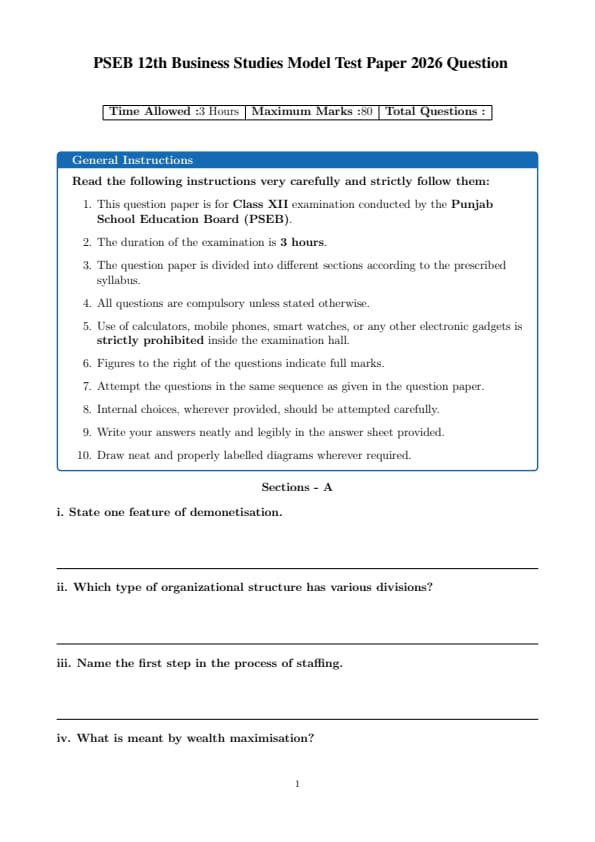
State one feature of demonetisation.
View Solution
Step 1: Understand the concept of demonetisation.
Demonetisation is the process in which certain currency notes or coins are declared as no longer legal tender. It is typically used by governments to address issues related to the black economy, corruption, and counterfeit currency.
Step 2: Key feature of demonetisation.
One major feature of demonetisation is its aim to reduce black money. By invalidating high-denomination currency notes, it forces individuals to deposit or exchange their unaccounted wealth, which can be traced and taxed.
Step 3: Conclusion.
The primary aim of demonetisation is to reduce black money and counterfeit currency, which are detrimental to the economy.
Quick Tip: Demonetisation is a powerful tool to combat corruption and black money in the economy, but its implementation needs to be done carefully to avoid economic disruption.
Which type of organizational structure has various divisions?
View Solution
Step 1: Understand the concept of organizational structures.
An organizational structure defines how activities such as task allocation, coordination, and supervision are directed towards achieving organizational goals. There are several types of structures, each suited to different types of organizations.
Step 2: What is a divisional structure?
In a divisional structure, the organization is split into divisions based on various factors like products, services, or geographical regions. Each division operates independently with its own resources and goals. This structure allows for specialization and better focus on different areas.
Step 3: Conclusion.
The divisional structure is characterized by various divisions, each with its own specialized teams, focusing on different aspects of the organization such as products, regions, or customer groups.
Quick Tip: In divisional structures, divisions act like separate companies, allowing for faster decision-making and better handling of specific market needs.
Name the first step in the process of staffing.
View Solution
Step 1: Understand the process of staffing.
Staffing is a key function of human resource management. It involves the process of recruiting, selecting, training, and developing employees to fill positions within an organization.
Step 2: What is Human Resource Planning?
The first step in staffing is Human Resource Planning (HRP), which involves assessing the organization's staffing needs, both in terms of quantity and quality. HRP ensures that the right people are available at the right time to meet the organization’s needs.
Step 3: Conclusion.
Human Resource Planning is the foundation for all staffing activities, as it identifies the number and type of employees needed to achieve organizational goals. Without proper planning, recruitment and selection would be inefficient.
Quick Tip: Effective human resource planning ensures that organizations have the right people with the right skills at the right time, making staffing processes more efficient.
What is meant by wealth maximisation?
View Solution
Step 1: Understand the goal of wealth maximisation.
Wealth maximisation refers to the process of making financial decisions that increase the value of a firm, particularly in terms of the market price of its shares, which ultimately benefits the shareholders.
Step 2: Why is wealth maximisation important?
Wealth maximisation is important because it focuses on the long-term sustainability and growth of a company. It is a more holistic approach compared to profit maximisation, as it considers both the time value of money and the risk associated with investments.
Step 3: Conclusion.
Wealth maximisation focuses on increasing the shareholders’ wealth by enhancing the value of the company’s shares, which reflects long-term profitability, growth, and strategic success.
Quick Tip: Wealth maximisation prioritizes long-term growth and value creation over short-term profit, ensuring sustainable business success.
What is meant by window display?
View Solution
Step 1: Understand the concept of window display.
A window display is a retail marketing technique used to present products in a store’s window in an attractive and engaging manner. It serves as a visual tool to grab the attention of potential customers and encourage them to enter the store.
Step 2: Purpose of window displays.
The main purpose of a window display is to showcase the store’s products in a way that catches the eye of passers-by. A well-designed window display can attract customers, promote new or seasonal items, and reinforce the store's brand image.
Step 3: Conclusion.
A window display is an effective way to engage customers visually, which is an important aspect of retail marketing. The right display can significantly influence customer interest and sales.
Quick Tip: A creative window display can make a strong first impression, drawing customers in and encouraging them to explore the store further.
Specialisation in the organisation is promoted by the principle of \hspace{2cm}.
(Division of work/units of direction)
View Solution
Step 1: Understanding specialisation.
Specialisation refers to the process of focusing on a specific task or role in an organisation. It allows employees to become experts in their assigned tasks, leading to higher productivity and efficiency.
Step 2: Understanding the principle of Division of Work.
The principle of Division of Work, proposed by Henri Fayol, encourages dividing the tasks of an organisation into specialized roles. This principle promotes specialisation by ensuring that each individual focuses on a specific area of expertise.
Step 3: Conclusion.
Specialisation in an organisation is largely promoted by the principle of Division of Work, as it helps create distinct roles for employees, increasing efficiency and expertise in each area.
Quick Tip: Specialisation through the Division of Work leads to greater proficiency and better use of skills within an organisation.
Strategies are never \hspace{2cm}.
(different/static)
View Solution
Step 1: Understanding strategy.
A strategy in business refers to the long-term plan or approach taken by an organisation to achieve its goals. It involves careful planning and adaptation to market trends, competition, and other external factors.
Step 2: Why are strategies not static?
Strategies are never static because they need to adapt to changing circumstances such as market conditions, technological advancements, and competition. A static strategy would become obsolete over time as these factors evolve.
Step 3: Conclusion.
A strategy must always remain dynamic, allowing an organisation to respond to external changes. Hence, strategies are never static.
Quick Tip: A successful strategy must be flexible and adaptable, constantly evolving to keep up with changes in the business environment.
Negative motivation is based on \hspace{2cm}.
(fear/incentive)
View Solution
Step 1: Understanding negative motivation.
Negative motivation is the use of fear, threat, or punishment to encourage employees to meet certain expectations or to avoid undesirable outcomes. This type of motivation is usually associated with negative reinforcement.
Step 2: Fear as a motivator.
Negative motivation is based on fear, such as fear of failure, reprimand, or punishment. It relies on the threat of negative consequences to drive behavior, rather than providing positive rewards or incentives.
Step 3: Conclusion.
In the context of motivation, fear is the key factor that drives behavior under negative motivation.
Quick Tip: Although fear-based motivation can provide short-term results, it is often less effective for long-term engagement and performance compared to positive motivation.
Funds used to purchase raw materials is a part of \hspace{2cm}.
(fixed capital/working capital)
View Solution
Step 1: Understanding working capital.
Working capital refers to the short-term funds required to manage day-to-day operations of a business. It includes the money needed to purchase raw materials, pay wages, and cover other operational expenses.
Step 2: Difference between working capital and fixed capital.
Fixed capital refers to long-term investments in assets like machinery, buildings, or land, which are not easily converted into cash. In contrast, funds used for purchasing raw materials are classified as working capital, as they are used in the ongoing production process.
Step 3: Conclusion.
Funds used to purchase raw materials are considered part of working capital, which is essential for the day-to-day operations of a business.
Quick Tip: Working capital ensures that a business has enough liquidity to cover short-term expenses, while fixed capital is used for long-term investment in assets.
As per the Caveat Venditor, let the \hspace{2cm} beware.
(buyer/seller)
View Solution
Step 1: Understanding Caveat Venditor.
The term Caveat Venditor is a Latin phrase meaning "let the seller beware." It places the responsibility on the seller to ensure that the goods they are selling are of the proper quality, free from defects, and accurately represented.
Step 2: Distinguishing between Caveat Venditor and Caveat Emptor.
Unlike Caveat Emptor ("let the buyer beware"), which shifts the responsibility to the buyer, Caveat Venditor shifts the responsibility to the seller to guarantee that products meet the agreed-upon standards.
Step 3: Conclusion.
As per the Caveat Venditor principle, the seller is responsible for ensuring that the products they sell are of satisfactory quality and conform to the agreed terms.
Quick Tip: Caveat Venditor emphasizes the seller’s responsibility in the transaction, ensuring that the buyer receives the quality of goods promised.
Principles of management are static in nature.
View Solution
Step 1: Understanding the principles of management.
The principles of management, such as division of work, authority, discipline, etc., are not static but dynamic. They evolve according to the changing business environment and the needs of the organization.
Step 2: Why are they not static?
Principles of management adapt to the dynamic conditions of the workplace, market, and technology. As the business world evolves, management principles must also change to remain relevant and effective.
Step 3: Conclusion.
Since management principles must adapt to changing circumstances, they are not static in nature.
Quick Tip: Management principles are adaptable to changing organizational needs and external conditions.
New Economic Policy was adopted in 2005.
View Solution
Step 1: Understanding the New Economic Policy.
The New Economic Policy (NEP) was adopted in 1991, not 2005. This policy aimed to liberalize India's economy by reducing government control, promoting foreign investment, and encouraging economic growth through market-driven forces.
Step 2: Conclusion.
The correct year for the adoption of the New Economic Policy is 1991, not 2005.
Quick Tip: The NEP, introduced in 1991, marked a significant shift in India's economic policy, promoting privatization, liberalization, and globalization.
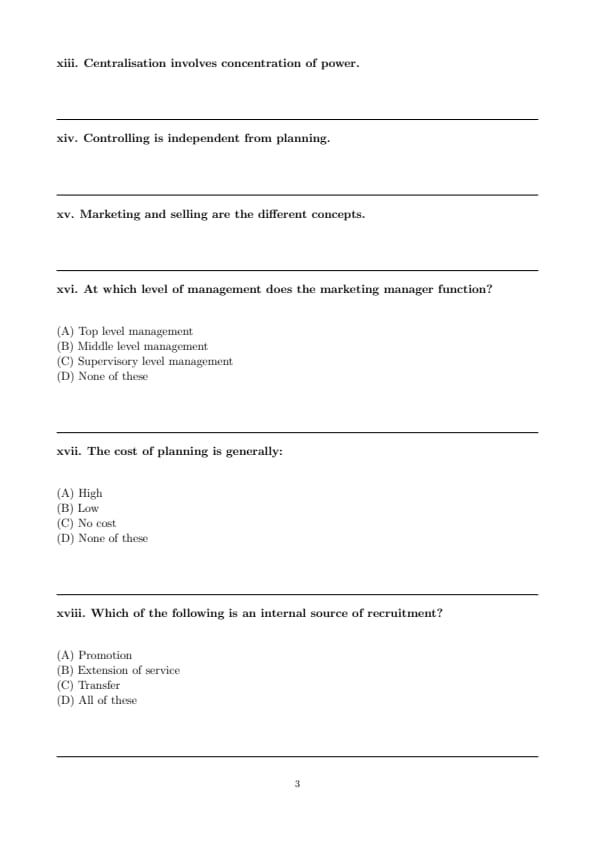
Centralisation involves concentration of power.
View Solution
Step 1: Understanding centralisation.
Centralisation refers to the process where decision-making authority is concentrated at the top levels of management. The lower levels of the organization have little or no autonomy in decision-making.
Step 2: Conclusion.
Since centralisation involves the concentration of decision-making power at the top levels of an organization, it is indeed true that centralisation involves concentration of power.
Quick Tip: Centralisation often leads to a more uniform approach to decision-making but may limit flexibility at lower levels.
Controlling is independent from planning.
View Solution
Step 1: Understanding controlling and planning.
Controlling and planning are two interdependent functions of management. Planning involves setting goals and deciding the best course of action, while controlling involves monitoring performance and ensuring that the plans are being followed.
Step 2: Why they are not independent.
Controlling cannot function effectively without planning. The objectives set in the planning stage provide the benchmarks for controlling. Likewise, controlling helps in modifying the plans if the performance deviates from the set goals.
Step 3: Conclusion.
Controlling is closely linked to planning, making them dependent on each other rather than independent.
Quick Tip: Controlling helps ensure that plans are being executed properly and can lead to adjustments in future planning based on feedback.
Marketing and selling are the different concepts.
View Solution
Step 1: Understanding marketing and selling.
Marketing and selling, though related, are distinct concepts. Marketing involves a broad range of activities aimed at identifying customer needs and delivering products or services to meet those needs. It includes market research, advertising, product development, and distribution.
Step 2: Selling as a part of marketing.
Selling, on the other hand, is just one part of the marketing process. It refers to the actual transaction where the product or service is exchanged for money. While selling focuses on closing a deal, marketing focuses on understanding and meeting customer needs in a broader sense.
Step 3: Conclusion.
Marketing is a comprehensive approach that includes selling, but selling is just one of the steps in the broader marketing process. Thus, marketing and selling are indeed different concepts.
Quick Tip: While selling is part of marketing, marketing includes various strategies that lead to the development of the product, its promotion, and customer relationships.
At which level of management does the marketing manager function?
View Solution
Step 1: Understanding the role of a marketing manager.
A marketing manager is responsible for developing marketing strategies, overseeing campaigns, and ensuring that the marketing efforts align with the company’s goals. This role requires coordination between top management and the implementation of these strategies at the operational level.
Step 2: Role at the middle level management.
Marketing managers typically function at the middle level management because they bridge the gap between top management, which sets the strategic direction, and the operational teams who implement these strategies. They are responsible for translating the broad goals of the organization into specific, actionable marketing plans.
Step 3: Conclusion.
Marketing managers typically operate at the middle level of management, where they oversee day-to-day marketing functions while implementing strategies set by top management.
Quick Tip: Middle management is crucial for executing the strategic objectives set by top management and ensuring that they are effectively implemented at the operational level.
The cost of planning is generally:
View Solution
Step 1: Understanding the cost of planning.
Planning is a crucial part of the management process, and it requires resources such as time, effort, and often financial investment. The costs involved can include market research, consultations with experts, and the development of detailed plans and strategies.
Step 2: Why planning is costly.
Effective planning involves gathering data, analyzing trends, and forecasting future conditions, all of which take time and expertise. These activities often require dedicated teams, research tools, and other resources, contributing to a high overall cost.
Step 3: Conclusion.
Although planning is essential for the success of any organization, it generally comes with a high cost due to the resources and efforts required to develop and implement comprehensive plans.
Quick Tip: While planning involves initial costs, its benefits in terms of achieving long-term goals and minimizing risks make it a worthwhile investment.
Which of the following is an internal source of recruitment?
View Solution
Step 1: Understanding internal recruitment sources.
Internal sources of recruitment refer to hiring candidates from within the organization. This can involve promotions, transfers, or extensions of service to fill positions.
Step 2: Why these are internal sources.
- Promotion: Promoting existing employees to higher positions is a common internal recruitment method.
- Extension of service: Extending the service of existing employees, especially in critical roles, is another way to fill vacancies internally.
- Transfer: Transferring employees from one department to another is another form of internal recruitment.
Step 3: Conclusion.
All of the listed options — promotion, extension of service, and transfer — are valid internal sources of recruitment.
Quick Tip: Internal recruitment helps retain valuable employees and boosts morale by providing growth opportunities within the organization.
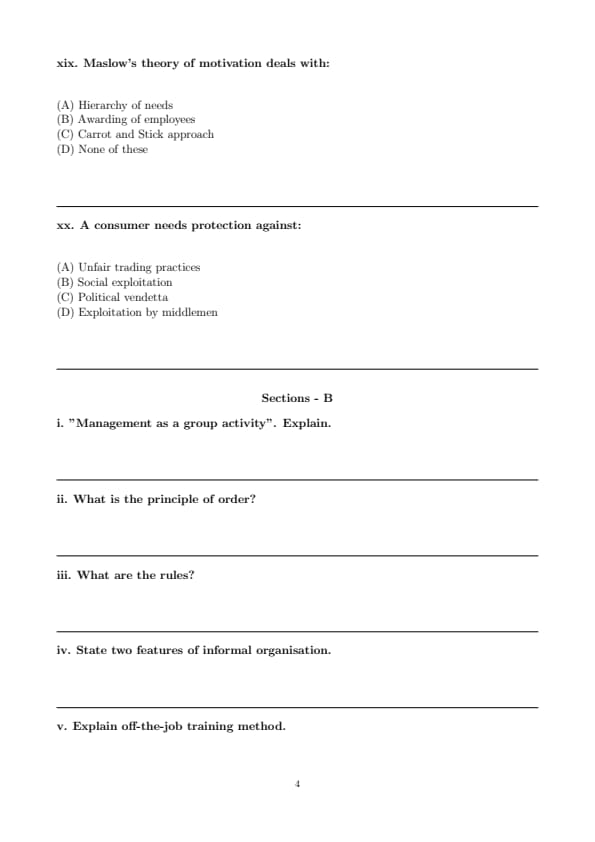
Maslow's theory of motivation deals with:
View Solution
Step 1: Understanding Maslow's theory of motivation.
Maslow's Hierarchy of Needs is a motivational theory that suggests people have a series of needs that must be fulfilled in a specific order: physiological needs, safety needs, social needs, esteem needs, and self-actualization.
Step 2: What the theory deals with.
Maslow's theory emphasizes how individuals are motivated by the fulfillment of different levels of needs, with basic needs (like food and safety) at the base and higher-level needs (like esteem and self-actualization) at the top.
Step 3: Conclusion.
Maslow's theory primarily deals with the Hierarchy of Needs and is not related to awarding employees or the "carrot and stick" approach.
Quick Tip: Maslow's theory helps understand the different levels of motivation that drive human behavior, from basic survival needs to self-fulfillment.
A consumer needs protection against:
View Solution
Step 1: Understanding consumer protection.
Consumer protection refers to the laws and regulations designed to ensure that the rights of consumers are upheld, and they are safeguarded from fraudulent or unfair business practices.
Step 2: Why consumers need protection against unfair trading practices.
Unfair trading practices include deceptive advertising, false claims, exploitation, and selling goods that are unsafe. Consumers need protection to ensure they are not misled or harmed by such practices.
Step 3: Conclusion.
Consumer protection laws are mainly focused on guarding consumers against unfair trading practices, which is the correct answer.
Quick Tip: Consumer protection ensures fair treatment in the marketplace, promoting trust and confidence in businesses.
"Management as a group activity". Explain.
View Solution
Step 1: Understanding management as a group activity.
Management is often considered a group activity because it involves coordinating and overseeing a team to achieve common goals. It requires collaboration, communication, and leadership. Managers work with teams to guide, motivate, and manage resources effectively.
Step 2: The role of group dynamics.
In any organization, success is not achieved by individuals alone. It is a collective effort, where everyone plays a role in the decision-making process. By working together as a group, managers can achieve synergy and improve efficiency.
Step 3: Conclusion.
Thus, management as a group activity highlights the importance of teamwork and collaboration in achieving organizational goals.
Quick Tip: Effective management relies on group dynamics, where the collective strength of a team leads to better decision-making and performance.
What is the principle of order?
View Solution
Step 1: Understanding the principle of order.
The principle of order is one of the principles of management proposed by Henri Fayol. It emphasizes the importance of having a proper place for everything, and everyone in the organization. Resources, personnel, and tasks must be organized systematically to ensure smooth operations.
Step 2: Importance of order in management.
By following this principle, organizations can avoid confusion and improve efficiency. Clear organization helps employees understand their roles, and tasks are completed without unnecessary delays.
Step 3: Conclusion.
The principle of order advocates for structured and organized management to facilitate optimal use of resources and avoid any disorder.
Quick Tip: Order in an organization contributes to efficiency and ensures that resources and tasks are managed effectively.
What are the rules?
View Solution
Step 1: Understanding rules in an organization.
Rules in an organization are guidelines that dictate behavior and actions within the workplace. They are designed to ensure that employees adhere to the organization's policies and procedures, thus promoting a disciplined work environment.
Step 2: Importance of rules.
Rules are crucial for maintaining order and consistency in organizational operations. They help in setting expectations for employees and provide a framework for resolving conflicts.
Step 3: Conclusion.
Rules ensure that employees understand their responsibilities and the standards they need to meet, contributing to the overall success of the organization.
Quick Tip: Well-defined rules help maintain discipline, set clear expectations, and promote fairness within an organization.
State two features of informal organisation.
View Solution
Step 1: Understanding informal organization.
An informal organization is a social structure that exists within the formal organizational framework. It is based on personal relationships, friendships, and common interests among employees.
Step 2: Features of informal organization.
- Spontaneous relationships: Informal organizations emerge naturally as employees develop friendships and work together beyond their formal roles.
- No official structure: Unlike formal organizations, informal organizations do not have clearly defined roles or hierarchies. Relationships are based on personal influence rather than authority.
Step 3: Conclusion.
Informal organizations foster communication and collaboration but can sometimes challenge the formal structure if the informal networks influence decision-making.
Quick Tip: While informal organizations can enhance teamwork and morale, they should align with the formal structure to avoid confusion and inefficiency.
Explain off-the-job training method.
View Solution
Step 1: Understanding off-the-job training.
Off-the-job training refers to any form of training that takes place outside the workplace. It allows employees to develop skills and knowledge in a controlled environment away from their daily work pressures.
Step 2: Types of off-the-job training methods.
- Classroom training: Employees are taught through lectures, presentations, and workshops.
- Simulations: Employees practice skills in a simulated environment that mimics real-life situations.
Step 3: Conclusion.
Off-the-job training provides employees with the necessary skills and knowledge without the distractions of day-to-day work activities, ensuring a more focused learning experience.
Quick Tip: Off-the-job training allows employees to gain theoretical knowledge and practical skills in a setting that’s removed from the workplace, fostering a better learning environment.
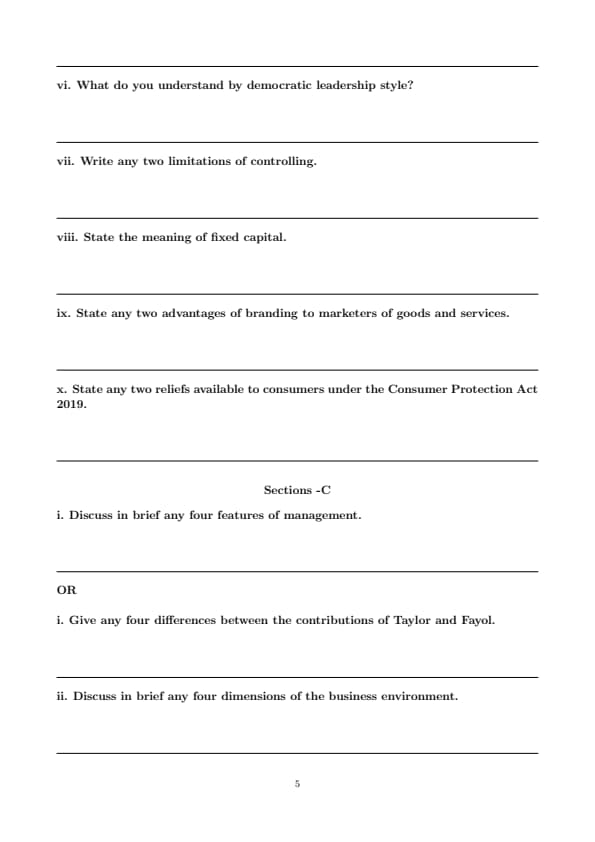
What do you understand by democratic leadership style?
View Solution
Step 1: Understanding democratic leadership.
Democratic leadership, also known as participative leadership, is a style where leaders encourage active participation and input from their team members in decision-making. This leadership style promotes a sense of shared responsibility and fosters collaboration.
Step 2: Characteristics of democratic leadership.
- Leaders make decisions based on group input.
- Employees are encouraged to share their ideas and suggestions.
- It promotes open communication and trust between leaders and subordinates.
Step 3: Conclusion.
Democratic leadership fosters a more inclusive and collaborative work environment, enhancing motivation and job satisfaction.
Quick Tip: A democratic leadership style can lead to higher employee morale and creativity as it values their input in decision-making.
Write any two limitations of controlling.
View Solution
Step 1: Understanding the limitations of controlling.
Controlling is an essential management function, but it has some limitations that can affect its effectiveness.
Step 2: Two limitations of controlling.
1. Time-Consuming: Controlling can be time-consuming as it requires constant monitoring, evaluation, and adjustments based on performance data.
2. Resistance to Control: Employees may resist controlling measures due to fear of micromanagement or lack of trust in the process, leading to reduced effectiveness.
Step 3: Conclusion.
While controlling is essential for achieving goals, its effectiveness can be hindered by time constraints and resistance from employees.
Quick Tip: Effective controlling requires striking a balance between oversight and employee autonomy to avoid micromanagement and enhance motivation.
State the meaning of fixed capital.
View Solution
Step 1: Understanding fixed capital.
Fixed capital refers to the long-term investments made by a business in physical assets, such as machinery, land, buildings, and equipment. These assets are used to produce goods and services and are expected to provide value over a long period.
Step 2: Characteristics of fixed capital.
- It is used for the long-term operation of the business.
- Fixed capital does not get converted into cash easily.
- It involves high initial investment but contributes to production for many years.
Step 3: Conclusion.
Fixed capital is crucial for the functioning of any business as it helps in the production process and is essential for long-term growth.
Quick Tip: Investing in fixed capital ensures that businesses have the necessary resources to operate efficiently and meet future demands.
State any two advantages of branding to marketers of goods and services.
View Solution
Step 1: Understanding the concept of branding.
Branding refers to the creation of a unique name, image, or symbol for a product or service to distinguish it from others in the market. Branding helps businesses build recognition, trust, and loyalty with customers.
Step 2: Two advantages of branding to marketers.
1. Increased Customer Loyalty: Strong branding fosters customer trust and loyalty, leading to repeat business and customer retention.
2. Higher Profit Margins: A well-established brand can command higher prices and create a perception of quality, leading to better profit margins.
Step 3: Conclusion.
Branding helps marketers differentiate their products, build a loyal customer base, and achieve higher profitability.
Quick Tip: Branding is a powerful tool that can significantly enhance a company's reputation, increase sales, and establish long-term market success.
State any two reliefs available to consumers under the Consumer Protection Act 2019.
View Solution
Step 1: Understanding consumer protection under the Consumer Protection Act.
The Consumer Protection Act 2019 provides a legal framework to safeguard the rights of consumers in India. It offers various reliefs to consumers in cases of defective goods, unfair trade practices, and other grievances.
Step 2: Two reliefs available to consumers.
1. Compensation for Defective Goods or Services: Consumers can seek compensation for any loss or damage caused by the use of defective goods or services.
2. Return or Replacement of Defective Products: Consumers have the right to demand the return, replacement, or repair of goods if they are defective.
Step 3: Conclusion.
The Consumer Protection Act 2019 ensures that consumers receive fair treatment, compensation, and remedies for any grievances related to goods and services.
Quick Tip: The Consumer Protection Act empowers consumers to seek justice and hold businesses accountable for any shortcomings in their products or services.
Discuss in brief any four features of management.
View Solution
Step 1: Understanding the features of management.
Management is a comprehensive process of planning, organizing, leading, and controlling resources to achieve organizational goals efficiently and effectively. The features of management are its universal nature, goal-oriented approach, continuous process, and multidimensional aspects.
Step 2: Four features of management.
1. Universal Applicability: Management principles can be applied to all types of organizations, whether large or small, public or private.
2. Goal-Oriented: Management is always directed towards achieving specific goals, such as profit maximization, productivity, or customer satisfaction.
3. Continuous Process: Management is an ongoing process, as it involves planning, organizing, directing, and controlling on a continuous basis to ensure smooth operations.
4. Multidimensional: Management involves dealing with various aspects, such as people, resources, and technology, and focuses on both organizational goals and human needs.
Step 3: Conclusion.
These features highlight the dynamic and comprehensive nature of management, which is vital for the smooth functioning of any organization.
Quick Tip: Management is a universal and dynamic process that requires flexibility to adapt to changing business environments.
Give any four differences between the contributions of Taylor and Fayol.
View Solution
Step 1: Understanding the contributions of Taylor and Fayol.
Frederick Taylor and Henri Fayol were both pioneers in the field of management, but they had different approaches and made distinct contributions. Taylor is known for his scientific management principles, while Fayol is known for his general principles of management.
Step 2: Four differences between Taylor and Fayol.
1. Focus of Contribution:
- Taylor: Focused on improving productivity through scientific methods of work. He emphasized the optimization of work processes and the role of workers.
- Fayol: Focused on the overall management process and introduced principles of management applicable to all levels of an organization.
2. Approach:
- Taylor: His approach was mainly concerned with the efficiency of work processes and the relationship between workers and managers.
- Fayol: His approach was broader, dealing with the functions of management and how managers should act in various situations.
3. Principles:
- Taylor: He formulated principles like scientific selection and training of workers, standardized tools and work methods, and time study.
- Fayol: He outlined 14 principles of management, including unity of command, division of work, discipline, and authority.
4. Application:
- Taylor: His principles were mainly applied in the manufacturing sector to increase operational efficiency.
- Fayol: His principles are applicable across all types of organizations, including both private and public sectors.
Step 3: Conclusion.
While Taylor’s work focuses on improving productivity through scientific management, Fayol’s work provides a broader framework for managing all types of organizations. Both have made significant contributions to modern management practices.
Quick Tip: Taylor’s scientific management focuses on optimizing work methods, while Fayol’s general principles guide managerial functions across all organizational levels.
Discuss in brief any four dimensions of the business environment.
View Solution
Step 1: Understanding business environment.
The business environment refers to the external and internal factors that influence a company's operations. It is dynamic and can be influenced by a range of factors including economic, social, technological, and political aspects.
Step 2: Four dimensions of the business environment.
1. Economic Environment: The economic environment includes factors such as inflation, interest rates, unemployment rates, and economic growth. These factors affect the purchasing power of consumers, the cost of capital for businesses, and overall economic stability.
2. Political Environment: The political environment involves government policies, political stability, taxation laws, and regulatory frameworks. These factors can create opportunities or pose threats for businesses.
3. Technological Environment: This dimension includes the advancements in technology that affect production, marketing, and communication. Technology can lead to innovations and provide businesses with tools to enhance their efficiency.
4. Social Environment: The social environment refers to the cultural, social, and demographic factors that impact consumer behavior. This includes societal norms, lifestyle changes, population demographics, and consumer attitudes.
Step 3: Conclusion.
The business environment is influenced by multiple dimensions, each contributing to the opportunities and threats faced by businesses. Understanding these dimensions is critical for making informed decisions.
Quick Tip: A business must continuously monitor the different dimensions of the environment to remain competitive and adaptable in a dynamic market.
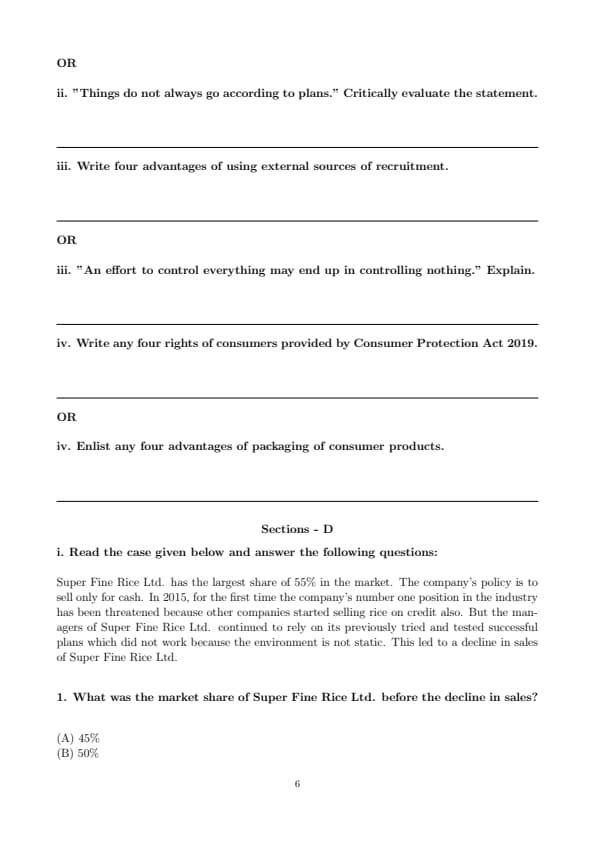
"Things do not always go according to plans." Critically evaluate the statement.
View Solution
Step 1: Understanding the statement.
The statement acknowledges that despite careful planning, external factors, unforeseen circumstances, or internal inefficiencies can disrupt even the best-laid plans. This reflects the inherent uncertainty in the business world.
Step 2: Why things may not go according to plans.
- External factors: The business environment is constantly changing due to political, economic, and social factors, which can influence the execution of a plan.
- Unforeseen circumstances: Unexpected events such as natural disasters, technological failures, or sudden market changes can derail plans.
- Internal inefficiencies: Sometimes, poor execution, lack of resources, or ineffective communication can prevent a plan from being implemented as intended.
Step 3: Critical evaluation of the statement.
While plans may not always go as expected, this does not mean planning is unnecessary. In fact, planning is essential as it provides a roadmap for success and helps organizations anticipate challenges. When things do go wrong, having a plan in place allows businesses to quickly adapt and re-strategize.
Step 4: Conclusion.
The statement highlights the unpredictability of business, but effective planning remains a crucial element in guiding organizations through uncertainties. The key is flexibility and adaptability in response to unexpected changes.
Quick Tip: While not everything will go according to plan, having a well-thought-out strategy enables businesses to pivot and adapt when challenges arise.
Write four advantages of using external sources of recruitment.
View Solution
Step 1: Understanding external recruitment.
External sources of recruitment refer to hiring candidates from outside the organization to fill job vacancies. These sources include job portals, recruitment agencies, employee referrals, and campus recruitment.
Step 2: Four advantages of using external sources of recruitment.
1. Access to a Larger Pool of Candidates: External recruitment allows the organization to tap into a broader range of candidates with diverse skills, experiences, and backgrounds.
2. Bringing in New Ideas and Perspectives: Hiring from outside brings fresh perspectives and innovative ideas that can drive the company forward and improve creativity.
3. Filling Specialized Roles: External recruitment is beneficial for filling specialized or high-level positions that require specific skills or expertise that internal candidates may not possess.
4. Increased Competition and Motivation: Hiring from outside introduces competition among candidates, which can improve the overall quality of employees and foster a more motivated and productive workforce.
Step 3: Conclusion.
External recruitment provides organizations with a larger talent pool, fresh ideas, and the expertise required to stay competitive in the market.
Quick Tip: External recruitment can also help overcome internal biases by providing a diverse range of candidates for any given position.
"An effort to control everything may end up in controlling nothing." Explain.
View Solution
Step 1: Understanding the meaning of the statement.
The statement highlights the potential negative impact of trying to micromanage every aspect of an organization or a process. When a manager or leader attempts to control everything in minute detail, they may lose focus and effectiveness, ultimately achieving less control.
Step 2: Why this happens.
- Overload of Tasks: By trying to control everything, managers become overwhelmed and unable to give adequate attention to key areas.
- Reduced Autonomy: Employees may feel disempowered and demotivated, as they are not trusted to make decisions or take responsibility for their work.
- Inefficiency: Micromanagement can result in delays, as decisions may need to pass through several levels of approval, slowing down the overall process.
Step 3: Conclusion.
The key to effective management is delegation and trust. Rather than attempting to control everything, managers should focus on important areas and allow employees to take ownership of their tasks. This approach leads to greater efficiency and productivity.
Quick Tip: Effective leaders focus on setting clear goals, delegating authority, and providing support, rather than micromanaging every detail.
Write any four rights of consumers provided by Consumer Protection Act 2019.
View Solution
Step 1: Understanding the Consumer Protection Act 2019.
The Consumer Protection Act 2019 is designed to safeguard the interests of consumers and ensure their rights are protected. It provides legal recourse in case consumers face unfair practices or defective goods.
Step 2: Four rights of consumers under the Consumer Protection Act 2019.
1. Right to Protection against Unfair Trade Practices: Consumers have the right to be protected from deceptive and unfair business practices, such as false advertising and fraudulent claims.
2. Right to Information: Consumers have the right to accurate and truthful information about the products and services they purchase, including prices, quality, and warranties.
3. Right to Seek Redressal: Consumers have the right to seek compensation or a remedy in case they are harmed by defective goods, services, or unfair trade practices.
4. Right to Consumer Education: Consumers have the right to access information and education about their rights, responsibilities, and the processes involved in filing complaints.
Step 3: Conclusion.
The Consumer Protection Act 2019 ensures that consumers are empowered, aware of their rights, and can seek justice in cases of unfair treatment or defective products.
Quick Tip: Consumers should always be aware of their rights to make informed decisions and protect themselves from fraud or unfair practices.
Enlist any four advantages of packaging of consumer products.
View Solution
Step 1: Understanding the role of packaging.
Packaging is an essential part of product marketing. It not only protects the product but also plays a crucial role in branding and communication. Well-designed packaging can attract customers and enhance the overall value of the product.
Step 2: Four advantages of packaging of consumer products.
1. Protection: Packaging protects the product from damage during transportation, handling, and storage. It helps maintain the quality and safety of the product.
2. Convenience: Packaging makes the product easier to handle, store, and use. It provides information such as usage instructions, ingredients, or expiration dates.
3. Branding and Marketing: Packaging serves as a marketing tool. It helps differentiate the product from competitors and communicates the brand’s identity, attracting consumers.
4. Preservation: Packaging helps preserve the product by extending its shelf life and preventing contamination, ensuring that it remains fresh until use.
Step 3: Conclusion.
Effective packaging not only protects and preserves products but also enhances the customer experience and supports marketing efforts.
Quick Tip: Good packaging is key to a product’s success, as it ensures protection, convenience, and effective marketing.
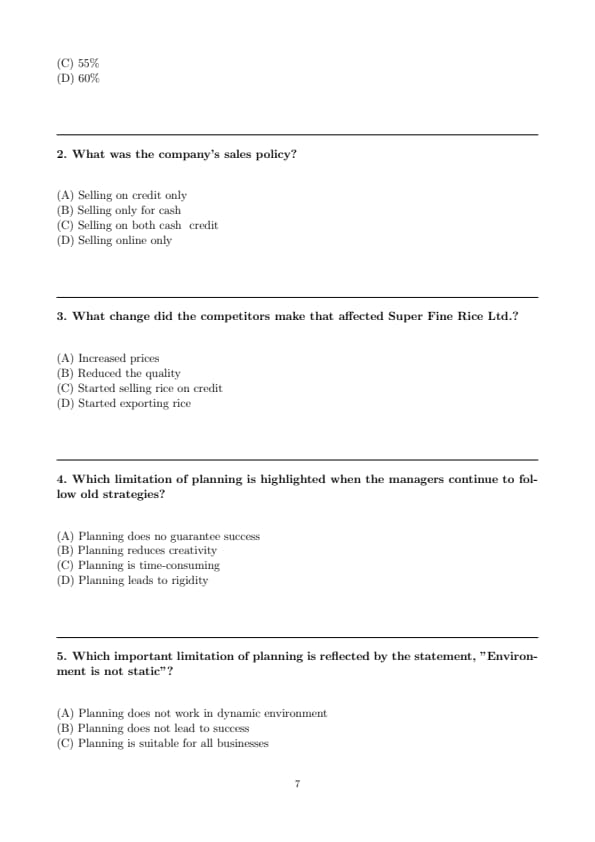
1. What was the market share of Super Fine Rice Ltd. before the decline in sales?
View Solution
Step 1: Understanding the market share before the decline.
The case clearly mentions that Super Fine Rice Ltd. had a 55% share of the market before the decline in sales.
Step 2: Interpretation of the situation.
The company’s strong market position was a result of its cash-based selling policy, which helped it dominate the market. However, the introduction of credit sales by competitors started to challenge this position.
Step 3: Conclusion.
Thus, before the decline in sales, Super Fine Rice Ltd. had a market share of 55%.
Quick Tip: Market share is a key indicator of a company's competitive position in the industry. Changes in the market environment can significantly affect these shares.
What was the company’s sales policy?
View Solution
Step 1: Understanding the sales policy.
The case clearly mentions that Super Fine Rice Ltd.'s policy was to sell rice only for cash. This is why the company’s position in the market was challenged when competitors began offering credit sales.
Step 2: The impact of this policy.
Selling only for cash limited the company’s customer base, as it was less flexible compared to competitors who offered more payment options.
Step 3: Conclusion.
The sales policy of selling only for cash is the correct answer, as stated in the case.
Quick Tip: Flexibility in payment options can increase customer access and help businesses stay competitive in a changing market.
What change did the competitors make that affected Super Fine Rice Ltd.?
View Solution
Step 1: Identifying the competitive change.
The case explains that the competitors of Super Fine Rice Ltd. started selling rice on credit, which posed a challenge to the company. This change in their business model led to a decline in Super Fine Rice Ltd.'s sales.
Step 2: Why this affected the company.
Super Fine Rice Ltd.'s cash-only policy became a disadvantage as customers were attracted to the credit sales offered by competitors.
Step 3: Conclusion.
The competitors’ decision to offer credit sales directly impacted Super Fine Rice Ltd., leading to a decline in market share.
Quick Tip: Understanding competitors' strategies and adapting to market changes is key to maintaining a competitive edge.
Which limitation of planning is highlighted when the managers continue to follow old strategies?
View Solution
Step 1: Understanding the limitation of planning.
The case highlights that the managers of Super Fine Rice Ltd. continued to rely on old strategies, which did not work in the changing environment. This reflects the limitation that planning can lead to rigidity.
Step 2: Why rigidity occurs in planning.
When organizations stick too strictly to old plans and strategies, they fail to adapt to changes in the external environment. This can result in lost opportunities and decreased effectiveness.
Step 3: Conclusion.
The limitation of planning leading to rigidity is clearly reflected in this scenario, as Super Fine Rice Ltd. failed to adjust to new competitive strategies.
Quick Tip: Flexibility in planning is crucial for adapting to external changes and ensuring the continued success of the organization.
Which important limitation of planning is reflected by the statement, "Environment is not static"?
View Solution
Step 1: Understanding the dynamic nature of the environment.
The case emphasizes that the environment is not static, meaning it constantly changes due to various factors like competition, consumer preferences, and market conditions. This dynamic nature can impact the effectiveness of static plans.
Step 2: The limitation of planning in a dynamic environment.
In a dynamic environment, rigid planning can become ineffective. Organizations must be flexible and adaptable, as the conditions that were favorable during planning may change, making the plans obsolete.
Step 3: Conclusion.
The limitation of planning in a dynamic environment is that plans may no longer be effective if the external conditions change rapidly.
Quick Tip: Planning should be flexible and adaptable to external changes to remain effective and responsive to the environment.
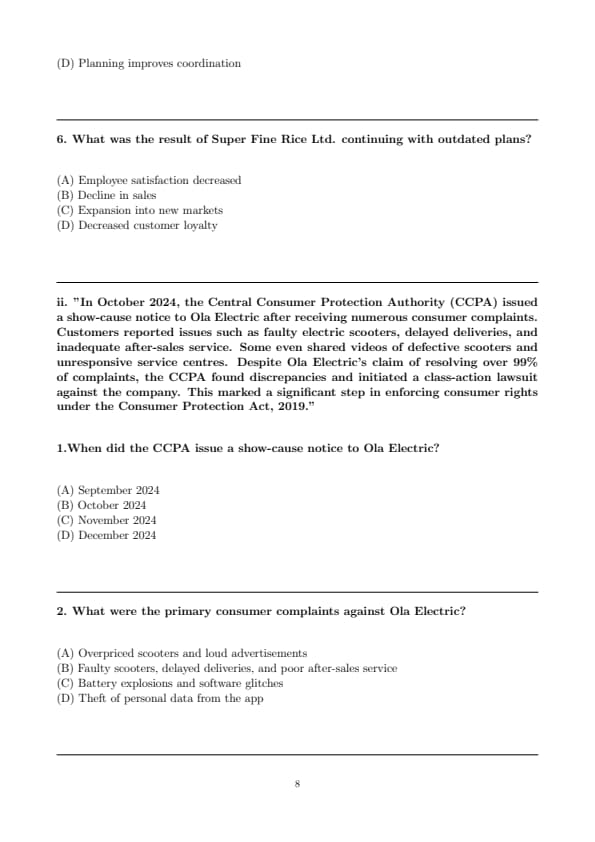
What was the result of Super Fine Rice Ltd. continuing with outdated plans?
View Solution
Step 1: Understanding the outcome of outdated plans.
The case highlights that the failure to adapt to changing market conditions (such as the introduction of credit sales by competitors) led to a decline in Super Fine Rice Ltd.'s sales.
Step 2: The impact of not updating plans.
By sticking to outdated plans, the company failed to respond to the new competitive strategies, leading to a decrease in its market share and sales.
Step 3: Conclusion.
The result of continuing with outdated plans was a significant decline in sales, as the company failed to keep pace with changes in the business environment.
Quick Tip: It’s crucial for businesses to periodically review and adjust their plans to stay competitive and relevant in the marketplace.
1.When did the CCPA issue a show-cause notice to Ola Electric?
View Solution
Step 1: Understanding the passage.
The case passage clearly states that the Central Consumer Protection Authority (CCPA) issued a show-cause notice to Ola Electric in October 2024 after receiving multiple consumer complaints regarding faulty products and poor after-sales service.
Step 2: Identifying the date mentioned.
The key detail in the passage is that the show-cause notice was issued in October 2024. This is the specific month mentioned in the passage when the CCPA took action.
Step 3: Conclusion.
Therefore, the correct answer is (B) October 2024, as stated in the case.
Quick Tip: In cases involving consumer complaints, authorities like the CCPA play a critical role in enforcing consumer rights and holding companies accountable.
What were the primary consumer complaints against Ola Electric?
View Solution
Step 1: Identifying the complaints.
The case passage highlights that consumers complained about faulty electric scooters, delayed deliveries, and inadequate after-sales service. These were the primary issues raised by customers.
Step 2: Conclusion.
The correct answer is (B), as it accurately reflects the complaints mentioned in the case.
Quick Tip: Identifying and addressing consumer complaints is crucial for maintaining a brand’s reputation and customer loyalty.
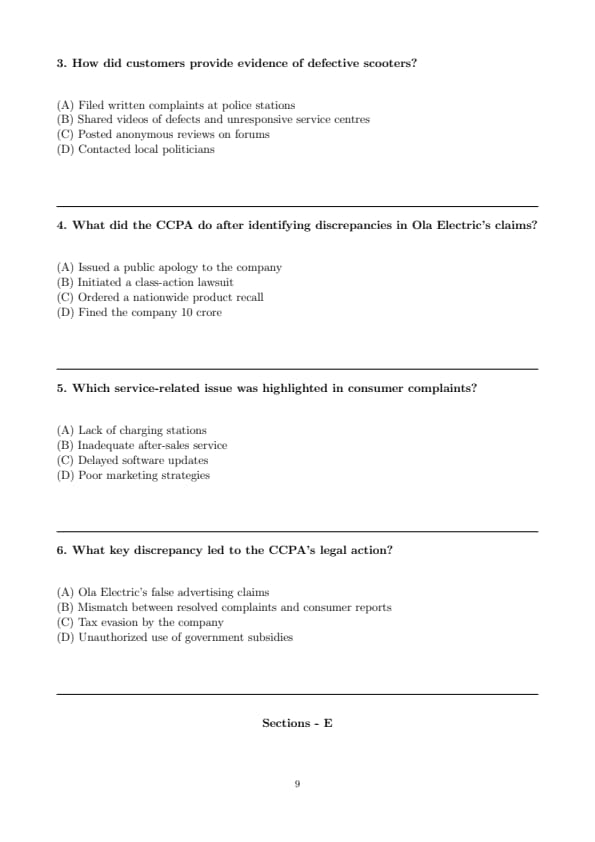
How did customers provide evidence of defective scooters?
View Solution
Step 1: Evidence provided by customers.
The case states that customers shared videos of defective scooters and unresponsive service centres as evidence of the issues they faced with Ola Electric’s products and services.
Step 2: Conclusion.
The correct answer is (B), as it directly matches the evidence provided in the case.
Quick Tip: Providing clear evidence can help strengthen consumer complaints and lead to more effective legal actions.
What did the CCPA do after identifying discrepancies in Ola Electric’s claims?
View Solution
Step 1: Actions taken by the CCPA.
The case clearly states that after finding discrepancies in Ola Electric's claims, the CCPA initiated a class-action lawsuit against the company. This was done despite Ola Electric's claims of resolving most complaints.
Step 2: Conclusion.
The correct answer is (B), as it directly reflects the action taken by the CCPA in the case.
Quick Tip: A class-action lawsuit is a powerful tool for consumers to collectively address grievances against a company.
Which service-related issue was highlighted in consumer complaints?
View Solution
Step 1: Identifying the service-related issue.
The case specifically mentions that inadequate after-sales service was a major concern for customers. This involved unresponsive service centres and delays in addressing complaints.
Step 2: Conclusion.
The correct answer is (B), as it matches the issue mentioned in the case.
Quick Tip: Good after-sales service is essential for customer retention and satisfaction.
What key discrepancy led to the CCPA’s legal action?
View Solution
Step 1: Understanding the key discrepancy.
The case mentions that despite Ola Electric claiming to have resolved over 99% of complaints, the CCPA found discrepancies in these claims when compared to consumer reports. This mismatch led to the legal action.
Step 2: Conclusion.
The correct answer is (B), as the mismatch between resolved complaints and consumer reports was the key discrepancy highlighted by the CCPA.
Quick Tip: Accurate reporting and transparency are critical for maintaining consumer trust and avoiding legal actions.
Give any six points of importance of delegation.
View Solution
Step 1: Understanding the importance of delegation.
Delegation is the process of assigning responsibility and authority to others while maintaining accountability. It is an essential management skill that empowers employees and helps in achieving organizational goals effectively.
Step 2: Six points of importance of delegation.
1. Increases Efficiency: Delegation helps to distribute tasks among employees, which increases the overall efficiency of the organization.
2. Reduces Managerial Workload: By delegating tasks, managers can focus on higher-level responsibilities and strategic decision-making.
3. Employee Development: Delegation provides employees with opportunities to learn and develop new skills, increasing their competency.
4. Improves Motivation and Job Satisfaction: When employees are given more responsibility, they feel trusted, leading to increased motivation and job satisfaction.
5. Enhances Decision-Making: Delegating decision-making authority to employees at lower levels ensures faster and more effective decisions.
6. Promotes Trust and Collaboration: Delegation fosters trust between managers and employees and promotes better collaboration within teams.
Step 3: Conclusion.
Delegation is crucial for effective management and the growth of employees. It increases efficiency, encourages personal growth, and improves the overall functioning of the organization.
Quick Tip: Effective delegation is key to leadership development and organizational success. It helps managers focus on strategic goals while empowering their teams.
Write any six measures to overcome the barriers and improve communication effectiveness.
View Solution
Step 1: Understanding communication barriers.
Communication barriers are obstacles that hinder effective communication between individuals or groups in an organization. These barriers can be physical, psychological, or emotional, and they can lead to misunderstandings and inefficiencies.
Step 2: Six measures to overcome communication barriers.
1. Use of Clear Language: Avoid jargon and complex terms. Use simple and clear language that can be easily understood by the audience.
2. Active Listening: Encourage active listening among employees to ensure that the message is understood correctly. Listening attentively helps to avoid misunderstandings.
3. Non-Verbal Communication: Pay attention to body language, gestures, and facial expressions as they can convey important messages and reinforce the spoken words.
4. Feedback Mechanism: Implement regular feedback systems where employees can clarify doubts and express their concerns, ensuring that communication flows effectively.
5. Encourage Open Communication: Foster a culture of openness where employees feel comfortable sharing their ideas, suggestions, and concerns without fear of judgment.
6. Training and Development: Provide communication skills training to employees to help them improve both verbal and non-verbal communication, enhancing their ability to interact with others.
Step 3: Conclusion.
Effective communication is crucial for the success of any organization. By overcoming communication barriers and improving communication practices, organizations can ensure better teamwork, decision-making, and overall performance.
Quick Tip: Fostering open communication and active listening enhances collaboration and reduces the risk of misunderstandings in the workplace.
"Advertising is a necessary evil." Analyse the statement.
View Solution
Step 1: Understanding the phrase "necessary evil."
The term "necessary evil" refers to something that is unpleasant or undesirable but is required for achieving a specific goal or outcome. In the context of advertising, while it may be criticized for being intrusive or misleading, it plays a vital role in the success of businesses and brands.
Step 2: The role of advertising.
Advertising is essential for businesses to communicate with consumers, build brand awareness, and promote products or services. In competitive markets, businesses rely on advertising to differentiate their offerings and establish customer loyalty.
Step 3: The negative aspects of advertising.
Despite its importance, advertising has its drawbacks, such as the potential for misleading claims, over-saturation, and the pressure it places on consumers to purchase products. It is often viewed as manipulative or as contributing to consumerism.
Step 4: Conclusion.
While advertising may be seen as a "necessary evil" due to its negative aspects, it remains an essential tool for business success in the modern economy. Companies must balance effective advertising with ethical standards to avoid alienating consumers.
Quick Tip: Effective advertising should be truthful, ethical, and transparent, ensuring that it serves the interests of both the company and the consumer.
Discuss any six factors affecting the choice of capital structure.
View Solution
Step 1: Understanding capital structure.
Capital structure refers to the mix of debt and equity financing used by a company to fund its operations and growth. The choice of capital structure is influenced by various factors, as companies must decide on the most efficient way to finance their activities.
Step 2: Six factors affecting the choice of capital structure.
1. Cost of Capital: The cost of raising funds through debt or equity influences the choice of capital structure. If debt is cheaper, firms may prefer to use more debt to minimize costs.
2. Risk of the Business: Companies with a higher level of risk may opt for more equity to avoid the obligation of paying interest on debt. Conversely, lower-risk businesses may use more debt.
3. Control Considerations: Equity financing dilutes ownership and control, while debt financing allows the owners to retain full control of the business. Companies that wish to maintain control may prefer debt.
4. Financial Flexibility: Firms that require financial flexibility may prefer to use more equity, as it provides greater leeway for raising funds in the future.
5. Market Conditions: The state of the financial markets can affect the cost and availability of debt and equity. Favorable market conditions may encourage firms to issue more debt, while adverse conditions may lead to reliance on equity.
6. Company’s Profitability and Size: Larger and more profitable firms may be able to raise more debt due to their established creditworthiness. Smaller or less profitable companies may rely more on equity financing.
Step 3: Conclusion.
The capital structure decision involves considering the trade-offs between debt and equity to find the optimal mix that minimizes the cost of capital while managing risk and maintaining financial flexibility.
Quick Tip: The choice of capital structure should be made carefully, considering the company's risk profile, growth prospects, and market conditions.




Comments