




The PSEB Class 12 Chemistry Sample Paper exam will be conducted with the question paper and solutions made available after the exam. The exam will assess students' understanding through a combination of multiple-choice, objective, short, and long answer questions within a 3-hour duration. The paper will total 100 marks, with 80 marks allotted for the theory component and 20 marks for internal assessment. There will be no negative marking for incorrect answers.
PSEB Class 12 Chemistry Sample Paper 2026 Question Paper with Solutions PDF
| PSEB Class 12 Chemistry Sample Paper 2026 Question Paper with Solutions PDF | Download PDF | Check Solutions |
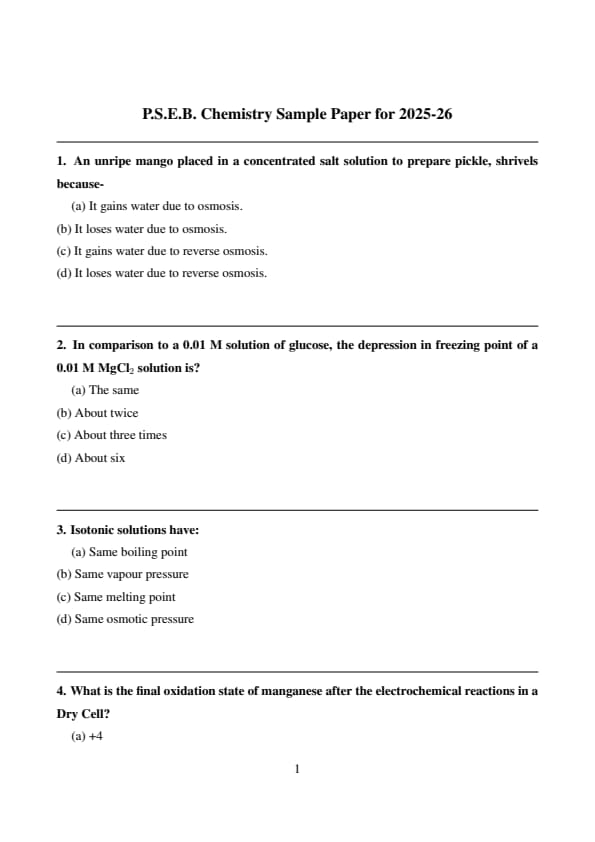
An unripe mango placed in a concentrated salt solution to prepare pickle, shrivels because-
View Solution
Step 1: The concentrated salt solution is hypertonic compared to the cell sap of the mango.
Step 2: Due to osmosis, water moves from a region of higher water concentration (inside the mango cells) to a region of lower water concentration (salt solution).
Step 3: Loss of water from the cells causes them to shrink, resulting in the shrivelling of the mango. Quick Tip: Cells placed in a hypertonic solution lose water by osmosis and shrink. This principle is applied in food preservation methods like pickling.
In comparison to a 0.01 M solution of glucose, the depression in freezing point of a 0.01 M MgCl\(_2\) solution is?
View Solution
Step 1: Depression in freezing point is a colligative property and depends on the number of solute particles present in the solution.
Step 2: Glucose is a non-electrolyte and does not dissociate in solution, so one molecule produces one particle.
Step 3: Magnesium chloride (\(MgCl_2\)) is an electrolyte and dissociates as: \[ MgCl_2 \rightarrow Mg^{2+} + 2Cl^- \]
Thus, one formula unit produces three particles.
Step 4: Hence, for the same molar concentration, the depression in freezing point of \(MgCl_2\) solution is approximately three times that of glucose solution. Quick Tip: The van’t Hoff factor (\(i\)) equals the number of particles formed after dissociation and determines the magnitude of colligative properties.
Isotonic solutions have:
View Solution
Step 1: Isotonic solutions are defined as solutions that have the same osmotic pressure at a given temperature.
Step 2: Osmotic pressure is a colligative property and depends on the number of solute particles present in the solution.
Step 3: Even if two solutions differ in composition, they are isotonic as long as their osmotic pressures are equal. Quick Tip: Isotonic solutions do \textbf{not} necessarily have the same boiling point, freezing point, or vapour pressure— they are defined only by having equal osmotic pressure.
What is the final oxidation state of manganese after the electrochemical reactions in a Dry Cell?
View Solution
Step 1: In a dry cell (Leclanché cell), manganese dioxide (\(MnO_2\)) acts as a depolarizer at the cathode.
Step 2: During the electrochemical reaction, \(MnO_2\) gets reduced to manganese(III) oxide (\(Mn_2O_3\)).
Step 3: The oxidation state of manganese changes from \(+4\) in \(MnO_2\) to \(+3\) in \(Mn_2O_3\). Quick Tip: In dry cells, manganese dioxide is reduced from oxidation state \(+4\) to \(+3\), helping prevent polarization at the cathode.
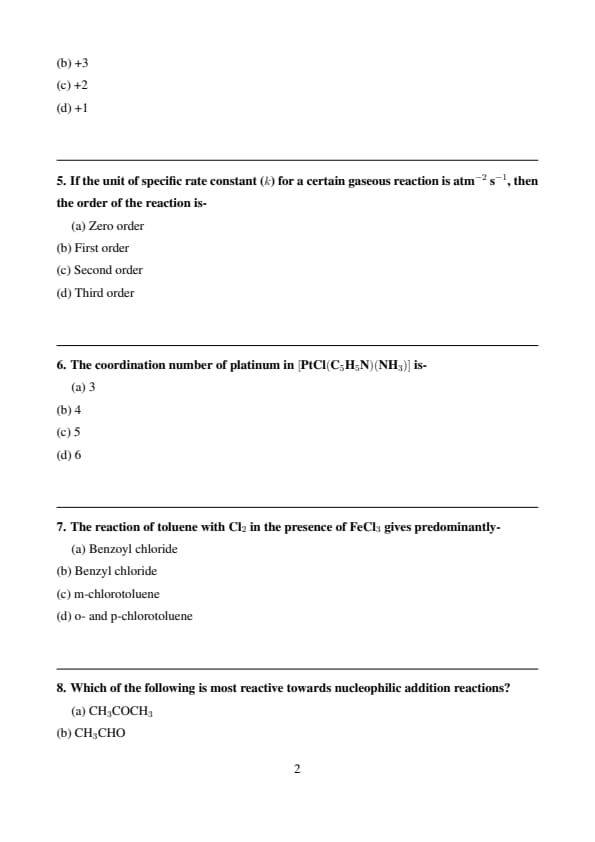
If the unit of specific rate constant (\(k\)) for a certain gaseous reaction is atm\(^{-2}\) s\(^{-1}\), then the order of the reaction is-
View Solution
Step 1: For a gaseous reaction, the rate law can be written in terms of pressure: \[ Rate = k (P)^n \]
Step 2: The unit of rate is atm s\(^{-1}\).
Given unit of \(k = atm^{-2}\,s^{-1}\).
Step 3: Substituting units: \[ atm s^{-1} = (atm^{-2}\,s^{-1})(atm)^n \]
Step 4: Comparing powers of atm: \[ -2 + n = 1 \quad \Rightarrow \quad n = 3 \]
Step 5: Hence, the reaction is of third order. Quick Tip: For gaseous reactions, compare pressure units in the rate law to determine the order of reaction.
The coordination number of platinum in \([PtCl(C_5H_5N)(NH_3)]\) is-
View Solution
Step 1: Coordination number is defined as the number of ligand donor atoms directly bonded to the central metal atom.
Step 2: In the complex \([PtCl(C_5H_5N)(NH_3)]\), the ligands present are:
\(Cl^-\) : monodentate ligand (1 donor atom)
\(C_5H_5N\) (pyridine): monodentate ligand (1 donor atom)
\(NH_3\): monodentate ligand (1 donor atom)
Step 3: Total number of donor atoms attached to platinum: \[ 1 + 1 + 1 = 3 \]
Step 4: Hence, the coordination number of platinum is 3. Quick Tip: Coordination number depends on the number of donor atoms, not on the number of ligands or charges present.
The reaction of toluene with Cl\(_2\) in the presence of FeCl\(_3\) gives predominantly-
View Solution
Step 1: In the presence of FeCl\(_3\), chlorination of toluene occurs via electrophilic aromatic substitution.
Step 2: The methyl group (\(-CH_3\)) in toluene is an electron-donating and ortho/para-directing group.
Step 3: Due to increased electron density at the ortho and para positions, substitution occurs mainly at these positions.
Step 4: Hence, the major products formed are ortho-chlorotoluene and para-chlorotoluene. Quick Tip: Activating groups like \(-CH_3\) increase the rate of electrophilic substitution and direct incoming electrophiles to ortho and para positions.
Which of the following is most reactive towards nucleophilic addition reactions?
View Solution
Step 1: Nucleophilic addition reactions occur at the carbonyl carbon, which is electrophilic in nature.
Step 2: The reactivity of carbonyl compounds towards nucleophilic addition depends on:
Electron-donating effect of alkyl groups
Steric hindrance around the carbonyl carbon
Step 3: Formaldehyde (HCHO) has no alkyl groups attached to the carbonyl carbon, resulting in:
Maximum electrophilicity
Minimum steric hindrance
Step 4: Hence, formaldehyde is the most reactive towards nucleophilic addition reactions. Quick Tip: Reactivity order for nucleophilic addition: \[ HCHO > RCHO > RCOR' \] Aldehydes are more reactive than ketones.
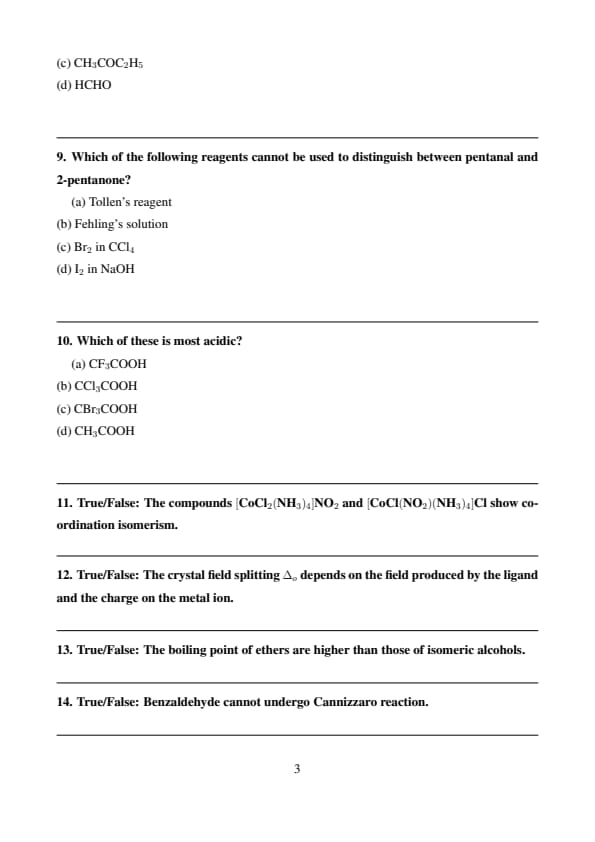
Which of the following reagents cannot be used to distinguish between pentanal and 2-pentanone?
View Solution
Step 1: Pentanal is an aldehyde, while 2-pentanone is a ketone.
Step 2: Tollen’s reagent gives a silver mirror with aldehydes but not with ketones, so it can distinguish them.
Step 3: Fehling’s solution is reduced by aliphatic aldehydes like pentanal but not by ketones, hence it can distinguish them.
Step 4: Iodoform test is given by methyl ketones.
2-pentanone (\(CH_3CO-\)) gives a positive test, while pentanal does not.
Step 5: Br\(_2\) in CCl\(_4\) is used to test unsaturation.
Since both pentanal and 2-pentanone are saturated compounds, neither reacts, so this reagent cannot distinguish between them. Quick Tip: Br\(_2\) in CCl\(_4\) is a test for double or triple bonds, not for differentiating aldehydes and ketones.
Which of these is most acidic?
View Solution
Step 1: Acidity of carboxylic acids depends on the stability of the carboxylate ion formed after loss of a proton.
Step 2: Electron-withdrawing groups increase acidity by stabilizing the negative charge through the –I (inductive) effect.
Step 3: The inductive effect of halogens follows the order: \[ F > Cl > Br > CH_3 \]
Step 4: CF\(_3\)COOH has the strongest electron-withdrawing effect, providing maximum stabilization to the conjugate base.
Step 5: Hence, CF\(_3\)COOH is the most acidic among the given compounds. Quick Tip: Greater the electron-withdrawing power of the substituent attached to COOH, greater is the acidity of the carboxylic acid.
True/False:
The compounds \([CoCl_2(NH_3)_4]NO_2\) and \([CoCl(NO_2)(NH_3)_4]Cl\) show coordination isomerism.
View Solution
Step 1: Coordination isomerism occurs when both the cation and anion are complex ions and ligands are interchanged between them.
Step 2: In \([CoCl_2(NH_3)_4]NO_2\), the coordination sphere contains two chloride ions and four ammonia molecules, while \(NO_2^-\) is outside the coordination sphere.
Step 3: In \([CoCl(NO_2)(NH_3)_4]Cl\), one chloride ion is replaced by a nitrito ligand inside the coordination sphere, and chloride ion remains outside.
Step 4: Since the ligands interchange between the coordination sphere and counter ion, the compounds exhibit coordination isomerism. Quick Tip: Coordination isomerism is possible only when both cation and anion are complex species.
True/False:
The crystal field splitting \(\Delta_o\) depends on the field produced by the ligand and the charge on the metal ion.
View Solution
Step 1: Crystal field splitting energy (\(\Delta_o\)) depends on the nature of the ligand.
Strong-field ligands produce a larger splitting, while weak-field ligands produce a smaller splitting.
Step 2: \(\Delta_o\) also depends on the charge on the metal ion.
Higher oxidation state of the metal ion increases attraction between metal and ligands, leading to greater splitting.
Step 3: Therefore, both ligand field strength and metal ion charge influence the value of \(\Delta_o\). Quick Tip: Order of ligand field strength (spectrochemical series): \[ I^- < Br^- < Cl^- < F^- < H_2O < NH_3 < CN^- \] Stronger ligands cause larger crystal field splitting.
True/False:
The boiling point of ethers are higher than those of isomeric alcohols.
View Solution
Step 1: Alcohols contain the \(-OH\) group, which allows them to form intermolecular hydrogen bonding.
Step 2: Ethers do not have an \(-OH\) group and therefore cannot form hydrogen bonds between their own molecules.
Step 3: Due to stronger intermolecular forces, alcohols have higher boiling points than their isomeric ethers.
Step 4: Hence, the given statement is false. Quick Tip: Hydrogen bonding significantly increases boiling point. Alcohols boil at higher temperatures than ethers of similar molecular mass.
True/False:
Benzaldehyde cannot undergo Cannizzaro reaction.
View Solution
Step 1: Cannizzaro reaction is shown by aldehydes which do not have \(\alpha\)-hydrogen atoms.
Step 2: Benzaldehyde (\(C_6H_5CHO\)) does not contain any \(\alpha\)-hydrogen.
Step 3: Therefore, benzaldehyde undergoes Cannizzaro reaction in the presence of a strong base, forming benzyl alcohol and benzoate ion.
Step 4: Hence, the given statement is false. Quick Tip: All aldehydes lacking \(\alpha\)-hydrogen (e.g., formaldehyde, benzaldehyde) undergo Cannizzaro reaction.
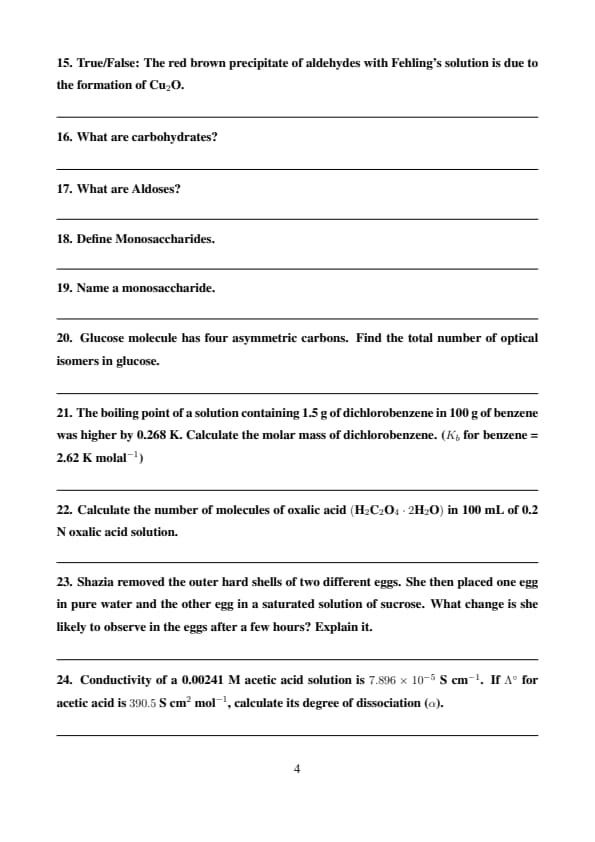
True/False:
The red brown precipitate of aldehydes with Fehling’s solution is due to the formation of Cu\(_2\)O.
View Solution
Step 1: Fehling’s solution contains \(Cu^{2+}\) ions in an alkaline medium.
Step 2: Aliphatic aldehydes reduce \(Cu^{2+}\) ions to \(Cu^+\) ions during oxidation to carboxylate ions.
Step 3: The reduced \(Cu^+\) ions form cuprous oxide (\(Cu_2O\)), which appears as a red-brown precipitate. Quick Tip: Fehling’s test is positive for aliphatic aldehydes due to the formation of red-brown \(Cu_2O\) precipitate.
What are carbohydrates?
View Solution
Step 1: Carbohydrates contain multiple hydroxyl (\(-OH\)) groups along with either an aldehydic (\(-CHO\)) or ketonic (\(>C=O\)) functional group.
Step 2: Some carbohydrates may not directly have these groups but produce them upon hydrolysis.
Step 3: Due to the presence of asymmetric carbon atoms, carbohydrates are generally optically active. Quick Tip: Carbohydrates include sugars like glucose and fructose and are classified as aldoses or ketoses based on the functional group present.
What are Aldoses?
View Solution
Step 1: Aldoses are carbohydrates that have an aldehyde functional group.
Step 2: Examples of aldoses include glucose and galactose. Quick Tip: If the functional group is \(-CHO\), the sugar is an aldose; if it is \(>C=O\), it is a ketose.
Define Monosaccharides.
View Solution
Step 1: Monosaccharides are the simplest form of carbohydrates.
Step 2: They act as the basic building blocks for oligosaccharides and polysaccharides. Quick Tip: Examples of monosaccharides include glucose, fructose, and galactose.
Name a monosaccharide.
View Solution
Step 1: Glucose is a simple sugar and cannot be hydrolysed further.
Step 2: Hence, it is classified as a monosaccharide. Quick Tip: Common monosaccharides: glucose, fructose, ribose.
Glucose molecule has four asymmetric carbons. Find the total number of optical isomers in glucose.
View Solution
Step 1: The number of optical isomers is given by the formula: \[ 2^n \]
where \(n\) is the number of asymmetric carbon atoms.
Step 2: For glucose, \(n = 4\).
Step 3: Therefore: \[ 2^4 = 16 \] Quick Tip: Each asymmetric carbon doubles the number of possible optical isomers.
The boiling point of a solution containing 1.5 g of dichlorobenzene in 100 g of benzene was higher by 0.268 K. Calculate the molar mass of dichlorobenzene.
(\(K_b\) for benzene = 2.62 K molal\(^{-1}\))
View Solution
Step 1: Use the boiling point elevation formula: \[ \Delta T_b = K_b \times m \]
Step 2: Substitute the given values: \[ 0.268 = 2.62 \times m \] \[ m = \frac{0.268}{2.62} = 0.1023 \ mol kg^{-1} \]
Step 3: Mass of benzene (solvent) = 100 g = 0.1 kg
Molality: \[ m = \frac{moles of solute}{kg of solvent} \] \[ Moles of solute = 0.1023 \times 0.1 = 0.01023 \]
Step 4: Calculate molar mass of dichlorobenzene: \[ Molar mass = \frac{mass}{moles} = \frac{1.5}{0.01023} \] \[ = 146.7 \approx 147 \ g mol^{-1} \] Quick Tip: For boiling point elevation problems: \[ \Delta T_b = K_b \times m \] Always convert solvent mass into kilograms before calculating molality.
Calculate the number of molecules of oxalic acid \((H_2C_2O_4\cdot2H_2O)\) in 100 mL of 0.2 N oxalic acid solution.
View Solution
Step 1: Normality (\(N\)) is defined as: \[ N = \frac{gram equivalents}{litre of solution} \]
Given: \[ N = 0.2,\quad Volume = 100\,mL = 0.1\,L \]
Step 2: Calculate the number of gram equivalents: \[ Gram equivalents = N \times V = 0.2 \times 0.1 = 0.02 \]
Step 3: Oxalic acid is a dibasic acid, so: \[ 1 mole of oxalic acid = 2 equivalents \]
Step 4: Calculate number of moles of oxalic acid: \[ Moles = \frac{0.02}{2} = 0.01 \]
Step 5: Calculate the number of molecules: \[ Number of molecules = 0.01 \times 6.022 \times 10^{23} \] \[ = 6.022 \times 10^{21} \] Quick Tip: For acids and bases, convert normality to moles using the number of replaceable hydrogen ions before calculating molecules.
Shazia removed the outer hard shells of two different eggs. She then placed one egg in pure water and the other egg in a saturated solution of sucrose. What change is she likely to observe in the eggs after a few hours? Explain it.
View Solution
Step 1: After removing the hard shell, the egg is surrounded by a semipermeable membrane.
Step 2: When the egg is placed in pure water, the surrounding solution is hypotonic compared to the egg contents.
Water enters the egg through the membrane by osmosis, causing the egg to swell.
Step 3: When the egg is placed in a saturated sucrose solution, the surrounding solution is hypertonic.
Water moves out of the egg by osmosis, causing the egg to shrink.
Step 4: These changes occur due to the movement of water across a semipermeable membrane depending on the concentration difference. Quick Tip: Osmosis occurs from a region of higher water concentration to lower water concentration through a semipermeable membrane. Hypotonic solution causes swelling, while hypertonic solution causes shrinkage.
Conductivity of a 0.00241 M acetic acid solution is \(7.896 \times 10^{-5}\) S cm\(^{-1}\).
If \(\Lambda^{\circ}\) for acetic acid is \(390.5\) S cm\(^2\) mol\(^{-1}\), calculate its degree of dissociation (\(\alpha\)).
View Solution
Step 1: Molar conductivity (\(\Lambda_m\)) is given by: \[ \Lambda_m = \frac{\kappa \times 1000}{C} \]
where \(\kappa = 7.896 \times 10^{-5}\) S cm\(^{-1}\) \(C = 0.00241\) M
Step 2: Substitute the values: \[ \Lambda_m = \frac{7.896 \times 10^{-5} \times 1000}{0.00241} \] \[ \Lambda_m \approx 32.76 \ S cm^2 mol^{-1} \]
Step 3: Degree of dissociation (\(\alpha\)) is given by: \[ \alpha = \frac{\Lambda_m}{\Lambda^{\circ}} \]
Step 4: Substitute the values: \[ \alpha = \frac{32.76}{390.5} \] \[ \alpha \approx 0.084 \]
Step 5: Therefore, the degree of dissociation is approximately: \[ \alpha = 8.4% \] Quick Tip: For weak electrolytes: \[ \alpha = \frac{\Lambda_m}{\Lambda^{\circ}} \] Molar conductivity increases with dilution due to increased dissociation.
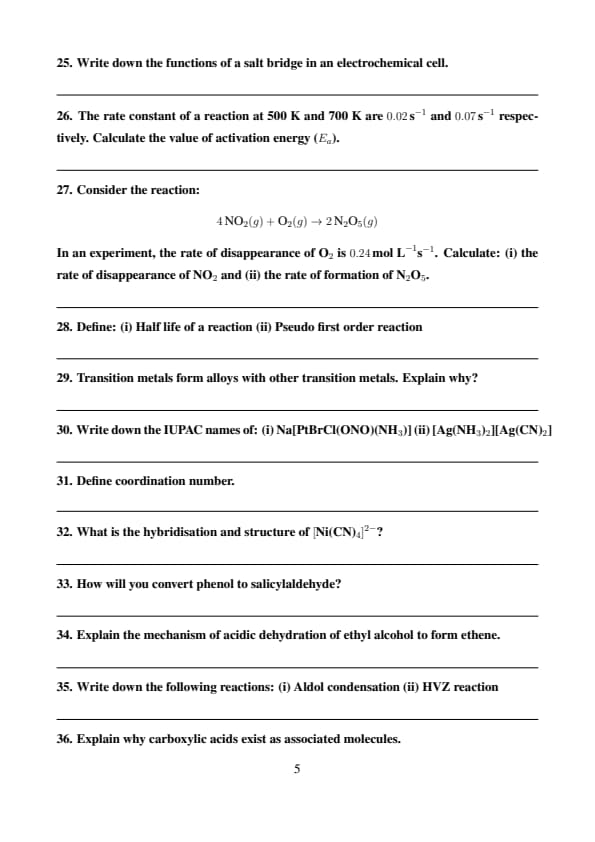
Write down the functions of a salt bridge in an electrochemical cell.
View Solution
Step 1: The salt bridge allows the migration of ions between the two half-cells to maintain electrical neutrality.
Step 2: It prevents accumulation of charges in the half-cells, which would otherwise stop the flow of electrons.
Step 3: The salt bridge completes the electrical circuit without allowing direct mixing of the solutions in the two half-cells.
Step 4: It minimizes liquid junction potential, ensuring a steady and accurate cell potential. Quick Tip: Common electrolytes used in salt bridges are KCl or KNO\(_3\) because their ions have similar mobilities.
The rate constant of a reaction at 500 K and 700 K are \(0.02\,s^{-1}\) and \(0.07\,s^{-1}\) respectively. Calculate the value of activation energy (\(E_a\)).
View Solution
Step 1: Use the Arrhenius equation: \[ \ln\left(\frac{k_2}{k_1}\right) = \frac{E_a}{R}\left(\frac{1}{T_1}-\frac{1}{T_2}\right) \]
Step 2: Substitute the given values: \[ k_1 = 0.02\,s^{-1}, \quad k_2 = 0.07\,s^{-1} \] \[ T_1 = 500\,K, \quad T_2 = 700\,K \]
Step 3: Calculate each term: \[ \ln\left(\frac{0.07}{0.02}\right) = \ln(3.5) = 1.253 \] \[ \frac{1}{500} - \frac{1}{700} = \frac{200}{350000} = 0.0005714 \]
Step 4: Substitute values into the equation: \[ 1.253 = \frac{E_a}{8.314} \times 0.0005714 \]
Step 5: Solve for \(E_a\): \[ E_a = \frac{1.253 \times 8.314}{0.0005714} \] \[ E_a \approx 1.82 \times 10^{4}\,J mol^{-1} \] \[ E_a \approx 18.2\,kJ mol^{-1} \] Quick Tip: Higher activation energy means greater temperature sensitivity of the rate constant. Always convert \(E_a\) into kJ mol\(^{-1}\) for final answers.
Consider the reaction: \[ 4\,NO_2(g) + O_2(g) \rightarrow 2\,N_2O_5(g) \]
In an experiment, the rate of disappearance of O\(_2\) is \(0.24\,mol L^{-1}s^{-1}\).
Calculate:
(i) the rate of disappearance of NO\(_2\) and
(ii) the rate of formation of N\(_2\)O\(_5\).
View Solution
Step 1: Write the stoichiometric rate relation for the reaction: \[ -\frac{1}{4}\frac{d[NO_2]}{dt} = -\frac{1}{1}\frac{d[O_2]}{dt} = \frac{1}{2}\frac{d[N_2O_5]}{dt} \]
Step 2: Given rate of disappearance of oxygen: \[ -\frac{d[O_2]}{dt} = 0.24\,mol L^{-1}s^{-1} \]
Step 3: Calculate rate of disappearance of NO\(_2\): \[ -\frac{d[NO_2]}{dt} = 4 \times 0.24 = 0.96\,mol L^{-1}s^{-1} \]
Step 4: Calculate rate of formation of N\(_2\)O\(_5\): \[ \frac{d[N_2O_5]}{dt} = 2 \times 0.24 = 0.48\,mol L^{-1}s^{-1} \] Quick Tip: Rates of reactions are related to stoichiometric coefficients. Multiply the given rate by the ratio of coefficients to find rates of other species.
Define:
(i) Half life of a reaction
(ii) Pseudo first order reaction
View Solution
Step 1: Half life (\(t_{1/2}\)) is an important kinetic parameter used to study the rate of a reaction.
For a first order reaction: \[ t_{1/2} = \frac{0.693}{k} \]
where \(k\) is the rate constant.
Step 2: In a pseudo first order reaction, the concentration of one reactant remains nearly constant throughout the reaction.
As a result, the rate depends only on the concentration of one reactant, making the reaction appear first order.
Step 3: A common example is the hydrolysis of ethyl acetate in excess water. Quick Tip: Pseudo first order reactions simplify kinetic analysis when one reactant is in large excess and its concentration effectively remains constant.
Transition metals form alloys with other transition metals. Explain why?
View Solution
Step 1: Transition metals have comparable atomic radii, allowing atoms of one metal to easily replace or fit into the lattice of another metal.
Step 2: They generally possess similar crystal structures (such as body-centered cubic or face-centered cubic).
Step 3: Transition metals exhibit strong metallic bonding due to the presence of delocalized \(d\)-electrons, which is not significantly disturbed on mixing.
Step 4: These similarities enable the formation of substitutional alloys with enhanced mechanical properties. Quick Tip: Alloy formation is favored when metals have similar atomic size and crystal structure, leading to minimal lattice distortion.
Write down the IUPAC names of:
(i) Na[PtBrCl(ONO)(NH\(_3\))]
(ii) [Ag(NH\(_3\))\(_2\)][Ag(CN)\(_2\)]
View Solution
Step 1: For \(Na[PtBrCl(ONO)(NH_3)]\):
The complex ion is anionic, so the metal name ends with –ate.
Oxidation state of Pt is \(+2\).
Ligands are named in alphabetical order: ammine, bromido, chlorido, nitrito-\(\kappa O\).
Step 2: For \([Ag(NH_3)_2][Ag(CN)_2]\):
The cationic complex \([Ag(NH_3)_2]^+\) is named first as diamminesilver(I).
The anionic complex \([Ag(CN)_2]^-\) is named as dicyanidoargentate(I). Quick Tip: Always name the cation first, then the anion. For anionic complexes, the metal name ends with \textbf{–ate} and ligand names are written in alphabetical order.
Define coordination number.
View Solution
Step 1: Ligands donate one or more lone pairs of electrons to the central metal atom through coordinate bonds.
Step 2: The total count of donor atoms attached to the metal determines the coordination number.
Step 3: For example, in \([Co(NH_3)_6]^{3+}\), six ammonia molecules donate lone pairs to cobalt, so the coordination number is 6. Quick Tip: Coordination number depends on the number of donor atoms, not on the charge of ligands or metal ion.
What is the hybridisation and structure of \([Ni(CN)_4]^{2-}\)?
View Solution
Step 1: Determine the oxidation state of nickel: \[ x + 4(-1) = -2 \quad \Rightarrow \quad x = +2 \]
So, nickel is in the \(+2\) oxidation state.
Step 2: Electronic configuration of Ni (\(Z = 28\)): \[ Ni^{2+}: [Ar]\,3d^8 \]
Step 3: CN\(^-\) is a strong field ligand, which causes pairing of electrons in the \(3d\) orbitals.
Step 4: After pairing, one \(3d\), one \(4s\), and two \(4p\) orbitals hybridise to form \(\textbf{dsp}^2\) hybrid orbitals.
Step 5: \(dsp^2\) hybridisation leads to a square planar geometry. Quick Tip: Strong field ligands like CN\(^-\) cause electron pairing and often result in square planar complexes for \(d^8\) metal ions such as Ni(II).
How will you convert phenol to salicylaldehyde?
View Solution
Step 1: Phenol is treated with chloroform (CHCl\(_3\)) and aqueous sodium hydroxide (NaOH) and heated.
Step 2: Under alkaline conditions, chloroform generates dichlorocarbene (\(:CCl_2\)), which acts as an electrophile.
Step 3: The electrophile attacks the ortho position of phenol (–OH group is ortho/para directing).
Step 4: On subsequent hydrolysis, the ortho-substituted product forms salicylaldehyde (o-hydroxybenzaldehyde).
\[ Phenol \xrightarrow[NaOH]{CHCl_3,\ \Delta} Salicylaldehyde \] Quick Tip: The Reimer–Tiemann reaction introduces a \(-CHO\) group at the ortho position of phenols using CHCl\(_3\) and NaOH.
Explain the mechanism of acidic dehydration of ethyl alcohol to form ethene.
View Solution
Step 1: Protonation of alcohol
Ethyl alcohol reacts with concentrated \(H_2SO_4\) at about \(443\,K\), and the hydroxyl group gets protonated, forming an oxonium ion: \[ CH_3CH_2OH + H^+ \rightarrow CH_3CH_2OH_2^+ \]
Step 2: Formation of carbocation
The protonated alcohol loses a water molecule to form an ethyl carbocation: \[ CH_3CH_2OH_2^+ \rightarrow CH_3CH_2^+ + H_2O \]
Step 3: Elimination of proton
The carbocation loses a proton to form ethene: \[ CH_3CH_2^+ \rightarrow CH_2 = CH_2 + H^+ \]
Step 4: Regeneration of acid
The proton released in the last step regenerates the acid catalyst. Quick Tip: Acidic dehydration of alcohols is an elimination reaction. Higher temperature favors alkene formation over ether formation.
Write down the following reactions:
(i) Aldol condensation
(ii) HVZ reaction
View Solution
(i) Aldol Condensation:
When acetaldehyde is treated with dilute NaOH: \[ 2\,CH_3CHO \xrightarrow{dil. NaOH} CH_3CH(OH)CH_2CHO \]
(\(\beta\)-hydroxy aldehyde, aldol)
On heating: \[ CH_3CH(OH)CH_2CHO \xrightarrow{\Delta} CH_3CH=CHCHO + H_2O \]
(ii) HVZ Reaction:
Carboxylic acids having \(\alpha\)-hydrogen react with halogen in the presence of red phosphorus: \[ RCH_2COOH \xrightarrow{Br_2/Red P} RCHBrCOOH \] Quick Tip: Aldol condensation requires \(\alpha\)-hydrogen atoms. HVZ reaction is used for \(\alpha\)-halogenation of carboxylic acids.
Explain why carboxylic acids exist as associated molecules.
View Solution
Step 1: Carboxylic acids contain both a \(-OH\) group and a carbonyl (\(>C=O\)) group.
Step 2: The hydrogen of the \(-OH\) group forms a strong hydrogen bond with the oxygen atom of the carbonyl group of another carboxylic acid molecule.
Step 3: Two molecules associate to form a cyclic dimer through two intermolecular hydrogen bonds.
Step 4: This dimeric association increases molecular mass and intermolecular attraction, causing higher boiling points of carboxylic acids. Quick Tip: Carboxylic acids form stable cyclic dimers due to double hydrogen bonding, especially in the vapour phase and non-polar solvents.
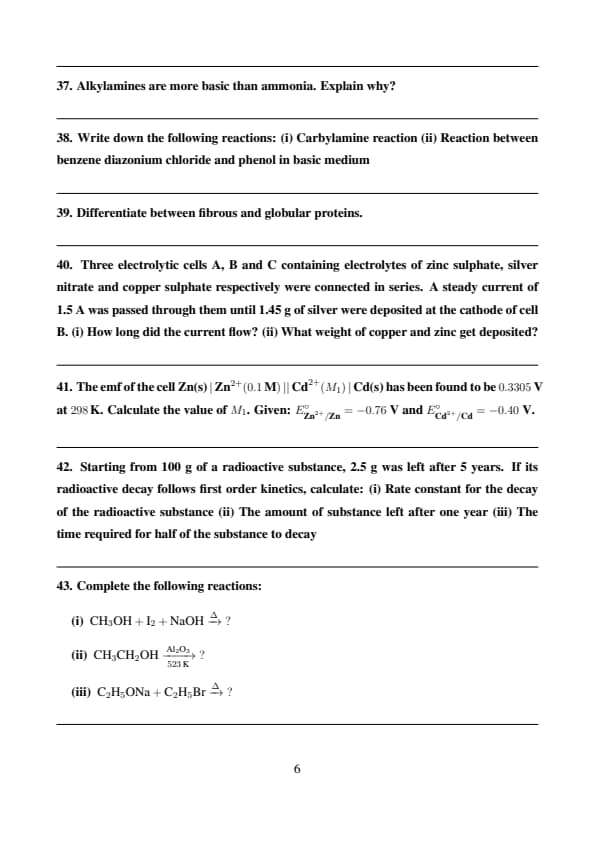
Alkylamines are more basic than ammonia. Explain why?
View Solution
Step 1: Basicity depends on the availability of the lone pair of electrons on the nitrogen atom to accept a proton.
Step 2: Alkyl groups (\(-R\)) exhibit a +I (electron-donating) inductive effect, which pushes electron density towards the nitrogen atom.
Step 3: Increased electron density on nitrogen makes the lone pair more available for protonation, thereby increasing basicity.
Step 4: In ammonia, there is no alkyl group attached to nitrogen, so it lacks this electron-donating effect.
Step 5: Hence, alkylamines are more basic than ammonia. Quick Tip: Greater the +I effect of substituents attached to nitrogen, greater is the basic strength of amines.
Write down the following reactions:
(i) Carbylamine reaction
(ii) Reaction between benzene diazonium chloride and phenol in basic medium
View Solution
(i) Carbylamine reaction:
When a primary amine is heated with chloroform and alcoholic KOH, a foul-smelling isocyanide is formed: \[ RNH_2 + CHCl_3 + 3KOH \rightarrow RNC + 3KCl + 3H_2O \]
(ii) Reaction between benzene diazonium chloride and phenol in basic medium:
Phenol reacts with benzene diazonium chloride in alkaline medium to form an azo dye (p-hydroxyazobenzene): \[ C_6H_5N_2^+Cl^- + C_6H_5OH \xrightarrow{NaOH} C_6H_5{-}N=N{-}C_6H_4OH \] Quick Tip: Carbylamine reaction is a confirmatory test for primary amines. Azo coupling reactions are carried out in cold alkaline medium.
Differentiate between fibrous and globular proteins.
View Solution
\begin{tabular{|p{4cm|p{5cm|p{5cm|
\hline
Property & Fibrous proteins & Globular proteins
\hline
Shape & Long, thread-like & Compact, spherical
\hline
Solubility & Insoluble in water & Generally soluble in water
\hline
Structure & Simple and repetitive & Complex and folded
\hline
Function & Structural role & Functional (enzymes, hormones)
\hline
Examples & Keratin, collagen & Hemoglobin, insulin
\hline
\end{tabular Quick Tip: Fibrous proteins provide mechanical support, while globular proteins perform biological functions.
Three electrolytic cells A, B and C containing electrolytes of zinc sulphate, silver nitrate and copper sulphate respectively were connected in series. A steady current of 1.5 A was passed through them until 1.45 g of silver were deposited at the cathode of cell B.
(i) How long did the current flow?
(ii) What weight of copper and zinc get deposited?
View Solution
Step 1: According to Faraday’s first law of electrolysis: \[ m = \frac{E}{F} \, Q \]
where \(m\) = mass deposited, \(E\) = equivalent weight, \(F = 96500\ C mol^{-1}\), \(Q = It\).
Step 2: For silver: \[ Equivalent weight of Ag = \frac{108}{1} = 108 \]
Step 3: Substitute values: \[ 1.45 = \frac{108}{96500} \times (1.5 \times t) \]
Step 4: Solve for time \(t\): \[ t = \frac{1.45 \times 96500}{108 \times 1.5} \] \[ t \approx 930\ s \]
Step 5: Since the cells are connected in series, the same quantity of electricity passes through all cells.
Step 6: Calculate mass of copper deposited: \[ E_{Cu} = \frac{63.5}{2} = 31.75 \] \[ m_{Cu} = \frac{31.75}{108} \times 1.45 = 0.44\ g \]
Step 7: Calculate mass of zinc deposited: \[ E_{Zn} = \frac{65}{2} = 32.5 \] \[ m_{Zn} = \frac{32.5}{108} \times 1.45 = 0.22\ g \] Quick Tip: In electrolytic cells connected in series, the same charge flows through each cell, so masses deposited are proportional to their equivalent weights.
The emf of the cell \(Zn(s) \,|\, Zn^{2+}(0.1\,M) \,||\, Cd^{2+}(M_1) \,|\, Cd(s)\)
has been found to be \(0.3305\ V\) at \(298\,K\).
Calculate the value of \(M_1\).
Given: \(E^\circ_{Zn^{2+}/Zn} = -0.76\ V\) and \(E^\circ_{Cd^{2+}/Cd} = -0.40\ V\).
View Solution
Step 1: Write the cell reaction: \[ Zn(s) + Cd^{2+}(aq) \rightarrow Zn^{2+}(aq) + Cd(s) \]
Step 2: Calculate the standard emf of the cell: \[ E^\circ_{cell} = E^\circ_{cathode} - E^\circ_{anode} \] \[ E^\circ_{cell} = (-0.40) - (-0.76) = 0.36\ V \]
Step 3: Apply the Nernst equation at \(298\,K\): \[ E_{cell} = E^\circ_{cell} - \frac{0.0591}{n}\log Q \]
Here, \(n = 2\).
Step 4: Write the reaction quotient: \[ Q = \frac{[Zn^{2+}]}{[Cd^{2+}]} = \frac{0.1}{M_1} \]
Step 5: Substitute the given values: \[ 0.3305 = 0.36 - \frac{0.0591}{2}\log\left(\frac{0.1}{M_1}\right) \]
Step 6: Simplify: \[ 0.36 - 0.3305 = 0.02955 \log\left(\frac{0.1}{M_1}\right) \] \[ 0.0295 = 0.02955 \log\left(\frac{0.1}{M_1}\right) \]
Step 7: Solve: \[ \log\left(\frac{0.1}{M_1}\right) = 1 \] \[ \frac{0.1}{M_1} = 10 \] \[ M_1 = 0.01 \times 10 = 1.0\ M \] Quick Tip: For electrochemical concentration cells, the Nernst equation relates emf directly to ion concentrations through the reaction quotient.
Starting from 100 g of a radioactive substance, 2.5 g was left after 5 years.
If its radioactive decay follows first order kinetics, calculate:
(i) Rate constant for the decay of the radioactive substance
(ii) The amount of substance left after one year
(iii) The time required for half of the substance to decay
View Solution
Step 1: For a first order reaction: \[ \ln\left(\frac{N_0}{N}\right) = kt \]
Given: \[ N_0 = 100\ g, \quad N = 2.5\ g, \quad t = 5\ years \]
Step 2: Calculate the rate constant \(k\): \[ \ln\left(\frac{100}{2.5}\right) = k \times 5 \] \[ \ln(40) = 5k \] \[ k = \frac{3.689}{5} = 0.738\ year^{-1} \]
Step 3: Amount left after 1 year: \[ N = N_0 e^{-kt} \] \[ N = 100 \, e^{-0.738 \times 1} \] \[ N \approx 100 \times 0.478 = 47.8\ g \]
Step 4: Time required for half of the substance to decay (half-life): \[ t_{1/2} = \frac{0.693}{k} \] \[ t_{1/2} = \frac{0.693}{0.738} \] \[ t_{1/2} \approx 0.94\ years \] Quick Tip: Radioactive decay always follows first order kinetics. Half-life is independent of initial amount and depends only on the rate constant.
Complete the following reactions:
(i) \(\ CH_3OH + I_2 + NaOH \xrightarrow{\Delta} \ ?\)
(ii) \(\ CH_3CH_2OH \xrightarrow[\;523\,K\;]{Al_2O_3} \ ?\)
(iii) \(\ C_2H_5ONa + C_2H_5Br \xrightarrow{\Delta} \ ?\)
View Solution
Step 1: Reaction (i) is the iodoform reaction.
Alcohols containing the \(-CH_3OH\) group give yellow precipitate of iodoform (\(CHI_3\)).
Step 2: Reaction (ii) is acidic dehydration of alcohol.
Alumina at high temperature converts ethanol into ethene.
Step 3: Reaction (iii) is Williamson ether synthesis, where an alkoxide reacts with an alkyl halide to form an ether. Quick Tip: Iodoform test confirms presence of \(-CH_3OH\) or \(-COCH_3\) group. Williamson synthesis is the best method for preparing symmetrical and unsymmetrical ethers.
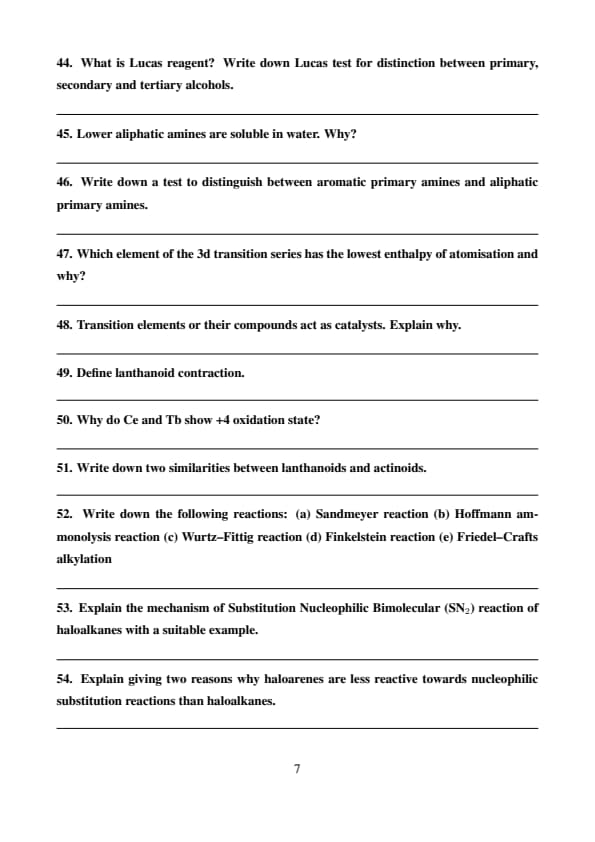
What is Lucas reagent? Write down Lucas test for distinction between primary, secondary and tertiary alcohols.
View Solution
Step 1: Lucas reagent
Lucas reagent consists of:
Concentrated HCl
Anhydrous ZnCl\(_2\)
ZnCl\(_2\) acts as a Lewis acid and facilitates the substitution of the \(-OH\) group by Cl\(^-\).
Step 2: Principle of Lucas test
Alcohols react with Lucas reagent to form insoluble alkyl chlorides.
Turbidity appears due to the formation of these alkyl chlorides.
Step 3: Distinction among alcohols
Tertiary alcohols: Immediate turbidity (reaction is fastest due to stable carbocation).
Secondary alcohols: Turbidity appears after a few minutes.
Primary alcohols: No turbidity at room temperature (react only on heating). Quick Tip: Lucas test is based on the stability of carbocations formed during substitution: \(3^\circ > 2^\circ > 1^\circ\) alcohols.
Lower aliphatic amines are soluble in water. Why?
View Solution
Step 1: Lower aliphatic amines contain the \(-NH_2\), \(-NH\), or \(-N\) group, which has a lone pair of electrons on nitrogen.
Step 2: This lone pair allows amine molecules to form hydrogen bonds with water molecules.
Step 3: In lower amines, the alkyl group is small, so the hydrophobic character is minimal and does not hinder solubility.
Step 4: As the size of the alkyl group increases, the hydrophobic effect increases and solubility decreases. Quick Tip: Solubility of amines in water decreases as the size of the alkyl group increases due to increased hydrophobic character.
Write down a test to distinguish between aromatic primary amines and aliphatic primary amines.
View Solution
Step 1: Treat the given primary amine with nitrous acid (prepared in situ using NaNO\(_2\) and dilute HCl) at \(0–5^\circC\).
Step 2:
Aromatic primary amines form stable diazonium salts at low temperature. \[ ArNH_2 + HNO_2 + HCl \rightarrow ArN_2^+Cl^- + 2H_2O \]
Aliphatic primary amines form unstable diazonium salts, which immediately decompose to give alcohols with evolution of nitrogen gas. \[ RNH_2 + HNO_2 \rightarrow ROH + N_2 \uparrow + H_2O \]
Step 3: Observation:
Formation of stable diazonium salt → Aromatic primary amine
Brisk effervescence of N\(_2\) gas → Aliphatic primary amine Quick Tip: Only aromatic primary amines form stable diazonium salts at \(0–5^\circC\); aliphatic ones do not.
Which element of the 3d transition series has the lowest enthalpy of atomisation and why?
View Solution
Step 1: Enthalpy of atomisation depends on the strength of metal–metal bonding in the solid state.
Step 2: Strong metallic bonding in transition metals is due to the presence of unpaired \(d\)-electrons.
Step 3: Zinc has a completely filled \(3d^{10}\) electronic configuration, resulting in no unpaired \(d\)-electrons.
Step 4: Due to weaker metallic bonding, zinc has the lowest enthalpy of atomisation among 3d transition elements. Quick Tip: Greater the number of unpaired \(d\)-electrons, stronger is the metallic bonding and higher is the enthalpy of atomisation.
Transition elements or their compounds act as catalysts. Explain why.
View Solution
Step 1: Transition elements possess variable oxidation states.
This allows them to easily accept or donate electrons during a chemical reaction.
Step 2: They have partially filled \(d\)-orbitals, which enable the formation of temporary intermediate complexes with reactant molecules.
Step 3: Formation of such intermediates provides an alternative reaction pathway with lower activation energy.
Step 4: Due to these properties, transition metals increase the rate of reaction without being consumed. Quick Tip: Catalytic activity of transition metals is mainly due to variable oxidation states and availability of vacant or partially filled \(d\)-orbitals.
Define lanthanoid contraction.
View Solution
Step 1: In lanthanoids, electrons are added to the 4f-orbitals.
Step 2: The 4f-electrons have poor shielding effect compared to s and p electrons.
Step 3: As a result, the effective nuclear charge experienced by the outer electrons increases gradually.
Step 4: This increased attraction causes a decrease in atomic and ionic sizes, known as lanthanoid contraction. Quick Tip: Lanthanoid contraction explains the similarity in properties of elements like zirconium and hafnium.
Why do Ce and Tb show +4 oxidation state?
View Solution
Step 1: Lanthanoids generally show +3 oxidation state due to the loss of two 6s electrons and one 5d or 4f electron.
Step 2: Cerium (\(Ce\)) has the electronic configuration: \[ [Xe]\,4f^1 5d^1 6s^2 \]
On losing four electrons, it attains: \[ Ce^{4+} : [Xe] \]
which is a noble gas configuration and hence very stable.
Step 3: Terbium (\(Tb\)) has the electronic configuration: \[ [Xe]\,4f^9 6s^2 \]
On losing four electrons, it forms: \[ Tb^{4+} : [Xe]\,4f^7 \]
which is a half-filled \(4f^7\) configuration, known for extra stability.
Step 4: Due to these stable electronic configurations, Ce and Tb can exhibit the +4 oxidation state. Quick Tip: Completely filled, half-filled, or noble gas configurations impart extra stability and allow higher oxidation states.
Write down two similarities between lanthanoids and actinoids.
View Solution
Step 1: In both lanthanoids and actinoids, electrons are progressively filled in the inner \(f\)-orbitals (4f in lanthanoids and 5f in actinoids).
Step 2: Both series predominantly exhibit the +3 oxidation state, which is the most stable oxidation state for elements of both groups. Quick Tip: Lanthanoids involve filling of 4f orbitals, while actinoids involve filling of 5f orbitals, leading to many similarities in size and chemistry.
Write down the following reactions:
(a) Sandmeyer reaction
(b) Hoffmann ammonolysis reaction
(c) Wurtz–Fittig reaction
(d) Finkelstein reaction
(e) Friedel–Crafts alkylation
View Solution
These reactions are important name reactions used for the preparation of halides, amines, and substituted aromatic compounds in organic chemistry. Quick Tip: Remember: Sandmeyer → Diazonium replacement Wurtz–Fittig → Alkyl benzene formation Friedel–Crafts → Electrophilic aromatic substitution
Explain the mechanism of Substitution Nucleophilic Bimolecular (SN\(_2\)) reaction of haloalkanes with a suitable example.
View Solution
Step 1: Nature of SN\(_2\) reaction
SN\(_2\) stands for Substitution Nucleophilic Bimolecular.
The rate of reaction depends on the concentration of both the haloalkane and the nucleophile: \[ Rate = k[RX][Nu^-] \]
Step 2: Mechanism
The nucleophile attacks the carbon atom bonded to the halogen from the backside, opposite to the leaving group.
Bond formation and bond breaking occur simultaneously through a single transition state.
Step 3: Transition state
A pentacoordinate transition state is formed in which the carbon atom is partially bonded to both the nucleophile and the leaving group.
Step 4: Stereochemical outcome
The reaction results in inversion of configuration (Walden inversion).
Example:
Reaction of methyl bromide with hydroxide ion: \[ CH_3Br + OH^- \rightarrow CH_3OH + Br^- \] Quick Tip: SN\(_2\) reactions are favored by primary haloalkanes, strong nucleophiles, and polar aprotic solvents.
Explain giving two reasons why haloarenes are less reactive towards nucleophilic substitution reactions than haloalkanes.
View Solution
Reason 1: Partial double bond character of C–X bond
In haloarenes, the lone pair of electrons on the halogen is involved in resonance with the aromatic ring.
This gives the C–X bond partial double bond character, making it shorter and stronger than the C–X bond in haloalkanes.
As a result, the bond is difficult to break during nucleophilic substitution.
Reason 2: Instability of carbocation / SN\(_2\) hindrance
Haloarenes do not undergo SN\(_1\) reactions because the phenyl carbocation formed is highly unstable.
SN\(_2\) reactions are also difficult because the carbon atom bonded to halogen is sp\(^2\)-hybridised and the planar aromatic ring hinders backside attack by the nucleophile. Quick Tip: Resonance stabilization of the C–X bond and sp\(^2\) hybridisation make haloarenes much less reactive than haloalkanes in nucleophilic substitution reactions.



Comments