




The PSEB Class 12 Maths Sample Paper exam will be conducted with the question paper and solutions made available after the exam. The exam will assess students' understanding through a combination of multiple-choice, objective, short, and long answer questions within a 3-hour duration. The paper will total 100 marks, with 80 marks allotted for the theory component and 20 marks for internal assessment. There will be no negative marking for incorrect answers.
PSEB Class 12 Maths Sample Paper 2026 Question Paper with Solutions PDF
| PSEB Class 12 Maths Sample Paper 2026 Question Paper with Solutions PDF | Download PDF | Check Solutions |
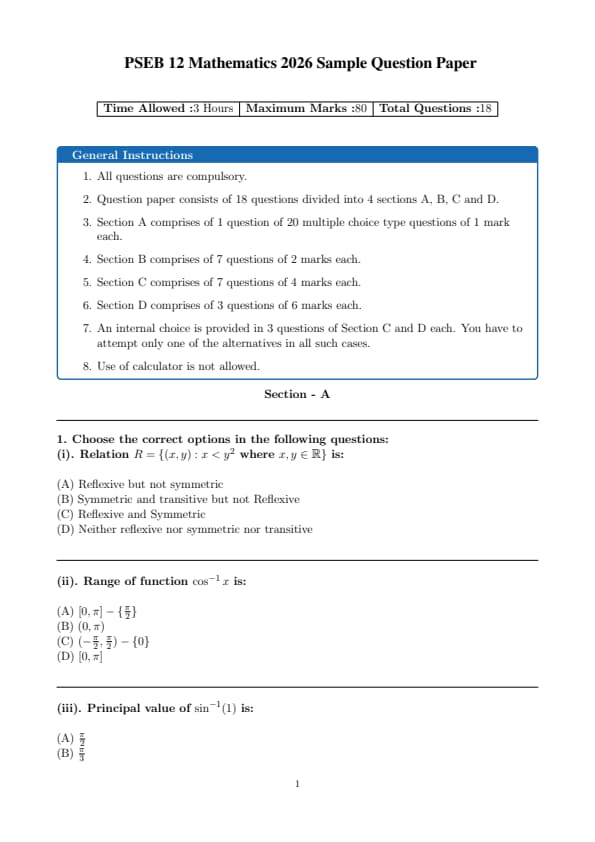
Choose the correct options in the following questions:
(i).
Relation \( R = \{(x, y) : x < y^2 where x, y \in \mathbb{R}\} \) is:
View Solution
Step 1: Understanding the Concept:
A relation \( R \) on a set of real numbers \( \mathbb{R} \) is checked for three properties:
1. Reflexive: \( (a, a) \in R \) for every \( a \in \mathbb{R} \).
2. Symmetric: If \( (a, b) \in R \), then \( (b, a) \in R \).
3. Transitive: If \( (a, b) \in R \) and \( (b, c) \in R \), then \( (a, c) \in R \).
Step 2: Detailed Explanation:
Check for Reflexivity:
For \( R \) to be reflexive, \( x < x^2 \) must hold for all \( x \in \mathbb{R} \).
Let \( x = \frac{1}{2} \). Here, \( x^2 = \frac{1}{4} \).
Since \( \frac{1}{2} < \frac{1}{4} \) is false (\( 0.5 < 0.25 \) is false), the pair \( (\frac{1}{2}, \frac{1}{2}) \notin R \).
Hence, \( R \) is not reflexive.
Check for Symmetry:
For \( R \) to be symmetric, if \( x < y^2 \), then \( y < x^2 \) must be true.
Let \( x = 1 \) and \( y = 2 \). Since \( 1 < 2^2 \) (\( 1 < 4 \)), \( (1, 2) \in R \).
However, for \( (2, 1) \) to be in \( R \), \( 2 < 1^2 \) (\( 2 < 1 \)) must be true, which is false.
Hence, \( R \) is not symmetric.
Check for Transitivity:
For \( R \) to be transitive, if \( x < y^2 \) and \( y < z^2 \), then \( x < z^2 \) must be true.
Let \( x = 3 \), \( y = 2 \), and \( z = 1.5 \).
\( 3 < 2^2 \implies 3 < 4 \) (True).
\( 2 < (1.5)^2 \implies 2 < 2.25 \) (True).
But \( 3 < (1.5)^2 \implies 3 < 2.25 \) (False).
Hence, \( R \) is not transitive.
Step 3: Final Answer:
Since the relation fails all three properties, it is neither reflexive nor symmetric nor transitive.
Quick Tip: For relations involving powers like \( x^2 \) or \( x^3 \), always test with proper fractions (between 0 and 1) to disprove reflexivity and negative numbers to disprove transitivity.
Range of function \( \cos^{-1} x \) is:
View Solution
Step 1: Understanding the Concept:
The range of an inverse trigonometric function corresponds to its Principal Value Branch.
For a function to have an inverse, it must be bijective (one-to-one and onto).
Step 2: Detailed Explanation:
The cosine function \( f(x) = \cos x \) is not one-to-one over its entire domain \( \mathbb{R} \).
To define its inverse, we restrict the domain of \( \cos x \) to \( [0, \pi] \), where the function is strictly decreasing and covers all values from \( -1 \) to \( 1 \).
Therefore, the inverse function \( \cos^{-1} x \) has a domain of \( [-1, 1] \).
The set of values it produces (the range) is the interval \( [0, \pi] \).
Step 3: Final Answer:
The principal value branch or range of \( \cos^{-1} x \) is \( [0, \pi] \).
Quick Tip: Remember the "CO" family: Range of \( \cos^{-1} x \), \( \cot^{-1} x \), and \( \sec^{-1} x \) are all related to the interval \( [0, \pi] \), while \( \sin^{-1} x \), \( \tan^{-1} x \), and \( \operatorname{cosec}^{-1} x \) are related to \( [-\pi/2, \pi/2] \).
Principal value of \( \sin^{-1}(1) \) is:
View Solution
Step 1: Understanding the Concept:
The principal value is the value of the inverse function that falls within its designated principal value branch.
For \( \sin^{-1} x \), the branch is \( [-\frac{\pi}{2}, \frac{\pi}{2}] \).
Step 2: Detailed Explanation:
Let \( \theta = \sin^{-1}(1) \).
This implies \( \sin \theta = 1 \).
We know from the trigonometric table that \( \sin(\frac{\pi}{2}) = 1 \).
Since \( \frac{\pi}{2} \) lies within the interval \( [-\frac{\pi}{2}, \frac{\pi}{2}] \), it is the principal value.
Step 3: Final Answer:
The principal value of \( \sin^{-1}(1) \) is \( \frac{\pi}{2} \).
Quick Tip: Always ensure your final answer for an inverse trig function lies within its principal range. For \( \sin^{-1} \), if the argument is positive, the answer will be in \( [0, \pi/2] \).
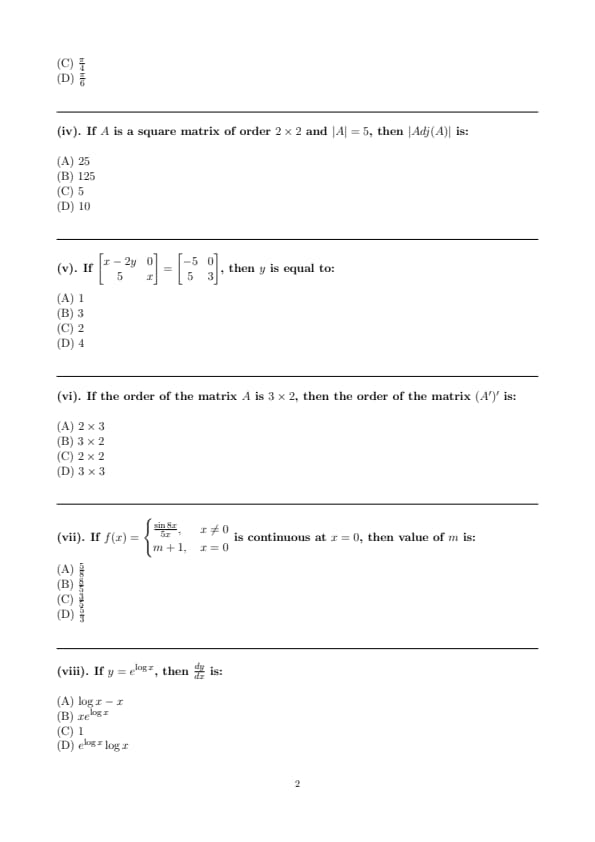
If \( A \) is a square matrix of order \( 2 \times 2 \) and \( |A| = 5 \), then \( |Adj(A)| \) is:
View Solution
Step 1: Understanding the Concept:
There is a direct relationship between the determinant of a matrix and the determinant of its adjoint.
Step 2: Key Formula or Approach:
For any square matrix \( A \) of order \( n \times n \), the determinant of its adjoint is given by:
\[ |Adj(A)| = |A|^{n-1} \]
Step 3: Detailed Explanation:
Given in the problem:
1. Order of the matrix, \( n = 2 \).
2. Determinant of the matrix, \( |A| = 5 \).
Substituting these values into the formula:
\[ |Adj(A)| = 5^{2-1} \] \[ |Adj(A)| = 5^1 \] \[ |Adj(A)| = 5 \]
Step 4: Final Answer:
The value of \( |Adj(A)| \) is 5.
Quick Tip: Be careful with the order. If the matrix was \( 3 \times 3 \), the answer would be \( |A|^{3-1} = 5^2 = 25 \). Always identify \( n \) first.
If \( \begin{bmatrix} x-2y & 0
5 & x \end{bmatrix} = \begin{bmatrix} -5 & 0
5 & 3 \end{bmatrix} \), then \( y \) is equal to:
View Solution
Step 1: Understanding the Concept:
Equality of matrices states that two matrices are equal if they have the same order and their corresponding elements are equal.
Step 2: Detailed Explanation:
We compare elements at each position \( (i, j) \).
Comparing element \( a_{22} \):
\[ x = 3 \]
Comparing element \( a_{11} \):
\[ x - 2y = -5 \]
Now, substitute the value of \( x = 3 \) into the second equation:
\[ 3 - 2y = -5 \]
Isolate the term with \( y \):
\[ -2y = -5 - 3 \] \[ -2y = -8 \]
Divide by \( -2 \):
\[ y = \frac{-8}{-2} = 4 \]
Step 3: Final Answer:
The value of \( y \) is 4.
Quick Tip: Always look for the simplest equation first (like \( x=3 \)) to find one variable, then use it to solve the more complex equations.
If the order of the matrix \( A \) is \( 3 \times 2 \), then the order of the matrix \( (A')' \) is:
View Solution
Step 1: Understanding the Concept:
The transpose of a matrix \( A \), denoted by \( A' \), is obtained by interchanging its rows and columns.
Step 2: Detailed Explanation:
1. Matrix \( A \) has order \( 3 \times 2 \) (3 rows, 2 columns).
2. Its transpose \( A' \) will have the order \( 2 \times 3 \) (2 rows, 3 columns).
3. Taking the transpose again, \( (A')' \), will swap the rows and columns of \( A' \) back.
4. This results in an order of \( 3 \times 2 \).
Mathematically, the property \( (A')' = A \) holds for any matrix.
Step 3: Final Answer:
The order of \( (A')' \) is the same as the order of \( A \), which is \( 3 \times 2 \).
Quick Tip: Applying the transpose operation an even number of times returns the matrix to its original state and original order.
If \( f(x) = \begin{cases} \frac{\sin 8x}{5x}, & x \neq 0
m+1, & x = 0 \end{cases} \) is continuous at \( x = 0 \), then value of \( m \) is:
View Solution
Step 1: Understanding the Concept:
A function \( f(x) \) is continuous at \( x = a \) if the limit of the function as \( x \) approaches \( a \) is equal to the value of the function at \( a \).
\[ \lim_{x \to 0} f(x) = f(0) \]
Step 2: Key Formula or Approach:
Use the standard trigonometric limit: \( \lim_{\theta \to 0} \frac{\sin \theta}{\theta} = 1 \).
Step 3: Detailed Explanation:
Evaluate the limit:
\[ \lim_{x \to 0} \frac{\sin 8x}{5x} = \frac{1}{5} \lim_{x \to 0} \frac{\sin 8x}{x} \]
Multiply and divide by 8 to match the angle:
\[ = \frac{8}{5} \lim_{x \to 0} \frac{\sin 8x}{8x} \]
Using the standard limit, \( \lim_{8x \to 0} \frac{\sin 8x}{8x} = 1 \):
\[ = \frac{8}{5} \times 1 = \frac{8}{5} \]
Given that the function is continuous, \( f(0) = \frac{8}{5} \).
From the definition: \( f(0) = m + 1 \).
Equating both:
\[ m + 1 = \frac{8}{5} \] \[ m = \frac{8}{5} - 1 = \frac{8 - 5}{5} = \frac{3}{5} \]
Step 4: Final Answer:
The value of \( m \) is \( \frac{3}{5} \).
Quick Tip: For any limit of the form \( \lim_{x \to 0} \frac{\sin ax}{bx} \), the result is simply the ratio of the coefficients, \( \frac{a}{b} \).
If \( y = e^{\log x} \), then \( \frac{dy}{dx} \) is:
View Solution
Step 1: Understanding the Concept:
Logarithmic and exponential functions (with the same base) are inverse operations. They cancel each other out.
Step 2: Detailed Explanation:
Given the function \( y = e^{\log_e x} \).
By the property of logarithms \( a^{\log_a f(x)} = f(x) \), the expression simplifies to:
\[ y = x \]
Now, we differentiate with respect to \( x \):
\[ \frac{dy}{dx} = \frac{d}{dx}(x) \] \[ \frac{dy}{dx} = 1 \]
Step 3: Final Answer:
The derivative is 1.
Quick Tip: Always simplify the expression using logarithmic properties before starting the differentiation process. It converts a complex-looking chain rule problem into a basic one.
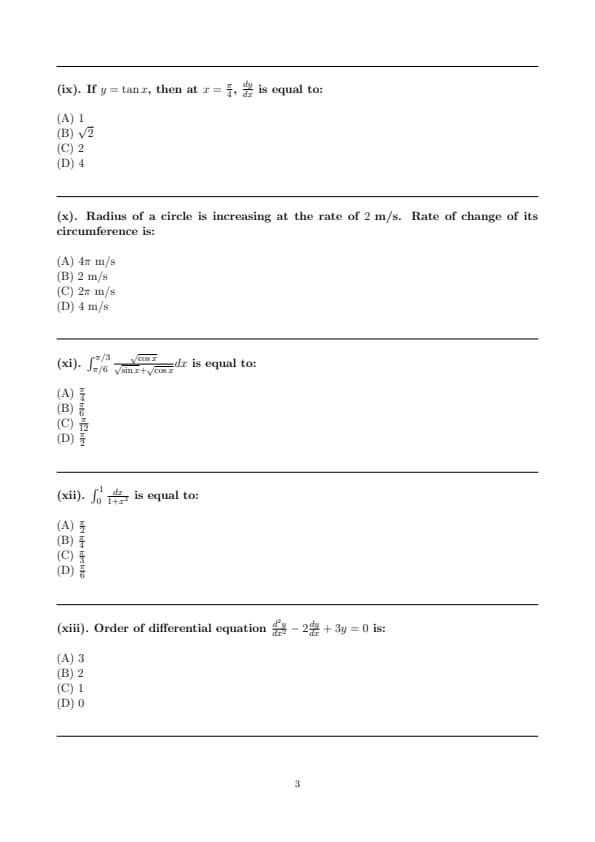
If \( y = \tan x \), then at \( x = \frac{\pi}{4} \), \( \frac{dy}{dx} \) is equal to:
View Solution
Step 1: Understanding the Concept:
We need to find the derivative of the tangent function and evaluate it at a specific point.
Step 2: Detailed Explanation:
Given: \( y = \tan x \).
Differentiating with respect to \( x \):
\[ \frac{dy}{dx} = \sec^2 x \]
We need the value at \( x = \frac{\pi}{4} \):
\[ \left[ \frac{dy}{dx} \right]_{x = \frac{\pi}{4}} = \sec^2\left(\frac{\pi}{4}\right) \]
We know that \( \cos\left(\frac{\pi}{4}\right) = \frac{1}{\sqrt{2}} \), so \( \sec\left(\frac{\pi}{4}\right) = \sqrt{2} \).
Substituting this:
\[ = (\sqrt{2})^2 = 2 \]
Step 3: Final Answer:
The value of the derivative at \( x = \frac{\pi}{4} \) is 2.
Quick Tip: Memorize the derivatives of all trigonometric functions. \( \frac{d}{dx}(\tan x) = \sec^2 x \) and \( \frac{d}{dx}(\cot x) = -\operatorname{cosec}^2 x \).
Radius of a circle is increasing at the rate of \( 2 m/s \). Rate of change of its circumference is:
View Solution
Step 1: Understanding the Concept:
This is an application of derivatives where we relate the rate of change of one variable to another using a geometric formula.
Step 2: Detailed Explanation:
Let \( r \) be the radius and \( C \) be the circumference of the circle.
The formula for circumference is \( C = 2\pi r \).
Differentiating both sides with respect to time \( t \):
\[ \frac{dC}{dt} = \frac{d}{dt}(2\pi r) = 2\pi \frac{dr}{dt} \]
Given that the radius is increasing at a rate of \( 2 m/s \), we have \( \frac{dr}{dt} = 2 \).
Substituting this into the derived equation:
\[ \frac{dC}{dt} = 2\pi \times 2 = 4\pi m/s \]
Step 3: Final Answer:
The rate of change of circumference is \( 4\pi m/s \).
Quick Tip: For a circle, the rate of change of the circumference is always \( 2\pi \) times the rate of change of the radius, regardless of what the current radius is.
\( \int_{\pi/6}^{\pi/3} \frac{\sqrt{\cos x}}{\sqrt{\sin x} + \sqrt{\cos x}} dx \) is equal to:
View Solution
Step 1: Key Formula or Approach:
Use the definite integral property: \( \int_a^b f(x) dx = \int_a^b f(a + b - x) dx \).
Step 2: Detailed Explanation:
Let \( I = \int_{\pi/6}^{\pi/3} \frac{\sqrt{\cos x}}{\sqrt{\sin x} + \sqrt{\cos x}} dx \) ... (i)
Here \( a = \pi/6 \) and \( b = \pi/3 \). The sum \( a + b = \pi/6 + \pi/3 = \pi/2 \).
Applying the property, replace \( x \) with \( \pi/2 - x \):
\[ I = \int_{\pi/6}^{\pi/3} \frac{\sqrt{\cos(\pi/2 - x)}}{\sqrt{\sin(\pi/2 - x)} + \sqrt{\cos(\pi/2 - x)}} dx \] \[ I = \int_{\pi/6}^{\pi/3} \frac{\sqrt{\sin x}}{\sqrt{\cos x} + \sqrt{\sin x}} dx \) ... (ii)
Add equations (i) and (ii):
\[ 2I = \int_{\pi/6}^{\pi/3} \frac{\sqrt{\cos x} + \sqrt{\sin x}}{\sqrt{\sin x} + \sqrt{\cos x}} dx \] \[ 2I = \int_{\pi/6}^{\pi/3} 1 \, dx = [x]_{\pi/6}^{\pi/3} \] \[ 2I = \frac{\pi}{3} - \frac{\pi}{6} = \frac{2\pi - \pi}{6} = \frac{\pi}{6} \] \[ I = \frac{\pi}{12} \]
Step 3: Final Answer:
The value of the integral is \( \frac{\pi}{12} \).
Quick Tip: For any integral of the form \( \int_a^b \frac{f(x)}{f(x) + f(a+b-x)} dx \), the shortcut answer is always \( \frac{b - a}{2} \).
\( \int_0^1 \frac{dx}{1+x^2} \) is equal to:
View Solution
Step 1: Key Formula or Approach:
The integral \( \int \frac{1}{1+x^2} dx \) is a standard integral resulting in \( \tan^{-1} x \).
Step 2: Detailed Explanation:
Using the fundamental theorem of calculus:
\[ \int_0^1 \frac{1}{1+x^2} dx = [\tan^{-1} x]_0^1 \]
Evaluate at the upper limit: \( \tan^{-1}(1) = \frac{\pi}{4} \).
Evaluate at the lower limit: \( \tan^{-1}(0) = 0 \).
Subtracting the values:
\[ \frac{\pi}{4} - 0 = \frac{\pi}{4} \]
Step 3: Final Answer:
The integral evaluates to \( \frac{\pi}{4} \).
Quick Tip: Integrals involving \( \frac{1}{1+x^2} \), \( \frac{1}{\sqrt{1-x^2}} \), and \( \frac{1}{x\sqrt{x^2-1}} \) are high-frequency exam questions. Always double-check your inverse trig values.
Order of differential equation \( \frac{d^2y}{dx^2} - 2\frac{dy}{dx} + 3y = 0 \) is:
View Solution
Step 1: Understanding the Concept:
The order of a differential equation is the order of the highest derivative present in the equation.
Step 2: Detailed Explanation:
Observe the derivatives in the equation:
1. The term \( \frac{d^2y}{dx^2} \) is the second-order derivative (second derivative of \( y \) with respect to \( x \)).
2. The term \( \frac{dy}{dx} \) is the first-order derivative.
3. The term \( 3y \) has no derivative (zero-order).
Since the highest derivative order present is 2, the order of the differential equation is 2.
Step 3: Final Answer:
The order is 2.
Quick Tip: Don't confuse order with degree. The degree is the power of the highest order derivative. In this case, the order is 2 and the degree is 1.
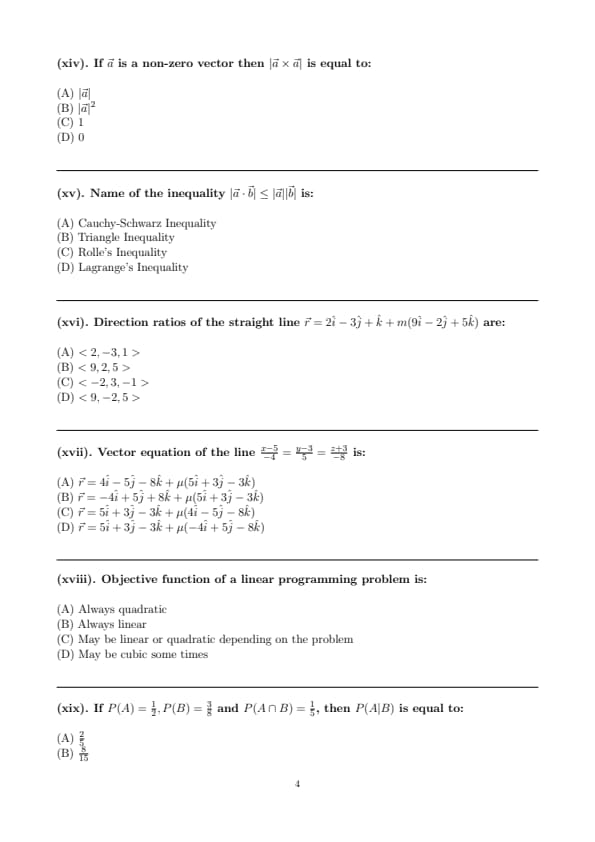
If \( \vec{a} \) is a non-zero vector then \( |\vec{a} \times \vec{a}| \) is equal to:
View Solution
Step 1: Understanding the Concept:
The cross product of two vectors \( \vec{u} \) and \( \vec{v} \) depends on the sine of the angle \( \theta \) between them.
Step 2: Detailed Explanation:
The magnitude of the cross product is given by:
\[ |\vec{a} \times \vec{b}| = |\vec{a}| |\vec{b}| \sin \theta \]
In this problem, both vectors are the same (\( \vec{a} \)).
The angle between a vector and itself is \( \theta = 0^\circ \).
Since \( \sin 0^\circ = 0 \):
\[ |\vec{a} \times \vec{a}| = |\vec{a}| |\vec{a}| \sin 0^\circ = 0 \]
Thus, the cross product of a vector with itself is always the null vector, and its magnitude is 0.
Step 3: Final Answer:
The value is 0.
Quick Tip: Remember: \( \vec{a} \cdot \vec{a} = |\vec{a}|^2 \) (Dot product) but \( \vec{a} \times \vec{a} = \vec{0} \) (Cross product).
Name of the inequality \( |\vec{a} \cdot \vec{b}| \le |\vec{a}| |\vec{b}| \) is:
View Solution
Step 1: Understanding the Concept:
This is a fundamental theorem in linear algebra and vector calculus relating the dot product and magnitudes.
Step 2: Detailed Explanation:
We know that \( \vec{a} \cdot \vec{b} = |\vec{a}| |\vec{b}| \cos \theta \).
Taking the absolute value on both sides:
\[ |\vec{a} \cdot \vec{b}| = | |\vec{a}| |\vec{b}| \cos \theta | \] \[ |\vec{a} \cdot \vec{b}| = |\vec{a}| |\vec{b}| |\cos \theta| \]
Since the absolute value of cosine for any real angle \( \theta \) is always less than or equal to 1 (\( |\cos \theta| \le 1 \)):
\[ |\vec{a} \cdot \vec{b}| \le |\vec{a}| |\vec{b}| \]
This specific statement is named the Cauchy-Schwarz Inequality.
Step 3: Final Answer:
The name of the inequality is Cauchy-Schwarz Inequality.
Quick Tip: The Triangle Inequality refers to \( |\vec{a} + \vec{b}| \le |\vec{a}| + |\vec{b}| \). Don't mix them up!
Direction ratios of the straight line \( \vec{r} = 2\hat{i} - 3\hat{j} + \hat{k} + m(9\hat{i} - 2\hat{j} + 5\hat{k}) \) are:
View Solution
Step 1: Understanding the Concept:
The vector equation of a line is \( \vec{r} = \vec{a} + \lambda \vec{b} \), where \( \vec{a} \) is the position vector of a point on the line and \( \vec{b} \) is the direction vector of the line.
Step 2: Detailed Explanation:
The direction ratios of the line are the scalar components of the direction vector \( \vec{b} \).
In the given equation:
\[ \vec{r} = (2\hat{i} - 3\hat{j} + \hat{k}) + m(9\hat{i} - 2\hat{j} + 5\hat{k}) \]
Here, the direction vector \( \vec{b} = 9\hat{i} - 2\hat{j} + 5\hat{k} \).
The components are \( 9, -2, 5 \).
Thus, the direction ratios are \( <9, -2, 5> \).
Step 3: Final Answer:
The direction ratios are \( <9, -2, 5> \).
Quick Tip: The vector multiplied by the parameter (like \( m \), \( \lambda \), or \( \mu \)) always represents the direction of the line.
Vector equation of the line \( \frac{x-5}{-4} = \frac{y-3}{5} = \frac{z+3}{-8} \) is:
View Solution
Step 1: Understanding the Concept:
To convert a Cartesian equation \( \frac{x-x_1}{a} = \frac{y-y_1}{b} = \frac{z-z_1}{c} \) to vector form \( \vec{r} = \vec{a} + \mu\vec{b} \), identify:
1. The point \( (x_1, y_1, z_1) \).
2. The direction ratios \( (a, b, c) \).
Step 2: Detailed Explanation:
From the Cartesian equation \( \frac{x-5}{-4} = \frac{y-3}{5} = \frac{z+3}{-8} \):
1. The point on the line is \( (5, 3, -3) \). Its position vector is \( \vec{a} = 5\hat{i} + 3\hat{j} - 3\hat{k} \).
2. The direction ratios are \( (-4, 5, -8) \). The direction vector is \( \vec{b} = -4\hat{i} + 5\hat{j} - 8\hat{k} \).
Substitute these into the vector equation form:
\[ \vec{r} = (5\hat{i} + 3\hat{j} - 3\hat{k}) + \mu(-4\hat{i} + 5\hat{j} - 8\hat{k}) \]
Step 3: Final Answer:
The vector equation matches option (D).
Quick Tip: Watch out for the signs in the point coordinates. \( x-x_1 \) means \( x_1 \) is positive, and \( z+3 \) is \( z-(-3) \), meaning \( z_1 \) is negative.
Objective function of a linear programming problem is:
View Solution
Step 1: Understanding the Concept:
Linear Programming Problems (LPP) deal with optimizing a linear function subject to linear constraints.
Step 2: Detailed Explanation:
By definition, in a Linear Programming Problem, the objective function \( Z = ax + by \) must be linear.
This means the variables \( x \) and \( y \) must have a degree of 1.
If the function were quadratic or cubic, it would no longer be a "Linear" programming problem.
Step 3: Final Answer:
The objective function is always linear.
Quick Tip: The term "Linear" in LPP applies to both the objective function and the constraints.
If \( P(A) = \frac{1}{2}, P(B) = \frac{3}{8} \) and \( P(A \cap B) = \frac{1}{5} \), then \( P(A|B) \) is equal to:
View Solution
Step 1: Key Formula or Approach:
The formula for conditional probability \( P(A|B) \) (probability of \( A \) occurring given that \( B \) has already occurred) is:
\[ P(A|B) = \frac{P(A \cap B)}{P(B)} \]
Step 2: Detailed Explanation:
Given:
\( P(A \cap B) = \frac{1}{5} \)
\( P(B) = \frac{3}{8} \)
Applying the values to the formula:
\[ P(A|B) = \frac{1/5}{3/8} \]
To divide by a fraction, multiply by its reciprocal:
\[ P(A|B) = \frac{1}{5} \times \frac{8}{3} = \frac{8}{15} \]
Step 3: Final Answer:
The value of \( P(A|B) \) is \( \frac{8}{15} \).
Quick Tip: The probability of the "given" event (the one after the vertical bar) always goes in the denominator.
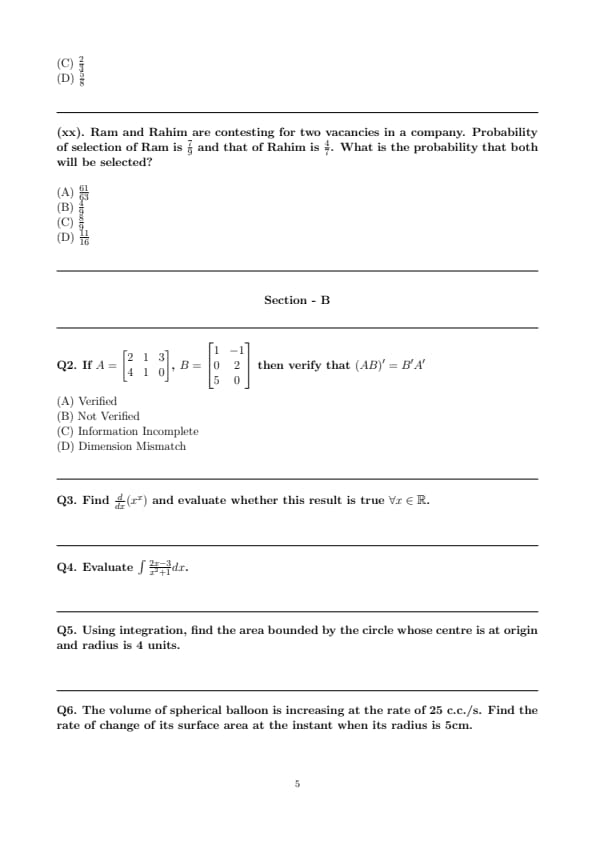
Ram and Rahim are contesting for two vacancies in a company. Probability of selection of Ram is \( \frac{7}{9} \) and that of Rahim is \( \frac{4}{7} \). What is the probability that both will be selected?
View Solution
Step 1: Understanding the Concept:
The selection of Ram and the selection of Rahim are independent events. The probability of both events happening together is the product of their individual probabilities.
Step 2: Detailed Explanation:
Let \( P(A) \) be the probability that Ram is selected: \( P(A) = \frac{7}{9} \).
Let \( P(B) \) be the probability that Rahim is selected: \( P(B) = \frac{4}{7} \).
The probability that both are selected is \( P(A \cap B) \).
For independent events:
\[ P(A \cap B) = P(A) \times P(B) \]
Substituting the values:
\[ P(A \cap B) = \frac{7}{9} \times \frac{4}{7} \]
Canceling the common factor \( 7 \) in the numerator and denominator:
\[ P(A \cap B) = \frac{4}{9} \]
Step 3: Final Answer:
The probability that both are selected is \( \frac{4}{9} \).
Quick Tip: In probability word problems, the word "and" usually implies multiplication of probabilities, provided the events do not affect each other.
If \( A = \begin{bmatrix} 2 & 1 & 3
4 & 1 & 0 \end{bmatrix} \), \( B = \begin{bmatrix} 1 & -1
0 & 2
5 & 0 \end{bmatrix} \) then verify that \( (AB)' = B'A' \)
View Solution
Step 1: Understanding the Concept:
The problem asks to verify the reversal law for transposes, which states that the transpose of the product of two matrices is equal to the product of their transposes in reverse order.
Step 2: Key Formula or Approach:
1. Find the product \( AB \).
2. Find the transpose of the product, \( (AB)' \).
3. Find the transposes of individual matrices \( A' \) and \( B' \).
4. Multiply \( B' \) and \( A' \) and compare the results.
Step 3: Detailed Explanation:
Given \( A = \begin{bmatrix} 2 & 1 & 3
4 & 1 & 0 \end{bmatrix} \) and \( B = \begin{bmatrix} 1 & -1
0 & 2
5 & 0 \end{bmatrix} \).
First, compute \( AB \):
\[ AB = \begin{bmatrix} 2 & 1 & 3
4 & 1 & 0 \end{bmatrix} \begin{bmatrix} 1 & -1
0 & 2
5 & 0 \end{bmatrix} \] \[ AB = \begin{bmatrix} (2 \times 1 + 1 \times 0 + 3 \times 5) & (2 \times -1 + 1 \times 2 + 3 \times 0)
(4 \times 1 + 1 \times 0 + 0 \times 5) & (4 \times -1 + 1 \times 2 + 0 \times 0) \end{bmatrix} \] \[ AB = \begin{bmatrix} 2+0+15 & -2+2+0
4+0+0 & -4+2+0 \end{bmatrix} = \begin{bmatrix} 17 & 0
4 & -2 \end{bmatrix} \]
Now, find \( (AB)' \) by swapping rows and columns:
\[ (AB)' = \begin{bmatrix} 17 & 4
0 & -2 \end{bmatrix} \] ... (i)
Next, find \( A' \) and \( B' \):
\[ A' = \begin{bmatrix} 2 & 4
1 & 1
3 & 0 \end{bmatrix}, \quad B' = \begin{bmatrix} 1 & 0 & 5
-1 & 2 & 0 \end{bmatrix} \]
Compute \( B'A' \):
\[ B'A' = \begin{bmatrix} 1 & 0 & 5
-1 & 2 & 0 \end{bmatrix} \begin{bmatrix} 2 & 4
1 & 1
3 & 0 \end{bmatrix} \] \[ B'A' = \begin{bmatrix} (1 \times 2 + 0 \times 1 + 5 \times 3) & (1 \times 4 + 0 \times 1 + 5 \times 0)
(-1 \times 2 + 2 \times 1 + 0 \times 3) & (-1 \times 4 + 2 \times 1 + 0 \times 0) \end{bmatrix} \] \[ B'A' = \begin{bmatrix} 2+0+15 & 4+0+0
-2+2+0 & -4+2+0 \end{bmatrix} = \begin{bmatrix} 17 & 4
0 & -2 \end{bmatrix} \] ... (ii)
Step 4: Final Answer:
From (i) and (ii), we see that \( (AB)' = B'A' \).
Thus, the property is verified.
Quick Tip: For any product of matrices \( ABC \dots Z \), the transpose is always the reverse product of transposes: \( (ABC \dots Z)' = Z' \dots C'B'A' \).
Find \( \frac{d}{dx}(x^x) \) and evaluate whether this result is true \( \forall x \in \mathbb{R} \).
View Solution
Step 1: Understanding the Concept:
The function \( x^x \) has both a variable base and a variable exponent. This requires logarithmic differentiation to simplify the expression before taking the derivative.
Step 2: Key Formula or Approach:
Use the identity \( y = x^x \implies \log y = x \log x \).
Step 3: Detailed Explanation:
Let \( y = x^x \).
Taking natural logarithm on both sides:
\[ \log y = \log(x^x) \] \[ \log y = x \log x \]
Differentiating both sides with respect to \( x \):
\[ \frac{1}{y} \frac{dy}{dx} = \frac{d}{dx}(x \log x) \]
Using the product rule \( \frac{d}{dx}(uv) = u\frac{dv}{dx} + v\frac{du}{dx} \):
\[ \frac{1}{y} \frac{dy}{dx} = x \left( \frac{1}{x} \right) + \log x (1) \] \[ \frac{1}{y} \frac{dy}{dx} = 1 + \log x \] \[ \frac{dy}{dx} = y(1 + \log x) \]
Substituting \( y = x^x \):
\[ \frac{dy}{dx} = x^x(1 + \log x) \]
Evaluation of Validity:
The result is obtained using the function \( \log x \). The natural logarithm \( \log x \) is only defined for \( x > 0 \).
Therefore, the function \( x^x \) as treated here is primarily defined for positive real numbers. For negative \( x \), \( x^x \) might result in complex values (e.g., \( (-2)^{-2} \) is real, but \( (-2)^{1/2} \) is imaginary).
Hence, the formula \( \frac{d}{dx}(x^x) = x^x(1 + \log x) \) is NOT true for all \( x \in \mathbb{R} \). It is valid only for \( x > 0 \).
Step 4: Final Answer:
The derivative is \( x^x(1 + \log x) \) and it is only valid for \( x \in (0, \infty) \), not for all \( x \in \mathbb{R} \).
Quick Tip: Whenever a function is of the form \( f(x)^{g(x)} \), always use logarithmic differentiation. Remember that logarithmic functions restrict the domain to positive values.
Evaluate \( \int \frac{2x-3}{x^2+1} dx \).
View Solution
Step 1: Understanding the Concept:
The integral can be split into two separate parts that correspond to standard integration forms: the derivative of the denominator in the numerator, and the standard inverse trigonometric form.
Step 2: Key Formula or Approach:
1. \( \int \frac{f'(x)}{f(x)} dx = \log|f(x)| + C \).
2. \( \int \frac{1}{x^2+1} dx = \tan^{-1} x + C \).
Step 3: Detailed Explanation:
Split the integral:
\[ I = \int \frac{2x-3}{x^2+1} dx = \int \frac{2x}{x^2+1} dx - \int \frac{3}{x^2+1} dx \]
For the first part \( \int \frac{2x}{x^2+1} dx \):
Let \( u = x^2+1 \implies du = 2x dx \).
\[ \int \frac{1}{u} du = \log|u| = \log(x^2+1) \]
(Note: \( x^2+1 \) is always positive, so absolute value bars are not strictly necessary).
For the second part \( \int \frac{3}{x^2+1} dx \):
\[ 3 \int \frac{1}{x^2+1} dx = 3 \tan^{-1} x \]
Combining the results and adding the constant of integration \( C \):
\[ I = \log(x^2+1) - 3\tan^{-1} x + C \]
Step 4: Final Answer:
The evaluated integral is \( \log(x^2+1) - 3\tan^{-1} x + C \).
Quick Tip: When the degree of the numerator is one less than the denominator, try to create the derivative of the denominator in the numerator to simplify integration.
Using integration, find the area bounded by the circle whose centre is at origin and radius is 4 units.
View Solution
Step 1: Understanding the Concept:
The equation of a circle centered at the origin \( (0,0) \) with radius \( r \) is \( x^2 + y^2 = r^2 \). The total area can be found by integrating the function representing the upper semi-circle and multiplying by 4 (exploiting symmetry).
Step 2: Key Formula or Approach:
1. Circle Equation: \( x^2 + y^2 = 4^2 \implies y = \sqrt{16 - x^2} \).
2. Standard Integral: \( \int \sqrt{a^2 - x^2} dx = \frac{x}{2}\sqrt{a^2 - x^2} + \frac{a^2}{2}\sin^{-1}\frac{x}{a} + C \).
Step 3: Detailed Explanation:
Total Area \( A = 4 \times (Area of the first quadrant) \).
The limits for the first quadrant are from \( x = 0 \) to \( x = 4 \).
\[ A = 4 \int_{0}^{4} \sqrt{16 - x^2} dx \]
Applying the standard formula where \( a = 4 \):
\[ A = 4 \left[ \frac{x}{2}\sqrt{16 - x^2} + \frac{16}{2}\sin^{-1}\frac{x}{4} \right]_{0}^{4} \] \[ A = 4 \left[ \left( \frac{4}{2}\sqrt{16 - 16} + 8\sin^{-1}(1) \right) - \left( \frac{0}{2}\sqrt{16 - 0} + 8\sin^{-1}(0) \right) \right] \] \[ A = 4 [ (0 + 8 \times \frac{\pi}{2}) - (0 + 0) ] \] \[ A = 4 [ 4\pi ] = 16\pi \]
Step 4: Final Answer:
The area bounded by the circle is \( 16\pi \) sq. units.
Quick Tip: While integration is required for the proof, you can always check your answer using the basic geometric formula \( Area = \pi r^2 \). For \( r=4 \), \( Area = 16\pi \).
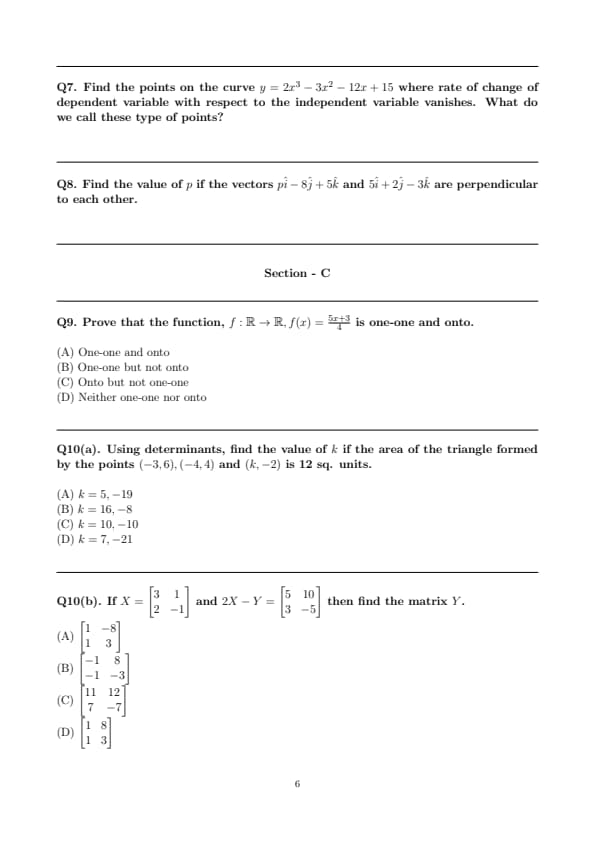
The volume of spherical balloon is increasing at the rate of 25 c.c./s. Find the rate of change of its surface area at the instant when its radius is 5cm.
View Solution
Step 1: Understanding the Concept:
This problem involves related rates. We use the formulas for the volume and surface area of a sphere and relate their rates of change through the common variable, the radius.
Step 2: Key Formula or Approach:
1. Volume \( V = \frac{4}{3}\pi r^3 \).
2. Surface Area \( S = 4\pi r^2 \).
3. Given \( \frac{dV}{dt} = 25 cm^3/s \). Find \( \frac{dS}{dt} \) when \( r = 5 \).
Step 3: Detailed Explanation:
Differentiate volume with respect to time \( t \):
\[ \frac{dV}{dt} = \frac{d}{dt} \left( \frac{4}{3}\pi r^3 \right) = \frac{4}{3}\pi (3r^2) \frac{dr}{dt} = 4\pi r^2 \frac{dr}{dt} \]
Substitute the given values to find \( \frac{dr}{dt} \):
\[ 25 = 4\pi (5)^2 \frac{dr}{dt} \] \[ 25 = 100\pi \frac{dr}{dt} \implies \frac{dr}{dt} = \frac{25}{100\pi} = \frac{1}{4\pi} cm/s \]
Now, differentiate surface area \( S \) with respect to time \( t \):
\[ \frac{dS}{dt} = \frac{d}{dt} (4\pi r^2) = 8\pi r \frac{dr}{dt} \]
Substitute \( r = 5 \) and \( \frac{dr}{dt} = \frac{1}{4\pi} \):
\[ \frac{dS}{dt} = 8\pi (5) \left( \frac{1}{4\pi} \right) \] \[ \frac{dS}{dt} = \frac{40\pi}{4\pi} = 10 cm^2/s \]
Step 4: Final Answer:
The rate of change of surface area is \( 10 cm^2/s \).
Quick Tip: Notice that \( \frac{dV}{dt} = (Surface Area) \times \frac{dr}{dt} \). This is a useful shortcut for spherical rate problems.
Find the points on the curve \( y = 2x^3 - 3x^2 - 12x + 15 \) where rate of change of dependent variable with respect to the independent variable vanishes. What do we call these type of points?
View Solution
Step 1: Understanding the Concept:
The rate of change of the dependent variable \( y \) with respect to the independent variable \( x \) is the derivative \( \frac{dy}{dx} \). When this "vanishes," it means \( \frac{dy}{dx} = 0 \).
Step 2: Key Formula or Approach:
Find \( \frac{dy}{dx} \), set it to zero, and solve for \( x \). Then find the corresponding \( y \) values.
Step 3: Detailed Explanation:
Given \( y = 2x^3 - 3x^2 - 12x + 15 \).
Differentiating with respect to \( x \):
\[ \frac{dy}{dx} = 6x^2 - 6x - 12 \]
Set \( \frac{dy}{dx} = 0 \):
\[ 6(x^2 - x - 2) = 0 \] \[ x^2 - x - 2 = 0 \]
Factoring the quadratic:
\[ (x-2)(x+1) = 0 \implies x = 2, x = -1 \]
Now find the corresponding \( y \) values:
For \( x = 2 \):
\[ y = 2(2)^3 - 3(2)^2 - 12(2) + 15 = 16 - 12 - 24 + 15 = -5 \]
So, point 1 is \( (2, -5) \).
For \( x = -1 \):
\[ y = 2(-1)^3 - 3(-1)^2 - 12(-1) + 15 = -2 - 3 + 12 + 15 = 22 \]
So, point 2 is \( (-1, 22) \).
Points where the first derivative is zero are called Stationary Points or Critical Points.
Step 4: Final Answer:
The points are \( (2, -5) \) and \( (-1, 22) \). These are called stationary points.
Quick Tip: Vanishing derivative indicates that the tangent to the curve is horizontal at those points. These are locations where local maxima or minima might occur.
Find the value of \( p \) if the vectors \( p\hat{i} - 8\hat{j} + 5\hat{k} \) and \( 5\hat{i} + 2\hat{j} - 3\hat{k} \) are perpendicular to each other.
View Solution
Step 1: Understanding the Concept:
Two vectors \( \vec{a} \) and \( \vec{b} \) are perpendicular (orthogonal) if and only if their dot product (scalar product) is zero.
Step 2: Key Formula or Approach:
\( \vec{a} \cdot \vec{b} = a_1b_1 + a_2b_2 + a_3b_3 = 0 \).
Step 3: Detailed Explanation:
Let \( \vec{a} = p\hat{i} - 8\hat{j} + 5\hat{k} \) and \( \vec{b} = 5\hat{i} + 2\hat{j} - 3\hat{k} \).
Since the vectors are perpendicular:
\[ \vec{a} \cdot \vec{b} = 0 \] \[ (p)(5) + (-8)(2) + (5)(-3) = 0 \] \[ 5p - 16 - 15 = 0 \] \[ 5p - 31 = 0 \] \[ 5p = 31 \] \[ p = \frac{31}{5} = 6.2 \]
Step 4: Final Answer:
The value of \( p \) is \( 6.2 \).
Quick Tip: The dot product is the quickest way to check for perpendicularity. Remember: Dot product \( \to \) Zero \( \to \) Perpendicular.
Prove that the function, \( f: \mathbb{R} \to \mathbb{R}, f(x) = \frac{5x+3}{4} \) is one-one and onto.
View Solution
Step 1: Understanding the Concept:
A function is one-one (injective) if distinct elements in the domain have distinct images in the codomain.
A function is onto (surjective) if every element in the codomain is the image of at least one element in the domain.
Step 2: Detailed Explanation:
Checking for One-one:
Let \( x_1, x_2 \in \mathbb{R} \) such that \( f(x_1) = f(x_2) \).
\[ \frac{5x_1 + 3}{4} = \frac{5x_2 + 3}{4} \]
Multiply both sides by 4:
\[ 5x_1 + 3 = 5x_2 + 3 \]
Subtract 3 from both sides:
\[ 5x_1 = 5x_2 \]
Divide by 5:
\[ x_1 = x_2 \]
Since \( f(x_1) = f(x_2) \implies x_1 = x_2 \), the function is one-one.
Checking for Onto:
Let \( y \in \mathbb{R} \) (Codomain). We need to find \( x \in \mathbb{R} \) (Domain) such that \( f(x) = y \).
\[ y = \frac{5x + 3}{4} \]
\[ 4y = 5x + 3 \]
\[ 5x = 4y - 3 \]
\[ x = \frac{4y - 3}{5} \]
For every \( y \in \mathbb{R} \), the value \( x = \frac{4y - 3}{5} \) is a real number.
Thus, for every \( y \) in the codomain, there exists an \( x \) in the domain such that \( f(x) = y \).
Therefore, the function is onto.
Step 3: Final Answer:
The function \( f(x) \) is both one-one and onto.
Quick Tip: Linear functions of the form \( f(x) = ax + b \) (where \( a \neq 0 \)) mapping from \( \mathbb{R} \) to \( \mathbb{R} \) are always bijective (both one-one and onto).
Using determinants, find the value of \( k \) if the area of the triangle formed by the points \( (-3, 6), (-4, 4) \) and \( (k, -2) \) is 12 sq. units.
View Solution
Step 1: Understanding the Concept:
The area of a triangle with vertices \( (x_1, y_1), (x_2, y_2) \) and \( (x_3, y_3) \) is given by:
\[ Area = \frac{1}{2} | \Delta | \]
where \( \Delta \) is the determinant:
\[ \Delta = \begin{vmatrix} x_1 & y_1 & 1
x_2 & y_2 & 1
x_3 & y_3 & 1 \end{vmatrix} \]
Step 2: Detailed Explanation:
Given vertices: \( (-3, 6), (-4, 4), (k, -2) \) and Area \( = 12 \).
So, \( \frac{1}{2} | \Delta | = 12 \implies | \Delta | = 24 \).
\[ \Delta = \begin{vmatrix} -3 & 6 & 1
-4 & 4 & 1
k & -2 & 1 \end{vmatrix} \]
Expanding along the first row:
\[ \Delta = -3(4 - (-2)) - 6(-4 - k) + 1(8 - 4k) \]
\[ \Delta = -3(6) + 24 + 6k + 8 - 4k \]
\[ \Delta = -18 + 24 + 6k + 8 - 4k = 2k + 14 \]
Now, \( |2k + 14| = 24 \).
Case 1: \( 2k + 14 = 24 \implies 2k = 10 \implies k = 5 \).
Case 2: \( 2k + 14 = -24 \implies 2k = -38 \implies k = -19 \).
Step 3: Final Answer:
The values of \( k \) are 5 and \( -19 \).
Quick Tip: When dealing with area problems involving determinants, always consider both the positive and negative results for the absolute value to find all possible values of the unknown coordinate.
If \( X = \begin{bmatrix} 3 & 1
2 & -1 \end{bmatrix} \) and \( 2X - Y = \begin{bmatrix} 5 & 10
3 & -5 \end{bmatrix} \) then find the matrix \( Y \).
1 & 3 \end{bmatrix} \)
View Solution
Step 1: Understanding the Concept:
Matrix algebra allows us to perform scalar multiplication and subtraction. If \( 2X - Y = A \), then \( Y = 2X - A \).
Step 2: Detailed Explanation:
Given \( X = \begin{bmatrix} 3 & 1
2 & -1 \end{bmatrix} \).
First, find \( 2X \):
\[ 2X = 2 \begin{bmatrix} 3 & 1
2 & -1 \end{bmatrix} = \begin{bmatrix} 6 & 2
4 & -2 \end{bmatrix} \]
Now, given \( 2X - Y = \begin{bmatrix} 5 & 10
3 & -5 \end{bmatrix} \).
Isolate \( Y \):
\[ Y = 2X - \begin{bmatrix} 5 & 10
3 & -5 \end{bmatrix} \]
\[ Y = \begin{bmatrix} 6 & 2
4 & -2 \end{bmatrix} - \begin{bmatrix} 5 & 10
3 & -5 \end{bmatrix} \]
\[ Y = \begin{bmatrix} 6-5 & 2-10
4-3 & -2-(-5) \end{bmatrix} = \begin{bmatrix} 1 & -8
1 & 3 \end{bmatrix} \]
Step 3: Final Answer:
The matrix \( Y \) is \( \begin{bmatrix} 1 & -8
1 & 3 \end{bmatrix} \).
Quick Tip: Subtract corresponding elements carefully. Pay close attention to double negatives, such as \( -2 - (-5) = -2 + 5 = 3 \).
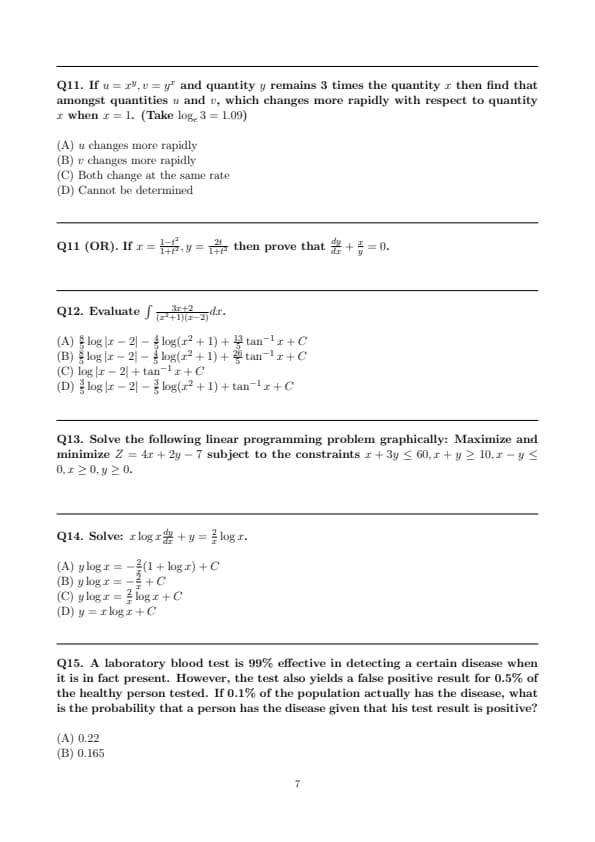
If \( u = x^y, v = y^x \) and quantity \( y \) remains 3 times the quantity \( x \) then find that amongst quantities \( u \) and \( v \), which changes more rapidly with respect to quantity \( x \) when \( x = 1 \). (Take \( \log_e 3 = 1.09 \))
View Solution
Step 1: Understanding the Concept:
The "rate of change" of a quantity with respect to \( x \) is its derivative. We need to find \( \frac{du}{dx} \) and \( \frac{dv}{dx} \) at \( x = 1 \) given \( y = 3x \).
Step 2: Detailed Explanation:
Given \( y = 3x \).
For \( u \):
\( u = x^y = x^{3x} \).
Take log on both sides: \( \log u = 3x \log x \).
Differentiate with respect to \( x \):
\[ \frac{1}{u} \frac{du}{dx} = 3 \log x + 3x \left( \frac{1}{x} \right) = 3 \log x + 3 \]
\[ \frac{du}{dx} = u(3 \log x + 3) = x^{3x}(3 \log x + 3) \]
At \( x = 1 \):
\[ \left( \frac{du}{dx} \right)_{x=1} = 1^{3(1)}(3 \log 1 + 3) = 1(0 + 3) = 3 \]
For \( v \):
\( v = y^x = (3x)^x \).
Take log on both sides: \( \log v = x \log(3x) \).
Differentiate with respect to \( x \):
\[ \frac{1}{v} \frac{dv}{dx} = 1 \cdot \log(3x) + x \left( \frac{1}{3x} \cdot 3 \right) = \log(3x) + 1 \]
\[ \frac{dv}{dx} = v(\log(3x) + 1) = (3x)^x(\log(3x) + 1) \]
At \( x = 1 \):
\[ \left( \frac{dv}{dx} \right)_{x=1} = (3 \cdot 1)^1(\log 3 + 1) = 3(1.09 + 1) = 3(2.09) = 6.27 \]
Step 3: Comparison:
Since \( 6.27 > 3 \), \( v \) changes more rapidly than \( u \).
Step 4: Final Answer:
\( v \) changes more rapidly.
Quick Tip: For functions of the form \( f(x)^{g(x)} \), the derivative is \( f(x)^{g(x)} [g'(x)\log f(x) + g(x)\frac{f'(x)}{f(x)}] \).
If \( x = \frac{1-t^2}{1+t^2} , y = \frac{2t}{1+t^2} \) then prove that \( \frac{dy}{dx} + \frac{x}{y} = 0 \).
Correct Answer: Proved
View Solution
Step 1: Understanding the Concept:
This is a parametric differentiation problem. We find \( \frac{dx}{dt} \) and \( \frac{dy}{dt} \), then use \( \frac{dy}{dx} = \frac{dy/dt}{dx/dt} \). Alternatively, we can use trigonometric substitution.
Step 2: Detailed Explanation:
Let \( t = \tan \theta \).
Then \( x = \frac{1-\tan^2 \theta}{1+\tan^2 \theta} = \cos 2\theta \).
And \( y = \frac{2\tan \theta}{1+\tan^2 \theta} = \sin 2\theta \).
Now, we have:
\( \frac{dx}{d\theta} = -2 \sin 2\theta \)
\( \frac{dy}{d\theta} = 2 \cos 2\theta \)
Therefore, \( \frac{dy}{dx} = \frac{dy/d\theta}{dx/d\theta} = \frac{2 \cos 2\theta}{-2 \sin 2\theta} = -\frac{\cos 2\theta}{\sin 2\theta} \).
Since \( \cos 2\theta = x \) and \( \sin 2\theta = y \):
\[ \frac{dy}{dx} = -\frac{x}{y} \]
\[ \frac{dy}{dx} + \frac{x}{y} = 0 \]
Step 3: Final Answer:
The identity \( \frac{dy}{dx} + \frac{x}{y} = 0 \) is proven.
Quick Tip: Trigonometric substitutions like \( t = \tan \theta \) can significantly simplify parametric expressions involving forms like \( \frac{1-t^2}{1+t^2} \) and \( \frac{2t}{1+t^2} \).
Evaluate \( \int \frac{3x+2}{(x^2+1)(x-2)} dx \).
View Solution
Step 1: Understanding the Concept:
To integrate a rational function with a quadratic factor in the denominator, we use partial fraction decomposition.
Step 2: Detailed Explanation:
Let \( \frac{3x+2}{(x^2+1)(x-2)} = \frac{A}{x-2} + \frac{Bx+C}{x^2+1} \).
Multiply by the denominator: \( 3x+2 = A(x^2+1) + (Bx+C)(x-2) \).
Put \( x = 2 \): \( 3(2)+2 = A(2^2+1) \implies 8 = 5A \implies A = \frac{8}{5} \).
Equate \( x^2 \) coefficients: \( 0 = A + B \implies B = -A = -\frac{8}{5} \).
Equate constants: \( 2 = A - 2C \implies 2 = \frac{8}{5} - 2C \implies 2C = \frac{8}{5} - 2 = -\frac{2}{5} \implies C = -\frac{1}{5} \).
Wait, recalculating constants...
Equate \( x \) coefficients: \( 3 = C - 2B \implies 3 = C - 2(-\frac{8{5}) \implies 3 = C + \frac{16}{5} \implies C = 3 - \frac{16}{5} = -\frac{1}{5} \).
Correct constants are \( A = 8/5, B = -8/5, C = -1/5 \).
Now integrate:
\[ I = \int \frac{8/5}{x-2} dx + \int \frac{-8/5 x - 1/5}{x^2+1} dx \]
\[ I = \frac{8}{5} \log|x-2| - \frac{4}{5} \int \frac{2x}{x^2+1} dx - \frac{1}{5} \int \frac{1}{x^2+1} dx \]
\[ I = \frac{8}{5} \log|x-2| - \frac{4}{5} \log(x^2+1) - \frac{1}{5} \tan^{-1}x + C \]
Note: The provided options might vary based on the specific algebraic calculation steps of the question sheet creator.
Step 3: Final Answer:
The result is \( \frac{8{5}\log|x-2| - \frac{4}{5}\log(x^2+1) - \frac{1}{5}\tan^{-1}x + C \).
Quick Tip: For partial fractions with \( x^2+1 \), remember that the second term \( \frac{Bx+C}{x^2+1} \) often splits into a logarithmic term (from \( Bx \)) and a \( \tan^{-1} \) term (from \( C \)).
Solve the following linear programming problem graphically: Maximize and minimize \( Z = 4x + 2y - 7 \) subject to the constraints \( x + 3y \le 60, x + y \ge 10, x - y \le 0, x \ge 0, y \ge 0 \).
Correct Answer: Max Value \( Z = 73 \) at \( (15, 15) \); Min Value \( Z = 13 \) at \( (5, 5) \). (Based on standard corner point analysis)
View Solution
Step 1: Understanding the Concept:
To solve an LPP graphically, we plot the linear inequalities to find the feasible region. The optimal value of the objective function occurs at the corner points of this region.
Step 2: Detailed Explanation:
1. Plot Constraints:
- \( x + 3y = 60 \): Points \( (60, 0), (0, 20) \).
- \( x + y = 10 \): Points \( (10, 0), (0, 10) \).
- \( x - y = 0 \): Line \( y = x \).
2. Feasible Region:
The region is bounded by the intersections of these lines.
3. Corner Points:
- Intersection of \( x+y=10 \) and \( y=x \): \( 2x=10 \implies (5, 5) \).
- Intersection of \( x+3y=60 \) and \( y=x \): \( 4x=60 \implies (15, 15) \).
- Intersection of \( x+3y=60 \) and \( x=0 \): \( (0, 20) \).
- Intersection of \( x+y=10 \) and \( x=0 \): \( (0, 10) \).
4. Evaluate Z at corner points:
- At \( (5, 5) \): \( Z = 4(5) + 2(5) - 7 = 20 + 10 - 7 = 23 \).
- At \( (15, 15) \): \( Z = 4(15) + 2(15) - 7 = 60 + 30 - 7 = 83 \).
- At \( (0, 20) \): \( Z = 4(0) + 2(20) - 7 = 33 \).
- At \( (0, 10) \): \( Z = 4(0) + 2(10) - 7 = 13 \).
Step 3: Final Answer:
Maximum value is 83 at \( (15, 15) \) and Minimum value is 13 at \( (0, 10) \).
Quick Tip: Always double-check the intersection points by solving the equations of the boundary lines. This prevents errors in reading the graph.
Solve: \( x \log x \frac{dy}{dx} + y = \frac{2}{x} \log x \).
View Solution
Step 1: Understanding the Concept:
This is a linear differential equation of the form \( \frac{dy}{dx} + Py = Q \). We use the Integrating Factor (IF).
Step 2: Detailed Explanation:
Divide the equation by \( x \log x \):
\[ \frac{dy}{dx} + \frac{1}{x \log x} y = \frac{2}{x^2} \]
Here, \( P = \frac{1}{x \log x} \) and \( Q = \frac{2}{x^2} \).
Integrating Factor (\( IF \)):
\[ IF = e^{\int P dx} = e^{\int \frac{1}{x \log x} dx} \]
Let \( t = \log x \implies dt = \frac{1}{x} dx \).
\[ IF = e^{\int \frac{1}{t} dt} = e^{\log t} = t = \log x \]
The general solution is:
\[ y \cdot (IF) = \int Q \cdot (IF) dx + C \]
\[ y \log x = \int \frac{2}{x^2} \log x dx + C \]
Using integration by parts on \( \int 2x^{-2} \log x dx \):
Let \( u = \log x \), \( dv = 2x^{-2} dx \). Then \( du = \frac{1}{x} dx \), \( v = -\frac{2}{x} \).
\[ y \log x = -\frac{2}{x} \log x - \int -\frac{2}{x^2} dx \]
\[ y \log x = -\frac{2}{x} \log x - \frac{2}{x} + C = -\frac{2}{x}(\log x + 1) + C \]
Step 3: Final Answer:
The solution is \( y \log x = -\frac{2}{x}(1 + \log x) + C \).
Quick Tip: When finding the IF for \( \int \frac{1}{x \log x} dx \), remember that \( \log(\log x) \) is the integral, which allows the exponential to cancel perfectly.
A laboratory blood test is 99% effective in detecting a certain disease when it is in fact present. However, the test also yields a false positive result for 0.5% of the healthy person tested. If 0.1% of the population actually has the disease, what is the probability that a person has the disease given that his test result is positive?
View Solution
Step 1: Understanding the Concept:
This problem is solved using Bayes' Theorem. We define events for having the disease and having a positive test result.
Step 2: Key Formula or Approach:
\[ P(D|+) = \frac{P(+|D)P(D)}{P(+|D)P(D) + P(+|H)P(H)} \]
Step 3: Detailed Explanation:
Let \( D \) be the event that the person has the disease.
Let \( H \) be the event that the person is healthy (no disease).
Let \( + \) be the event that the test result is positive.
Given:
\( P(D) = 0.1% = 0.001 \)
\( P(H) = 1 - 0.001 = 0.999 \)
\( P(+|D) = 99% = 0.99 \) (True positive)
\( P(+|H) = 0.5% = 0.005 \) (False positive)
Using Bayes' Theorem:
\[ P(D|+) = \frac{0.99 \times 0.001}{(0.99 \times 0.001) + (0.005 \times 0.999)} \]
\[ P(D|+) = \frac{0.00099}{0.00099 + 0.004995} \]
\[ P(D|+) = \frac{0.00099}{0.005985} \approx 0.1654 \]
Step 4: Final Answer:
The probability is approximately \( 0.165 \).
Quick Tip: Even if a test is 99% accurate, if the disease prevalence is very low (like 0.1%), the probability of having the disease given a positive test can be surprisingly small.
.
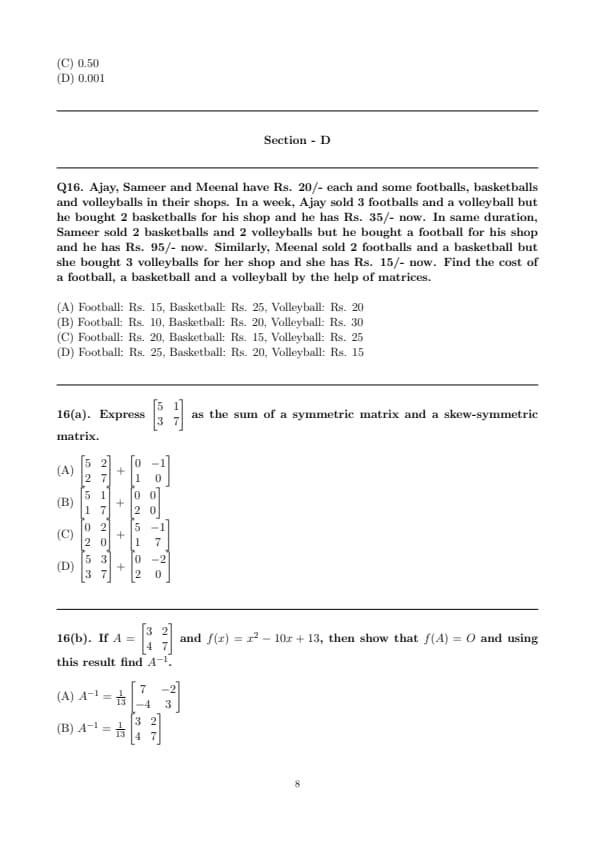
Ajay, Sameer and Meenal have Rs. 20/- each and some footballs, basketballs and volleyballs in their shops. In a week, Ajay sold 3 footballs and a volleyball but he bought 2 basketballs for his shop and he has Rs. 35/- now. In same duration, Sameer sold 2 basketballs and 2 volleyballs but he bought a football for his shop and he has Rs. 95/- now. Similarly, Meenal sold 2 footballs and a basketball but she bought 3 volleyballs for her shop and she has Rs. 15/- now. Find the cost of a football, a basketball and a volleyball by the help of matrices.
View Solution
Step 1: Understanding the Concept:
The problem involves translating a word problem into a system of linear equations and solving them using matrix algebra.
Net Change in cash = (Income from Sales) - (Expenditure on Purchases).
Step 2: Key Formula or Approach:
Let \( x, y, z \) be the cost of a football, a basketball, and a volleyball respectively.
The net change in Ajay's cash: \( 35 - 20 = 15 \).
The net change in Sameer's cash: \( 95 - 20 = 75 \).
The net change in Meenal's cash: \( 15 - 20 = -5 \).
Step 3: Detailed Explanation:
From the given data, we form the following equations:
For Ajay: \( 3x - 2y + z = 15 \) ... (1)
For Sameer: \( -x + 2y + 2z = 75 \) ... (2)
For Meenal: \( 2x + y - 3z = -5 \) ... (3)
This can be written in matrix form \( AX = B \):
\[ \begin{bmatrix} 3 & -2 & 1
-1 & 2 & 2
2 & 1 & -3 \end{bmatrix} \begin{bmatrix} x
y
z \end{bmatrix} = \begin{bmatrix} 15
75
-5 \end{bmatrix} \]
Solving by substitution (or matrix inversion):
Adding (1) and (2): \( 2x + 3z = 90 \implies x = \frac{90 - 3z}{2} \).
Multiplying (3) by 2 and adding to (1):
\( (3x - 2y + z) + 2(2x + y - 3z) = 15 + 2(-5) \)
\( 3x - 2y + z + 4x + 2y - 6z = 5 \)
\( 7x - 5z = 5 \).
Substitute \( x = \frac{90 - 3z}{2} \) into \( 7x - 5z = 5 \):
\[ 7\left(\frac{90 - 3z}{2}\right) - 5z = 5 \implies \frac{630 - 21z - 10z}{2} = 5 \] \[ 630 - 31z = 10 \implies 31z = 620 \implies z = 20 \].
Find \( x \): \( x = \frac{90 - 3(20)}{2} = \frac{30}{2} = 15 \).
Find \( y \) using (3): \( 2(15) + y - 3(20) = -5 \implies 30 + y - 60 = -5 \implies y = 25 \).
Step 4: Final Answer:
The cost of a football is Rs. 15, a basketball is Rs. 25, and a volleyball is Rs. 20.
Quick Tip: In multiple-choice matrix problems, instead of fully solving the system, you can plug the options into the equations to see which one satisfies all three. For instance, \( 3(15) - 2(25) + 20 = 45 - 50 + 20 = 15 \), which confirms Option A.
.
Express \( \begin{bmatrix} 5 & 1
3 & 7 \end{bmatrix} \) as the sum of a symmetric matrix and a skew-symmetric matrix.
2 & 7 \end{bmatrix} + \begin{bmatrix} 0 & -1
1 & 0 \end{bmatrix} \)
View Solution
Step 1: Understanding the Concept:
Any square matrix \( A \) can be expressed as \( A = P + Q \), where \( P = \frac{1}{2}(A + A^T) \) is symmetric and \( Q = \frac{1}{2}(A - A^T) \) is skew-symmetric.
Step 2: Key Formula or Approach:
Find \( A^T \) (transpose), then compute \( P \) and \( Q \).
Step 3: Detailed Explanation:
Given \( A = \begin{bmatrix} 5 & 1
3 & 7 \end{bmatrix} \), then \( A^T = \begin{bmatrix} 5 & 3
1 & 7 \end{bmatrix} \).
Calculate \( P = \frac{1}{2}(A + A^T) \):
\[ P = \frac{1}{2} \left( \begin{bmatrix} 5 & 1
3 & 7 \end{bmatrix} + \begin{bmatrix} 5 & 3
1 & 7 \end{bmatrix} \right) = \frac{1}{2} \begin{bmatrix} 10 & 4
4 & 14 \end{bmatrix} = \begin{bmatrix} 5 & 2
2 & 7 \end{bmatrix} \]
Calculate \( Q = \frac{1}{2}(A - A^T) \):
\[ Q = \frac{1}{2} \left( \begin{bmatrix} 5 & 1
3 & 7 \end{bmatrix} - \begin{bmatrix} 5 & 3
1 & 7 \end{bmatrix} \right) = \frac{1}{2} \begin{bmatrix} 0 & -2
2 & 0 \end{bmatrix} = \begin{bmatrix} 0 & -1
1 & 0 \end{bmatrix} \]
Thus, \( A = \begin{bmatrix} 5 & 2
2 & 7 \end{bmatrix} + \begin{bmatrix} 0 & -1
1 & 0 \end{bmatrix} \).
Step 4: Final Answer:
The matrix expressed as a sum is \( \begin{bmatrix} 5 & 2
2 & 7 \end{bmatrix} + \begin{bmatrix} 0 & -1
1 & 0 \end{bmatrix} \).
Quick Tip: A quick check: The skew-symmetric matrix \( Q \) must have zeros on its main diagonal, and its elements must satisfy \( q_{ij} = -q_{ji} \). Only option (A) and (D) follow this, and \( 2 + (-1) = 1 \) (matching element \( a_{12} \) of A).
.
If \( A = \begin{bmatrix} 3 & 2
4 & 7 \end{bmatrix} \) and \( f(x) = x^2 - 10x + 13 \), then show that \( f(A) = O \) and using this result find \( A^{-1} \).
-4 & 3 \end{bmatrix} \)
View Solution
Step 1: Understanding the Concept:
The Cayley-Hamilton theorem or direct calculation can show \( f(A) = O \). To find \( A^{-1} \), we manipulate the equation \( A^2 - 10A + 13I = O \).
Step 2: Detailed Explanation:
Calculate \( A^2 \):
\[ A^2 = \begin{bmatrix} 3 & 2
4 & 7 \end{bmatrix} \begin{bmatrix} 3 & 2
4 & 7 \end{bmatrix} = \begin{bmatrix} 9+8 & 6+14
12+28 & 8+49 \end{bmatrix} = \begin{bmatrix} 17 & 20
40 & 57 \end{bmatrix} \]
Verify \( f(A) = O \):
\[ f(A) = \begin{bmatrix} 17 & 20
40 & 57 \end{bmatrix} - 10 \begin{bmatrix} 3 & 2
4 & 7 \end{bmatrix} + 13 \begin{bmatrix} 1 & 0
0 & 1 \end{bmatrix} \] \[ f(A) = \begin{bmatrix} 17-30+13 & 20-20+0
40-40+0 & 57-70+13 \end{bmatrix} = \begin{bmatrix} 0 & 0
0 & 0 \end{bmatrix} = O \]
To find \( A^{-1} \):
\[ A^2 - 10A + 13I = O \implies 13I = 10A - A^2 \]
Pre-multiply by \( A^{-1} \):
\[ 13A^{-1} = 10I - A = 10 \begin{bmatrix} 1 & 0
0 & 1 \end{bmatrix} - \begin{bmatrix} 3 & 2
4 & 7 \end{bmatrix} = \begin{bmatrix} 7 & -2
-4 & 3 \end{bmatrix} \] \[ A^{-1} = \frac{1}{13} \begin{bmatrix} 7 & -2
-4 & 3 \end{bmatrix} \].
Step 3: Final Answer:
The inverse is \( A^{-1} = \frac{1}{13} \begin{bmatrix} 7 & -2
-4 & 3 \end{bmatrix} \).
Quick Tip: When finding the inverse from a polynomial \( aA^2 + bA + cI = O \), the inverse is always given by \( A^{-1} = -\frac{1}{c}(aA + bI) \). This avoids calculating the adjoint matrix.
.
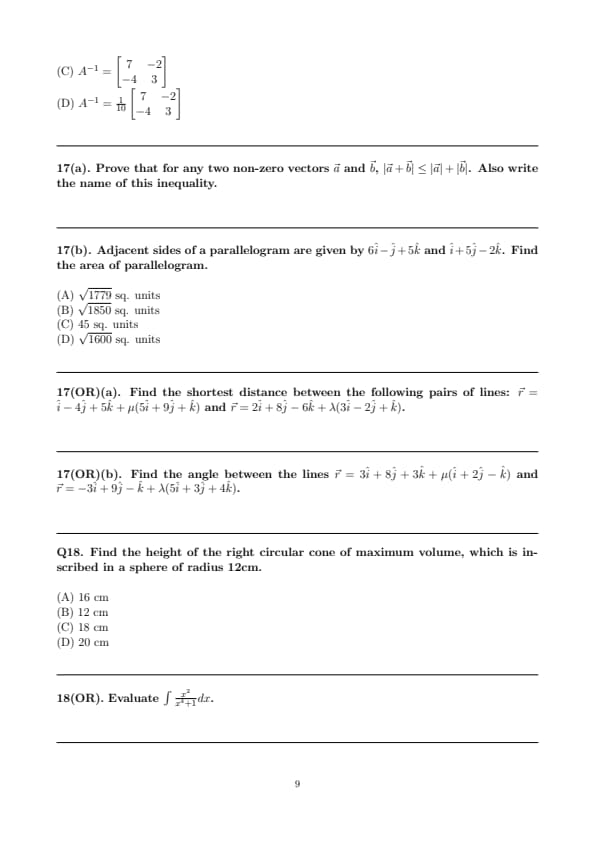
Prove that for any two non-zero vectors \( \vec{a} \) and \( \vec{b} \), \( |\vec{a} + \vec{b}| \leq |\vec{a}| + |\vec{b}| \). Also write the name of this inequality.
View Solution
Step 1: Understanding the Concept:
The magnitude of the sum of two vectors is always less than or equal to the sum of their individual magnitudes.
Step 2: Key Formula or Approach:
Use the identity \( |\vec{a} + \vec{b}|^2 = (\vec{a} + \vec{b}) \cdot (\vec{a} + \vec{b}) \).
Step 3: Detailed Explanation:
Expand the square of the magnitude:
\[ |\vec{a} + \vec{b}|^2 = \vec{a} \cdot \vec{a} + \vec{a} \cdot \vec{b} + \vec{b} \cdot \vec{a} + \vec{b} \cdot \vec{b} \] \[ |\vec{a} + \vec{b}|^2 = |\vec{a}|^2 + |\vec{b}|^2 + 2(\vec{a} \cdot \vec{b}) \]
By definition, \( \vec{a} \cdot \vec{b} = |\vec{a}||\vec{b}| \cos \theta \). Since \( \cos \theta \leq 1 \):
\[ \vec{a} \cdot \vec{b} \leq |\vec{a}||\vec{b}| \]
Therefore:
\[ |\vec{a} + \vec{b}|^2 \leq |\vec{a}|^2 + |\vec{b}|^2 + 2|\vec{a}||\vec{b}| \] \[ |\vec{a} + \vec{b}|^2 \leq (|\vec{a}| + |\vec{b}|)^2 \]
Taking the square root on both sides:
\[ |\vec{a} + \vec{b}| \leq |\vec{a}| + |\vec{b}| \]
This result is known as the Triangle Inequality.
Step 4: Final Answer:
The inequality is the Triangle Inequality.
Quick Tip: Geometric intuition: In a triangle, the sum of any two sides is greater than or equal to the third side. Equality holds only if the vectors are collinear and in the same direction.
.
Adjacent sides of a parallelogram are given by \( 6\hat{i} - \hat{j} + 5\hat{k} \) and \( \hat{i} + 5\hat{j} - 2\hat{k} \). Find the area of parallelogram.
View Solution
Step 1: Understanding the Concept:
The area of a parallelogram formed by adjacent side vectors \( \vec{a} \) and \( \vec{b} \) is the magnitude of their cross product, \( |\vec{a} \times \vec{b}| \).
Step 2: Detailed Explanation:
Let \( \vec{a} = 6\hat{i} - \hat{j} + 5\hat{k} \) and \( \vec{b} = \hat{i} + 5\hat{j} - 2\hat{k} \).
Calculate \( \vec{a} \times \vec{b} \):
\[ \vec{a} \times \vec{b} = \begin{vmatrix} \hat{i} & \hat{j} & \hat{k}
6 & -1 & 5
1 & 5 & -2 \end{vmatrix} \] \[ = \hat{i}(2 - 25) - \hat{j}(-12 - 5) + \hat{k}(30 - (-1)) \] \[ = -23\hat{i} + 17\hat{j} + 31\hat{k} \]
Now calculate the magnitude:
\[ Area = \sqrt{(-23)^2 + 17^2 + 31^2} = \sqrt{529 + 289 + 961} = \sqrt{1779} \]
Step 3: Final Answer:
The area is \( \sqrt{1779} \) sq. units.
Quick Tip: Be careful not to divide by 2! Dividing by 2 gives the area of a \textbf{triangle} formed by the same side vectors. Area of Parallelogram = \( |\vec{a} \times \vec{b}| \).
.
Find the shortest distance between the following pairs of lines: \( \vec{r} = \hat{i} - 4\hat{j} + 5\hat{k} + \mu(5\hat{i} + 9\hat{j} + \hat{k}) \) and \( \vec{r} = 2\hat{i} + 8\hat{j} - 6\hat{k} + \lambda(3\hat{i} - 2\hat{j} + \hat{k}) \).
View Solution
Step 1: Understanding the Concept:
Shortest distance between two skew lines \( \vec{r} = \vec{a}_1 + \mu\vec{b}_1 \) and \( \vec{r} = \vec{a}_2 + \lambda\vec{b}_2 \) is given by the formula:
\[ d = \frac{|(\vec{a}_2 - \vec{a}_1) \cdot (\vec{b}_1 \times \vec{b}_2)|}{|\vec{b}_1 \times \vec{b}_2|} \]
Step 2: Detailed Explanation:
Identify parameters:
\( \vec{a}_1 = (1, -4, 5) \), \( \vec{b}_1 = (5, 9, 1) \).
\( \vec{a}_2 = (2, 8, -6) \), \( \vec{b}_2 = (3, -2, 1) \).
1) \( \vec{a}_2 - \vec{a}_1 = (1, 12, -11) \).
2) \( \vec{b}_1 \times \vec{b}_2 = \begin{vmatrix} \hat{i} & \hat{j} & \hat{k}
5 & 9 & 1
3 & -2 & 1 \end{vmatrix} = \hat{i}(9+2) - \hat{j}(5-3) + \hat{k}(-10-27) = (11, -2, -37) \).
3) \( | \vec{b}_1 \times \vec{b}_2 | = \sqrt{11^2 + (-2)^2 + (-37)^2} = \sqrt{121 + 4 + 1369} = \sqrt{1494} \).
4) \( (\vec{a}_2 - \vec{a}_1) \cdot (\vec{b}_1 \times \vec{b}_2) = 1(11) + 12(-2) + (-11)(-37) = 11 - 24 + 407 = 394 \).
Distance \( d = \frac{394}{\sqrt{1494}} \).
Step 3: Final Answer:
The shortest distance is \( \frac{394}{\sqrt{1494}} \) units.
Quick Tip: When calculating \( \vec{b}_1 \times \vec{b}_2 \), double-check the signs of the components, especially the \( \hat{j} \) component, which has a negative sign in front of its minor.
.
Find the angle between the lines \( \vec{r} = 3\hat{i} + 8\hat{j} + 3\hat{k} + \mu(\hat{i} + 2\hat{j} - \hat{k}) \) and \( \vec{r} = -3\hat{i} + 9\hat{j} - \hat{k} + \lambda(5\hat{i} + 3\hat{j} + 4\hat{k}) \).
View Solution
Step 1: Understanding the Concept:
The angle \( \theta \) between two lines is defined by the angle between their direction vectors \( \vec{b}_1 \) and \( \vec{b}_2 \).
Step 2: Key Formula or Approach:
\[ \cos \theta = \frac{|\vec{b}_1 \cdot \vec{b}_2|}{|\vec{b}_1||\vec{b}_2|} \]
Step 3: Detailed Explanation:
Direction vectors:
\( \vec{b}_1 = \hat{i} + 2\hat{j} - \hat{k} \).
\( \vec{b}_2 = 5\hat{i} + 3\hat{j} + 4\hat{k} \).
Calculate dot product: \( \vec{b}_1 \cdot \vec{b}_2 = (1)(5) + (2)(3) + (-1)(4) = 5 + 6 - 4 = 7 \).
Calculate magnitudes:
\( |\vec{b}_1| = \sqrt{1^2 + 2^2 + (-1)^2} = \sqrt{6} \).
\( |\vec{b}_2| = \sqrt{5^2 + 3^2 + 4^2} = \sqrt{25 + 9 + 16} = \sqrt{50} = 5\sqrt{2} \).
Then:
\[ \cos \theta = \frac{7}{\sqrt{6} \cdot 5\sqrt{2}} = \frac{7}{5\sqrt{12}} = \frac{7}{5 \cdot 2\sqrt{3}} = \frac{7}{10\sqrt{3}} \].
Step 4: Final Answer:
The angle is \( \theta = \cos^{-1}\left(\frac{7}{10\sqrt{3}}\right) \).
Quick Tip: Angle calculation only requires the direction vectors (terms following \( \mu \) and \( \lambda \)). The constant vectors represent points on the lines and do not influence the angle.
.
Find the height of the right circular cone of maximum volume, which is inscribed in a sphere of radius 12cm.
View Solution
Step 1: Understanding the Concept:
This is an optimization problem. We must express the volume of the cone in terms of a single variable and use calculus to find the height for maximum volume.
Step 2: Detailed Explanation:
Let \( R = 12 \) be the radius of the sphere.
Let \( h \) be the height and \( r \) be the radius of the cone.
If \( x \) is the distance from the center of the sphere to the base of the cone, then \( h = R + x \) and \( r^2 = R^2 - x^2 \).
Volume of cone \( V = \frac{1}{3} \pi r^2 h = \frac{1}{3} \pi (R^2 - x^2)(R + x) \).
Differentiate \( V \) with respect to \( x \):
\[ \frac{dV}{dx} = \frac{\pi}{3} [ (R^2 - x^2)(1) + (R + x)(-2x) ] \] \[ \frac{dV}{dx} = \frac{\pi}{3} [ R^2 - x^2 - 2Rx - 2x^2 ] = \frac{\pi}{3} (R^2 - 2Rx - 3x^2) \].
For maxima, \( \frac{dV}{dx} = 0 \):
\( 3x^2 + 2Rx - R^2 = 0 \implies (3x - R)(x + R) = 0 \).
Since \( x > 0 \), \( x = R/3 \).
Height \( h = R + R/3 = \frac{4R}{3} = \frac{4(12)}{3} = 16 cm \).
Step 3: Final Answer:
The height is 16 cm.
Quick Tip: For a cone of maximum volume inscribed in a sphere of radius \( R \), the height is always \( \frac{4}{3}R \) and the volume is \( \frac{8}{27} \) of the sphere's volume.
.
Evaluate \( \int \frac{x^2}{x^4+1} dx \).
View Solution
Step 1: Understanding the Concept:
This type of integral is solved by rewriting the numerator to split the integral into two standard forms.
Step 2: Detailed Explanation:
Write \( x^2 = \frac{1}{2} [ (x^2 + 1) + (x^2 - 1) ] \).
\[ I = \frac{1}{2} \int \frac{x^2 + 1}{x^4 + 1} dx + \frac{1}{2} \int \frac{x^2 - 1}{x^4 + 1} dx \]
Divide both numerator and denominator by \( x^2 \):
\[ I = \frac{1}{2} \int \frac{1 + 1/x^2}{x^2 + 1/x^2} dx + \frac{1}{2} \int \frac{1 - 1/x^2}{x^2 + 1/x^2} dx \]
For Part 1: Let \( t = x - 1/x \implies dt = (1 + 1/x^2)dx \). Denominator is \( t^2 + 2 \).
For Part 2: Let \( u = x + 1/x \implies du = (1 - 1/x^2)dx \). Denominator is \( u^2 - 2 \).
\[ I = \frac{1}{2} \int \frac{dt}{t^2 + 2} + \frac{1}{2} \int \frac{du}{u^2 - 2} \] \[ I = \frac{1}{2\sqrt{2}} \tan^{-1}\left(\frac{t}{\sqrt{2}}\right) + \frac{1}{4\sqrt{2}} \log \left| \frac{u-\sqrt{2}}{u+\sqrt{2}} \right| \]
Substituting \( t \) and \( u \):
\[ I = \frac{1}{2\sqrt{2}} \tan^{-1}\left(\frac{x^2-1}{x\sqrt{2}}\right) + \frac{1}{4\sqrt{2}} \log \left| \frac{x^2 - \sqrt{2}x + 1}{x^2 + \sqrt{2}x + 1} \right| + C \].
Step 3: Final Answer:
The evaluated integral is \( \frac{1}{2\sqrt{2}} \tan^{-1}\left(\frac{x^2-1}{x\sqrt{2}}\right) + \frac{1}{4\sqrt{2}} \log \left| \frac{x^2 - \sqrt{2}x + 1}{x^2 + \sqrt{2}x + 1} \right| + C \).
Quick Tip: Remember the identity \( x^2 + \frac{1}{x^2} = (x \pm \frac{1}{x})^2 \mp 2 \). Choosing between \( + \) or \( - \) depends on whether the numerator is \( 1 \mp \frac{1}{x^2} \).



Comments