




The PSEB Class 12 Physics Sample Paper exam will be conducted with the question paper and solutions made available after the exam. The exam will assess students' understanding through a combination of multiple-choice, objective, short, and long answer questions within a 3-hour duration. The paper will total 100 marks, with 80 marks allotted for the theory component and 20 marks for internal assessment. There will be no negative marking for incorrect answers.
PSEB Class 12 Physics Sample Paper 2026 Question Paper with Solutions PDF
| PSEB Class 12 Physics Sample Paper 2026 Question Paper with Solutions PDF | Download PDF | Check Solutions |
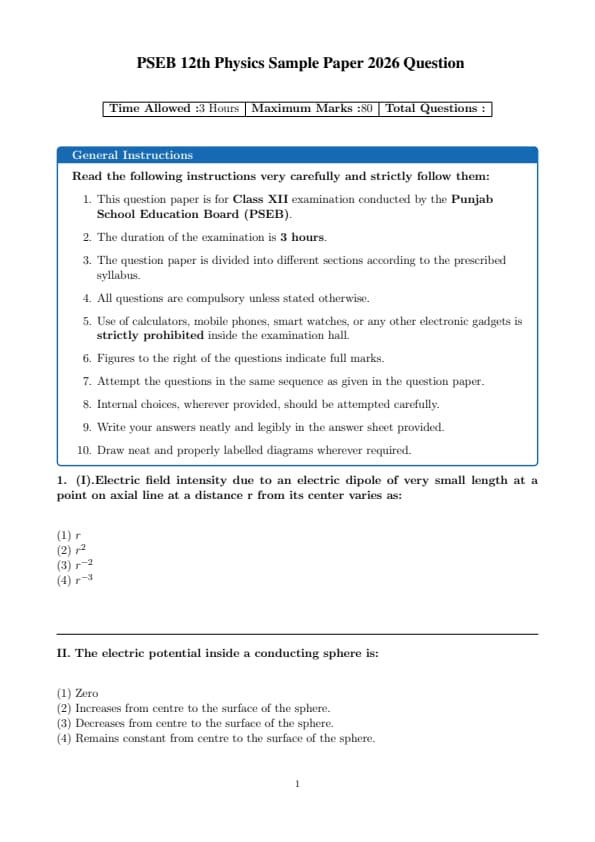
(I).Electric field intensity due to an electric dipole of very small length at a point on axial line at a distance r from its center varies as:
View Solution
Step 1: Understanding the concept.
For an electric dipole, the electric field at a point on the axial line at a distance \( r \) from the center of the dipole varies with the inverse cube of the distance (\( r^{-3} \)). The field intensity \( E \) due to an electric dipole is given by: \[ E = \dfrac{1}{4 \pi \varepsilon_0} \dfrac{2p}{r^3} \]
where \( p \) is the dipole moment and \( r \) is the distance from the center of the dipole along the axial line. This shows that the electric field intensity decreases as \( r^{-3} \).
Step 2: Analyzing the options.
(1) \( r \): This is incorrect. The electric field intensity does not vary linearly with distance for a dipole.
(2) \( r^2 \): This is incorrect. This would be true for a point charge, not a dipole.
(3) \( r^{-2} \): This is incorrect. This would apply to the electric field of a monopole or point charge, but not a dipole.
(4) \( r^{-3} \): Correct. The electric field intensity due to a dipole falls off as \( r^{-3} \) along the axial line.
Step 3: Conclusion.
The correct answer is (4) \( r^{-3} \), as the electric field due to a dipole decreases with the cube of the distance on the axial line. Quick Tip: For an electric dipole, the field intensity on the axial line falls off as \( r^{-3} \), while for a point charge, it falls off as \( r^{-2} \).
The electric potential inside a conducting sphere is:
View Solution
Step 1: Understanding the concept.
In a conducting sphere, the electric potential remains constant throughout the entire volume. The free charges in a conductor arrange themselves such that the electric field inside the conductor is zero, and as a result, the potential is uniform across the conducting material.
Step 2: Analyzing the options.
(1) Zero: This is incorrect. The electric field inside a conducting sphere is zero, but the potential is not zero; it is constant.
(2) Increases from centre to the surface of the sphere: This is incorrect. In a conductor, the electric potential does not increase or decrease within the material.
(3) Decreases from centre to the surface of the sphere: This is incorrect. The potential does not decrease in a conductor; it remains constant.
(4) Remains constant from centre to the surface of the sphere: Correct. The potential inside a conductor is uniform, and there is no change in the potential from the center to the surface of the sphere.
Step 3: Conclusion.
The correct answer is (4) Remains constant from centre to the surface of the sphere, as the electric potential inside a conducting sphere is constant.
Quick Tip: In conductors, the electric field inside the material is zero, leading to a constant electric potential throughout the conductor.
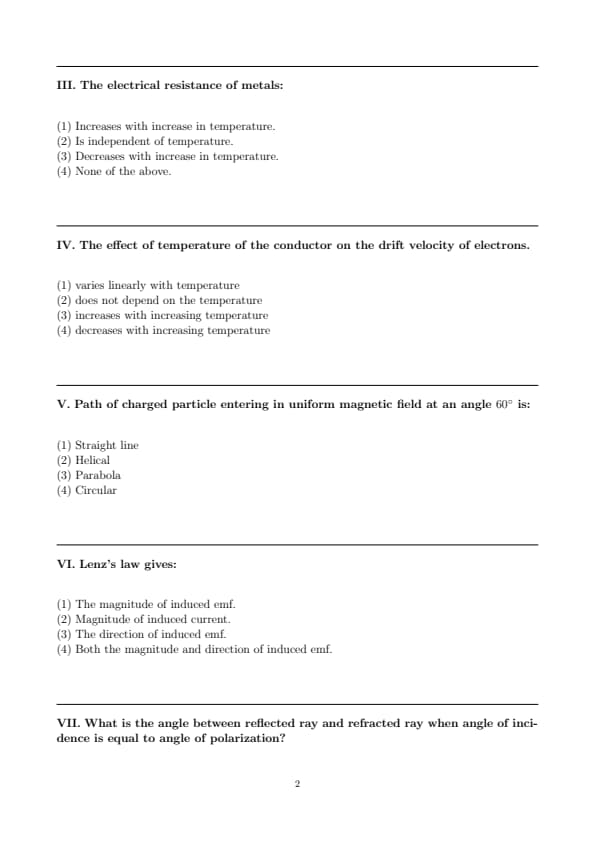
The electrical resistance of metals:
View Solution
Step 1: Understanding the concept.
The electrical resistance of most metals increases as the temperature increases. This is because, at higher temperatures, the metal atoms vibrate more, causing increased collisions between free electrons and the atoms, which in turn increases the resistance.
Step 2: Analyzing the options.
(1) Increases with increase in temperature: Correct. As the temperature increases, the atoms in the metal vibrate more, increasing resistance.
(2) Is independent of temperature: This is incorrect. The resistance of metals is temperature dependent.
(3) Decreases with increase in temperature: This is incorrect. Resistance generally increases with temperature in metals.
(4) None of the above: This is incorrect, as option (1) is correct.
Step 3: Conclusion.
The correct answer is (1) Increases with increase in temperature, as the electrical resistance of metals increases with temperature.
Quick Tip: In most metals, the resistance increases with temperature. This is because of the increased atomic vibrations at higher temperatures.
The effect of temperature of the conductor on the drift velocity of electrons.
View Solution
Step 1: Understanding the concept.
The drift velocity of electrons in a conductor is affected by temperature. As the temperature increases, the resistivity of the conductor generally increases due to more frequent collisions between electrons and atoms. These collisions reduce the drift velocity of the electrons.
Step 2: Analyzing the options.
(1) varies linearly with temperature: This is incorrect. The drift velocity does not vary linearly with temperature.
(2) does not depend on the temperature: This is incorrect. The drift velocity is indeed affected by the temperature of the conductor.
(3) increases with increasing temperature: This is incorrect. An increase in temperature causes more atomic vibrations, which increases resistance and decreases the drift velocity.
(4) decreases with increasing temperature: Correct. As the temperature increases, the drift velocity of electrons decreases due to increased resistance in the conductor.
Step 3: Conclusion.
The correct answer is (4) decreases with increasing temperature, as the drift velocity of electrons decreases with an increase in temperature due to increased collisions with the atomic lattice.
Quick Tip: As the temperature increases, the atoms in the conductor vibrate more, causing more collisions between electrons and the atomic lattice, which reduces the drift velocity of the electrons.
Path of charged particle entering in uniform magnetic field at an angle \( 60^\circ \) is:
View Solution
Step 1: Understanding the concept.
When a charged particle enters a uniform magnetic field at an angle (other than 90°), it will follow a helical path due to the combination of uniform circular motion in the plane perpendicular to the magnetic field and linear motion along the direction of the field.
Step 2: Analyzing the options.
(1) Straight line: This is incorrect. A straight line path would occur if the charge moved parallel to the magnetic field.
(2) Helical: Correct. The motion is helical because the particle moves in a spiral due to the component of velocity perpendicular to the field.
(3) Parabola: This is incorrect. A parabolic path would occur for projectile motion under gravity, not in a magnetic field.
(4) Circular: This is incorrect. Circular motion occurs when the velocity is perpendicular to the magnetic field, but here the velocity has a component along the field.
Step 3: Conclusion.
The correct answer is (2) Helical, as the particle follows a helical path due to the magnetic force acting perpendicular to the velocity.
Quick Tip: When a charged particle moves at an angle to the magnetic field, the path it follows is helical, combining circular motion and linear motion along the field.
Lenz’s law gives:
View Solution
Step 1: Understanding the concept.
Lenz’s law states that the direction of the induced current (or emf) is such that it opposes the change in the magnetic flux that caused it. Lenz's law helps determine the direction of induced emf but not its magnitude.
Step 2: Analyzing the options.
(1) The magnitude of induced emf: This is incorrect. Lenz’s law only gives the direction, not the magnitude of the induced emf.
(2) Magnitude of induced current: This is incorrect. The law does not provide the magnitude of the induced current either.
(3) The direction of induced emf: Correct. Lenz's law helps to determine the direction of the induced emf based on the change in flux.
(4) Both the magnitude and direction of induced emf: This is incorrect. Lenz’s law only gives the direction, not the magnitude.
Step 3: Conclusion.
The correct answer is (3) The direction of induced emf, as Lenz's law tells us how to determine the direction of the induced emf.
Quick Tip: Lenz’s law is used to determine the direction of the induced emf or current, ensuring it opposes the change in magnetic flux.
What is the angle between reflected ray and refracted ray when angle of incidence is equal to angle of polarization?
View Solution
Step 1: Understanding the concept.
The angle of polarization is the angle of incidence at which light is perfectly polarized upon reflection. When the angle of incidence is equal to the angle of polarization, the reflected and refracted rays are perpendicular to each other, which results in a \( 90^\circ \) angle between them.
Step 2: Analyzing the options.
(1) \( 90^\circ \): Correct. At the angle of polarization, the reflected and refracted rays are perpendicular.
(2) \( 0^\circ \): This is incorrect. A \( 0^\circ \) angle would suggest no difference between the reflected and refracted rays.
(3) \( 30^\circ \): This is incorrect. This is not the angle between the reflected and refracted rays at the angle of polarization.
(4) \( 120^\circ \): This is incorrect. The angle between the reflected and refracted rays at the angle of polarization is \( 90^\circ \).
Step 3: Conclusion.
The correct answer is (1) \( 90^\circ \), as the reflected and refracted rays are perpendicular to each other at the angle of polarization.
Quick Tip: At the angle of polarization, the reflected and refracted rays are always perpendicular, forming a \( 90^\circ \) angle between them.
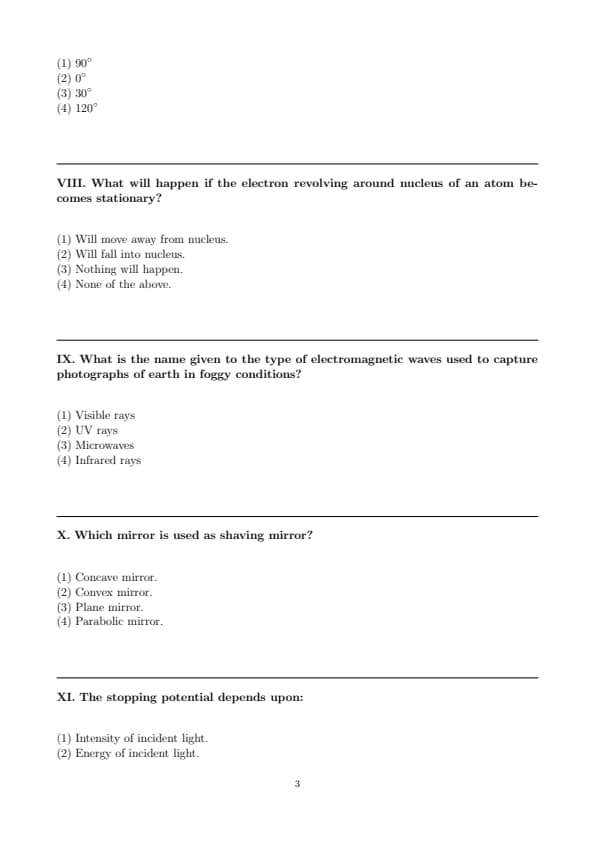
What will happen if the electron revolving around nucleus of an atom becomes stationary?
View Solution
Step 1: Understanding the concept.
According to classical physics, when an electron moving around the nucleus comes to rest (becomes stationary), it will lose energy due to the attractive force between the electron and the nucleus. This loss of energy will cause the electron to spiral inward and eventually fall into the nucleus. This is the concept behind atomic models before quantum mechanics.
Step 2: Analyzing the options.
(1) Will move away from nucleus: This is incorrect. If the electron becomes stationary, it would lose energy and spiral inward, not move away.
(2) Will fall into nucleus: Correct. The electron will lose energy and eventually fall into the nucleus, which was a major issue in the classical model of the atom.
(3) Nothing will happen: This is incorrect. In classical mechanics, if the electron became stationary, it would eventually fall into the nucleus due to the attraction.
(4) None of the above: This is incorrect, as option (2) is correct.
Step 3: Conclusion.
The correct answer is (2) Will fall into nucleus, based on the classical model of the atom.
Quick Tip: In classical physics, a stationary electron would eventually spiral inward due to energy loss, unlike in the quantum mechanical model where electron orbits are stable.
What is the name given to the type of electromagnetic waves used to capture photographs of earth in foggy conditions?
View Solution
Step 1: Understanding the concept.
Infrared rays are electromagnetic waves that have longer wavelengths than visible light and can penetrate fog, smoke, and other obstructions better than visible light. This makes them ideal for capturing photographs of the earth in foggy conditions.
Step 2: Analyzing the options.
(1) Visible rays: This is incorrect. Visible light is not effective in foggy conditions because it cannot penetrate through fog and other obstructions easily.
(2) UV rays: This is incorrect. UV rays are used for other purposes, such as sterilization, and are not suitable for capturing photographs through fog.
(3) Microwaves: This is incorrect. While microwaves can penetrate obstacles, they are not typically used for photographic imaging.
(4) Infrared rays: Correct. Infrared rays can penetrate fog and other obstructions, making them ideal for capturing images of the earth in such conditions.
Step 3: Conclusion.
The correct answer is (4) Infrared rays, as they are used for capturing photographs in foggy conditions.
Quick Tip: Infrared radiation is widely used in remote sensing and photography, especially in conditions with poor visibility like fog or smoke.
Which mirror is used as shaving mirror?
View Solution
Step 1: Understanding the concept.
A concave mirror is used as a shaving mirror because it can form an upright, magnified image when the object is placed between the mirror and its focal point. This magnified image allows a clearer view for tasks like shaving.
Step 2: Analyzing the options.
(1) Concave mirror: Correct. A concave mirror is used for magnification and produces an enlarged, upright image when the object is placed close to the mirror.
(2) Convex mirror: This is incorrect. A convex mirror always produces a diminished, virtual image that is upright and smaller, which is not suitable for shaving.
(3) Plane mirror: This is incorrect. A plane mirror gives an image of the same size as the object, which is not magnified for shaving purposes.
(4) Parabolic mirror: This is incorrect. A parabolic mirror is used for focusing parallel rays, such as in satellite dishes or telescopes, not for magnifying images in everyday use.
Step 3: Conclusion.
The correct answer is (1) Concave mirror, as it is used to provide a magnified, upright image for tasks like shaving.
Quick Tip: Concave mirrors are used for magnification in applications like shaving mirrors, makeup mirrors, and telescopes.
The stopping potential depends upon:
View Solution
Step 1: Understanding the concept.
The stopping potential in the photoelectric effect depends on the energy of the incident light, which is directly related to its frequency. The stopping potential is the minimum voltage required to stop the ejected photoelectrons, and it is independent of the light's intensity but depends on the energy (frequency) of the photons.
Step 2: Analyzing the options.
(1) Intensity of incident light: This is incorrect. The stopping potential does not depend on the intensity of light, but rather on its energy.
(2) Energy of incident light: Correct. The energy of the incident light determines the kinetic energy of the ejected electrons and thus the stopping potential.
(3) Surface area of the metal: This is incorrect. The surface area of the metal does not affect the stopping potential.
(4) Independent of intensity of incident light: This is incorrect. While the stopping potential does not depend on intensity, it does depend on the energy of the incident light.
Step 3: Conclusion.
The correct answer is (2) Energy of incident light, as the stopping potential depends on the energy (or frequency) of the incident photons.
Quick Tip: The stopping potential in the photoelectric effect depends on the frequency of light, not its intensity.
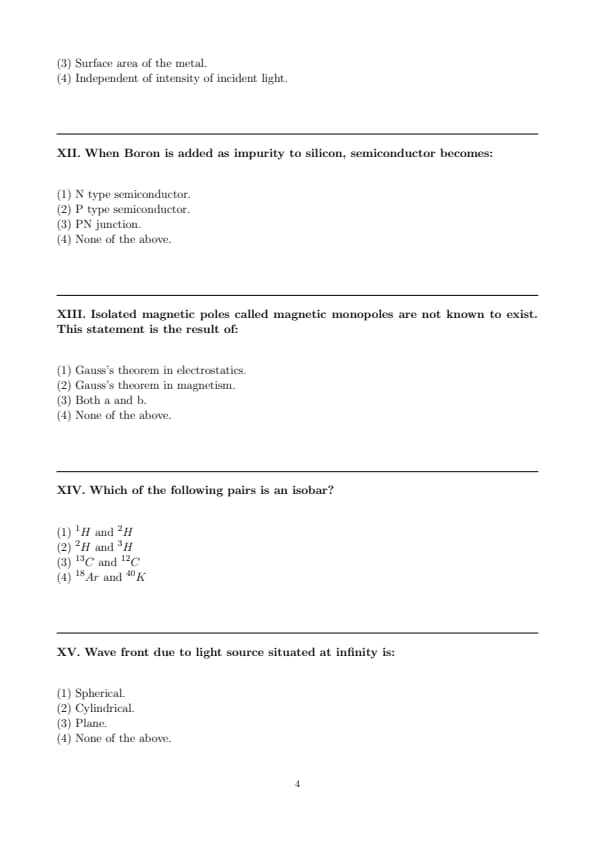
When Boron is added as impurity to silicon, semiconductor becomes:
View Solution
Step 1: Understanding the concept.
When Boron (a Group III element) is added to silicon (a Group IV element) as an impurity, it creates "holes" (missing electrons) in the crystal structure, which makes the silicon a P-type semiconductor. This is because Boron has one less electron than silicon, and this creates an excess of positive charge carriers (holes).
Step 2: Analyzing the options.
(1) N type semiconductor: This is incorrect. An N-type semiconductor is created by adding Group V elements like Phosphorus, which contribute extra electrons (negative charge carriers).
(2) P type semiconductor: Correct. Adding Boron to silicon results in a P-type semiconductor due to the creation of holes (positive charge carriers).
(3) PN junction: This is incorrect. A PN junction is formed when both P-type and N-type semiconductors are combined, not by adding a single impurity.
(4) None of the above: This is incorrect, as option (2) is the correct answer.
Step 3: Conclusion.
The correct answer is (2) P type semiconductor, as Boron creates holes that make silicon a P-type semiconductor.
Quick Tip: When Group III elements like Boron are added to silicon, it results in a P-type semiconductor due to the creation of holes (positive charge carriers).
Isolated magnetic poles called magnetic monopoles are not known to exist. This statement is the result of:
View Solution
Step 1: Understanding the concept.
Gauss’s law in magnetism states that the net magnetic flux through any closed surface is zero, meaning that there are no isolated magnetic monopoles. This law is one of Maxwell's equations and reflects the fact that magnetic field lines always form closed loops.
Step 2: Analyzing the options.
(1) Gauss’s theorem in electrostatics: This is incorrect. Gauss's law in electrostatics deals with electric fields, not magnetic fields.
(2) Gauss’s theorem in magnetism: Correct. Gauss’s law for magnetism indicates that isolated magnetic monopoles do not exist.
(3) Both a and b: This is incorrect. Only Gauss’s law in magnetism explains the absence of magnetic monopoles.
(4) None of the above: This is incorrect, as option (2) is correct.
Step 3: Conclusion.
The correct answer is (2) Gauss’s theorem in magnetism, as it explains that magnetic monopoles do not exist.
Quick Tip: Gauss’s law for magnetism implies that there are no isolated magnetic poles, as magnetic field lines always form closed loops.
Which of the following pairs is an isobar?
View Solution
Step 1: Understanding the concept.
Isobars are atoms of different elements that have the same mass number. The mass number is the sum of protons and neutrons.
Step 2: Analyzing the options.
(1) \( ^1H \) and \( ^2H \): This is incorrect. These are isotopes of hydrogen, not isobars, because they have different mass numbers.
(2) \( ^2H \) and \( ^3H \): This is incorrect. These are isotopes of hydrogen, with different mass numbers.
(3) \( ^{13}C \) and \( ^{12}C \): Correct. These are isotopes of carbon, but they are not isobars since they have different numbers of neutrons but the same mass number (13 and 12).
(4) \( ^{18}Ar \) and \( ^{40}K \): This is incorrect. These are not isobars as they have different mass numbers.
Step 3: Conclusion.
The correct answer is (3) \( ^{13}C \) and \( ^{12}C \), which are isobars as they share the same mass number.
Quick Tip: Isobars are elements with the same mass number but different atomic numbers.
Wave front due to light source situated at infinity is:
View Solution
Step 1: Understanding the concept.
When a light source is located at infinity, the light rays reach the object in parallel, and the wavefronts formed are plane waves. This is because the distance is so large that the curvature of the wavefront is negligible.
Step 2: Analyzing the options.
(1) Spherical: This is incorrect. Spherical wavefronts occur when the light source is a point source.
(2) Cylindrical: This is incorrect. Cylindrical wavefronts occur when the source is along a line.
(3) Plane: Correct. A light source at infinity produces parallel rays, resulting in plane wavefronts.
(4) None of the above: This is incorrect, as option (3) is correct.
Step 3: Conclusion.
The correct answer is (3) Plane, as the wavefront formed by a light source situated at infinity is a plane wave.
Quick Tip: A light source at infinity creates plane wavefronts because the rays are parallel when they reach the object.
When forward biasing is applied to the PN junction, width of depletion layer increases. (T/F)
View Solution
Step 1: Understanding the concept.
When a forward bias is applied to a PN junction, the width of the depletion layer decreases. This happens because the applied voltage reduces the barrier that the electric field creates, allowing more charge carriers to move across the junction.
Step 2: Analyzing the statement.
The statement is False because forward biasing reduces the width of the depletion layer, not increases it.
Step 3: Conclusion.
The correct answer is False, as the width of the depletion region decreases when forward bias is applied to the PN junction.
Quick Tip: When a PN junction is forward biased, the potential barrier is reduced, leading to a decrease in the width of the depletion region.
Photoelectric effect is not possible for the light of all frequencies. (T/F)
View Solution
Step 1: Understanding the concept.
The photoelectric effect only occurs when the frequency of the incident light is above a certain threshold frequency. Light with lower frequencies (below the threshold frequency) cannot cause the ejection of electrons from a material, regardless of its intensity.
Step 2: Analyzing the statement.
The statement is True, as the photoelectric effect requires a minimum frequency of light to eject electrons from a surface.
Step 3: Conclusion.
The correct answer is True, as the photoelectric effect does not occur for all frequencies of light.
Quick Tip: The photoelectric effect occurs only when the frequency of light exceeds a threshold frequency, which depends on the material.
AC generator is based upon principle of electromagnetic induction. (T/F)
View Solution
Step 1: Understanding the concept.
An AC generator works on the principle of electromagnetic induction, where a conductor moving in a magnetic field induces an electromotive force (emf) in the conductor, generating an alternating current.
Step 2: Analyzing the statement.
The statement is True, as the working of an AC generator is based on Faraday's law of electromagnetic induction.
Step 3: Conclusion.
The correct answer is True, as an AC generator relies on electromagnetic induction to produce alternating current.
Quick Tip: AC generators work on the principle of electromagnetic induction, where the movement of a conductor in a magnetic field induces an emf.
Power of a thick lens is smaller than the thin lens. (T/F)
View Solution
Step 1: Understanding the concept.
The power of a lens is inversely related to its focal length. A thick lens has a slightly longer focal length compared to a thin lens of the same curvature, and therefore, its power is lower than that of the thin lens.
Step 2: Analyzing the statement.
The statement is True, as the power of a thick lens is indeed smaller than the power of a thin lens, due to the difference in focal lengths.
Step 3: Conclusion.
The correct answer is True, as the power of a thick lens is smaller than that of a thin lens.
Quick Tip: The power of a lens is inversely proportional to its focal length. A thicker lens has a longer focal length, leading to a smaller power.
Sustained interference is caused by the superposition of two waves coming from two coherent sources. (T/F)
View Solution
Step 1: Understanding the concept.
Sustained interference patterns occur when two coherent sources produce waves that superpose constructively and destructively, creating a stable pattern. Coherence is essential for sustained interference.
Step 2: Analyzing the statement.
The statement is True, as sustained interference requires two coherent sources to produce a stable and observable interference pattern.
Step 3: Conclusion.
The correct answer is True, as sustained interference is indeed caused by the superposition of two waves from coherent sources.
Quick Tip: For sustained interference patterns, the sources must be coherent, meaning they must have a constant phase relationship.
What do you mean by quantization of charge?
View Solution
Step 1: Understanding the concept.
Quantization of charge refers to the fact that the charge of an object can only be an integer multiple of the elementary charge \( e \), which is the charge of a single electron or proton. This means that charges are discrete and not continuous. The charge \( q \) of any object can be expressed as: \[ q = n \times e \]
where \( n \) is an integer and \( e \approx 1.6 \times 10^{-19} \, C \) is the elementary charge.
Step 2: Explanation.
This concept implies that charges come in discrete units, and it is impossible to have a charge that is a fraction of the elementary charge. This was first proposed by Max Planck and later confirmed by experiments.
Step 3: Conclusion.
Quantization of charge is a fundamental concept in electromagnetism that states that the total charge in any system is always an integer multiple of the elementary charge.
Quick Tip: Charge is quantized, meaning that the charge on any object is always a multiple of the elementary charge \( e \).
Define Kirchhoff’s first and second law.
View Solution
Kirchhoff's First Law (Junction Rule):
Kirchhoff's first law states that the total current entering a junction (or node) is equal to the total current leaving the junction. This is a consequence of the conservation of charge. Mathematically, it can be expressed as: \[ \sum I_{in} = \sum I_{out} \]
This means that the algebraic sum of all currents at any junction is zero.
Kirchhoff's Second Law (Loop Rule):
Kirchhoff's second law states that the sum of the potential differences (voltage) across all elements around any closed loop or circuit is always equal to zero. This is a consequence of the conservation of energy. Mathematically, it is expressed as: \[ \sum V = 0 \]
This means that the sum of the electromotive forces (emfs) and the potential drops (voltage) around a closed loop is zero.
Step 3: Conclusion.
Kirchhoff's laws are essential for solving complex circuits involving multiple components.
Quick Tip: Kirchhoff’s laws are fundamental tools for analyzing electrical circuits, based on the conservation of charge and energy.
Draw labelled diagram of converting a galvanometer into an ammeter.
View Solution
Step 1: Understanding the concept.
To convert a galvanometer into an ammeter, we need to modify it so it can measure higher currents. The galvanometer is designed for detecting small currents, so we need to use a method to allow larger currents to flow through it without damaging it.
Step 2: Adding a shunt resistance.
The solution is to add a **shunt resistance** in parallel with the galvanometer. The shunt is a low resistance that allows most of the current to bypass the galvanometer, ensuring that only a small fraction of the current flows through the sensitive galvanometer. This way, the galvanometer can be used to measure large currents without being damaged.
Step 3: The diagram.
The diagram of converting a galvanometer into an ammeter is as follows:
\[ [Galvanometer] \quad \parallel \quad [Shunt Resistance] \]
In this setup:
- The galvanometer has a known resistance \( R_g \),
- The shunt resistance \( R_s \) is chosen so that the desired range of current can be measured without the current through the galvanometer exceeding its limits. Quick Tip: A shunt resistance in parallel with a galvanometer is used to convert it into an ammeter. The value of the shunt determines the maximum current the ammeter can measure.
State Faraday’s law of electromagnetic induction.
View Solution
Step 1: Understanding the concept.
Faraday's law of electromagnetic induction is a fundamental principle that describes how a changing magnetic field induces an electromotive force (emf) in a conductor. The induced emf is the result of a time-varying magnetic flux through the conductor.
Step 2: Faraday’s Law Statement.
Faraday's law states that the induced emf in any closed loop is proportional to the rate of change of magnetic flux through the loop. Mathematically, it is expressed as: \[ \mathcal{E} = - \dfrac{d\Phi_B}{dt} \]
where:
- \( \mathcal{E} \) is the induced emf,
- \( \Phi_B \) is the magnetic flux,
- \( \dfrac{d\Phi_B}{dt} \) is the rate of change of the magnetic flux.
The negative sign indicates that the direction of the induced emf opposes the change in magnetic flux, as described by Lenz's Law.
Step 3: Explanation of magnetic flux.
Magnetic flux \( \Phi_B \) is given by the product of the magnetic field \( B \) and the area \( A \) through which the field lines pass, as well as the cosine of the angle \( \theta \) between the magnetic field and the normal to the surface: \[ \Phi_B = B \cdot A \cdot \cos(\theta) \]
Step 4: Conclusion.
Faraday's law forms the basis for many electrical devices, including transformers and electric generators. It explains how mechanical energy can be converted into electrical energy through electromagnetic induction. Quick Tip: Faraday’s law explains how a changing magnetic field induces an emf, and is the principle behind electrical generators and transformers.
Give any two uses of X-rays.
View Solution
Step 1: Understanding X-rays.
X-rays are a form of high-energy electromagnetic radiation. They have wavelengths between 0.01 and 10 nanometers, which are shorter than ultraviolet rays and longer than gamma rays. Because of their ability to penetrate solid objects, X-rays have many practical uses, particularly in the medical field.
Step 2: Two Uses of X-rays.
1. **Medical Imaging (X-ray Radiography):**
X-rays are widely used for non-invasive imaging to diagnose various medical conditions. X-ray images allow doctors to see inside the body and examine bones, tissues, and organs. For example, X-rays are used to detect fractures, infections, tumors, and other abnormalities.
2. **Cancer Treatment (Radiotherapy):**
X-rays are used in the treatment of cancer through a method known as radiotherapy. High-energy X-rays are directed at cancer cells to damage and kill them. This helps in shrinking tumors and treating cancerous growths.
Step 3: Conclusion.
X-rays have vital medical applications, including imaging for diagnosis and treatment of diseases, especially cancer. Quick Tip: X-rays are essential for medical imaging and cancer treatment, allowing for both diagnosis and targeted therapy.
Write Einstein’s photoelectric equation.
View Solution
Step 1: Understanding the concept.
Einstein’s photoelectric equation describes the relationship between the energy of the incident photons and the energy required to eject an electron from a material in the photoelectric effect. It incorporates the work function of the material (the minimum energy required to remove an electron) and the energy of the incident photon.
Step 2: Einstein’s photoelectric equation.
The equation is given by: \[ E_k = h\nu - \phi \]
where:
- \( E_k \) is the kinetic energy of the ejected electron,
- \( h \) is Planck’s constant (\( h = 6.626 \times 10^{-34} \, J \cdot s \)),
- \( \nu \) is the frequency of the incident light,
- \( \phi \) is the work function of the material.
This equation shows that the kinetic energy of the ejected electron is the difference between the energy of the incident photon and the work function of the material. If the energy of the photon is less than the work function, no electron will be ejected.
Step 3: Conclusion.
Einstein’s photoelectric equation is crucial in understanding the behavior of electrons when exposed to light and forms the foundation of quantum theory for explaining the photoelectric effect. Quick Tip: Einstein’s photoelectric equation explains that the energy of an ejected electron depends on the frequency of the incident light and the work function of the material.
Write any two differences between nuclear fission and nuclear fusion.
View Solution
Nuclear fission and nuclear fusion are two different nuclear reactions that release energy due to high-powered atomic interactions. Below are the differences between nuclear fission and nuclear fusion:
1. Process:
- **Nuclear Fission:** It is the process where a heavy nucleus, like uranium or plutonium, splits into two smaller nuclei along with the release of a large amount of energy.
- **Nuclear Fusion:** It is the process where two light atomic nuclei, such as hydrogen isotopes, combine to form a heavier nucleus, releasing energy in the process.
2. Energy Yield:
- **Nuclear Fission:** Fission reactions release a considerable amount of energy and are currently used in nuclear power plants.
- **Nuclear Fusion:** Fusion reactions release far more energy per unit of mass than fission and are the source of energy in stars, including the sun. Quick Tip: Nuclear fission splits heavy nuclei, while nuclear fusion combines light nuclei. Fusion releases more energy than fission.
What is an equipotential surface? Show that no work is done in moving a given charge over an equipotential surface.
View Solution
Step 1: Definition of equipotential surface.
An equipotential surface is a surface on which the electric potential at every point is the same. In other words, no matter where you move a point on the surface, the potential remains constant. These surfaces are perpendicular to the electric field lines at every point.
For example, in a uniform electric field, the equipotential surfaces are planes that are parallel to each other and perpendicular to the field lines. In a point charge field, the equipotential surfaces are spheres centered at the point charge.
Step 2: Work done in moving a charge over an equipotential surface.
The work \( W \) done in moving a charge \( q \) through a potential difference \( V \) is given by the equation: \[ W = q \cdot V \]
where:
- \( W \) is the work done,
- \( q \) is the charge,
- \( V \) is the potential difference.
Since the potential difference \( V \) between any two points on an equipotential surface is zero (because the potential is the same everywhere on the surface), the work done in moving a charge over an equipotential surface is: \[ W = q \cdot 0 = 0 \]
Step 3: Conclusion.
Thus, no work is done in moving a given charge over an equipotential surface, as there is no potential difference between any two points on the surface.
Quick Tip: Work done is the product of charge and potential difference. Since the potential difference is zero on an equipotential surface, the work done is zero.
With a circuit diagram, explain how a meter bridge can be used to determine unknown resistance of a given wire.
View Solution
Step 1: Understanding the meter bridge.
A meter bridge is a device used to measure the unknown resistance of a wire using the principle of a Wheatstone bridge. It consists of a long, horizontal wire (usually made of constantan) mounted on a wooden or metallic base. The wire is stretched along a meter scale, and a jockey is used to make contact with the wire at various points.
Step 2: Wheatstone Bridge Setup.
The meter bridge consists of four resistors:
1. The wire of length \( 1 \, m \) which is uniform and has a known resistance per unit length.
2. A known resistance \( R_2 \) (the resistance of a known wire or resistor).
3. An unknown resistance \( R_x \), which we want to find.
4. A galvanometer to detect current flow.
The setup is as follows:
\[ \begin{array}{c} Known Resistance R_2 \quad \parallel \quad Wire (meter scale) \quad \parallel \quad Unknown Resistance R_x
\hline \end{array} \]
The jockey is moved along the bridge wire, and a null point is found where the galvanometer shows no deflection. At this point, the bridge is said to be "balanced."
Step 3: Principle of operation.
When the meter bridge is balanced, the ratio of the resistances is equal to the ratio of the lengths of the bridge wire on either side of the jockey. This can be written as: \[ \frac{R_1}{R_2} = \frac{l_1}{l_2} \]
where:
- \( R_1 \) is the known resistance,
- \( R_2 \) is the unknown resistance,
- \( l_1 \) and \( l_2 \) are the lengths of the bridge wire on either side of the jockey, such that \( l_1 + l_2 = 1 \, m \).
Step 4: Formula for calculating the unknown resistance.
By rearranging the formula above, we can calculate the unknown resistance: \[ R_x = R_2 \times \frac{l_2}{l_1} \]
where \( l_1 \) and \( l_2 \) are measured when the bridge is balanced.
Step 5: Conclusion.
By using a meter bridge and applying the Wheatstone bridge principle, the unknown resistance can be determined by measuring the lengths at the null point and using the above formula. Quick Tip: A meter bridge uses the principle of the Wheatstone bridge to measure unknown resistance by balancing the bridge and using the ratio of resistances and lengths.
Derive an expression for force per unit length between two parallel straight conductors carrying current in the same direction.
View Solution
Step 1: Understanding the concept.
According to Ampere’s Law, two parallel conductors carrying currents exert a force on each other. The force between the conductors is due to the magnetic field created by the current in one conductor, which acts on the other conductor.
Step 2: Magnetic field due to one conductor.
The magnetic field \( B \) at a distance \( r \) from a long straight conductor carrying a current \( I \) is given by Ampere’s law: \[ B = \dfrac{\mu_0 I}{2 \pi r} \]
where:
- \( \mu_0 \) is the permeability of free space (\( \mu_0 = 4 \pi \times 10^{-7} \, T \cdot m/A \)),
- \( I \) is the current in the conductor,
- \( r \) is the distance from the conductor.
Step 3: Force on the second conductor.
The force on a length \( L \) of the second conductor due to the magnetic field \( B \) produced by the first conductor is given by the formula: \[ F = I L B \]
Substitute the value of \( B \) from the previous equation: \[ F = I L \left( \dfrac{\mu_0 I}{2 \pi r} \right) \]
Simplifying: \[ F = \dfrac{\mu_0 I^2 L}{2 \pi r} \]
Step 4: Force per unit length.
To find the force per unit length, divide both sides of the equation by \( L \): \[ \frac{F}{L} = \dfrac{\mu_0 I^2}{2 \pi r} \]
This is the expression for the force per unit length between two parallel conductors carrying currents in the same direction.
Step 5: Conclusion.
The force per unit length between two parallel conductors carrying currents in the same direction is given by: \[ \frac{F}{L} = \dfrac{\mu_0 I^2}{2 \pi r} \] Quick Tip: The force between two parallel conductors is directly proportional to the product of the currents and inversely proportional to the distance between them.
What do you mean by impedance of LCR series circuit? Derive an expression for it by using phasor diagram.
View Solution
Step 1: Definition of impedance in an LCR series circuit.
Impedance \( Z \) is the total opposition to the flow of alternating current (AC) in a circuit containing resistors (R), inductors (L), and capacitors (C). It is a complex quantity that takes both the resistance and reactance into account and is measured in ohms. The impedance \( Z \) in an LCR series circuit is the combined effect of the resistance \( R \), inductive reactance \( X_L \), and capacitive reactance \( X_C \).
Step 2: Phasor diagram for an LCR series circuit.
In an LCR series circuit, the voltage across the resistor, inductor, and capacitor are all out of phase with each other:
- The voltage across the resistor \( V_R \) is in phase with the current.
- The voltage across the inductor \( V_L \) leads the current by \( 90^\circ \).
- The voltage across the capacitor \( V_C \) lags the current by \( 90^\circ \).
Using a phasor diagram, we represent these voltages as vectors in the complex plane. The total voltage across the LCR circuit \( V \) is the vector sum of \( V_R \), \( V_L \), and \( V_C \).
The total impedance \( Z \) is the magnitude of the total voltage divided by the current \( I \): \[ Z = \dfrac{V}{I} \]
Step 3: Expression for impedance.
The total impedance \( Z \) can be calculated using the Pythagorean theorem: \[ Z = \sqrt{R^2 + (X_L - X_C)^2} \]
where:
- \( R \) is the resistance,
- \( X_L = \omega L \) is the inductive reactance,
- \( X_C = \dfrac{1}{\omega C} \) is the capacitive reactance,
- \( \omega = 2 \pi f \) is the angular frequency of the AC source.
Thus, the impedance in an LCR series circuit is a combination of the resistance and the net reactance (the difference between inductive and capacitive reactance).
Step 4: Conclusion.
The impedance \( Z \) of an LCR series circuit is given by: \[ Z = \sqrt{R^2 + (X_L - X_C)^2} \] Quick Tip: Impedance is the total opposition to current in an AC circuit, and in an LCR circuit, it depends on the resistance, inductive reactance, and capacitive reactance.
What is total internal reflection? Write necessary conditions for it.
View Solution
Step 1: Understanding Total Internal Reflection.
Total internal reflection occurs when a light ray traveling from a denser medium to a rarer medium is completely reflected back into the denser medium. This phenomenon only occurs when the angle of incidence exceeds a certain critical angle, and the light is traveling from a medium with a higher refractive index to one with a lower refractive index.
Step 2: Conditions for Total Internal Reflection.
The necessary conditions for total internal reflection are:
1. The light must travel from a denser medium (higher refractive index) to a rarer medium (lower refractive index).
2. The angle of incidence must be greater than the critical angle, \( \theta_c \). The critical angle is given by: \[ \theta_c = \sin^{-1} \left( \dfrac{n_2}{n_1} \right) \]
where \( n_1 \) is the refractive index of the denser medium and \( n_2 \) is the refractive index of the rarer medium.
Step 3: Conclusion.
Total internal reflection is the phenomenon where the light is completely reflected back into the denser medium, and it occurs only when the angle of incidence is greater than the critical angle.
Quick Tip: Total internal reflection can be observed in optical fibers and prisms when the angle of incidence exceeds the critical angle.
Define binding energy per nucleon. Draw and explain the curve between binding energy per nucleon and mass number.
View Solution
Step 1: Definition of binding energy per nucleon.
The binding energy per nucleon is defined as the energy required to separate a nucleus into its individual nucleons (protons and neutrons). It is given by the total binding energy of the nucleus divided by the number of nucleons in the nucleus. The binding energy is a measure of the stability of the nucleus; higher binding energy per nucleon indicates greater stability.
\[ Binding energy per nucleon = \frac{Total binding energy}{Number of nucleons} \]
Step 2: Curve between binding energy per nucleon and mass number.
The binding energy per nucleon increases with mass number until it reaches a peak at around mass number 56 (for iron and nickel). After this point, the binding energy per nucleon starts to decrease as the mass number increases further. This curve indicates that nuclei with mass numbers around 56 are the most stable.
Step 3: Drawing and explanation of the curve.
The curve typically shows the following:
- For light nuclei (low mass number), the binding energy per nucleon is relatively low.
- As the mass number increases, the binding energy per nucleon increases until it reaches a maximum at around mass number 56.
- Beyond mass number 56, the binding energy per nucleon starts to decrease, indicating that heavier nuclei are less stable and more likely to undergo fission.
Step 4: Conclusion.
The curve between binding energy per nucleon and mass number shows that medium-sized nuclei (especially iron) are the most stable, and fission or fusion can release energy by moving to more stable configurations. Quick Tip: Binding energy per nucleon increases with mass number up to iron and then decreases for heavier elements, explaining the energy release in fission and fusion.
With the help of a circuit diagram, explain the V-I characteristics of a PN junction diode in forward biasing.
View Solution
Step 1: V-I Characteristics of a PN Junction Diode.
The V-I characteristics of a PN junction diode describe the relationship between the voltage across the diode and the current flowing through it. The diode has two modes of operation: forward bias and reverse bias.
Step 2: Circuit Diagram for Forward Bias.
In forward bias, the positive terminal of the battery is connected to the p-type material (anode), and the negative terminal is connected to the n-type material (cathode). This reduces the potential barrier of the junction, allowing current to flow once the applied voltage exceeds a certain threshold (typically 0.7V for silicon diodes).
The circuit diagram for forward bias is:
\[ [Battery] \quad [PN Junction Diode] \quad [Resistor] \]
Step 3: V-I Characteristics in Forward Bias.
In the forward bias region:
- When the applied voltage is less than the threshold voltage, no significant current flows through the diode (except for a small leakage current).
- As the applied voltage increases and exceeds the threshold (typically 0.7V for silicon), the diode starts to conduct, and the current increases rapidly with voltage.
- The relationship between the current and voltage is non-linear in the forward bias region.
The V-I curve in forward bias shows an exponential increase in current with increasing voltage after the threshold voltage is reached.
Step 4: Conclusion.
The V-I characteristic of a PN junction diode in forward bias shows that the current remains very small until the voltage exceeds the threshold voltage, beyond which it increases exponentially. This is typical of semiconductor diodes. Quick Tip: In forward bias, once the threshold voltage is exceeded, the current through the diode increases rapidly. Below this voltage, the diode does not conduct significant current.
Read the passage carefully and answer the questions from (a) to (e).
% Passage
Passage:
The strength of the earth's magnetic field varies from place to place on the earth's surface; its value being of the order of \( 10^{-5} \, T \).
What causes the earth to have a magnetic field is not clear. Originally the magnetic field was thought of as arising from a giant bar magnet placed approximately along the axis of rotation of the earth and deep in the interior. However, this simplistic picture is certainly not correct. The magnetic field is now thought to arise due to electrical currents produced by convective motion of metallic fluids (consisting mostly of molten iron and nickel) in the outer core of the earth. This is known as the dynamo effect.
The magnetic field lines of the earth resemble that of a (hypothetical) magnetic dipole located at the centre of the earth. The axis of the dipole does not coincide with the axis of rotation of the earth but is presently tilted by approximately 11.3° with respect to the later. In this way of looking at it, the magnetic poles are located where the magnetic field lines due to the dipole enter or leave the earth. The location of the north magnetic pole is at a latitude of \( 79.74^\circ \, N \) and a longitude of \( 71.8^\circ \, W \), a place somewhere in north Canada. The magnetic south pole is at \( 79.74^\circ \, S, 108.22^\circ \, E \) in the Antarctica.
View Solution
Step 1: Understanding the concept.
The magnetic field strength at the surface of the earth is of the order of \( 10^{-5} \, T \) as given in the passage. This is the typical magnitude of the Earth's magnetic field.
Step 2: Conclusion.
The order of magnitude of the magnetic field of the earth is \( 10^{-5} \, T \).
Quick Tip: The earth's magnetic field strength is approximately \( 10^{-5} \, T \) at the surface.
Read the passage carefully and answer the questions from (a) to (e).
% Passage
Passage:
The strength of the earth's magnetic field varies from place to place on the earth's surface; its value being of the order of \( 10^{-5} \, T \).
What causes the earth to have a magnetic field is not clear. Originally the magnetic field was thought of as arising from a giant bar magnet placed approximately along the axis of rotation of the earth and deep in the interior. However, this simplistic picture is certainly not correct. The magnetic field is now thought to arise due to electrical currents produced by convective motion of metallic fluids (consisting mostly of molten iron and nickel) in the outer core of the earth. This is known as the dynamo effect.
The magnetic field lines of the earth resemble that of a (hypothetical) magnetic dipole located at the centre of the earth. The axis of the dipole does not coincide with the axis of rotation of the earth but is presently tilted by approximately 11.3° with respect to the later. In this way of looking at it, the magnetic poles are located where the magnetic field lines due to the dipole enter or leave the earth. The location of the north magnetic pole is at a latitude of \( 79.74^\circ \, N \) and a longitude of \( 71.8^\circ \, W \), a place somewhere in north Canada. The magnetic south pole is at \( 79.74^\circ \, S, 108.22^\circ \, E \) in the Antarctica.
% Question
(a) What is the order of magnitude of magnetic field of earth?
View Solution
Step 1: Understanding the concept.
The magnetic field strength at the surface of the earth is of the order of \( 10^{-5} \, T \) as given in the passage. This is the typical magnitude of the Earth's magnetic field.
Step 2: Conclusion.
The order of magnitude of the magnetic field of the earth is \( 10^{-5} \, T \).
Quick Tip: The earth's magnetic field strength is approximately \( 10^{-5} \, T \) at the surface.
State Gauss’s theorem. Using this theorem, derive electric field intensity due to thin uniformly charged infinite plane sheet.
View Solution
Step 1: Gauss’s Theorem.
Gauss's theorem (or Gauss's law) states that the electric flux through a closed surface is proportional to the charge enclosed within that surface. Mathematically, Gauss’s law is given by: \[ \oint \vec{E} \cdot d\vec{A} = \dfrac{Q_{enc}}{\epsilon_0} \]
where:
- \( \oint \vec{E} \cdot d\vec{A} \) is the electric flux through a closed surface,
- \( Q_{enc} \) is the total charge enclosed within the surface,
- \( \epsilon_0 \) is the permittivity of free space.
Step 2: Application of Gauss’s Law to an Infinite Plane Sheet.
Consider an infinite plane sheet with uniform charge density \( \sigma \) (charge per unit area). To find the electric field due to this sheet, we apply Gauss's law using a Gaussian surface in the form of a rectangular box (Gaussian pillbox) that is symmetrically placed around the plane. The box should have one face above and one face below the plane sheet.
Step 3: Symmetry and Field Direction.
By symmetry, the electric field will be perpendicular to the surface of the sheet and will have the same magnitude at equal distances on both sides of the sheet. Let the electric field be \( E \) on both sides of the sheet, directed away from the surface if the charge is positive.
Step 4: Electric Flux Calculation.
The total flux through the Gaussian surface is the sum of the flux through the top and bottom faces. The area of each face is \( A \), and the flux is: \[ \Phi_E = E \cdot A + E \cdot A = 2EA \]
Since the charge enclosed is \( Q_{enc} = \sigma A \), Gauss’s law gives: \[ 2EA = \dfrac{\sigma A}{\epsilon_0} \]
Simplifying, we get the electric field: \[ E = \dfrac{\sigma}{2 \epsilon_0} \]
Step 5: Conclusion.
The electric field intensity due to an infinitely charged plane sheet is: \[ E = \dfrac{\sigma}{2 \epsilon_0} \]
where \( \sigma \) is the surface charge density, and \( \epsilon_0 \) is the permittivity of free space. Quick Tip: The electric field due to an infinite plane sheet with uniform charge density is constant and does not depend on the distance from the sheet.
With help of labelled diagram, write principle of astronomical telescope and derive expression for magnifying power of an astronomical telescope, when final image is formed at least distance of distinct vision.
View Solution
Step 1: Principle of Astronomical Telescope.
An astronomical telescope is an optical instrument used to observe distant objects, such as stars and planets. It consists of two lenses:
- **Objective lens**: A large lens with a short focal length that collects light from a distant object and forms a real, inverted, and diminished image.
- **Eyepiece**: A smaller lens with a long focal length that magnifies the image formed by the objective lens.
The principle of the astronomical telescope is based on the combination of these two lenses. The objective lens forms an image of the distant object at a position where the eyepiece can view it.
Step 2: Magnifying Power of the Telescope.
The magnifying power \( M \) of an astronomical telescope is the ratio of the angular size of the image to the angular size of the object when viewed with the naked eye. The formula for magnifying power is: \[ M = \dfrac{\theta_{image}}{\theta_{object}} \]
where \( \theta_{image} \) is the angular size of the image formed by the objective lens, and \( \theta_{object} \) is the angular size of the object.
For an astronomical telescope, when the final image is formed at the least distance of distinct vision \( D \), the magnifying power is given by: \[ M = \dfrac{f_o}{f_e} \]
where:
- \( f_o \) is the focal length of the objective lens,
- \( f_e \) is the focal length of the eyepiece.
Thus, the magnifying power of an astronomical telescope is the ratio of the focal lengths of the objective and eyepiece lenses.
Step 3: Diagram.
The diagram for an astronomical telescope with final image at the least distance of distinct vision is as follows:
\[ \begin{array}{c} Object at Infinity \quad \longrightarrow \quad Objective lens \quad \longrightarrow \quad Real Image \quad \longrightarrow \quad Eyepiece \quad \longrightarrow \quad Virtual Image at D \end{array} \]
Step 4: Conclusion.
The magnifying power of an astronomical telescope is given by the ratio of the focal length of the objective lens to the focal length of the eyepiece: \[ M = \dfrac{f_o}{f_e} \] Quick Tip: The magnifying power of an astronomical telescope increases with the focal length of the objective lens and decreases with the focal length of the eyepiece.



Comments