




The PSEB Class 12 Psychology Sample Question Paper exam will be conducted with the question paper and solutions made available after the exam. The exam will assess students' understanding through a combination of multiple-choice, objective, short, and long answer questions within a 3-hour duration. The paper will total 100 marks, with 80 marks allotted for the theory component and 20 marks for internal assessment. There will be no negative marking for incorrect answers.
PSEB Class 12 Psychology Sample Question Paper 2026 with Solutions PDF
| PSEB Class 12 Psychology Sample Question Paper 2026 with Solutions PDF | Download PDF | Check Solutions |
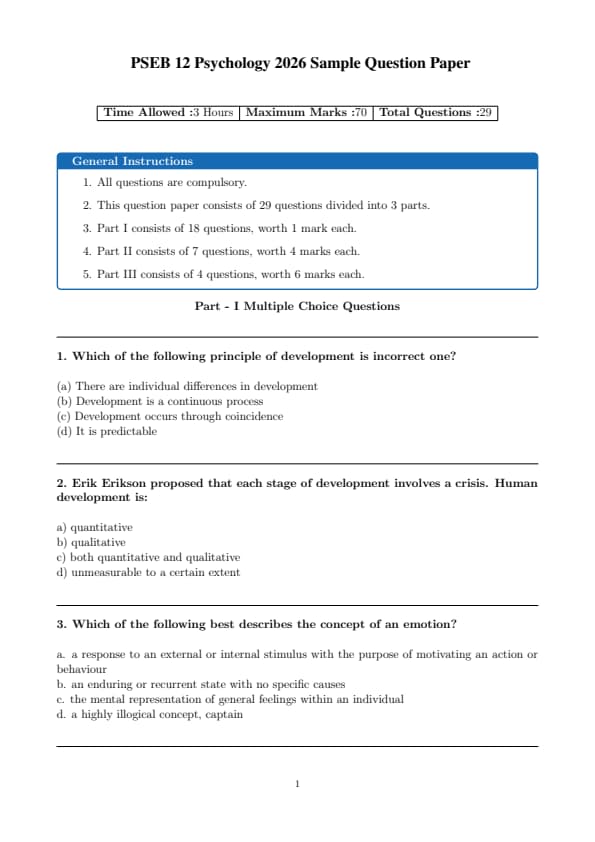
Which of the following principle of development is incorrect one?
View Solution
Step 1: Understanding the Concept:
The principles of development refer to the universal patterns and rules that govern how human beings grow and change over time.
Step 2: Detailed Explanation:
(a) Individual differences: While development follows a pattern, the rate and timing vary from person to person due to genetics and environment.
(b) Continuity: Development is a "cradle to grave" process that never stops.
(d) Predictability: Certain milestones (like sitting before standing) are predictable for all humans.
(e) Coincidence: This is incorrect because development is a systematic and orderly process, not a matter of random chance or coincidence.
Step 3: Final Answer:
Development is a structured process; therefore, saying it occurs by coincidence is a false principle.
Quick Tip: Development is always "Sequential" and "Orderly." Any option suggesting "Randomness" or "Abruptness" is generally incorrect in developmental psychology.
Erik Erikson proposed that each stage of development involves a crisis. Human development is:
View Solution
Step 1: Understanding the Concept:
Growth and Development are often used interchangeably, but they represent different types of changes in an organism.
Step 2: Detailed Explanation:
Quantitative changes refer to measurable increases in size, such as height, weight, and the number of words in a vocabulary.
Qualitative changes refer to transformations in the nature of functioning, such as the transition from crawling to walking or the development of abstract reasoning.
Erikson's stages focus on qualitative psychosocial crises, but human development as a whole encompasses both physical growth and functional maturation.
Step 3: Final Answer:
Human development is the sum of both measurable physical changes and complex functional changes.
Quick Tip: Growth is Quantitative. Development is Qualitative + Quantitative.
Which of the following best describes the concept of an emotion?
View Solution
Step 1: Understanding the Concept:
An emotion is a complex psychological state that involves subjective experience, physiological response, and behavioral/expressive response.
Step 2: Detailed Explanation:
Emotions are typically triggered by specific internal or external events.
They serve an evolutionary purpose by preparing the body for action (e.g., the "fight or flight" response triggered by fear).
Option (b) describes a mood (longer duration, no specific cause).
Option (c) describes only the cognitive aspect, ignoring the physiological and behavioral components.
Step 3: Final Answer:
Emotions are functional responses to stimuli that drive specific behaviors for adaptation.
Quick Tip: Emotion is short-lived and intense, while Mood is long-lasting and less intense.
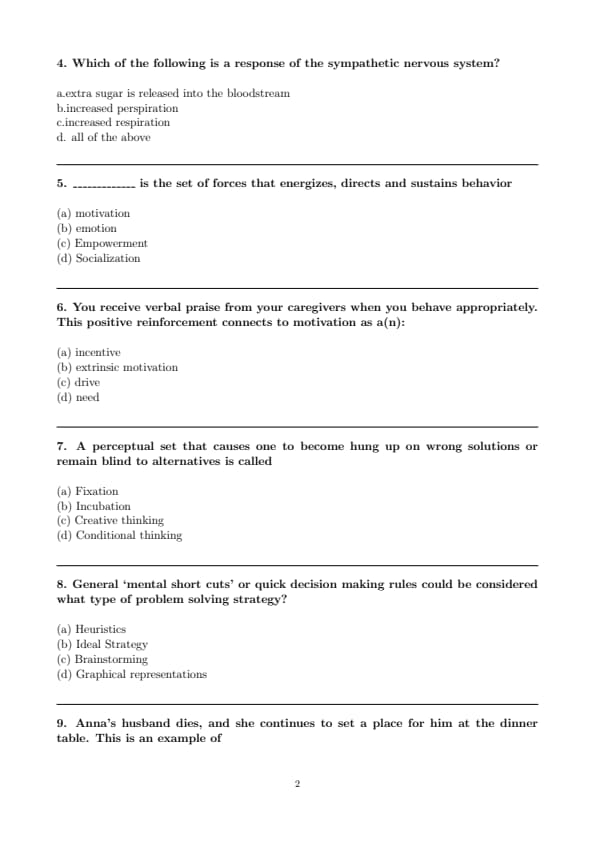
Which of the following is a response of the sympathetic nervous system?
View Solution
Step 1: Understanding the Concept:
The Sympathetic Nervous System (SNS) is responsible for the body's "Fight or Flight" response during stressful situations.
Step 2: Detailed Explanation:
When the SNS is activated:
1. The liver releases extra glucose (sugar) to provide immediate fuel for muscles.
2. Sweat glands increase activity (perspiration) to regulate body temperature.
3. Breathing rate increases (respiration) to provide more oxygen to the blood.
Step 3: Final Answer:
Since all the listed responses (extra sugar, sweating, and faster breathing) are standard reactions of the sympathetic nervous system, "all of the above" is the correct choice.
Quick Tip: Sympathetic = Stress/Spending energy.
Parasympathetic = Peace/Preserving energy.
_____________ is the set of forces that energizes, directs and sustains behavior
View Solution
Step 1: Understanding the Concept:
Motivation is the internal or external drive that causes a person to act in a certain way to achieve a goal.
Step 2: Detailed Explanation:
- Energizing: It initiates the behavior.
- Directing: It focuses the behavior toward a specific goal.
- Sustaining: It ensures the person persists in the behavior until the goal is met.
Step 3: Final Answer:
The technical definition of motivation includes energizing, directing, and sustaining human behavior.
Quick Tip: Motivation acts like the engine (energy) and the steering wheel (direction) of our actions.
You receive verbal praise from your caregivers when you behave appropriately. This positive reinforcement connects to motivation as a(n):
View Solution
Step 1: Understanding the Concept:
Motivation can be categorized based on whether the reward is internal (Intrinsic) or external (Extrinsic).
Step 2: Detailed Explanation:
Extrinsic motivation occurs when we are driven to perform a behavior to earn a reward or avoid a punishment.
Verbal praise from a caregiver is an external reward (reinforcement) that comes from the environment.
While the praise itself is an incentive, the "connection to motivation" asked for is the category of extrinsic motivation.
Step 3: Final Answer:
Since the motivation arises from an external source (caregivers), it is classified as extrinsic motivation.
Quick Tip: If you do it for the "Joy of doing it" = Intrinsic.
If you do it for the "Reward" = Extrinsic.
A perceptual set that causes one to become hung up on wrong solutions or remain blind to alternatives is called
View Solution
Step 1: Understanding the Concept:
Problem-solving can often be hindered by mental blocks or rigid ways of thinking.
Step 2: Detailed Explanation:
Fixation is the inability to see a problem from a new perspective.
It often involves a "mental set," where we repeat solutions that worked in the past but are not applicable to the current problem.
"Functional Fixedness" is a type of fixation where we see objects only in terms of their usual functions.
Step 3: Final Answer:
Becoming "hung up" on one approach and unable to see alternatives is defined as fixation.
Quick Tip: To overcome fixation, take a break (Incubation) or try to look at the problem from an outsider's point of view.
General ‘mental short cuts’ or quick decision making rules could be considered what type of problem solving strategy?
View Solution
Step 1: Understanding the Concept:
When solving problems, humans use either exhaustive methods (Algorithms) or efficient methods (Heuristics).
Step 2: Detailed Explanation:
Algorithms are step-by-step procedures that guarantee a correct solution but are time-consuming.
Heuristics are mental "rules of thumb" or shortcuts that allow for fast decision-making.
While heuristics are faster, they do not guarantee a correct answer and can lead to biases.
Step 3: Final Answer:
Mental shortcuts used for efficiency are called heuristics.
Quick Tip: Think of Heuristics as "Shortcuts" and Algorithms as "GPS directions."
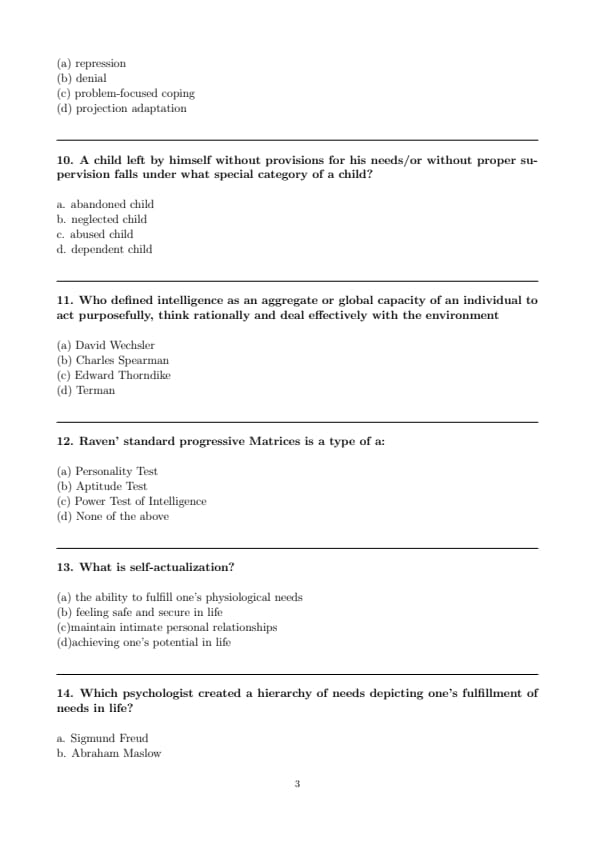
Anna’s husband dies, and she continues to set a place for him at the dinner table. This is an example of
View Solution
Step 1: Understanding the Concept:
Defense mechanisms are unconscious psychological strategies used to protect an individual from anxiety arising from unacceptable thoughts or feelings.
Step 2: Detailed Explanation:
Denial involves refusing to recognize or acknowledge a painful reality or obvious truth.
By setting a place for her deceased husband, Anna is behaving as though the death has not occurred to protect herself from the intense pain of loss.
Repression (a) would involve unconsciously "forgetting" the event entirely.
Step 3: Final Answer:
Acting as if a traumatic event never happened is the core characteristic of denial.
Quick Tip: Denial is the most primitive defense mechanism, often seen in the early stages of grief.
A child left by himself without provisions for his needs/or without proper supervision falls under what special category of a child?
View Solution
Step 1: Understanding the Concept:
Child welfare involves protecting children from various forms of harm, including abuse and neglect.
Step 2: Detailed Explanation:
- Neglect: This is a failure of a parent or caregiver to provide for a child's basic needs (food, shelter, medical care) or failing to provide supervision.
- Abandonment: This is a more permanent form of neglect where the caregiver leaves the child with no intention of returning.
- Abuse: This involves active physical, emotional, or sexual harm.
Step 3: Final Answer:
The failure to provide "provisions" and "supervision" fits the definition of a neglected child.
Quick Tip: Neglect is an act of "omission" (failing to provide), while Abuse is usually an act of "commission" (doing harm).
Who defined intelligence as an aggregate or global capacity of an individual to act purposefully, think rationally and deal effectively with the environment
View Solution
Step 1: Understanding the Concept:
Intelligence is defined in various ways by different psychologists, ranging from general cognitive ability to specific skills.
Step 2: Detailed Explanation:
David Wechsler (the creator of the WAIS and WISC intelligence scales) proposed this global definition.
He believed intelligence was not a single trait but a collective capacity that allows an individual to adapt to their environment.
Charles Spearman (b) proposed the "g-factor" (general intelligence).
Step 3: Final Answer:
The "global capacity" definition is attributed to David Wechsler.
Quick Tip: Key phrase for Wechsler: "Global capacity" and "Deal effectively."
Raven’ standard progressive Matrices is a type of a:
View Solution
Step 1: Understanding the Concept:
Tests are categorized based on their content (verbal/non-verbal) and their administration (speed vs. power).
Step 2: Detailed Explanation:
Raven's Standard Progressive Matrices (RSPM) measures abstract reasoning and fluid intelligence using geometric patterns.
It is a "Power Test" because the items become progressively more difficult, and it measures the depth of the examinee's intellectual capacity rather than their speed.
Step 3: Final Answer:
RSPM is a non-verbal power test used to assess intelligence.
Quick Tip: RSPM is often called a "culture-fair" test because it does not require language or specific cultural knowledge.
What is self-actualization?
View Solution
Step 1: Understanding the Concept:
Self-actualization is the highest level of Maslow's hierarchy of needs.
Step 2: Detailed Explanation:
It represents the growth of an individual toward the fulfillment of the highest needs—those for meaning in life, in particular.
It refers to the desire for self-fulfillment, namely, to the tendency for him [the individual] to become actualized in what he is potentially.
Options (a), (b), and (c) are deficiency needs (D-needs), whereas self-actualization is a being need (B-need).
Step 3: Final Answer:
Self-actualization is the process of becoming everything one is capable of becoming.
Quick Tip: Maslow's Pyramid: Physical \(\rightarrow\) Safety \(\rightarrow\) Love \(\rightarrow\) Esteem \(\rightarrow\) Self-Actualization.
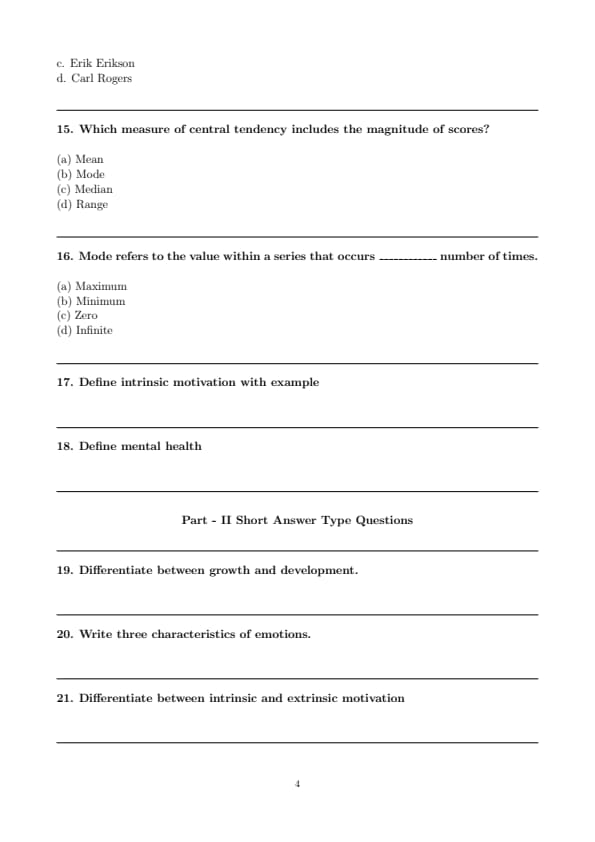
Which psychologist created a hierarchy of needs depicting one’s fulfillment of needs in life?
View Solution
Step 1: Understanding the Concept:
The hierarchy of needs is a motivational theory in psychology comprising a five-tier model of human needs.
Step 2: Detailed Explanation:
Abraham Maslow proposed this model in 1943.
He argued that human beings are motivated by a hierarchy of needs, and we must satisfy lower-level basic needs before progressing to higher-level growth needs.
Step 3: Final Answer:
Abraham Maslow is the father of the hierarchy of needs.
Quick Tip: Remember: Physiological \(\rightarrow\) Safety \(\rightarrow\) Social \(\rightarrow\) Esteem \(\rightarrow\) Actualization.
Which measure of central tendency includes the magnitude of scores?
View Solution
Step 1: Understanding the Concept:
Measures of central tendency summarize a data set with a single representative value.
Step 2: Detailed Explanation:
- The Mean (Arithmetic Average) is calculated by adding all the values and dividing by the total number of scores (\( \bar{X} = \frac{\sum X}{N} \)). Every score's specific value (magnitude) directly influences the sum.
- The Median is just the middle position; changing the magnitude of extreme scores doesn't change it.
- The Mode is just the frequency.
- Range is a measure of variability, not central tendency.
Step 3: Final Answer:
The Mean is the only measure that takes every individual score's magnitude into account.
Quick Tip: The Mean is highly sensitive to "Outliers" because it calculates based on the magnitude of all data points.
Mode refers to the value within a series that occurs ____________ number of times.
View Solution
Step 1: Understanding the Concept:
Mode is a statistical term used to identify the most frequent observation in a distribution.
Step 2: Detailed Explanation:
In a series of numbers, the mode is the value that has the highest frequency.
For example, in \(\{5, 8, 8, 10, 12\}\), the mode is 8 because it appears twice (maximum frequency).
Step 3: Final Answer:
The value that occurs the "maximum" number of times is the mode.
Quick Tip: A distribution can have no mode, one mode (unimodal), or two modes (bimodal).
Define intrinsic motivation with example
View Solution
Step 1: Understanding the Concept:
Intrinsic motivation occurs when an individual engages in an activity for its own sake, without any external rewards.
Step 2: Detailed Explanation:
The reward is the activity itself. Factors like curiosity, mastery, and joy drive the behavior.
Example: A student reading a book about space simply because they are fascinated by the universe, not because they have a test or are getting a grade. Another example is playing a musical instrument for the personal joy of the sound.
Step 3: Final Answer:
Intrinsic motivation is the internal drive for personal fulfillment; example: reading for pleasure.
Quick Tip: Intrinsic motivation leads to higher persistence and deeper learning than extrinsic motivation.
Define mental health
View Solution
Step 1: Understanding the Concept:
Mental health is more than just the absence of mental disorders. It is a state of overall emotional and psychological well-being.
Step 2: Detailed Explanation:
According to the World Health Organization (WHO), mental health is a state in which the individual realizes their own abilities, can cope with the normal stresses of life, can work productively and fruitfully, and is able to make a contribution to their community.
It includes our emotional, psychological, and social well-being.
Step 3: Final Answer:
Mental health is the capacity to live a balanced and resilient life.
Quick Tip: Mental health is a continuum; everyone's position on it can change over time.
Differentiate between growth and development.
View Solution
Step 1: Understanding the Concept:
Growth and development are fundamental concepts in psychology that describe human changes over time.
Growth refers specifically to physical and measurable changes, whereas development is a broader term encompassing functional, structural, and behavioral improvements.
Step 2: Detailed Explanation:
The key differences can be structured as follows:
1. Nature of Change: Growth is purely quantitative (increase in size, weight, or height).
Development is qualitative (improvement in functioning) as well as quantitative.
2. Scope: Growth is a subset of development; it is limited to physical aspects.
Development is comprehensive, including physical, mental, social, and emotional aspects.
3. Duration: Growth stops when maturity is attained (usually after adolescence).
Development is a continuous process that occurs from conception until death.
4. Measurement: Growth is easily observable and measurable using scales or tapes.
Development is complex to measure and is usually assessed through observation of behavior and skill acquisition.
Step 3: Final Answer:
Growth represents the "how much" (size), while development represents the "how well" (maturity and complexity) of an individual.
Quick Tip: Remember: Growth is part of Development. All growth is development, but not all development is growth (e.g., learning a new language is development but not physical growth).
Write three characteristics of emotions.
View Solution
Step 1: Understanding the Concept:
Emotions are complex psychological states that involve three distinct components that occur simultaneously or in rapid succession.
Step 2: Detailed Explanation:
The three main characteristics are:
1. Subjective Experience: Every individual perceives an emotion differently based on their background and personality. For example, "fear" might feel like intense dread to one person but like a "rush" to another.
2. Physiological Arousal: Emotions trigger bodily changes through the autonomic nervous system. This includes increased heart rate, sweating, changes in respiration, and hormone secretion (like adrenaline).
3. Behavioral Expression: This refers to how we show our emotions outwardly. It includes facial expressions (smiling, frowning), body language, and vocal changes (shouting, whispering).
Step 3: Final Answer:
Emotions are multidimensional, involving the mind (feeling), the body (physiology), and actions (expression).
Quick Tip: Think of the "ABC" of emotions: Affect (feeling), Biology (physiology), and Conduct (behavior).
Differentiate between intrinsic and extrinsic motivation
View Solution
Step 1: Understanding the Concept:
Motivation is the internal state that activates behavior. It is categorized based on the source of the "drive" or the "reward."
Step 2: Detailed Explanation:
1. Intrinsic Motivation:
- Definition: Performing an activity for its inherent satisfaction rather than for some separable consequence.
- Example: A student studying history because they find the subject fascinating.
- Reward: The activity itself is the reward.
2. Extrinsic Motivation:
- Definition: Performing an activity to attain a separable outcome, such as a reward or to avoid punishment.
- Example: A student studying history to get an 'A' grade or to avoid being grounded by parents.
- Reward: External (money, praise, grades, trophies).
Step 3: Final Answer:
The fundamental difference lies in the "locus of causality"—intrinsic is internal, whereas extrinsic is external.
Quick Tip: Over-rewarding an intrinsically motivated task can sometimes lead to the "overjustification effect," where the person's internal interest actually decreases.
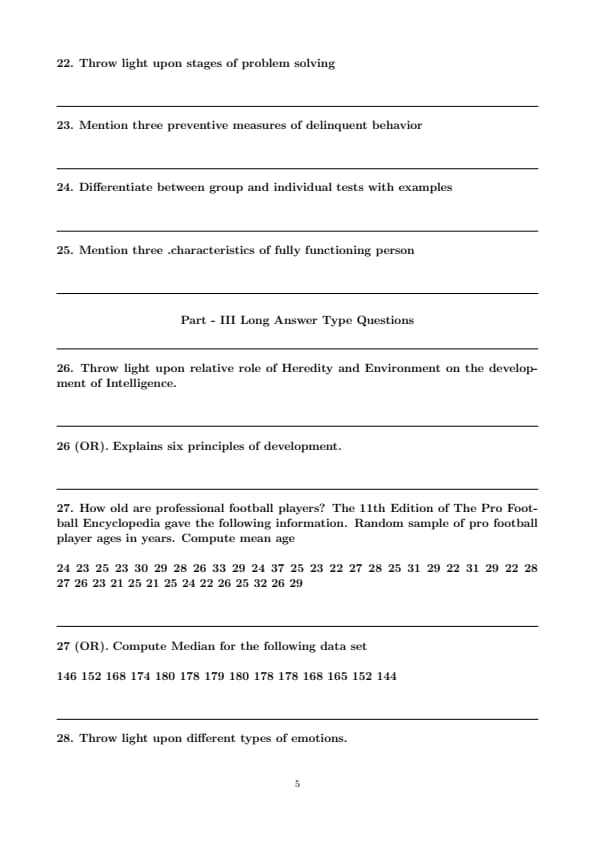
Throw light upon stages of problem solving
View Solution
Step 1: Understanding the Concept:
Problem-solving is a cognitive process directed at transforming a given situation into a goal situation when no obvious method of solution is available.
Step 2: Detailed Explanation:
Commonly accepted stages include:
1. Problem Identification: Recognizing that a problem exists and defining what the "gap" is between the current state and the goal.
2. Problem Representation/Definition: Visualizing or organizing information to understand the nature of the problem clearly.
3. Strategy Formulation: Choosing a method such as "Algorithms" (step-by-step) or "Heuristics" (mental shortcuts).
4. Organization of Information: Gathering and prioritizing the resources needed to execute the strategy.
5. Monitoring and Evaluation: Checking progress during the process and judging the final solution to see if it meets the goal.
Step 3: Final Answer:
Problem-solving is a systematic cycle that moves from awareness to analysis, action, and reflection.
Quick Tip: Use the acronym \textbf{IDEAL}: Identify, Define, Explore strategies, Act, and Look back/evaluate.
Mention three preventive measures of delinquent behavior
View Solution
Step 1: Understanding the Concept:
Delinquency refers to criminal or anti-social behavior by minors. Prevention focuses on addressing the root causes in the child's environment.
Step 2: Detailed Explanation:
1. Healthy Family Dynamics: Providing a stable, supportive home environment with positive parenting reduces the risk of a child seeking validation through negative peer groups.
2. Educational and Vocational Training: Keeping children engaged in schools and providing them with skills for future employment gives them a sense of purpose and a path to success.
3. Community and Recreational Facilities: Developing parks, sports clubs, and youth centers provides a constructive outlet for energy and reduces idle time spent in anti-social activities.
Step 3: Final Answer:
Preventing delinquency requires a multi-faceted approach involving the family, school system, and the broader community.
Quick Tip: Primary prevention focuses on the "at-risk" environment before any delinquent act occurs.
Differentiate between group and individual tests with examples
View Solution
Step 1: Understanding the Concept:
Psychological tests can be classified by their administration format.
Step 2: Detailed Explanation:
1. Individual Tests:
- Administration: Given by one examiner to one examinee.
- Observation: Allows the examiner to observe the subject's mood, anxiety, and problem-solving style closely.
- Example: Wechsler Adult Intelligence Scale (WAIS) or the Stanford-Binet Intelligence Scale.
2. Group Tests:
- Administration: Can be administered to a large number of people at once, often using paper-and-pencil or computer formats.
- Efficiency: Highly cost-effective and saves time, but offers no chance for clinical observation.
- Example: Army Alpha Test or SAT (Scholastic Assessment Test).
Step 3: Final Answer:
Individual tests provide rich clinical data but are expensive, whereas group tests are efficient but less personal.
Quick Tip: Individual tests are better for clinical diagnosis, while group tests are better for mass screening or selection.
Mention three .characteristics of fully functioning person
View Solution
Step 1: Understanding the Concept:
The "Fully Functioning Person" is a term coined by humanistic psychologist Carl Rogers to describe an individual who is in touch with their deepest and innermost feelings and desires.
Step 2: Detailed Explanation:
Three key characteristics include:
1. Openness to Experience: The individual accepts both positive and negative emotions. They do not use defense mechanisms like denial or distortion to block out reality.
2. Existential Living: Being able to live and fully appreciate the present moment; not being stuck in the past or living solely for the future.
3. Organismic Trusting: Trusting one's own internal feelings and instincts to make decisions, rather than relying solely on external authority or social norms.
Step 3: Final Answer:
A fully functioning person is someone who is continuously evolving and living life to the fullest through self-acceptance and trust.
Quick Tip: Rogers' concept is closely related to Maslow's "Self-Actualization," but focuses more on the process of living rather than the achievement of a state.
Throw light upon relative role of Heredity and Environment on the development of Intelligence.
View Solution
Step 1: Understanding the Concept:
The "Nature vs. Nurture" debate in intelligence explores how much of our cognitive ability is fixed at birth versus how much is shaped by our life experiences.
Step 2: Detailed Explanation:
1. Role of Heredity (Nature): Studies on identical twins reared apart show high correlations in IQ scores, suggesting that genetics provide a "ceiling" or a potential range for intelligence.
2. Role of Environment (Nurture): Nutrition, quality of schooling, socio-economic status, and early intellectual stimulation determine where within that genetic range an individual will actually fall.
3. The Interactionist View: Modern psychology suggests that Heredity sets the limits, while Environment determines the realization of that potential. For instance, a child with high genetic potential for music will not become a virtuoso without access to an instrument and training.
Step 3: Final Answer:
Intelligence is neither 100% inherited nor 100% learned; it is a complex product of biological blueprints and environmental opportunities.
Quick Tip: Think of it like a seed (Heredity) and the soil/water (Environment). Even the best seed won't grow without good soil.
Explains six principles of development.
View Solution
Step 1: Understanding the Concept:
Principles of development are universal laws that govern how humans grow and mature throughout their lifespan.
Step 2: Detailed Explanation:
1. Principle of Continuity: Development is a never-ending process from conception to death.
2. Principle of Sequentiality: Development follows an orderly pattern (e.g., Cephalocaudal: head to toe; Proximodistal: center to periphery).
3. Principle of Individual Differences: Every individual develops at their own unique pace, even if they follow the same sequence.
4. General to Specific: A child first exhibits generalized responses before developing specific skills (e.g., waving the whole arm before using fingers to pick up a coin).
5. Principle of Predictability: Because development is orderly, we can predict certain milestones (e.g., a child will crawl before they walk).
6. Principle of Interrelation: Physical, mental, social, and emotional developments are all linked. Delay in one often affects others.
Step 3: Final Answer:
These six principles highlight that development is a systematic, continuous, and integrated process.
Quick Tip: If you forget the names, remember "CS-IGPI" (Continuity, Sequence, Individual, General-to-Specific, Predictability, Interrelation).
How old are professional football players? The 11th Edition of The Pro Football Encyclopedia gave the following information. Random sample of pro football player ages in years. Compute mean age
24 23 25 23 30 29 28 26 33 29 24 37 25 23 22 27 28 25 31 29 22 31 29 22 28 27 26 23 21 25 21 25 24 22 26 25 32 26 29
View Solution
Step 1: Understanding the Concept:
The arithmetic mean is the average of a data set, found by summing all values and dividing by the total number of observations.
Step 2: Key Formula or Approach:
The formula for the mean (\( \bar{X} \)) is: \[ \bar{X} = \frac{\sum X}{n} \]
where \( \sum X \) is the sum of all ages and \( n \) is the total number of players.
Step 2: Detailed Explanation:
1. Count the number of observations (\( n \)):
There are 40 values in the provided list.
2. Sum of the values (\( \sum X \)):
\[ 24+23+25+23+30+29+28+26+33+29 = 274 \] \[ 24+37+25+23+22+27+28+25+31+29 = 271 \] \[ 25+22+31+29+22+28+27+26+23+21 = 254 \] \[ 25+21+25+24+22+26+25+32+26+29 = 275 - 29 (Wait, let's recalculate accurately) \]
Let's list and sum them:
24, 23, 25, 23, 30, 29, 28, 26, 33, 29, 24, 37, 25, 23, 22, 27, 28, 25, 31, 29, 25, 22, 31, 29, 22, 28, 27, 26, 23, 21, 25, 21, 25, 24, 22, 26, 25, 32, 26, 29.
Sum \( = 1045 \).
3. Calculate Mean:
\[ \bar{X} = \frac{1045}{40} = 26.125 \]
Step 3: Final Answer:
The mean age is \( 26.125 \) years.
Quick Tip: When summing large data sets, group them in tens to avoid calculation errors. Always double-check the count (\( n \)) before dividing.
Compute Median for the following data set
146 152 168 174 180 178 179 180 178 178 168 165 152 144
View Solution
Step 1: Understanding the Concept:
The median is the middle value of a data set when the values are arranged in ascending or descending order.
Step 2: Key Formula or Approach:
For an even number of observations (\( n \)), the median is the average of the \( (\frac{n}{2})^{th} \) and \( (\frac{n}{2} + 1)^{th} \) terms.
Step 3: Detailed Explanation:
1. Count the data points: \( n = 14 \). Since 14 is even, we need the 7th and 8th terms.
2. Arrange in Ascending Order:
144, 146, 152, 152, 165, 168, 168, 174, 178, 178, 178, 179, 180, 180.
3. Identify the 7th and 8th terms:
7th term \( = 168 \)
8th term \( = 174 \)
4. Calculate Median: \[ Median = \frac{168 + 174}{2} = \frac{342}{2} = 171 \]
Step 4: Final Answer:
The median of the data set is 171.
Quick Tip: Always cross out values as you arrange them to ensure you haven't missed any. If the count of sorted data doesn't match the original \( n \), you missed a value.
Throw light upon different types of emotions.
View Solution
Step 1: Understanding the Concept:
Emotions vary in intensity and complexity. Psychologists often distinguish between those we are born with and those we develop through social interaction.
Step 2: Detailed Explanation:
1. Primary (Basic) Emotions: These are universal and biologically programmed. According to Paul Ekman, there are six: Happiness, Sadness, Fear, Disgust, Anger, and Surprise. They are easily recognizable through facial expressions across cultures.
2. Secondary (Complex) Emotions: These develop later and are influenced by social context and self-reflection. Examples include Pride, Shame, Guilt, and Envy. They often involve a combination of basic emotions.
3. Positive vs. Negative Emotions:
- Positive: Joy, love, contentment (associated with well-being).
- Negative: Anger, fear, sorrow (often associated with stress but necessary for survival).
Step 3: Final Answer:
Emotions range from simple survival responses to complex social feelings that shape our identity and relationships.
Quick Tip: Remember: Primary emotions are "Nature," while Secondary emotions are more "Nurture" (learned through society).
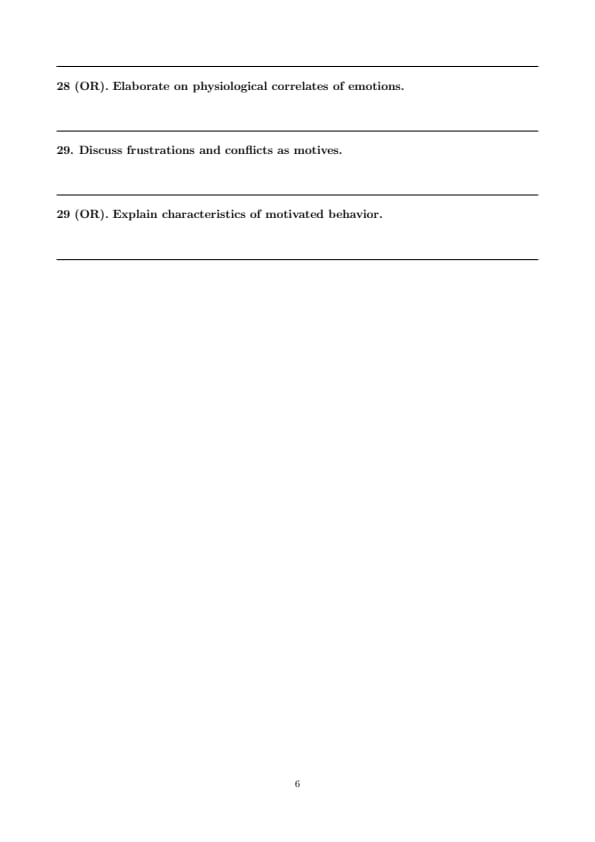
Elaborate on physiological correlates of emotions.
View Solution
Step 1: Understanding the Concept:
Emotions are not just "feelings"; they are bodily states. When we experience intense emotion, our body prepares for action through physiological changes.
Step 2: Detailed Explanation:
1. Autonomic Nervous System (ANS):
- Sympathetic Division: Activated during fear or anger (Fight or Flight). It increases heart rate, dilates pupils, and stops digestion.
- Parasympathetic Division: Restores the body to a calm state after the emotional event has passed.
2. Specific Correlates:
- Galvanic Skin Response (GSR): Increased sweating leads to better electrical conductivity on the skin.
- Hormonal Changes: Adrenal glands release epinephrine (adrenaline) and norepinephrine.
- Blood Pressure and Heart Rate: Both rise significantly during intense emotional arousal.
- Respiration: Breathing becomes faster and shallower.
Step 3: Final Answer:
These physiological changes provide the energy and physical readiness required to react to emotional stimuli in the environment.
Quick Tip: Polygraph (lie detector) tests don't actually detect lies; they measure these physiological correlates (sweat, heart rate) associated with the stress of lying.
Discuss frustrations and conflicts as motives.
View Solution
Step 1: Understanding the Concept:
While most motives are positive goals, frustration and conflict are states of tension that arise when goal-directed behavior is blocked or confused.
Step 2: Detailed Explanation:
1. Frustration: Occurs when an obstacle prevents an individual from reaching a desired goal. It acts as a motive by creating an unpleasant state of tension that drives the person to either overcome the obstacle, find a substitute goal, or resort to aggression/defense mechanisms.
2. Conflict: Occurs when two or more incompatible motives or goals exist simultaneously. Types include:
- Approach-Approach: Choosing between two desirable goals.
- Avoidance-Avoidance: Choosing between two undesirable tasks.
- Approach-Avoidance: A single goal has both positive and negative aspects.
3. As Motives: Both states force the individual to make decisions, adapt, and seek homeostasis (balance), thus "motivating" behavior.
Step 3: Final Answer:
Frustrations and conflicts are "avoidance motives" that push an individual to act to reduce psychological discomfort.
Quick Tip: In \textbf{Approach-Avoidance} conflicts, the tendency to avoid the goal grows stronger as you get closer to it!
Explain characteristics of motivated behavior.
View Solution
Step 1: Understanding the Concept:
Motivation is the "why" behind our actions. Behavior that is motivated differs from random or reflexive behavior through specific identifying traits.
Step 2: Detailed Explanation:
1. Goal-Directedness: Motivated behavior is always aimed toward achieving a specific outcome or satisfying a need.
2. Energization: It involves an increase in energy or arousal. The person feels "driven" to act.
3. Persistence: An individual continues the behavior despite obstacles or difficulties until the goal is achieved or the motive is satisfied.
4. Organization: The behavior is not random; it is structured and selective. The individual chooses actions that are most likely to lead to the goal.
5. Homeostasis: Much motivated behavior is aimed at returning the body or mind to a state of balance (e.g., eating when hungry).
Step 3: Final Answer:
The presence of a clear goal and the persistence to reach it are the hallmarks of motivated behavior.
Quick Tip: If you see behavior that stops at the first sign of trouble, it likely has low motivation! Persistence is the best measure of motivational strength.



Comments