




The PSEB Class 12 Biology exam in 2025 was conducted on March 17, 2025, with the question paper and solutions available post-exam. The exam tests understanding of Introductory Microeconomics, including consumer behavior and market forms, as well as Introductory Macroeconomics, covering national income, money and banking, government budget, and open economy macroeconomics.
Students must attempt a combination of multiple-choice, objective, short, and long answer questions in 3 hours. The paper totals 100 marks, comprising 80 marks for the theory component and 20 marks for internal assessment, with no negative marking for incorrect answers.
PSEB Class 12 Biology 2025 Question Paper with Solutions PDF(Set A)
| PSEB Class 12 Biology 2025 Question Paper with Solutions PDF(Set A) | Download PDF | Check Solutions |
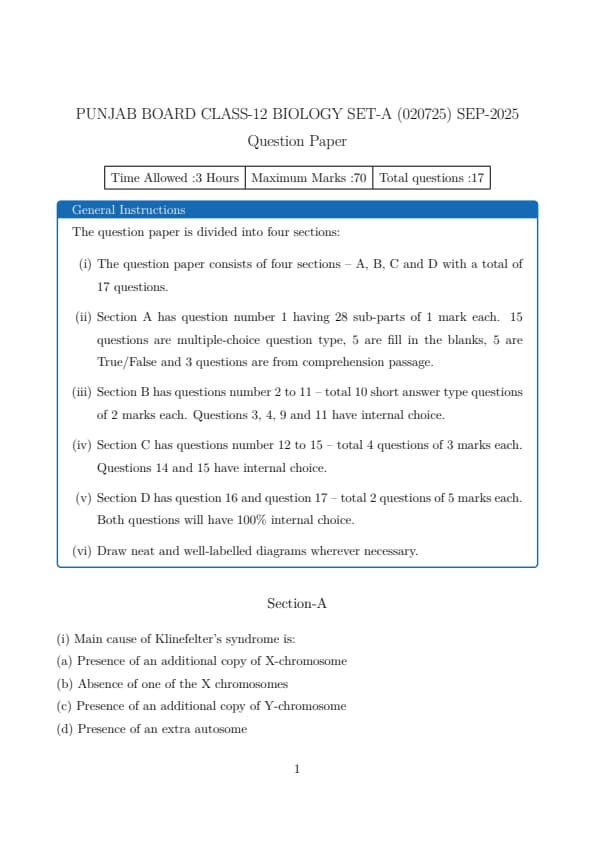
Main cause of Klinefelter's syndrome is:
View Solution
Step 1: Klinefelter's syndrome is a genetic condition caused by a chromosomal aberration in males.
Step 2: It results from the presence of an extra X chromosome, leading to a karyotype of \(47, XXY\).
Step 3: This additional X chromosome interferes with male sexual development, often resulting in sterile individuals with some feminine characteristics (e.g., gynecomastia). Quick Tip: Remember: Turner's Syndrome is the absence of an X chromosome (\(45, XO\)), while Klinefelter's is an extra X chromosome (\(47, XXY\)).
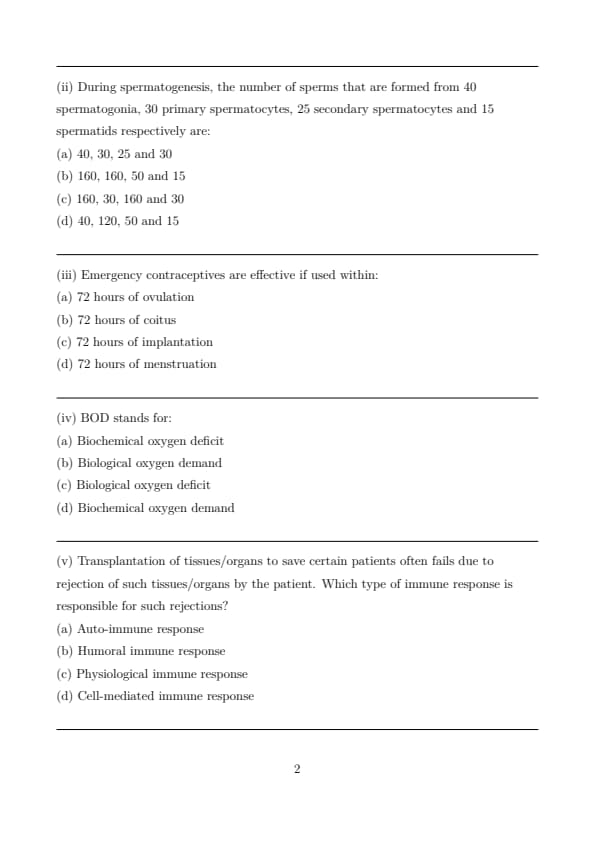
During spermatogenesis, the number of sperms that are formed from 40 spermatogonia, 30 primary spermatocytes, 25 secondary spermatocytes and 15 spermatids respectively are:
View Solution
Step 1: One **Spermatogonium** produces one primary spermatocyte (ratio 1:1), but if we consider the ultimate yield after complete maturation, 40 spermatogonia eventually produce 160 sperms (4 each). However, in these specific multiple-choice contexts, spermatogonia are often counted 1:1 for the initial stage.
Step 2: One **Primary Spermatocyte** undergoes Meiosis I and II to produce 4 sperms. So, \(30 \times 4 = 120\).
Step 3: One **Secondary Spermatocyte** undergoes Meiosis II to produce 2 sperms. So, \(25 \times 2 = 50\).
Step 4: One **Spermatid** undergoes spermiogenesis (differentiation) to become 1 sperm. So, \(15 \times 1 = 15\). Quick Tip: Primary spermatocytes are diploid (\(2n\)) and produce 4 haploid sperms, whereas secondary spermatocytes are already haploid (\(n\)) and produce only 2 sperms each.
Emergency contraceptives are effective if used within:
View Solution
Step 1: Emergency contraceptives (like i-pill or Saheli) are used to prevent unintended pregnancy after unprotected sexual intercourse.
Step 2: They work primarily by delaying ovulation or interfering with fertilization.
Step 3: For maximum effectiveness, they must be administered within 72 hours (3 days) of coitus (intercourse). Quick Tip: The sooner an emergency contraceptive is taken after unprotected sex, the higher the percentage of effectiveness in preventing pregnancy.
BOD stands for:
View Solution
Step 1: BOD is a measure of the amount of dissolved oxygen needed by aerobic biological organisms to break down organic material present in a given water sample.
Step 2: High BOD indicates that the water is highly polluted with organic waste, as microbes are consuming more oxygen to decompose it.
Step 3: It is a key parameter used in sewage treatment and monitoring water quality. Quick Tip: High BOD = High Pollution = Low Dissolved Oxygen (DO). They are inversely proportional.
Transplantation of tissues/organs to save certain patients often fails due to rejection of such tissues/organs by the patient. Which type of immune response is responsible for such rejections?
View Solution
Step 1: When an organ is transplanted, the recipient's immune system identifies the new tissue as "non-self" or foreign.
Step 2: The **Cell-mediated immune response (CMI)**, involving T-lymphocytes, is primarily responsible for detecting these foreign antigens on the graft.
Step 3: T-cells then attack and destroy the transplanted cells, leading to graft rejection. This is why immunosuppressants are required for life after a transplant. Quick Tip: Humoral immunity involves B-cells and antibodies in the blood, while Cell-mediated immunity involves T-cells and is the main culprit in organ rejection.
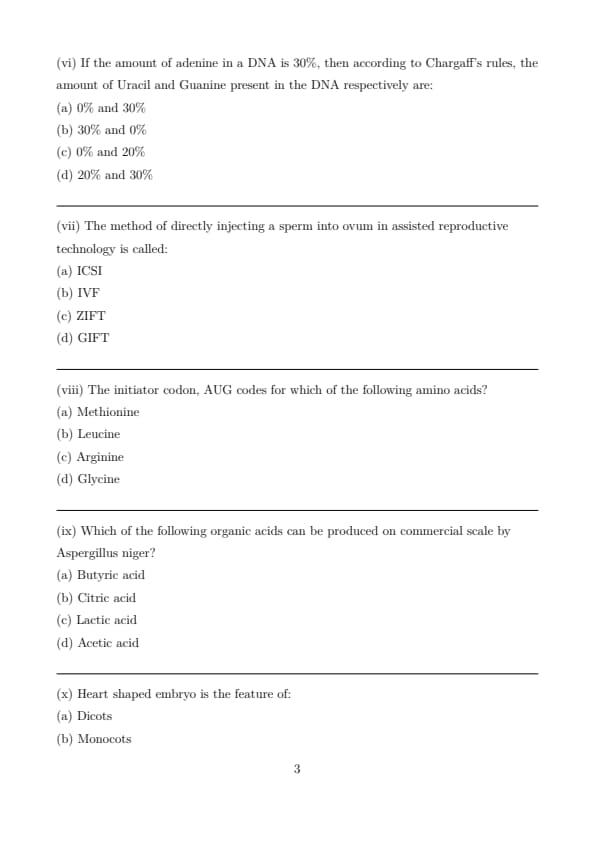
If the amount of adenine in a DNA is 30%, then according to Chargaff's rules, the amount of Uracil and Guanine present in the DNA respectively are:
View Solution
Step 1: Chargaff's Rule states that in DNA, \(A=T\) and \(G=C\). Also, the total percentage of purines equals pyrimidines (\(50%:50%\)).
Step 2: If \(A = 30%\), then \(T\) must also be \(30%\). Together, \(A + T = 60%\).
Step 3: The remaining \(40%\) must be \(G + C\). Since \(G=C\), then \(G = 20%\) and \(C = 20%\).
Step 4: **Uracil** is not present in DNA; it is only found in RNA. Therefore, Uracil is \(0%\). Quick Tip: Always check the molecule type in the question! Uracil is the "imposter" in DNA questions; its value will always be \(0\) for a DNA molecule.
The method of directly injecting a sperm into ovum in assisted reproductive technology is called:
View Solution
Step 1: **ICSI** stands for **Intra-Cytoplasmic Sperm Injection**. It is a specialized form of IVF.
Step 2: In this procedure, a single sperm is picked up with a fine glass needle and injected directly into the cytoplasm of the egg (ovum).
Step 3: This is particularly helpful in cases of severe male infertility where sperm count or motility is extremely low. Quick Tip: Do not confuse ICSI with IVF. IVF is the broad term for fertilization in a lab, while ICSI is the specific technique of "direct injection."
The initiator codon, AUG codes for which of the following amino acids?
View Solution
Step 1: AUG is known as the **start codon** or initiator codon because it marks the site where translation (protein synthesis) begins.
Step 2: In eukaryotes, AUG always codes for the amino acid **Methionine**.
Step 3: It has a dual function: it codes for an amino acid and also acts as the "start" signal for the ribosome. Quick Tip: Remember the mnemonic "AUG starts the engine with Met" (Methionine).
Which of the following organic acids can be produced on commercial scale by Aspergillus niger?
View Solution
Step 1: *Aspergillus niger* is a fungus (specifically a black mold).
Step 2: It is widely used in the food and beverage industry for the large-scale production of **Citric acid**.
Step 3: For comparison: *Acetobacter aceti* produces Acetic acid, *Lactobacillus* produces Lactic acid, and *Clostridium butylicum* produces Butyric acid. Quick Tip: Think of "Aspergillus" as the fungus that makes your citrus-flavored sodas possible!
Heart shaped embryo is the feature of:
View Solution
Step 1: During embryogeny in **dicotyledonous** plants, the zygote gives rise to the proembryo.
Step 2: The development follows a specific sequence of shapes: Globular \(\rightarrow\) **Heart-shaped** \(\rightarrow\) Mature embryo.
Step 3: The two "lobes" of the heart eventually develop into the two cotyledons characteristic of dicots. Quick Tip: Monocots do not show a distinct heart-shaped stage because they only develop a single cotyledon (scutellum).
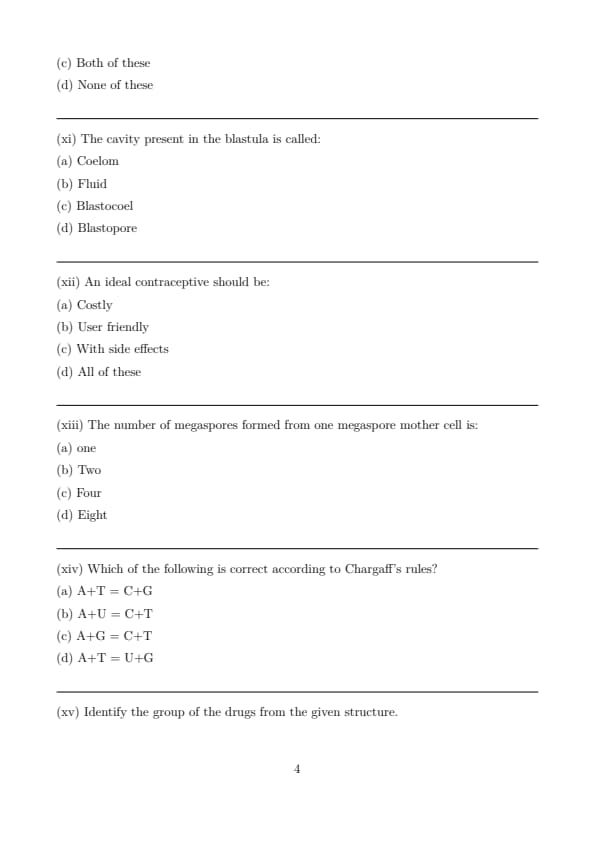
The cavity present in the blastula is called:
View Solution
Step 1: After fertilization, the zygote undergoes cleavage to form a solid ball of cells called the morula.
Step 2: This morula transforms into a hollow ball of cells known as the **blastula** (or blastocyst in humans).
Step 3: The central, fluid-filled internal cavity that forms within the blastula is the **blastocoel**. It serves to separate the inner cell mass from the outer trophoblast in mammals. Quick Tip: Don't confuse Blastocoel with Blastopore. The blastocoel is the cavity inside, while the blastopore is the opening that forms later during gastrulation.
An ideal contraceptive should be:
View Solution
Step 1: According to reproductive health standards, a contraceptive must meet certain criteria to be effective for a population.
Step 2: An ideal contraceptive should be **user-friendly**, easily available, effective, and reversible with no or least side effects.
Step 3: It should also not interfere with the sexual drive or desire of the user. Quick Tip: "Ideal" in biology refers to the most efficient and least harmful version of a tool or process.
The number of megaspores formed from one megaspore mother cell is:
View Solution
Step 1: The process of formation of megaspores from the Megaspore Mother Cell (MMC) is called megasporogenesis.
Step 2: The MMC (which is diploid, \(2n\)) undergoes **meiosis** (reduction division).
Step 3: Meiosis always results in the formation of a linear tetrad of **four** haploid (\(n\)) megaspores. Quick Tip: While four megaspores are formed, in most flowering plants, three of them degenerate, and only one remains functional to develop into the embryo sac.
Which of the following is correct according to Chargaff's rules?
View Solution
Step 1: Chargaff's base-pairing rule states that Adenine (\(A\)) pairs with Thymine (\(T\)), and Guanine (\(G\)) pairs with Cytosine (\(C\)). Therefore, \(A=T\) and \(G=C\).
Step 2: Chargaff also stated that the total number of Purines (\(A+G\)) always equals the total number of Pyrimidines (\(T+C\)).
Step 3: Therefore, \(A+G = T+C\) (or \(C+T\)). This proves that the ratio of purines to pyrimidines is always \(1:1\). Quick Tip: \(A+T\) does NOT necessarily equal \(G+C\). The ratio of \((A+T)/(G+C)\) varies between different species.
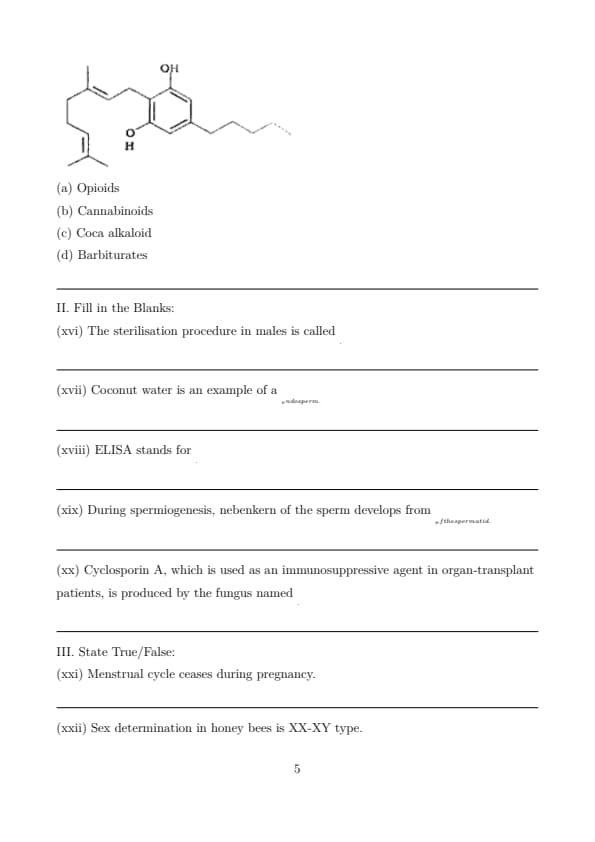
Identify the group of the drugs from the given structure.
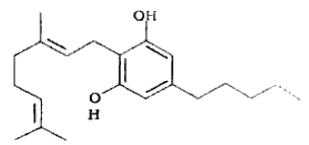
View Solution
Step 1: In Biology textbooks (NCERT), chemical structures are provided for Morphine (Opioid) and **Cannabinoid molecules**.
Step 2: Cannabinoids are a group of chemicals that interact with cannabinoid receptors in the brain. They are naturally obtained from the inflorescences of the plant *Cannabis sativa*.
Step 3: They are known for their effects on the cardiovascular system of the body. Quick Tip: Opioid structures (like Morphine) usually feature a complex multi-ring system with a nitrogen atom, while Cannabinoid structures feature characteristic phenolic and pyran rings.
The sterilisation procedure in males is called ________.
View Solution
Step 1: Vasectomy is a surgical procedure for male sterilization or permanent contraception.
Step 2: During the procedure, the **vasa deferentia** (the ducts that transmit sperm) are cut, tied, or sealed.
Step 3: This prevents sperm from entering into the seminal stream (ejaculate) and thereby prevents fertilization. Quick Tip: Remember: \textbf{V}asectomy involves the \textbf{V}as deferens (Males), while \textbf{T}ubectomy involves the Fallopian \textbf{T}ubes (Females).
Coconut water is an example of a ________ endosperm.
View Solution
Step 1: In the development of a coconut, the primary endosperm nucleus undergoes successive nuclear divisions without immediate cell wall formation.
Step 2: This results in a large number of free nuclei suspended in fluid, known as **free-nuclear endosperm**.
Step 3: The surrounding white kernel (the "meat") is the cellular endosperm. Quick Tip: The coconut water is technically thousands of nuclei! It is one of the most common examples used to demonstrate nuclear endosperm in botany.
ELISA stands for ________.
View Solution
Step 1: ELISA is a biochemical technique used mainly in immunology to detect the presence of an antibody or an antigen in a sample.
Step 2: It is based on the principle of **antigen-antibody interaction**.
Step 3: It is commonly used as a diagnostic tool for diseases like AIDS (caused by HIV). Quick Tip: While ELISA is a very sensitive "screening test" for HIV, the "Western Blot" is used as a "confirmatory test."
During spermiogenesis, nebenkern of the sperm develops from ________ of the spermatid.
View Solution
Step 1: Spermiogenesis is the transformation of a non-motile spermatid into a motile spermatozoon.
Step 2: The **mitochondria** of the spermatid aggregate and twist around the proximal part of the axial filament in the middle piece.
Step 3: This spiral arrangement of mitochondria is specifically called the **nebenkern**, which provides energy (ATP) for sperm motility. Quick Tip: The nebenkern is essentially the "engine room" of the sperm, located in the middle piece.
Cyclosporin A, which is used as an immunosuppressive agent in organ-transplant patients, is produced by the fungus named ________.
View Solution
Step 1: Cyclosporin A is a bioactive molecule that inhibits the T-cell mediated immune response.
Step 2: It is used to prevent the patient's body from rejecting a newly transplanted organ.
Step 3: It is extracted commercially from the fungus Trichoderma polysporum. Quick Tip: Don't confuse this with Statins, which are blood-cholesterol lowering agents produced by the yeast \textit{Monascus purpureus.
Menstrual cycle ceases during pregnancy.
View Solution
Step 1: After fertilization, the corpus luteum continues to secrete high levels of progesterone.
Step 2: High progesterone levels maintain the endometrial lining of the uterus to support the developing fetus and inhibit the release of FSH and LH from the pituitary.
Step 3: This suppression prevents the maturation of new follicles and the shedding of the uterine lining, thereby ceasing the menstrual cycle for the duration of the pregnancy. Quick Tip: The absence of a menstrual period is often the first clinical indication of pregnancy in a healthy, reproductive-age woman.
Sex determination in honey bees is XX-XY type.
View Solution
Step 1: In honey bees, sex determination is based on the number of sets of chromosomes an individual receives, known as the **haplo-diploid** system.
Step 2: An offspring formed from the union of a sperm and an egg develops as a female (Queen or Worker) and is diploid (\(2n = 32\)).
Step 3: An unfertilized egg develops as a male (Drone) by means of parthenogenesis and is haploid (\(n = 16\)). The XX-XY system is found in humans and fruit flies. Quick Tip: In honey bees, males (drones) do not have a father and cannot have sons, but they do have a grandfather and can have grandsons.
Floral parts are un-wettable in case of hydrophilous flowers.
View Solution
Step 1: Hydrophilous flowers are those that are pollinated by water.
Step 2: To protect the floral parts and pollen grains from damage due to constant water exposure, they are covered with a **mucilaginous coating**.
Step 3: This waxy/mucilaginous layer makes the floral parts un-wettable, ensuring that the pollen remains viable and light enough to be carried by water currents. Quick Tip: Common examples of hydrophilous plants include Vallisneria, Hydrilla, and Zostera (sea grass).
Organic farming does not include chemical fertilizers.
View Solution
Step 1: Organic farming is a holistic production management system which promotes and enhances agro-ecosystem health.
Step 2: It strictly avoids the use of synthetic inputs such as chemical fertilizers, pesticides, and growth regulators.
Step 3: Instead, it relies on crop rotations, green manures, compost, and biological pest control to maintain soil fertility and plant health. Quick Tip: Organic farming is not just about avoiding chemicals; it’s about working with the natural biological cycles of the soil.
A child may have O blood group if his father and mother have A and AB blood group respectively.
View Solution
Step 1: The O blood group is recessive and requires the genotype \(ii\). This means both parents must contribute an '\(i\)' allele.
Step 2: A father with A blood group could be \(I^A I^A\) or \(I^A i\). A mother with AB blood group has the genotype \(I^A I^B\).
Step 3: Since the mother only possesses \(I^A\) and \(I^B\) alleles, she cannot pass on the recessive '\(i\)' allele. Therefore, it is impossible for the child to have the \(ii\) genotype (O group). Quick Tip: An AB parent can never have an O group child, and an O group parent can never have an AB group child.
The lymphoid organs are the part of which system of human body?
View Solution
Step 1: As per the passage, lymphoid organs are responsible for the maturation and proliferation of lymphocytes.
Step 2: Lymphocytes (B-cells and T-cells) are the primary cells responsible for the body's defense mechanism.
Step 3: Therefore, these organs constitute the **Immune System**, which protects the body against pathogens and foreign antigens. Quick Tip: The immune system is not just a single organ but a complex network of cells, tissues, and organs spread throughout the body.
What are primary lymphoid organs?
View Solution
Step 1: According to the passage, primary lymphoid organs serve as the "training ground" for immune cells.
Step 2: In these organs, immature lymphocytes undergo genetic rearrangement and maturation.
Step 3: The result is the production of **antigen-sensitive lymphocytes**, which are capable of recognizing specific foreign invaders but have not yet encountered them. Quick Tip: Think of primary lymphoid organs as the "schools" where immune cells learn to recognize enemies, and secondary organs as the "battlefields" where they actually fight them.
Name one primary lymphoid organ and one secondary lymphoid organ found in the human body.
View Solution
Step 1: Primary Lymphoid Organ: Bone marrow is where all blood cells (including B-lymphocytes) are produced and where B-cells mature. The Thymus is where T-lymphocytes mature.
Step 2: Secondary Lymphoid Organ: The Spleen acts as a filter for the blood, trapping blood-borne microorganisms. Lymph nodes trap microorganisms that enter the lymph and tissue fluid.
Step 3: Other secondary organs include Tonsils and Peyer's patches of the small intestine. Quick Tip: The Bone Marrow is the main lymphoid organ where all lymphocytes are produced, regardless of where they eventually mature.
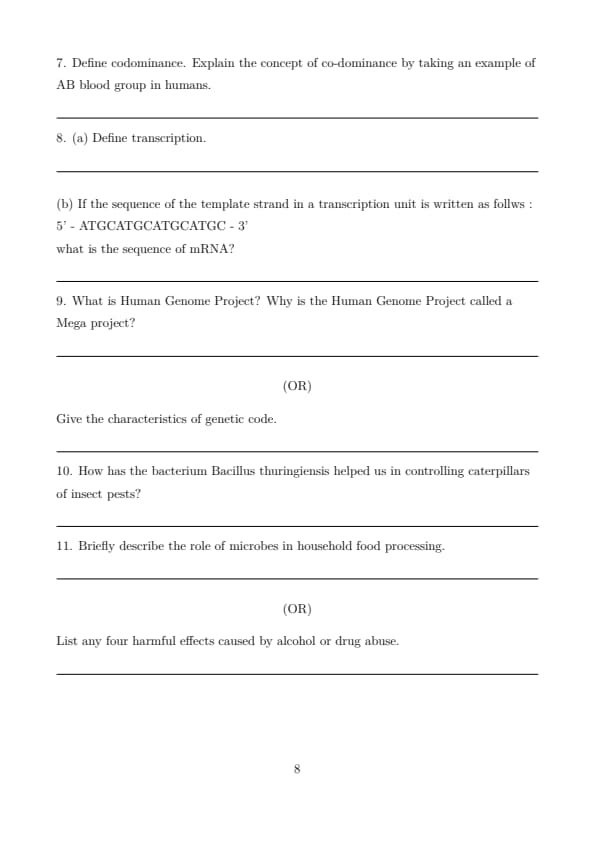
Draw a neat and well-labelled diagram of a transverse section of a young anther.
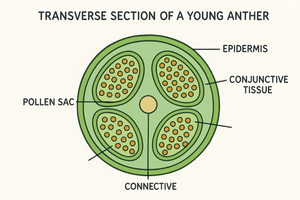
View Solution
Step 1: A young anther is a bithecal and tetrasporangiate structure. In transverse section, it appears as a four-sided structure with four microsporangia.
Step 2: The anther wall consists of four layers: the Epidermis (outermost protection), Endothecium (helps in dehiscence), Middle layers, and the Tapetum (innermost nutrient-providing layer).
Step 3: The center of each microsporangium is occupied by Sporogenous tissue, which eventually produces pollen grains. Quick Tip: The tapetum cells are often multinucleated and possess dense cytoplasm to nourish the developing pollen grains.
Define infertility. Explain any one assisted reproductive technology to check the problem of infertility.
View Solution
Step 1: Definition - Infertility is the inability to produce children even after two years of regular, unprotected sexual intercourse.
Step 2: ART (ZIFT) - Zygote Intra Fallopian Transfer (ZIFT) is a method where the zygote or early embryo (up to 8 blastomeres) is transferred into the fallopian tube.
Step 3: Process - In this, fertilization is performed in a laboratory (In-vitro), and then the zygote is surgically placed into the woman's fallopian tube to continue natural development. Quick Tip: IVF (In-Vitro Fertilization) followed by Embryo Transfer (ET) is popularly known as the "test-tube baby" procedure.
What is Amniocentesis? For what purpose, it is used?
View Solution
Step 1: Definition - Amniocentesis is a fetal sex determination and disorder test based on the chromosomal pattern in the amniotic fluid surrounding the developing embryo.
Step 2: Purpose - It is primarily used to detect genetic disorders such as Down's syndrome, haemophilia, or sickle-cell anemia in the fetus through chromosomal analysis.
Step 3: Legal Aspect - While scientifically useful, it is often misused for female foeticide, which has led to a statutory ban on sex determination in India. Quick Tip: Amniotic fluid contains fetal skin cells and various proteins that allow for detailed chromosomal analysis.
State and explain Mendel's law of dominance with the help of an example.
View Solution
Step 1: Statement - The Law of Dominance states that in a pair of dissimilar factors (alleles), one member of the pair dominates (dominant) and the other fails to express itself (recessive).
Step 2: Example - Crossing a homozygous Tall (\(TT\)) pea plant with a homozygous Dwarf (\(tt\)) plant.
Step 3: Result - In the \(F_1\) generation, all plants are Tall (\(Tt\)). Although both factors are present, the 'Tall' trait dominates the 'Dwarf' trait. Quick Tip: The dominant allele is always written with a capital letter, while the recessive version is written in lowercase.
A woman carrier for haemophilia marries a normal man. Predict the possible genotypes and phenotypes of the offspring using a Punnett square. Also state percentages.
View Solution
Step 1: Parental Genotypes - Carrier Mother: \(X^{H}X^{h}\); Normal Father: \(X^{H}Y\).
Step 2: Punnett Square - The cross yields four genotypes: \(X^{H}X^{H}\) (Normal Female), \(X^{H}X^{h}\) (Carrier Female), \(X^{H}Y\) (Normal Male), and \(X^{h}Y\) (Haemophilic Male).
Step 3: Statistics -
(a) Normal males: 25% of total offspring (or 50% of all sons).
(b) Carrier for haemophilia: 25% of total offspring (or 50% of all daughters). Quick Tip: Haemophilia is a sex-linked recessive disorder, which is why it predominantly affects males.
What happens to the corpus luteum in human females if the ovum is (a) fertilised (b) not fertilised?
View Solution
Step 1: (a) Fertilised - The corpus luteum is maintained by the hormone hCG. It continues to secrete Progesterone, which maintains the endometrium for pregnancy.
Step 2: (b) Not fertilised - In the absence of fertilization, the corpus luteum degenerates.
Step 3: Result - Its degeneration into the Corpus albicans leads to a drop in progesterone levels, causing the breakdown of the endometrium and the onset of menstruation. Quick Tip: Progesterone is often called the "pregnancy hormone" because of its role in maintaining the uterine environment.
Distinguish between innate and acquired immunity.
View Solution
Step 1: Innate Immunity - It is a non-specific type of defense that is present at the time of birth. It consists of four types of barriers: physical, physiological, cellular, and cytokine barriers.
Step 2: Acquired Immunity - It is pathogen-specific and is characterized by memory. It is acquired by the body after birth upon exposure to pathogens.
Step 3: Key Difference - Innate immunity provides immediate but general protection, while acquired immunity involves a primary and secondary response mediated by B-lymphocytes and T-lymphocytes. Quick Tip: Think of Innate immunity as the "built-in" security system and Acquired immunity as the "learned" defense system that recognizes specific enemies.
Define codominance. Explain the concept of co-dominance by taking an example of AB blood group in humans.
View Solution
Step 1: Definition - Codominance is a phenomenon in which both the alleles of a gene pair in a heterozygote are fully expressed, resulting in an offspring with a phenotype that is neither dominant nor recessive.
Step 2: AB Blood Group Example - Human blood groups are controlled by the gene \(I\), which has three alleles: \(I^A\), \(I^B\), and \(i\). Alleles \(I^A\) and \(I^B\) are both dominant over \(i\).
Step 3: Expression - When a person has the genotype \(I^A I^B\), both alleles express their own types of sugars on the surface of red blood cells. This results in the AB blood group, showcasing codominance. Quick Tip: In incomplete dominance, the traits "blend" (like pink flowers), but in codominance, "both" traits show up clearly (like AB blood).
(a) Define transcription.
View Solution
Transcription is the process of copying genetic information from one strand of the DNA into RNA. This process is governed by the principle of complementarity and is catalyzed by the enzyme DNA-dependent RNA polymerase. Quick Tip: Always remember: RNA contains Uracil (\(U\)) instead of Thymine (\(T\)).
If the sequence of the template strand in a transcription unit is written as follws :
5' - ATGCATGCATGCATGC - 3'
what is the sequence of mRNA?
View Solution
Step 1: The mRNA is synthesized complementary to the template strand but in the opposite polarity.
Step 2: If the template is 5' to 3', the mRNA will be 3' to 5'. Adenine (\(A\)) pairs with Uracil (\(U\)) in RNA, and Cytosine (\(C\)) pairs with Guanine (\(G\)).
Step 3: Result - The complementary sequence for 5' - ATGCATGCATGCATGC - 3' is:
3' - UACGUACGUACGUACG - 5' (or 5' - GCAUGCaugcaugcau - 3'). Quick Tip: Always remember: RNA contains Uracil (\(U\)) instead of Thymine (\(T\)).
What is Human Genome Project? Why is the Human Genome Project called a Mega project?
View Solution
Step 1: Definition - The Human Genome Project (HGP) was an international scientific research project with the goal of determining the base pairs that make up human DNA and mapping all the genes of the human genome.
Step 2: Scale - It is called a "Mega Project" because of its sheer scale. The human genome has approximately \(3 \times 10^9\) base pairs. If the cost was
(3 per base pair, the total cost would be
)9 billion.
Step 3: Data Handling - If the sequences were stored in books, it would require 3300 books, each with 1000 pages and 1000 letters per page. This required the development of high-speed computational devices (Bioinformatics). Quick Tip: HGP was a 13-year project coordinated by the U.S. Department of Energy and the National Institute of Health.
Give the characteristics of genetic code.
View Solution
1. Triplet nature: Each codon is made of three nitrogenous bases. There are 64 codons in total.
2. Universal: The code is nearly universal; for example, from bacteria to humans, UUU codes for Phenylalanine.
3. Degenerate: Some amino acids are coded by more than one codon.
4. Non-overlapping and Commaless: The code is read in mRNA in a contiguous fashion without any punctuation.
5. Initiation and Termination: AUG acts as the initiator codon. UAA, UAG, and UGA are stop (nonsense) codons. Quick Tip: AUG has dual functions: it codes for Methionine and acts as an initiator codon.
How has the bacterium Bacillus thuringiensis helped us in controlling caterpillars of insect pests?
View Solution
Step 1: BT Toxin - \textit{Bacillus thuringiensis (\(Bt\)) produces protein crystals during a specific phase of their growth which contain a toxic insecticidal protein.
Step 2: Mode of Action - When a caterpillar ingests the toxin, it is converted into an active form due to the alkaline \(pH\) of the insect's gut.
Step 3: Effect - The activated toxin binds to the surface of midgut epithelial cells and creates pores, causing cell swelling and lysis, which eventually leads to the death of the insect. This technology is used to create \(Bt\)-Cotton. Quick Tip: The \(Bt\) toxin is initially an inactive "protoxin" so that it doesn't kill the bacterium itself.
Briefly describe the role of microbes in household food processing.
View Solution
Step 1: Curd formation - Microorganisms like Lactobacillus and others commonly called Lactic Acid Bacteria (LAB) grow in milk and convert it into curd by producing acids that coagulate and partially digest milk proteins.
Step 2: Fermentation in Dough - The dough used for making foods like dosa and idli is fermented by bacteria. Similarly, \textit{Saccharomyces cerevisiae (Baker’s yeast) is used to ferment dough for making bread, giving it a puffed-up appearance due to \(CO_2\) production.
Step 3: Other uses - Microbes are used to ferment fish, soybean, and bamboo shoots to make tasty foods. Different varieties of cheese, like Swiss cheese, are formed due to the production of large amounts of \(CO_2\) by bacteria like \textit{Propionibacterium sharmanii. Quick Tip: LAB (Lactic Acid Bacteria) not only converts milk to curd but also improves its nutritional quality by increasing Vitamin \(B_{12\).
List any four harmful effects caused by alcohol or drug abuse.
View Solution
1. Damage to Nervous System and Liver: Chronic use of alcohol damages the central nervous system and leads to liver cirrhosis.
2. Social and Family Problems: Abuse leads to reckless behavior, vandalism, and violence. It often results in the deterioration of personal relationships and financial distress for the family.
3. Health Risks from Injections: Intravenous drug users are at high risk of contracting serious infections like AIDS and Hepatitis B through shared needles.
4. Mental Health Issues: Drug and alcohol abuse can lead to depression, anxiety, fatigue, and in extreme cases, permanent damage to brain function or even coma and death due to respiratory failure. Quick Tip: Adolescence is a very vulnerable phase; counseling and early medical intervention are crucial to preventing long-term addiction.
Briefly describe the Meselson and Stahl's experiment to prove that DNA replication is semi-conservative.
View Solution
Step 1: Experimental Setup - Meselson and Stahl grew E. coli in a medium containing \(^{15NH_4Cl\) (heavy nitrogen) for many generations until the DNA was completely labeled with \(^{15}N\).
Step 2: Transfer to \(^{14}N\) - The cells were then transferred to a medium with normal \(^{14}NH_4Cl\). They took samples at 20-minute intervals (the time it takes for E. coli to divide).
Step 3: Centrifugation - Using Cesium Chloride (\(CsCl\)) density gradient centrifugation, they observed that after 20 minutes, the DNA was of hybrid density (\(^{14N^{15}N\)). After 40 minutes, there was an equal amount of hybrid and light DNA. This proved that each new DNA molecule has one old and one new strand. Quick Tip: \(^{15}N\) is a heavy isotope of nitrogen, not a radioactive one. The separation of DNA molecules is based purely on their density.
(a) What would happen if a large volume of untreated sewage is discharged into a river?
View Solution
Step 1: Discharging untreated sewage increases the organic matter in the water, which leads to a sharp increase in the **Biochemical Oxygen Demand (BOD)**.
Step 2: Microorganisms consume the dissolved oxygen to decompose the organic waste, leading to a decline in **Dissolved Oxygen (DO)**.
Step 3: This lack of oxygen results in the mass mortality of fish and other aquatic organisms, and the water becomes a source of waterborne diseases like Cholera. Quick Tip: High BOD = High water pollution. The BOD test measures the rate of uptake of oxygen by micro-organisms in a sample of water.
In what way, anaerobic sludge digestion is important in sewage treatments?
View Solution
In this process, anaerobic bacteria digest the bacteria and fungi present in the activated sludge. This is important because it significantly reduces the sludge volume and produces **biogas** (a mixture of methane, hydrogen sulfide, and \(CO_2\)), which can be used as fuel. Quick Tip: High BOD = High water pollution. The BOD test measures the rate of uptake of oxygen by micro-organisms in a sample of water.
Name the causative agent of Amoebiasis. Mention its symptoms and mode of transmission. State any two precautionary measures.
View Solution
Causative Agent: \textit{Entamoeba histolytica.
Symptoms: Constipation, abdominal pain, cramps, and stools with excess mucous and blood clots.
Transmission: Through contaminated food and water. Houseflies act as mechanical carriers.
Precautions: 1. Drink boiled/filtered water. 2. Maintain proper personal hygiene and sanitation. Quick Tip: Amoebiasis primarily affects the large intestine in humans. Always wash raw vegetables and fruits thoroughly before consumption.
Name the parasite which causes Malaria. At what stage does it enter the human body? Mention symptoms and two control measures.
View Solution
Parasite: Plasmodium (e.g., \textit{P. vivax, \textit{P. falciparum).
Infective Stage: It enters the human body as **Sporozoites** through the bite of an infected female \textit{Anopheles mosquito.
Symptoms: Chills and high fever recurring every 3 to 4 days due to the release of **Haemozoin**.
Control Measures: 1. Spraying insecticides. 2. Introducing fish like \textit{Gambusia in ponds to eat mosquito larvae. Quick Tip: \textit{Plasmodium falciparum causes the most serious type of malaria (Malignant malaria), which can even be fatal.
What are Intra-uterine devices (IUDs)? Discuss their mode of action.
View Solution
Step 1: IUDs are contraceptive devices inserted by doctors into the uterus through the vagina.
Step 2: They increase the **phagocytosis of sperms** within the uterus.
Step 3: Specifically, Copper-releasing IUDs (like CuT) release \(Cu\) ions that suppress sperm motility, while hormone-releasing IUDs (like LNG-20) make the cervix hostile to sperms. Quick Tip: IUDs are currently the most widely accepted method of contraception in India for women who want to delay pregnancy.
What are the measures one has to take to prevent from contracting STDs?
View Solution
1. Avoid sex with multiple or unknown partners.
2. Always use condoms during intercourse.
3. Seek medical help immediately if any symptoms (like itching or fluid discharge) appear. Quick Tip: IUDs are currently the most widely accepted method of contraception in India for women who want to delay pregnancy.
Differentiate between homozygous and heterozygous individuals.
View Solution
Homozygous: An individual possessing two identical alleles for a specific gene (e.g., \(TT\) or \(tt\)). They breed true for that trait.
Heterozygous: An individual possessing two different alleles for a specific gene (e.g., \(Tt\)). They do not breed true and show dominant-recessive interactions. Quick Tip: Linkage was extensively studied by T.H. Morgan using Drosophila melanogaster (fruit flies).
What is linkage? Discuss any two factors affecting linkage.
View Solution
Linkage: It is the physical association of two or more genes on the same chromosome, leading them to be inherited together.
Factors: 1. **Distance:** Linkage is inversely proportional to the distance between genes (closer genes = stronger linkage). 2. **Crossing Over:** Higher frequency of crossing over reduces the strength of linkage. Quick Tip: Linkage was extensively studied by T.H. Morgan using Drosophila melanogaster (fruit flies).
What is fertilization? In which part of the human female reproductive system does it occur? Explain, with the help of diagrams, various physical and chemical events of fertilization in humans.
View Solution
Definition: Fertilization is the process of fusion of a haploid male gamete (sperm) with a haploid female gamete (ovum) to form a diploid zygote.
Site of Fertilization: It occurs in the **ampullary region** of the Fallopian tube (oviduct).
Events of Fertilization:
Acrosomal Reaction (Chemical Event): When the sperm comes in contact with the \textit{zona pellucida layer of the ovum, the acrosome releases enzymes (hyaluronidase and acrosin). These enzymes dissolve the egg's membranes to allow sperm entry.
Cortical Reaction (Physical Event): The entry of the first sperm induces changes in the \textit{zona pellucida (depolarization), making it impervious to other sperms. This blocks polyspermy.
Completion of Meiosis II: The entry of the sperm stimulates the secondary oocyte to complete its second meiotic division, forming a haploid ovum (ootid) and a second polar body.
Karyogamy: The haploid nucleus of the sperm and that of the ovum fuse together to form a diploid zygote. Quick Tip: Sperms can remain viable in the female reproductive tract for about 48–72 hours, but the ovum is viable for only about 24 hours after ovulation.
What is meant by monosporic development of female gametophyte?
View Solution
In a majority of flowering plants, out of the four megaspores formed after meiosis, three degenerate and only one remains functional. This single functional megaspore develops into the female gametophyte (embryo sac). This method of embryo sac formation from a single megaspore is termed **monosporic development**. Quick Tip: The mature angiosperm embryo sac is "7-celled but 8-nucleate" because the large central cell contains two polar nuclei.
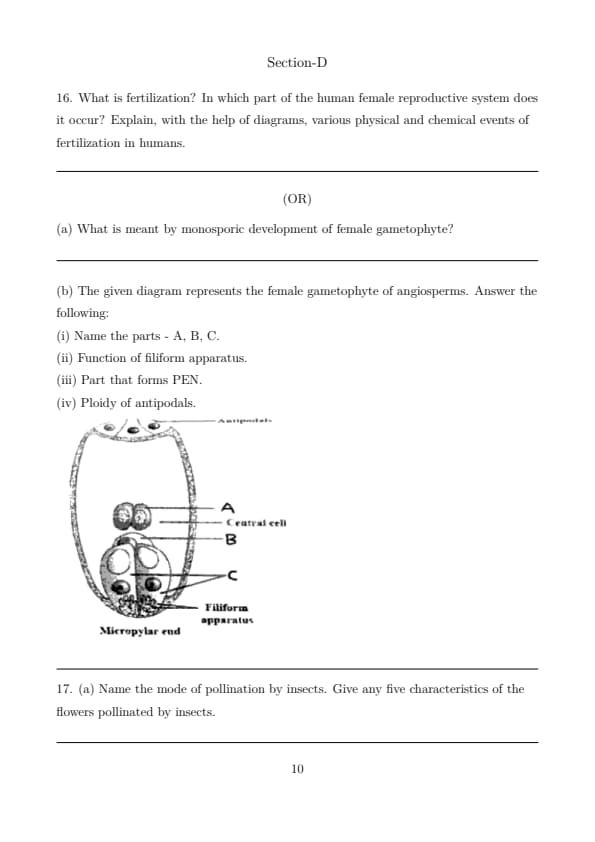
The given diagram represents the female gametophyte of angiosperms. Answer the following:
(i) Name the parts - A, B, C.
(ii) Function of filiform apparatus.
(iii) Part that forms PEN.
(iv) Ploidy of antipodals.
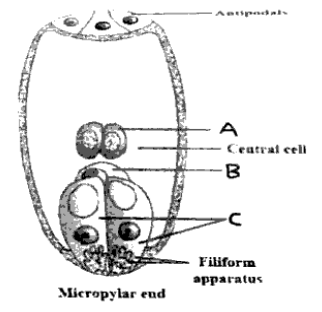
View Solution
i. Identification: Based on a standard 7-celled, 8-nucleate embryo sac:
A: Antipodal cells (located at the chalazal end).
B: Central cell (containing polar nuclei).
C: Egg cell (part of the egg apparatus at the micropylar end).
ii. Function of filiform apparatus: These finger-like projections in the synergids guide the entry of the pollen tube into the synergid.
iii. Formation of PEN: The secondary nucleus (formed by the fusion of two polar nuclei in the central cell) fuses with the second male gamete to form the Primary Endosperm Nucleus (PEN).
iv. Ploidy of antipodal cells: They are haploid (\(n\)). Quick Tip: The mature angiosperm embryo sac is "7-celled but 8-nucleate" because the large central cell contains two polar nuclei.
Name the mode of pollination by insects. Give any five characteristics of the flowers pollinated by insects.
View Solution
Mode of Pollination: Pollination by insects is known as Entomophily.
Characteristics of Insect-pollinated Flowers:
Color: Flowers are brightly colored to be easily visible to pollinators.
Nectar: They produce nectar as a nutritional reward for insects.
Fragrance: Many flowers emit a strong scent to attract insects from a distance.
Sticky Pollen: Pollen grains have a sticky or spiny surface to adhere to the insect's body.
Sticky Stigma: The stigma is typically sticky to effectively capture pollen grains. Quick Tip: In some species, insects and plants have a symbiotic relationship where the flower provides a safe place to lay eggs (e.g., Amorphophallus and Yucca plant).
Differentiate between self-pollination and cross-pollination.
View Solution
\begin{table[h]
\centering
\begin{tabular{|l|l|
\hline
Self-Pollination & Cross-Pollination
\hline
Transfer of pollen within the same flower or plant. & Transfer of pollen to a flower on a different plant.
\hline
Does not require pollinators (usually). & Requires agents like wind, water, or animals.
\hline
Low genetic variation. & High genetic variation.
\hline
\end{tabular
\end{table Quick Tip: \textbf{Cleistogamous} flowers never open and are invariably self-pollinated, ensuring seed set even without pollinators.
Question 58:
Observe the given diagram of male reproductive system and answer the following
questions:
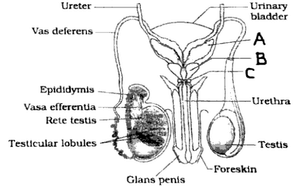
Label the parts shown as A, B and C and state the function(s) of these parts.
View Solution
A - Testis: Produces sperms and secretes testosterone.
B - Vas deferens: A tube that conducts sperms from the epididymis toward the urethra.
C - Seminal Vesicle / Prostate Gland: Secretes alkaline fluid that provides energy and mobility to sperms. Quick Tip: The secretion of male accessory glands (seminal plasma) is rich in fructose, calcium, and certain enzymes.
Name the primary sex organs of males and state their functions.
View Solution
The primary sex organs in males are the Testes.
Functions:
1. Spermatogenesis: The production of male gametes (sperms).
2. Endocrine function: Production of male sex hormones, primarily testosterone, which regulates secondary sexual characters. Quick Tip: Testes are located in the scrotum to maintain a temperature \(2-2.5^\circ C\) lower than internal body temperature for sperm production.
Trace the path of flow of sperms from the testes to the outside of male's body.
View Solution
The pathway is as follows:
Seminiferous Tubules \(\rightarrow\) Rete Testis \(\rightarrow\) Vasa Efferentia \(\rightarrow\) Epididymis \(\rightarrow\) Vas Deferens \(\rightarrow\) Ejaculatory Duct \(\rightarrow\) Urethra \(\rightarrow\) Urethral Meatus. Quick Tip: The \textbf{Epididymis} is where sperms are stored temporarily and undergo physiological maturation to gain motility.



Comments