




The PSEB Class 12 Biology exam in 2025 was conducted on March 17, 2025, with the question paper and solutions available post-exam. The exam tests understanding of Introductory Microeconomics, including consumer behavior and market forms, as well as Introductory Macroeconomics, covering national income, money and banking, government budget, and open economy macroeconomics.
Students must attempt a combination of multiple-choice, objective, short, and long answer questions in 3 hours. The paper totals 100 marks, comprising 80 marks for the theory component and 20 marks for internal assessment, with no negative marking for incorrect answers.
PSEB Class 12 Biology 2025 Question Paper with Solutions PDF(Set C)
| PSEB Class 12 Biology 2025 Question Paper with Solutions PDF(Set C) | Download PDF | Check Solutions |
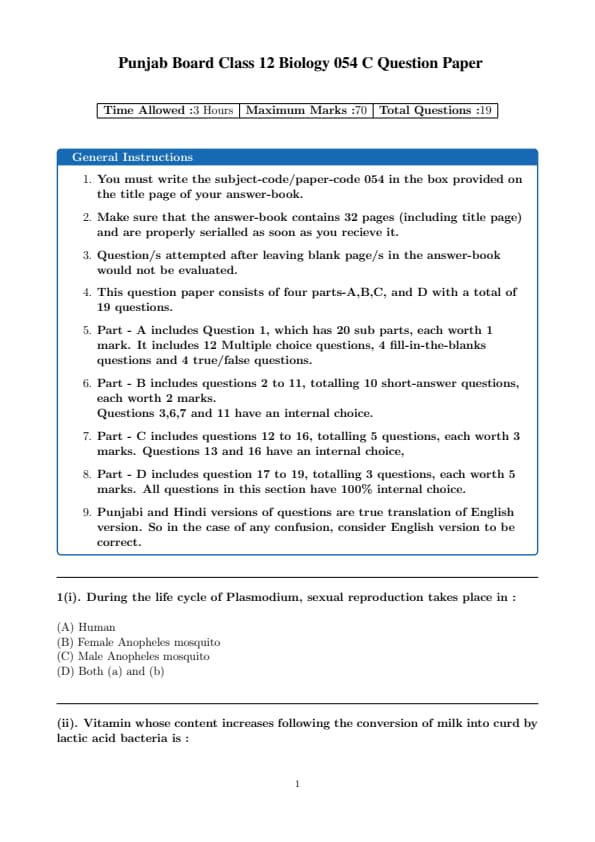
During the life cycle of Plasmodium, sexual reproduction takes place in :
View Solution
Step 1: Understanding the Concept:
\textit{Plasmodium, the malarial parasite, is a digenetic organism that requires two hosts to complete its life cycle.
The human acts as the secondary or intermediate host, while the female \textit{Anopheles mosquito acts as the primary or definitive host.
Step 2: Detailed Explanation:
In humans, the parasite undergoes asexual reproduction (schizogony) in liver cells and red blood cells.
Sexual stages, called gametocytes, develop in the human RBCs but do not fuse there.
When a female \textit{Anopheles mosquito bites an infected human, it ingests these gametocytes.
The actual sexual reproduction (fertilization and zygote formation) occurs within the mosquito's gut (intestine).
Step 3: Final Answer:
Sexual reproduction of \textit{Plasmodium occurs in the female \textit{Anopheles mosquito.
Quick Tip: Always remember: The host where the sexual phase occurs is the "Primary Host". For Malaria, that is the Mosquito.
Asexual Phase = Human; Sexual Phase = Mosquito.
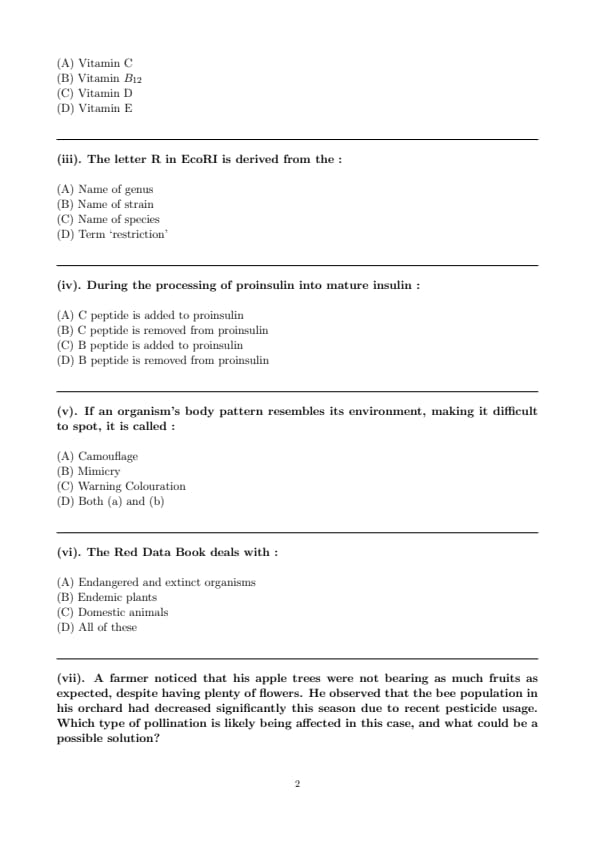
Vitamin whose content increases following the conversion of milk into curd by lactic acid bacteria is :
View Solution
Step 1: Understanding the Concept:
Lactic Acid Bacteria (LAB), such as Lactobacillus, are responsible for the fermentation of milk into curd.
Step 2: Detailed Explanation:
During growth, LAB produce acids that coagulate and partially digest the milk proteins (casein).
This process not only changes the texture and taste but also significantly enhances the nutritional value of the milk.
The most notable nutritional improvement is the increase in the concentration of Vitamin \(B_{12\).
Additionally, LAB in the human stomach play a beneficial role in checking disease-causing microbes.
Step 3: Final Answer:
The conversion of milk to curd increases the content of Vitamin \(B_{12}\).
Quick Tip: Curd is nutritionally superior to milk because of higher Vitamin \(B_{12}\) and the presence of probiotic bacteria that aid digestion.
The letter R in EcoRI is derived from the :
View Solution
Step 1: Understanding the Concept:
Restriction enzymes follow a specific nomenclature based on the bacterial source from which they are isolated.
Step 2: Detailed Explanation:
For the enzyme \textit{EcoRI:
The first letter 'E' comes from the genus \textit{Escherichia.
The next two letters 'co' come from the species \textit{coli.
The letter 'R' is derived from the name of the specific strain, which is RY 13.
The Roman numeral 'I' indicates the order in which the enzyme was discovered or isolated from that strain.
Step 3: Final Answer:
The letter 'R' in \textit{EcoRI represents the strain of the organism.
Quick Tip: Nomenclature sequence: Genus (1st) \(\rightarrow\) Species (2nd, 3rd) \(\rightarrow\) Strain (4th) \(\rightarrow\) Order of discovery (Roman Numeral).
During the processing of proinsulin into mature insulin :
View Solution
Step 1: Understanding the Concept:
Insulin is synthesized in mammals as a pro-hormone (proinsulin) that requires processing to become a functional mature hormone.
Step 2: Detailed Explanation:
Proinsulin consists of three chains: A-peptide, B-peptide, and a connecting C-peptide.
Mature functional insulin consists only of A and B chains linked together by disulphide bridges.
During the maturation of proinsulin into insulin, the C-peptide is enzymatically removed.
This is why mature insulin does not contain the C-peptide.
Step 3: Final Answer:
The C-peptide is removed during the maturation process of insulin.
Quick Tip: In recombinant DNA technology (Humulin), the A and B chains are produced separately in E. coli and then joined by disulphide bonds to bypass the natural C-peptide removal step.
If an organism’s body pattern resembles its environment, making it difficult to spot, it is called :
View Solution
Step 1: Understanding the Concept:
Organisms use various morphological adaptations to protect themselves from predators or to hide from prey.
Step 2: Detailed Explanation:
Camouflage is an adaptation where an organism blends into its surrounding environment using colors or patterns.
Examples include leaf insects or stick insects that look exactly like their surroundings.
Mimicry is different; it involves one species evolving to look like another species (the "model") to gain protection.
Warning Colouration (Aposematism) involves using bright, high-contrast colors to signal to predators that the organism is toxic or distasteful.
Step 3: Final Answer:
Resemblance to the environment for the purpose of hiding is defined as camouflage.
Quick Tip: Distinction: Camouflage = Resembling Background.
Mimicry = Resembling another Organism.
The Red Data Book deals with :
View Solution
Step 1: Understanding the Concept:
The Red Data Book is an inventory of the global conservation status of biological species.
Step 2: Detailed Explanation:
Maintained by the International Union for Conservation of Nature (IUCN), the Red Data Book records information about rare, threatened, and endangered species of plants and animals.
It classifies species into various categories such as Extinct, Extinct in the Wild, Critically Endangered, Endangered, and Vulnerable.
This helps scientists and governments prioritize conservation efforts for those at the highest risk of extinction.
Step 3: Final Answer:
The Red Data Book specifically catalogs endangered and extinct organisms.
Quick Tip: The IUCN Red List is updated regularly and is the most authoritative guide to the status of global biodiversity.
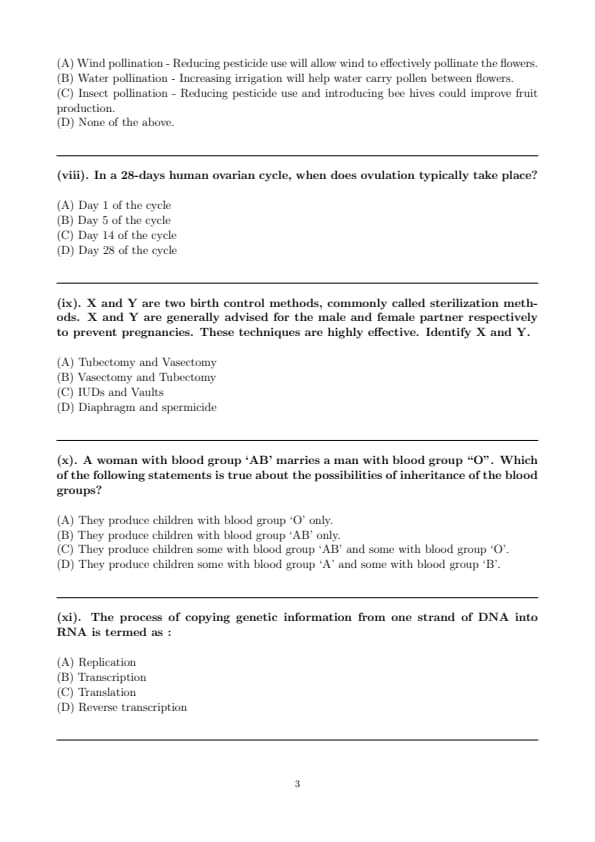
A farmer noticed that his apple trees were not bearing as much fruits as expected, despite having plenty of flowers. He observed that the bee population in his orchard had decreased significantly this season due to recent pesticide usage. Which type of pollination is likely being affected in this case, and what could be a possible solution?
View Solution
Step 1: Understanding the Concept:
Many fruit-bearing trees, including apples, are entomophilous, meaning they require biotic agents (insects) for pollination.
Step 2: Detailed Explanation:
Bees are the primary pollinators for apple orchards.
A decrease in the bee population due to pesticides prevents the transfer of pollen from the anther to the stigma, leading to a failure in fertilization and subsequent fruit development.
The logical solution is to stop using harmful pesticides and restore the pollinator population by placing bee hives (apiculture) in the orchard during the flowering season.
Step 3: Final Answer:
Insect pollination is the affected process, and the remedy is reducing pesticide use and introducing hives.
Quick Tip: Apiculture (bee-keeping) is often practiced in orchards not just for honey, but to maximize crop yield through enhanced pollination.
In a 28-days human ovarian cycle, when does ovulation typically take place?
View Solution
Step 1: Understanding the Concept:
The menstrual/ovarian cycle consists of several phases regulated by hormones from the pituitary and ovaries.
Step 2: Detailed Explanation:
In a typical 28-day cycle, the follicular phase lasts about 13 days.
Around the \(14^{th}\) day, there is a surge in Luteinizing Hormone (LH surge) and Follicle Stimulating Hormone (FSH).
This LH surge induces the rupture of the Graafian follicle and the release of the secondary oocyte (ovum), a process known as ovulation.
This marks the midpoint of the cycle.
Step 3: Final Answer:
Ovulation typically takes place on Day 14 of a 28-day cycle.
Quick Tip: Ovulation occurs 14 days \textbf{before} the onset of the next menstrual period, regardless of the total length of the cycle.
X and Y are two birth control methods, commonly called sterilization methods. X and Y are generally advised for the male and female partner respectively to prevent pregnancies. These techniques are highly effective. Identify X and Y.
View Solution
Step 1: Understanding the Concept:
Sterilization methods are terminal (permanent) contraceptive methods that prevent the transport of gametes through surgical intervention.
Step 2: Detailed Explanation:
X (Male Method): In a vasectomy, a small part of the vas deferens is removed or tied up through a small incision on the scrotum.
Y (Female Method): In a tubectomy, a small part of the \textit{fallopian tubes is removed or tied up through a small incision in the abdomen or through the vagina.
Both methods are nearly 100% effective but have very poor reversibility.
Step 3: Final Answer:
X is Vasectomy and Y is Tubectomy.
Quick Tip: Remember: \textbf{Vas deferens \(\rightarrow\) \textbf{Vas}ectomy (Male).
Fallopian \textbf{Tube} \(\rightarrow\) \textbf{Tub}ectomy (Female).
A woman with blood group ‘AB’ marries a man with blood group “O”. Which of the following statements is true about the possibilities of inheritance of the blood groups?
View Solution
Step 1: Understanding the Concept:
ABO blood grouping is an example of multiple allelism and codominance, determined by alleles \(I^A, I^B,\) and \(i\).
Step 2: Key Formula or Approach:
Woman (Group AB) Genotype: \(I^A I^B\)
Man (Group O) Genotype: \(ii\)
Cross: \(I^A I^B \times ii\)
Punnett Square:
\[ \begin{array}{|c|c|c|} \hline Gametes & i & i
\hline I^A & I^A i (Group A) & I^A i (Group A)
\hline I^B & I^B i (Group B) & I^B i (Group B)
\hline \end{array} \]
Step 3: Detailed Explanation:
The mother provides either an \(I^A\) allele or an \(I^B\) allele.
The father provides only the \(i\) allele.
Resulting offspring can only have genotypes \(I^A i\) (Phenotype A) or \(I^B i\) (Phenotype B).
There is a 0% probability of having a child with group AB or group O.
Step 4: Final Answer:
The children will have either blood group A or blood group B.
Quick Tip: If one parent is 'O' and the other is 'AB', the children will \textbf{never} have the blood group of either parent. They will always be A or B.
The process of copying genetic information from one strand of DNA into RNA is termed as :
View Solution
Step 1: Understanding the Concept:
The Central Dogma of molecular biology explains the flow of genetic information: DNA \(\rightarrow\) RNA \(\rightarrow\) Protein.
Step 2: Detailed Explanation:
Replication: The process of copying DNA to produce more DNA.
Transcription: The process of synthesizing RNA from a DNA template. Only one strand of DNA (template strand) is used.
Translation: The process where ribosomes synthesize proteins using the information in mRNA.
Reverse Transcription: Synthesis of DNA from an RNA template, typically seen in retroviruses like HIV.
Step 3: Final Answer:
The synthesis of RNA from DNA is called Transcription.
Quick Tip: Transcription occurs in the nucleus of eukaryotes, while replication occurs in the S-phase of the cell cycle.
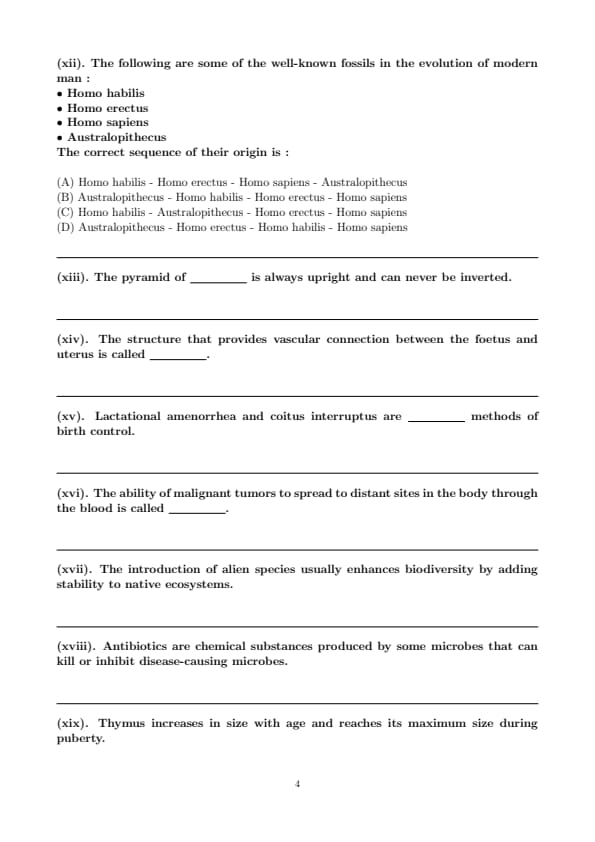
The following are some of the well-known fossils in the evolution of modern man :
\(\bullet\) Homo habilis
\(\bullet\) Homo erectus
\(\bullet\) Homo sapiens
\(\bullet\) Australopithecus
The correct sequence of their origin is :
View Solution
Step 1: Understanding the Concept:
Human evolution is characterized by increasing brain size (cranial capacity) and changes in posture and tool usage over millions of years.
Step 2: Detailed Explanation:
1. Australopithecus: Lived about 2 million years ago in East African grasslands. They were the ancestors to the Homo genus.
2. \textit{Homo habilis: The "handy man," the first human-like hominid. Brain capacity 650-800 cc.
3. Homo erectus: Lived about 1.5 million years ago. Had a larger brain (900 cc) and walked upright.
4. Homo sapiens: Modern humans, arose in Africa and moved across continents about 75,000-10,000 years ago.
Step 3: Final Answer:
The chronological order is Australopithecus \(\rightarrow\) \textit{Homo habilis \(\rightarrow\) \textit{Homo erectus \(\rightarrow\) \textit{Homo sapiens.
Quick Tip: Mnemonic: \textbf{Ape-men (Australopithecus) \(\rightarrow\) \textbf{H}andy man (habilis) \(\rightarrow\) \textbf{E}rect man (erectus) \(\rightarrow\) \textbf{S}mart man (sapiens).
The pyramid of \hspace{2cm} is always upright and can never be inverted.
View Solution
Step 1: Understanding the Concept:
Ecological pyramids represent the relationship between trophic levels in an ecosystem.
Step 2: Detailed Explanation:
The pyramids of numbers and biomass can sometimes be inverted (e.g., in a single large tree supporting many insects or biomass in marine ecosystems).
However, the pyramid of energy is always upright.
This is because according to the second law of thermodynamics, energy is lost as heat at every trophic level transfer.
Typically, only 10% of the energy is transferred to the next higher level. Thus, the energy at a lower level is always greater than the energy at a higher level.
Step 3: Final Answer:
Pyramid of energy.
Quick Tip: Thermodynamics dictates that energy flow is unidirectional and dissipative; hence energy pyramids can \textbf{never} be inverted.
The structure that provides vascular connection between the foetus and uterus is called \hspace{2cm}.
View Solution
Step 1: Understanding the Concept:
During pregnancy, the developing embryo requires a physical link to the mother for the exchange of materials.
Step 2: Detailed Explanation:
The placenta is a temporary organ formed by the association of chorionic villi (fetal part) and uterine tissue (maternal part).
It facilitates the supply of oxygen and nutrients to the fetus and the removal of carbon dioxide and waste products.
It is connected to the fetus via the umbilical cord.
Step 3: Final Answer:
The structure is the placenta.
Quick Tip: The placenta also acts as an endocrine gland, secreting hormones like hCG, hPL, and progesterone to maintain pregnancy.
Lactational amenorrhea and coitus interruptus are \hspace{2cm} methods of birth control.
View Solution
Step 1: Understanding the Concept:
Contraceptive methods are divided into natural, barrier, chemical, and surgical categories.
Step 2: Detailed Explanation:
Natural/Traditional methods work on the principle of avoiding the chances of ovum and sperm meeting without using external devices or chemicals.
Coitus interruptus (Withdrawal): The male withdraws the penis from the vagina before ejaculation.
Lactational amenorrhea: Absence of menstruation during intense breastfeeding, which prevents ovulation for up to 6 months post-childbirth.
Step 3: Final Answer:
These are Natural methods.
Quick Tip: Natural methods have zero side effects but have a very high failure rate compared to modern methods.
The ability of malignant tumors to spread to distant sites in the body through the blood is called \hspace{2cm}.
View Solution
Step 1: Understanding the Concept:
Cancerous tumors are characterized by uncontrolled cell division and the ability to invade other tissues.
Step 2: Detailed Explanation:
Unlike benign tumors which remain localized, malignant tumors are invasive.
Cells from the primary tumor break off and enter the circulatory system (blood or lymph).
These cells travel to distant organs, lodge there, and begin forming secondary tumors.
This destructive property is known as metastasis.
Step 3: Final Answer:
The property is metastasis.
Quick Tip: Metastasis is the most dangerous stage of cancer and is the primary cause of death in cancer patients.
The introduction of alien species usually enhances biodiversity by adding stability to native ecosystems.
View Solution
Step 1: Understanding the Concept:
Alien (exotic) species are those introduced from a different geographical region to a new environment.
Step 2: Detailed Explanation:
Alien species often lack natural predators in their new environment.
This allows them to grow exponentially and outcompete native species for resources (food, space).
This often leads to the decline or extinction of indigenous species, thereby decreasing biodiversity rather than enhancing it.
Examples include Water Hyacinth (\textit{Eichhornia) and Nile Perch in Lake Victoria.
Step 3: Final Answer:
False.
Quick Tip: Alien species invasion is one of the four major causes of biodiversity loss, collectively known as "The Evil Quartet."
Antibiotics are chemical substances produced by some microbes that can kill or inhibit disease-causing microbes.
View Solution
Step 1: Understanding the Concept:
Antibiotics are biological products used in medicine to treat bacterial infections.
Step 2: Detailed Explanation:
The term 'Antibiotic' (Greek: \textit{anti = against; \textit{bios = life) refers to substances that act against life (pathogenic bacteria).
They are naturally produced by certain microbes (like \textit{Penicillium mold or \textit{Streptomyces bacteria) to inhibit the growth of competing microorganisms.
They are effective against bacteria but not against viruses.
Step 3: Final Answer:
True.
Quick Tip: Penicillin, discovered by Alexander Fleming, was the first "wonder drug" antibiotic used to treat soldiers in WWII.
Thymus increases in size with age and reaches its maximum size during puberty.
View Solution
Step 1: Understanding the Concept:
The thymus is a primary lymphoid organ located near the heart, where T-lymphocytes undergo maturation.
Step 2: Detailed Explanation:
The thymus is relatively large at birth.
It continues to grow and increases in mass as the child grows, reaching its maximum absolute size at puberty.
Post-puberty, it undergoes a process called involution, where it gradually shrinks and is replaced by fat and connective tissue.
This is why immune responses weaken in old age.
Step 3: Final Answer:
True.
Quick Tip: The thymus is unique because it is the only organ that effectively "disappears" or significantly atrophies as we age after reaching peak functionality at puberty.
Simple shake flasks are more effective than stirred-tank bioreactors for producing large quantities of recombinant proteins.
View Solution
Step 1: Understanding the Concept:
Large-scale production of biological products requires specialized equipment to maintain optimal conditions.
Step 2: Detailed Explanation:
Shake flasks are used for small-scale laboratory experiments and cannot handle volumes greater than a few liters effectively.
Stirred-tank bioreactors (100–1000 liters) are designed for large-scale production.
They provide better aeration (oxygen transfer), uniform mixing, and precise control over temperature, pH, and foam, which is essential for high yields of recombinant proteins.
Step 3: Final Answer:
False.
Quick Tip: Industrial biotechnology relies on Bioreactors to transition from "Lab-scale" to "Industrial-scale" production.
Expand GEAC. What is the responsibility of GEAC, set up by the Indian Government.
View Solution
Step 1: Understanding the Concept:
The Indian Government established the Genetic Engineering Appraisal Committee (GEAC) under the Ministry of Environment, Forest and Climate Change.
It acts as a regulatory body to oversee activities involving the use, manufacture, storage, export, and import of hazardous microorganisms or genetically engineered organisms and cells.
Step 2: Detailed Explanation:
The primary responsibilities of GEAC include:
1. Validity of Research: Making decisions regarding the validity and safety of genetic engineering research.
2. Public Safety: Assessing the safety of introducing genetically modified (GM) organisms into the public domain for services (e.g., GM crops for agriculture).
3. Environmental Impact: Evaluating the potential risks posed by GM organisms to the environment and biological diversity.
Step 3: Final Answer:
GEAC expands to Genetic Engineering Appraisal Committee.
Its responsibility is to regulate the use of genetically modified organisms and ensure the safety of introducing them for public use.
Quick Tip: GEAC was formerly known as the Genetic Engineering Approval Committee.
In exams, always mention its role in both "Research Validity" and "Public Safety".
Write any two points of difference between grazing food-chain and detritus food-chain.
View Solution
Step 1: Understanding the Concept:
Food chains represent the flow of energy and nutrients through an ecosystem.
They are categorized based on their starting point and the nature of the energy source.
Step 2: Detailed Explanation:
The differences between Grazing Food Chain (GFC) and Detritus Food Chain (DFC) are:
1. Source of Energy: GFC begins with green plants (producers) that capture solar energy.
DFC begins with dead organic matter (detritus) like fallen leaves or animal remains.
2. Major Ecosystem Roles: In aquatic ecosystems, GFC is the major conduit for energy flow.
In terrestrial ecosystems, a much larger fraction of energy flows through the DFC than through the GFC.
Step 3: Final Answer:
The main differences are the starting trophic level (Producers vs. Detritus) and the primary ecosystem where they dominate energy flow.
Quick Tip: Remember: GFC relies on "Living" energy (Solar \(\rightarrow\) Plant), whereas DFC relies on "Dead" energy (Decomposition).
What do you mean by ‘Rivet Popper’ hypothesis ?
View Solution
Step 1: Understanding the Concept:
Ecologists use analogies to explain complex ecological dependencies.
Stanford ecologist Paul Ehrlich proposed this hypothesis to illustrate how species loss affects ecosystem stability.
Step 2: Detailed Explanation:
1. Analogy: In an airplane (ecosystem), all parts are joined together using thousands of rivets (species).
2. Rivet Popping: If every passenger starts popping a rivet to take home (species extinction), it may not affect flight safety initially.
3. Critical Loss: As more rivets are removed, the plane becomes dangerously weak over time.
4. Key Species: Loss of rivets on the wings (key species that drive major ecosystem functions) is more critical than the loss of rivets on the seats (non-key species).
Step 3: Final Answer:
The hypothesis states that while an ecosystem can tolerate the loss of some species, the loss of "key" species can lead to a catastrophic collapse of ecosystem stability.
Quick Tip: In the exam, clearly identify what the "Airplane", "Rivets", and "Popping" represent to score full marks.
What is meant by emasculation ? How is it useful in plant breeding programme ?
View Solution
Step 1: Understanding the Concept:
In artificial hybridization, breeders want to ensure that only desired pollen grains are used for pollination.
Step 2: Detailed Explanation:
Definition: Emasculation is the process of removing the stamens or anthers from the flower bud of a female parent (if it is bisexual) using a pair of forceps.
Usefulness in Plant Breeding:
1. Prevents Self-Pollination: It ensures that the flower does not pollinate itself, which is crucial for creating specific hybrids.
2. Controlled Hybridization: It allows the breeder to pollinate the stigma with pollen grains collected from a specifically chosen male parent.
3. Genetic Purity: It maintains the genetic integrity of the experimental cross by eliminating unwanted natural pollination.
Step 3: Final Answer:
Emasculation involves removing anthers to prevent self-fertilization, allowing breeders to perform controlled crosses between desired parent plants.
Quick Tip: Emasculation is always followed by "Bagging" to prevent contamination of the stigma by unwanted foreign pollen.
Draw labelled diagram for the structure of human sperm.
View Solution
Step 1: Understanding the Concept:
The human sperm is a microscopic, motile male gamete composed of four distinct regions, all enveloped by a plasma membrane.
Step 2: Detailed Explanation:
A well-labelled diagram of a human sperm should include:
1. Head: Contains an elongated haploid nucleus. The anterior portion is covered by a cap-like structure called the Acrosome (filled with enzymes that help in fertilization).
2. Neck: The short region connecting the head to the middle piece.
3. Middle Piece: Contains numerous mitochondria, which produce energy (ATP) for the movement of the tail.
4. Tail: A long structure that facilitates sperm motility essential for reaching the ovum.
Step 3: Final Answer:
The primary components to label in the diagram are: Plasma Membrane, Acrosome, Nucleus, Neck, Mitochondria (Middle Piece), and Tail.
Quick Tip: Remember that the middle piece is the "powerhouse" of the sperm because it contains mitochondria providing swimming energy.
Amniocentesis for sex determination is banned in our country. Is this ban necessary ? Comment.
View Solution
Step 1: Understanding the Concept:
Amniocentesis is a prenatal diagnostic test used to detect genetic disorders in the fetus by analyzing amniotic fluid.
Step 2: Detailed Explanation:
Misuse: Because the amniotic fluid contains cells with the fetus's chromosomes, it can also reveal the sex of the child.
Social Impact: In India, a preference for male children led to the widespread misuse of this technique for sex-selective abortion (female foeticide).
Necessity of the Ban:
1. Gender Balance: It is essential to maintain a healthy sex ratio in the population.
2. Ethical Reasons: To prevent the unethical termination of healthy female pregnancies.
3. Legal Protection: The Pre-Conception and Pre-Natal Diagnostic Techniques (PCPNDT) Act was enacted to regulate such technologies.
Step 3: Final Answer:
The ban is absolutely necessary to curb female foeticide and ensure the right to life for the girl child, preserving a balanced societal structure.
Quick Tip: In the answer, distinguish between the \textbf{diagnostic use} (detection of Down's syndrome, etc.) and \textbf{misuse} (sex determination) of amniocentesis.
Briefly describe Zygote Intra Fallopian Transfer (ZIFT) technique practice to help infertile couples.
View Solution
Step 1: Understanding the Concept:
ZIFT is a variation of In Vitro Fertilization (IVF) where fertilization happens outside the body in a laboratory.
Step 2: Detailed Explanation:
1. Fertilization: Ova from the wife/donor and sperms from the husband/donor are collected and induced to form a zygote under simulated conditions in the lab.
2. Stage of Transfer: The zygote or early embryo (with up to 8 blastomeres) is then transferred into the fallopian tube of the female.
3. Post-Transfer: The embryo then travels naturally to the uterus for implantation and further development.
Step 3: Final Answer:
ZIFT involves the transfer of an early embryo (up to 8-blastomere stage) directly into the fallopian tube to facilitate natural implantation in infertile couples.
Quick Tip: Contrast ZIFT with IUT (Intra Uterine Transfer). ZIFT = Fallopian tube (up to 8 cells). IUT = Uterus (\(>\) 8 cells).
Name the chromosomal disorder that is caused by the trisomy of the \(21^{st}\) chromosome. Also write down its symptoms.
View Solution
Step 1: Understanding the Concept:
A chromosomal disorder occurs due to the gain or loss of one or more chromosomes. Trisomy means an individual has three copies of a specific chromosome instead of the usual pair.
Step 2: Detailed Explanation:
Disorder: Down's Syndrome is caused by the presence of an additional copy of chromosome number 21 (Trisomy 21).
Symptoms:
1. Physical features: Short stature with a small round head.
2. Facial features: Furrowed tongue and partially open mouth.
3. Hand features: Broad palm with a characteristic palm crease.
4. Development: Retarded physical, psychomotor, and mental development.
Step 3: Final Answer:
The disorder is Down's Syndrome. Key symptoms include physical and mental growth retardation, furrowed tongue, and characteristic facial features.
Quick Tip: Down's Syndrome was first described by Langdon Down in 1866.
What is incomplete dominance ? Give an example.
View Solution
Step 1: Understanding the Concept:
In Mendelian inheritance, one allele is usually dominant over the other. However, in incomplete dominance, neither allele is completely dominant.
Step 2: Detailed Explanation:
Mechanism: When a cross is made between two parents with contrasting traits, the heterozygous offspring expresses a blended or intermediate trait.
Example: Flower color in Antirrhinum (snapdragon) or \textit{Mirabilis jalapa (4 o'clock plant).
1. Cross: Red flower (RR) \(\times\) White flower (rr).
2. \(F_1\) Generation: All flowers are Pink (Rr).
3. Phenotypic Ratio in \(F_2\): 1 Red : 2 Pink : 1 White.
Step 3: Final Answer:
Incomplete dominance results in an intermediate phenotype in heterozygotes. A classic example is the pink flowers produced by crossing red and white snapdragons.
Quick Tip: In incomplete dominance, the \textbf{Genotypic ratio and \textbf{Phenotypic ratio} are exactly the same (1:2:1).
Are the thorn of Bougainvillea and tendril of Cucurbita homologous or analogous ? What type of evolution has brought such a similarity in them ?
View Solution
Step 1: Understanding the Concept:
Homology indicates common ancestry, whereas analogy indicates similar function without common origin.
Step 2: Detailed Explanation:
1. Homology: Both the thorns of \textit{Bougainvillea and the tendrils of \textit{Cucurbita arise from the same position (axillary bud). Thus, they have a similar anatomical origin.
2. Functional Difference: Thorns are for protection, while tendrils are for climbing/support.
3. Evolutionary Process: This is called Divergent Evolution. In this process, the same structure developed along different directions due to adaptations to different needs.
Step 3: Final Answer:
They are homologous structures. Divergent evolution is the process responsible for their development.
Quick Tip: Homology = Same origin, different function (Divergent Evolution).
Analogy = Different origin, same function (Convergent Evolution).
Draw a labelled diagram showing the structure of an antibody molecule.
View Solution
Step 1: Understanding the Concept:
Antibodies (immunoglobulins) are produced by B-lymphocytes in response to pathogens. They are made of four polypeptide chains.
Step 2: Detailed Explanation:
The labels for the antibody diagram include:
1. Heavy Chains: Two identical long polypeptide chains.
2. Light Chains: Two identical short polypeptide chains.
3. Disulphide Bonds: Bridges that hold the chains together.
4. Antigen-Binding Site: Located at the "variable" region at the tips of the 'Y' where the antibody attaches to a specific antigen.
5. Variable and Constant Regions: Parts of the chains that differ (variable) or remain similar (constant) between different antibodies.
Step 3: Final Answer:
The diagram depicts a \(H_2L_2\) structure with two heavy and two light chains connected by disulphide linkages, featuring specific antigen-binding sites.
Quick Tip: The specific arrangement of the \(H_2L_2\) structure is essential for the specificity of the immune response.
How do methanogens help in producing biogas ?
View Solution
Step 1: Understanding the Concept:
Methanogens are anaerobic bacteria commonly found in anaerobic sludge during sewage treatment and in the rumen of cattle.
Step 2: Detailed Explanation:
1. Anaerobic Digestion: These bacteria grow anaerobically on cellulosic materials present in organic waste (like cow dung/gobar).
2. Production of Gases: During their metabolic activity, they produce large amounts of methane (\(CH_4\)) along with carbon dioxide (\(CO_2\)) and hydrogen (\(H_2\)).
3. Biogas Generation: This mixture of gases is highly inflammable and is collectively called biogas.
4. Example: \textit{Methanobacterium is a common genus involved in this process.
Step 3: Final Answer:
Methanogens decompose organic matter in the absence of oxygen to release methane-rich biogas, used as a renewable energy source.
Quick Tip: The large presence of methanogens in cattle dung is why "Gobar Gas" plants are common in rural areas.
DNA being hydrophilic cannot pass through the cell membrane of a host cell. Explain how the host cell is made 'competent' to take up the recombinant DNA ?
View Solution
Step 1: Understanding the Concept:
Because DNA is negatively charged and hydrophilic, it cannot cross lipid-rich cell membranes naturally. Host cells must be specifically treated to force them to take up recombinant DNA.
Step 2: Detailed Explanation:
1. Chemical Treatment: The bacterial cells are treated with a specific concentration of a divalent cation, such as calcium (\(Ca^{2+}\)). This increases the efficiency with which DNA enters the bacterium through pores in its cell wall.
2. Incubation: Recombinant DNA is incubated with the host cells on ice.
3. Heat Shock: The cells are then placed briefly at \(42^\circ C\) (heat shock) and then put back on ice.
4. Result: This series of steps allows the bacteria to take up the recombinant DNA.
Step 3: Final Answer:
Host cells are made competent by treating them with \(Ca^{2+}\) ions and applying a heat-shock treatment, which alters membrane permeability.
Quick Tip: Other methods include Micro-injection (for animal cells) and Biolistics/Gene gun (for plant cells).
Why is it essential to have ‘selectable marker’ in a cloning vector ?
View Solution
Step 1: Understanding the Concept:
After a transformation experiment, only a very small percentage of bacterial cells actually take up the foreign DNA. Scientists need a way to find those specific cells.
Step 2: Detailed Explanation:
1. Identification: A selectable marker is a gene (usually an antibiotic resistance gene like ampR or \textit{tetR) that allows researchers to distinguish between cells that have taken up the vector and those that have not.
2. Selection: Non-transformed cells will die in the presence of the selective agent (antibiotic), while transformed cells will survive and multiply.
3. Efficiency: Without a selectable marker, it would be impossible to isolate the few successful recombinant cells from millions of unsuccessful ones.
Step 3: Final Answer:
Selectable markers are vital for the selective growth of transformed host cells and for eliminating non-transformed cells during the screening process.
Quick Tip: The genes encoding resistance to antibiotics like ampicillin, chloramphenicol, tetracycline, or kanamycin are considered useful selectable markers for \textit{E. coli.
Explain Gause’s competitive exclusion principle.
View Solution
Step 1: Understanding the Concept:
In community ecology, the "niche" of a species includes all the resources it uses and the conditions it requires.
When two species have significantly overlapping niches—meaning they require the same limited resources like food, nesting sites, or sunlight—competition arises.
Russian ecologist G.F. Gause formulated a principle to describe the outcome of such intense competition.
Step 2: Detailed Explanation:
The principle is built on several key ecological premises:
1. Resource Limitation: The principle is most applicable when resources are "limiting" (not enough to satisfy everyone).
2. Absolute Competitors: If two species are identical in their resource requirements, they are termed "complete competitors."
3. The Outcome of Competition: One species will always possess a slight biological advantage—be it faster reproduction, better foraging efficiency, or higher tolerance to environmental stress.
4. Competitive Exclusion: Over time, the "superior" competitor will out-reproduce the "inferior" one.
5. Extinction: This leads to the eventual local extinction of the inferior species or forces it to migrate to a different habitat.
6. Modern Context (Resource Partitioning): Later studies (like MacArthur's warblers) showed that species can avoid this exclusion by evolving "Resource Partitioning," where they feed at different times or on different parts of the same resource to coexist.
Step 3: Final Answer:
Gause’s principle asserts that in a resource-limited environment, two species cannot occupy the exact same niche; the more efficient species will eventually displace the other.
Quick Tip: A catchy way to remember this is: "Two species cannot live in the same house if they want to eat the exact same food at the exact same time."
Coexistence is only possible through niche differentiation or resource partitioning.
How did Hershey and Chase differentiate between DNA and protein in their experiment while proving that DNA is the genetic material ?
View Solution
Step 1: Understanding the Concept:
By 1952, scientists knew that chromosomes carried genetic information, but they debated whether that information was stored in DNA or Protein.
Hershey and Chase used bacteriophages (viruses that infect bacteria) because they consist only of a DNA core surrounded by a protein coat.
Step 2: Key Formula or Approach:
The experimental approach relied on labeling the two components with specific radioactive tracers that do not overlap.
- DNA contains Phosphorus (\(P\)) in its phosphate backbone but lacks Sulfur (\(S\)).
- Proteins contain Sulfur (\(S\)) in amino acids like Cysteine and Methionine but lack Phosphorus (\(P\)).
Step 3: Detailed Explanation:
The experiment was conducted in three logical stages:
1. Infection:
- Batch 1: Phages were grown with \(^{32}P\). Their DNA became radioactive.
- Batch 2: Phages were grown with \(^{35}S\). Their protein coats became radioactive.
- These phages were allowed to infect E. coli bacteria.
2. Blending:
- The mixture was agitated in a blender. This mechanical force sheared off the viral "ghosts" (empty protein shells) from the surface of the bacteria without killing the bacteria.
3. Centrifugation:
- The mixture was spun at high speed. The heavy bacteria formed a "pellet" at the bottom, while the lighter viral parts remained in the "supernatant" (liquid) at the top.
4. Results:
- In the \(^{32P\) batch, radioactivity was found in the pellet (inside the bacteria).
- In the \(^{35}S\) batch, radioactivity was found in the supernatant (outside the bacteria).
Step 4: Final Answer:
This proved that DNA was the material that actually entered the cell and directed the production of new viruses, confirming DNA as the genetic material.
Quick Tip: Pellet = Bacteria (Inside).
Supernatant = Viral Coats (Outside).
If the radioactivity is in the pellet, the substance entered the host.
Discuss the nature of genetic code.
View Solution
Step 1: Understanding the Concept:
The genetic code is the "dictionary" used by the ribosome during translation.
Since there are 4 nucleotides and 20 amino acids, a single (4) or doublet (16) code is insufficient; a triplet code (\(4^{3} = 64\)) provides more than enough combinations.
Step 2: Detailed Explanation:
The "nature" of the code is defined by several unique properties:
1. The Triplet Codon: Each "word" in mRNA is a sequence of three bases. Of the 64 codons, 61 code for amino acids.
2. Unambiguous: A specific codon always codes for the same amino acid (e.g., GUG always codes for Valine). There is no confusion.
3. Degenerate: Many amino acids are coded by more than one codon (e.g., Serine is coded by 6 different codons). This provides a buffer against mutations.
4. Comma-less: The code is read sequentially without any gaps or overlapping of bases. If one base is deleted, the entire "reading frame" shifts.
5. Universal: The code is nearly identical across all life forms, from a simple E. coli to a complex Human. This is strong evidence for a common ancestor.
6. Start and Stop Signals:
- AUG is the start codon (it also codes for Methionine).
- UAA, UAG, UGA are stop codons (nonsense codons) that do not code for any amino acid and signal the end of translation.
Step 3: Final Answer:
The genetic code is a highly organized, universal system that ensures the accurate translation of genetic information into functional proteins.
Quick Tip: Mnemonic for Stop Codons:
\textbf{U \textbf{A}re \textbf{A}way (UAA)
\textbf{U} \textbf{A}re \textbf{G}one (UAG)
\textbf{U} \textbf{G}o \textbf{A}way (UGA)
Darwin observed a variety of beaks in small black birds inhabiting Galapagos Islands. Explain what conclusions did he draw and how ?
View Solution
Step 1: Understanding the Concept:
The Galapagos Islands are a chain of volcanic islands that were never connected to the mainland.
When a small group of ancestral finches arrived there, they found diverse habitats with little competition.
Step 2: Detailed Explanation:
Darwin's thought process followed these steps:
1. Diversity Observation: He saw finches with heavy beaks for crushing seeds, thin beaks for catching insects, and long beaks for drinking nectar or pecking wood.
2. Common Origin: He hypothesized that these birds did not arrive as separate species from South America. Instead, a single ancestral "seed-eating" species reached the islands.
3. Geographical Isolation: As the birds moved to different islands, they became isolated.
4. Natural Selection: On an island with many insects, birds with slightly more pointed beaks survived better and passed on those traits. On an island with hard seeds, birds with stronger beaks flourished.
5. Adaptive Radiation: He concluded that this was a classic example of "Adaptive Radiation"—the process where one species evolves into many different forms to fill different ecological niches in a new environment.
Step 3: Final Answer:
Darwin concluded that the varied beaks were adaptations driven by natural selection in response to different feeding habits, proving that evolution is a branching process from a common ancestor.
Quick Tip: Adaptive Radiation is a form of \textbf{Divergent Evolution}.
It happens when "Nature" selects the best tool (beak) for the job (eating).
Identify the plant shown in the diagram.
View Solution
Step 1: Understanding the Concept:
The identification is based on the morphological characteristics of the plant family Papaveraceae.
Step 2: Detailed Explanation:
The diagram displays a plant with a prominent flowering structure and a large, rounded fruiting body known as a "capsule."
The specific shape of the capsule and the delicate, broad-petaled flowers are diagnostic features of \textit{Papaver somniferum.
Step 3: Final Answer:
The plant identified is \textit{Papaver somniferum.
Quick Tip: In biology exams, if you see a diagram of a plant associated with "Latex" or "Morphine," it is always the Poppy.
Name the drug obtained from the latex of this plant.
View Solution
Step 1: Understanding the Concept:
Latex is the milky sap found in the unripe seed pods (capsules) of the poppy plant.
Step 2: Detailed Explanation:
This latex contains over 20 different alkaloids.
The most medically significant alkaloid is Morphine.
Morphine can undergo a chemical reaction called "acetylation" to produce Heroin (Diacetylmorphine).
Heroin is much more potent and addictive than morphine itself.
Step 3: Final Answer:
The primary drug extracted from the latex is Morphine.
Quick Tip: Acetylation of Morphine \(\rightarrow\) Heroin.
Heroin is chemically known as Diacetylmorphine.
How does the drug affect the human body ?
View Solution
Step 1: Understanding the Concept:
Drugs work by mimicking or blocking natural signaling molecules in the body. Opioids have their own dedicated "Opioid Receptors."
Step 2: Detailed Explanation:
1. Receptor Binding: Opioids bind to receptors in the brain, spinal cord, and gut.
2. Analgesia: They are extremely effective at blocking pain signals, which is why morphine is used for post-surgical patients.
3. Systemic Depressant: They slow down the central nervous system. This results in reduced heart rate, slower breathing, and a feeling of "heavy" limbs.
4. Psychological Effect: They induce a state of euphoria and relaxation, which leads to high abuse potential and addiction.
5. Heroin Specifics: Heroin is a depressant that specifically slows down physiological body functions.
Step 3: Final Answer:
The drug acts as a sedative and depressant, significantly slowing down physiological body functions and reducing pain perception.
Quick Tip: Remember: Opioids = Depressants (Slow down).
Cocaine/Amphetamines = Stimulants (Speed up).
A recombinant DNA is formed when sticky ends of vector DNA and foreign DNA Join. Explain how the sticky ends are formed and get jointed.
View Solution
Step 1: Understanding the Concept:
Genetic engineering requires "molecular scissors" (restriction enzymes) and "molecular glue" (DNA ligase).
Step 2: Detailed Explanation:
1. The Palindrome: Restriction enzymes recognize a "Palindromic Nucleotide Sequence"—a sequence that reads the same on both strands in the \(5' \rightarrow 3'\) direction (e.g., GAATTC).
2. The Staggered Cut: Most restriction enzymes (like EcoRI) do not cut exactly in the middle of the palindrome. They cut the two strands slightly apart from each other.
3. Sticky End Formation: This results in short, single-stranded "tails" of DNA hanging off the ends. Because these tails have exposed bases, they are "sticky" (ready to base-pair with a complementary sequence).
4. The Joining Process:
- If both the source DNA and the vector DNA are cut with the same enzyme, their sticky ends will be perfectly complementary.
- They naturally find each other and form weak Hydrogen bonds.
- The enzyme DNA Ligase then makes the bond permanent by forming a covalent phosphodiester bond between the sugar and phosphate of the adjacent nucleotides.
Step 3: Final Answer:
Sticky ends are staggered cuts made by restriction endonucleases that facilitate the precise annealing of DNA fragments, which are then covalently sealed by DNA ligase.
Quick Tip: Key Requirement: Use the \textbf{SAME enzyme for both DNA sources.
If you use different enzymes, the sticky ends won't "match," and the DNA won't join.
What are Cry proteins ? How have biotechnologists exploited these proteins to benefit farmers ?
View Solution
Step 1: Understanding the Concept:
Bacillus thuringiensis is a soil bacterium that naturally produces protein crystals during a specific phase of its life cycle. These crystals contain the "Cry" (Crystal) protein.
Step 2: Detailed Explanation:
1. Mechanism of Toxicity:
- The protein is produced as an inactive protoxin in the bacterium (this ensures the bacterium itself isn't killed).
- When an insect (like a bollworm) eats the plant, the protoxin enters its gut.
- The alkaline pH of the insect's midgut solubilizes the crystal and activates the toxin.
- The active toxin binds to the midgut lining, creating pores. This causes cell swelling and lysis, eventually starving and killing the insect.
2. Biotechnological Exploitation:
- Scientists isolated the specific genes (\textit{cry genes) from the bacteria.
- They inserted these genes into the DNA of crop plants (e.g., Bt-Cotton, Bt-Corn).
- Now, the plant produces its own pesticide.
3. Benefits to Farmers:
- Reduced dependency on expensive chemical pesticide sprays.
- Protection of beneficial insects that would normally be killed by broad-spectrum sprays.
- Higher crop yields due to reduced pest damage.
Step 3: Final Answer:
Cry proteins are natural biopesticides. By transferring the genes responsible for these proteins into crops, scientists have created plants that can defend themselves against specific insect pests.
Quick Tip: Specificity Matters:
\textit{cryIAc and cryIIAb \(\rightarrow\) control Cotton Bollworms.
cryIAb \(\rightarrow\) controls Corn Borer.
What does this diagram represent ?
View Solution
Step 1: Understanding the Concept:
In flowering plants, the megaspore develops into the female gametophyte, which is housed inside the ovule.
Step 2: Detailed Explanation:
The diagram shows a fully developed structure after three successive mitotic divisions of the functional megaspore.
It is a highly specialized structure containing precisely arranged cells ready for fertilization.
This specific arrangement (7 cells and 8 nuclei) is known as the "Polygonum type" embryo sac, which is the most common form in angiosperms.
Step 3: Final Answer:
The diagram represents a mature angiosperm embryo sac.
Quick Tip: Counting check: 3 Antipodals + 2 Synergids + 1 Egg + 1 Central Cell = \textbf{7 Cells}.
3 nuclei in Antipodals + 2 in Synergids + 1 in Egg + 2 Polar nuclei = \textbf{8 Nuclei}.
Which part is responsible for guiding the pollen tube into synergid ?
View Solution
Step 1: Understanding the Concept:
The pollen tube must find its way through the style and into the tiny opening of the ovule (micropyle). Once there, it needs a specific signal to enter the embryo sac.
Step 2: Detailed Explanation:
Synergids are the "helper cells" located at the micropylar end.
They possess finger-like cellular thickenings known as the filiform apparatus.
This apparatus acts like a "beacon"; it secretes chemotropic chemicals that attract the pollen tube and provide a physical guide for the tube to enter one of the synergids to release its male gametes.
Step 3: Final Answer:
The filiform apparatus, located within the synergids, is responsible for guiding the pollen tube.
Quick Tip: "Filiform" means "thread-like." Think of it as a set of chemical "traffic signs" for the growing pollen tube.
What will be the fate of polar nuclei after fertilisation ?
View Solution
Step 1: Understanding the Concept:
Angiosperms undergo a unique process called "Double Fertilization."
Step 2: Detailed Explanation:
There are two polar nuclei located in the large central cell.
During fertilization, one of the two male gametes travels to the center of the embryo sac and fuses with these two polar nuclei.
Since this involves the fusion of three haploid nuclei (\(n + n + n\)), it is called Triple Fusion.
The resulting cell is triploid (\(3n\)) and is called the Primary Endosperm Cell (PEC), containing the Primary Endosperm Nucleus (PEN).
This tissue grows into the Endosperm, which stores nutrients to feed the developing embryo.
Step 3: Final Answer:
The polar nuclei develop into the triploid endosperm, which serves as a nutritive tissue for the embryo.
Quick Tip: Ploidy level is a frequent exam trap!
Egg/Sperm = \(n\).
Zygote = \(2n\).
Endosperm = \(3n\).
Which of the following structures is/are present at micropylar end ?
View Solution
Step 1: Understanding the Concept:
The embryo sac is polarized. One end points toward the opening of the ovule (Micropylar end) and the other toward the base (Chalazal end).
Step 2: Detailed Explanation:
1. Micropylar End: Contains the "Egg Apparatus." This consists of two synergids and one centrally placed egg cell.
2. Chalazal End: Contains three antipodal cells.
3. Central Region: Contains the large central cell with two polar nuclei.
Step 3: Final Answer:
The synergids and the egg are both located at the micropylar end.
Quick Tip: Think of the Micropyle as the "Front Door" where the egg waits for the sperm.
Which of the following structures participate in double fertilisation ?
View Solution
Step 1: Understanding the Concept:
Double fertilization requires two male gametes to fuse with two different structures within the same female gametophyte.
Step 2: Detailed Explanation:
- Fusion 1: 1st Male Gamete + Egg \(\rightarrow\) Zygote (Syngamy).
- Fusion 2: 2nd Male Gamete + 2 Polar Nuclei \(\rightarrow\) Primary Endosperm Nucleus (Triple Fusion).
The antipodal cells and the synergids do not participate in these fusions; they typically degenerate shortly after fertilization.
Step 3: Final Answer:
Since both the polar nuclei and the egg cell undergo fusion with male gametes, they are both participants in the process of double fertilization.
Quick Tip: Without "Double" fertilization, you would have an embryo but no food (endosperm) to support its growth.
What is Oogenesis. Briefly describe the process of Oogenesis.
View Solution
Step 1: Understanding the Concept:
Oogenesis is markedly different from spermatogenesis. While males produce sperm continuously from puberty, females are born with all the potential eggs they will ever have.
Step 2: Detailed Explanation:
The process follows a strict chronological timeline:
1. Fetal Period: Gamete mother cells (oogonia) multiply by mitosis in the fetal ovary. They enter Meiosis I but get arrested at the Diplotene stage of Prophase I. These are now "Primary Oocytes."
2. Childhood: Primary oocytes remain dormant inside primary follicles. Many of these follicles degenerate (follicular atresia) until puberty.
3. Puberty to Menopause: Every month, a few primary follicles begin to mature. One becomes the dominant Graafian follicle.
4. First Meiotic Division: Just before ovulation, the primary oocyte completes Meiosis I. This division is unequal, producing one large Secondary Oocyte (carrying most of the cytoplasm) and one tiny First Polar Body.
5. Ovulation: The secondary oocyte is released from the ovary. It is arrested again at Metaphase II.
6. Completion: Meiosis II is completed ONLY if a sperm enters the secondary oocyte. This produces the mature Ootid (Ovum) and a second polar body.
Step 3: Final Answer:
Oogenesis is the developmental process that produces a haploid ovum from diploid oogonia through a series of mitotic and meiotic divisions, characterized by significant periods of arrest.
Quick Tip: Critical Arrest Points:
1. Prophase I (Before birth).
2. Metaphase II (At ovulation, until sperm arrival).
State and explain Mendel’s Law of Independent Assortment with reference to a dihybrid cross involving pea plant. Consider the traits of seed shape (round vs. wrinkled) and seed colour (yellow vs. green).
View Solution
Step 1: Understanding the Concept:
The Law of Independent Assortment is based on dihybrid crosses, where two pairs of contrasting characters are studied simultaneously.
It explains how different genes separate from one another when reproductive cells develop.
Step 2: Key Formula or Approach:
Consider a cross between a pea plant with Round Yellow seeds (RRYY) and a plant with Wrinkled Green seeds (rryy).
1. Parental Generation (P): \( RRYY \times rryy \)
2. Gametes: \( RY \) and \( ry \)
3. F1 Generation: \( RrYy \) (All are Round and Yellow).
4. F2 Generation (Selfing F1): \( RrYy \times RrYy \)
Step 3: Detailed Explanation:
During gamete formation in the F1 hybrid (\( RrYy \)), the segregation of the 'R' and 'r' alleles is independent of the 'Y' and 'y' alleles.
This results in four types of gametes produced in equal frequency (25% each): \( RY, Ry, rY, and ry \).
When these gametes fuse randomly during fertilization, they produce 16 possible combinations in the F2 generation.
The phenotypic ratio obtained is:
- Round Yellow: 9
- Round Green: 3
- Wrinkled Yellow: 3
- Wrinkled Green: 1
The appearance of new combinations like Round Green and Wrinkled Yellow proves that the traits for seed shape and seed color assorted independently.
Step 4: Final Answer:
The dihybrid phenotypic ratio of 9:3:3:1 confirms that the inheritance of one trait does not influence the inheritance of another.
Quick Tip: Independent assortment only occurs for genes located on different chromosomes or very far apart on the same chromosome. If genes are close together, they show "Linkage" instead.
What is the function of the substance labelled A in this diagram of the Lac operon?
View Solution
Step 1: Understanding the Concept:
The Lac operon is a system for the regulated expression of genes involved in lactose metabolism in \textit{E. coli.
Step 2: Detailed Explanation:
Substance A is the Inducer.
In the absence of an inducer, the repressor protein (produced by the 'i' gene) binds to the operator region and prevents RNA polymerase from transcribing the structural genes.
When the inducer (Lactose) is present, it binds to the repressor.
This binding causes a conformational change in the repressor, making it inactive and unable to bind to the operator.
This allows RNA polymerase access to the promoter, and transcription proceeds (the operon is switched "ON").
Step 3: Final Answer:
The function of substance A is to inactivate the repressor so that the operon can be transcribed.
Quick Tip: The Lac operon is an example of "negative regulation" because the default state is inhibited by a repressor. The inducer removes this inhibition.
Label parts B to D in the Lac operon diagram.
View Solution
Step 1: Understanding the Concept:
The structural genes \( z, y, and a \) in the Lac operon code for three different enzymes required for lactose metabolism.
Step 2: Detailed Explanation:
1. Label B (from 'z' gene): This codes for \(\beta\)-galactosidase. This enzyme hydrolyzes lactose into glucose and galactose.
2. Label C (from 'y' gene): This codes for Permease. This enzyme increases the permeability of the cell to \(\beta\)-galactosides (lactose).
3. Label D (from 'a' gene): This codes for Transacetylase. It transfers an acetyl group from acetyl-CoA to \(\beta\)-galactosides.
Step 3: Final Answer:
B is \(\beta\)-galactosidase, C is Permease, and D is Transacetylase.
Quick Tip: Use the mnemonic: "Z-Y-A \(\rightarrow\) B-P-T" (Beta-gal, Permease, Transacetylase).
What would happen if the substance labelled A was not present?
View Solution
Step 1: Understanding the Concept:
The regulation of the Lac operon is an energy-saving mechanism; the cell only produces enzymes when the substrate is available.
Step 2: Detailed Explanation:
If the inducer (lactose) is not present:
1. The 'i' gene constitutively synthesizes the repressor mRNA, which is translated into an active repressor protein.
2. This active repressor binds firmly to the operator region (o) of the operon.
3. The bound repressor physically blocks the RNA polymerase from moving forward from the promoter to the structural genes.
4. Consequently, transcription of \( z, y, and a \) genes does not occur, and no enzymes are produced.
Step 3: Final Answer:
The operon would remain in a repressed (OFF) state, and no enzymes for lactose metabolism would be synthesized.
Quick Tip: Regulation by a repressor is called negative regulation. In the absence of lactose, the repressor is the "brake" of the system.
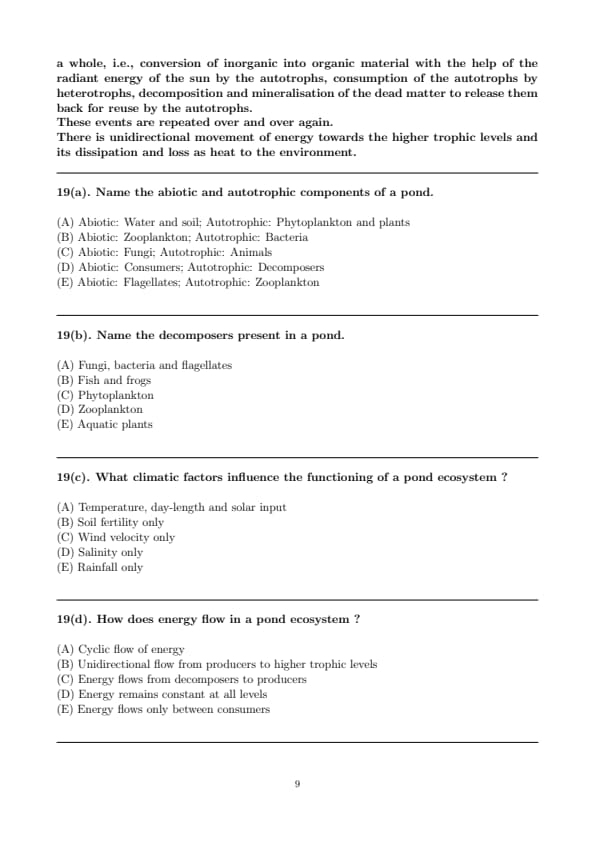
Name the abiotic and autotrophic components of a pond.
View Solution
Step 1: Understanding the Concept:
Every ecosystem is made up of abiotic (non-living) and biotic (living) components.
Autotrophs are producers that manufacture their own food using sunlight, carbon dioxide, and water.
Step 2: Detailed Explanation:
From the given passage, the abiotic components of the pond include water containing dissolved inorganic and organic substances.
The soil deposits present at the bottom of the pond also form an important abiotic component as they store nutrients.
The autotrophic components include phytoplankton, algae, and floating, submerged, and marginal plants.
These organisms carry out photosynthesis and convert solar energy into chemical energy stored as food.
They form the primary producers and constitute the first trophic level of the pond ecosystem.
Step 3: Final Answer:
Abiotic components are water and bottom soil deposits, while autotrophic components include phytoplankton, algae, and aquatic plants.
Quick Tip: Always classify ecosystem components into abiotic and biotic before identifying producers, consumers, and decomposers.
Name the decomposers present in a pond.
View Solution
Step 1: Understanding the Concept:
Decomposers are organisms that break down dead plants and animals into simpler inorganic substances.
They play a crucial role in nutrient recycling within ecosystems.
Step 2: Detailed Explanation:
As described in the passage, fungi, bacteria, and flagellates are abundantly present at the bottom of the pond.
These organisms secrete enzymes that decompose complex organic matter into simpler forms.
The released nutrients are returned to the water and soil, making them available again to autotrophs.
Thus, decomposers help maintain nutrient balance in the pond ecosystem.
Step 3: Final Answer:
The decomposers present in a pond ecosystem are fungi, bacteria, and flagellates.
Quick Tip: Decomposers are usually microorganisms and are commonly associated with nutrient recycling questions.
What climatic factors influence the functioning of a pond ecosystem ?
View Solution
Step 1: Understanding the Concept:
Climatic factors control the physical and biological processes occurring in ecosystems.
They directly affect growth, reproduction, and metabolic activities of organisms.
Step 2: Detailed Explanation:
The passage states that solar input, temperature cycle, and day-length regulate the rate of functioning of the pond.
Solar input determines the rate of photosynthesis carried out by autotrophs.
Temperature affects enzymatic and metabolic activities of aquatic organisms.
Day-length influences seasonal productivity and biological rhythms within the pond ecosystem.
Step 3: Final Answer:
Solar input, temperature cycle, and day-length are the main climatic factors influencing a pond ecosystem.
Quick Tip: In ecology, climatic factors are frequently linked with productivity and photosynthesis-based questions.
How does energy flow in a pond ecosystem ?
View Solution
Step 1: Understanding the Concept:
Energy flow refers to the transfer of energy through different trophic levels of an ecosystem.
Unlike matter, energy cannot be recycled and always moves in one direction.
Step 2: Detailed Explanation:
In a pond ecosystem, energy enters in the form of solar radiation.
Autotrophs convert this radiant energy into chemical energy through photosynthesis.
This stored energy is transferred to primary consumers, then to higher-level consumers.
At each trophic level, a significant amount of energy is lost as heat due to respiration.
Therefore, energy flow is unidirectional and progressively decreases at higher trophic levels.
Step 3: Final Answer:
Energy flows unidirectionally from producers to consumers with continuous loss as heat at each trophic level.
Quick Tip: Always remember: energy flow is one-way, while nutrients show cyclic movement in ecosystems.



Comments