



.png?h=35&w=35&mode=stretch)
The Punjab Board 2026 Class 12 Biology Question Paper with Solution PDF is available here. The PSEB Biology exam was scheduled for February 2026, during the Afternoon Session from 11:00 AM to 2:15 PM.
The paper was moderately difficult and highly diagram-oriented. While the sections on Reproduction and Ecology were straightforward and high-scoring, the conceptual questions in Genetics, Molecular Biology, and Biotechnology required a deeper level of analytical thinking and precise terminology. Students aiming for medical entrance standards should target a score between 60–70 marks (out of 70 in theory), ensuring they include neat, labeled diagrams and flowcharts for processes like DNA replication and the Biogas plant.
Punjab Board 2026 Class 12 Biology Question Paper with Solution PDF
| Punjab Board 2026 Class 12 Biology Question Paper with Solution PDF | Download PDF | Check Solutions |
(i) What causes the inactive form of Bt toxin (Protoxin) to get converted into its active form in the body of an insect?
View Solution
Concept:
Bt toxin is produced by the bacterium Bacillus thuringiensis and is widely used in pest control.
It exists initially as an inactive protoxin that becomes toxic inside the insect body.
Step 1: {\color{redNature of Bt toxin.
The bacterium produces the toxin in an inactive crystalline protoxin form.
Step 2: {\color{redActivation inside insect gut.
When an insect ingests Bt toxin, the alkaline conditions of its gut dissolve the crystals and convert the protoxin into an active toxin.
Step 3: {\color{redEffect of active toxin.
The activated toxin binds to gut epithelial cells, creating pores that lead to cell lysis and insect death.
Conclusion: \[ \boxed{(C)\ Alkaline pH of the gut \] Quick Tip: Bt toxin activates in alkaline insect gut.
(ii) Two species competing for the same resource can avoid competition by choosing different habits. This phenomenon is called ________ and was supported by ________.
View Solution
Concept:
When two species compete for the same resource, they may evolve mechanisms to reduce competition and coexist in the same habitat.
Step 1: {\color{redUnderstanding the phenomenon.
If species use the same resource in different ways or at different times, competition is reduced.
This is known as resource partitioning.
Step 2: {\color{redScientific support.
The concept was demonstrated by Robert MacArthur through his study of warblers feeding in different parts of a tree.
Step 3: {\color{redEliminate other options.
Competitive exclusion (Gause’s principle) states that two species cannot coexist if they compete for the exact same resource.
Conclusion: \[ \boxed{(D)\ Resource partitioning, MacArthur} \] Quick Tip: MacArthur → Resource partitioning (warbler study).
(iii) The flow of energy through lower to higher trophic levels in an ecosystem is:
View Solution
Concept:
Energy flow in an ecosystem follows a definite path through trophic levels, starting from producers and moving upward to consumers.
Step 1: {\color{redEnergy source.
Energy enters the ecosystem through sunlight, which is captured by producers (plants).
Step 2: {\color{redFlow through trophic levels.
Energy moves from: \[ Producers \rightarrow Primary consumers \rightarrow Secondary consumers \rightarrow Tertiary consumers \]
Step 3: {\color{redLoss of energy.
At each trophic level, a large portion of energy is lost as heat and cannot be reused.
Step 4: {\color{redConclusion.
Since energy cannot return to lower trophic levels, its flow is always in one direction.
\[ \boxed{(A)\ always unidirectional} \] Quick Tip: Energy flow = One-way (Sun → Producers → Consumers).
(iv) Meenu visited Mahendra Chaudhary Zoological Park (Chhatbir Zoo) as part of her environmental studies school tour. She observed several animals such as tigers, rhinoceroses and lions being maintained and bred in enclosures. This is an example of which type of conservation?
View Solution
Concept:
Conservation of biodiversity can be broadly classified into in situ and ex situ conservation methods.
Step 1: {\color{redUnderstand the situation.
Animals are being maintained and bred in a zoo, which is an artificial, controlled environment.
Step 2: {\color{redTypes of conservation.
In situ conservation:
Protection of species in their natural habitat (e.g., national parks, wildlife sanctuaries).
Ex situ conservation:
Conservation outside natural habitats (e.g., zoos, botanical gardens, seed banks).
Step 3: {\color{redConclusion.
Since the animals are conserved in a zoo, it represents ex situ conservation.
\[ \boxed{(B)\ Ex situ conservation} \] Quick Tip: Zoo = Ex situ conservation.
(v) Geitonogamy involves transfer of pollen grains:
View Solution
Concept:
Pollination can occur in different forms based on the source and destination of pollen transfer.
Step 1: {\color{redTypes of pollination.
Autogamy:
Transfer of pollen from anther to stigma of the same flower.
Geitonogamy:
Transfer of pollen between different flowers of the same plant.
Xenogamy:
Transfer of pollen between flowers of different plants of the same species.
Step 2: {\color{redIdentify geitonogamy.
It involves pollen transfer from one flower to another flower on the same plant.
Conclusion: \[ \boxed{(B)\ from anther to stigma of another flower on the same plant} \] Quick Tip: Geitonogamy = Same plant, different flower.
(vi) The testes in humans are located outside the abdominal cavity within a pouch called the scrotum. This positioning helps in:
View Solution
Concept:
The location of testes outside the abdominal cavity is an important adaptation related to male reproductive physiology.
Step 1: {\color{redRole of scrotum.
The scrotum is a pouch that holds the testes outside the body.
Step 2: {\color{redImportance of temperature.
Spermatogenesis (formation of sperms) requires a temperature about 2–3°C lower than normal body temperature.
Step 3: {\color{redReason for external location.
By being outside the abdominal cavity, the scrotum helps maintain a cooler environment suitable for sperm production.
Conclusion: \[ \boxed{(B)\ maintaining a temperature slightly lower than body temperature} \] Quick Tip: Scrotum = Cooler temperature → Proper sperm formation.
(vii) Diaphragms are contraceptive devices used by females. Which of the following statement is correct about diaphragm?
View Solution
Concept:
Contraceptive methods can be classified as barrier, hormonal, intrauterine, and surgical methods.
A diaphragm is a barrier contraceptive.
Step 1: {\color{redNature of diaphragm.
A diaphragm is a dome-shaped rubber device inserted into the vagina before intercourse.
Step 2: {\color{redMode of action.
It covers the cervix and prevents sperms from entering the uterus, thereby blocking fertilisation.
Step 3: {\color{redEliminate other options.
(A) refers to intrauterine devices (IUDs).
(C) refers to chemical spermicides.
(D) refers to hormonal contraceptives.
Conclusion: \[ \boxed{(B)\ Covers cervix and acts as a physical barrier} \] Quick Tip: Diaphragm = Barrier contraceptive (blocks sperm entry).
(viii) A pure tall (TT) plant is crossed with a pure dwarf (tt) plant to produce F\(_1\) offspring. The F\(_1\) offspring are then self-crossed. What is the ratio of true-breeding tall (TT) to true-breeding dwarf (tt) plants in the F\(_2\) generation?
View Solution
Concept:
This is a classic Mendelian monohybrid cross involving dominant (T) and recessive (t) alleles.
Step 1: {\color{redParental cross. \[ TT \times tt \]
All F\(_1\) offspring will be heterozygous: \[ F_1 = Tt \ (all tall) \]
Step 2: {\color{redSelf-cross of F\(_1\). \[ Tt \times Tt \]
Step 3: {\color{redGenotypic ratio in F\(_2\). \[ TT : Tt : tt = 1 : 2 : 1 \]
Step 4: {\color{redRequired ratio.
The question asks for: \[ True-breeding tall (TT) : True-breeding dwarf (tt) \]
From the genotypic ratio: \[ 1 : 1 \]
Conclusion: \[ \boxed{1 : 1} \] Quick Tip: Monohybrid F\(_2\): TT : Tt : tt = 1 : 2 : 1
(ix) In E. coli, the lac operon gets switched on when:
View Solution
Concept:
The lac operon is an inducible operon that controls lactose metabolism in E. coli.
It is switched on only in the presence of lactose.
Step 1: {\color{redRole of repressor.
In the absence of lactose, the repressor binds to the operator and blocks transcription.
Step 2: {\color{redEffect of lactose.
When lactose is present, it acts as an inducer (allolactose) and binds to the repressor.
Step 3: {\color{redActivation of operon.
This binding inactivates the repressor, allowing RNA polymerase to transcribe the structural genes.
Conclusion: \[ \boxed{(A)\ lactose present binds to repressor \] Quick Tip: Lactose present → Repressor inactive → lac operon ON.
(xi) Darwin observed different types of beaks in finches adapted to different feeding habits on the Galapagos Islands. This diversity provides evidence for:
View Solution
Concept:
Darwin’s finches are a classic example used to explain evolution by natural selection.
Step 1: {\color{redObservation by Darwin.
On the Galapagos Islands, Darwin found finches with different beak shapes adapted to specific food sources.
Step 2: {\color{redSignificance.
These variations showed how species evolve over time due to environmental pressures and adaptation.
Step 3: {\color{redTheory supported.
This observation became key evidence for Darwin’s theory of evolution, explaining the origin of species through natural selection.
Conclusion: \[ \boxed{(C)\ origin of species by natural selection} \] Quick Tip: Darwin’s finches = Evolution by natural selection.
(xi) Identify the parts labelled A, B, C and D in the diagram of an antibody molecule and select the correct option:
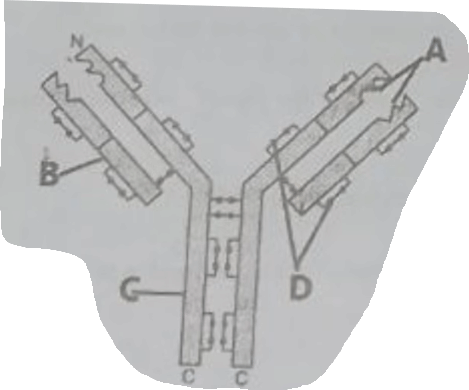
(A) A – Light chains, B – Heavy chains, C – Antigen-binding sites, D – Disulphide bonds
View Solution
Concept:
An antibody (immunoglobulin) molecule has a Y-shaped structure composed of heavy and light chains connected by disulphide bonds.
Step 1: {\color{redIdentify antigen-binding sites (A).
The tips of the Y-shaped structure are the antigen-binding sites.
Step 2: {\color{redIdentify light chains (B).
Shorter outer chains present on each arm are the light chains.
Step 3: {\color{redIdentify heavy chains (C).
The longer inner chains forming the stem and arms are heavy chains.
Step 4: {\color{redIdentify disulphide bonds (D).
The small connecting links between chains represent disulphide bonds.
Conclusion: \[ \boxed{(C)\ A=Antigen-binding sites,\ B=Light chains,\ C=Heavy chains,\ D=Disulphide bonds} \] Quick Tip: Antibody tips = Antigen-binding sites.
Long chains = Heavy, Short = Light.
(xii) The enzyme Taq polymerase used in PCR has been isolated from the bacterium:
View Solution
Concept:
Taq polymerase is a heat-stable DNA polymerase used in Polymerase Chain Reaction (PCR).
Step 1: {\color{redRequirement in PCR.
PCR involves repeated heating cycles (up to 94–95°C), so a heat-stable enzyme is required.
Step 2: {\color{redSource of Taq polymerase.
The enzyme was isolated from Thermus aquaticus, a thermophilic bacterium found in hot springs.
Step 3: {\color{redSignificance.
Because it can withstand high temperatures, Taq polymerase does not denature during PCR.
Conclusion: \[ \boxed{(B)\ Thermus aquaticus} \] Quick Tip: Taq = Thermus aquaticus (hot spring bacterium).
(xiii) Alexander Fleming, Ernst Chain and Howard Florey were awarded the Nobel Prize in 1945 for the discovery of ________.
View Solution
Concept:
The discovery of antibiotics marked a major breakthrough in medical science, revolutionising the treatment of bacterial infections.
Step 1: {\color{redRole of Alexander Fleming.
In 1928, Alexander Fleming discovered the antibacterial properties of a fungus, Penicillium notatum, which produced penicillin.
Step 2: {\color{redContribution of Chain and Florey.
Ernst Chain and Howard Florey purified and developed penicillin for large-scale medical use.
Step 3: {\color{redNobel Prize.
For this groundbreaking discovery and its therapeutic application, they were awarded the Nobel Prize in Physiology or Medicine in 1945.
Conclusion: \[ \boxed{Penicillin \] Quick Tip: Fleming = Discovery of Penicillin.
(xiv) The sequence of base pairs in a double-stranded DNA or RNA molecule that reads the same forwards and backwards on each strand is called ________ nucleotide sequence.
View Solution
Concept:
Certain nucleotide sequences exhibit symmetry and read the same in both directions. These are important in molecular biology, especially in restriction enzyme recognition sites.
Step 1: {\color{redDefinition.
A palindromic nucleotide sequence is one in which the base sequence reads the same forward and backward on complementary strands.
Step 2: {\color{redExample.
Example of a palindromic sequence: \[ 5' \, GAATTC \, 3'
3' \, CTTAAG \, 5' \]
This is recognised by the restriction enzyme EcoRI.
Step 3: {\color{redSignificance.
Palindromic sequences are commonly found at restriction sites and play an important role in recombinant DNA technology.
Conclusion: \[ \boxed{Palindromic nucleotide sequence} \] Quick Tip: Palindrome in DNA = Same forward and backward.
(xv) The process of release of ovum from the mature follicle is called ________.
View Solution
Concept:
The female reproductive cycle involves periodic maturation and release of an egg from the ovary.
Step 1: {\color{redFollicle development.
During the menstrual cycle, ovarian follicles mature under the influence of hormones.
Step 2: {\color{redRelease of ovum.
When a mature Graafian follicle ruptures and releases the ovum, the process is called ovulation.
Conclusion: \[ \boxed{Ovulation} \] Quick Tip: Release of egg from ovary = Ovulation.
(xvi) ________ test is performed to confirm typhoid.
View Solution
Concept:
Typhoid fever is caused by the bacterium Salmonella typhi. Laboratory tests are used for diagnosis.
Step 1: {\color{redDiagnostic test.
The Widal test detects antibodies against Salmonella typhi in the patient’s serum.
Step 2: {\color{redUse in confirmation.
It is commonly used to confirm typhoid infection, especially in endemic regions.
Conclusion: \[ \boxed{Widal test \] Quick Tip: Typhoid diagnosis = Widal test.
(xvii) Saccharomyces cerevisiae is used in the production of alcohol and bread.
View Solution
Concept:
Saccharomyces cerevisiae, commonly known as baker’s yeast, is a unicellular fungus widely used in fermentation industries.
Reason:
It ferments sugars to produce ethanol and carbon dioxide.
Ethanol production is used in alcoholic beverages.
Carbon dioxide helps dough rise in bread making.
Conclusion: \[ \boxed{True \] Quick Tip: Baker’s yeast = Alcohol fermentation + Bread making.
(xviii) The Amazon rainforest is known as the ``lungs of the planet'' because it produces a large amount of carbon dioxide.
View Solution
Concept:
The Amazon rainforest plays a major role in maintaining the Earth’s atmospheric balance.
Reason:
Through photosynthesis, the Amazon rainforest absorbs carbon dioxide and releases oxygen.
It is called the ``lungs of the planet'' because it produces a significant amount of the world’s oxygen.
Conclusion:
The statement is incorrect because the Amazon rainforest produces oxygen, not carbon dioxide.
\[ \boxed{False} \] Quick Tip: Amazon rainforest = Oxygen producer, not CO\(_2\) producer.
(xix) Surgical methods of contraception prevent gamete formation.
View Solution
Concept:
Surgical contraception methods include vasectomy in males and tubectomy in females.
Reason:
These methods block the transport of gametes (sperms or ova).
They do not stop the formation of gametes in testes or ovaries.
Conclusion:
Since gamete formation still occurs, the statement is incorrect.
\[ \boxed{False} \] Quick Tip: Surgery blocks transport, not formation of gametes.
(xx) Cocaine is obtained from the leaves of the Erythroxylum coca and acts as a stimulant on the central nervous system.
View Solution
Concept:
Cocaine is a natural alkaloid classified under drugs that affect the central nervous system (CNS).
Reason:
It is extracted from the leaves of the plant Erythroxylum coca.
It acts as a powerful stimulant, increasing alertness and energy levels.
It affects the CNS by interfering with neurotransmitter reuptake.
Conclusion:
The given statement is correct.
\[ \boxed{True \] Quick Tip: Cocaine = Coca plant alkaloid + CNS stimulant.
Samina saw her mother adding a little curd to warm milk at night. She asked why she was doing this. She replied that the curd acts as an inoculum to convert milk into curd.
(a) Name the bacterium responsible.
(b) Explain how adding a small amount of curd (inoculum) helps in making the entire milk turn into curd?
View Solution
(a) Name of the bacterium:
Lactobacillus
(b) Explanation:
Concept:
Curd formation is an example of bacterial fermentation, where lactose in milk is converted into lactic acid.
Explanation:
Curd contains live lactic acid bacteria, mainly Lactobacillus.
When a small amount of curd is added to warm milk, these bacteria multiply rapidly.
They ferment lactose (milk sugar) into lactic acid.
The lactic acid coagulates milk proteins (casein), causing the milk to thicken and form curd.
Conclusion:
A small amount of curd acts as an inoculum by introducing beneficial bacteria that multiply and convert the entire milk into curd. Quick Tip: Curd formation = Lactobacillus + Lactic acid fermentation.
What is biolistic method for introducing alien DNA into a host cell?
OR
Why is restriction endonuclease called a ``Molecular Scissor''? Explain its role in biotechnology.
View Solution
Answer (Biolistic Method):
Concept:
The biolistic method is a physical technique used to introduce foreign DNA into host cells, especially plant cells.
Explanation:
It is also known as the gene gun method.
In this method, microscopic particles of gold or tungsten are coated with the desired DNA.
These DNA-coated particles are shot into target cells at very high velocity.
The particles penetrate the cell wall and membrane, allowing the foreign DNA to enter the cell.
Application:
Widely used in genetic engineering of plants like rice, maize, and wheat.
\hrule
Answer (Restriction Endonuclease as Molecular Scissor):
Concept:
Restriction endonucleases are enzymes that cut DNA at specific nucleotide sequences.
Why called Molecular Scissors?
They recognise specific palindromic DNA sequences.
They cleave the DNA at these sites, producing sticky or blunt ends.
Hence, they act like scissors at the molecular level.
Role in Biotechnology:
Used to cut DNA at desired locations during recombinant DNA technology.
Helps in isolating genes of interest.
Enables insertion of foreign DNA into vectors like plasmids.
Essential for gene cloning and genetic engineering. Quick Tip: Gene gun = Biolistic method.
Restriction enzymes = Molecular scissors.
Bt toxin is produced by bacteria Bacillus thuringiensis but it does not kill the bacteria itself. Why is it so?
View Solution
Concept:
Bt toxin is an insecticidal protein produced by the bacterium Bacillus thuringiensis.
However, it remains harmless to the bacterium itself.
Explanation:
Bt toxin is produced in an inactive crystalline protoxin form inside the bacterial cell.
In this inactive form, it does not affect the bacterium.
The toxin becomes activated only inside the alkaline gut of insects.
The alkaline pH dissolves the crystals and converts the protoxin into an active toxin.
The active toxin then binds to gut epithelial cells of the insect, creating pores and causing cell lysis.
Conclusion:
Bt toxin does not kill the bacterium because it is produced in an inactive form and becomes toxic only after activation in the alkaline gut of susceptible insects. Quick Tip: Bt toxin = Inactive in bacteria, active in insect gut.
Define food chain. Construct a grazing food chain using any 5 of the following: Grass, Earthworm, Snake, Vulture, Frog, Grasshopper, Decaying plant matter.
OR
Explain why the introduction of an alien species reduces the biodiversity of an area. Support your answer with an example.
View Solution
Answer (Food Chain):
Definition:
A food chain is a linear sequence of organisms through which energy flows as one organism eats another.
Grazing Food Chain:
A grazing food chain starts with green plants (producers).
Example using given components: \[ Grass \rightarrow Grasshopper \rightarrow Frog \rightarrow Snake \rightarrow Vulture \]
Explanation:
Grass → Producer
Grasshopper → Primary consumer
Frog → Secondary consumer
Snake → Tertiary consumer
Vulture → Top carnivore/scavenger
\hrule
Answer (Alien Species and Biodiversity):
Concept:
Alien species are organisms introduced into an ecosystem where they are not native.
Reason for reduced biodiversity:
Alien species often lack natural predators in the new habitat.
They multiply rapidly and outcompete native species for food and space.
They may introduce diseases or disrupt ecological balance.
This leads to decline or extinction of indigenous species.
Example:
Introduction of the African catfish in India has threatened native fish species.
Water hyacinth in Indian water bodies has reduced aquatic biodiversity. Quick Tip: Grazing chain starts with plants.
Alien species = Threat to native biodiversity.
Draw a well-labelled diagram of a longitudinal section of a flower showing all its parts.
View Solution
Concept:
A longitudinal section (L.S.) of a flower shows its internal structure including both male and female reproductive parts.
Parts to be shown and labelled in the diagram:
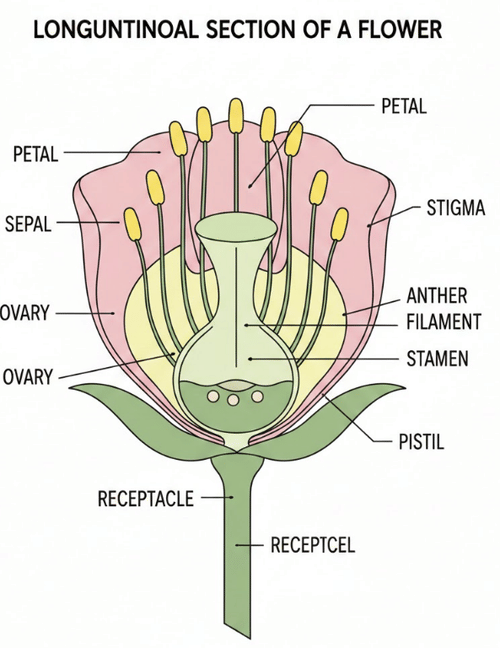
Sepals – Outermost protective whorl
Petals – Attract pollinators
Stamen (Male part):
Anther
Filament
Pistil/Carpel (Female part):
Stigma
Style
Ovary
Ovules
Receptacle (Thalamus)
Pedicel (Flower stalk)
Instructions for drawing:
Draw a vertical section of the flower.
Show outer sepals and inner petals.
Draw stamens with anther and filament.
Draw central pistil with stigma, style, and ovary.
Show ovules inside the ovary.
Label all parts neatly.
Note:
Marks are awarded for:
Correct structure
Proper labelling
Neatness Quick Tip: L.S. Flower = Sepal → Petal → Stamen → Pistil (Stigma, Style, Ovary).
State the role of oxytocin in parturition.
View Solution
Concept:
Parturition (childbirth) is regulated by hormonal interactions, especially involving oxytocin.
Role of Oxytocin:
Oxytocin is secreted by the posterior pituitary gland.
It stimulates strong and rhythmic contractions of the uterine muscles.
These contractions help in the dilation of the cervix.
It enhances labour through a positive feedback mechanism (fetal ejection reflex).
Conclusion:
Oxytocin plays a crucial role in parturition by inducing and intensifying uterine contractions that facilitate childbirth. Quick Tip: Oxytocin = Uterine contractions during childbirth.
In case of an infertile couple, the male has very low sperm count but the female has normal functioning reproductive system. Suggest and explain the Assisted Reproductive Technology (ART) useful to this couple.
OR
In our society, women are often blamed for giving birth to daughters. Explain scientifically why this belief is incorrect.
View Solution
Answer (ART for Low Sperm Count):
Suggested Technique: ICSI (Intracytoplasmic Sperm Injection)
Explanation:
ICSI is an advanced Assisted Reproductive Technology used in cases of low sperm count or poor sperm motility.
A single healthy sperm is directly injected into the cytoplasm of the ovum using a microneedle.
The fertilised egg (zygote) is then cultured in vitro.
The developing embryo is transferred into the uterus for implantation.
Why suitable?
Requires only one viable sperm.
Highly effective in male infertility cases.
\hrule
Answer (Gender Determination Scientific Explanation):
Concept:
The sex of a child is determined by the combination of sex chromosomes contributed by parents.
Explanation:
Females have XX chromosomes and produce ova containing only X chromosome.
Males have XY chromosomes and produce two types of sperms:
X-bearing sperms
Y-bearing sperms
If an X-bearing sperm fertilises the ovum → XX (female child).
If a Y-bearing sperm fertilises the ovum → XY (male child).
Conclusion:
The sex of the child depends on the type of sperm contributed by the father. Therefore, blaming women for giving birth to daughters is scientifically incorrect. Quick Tip: Father determines child's sex (X or Y sperm).
A man with blood group A marries a woman with blood group B. They have two children, one with blood group AB and the other with blood group O. Work out a genetic cross to show how this is possible.
OR
A normal male marries a female carrier for colour blindness. Show the type of progeny formed with help of Punnett square.
View Solution
Answer (Blood Group Cross):
Concept:
ABO blood group inheritance involves three alleles: \[ I^A,\ I^B,\ i \]
\(I^A\) and \(I^B\) are co-dominant
\(i\) is recessive
Given:
One child = AB → genotype \(I^A I^B\)
One child = O → genotype \(ii\)
Inference:
Father (A) must be \(I^A i\)
Mother (B) must be \(I^B i\)
Cross: \[ I^A i \times I^B i \]
Punnett Square:
\begin{tabular{c|cc
& \(I^B\) & \(i\)
\hline \(I^A\) & \(I^A I^B\) (AB) & \(I^A i\) (A)
\(i\) & \(I^B i\) (B) & \(ii\) (O)
\end{tabular
Result:
All four blood groups possible: A, B, AB, O.
\hrule
Answer (Colour Blindness Cross):
Concept:
Colour blindness is an X-linked recessive trait.
Genotypes:
Normal male = \(X^N Y\)
Carrier female = \(X^N X^c\)
Cross: \[ X^N Y \times X^N X^c \]
Punnett Square:
\begin{tabular{c|cc
& \(X^N\) & \(X^c\)
\hline \(X^N\) & \(X^N X^N\) (Normal girl) & \(X^N X^c\) (Carrier girl)
\(Y\) & \(X^N Y\) (Normal boy) & \(X^c Y\) (Colour blind boy)
\end{tabular
Result:
50% daughters normal (half carriers)
50% sons normal, 50% colour blind Quick Tip: ABO → Multiple alleles.
Colour blindness → X-linked recessive.
Classify the following pairs as analogous or homologous organs:
Wings of butterflies and birds
Thorns of bougainvillea and tendrils of cucurbita
Forelimbs of whale, bat, cheetah and human
Sweet potato and potato
View Solution
Concept:
Homologous organs: Same origin and structure but different functions.
Analogous organs: Different origin and structure but similar functions.
Classification:
Wings of butterflies and birds → Analogous organs
Both perform flight but originate from different structures (insect wing vs vertebrate forelimb).
Thorns of bougainvillea and tendrils of cucurbita → Homologous organs
Both are modifications of the stem but perform different functions (protection vs climbing).
Forelimbs of whale, bat, cheetah and human → Homologous organs
Same basic skeletal structure but different functions (swimming, flying, running, grasping).
Sweet potato and potato → Analogous organs
Both store food but differ in origin:
Sweet potato = modified root
Potato = modified stem Quick Tip: Same origin = Homologous.
Same function = Analogous.
Write any two points of difference between innate and acquired immunity.
View Solution
Concept:
Immunity is the body’s defence mechanism against pathogens and is broadly classified into innate and acquired immunity.
Differences:
Nature of immunity:
Innate immunity is present from birth and is non-specific.
Acquired immunity develops after exposure to pathogens and is specific.
Memory:
Innate immunity has no immunological memory.
Acquired immunity has memory and responds more rapidly upon re-exposure.
Response time (additional point):
Innate immunity acts immediately.
Acquired immunity takes time to develop after infection or vaccination.
Conclusion:
Innate immunity is non-specific and immediate, whereas acquired immunity is specific and memory-based. Quick Tip: Innate = Inborn, non-specific.
Acquired = Learned, specific, memory-based.
The diagram below shows an agarose gel electrophoresis setup:
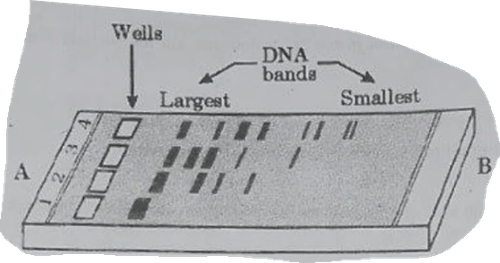
(a) Label the positive (+) and negative (–) terminals.
(b) What type of charge is carried by DNA molecules and how does this property help in their separation?
(c) Name the method used to isolate the separated DNA fragments from the gel.
OR
What is gene therapy? Illustrate using the example of adenosine deaminase (ADA) deficiency.
View Solution
Answer (Gel Electrophoresis):
(a) Terminals:
Wells are placed near the negative (–) terminal.
DNA migrates towards the positive (+) terminal.
(b) Charge on DNA and its role:
DNA molecules carry a negative charge due to phosphate groups.
When electric current is applied, DNA moves towards the positive electrode (anode).
Smaller DNA fragments move faster and farther than larger ones, leading to separation based on size.
(c) Method to isolate separated DNA fragments:
Elution
\hrule
Answer (Gene Therapy and ADA Deficiency):
Definition:
Gene therapy is a technique in which defective genes are replaced with functional ones to treat genetic disorders.
Example: ADA Deficiency
ADA deficiency is caused by mutation in the gene encoding adenosine deaminase enzyme.
It leads to Severe Combined Immunodeficiency (SCID).
Procedure:
Lymphocytes are isolated from the patient’s blood.
A functional ADA gene is introduced into these cells using a retroviral vector.
The genetically modified lymphocytes are then reintroduced into the patient.
Outcome:
The introduced gene enables production of functional ADA enzyme, partially restoring immune function. Quick Tip: DNA is negative → Moves to positive electrode.
ADA deficiency = Example of gene therapy.
Name the type of interaction seen in each of the following examples:
(a) Cuscuta growing on a hedge plant
(b) Mycorrhizae living on the roots of higher plants
(c) An orchid growing on the branch of a mango tree
View Solution
Concept:
Organisms in ecosystems interact in various ways such as parasitism, mutualism, and commensalism.
(a) Cuscuta on hedge plant → Parasitism
Cuscuta derives nutrients from the host plant, harming it.
(b) Mycorrhizae and plant roots → Mutualism
Fungi help in absorption of water and minerals, while plants provide food to fungi.
(c) Orchid on mango tree → Commensalism
Orchid gets support for growth, while the mango tree is neither harmed nor benefited. Quick Tip: Parasite harms host.
Mutualism = Both benefit.
Commensalism = One benefits, other unaffected.
Given diagram is of transcription unit. Identify the strands A and B in this diagram and write the basis on which you identified them.

OR
Why is Human Genome Project called a mega project?
View Solution
Answer (Transcription Unit):
Identification of strands:
Strand A → Coding (sense) strand
Strand B → Template (antisense) strand
Basis of identification:
The template strand is read by RNA polymerase in the 3' → 5' direction.
mRNA is synthesised in the 5' → 3' direction.
In the diagram, strand B runs in the 3' → 5' direction relative to transcription, so it acts as the template strand.
The coding strand (A) has the same sequence as mRNA (except T replaced by U).
\hrule
Answer (Human Genome Project as Mega Project):
Concept:
The Human Genome Project (HGP) was an international research effort to map and sequence the entire human genome.
Reasons it is called a mega project:
Enormous amount of data: Human genome has about 3 billion base pairs.
Large number of genes: Around 20,000–25,000 genes.
International collaboration involving multiple countries and laboratories.
Required advanced technology, bioinformatics, and huge funding.
Long duration (1990–2003).
Conclusion:
Due to its scale, complexity, cost, and global collaboration, HGP is termed a mega project. Quick Tip: Template strand read 3'→5'.
HGP = 3 billion base pairs → Mega project.
After industrialisation in England, the population of melanised moths (dark-coloured) increased while that of white-winged moths decreased.
(a) State the reason behind this change.
(b) Explain this change in terms of natural selection.
View Solution
Concept:
This phenomenon is known as industrial melanism, a classic example of evolution by natural selection.
(a) Reason behind the change:
Industrialisation caused air pollution and deposition of soot on tree trunks.
The bark of trees became dark.
White-winged moths became more visible to predators.
Dark-coloured (melanised) moths were better camouflaged.
(b) Explanation in terms of natural selection:
Before industrialisation, light-coloured moths had better survival due to camouflage on light bark.
After pollution, environmental conditions changed.
Dark moths had a survival advantage because they were less visible to predators.
They reproduced more and passed their genes to the next generation.
Over time, the frequency of melanised moths increased in the population.
Conclusion:
This demonstrates natural selection, where environmental changes favour organisms with advantageous traits. Quick Tip: Industrial melanism = Natural selection in action.
Name the causing agent of malaria. Also write down its symptoms and modes of transmission.
View Solution
Causative Agent:
Malaria is caused by a protozoan parasite of the genus Plasmodium.
Common species: P. vivax, P. falciparum, P. malariae, P. ovale.
Symptoms of Malaria:
High fever with chills and shivering
Headache
Sweating
Nausea and vomiting
Muscle pain and fatigue
Anaemia (in severe cases)
Mode of Transmission:
Transmitted by the bite of an infected female Anopheles mosquito.
The mosquito acts as the vector and transfers sporozoites into human blood during a bite.
Conclusion:
Malaria is a vector-borne disease caused by Plasmodium and transmitted through infected female Anopheles mosquitoes. Quick Tip: Malaria = Plasmodium + Female Anopheles mosquito.
Read the paragraph carefully and answer the following questions:
Passage:
A constant input of solar energy is the basic requirement for any ecosystem to function and sustain. Primary production is defined as the amount of biomass or organic matter produced per unit area over a time period by plants during photosynthesis. It is expressed in terms of weight (gm\(^{-2}\)) or energy (kcal m\(^{-2}\)). The rate of biomass production is called productivity. It is expressed in terms of gm\(^{-2}\) yr\(^{-1}\) or (kcal m\(^{-2}\)) yr\(^{-1}\) to compare the productivity of different ecosystems. It can be divided into gross primary productivity (GPP) and net primary productivity (NPP). Gross primary productivity of an ecosystem is the rate of production of organic matter during photosynthesis. A considerable amount of GPP is utilised by plants in respiration. Gross primary productivity minus respiration losses (R), is the net primary productivity (NPP). Net primary productivity is the available biomass for the consumption to heterotrophs (herbivores and decomposers). Secondary productivity is defined as the rate of formation of new organic matter by consumers. Primary productivity depends on the plant species inhabiting a particular area. It also depends on a variety of environmental factors, availability of nutrients and photosynthetic capacity of plants. Therefore, it varies in different types of ecosystems.
(a) Name the factors that influence the primary productivity of an ecosystem.
(b) Suppose the GPP of a grassland ecosystem is 2000 kcal m\(^{-2}\) yr\(^{-1}\) and NPP is 1200 kcal m\(^{-2}\) yr\(^{-1}\). Calculate the respiratory loss (R).
(c) Why is all the primary productivity not available to herbivores for consumption?
(d) Differentiate between GPP and NPP.
OR
Define biodiversity. Describe the three important components of biodiversity with suitable examples.
View Solution
(a) Factors influencing primary productivity:
Plant species present in the ecosystem
Environmental factors (temperature, light, rainfall)
Availability of nutrients
Photosynthetic capacity of plants
(b) Calculation of respiratory loss (R):
\[ NPP = GPP - R \] \[ R = GPP - NPP \] \[ R = 2000 - 1200 = 800 kcal m^{-2} yr^{-1} \]
Respiratory loss = 800 kcal m\(^{-2}\) yr\(^{-1}\)
(c) Reason why all primary productivity is not available to herbivores:
A significant portion of GPP is used by plants for respiration.
Energy is lost as heat during metabolic activities.
Only the remaining biomass (NPP) is available to herbivores.
(d) Difference between GPP and NPP:
\begin{tabular{|c|c|c|
\hline
Basis & GPP & NPP
\hline
Definition & Total organic matter produced & GPP minus respiratory loss
\hline
Energy availability & Includes respiration loss & Available to herbivores
\hline
Formula & Total photosynthesis & NPP = GPP – R
\hline
\end{tabular
\hrule
Answer (Biodiversity):
Definition:
Biodiversity refers to the variety and variability of living organisms present on Earth.
Components of Biodiversity:
Genetic diversity:
Variation of genes within a species.
Example: Different varieties of rice, wheat.
Species diversity:
Variety of species within a habitat or region.
Example: Different animals and plants in a forest ecosystem.
Ecosystem diversity:
Variety of ecosystems in a geographical area.
Example: Forests, deserts, wetlands, grasslands. Quick Tip: GPP – Respiration = NPP.
Biodiversity = Genetic + Species + Ecosystem diversity.
(a) What is meant by monosporic development of the female gametophyte?
(b) Draw a diagram of a mature embryo sac and label any four parts.
OR
Given below is the diagram of a part of seminiferous tubule of human testis:
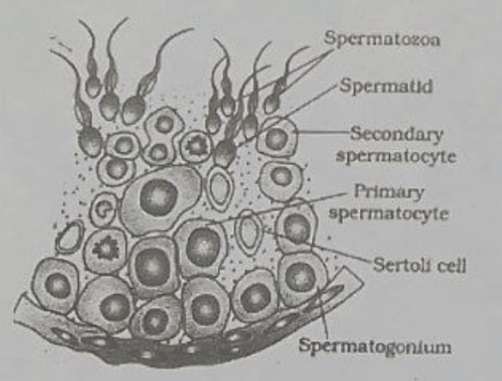
(a) Name the cells that undergo spermiogenesis.
(b) Name the type of cell division responsible for generation of primary spermatocyte.
(c) Differentiate between spermiogenesis and spermiation.
(d) How many sperms will be produced from 50 primary spermatocytes?
(a) Development of female gametophyte from a single functional megaspore.
(b) Labeled diagram showing: Egg cell, Synergids, Polar nuclei (central cell), Antipodals.
OR
(a) Spermatids
(b) Mitosis
(c) See explanation below
(d) 200 sperms
View Solution
Concept:
In flowering plants, the female gametophyte (embryo sac) develops inside the ovule from a megaspore. In humans, spermatogenesis occurs inside seminiferous tubules and involves mitosis, meiosis, and differentiation stages leading to sperm formation.
Part (a): Monosporic development of female gametophyte
During megasporogenesis, a megaspore mother cell undergoes meiosis to produce four haploid megaspores. In most angiosperms, only one megaspore remains functional while the other three degenerate. The embryo sac develops from this single functional megaspore.
Thus, monosporic development refers to the development of the female gametophyte from only one megaspore.
Part (b): Structure of Mature Embryo Sac
A typical mature embryo sac (Polygonum type) is 7-celled and 8-nucleate. It consists of:
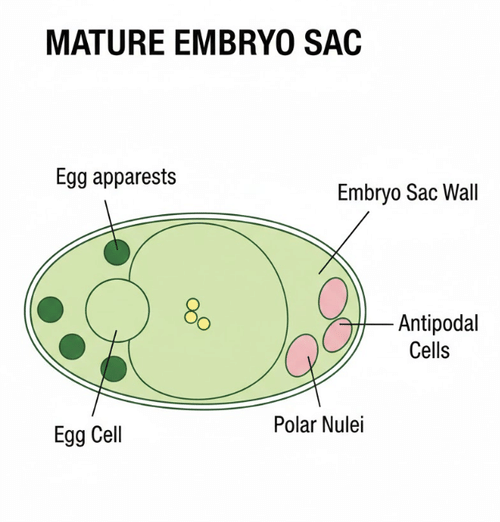
One Egg cell
Two Synergids
Three Antipodal cells
Two Polar nuclei (in central cell)
These parts should be shown and labeled in the diagram.
OR
(a) Cells that undergo spermiogenesis
Spermiogenesis is the transformation of spermatids into spermatozoa.
Therefore, the cells that undergo spermiogenesis are spermatids.
(b) Type of cell division responsible for generation of primary spermatocyte
Primary spermatocytes are formed from spermatogonia by mitotic division.
(c) Difference between spermiogenesis and spermiation
Spermiogenesis: It is the process by which spermatids transform into mature spermatozoa. It involves morphological changes such as formation of tail and acrosome.
Spermiation: It is the release of mature spermatozoa from Sertoli cells into the lumen of seminiferous tubule.
(d) Number of sperms produced from 50 primary spermatocytes
Each primary spermatocyte undergoes meiosis I to form 2 secondary spermatocytes.
Each secondary spermatocyte undergoes meiosis II to form 2 spermatids.
Thus, \[ 1 primary spermatocyte \rightarrow 4 sperms \]
Therefore, \[ 50 \times 4 = 200 sperms \] Quick Tip: Remember: - Monosporic embryo sac develops from one functional megaspore. - 1 Primary spermatocyte always produces 4 sperms after meiosis. - Spermiogenesis = formation of sperm. - Spermiation = release of sperm.
Answer the following:
(a) Based on the karyotype, what chromosomal disorder is detected?
(b) Write its cause.
(c) Write the symptoms of the disorder.
OR
Frederick Griffith performed an experiment on Streptococcus pneumoniae to study inheritance.
(a) Describe the experimental setup.
(b) What were his major observations when he injected mice with different strains?
(c) What conclusion did Griffith draw from this experiment?
View Solution
(a) Chromosomal disorder detected:
The karyotype shows three copies of chromosome 21 instead of two.
This condition is known as Trisomy 21, commonly called Down syndrome.
(b) Cause of the disorder:
Down syndrome is caused by the presence of an extra copy of chromosome 21.
This arises due to nondisjunction during meiosis, leading to gametes with abnormal chromosome number.
(c) Symptoms of Down syndrome:
Intellectual disability and delayed cognitive development.
Distinct facial features (flat face, upward slanting eyes, small ears).
Short stature and poor muscle tone.
Increased risk of congenital heart defects and certain medical conditions.
\hrule
Answer (Griffith’s experiment):
(a) Experimental setup:
Griffith worked with two strains of Streptococcus pneumoniae:
Smooth (S) strain – virulent, with polysaccharide capsule.
Rough (R) strain – non-virulent, lacking capsule.
He injected these strains into mice to study their effect.
(b) Major observations:
Mice injected with live S strain died.
Mice injected with live R strain survived.
Mice injected with heat-killed S strain survived.
Mice injected with a mixture of heat-killed S strain and live R strain died, and live S strain bacteria were recovered from their bodies.
(c) Conclusion:
Griffith concluded that some “transforming principle” from the dead S strain bacteria had transformed the live R strain into virulent S strain.
This experiment demonstrated the phenomenon of bacterial transformation. Quick Tip: Down syndrome = Trisomy 21 due to nondisjunction.
Griffith’s experiment = Discovery of transformation principle in bacteria.



Comments