




The PSEB Class 12 Business Studies exam in 2025 was conducted on March 17, 2025, with the question paper and solutions available post-exam. The exam tests understanding of Introductory Microeconomics, including consumer behavior and market forms, as well as Introductory Macroeconomics, covering national income, money and banking, government budget, and open economy macroeconomics.
Students must attempt a combination of multiple-choice, objective, short, and long answer questions in 3 hours. The paper totals 100 marks, comprising 80 marks for the theory component and 20 marks for internal assessment, with no negative marking for incorrect answers.
PSEB Class 12 Business Studies 2025 Question Paper with Solutions PDF
| PSEB Class 12 Business Studies 2025 Question Paper with Solutions PDF | Download PDF | Check Solutions |
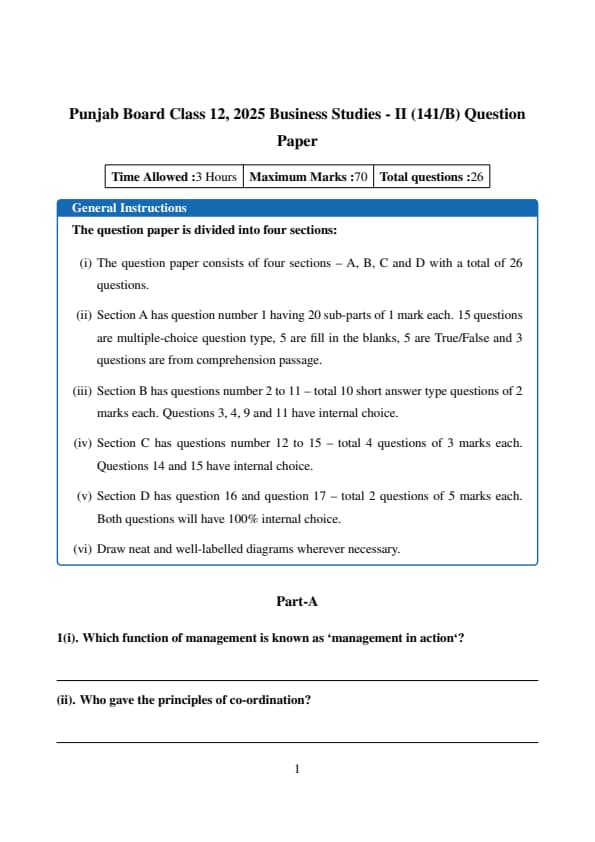
Which function of management is known as `management in action`?
View Solution
The function of management that is known as management in action is Directing.
Management consists of several functions such as planning, organizing, staffing, directing, and controlling. Among these, directing is considered the most dynamic function because it involves putting plans into action.
Directing refers to the process by which managers guide, motivate, supervise, and communicate with employees to ensure that organizational objectives are achieved. While planning decides what is to be done and organizing arranges resources, directing actually initiates action at the workplace.
Through directing, managers issue instructions, provide leadership, motivate employees, and supervise their work. Without directing, employees would not know how to perform their tasks effectively, even if plans and organizational structures exist.
Therefore, directing activates all other managerial functions and ensures that employees work efficiently toward achieving organizational goals. Hence, it is rightly called management in action.
Quick Tip: Directing is called management in action because it converts plans into actual performance by guiding and motivating employees.
Who gave the principles of co-ordination?
View Solution
The principles of co-ordination were given by Mary Parker Follett.
Mary Parker Follett was a renowned management thinker who emphasized the importance of coordination in achieving organizational objectives. According to her, coordination is not a separate function but an integral part of all managerial activities.
She explained that coordination ensures harmony of actions among individuals and departments working in an organization. To achieve effective coordination, she proposed certain principles such as direct contact among people concerned, coordination in the early stages of planning, continuity of coordination, and reciprocal relationships among departments.
Follett believed that coordination should begin at the planning stage and continue throughout the execution of activities. She also emphasized that coordination is a continuous process and must be maintained at all levels of management.
Her principles highlight that effective coordination helps in minimizing conflicts, avoiding duplication of efforts, and ensuring unity of action in the organization. Thus, Mary Parker Follett made a significant contribution to management by explaining the principles of coordination.
Quick Tip: Mary Parker Follett emphasized coordination as a continuous process essential for achieving unity of action in management.
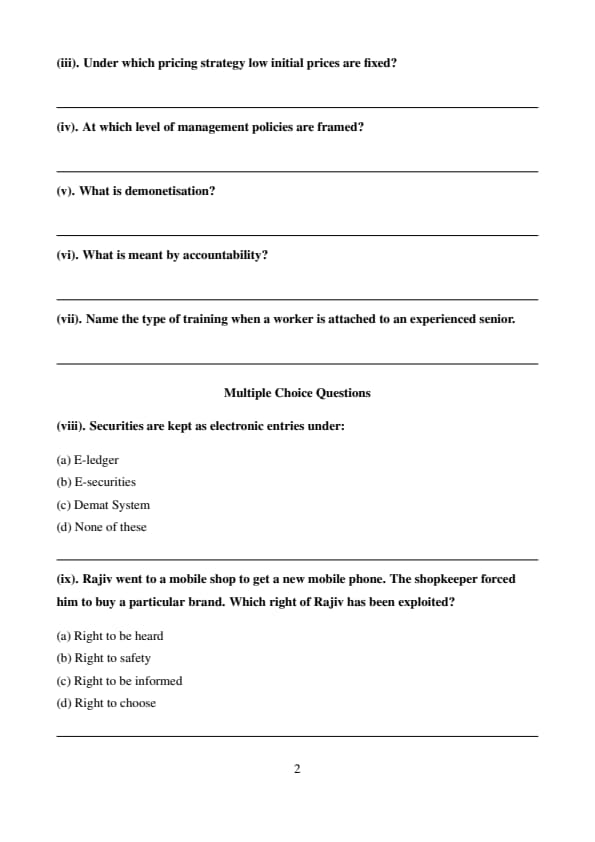
Under which pricing strategy low initial prices are fixed?
View Solution
Low initial prices are fixed under the Penetration Pricing Strategy.
Penetration pricing is a pricing strategy in which a firm sets a relatively low price for a new product at the time of its introduction into the market. The primary objective of this strategy is to penetrate the market quickly by attracting a large number of customers. Since the price is kept low, the product becomes affordable to a wider segment of consumers, leading to higher sales volume.
This strategy is especially useful in markets where consumers are price-sensitive and where strong competition exists or is expected to arise in the future. By fixing low initial prices, the firm discourages potential competitors from entering the market because the low profit margins make the market less attractive to them.
Once the product gains wide acceptance, establishes brand loyalty, and captures a significant market share, the firm may gradually increase the price. Thus, penetration pricing focuses on long-term gains rather than short-term profits.
Quick Tip: Penetration pricing emphasizes high sales volume and market share by initially keeping prices low.
At which level of management policies are framed?
View Solution
Management policies are framed at the Top Level of Management.
The top level of management is responsible for framing policies because it deals with the overall direction, objectives, and long-term plans of the organization. This level generally includes the Board of Directors, Managing Director, Chief Executive Officer, and other senior executives.
Policies act as guidelines for decision-making and provide a framework within which all organizational activities are carried out. Since policies affect the entire organization and have long-term implications, they must be formulated by those who have a comprehensive understanding of the organization’s goals, resources, and external environment.
Top-level management analyzes internal strengths and weaknesses as well as external opportunities and threats before framing policies. Once formulated, these policies are communicated to middle-level management for interpretation and to lower-level management for implementation.
Thus, policy formulation is a strategic function and is always performed by the top level of management.
Quick Tip: Policy framing is a strategic activity and hence lies exclusively with top-level management.
What is demonetisation?
View Solution
Demonetisation is an economic process in which a government withdraws the legal tender status of a particular currency note or coin.
When demonetisation is implemented, the specified currency notes are no longer accepted as a medium of exchange for goods and services.
The demonetised currency is usually replaced with new currency notes or coins, and people are required to exchange or deposit the old currency within a fixed time period.
This process is carried out as a policy decision by the government and the central bank of a country.
The main objectives of demonetisation include controlling black money, reducing corruption, curbing tax evasion, eliminating counterfeit currency, and discouraging illegal activities.
Demonetisation also aims to promote digital payments and reduce excessive dependence on cash transactions in the economy.
Although demonetisation may cause short-term inconvenience to the public, it is intended to strengthen the financial system and bring transparency in economic transactions.
Quick Tip: Demonetisation means officially declaring certain currency notes invalid and replacing them with new legal tender.
What is meant by accountability?
View Solution
Accountability refers to the obligation of individuals, officials, or organisations to take responsibility for their actions, decisions, and performance.
It means that a person or institution must explain and justify their actions to those who are affected by them or to higher authorities.
In a democratic system, accountability ensures that public officials, government institutions, and administrators act in the best interest of the people.
It helps in preventing misuse of power, corruption, and inefficiency by making authorities answerable for their conduct.
Accountability also promotes transparency, fairness, and trust in governance and administration.
When accountability exists, citizens can question decisions, demand explanations, and expect corrective action if mistakes are made.
Thus, accountability is essential for effective governance, good administration, and the smooth functioning of both public and private organisations.
Quick Tip: Accountability means being answerable for one’s actions and accepting responsibility for their outcomes.
Name the type of training when a worker is attached to an experienced senior.
View Solution
When a worker is attached to an experienced senior, the training takes place directly in the actual work environment where the job is performed.
In this method, the worker learns by observing the senior employee closely and by performing tasks under their continuous guidance and supervision.
The experienced senior acts as a mentor and demonstrates how different tasks are carried out, explains work procedures, and shares practical knowledge gained through experience.
The worker gradually develops job-related skills, technical know-how, and confidence by learning through real-life work situations rather than theoretical instruction alone.
This form of training emphasizes learning by doing, which helps the worker understand job responsibilities more effectively.
It also allows immediate correction of mistakes, direct feedback, and practical exposure, making the learning process faster and more effective.
Such training is commonly used in factories, offices, workshops, and service organizations where hands-on experience is essential for skill development.
Therefore, the type of training in which a worker is attached to an experienced senior is called On-the-job training.
Quick Tip: On-the-job training helps employees gain practical skills by learning directly at the workplace under the guidance of experienced personnel.
Securities are kept as electronic entries under:
View Solution
In modern financial markets, physical share certificates are no longer preferred because they involve paperwork, risk of damage, theft, and delays in transfer. Therefore, the financial system introduced a process known as dematerialisation, where securities are converted from physical form into electronic entries stored inside a depositor system.
Step 1: Understanding electronic storage of securities.
Electronic securities are maintained in accounts similar to bank accounts. These accounts are opened with institutions called Depositories (such as NSDL or CDSL). The system they use is known as a Demat System. It ensures that instead of receiving physical paper certificates, investors simply receive electronic confirmations.
Step 2: Evaluate each option.
(a) E-ledger: Although ledgers are used for recording transactions, they are not specifically meant for the electronic storage of securities.
(b) E-securities: This term appears correct but is not the official system used for storing securities.
(c) Demat System: This is the correct and internationally recognized system where securities are held in electronic form within a Demat account.
(d) None of these: Incorrect because option (c) is correct.
Step 3: Final reasoning.
Since Demat accounts convert physical securities into electronic entries and securely maintain them, the correct answer is the Demat System.
Final Answer: (c) Demat System
Quick Tip: Demat accounts eliminate risks of physical certificates and make buying or selling shares faster, safer, and more efficient.
Rajiv went to a mobile shop to get a new mobile phone. The shopkeeper forced him to buy a particular brand. Which right of Rajiv has been exploited?
View Solution
Consumers are protected under the Consumer Protection Act, which gives them several rights. One of the most important rights is the Right to Choose, which ensures that consumers can select goods and services freely without pressure or manipulation.
Step 1: Understanding the scenario.
Rajiv visited a mobile shop to buy a mobile phone based on his own preference. However, the shopkeeper did not allow him to decide freely and instead forced him to buy a particular brand. This means Rajiv was denied freedom of choice.
Step 2: Evaluate each right mentioned.
(a) Right to be heard – This protects consumers by ensuring their complaints are listened to in consumer courts. Not relevant here because no complaint was made yet.
(b) Right to safety – This deals with protection from harmful or unsafe products. The issue here is not safety but choice.
(c) Right to be informed – This ensures that consumers receive correct information about products. Rajiv was not denied information; he was denied freedom.
(d) Right to choose – This guarantees that consumers can choose from a variety of products according to their preferences without being forced. This is exactly what the shopkeeper violated.
Step 3: Final justification.
Since Rajiv was compelled to buy a specific brand, his Right to Choose was clearly violated. Consumers must always be free to select a product without any pressure from the seller.
Final Answer: (d) Right to choose
Quick Tip: Whenever a seller forces you to buy a specific product, your consumer Right to Choose is being violated. Always demand freedom of choice.
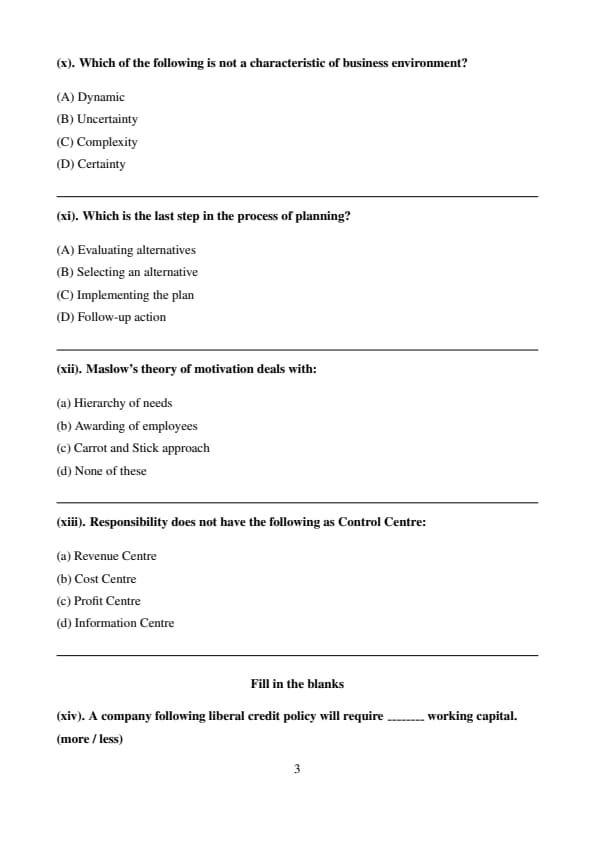
Which of the following is not a characteristic of business environment?
View Solution
Step 1: Understanding the business environment.
Business environment refers to all external forces that influence the functioning and decision-making of a business organisation. These forces include economic, social, political, technological, and legal factors.
Step 2: Identifying common characteristics.
The business environment is dynamic because it keeps changing, uncertain because future business conditions cannot be predicted accurately, and complex due to the presence of many interrelated factors.
Step 3: Analysis of options.
(A) Dynamic: This is a true characteristic of business environment.
(B) Uncertainty: This is a true characteristic due to unpredictability of future events.
(C) Complexity: This is a true characteristic as many factors affect business simultaneously.
(D) Certainty: This is not a characteristic because business environment is never fully predictable.
Step 4: Conclusion.
Therefore, the correct answer is option (D) Certainty.
Quick Tip: Always remember that business environment is dynamic, uncertain, and complex in nature.
Which is the last step in the process of planning?
View Solution
Step 1: Meaning of planning.
Planning is the process of deciding in advance the objectives to be achieved and the course of action to be followed to achieve those objectives.
Step 2: Steps involved in planning.
The planning process includes setting objectives, identifying alternatives, evaluating alternatives, selecting the best alternative, implementing the plan, and finally follow-up action.
Step 3: Evaluation of options.
(A) Evaluating alternatives: This is not the last step.
(B) Selecting an alternative: This precedes implementation.
(C) Implementing the plan: This is followed by monitoring and review.
(D) Follow-up action: This is the final step which ensures corrective measures if required.
Step 4: Conclusion.
Hence, follow-up action is the last step in the process of planning.
Quick Tip: Follow-up action helps in comparing actual performance with planned performance.
Maslow's theory of motivation deals with:
View Solution
Step 1: Understanding Maslow's theory.
Abraham Maslow proposed the famous Hierarchy of Needs theory, which explains human motivation based on different levels of needs such as physiological needs, safety needs, social needs, esteem needs, and self-actualization needs. According to this theory, lower-level needs must be satisfied before higher-level needs become motivating factors.
Step 2: Elimination of incorrect options.
(b) Awarding of employees: This refers to rewarding systems, not specifically related to Maslow’s hierarchical structure.
(c) Carrot and Stick approach: This belongs to behavioral motivation techniques, not Maslow’s need-based theory.
(d) None of these: Incorrect because option (a) correctly defines Maslow’s theory.
Step 3: Conclusion.
Maslow’s theory focuses entirely on the hierarchy of needs that drive human behavior and motivation, making option (a) the correct answer.
Quick Tip: Maslow’s theory moves from basic needs (food, safety) to advanced needs (esteem, self-actualization).
Responsibility does not have the following as Control Centre:
View Solution
Step 1: Understanding responsibility centres.
Responsibility centres are organisational units where managers are responsible for specific performance areas. These centres are classified into Revenue Centres, Cost Centres, Profit Centres, and Investment Centres. Each type measures performance differently, depending on what the manager controls.
Step 2: Evaluating the given options.
(a) Revenue Centre: Manager is responsible only for generating revenue. This is a valid responsibility centre.
(b) Cost Centre: Manager controls costs but not revenues. This also qualifies as a responsibility centre.
(c) Profit Centre: Manager controls both costs and revenues and is responsible for profits. This is definitely a responsibility centre.
(d) Information Centre: This is not considered a responsibility centre because it does not directly control revenue, cost, or profit elements. It mainly provides data or support, not performance accountability.
Step 3: Conclusion.
Since Information Centre is not recognised as a responsibility centre, option (d) is correct.
Quick Tip: Responsibility centres must involve measurable financial accountability—information centres do not.
A company following liberal credit policy will require ________ working capital. (more / less)
View Solution
A company following a liberal credit policy will require more working capital.
A liberal credit policy means that the firm allows its customers a longer period to make payments for goods sold. As a result, the amount of debtors or accounts receivable increases.
When customers take more time to pay, the firm’s money remains blocked in receivables for a longer duration. This reduces the immediate availability of cash.
To continue its day-to-day operations such as purchasing raw materials, paying wages, and meeting other operating expenses, the company needs additional funds.
Therefore, due to higher receivables and blocked funds, a firm following a liberal credit policy requires more working capital.
Quick Tip: Liberal credit policy increases receivables, which leads to a higher requirement of working capital.
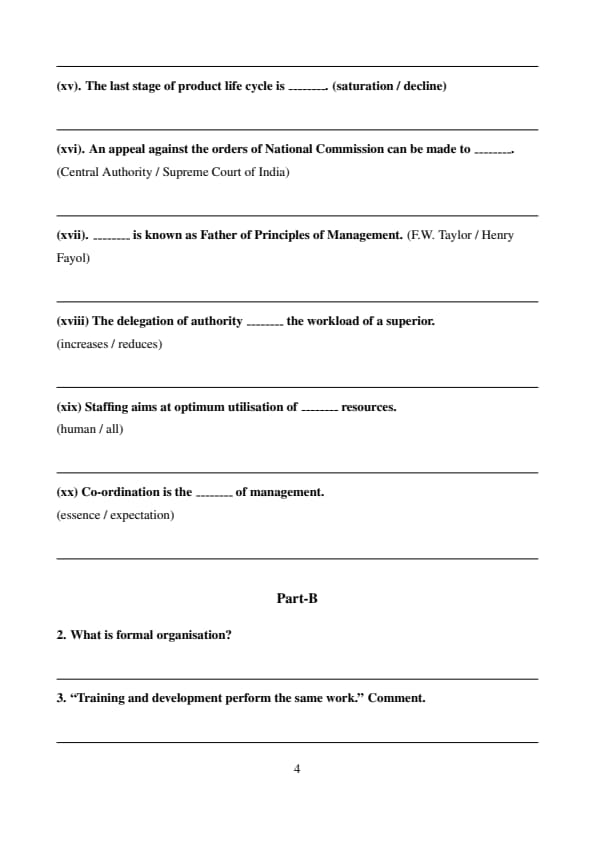
The last stage of product life cycle is ________. (saturation / decline)
View Solution
The last stage of the product life cycle is decline.
A product life cycle represents the stages through which a product passes from its introduction in the market to its eventual withdrawal. These stages include introduction, growth, saturation or maturity, and decline.
After the saturation stage, the market becomes fully served and sales stop growing. Gradually, sales begin to fall due to factors such as changing consumer preferences, technological advancements, or the availability of better substitute products.
During the decline stage, profits decrease and firms may reduce marketing efforts, lower prices, or discontinue the product completely.
Hence, the final stage of the product life cycle is known as the decline stage.
Quick Tip: Decline is the final stage of the product life cycle, marked by falling sales and profits.
An appeal against the orders of National Commission can be made to ________.
(Central Authority / Supreme Court of India)
View Solution
An appeal against the orders of the National Commission can be made to the Supreme Court of India.
The National Consumer Disputes Redressal Commission is the highest consumer dispute redressal body at the national level under the Consumer Protection Act. Since it functions as the apex authority in the consumer dispute redressal system, there is no higher consumer forum above it.
As per the provisions of the Consumer Protection Act, any person aggrieved by an order passed by the National Commission has the right to file an appeal directly before the Supreme Court of India. The Supreme Court examines whether the order passed is legally valid and in accordance with the law.
Therefore, the Supreme Court of India serves as the final appellate authority against the orders of the National Commission.
Quick Tip: Appeals always move from lower authority to higher judicial authority, and the Supreme Court is the highest court in India.
________ is known as Father of Principles of Management.
(F.W. Taylor / Henry Fayol)
View Solution
Henry Fayol is known as the Father of Principles of Management.
Henry Fayol was a French industrialist and management theorist who laid down fourteen fundamental principles of management. These principles provide guidelines for managerial practices such as division of work, unity of command, unity of direction, authority and responsibility, discipline, and esprit de corps.
His contribution focused on administrative management and the universal functions of management including planning, organizing, commanding, coordinating, and controlling. These principles are applicable to all organizations irrespective of their size or nature.
While F.W. Taylor is regarded as the Father of Scientific Management, Henry Fayol is recognized for establishing the foundational principles that form the basis of modern management theory.
Quick Tip: Taylor is linked with scientific management, whereas Fayol is associated with principles and functions of management.
The delegation of authority ________ the workload of a superior.
(increases / reduces)
View Solution
Delegation of authority means assigning responsibility and authority to subordinates to perform specific tasks.
When a superior delegates authority, part of the work is transferred to subordinates.
This reduces the burden on the superior, allowing them to focus on important managerial and strategic functions.
Therefore, delegation of authority helps in reducing the workload of a superior rather than increasing it.
Hence, the correct answer is reduces.
Quick Tip: Delegation helps managers save time and concentrate on higher-level decision-making.
Staffing aims at optimum utilisation of ________ resources.
(human / all)
View Solution
Staffing is the managerial function that deals with recruitment, selection, training, and development of employees.
The main objective of staffing is to ensure that the right people are placed in the right jobs at the right time.
Staffing focuses specifically on managing and utilising human resources effectively.
It does not deal directly with all types of resources such as material or financial resources.
Therefore, staffing aims at optimum utilisation of human resources.
Quick Tip: Staffing is concerned only with human resources, not physical or financial resources.
Co-ordination is the ________ of management.
(essence / expectation)
View Solution
Co-ordination refers to the process of integrating and harmonising the activities of different departments and individuals.
It ensures that all efforts are directed towards achieving organisational goals efficiently.
Co-ordination is required at all levels of management and in all managerial functions such as planning, organising, staffing, directing, and controlling.
Without co-ordination, management functions cannot work smoothly or effectively.
Therefore, co-ordination is rightly called the essence of management.
Quick Tip: Co-ordination binds all managerial functions into a unified whole.
What is formal organisation?
View Solution
A formal organisation refers to the official structure of relationships deliberately created by management to achieve organizational objectives.
It is a system of well-defined jobs, authority, responsibility, and accountability, where each employee knows his or her duties and position in the organisation.
Formal organisation is established through proper planning and is represented by an organisational chart that clearly shows lines of authority and communication.
In a formal organisation, rules, regulations, policies, and procedures are clearly laid down to guide the behaviour and actions of employees.
It ensures coordination, discipline, and systematic working by defining relationships among various departments and individuals.
Thus, a formal organisation provides a stable framework within which the activities of an enterprise are carried out efficiently.
Quick Tip: Formal organisation is officially created by management and is based on authority, rules, and defined relationships.
``Training and development perform the same work.'' Comment.
View Solution
The statement ``Training and development perform the same work'' is not completely correct.
Training and development are closely related concepts, but they are not identical and serve different purposes in an organisation.
Training focuses on improving the skills, knowledge, and abilities of employees to perform their present jobs efficiently. It is job-oriented, short-term in nature, and aims at increasing productivity and efficiency.
On the other hand, development is a broader concept that focuses on the overall growth of employees. It prepares employees for future roles and responsibilities by enhancing their personality, decision-making ability, and leadership qualities.
While training is mainly concerned with current job performance, development is future-oriented and continuous in nature.
Therefore, although training and development are interrelated and complementary, they do not perform the same work.
Quick Tip: Training is job-specific and short-term, while development is career-oriented and long-term.
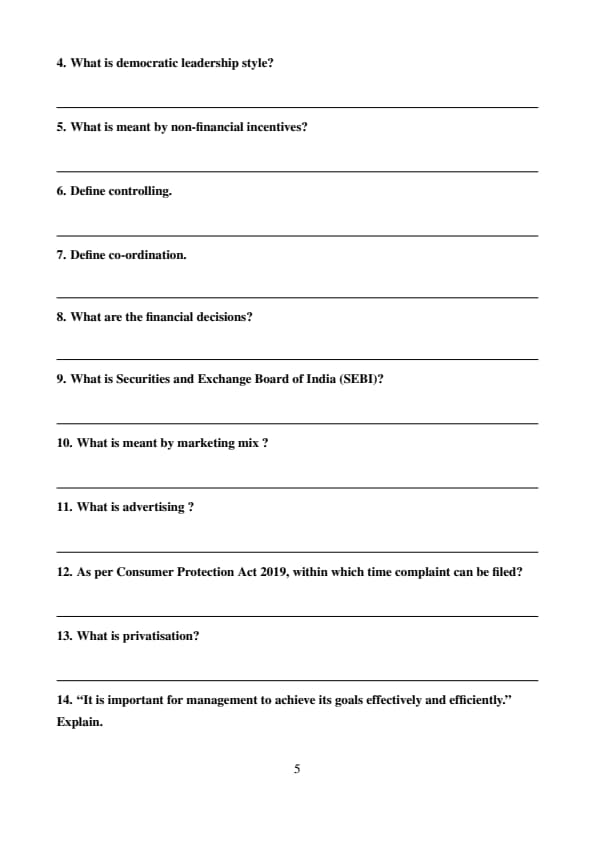
What is democratic leadership style?
View Solution
Democratic leadership style is a leadership style in which the leader actively involves subordinates in the process of decision-making. In this style, employees are encouraged to express their ideas, opinions, and suggestions, and these views are considered before taking any final decision.
The leader following democratic leadership does not exercise authority in an autocratic manner. Instead, authority and responsibility are shared among group members, which creates a sense of belonging and ownership among employees. Though the leader has the final authority, decisions are generally taken after discussion, consultation, and mutual agreement.
This leadership style promotes open communication, cooperation, and teamwork within the organization. Employees feel motivated and satisfied because their views are respected and they are treated as an important part of the organization. As a result, employee morale, creativity, and productivity increase significantly.
Democratic leadership style is most suitable in organizations where innovation, creativity, and employee participation are important. However, it may sometimes lead to delays in decision-making because of extensive consultation and discussion.
Quick Tip: Democratic leadership encourages participation and improves morale by involving employees in decision-making.
What is meant by non-financial incentives?
View Solution
Non-financial incentives refer to incentives that do not involve direct monetary rewards but motivate employees by satisfying their psychological, social, and emotional needs. These incentives focus on providing recognition, respect, responsibility, and opportunities for personal and professional growth.
Non-financial incentives include appreciation, praise, job security, promotion, participation in decision-making, delegation of authority, good working conditions, and opportunities for career advancement. Such incentives help employees feel valued and important within the organization, which enhances their motivation and commitment.
These incentives play a vital role in improving employee morale, loyalty, and job satisfaction. Even when financial incentives are provided, non-financial incentives are necessary to maintain long-term motivation because money alone cannot satisfy all human needs.
Therefore, non-financial incentives complement financial incentives and contribute significantly to overall employee performance and organizational success.
Quick Tip: Non-financial incentives motivate employees by fulfilling higher-level needs like recognition and self-respect.
Define controlling.
View Solution
Controlling is an important function of management which ensures that organisational activities are performed according to the planned objectives.
It involves measuring actual performance, comparing it with the standards set in advance, and identifying deviations, if any.
Through controlling, managers can determine whether the work is progressing as per plans or not.
If deviations are found, corrective actions are taken to ensure that organisational goals are achieved efficiently.
Thus, controlling helps in maintaining discipline, improving performance, and ensuring effective utilisation of resources.
It also provides feedback to management, which is useful for future planning and decision-making.
Quick Tip: Controlling ensures that actual performance matches planned performance.
Define co-ordination.
View Solution
Co-ordination is the process of integrating and synchronising the activities of different individuals and departments in an organisation.
It ensures that all efforts are directed towards the achievement of common organisational goals.
Co-ordination helps in avoiding duplication of work and reducing conflicts among departments.
It brings unity of action by harmonising individual efforts and group activities.
Co-ordination is required at all levels of management and is present in every managerial function such as planning, organising, staffing, directing, and controlling.
Therefore, it is rightly regarded as the essence of management.
Quick Tip: Co-ordination brings unity of effort and avoids conflicts in an organisation.
What are the financial decisions?
View Solution
Financial decisions refer to the decisions taken by a business regarding the management of its funds and financial resources.
These decisions are very important because they directly affect the profitability, liquidity, and long-term stability of the business.
Financial decisions mainly involve deciding how funds should be raised, invested, and distributed within the organization.
Such decisions are taken by the financial managers after carefully analyzing the risk, cost, and expected returns.
Financial decisions can broadly be classified into three main types:
Investment decisions, which deal with how funds are invested in different assets like machinery, buildings, or projects.
Financing decisions, which relate to choosing the sources of funds such as equity shares, debentures, loans, or retained earnings.
Dividend decisions, which involve deciding how much profit should be distributed to shareholders and how much should be retained in the business.
Thus, financial decisions help in the efficient utilization of financial resources and ensure the smooth functioning and growth of the business.
Quick Tip: Financial decisions focus on investment, financing, and dividend policies of a business.
What is Securities and Exchange Board of India (SEBI)?
View Solution
The Securities and Exchange Board of India (SEBI) is the regulatory authority of the securities market in India.
It was established in the year 1992 with the objective of protecting the interests of investors and promoting the development of the capital market.
SEBI regulates the functioning of stock exchanges, brokers, sub-brokers, merchant bankers, mutual funds, and other participants in the securities market.
It ensures that the securities market operates in a fair, transparent, and efficient manner.
One of the major roles of SEBI is to prevent unfair practices such as insider trading, fraud, and price manipulation in the stock market.
It also works to educate investors and create awareness about their rights and responsibilities.
By enforcing rules and regulations, SEBI helps in maintaining confidence among investors and encourages healthy growth of the Indian capital market.
Therefore, SEBI plays a vital role in regulating and developing the securities market in India.
Quick Tip: SEBI is the watchdog of the Indian securities market and protects investors from unfair practices.
What is meant by marketing mix ?
View Solution
The marketing mix refers to the combination of important marketing elements that a business uses to promote and sell its products or services in the market.
Step 1: Meaning of Marketing Mix.
Marketing mix is a set of controllable variables that a company uses to influence consumers and achieve its marketing objectives.
Step 2: Components of Marketing Mix.
The marketing mix generally consists of four main elements known as the 4 Ps:
Product, Price, Place, and Promotion.
These elements help a firm to design effective marketing strategies according to market needs.
Step 3: Conclusion.
Thus, marketing mix is the overall marketing strategy formed by combining product decisions, pricing policies, distribution methods, and promotional activities.
Quick Tip: Marketing mix is also called the \textbf{4 Ps of marketing}: Product, Price, Place, and Promotion.
What is advertising ?
View Solution
Advertising is a marketing activity used to inform, persuade, and remind consumers about a product, service, or idea.
Step 1: Meaning of Advertising.
Advertising refers to paid, non-personal communication through various media such as newspapers, television, radio, and the internet to promote goods and services.
Step 2: Purpose of Advertising.
The main purpose of advertising is to create awareness, attract customers, increase sales, and build brand image in the market.
Step 3: Conclusion.
Therefore, advertising plays an important role in marketing by influencing consumer buying behaviour and increasing market demand.
Quick Tip: Advertising is always a \textbf{paid and non-personal} form of promotion.
As per Consumer Protection Act 2019, within which time complaint can be filed?
View Solution
As per the Consumer Protection Act, 2019, a consumer complaint can be filed within a period of two years from the date on which the cause of action arises.
The cause of action refers to the date on which the consumer suffers loss or damage due to defective goods, deficient services, unfair trade practices, or restrictive trade practices.
This time limit has been fixed to ensure that complaints are filed within a reasonable period so that evidence is available and disputes can be resolved efficiently.
However, the Consumer Commission may allow a complaint to be filed even after the expiry of two years if the complainant is able to show sufficient cause for the delay.
Thus, normally a consumer must file a complaint within two years from the date of cause of action under the Consumer Protection Act, 2019.
Quick Tip: Under the Consumer Protection Act, 2019, complaints should generally be filed within two years from the date of cause of action.
What is privatisation?
View Solution
Privatisation refers to the process of transferring ownership, management, or control of a public sector enterprise to the private sector.
It involves reducing the role of the government in business activities and increasing the participation of private individuals or companies in economic activities.
Privatisation aims at improving efficiency, productivity, and profitability by introducing competition, professional management, and better use of resources.
It may take various forms such as sale of government shares to private investors, transfer of management to private entities, or outsourcing certain activities to the private sector.
Privatisation helps in reducing the financial burden on the government and encourages innovation and customer-oriented services.
Thus, privatisation is an important economic reform that promotes efficiency and growth by increasing private sector involvement in the economy.
Quick Tip: Privatisation means shifting ownership or control of public sector enterprises to the private sector.
``It is important for management to achieve its goals effectively and efficiently.'' Explain.
View Solution
Management plays a crucial role in ensuring that organizational goals are achieved both effectively and efficiently. Effectiveness means achieving the desired objectives, while efficiency refers to achieving these objectives with minimum use of resources such as time, money, and effort. Both are essential for the success and sustainability of an organization.
Firstly, effectiveness ensures that management is doing the right things. It focuses on selecting appropriate goals and taking actions that help in achieving those goals. If management is effective, the organization is able to meet its targets, satisfy customer needs, and adapt to changes in the external environment. Without effectiveness, even efficient operations would be meaningless as the organization may be moving in the wrong direction.
Secondly, efficiency ensures that management is doing things in the right manner. It emphasizes optimum utilization of available resources so that wastage is minimized and productivity is maximized. Efficient management helps in reducing costs, improving profitability, and increasing competitiveness in the market.
Management must balance both effectiveness and efficiency. Being effective without efficiency may lead to high costs, while being efficient without effectiveness may result in failure to achieve organizational objectives. Therefore, management must strive to achieve goals in a way that ensures both proper results and optimal use of resources.
Thus, achieving goals effectively and efficiently is essential for organizational growth, survival, and long-term success.
Quick Tip: Effectiveness is about achieving goals, while efficiency is about using resources wisely to achieve those goals.
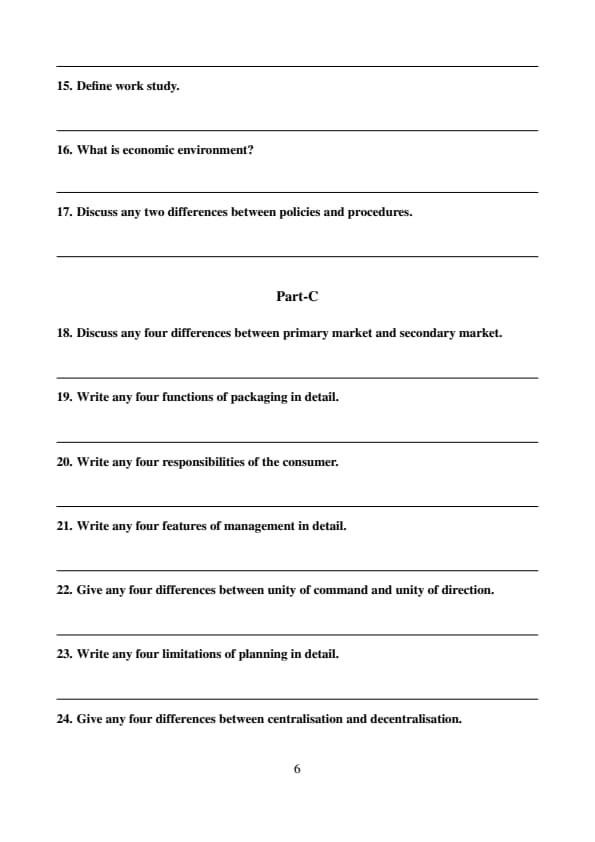
Define work study.
View Solution
Work study is a systematic and scientific technique used to examine work methods and measure work performance in order to improve efficiency and productivity. It aims at finding the best possible way of doing a job with minimum cost and effort while maintaining quality.
Work study consists of two main components: method study and work measurement. Method study focuses on analyzing existing methods of doing work and developing improved methods, whereas work measurement determines the standard time required to perform a particular task under given conditions.
The main objective of work study is to eliminate unnecessary movements, reduce wastage of time and resources, and increase overall productivity. It helps management in better planning, cost control, and optimum utilization of human and material resources.
Thus, work study is an important managerial tool that enhances efficiency, reduces operational costs, and improves organizational performance.
Quick Tip: Work study improves productivity by combining method study and work measurement.
What is economic environment?
View Solution
Economic environment refers to all those economic factors and conditions which influence the functioning, performance, and decision-making of business organisations.
It includes elements such as economic system, level of economic growth, income distribution, inflation rate, interest rates, employment level, and government economic policies.
The economic environment determines the purchasing power of consumers and the demand for goods and services in the market.
Changes in economic conditions directly affect production, pricing, investment, and expansion decisions of business enterprises.
For example, during periods of economic growth, businesses experience higher demand, whereas during recession, demand generally declines.
Thus, understanding the economic environment helps businesses to plan their strategies effectively and adapt to changing economic conditions.
Quick Tip: Economic environment includes factors like income, inflation, interest rates, and economic policies that affect business activities.
Discuss any two differences between policies and procedures.
View Solution
Policies and procedures are important tools of management that guide organisational actions, but they differ in nature and application.
First Difference – Meaning:
Policies are broad guidelines or general statements that provide direction for decision-making in an organisation.
Procedures, on the other hand, are detailed and specific steps that must be followed to carry out a particular task or activity.
Second Difference – Flexibility:
Policies are flexible in nature and allow managers to exercise judgment depending on the situation.
Procedures are rigid and must be followed in a fixed sequence to ensure uniformity and consistency in operations.
Thus, while policies act as a framework for decision-making, procedures specify the exact manner in which work is to be performed.
Quick Tip: Policies guide decisions, whereas procedures tell how work should be done step by step.
Discuss any four differences between primary market and secondary market.
View Solution
The primary market and secondary market are two important components of the capital market.
They differ from each other on several bases. The four major differences are discussed below:
1. Meaning:
The primary market is the market where new securities are issued for the first time directly by the company to investors.
The secondary market is the market where existing securities are bought and sold among investors.
2. Flow of Funds:
In the primary market, funds flow directly from investors to the issuing company, helping the company raise capital.
In the secondary market, funds flow from one investor to another, and the company does not receive any funds from such transactions.
3. Purpose:
The main purpose of the primary market is to mobilize savings and provide funds to companies for expansion and growth.
The main purpose of the secondary market is to provide liquidity to securities so that investors can easily buy or sell them.
4. Price Determination:
In the primary market, the price of securities is fixed by the issuing company in consultation with experts.
In the secondary market, prices are determined by demand and supply forces in the stock exchange.
Thus, both markets perform different but complementary functions in the capital market system.
Quick Tip: Primary market deals with new issues, while secondary market deals with trading of existing securities.
Write any four functions of packaging in detail.
View Solution
Packaging plays an important role in marketing and distribution of goods.
The four major functions of packaging are explained below in detail:
1. Protection:
One of the primary functions of packaging is to protect goods from damage, breakage, leakage, and spoilage during storage and transportation.
Proper packaging safeguards the product from heat, moisture, dust, and other external factors.
2. Identification:
Packaging helps in identifying the product easily.
It contains important information such as brand name, quantity, price, ingredients, and instructions for use, which helps consumers in making purchase decisions.
3. Convenience:
Good packaging makes handling, storage, transportation, and use of products more convenient.
Features like easy opening, resealing, and proper size improve customer convenience and satisfaction.
4. Promotion:
Packaging acts as an effective promotional tool.
Attractive design, colors, and labeling help in attracting customers and creating a positive image of the product in the market.
Therefore, packaging not only protects the product but also adds value and helps in marketing.
Quick Tip: Effective packaging protects the product, informs consumers, and supports marketing efforts.
Write any four responsibilities of the consumer.
View Solution
Consumers play an important role in the market and have certain responsibilities to ensure fair trade practices. The following are any four responsibilities of a consumer:
Step 1: Awareness.
A consumer should be aware of the quality, quantity, price, and features of goods and services before making a purchase. Awareness helps consumers avoid exploitation.
Step 2: Right Use of Goods.
Consumers should use products according to the instructions given by the manufacturer to avoid wastage, accidents, or misuse.
Step 3: Filing Complaints.
If a consumer is cheated or receives defective goods, they should file a complaint in the appropriate consumer forum instead of remaining silent.
Step 4: Honest Behaviour.
Consumers should be honest while purchasing goods and should not make false complaints or misuse consumer protection laws.
Quick Tip: An aware and responsible consumer helps in promoting fair trade practices in the market.
Write any four features of management in detail.
View Solution
Management is an essential activity required for the successful functioning of an organization. The following are any four important features of management:
Step 1: Management is Goal-oriented.
Management is always directed towards achieving organizational goals effectively and efficiently. All managerial activities are focused on goal attainment.
Step 2: Management is a Continuous Process.
Management is an ongoing process that includes planning, organizing, staffing, directing, and controlling. These functions are performed continuously.
Step 3: Management is Universal.
Management is required in all types of organizations, whether business, educational, social, or government institutions.
Step 4: Management is a Group Activity.
Management involves coordination of group efforts to achieve common objectives. It cannot be performed individually.
Quick Tip: Management exists wherever people work together to achieve common goals.
Give any four differences between unity of command and unity of direction.
View Solution
Unity of command and unity of direction are two important principles of management given by Henri Fayol. Although both aim at ensuring coordination and efficiency, they differ in their meaning and application. The four major differences between them are explained below.
(i) Meaning:
Unity of command means that an employee should receive orders from only one superior at a time. On the other hand, unity of direction means that all activities having the same objective should be directed by one manager and follow one plan.
(ii) Focus:
Unity of command focuses on the relationship between a superior and a subordinate. In contrast, unity of direction focuses on the coordination of activities and efforts of different departments toward a common goal.
(iii) Objective:
The main objective of unity of command is to avoid confusion, conflict, and overlapping of instructions. The objective of unity of direction is to ensure unity of action and effective achievement of organizational goals.
(iv) Scope:
Unity of command is concerned with individual employees and their reporting relationships. Unity of direction is concerned with the entire organization or a group of activities having the same objective.
Thus, while unity of command ensures discipline at the individual level, unity of direction ensures coordination at the organizational level.
Quick Tip: Unity of command deals with reporting to one boss, whereas unity of direction deals with one plan for one objective.
Write any four limitations of planning in detail.
View Solution
Planning is an essential function of management, but it has certain limitations which restrict its effectiveness. Any four major limitations of planning are explained below.
(i) Planning leads to rigidity:
Once plans are formulated, managers may find it difficult to change them. This rigidity reduces flexibility and makes it difficult for the organization to adapt to changing business conditions.
(ii) Planning may not work in a dynamic environment:
The business environment is highly dynamic and uncertain. Factors such as technological changes, government policies, and market conditions may change rapidly, making plans irrelevant or ineffective.
(iii) Planning is time-consuming and costly:
Planning requires a lot of time, effort, and resources. Collection of data, forecasting, and analysis involve high costs, which may not be affordable for small organizations.
(iv) Planning does not guarantee success:
Planning is based on assumptions about the future, which may not always be accurate. Even well-prepared plans may fail due to unforeseen circumstances beyond the control of management.
Therefore, although planning is essential, it should be flexible and continuously reviewed to overcome its limitations.
Quick Tip: Planning is useful but not foolproof; it must be flexible to deal with uncertainty.
Give any four differences between centralisation and decentralisation.
View Solution
Centralisation and decentralisation differ mainly in the distribution of authority and decision-making power within an organisation. The four major differences are explained below:
(i) Concentration of Authority:
In centralisation, decision-making authority is concentrated at the top level of management. Lower-level managers have very limited powers. In decentralisation, authority is delegated to middle and lower levels of management, allowing them to take decisions related to their work.
(ii) Role of Top Management:
Under centralisation, top management takes most of the important decisions and closely controls operations. In decentralisation, top management focuses more on policy formulation and strategic planning, while routine decisions are handled by lower-level managers.
(iii) Managerial Development:
Centralisation limits the development of managerial skills at lower levels because employees get fewer opportunities to make decisions. Decentralisation helps in developing managerial talent by giving employees experience in decision-making and problem-solving.
(iv) Flexibility and Speed of Decisions:
Centralisation often leads to delays in decision-making due to dependency on top management. Decentralisation allows faster and more flexible decisions as authority is delegated closer to the point of action.
Thus, while centralisation ensures uniformity and control, decentralisation promotes efficiency, initiative, and managerial growth.
Quick Tip: Centralisation concentrates authority at the top, whereas decentralisation distributes authority to lower levels.
Describe in detail any four steps involved in communication process.
View Solution
Communication is a systematic process through which information is exchanged between individuals. The four important steps involved in the communication process are explained below:
(i) Sender:
The sender is the person who initiates the communication. The sender has an idea, thought, or message that needs to be communicated to another person. Effective communication begins when the sender has clarity about the message to be conveyed.
(ii) Encoding:
Encoding is the process of converting the idea or message into words, symbols, gestures, or expressions that can be understood by the receiver. Proper encoding is essential to ensure that the message is clear and free from ambiguity.
(iii) Channel:
The channel refers to the medium through which the message is transmitted from the sender to the receiver. It may be oral, written, visual, or electronic. The selection of an appropriate channel is important for effective communication.
(iv) Receiver and Decoding:
The receiver is the person for whom the message is intended. Decoding is the process by which the receiver interprets and understands the message. Effective communication occurs when the receiver correctly understands the message as intended by the sender.
These steps together ensure smooth flow of information and help in achieving effective communication within an organisation.
Quick Tip: Communication is complete only when the receiver correctly understands the sender’s message.
Discuss any four functions of financial manager in detail.
View Solution
A financial manager plays a very important role in the efficient management of finances of an organisation.
The main functions of a financial manager are related to planning, procurement, utilisation, and control of financial resources.
Any four important functions of a financial manager are discussed below in detail:
1. Financial Planning:
Financial planning is one of the most important functions of a financial manager.
It involves estimating the financial requirements of the business for both short-term and long-term needs.
The financial manager prepares plans regarding how much capital is required, when it is required, and from which sources it should be obtained.
Proper financial planning ensures availability of adequate funds and avoids both shortage and excess of funds in the organisation.
2. Investment Decision:
Investment decision relates to the proper utilisation of funds in different assets and projects.
The financial manager decides where and how the funds should be invested to earn maximum returns.
This includes decisions regarding investment in fixed assets like land, building, machinery, and also in current assets such as inventory and receivables.
Sound investment decisions help in increasing profitability and long-term growth of the organisation.
3. Financing Decision:
Financing decision refers to the decision regarding the sources of finance to be used by the business.
The financial manager decides the appropriate mix of owned funds (equity) and borrowed funds (debt), known as capital structure.
The aim is to raise funds at minimum cost while maintaining financial stability and control of the organisation.
A balanced financing decision reduces financial risk and increases the value of the firm.
4. Dividend Decision:
Dividend decision involves deciding how much profit should be distributed among shareholders as dividend and how much should be retained in the business.
The financial manager has to strike a balance between shareholders’ expectations and the future financial needs of the organisation.
A sound dividend policy helps in maintaining goodwill of the company and ensuring steady growth.
Thus, the financial manager performs crucial functions that help in the efficient use of financial resources and achievement of organisational objectives.
Quick Tip: The four core functions of a financial manager are financial planning, investment decision, financing decision, and dividend decision.




Comments