




The PSEB Class 12 Economics exam in 2025 was conducted on March 17, 2025, with the question paper and solutions available post-exam. The exam tests understanding of Introductory Microeconomics, including consumer behavior and market forms, as well as Introductory Macroeconomics, covering national income, money and banking, government budget, and open economy macroeconomics.
Students must attempt a combination of multiple-choice, objective, short, and long answer questions in 3 hours. The paper totals 100 marks, comprising 80 marks for the theory component and 20 marks for internal assessment, with no negative marking for incorrect answers.
PSEB Class 12 Economics 2025 Question Paper with Solutions PDF
| PSEB Class 12 Economics 2025 Question Paper with Solutions PDF | Download PDF | Check Solutions |
(i) Which form of Market is more practical ?
View Solution
Step 1: Understanding the Concept:
In economic theory, market structures are classified based on the number of sellers, product differentiation, and ease of entry.
"Practicality" refers to which model most accurately represents the vast majority of real-world retail and service industries.
Step 2: Detailed Explanation:
1. Perfect Competition is a theoretical ideal where infinite sellers sell identical products with perfect knowledge. This rarely exists because branding and information gaps are always present.
2. Monopoly exists when there is only one seller. While some utilities might resemble this, anti-monopoly laws and the presence of distant substitutes make pure monopolies extremely rare.
3. Monopolistic Competition features many sellers selling "differentiated" products (different brands of soap, shoes, or restaurants). This is the most practical because it accounts for branding, advertising, and product variety which we see in daily life.
Step 3: Final Answer:
Because real-world markets are characterized by product differentiation and many competing brands, Monopolistic Competition is the most practical market form.
Quick Tip: Perfect Competition and Monopoly are "limiting cases" or extremes. Monopolistic Competition and Oligopoly are "real-world" market structures.
Supply of a commodity rises due to rise in Price is called ________.
View Solution
Step 1: Understanding the Concept:
Economics distinguishes between a "change in quantity supplied" (movement along the curve) and a "change in supply" (shift of the curve).
Step 2: Detailed Explanation:
1. When the quantity supplied changes due to a change in the price of the commodity itself, it is a movement along the same supply curve.
2. An upward movement along the curve (Price \(\uparrow\), Quantity Supplied \(\uparrow\)) is specifically called Extension or Expansion in Supply.
3. A downward movement (Price \(\downarrow\), Quantity Supplied \(\downarrow\)) is called Contraction in Supply.
4. "Increase in Supply" (Option B) refers to a rightward shift of the entire curve due to external factors like better technology or lower input costs, not the price of the product itself.
Step 3: Final Answer:
The rise in supply specifically caused by a rise in the commodity's own price is defined as Extension in Supply.
Quick Tip: Price Change = Extension/Contraction (Movement).
Other Factors Change = Increase/Decrease (Shift).
What type of relation is between Price and Demand ?
View Solution
Step 1: Understanding the Concept:
The "Law of Demand" describes the functional relationship between the price of a good and the quantity consumers are willing to buy.
Step 2: Detailed Explanation:
The Law of Demand states that, ceteris paribus (all other things being equal), as the price of a good increases, the quantity demanded decreases. Conversely, as the price decreases, the quantity demanded increases.
Since the two variables move in opposite directions, the relationship is termed inverse or negative.
Graphically, this results in a demand curve that slopes downwards from left to right.
Step 3: Final Answer:
The inverse relationship between price and quantity demanded is mathematically represented as a negative relation.
Quick Tip: Negative relation = Inverse relation. This leads to a downward sloping demand curve with a negative slope.
Per Unit Cost of a commodity is called ________.
View Solution
Step 1: Understanding the Concept:
Cost analysis helps firms determine pricing and production levels. Different cost measures look at total spending versus spending per unit of output.
Step 2: Key Formula or Approach:
The relationship between Total Cost (TC) and Average Cost (AC) is expressed as:
\[ AC = \frac{TC}{Q} \]
Where \( Q \) represents the number of units produced.
Step 2: Detailed Explanation:
1. Total Variable Cost (TVC) is the total cost that changes with output.
2. Average Fixed Cost (AFC) is only the fixed portion of cost divided by units.
3. Average Cost (AC) is the result of dividing the Total Cost (Fixed + Variable) by the total units produced. Therefore, it represents the complete cost incurred to produce a single unit of the commodity.
Step 3: Final Answer:
The cost measured per unit of output is known as the Average Cost (AC).
Quick Tip: "Average" in economics usually translates to "Per Unit". If you see "per unit", look for an option starting with "Average".
________ are two principal branches of Economics.
View Solution
Step 1: Understanding the Concept:
The study of economics is categorized based on the scale of analysis—whether we look at individual components or the entire system.
Step 2: Detailed Explanation:
1. Microeconomics focuses on the behavior of individual economic agents such as consumers, households, and firms. It deals with price determination in specific markets.
2. Macroeconomics focuses on the performance, structure, and behavior of the economy as a whole. It deals with aggregates like GDP, inflation, and national unemployment.
These two branches were formally distinguished by Ragnar Frisch in 1933 and form the foundation of economic study.
Step 3: Final Answer:
The two fundamental pillars of economic theory are Micro Economics and Macro Economics.
Quick Tip: Micro = Microscope (looking at individual cells).
Macro = Satellite (looking at the whole earth).
When TU is maximum, then MU is ________.
View Solution
Step 1: Understanding the Concept:
Utility refers to the satisfaction derived from consumption. The relationship between Total Utility (TU) and Marginal Utility (MU) is central to consumer behavior theory.
Step 2: Detailed Explanation:
1. Marginal Utility (MU) is the addition to Total Utility from consuming one more unit.
2. As long as MU is positive, TU continues to rise.
3. When the consumer reaches the point of complete satisfaction (satiety), the next unit adds nothing to total satisfaction. At this point, MU becomes zero.
4. Because no more utility is being added, TU is at its peak (maximum).
5. If consumption continues, MU becomes negative (disutility), causing TU to decline.
Step 3: Final Answer:
At the point of satiety, Total Utility is at its maximum and Marginal Utility is zero.
Quick Tip: Mathematically, MU is the derivative (slope) of the TU curve. When a function reaches its maximum, its slope is zero.
What is Bank Rate ?
View Solution
Step 1: Understanding the Concept:
The Bank Rate is a tool used by the Central Bank (like RBI) to control the money supply and credit in an economy.
Step 2: Detailed Explanation:
1. The Central Bank acts as the "Banker's Bank". It does not deal with the general public (citizens).
2. When Commercial Banks face a shortage of funds, they borrow from the Central Bank.
3. The official interest rate at which the Central Bank lends long-term funds to commercial banks is called the Bank Rate.
4. By changing this rate, the Central Bank can make borrowing cheaper or more expensive for commercial banks, which eventually affects the interest rates for the public.
Step 3: Final Answer:
Bank Rate is the rate charged by the Central Bank on loans to Commercial Banks.
Quick Tip: Central Bank \(\rightarrow\) Commercial Bank = Bank Rate.
Commercial Bank \(\rightarrow\) Public = Lending Rate.
Central Bank NEVER lends to the public.
National Income = ________.
View Solution
Step 1: Understanding the Concept:
National Income is the total value of final goods and services produced by normal residents of a country in a year, representing the total factor payments.
Step 2: Detailed Explanation:
1. Factor Cost (FC): We use factor cost because it represents the actual income earned by factors of production (Wages + Rent + Interest + Profit). Market Price includes taxes which are not "income" for factors.
2. Net: We use "Net" because depreciation (consumption of fixed capital) is subtracted from "Gross" to find the actual new value added.
3. National: We use "National" (which includes Net Factor Income from Abroad) instead of "Domestic" to account for the income of residents worldwide.
4. Therefore, standard National Income is technically defined as \( NNP_{FC} \) (Net National Product at Factor Cost).
Step 3: Final Answer:
National Income is equivalent to Net National Income at Factor Cost.
Quick Tip: Remember the formula: \( NNP_{FC} = \) National Income.
\( NDP_{FC} = \) Domestic Income.
Choose True/False : Net Indirect Taxes = (Indirect Taxes - Subsidy)
View Solution
Step 1: Understanding the Concept:
Net Indirect Tax (NIT) is the bridge used to convert Factor Cost into Market Price in national income aggregates.
Step 2: Key Formula or Approach:
\[ Market Price (MP) = Factor Cost (FC) + Indirect Taxes - Subsidies \]
Since \( NIT = Indirect Taxes - Subsidies \), the formula becomes:
\[ MP = FC + NIT \]
Step 2: Detailed Explanation:
1. Indirect Taxes: These are taxes levied by the government on production and sale (like GST), which increase the market price.
2. Subsidies: These are financial aids provided by the government to reduce the price of essential goods.
The "Net" impact is found by subtracting what the government gives back (subsidy) from what it takes (tax).
Step 3: Final Answer:
The statement is True as per the standard economic definition of Net Indirect Taxes.
Quick Tip: If Subsidies \(>\) Indirect Taxes, NIT becomes negative, and Market Price will be lower than Factor Cost.
A variable which is measured with reference to 'a point of time' is called ________.
View Solution
Step 1: Understanding the Concept:
Economic variables are classified based on their relationship with time—whether they represent a static quantity or a dynamic rate.
Step 2: Detailed Explanation:
1. Stock Variable: This is a quantity measured at a specific moment or point in time. Examples: Wealth on January 1st, money supply in the economy today, or the amount of water in a tank right now.
2. Flow Variable: This is a quantity measured over a duration or period of time (per hour, per month, per year). Examples: Monthly salary, annual GDP, or water flowing through a pipe per minute.
Step 3: Final Answer:
Since the question specifies "a point of time", it refers to a Stock variable.
Quick Tip: Think of a photograph vs. a movie. A photograph is a 'Stock' (point in time), while a movie is a 'Flow' (duration of time).
Which Banks do not have the authority to issue the currency notes in India ?
View Solution
Step 1: Understanding the Concept:
Currency issuance is a sovereign function, usually delegated to a single authority to ensure stability and uniformity in the economy.
Step 2: Detailed Explanation:
1. In India, the Reserve Bank of India (RBI) has the "Monopoly of Note Issue". It is the only bank authorized to print and issue currency notes (except the one-rupee note).
2. Commercial Banks (whether state-owned like SBI or private like HDFC) do not have the legal right to print money. Their role is to accept deposits and create credit.
3. Private Banks are a subset of commercial banks and likewise lack this authority.
Step 3: Final Answer:
Neither Commercial Banks nor Private Banks can issue currency notes; only the Central Bank (RBI) can.
Quick Tip: Only one "Central Bank" exists per country with the power to issue currency. All other banks are "Commercial" and only deal with money circulation.
Income Tax is a type of ________.
View Solution
Step 1: Understanding the Concept:
Taxes are classified as direct or indirect based on whether the "impact" (legal liability) and "incidence" (monetary burden) fall on the same person.
Step 2: Detailed Explanation:
1. Direct Tax: The burden of the tax cannot be shifted. The person who is legally responsible for the tax pays it directly from their pocket to the government. Income tax is levied on the earnings of an individual; the individual cannot ask someone else to pay their income tax.
2. Indirect Tax: The burden can be shifted. For example, a shopkeeper pays GST to the government but recovers it from the customer.
Step 3: Final Answer:
Since the burden of income tax stays with the person earning the income, it is a Direct Tax.
Quick Tip: Direct Tax: Burden cannot be shifted (Income Tax, Wealth Tax).
Indirect Tax: Burden is shifted (GST, Customs Duty).
Which is not the part of a government budget ?
View Solution
Step 1: Understanding the Concept:
A government budget is a comprehensive statement of estimated receipts and expenditures of the government for a financial year. It is structured into specific functional categories.
Step 2: Detailed Explanation:
The Government Budget consists of two main parts:
1. Revenue Budget: This includes revenue receipts (tax and non-tax) and revenue expenditure (spending that doesn't create assets, like salaries).
2. Capital Budget: This includes capital receipts (loans, disinvestment) and capital expenditure (spending that creates assets, like building roads).
"Domestic Budget" is not a formal accounting division in the official government budgetary framework.
Step 3: Final Answer:
The official parts are Revenue and Capital budgets; Domestic Budget is not a standard component.
Quick Tip: Govt Budget = Revenue Budget (Recurrent) + Capital Budget (Asset/Liability related).
Choose : (True/False) Producer's Equilibrium is determined when Marginal Cost equals to Marginal Revenue and Marginal Cost Curve cut Marginal Revenue Curve from below.
View Solution
Step 1: Understanding the Concept:
Producer's Equilibrium is the output level where a firm earns maximum profit or incurs minimum loss. The MC-MR approach is the standard method to determine this.
Step 2: Detailed Explanation:
There are two conditions for Producer's Equilibrium:
1. First Condition (\( MC = MR \)): At this point, the revenue from the last unit equals the cost of producing it. However, this could happen at two points (one where MC is falling and one where MC is rising).
2. Second Condition (\( MC \) cuts \( MR \) from below): This means after the point of equality, Marginal Cost must be greater than Marginal Revenue (\( MC > MR \)). This ensures that producing any more units would reduce total profit.
Step 3: Final Answer:
The statement correctly lists both the necessary and sufficient conditions for equilibrium. Thus, it is True.
Quick Tip: If MC cuts MR from above, it's a point of minimum profit, not equilibrium! Always look for MC rising at the equilibrium point.
Read the given statements carefully.
Statement 1 : There is more economic freedom to a person in the Mixed Economy.
Statement 2 : There is more economic freedom to a person in the Socialistic Economy.
Choose the right answer in the light of above given statements :
View Solution
Step 1: Understanding the Concept:
Economic freedom refers to the rights of individuals to own property, choose their occupation, and make production or consumption decisions without state interference.
Step 2: Detailed Explanation:
1. Socialistic Economy: The state owns the means of production and decides what to produce and for whom. Private property is limited, and individual economic choice is minimal.
2. Mixed Economy: It combines private and public sectors. While the government regulates, individuals are free to start businesses, own property, and choose goods.
Hence, Statement 1 is factually correct (Mixed economies offer freedom), and Statement 2 is incorrect (Socialism restricts individual economic freedom).
Step 3: Final Answer:
Therefore, Option (B) is the correct choice.
Quick Tip: Market/Mixed Economy = High Individual Freedom.
Centrally Planned/Socialist = High State Control.
Which is correct to measure Marginal Revenue ?
View Solution
Step 1: Understanding the Concept:
Marginal Revenue (MR) measures the change in Total Revenue (TR) resulting from a one-unit change in the quantity sold (\( Q \)).
Step 2: Detailed Explanation:
1. Discrete Method: If we want to find the MR of the \( n \)-th unit, we subtract the TR of \( n-1 \) units from the TR of \( n \) units. This is shown in Option (A).
2. General/Change Method: If the change in quantity is more than one unit, we use the ratio of total change in revenue to total change in quantity. This is shown in Option (B).
Both are mathematically valid definitions of the same economic concept.
Step 3: Final Answer:
Since both formulas are standard ways to calculate MR, Option (C) is correct.
Quick Tip: Use \( TR_n - TR_{n-1} \) for tables where quantity increases by 1. Use \( \Delta TR / \Delta Q \) for larger jumps in quantity.
There is no change in ________ when Price Elasticity of Demand is inelastic.
View Solution
Step 1: Understanding the Concept:
Price Elasticity of Demand (\( E_d \)) measures how much the quantity demanded changes when price changes.
Step 2: Detailed Explanation:
1. Inelastic Demand (\( E_d < 1 \)): Demand is not very responsive to price.
2. Perfectly Inelastic Demand (\( E_d = 0 \)): This is a extreme case where, no matter how much the price changes, the quantity demanded remains exactly the same.
The phrase "no change" in the question refers to the Quantity Demanded (simply called 'demand' here). Even if the price changes significantly, the demand remains constant.
Step 3: Final Answer:
In a perfectly inelastic scenario, there is zero change in the quantity demanded.
Quick Tip: Perfectly Inelastic = Vertical Demand Curve. Demand is constant like a 'pillar'.
Household Sector is the owner of the Factors of the Production. (True/False)
View Solution
Step 1: Understanding the Concept:
The "Circular Flow of Income" model divides the economy into sectors. The relationship between households and firms is the most basic flow.
Step 2: Detailed Explanation:
1. Factors of production are: Land, Labour, Capital, and Entrepreneurship.
2. In economic theory, it is assumed that individuals (Households) are the ultimate owners of these resources.
3. Households provide these "Factor Services" to Firms.
4. In exchange, Firms pay "Factor Income" (Rent, Wages, Interest, Profit) back to the households.
Step 3: Final Answer:
The statement is True; the household sector provides the inputs necessary for production.
Quick Tip: Households = Resource Suppliers.
Firms = Resource Users / Goods Producers.
Match the correct statement :
\begin{tabular}{ll}
Economic Concept & Explanation
(A) Real Flow & (i) Flow of goods and services
(B) Monetary Flow & (ii) Weaken the Circular Flow of Income
(C) Injections & (iii) Money Flow
(D) Leakages & (iv) Strengthen the Circular Flow of Income
\end{tabular}
View Solution
Step 1: Understanding the Concept:
This question covers the fundamental definitions used to describe the movement of value through an economy.
Step 2: Detailed Explanation:
1. Real Flow: The physical movement of goods, services, and factor inputs between sectors (A matches i).
2. Monetary Flow: The exchange of money (wages, payments for goods) between sectors (B matches iii).
3. Injections: Variables like Investment, Govt Spending, or Exports that add money to the circular flow, thus strengthening economic activity (C matches iv).
4. Leakages: Variables like Savings, Taxes, or Imports that take money out of the circular flow, thus weakening economic activity (D matches ii).
Step 3: Final Answer:
The only option that correctly matches all four pairs is Option (A).
Quick Tip: Real = Physical. Monetary = Cash.
Injections = Income Boiler. Leakages = Income Drain.
Marginal Propensity to Consume (MPC) =
View Solution
Step 1: Understanding the Concept:
The Marginal Propensity to Consume (MPC) is an economic measure that quantifies the induced consumption.
It represents the proportion of an aggregate raise in pay that a consumer spends on the consumption of goods and services, rather than saving it.
In a Keynesian consumption function, MPC represents the slope of the consumption line.
Step 2: Key Formula or Approach:
The formula for Marginal Propensity to Consume (MPC) is the ratio of the change in consumption (\(\Delta C\)) to the change in income (\(\Delta Y\)).
Mathematically, it is expressed as:
\[ MPC = \frac{\Delta C}{\Delta Y} \]
Where:
\(\Delta C\) = Change in Consumption Expenditure
\(\Delta Y\) = Change in Disposable Income
Step 3: Detailed Explanation:
To distinguish MPC from other related concepts:
1. Average Propensity to Consume (APC): It is the ratio of total consumption to total income at a specific level, given by \(APC = \frac{C}{Y}\).
2. Marginal Propensity to Save (MPS): It is the ratio of the change in savings to the change in income, given by \(MPS = \frac{\Delta S}{\Delta Y}\).
In the given options:
- Option (A) \(\frac{C}{Y}\) is the formula for APC.
- Option (C) \(\frac{\Delta Y}{\Delta C}\) is the reciprocal of MPC and does not have a standard economic label.
- Option (D) \(\frac{\Delta C}{\Delta Y}\) correctly matches the definition of MPC, showing how much extra consumption is generated per unit of extra income.
Usually, \(0 < MPC < 1\), as people typically consume some but not all of their additional income.
Step 4: Final Answer:
The correct formula for Marginal Propensity to Consume is \(\frac{\Delta C}{\Delta Y}\).
Quick Tip: Always remember that \(MPC + MPS = 1\).
If you know the value of MPC, you can easily find MPS by subtracting it from 1.
This relationship exists because any additional unit of income must be either consumed or saved.
(i) Who is Producer?
View Solution
Step 1: Understanding the Concept:
In economics, production is the process of transforming inputs into outputs.
The person or entity responsible for this transformation is known as a producer.
Step 2: Detailed Explanation:
A producer plays a vital role in the economy by supplying products to meet consumer demand.
Their primary objective is typically profit maximization, which is achieved by minimizing costs and maximizing revenue.
Producers can be individual farmers, artisans, or large corporations.
Step 3: Final Answer:
A producer is an individual or firm that produces goods and services by organizing various inputs to earn profit.
Quick Tip: Remember that every producer is also a consumer of factors of production (inputs).
Their behavior is studied under the 'Theory of the Firm' in Microeconomics.
What is meant by foreign Exchange Rate?
View Solution
Step 1: Understanding the Concept:
International trade requires the exchange of currencies because different nations use different monetary units.
The exchange rate acts as a link between the price levels of different countries.
Step 2: Detailed Explanation:
For example, if 1 US Dollar is equal to 83 Indian Rupees, the exchange rate is \(
(1 = ₹83 \).
This rate can be determined by market forces (Flexible Rate), the government (Fixed Rate), or a combination of both (Managed Floating).
It fluctuates based on the demand and supply of foreign currency in the international market.
Step 3: Final Answer:
Foreign exchange rate is the rate at which one currency is exchanged for another in the foreign exchange market.
Quick Tip: When the exchange rate increases (e.g., from 1 Dollar = 70 Rupees to 80 Rupees), it means the domestic currency has depreciated.
This generally makes exports cheaper and imports more expensive.
What is meant by Balance of Trade?
View Solution
Step 1: Understanding the Concept:
Balance of Trade is a component of the Balance of Payments (BOP).
It only records "visible" items, which are physical goods that can be seen crossing borders.
Step 2: Key Formula or Approach:
The formula for Balance of Trade is:
\[ BOT = Value of Visible Exports - Value of Visible Imports \]
Step 3: Detailed Explanation:
1. Surplus BOT: When exports exceed imports (\(Exports > Imports\)).
2. Deficit BOT: When imports exceed exports (\(Imports > Exports\)).
3. Balanced BOT: When exports equal imports (\(Exports = Imports\)).
Unlike BOP, BOT does not include "invisible" items like services (banking, shipping, insurance).
Step 4: Final Answer:
Balance of trade is the net difference between the export and import of physical goods of a country.
Quick Tip: Do not confuse BOT with BOP.
BOT is a narrow concept focusing only on goods, while BOP is a broader concept including goods, services, and capital transfers.
What is Economics?
View Solution
Step 1: Understanding the Concept:
The word 'Economics' originates from the Greek words 'Oikos' (house) and 'Nomos' (management), meaning household management.
It is fundamentally the study of choices under the constraint of scarcity.
Step 2: Detailed Explanation:
The core problem in economics is the "Scarcity Problem" because resources are limited but human desires are infinite.
It is divided into two main branches:
1. Microeconomics: Deals with individual units like a consumer or a firm.
2. Macroeconomics: Deals with the economy as a whole, focusing on aggregates like national income.
Step 3: Final Answer:
Economics is the study of how people make choices to use limited resources with alternative uses to achieve maximum satisfaction.
Quick Tip: The three basic questions every economy must answer are: What to produce? How to produce? and For whom to produce?
What are Indifference Curves?
View Solution
Step 1: Understanding the Concept:
Indifference curve analysis is based on the ordinal utility approach.
It assumes that consumers can rank their preferences even if they cannot measure utility in numbers.
Step 2: Detailed Explanation:
Since all points on an indifference curve provide equal satisfaction, the consumer is "indifferent" between them.
Key properties of Indifference Curves (IC):
1. ICs are downward sloping from left to right.
2. ICs are convex to the origin due to the diminishing Marginal Rate of Substitution (MRS).
3. A higher IC represents a higher level of satisfaction.
4. Two ICs can never intersect each other.
Step 3: Final Answer:
Indifference curves are loci of points representing commodity bundles between which a consumer is indifferent because they provide identical utility.
Quick Tip: The slope of an Indifference Curve is the Marginal Rate of Substitution (MRS), which measures how much of one good a consumer is willing to give up for an extra unit of another good while keeping total utility constant.
Complete the following Table:
\begin{tabular{|c|c|c|c|c|
\hline
Units of Production & 1 & 2 & 3 & 4
\hline
MC & 30 & 25 & 20 & 10
\hline
TC & - & - & - & -
\hline
\end{tabular
View Solution
Step 1: Understanding the Concept:
Marginal Cost (MC) is the addition to the Total Cost (TC) when one more unit of output is produced.
Total Cost can be found by summing up the Marginal Costs of all units produced, assuming Total Fixed Cost (TFC) is zero or identifying it as the sum of variable costs.
Step 2: Key Formula or Approach:
The formula relating TC and MC is:
\[ TC_n = \sum_{i=1}^{n} MC_i \]
Or, \( TC_n = TC_{n-1} + MC_n \).
Step 3: Detailed Explanation:
Calculating TC for each unit:
- For Unit 1: \( TC = MC_1 = 30 \).
- For Unit 2: \( TC = TC_1 + MC_2 = 30 + 25 = 55 \).
- For Unit 3: \( TC = TC_2 + MC_3 = 55 + 20 = 75 \).
- For Unit 4: \( TC = TC_3 + MC_4 = 75 + 10 = 85 \).
Step 4: Final Answer:
The completed table is:
\begin{tabular{|c|c|c|c|c|
\hline
Units of Production & 1 & 2 & 3 & 4
\hline
MC & 30 & 25 & 20 & 10
\hline
TC & 30 & 55 & 75 & 85
\hline
\end{tabular
Quick Tip: In numerical tables, if Total Fixed Cost (TFC) is not given, we usually treat TC at unit 1 as equal to the MC of the first unit, which essentially means we are calculating Total Variable Cost (TVC).
Write the features of market.
View Solution
Step 1: Understanding the Concept:
In economics, a market does not necessarily refer to a physical place.
It refers to the whole area where buyers and sellers are in contact with each other for the purpose of trade.
Step 2: Detailed Explanation:
The key characteristics of a market are:
1. Area: It represents the entire region where buyers and sellers operate.
2. Buyers and Sellers: Both parties must exist to facilitate exchange.
3. Commodity: There must be a specific good or service being bought and sold.
4. Single Price: Under ideal conditions (like perfect competition), there is a tendency for a uniform price to prevail.
5. Communication: Efficient means of contact (direct or indirect) must exist between buyers and sellers.
Step 3: Final Answer:
A market is characterized by a group of buyers and sellers, a commodity, an exchange mechanism, and a price determination process.
Quick Tip: Modern markets often function without a physical location through digital platforms (E-commerce), highlighting that "contact" is more important than "place".
Write the conditions of a producer's equilibrium with Marginal method.
View Solution
Step 1: Understanding the Concept:
Producer's equilibrium is the level of output at which the producer earns maximum profit.
The Marginal method looks at the change in revenue and cost from producing one extra unit.
Step 2: Detailed Explanation:
There are two necessary and sufficient conditions:
1. Necessary Condition: \( MR = MC \). As long as \( MR > MC \), the producer can increase profit by producing more. If \( MR < MC \), the producer should decrease production.
2. Sufficient Condition: MC must be greater than MR after the point of equality. This means the MC curve must intersect the MR curve from below. This ensures that profit is maximized and not minimized.
Step 3: Final Answer:
A profit-maximizing firm produces where \( MC = MR \) and the marginal cost is increasing.
Quick Tip: Always check the second condition!
MC can equal MR at two points (during falling and rising MC), but equilibrium only occurs when MC is rising.
What is meant by Macro Economics?
View Solution
Step 1: Understanding the Concept:
The term "Macro" is derived from the Greek word 'Makros', meaning large.
Instead of individual markets, it focuses on aggregate variables.
Step 2: Detailed Explanation:
Macroeconomics examines economy-wide phenomena such as:
1. National Income and GDP: Total output of a country.
2. Inflation: The general rise in price levels.
3. Unemployment: The state of the labor market.
4. Balance of Payments: A country's transactions with the rest of the world.
It helps in formulating government policies like fiscal and monetary policy.
Step 3: Final Answer:
Macroeconomics deals with total aggregates like total employment, national income, total investment, and general price level.
Quick Tip: Think of Microeconomics as looking at a single tree, while Macroeconomics looks at the entire forest.
What is Full Employment?
View Solution
Step 1: Understanding the Concept:
In a practical sense, full employment does not mean 0% unemployment.
It refers to a state where there is no "involuntary unemployment".
Step 2: Detailed Explanation:
- Involuntary Unemployment: When people are willing and able to work at the existing wage rate but cannot find work.
- Voluntary Unemployment: When people choose not to work at the prevailing wage rate. This still exists at full employment.
- Even at full employment, there may be "frictional" or "structural" unemployment due to job transitions or changes in technology.
Step 3: Final Answer:
Full employment is a state where everyone who is willing and able to work at the prevailing wage rate gets employment.
Quick Tip: Keynes defined full employment as the absence of involuntary unemployment.
In modern economics, this level is often called the Natural Rate of Unemployment.
State the relation between Multiplier and Marginal propensity to Consume.
View Solution
Step 1: Understanding the Concept:
The investment multiplier shows how many times the national income increases as a result of an initial increase in investment.
Step 2: Key Formula or Approach:
The mathematical relationship is given by:
\[ k = \frac{1}{1 - MPC} \]
Step 3: Detailed Explanation:
- If MPC increases, the value of the multiplier (\(k\)) also increases.
- For example, if \(MPC = 0.5\), then \(k = \frac{1}{1-0.5} = 2\).
- If \(MPC = 0.8\), then \(k = \frac{1}{1-0.8} = 5\).
This happens because higher consumption leads to higher income for others in a circular flow, multiplying the initial investment effect.
Step 4: Final Answer:
The value of the multiplier is directly proportional to the MPC; the higher the propensity to consume, the higher the multiplier.
Quick Tip: Remember that the multiplier is inversely related to the Marginal Propensity to Save (MPS), as \(k = \frac{1}{MPS}\).
What is Repo Rate?
View Solution
Step 1: Understanding the Concept:
Repo rate is a tool of monetary policy used by the central bank to control liquidity and inflation in the economy.
Step 2: Detailed Explanation:
- When the central bank increases the Repo Rate, it becomes more expensive for banks to borrow money.
- This leads to higher interest rates for consumers, reducing money supply and controlling inflation.
- Conversely, a lower Repo Rate encourages banks to borrow more and lend more to the public, stimulating economic growth.
It is a short-term lending rate.
Step 3: Final Answer:
Repo rate is the interest rate at which commercial banks borrow short-term funds from the Reserve Bank of India.
Quick Tip: Think of Repo Rate as the "benchmark" interest rate.
An increase in Repo Rate is a signal of a "Dear Money Policy" (to curb inflation), while a decrease signals a "Cheap Money Policy".
Why is Foreign Exchange demanded?
View Solution
Step 1: Understanding the Concept:
Individuals, firms, and the government need foreign currency to make payments to the rest of the world.
Step 2: Detailed Explanation:
Major reasons for demand for foreign exchange:
1. Imports: To pay for goods and services purchased from foreign countries.
2. Tourism: Citizens going abroad for holidays need the currency of that country for local expenses.
3. Unilateral Transfers: Sending gifts or financial help to people living in other countries.
4. Investment: To buy assets like shares, bonds, or real estate in foreign nations.
5. Speculation: Holding foreign currency to profit from future changes in the exchange rate.
Step 3: Final Answer:
Foreign exchange is demanded for imports, international travel, foreign investments, and financial transfers to other nations.
Quick Tip: The demand curve for foreign exchange is downward sloping, meaning as the exchange rate falls (foreign currency gets cheaper), the demand for it increases.
What is meant by Monetary Cost?
View Solution
Step 1: Understanding the Concept:
Unlike "real cost" (which measures effort or sacrifice), monetary cost is expressed in terms of money units.
Step 2: Detailed Explanation:
It includes two types of costs:
1. Explicit Costs: Actual cash payments made to outsiders for purchasing inputs (e.g., wages, rent, raw material costs).
2. Implicit Costs: The estimated value of inputs owned and used by the producer themselves (e.g., interest on own capital, rent of own land).
Total Monetary Cost = Explicit Cost + Implicit Cost + Normal Profit.
Step 3: Final Answer:
Monetary cost is the sum of all money payments made by a producer for the services of various factors of production and non-factor inputs.
Quick Tip: In accounting, only explicit costs are recorded, but in economics, both explicit and implicit costs are included in the monetary cost of production.
What is meant by Perfect Competition Market?
View Solution
Step 1: Understanding the Concept:
It is an ideal market form where no individual buyer or seller can influence the price of the product.
Step 2: Detailed Explanation:
Key features include:
1. Homogeneous Product: All products sold are identical in quality, shape, and size.
2. Price Takers: Individual firms must accept the price determined by industry demand and supply.
3. Perfect Knowledge: All buyers and sellers have full information about prices and product quality.
4. No Transport Costs: It is assumed that there are no costs for moving goods.
5. Free Entry/Exit: Firms can enter or leave the industry without any barriers.
Step 3: Final Answer:
Perfect competition is a theoretical market model where identical products are sold by numerous sellers at a uniform market price.
Quick Tip: In a perfect competition market, the demand curve for an individual firm is perfectly elastic (a horizontal straight line), meaning they can sell any quantity at the prevailing market price.
(i) Who is Producer ?
View Solution
Step 1: Understanding the Concept:
In the study of economics, the producer is the central figure in the theory of supply.
Production is not the creation of matter but the addition of "utility" to existing materials.
Step 2: Detailed Explanation:
A producer organizes the four factors of production: Land, Labour, Capital, and Entrepreneurship.
The producer's primary motive is profit maximization, which is the difference between total revenue and total cost.
Producers can take various forms, such as an individual farmer growing crops, a factory owner manufacturing cars, or a software company providing digital services.
They play a crucial role in the circular flow of income by providing goods to consumers and income to factor owners.
Step 3: Final Answer:
A producer is an individual or a firm that combines various productive resources to create finished goods or services intended for sale in the market.
Quick Tip: While consumers aim for "Utility Maximization," producers always aim for "Profit Maximization."
This distinction is fundamental to understanding market dynamics.
What is meant by foreign Exchange Rate ?
View Solution
Step 1: Understanding the Concept:
Since every country has its own legal tender (currency), international trade requires a mechanism to determine how much of one currency is needed to buy another.
Step 2: Detailed Explanation:
The exchange rate acts as a bridge between the price levels of different countries.
1. Example: If you need to pay \( 83 \) Indian Rupees to obtain \( 1 \) US Dollar, the exchange rate is \(
(1 = ₹83 \).
2. Determination: In a free market, this rate is determined by the intersection of the demand for and supply of foreign exchange.
3. Types: It can be a Fixed Exchange Rate (set by the government) or a Flexible/Floating Exchange Rate (set by market forces).
Fluctuations in this rate directly impact the cost of imports and the earnings from exports for a nation.
Step 3: Final Answer:
The foreign exchange rate is the external value of a domestic currency in the international market, defining the ratio of exchange between two currencies.
Quick Tip: Currency Appreciation means the domestic currency has become stronger (e.g., from 80 to 75 per dollar).
Currency Depreciation means it has become weaker (e.g., from 80 to 85 per dollar).
What is meant by Balance of Trade ?
View Solution
Step 1: Understanding the Concept:
Balance of Trade is also known as the "Trade Balance" or "Merchandise Balance."
It is a specific component of the Current Account within the broader Balance of Payments (BOP).
Step 2: Key Formula or Approach:
The formula for calculating the Balance of Trade is:
\[ BOT = Value of Visible Exports - Value of Visible Imports \]
Step 3: Detailed Explanation:
The term "visible" refers to physical commodities that can be seen, touched, and recorded by customs at the borders.
There are three possible states for BOT:
1. Surplus: When exports of goods exceed imports (\(X > M\)). This is considered favorable.
2. Deficit: When imports of goods exceed exports (\(M > X\)). This is considered unfavorable.
3. Balanced: When the value of exported goods exactly equals the value of imported goods.
Note that BOT does not include "invisible" items like services (banking, insurance, tourism) or transfer payments.
Step 4: Final Answer:
Balance of Trade is a record of a country's trade in physical goods with the rest of the world over a specific period, usually a year.
Quick Tip: A deficit in the Balance of Trade (goods) can often be offset by a surplus in the Balance of Services (invisibles) in the overall Current Account.
What is Economics ?
View Solution
Step 1: Understanding the Concept:
The fundamental problem of economics is "Scarcity."
Resources (Land, Labor, Capital) are limited, while human wants and desires are unlimited.
Step 2: Detailed Explanation:
Economics is essentially the "Science of Choice." Because we cannot have everything we want, we must make choices.
1. Microeconomics: Examines the behavior of individual units like a single household or a firm.
2. Macroeconomics: Examines the economy as a whole, looking at aggregates like National Income, Inflation, and Employment.
Different economists have defined it differently: Adam Smith focused on "Wealth," Alfred Marshall on "Material Welfare," and Lionel Robbins on "Scarcity and Choice."
Step 3: Final Answer:
Economics is the study of how individuals and society choose to employ scarce productive resources to produce various commodities and distribute them for consumption.
Quick Tip: Economics is often called the "Dismal Science," but it is actually the logic behind every decision we make in daily life.
What are Indifference Curves ?
View Solution
Step 1: Understanding the Concept:
Indifference curve analysis belongs to the "Ordinal Utility" school of thought, which suggests that utility cannot be measured in numbers but can be ranked.
Step 2: Detailed Explanation:
The consumer is "indifferent" between the combinations on the curve because they all yield the same utility.
Key characteristics of an IC:
1. Negative Slope: To get more of one good, the consumer must give up some of the other to keep satisfaction constant.
2. Convex to the Origin: This is due to the Law of Diminishing Marginal Rate of Substitution (MRS).
3. Higher IC = Higher Satisfaction: A curve further to the right represents more goods and thus more utility.
4. Non-Intersecting: Two ICs can never cross because each curve represents a unique, consistent level of satisfaction.
Step 3: Final Answer:
An indifference curve is a graphical representation of different bundles of two commodities that leave the consumer equally well-off.
Quick Tip: The slope of the Indifference Curve is the Marginal Rate of Substitution (MRS), which tells us the rate at which a consumer is willing to trade one good for another.
Complete the following Table :
\begin{tabular{|c|c|c|c|c|
\hline
Units of Production & 1 & 2 & 3 & 4
\hline
MC & 30 & 25 & 20 & 10
\hline
TC & - & - & - & -
\hline
\end{tabular
View Solution
Step 1: Understanding the Concept:
Marginal Cost (MC) is the addition made to the Total Cost by producing one additional unit of output.
Assuming there is no Fixed Cost mentioned (or calculating Total Variable Cost which is often treated as TC in such basic tables), TC is the cumulative sum of MC.
Step 2: Key Formula or Approach:
The relationship is given by:
\[ TC_n = MC_1 + MC_2 + ... + MC_n \]
Or simply, \( TC_n = TC_{n-1} + MC_n \).
Step 3: Detailed Explanation:
Let's calculate the TC for each unit step-by-step:
1. For Unit 1: \( TC = MC_1 = 30 \).
2. For Unit 2: \( TC = TC of unit 1 + MC of unit 2 = 30 + 25 = 55 \).
3. For Unit 3: \( TC = TC of unit 2 + MC of unit 3 = 55 + 20 = 75 \).
4. For Unit 4: \( TC = TC of unit 3 + MC of unit 4 = 75 + 10 = 85 \).
Step 4: Final Answer:
The completed row for TC is: 30, 55, 75, 85.
Quick Tip: In exams, if the question doesn't provide Total Fixed Cost (TFC), the TC for the first unit is equal to its MC. If TFC was given as 10, then TC at unit 1 would be 10 (Fixed) + 30 (Marginal) = 40.
Write the features of market.
View Solution
Step 1: Understanding the Concept:
In economics, a "market" is not necessarily a physical shopping mall or a bazaar. It is a system or arrangement that facilitates exchange.
Step 2: Detailed Explanation:
A market is characterized by the following essential elements:
1. Area: It refers to the whole region where buyers and sellers are spread out and in contact.
2. Buyers and Sellers: There must be at least one buyer and one seller for an exchange to occur.
3. Commodity: There must be a specific good or service (like wheat, oil, or haircuts) that is being traded.
4. One Price: There is a tendency for a uniform price to prevail for the same commodity at a given time.
5. Competition: The existence of multiple buyers or sellers creates competition, which helps determine the market price.
6. Communication: Efficient means of communication (like phones or the internet) must exist between parties.
Step 3: Final Answer:
A market is an organizational mechanism where buyers and sellers of a commodity interact to determine its price and quantity of exchange.
Quick Tip: Remember that "Contact" between buyer and seller is more important than "Location." A stock market or an e-commerce site (like Amazon) are perfect examples of non-physical markets.
Write the conditions of a producer's equilibrium with Marginal method.
View Solution
Step 1: Understanding the Concept:
Producer's equilibrium refers to a state of maximum profit or minimum loss where the producer has no incentive to change the level of output.
Step 2: Detailed Explanation:
The Marginal Revenue (MR) and Marginal Cost (MC) method specifies two conditions:
1. The Necessary Condition (\( MR = MC \)): Profits are maximized only when the revenue from the last unit produced equals the cost of producing that unit. If \( MR > MC \), the producer can still add to total profit by producing more. If \( MR < MC \), the producer is losing money on the last unit and should reduce production.
2. The Sufficient Condition (\( MC \) must be rising): The MC curve must cut the MR curve from below. This ensures that after the point of equality, \( MC \) becomes greater than \( MR \), making further production unprofitable. This distinguishes the point of maximum profit from a point of maximum loss.
Step 3: Final Answer:
A firm reaches equilibrium when its marginal cost equals its marginal revenue and the marginal cost is increasing at that output level.
Quick Tip: Always draw the diagram in your mind: Equilibrium is the second intersection where MC is going up, not the first intersection where MC might be going down.
What is meant by Macro Economics ?
View Solution
Step 1: Understanding the Concept:
The term 'Macro' comes from the Greek word 'Makros', meaning large. It focuses on the "Big Picture" of the economy.
Step 2: Detailed Explanation:
Macroeconomics deals with economic aggregates and averages. Its main areas of study include:
1. National Income: The total value of all final goods and services produced in a country.
2. Employment: The total level of employment and the causes of unemployment.
3. General Price Level: The study of inflation (rising prices) and deflation (falling prices).
4. Economic Growth: The long-term increase in the economy's productive capacity.
It helps governments formulate fiscal policies (taxes/spending) and monetary policies (interest rates/money supply) to stabilize the economy.
Step 3: Final Answer:
Macroeconomics is the study of aggregates like total consumption, total investment, total savings, and the general price level of an entire nation.
Quick Tip: Macroeconomics is often called the "Theory of Income and Employment" because these are its core themes.
What is Full Employment ?
View Solution
Step 1: Understanding the Concept:
In a healthy economy, full employment does not mean that \( 100% \) of the workforce is working. It refers to a state where the demand for labor equals the supply of labor at the prevailing wage.
Step 2: Detailed Explanation:
Key aspects of full employment:
1. Absence of Involuntary Unemployment: This occurs when everyone who is willing and able to work at the current wage rate finds a job.
2. Presence of Natural Unemployment: Even at full employment, there is always some "Frictional Unemployment" (people between jobs) and "Structural Unemployment" (mismatch of skills).
3. Voluntary Unemployment: People who choose not to work at the given wage are not counted as "unemployed" in the context of the full employment target.
Keynesian economics defines it as the point where further increases in aggregate demand lead to inflation rather than more output.
Step 3: Final Answer:
Full employment is a state of the economy where all those who are able and willing to work at existing wages are employed, except for those undergoing brief transitions between jobs.
Quick Tip: Full employment corresponds to the "Natural Rate of Unemployment." If unemployment falls below this, the economy might overheat and cause high inflation.
State the relation between Multiplier and Marginal propensity to Consume.
View Solution
Step 1: Understanding the Concept:
The Investment Multiplier measures the ratio of the change in National Income to the initial change in Investment. It explains how an initial injection of spending leads to a much larger increase in final income.
Step 2: Key Formula or Approach:
The relationship is expressed by the formula:
\[ k = \frac{1}{1 - MPC} \]
Step 3: Detailed Explanation:
- If people spend a larger portion of their extra income (\( MPC \) is high), the money circulates more in the economy, creating more income for others.
- Example 1: If \( MPC = 0.5 \), then \( k = \frac{1}{1-0.5} = 2 \). An investment of ₹100 leads to an income increase of ₹200.
- Example 2: If \( MPC = 0.8 \), then \( k = \frac{1}{1-0.8} = 5 \). An investment of ₹100 leads to an income increase of ₹500.
Thus, as \( MPC \) increases, the multiplier effect becomes stronger.
Step 4: Final Answer:
The value of the multiplier depends directly on the \( MPC \); a higher propensity to consume leads to a higher value of the multiplier.
Quick Tip: Multiplier is also inversely related to the Marginal Propensity to Save (\( MPS \)) because \( k = \frac{1}{MPS} \). If you save more (high \( MPS \)), the multiplier effect leaks away.
What is Repo Rate ?
View Solution
Step 1: Understanding the Concept:
"Repo" stands for Repurchasing Option. It is a quantitative tool used by the central bank to control the money supply and inflation in the economy.
Step 2: Detailed Explanation:
Commercial banks borrow from the RBI by selling government securities with an agreement to buy them back (repurchase) at a future date at a predetermined price.
1. To Curb Inflation: The RBI increases the Repo Rate. This makes borrowing expensive for banks, who then increase their lending rates. This reduces demand and slows down inflation.
2. To Boost Growth: During a recession, the RBI lowers the Repo Rate. This makes loans cheaper, encouraging businesses and consumers to spend and invest.
It is usually a short-term lending rate.
Step 3: Final Answer:
Repo rate is the benchmark interest rate at which the Reserve Bank of India lends liquidity to commercial banks against the collateral of government securities.
Quick Tip: When you hear in the news that "EMI will increase," it is usually because the Central Bank has increased the Repo Rate.
Why is Foreign Exchange demanded ?
View Solution
Step 1: Understanding the Concept:
The demand for foreign exchange arises because domestic currency is not accepted for transactions in other countries.
Step 2: Detailed Explanation:
The major sources of demand for foreign exchange are:
1. Imports: To pay for goods (like oil or machinery) and services (like software) purchased from other countries.
2. Tourism: Indian residents traveling abroad need foreign currency for their expenses.
3. Unilateral Transfers: Sending gifts, grants, or remittances to family members living in foreign countries.
4. Purchase of Assets: Buying shares, bonds, or real estate in foreign nations.
5. Speculation: People buy foreign currency if they expect its value to rise in the future, hoping to sell it later for a profit.
Step 3: Final Answer:
Foreign exchange is needed to settle international debts, finance imports, and facilitate overseas investment and travel.
Quick Tip: There is an inverse relationship between the exchange rate and the demand for foreign exchange. If the dollar gets cheaper, Indians will demand more dollars to import more goods.
What is meant by Monetary Cost ?
View Solution
Step 1: Understanding the Concept:
While "Real Cost" refers to the mental and physical effort or sacrifice involved, "Monetary Cost" translates these into money terms for accounting and decision-making.
Step 2: Detailed Explanation:
In economics, monetary cost consists of three main components:
1. Explicit Costs: The actual out-of-pocket payments made to outsiders for purchasing or hiring inputs (e.g., wages, rent, raw materials).
2. Implicit Costs: The estimated value of the inputs owned and used by the producer themselves (e.g., interest on own capital, rent of own building).
3. Normal Profit: The minimum return required to keep the entrepreneur in the business.
Therefore, Total Monetary Cost = Explicit Cost + Implicit Cost + Normal Profit.
Step 3: Final Answer:
Monetary cost refers to the sum of all money payments made to factor owners and for non-factor inputs required for production.
Quick Tip: Business accountants only look at Explicit Costs, but economists always include Implicit Costs to calculate the "Economic Cost."
What is meant by Perfect Competition Market ?
View Solution
Step 1: Understanding the Concept:
It is a theoretical "ideal" market form where no single buyer or seller has the power to influence the market price.
Step 2: Detailed Explanation:
The characteristic features of such a market are:
1. Large Number of Buyers and Sellers: An individual seller’s share is so small that they cannot affect the total supply.
2. Homogeneous Product: All firms sell identical products (e.g., pure salt or wheat), so buyers are indifferent between sellers.
3. Free Entry and Exit: Firms can enter the industry when there are profits and leave when there are losses without any legal barriers.
4. Perfect Knowledge: Everyone knows the prevailing price and the quality of the product.
5. Price Taker: The firm must accept the price determined by industry-wide demand and supply.
Step 3: Final Answer:
Perfect competition is a market situation characterized by complete transparency, identical products, and zero market power for individual participants.
Quick Tip: Under perfect competition, the firm's demand curve is a horizontal straight line, meaning \( Price = AR = MR \).
(i) What is the size of the Indian economy at present ?
( 854.7 billion
View Solution
Step 1: Understanding the Concept:
The question asks for the "nominal" economic size of India as mentioned in the provided text.
Step 2: Detailed Explanation:
The passage provides a comparison between India and the United Kingdom in terms of their GDP measured in 'nominal' cash terms.
It explicitly states: "The size of the Indian economy in ‘nominal’ cash terms was estimated to be
) 854.7 billion."
During the same period, the U.K. was estimated at
( 816 billion, making the Indian economy larger.
Step 3: Final Answer:
Based on the text, the current estimated size of the Indian economy is
) 854.7 billion.
Quick Tip: Nominal GDP measures the value of goods and services at current market prices, without adjusting for inflation.
How much Indian GDP expanded in the April-June quarter ?
View Solution
Step 1: Understanding the Concept:
This question requires identifying the specific quarterly growth rate of the Indian economy mentioned in the case study.
Step 2: Detailed Explanation:
The passage highlights a period of "record beating expansion" for India.
It clearly mentions: "Although, India’s GDP expanded 13.5% in the April-June quarter...".
This high growth rate was instrumental in propelling India to the fifth-largest spot in global rankings.
Step 3: Final Answer:
The Indian GDP grew by 13.5% during the April-June quarter.
Quick Tip: GDP expansion is usually reported as a percentage increase over the same quarter of the previous year (YoY growth).
What is the size of India's population in comparison with U.K. ?
View Solution
Step 1: Understanding the Concept:
The question focuses on the demographic comparison between the two nations and its impact on per-capita indicators.
Step 2: Detailed Explanation:
While India has surpassed the U.K. in total economic size, the text notes a significant difference in population.
It states: "But, India has a population 20 times that of the U.K. and so its GDP per capita is lower."
This means that even though the total "pie" (GDP) is larger, it has to be shared among a much larger group of people, resulting in less income per individual compared to the U.K.
Step 3: Final Answer:
As per the passage, India's population is 20 times larger than that of the United Kingdom.
Quick Tip: \( GDP Per Capita = \frac{Total GDP}{Population} \). A very high population (denominator) results in a low per-capita value even if the total GDP (numerator) is high.
Name the two largest economies of the world.
View Solution
Step 1: Understanding the Concept:
This involves identifying the top-tier global economies based on the rankings provided in the text.
Step 2: Detailed Explanation:
The passage discusses India's rise to the 5th position. It notes that India is now "behind only the US, China, Japan and Germany."
By logical deduction from this ordered list:
1. Rank 1: US
2. Rank 2: China
3. Rank 3: Japan
4. Rank 4: Germany
Therefore, the two largest are the US and China.
Step 3: Final Answer:
The two largest economies in the world are the United States and China.
Quick Tip: In economic lists, the order of names usually follows their rank from highest to lowest unless otherwise stated.
According to the para, highlight any two factors which could slow down the growth of the Indian economy in the coming quarters.
View Solution
Step 1: Understanding the Concept:
This requires identifying "headwinds" or risks mentioned in the text that could negatively impact future GDP growth.
Step 2: Detailed Explanation:
The passage lists several challenges:
1. Rising Interest Costs: Higher rates make borrowing expensive, reducing investment.
2. Global Recession: If major partners like the US or EU enter a recession, India's exports will fall.
3. Manufacturing Slowdown: The sector's growth is decelerating, which is a "worry."
4. Trade Imbalance: Higher imports than exports (trade deficit).
5. Uneven Monsoon: This impacts agriculture and rural demand.
Any two of these accurately answer the question.
Step 3: Final Answer:
Two major factors mentioned are the rising cost of interest and the threat of a global economic recession.
Quick Tip: Look for words like "worry," "concern," "threat," or "slow the momentum" to find negative growth factors in a comprehension passage.
By how many basis points, has the repo rate been increased since May 2022 ?
View Solution
Step 1: Understanding the Concept:
This question asks for a specific numerical value related to monetary policy adjustments made by the central bank.
Step 2: Detailed Explanation:
The paragraph concludes by discussing inflation management. It states: "The central bank has raised the repo rate by 190 basis points in four instalments since May 2022..."
In financial terms, 100 basis points equal 1 percentage point (1%). Therefore, a 190 basis point hike is equal to an increase of 1.9% in the interest rate.
Step 3: Final Answer:
The total increase in the repo rate since May 2022 is 190 basis points.
Quick Tip: Always remember: \( 100 basis points (bps) = 1% \). This unit is used to describe changes in interest rates precisely.
(i) In Rs. 80,000 Cr. economy Rs. 7000 Crore are invested. If Marginal Propensity to Consume (MPC) in the economy is 0.50 then, (i) How much income will increase and (ii) what will be the total income of the economy ?
(ii) Total income = Rs. 94,000 Cr.
View Solution
Step 1: Understanding the Concept:
The concept of the Investment Multiplier (\(k\)) describes how an initial change in investment (\(\Delta I\)) leads to a final change in national income (\(\Delta Y\)).
The magnitude of this multiplier is determined by the Marginal Propensity to Consume (MPC).
A higher MPC indicates that people spend more of their additional income, leading to a larger circular flow and a higher multiplier effect.
Step 2: Key Formula or Approach:
1. Investment Multiplier (\(k\)) = \(\frac{1}{1 - MPC}\)
2. Change in Income (\(\Delta Y\)) = \(k \times \Delta I\)
3. Total Income (\(Y_{total}\)) = Initial Income (\(Y\)) + Change in Income (\(\Delta Y\))
Step 3: Detailed Explanation:
Given Data:
Initial Income (\(Y\)) = Rs. 80,000 Cr.
Change in Investment (\(\Delta I\)) = Rs. 7,000 Cr.
Marginal Propensity to Consume (MPC) = 0.50
Calculation for Multiplier (k):
\[ k = \frac{1}{1 - 0.50} = \frac{1}{0.50} = 2 \]
Calculation for (i) Increase in Income (\(\Delta Y\)):
\[ \Delta Y = k \times \Delta I \]
\[ \Delta Y = 2 \times 7000 = 14,000 Cr. \]
Calculation for (ii) Total Income of the Economy:
\[ Y_{total} = Y + \Delta Y \]
\[ Y_{total} = 80,000 + 14,000 = 94,000 Cr. \]
Step 4: Final Answer:
(i) The income will increase by Rs. 14,000 Crore.
(ii) The total income of the economy will be Rs. 94,000 Crore.
Quick Tip: If the question gives Marginal Propensity to Save (MPS) instead of MPC, use \(k = \frac{1}{MPS}\).
Remember that \(MPC + MPS = 1\), so if \(MPC = 0.5\), then \(MPS = 0.5\) as well.
Write any four functions of the Budget.
View Solution
Step 1: Understanding the Concept:
A government budget is an annual financial statement presenting the estimated receipts and expenditures for a fiscal year.
It serves as a primary tool for implementing government socio-economic policies.
Step 2: Detailed Explanation:
The four key functions of the budget are:
1. Allocation Function: The government provides certain goods and services (public goods) like defense, street lighting, and parks that the market mechanism cannot provide. The budget allocates resources between private and public sectors.
2. Redistributive Function: To achieve social justice, the government uses the budget to reduce inequalities in income and wealth. This is done through progressive taxation on the rich and providing subsidies or social security to the poor.
3. Stabilization Function: The government aims to avoid economic fluctuations (inflation or recession). By adjusting spending and taxes, the budget helps maintain a stable price level and high employment.
4. Economic Growth: Through the budget, the government incentivizes savings and investment. Providing tax breaks for infrastructure projects promotes long-term economic expansion and increases the GDP.
Step 3: Final Answer:
The budget functions as a roadmap for resource allocation, wealth redistribution, economic stabilization, and fostering growth in a nation.
Quick Tip: The redistribution function is also known as the "Distributional Function." It specifically targets "equity" in society, while the allocation function targets "efficiency."
Explain any four factors affecting demand.
View Solution
Step 1: Understanding the Concept:
The demand for a commodity refers to the quantity that consumers are willing and able to buy at various prices.
Various factors, collectively known as determinants of demand, influence this quantity.
Step 2: Detailed Explanation:
1. Price of the Commodity: This is the most important factor. According to the Law of Demand, there is an inverse relationship between price and quantity demanded. As price rises, demand falls, and vice-versa.
2. Income of the Consumer: For normal goods, demand increases as income increases. However, for inferior goods (like coarse grain), demand may decrease when income rises as consumers switch to superior quality items.
3. Price of Related Goods:
- Substitute Goods: If the price of tea increases, the demand for coffee (its substitute) may rise.
- Complementary Goods: If the price of petrol rises, the demand for cars (complementary good) may fall.
4. Tastes and Preferences: Demand is heavily influenced by consumer habits, fashion, and trends. Commodities that are in fashion see higher demand regardless of small price changes.
Step 3: Final Answer:
Demand is determined by price, consumer income, prices of substitutes/complements, and individual preferences.
Quick Tip: Distinguish between "Movement along the demand curve" (caused by change in own price) and "Shift in the demand curve" (caused by changes in other factors like income or tastes).
Complete the given table :
\begin{tabular{|c|c|c|c|c|c|
\hline
Units of Production & TC & TFC & TVC & AFC & AVC
\hline
0 & 50 & & & &
\hline
1 & 90 & & & &
\hline
2 & 140 & & & &
\hline
3 & 200 & & & &
\hline
4 & 280 & & & &
\hline
\end{tabular
View Solution
Step 1: Understanding the Concept:
Cost theory identifies different components of production costs:
- TFC (Total Fixed Cost): Costs that do not change with output (Total Cost at 0 output).
- TVC (Total Variable Cost): Costs that vary with the level of output (\(TC - TFC\)).
- AFC (Average Fixed Cost): \(\frac{TFC}{Q}\).
- AVC (Average Variable Cost): \(\frac{TVC}{Q}\).
Step 2: Key Formula or Approach:
1. \(TFC = TC\) at output 0.
2. \(TVC = TC - TFC\).
3. \(AFC = TFC / Units\).
4. \(AVC = TVC / Units\).
Step 3: Detailed Explanation:
At Units = 0, \(TC = 50\). Since TVC is zero at zero output, \(TFC = 50\).
TFC remains constant at all levels of output.
Calculations:
- Units 0: \(TFC = 50\), \(TVC = 50 - 50 = 0\), \(AFC = \infty\), \(AVC = -\)
- Units 1: \(TC = 90, TFC = 50, TVC = 90 - 50 = 40, AFC = 50/1 = 50, AVC = 40/1 = 40\)
- Units 2: \(TC = 140, TFC = 50, TVC = 140 - 50 = 90, AFC = 50/2 = 25, AVC = 90/2 = 45\)
- Units 3: \(TC = 200, TFC = 50, TVC = 200 - 50 = 150, AFC = 50/3 = 16.67, AVC = 150/3 = 50\)
- Units 4: \(TC = 280, TFC = 50, TVC = 280 - 50 = 230, AFC = 50/4 = 12.5, AVC = 230/4 = 57.5\)
Step 4: Final Answer:
\begin{tabular{|c|c|c|c|c|c|
\hline
Units & TC & TFC & TVC & AFC & AVC
\hline
0 & 50 & 50 & 0 & -- & --
\hline
1 & 90 & 50 & 40 & 50 & 40
\hline
2 & 140 & 50 & 90 & 25 & 45
\hline
3 & 200 & 50 & 150 & 16.67 & 50
\hline
4 & 280 & 50 & 230 & 12.5 & 57.5
\hline
\end{tabular
Quick Tip: TFC is the vertical intercept of the TC curve. It is always equal to the TC when production is zero. This is a crucial starting point for completing any cost table.
Explain the relation between Total Revenue, Average Revenue and Marginal Revenue.
View Solution
Step 1: Understanding the Concept:
- Total Revenue (TR): Total money received by selling a given quantity (\(P \times Q\)).
- Average Revenue (AR): Revenue per unit of output sold. It is always equal to the Price (\(TR/Q\)).
- Marginal Revenue (MR): Additional revenue generated by selling one extra unit (\(TR_n - TR_{n-1}\)).
Step 2: Detailed Explanation:
The relationship depends on the market condition:
1. Under Perfect Competition (Price Constant):
- AR and MR are equal and constant (\(AR = MR = Price\)).
- The AR/MR curve is a horizontal line.
- TR increases at a constant rate, represented by a straight line from the origin.
2. Under Imperfect Competition (Price Falls to sell more):
- Both AR and MR decline. MR falls faster than AR (\(AR > MR\)).
- When MR is positive, TR increases (but at a decreasing rate).
- When MR is zero, TR is at its maximum (Peak point).
- When MR becomes negative, TR starts to fall.
Step 3: Final Answer:
In summary, TR is the sum of MR; AR represents the price; and MR determines the slope and direction of the TR curve.
Quick Tip: The most important relationship for exams is: When \(MR = 0\), TR is maximum. This is the point where the firm has maximized its total sales receipts.
With the help of diagram, write in brief the Law of Diminishing Marginal Utility.
View Solution
Step 1: Understanding the Concept:
This law, proposed by H.H. Gossen, describes a fundamental human psychological behavior regarding satisfaction.
Step 2: Detailed Explanation:
Statement: "The additional benefit which a person derives from a given increase of his stock of a thing diminishes with every increase in the stock that he already has."
Assumptions: The consumption must be continuous, units must be of standard size, and the quality must be identical.
Graphical Representation:
- On the X-axis, we plot the quantity consumed.
- On the Y-axis, we plot Marginal Utility (MU).
- The MU curve slopes downward from left to right.
- Positive MU: Utility is adding to total satisfaction.
- Zero MU (Satiety Point): Total Utility (TU) is maximum; the consumer is fully satisfied.
- Negative MU (Disutility): Consuming further leads to dissatisfaction; TU begins to fall.
Step 3: Final Answer:
The law shows that the first unit of consumption gives the most satisfaction, and subsequent units give less and less, eventually leading to zero and negative utility.
Quick Tip: Always remember the "Satiety Point": It is where the MU curve intersects the X-axis. At this point, the consumer has no desire for another unit of the good.
Explain the Circular Flow of Income in two Sector Economy with the help of diagram.
View Solution
Step 1: Understanding the Concept:
The circular flow of income is a model representing the flow of payments for factors and payments for goods between different sectors of the economy. In a simple two-sector model, we ignore the government and foreign sectors.
Step 2: Detailed Explanation:
There are two types of flows between Households and Firms:
1. Real Flow: Households provide factor services (Land, Labor, Capital, Enterprise) to Firms. In return, Firms produce goods and services and sell them to Households.
2. Money Flow: Firms make factor payments (Rent, Wages, Interest, Profit) to Households for their services. Households then use this money for consumption expenditure to buy goods from Firms.
The Diagrammatic Path:
- Upper Loop: Money flows from Firms to Households as income.
- Lower Loop: Money flows from Households to Firms as payment for goods.
In this closed system, Total Production = Total Income = Total Expenditure.
Step 3: Final Answer:
The model illustrates that in an economy, the expenditure of one person is the income of another, creating a never-ending circle of economic activity.
Quick Tip: In a two-sector model, we assume all income is spent. If savings are introduced, they are considered a "leakage," while investments are "injections."
What is meant by Money ? Explain its primary functions.
View Solution
Step 1: Understanding the Concept:
The evolution of money solved the problems of the Barter system, such as the double coincidence of wants and lack of a common unit of value.
Step 2: Detailed Explanation:
Money performs several functions, categorized as Primary, Secondary, and Contingent. The primary functions are the most fundamental:
1. Medium of Exchange: This is the most essential function. Money acts as an intermediary in transactions. It allows people to sell goods for money and use that money to buy what they need. This separates the acts of buying and selling.
2. Measure of Value (Unit of Account): Money serves as a common denominator for expressing the values of all goods and services. Just as we measure length in meters, we measure economic value in currency units (like Rupees). This facilitates accounting and price comparison.
Step 3: Final Answer:
By acting as a medium of exchange and a measure of value, money eliminates the inefficiencies of barter and allows for modern commerce and complex economic systems.
Quick Tip: A famous rhyme to remember the functions: "Money is a matter of functions four; a medium, a measure, a standard, a store." The first two are the Primary functions.
(i) Find out from the following data :
(a) Net National Product at Factor Cost
(b) Gross Domestic Product at Market Price (\(GDP_{MP}\))
\begin{tabular{|l|c|
\hline
Items & Rs. (in Crores)
\hline
(1) Rent & 100
\hline
(2) Profit & 150
\hline
(3) Interest & 75
\hline
(4) Wages & 400
\hline
(5) Employer's contribution to social security & 70
\hline
(6) Net Factor Income from Abroad (NFIA) & 200
\hline
(7) Net Indirect Taxes (NIT) & 90
\hline
(8) Depreciation & 105
\hline
\end{tabular
View Solution
Step 1: Understanding the Concept:
The Income Method is used to calculate National Income by summing up all factor incomes (Rent, Interest, Profit, and Compensation of Employees) generated within the domestic territory of a country.
Net National Product at Factor Cost (\(NNP_{FC}\)) is the official measure of National Income.
Gross Domestic Product at Market Price (\(GDP_{MP}\)) is the market value of all final goods and services produced within the domestic territory during a year, inclusive of depreciation and net indirect taxes.
Step 2: Key Formula or Approach:
1. \(NDP_{FC} = Compensation of Employees (Wages + Employer's Social Security Contribution) + Operating Surplus (Rent + Interest + Profit)\)
2. \(NNP_{FC} (National Income) = NDP_{FC} + NFIA\)
3. \(GDP_{MP} = NDP_{FC} + Depreciation + NIT\)
Step 2: Detailed Explanation:
Part (a): Calculation of Net National Product at Factor Cost (\(NNP_{FC}\))
First, we calculate \(NDP_{FC}\) (Domestic Income):
\[ NDP_{FC} = (Wages + Employer's contribution) + (Rent + Profit + Interest) \]
\[ NDP_{FC} = (400 + 70) + (100 + 150 + 75) \]
\[ NDP_{FC} = 470 + 325 = 795 Crores \]
Now, calculate \(NNP_{FC}\):
\[ NNP_{FC} = NDP_{FC} + NFIA \]
\[ NNP_{FC} = 795 + 200 = 995 Crores \]
Part (b): Calculation of Gross Domestic Product at Market Price (\(GDP_{MP}\))
We can derive \(GDP_{MP}\) from the previously calculated \(NDP_{FC}\):
\[ GDP_{MP} = NDP_{FC} + Depreciation + Net Indirect Taxes (NIT) \]
\[ GDP_{MP} = 795 + 105 + 90 \]
\[ GDP_{MP} = 900 + 90 = 990 Crores \]
Step 3: Final Answer:
The calculated values are:
(a) Net National Product at Factor Cost (\(NNP_{FC}\)) = Rs. 995 Crores.
(b) Gross Domestic Product at Market Price (\(GDP_{MP}\)) = Rs. 990 Crores.
Quick Tip: Remember the identity: \(NNP_{FC}\) is the same as National Income.
To convert 'Net' to 'Gross', add Depreciation.
To convert 'Factor Cost' to 'Market Price', add Net Indirect Taxes (NIT).
To convert 'Domestic' to 'National', add NFIA.
What are the reasons of disequilibrium in Balance of Payments ?
View Solution
Step 1: Understanding the Concept:
Balance of Payments (BOP) is a systematic record of all economic transactions between residents of a country and the rest of the world.
Disequilibrium refers to a situation where the credits (receipts) do not equal debits (payments), leading to either a surplus or, more commonly, a deficit.
Step 2: Detailed Explanation:
The reasons for disequilibrium can be categorized as follows:
1. Economic Factors:
- Developmental Expenditure: Developing nations often import heavy machinery and technology, leading to a deficit.
- Inflation: High domestic prices make exports expensive and imports cheaper, worsening the trade balance.
- Cyclical Fluctuations: Recession in foreign markets reduces demand for exports.
2. Political Factors:
- Political Instability: Frequent changes in government or civil unrest discourage foreign investment and disrupt trade.
- Diplomatic Relations: Trade barriers or sanctions imposed due to political conflicts lead to BOP issues.
3. Social Factors:
- Change in Tastes and Preferences: A sudden preference for foreign goods increases imports.
- Population Growth: Rapidly rising population increases domestic demand for goods, leaving less for export and requiring more imports.
- Demonstration Effect: People in developing countries imitating the consumption patterns of developed nations lead to higher luxury imports.
Step 3: Final Answer:
BOP disequilibrium arises when structural, cyclical, or accidental changes lead to a persistent gap between a nation's foreign exchange earnings and its expenditures.
Quick Tip: A "Deficit" in BOP is more concerning for an economy than a "Surplus."
Persistent deficits can lead to currency depreciation and depletion of foreign exchange reserves.
Explain the Law of Supply. What are its exceptions ?
View Solution
Step 1: Understanding the Concept:
The Law of Supply describes the functional relationship between the price of a commodity and the quantity offered for sale by producers.
Step 2: Detailed Explanation:
The Law: It states that "other things being equal (ceteris paribus), as the price of a commodity increases, the quantity supplied increases, and as the price decreases, the quantity supplied decreases."
The supply curve slopes upward from left to right, indicating a positive correlation.
Assumptions: Technology, cost of production, and government policy remain unchanged.
Exceptions to the Law:
1. Agricultural Products: The supply of crops depends more on weather conditions (monsoon, pests) than price. If a harvest is ruined, supply cannot increase even if prices are high.
2. Perishable Goods: Sellers of items like milk or vegetables may sell more even at low prices to avoid complete loss due to spoilage.
3. Rare Articles: The supply of unique items (e.g., a painting by Da Vinci or ancient coins) is fixed and cannot be increased regardless of the price offered.
4. Expectation of Price Change: If sellers expect prices to fall further in the future, they might sell more now at a lower price.
5. Labor Supply: After a certain wage level, workers may prefer leisure over work, causing the labor supply curve to bend backward.
Step 3: Final Answer:
The Law of Supply typically holds for industrial goods but fails in sectors where production is constrained by time, nature, or absolute scarcity.
Quick Tip: While the Law of Demand is based on consumer behavior (marginal utility), the Law of Supply is based on producer behavior (profit maximization).
What is meant by Equilibrium Price ? How Equilibrium Price is determined under Perfect Competition ?
View Solution
Step 1: Understanding the Concept:
In a competitive market, equilibrium represents a state of "rest" where market forces are balanced.
The equilibrium price is also known as the "Market Clearing Price" because at this price, there are no frustrated buyers or sellers.
Step 2: Detailed Explanation:
The determination involves the interaction of two forces:
1. Market Demand: Represents consumers; slopes downward (inverse relationship with price).
2. Market Supply: Represents producers; slopes upward (direct relationship with price).
The Process:
- The Intersection: The point where the Demand (D) and Supply (S) curves cross is the equilibrium point (E). The corresponding price on the Y-axis is the Equilibrium Price (\(P_e\)).
- Case of Excess Supply: If the price is above equilibrium, quantity supplied exceeds quantity demanded. To clear stock, sellers reduce prices until they reach equilibrium.
- Case of Excess Demand: If the price is below equilibrium, quantity demanded exceeds quantity supplied. Buyers bid up the price, causing it to rise back to equilibrium.
Step 3: Final Answer:
Under perfect competition, the market price is determined solely by the aggregate behavior of all buyers and sellers where market demand equals market supply.
Quick Tip: An individual firm under perfect competition is a "Price Taker."
It must accept the equilibrium price determined by the industry and cannot change its own price without losing all customers.
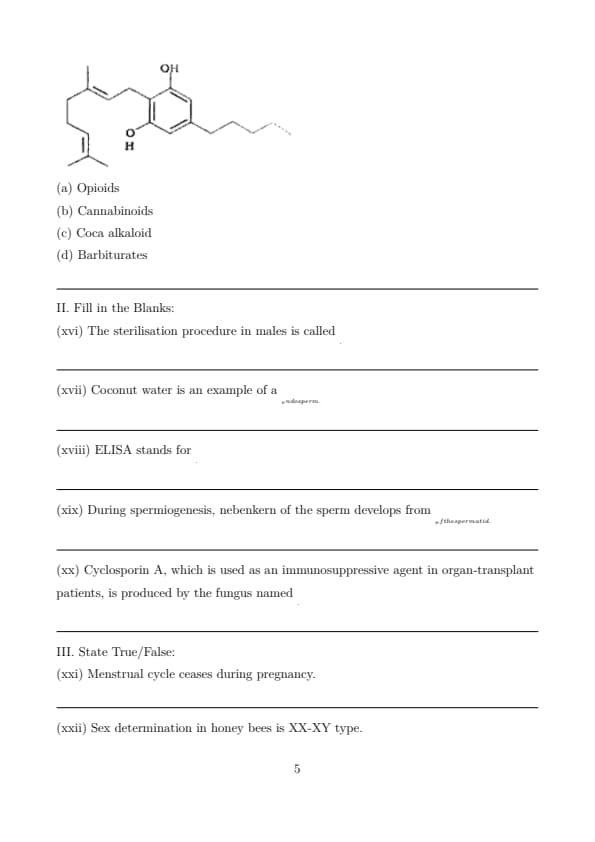
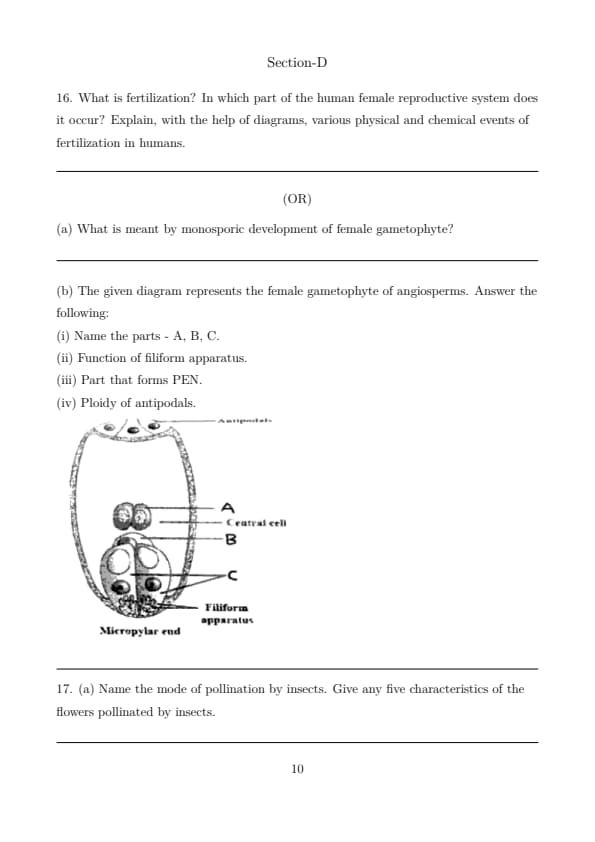
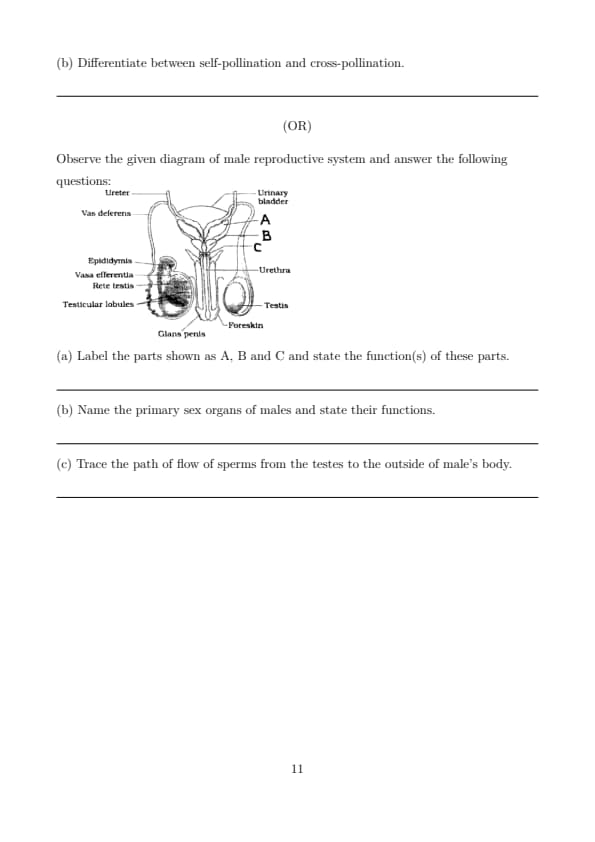



Comments