




The PSEB Class 12 English General exam in 2025 was conducted on March 17, 2025, with the question paper and solutions available post-exam. The exam tests understanding of Introductory Microeconomics, including consumer behavior and market forms, as well as Introductory Macroeconomics, covering national income, money and banking, government budget, and open economy macroeconomics.
Students must attempt a combination of multiple-choice, objective, short, and long answer questions in 3 hours. The paper totals 100 marks, comprising 80 marks for the theory component and 20 marks for internal assessment, with no negative marking for incorrect answers.
PSEB Class 12 English General 2025 Question Paper with Solutions PDF(Set A)
| PSEB Class 12 English General 2025 Question Paper with Solutions PDF(Set A) | Download PDF | Check Solutions |
Why is the combination of yoghurt and bananas an enriching power food?
View Solution
Step 1: According to the passage, this combination is an excellent post-exercise snack.
Step 2: Yoghurt is packed with proteins that help preserve muscle mass.
Step 3: Bananas provide carbohydrates that refuel energy and prevent muscle soreness after physical activity. Quick Tip: Protein and carbohydrate combinations are ideal for recovery because they simultaneously repair tissues and replenish glycogen stores.
What is the advantage of including onions and garlic in our diet?
View Solution
Step 1: Onions and garlic contain specific sulphur compounds.
Step 2: These compounds aid the body in the absorption of essential minerals like iron and zinc from other foods (such as chickpeas).
Step 3: This helps in preventing iron deficiency and related conditions like anaemia. Quick Tip: Bioavailability refers to how much of a nutrient the body can actually absorb; onions and garlic increase the bioavailability of iron.
What is the advantages of combining green tea with lemon juice?
View Solution
Step 1: Green tea is a rich source of catechins, which are antioxidants that stop oxidative damage to cells.
Step 2: Adding lemon juice makes these catechins significantly more absorbable by the body. Quick Tip: Vitamin C in lemon creates an acidic environment that prevents catechins from breaking down in the digestive system.
What are the functions of carbohydrates as mentioned in the passage?
View Solution
Based on the passage, the functions of carbohydrates are:
Energy Refuelling: They help in restoring the glucose levels burned during exercise.
Muscle Protection: They assist in preventing muscle soreness after physical exertion. Quick Tip: Carbohydrates are the body's primary and most efficient source of fuel for high-intensity activities.
What are power foods?
View Solution
Step 1: As defined in the first sentence, power foods are specific types of foods that provide rich levels of nutrients.
Step 2: These nutrients primarily include fibre, potassium, and various minerals. Quick Tip: Power foods are often "whole foods," meaning they are minimally processed and retain their natural nutritional profile.
Find the word in the passage which means 'inadequacy'.
View Solution
Step 1: The word 'inadequacy' refers to a lack or shortage of something required.
Step 2: In the passage, while discussing iron, the text mentions "Iron **deficiency** can lead to anaemia," where 'deficiency' is used to describe the insufficient amount of iron in the body. Quick Tip: In biological contexts, 'deficiency' is the standard term used when the body lacks essential vitamins or minerals.
Which one of the following helps in transportation of oxygen to all the parts of the body?
View Solution
Step 1: The passage states that the combination of chickpeas and onions is a powerful source of iron.
Step 2: It explicitly mentions that iron is "required by the body to transport oxygen to its various parts." Quick Tip: Iron is a key component of hemoglobin, the protein in red blood cells that carries oxygen from the lungs to the tissues.
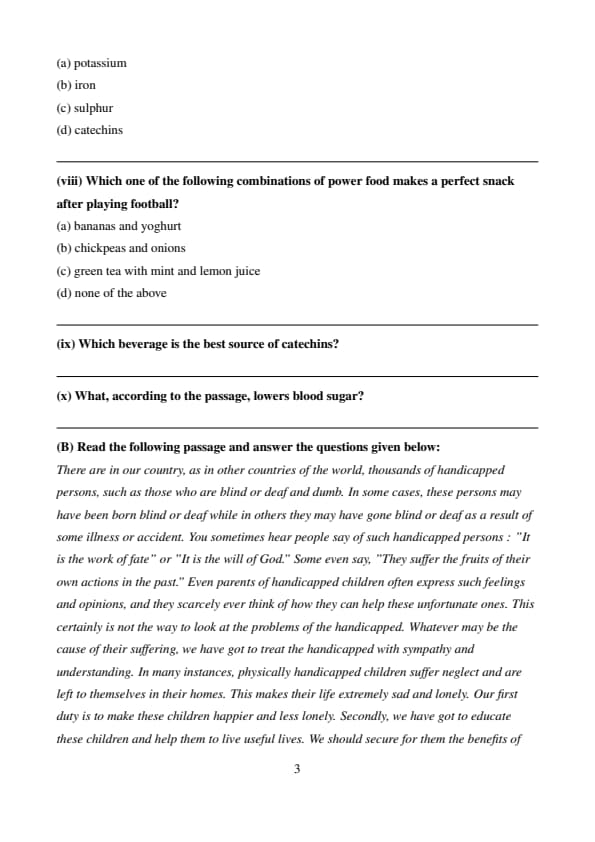
Which one of the following combinations of power food makes a perfect snack after playing football?
View Solution
Step 1: The passage refers to the combination of yoghurt and bananas as a favorite for power food takers.
Step 2: It specifically describes this pairing as a "perfect snack after a rough game of football" because it helps in muscle mass preservation and energy refueling. Quick Tip: Post-workout nutrition is often called the "anabolic window," where the body is most efficient at absorbing nutrients to repair muscles.
Which beverage is the best source of catechins?
View Solution
Step 1: The passage identifies beverages as a source of healthy compounds.
Step 2: It states, "Among beverages, green tea is the best source of catechins." Quick Tip: Catechins are a type of natural phenol and antioxidant that help prevent cell damage.
What, according to the passage, lowers blood sugar?
View Solution
Step 1: While discussing the benefits of the yoghurt and banana snack, the passage mentions the effect of physical activity.
Step 2: It states, "Exercising burns glucose and thus lowers blood sugar." Quick Tip: During exercise, muscles take up glucose from the bloodstream to use as fuel, which naturally reduces blood sugar levels.
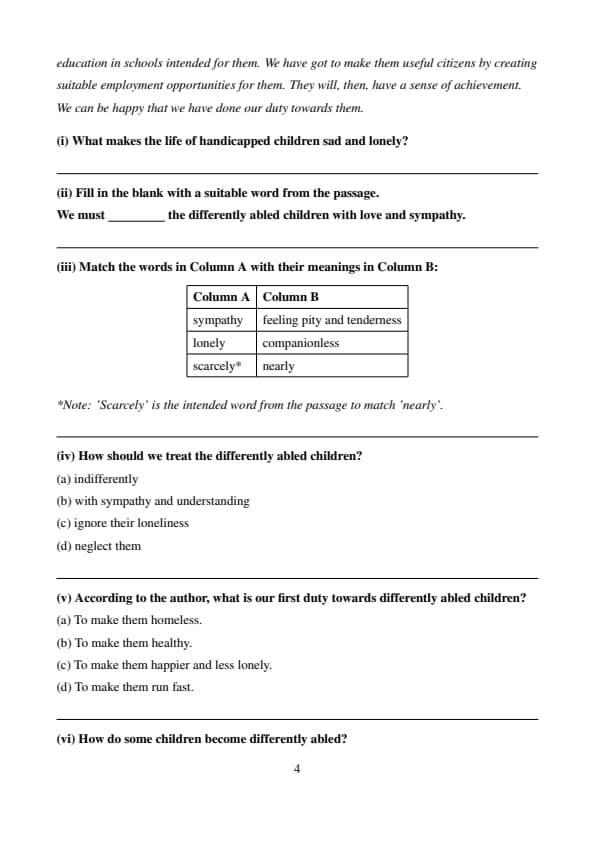
What makes the life of handicapped children sad and lonely?
View Solution
According to the passage, the primary cause of loneliness and sadness among handicapped children is the neglect they face. When parents or society view their condition as "fate" or "the will of God" and fail to provide the necessary support, these children become isolated within their own homes. Quick Tip: To find the answer in a passage, look for keywords like "sad," "lonely," or "neglect." The sentence immediately surrounding these words usually contains the answer.
Fill in the blank with a suitable word from the passage.
We must \hspace{2cm} the differently abled children with love and sympathy.
View Solution
The passage states: "Whatever may be the cause of their suffering, we have got to treat the handicapped with sympathy and understanding." Therefore, the word 'treat' fits perfectly in the given blank to convey the same meaning. Quick Tip: When filling in blanks from a passage, ensure the word you choose matches the grammatical tense of the sentence provided in the question.
Match the words in Column A with their meanings in Column B:
\begin{table[h]
\centering
\begin{tabular{|l|l|
\hline
Column A & Column B
\hline
sympathy & feeling pity and tenderness
\hline
lonely & companionless
\hline
scarcely* & nearly
\hline
\end{tabular
\end{table
\textit{*Note: 'Scarcely' is the intended word from the passage to match 'nearly'.
View Solution
Step 1: Contextual Analysis - Based on the passage, 'sympathy' refers to the emotional support and tenderness shown to those suffering. 'Lonely' is the state of being without company (companionless). 'Scarcely' (found in the text as "scarcely ever") acts as an adverb meaning 'nearly' not at all. Quick Tip: In matching exercises, eliminate the most obvious pairs first. For example, 'lonely' and 'companionless' are direct synonyms, making the remaining matches easier to identify.
How should we treat the differently abled children?
View Solution
Step 1: Textual Evidence - The passage explicitly refutes the idea of looking at disabilities as "fate" or "the will of God." It states, "Whatever may be the cause of their suffering, we have got to treat the handicapped with sympathy and understanding." Quick Tip: Look for the sentence starting with "we have got to treat..." in the passage to find the recommended approach for interaction.
According to the author, what is our first duty towards differently abled children?
View Solution
Step 1: Locating Primary Duty - The author lists responsibilities in a sequence. The text says: "Our first duty is to make these children happier and less lonely." The second duty is education. Quick Tip: The word "firstly" or "first duty" in a passage usually signals a primary objective in a list of recommendations.
How do some children become differently abled?
View Solution
Step 1: Identification of Causes - The passage mentions that disabilities can be congenital ("born blind or deaf") or acquired later in life ("as a result of some illness or accident"). Quick Tip: Always look for the word "while" or "or" to identify multiple causes mentioned in a single explanatory sentence.
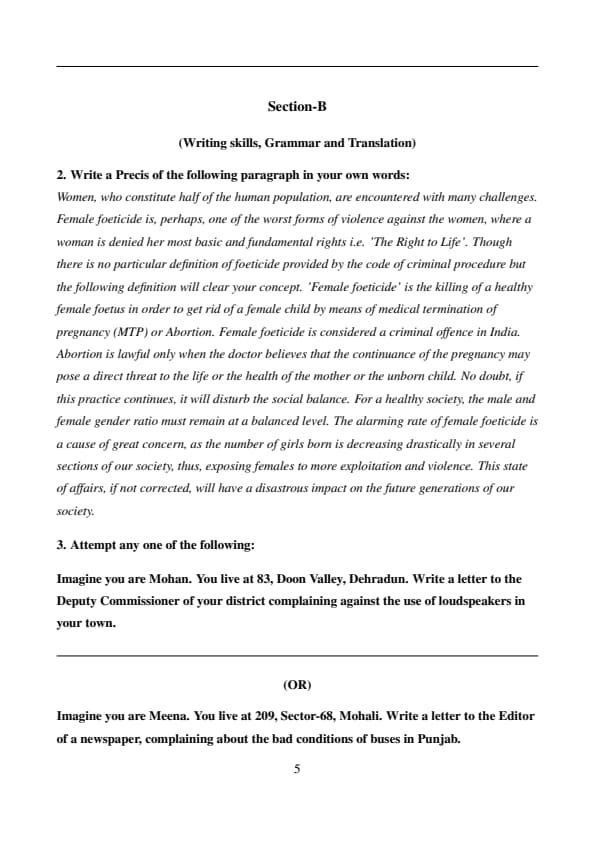
Imagine you are Mohan. You live at 83, Doon Valley, Dehradun. Write a letter to the Deputy Commissioner of your district complaining against the use of loudspeakers in your town.
83, Doon Valley,
Dehradun.
January 1, 2026
The Deputy Commissioner,
Dehradun District,
Uttarakhand.
\textbf{Subject: Complaint against the nuisance caused by loudspeakers.}
Sir,
I wish to draw your kind attention to the excessive use of loudspeakers in our town. Though there are regulations regarding noise pollution, they are being openly flouted by religious places, marriage palaces, and event organizers.
This constant noise is causing immense distress to the elderly and heart patients. Furthermore, as annual examinations are approaching, students find it impossible to concentrate on their studies.
I request you to strictly enforce the "no loudspeaker" policy after 10:00 PM and limit the volume during the day to ensure peace in the locality.
Yours faithfully,
Mohan
View Solution
Step 1: Formal Format - Use the Sender's Address \(\to\) Date \(\to\) Receiver's Designation \(\to\) Subject \(\to\) Salutation.
Step 2: Body - State the problem clearly and mention the specific groups affected (students, elderly).
Step 3: Conclusion - End with a specific request for action. Quick Tip: In formal letters to authorities, keep the tone respectful but firm. Always include a clear "Subject" line to help the official identify the issue quickly.
Imagine you are Meena. You live at 209, Sector-68, Mohali. Write a letter to the Editor of a newspaper, complaining about the bad conditions of buses in Punjab.
209, Sector-68,
Mohali.
January 1, 2026
The Editor,
The Tribune,
Chandigarh.
\textbf{Subject: Deplorable condition of public transport buses in Punjab.}
Sir,
Through the columns of your esteemed newspaper, I would like to highlight the pathetic condition of the state-run buses in Punjab.
Most of the buses are in a state of decay with broken window panes, torn seats, and leaking roofs during the rains. Moreover, the lack of timely maintenance often leads to frequent breakdowns, causing great inconvenience to daily commuters. The emission of heavy smoke also adds to environmental pollution.
It is high time the Transport Department renovates the existing fleet or introduces new buses to ensure a safe and comfortable journey for the public.
Yours truly,
Meena
View Solution
Step 1: Editor's Address - Address the specific newspaper and city.
Step 2: Opening Statement - Use the standard phrase "Through the columns of your esteemed newspaper..." to introduce the grievance.
Step 3: Descriptive Details - List specific physical defects of the buses to make the complaint more impactful. Quick Tip: When writing to an Editor, remember that the Editor themselves cannot fix the problem; your goal is to raise public awareness and catch the attention of the relevant authorities.
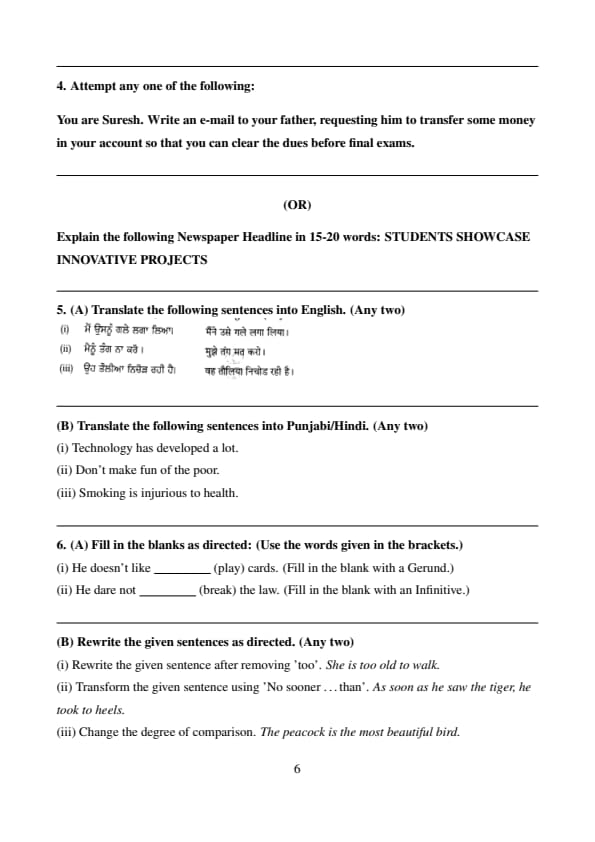
You are Suresh. Write an e-mail to your father, requesting him to transfer some money in your account so that you can clear the dues before final exams.
\textbf{To:} father.email@example.com
\textbf{Subject:} Urgent request for fund transfer for exam dues.
Dear Father,
I hope you and Mom are doing well.
As you know, my final examinations are scheduled to begin next week. The college administration has issued a notice stating that all pending dues, including tuition and hostel fees, must be cleared before we can collect our roll numbers.
I request you to kindly transfer ₹5,000 into my bank account at your earliest convenience so that I can pay the dues on time. I apologize for any inconvenience caused.
With regards to everyone at home.
Your loving son,
Suresh
View Solution
Step 1: E-mail Structure - Include the recipient's email address and a clear, descriptive subject line.
Step 2: Tone - Use a respectful and polite tone suitable for a family member.
Step 3: Justification - Clearly state the reason for the money (exam dues) and the urgency (final exams starting). Quick Tip: In a formal or semi-formal e-mail, keep the body concise and ensure the 'Subject' line summarizes the purpose of the message.
Explain the following Newspaper Headline in 15-20 words: STUDENTS SHOWCASE INNOVATIVE PROJECTS
During a recent exhibition, students displayed their creative and original scientific projects, highlighting their problem-solving skills and technical ingenuity.
View Solution
Step 1: Decoding Keywords - 'Showcase' means to display or exhibit. 'Innovative projects' refers to new and creative ideas or inventions.
Step 2: Contextual Expansion - Add a subject (students) and a setting (an exhibition or fair) to turn the headline into a complete thought. Quick Tip: When explaining a headline, always use full sentences and explain the core event in simple, non-journalistic language.
Translate the following sentences into English. (Any two)
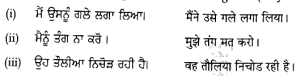
(i) I embraced him/her. (OR) I hugged him/her.
(ii) Do not tease/disturb me.
(iii) She is wringing the towel.
View Solution
Step 1: Tense Identification -
(i) Past Indefinite - use 'ed' form.
(ii) Imperative (Negative) - use 'Do not'.
(iii) Present Continuous - use 'is' + verb + 'ing'.
Step 2: Vocabulary - 'Gale lagana' = hug/embrace; 'Tang karna' = disturb/tease; 'Nichodna' = wring. Quick Tip: 'Wringing' is a specific verb used for squeezing water out of a cloth. Avoid using 'squeezing' for towels if possible.
Translate the following sentences into Punjabi/Hindi. (Any two)
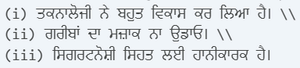
(i) Technology has developed a lot.
(ii) Don't make fun of the poor.
(iii) Smoking is injurious to health.
Correct Answer:
View Solution
Step 1: Literal and Meaningful Match -
(i) 'Developed' translates to (Vikas).
(ii) 'Make fun' is an idiom translated as 'ਮਜ਼ਾਕ ਉਡਾਉਣਾ'.
(iii) 'Injurious' means 'ਹਾਨੀਕਾਰਕ' (Hanikarak). Quick Tip: For formal warnings like "Smoking is injurious," use standard vocabulary like 'ਸਿਹਤ ਲਈ ਹਾਨੀਕਾਰਕ' rather than colloquial terms.
Fill in the blanks as directed: (Use the words given in the brackets.)
(i) He doesn't like \underline{\hspace{2cm (play) cards. (Fill in the blank with a Gerund.)
(ii) He dare not \underline{\hspace{2cm (break) the law. (Fill in the blank with an Infinitive.)
View Solution
Step 1: Gerund - A gerund is the '-ing' form of a verb used as a noun. Here, 'playing' follows the verb 'like'.
Step 2: Bare Infinitive - After auxiliary verbs like 'dare not' or 'need not', we use the infinitive without 'to' (bare infinitive). Quick Tip: - Gerund = Verb + ing (used as a noun). - After 'dare not', use only the base verb (e.g., break) without 'to'.
Rewrite the given sentences as directed. (Any two)
(i) Rewrite the given sentence after removing 'too'. \textit{She is too old to walk.
(ii) Transform the given sentence using 'No sooner \dots than'. \textit{As soon as he saw the tiger, he took to heels.
(iii) Change the degree of comparison. \textit{The peacock is the most beautiful bird.
(i) She is so old that she cannot walk.
(ii) No sooner did he see the tiger than he took to heels.
(iii) No other bird is as beautiful as the peacock.
View Solution
Step 1: Removing 'too' - We replace 'too' with 'so' and 'to' with 'that... cannot'.
Step 2: No sooner... than - 'As soon as' is replaced by 'No sooner did', and the second clause starts with 'than'. The past verb 'saw' changes to the base form 'see' because of 'did'.
Step 3: Degrees of Comparison - The superlative 'most beautiful' is changed to positive degree using 'No other... as beautiful as'. Quick Tip: - Too + Adj + to = So + Adj + that + cannot. - "No sooner" always takes "than" (not when/then).
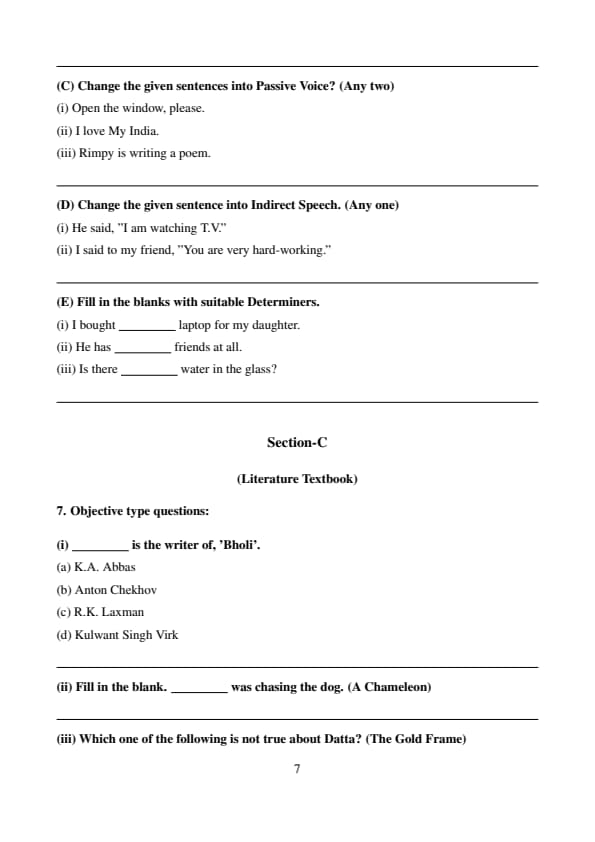
Change the given sentences into Passive Voice? (Any two)
(i) Open the window, please.
(ii) I love My India.
(iii) Rimpy is writing a poem.
(i) You are requested to open the window.
(ii) My India is loved by me.
(iii) A poem is being written by Rimpy.
View Solution
Step 1: Imperative Request - Sentences with 'please' are changed to passive using 'You are requested to'.
Step 2: Present Indefinite - Use 'is/am/are + V3'.
Step 3: Present Continuous - Use 'is/am/are + being + V3'. Quick Tip: In Passive Voice, the focus shifts from the 'doer' to the 'action/receiver'. Always use the 3rd form (Past Participle) of the verb.
Change the given sentence into Indirect Speech. (Any one)
(i) He said, "I am watching T.V."
(ii) I said to my friend, "You are very hard-working."
(i) He said that he was watching T.V.
(ii) I told my friend that he/she was very hard-working.
View Solution
Step 1: Tense Change - Since the reporting verb (said) is in the past, the internal tense changes (am watching \(\to\) was watching; are \(\to\) was).
Step 2: Pronoun Change - 'I' changes to 'he' and 'You' changes to 'he/she' based on the listener. Quick Tip: When converting to Indirect Speech, "said to" becomes "told" + Object. Don't forget to remove the quotation marks and add "that".
Fill in the blanks with suitable Determiners.
(i) I bought \underline{\hspace{2cm laptop for my daughter.
(ii) He has \underline{\hspace{2cm friends at all.
(iii) Is there \underline{\hspace{2cm water in the glass?
View Solution
Step 1: Articles - 'a' is used for a non-specific singular countable noun.
Step 2: Quantifiers - 'no... at all' emphasizes the zero quantity.
Step 3: Interrogative Determiner - 'any' is used for questions and negative sentences. Quick Tip: - Use 'a/an' for one item. - Use 'any' for questions (?) and 'some' for positive statements (+).
\hspace{2cm} is the writer of, 'Bholi'.
View Solution
Step 1: Fact Check - The short story 'Bholi', which tells the story of a girl named Sulekha, was written by the famous Indian film director and novelist K.A. Abbas (Khwaja Ahmad Abbas). Quick Tip: To remember authors, try associating the main character with the writer. For example, "Abbas wrote about Bholi's progress."
Fill in the blank. \hspace{2cm} was chasing the dog. (A Chameleon)
View Solution
Step 1: Contextual Recall - In Anton Chekhov’s story 'A Chameleon', the goldsmith Hryukin is the character who chases the dog after being bitten by it. Quick Tip: In 'A Chameleon', the shift in the police superintendent's opinion depends entirely on who the owner of the dog is.
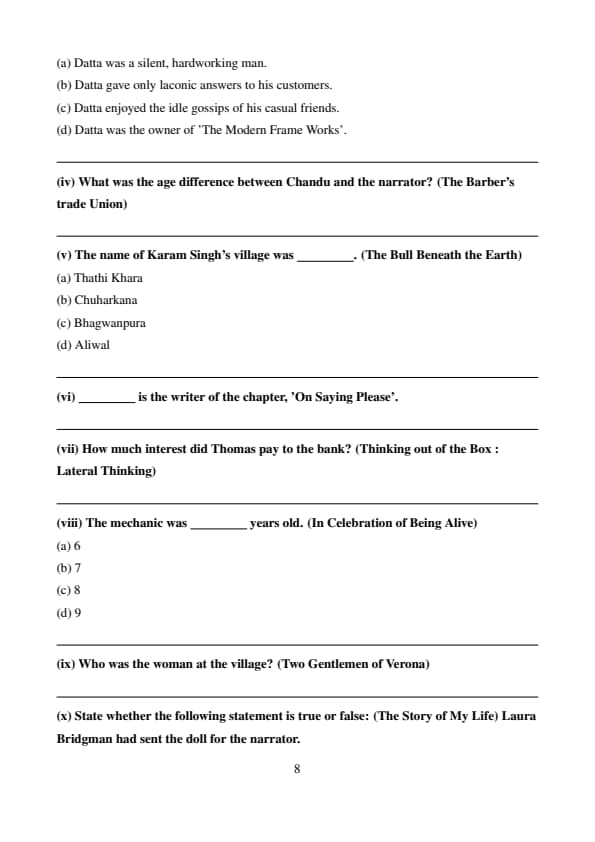
Which one of the following is not true about Datta? (The Gold Frame)
View Solution
Step 1: Character Analysis - In the story 'The Gold Frame', Datta is described as a very reserved and busy man who preferred working in silence and hated being interrupted by idle talk. Therefore, option (c) is false. Quick Tip: "Laconic" means using very few words. Datta’s personality was the opposite of social or gossipy.
What was the age difference between Chandu and the narrator? (The Barber's trade Union)
View Solution
Step 1: Textual Reference - In Mulk Raj Anand's 'The Barber's Trade Union', the narrator mentions that although they were close friends, Chandu was his senior by six months. Quick Tip: Despite the small age difference, the caste hierarchy created a significant social gap between the two friends in the story.
The name of Karam Singh's village was \hspace{2cm}. (The Bull Beneath the Earth)
View Solution
Step 1: Locating the Place - In the story 'The Bull Beneath the Earth' (Dharti Hethla Balad), the soldier Karam Singh belonged to the village Thathi Khara in Amritsar district. Quick Tip: Karam Singh's friend, Man Singh, visits this village to deliver the news of Karam Singh's martyrdom.
\hspace{2cm} is the writer of the chapter, 'On Saying Please'.
View Solution
Step 1: Attribution - The essay 'On Saying Please', which discusses the value of good manners and social civility, was written by the famous English journalist and essayist Alfred George Gardiner (who often wrote under the pen name 'Alpha of the Plough'). Quick Tip: Gardiner emphasizes that while bad manners are not a legal crime, they poison the stream of social life.
How much interest did Thomas pay to the bank? (Thinking out of the Box : Lateral Thinking)
(15} as interest.
View Solution
Step 1: Mathematical Logic - Thomas borrowed
)5,000 for two weeks at an interest rate of 15% per annum. The calculated interest for that short period came to approximately
(15. Quick Tip: This story is a classic example of lateral thinking—Thomas used a million-dollar Ferrari as collateral just to get cheap parking in New York!
The mechanic was \hspace{2cm} years old. (In Celebration of Being Alive)
View Solution
Step 1: Identification - In Dr. Christiaan Barnard's essay, the 'mechanic' was a seven-year-old boy who had been blind since birth but provided the 'motor power' for the trolley. Quick Tip: The "driver" was a boy with only one arm, and the "mechanic" was blind. Together, they showed the joy of being alive.
Who was the woman at the village? (Two Gentlemen of Verona)
View Solution
Step 1: Plot Recall - In A.J. Cronin's story, the two boys work tirelessly to pay for the medical treatment of their sister, Lucia, who is suffering from tuberculosis of the spine in a hospital in the village of Poleta. Quick Tip: The title 'Two Gentlemen of Verona' is ironic because the "gentlemen" are actually two small, hardworking boys.
State whether the following statement is true or false: (The Story of My Life) Laura Bridgman had sent the doll for the narrator.
View Solution
Step 1: Historical Fact - In Helen Keller's autobiography 'The Story of My Life', she mentions that the little blind children at the Perkins Institution had sent a doll for her, and Laura Bridgman (another famous deaf-blind student) had dressed it. Quick Tip: The doll was brought to Helen by her teacher, Anne Sullivan, and it was through this doll that Helen learned her first word: D-O-L-L.
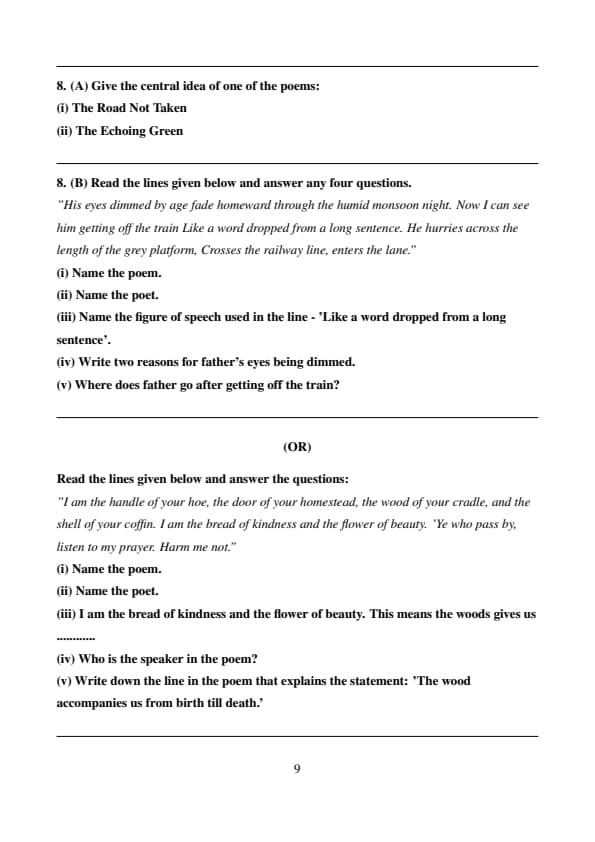
Give the central idea of one of the poems:
(i) The Road Not Taken
(ii) The Echoing Green
\textbf{(i) The Road Not Taken:} The central idea is that life is a journey of choices. One decision often leads to another, and the choices we make today shape our future. It emphasizes that taking a less conventional path can make a significant difference in one's life.
\textbf{(ii) The Echoing Green:} The central idea is the cycle of life and the transition from the innocence of youth to the weariness of old age. It depicts how human life follows the patterns of nature, moving from a joyful sunrise to a peaceful sunset.
View Solution
Step 1: Theme Identification -
- For 'The Road Not Taken', focus on the theme of decision-making and its long-term impact.
- For 'The Echoing Green', focus on the cyclical nature of life (Childhood \(\to\) Maturity \(\to\) Old Age).
Step 2: Summarization - Combine these themes into a concise statement that reflects the poet's intent. Quick Tip: To write a central idea, identify the main "message" or "lesson" the poet is trying to convey to the reader in 3-4 sentences.
Read the lines given below and answer any four questions.
\textit{"His eyes dimmed by age fade homeward through the humid monsoon night. Now I can see him getting off the train Like a word dropped from a long sentence. He hurries across the length of the grey platform, Crosses the railway line, enters the lane."
(i) Name the poem.
(ii) Name the poet.
(iii) Name the figure of speech used in the line - 'Like a word dropped from a long sentence'.
(iv) Write two reasons for father's eyes being dimmed.
(v) Where does father go after getting off the train?
(i) \textbf{Poem:} Father Returning Home
(ii) \textbf{Poet:} Dilip Chitre
(iii) \textbf{Figure of Speech:} Simile
(iv) \textbf{Reasons:} 1. Old age (natural weakening of eyesight). 2. The humid monsoon night (rain and darkness reducing visibility).
(v) \textbf{Destination:} He hurries across the platform, crosses the railway line, and enters the lane to go to his home.
View Solution
Step 1: Poem Identification - These lines are from 'Father Returning Home' by Dilip Chitre, which depicts the loneliness and alienation of an elderly man in a metropolitan city.
Step 2: Figure of Speech - The line "Like a word dropped from a long sentence" uses the word 'like' to compare the father's exit from the train to an insignificant word falling out of a long sentence. This is a Simile.
Step 3: Contextual Analysis - The father is tired and neglected. The "dimmed eyes" symbolize both his physical exhaustion and the lack of hope or excitement in his life.
Quick Tip: To identify a \textbf{Simile}, always look for comparison words like "as" or "like". In this poem, the simile highlights how the father is unnoticed and unimportant to the crowd around him.
Read the lines given below and answer the questions:
\textit{"I am the handle of your hoe, the door of your homestead, the wood of your cradle, and the shell of your coffin. I am the bread of kindness and the flower of beauty. 'Ye who pass by, listen to my prayer. Harm me not."
(i) Name the poem.
(ii) Name the poet.
(iii) I am the bread of kindness and the flower of beauty. This means the woods gives us ............
(iv) Who is the speaker in the poem?
(v) Write down the line in the poem that explains the statement: 'The wood accompanies us from birth till death.'
(i) \textbf{Poem:} Prayer of the Woods
(ii) \textbf{Poet:} Anonymous
(iii) This means the woods gives us \textbf{food (sustenance) and aesthetic pleasure (beauty)}.
(iv) The \textbf{Woods (Trees)} is the speaker in the poem.
(v) The line is: \textbf{"the wood of your cradle, and the shell of your coffin."}
View Solution
Step 1: Poem Analysis - The 'Prayer of the Woods' is a personification where the woods speak directly to humans. It highlights the selfless service of trees throughout a person's life.
Step 2: Interpretation of Metaphors -
- "Bread of kindness" refers to the fruits and food that trees provide.
- "Flower of beauty" refers to the joy, shade, and aesthetic appeal of nature.
Step 3: Lifecycle Connection - The poem mentions the "cradle" (for a baby) and the "coffin" (for the deceased) to show that wood is essential from the beginning of life until the very end.
Quick Tip: To answer question (v), look for the physical objects made of wood that represent the very start of life (cradle) and the very end of life (coffin).
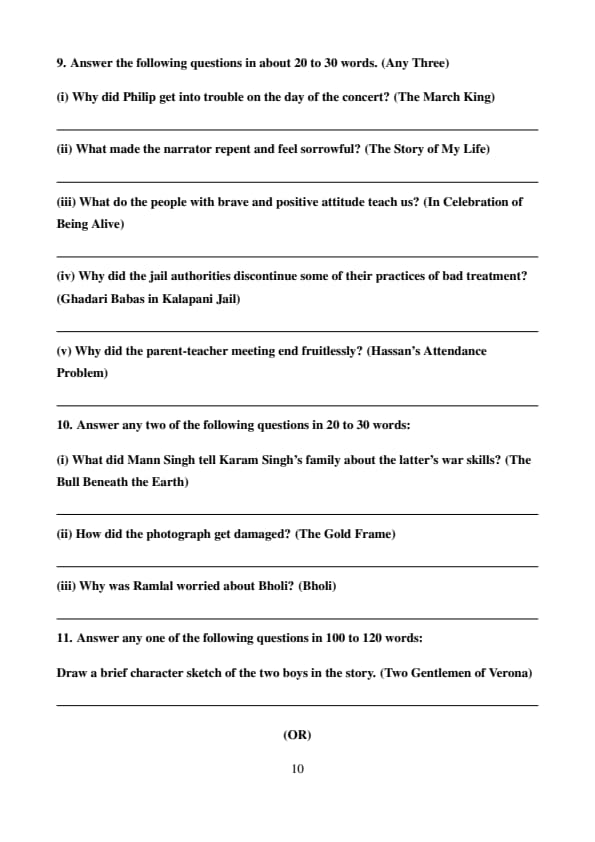
Why did Philip get into trouble on the day of the concert? (The March King)
View Solution
Step 1: Contextual Recall - On the day of the concert, Philip's own shirt was dirty, so Mrs. Esputa gave him a massive oversized shirt.
Step 2: The Conflict - Because the shirt wasn't his size, it was pinned up. The physical movement during the violin performance caused the pins to fail, leading to a humiliating situation. Quick Tip: Focus on the keywords: "oversized shirt," "pins," and "embarrassment" to construct a perfect answer for this question.
What made the narrator repent and feel sorrowful? (The Story of My Life)
View Solution
Step 1: Action - In a fit of frustration, Helen (the narrator) threw her doll on the floor, breaking it into pieces.
Step 2: Realization - It was only after she successfully learned the concept of language and 'naming' objects that she felt a sense of loss and regret for the broken toy. Quick Tip: This moment represents the transition from a world of darkness and confusion to a world of light and understanding for Helen Keller.
What do the people with brave and positive attitude teach us? (In Celebration of Being Alive)
View Solution
Step 1: Philosophy of Dr. Barnard - The essay highlights that despite physical disabilities, children like the 'driver' and 'mechanic' were full of joy.
Step 2: Moral Lesson - Their positive attitude teaches us to focus on our existing strengths and the beauty of life rather than complaining about our sufferings. Quick Tip: The core message is to focus on "what is left" rather than "what is lost."
Why did the jail authorities discontinue some of their practices of bad treatment? (Ghadari Babas in Kalapani Jail)
View Solution
Step 1: Resistance - The political prisoners (Ghadari Babas) refused to submit to the inhuman conditions and organized hunger strikes.
Step 2: Outcome - Fearing further unrest and the impact of the prisoners' sacrifices, the British authorities were eventually forced to relax some of the harsh rules. Quick Tip: The word "resistance" is the key to understanding why the change in treatment occurred in the Cellular Jail.
Why did the parent-teacher meeting end fruitlessly? (Hassan's Attendance Problem)
View Solution
Step 1: Parental Conflict - Hassan's father took a distant approach, while his mother was helpless and expected the father to be more involved.
Step 2: Conclusion - Because there was no coordination or shared responsibility between the parents, the teacher's (Sudha Murty's) efforts to help Hassan failed. Quick Tip: A "fruitless" meeting means one that yields no results. Here, the lack of parental cooperation made it impossible to help the student.
What did Mann Singh tell Karam Singh's family about the latter's war skills? (The Bull Beneath the Earth)
View Solution
Step 1: Context - Mann Singh, while visiting Karam Singh's village, tries to keep the conversation positive before he realizes the family is hiding the news of Karam Singh's death.
Step 2: Specific Details - He highlights Karam Singh's reputation among his fellow soldiers as a "crack-shot," meaning an expert sniper or marksman. Quick Tip: The term "crack-shot" is crucial here as it highlights the respect Karam Singh commanded as a soldier.
How did the photograph get damaged? (The Gold Frame)
View Solution
Step 1: The Accident - Datta was looking for a pencil when he accidentally knocked over a tin of white enamel paint.
Step 2: The Failed Restoration - In his panic, he used a piece of cloth soaked in turpentine to wipe the paint, but the chemical and the rubbing force destroyed the delicate surface of the old photograph. Quick Tip: Remember that it wasn't just the paint that ruined the photo, but Datta's desperate attempt to clean it that caused the final damage.
Why was Ramlal worried about Bholi? (Bholi)
View Solution
Step 1: Physical Condition - An attack of smallpox had left Bholi's entire body covered with permanent black pock-marks.
Step 2: Mental and Social State - A fall from a cot in her infancy had damaged a part of her brain, making her a slow learner. This combination made Ramlal anxious about her future prospects in a society that valued appearance and wit. Quick Tip: Ramlal’s worry stems from the traditional social norms of the time, where a girl’s marriage was considered the father’s primary responsibility.
Draw a brief character sketch of the two boys in the story. (Two Gentlemen of Verona)
Nicola and Jacopo, the "Two Gentlemen of Verona," are symbols of selfless devotion, resilience, and maturity far beyond their years. Nicola, aged thirteen, and Jacopo, nearly twelve, are portrayed as hardworking and extremely responsible. Despite their shabbiness, they exhibit a dignity that earns them the title "gentlemen." They perform various jobs, from selling fruit and shining shoes to guiding tourists, all to pay for their sister Lucia's expensive tuberculosis treatment.
Their character is defined by their secretiveness regarding their struggles; they never ask for pity or charity. They live a life of extreme hardship, wearing old clothes and eating little, yet their spirit remains unbroken. Their maturity is evident in how they have taken charge of their lives after being orphaned by the war. Through their tireless efforts and unwavering love for their sister, they provide a new hope for humanity and redefine the true meaning of being a gentleman.
View Solution
Step 1: Introduction - Introduce Nicola (13) and Jacopo (12) as orphans of war in Verona.
Step 2: Key Traits - Focus on their diligence, self-respect, and spirit of sacrifice. Mention the variety of odd jobs they perform.
Step 3: Motivation - Explain their driving force: the medical care for their sister, Lucia.
Step 4: Conclusion - Summarize why the narrator (A.J. Cronin) considers them true "gentlemen." Quick Tip: To remember their traits, use the acronym **D.R.S.** - **D**ignity, **R**esilience, and **S**acrifice. They are small in age but "great" in character.
What is the theme of the lesson, 'On Saying Please'.
The central theme of A.G. Gardiner's essay 'On Saying Please' is the vital importance of courtesy and good manners in social interactions. Gardiner argues that while bad manners are not a legal offense and cannot be punished by law, they significantly impact the quality of social life. Courtesy is the "oil" that keeps the machine of life running smoothly.
The essay highlights that "please" and "thank you" are small words but have a great impact on making life sweet and cooperative. Conversely, rudeness creates a chain reaction of ill-temper, as seen in the example of the liftman who was punished for his violent reaction to a passenger's discourtesy. Gardiner emphasizes that a polite person not only makes others happy but also maintains their own mental peace. The ultimate message is that social civility is a moral obligation that makes the world a better place to live.
View Solution
Step 1: Core Argument - The essay distinguishes between legal crimes and social discourtesy.
Step 2: Impact of Manners - Explain how manners act as a social lubricant, preventing friction between individuals.
Step 3: The Chain Reaction - Mention how both good and bad moods are contagious.
Step 4: Conclusion - Summarize the moral victory of a polite person over a rude one. Quick Tip: The key takeaway is that the law cannot compel us to be polite, but our own "inner law" or moral sense should guide us to be civil.
Give a brief character sketch of Miss Beam. (The School for Sympathy)
Miss Beam is the central figure and the head of 'The School for Sympathy'. She is described as a middle-aged, authoritative yet extremely kind-hearted woman. Her hair is beginning to turn grey, giving her a dignified and comforting appearance. She is deeply concerned about the education and character development of her students.
Miss Beam is a pioneer of a unique educational system designed to teach students "thoughtfulness" and "humanity." Instead of focusing solely on academic excellence, she implements "blind days," "deaf days," and "lame days" to help students experience and appreciate the hardships of the differently-abled. Her primary goal is to make her students good and responsible citizens who possess genuine sympathy for others. She is patient, wise, and possesses a motherly affection that makes her school a center for emotional and moral learning.
View Solution
Step 1: Physical Appearance - Mention her age (middle-aged) and her comforting, motherly presence.
Step 2: Educational Vision - Describe her unique school where the focus is on empathy and sympathy rather than just textbooks.
Step 3: Character Traits - Highlight her kindness, wisdom, and her desire to produce "thoughtful" citizens.
Step 4: Conclusion - Summarize her impact on the narrator and her students. Quick Tip: Remember the phrase "The School for Sympathy." Miss Beam doesn't just teach sympathy; she makes students *live* it through experience.
Justify the title of the lesson, 'A Chameleon'.
The title 'A Chameleon' is highly appropriate and symbolic. A chameleon is a reptile known for changing its color to blend in with its surroundings. In Anton Chekhov's story, the title refers to the fickle and shifting character of the police superintendent, Otchumyelov. Throughout the story, Otchumyelov changes his opinion and attitude toward a dog six times, depending on whether he thinks the dog belongs to a high-ranking General or a common citizen.
When he believes the dog is a stray, he acts strictly and threatens to punish its owner. However, as soon as he is told it might belong to the General, he becomes submissive and blames the victim, Hryukin. This rapid changing of "moral colors" based on social status and power perfectly mirrors the behavior of a chameleon. The title serves as a sharp satire on the hypocrisy, opportunism, and sycophancy prevalent in the bureaucracy.
View Solution
Step 1: Literal Meaning - Explain what a chameleon is (an animal that changes color for survival).
Step 2: Symbolic Connection - Connect this trait to the protagonist, Otchumyelov.
Step 3: Plot Evidence - Briefly mention how his stance on the dog bite case shifts based on the General's name.
Step 4: Thematic Conclusion - Conclude that the title satirizes people who change their principles to please those in power. Quick Tip: To justify a title, always explain the literal meaning first and then show how it applies metaphorically to the characters or the theme of the story.



Comments