




Punjab Board is conducting the Class 12 Sociology Board Exam 2026 on February 18, 2026. Class 12 Sociology Question Paper with Solution PDF is available here for download.
The official question paper of Punjab Board Class 12 Sociology Board Exam 2026 is provided below. Students can download the official paper in PDF format for reference.
Punjab Board Class 12 2026 Sociology Question Paper with Solution PDF
| Punjab Board Class 12 2026 Sociology Question Paper with Solution PDF | Download PDF | Check Solutions |
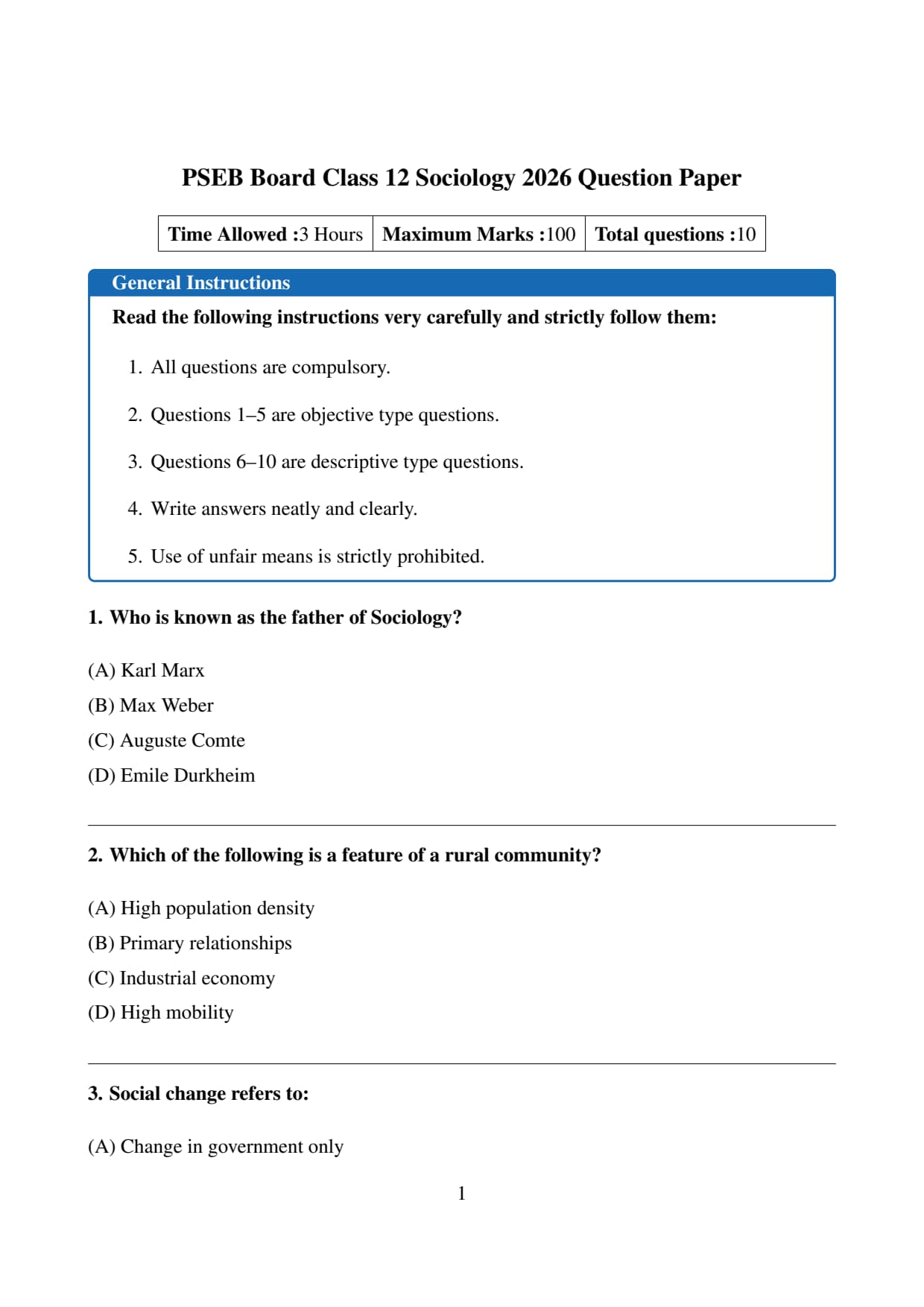
Who is known as the father of Sociology?
View Solution
Auguste Comte coined the term Sociology and is regarded as the founder of the discipline.
Step 1: Analyze the options.
- Karl Marx — Conflict theory.
- Max Weber — Interpretive sociology.
- Auguste Comte — Founder of Sociology.
- Emile Durkheim — Functionalism.
Step 2: Conclusion.
Hence, Comte is the father of Sociology.
Final Answer: \[ \boxed{(C) \, Auguste Comte} \] Quick Tip: Auguste Comte introduced positivism in sociology.
Which of the following is a feature of a rural community?
View Solution
Rural communities are characterized by close personal relationships and strong kinship ties.
Step 1: Analyze the options.
- High population density — Urban feature.
- Primary relationships — Rural feature.
- Industrial economy — Urban feature.
- High mobility — Urban feature.
Step 2: Conclusion.
Thus option (B) is correct.
Final Answer: \[ \boxed{(B) \, Primary relationships} \] Quick Tip: Rural life is based on agriculture and community bonds.
Social change refers to:
View Solution
Social change involves transformation in social institutions, relationships, and cultural patterns.
Step 1: Analyze the options.
- Government only — Too narrow.
- Culture and structure — Correct definition.
- Technology only — Partial.
- Population only — Partial.
Step 2: Conclusion.
Hence option (B) is correct.
Final Answer: \[ \boxed{(B) \, Change in culture and social structure} \] Quick Tip: Social change can be gradual or rapid.
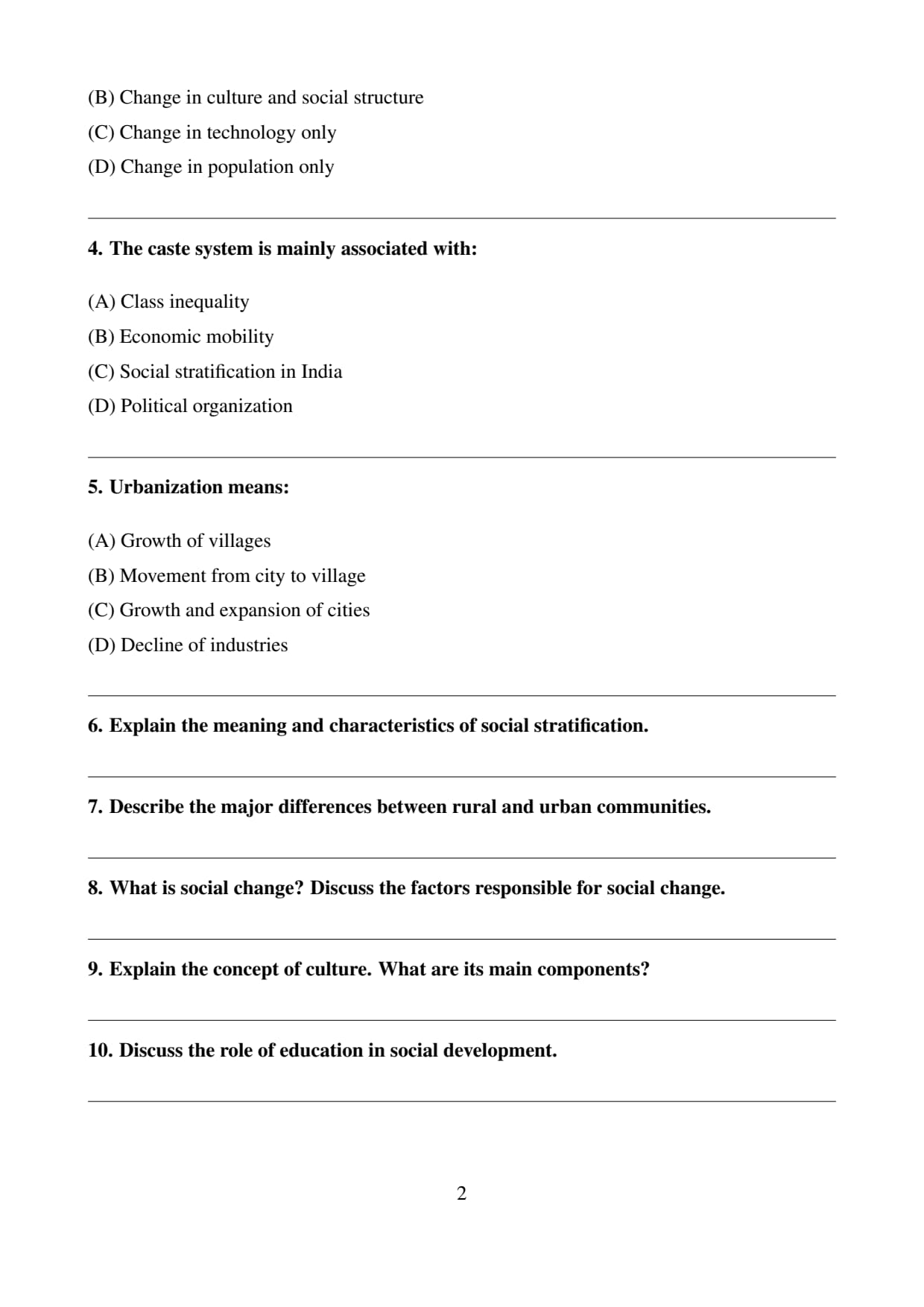
The caste system is mainly associated with:
View Solution
The caste system is a hereditary hierarchical system unique to Indian society.
Step 1: Analyze the options.
- Class inequality — General concept.
- Economic mobility — Opposite of caste rigidity.
- Social stratification in India — Correct.
- Political organization — Not related.
Step 2: Conclusion.
Thus option (C) is correct.
Final Answer: \[ \boxed{(C) \, Social stratification in India} \] Quick Tip: Caste status is determined by birth.
Urbanization means:
View Solution
Urbanization refers to increasing population and development of towns and cities.
Step 1: Analyze the options.
- Villages — Opposite concept.
- City to village — Counter-urbanization.
- Growth of cities — Correct.
- Decline of industries — Incorrect.
Step 2: Conclusion.
Hence option (C) is correct.
Final Answer: \[ \boxed{(C) \, Growth and expansion of cities} \] Quick Tip: Urbanization is closely linked with industrialization.
Explain the meaning and characteristics of social stratification.
View Solution
Social stratification refers to the division of society into different hierarchical layers or strata based on factors such as wealth, power, prestige, occupation, caste, or education. It determines people’s social position and access to resources and opportunities. Every society exhibits some form of stratification, though the basis may differ. In India, caste has traditionally been a major factor, while in modern societies class plays a dominant role.
One key characteristic of social stratification is inequality — higher strata enjoy more privileges than lower ones. It is also universal, meaning it exists in all societies, whether ancient or modern. Another feature is social ranking, where individuals or groups are placed above or below others. Stratification tends to persist over generations, making it relatively stable. It also influences life chances, such as access to education, healthcare, and employment. Additionally, it is supported by social norms and institutions, which justify and maintain these divisions. Quick Tip: Stratification produces upper, middle, and lower classes.
Describe the major differences between rural and urban communities.
View Solution
Rural and urban communities differ in several important aspects such as lifestyle, occupation, social relations, and infrastructure. Rural communities are typically based on agriculture and related activities, while urban communities are centered around industries, trade, and services. Population density is low in villages and high in cities.
Social relationships in rural areas are close-knit and personal, often called primary relationships, because people know each other well and interact frequently. In contrast, urban relationships are mostly formal and impersonal due to the large population and busy lifestyle. Rural societies tend to be more traditional, guided by customs and beliefs, whereas urban societies are more modern and influenced by science and technology Quick Tip: Rural = traditional, Urban = modern.
What is social change? Discuss the factors responsible for social change.
View Solution
Social change refers to significant alterations in the structure, functions, values, norms, and institutions of society over time. It may affect social relationships, cultural patterns, and ways of life. Change can be gradual or rapid, planned or unplanned, and positive or negative.
Several factors contribute to social change. Technological development is one of the most powerful drivers, as inventions such as the internet, transportation systems, and medical advances transform daily life. Economic factors, including industrialization and globalization, also reshape occupations, production methods, and living standards. Cultural factors such as new ideas, education, and reform movements influence people’s attitudes and behaviors. Political factors like government policies, laws, and revolutions can bring major structural changes. Demographic factors, including population growth, migration, and urbanization, also play a significant role Quick Tip: Technology is a major driver of change.
Explain the concept of culture. What are its main components?
View Solution
Culture refers to the total way of life of a society, including its beliefs, values, customs, traditions, language, art, and social practices. It is learned, shared, and transmitted from one generation to another through socialization. Culture shapes how people think, behave, and interact within society.
Culture has two main components: material culture and non-material culture. Material culture includes physical objects created by humans, such as tools, buildings, clothing, technology, and artworks. These represent the tangible aspects of life. Non-material culture consists of intangible elements like beliefs, values, norms, morals, customs, traditions, language, and religion. These guide behavior and give meaning to social life.
Culture also performs important functions. It provides identity, promotes social cohesion, regulates behavior, and helps individuals adapt to their environment. Although culture is relatively stable, it is not static; it evolves over time due to innovation, diffusion, and social change Quick Tip: Culture is learned and shared.
Discuss the role of education in social development.
View Solution
Education plays a crucial role in social development by promoting knowledge, skills, values, and awareness among individuals. It helps people understand their rights and responsibilities and prepares them to participate effectively in society. An educated population contributes to economic growth, political stability, and social progress.
Education reduces social inequalities by providing equal opportunities for advancement regardless of caste, gender, or economic background. It encourages social mobility by enabling individuals to secure better employment and improve their living standards. It also promotes scientific thinking, tolerance, and democratic values, which are essential for a modern society.
Furthermore, education helps in social integration by bringing people from different backgrounds together. It plays an important role in reducing social evils such as superstition, discrimination, and illiteracy. Education also raises awareness about health, environment, and civic responsibilities Quick Tip: Education transforms individuals and society.
Punjab Board Class 12 Sociology Question Paper 2026 Youtube Solution



Comments