




UK Board is conducting the Class 12 Biology Board Exam 2026 on February 25, 2026. Class 12 Biology Question Paper with Solution PDF is available here for download.
The official question paper of UK Board Class 12 Biology Board Exam 2026 is provided below. Students can download the official paper in PDF format for reference.
UK Board Class 12 2026 Biology Question Paper with Solution PDF
| UK Board Class 12 2026 Biology Question Paper with Solution PDF | Download PDF | Check Solution |

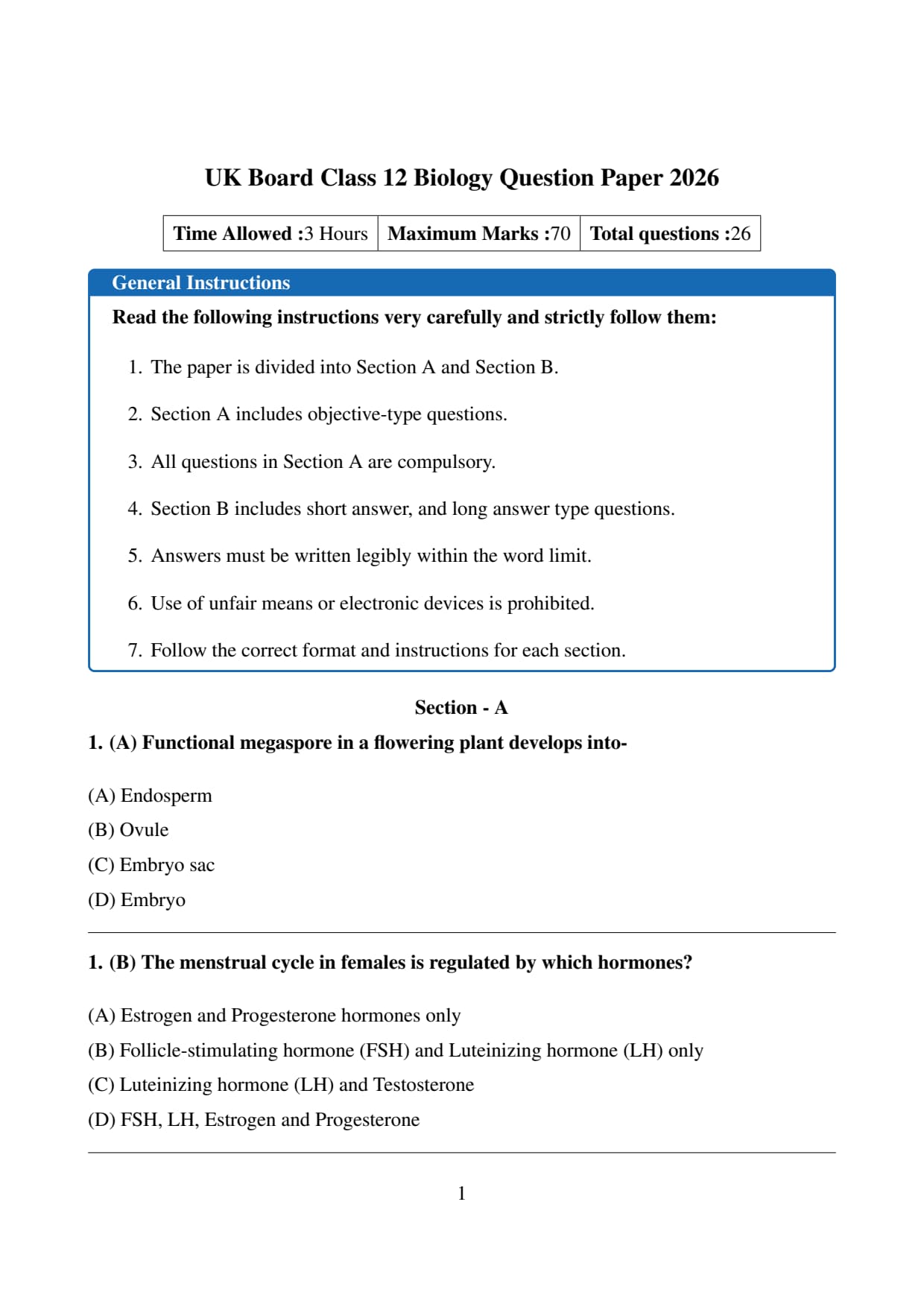
Functional megaspore in a flowering plant develops into-
View Solution
Step 1: Understand the process of megasporogenesis in flowering plants.
In flowering plants (angiosperms), the female reproductive part (gynoecium) contains ovules. Within the ovule, a diploid cell called the megaspore mother cell undergoes meiosis to produce four haploid megaspores.
Step 2: Identify the functional megaspore.
Out of the four megaspores produced, three degenerate and only one remains functional. This is called the functional megaspore (also known as the functional megaspore).
Step 3: Development of the functional megaspore.
The functional megaspore undergoes three successive mitotic divisions to develop into the embryo sac (female gametophyte). This process is called megagametogenesis.
The mature embryo sac typically contains:
Egg cell (1)
Synergids (2)
Polar nuclei (2) which fuse to form diploid secondary nucleus
Antipodal cells (3)
Step 4: Analysis of each option.
(A) Endosperm: Incorrect. Endosperm is triploid tissue formed after fertilization (double fertilization) when one sperm fuses with the polar nuclei. It is not derived from the megaspore.
(B) Ovule: Incorrect. The ovule is the structure that contains the megaspore. The megaspore develops inside the ovule (within the nucellus), but does not become the ovule itself.
(C) Embryo sac: Correct. The functional megaspore develops into the embryo sac, which is the female gametophyte in angiosperms.
(D) Embryo: Incorrect. The embryo develops from the zygote after fertilization of the egg cell by a sperm, not from the megaspore.
Step 5: Conclusion.
The functional megaspore in flowering plants undergoes mitotic divisions to form the embryo sac (female gametophyte), which contains the egg cell and other nuclei necessary for fertilization.
Final Answer: (C) Embryo sac Quick Tip: Remember the sequence: Megaspore mother cell (2n) \(\Rightarrow\) Meiosis \(\Rightarrow\) 4 megaspores (n) 3 degenerate \(\Rightarrow\) 1 functional megaspore (n) Functional megaspore \(\Rightarrow\) 3 mitotic divisions \(\Rightarrow\) 8-nucleate embryo sac Embryo sac structure: Egg (1) + Synergids (2) + Polar nuclei (2) + Antipodals (3)
The menstrual cycle in females is regulated by which hormones?
View Solution
Step 1: Understand the menstrual cycle.
The menstrual cycle is a monthly series of changes in the female reproductive system that prepares the body for pregnancy. It involves complex interactions between hormones from the hypothalamus, pituitary gland, and ovaries.
Step 2: Identify the hormones involved in regulating the menstrual cycle.
The menstrual cycle is regulated by four main hormones:
Follicle-stimulating hormone (FSH): Secreted by the anterior pituitary gland; stimulates growth and development of ovarian follicles.
Luteinizing hormone (LH): Secreted by the anterior pituitary gland; triggers ovulation and formation of corpus luteum.
Estrogen: Secreted by developing ovarian follicles; promotes thickening of the uterine lining (endometrium) and regulates FSH/LH secretion through feedback mechanisms.
Progesterone: Secreted by the corpus luteum after ovulation; maintains the uterine lining for potential implantation.
Step 3: Interaction between these hormones.
These hormones work together in a coordinated manner:
Follicular phase: FSH stimulates follicle growth \(\Rightarrow\) Follicles produce estrogen \(\Rightarrow\) Estrogen levels rise
Ovulation: High estrogen triggers LH surge \(\Rightarrow\) LH surge causes ovulation
Luteal phase: LH stimulates corpus luteum formation \(\Rightarrow\) Corpus luteum produces progesterone
Step 4: Analysis of each option.
(A) Estrogen and Progesterone hormones only: Incorrect. While these are important ovarian hormones, they alone do not regulate the entire cycle. Pituitary hormones (FSH and LH) are essential.
(B) Follicle-stimulating hormone (FSH) and Luteinizing hormone (LH) only: Incorrect. These pituitary hormones are crucial, but they work in conjunction with estrogen and progesterone through feedback loops.
(C) Luteinizing hormone (LH) and Testosterone: Incorrect. Testosterone is a male sex hormone, not involved in regulating the menstrual cycle (though present in small amounts in females).
(D) FSH, LH, Estrogen and Progesterone: Correct. The menstrual cycle is regulated by the combined action of all four hormones - FSH and LH from the pituitary, and estrogen and progesterone from the ovaries.
Step 5: Conclusion.
The menstrual cycle is regulated by a complex interplay of FSH and LH (pituitary hormones) and estrogen and progesterone (ovarian hormones). All four work together through feedback mechanisms to control the different phases of the cycle.
Final Answer: (D) FSH, LH, Estrogen and Progesterone Quick Tip: Hormonal regulation of menstrual cycle: Early follicular phase: FSH increases Late follicular phase: Estrogen increases Ovulation: LH surge Luteal phase: Progesterone dominates All four hormones are essential and work together!
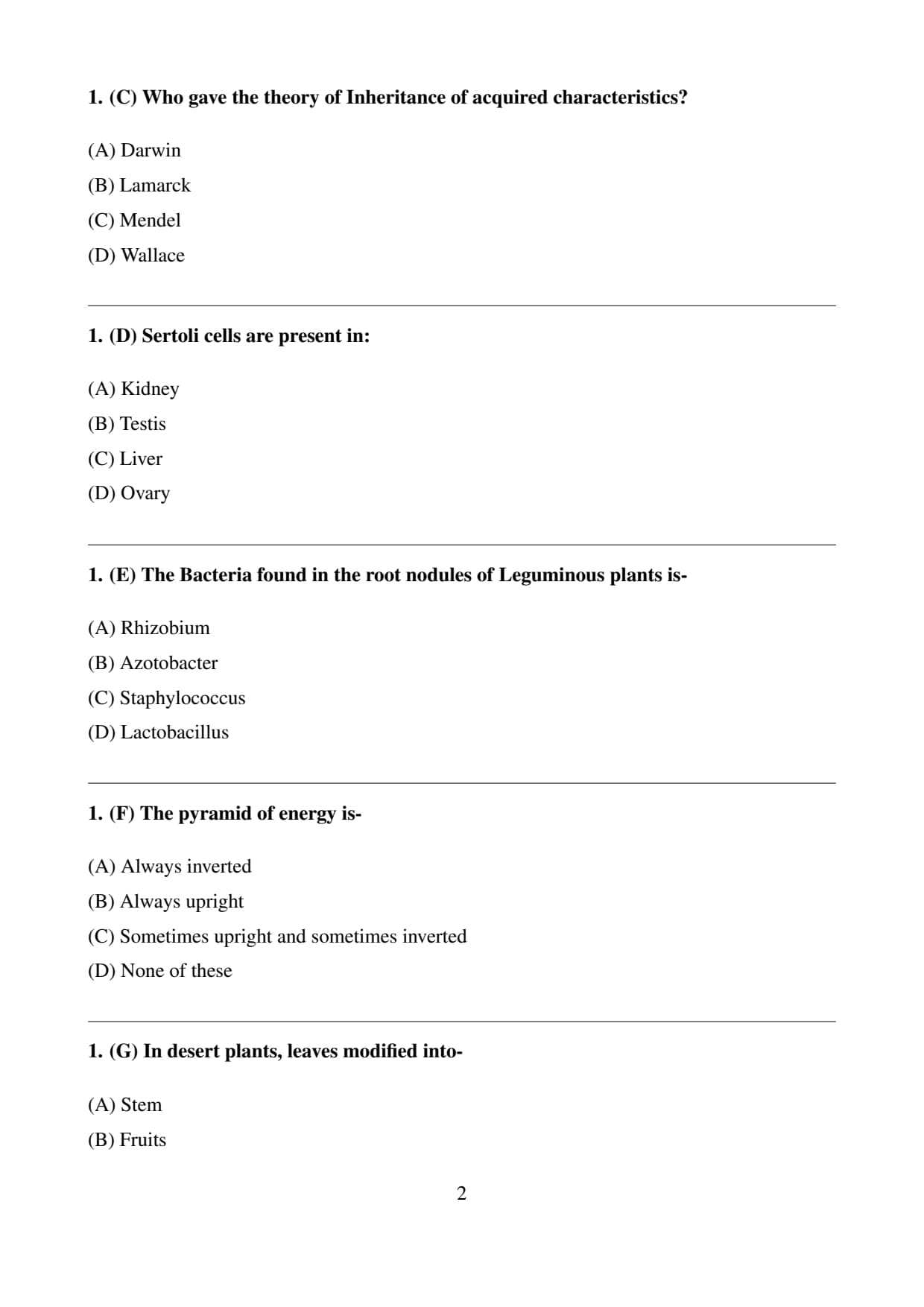
Who gave the theory of Inheritance of acquired characteristics?
View Solution
Step 1: Understand the theory of Inheritance of Acquired Characteristics.
The theory of Inheritance of Acquired Characteristics, also known as Lamarckism, proposes that an organism can pass on characteristics that it acquired during its lifetime to its offspring.
Step 2: Identify the scientist who proposed this theory.
Jean-Baptiste Lamarck (1744-1829) was a French naturalist who proposed this theory in the early 19th century.
His famous example was the giraffe's long neck, which he suggested developed because ancestral giraffes stretched their necks to reach leaves, and this acquired characteristic was passed to offspring.
Step 3: Analysis of each option.
(A) Darwin: Incorrect. Charles Darwin proposed the theory of Natural Selection and Evolution, not inheritance of acquired characteristics.
(B) Lamarck: Correct. Lamarck is the scientist who gave the theory of Inheritance of Acquired Characteristics.
(C) Mendel: Incorrect. Gregor Mendel is known for his work on genetics and inheritance patterns in pea plants (laws of inheritance), not acquired characteristics.
(D) Wallace: Incorrect. Alfred Russel Wallace independently proposed the theory of evolution by natural selection alongside Darwin.
Step 4: Conclusion.
Jean-Baptiste Lamarck proposed the theory of Inheritance of Acquired Characteristics, which was one of the earliest theories of evolution, though it was later replaced by Darwin's theory of natural selection.
Final Answer: (B) Lamarck Quick Tip: Remember key scientists and their contributions: Lamarck \(\Rightarrow\) Inheritance of Acquired Characteristics Darwin \(\Rightarrow\) Natural Selection Mendel \(\Rightarrow\) Laws of Inheritance (Genetics) Wallace \(\Rightarrow\) Co-discoverer of Natural Selection
Sertoli cells are present in:
View Solution
Step 1: Understand what Sertoli cells are.
Sertoli cells are specialized cells found in the male reproductive system. They are also known as "nurse cells" or "sustentacular cells."
Step 2: Function of Sertoli cells.
Sertoli cells are located in the seminiferous tubules of the testis and perform several important functions:
Provide nutritional support to developing sperm cells (spermatogenesis)
Form the blood-testis barrier
Secrete hormones and other factors (like inhibin and anti-Müllerian hormone)
Phagocytose residual cytoplasm during sperm maturation
Step 3: Analysis of each option.
(A) Kidney: Incorrect. Kidney contains nephrons with cells like podocytes, proximal tubule cells, etc., not Sertoli cells.
(B) Testis: Correct. Sertoli cells are present in the seminiferous tubules of the testis.
(C) Liver: Incorrect. Liver contains hepatocytes, Kupffer cells, etc., not Sertoli cells.
(D) Ovary: Incorrect. Ovary contains granulosa cells, theca cells, etc., which are female counterparts but not Sertoli cells. The female equivalent of Sertoli cells are called "follicular cells" or "granulosa cells."
Step 4: Conclusion.
Sertoli cells are exclusively found in the seminiferous tubules of the testis, where they support and nourish developing sperm cells during spermatogenesis.
Final Answer: (B) Testis Quick Tip: Remember: Male reproductive cells: Sertoli cells (nurse cells) and Leydig cells (interstitial cells) \(\Rightarrow\) both in Testis Female counterparts: Granulosa cells and Theca cells \(\Rightarrow\) in Ovary
The Bacteria found in the root nodules of Leguminous plants is-
View Solution
Step 1: Understand the relationship between leguminous plants and bacteria.
Leguminous plants (like peas, beans, grams, etc.) have a symbiotic relationship with specific nitrogen-fixing bacteria that live in their root nodules.
Step 2: Identify the specific bacteria found in root nodules.
The bacteria found in the root nodules of leguminous plants is Rhizobium. These bacteria convert atmospheric nitrogen into a form that plants can use (ammonia), and in return, the plants provide shelter and nutrients to the bacteria.
Step 3: Analysis of each option.
(A) Rhizobium: Correct. Rhizobium is the symbiotic nitrogen-fixing bacteria found in root nodules of leguminous plants.
(B) Azotobacter: Incorrect. Azotobacter is a free-living nitrogen-fixing bacteria found in soil, not in root nodules.
(C) Staphylococcus: Incorrect. Staphylococcus is a pathogenic bacteria commonly found on skin and mucous membranes of humans and animals. It does not fix nitrogen.
(D) Lactobacillus: Incorrect. Lactobacillus is a bacteria used in the production of yogurt and other fermented foods. It does not fix nitrogen and is not found in root nodules.
Step 4: Conclusion.
Rhizobium is the symbiotic bacteria that forms root nodules in leguminous plants and fixes atmospheric nitrogen into ammonia, enriching soil fertility.
Final Answer: (A) Rhizobium Quick Tip: Remember: Rhizobium \(\Rightarrow\) Symbiotic nitrogen fixation (in root nodules of legumes) Azotobacter \(\Rightarrow\) Free-living nitrogen fixation (in soil) Frankia \(\Rightarrow\) Symbiotic nitrogen fixation (in non-leguminous plants like Alnus) Cyanobacteria \(\Rightarrow\) Free-living nitrogen fixation (in aquatic environments)
The pyramid of energy is-
View Solution
Step 1: Understand ecological pyramids.
Ecological pyramids are graphical representations of the relationship between organisms at different trophic levels. There are three types: pyramid of numbers, pyramid of biomass, and pyramid of energy.
Step 2: Recall the characteristics of pyramid of energy.
The pyramid of energy shows the flow of energy from one trophic level to the next in an ecosystem. It has the following characteristics:
It is always upright (never inverted)
It represents the amount of energy transferred per unit area per unit time
Energy decreases at each successive trophic level (approximately 10% is transferred)
It is based on the laws of thermodynamics
Step 3: Reason why pyramid of energy is always upright.
Energy flows in a single direction and is lost as heat at each transfer due to respiration and metabolic activities. Therefore, the energy available at each successive trophic level is always less than the previous level.
Step 4: Analysis of each option.
(A) Always inverted: Incorrect. The pyramid of energy is never inverted.
(B) Always upright: Correct. The pyramid of energy is always upright because energy decreases at each trophic level.
(C) Sometimes upright and sometimes inverted: Incorrect. Only pyramids of numbers and biomass can sometimes be inverted, never the pyramid of energy.
(D) None of these: Incorrect. Option (B) is correct.
Step 5: Conclusion.
The pyramid of energy is always upright due to the universal law of energy flow in ecosystems.
Final Answer: (B) Always upright Quick Tip: Remember: Pyramid of Energy \(\Rightarrow\) Always upright Pyramid of Biomass \(\Rightarrow\) Generally upright, can be inverted (e.g., aquatic ecosystems) Pyramid of Numbers \(\Rightarrow\) Generally upright, can be inverted (e.g., parasitic food chain)
In desert plants, leaves modified into-
View Solution
Step 1: Understand adaptations in desert plants.
Desert plants (xerophytes) have various adaptations to survive in arid conditions with limited water availability. These adaptations help reduce water loss through transpiration.
Step 2: Identify leaf modification in desert plants.
In desert plants like cacti, leaves are modified into spines (thorns). This modification serves multiple purposes:
Reduces water loss: Spines have a reduced surface area, minimizing transpiration
Protection: Spines protect the plant from herbivores
Photosynthesis: The green stem takes over the function of photosynthesis
Step 3: Examples of desert plants with spines.
Common examples include:
Cactus (Opuntia)
Euphorbia
Acacia (some species)
Step 4: Analysis of each option.
(A) Stem: Incorrect. In desert plants, the stem becomes fleshy and performs photosynthesis, but leaves are not modified into stem.
(B) Fruits: Incorrect. Fruits are reproductive structures, not modifications of leaves in desert plants.
(C) Spines: Correct. Leaves are modified into spines to reduce water loss and provide protection.
(D) Roots: Incorrect. Roots may be modified for water absorption (deep roots), but leaves are not modified into roots.
Step 5: Conclusion.
In desert plants, leaves are modified into spines as an adaptation to reduce water loss through transpiration and protect against herbivores.
Final Answer: (C) Spines Quick Tip: Xerophytic adaptations in desert plants: Leaves \(\Rightarrow\) Spines (reduce transpiration) Stem \(\Rightarrow\) Fleshy, green (photosynthesis) Roots \(\Rightarrow\) Deep (water absorption) Cuticle \(\Rightarrow\) Thick (reduce water loss)
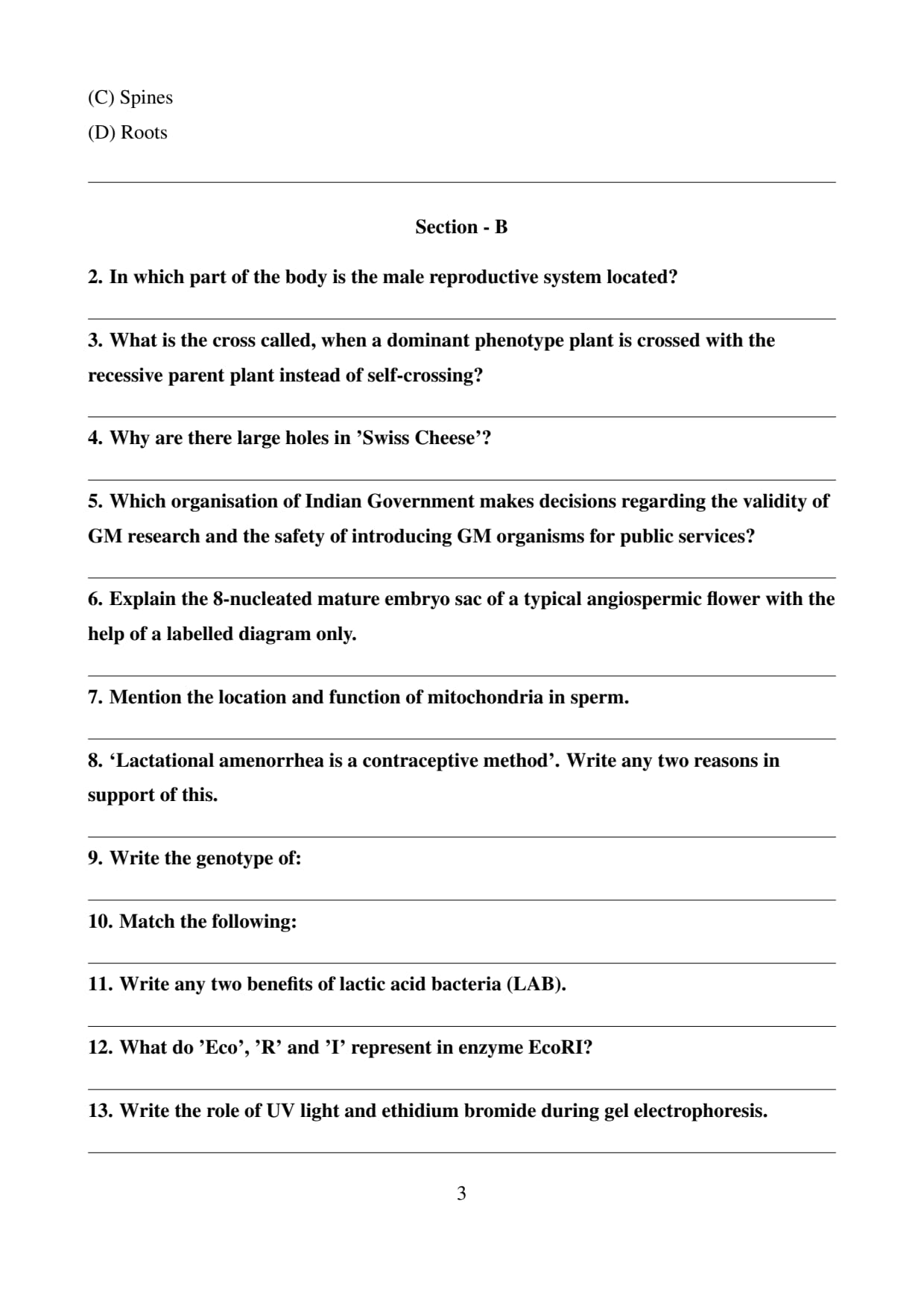
In which part of the body is the male reproductive system located?
View Solution
The male reproductive system is located in the pelvic region, specifically outside the abdominal cavity or externally.
Main external parts include:
Penis - external organ
Scrotum - pouch of skin containing the testes
Testes - located within the scrotum, outside the body
Internal parts include:
Accessory glands (prostate gland, seminal vesicles, bulbourethral glands)
Ducts (epididymis, vas deferens, ejaculatory duct)
The testes are located outside the body in the scrotum because sperm production requires a temperature slightly lower than normal body temperature. Quick Tip: The male reproductive system is primarily located externally in the pelvic region, with testes in the scrotum to maintain optimal temperature for sperm production.
What is the cross called, when a dominant phenotype plant is crossed with the recessive parent plant instead of self-crossing?
View Solution
The cross described is called a Test Cross.
Explanation:
A test cross is performed to determine the genotype of an individual showing a dominant phenotype.
The individual with dominant phenotype (but unknown genotype - could be homozygous dominant or heterozygous) is crossed with a homozygous recessive individual.
The offspring ratios reveal the genotype of the dominant parent.
How it works:
If the dominant parent is homozygous dominant (TT): All offspring will show dominant phenotype.
If the dominant parent is heterozygous (Tt): Offspring will show 1:1 ratio of dominant and recessive phenotypes.
Example:
Unknown plant (tall - could be TT or Tt) crossed with dwarf plant (tt)
If all offspring are tall \(\Rightarrow\) parent was TT
If half are tall, half are dwarf \(\Rightarrow\) parent was Tt
This cross is different from self-crossing (self-pollination) where the plant is crossed with itself. Quick Tip: A test cross involves crossing a dominant phenotype individual with a homozygous recessive parent to determine its genotype. The offspring ratio reveals whether the dominant parent is homozygous or heterozygous.
Why are there large holes in 'Swiss Cheese'?
View Solution
The large holes in Swiss cheese are formed due to a special bacteria used during its production process.
Reason:
During the making of Swiss cheese, a specific bacterium called Propionibacterium shermanii is added.
These bacteria consume the lactic acid present in the cheese and produce carbon dioxide (CO₂) gas.
This gas accumulates inside the cheese and creates pressure.
As the cheese solidifies during the ripening process, the gas cannot escape and forms bubbles inside.
Over time, these bubbles enlarge and eventually become the large holes characteristic of Swiss cheese.
Additional Information:
These holes are also called 'eyes'.
The size and number of holes depend on the ripening duration and temperature.
These holes have become the signature feature of Swiss cheese. Quick Tip: The large holes in Swiss cheese are formed by carbon dioxide gas produced by Propionibacterium bacteria, which gets trapped inside the cheese during ripening, creating bubbles that become holes.
Which organisation of Indian Government makes decisions regarding the validity of GM research and the safety of introducing GM organisms for public services?
View Solution
In India, the regulation of Genetically Modified (GM) research and the safety assessment of GM organisms for public use is managed through a multi-tiered regulatory framework under the **"Rules for the Manufacture, Use/Import/Export and Storage of Hazardous Micro Organisms/Genetically Engineered Organisms or Cells, 1989"** (Rules 1989), notified under the Environment (Protection) Act, 1986 [citation:1][citation:3][citation:4].
The key organizations responsible for these decisions are:
Genetic Engineering Appraisal Committee (GEAC):
This is the **apex statutory committee** constituted under the Ministry of Environment, Forest and Climate Change (MoEF\&CC) [citation:8][citation:10].
The GEAC is the final authority for approving the **environmental release** of GM organisms and products into the environment, including experimental field trials (BRL-I and BRL-II) [citation:1][citation:8].
Its clearance is **mandatory for the commercial cultivation** or introduction of any GM crop for public services [citation:8][citation:10].
Review Committee on Genetic Manipulation (RCGM):
This committee functions under the **Department of Biotechnology (DBT)**, Ministry of Science and Technology [citation:3][citation:6].
It monitors the safety aspects of ongoing research projects and confined field trials involving genetically engineered organisms [citation:3][citation:6].
The RCGM oversees the initial phases of research and development, including small-scale field trials, before proposals are forwarded to the GEAC [citation:6].
Institutional Biosafety Committee (IBSC):
These committees are established at the institutional level (research labs, universities, companies) handling GM research [citation:2][citation:9].
They serve as the first point of regulatory oversight, ensuring on-site compliance with biosafety guidelines and reviewing institutional research proposals [citation:3][citation:9].
Additionally, the **Food Safety and Standards Authority of India (FSSAI)** is the competent authority responsible for conducting the safety assessment of GM food [citation:1]. Quick Tip: India's GM regulatory framework involves a three-tier system: Institutional Biosafety Committees (IBSC) for local oversight, the Review Committee on Genetic Manipulation (RCGM) for research monitoring, and the Genetic Engineering Appraisal Committee (GEAC) as the apex body for final approval of environmental release and public use. The GEAC's clearance is mandatory for introducing GM organisms for public services [citation:1][citation:8].
Explain the 8-nucleated mature embryo sac of a typical angiospermic flower with the help of a labelled diagram only.
View Solution
The 8-nucleated mature embryo sac, also known as the female gametophyte or Polygonum type (monosporic development), is the most common type of embryo sac in angiosperms. It develops from a functional megaspore through three mitotic divisions.
Key Components of the 8-Nucleated Embryo Sac:
Egg Apparatus (at the micropylar end):
Contains 3 cells: 1 Egg cell and 2 Synergids
Egg cell (Female gamete): The actual female gamete that fuses with one male gamete to form the zygote.
Synergids: Two helper cells with filiform apparatus that guide the pollen tube into the embryo sac.
Central Cell:
Contains 2 Polar Nuclei
These two polar nuclei fuse with the second male gamete to form the triploid (3n) primary endosperm nucleus, which develops into the endosperm.
Antipodal Cells (at the chalazal end):
Contains 3 cells
These cells are generally short-lived and may degenerate after fertilization. Their function is believed to be nutritive for the developing embryo sac.
Summary of Nuclei Distribution:
Micropylar End: 3 nuclei (1 Egg + 2 Synergids)
Central Cell: 2 Polar Nuclei
Chalazal End: 3 Antipodal Cells
Total: 8 nuclei distributed in 7 cells (since the central cell contains 2 nuclei but is a single cell). Quick Tip: The mature angiosperm embryo sac (female gametophyte) contains 8 nuclei organized into 7 cells: 3 antipodals (chalazal end), 2 synergids and 1 egg cell (micropylar end), and a central cell with 2 polar nuclei. This 8-nucleate, 7-celled structure is characteristic of the Polygonum type embryo sac.
Mention the location and function of mitochondria in sperm.
View Solution
Location of Mitochondria in Sperm:
In a sperm cell, mitochondria are located in the middle piece (or mid-piece) of the sperm. They are arranged in a spiral or helical pattern around the axial filament (axoneme) in the neck region between the head and the tail. In mammalian sperm, they form a tightly packed mitochondrial sheath.
Functions of Mitochondria in Sperm:
Energy Production (ATP synthesis):
The primary function of sperm mitochondria is to generate energy in the form of Adenosine Triphosphate (ATP) through the process of oxidative phosphorylation.
Sperm motility requires enormous amounts of energy for the movement of the tail (flagellum).
Mitochondria utilize fructose (from seminal plasma) and other nutrients to produce this energy.
Providing Energy for Motility:
The ATP produced by mitochondria fuels the dynein arms of the axoneme, causing the microtubules to slide and generating the whip-like movement of the sperm tail.
This enables the sperm to swim through the female reproductive tract to reach and fertilize the egg.
Supporting Hyperactivation and Capacitation:
Mitochondrial energy production is crucial for sperm capacitation (biochemical changes) and hyperactivation (vigorous, asymmetrical tail movement) required for egg penetration.
Calcium Homeostasis:
Mitochondria in the mid-piece help regulate intracellular calcium levels, which is important for flagellar movement and acrosome reaction. Quick Tip: Mitochondria in sperm are located in the middle piece (mid-piece) and are arranged spirally. Their primary function is to produce ATP energy for tail movement, enabling sperm motility, capacitation, and hyperactivation required for fertilization.
‘Lactational amenorrhea is a contraceptive method’. Write any two reasons in support of this.
View Solution
Lactational amenorrhea refers to the temporary natural infertility that occurs after childbirth due to exclusive breastfeeding. It is recognized as a natural contraceptive method, often called the Lactational Amenorrhea Method (LAM).
Two Reasons Supporting Lactational Amenorrhea as a Contraceptive Method:
Suppression of Ovulation:
Frequent and exclusive breastfeeding stimulates the release of the hormone prolactin.
High prolactin levels inhibit the secretion of Gonadotropin-Releasing Hormone (GnRH) from the hypothalamus.
This suppression of GnRH leads to reduced secretion of Follicle Stimulating Hormone (FSH) and Luteinizing Hormone (LH) from the pituitary gland.
Without adequate FSH and LH, ovulation does not occur, preventing the release of an egg for fertilization.
Induction of Amenorrhea (Absence of Menstruation):
Due to the hormonal suppression described above, the normal menstrual cycle does not resume.
The absence of menstruation (amenorrhea) indicates that the ovarian cycle is inactive and the uterine lining is not being prepared for implantation.
The combined effect of no ovulation and no menstrual cycle creates a temporary period of infertility, acting as a natural barrier to conception.
Conditions for Effectiveness (WHO Criteria for LAM):
The mother must be exclusively breastfeeding (no other food or liquid).
The baby must be less than 6 months old.
The mother must remain amenorrheic (no menstrual bleeding after the first 56 days postpartum).
If these conditions are met, LAM is over 98% effective as a contraceptive method. Quick Tip: Lactational amenorrhea works as a contraceptive because (1) high prolactin from breastfeeding suppresses GnRH, inhibiting ovulation, and (2) it maintains amenorrhea (absence of menstruation), creating a natural period of infertility. It is effective when exclusive breastfeeding is practiced for the first 6 months postpartum.
Write the genotype of:
View Solution
The given genotypes are related to Sickle Cell Anemia, an autosomal recessive genetic disorder caused by a mutation in the hemoglobin gene (HBB). The normal allele is represented as Hb\(^A\) and the mutant (sickle cell) allele is represented as Hb\(^S\).
(क) वाहक व्यक्ति (Carrier) :
Genotype: \quad \large Hb\(^A\) Hb\(^S\)
A carrier (heterozygous) individual has one normal allele (Hb\(^A\)) and one mutant allele (Hb\(^S\)).
Such individuals do not show severe symptoms of the disease (asymptomatic under normal conditions) but can pass the mutant gene to their offspring.
They possess sickle cell trait and may exhibit mild symptoms only under extreme physiological stress (like severe dehydration or low oxygen levels).
(ख) प्रभावित व्यक्ति (Affected) :
Genotype: \quad \large Hb\(^S\) Hb\(^S\)
An affected individual (homozygous recessive) has both mutant alleles (Hb\(^S\) Hb\(^S\)).
Such individuals suffer from Sickle Cell Anemia, a severe disease characterized by:
Abnormal, sickle-shaped red blood cells
Chronic hemolytic anemia
Painful vaso-occlusive crises
Organ damage due to poor oxygen supply Quick Tip: In Sickle Cell Anemia: Carrier (Trait) = Heterozygous \textbf{Hb\(^A\)Hb\(^S\)} (mild/no symptoms) Affected (Disease) = Homozygous recessive \textbf{Hb\(^S\)Hb\(^S\)} (severe symptoms)
Match the following:
View Solution
\begin{tabular{|p{7cm|p{7cm|
\hline
Column A & Column B (Correct Match)
\hline
(A) Natural Selection & (i) Convergent evolution
\hline
(B) Inheritance of acquired characters & (ii) Dark and white winged moths
\hline
(C) Analogous Structures & (iii) Charles Darwin
\hline
(D) Industrial Melanism) & (iv) Long neck of Giraffe
\hline
\end{tabular
Correct Matching:
\begin{tabular{|p{7cm|p{7cm|
\hline
Column A & Column B (Correct Match)
\hline
(A) Natural Selection & (iii) Charles Darwin
\hline
(B) Inheritance of acquired characters & (iv) Long neck of Giraffe
\hline
(C) Analogous Structures & (i) Convergent evolution
\hline
(D) Industrial Melanism) & (ii) Dark and white winged moths
\hline
\end{tabular
Explanation of Matches:
Natural Selection -- Charles Darwin:
Charles Darwin proposed the theory of Natural Selection in his book "On the Origin of Species" (1859).
It explains how organisms with favorable variations survive and reproduce, passing these traits to offspring.
Inheritance of Acquired Characters -- Long neck of Giraffe:
This concept was proposed by Jean-Baptiste Lamarck.
Lamarck used the example of giraffes to explain his theory: giraffes stretched their necks to reach leaves, and this acquired longer neck was passed to offspring.
Though Lamarck's theory was later disproven, the giraffe's neck remains a classic example associated with this idea.
Analogous Structures -- Convergent Evolution:
Analogous structures are organs that perform similar functions but have different evolutionary origins (e.g., wings of birds and insects).
They arise due to convergent evolution, where unrelated species evolve similar traits adapting to similar environments.
Industrial Melanism -- Dark and White Winged Moths:
Industrial melanism is exemplified by the peppered moth (Biston betularia) in England.
During industrialization, dark-winged moths became more common on soot-covered trees due to better camouflage from predators, while white-winged moths declined.
This is a classic example of natural selection in action. Quick Tip: Evolutionary Concepts: Natural Selection \(\Rightarrow\) Darwin Acquired Characters \(\Rightarrow\) Giraffe neck (Lamarck) Analogous Structures \(\Rightarrow\) Convergent Evolution Industrial Melanism \(\Rightarrow\) Peppered moths
Write any two benefits of lactic acid bacteria (LAB).
View Solution
Lactic Acid Bacteria (LAB) are a group of beneficial bacteria that ferment carbohydrates to produce lactic acid. They are widely used in food production and have several health benefits.
Two Major Benefits of Lactic Acid Bacteria (LAB):
Food Preservation and Production:
LAB are essential in the production of various fermented foods including:
Yogurt and curd: LAB (e.g., Lactobacillus) ferment milk, coagulating proteins and giving characteristic texture and taste.
Cheese: Different LAB species contribute to flavor development during cheese ripening.
Fermented vegetables: Pickles, sauerkraut, and kimchi are produced using LAB.
Fermented cereals and legumes: Idli and dosa batter fermentation relies on LAB.
The lactic acid produced lowers the pH, creating an acidic environment that inhibits the growth of spoilage-causing and pathogenic bacteria, thereby naturally preserving food.
Health and Nutritional Benefits (Probiotic Effects):
LAB act as probiotics – beneficial microorganisms that improve gut health.
Improved digestion: They help break down lactose, making dairy products easier to digest for lactose-intolerant individuals.
Gut microbiota balance: LAB help maintain a healthy balance of intestinal microflora by suppressing harmful bacteria.
Enhanced nutrient absorption: They can increase the bioavailability of certain nutrients (like vitamins and minerals).
Immunity boost: LAB stimulate the immune system, potentially reducing the risk of infections.
Some LAB strains are known to produce vitamins (e.g., B vitamins) during fermentation.
Additional Benefits (for reference):
Reduction of cholesterol levels (in some studies)
Potential anti-carcinogenic properties
Treatment and prevention of diarrhea (especially antibiotic-associated diarrhea) Quick Tip: Lactic Acid Bacteria (LAB) benefits: \textbf{Food preservation:} Produce lactic acid that inhibits spoilage bacteria; used in making yogurt, cheese, pickles, etc. \textbf{Health benefits:} Act as probiotics improving digestion, gut health, nutrient absorption, and immunity.
What do 'Eco', 'R' and 'I' represent in enzyme EcoRI?
View Solution
EcoRI is a restriction enzyme (restriction endonuclease) isolated from a specific strain of bacteria. The naming of restriction enzymes follows a standard convention based on the bacterium from which they are isolated.
Meaning of each component in EcoRI:
Eco – Genus and Species abbreviation:
'E' stands for the first letter of the genus name: Escherichia
'co' stands for the first two letters of the species name: coli
Thus, 'Eco' represents the bacterium Escherichia coli
R – Strain designation:
'R' represents the specific strain of the bacterium from which the enzyme was first isolated.
In this case, 'R' stands for the RY13 strain of Escherichia coli.
Different strains of the same bacterial species may produce different restriction enzymes with different recognition sites.
I – Roman numeral for order of discovery:
The Roman numeral 'I' indicates that this was the first restriction enzyme isolated from \textit{E. coli strain RY13.
If multiple enzymes are isolated from the same bacterial strain, they are numbered sequentially as I, II, III, etc. in the order of their discovery.
For example, if a second enzyme were discovered from the same strain, it would be named EcoRII.
Summary Table:
\begin{tabular{|l|l|l|
\hline
Component & Represents & Meaning
\hline
Eco & Genus + Species & \textit{Escherichia coli
\hline
R & Strain & RY13 strain
\hline
I & Roman numeral & First enzyme discovered from this strain
\hline
\end{tabular
Additional Information:
EcoRI recognizes the palindromic DNA sequence: 5'-GAATTC-3'
It cuts between the G and A nucleotides, producing sticky ends. Quick Tip: EcoRI naming: \textbf{Eco = Escherichia coli (genus and species) \textbf{R} = RY13 strain of the bacterium \textbf{I} = First enzyme discovered from this strain
Write the role of UV light and ethidium bromide during gel electrophoresis.
View Solution
Gel electrophoresis is a technique used to separate DNA fragments based on their size. After electrophoresis, the DNA bands are not visible to the naked eye and must be visualized using a combination of a fluorescent dye and a specific light source.
Role of Ethidium Bromide (EtBr):
Ethidium bromide is a fluorescent intercalating dye used to visualize DNA in the gel.
Mechanism:
EtBr molecules contain a planar tricyclic structure that intercalates (inserts itself) between the stacked base pairs of the DNA double helix.
Once intercalated, it binds strongly to the DNA.
Function:
It acts as a staining agent that makes DNA visible under UV light.
Unbound EtBr in the gel produces a background fluorescence, while DNA-bound EtBr fluoresces much more intensely, revealing the location of DNA bands.
It can be added to the gel before casting or used to stain the gel after electrophoresis.
Role of UV Light (Ultraviolet Light):
UV light acts as an excitation source for the visualization of DNA stained with ethidium bromide.
Mechanism:
When exposed to UV light (typically at a wavelength of 302 nm or 312 nm), the ethidium bromide molecules absorb the UV energy.
This energy excites the electrons in the dye to a higher energy state.
As the electrons return to their ground state, they emit light at a longer wavelength (in the visible orange-red range, around 590 nm).
Function:
It makes the DNA bands visible to the human eye or detectable by gel documentation systems.
The stained DNA bands appear as bright orange fluorescent bands against a darker background.
This allows researchers to photograph the gel, analyze band patterns, and determine fragment sizes.
Working Together:
\fbox{
\begin{minipage{0.8\textwidth
\centering
UV Light + Ethidium Bromide = DNA Visualization
\end{minipage
EtBr binds to DNA and provides the fluorescent molecule.
UV light provides the energy to excite this molecule.
The combination allows for the detection and documentation of DNA fragments separated by electrophoresis.
Safety Note:
Ethidium bromide is a mutagen (potentially carcinogenic). UV light can damage skin and eyes. Proper safety precautions (gloves, UV-protective face shields/screens) must be used when working with both. Quick Tip: \textbf{Ethidium bromide:} Fluorescent dye that intercalates into DNA, staining it. \textbf{UV light:} Excites the bound ethidium bromide, causing it to emit visible orange fluorescence. \textbf{Together:} They make DNA bands visible after gel electrophoresis.
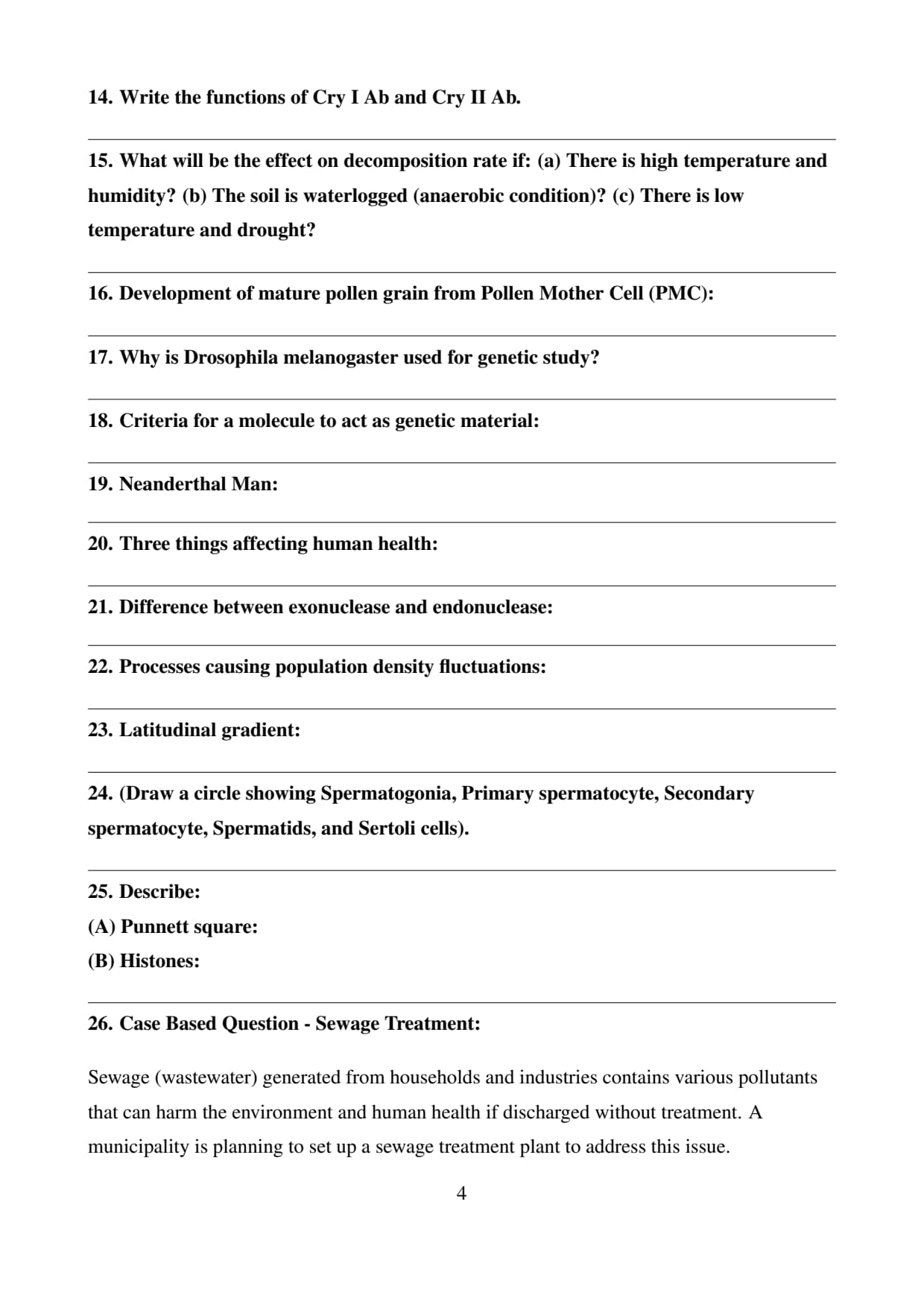
Write the functions of Cry I Ab and Cry II Ab.
View Solution
Cry I Ab and Cry II Ab are insecticidal crystal proteins (also called delta-endotoxins) produced by the bacterium Bacillus thuringiensis (Bt). The genes encoding these proteins (cry genes) are widely used in genetic engineering to develop insect-resistant transgenic crops, particularly Bt cotton.
General Mechanism of Cry Proteins:
The Cry protein is produced as an inactive protoxin in the bacterium (or plant).
When ingested by susceptible insect larvae, the alkaline pH of the insect gut solubilizes the protein.
Gut proteases (enzymes) cleave the protoxin, activating it into a toxic form.
The activated toxin binds to specific receptors on the epithelial cells of the insect midgut.
It creates pores in the cell membrane, causing cell lysis, gut paralysis, and ultimately death of the insect.
Functions of Specific Cry Proteins:
Cry I Ab:
Target pests: This toxin is primarily effective against lepidopteran insects (caterpillars/butterflies/moths).
Specific pests controlled:
European corn borer (\textit{Ostrinia nubilalis)
Tobacco budworm (\textit{Heliothis virescens)
Cotton bollworm (\textit{Helicoverpa armigera)
Various stem borers and leaf rollers
Usage: It is one of the most commonly used cry genes in Bt corn and early generations of Bt cotton to control lepidopteran pests.
Cry II Ab:
Target pests: This toxin has a broader spectrum of activity. It is effective against both lepidopteran and dipteran (flies/mosquitoes) insects. It shows higher potency against certain lepidopteran pests compared to Cry I Ab.
Specific pests controlled:
Cotton bollworm (\textit{Helicoverpa armigera) – with higher efficacy
Tobacco budworm (\textit{Heliothis virescens)
Armyworms (\textit{Spodoptera spp.)
Some dipteran species (like mosquitoes) in non-plant applications
Usage in transgenic crops:
Cry II Ab is often used in combination with Cry I Ac (a related protein) in modern Bt cotton hybrids (e.g., Bollgard II, Roundup Ready Flex cotton) to:
Broaden the spectrum of pest control
Provide a second mode of action to delay the development of resistance in insect populations
Comparison Table:
\begin{tabular{|p{3cm|p{5cm|p{5cm|
\hline
Feature & Cry I Ab & Cry II Ab
\hline
Target Order & Lepidoptera (caterpillars) & Lepidoptera and Diptera
\hline
Main Pests & European corn borer, cotton bollworm, tobacco budworm & Cotton bollworm (higher efficacy), armyworms
\hline
Usage & Bt corn, early Bt cotton & Modern Bt cotton (with Cry I Ac) for resistance management
\hline
Mode of Action & Pore formation in midgut epithelial cells & Same mechanism, but binds to different receptors
\hline
\end{tabular
Significance in Agriculture:
The combination of different cry genes (like Cry I Ab and Cry II Ab) in transgenic crops is a strategy called "gene pyramiding".
This reduces the likelihood of insects developing resistance, as they would need to develop resistance to multiple toxins simultaneously. Quick Tip: \textbf{Cry I Ab: Targets lepidopteran pests (corn borer, bollworm). Used in Bt corn and early Bt cotton. \textbf{Cry II Ab:} Broader spectrum - targets lepidoptera (with higher efficacy) and diptera. Used in modern Bt cotton with Cry I Ac for resistance management (gene pyramiding). Both are insecticidal proteins from Bacillus thuringiensis that kill insects by creating pores in their gut epithelial cells.
What will be the effect on decomposition rate if:
(a) There is high temperature and humidity?
(b) The soil is waterlogged (anaerobic condition)?
(c) There is low temperature and drought?
View Solution
Decomposition is the process by which complex organic matter is broken down into simpler inorganic substances by decomposers (bacteria and fungi). The rate of decomposition is influenced by various abiotic factors.
(a) Effect of high temperature and humidity:
Effect: Increased decomposition rate
Reason:
High temperature (up to an optimum, around 25-35°C) increases the metabolic activity and enzyme efficiency of decomposers (bacteria and fungi).
High humidity provides adequate moisture, which is essential for the survival and activity of decomposers.
Moisture also facilitates the diffusion of nutrients and enzymes, accelerating the breakdown process.
Tropical rainforests exhibit the fastest decomposition rates due to warm and humid conditions.
(b) Effect of waterlogged (anaerobic) condition:
Effect: Decreased decomposition rate
Reason:
Waterlogged soils lack oxygen (anaerobic conditions).
Most decomposers (especially fungi and aerobic bacteria) require oxygen for their respiratory metabolism.
In the absence of oxygen, decomposition is carried out by anaerobic bacteria, which are much slower and less efficient.
Partially decomposed organic matter accumulates in such conditions, leading to the formation of peat (e.g., in wetlands and bogs).
(c) Effect of low temperature and drought:
Effect: Decreased decomposition rate (very slow)
Reason:
Low temperature reduces the metabolic activity of decomposers. Enzyme activity is minimal in cold conditions.
Drought (lack of moisture) inhibits the growth and survival of decomposers.
Microorganisms become dormant or die due to desiccation.
In cold deserts, tundra regions, and during winter, decomposition almost stops, leading to accumulation of organic matter (low decomposition rates). Quick Tip: Decomposition rate is highest in warm, moist, aerobic conditions. It slows down in cold, dry, or anaerobic (waterlogged) conditions due to reduced decomposer activity.
Development of mature pollen grain from Pollen Mother Cell (PMC):
View Solution
The development of mature pollen grain from Pollen Mother Cell (PMC) occurs in two main stages: Microsporogenesis and Microgametogenesis.
Stage 1: Microsporogenesis (Formation of Microspores)
Pollen Mother Cell (2n) in anther undergoes meiosis.
Produces 4 haploid microspores arranged as tetrad.
Microspores are released from tetrad by enzyme callase.
Stage 2: Microgametogenesis (Development into Pollen Grain)
Each microspore (n) undergoes first mitotic division (asymmetric).
Forms 2-celled pollen grain:
Large Vegetative cell (tube cell)
Small Generative cell
Generative cell undergoes second mitotic division to form 2 male gametes (sperm cells).
Mature pollen grain is either 2-celled (vegetative + generative) or 3-celled (vegetative + 2 sperm cells).
Summary:
PMC (2n) \(\xrightarrow{Meiosis}\) 4 Microspores (n) \(\xrightarrow{Mitosis-1}\) 2-celled Pollen \(\xrightarrow{Mitosis-2}\) 3-celled Mature Pollen Quick Tip: Pollen development: PMC (2n) \(\Rightarrow\) Meiosis \(\Rightarrow\) 4 microspores (n) \(\Rightarrow\) Mitosis I \(\Rightarrow\) Vegetative cell + Generative cell \(\Rightarrow\) Mitosis II \(\Rightarrow\) 2 male gametes. Mature pollen is 2-celled or 3-celled.
Why is Drosophila melanogaster used for genetic study?
View Solution
Drosophila melanogaster (fruit fly) has been extensively used as a model organism in genetic studies since the early 20th century, starting with Thomas Hunt Morgan's experiments.
Reasons for using Drosophila in genetic studies:
Short Life Cycle:
Complete life cycle (egg to adult) in about 10-12 days.
Allows rapid observation of inheritance patterns across multiple generations.
High Reproductive Rate:
A single mating produces hundreds of offspring.
Provides large sample size for statistical analysis.
Easy and Economical to Culture:
Can be grown in simple laboratory bottles/containers.
Requires inexpensive culture medium (banana/agar medium).
Occupies very little space.
Clear Morphological Differences:
Easily distinguishable male and female (sexually dimorphic).
Many visible mutations (eye color, wing shape, body color) available.
Small Chromosome Number:
Only 4 pairs of chromosomes (2n=8).
Giant polytene chromosomes in salivary glands allow easy cytological mapping.
Well-Characterized Genome:
Complete genome sequenced.
Many genetic markers and mutants available. Quick Tip: Drosophila is ideal for genetics due to: short life cycle (10-12 days), high offspring number, easy culture, visible mutations, small chromosome number (4 pairs), and well-characterized genome.
Criteria for a molecule to act as genetic material:
View Solution
For a molecule to function as the genetic material (carrier of hereditary information), it must fulfill certain essential criteria. Both DNA and RNA (in some viruses) act as genetic material.
Essential Criteria for Genetic Material:
Ability to Replicate:
Genetic material must be capable of faithful replication so that genetic information can be passed from one generation to the next.
Replication must be accurate to maintain genetic continuity.
Example: DNA replication by semi-conservative method.
Storage of Genetic Information:
It must be able to store vast amounts of information in the form of genetic code.
The sequence of nucleotides (bases) determines the genetic information.
Information is stored as genes that code for proteins and regulate cellular functions.
Expression of Information:
The stored genetic information must be expressed to influence the phenotype of the organism.
It should direct the synthesis of proteins and enzymes through processes like transcription and translation.
Ability to Undergo Variation (Mutation):
Genetic material must be capable of undergoing changes (mutations) to provide genetic variability.
Mutations are the raw material for evolution.
However, changes should be rare enough to maintain stability but frequent enough to allow adaptation.
Stability:
Genetic material should be chemically and structurally stable to preserve information over generations.
DNA is highly stable due to its double-helix structure and presence of thymine (which confers stability).
Comparison of DNA and RNA as Genetic Material:
\begin{tabular{|l|l|l|
\hline
Criteria & DNA & RNA
\hline
Replication & Highly accurate & Less accurate
Stability & Very stable (thymine, double strand) & Less stable (uracil, single strand)
Mutation rate & Low & High
Information storage & Large capacity & Limited capacity
Occurrence & Most organisms & Some viruses only
\hline
\end{tabular
Conclusion:
DNA is the primary genetic material in most organisms because it is more stable and replicates accurately.
RNA acts as genetic material only in some viruses (e.g., HIV, Influenza virus, TMV) where it is less stable but allows rapid mutation (advantage for viruses). Quick Tip: Criteria for genetic material: Replication (faithful copying) Information storage (in nucleotide sequence) Expression (direct protein synthesis) Variation (ability to mutate) Stability (preserve information over generations) DNA fulfills all criteria best; RNA does in some viruses.
Neanderthal Man:
View Solution
Neanderthal man (Homo neanderthalensis) is an extinct species or subspecies of archaic humans who lived in Eurasia during the Pleistocene epoch. They are considered close relatives of modern humans.
Key Features of Neanderthal Man:
Location:
Neanderthals primarily inhabited Europe and Western Asia.
Fossil evidence found in:
Neander Valley, Germany (first discovery)
France, Spain, Italy
Middle East (Israel, Iraq)
Central Asia
They lived during the Ice Age (Pleistocene epoch).
Brain Capacity:
Average brain capacity: 1400 cc (cubic centimeters).
Interestingly, this is larger than average modern human brain (1350 cc).
Indicates high intelligence and cognitive abilities.
Advancements and Cultural Features:
Use of hides/skins: They used animal hides to protect their bodies from cold climates.
Burial of dead: They practiced deliberate burial of their dead, indicating:
Ritualistic behavior
Belief in afterlife (possible)
Social bonds and care for community members
Tool use: They used Mousterian stone tools.
Use of fire and cave dwellings. Quick Tip: Neanderthal Man: \textbf{Location:} Europe, Western Asia, Middle East \textbf{Brain capacity:} 1400 cc (larger than modern humans) \textbf{Advancements:} Used animal hides for protection, buried their dead, made tools, used fire
Three things affecting human health:
View Solution
Human health is influenced by a combination of factors that can be broadly categorized into internal (genetic) and external (environmental and lifestyle) factors.
Three Major Factors Affecting Human Health:
Genetic Factors (Inherited Traits):
Description: Health is influenced by genes inherited from parents.
Examples:
Genetic disorders: Sickle cell anemia, hemophilia, cystic fibrosis, color blindness.
Predisposition to diseases: Diabetes, hypertension, certain cancers may run in families.
Immune system strength and metabolic rate are partly genetically determined.
Environmental Factors:
Description: External surroundings and conditions that impact health.
Examples:
Physical environment: Air and water pollution, climate, radiation, noise.
Biological environment: Presence of pathogens (bacteria, viruses, parasites), vectors (mosquitoes).
Social environment: Sanitation, housing conditions, access to clean drinking water.
Pollution-related diseases: Asthma, lung cancer, lead poisoning.
Infectious diseases: Cholera (water), malaria (mosquitoes), tuberculosis (air).
Lifestyle Factors (Personal Choices):
Description: Daily habits and behaviors that significantly affect health.
Examples:
Diet and nutrition: Balanced diet vs. junk food, malnutrition, obesity.
Physical activity: Regular exercise vs. sedentary lifestyle.
Addictions: Smoking, alcohol consumption, drug abuse.
Sleep and stress management: Adequate sleep, stress reduction techniques.
Personal hygiene: Hand washing, cleanliness.
Interrelationship:
\fbox{
\begin{minipage{0.8\textwidth
\centering
Health = Genetic Factors + Environmental Factors + Lifestyle Choices
\end{minipage
These factors often interact. For example:
A person with genetic predisposition to diabetes may develop it only if they have poor lifestyle (diet, exercise).
A person living in polluted environment may suffer more if they smoke (combined effect). Quick Tip: Three main factors affecting human health: \textbf{Genetic factors:} Inherited traits, disorders, disease predisposition \textbf{Environmental factors:} Pollution, pathogens, sanitation, climate \textbf{Lifestyle factors:} Diet, exercise, addictions, hygiene, stress Health is determined by the interaction of all three.
Difference between exonuclease and endonuclease:
View Solution
Exonucleases and endonucleases are enzymes that cleave nucleic acids (DNA or RNA), but they differ in their site of action on the polynucleotide chain.
Key Differences:
\begin{tabular{|p{3.5cm|p{5cm|p{5cm|
\hline
Feature & Exonuclease & Endonuclease
\hline
Site of Action & Cleaves nucleotides from the ends of a polynucleotide chain. & Cleaves at specific positions within the polynucleotide chain (not at the ends).
\hline
Direction of Action & Removes nucleotides one at a time from the 5' end (5'\(\Rightarrow\)3' exonuclease) or 3' end (3'\(\Rightarrow\)5' exonuclease). & Cuts at internal sites, generating fragments of various lengths.
\hline
Requirement of Free Ends & Requires a free end (5' or 3') to begin cleavage. & Does not require free ends; can cut anywhere internally.
\hline
Product & Produces mononucleotides or short oligonucleotides. & Produces polynucleotide fragments of defined lengths.
\hline
Examples & E. coli DNA Polymerase I (3'\(\Rightarrow\)5' and 5'\(\Rightarrow\)3' exonuclease activity), Exonuclease III, Bal 31 nuclease. & Restriction enzymes (e.g., EcoRI, HindIII), DNase I, S1 nuclease.
\hline
Function in DNA Repair & Involved in proofreading during DNA replication and removing damaged nucleotides from ends. & Involved in cutting foreign DNA (restriction), DNA repair (cutting out damaged segments), and recombination.
\hline
\end{tabular
Simple Analogy:
Exonuclease: Like a person eating a candy bar from one end, biting off one piece at a time.
Endonuclease: Like a person cutting a rope at any point in the middle, not necessarily from the ends.
Summary:
Exonuclease: Cuts from the ends.
Endonuclease: Cuts from within. Quick Tip: \textbf{Exonuclease: Removes nucleotides from the ends (5' or 3') of DNA/RNA. Examples: Proofreading activity of DNA polymerase. \textbf{Endonuclease:} Cuts internally at specific sites. Examples: Restriction enzymes (EcoRI), DNase I.
Processes causing population density fluctuations:
View Solution
Population density refers to the number of individuals of a species per unit area. It is not constant and changes over time due to various ecological processes. These processes can be expressed through a simple population growth equation.
Basic Population Density Equation:
\Large
N = (B + I) - (D + E)
Where:
N = Population density
B = Birth rate (Natality)
I = Immigration
D = Death rate (Mortality)
E = Emigration
Four Main Processes Affecting Population Density:
Birth Rate (Natality):
Definition: Number of live births per unit population per unit time.
Effect on density: Increases population density.
Example: High birth rate in a country leads to population growth.
Death Rate (Mortality):
Definition: Number of deaths per unit population per unit time.
Effect on density: Decreases population density.
Example: Epidemic or famine increases death rate, reducing population.
Immigration:
Definition: Number of individuals entering a new habitat from elsewhere.
Effect on density: Increases population density in the new area.
Example: Birds migrating to a wetland during winter increases local population.
Emigration:
Definition: Number of individuals leaving a habitat to go elsewhere.
Effect on density: Decreases population density in the original area.
Example: Seasonal migration of animals reduces local population temporarily.
Additional Factors Influencing Population Density:
\setcounter{enumi{4
Food Availability: More food increases carrying capacity and density.
Predation: High predation decreases population density.
Disease: Epidemics cause mortality, reducing density.
Natural Calamities: Floods, fires, earthquakes can drastically reduce density.
Competition: Intra-specific and inter-specific competition affects density.
Summary Table:
\begin{tabular{|l|l|
\hline
Process & Effect on Population Density
\hline
Birth Rate (Natality) & Increases
\hline
Death Rate (Mortality) & Decreases
\hline
Immigration & Increases
\hline
Emigration & Decreases
\hline
\end{tabular
Note: When B + I > D + E, population density increases. When B + I < D + E, population density decreases. When B + I = D + E, population density remains stable. Quick Tip: Population density (N) changes due to: \textbf{Increase:} Birth rate + Immigration \textbf{Decrease:} Death rate + Emigration Formula: \textbf{N = (B + I) - (D + E)}
Latitudinal gradient:
View Solution
Latitudinal gradient refers to the pattern of variation in species diversity and richness with changing latitude from the equator towards the poles. It is one of the most well-established patterns in biogeography and ecology.
The Pattern:
\fbox{
\begin{minipage{0.8\textwidth
\centering
Species diversity decreases as we move from the equator towards the poles.
\end{minipage
Equator (Low latitudes): Maximum species diversity.
Poles (High latitudes): Minimum species diversity.
Key Features:
Tropical Regions (Near Equator):
High species richness (biodiversity hotspots).
Example: Amazon rainforest has millions of species.
Warm, stable climate with high productivity.
Temperate Regions:
Moderate species diversity.
Example: Forests of Europe, North America.
Seasonal climate with moderate productivity.
Polar Regions (Near Poles):
Low species diversity.
Example: Arctic tundra, Antarctica.
Extreme cold, harsh conditions, low productivity.
Reasons for Latitudinal Gradient:
Solar Energy and Temperature:
Equator receives more solar radiation \(\Rightarrow\) higher temperatures \(\Rightarrow\) greater productivity.
More energy supports more species.
Climate Stability:
Tropical climates are stable and predictable year-round.
Allows specialization and niche partitioning.
Evolutionary History:
Tropics have had stable conditions for longer periods.
More time for speciation and evolution.
Glacial History:
Temperate and polar regions were affected by ice ages.
Repeated glaciations caused extinctions and recolonizations.
Habitat Complexity:
Tropical forests have complex vertical structure.
More niches available for species.
Examples of Latitudinal Gradient:
\begin{tabular{|l|l|l|
\hline
Group & Tropics & Temperate/Polar
\hline
Bird species & Amazon: ~1500 species & Arctic: ~100 species
\hline
Tree species & 300 species/hectare & 10-30 species/hectare
\hline
Marine species & Coral reefs (high diversity) & Cold oceans (low diversity)
\hline
\end{tabular
Exceptions: Some groups (e.g., penguins, seals) show higher diversity in polar regions, but the overall pattern holds for most taxa. Quick Tip: Latitudinal gradient: Species diversity is highest near the equator and decreases towards the poles due to: Higher solar energy and temperature Climate stability Longer evolutionary history Absence of glaciations Greater habitat complexity
Draw a circle showing Spermatogonia, Primary spermatocyte, Secondary spermatocyte, Spermatids, and Sertoli cells.
View Solution
A seminiferous tubule is the site of spermatogenesis in the testes. The diagram below shows a cross-section of a seminiferous tubule with various stages of sperm development and supporting cells.
Labelled Diagram Description:
\begin{tikzpicture
% Draw a large circle representing the seminiferous tubule cross-section
\draw[thick] (0,0) circle (4cm);
% Draw lumen (inner space)
\draw[dashed] (0,0) circle (1.5cm);
\node at (0,0) {Lumen;
% Draw basement membrane (outer boundary)
\draw[<->] (4.2,0) -- (5.2,0);
\node at (4.7,0.3) {Basement Membrane;
% Add labels for different cell types
% Spermatogonia (near basement membrane)
\filldraw[black] (2.5,1.5) circle (2pt);
\node at (3.5,1.8) {Spermatogonia (2n);
% Primary spermatocyte
\filldraw[black] (1.5,2.8) circle (2pt);
\node at (2.8,3.2) {Primary Spermatocyte (2n);
% Secondary spermatocyte
\filldraw[black] (-1.2,3.2) circle (2pt);
\node at (-2.5,3.5) {Secondary Spermatocyte (n);
% Spermatids (near lumen)
\filldraw[black] (-2.5,1.2) circle (2pt);
\node at (-3.8,1.5) {Spermatids (n);
% Sertoli cell (tall cell spanning from basement to lumen)
\draw[thick] (0.5,-1) -- (0.5,1);
\draw[thick] (0.5,-1) -- (0.8,-0.8);
\draw[thick] (0.5,1) -- (0.8,0.8);
\node at (1.2,0) {Sertoli Cell;
% Add directional arrow for spermatogenesis
\draw[->,thick] (-3,-2) -- (3,-2);
\node at (0,-2.5) {Direction of Spermatogenesis;
\end{tikzpicture
Description of Components:
Spermatogonia (2n):
Located near the basement membrane (outermost layer).
Diploid germ cells that divide by mitosis to maintain population and produce primary spermatocytes.
Primary Spermatocytes (2n):
Formed from spermatogonia.
Undergo meiosis I (reduction division).
Largest cells in the tubule.
Secondary Spermatocytes (n):
Formed after meiosis I.
Short-lived; quickly undergo meiosis II.
Haploid cells.
Spermatids (n):
Formed after meiosis II.
Located near the lumen.
Haploid cells that undergo spermiogenesis (differentiation into spermatozoa).
Sertoli Cells (Nurse Cells):
Tall, columnar cells extending from basement membrane to lumen.
Provide nourishment and support to developing germ cells.
Form blood-testis barrier (tight junctions).
Secrete fluids and hormones (inhibin, androgen-binding protein).
Arrangement Pattern:
Cells are arranged in layers from basement membrane to lumen:
Basement Membrane \(\Rightarrow\) Spermatogonia \(\Rightarrow\) Primary Spermatocytes \(\Rightarrow\) Secondary Spermatocytes \(\Rightarrow\) Spermatids \(\Rightarrow\) Lumen
This represents the progressive stages of spermatogenesis. Quick Tip: Seminiferous tubule cross-section shows: \textbf{Outer layer (near basement):} Spermatogonia (2n) \textbf{Middle layers:} Primary spermatocytes (2n), Secondary spermatocytes (n) \textbf{Inner layer (near lumen):} Spermatids (n) \textbf{Supporting cells:} Sertoli cells (tall cells spanning all layers) Cells mature from outside to inside.
Describe:
(A) Punnett square:
(B) Histones:
View Solution
(A) (Punnett square):
Definition: A Punnett square is a graphical diagram used to predict the probability of all possible genotypes and phenotypes of offspring in a genetic cross.
Inventor: Developed by British geneticist Reginald C. Punnett.
Construction: Parental gametes are placed on the top and left side of a grid, and possible combinations are filled in the boxes.
Uses:
Predict genotypic and phenotypic ratios in monohybrid and dihybrid crosses.
Determine probability of inheritance of traits.
Study patterns of dominance, recessiveness, and independent assortment.
Example: In a monohybrid cross Tt × Tt, the Punnett square shows genotypic ratio 1 TT : 2 Tt : 1 tt and phenotypic ratio 3 Tall : 1 Dwarf.
(B) Histones:
Definition: Histones are a group of basic (positively charged) proteins that help in packaging DNA into structural units called nucleosomes.
Charge: Positively charged due to rich lysine and arginine amino acids.
Function:
DNA is negatively charged due to phosphate groups.
Histones bind to DNA through electrostatic attraction.
Help in condensation and packaging of long DNA molecules into the nucleus.
Play role in gene regulation (acetylation/deacetylation affects transcription).
Types: Five main types - Core histones (H2A, H2B, H3, H4) form octamer core, and linker histone H1 binds linker DNA.
Nucleosome structure: DNA wraps around histone octamer forming nucleosome, creating beads-on-string structure visible under electron microscope.
DNA (negative) + Histones (positive) \(\Rightarrow\) Nucleosomes \(\Rightarrow\) Chromatin \(\Rightarrow\) Chromosomes Quick Tip: \textbf{Punnett square:} Grid diagram to predict offspring genotypes and phenotypes in genetic crosses. \textbf{Histones:} Positively charged proteins that package negatively charged DNA into nucleosomes, forming chromatin.
Case Based Question - Sewage Treatment:
Sewage (wastewater) generated from households and industries contains various pollutants that can harm the environment and human health if discharged without treatment. A municipality is planning to set up a sewage treatment plant to address this issue.
Why is sewage treatment necessary? Explain briefly.
View Solution
Sewage treatment is essential for the following reasons:
Pathogenic Microorganisms:
Sewage contains disease-causing microorganisms (bacteria, viruses, protozoa) from human waste.
If untreated sewage is discharged into water bodies, it can cause waterborne diseases like cholera, typhoid, dysentery, and hepatitis.
High Organic Matter Content:
Sewage contains large amounts of organic matter (proteins, carbohydrates, fats, oils).
When organic matter enters water bodies, it is decomposed by microorganisms.
This decomposition consumes dissolved oxygen, leading to oxygen depletion.
Oxygen depletion causes death of aquatic organisms (fish, plants) and creates anaerobic conditions.
Environmental Pollution:
Untreated sewage causes eutrophication (excessive nutrient enrichment) in water bodies.
Leads to algal blooms, bad odors, and deterioration of water quality.
Makes water unfit for drinking, bathing, and other domestic uses.
Public Health Protection:
Treatment removes harmful contaminants, protecting communities from disease outbreaks.
Prevents contamination of groundwater and drinking water sources.
Legal Compliance:
Environmental protection laws mandate treatment of sewage before discharge.
Non-compliance can result in penalties and legal action. Quick Tip: Sewage treatment is necessary because raw sewage contains: Pathogenic microorganisms (cause diseases) High organic matter (depletes oxygen, kills aquatic life) Nutrients (cause eutrophication) Treatment protects public health and the environment.




Comments