




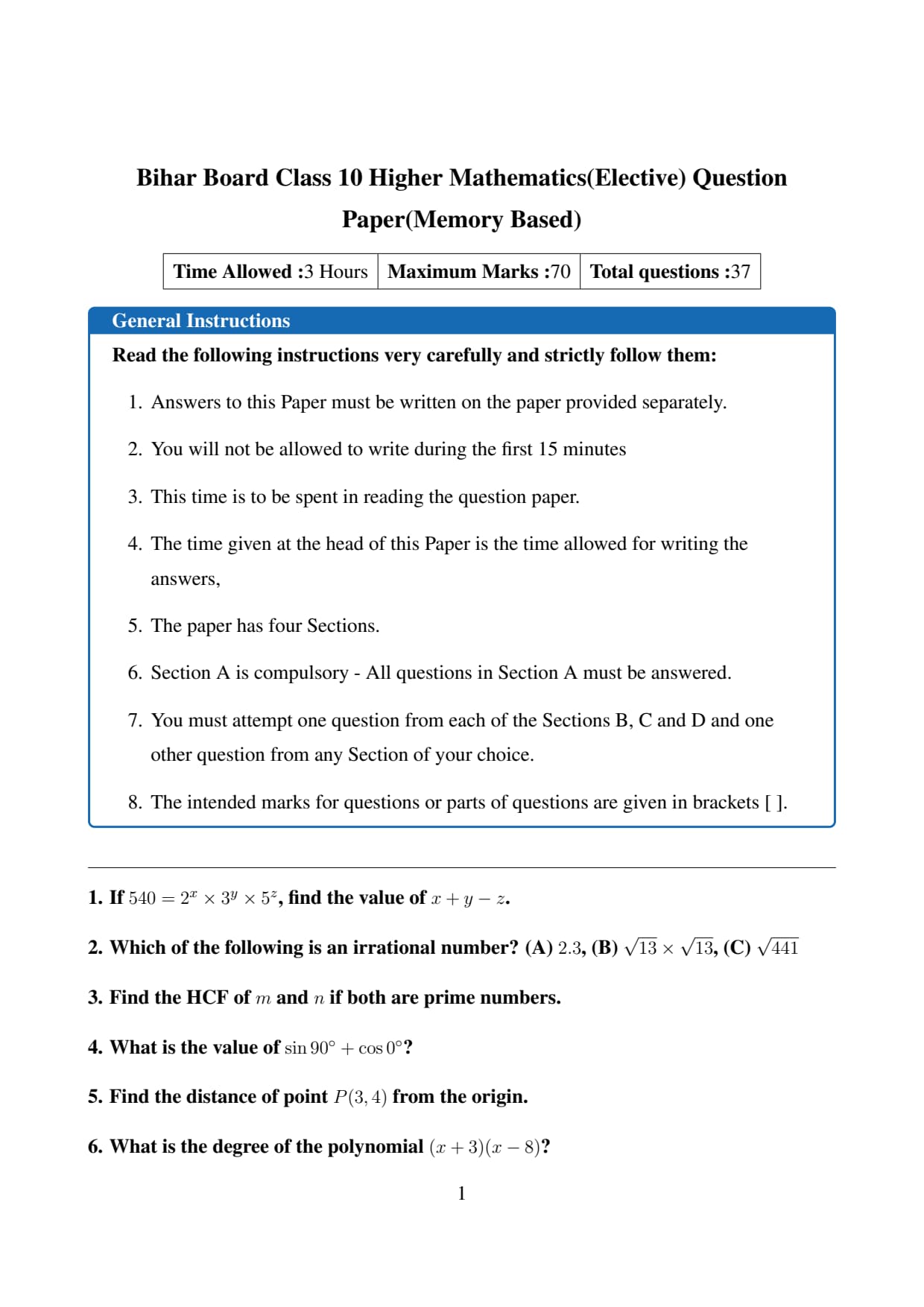
Bihar Board is conducting the Class 10 Higher Mathematics Board Exam 2026 on February 24, 2026. Class 10 Higher Mathematics Question Paper with Solution PDF is available here for download.
The official question paper of Bihar Board Class 10 Higher Mathematics Board Exam 2026 is provided below. Students can download the official paper in PDF format for reference.
Bihar Board Class 10 2026 Higher Mathematics Question Paper with Solution PDF - Memory Based
| Bihar Board Class 10 2026 Higher Mathematics Question Paper with Solution PDF | Download PDF | Check Solutions |

If \(540 = 2^x \times 3^y \times 5^z\), find the value of \(x + y - z\).
View Solution
Concept:
To compare exponents, express the number as a product of its prime factors.
Step 1: Prime factorization of 540 \[ 540 = 54 \times 10 \]
\[ 54 = 2 \times 27 = 2 \times 3^3 \] \[ 10 = 2 \times 5 \]
So, \[ 540 = (2 \times 3^3)(2 \times 5) = 2^2 \times 3^3 \times 5^1 \]
Step 2: Compare with given form \[ 540 = 2^x \times 3^y \times 5^z \]
Thus, \[ x = 2, \quad y = 3, \quad z = 1 \]
Step 3: Find required value \[ x + y - z = 2 + 3 - 1 = 4 \]
Final Answer: \[ \boxed{4} \] Quick Tip: To compare exponents: Always do prime factorization first. Match bases and compare powers. This method is common in factorization problems.
Which of the following is an irrational number? (A) \(2.3\), (B) \(\sqrt{13} \times \sqrt{13}\), (C) \(\sqrt{441}\)
View Solution
Concept:
Rational numbers can be written in the form \(\frac{p}{q}\).
Irrational numbers cannot be written as fractions.
Square root of a perfect square is rational.
Option (A): \(2.3\) \[ 2.3 = \frac{23}{10} \]
This is a fraction, so it is rational.
Option (B): \(\sqrt{13} \times \sqrt{13}\) \[ \sqrt{13} \times \sqrt{13} = 13 \]
Since 13 is an integer, it is rational.
Option (C): \(\sqrt{441}\) \[ 441 = 21^2 \] \[ \sqrt{441} = 21 \]
This is also rational.
Conclusion:
All given options are rational numbers.
Hence, none of them is irrational.
\[ \boxed{None of these} \] Quick Tip: Quick checks: Terminating decimals → rational \(\sqrt{a} \times \sqrt{a} = a\) Square root of perfect square → rational Only roots of non-perfect squares are irrational.
Find the HCF of \(m\) and \(n\) if both are prime numbers.
View Solution
Concept:
A prime number has only two factors: \(1\) and itself.
HCF (Highest Common Factor) is the greatest common factor of two numbers.
Case 1: \(m\) and \(n\) are different prime numbers
Factors of \(m\): \(1, m\)
Factors of \(n\): \(1, n\)
Common factor = \(1\)
So, \[ HCF(m, n) = 1 \]
Case 2: If \(m = n\) (same prime)
Then, \[ HCF(m, n) = m \]
Conclusion:
Generally, for two distinct prime numbers: \[ \boxed{1} \] Quick Tip: Remember: HCF of two different primes = 1 Same primes → HCF is the number itself This is a common objective question.
What is the value of \(\sin 90^\circ + \cos 0^\circ\)?
View Solution
Concept:
Standard trigonometric values: \[ \sin 90^\circ = 1, \quad \cos 0^\circ = 1 \]
Step 1: Substitute known values \[ \sin 90^\circ + \cos 0^\circ = 1 + 1 \]
Step 2: Simplify \[ = 2 \]
Final Answer: \[ \boxed{2} \] Quick Tip: Important values to memorize: \[ \sin 0^\circ = 0, \quad \sin 90^\circ = 1 \] \[ \cos 0^\circ = 1, \quad \cos 90^\circ = 0 \] These are frequently used in basic trigonometry.
Find the distance of point \(P(3, 4)\) from the origin.
View Solution
Concept:
Distance of a point \((x, y)\) from the origin \((0,0)\) is given by: \[ Distance = \sqrt{x^2 + y^2} \]
Step 1: Substitute coordinates \[ x = 3, \quad y = 4 \]
\[ Distance = \sqrt{3^2 + 4^2} \]
Step 2: Simplify \[ = \sqrt{9 + 16} = \sqrt{25} \]
\[ = 5 \]
Final Answer: \[ \boxed{5} \] Quick Tip: Distance from origin formula: \[ \sqrt{x^2 + y^2} \] Recognize Pythagorean triples like \((3,4,5)\) to solve quickly.
What is the degree of the polynomial \((x + 3)(x - 8)\)?
View Solution
Concept:
The degree of a polynomial is the highest power of the variable in its expanded form.
Step 1: Expand the polynomial \[ (x + 3)(x - 8) \]
Using distributive property: \[ x(x - 8) + 3(x - 8) \]
\[ = x^2 - 8x + 3x - 24 \]
\[ = x^2 - 5x - 24 \]
Step 2: Identify highest power
The highest power of \(x\) is \(2\).
Final Answer: \[ \boxed{2} \] Quick Tip: Degree rules: Product of two linear polynomials → degree 2 Add degrees when multiplying polynomials Example: \((x)(x)\) gives degree \(2\).
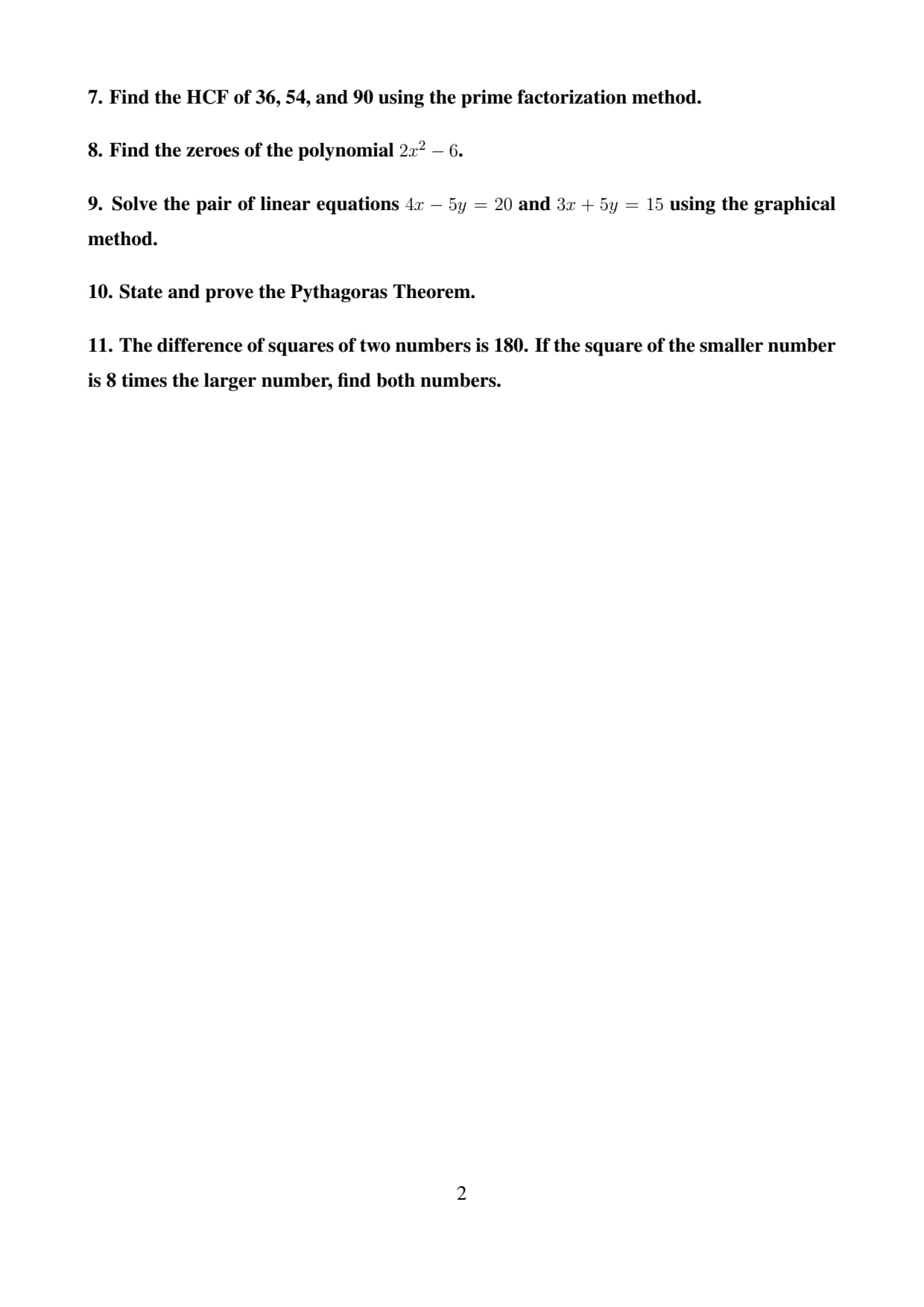
Find the HCF of 36, 54, and 90 using the prime factorization method.
View Solution
Concept:
To find the HCF using prime factorization:
Express each number as a product of prime factors.
Take only the common prime factors with the smallest powers.
Step 1: Prime factorization
36: \[ 36 = 2^2 \times 3^2 \]
54: \[ 54 = 2 \times 27 = 2 \times 3^3 \]
90: \[ 90 = 9 \times 10 = 3^2 \times 2 \times 5 = 2 \times 3^2 \times 5 \]
Step 2: Identify common prime factors
Common primes in all three: \[ 2 \quad and \quad 3 \]
Smallest powers: \[ 2^1, \quad 3^2 \]
Step 3: Find HCF \[ HCF = 2 \times 3^2 = 2 \times 9 = 18 \]
Final Answer: \[ \boxed{18} \] Quick Tip: Steps for HCF using prime factors: Write prime factorization of all numbers. Pick common primes only. Take smallest powers. This method works for any number of values.
Find the zeroes of the polynomial \(2x^2 - 6\).
View Solution
Concept:
Zeroes of a polynomial are values of \(x\) that make it equal to zero.
Step 1: Set the polynomial equal to zero \[ 2x^2 - 6 = 0 \]
Step 2: Solve for \(x\) \[ 2x^2 = 6 \]
\[ x^2 = 3 \]
Step 3: Take square root \[ x = \pm \sqrt{3} \]
Final Answer: \[ \boxed{x = \pm \sqrt{3}} \] Quick Tip: For equations of type \(ax^2 - b = 0\): Move constant term to RHS. Divide by coefficient of \(x^2\). Take square root. Always include both \(+\) and \(-\) roots.
Solve the pair of linear equations \(4x - 5y = 20\) and \(3x + 5y = 15\) using the graphical method.
View Solution
Concept:
In the graphical method:
Each linear equation represents a straight line.
The solution is the point of intersection of the two lines.
Step 1: Convert equations into convenient form
Equation (1): \[ 4x - 5y = 20 \]
Find intercepts:
If \(x = 0\), then \(-5y = 20 \Rightarrow y = -4\)
If \(y = 0\), then \(4x = 20 \Rightarrow x = 5\)
So points: \((0, -4)\) and \((5, 0)\)
Equation (2): \[ 3x + 5y = 15 \]
Find intercepts:
If \(x = 0\), then \(5y = 15 \Rightarrow y = 3\)
If \(y = 0\), then \(3x = 15 \Rightarrow x = 5\)
So points: \((0, 3)\) and \((5, 0)\)
Step 2: Graph the lines
Plot both pairs of points and draw the lines.
Step 3: Identify intersection point
Both lines intersect at: \[ (5, 0) \]
Conclusion:
The graphical solution of the equations is: \[ \boxed{(5, 0)} \] Quick Tip: For graphical method: Find two points for each line. Plot and draw lines. Intersection point = solution. If lines intersect at one point → unique solution.
State and prove the Pythagoras Theorem.
View Solution
Statement (Pythagoras Theorem):
In a right-angled triangle, the square of the hypotenuse is equal to the sum of the squares of the other two sides.
Given:
In \(\triangle ABC\), \(\angle B = 90^\circ\).
So, \(AC\) is the hypotenuse.
To Prove: \[ AC^2 = AB^2 + BC^2 \]
Proof (Using similarity):
Step 1: Draw altitude
Draw \(BD \perp AC\) from the right angle \(B\) to the hypotenuse \(AC\).
Step 2: Consider similar triangles
Triangles \(\triangle ABC\), \(\triangle ADB\), and \(\triangle BDC\) are similar because they share common angles.
From similarity of \(\triangle ABC \sim \triangle ADB\): \[ \frac{AB}{AC} = \frac{AD}{AB} \]
\[ AB^2 = AC \cdot AD \quad \cdots (1) \]
From similarity of \(\triangle ABC \sim \triangle BDC\): \[ \frac{BC}{AC} = \frac{DC}{BC} \]
\[ BC^2 = AC \cdot DC \quad \cdots (2) \]
Step 3: Add equations (1) and (2) \[ AB^2 + BC^2 = AC \cdot AD + AC \cdot DC \]
\[ AB^2 + BC^2 = AC(AD + DC) \]
But, \[ AD + DC = AC \]
So, \[ AB^2 + BC^2 = AC^2 \]
Conclusion:
Hence proved, \[ \boxed{AC^2 = AB^2 + BC^2} \] Quick Tip: Pythagoras Theorem applies only to right-angled triangles. Remember the formula: \[ (Hypotenuse)^2 = (Base)^2 + (Perpendicular)^2 \] Useful in distance formula and coordinate geometry.
The difference of squares of two numbers is 180. If the square of the smaller number is 8 times the larger number, find both numbers.
View Solution
Concept:
Translate the given statements into equations and solve simultaneously.
Let: \[ Smaller number = x, \quad Larger number = y \]
Step 1: Form equations
Difference of squares: \[ y^2 - x^2 = 180 \quad \cdots (1) \]
Square of smaller number is 8 times the larger: \[ x^2 = 8y \quad \cdots (2) \]
Step 2: Substitute equation (2) into (1) \[ y^2 - 8y = 180 \]
\[ y^2 - 8y - 180 = 0 \]
Step 3: Solve quadratic \[ y^2 - 8y - 180 = 0 \]
Factorization: \[ (y - 18)(y + 10) = 0 \]
\[ y = 18 \quad or \quad y = -10 \]
Since larger number must be positive: \[ y = 18 \]
Step 4: Find \(x\)
Using \(x^2 = 8y\): \[ x^2 = 8 \times 18 = 144 \]
\[ x = 12 \quad (taking positive value) \]
Final Answer: \[ \boxed{Smaller number = 12, \quad Larger number = 18} \] Quick Tip: Word problems → form equations first. Steps: Assign variables clearly. Convert statements into equations. Substitute to reduce variables. Always check which root is valid.



Comments