




Bihar Board is conducting the Class 10 Mathematics Board Exam 2026 on February 18, 2026. Class 10 Mathematics Question Paper with Solution PDF will be available here for download.
The official question paper of Bihar Board Class 10 Mathematics Board Exam 2026 is provided below. Students can download the official paper in PDF format for reference.
Bihar Board Class 10 2026 Mathematics Question Paper with Solution PDF
| Bihar Board Class 10 2026 Mathematics Question Paper with Solution PDF | Download PDF | Check Solutions |
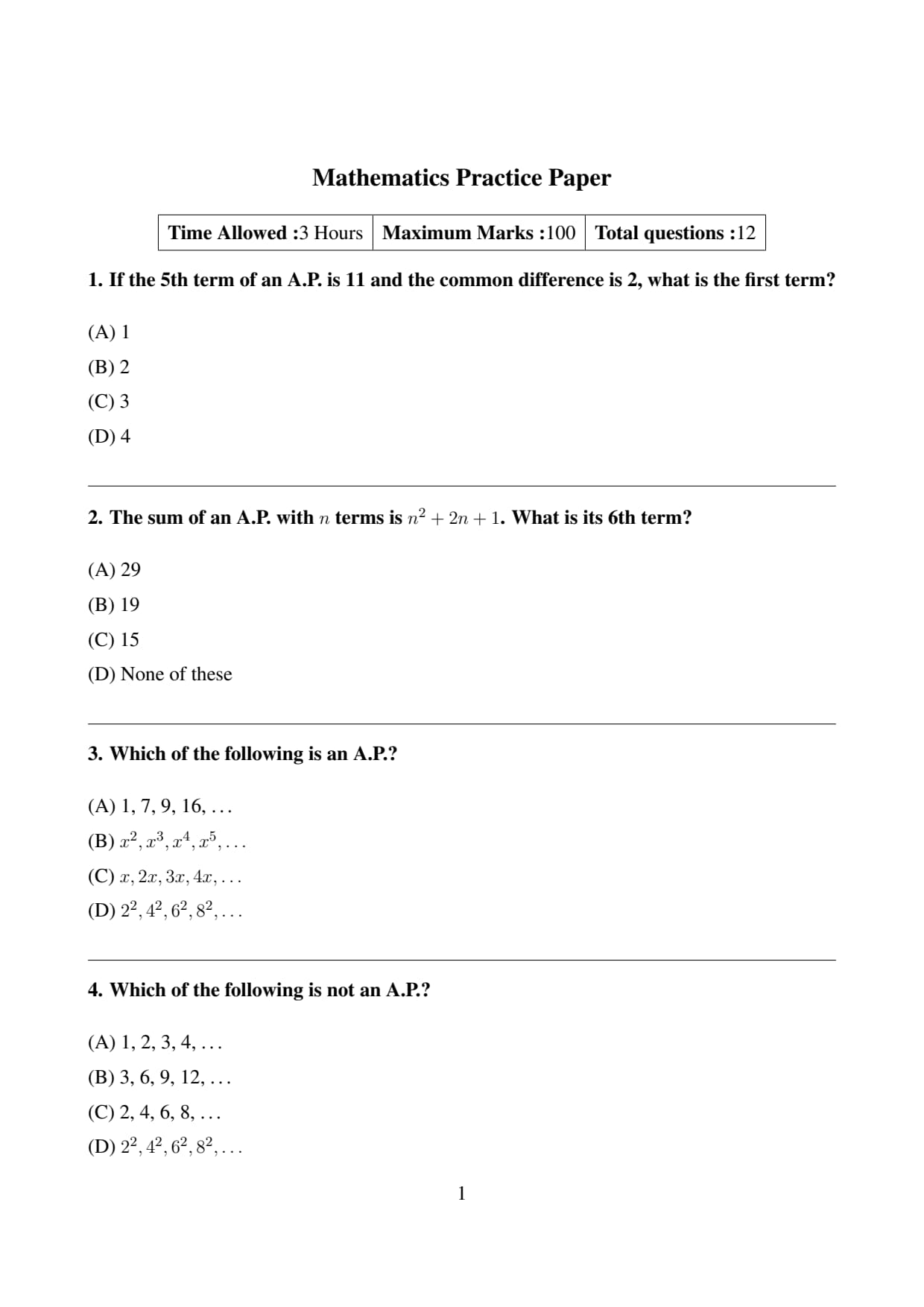
If the 5th term of an A.P. is 11 and the common difference is 2, what is the first term?
View Solution
The nth term of an A.P. is given by \( a_n = a + (n-1)d \).
For the 5th term:
\[ 11 = a + 4 \times 2 = a + 8 \Rightarrow a = 3 \]
Step 1: Analyze the options.
- (A) 1 — Incorrect value.
- (B) 2 — Does not satisfy the equation.
- (C) 3 — Correct value.
- (D) 4 — Too large.
Step 2: Conclusion.
Thus the first term is 3.
Final Answer: \[ \boxed{(C) \, 3} \] Quick Tip: General term of A.P.: \( a_n = a + (n-1)d \)
The sum of an A.P. with n terms is ( n^2 + 2n + 1 ). What is its 6th term?
View Solution
Given \( S_n = n^2 + 2n + 1 = (n+1)^2 \)
\[ t_n = S_n - S_{n-1} \]
\[ t_6 = 7^2 - 6^2 = 49 - 36 = 13 \]
Step 1: Analyze the options.
- (A) 29 — Incorrect.
- (B) 19 — Incorrect.
- (C) 15 — Incorrect.
- (D) None of these — Correct.
Step 2: Conclusion.
Actual 6th term is 13.
Final Answer: \[ \boxed{(D) \, None of these} \] Quick Tip: Term from sum: \( t_n = S_n - S_{n-1} \)
Which of the following is an A.P.?
View Solution
An A.P. has a constant difference between consecutive terms.
For option (C):
\[ 2x-x=x,\quad 3x-2x=x \]
Step 1: Analyze the options.
- (A) Differences not constant.
- (B) Differences increase.
- (C) Constant difference \(x\).
- (D) Differences not constant.
Step 2: Conclusion.
Thus option (C) is an A.P.
Final Answer: \[ \boxed{(C)} \] Quick Tip: Constant difference ⇒ Arithmetic Progression
Which of the following is not an A.P.?
View Solution
Squares: 4, 16, 36, 64 …
Differences: 12, 20, 28 (not constant)
Step 1: Analyze the options.
- (A), (B), (C) — Constant differences.
- (D) — Not constant.
Step 2: Conclusion.
Hence (D) is not an A.P.
Final Answer: \[ \boxed{(D)} \] Quick Tip: Squares do not form an A.P.
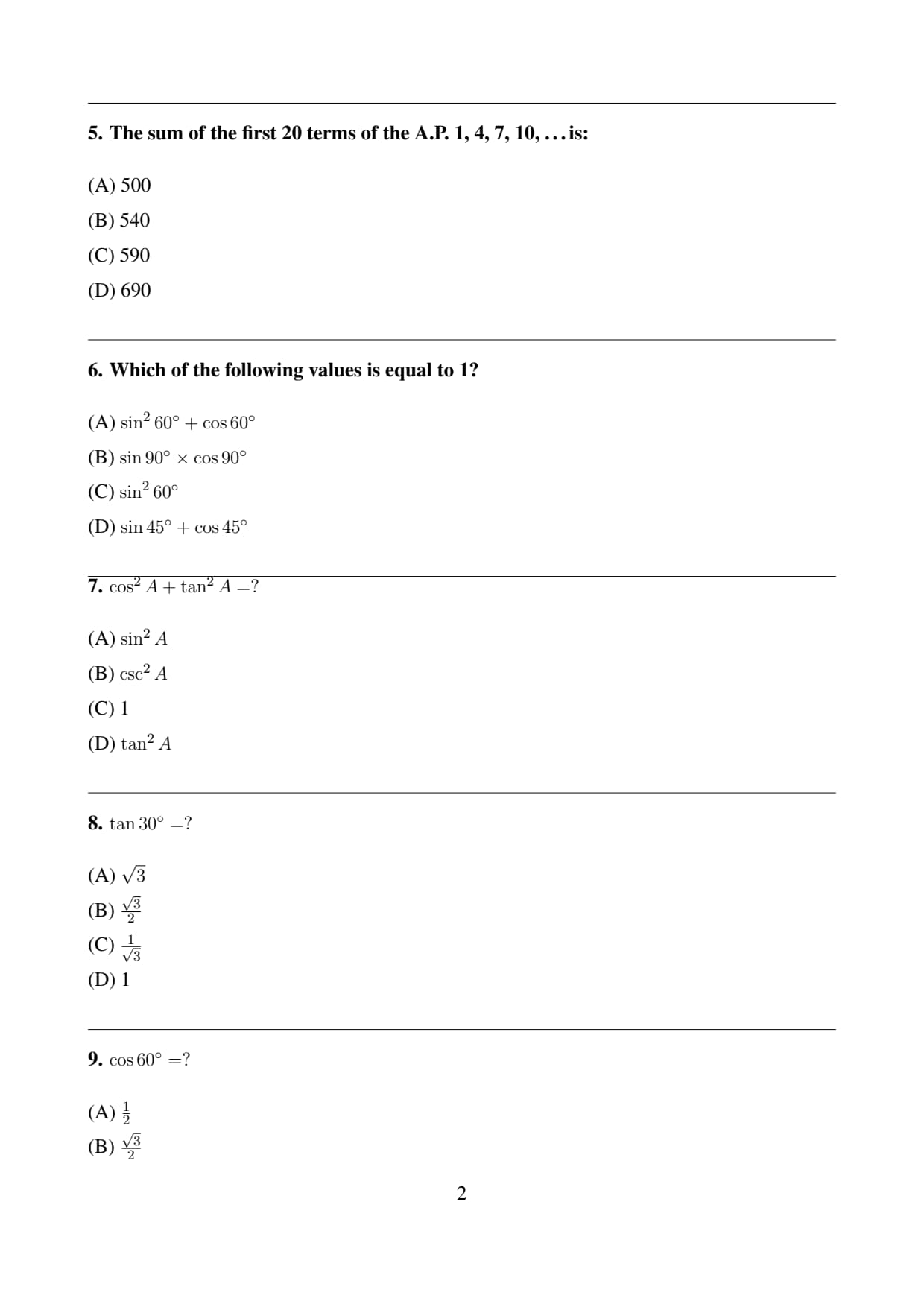
The sum of the first 20 terms of the A.P. 1, 4, 7, 10, ... is:
View Solution
\[ a=1,\ d=3,\ n=20 \]
\[ S_n = \frac{n}{2}[2a+(n-1)d] = 10[2+57] = 590 \]
Step 1: Analyze the options.
- Only option (C) matches the calculated sum.
Step 2: Conclusion.
Hence sum is 590.
Final Answer: \[ \boxed{(C) \, 590} \] Quick Tip: Use sum formula for A.P.
Which of the following values is equal to 1?
View Solution
\[ \sin45^\circ=\cos45^\circ=\frac{1}{\sqrt2} \]
\[ \frac{1}{\sqrt2}+\frac{1}{\sqrt2}=1 \]
Step 1: Analyze the options.
- (A), (B), (C) do not equal 1.
- (D) equals 1.
Step 2: Conclusion.
Thus option (D) is correct.
Final Answer: \[ \boxed{(D)} \] Quick Tip: Memorize special angle values.
cos^2 A + tan^2 A = ?
View Solution
Using trigonometric identities:
\[ \tan^2 A = \frac{\sin^2 A}{\cos^2 A} \]
\[ \cos^2 A + \tan^2 A = \cos^2 A + \frac{\sin^2 A}{\cos^2 A} = \frac{\cos^4 A + \sin^2 A}{\cos^2 A} = \frac{1}{\sin^2 A} = \csc^2 A \]
Step 1: Analyze the options.
- (A) \( \sin^2 A \) — Incorrect
- (B) \( \csc^2 A \) — Correct
- (C) 1 — Incorrect
- (D) \( \tan^2 A \) — Incorrect
Step 2: Conclusion.
Therefore, the expression equals \( \csc^2 A \).
Final Answer: \[ \boxed{(B) \, \csc^2 A} \] Quick Tip: Convert all functions into sine and cosine to simplify identities.
tan 30 = ?
View Solution
From standard trigonometric values:
\[ \tan 30^\circ = \frac{1}{\sqrt{3}} \]
Step 1: Analyze the options.
- (A) \( \sqrt{3} \) — Incorrect
- (B) \( \frac{\sqrt{3}}{2} \) — Incorrect
- (C) \( \frac{1}{\sqrt{3}} \) — Correct
- (D) 1 — Incorrect
Step 2: Conclusion.
Hence, the correct value is \( \frac{1}{\sqrt{3}} \).
Final Answer: \[ \boxed{(C) \, \frac{1}{\sqrt{3}}} \] Quick Tip: Memorize standard values for angles \(30^\circ, 45^\circ, 60^\circ\).
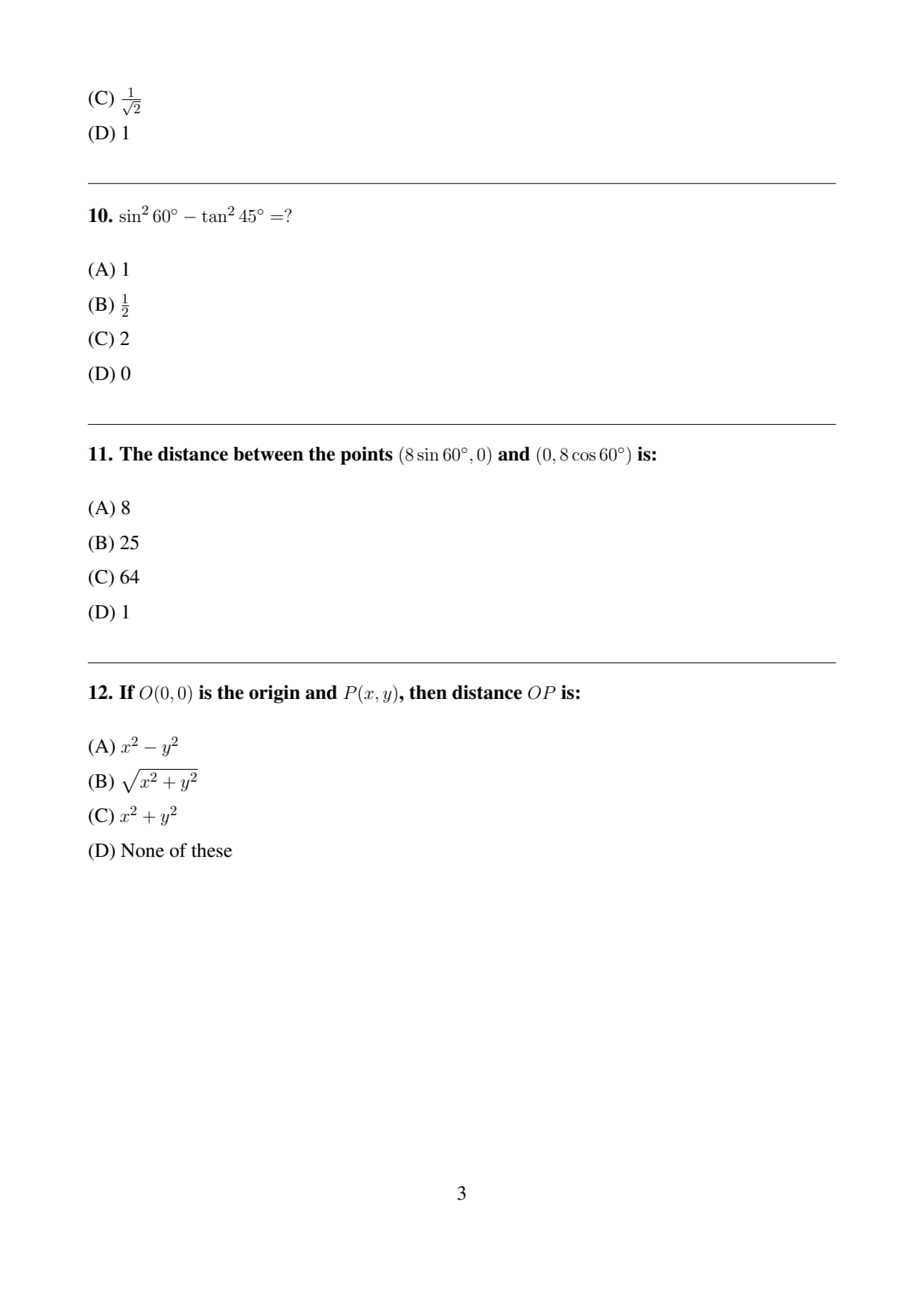
cos 60 = ?
View Solution
From standard trigonometric ratios:
\[ \cos 60^\circ = \frac{1}{2} \]
Step 1: Analyze the options.
- (A) \( \frac{1}{2} \) — Correct
- (B) \( \frac{\sqrt{3}}{2} \) — Incorrect
- (C) \( \frac{1}{\sqrt{2}} \) — Incorrect
- (D) 1 — Incorrect
Step 2: Conclusion.
Thus, the correct value is \( \frac{1}{2} \).
Final Answer: \[ \boxed{(A) \, \frac{1}{2}} \] Quick Tip: Cosine values decrease as angle increases from \(0^\circ\) to \(90^\circ\).
sin^2 60 – tan^2 45 = ?
View Solution
\[ \sin 60^\circ = \frac{\sqrt{3}}{2} \Rightarrow \sin^2 60^\circ = \frac{3}{4} \]
\[ \tan 45^\circ = 1 \Rightarrow \tan^2 45^\circ = 1 \]
\[ \frac{3}{4} - 1 = 0 \]
Step 1: Analyze the options.
- (A) 1 — Incorrect
- (B) \( \frac{1}{2} \) — Incorrect
- (C) 2 — Incorrect
- (D) 0 — Correct
Step 2: Conclusion.
Hence, the result is zero.
Final Answer: \[ \boxed{(D) \, 0} \] Quick Tip: Square trigonometric values carefully before subtracting.
The distance between the points (8sin 60,0) and (0,8cos 60) is:
View Solution
\[ 8\sin60^\circ = 4\sqrt{3}, \quad 8\cos60^\circ = 4 \]
Distance:
\[ d = \sqrt{(4\sqrt{3})^2 + 4^2} = \sqrt{48 + 16} = \sqrt{64} = 8 \]
Step 1: Analyze the options.
- (A) 8 — Correct
- (B) 25 — Incorrect
- (C) 64 — Incorrect
- (D) 1 — Incorrect
Step 2: Conclusion.
Therefore, the distance is 8.
Final Answer: \[ \boxed{(A) \, 8} \] Quick Tip: Use distance formula \( \sqrt{(x_2-x_1)^2+(y_2-y_1)^2} \).
Bihar Board Class 10 Mathematics Question Paper Youtube solutions



Comments