




UP Board Class 10 Agriculture Question Paper 2024 PDF is available for download here. The Agriculture exam was conducted on February 29, 2024 in the Afternoon Shift from 2:00 PM to 5:15 PM. The total marks for the theory paper are 70. Students reported the paper to be easy to moderate.
UP Board Class 10 Agriculture Question Paper 2024 with Solutions
| UP Board Class 10 Agriculture 2024 Question Paper with Answer Key |  Download Download |
Check Solutions |

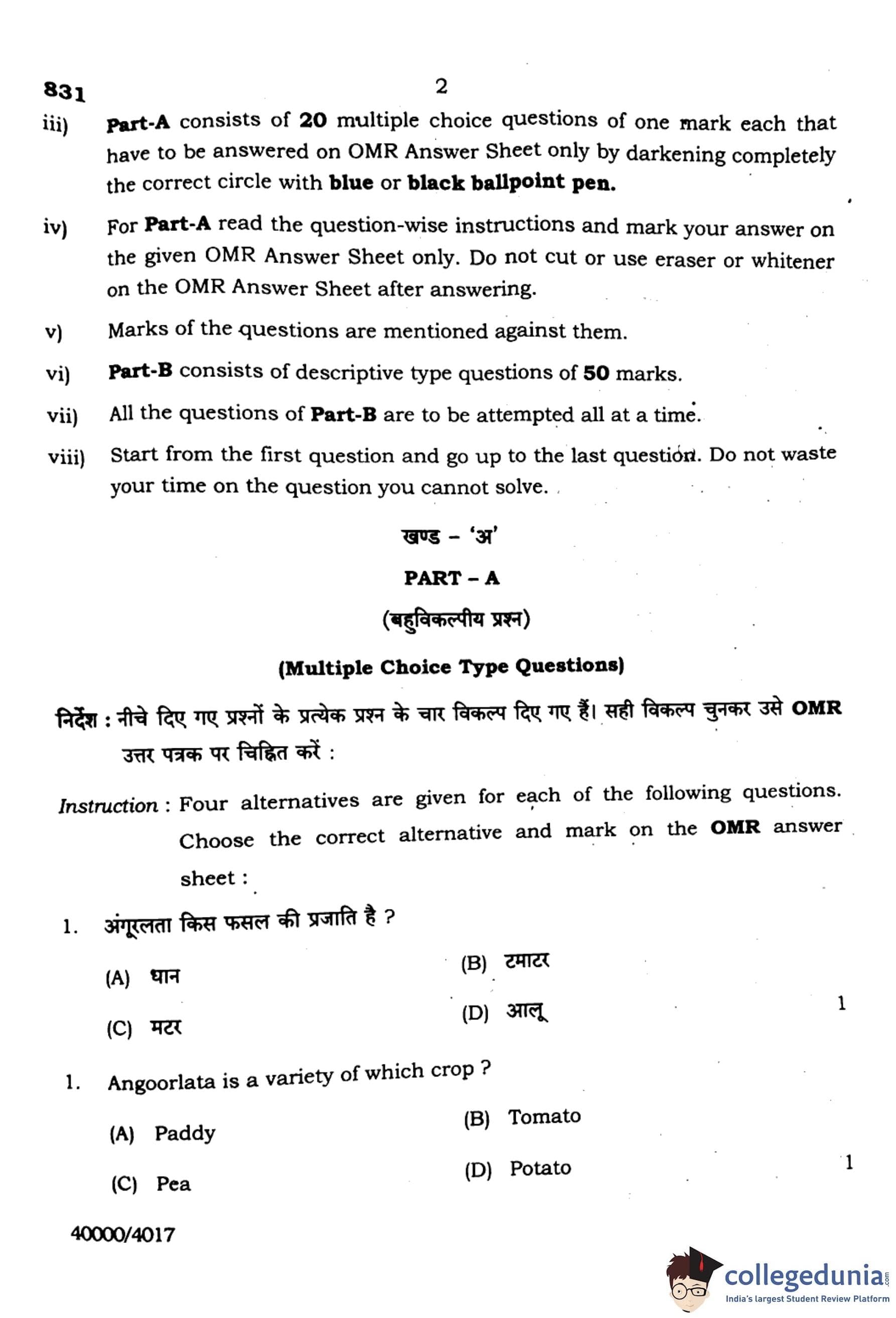
Angoorlata is a variety of which crop?
View Solution
Step 1: Understanding the crop variety.
"Angoorlata" is a specific horticultural variety. It belongs to the vegetable crop category.
Step 2: Identifying the correct crop.
Among the given options, "Angoorlata" is recognized as a variety of Tomato.
Step 3: Eliminating wrong options.
(A) Paddy – cereal crop, not relevant.
(C) Pea – legume crop, not relevant.
(D) Potato – tuber crop, not correct.
Step 4: Conclusion.
The correct answer is Tomato.
Quick Tip: Always remember: "Angoorlata" is a well-known variety of tomato, often asked in agricultural exams.
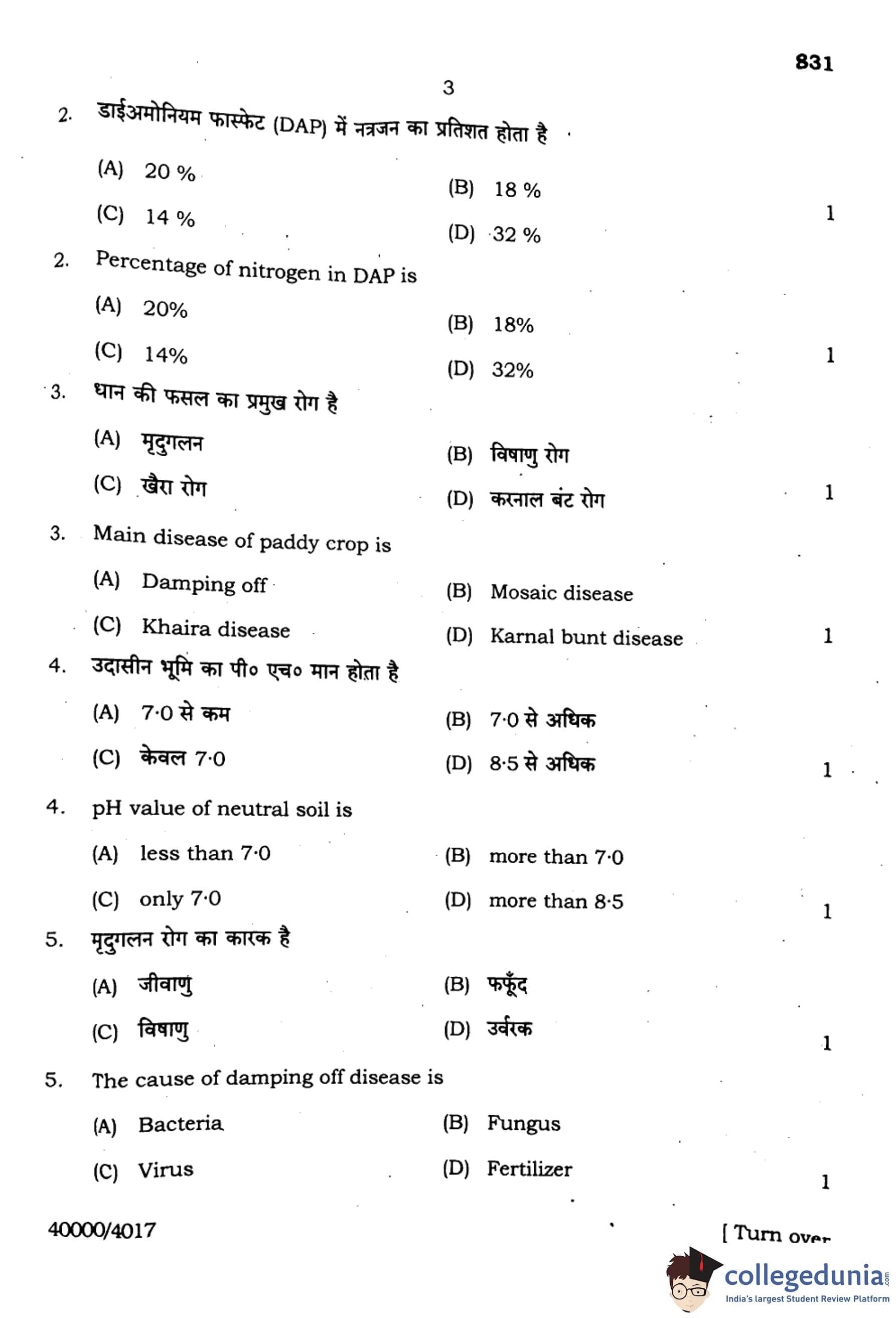
Percentage of nitrogen in DAP (Diammonium Phosphate) is:
View Solution
Step 1: Understanding DAP.
DAP (Diammonium Phosphate) is a widely used fertilizer containing both Nitrogen (N) and Phosphorus (P).
Step 2: Composition of DAP.
DAP contains about 18% Nitrogen and 46% Phosphorus (as P\(_2\)O\(_5\) equivalent).
Step 3: Analyzing the options.
(A) 20% – Incorrect, slightly higher than actual.
(B) 18% – Correct, standard nitrogen content in DAP.
(C) 14% – Too low, incorrect.
(D) 32% – Represents phosphorus percentage in some other fertilizer, not nitrogen in DAP.
Step 4: Conclusion.
Therefore, the correct answer is 18%.
Quick Tip: Remember: DAP fertilizer = 18% Nitrogen + 46% Phosphorus. A very important fact for agriculture exams.
Main disease of paddy crop is
View Solution
Step 1: Identify crop-specific diseases.
Paddy (rice) has characteristic disorders like blast, bacterial blight, sheath blight, and Khaira disease (Zn deficiency disorder specific to rice).
Step 2: Eliminate non-rice diseases.
(A) Damping off—general seedling disease across many crops, not specific/main for paddy.
(B) Mosaic disease—viral diseases typically noted in crops like sugarcane, tobacco, cucurbits; not a principal rice disease.
(D) Karnal bunt—\textit{Tilletia indica affects wheat, not rice.
Step 3: Conclusion.
Thus, the most appropriate “main disease” for paddy among the options is Khaira disease.
Quick Tip: Remember: Khaira disease = rice + zinc deficiency (bronzing/brown patches).
pH value of neutral soil is
View Solution
Step 1: Recall the pH scale.
On the pH scale (0–14), pH = 7 is neutral, \(<7\) acidic, \(>7\) alkaline.
Step 2: Match with options.
Only option (C) states exactly 7.0, which defines neutrality; (A) and (B) indicate acidic/alkaline ranges, and (D) is strongly alkaline.
Step 3: Conclusion.
Therefore, the neutral soil pH is 7.0 only.
Quick Tip: Think: Acid \(<\) 7, Neutral \(=\) 7, Alkaline \(>\) 7.
The cause of damping off disease is
View Solution
Step 1: Understand damping off.
Damping off is a seedling disease characterized by pre- or post-emergence rot at the collar/root zone.
Step 2: Causal organisms.
It is primarily caused by fungal pathogens like \textit{Pythium, \textit{Rhizoctonia, and \textit{Fusarium. Bacteria/viruses or fertilizers are not the causal agents.
Step 3: Conclusion.
Hence, the correct cause is Fungus.
Quick Tip: For seedling rots and “falling over” symptoms, first suspect soil-borne fungi (Pythium/Rhizoctonia).
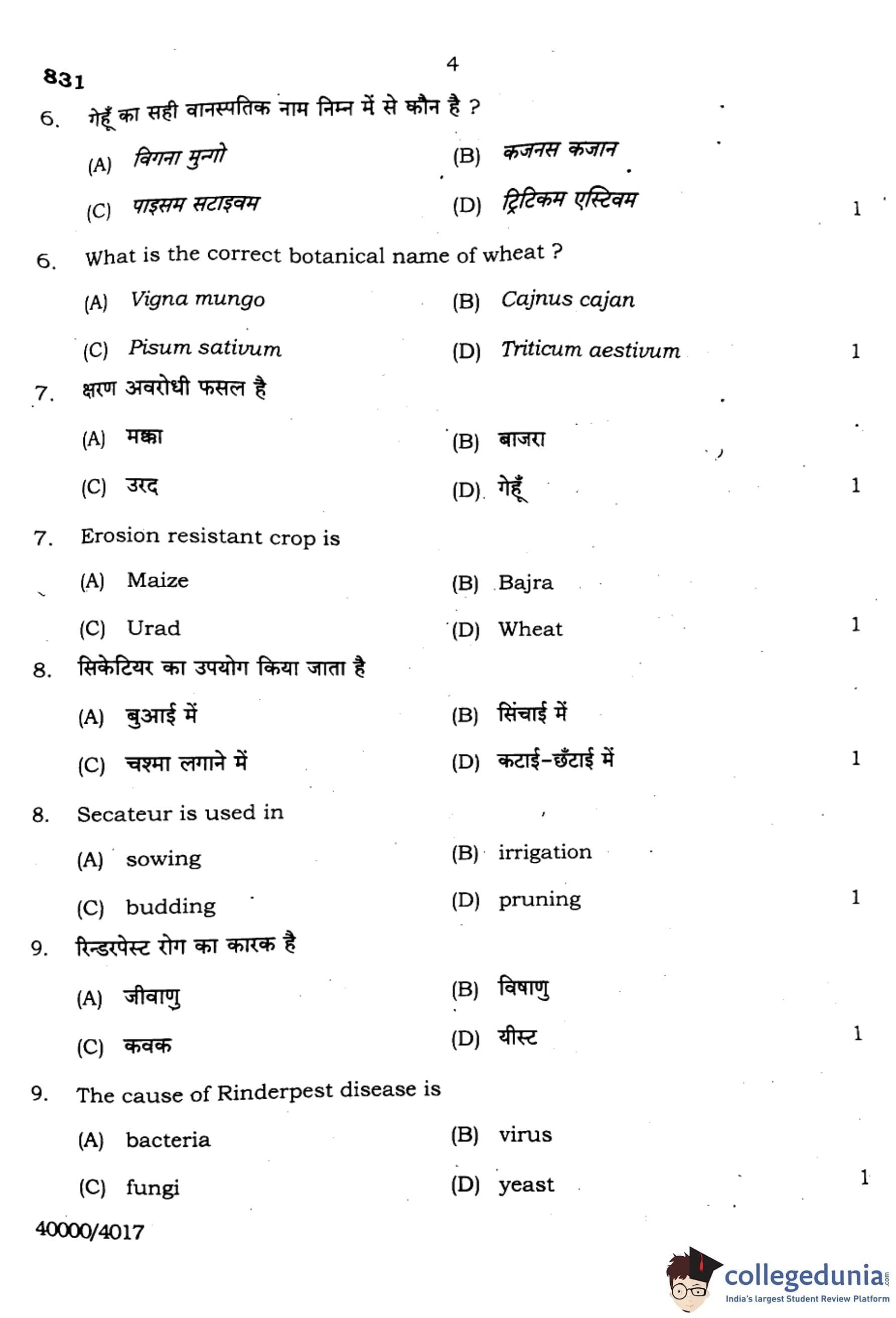
What is the correct botanical name of wheat?
View Solution
Step 1: Recall scientific classification.
Each crop has a unique binomial name: wheat is scientifically named Triticum aestivum, which is the most widely cultivated species of wheat.
Step 2: Analyze wrong options.
(A) Vigna mungo – this is black gram.
(B) Cajanus cajan – this is pigeon pea (arhar/tur).
(C) Pisum sativum – this is garden pea.
Step 3: Conclusion.
Thus, the correct botanical name of wheat is Triticum aestivum.
Quick Tip: Always remember: Wheat = Triticum aestivum, Rice = Oryza sativa, Maize = Zea mays.
Erosion resistant crop is
View Solution
Step 1: Understand erosion resistance.
Erosion resistance refers to crops that help reduce soil erosion due to their root system and ground coverage.
Step 2: Match with crop features.
Bajra (pearl millet) has deep roots, strong soil-binding ability, and drought tolerance, making it highly erosion resistant.
Step 3: Eliminate wrong options.
(A) Maize – though widely grown, it is not erosion resistant.
(C) Urad – pulse crop, not effective for erosion control.
(D) Wheat – seasonal crop, roots not as strong for erosion control.
Step 4: Conclusion.
Hence, Bajra is the correct erosion-resistant crop.
Quick Tip: Pearl millet (Bajra) is ideal for drylands, sandy soils, and erosion-prone regions due to strong root anchorage.
Secateur is used in
View Solution
Step 1: Identify the tool.
A secateur is a hand-held cutting tool, also known as pruning shears.
Step 2: Its application.
It is specifically designed for cutting branches, stems, and shaping plants during pruning.
Step 3: Analyze the wrong options.
(A) Sowing – requires seed drills, not secateurs.
(B) Irrigation – done with channels/pipes, not tools like secateurs.
(C) Budding – involves knife grafting, not secateurs.
Step 4: Conclusion.
Thus, secateurs are used in pruning.
Quick Tip: Secateurs = pruning shears = small cutting tool for branches and shoots in horticulture.
The cause of Rinderpest disease is
View Solution
Step 1: About Rinderpest.
Rinderpest, also called cattle plague, was a severe infectious viral disease in cattle and cloven-hoofed animals.
Step 2: Pathogen.
It is caused by the Rinderpest virus, belonging to the genus \textit{Morbillivirus of the family Paramyxoviridae.
Step 3: Global note.
This was one of the most devastating livestock diseases but was declared eradicated in 2011 by FAO and OIE.
Step 4: Eliminate wrong options.
(A) Bacteria – incorrect, not bacterial.
(C) Fungi – incorrect, no fungal involvement.
(D) Yeast – not related to animal diseases.
Step 5: Conclusion.
Hence, Rinderpest is caused by a Virus.
Quick Tip: Remember: Rinderpest = Viral disease in cattle, eradicated in 2011 (second disease eradicated after smallpox).
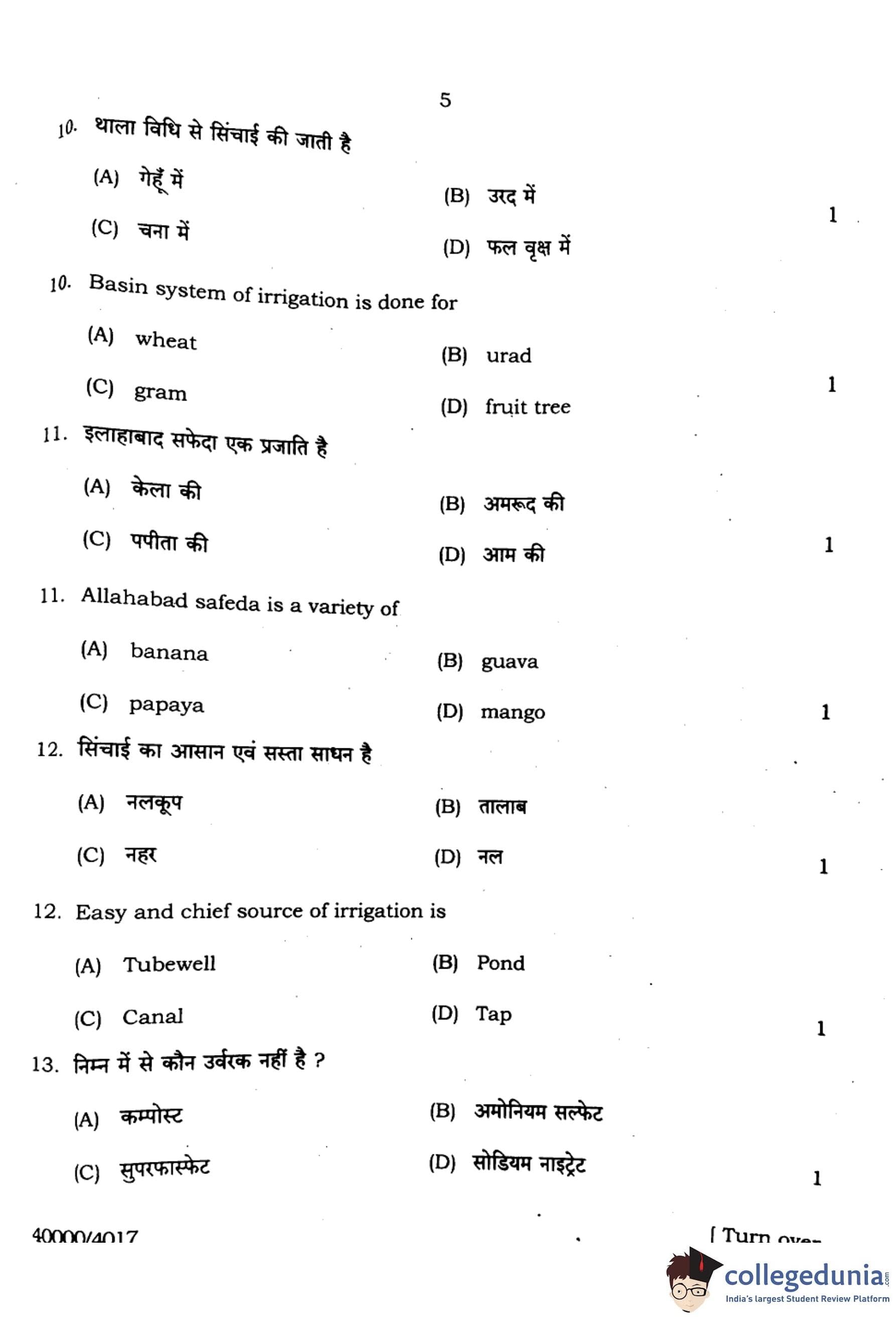
Basin system of irrigation is done for
View Solution
Step 1: Understand basin system of irrigation.
In the basin system, circular or square basins are formed around the plant/tree base, and water is applied so that it infiltrates deeply into the soil. This method is suited for long-duration, perennial crops.
Step 2: Crop suitability.
It is most effective for orchards and fruit trees (like mango, guava, citrus), where deep watering around the roots is required.
Step 3: Eliminate other options.
(A) Wheat – irrigated by furrow or flooding, not basin.
(B) Urad – a pulse crop, usually needs protective irrigation, not basin.
(C) Gram – requires limited irrigation, not basin.
Step 4: Conclusion.
Thus, basin irrigation is best suited for fruit trees.
Quick Tip: Basin irrigation = mostly used in orchards (fruit crops) for deep root watering.
Allahabad safeda is a variety of
View Solution
Step 1: Identify the horticultural variety.
"Allahabad Safeda" is one of the most famous and commercially grown varieties of guava in India. It has round shape, whitish pulp, and excellent keeping quality.
Step 2: Eliminate other crops.
(A) Banana – no such variety exists.
(C) Papaya – varieties are Pusa Delicious, Pusa Dwarf, etc.
(D) Mango – famous varieties include Alphonso, Dasheri, Langra, not Safeda.
Step 3: Conclusion.
Thus, "Allahabad Safeda" is a variety of Guava.
Quick Tip: Remember: Safeda = Guava. A major export quality variety grown in Allahabad (Prayagraj).
Easy and chief source of irrigation is
View Solution
Step 1: Understanding irrigation sources.
Among different sources, tubewells are easy to construct, low-cost, and widely used for irrigation, especially in Indo-Gangetic plains.
Step 2: Analyze other sources.
(B) Pond – traditional, but limited water storage capacity.
(C) Canal – requires large investment, not easily accessible to all farmers.
(D) Tap – domestic water supply, not a major irrigation source.
Step 3: Conclusion.
Hence, the easiest and cheapest irrigation source is Tubewell.
Quick Tip: Tubewells are the most common irrigation source in India due to groundwater availability and low cost.
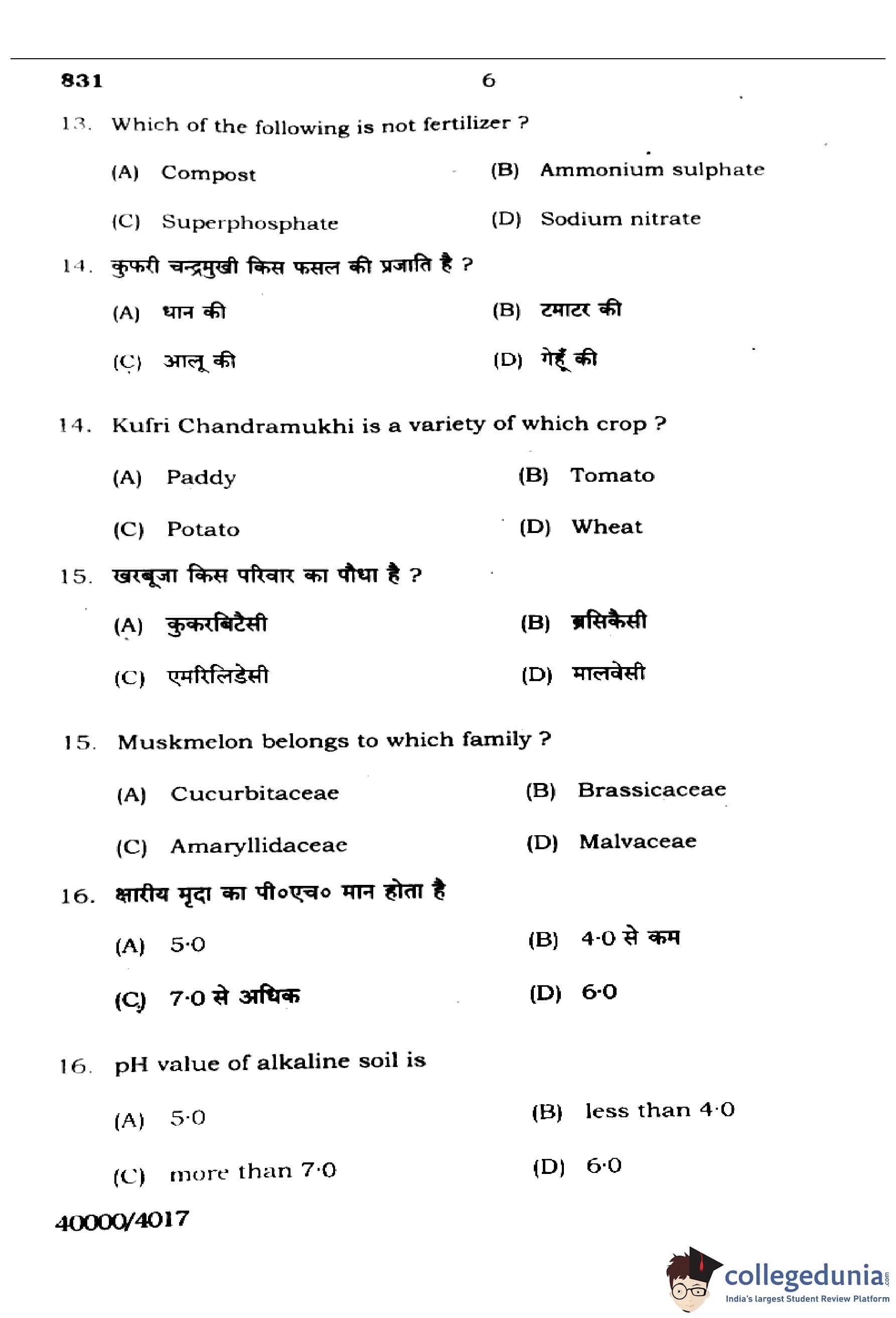
Which of the following is not fertilizer?
View Solution
Step 1: Define fertilizer.
Fertilizers are inorganic/chemical substances that provide nutrients (N, P, K, etc.) in concentrated form to plants.
Step 2: Analyze options.
(A) Compost – it is an organic manure, not a chemical fertilizer.
(B) Ammonium sulphate – nitrogen fertilizer.
(C) Superphosphate – phosphorus fertilizer.
(D) Sodium nitrate – nitrogen fertilizer.
Step 3: Conclusion.
Thus, among the given options, Compost is not a fertilizer but an organic manure.
Quick Tip: Manure = organic (low nutrients, improves soil health), Fertilizer = inorganic (high nutrient concentration).
Kufri Chandramukhi is a variety of which crop?
View Solution
Step 1: Recall popular crop varieties.
The name “Kufri” is widely associated with potato varieties developed in India (at Central Potato Research Institute, Kufri, Himachal Pradesh).
Step 2: Characteristics of Kufri Chandramukhi.
It is an early maturing, white-fleshed, high-yielding potato variety, commonly used for table consumption.
Step 3: Eliminate wrong options.
(A) Paddy – varieties include IR-8, Pusa Basmati.
(B) Tomato – varieties include Pusa Ruby, Arka Vikas.
(D) Wheat – varieties include Sonalika, Kalyan Sona.
Step 4: Conclusion.
Thus, Kufri Chandramukhi is a variety of Potato.
Quick Tip: Remember: Potato varieties in India usually start with “Kufri” (Kufri Jyoti, Kufri Bahar, Kufri Pukhraj).
Muskmelon belongs to which family?
View Solution
Step 1: Recall plant classification.
Muskmelon (Cucumis melo) belongs to the family Cucurbitaceae, which includes cucurbits like cucumber, pumpkin, watermelon, and gourds.
Step 2: Eliminate wrong options.
(B) Brassicaceae – includes mustard, cabbage, cauliflower.
(C) Amaryllidaceae – includes onion, garlic.
(D) Malvaceae – includes cotton, hibiscus, okra.
Step 3: Conclusion.
Therefore, muskmelon belongs to the family Cucurbitaceae.
Quick Tip: Cucurbits = vine crops like cucumber, pumpkin, muskmelon, watermelon.
pH value of alkaline soil is
View Solution
Step 1: Recall soil reaction basics.
- Acidic soil: pH \(<\) 7
- Neutral soil: pH = 7
- Alkaline soil: pH \(>\) 7
Step 2: Analyze options.
(A) 5.0 – acidic.
(B) less than 4.0 – strongly acidic.
(C) more than 7.0 – correct for alkaline soils.
(D) 6.0 – slightly acidic.
Step 3: Conclusion.
Hence, alkaline soil has a pH value greater than 7.0.
Quick Tip: Think of soil pH like water: 7 = neutral, below 7 = acidic, above 7 = alkaline.
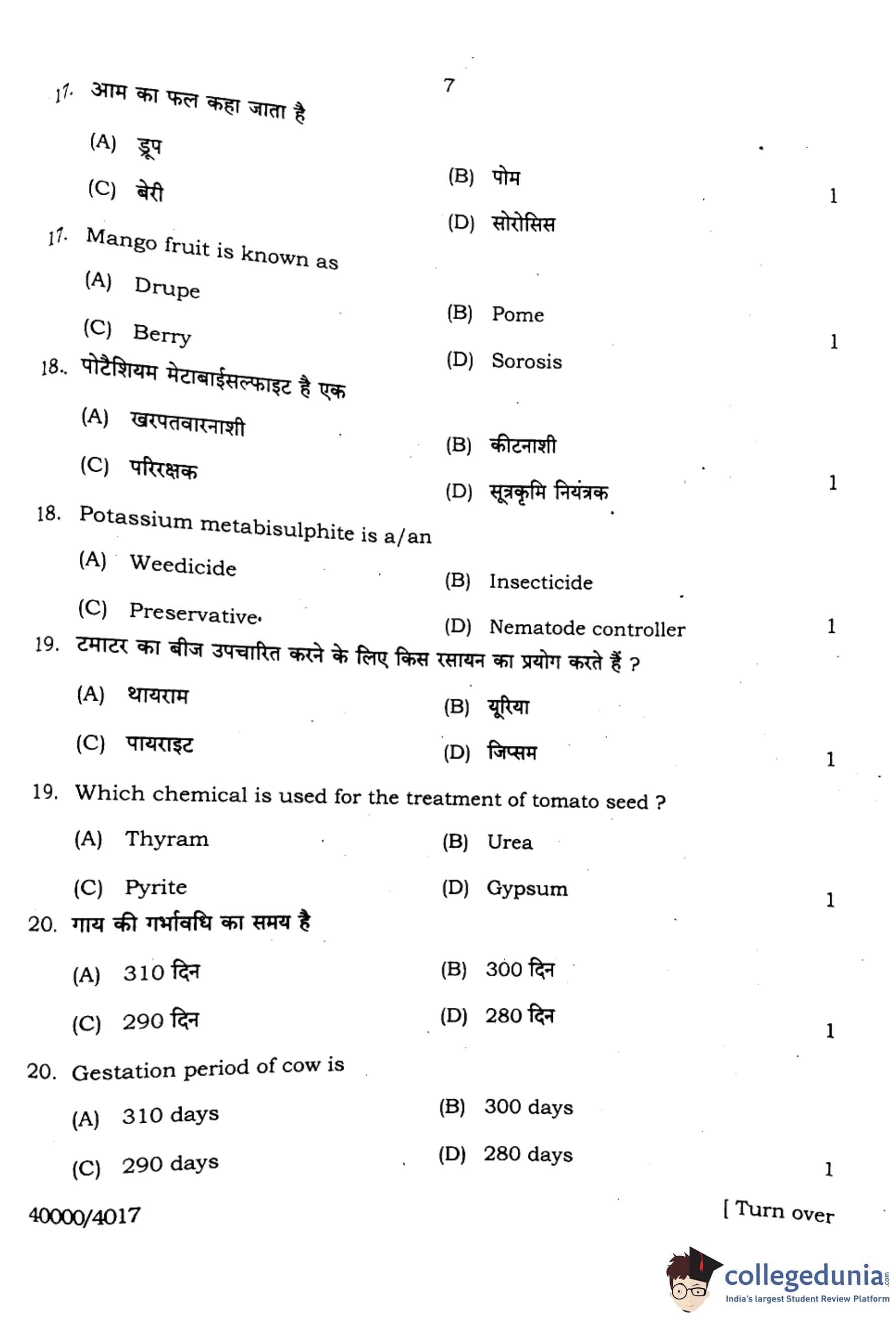
Mango fruit is known as
View Solution
Step 1: Understand fruit classification.
A drupe (stone fruit) is a fleshy fruit with a thin skin, a soft mesocarp, and a hard endocarp (stone) enclosing the seed. Examples: mango, peach, coconut.
Step 2: Analyze other options.
(B) Pome – fleshy fruit derived from accessory tissue (apple, pear).
(C) Berry – fruit with many seeds embedded in fleshy pulp (tomato, grape).
(D) Sorosis – fruit formed by multiple flowers (pineapple, mulberry).
Step 3: Conclusion.
Thus, mango is classified as a drupe.
Quick Tip: Mango, coconut, and peach = drupes (single stone fruit). Apple = pome, Tomato = berry, Pineapple = sorosis.
Potassium metabisulphite is a/an
View Solution
Step 1: Chemical use.
Potassium metabisulphite (K\(_2\)S\(_2\)O\(_5\)) is mainly used in food processing and winemaking as a preservative and antioxidant.
Step 2: Eliminate wrong options.
(A) Weedicide – kills weeds, not true.
(B) Insecticide – controls insects, not applicable here.
(D) Nematode controller – controls soil nematodes, not correct.
Step 3: Conclusion.
Thus, potassium metabisulphite is a preservative.
Quick Tip: Remember: Potassium metabisulphite = preservative (E224) in juices, wines, squashes.
Which chemical is used for the treatment of tomato seed?
View Solution
Step 1: Seed treatment concept.
Tomato seeds are prone to fungal diseases like damping-off, so fungicidal seed dressing is recommended.
Step 2: Chemical role.
Thiram (Thyram) is a fungicide widely used for seed treatment in vegetables, including tomato.
Step 3: Eliminate wrong options.
(B) Urea – nitrogen fertilizer, not used in seed treatment.
(C) Pyrite – iron sulphide mineral, not a seed treatment chemical.
(D) Gypsum – soil amendment, not used in seed treatment.
Step 4: Conclusion.
The correct answer is Thyram.
Quick Tip: Seed treatment of tomato is done with Thiram/Carbendazim to prevent fungal infections.
Gestation period of cow is
View Solution
Step 1: Recall gestation period in cattle.
Gestation = time from conception to calving. For cows, the average gestation period is 283–290 days (about 9.5 months).
Step 2: Analyze the options.
(A) 310 days – higher than average, applies more to buffalo.
(B) 300 days – still longer than normal for cows.
(C) 290 days – correct average for cows.
(D) 280 days – close but slightly lower.
Step 3: Conclusion.
Therefore, the correct gestation period of cows is about 290 days.
Quick Tip: Gestation periods: Cow ≈ 290 days, Buffalo ≈ 310 days, Goat/Sheep ≈ 150 days, Pig ≈ 115 days.
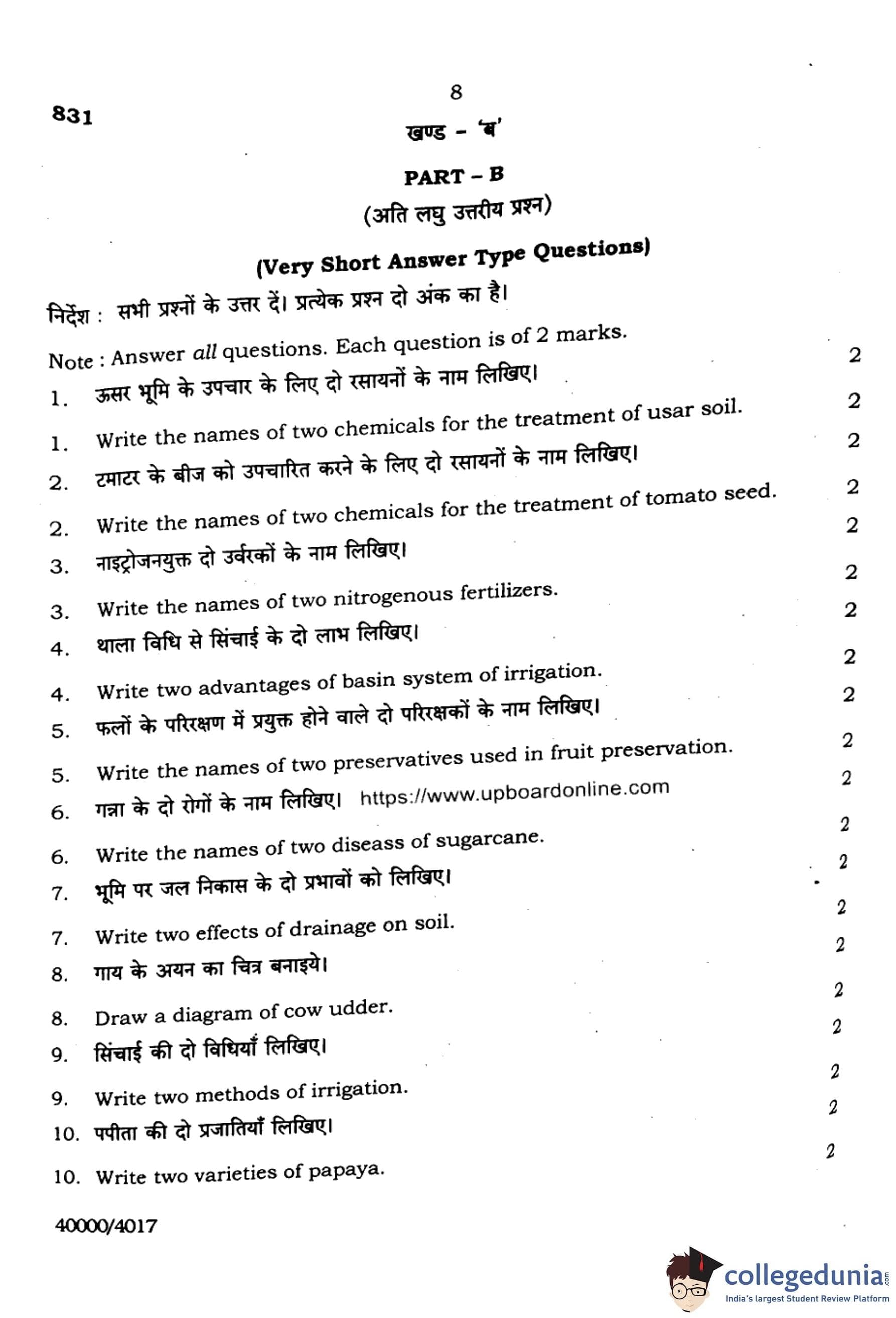
Write the names of two chemicals for the treatment of usar soil.
View Solution
Step 1: Understand usar soil.
Usar soil is saline/alkaline soil, characterized by excess sodium carbonate and poor fertility.
Step 2: Treatment chemicals.
- Gypsum (CaSO\(_4\)): Supplies calcium ions which replace sodium ions on the soil complex, thus improving soil structure.
- Elemental Sulphur (S): On oxidation, produces sulphuric acid which neutralizes alkalinity.
Step 3: Conclusion.
Therefore, the chemicals are Gypsum and Sulphur.
Quick Tip: For alkaline soils (usar), gypsum is the most common amendment.
Write the names of two chemicals for the treatment of tomato seed.
View Solution
Step 1: Purpose of treatment.
Tomato seeds are prone to fungal diseases, hence fungicidal chemicals are applied before sowing.
Step 2: Chemicals used.
- Thiram: A protective fungicide for seed dressing.
- Carbendazim: A systemic fungicide effective against seed-borne fungi.
Step 3: Conclusion.
Thus, the two chemicals are Thiram and Carbendazim.
Quick Tip: Always treat vegetable seeds with fungicides before sowing to prevent damping-off.
Write the names of two nitrogenous fertilizers.
View Solution
Step 1: Role of nitrogenous fertilizers.
They supply nitrogen, an essential nutrient for plant growth and protein synthesis.
Step 2: Examples.
- Urea (46% N): Most widely used nitrogenous fertilizer.
- Ammonium sulphate (20–21% N): Provides nitrogen and sulphur.
Step 3: Conclusion.
Thus, examples are Urea and Ammonium sulphate.
Quick Tip: Nitrogenous fertilizers boost vegetative growth but excessive use causes lodging.
Write two advantages of basin system of irrigation.
View Solution
Step 1: Recall basin irrigation.
In basin irrigation, water is applied to a circular/square basin around plant roots.
Step 2: Advantages.
1. Efficient water use: Deep percolation around roots ensures minimal wastage.
2. Best for fruit trees: Provides uniform supply of water to deep-rooted perennials.
Step 3: Conclusion.
Thus, the two advantages are efficient water use and suitability for fruit trees.
Quick Tip: Basin irrigation = mainly used in orchards and plantation crops.
Write the names of two preservatives used in fruit preservation.
View Solution
Step 1: Understand fruit preservation.
Fruits are perishable commodities and need preservation to prevent microbial spoilage and enzymatic deterioration. Preservatives are added to increase shelf life.
Step 2: Examples of preservatives.
1. Potassium metabisulphite (K\(_2\)S\(_2\)O\(_5\)) – releases sulphur dioxide (SO\(_2\)) which inhibits microbial growth. Widely used in squashes, juices, and wines.
2. Sodium benzoate (C\(_6\)H\(_5\)COONa) – prevents the growth of yeast and bacteria, commonly used in jams, jellies, fruit juices.
Step 3: Conclusion.
Thus, two important preservatives used are Potassium metabisulphite and Sodium benzoate.
Quick Tip: Remember: Potassium metabisulphite = used in light-colored juices, Sodium benzoate = used in dark-colored products.
Write the names of two diseases of sugarcane.
View Solution
Step 1: Importance of sugarcane diseases.
Sugarcane is a major commercial crop and is highly susceptible to fungal and bacterial diseases. Identifying key diseases is essential for crop protection.
Step 2: Examples of major diseases.
1. Red rot – caused by the fungus \textit{Colletotrichum falcatum, characterized by reddening and rotting of canes. It is the most devastating disease of sugarcane.
2. Smut – caused by \textit{Sporisorium scitamineum, characterized by black whip-like structures emerging from the cane top.
Step 3: Conclusion.
The two major diseases are Red rot and Smut.
Quick Tip: Red rot = "cancer of sugarcane"; Smut = black whip-like growth.
Write two effects of drainage on soil.
View Solution
Step 1: Understand soil drainage.
Drainage refers to the removal of excess surface or groundwater from the soil to maintain optimum moisture for plant growth.
Step 2: Effects of drainage.
1. Improves aeration: Excess water is removed, which increases oxygen availability in the root zone. This helps root respiration and nutrient uptake.
2. Prevents waterlogging: Prevents soil saturation and anaerobic conditions that can cause root diseases and yield losses.
Step 3: Conclusion.
Thus, the two major effects are better aeration and prevention of waterlogging.
Quick Tip: Drainage is essential in heavy clay soils and irrigated areas to maintain crop productivity.
Draw a diagram of cow udder.

View Solution
Step 1: Basic structure.
The cow udder is divided into four quarters, each with one teat. The front and rear quarters are separated by ligaments.
Step 2: Internal parts.
- Alveoli: Small milk-secreting units.
- Gland cistern: Collects milk from alveoli.
- Teat cistern: Stores milk before release.
- Teat canal: Passage for milk flow.
Step 3: Diagram representation.
In an exam, a neat labelled diagram is required showing four teats, udder quarters, alveoli, gland cistern, and teat canal.
Quick Tip: Always label all parts clearly in diagrams for full marks.
Write two methods of irrigation.
View Solution
Step 1: Recall major irrigation types.
Irrigation methods are broadly classified as surface, subsurface, and modern pressurized methods.
Step 2: Examples.
1. Surface irrigation (flood/furrow/basin): Water applied over soil surface by gravity flow.
2. Drip irrigation: Modern method delivering water drop by drop directly to root zone, saving water.
Step 3: Conclusion.
Thus, two irrigation methods are surface irrigation and drip irrigation.
Quick Tip: Drip irrigation saves 40–70% water compared to traditional surface irrigation.
Write two varieties of papaya.
View Solution
Step 1: Recall horticultural varieties.
Papaya has several improved varieties developed for better fruit size, taste, and yield.
Step 2: Examples.
1. Pusa Delicious: Hybrid variety known for high sweetness and red pulp.
2. Pusa Dwarf: Suitable for high-density planting, early bearing, short-stature plants.
Step 3: Conclusion.
Thus, two varieties of papaya are Pusa Delicious and Pusa Dwarf.
Quick Tip: For papaya, remember: Pusa Delicious, Pusa Dwarf, and Pusa Majesty are common exam-asked varieties.
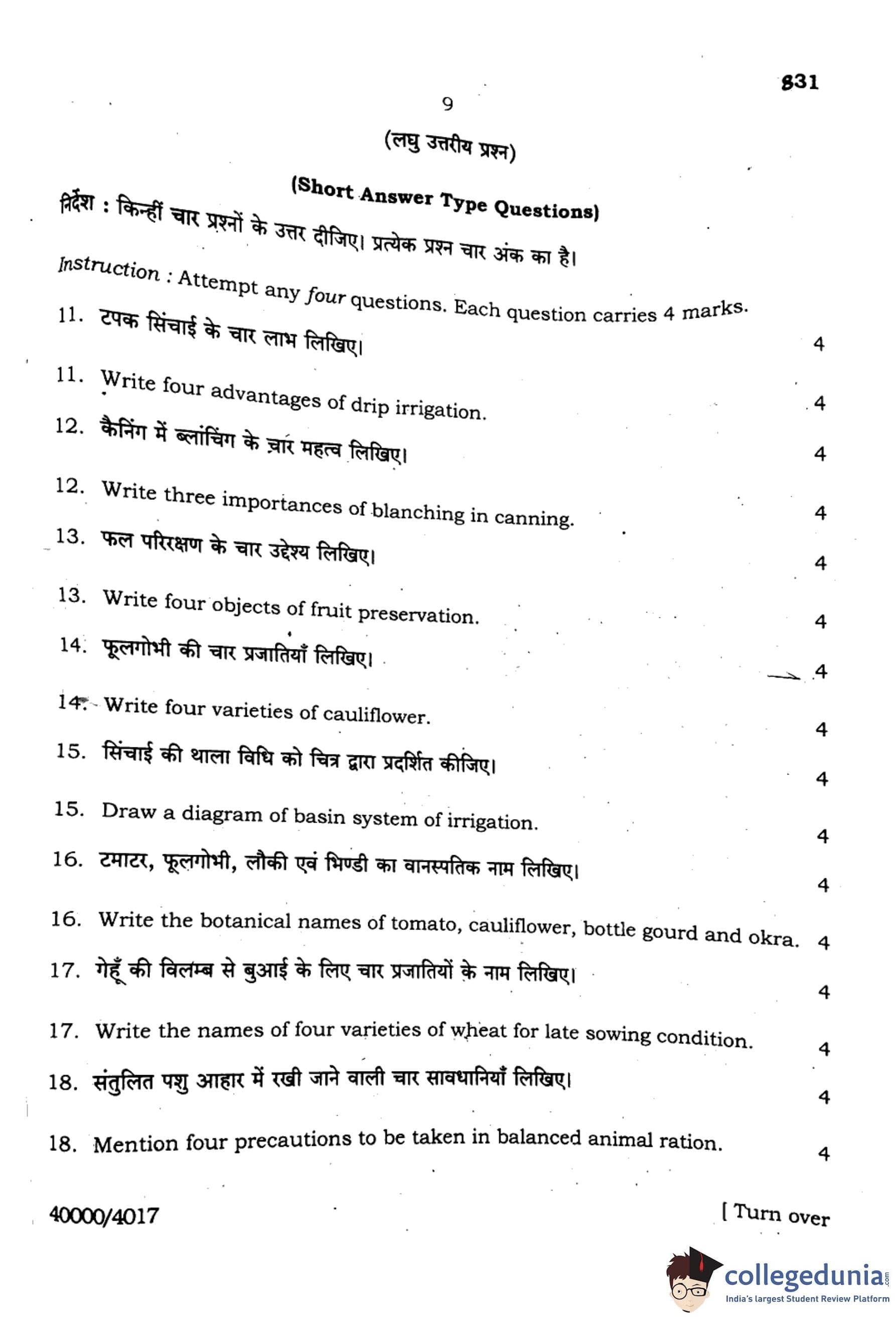
Write four advantages of drip irrigation.
View Solution
Step 1: Define drip irrigation.
Drip irrigation is a modern method where water is supplied drop by drop directly to the root zone through pipes and emitters.
Step 2: Advantages.
1. Saves water – 40–70% less water used compared to surface irrigation.
2. Reduces weed growth – since only root zones are irrigated, weeds in other areas get less water.
3. Improves yield and quality – provides uniform moisture, prevents stress, and boosts productivity.
4. Suitable for all soils and undulating areas – works even in sandy soils and uneven fields.
Step 3: Conclusion.
Hence, drip irrigation is efficient and highly productive.
Quick Tip: Drip irrigation is most effective for horticultural crops like fruits, vegetables, and cash crops.
Write three importances of blanching in canning.
View Solution
Step 1: Define blanching.
Blanching is a heat treatment (usually hot water or steam) given to fruits/vegetables before canning or freezing.
Step 2: Importance.
1. Inactivates enzymes – prevents spoilage and maintains color, flavor, and texture.
2. Reduces microbial load – kills many microorganisms present on the surface.
3. Improves product quality – softens tissues, reduces air, and helps in better filling in cans.
Step 3: Conclusion.
Thus, blanching is a crucial pre-processing step in canning.
Quick Tip: Blanching = short heat treatment before canning/freezing to preserve quality.
Write four objects of fruit preservation.
View Solution
Step 1: Define fruit preservation.
Fruit preservation is the process of treating and storing fruits to retain their nutritive value, taste, and quality for a longer time.
Step 2: Objectives.
1. Extend shelf life – prevents spoilage and deterioration.
2. Maintain quality – preserves natural flavor, color, and nutrients.
3. Prevent wastage – reduces post-harvest losses.
4. Off-season availability – allows consumption and marketing throughout the year.
Step 3: Conclusion.
Thus, preservation ensures economic and nutritional benefits.
Quick Tip: Fruit preservation is vital to reduce post-harvest losses, which are very high in perishable crops.
Write four varieties of cauliflower.
View Solution
Step 1: Recall cauliflower improvement.
Several varieties of cauliflower have been developed in India for early, mid, and late-season cultivation.
Step 2: Examples.
1. Pusa Katki – early maturing variety.
2. Early Kunwari – another early variety, popular for summer sowing.
3. Pusa Snowball – mid-season, compact curds.
4. Pusa Hybrid-2 – hybrid, high-yielding, and disease resistant.
Step 3: Conclusion.
Thus, four important varieties of cauliflower are Pusa Katki, Early Kunwari, Pusa Snowball, and Pusa Hybrid-2.
Quick Tip: Cauliflower varieties are grouped as early, mid, and late maturing depending on sowing season.
Draw a diagram of basin system of irrigation.

View Solution
Step 1: Understanding basin irrigation.
In basin irrigation, circular or square basins are formed around the plant base (especially fruit trees). Water is applied to the basin so that it seeps down to the root zone.
Step 2: Diagram requirements.
A correct diagram should show:
- A tree at the center.
- Circular basin around the tree.
- Water stored within the basin.
- Arrow showing seepage into the root zone.
Step 3: Importance.
This method ensures efficient water use and is highly suitable for orchards.
Quick Tip: In exams, neat diagrams with labels help score full marks.
Write the botanical names of tomato, cauliflower, bottle gourd, and okra.
- Cauliflower: \textit{Brassica oleracea var. botrytis}
- Bottle gourd: \textit{Lagenaria siceraria}
- Okra: \textit{Abelmoschus esculentus}
View Solution
Step 1: Recall scientific classification.
Each crop has a unique botanical name that helps in proper identification.
Step 2: Listing the names.
- Tomato belongs to the Solanaceae family (\textit{Solanum lycopersicum).
- Cauliflower belongs to the Brassicaceae family (\textit{Brassica oleracea var. botrytis).
- Bottle gourd is from the Cucurbitaceae family (\textit{Lagenaria siceraria).
- Okra is from the Malvaceae family (\textit{Abelmoschus esculentus).
Step 3: Conclusion.
Thus, the correct botanical names are as listed.
Quick Tip: Always remember: Tomato = Solanaceae, Cauliflower = Brassicaceae, Bottle gourd = Cucurbitaceae, Okra = Malvaceae.
Write the names of four varieties of wheat for late sowing condition.
View Solution
Step 1: Understanding late sowing wheat.
Late sowing wheat varieties are developed to mature early and escape high temperature stress.
Step 2: Examples.
1. Sonalika – popular short-duration variety.
2. Raj-3077 – suitable for late sowing in north-west India.
3. UP-2338 – high-yielding, tolerant to heat stress.
4. HD-2285 – early maturing variety.
Step 3: Conclusion.
Hence, Sonalika, Raj-3077, UP-2338, and HD-2285 are important late sowing varieties.
Quick Tip: Late sowing varieties = early maturing types that escape terminal heat stress.
Mention four precautions to be taken in balanced animal ration.
View Solution
Step 1: Understand balanced ration.
A balanced ration is the daily diet of animals that contains all essential nutrients in the right proportion for maintenance, growth, and production.
Step 2: Precautions.
1. Correct nutrient ratio: Ensure proper balance of carbohydrates, proteins, fats, vitamins, and minerals.
2. Avoid contaminated feed: Moldy or insect-infested feed should never be given.
3. Provide sufficient roughage: Roughages like green fodder and hay are essential for digestion in ruminants.
4. Supply clean water: Adequate clean water should always accompany the ration.
Step 3: Conclusion.
Following these precautions ensures animal health and high productivity.
Quick Tip: Balanced ration = “Right feed at right time in right amount.”
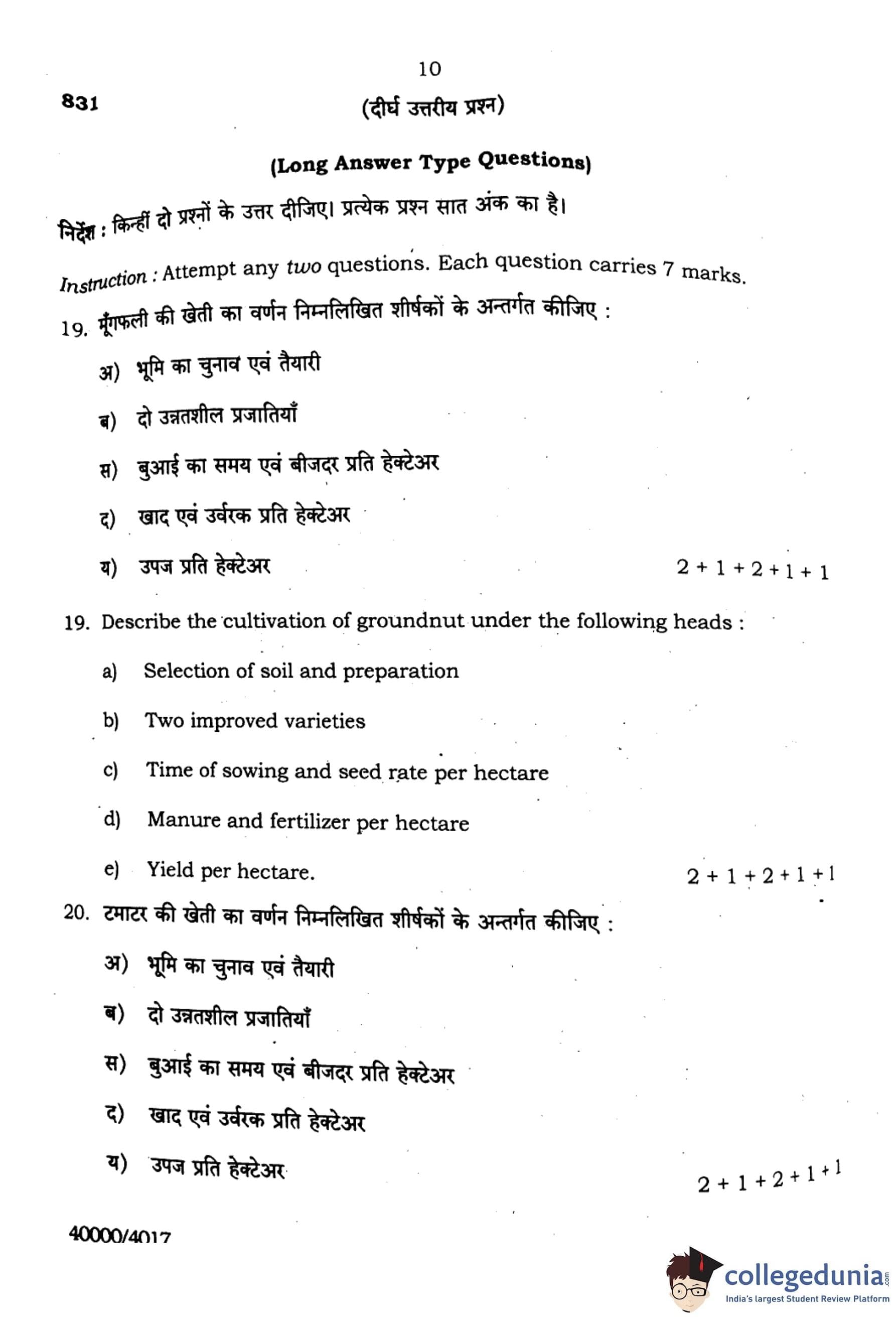
Describe the cultivation of groundnut under the following heads:
(a) Selection of soil and preparation
(b) Two improved varieties
(c) Time of sowing and seed rate per hectare
(d) Manure and fertilizer per hectare
(e) Yield per hectare
View Solution
(a) Selection of soil and preparation
- Groundnut requires well-drained sandy loam or loamy soils rich in calcium and organic matter.
- Heavy clay soils are unsuitable as they hinder pod development.
- Land should be ploughed 2–3 times with a disc or mould board plough, followed by harrowing to get a fine tilth.
- Proper leveling ensures uniform germination and irrigation efficiency.
(b) Two improved varieties
- JL-24: Short duration, high-yielding, suitable for rainfed conditions.
- TG-37A: Widely grown variety, tolerant to drought.
(Other options: K-6, GG-20, Kadiri-6).
(c) Time of sowing and seed rate per hectare
- Time of sowing:
- Kharif crop – June–July with onset of monsoon.
- Rabi crop – November (in irrigated areas).
- Seed rate:
- 100–120 kg/ha (for bunch types).
- 140–160 kg/ha (for spreading types).
(d) Manure and fertilizer per hectare
- FYM/Compost: 8–10 tons per hectare applied at land preparation.
- Fertilizers:
- Nitrogen: 20 kg/ha.
- Phosphorus: 40–60 kg P\(_2\)O\(_5\)/ha.
- Potassium: 40 kg K\(_2\)O/ha (if soil is deficient).
- Gypsum (250 kg/ha) is often applied at flowering to improve pod filling (Ca supply).
(e) Yield per hectare
- Average yield: 15–20 quintals/ha under rainfed conditions.
- Improved varieties under irrigation: 25–30 quintals/ha.
Quick Tip: Groundnut is a legume crop, so excessive nitrogen fertilizer is not needed — focus more on phosphorus, calcium, and proper seed treatment.
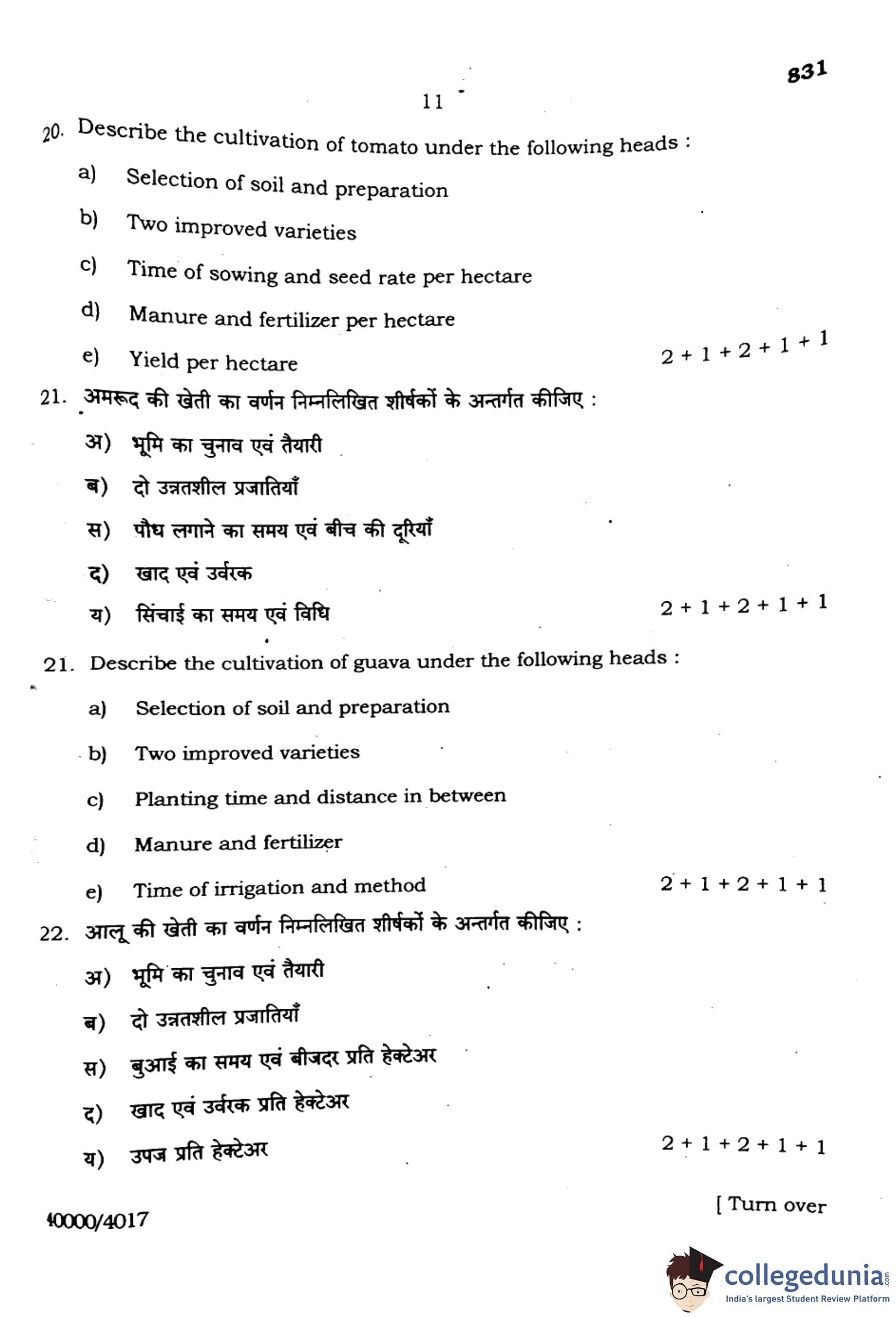
Describe the cultivation of tomato under the following heads:
(a) Selection of soil and preparation
(b) Two improved varieties
(c) Time of sowing and seed rate per hectare
(d) Manure and fertilizer per hectare
(e) Yield per hectare
View Solution
(a) Selection of soil and preparation
- Tomato grows best in well-drained sandy loam to clay loam soils with good organic matter.
- Soil pH should be between 6.0–7.0.
- The land should be ploughed 3–4 times, harrowed, and leveled to get a fine tilth.
- Raised beds or ridges are usually prepared for transplanting seedlings.
(b) Two improved varieties
- Pusa Ruby: Popular variety, medium-sized fruits, good for table purpose.
- Pusa Hybrid-1: Early, high-yielding hybrid with uniform fruits.
(Other examples: Arka Vikas, Arka Abha, Pusa Gaurav).
(c) Time of sowing and seed rate per hectare
- Time of sowing:
- Kharif: June–July
- Rabi: October–November
- Summer: January–February
- Seed rate:
- 400–500 g of seed is required per hectare for transplanting.
(d) Manure and fertilizer per hectare
- FYM/Compost: 20–25 tons/ha at the time of land preparation.
- Chemical fertilizers:
- Nitrogen (N): 120 kg/ha
- Phosphorus (P\(_2\)O\(_5\)): 80 kg/ha
- Potassium (K\(_2\)O): 60 kg/ha
- Fertilizer is applied in split doses – half basal and half at flowering/fruiting stage.
(e) Yield per hectare
- Open-pollinated varieties: 300–400 quintals/ha.
- Hybrids: 500–600 quintals/ha under good management.
Quick Tip: Tomato = high nutrient-demanding crop; use FYM + NPK in proper balance for maximum yield.
Describe the cultivation of guava under the following heads:
(a) Selection of soil and preparation
(b) Two improved varieties
(c) Planting time and distance in between
(d) Manure and fertilizer
(e) Time of irrigation and method
View Solution
(a) Selection of soil and preparation
- Guava grows well in alluvial soils, sandy loam to clay loam soils, with good drainage.
- Soil pH: 6.5–7.5 is ideal.
- Deep ploughing is done, followed by 2–3 harrowings.
- Pits of size 60 cm × 60 cm × 60 cm are dug and filled with topsoil mixed with FYM before planting.
(b) Two improved varieties
- Allahabad Safeda: Famous for large, round fruits with white pulp.
- Lucknow-49 (Sardar): Popular variety with high yield and excellent keeping quality.
(Other examples: Lalit, Arka Mridula).
(c) Planting time and distance in between
- Time of planting:
- Rainy season (July–August) and spring season (February–March).
- Spacing:
- 6 m × 6 m in square system for normal planting.
- High-density planting: 3 m × 3 m.
(d) Manure and fertilizer
- FYM: 20–25 kg per plant per year.
- Chemical fertilizers (per plant per year):
- Nitrogen: 500 g
- Phosphorus: 250 g
- Potassium: 250 g
- Fertilizers are applied in two splits: one after pruning and the other after fruit set.
(e) Time of irrigation and method
- Irrigation is given immediately after planting.
- In summer, irrigate at 10–15 days interval; in winter, irrigation at 20–25 days interval is sufficient.
- Basin method or drip irrigation is preferred to conserve water.
Quick Tip: Guava is called “poor man’s apple” due to its affordability, high vitamin-C content, and adaptability to marginal soils.
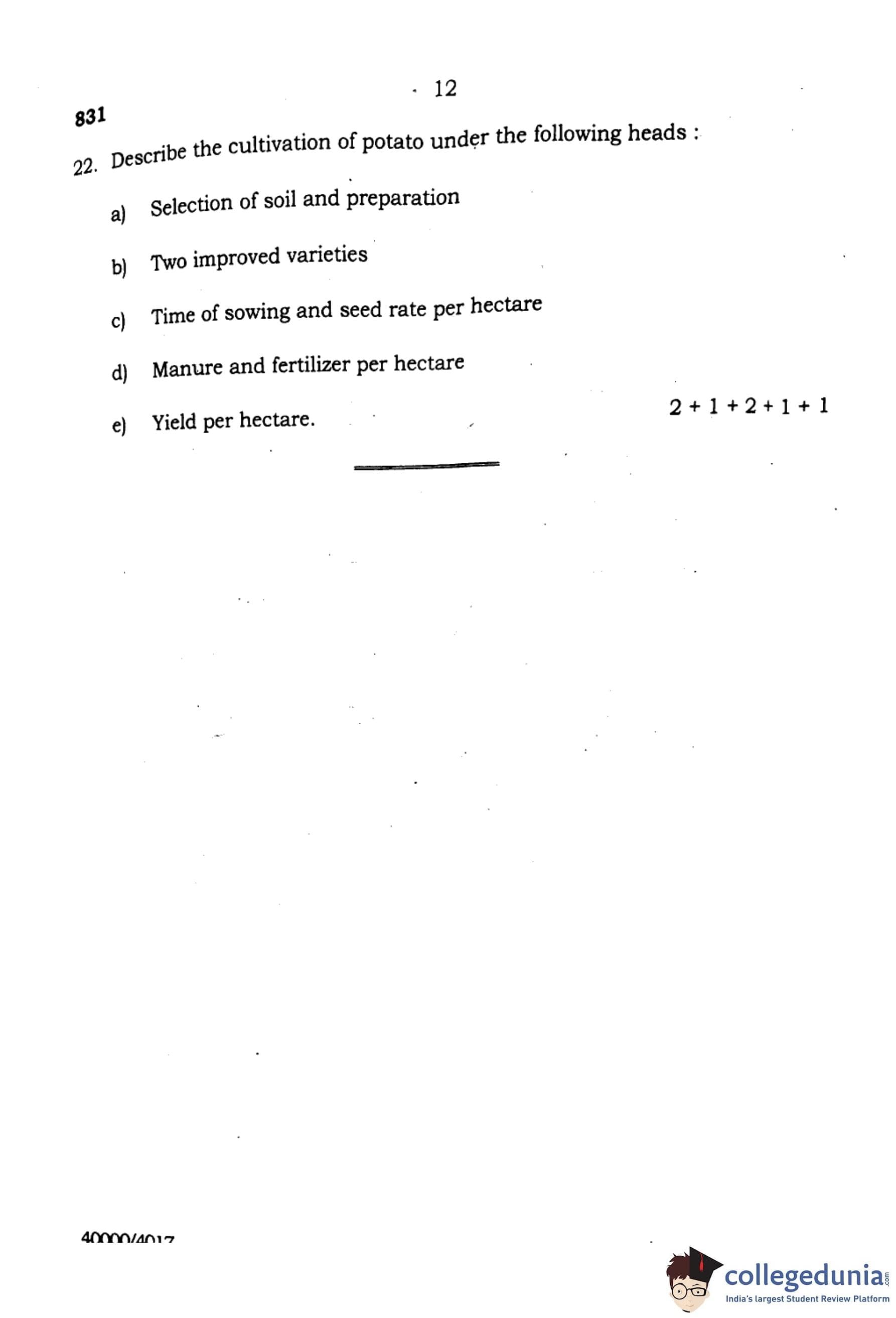
Describe the cultivation of potato under the following heads:
(a) Selection of soil and preparation
(b) Two improved varieties
(c) Time of sowing and seed rate per hectare
(d) Manure and fertilizer per hectare
(e) Yield per hectare
View Solution
(a) Selection of soil and preparation
- Potato grows best in well-drained sandy loam to loam soils rich in organic matter.
- Soil pH: 5.0–6.5 (slightly acidic soil is preferred).
- Land is prepared by 2–3 deep ploughings, followed by harrowing and leveling.
- Ridges and furrows or raised beds are prepared for proper tuber development.
(b) Two improved varieties
- Kufri Jyoti: Early maturing, resistant to late blight.
- Kufri Chandramukhi: High-yielding, suitable for table use.
(Other popular varieties: Kufri Pukhraj, Kufri Bahar).
(c) Time of sowing and seed rate per hectare
- Time of sowing:
- Plains: October–November (Rabi season).
- Hills: March–April (summer crop).
- Seed rate:
- 25–30 quintals of healthy seed tubers (30–50 g each) per hectare.
(d) Manure and fertilizer per hectare
- FYM: 20–25 tons/ha applied during field preparation.
- Fertilizers:
- Nitrogen (N): 120 kg/ha
- Phosphorus (P\(_2\)O\(_5\)): 80 kg/ha
- Potassium (K\(_2\)O): 100 kg/ha
- Half nitrogen + full phosphorus and potassium applied as basal, remaining nitrogen at earthing up.
(e) Yield per hectare
- Average yield: 200–250 quintals/ha.
- Improved varieties under irrigation: 300–350 quintals/ha.
Quick Tip: Potato = short-duration crop; use certified disease-free seed tubers and proper earthing-up for high yield.




Comments