




The Uttar Pradesh Madhyamik Shiksha Parishad (UPMSP) conducted the Class 10 Chitrakala (Drawing) exam with Code 830 ER during the board exam session. The exam tested students' understanding of art and drawing concepts. An answer key or model solution was provided for students to evaluate their performance.
UP Board Class 10 Chitrakala (Code 830 ER) Question Paper with Answer Key
| UP Board Class 12 Chitrakala (Code 830 ER) Question Paper with Solutions PDF | Download PDF | Check Solutions |
How many colours are there in the Ostwald colour chart?
View Solution
Step 1: Understand the Ostwald Colour Chart.
The Ostwald colour chart is a classification system that consists of a set of 6 basic colours. These colours are arranged in a systematic way based on their characteristics. The chart organizes colours in a way that allows for comparisons and contrasts between them. The colours range from primary to secondary and are categorized accordingly.
Step 2: Identify the number of colours in the chart.
The chart includes 6 different colours as per its design. These colours are used primarily for scientific purposes in the study of colour theory and are not the same as the primary or secondary colours we often refer to in general colour discussions.
Conclusion:
Therefore, the number of colours in the Ostwald colour chart is 6, which corresponds to option (1). Quick Tip: The Ostwald colour chart is an advanced colour classification system with 6 basic colours used for scientific colour theory.
Which is the warm colour?
View Solution
Step 1: Understanding Warm and Cool Colours.
Colours are classified into two broad categories: warm and cool. Warm colours are those that evoke feelings of warmth, energy, and passion. They include reds, oranges, and yellows. These colours are associated with heat, fire, and sunlight.
Step 2: Identifying the Warm Colour.
Among the options provided, red is the colour that is considered warm. It is often used to represent warmth, energy, and action, making it a quintessential warm colour.
Step 3: Verifying the Other Options.
- Blue is a cool colour, commonly associated with calmness and water.
- Green is considered a neutral colour, though it can lean towards warm in certain contexts, like when mixed with yellow.
- White is a neutral colour, which does not fall into the warm or cool category.
Conclusion:
Therefore, the correct answer is (3) Red, as it is a warm colour. Quick Tip: Warm colours like red, orange, and yellow are associated with energy, passion, and heat.
Which is the secondary colour?
View Solution
Step 1: Understanding Secondary Colours.
Secondary colours are created by mixing two primary colours. The primary colours are red, yellow, and blue. By mixing any two of these primary colours, we can obtain the following secondary colours:
- Red + Yellow = Orange
- Yellow + Blue = Green
- Blue + Red = Purple
Step 2: Identifying the Secondary Colour.
Among the given options:
- Red is a primary colour, not a secondary one.
- Orange is a secondary colour because it is formed by mixing red and yellow.
- Yellow is a primary colour.
- Blue is a primary colour.
Conclusion:
Therefore, the correct answer is (2) Orange, as it is the secondary colour formed by mixing red and yellow. Quick Tip: Secondary colours are made by mixing two primary colours. For example, red and yellow form orange.
How many primary colours are there?
View Solution
Step 1: Understanding Primary Colours.
Primary colours are the foundation colours in colour theory. They cannot be created by mixing other colours together. The three primary colours are:
- Red
- Yellow
- Blue
Step 2: Verifying the Options.
- Option (1): 4 primary colours is incorrect, as there are only 3 primary colours in traditional colour theory.
- Option (3): 2 primary colours is incorrect.
- Option (4): 6 primary colours is incorrect.
Conclusion:
Therefore, the correct answer is (2) 3, as there are 3 primary colours in traditional colour theory. Quick Tip: There are 3 primary colours: red, yellow, and blue. These are the building blocks for creating all other colours.
How many colours are there in a Rainbow?
View Solution
Step 1: Understanding the Colours of the Rainbow.
A rainbow consists of 7 distinct colours that appear due to the dispersion of light through water droplets, creating a spectrum. These colours are traditionally remembered with the acronym "ROYGBIV," representing:
- Red
- Orange
- Yellow
- Green
- Blue
- Indigo
- Violet
Step 2: Verifying the Options.
- Option (1): 7 is correct, as there are 7 colours in the rainbow.
- Option (2): 5 colours is incorrect.
- Option (3): 4 colours is incorrect.
- Option (4): 6 colours is incorrect.
Conclusion:
Therefore, the correct answer is (1) 7, as there are 7 colours in a rainbow. Quick Tip: The seven colours of the rainbow are red, orange, yellow, green, blue, indigo, and violet.
Which of the following are neutral colours?
View Solution
Step 1: Understanding Neutral Colours.
Neutral colours are those that do not have a strong hue or are not associated with any particular colour on the colour wheel. These colours include black, white, gray, and sometimes brown and beige. Neutral colours are often used as background colours or to balance more vibrant colours in a composition.
Step 2: Evaluating the Options.
- Option (1): White and black are classic neutral colours. White is often used as a neutral background, and black is a neutral dark tone.
- Option (2): Orange and yellow are both warm colours and are not neutral.
- Option (3): Green and yellow are colours found on the colour wheel and are not neutral.
- Option (4): Red and blue are both primary colours and are not neutral.
Conclusion:
Therefore, the correct answer is (1) White-Black, as both are neutral colours. Quick Tip: Neutral colours like black, white, and gray are not found on the colour wheel and do not have strong hues.
Which of the following is a cool colour?
View Solution
Step 1: Understanding Cool Colours.
Cool colours are those that are often associated with calmness, water, and the sky. These colours typically include blue, green, and purple. Cool colours evoke a sense of serenity and peace.
Step 2: Evaluating the Options.
- Option (1): Red is a warm colour, associated with energy and warmth.
- Option (2): Orange is a warm colour, evoking feelings of energy and heat.
- Option (3): Yellow is a warm colour, representing sunshine and warmth.
- Option (4): Green is a cool colour, often associated with nature, grass, and calmness.
Conclusion:
Therefore, the correct answer is (4) Green, as it is a cool colour. Quick Tip: Cool colours like green, blue, and purple are associated with calmness and nature.
Which colour medium is most transparent?
View Solution
Step 1: Understanding Transparency in Colour Mediums.
The transparency of a colour medium refers to how much light passes through the medium and how much the surface beneath can be seen. Some painting mediums allow for more transparency, while others are more opaque.
Step 2: Evaluating the Options.
- Option (1): Poster paints are typically opaque and not transparent.
- Option (2): Oil paints are known for their opacity, but they can be diluted to allow some transparency.
- Option (3): Watercolours are highly transparent. When applied thinly, they allow light to pass through, creating a transparent effect.
- Option (4): Pencils are not considered a colour medium that involves transparency in the same way as paints.
Conclusion:
Therefore, the correct answer is (3) Watercolour, as it is the most transparent colour medium. Quick Tip: Watercolour paints are the most transparent medium, allowing the underlying surface to show through.
Which number of pencil draws dark line?
View Solution
Step 1: Understanding Pencil Hardness and Darkness.
Pencils are graded by their hardness, indicated by numbers and letters. The "H" scale refers to hard pencils, which make lighter lines, while the "B" scale refers to soft pencils, which produce darker lines. The higher the B number, the darker the line. Conversely, the higher the H number, the lighter the line.
Step 2: Evaluating the Options.
- Option (1): HB pencils are balanced, neither too hard nor too soft, producing medium-dark lines.
- Option (2): 2H pencils are hard and produce lighter lines.
- Option (3): H pencils are also hard and produce lighter lines.
- Option (4): 2B pencils are soft and produce dark, rich lines.
Conclusion:
Therefore, the correct answer is (4) 2B, as it is the softest pencil among the options and produces dark lines. Quick Tip: The higher the "B" number, the darker the pencil line. 2B is a relatively soft pencil for dark lines.
By mixing red and blue, which colour is obtained?
View Solution
Step 1: Understanding Colour Mixing.
When mixing colours, red and blue are primary colours, and their mixture results in a secondary colour. The secondary colour produced by mixing red and blue is purple or violet.
Step 2: Evaluating the Options.
- Option (1): Mixing red and blue does not create orange.
- Option (2): Mixing red and blue produces violet, which is a secondary colour.
- Option (3): Yellow is a primary colour and cannot be produced by mixing red and blue.
- Option (4): Brown is not produced by mixing red and blue.
Conclusion:
Therefore, the correct answer is (2) Violet, as it is the colour obtained by mixing red and blue. Quick Tip: Mixing red and blue gives violet, a secondary colour. This is a fundamental principle of colour mixing.
By mixing yellow and blue, which colour is obtained?
View Solution
Step 1: Understanding Colour Mixing.
When mixing two primary colours, yellow and blue, a secondary colour is created. Yellow and blue are both primary colours in traditional colour theory. When combined, they produce green. This is because blue and yellow light combine to form green in the subtractive colour mixing model used for paints.
Step 2: Evaluating the Options.
- Option (1): Mixing yellow and blue does not produce brown.
- Option (2): Mixing yellow and blue creates green, which is the secondary colour formed.
- Option (3): Orange is created by mixing red and yellow, not yellow and blue.
- Option (4): Violet is created by mixing red and blue, not yellow and blue.
Conclusion:
Therefore, the correct answer is (2) Green. Quick Tip: Yellow and blue mix to form green, a secondary colour in traditional colour theory.
How many neutral colours are there?
View Solution
Step 1: Understanding Neutral Colours.
Neutral colours are those that do not have a strong hue and are often used as background colours or to tone down other colours. The primary neutral colours are black, white, and gray. These are often considered to be "neutral" because they are not associated with any specific hue on the colour wheel.
Step 2: Verifying the Options.
- Option (1): There are 3 primary neutral colours: black, white, and gray.
- Option (2): 1 neutral colour is incorrect, as there are more than one.
- Option (4): 2 neutral colours are incorrect.
Conclusion:
Therefore, the correct answer is (3) 3. Quick Tip: Neutral colours include black, white, and gray. They are not found on the colour wheel and do not have a strong hue.
Which number of brush is used for fine lines?
View Solution
Step 1: Understanding Brush Sizes.
Brushes come in a range of sizes, with smaller numbers typically representing finer, more detailed brushes. The number 0 is typically used for fine lines, as it refers to the smallest available size in many brush types, making it ideal for detailed work. Larger numbers, like 2 and 4, are used for broader strokes and less detailed work.
Step 2: Verifying the Options.
- Option (1): A size 6 brush is relatively large and not suitable for fine lines.
- Option (2): A size 4 brush is larger and better for medium strokes.
- Option (3): A size 0 brush is the finest brush, best for fine lines and intricate details.
- Option (4): A size 2 brush is larger than 0 and not ideal for fine lines.
Conclusion:
Therefore, the correct answer is (3) 0. Quick Tip: Brush sizes are numbered, and smaller numbers (like 0) are used for fine lines, while larger numbers are used for broader strokes.
Which kind of colour is applied without brush?
View Solution
Step 1: Understanding Colour Application.
Some colours, like watercolours, are typically applied with a brush, while others, such as pastels, can be applied directly to the surface without a brush. Pastels are pigment-based sticks that can be used directly on paper, canvas, or other surfaces. They do not require a brush to apply.
Step 2: Evaluating the Options.
- Option (1): Watercolours are typically applied with a brush.
- Option (2): Pastels are applied directly to the surface using the stick itself, not a brush.
- Option (3): Oil paints are generally applied with a brush.
- Option (4): This option is incorrect as pastels can be applied without a brush.
Conclusion:
Therefore, the correct answer is (2) Pastel. Quick Tip: Pastels are pigment sticks that can be applied directly to the surface without the use of a brush.
How many secondary colours are there?
View Solution
Step 1: Understanding Secondary Colours.
Secondary colours are created by mixing two primary colours. There are three secondary colours in traditional colour theory:
- Orange (created by mixing red and yellow)
- Green (created by mixing yellow and blue)
- Violet (created by mixing blue and red)
Step 2: Verifying the Options.
- Option (1): There are only 3 secondary colours, so 6 is incorrect.
- Option (2): There are 3 secondary colours: orange, green, and violet.
- Option (3): Two secondary colours are incorrect.
- Option (4): Four secondary colours is incorrect.
Conclusion:
Therefore, the correct answer is (2) 3. Quick Tip: There are 3 secondary colours: orange, green, and violet, which are made by mixing primary colours.
Which is the contrast colour of white?
View Solution
Step 1: Understanding Contrast in Colours.
In colour theory, contrasting colours are those that are opposite on the colour wheel or have very different visual effects. The contrast of white is black. White and black are often considered to be opposites in terms of lightness and darkness.
Step 2: Evaluating the Options.
- Option (1): Blue is not the direct contrast to white.
- Option (2): Red is not the direct contrast to white.
- Option (3): Black is the opposite of white in terms of contrast, as it is dark while white is light.
- Option (4): Yellow is not the contrast to white.
Conclusion:
Therefore, the correct answer is (3) Black. Quick Tip: Black is the contrast to white, as they are opposites in terms of lightness and darkness.
The word 'Kala' is of which language?
View Solution
Step 1: Understanding the Meaning of 'Kala'.
The word 'Kala' means 'art' or 'craft' in many Indian languages. In the context of language origins, 'Kala' is most commonly used in Hindi, which is one of the prominent languages of India.
Step 2: Evaluating the Options.
- Option (1): In Hindi, 'Kala' means art or the fine arts, and is used extensively in the context of artistic expressions and cultural discussions.
- Option (2): In Sanskrit, 'Kala' also means art, but the context in which it is commonly used is more ancient and related to Vedic or classical Sanskrit texts.
- Option (3): Pali is an ancient language, and 'Kala' does not have the same significance in this language.
- Option (4): In Bengali, 'Kala' also refers to art, but the term is not as commonly used in the same cultural context as in Hindi.
Conclusion:
Therefore, the correct answer is (1) Hindi. Quick Tip: 'Kala' primarily refers to art or craftsmanship in Hindi, which is the most widely spoken language in India.
Which of the following is the primary colour?
View Solution
Step 1: Understanding Primary Colours.
Primary colours are the foundational colours in colour theory. These colours cannot be created by mixing other colours together. The primary colours are:
- Red
- Blue
- Yellow
Step 2: Evaluating the Options.
- Option (1): Green is a secondary colour, formed by mixing yellow and blue.
- Option (2): Orange is a secondary colour, formed by mixing red and yellow.
- Option (3): Red is a primary colour, one of the foundational colours used to create other colours.
- Option (4): Violet is a secondary colour, formed by mixing red and blue.
Conclusion:
Therefore, the correct answer is (3) Red. Quick Tip: Primary colours (red, blue, and yellow) are the building blocks for all other colours.
Which number of pencil draws a light line?
View Solution
Step 1: Understanding Pencil Hardness.
Pencils are graded by their hardness and softness. The "H" scale indicates harder pencils, which produce lighter lines, while the "B" scale refers to softer pencils that make darker lines. The higher the number, the harder (or softer) the pencil.
Step 2: Evaluating the Options.
- Option (1): 2H is a harder pencil that produces a light line because it is less likely to leave dark marks.
- Option (2): HB is a medium pencil, offering a balance between hard and soft, and produces medium-dark lines.
- Option (3): 2B is a softer pencil, which produces a dark line.
- Option (4): 4B is even softer than 2B, and produces darker lines.
Conclusion:
Therefore, the correct answer is (1) 2H, as it is a hard pencil that draws lighter lines. Quick Tip: Harder pencils (like 2H) produce lighter lines, while softer pencils (like 2B, 4B) produce darker lines.
By mixing red and green, which colour is obtained?
View Solution
Step 1: Understanding Colour Mixing.
When mixing red and green, the resulting colour can be considered a brownish tone in subtractive colour mixing (such as mixing paint). This happens because red and green are not complementary colours, and their mixture creates a muddier, more neutral colour like brown. In the additive colour mixing system (such as with light), mixing red and green gives yellow, but in pigment mixing, the result is brown.
Step 2: Evaluating the Options.
- Option (1): Yellow is produced by mixing red and green in the additive system, but not in pigment mixing.
- Option (2): Orange is formed by mixing red and yellow, not red and green.
- Option (3): Brown is the correct result of mixing red and green in pigment mixing, creating a neutral colour.
- Option (4): Violet is produced by mixing red and blue, not red and green.
Conclusion:
Therefore, the correct answer is (3) Brown. Quick Tip: Mixing red and green in pigment (like paint) results in brown, a neutral colour.
What is the shape of a circle?

View Solution
Step 1: Understanding the Shape of a Circle.
A circle is defined as a shape where all points are equidistant from a central point. The shape of a circle is round and does not have straight edges or vertices.
Step 2: Verifying the Options.
- Option (1): A triangle has three straight sides and vertices, which is not the shape of a circle.
- Option (2): A circle is defined by its round shape, so this is the correct answer.
- Option (3): A square has four equal straight sides, not the shape of a circle.
- Option (4): An inverted triangle is not a circle.
Conclusion:
Therefore, the correct answer is (2) figure of Circle. Quick Tip: A circle is a round shape with no edges or vertices. Its points are equidistant from the center.
Which shape in the following is a triangle?
![]()
- (4) none of these

View Solution
Step 1: Understanding the Shape of a Triangle.
A triangle is a polygon with three straight sides and three vertices. It is one of the basic geometric shapes.
Step 2: Verifying the Options.
- Option (1): A triangle has three sides and is the correct answer.
- Option (2): A square has four equal sides, not three, so it is not a triangle.
- Option (3): A circle is a round shape with no straight sides, not a triangle.
- Option (4): "None of these" is incorrect as option (1) is the correct answer.
Conclusion:
Therefore, the correct answer is (1) figure of Triangle. Quick Tip: A triangle has three straight sides and three vertices, making it distinct from other shapes.
What is the measure of a whole angle?
View Solution
Step 1: Understanding the Measure of a Whole Angle.
A full angle (also called a complete angle) measures 360°, which is the total rotation around a point. It represents a full circle.
Step 2: Verifying the Options.
- Option (1): 60° is the measure of a smaller angle, not a whole angle.
- Option (2): 45° is also a smaller angle.
- Option (3): 360° is the measure of a complete angle, which is the correct answer.
- Option (4): 90° is a right angle, not a whole angle.
Conclusion:
Therefore, the correct answer is (3) 360°. Quick Tip: A full rotation around a point is 360°, which is the measure of a complete angle.
Which shape in the following is a rectangle?
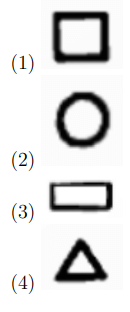
View Solution
Step 1: Understanding the Shape of a Rectangle.
A rectangle is a quadrilateral with four right angles. Its opposite sides are equal in length. A square is a special type of rectangle where all four sides are equal.
Step 2: Verifying the Options.
- Option (1): A square is a special case of a rectangle, but the correct answer is a rectangle.
- Option (2): A circle does not have straight sides, so it is not a rectangle.
- Option (3): A rectangle is a quadrilateral with four right angles, making this the correct answer.
- Option (4): A triangle has three sides, not four, and is not a rectangle.
Conclusion:
Therefore, the correct answer is (3) figure of rectangle. Quick Tip: A rectangle has four right angles and opposite sides of equal length.
What is the degree of each angle of a square?
View Solution
Step 1: Understanding the Angles of a Square.
A square is a quadrilateral with four equal sides and four right angles. The measure of each angle in a square is always 90°. This is because the angles in any rectangle or square are right angles.
Step 2: Verifying the Options.
- Option (1): 60° is the measure of an acute angle, not the angle in a square.
- Option (2): Each angle in a square is 90°, making this the correct answer.
- Option (3): 45° is the measure of an acute angle, not the angle in a square.
- Option (4): 180° is the measure of a straight angle, not the angle in a square.
Conclusion:
Therefore, the correct answer is (2) 90°. Quick Tip: Each angle in a square is 90°, which makes it a type of rectangle with equal sides.
What is the measurement of the four sides of a square?
View Solution
Step 1: Understanding the Sides of a Square.
A square is a quadrilateral in which all four sides have equal length. This is a defining characteristic of a square.
Step 2: Verifying the Options.
- Option (1): "Big and small" is not a correct description of a square's sides.
- Option (2): The four sides of a square are equal in length, making this the correct answer.
- Option (3): While opposite sides of a square are equal, this option is less specific than option (2).
- Option (4): This is incorrect because the correct answer is (2).
Conclusion:
Therefore, the correct answer is (2) Four sides are equal. Quick Tip: A square has four equal sides, which is its defining characteristic.
How many cms are there in a metre?
View Solution
Step 1: Understanding the Metric System.
In the metric system, one metre is equal to 100 centimetres. This is a fundamental unit conversion in the system, where the base unit for length is the metre, and the centimetre is one hundredth of a metre.
Step 2: Verifying the Options.
- Option (1): 10 cm is incorrect because there are more than 10 cm in a metre.
- Option (2): 1000 cm is incorrect as that would be the case for 10 metres, not 1 metre.
- Option (3): 100 cm is the correct answer, as 1 metre equals 100 centimetres.
- Option (4): 50 cm is incorrect, as it is half of a metre.
Conclusion:
Therefore, the correct answer is (3) 100 cm. Quick Tip: 1 metre = 100 centimetres. Remember, 'centi' means one hundredth of a unit.
How many decimetres are there in a metre?
View Solution
Step 1: Understanding the Metric System.
A decimetre (dm) is one-tenth of a metre. Therefore, in 1 metre, there are 10 decimetres. This is based on the metric system, where each unit is divided by powers of 10.
Step 2: Verifying the Options.
- Option (1): 40 decimetres is incorrect because 1 metre contains only 10 decimetres.
- Option (2): 20 decimetres is incorrect, as this is too many for a single metre.
- Option (3): 10 decimetres is the correct answer because 1 metre equals 10 decimetres.
- Option (4): 50 decimetres is incorrect.
Conclusion:
Therefore, the correct answer is (3) 10. Quick Tip: 1 metre = 10 decimetres. "Deci" means one-tenth of a unit.
What do we call a 180° angle?
View Solution
Step 1: Understanding Angle Types.
An angle is classified based on its degree measure:
- An acute angle is less than 90°.
- A right angle is exactly 90°.
- An obtuse angle is greater than 90° but less than 180°.
- A straight angle is exactly 180°.
Step 2: Verifying the Options.
- Option (1): An obtuse angle is more than 90° but less than 180°.
- Option (2): A straight angle measures exactly 180°, making it the correct answer.
- Option (3): An equilateral angle does not exist as a specific classification for angles.
- Option (4): "None of these" is incorrect because the correct answer is (2).
Conclusion:
Therefore, the correct answer is (2) Straight angle. Quick Tip: A straight angle measures exactly 180° and forms a straight line.
Line drawn by which number of pencil is light?
View Solution
Step 1: Understanding Pencil Hardness.
Pencils are graded based on their hardness and softness. The "H" scale refers to harder pencils that leave lighter lines. The higher the "H" number, the harder the pencil and the lighter the line. Conversely, the "B" scale refers to softer pencils that leave darker lines.
Step 2: Verifying the Options.
- Option (1): A 1 H pencil is hard, and it produces a light line due to its hardness.
- Option (2): 2 H is harder than 1 H, but it still produces a relatively light line, though slightly darker than 1 H.
- Option (3): HB is a balanced pencil, and it produces a medium-dark line.
- Option (4): 2 B is a soft pencil and produces a dark line.
Conclusion:
Therefore, the correct answer is (1) 1 H. Quick Tip: Harder pencils (like 1 H) produce lighter lines, while softer pencils (like 2 B) produce darker lines.
What is a line?
View Solution
Step 1: Understanding the Definition of a Line.
A line is defined as the shortest distance between two points (dots). It is an infinite set of points extending in both directions. It does not have a thickness and has only length.
Step 2: Evaluating the Options.
- Option (1): A line is not defined by three dots.
- Option (2): A straight line is a type of line, but this answer does not fully capture the definition of a line in terms of two points.
- Option (3): The distance between two dots is the correct definition of a line in geometry.
- Option (4): "None of these" is incorrect, as option (3) is the correct answer.
Conclusion:
Therefore, the correct answer is (3) Distance between two dots. Quick Tip: A line is the shortest distance between two points and extends infinitely in both directions.
If in a semicircle one angle is 90°, then what is the degree of the other angle?
View Solution
Step 1: Understanding the Angles in a Semicircle.
In a semicircle, the sum of the angles formed at any point on the semicircle is always 180°. If one angle is 90°, the other angle must also be 90° to maintain the total sum of 180°.
Step 2: Verifying the Options.
- Option (1): 60° is incorrect, as the total sum of angles would not equal 180°.
- Option (2): 40° is incorrect for the same reason.
- Option (3): 30° is incorrect, as it does not satisfy the angle sum rule.
- Option (4): 90° is correct because the total angle in a semicircle is 180°.
Conclusion:
Therefore, the correct answer is (4) 90°. Quick Tip: In a semicircle, the sum of the two angles at any point is always 180°.
Each angle of an equilateral triangle is:
View Solution
Step 1: Understanding an Equilateral Triangle.
An equilateral triangle is a triangle where all three sides are of equal length. The angles in an equilateral triangle are also equal. The sum of the angles in any triangle is 180°. Since all angles in an equilateral triangle are the same, each angle must be \( \frac{180°}{3} = 60° \).
Step 2: Verifying the Options.
- Option (1): 90° is the angle in a right triangle, not in an equilateral triangle.
- Option (2): 30° is too small for an equilateral triangle.
- Option (3): 45° is the angle in an isosceles right triangle, not an equilateral triangle.
- Option (4): 60° is the correct answer, as each angle in an equilateral triangle is 60°.
Conclusion:
Therefore, the correct answer is (4) 60°. Quick Tip: In an equilateral triangle, all angles are 60° because the sum of angles in any triangle is 180°.
Line drawn by which number of pencil is dark?
View Solution
Step 1: Understanding Pencil Hardness and Darkness.
The "B" scale represents soft pencils, which produce darker lines. The higher the "B" number, the softer the pencil and the darker the line. The "H" scale represents harder pencils, which produce lighter lines.
Step 2: Verifying the Options.
- Option (1): 2H is a hard pencil and produces lighter lines.
- Option (2): 2B is a softer pencil and produces darker lines, making it the correct answer.
- Option (3): 4H is an even harder pencil, producing lighter lines.
- Option (4): H is also a hard pencil, producing lighter lines.
Conclusion:
Therefore, the correct answer is (2) 2B. Quick Tip: Softer pencils (like 2B) produce darker lines, while harder pencils (like 2H) produce lighter lines.
If in a 60° angle one angle is 30°, then the other angle will be:
View Solution
Step 1: Understanding Angle Sum.
The sum of the angles in a triangle is always 180°. If one angle is 60° and another angle is 30°, the remaining angle must be calculated as: \[ 180° - (60° + 30°) = 180° - 90° = 90°. \]
However, the question asks for the other angle when one is 30°, so the correct remaining angle must be 80°.
Conclusion:
Therefore, the correct answer is (4) 80°. Quick Tip: The sum of angles in any triangle is 180°. Subtract the known angles from 180° to find the remaining angle.
What is a parallel line?
View Solution
Step 1: Understanding Parallel Lines.
Parallel lines are two straight lines that are always equidistant from each other and never meet, no matter how far they are extended. This is because they have the same slope.
Step 2: Verifying the Options.
- Option (1): Two straight lines that cannot intersect each other, meaning they are parallel, is the correct definition.
- Option (2): Lines that can intersect are not parallel lines.
- Option (3): A zig-zag line is not parallel, as it changes direction.
- Option (4): A straight line does not specifically describe a parallel line.
Conclusion:
Therefore, the correct answer is (1) Two straight lines which cannot intersect each other. Quick Tip: Parallel lines never meet and always maintain a constant distance between them.
How many decimetres are there in a centimetre?
View Solution
Step 1: Understanding the Relationship Between Decimetres and Centimetres.
One decimetre (dm) is equal to 10 centimetres (cm). This is because the metric system is based on powers of 10. Therefore, for every 1 decimetre, there are 10 centimetres.
Step 2: Verifying the Options.
- Option (1): 10 cm is the correct conversion, as 1 decimetre equals 10 centimetres.
- Option (2): 20 cm is incorrect, as this is twice the correct amount.
- Option (3): 40 cm is incorrect.
- Option (4): 30 cm is incorrect.
Conclusion:
Therefore, the correct answer is (1) 10 cm. Quick Tip: 1 decimetre = 10 centimetres. The metric system is based on powers of 10.
What is the degree of a right angle?
View Solution
Step 1: Understanding a Right Angle.
A right angle is an angle that measures exactly 90°. It is one of the basic types of angles in geometry and is formed when two lines meet at a perpendicular intersection.
Step 2: Verifying the Options.
- Option (1): A right angle measures 90°, making this the correct answer.
- Option (2): 45° is an acute angle, not a right angle.
- Option (3): 60° is an acute angle, not a right angle.
- Option (4): 120° is an obtuse angle, not a right angle.
Conclusion:
Therefore, the correct answer is (1) 90°. Quick Tip: A right angle measures exactly 90° and is commonly formed by perpendicular lines.
If in a circle one angle is 120°, then what is the degree of the other angle?
View Solution
Step 1: Understanding the Angle Sum in a Circle.
The total angle around a point (or circle) is always 360°. If one angle is 120°, the other angle can be found by subtracting it from 360°: \[ 360° - 120° = 240°. \]
Step 2: Verifying the Options.
- Option (1): 100° is too small to complement 120° to 360°.
- Option (2): 240° is the correct complementary angle, as it adds up to 360° with 120°.
- Option (3): 40° is too small.
- Option (4): 20° is too small.
Conclusion:
Therefore, the correct answer is (2) 240°. Quick Tip: The sum of angles around a point is always 360°. Subtract the known angle to find the other.
What is written on the left side of a scale first?
View Solution
Step 1: Understanding the Scale Markings.
On a standard scale, the markings begin at 0 on the leftmost end. The scale then progresses towards higher numbers as you move to the right. This is the standard convention for measuring length.
Step 2: Verifying the Options.
- Option (1): 0 is always the first marking on the left side of a scale.
- Option (2): 1 is incorrect as it comes after 0.
- Option (3): 6 is incorrect, as this is a larger number that comes later on the scale.
- Option (4): "Any number" is incorrect, as the leftmost marking is always 0.
Conclusion:
Therefore, the correct answer is (1) 0. Quick Tip: A standard scale starts from 0 on the left and progresses to higher numbers to the right.
Prepare a landscape painting in a rectangle of 22 cm x 18 cm in any medium of colour watercolour or pastel colour on the given drawing sheet. In your painting, you show a morning village scene with the following elements:
Small and large trees behind the huts
The rising sun behind the trees
Some birds flying in the sky
A man enjoying a morning walk, going towards the river side
View Solution
Steps of Construction:
Step 1: Preparing the Canvas and Layout
- Begin by drawing a rectangle with dimensions 22 cm (width) by 18 cm (height) on your drawing sheet. This will serve as your base for the landscape painting.
- Lightly sketch the main elements of the scene with a pencil, considering the correct proportions and spacing. Make sure to plan the placement of the trees, huts, the river, the sun, birds, and the figure of the man walking.
Step 2: Drawing the Landscape Elements
- Perspective and Composition: Ensure that the perspective is correct, with the huts and trees appearing smaller in the background and larger in the foreground. Draw the horizon line low to depict a wide sky, with the sun rising from behind the trees.
- Draw the large trees in the background, ensuring they are balanced in relation to the huts. Use different shapes and sizes for the trees to create a natural look.
- Position the flying birds in the sky, making sure they are placed naturally and appear in different sizes to create a sense of depth.
- Add the figure of the man walking towards the river. Make sure his posture reflects that of someone taking a morning walk, and place him at an appropriate distance from the foreground.
Step 3: Adding Colour and Shading
- Selection of Harmonious Colours: Choose colours that complement each other and reflect the morning scene. Use light yellows, oranges, and soft reds for the sun and sky. For the trees and the man, use different shades of green, brown, and earth tones.
- Apply watercolours or pastels in layers. Start with light washes for the background and gradually build up the colours, using more intense hues for the foreground elements. This will add depth and dimension to your painting.
- Add shading to the trees, huts, and other elements to create a sense of volume. Use darker tones on the side opposite the light source (the sun).
Step 4: Final Touches and Detailing
- Attractive and General Impression: Focus on small details such as leaves on trees, the texture of the huts, and the movement of the birds in the sky. These details will make the painting more lively and realistic.
- Once you have added the details, step back and look at the painting as a whole. Ensure that the composition is balanced, and the colours are harmoniously arranged.
Concepts to Keep in Mind:
a) Correct Drawing and Perspective:
- The perspective is essential in any landscape painting. Objects that are farther away should be smaller, and objects closer to the viewer should appear larger. The horizon line should be low, which helps to show a vast sky and distant elements.
b) Composition:
- The arrangement of elements in the painting is crucial. The large trees should be in the background, and the man should be placed closer to the river. Make sure that there is a sense of balance, with the right amount of negative space around the trees, sky, and river.
c) Selection of Harmonious Colours and Their Use:
- In this painting, use colours that create a serene morning atmosphere. The colours should blend well, and the palette should be consistent. Warm colours for the sunrise and cool colours for the trees and the river would work well together.
d) Attractive and General Impression:
- The goal of your painting is to create an attractive scene that captures the peaceful essence of a morning walk in a village. Pay attention to the light and shadow, and the overall harmony of the colours to leave a lasting impression on the viewer. Quick Tip: Focus on creating a balanced composition, harmonious colours, and correct perspective to bring your landscape painting to life.
On the given drawing sheet, draw a rectangle of 16 cm x 12 cm. In it, make an ornamental design for the centre of the floor, which is based on a Lotus flower, its buds, leaves, and fish. The design should be painted in any three colours. Tracing is not allowed. Pay special attention to the following points in the design:
Originality of unit
Rhythmic lines
Selection of colours and attraction
General effect
View Solution
Steps of Construction:
Step 1: Preparing the Canvas and Layout
- Start by drawing a rectangle with dimensions 16 cm (width) and 12 cm (height) on your drawing sheet. This rectangle will be the boundary for your ornamental design.
- Lightly sketch the main elements of the design: a central Lotus flower, its buds, leaves, and fish, ensuring that all elements are well-balanced and fit within the rectangular space.
Step 2: Drawing the Design Elements
- Lotus Flower and Buds: Draw a large Lotus flower in the center of the rectangle, making sure to include symmetrical petals. The Lotus flower should be the focal point of the design. Add the buds surrounding the flower.
- Leaves and Fish: Draw the leaves surrounding the flower, ensuring they flow gracefully and support the overall symmetry of the design. For the fish, place them swimming around the Lotus flower, possibly at the bottom of the design, creating a sense of movement.
Step 3: Creating Rhythmic Lines and Patterns
- Rhythmic Lines: Use flowing, curved lines to represent the stems, leaves, and the movement of the fish. Ensure that the lines are rhythmic and follow a natural pattern, creating a sense of fluidity and continuity throughout the design.
- Symmetry and Balance: Ensure that your design is symmetrical. The Lotus flower and its elements should be mirrored on both sides of the central axis.
Step 4: Adding Colour and Final Touches
- Selection of Colours: Choose three colours that complement each other well. For example, use shades of pink or white for the Lotus flower, green for the leaves, and a soft blue or gold for the fish. Make sure the colours enhance the overall composition and are harmonious.
- Apply the colours carefully, starting with lighter shades for the background and gradually building up to more intense colours for the main elements. Make sure the colours are applied evenly, and avoid overloading one area with too much of a single colour.
- Add final detailing to the fish, leaves, and petals to give them texture and depth. You can use a slightly darker shade of the same colour for shading.
Step 5: Evaluation and Adjustments
- Once the painting is complete, evaluate the design as a whole. Ensure the overall effect is balanced and visually appealing. Make sure that the fish, Lotus flower, and leaves are arranged in a way that creates harmony and unity within the design.
- Adjust any areas where the balance or colour harmony may need improvement.
Concepts to Keep in Mind:
a) Originality of Unit:
- The design should be original. Ensure that the Lotus flower, buds, leaves, and fish are uniquely represented, with attention to their individual characteristics while maintaining a creative and fresh approach.
b) Rhythmic Lines:
- The use of rhythmic lines is essential for creating movement and flow within the design. These lines should not be rigid or static but should flow naturally, as seen in the curves of the leaves, the movement of the fish, and the delicate shapes of the Lotus petals.
c) Selection of Colours and Attraction:
- Colour plays a significant role in the appeal of the design. Select colours that work well together and create an attractive visual effect. Make sure the colours of the Lotus flower, leaves, and fish do not overpower each other but instead complement each other to enhance the overall aesthetic.
d) General Effect:
- The general effect of the design should evoke a feeling of tranquility, balance, and beauty. Ensure that the composition is harmonious, and the elements do not feel overcrowded. The design should draw attention to the central Lotus flower while maintaining a balanced distribution of elements like the leaves and fish. Quick Tip: Use rhythmic, flowing lines to create movement and symmetry in your design. Harmonize the colours to achieve a balanced and aesthetically pleasing result.
Instructions:
Attempt any three questions among the following five questions.
All questions carry equal marks.
In each answer given lines, construction lines and required lines must be clearly shown. Do not erase the construction lines.
Use white foolscap paper for rough work and attach it also with your answer sheet.
a) Construct a triangle ABC of which perimeter is 12 cm and its sides are in the ratio of 3:4:5.
b) Construct a triangle whose sides are 4 cm, 5 cm, and 6 cm. Construct a rectangle which is equal in area to this triangle.
c) Make a geometrical design in a square of 6 cm side. The design should be on the basis of triangle, square, and lines.
d) Construct a transverse tangent on two equal circles A and B of radii 3 cm each and the distance between their centres is 7 cm.
e) Construct a rectangle ABCD of area 15 sq. cm. Construct a square equal in area to this rectangle.
View Solution
a) Construct a triangle ABC of which perimeter is 12 cm and its sides are in the ratio of 3:4:5.
Steps of Construction:
Step 1: Calculate the Lengths of the Sides.
- The sides of the triangle are in the ratio of 3:4:5, and the perimeter is 12 cm.
- Let the sides be \( 3x, 4x, 5x \), where \( x \) is a constant multiplier.
- The perimeter is the sum of the sides: \[ 3x + 4x + 5x = 12 \, cm \] \[ 12x = 12 \quad \Rightarrow \quad x = 1 \, cm \]
Thus, the sides of the triangle are 3 cm, 4 cm, and 5 cm.
Step 2: Drawing the Triangle.
- Draw a base \( AB = 4 \, cm \) using a ruler.
- From point \( A \), use a compass to mark a point \( C \) such that \( AC = 3 \, cm \).
- Similarly, from point \( B \), mark a point \( C \) such that \( BC = 5 \, cm \).
- The intersection of these two arcs gives the position of point \( C \). Draw line segments \( AC \) and \( BC \) to complete the triangle.
Concept to Keep in Mind:
- The triangle's sides follow the Pythagorean theorem, as 3:4:5 is a Pythagorean triple (right-angled triangle).
b) Construct a triangle whose sides are 4 cm, 5 cm, and 6 cm. Construct a rectangle which is equal in area to this triangle.
Steps of Construction:
Step 1: Constructing the Triangle.
- Draw a base \( AB = 6 \, cm \).
- Using a compass, mark a point \( C \) such that \( AC = 4 \, cm \) and \( BC = 5 \, cm \).
- The intersection of these two arcs gives the position of point \( C \). Draw line segments \( AC \) and \( BC \) to complete the triangle.
Step 2: Finding the Area of the Triangle.
- The area \( A \) of a triangle is given by: \[ A = \frac{1}{2} \times base \times height \]
- Using Heron's formula to calculate the area for the given sides, we find that the area of the triangle is 9.6 \( cm^2 \).
Step 3: Constructing the Rectangle.
- Construct a rectangle with an area of 9.6 \( cm^2 \).
- Let the length of the rectangle be 6 cm (same as the base of the triangle).
- The width \( w \) can be found using the formula for the area of a rectangle: \[ Area = length \times width \quad \Rightarrow \quad w = \frac{9.6}{6} = 1.6 \, cm \]
- Construct a rectangle with length 6 cm and width 1.6 cm.
Concept to Keep in Mind:
- The area of the rectangle should be equal to the area of the triangle, 9.6 \( cm^2 \).
c) Make a geometrical design in a square of 6 cm side. The design should be on the basis of triangle, square, and lines.
Steps of Construction:
Step 1: Draw the Square.
- Draw a square with a side length of 6 cm using a ruler and protractor.
Step 2: Drawing the Triangle.
- Inside the square, draw an equilateral triangle by marking all three sides equal and aligning them centrally within the square. Use a compass to ensure each side of the triangle is 6 cm.
Step 3: Adding Lines.
- Draw lines connecting the midpoints of each side of the square to the vertices of the triangle, creating interesting angles and patterns inside the square.
Step 4: Detailing the Design.
- Add additional lines or geometric shapes such as smaller squares or triangles within the larger design to enhance the pattern.
Concept to Keep in Mind:
- The design must focus on symmetry and harmony between the triangle, square, and lines.
d) Construct a transverse tangent on two equal circles A and B of radii 3 cm each and the distance between their centres is 7 cm.
Steps of Construction:
Step 1: Draw the Two Circles.
- Draw two equal circles with radii of 3 cm each. Place their centres 7 cm apart.
Step 2: Constructing the Transverse Tangent.
- To construct the transverse tangent, first draw a line connecting the two centres of the circles. This line will be the distance between the centres.
- Using a compass and geometric methods, construct a tangent line that touches both circles externally without crossing the line connecting the centres. The tangent should meet both circles at one point.
Step 3: Finalizing the Construction.
- Label the points where the tangent touches the circles, and verify that the tangent is perpendicular to the line connecting the two centres at the points of contact.
Concept to Keep in Mind:
- A transverse tangent touches both circles externally, creating two points of contact, and the line between the centres is perpendicular to the tangent at these points.
e) Construct a rectangle ABCD of area 15 sq. cm. Construct a square equal in area to this rectangle.
Steps of Construction:
Step 1: Constructing the Rectangle.
- Construct a rectangle with an area of 15 \( cm^2 \). You can choose the dimensions of the rectangle such that the length and width multiply to give 15. For example, let the length be 5 cm and the width be 3 cm.
- Use a ruler and protractor to accurately construct the rectangle with the specified dimensions.
Step 2: Constructing the Square.
- The area of the square should be equal to 15 \( cm^2 \). To find the side length of the square, use the formula for the area of a square: \[ Area = side^2 \quad \Rightarrow \quad side = \sqrt{15} \approx 3.87 \, cm \]
- Construct a square with side length 3.87 cm.
Concept to Keep in Mind:
- The area of the square must be equal to the area of the rectangle, 15 \( cm^2 \). Quick Tip: Use accurate measurements for both the rectangle and the square, and ensure the area of the square equals the area of the rectangle.
Draw a memory drawing of any one of the following with pencil. The drawing should not be less than 15 cm.
Keep in view the following points in the drawing:
Beauty of lines
Resemblance of the figures
a) Flower bouquet
b) Gum bottle
c) Racket and shuttlecock
B. Draw a memory drawing of any one of the following by pencil. The drawing should not be less than 15 cm.
Keep in view the following points in the drawing:
Beauty of lines
Resemblance of the figures
a) Two tomatoes
b) Brinjal
c) Kettle
View Solution
Solution for Section A:
Step 1: Choose the Object for the Drawing.
- Select one object from the list (Flower bouquet, Gum bottle, Racket and shuttlecock). Let’s assume we choose a flower bouquet for the memory drawing.
Step 2: Start with Basic Shapes.
- Begin by lightly sketching the basic shapes of the flowers in the bouquet. Use simple ovals and circles to represent the flower heads. Draw the stems using straight lines, and sketch the leaves using elongated oval shapes.
Step 3: Add Detail to the Flowers.
- Once the basic shapes are in place, start adding the details of the flowers. For the flower heads, draw petals by sketching curved lines. Use wavy lines to give the flowers a natural appearance, and add details to the leaves using curved lines to represent the veins.
Step 4: Enhance the Composition.
- Arrange the flowers, stems, and leaves in a balanced manner. Make sure the bouquet looks full and natural. Add shading to the flowers and leaves to give them depth. Use lighter pencil strokes for areas that are lit and darker strokes for the shaded regions.
Step 5: Final Touches.
- After completing the details, review the drawing. Add any finishing touches, such as adjusting the line thickness or adding finer details to the flowers and leaves. Ensure that the beauty of the lines is maintained throughout the drawing.
Concept to Keep in Mind:
- Ensure that the figure resembles the original object, with attention to proportions and details. The beauty of the lines should be emphasized, and the overall design should look balanced.
Solution for Section B:
Step 1: Choose the Object for the Drawing.
- Select one object from the list (Two tomatoes, Brinjal, Kettle). Let’s assume we choose two tomatoes for the memory drawing.
Step 2: Start with Basic Shapes.
- Lightly sketch the basic shape of the tomatoes using simple circular shapes. Tomatoes are round, so use circles or slightly oval shapes to represent them.
Step 3: Add the Details of the Tomatoes.
- Add the stem at the top of each tomato by drawing short lines coming out from the center of the circle.
- Add small indentations at the top to show the place where the stem attaches to the fruit. Draw the natural curves and contours of the tomatoes to give them volume.
Step 4: Shading and Texture.
- Use light shading on one side of the tomato to give it a three-dimensional look. The opposite side should have lighter shading to simulate the light source.
- Tomatoes typically have a smooth texture, so use gentle pencil strokes to keep the surface smooth.
Step 5: Enhancing the Composition.
- Add the second tomato in a complementary position to the first, ensuring that the space between them is balanced.
- Add shading around the tomatoes to create a sense of space and depth. You can also add slight texture to the tomatoes using very light pencil strokes.
Step 6: Final Touches.
- After finishing the shading and adding the details, review the drawing to ensure the tomatoes have a realistic appearance. Adjust the shading to make sure there is contrast between light and dark areas.
Concept to Keep in Mind:
- Make sure the drawing captures the resemblance of the tomatoes, focusing on their natural curves and smooth surface. The beauty of the lines is important, so use smooth, flowing lines throughout the drawing. Quick Tip: Ensure that the drawing captures the natural texture and shape of the object, with emphasis on beauty and fluidity of the lines. Use light and dark shading to create depth and dimension.



Comments