




UP Board Class 10 English Question Paper 2024 PDF (Code 817 HH) is available for download here. The English exam was conducted on March 4, 2024 in the Morning Shift from 8:30 AM to 11:45 AM. The total marks for the theory paper are 70. Students reported the paper to be easy to moderate.
UP Board Class 10 English Question Paper 2024 (Code 817 HH) with Solutions
| UP Board Class 10 English (817 HH) 2024 Question Paper with Answer Key |  Download Download |
Check Solutions |

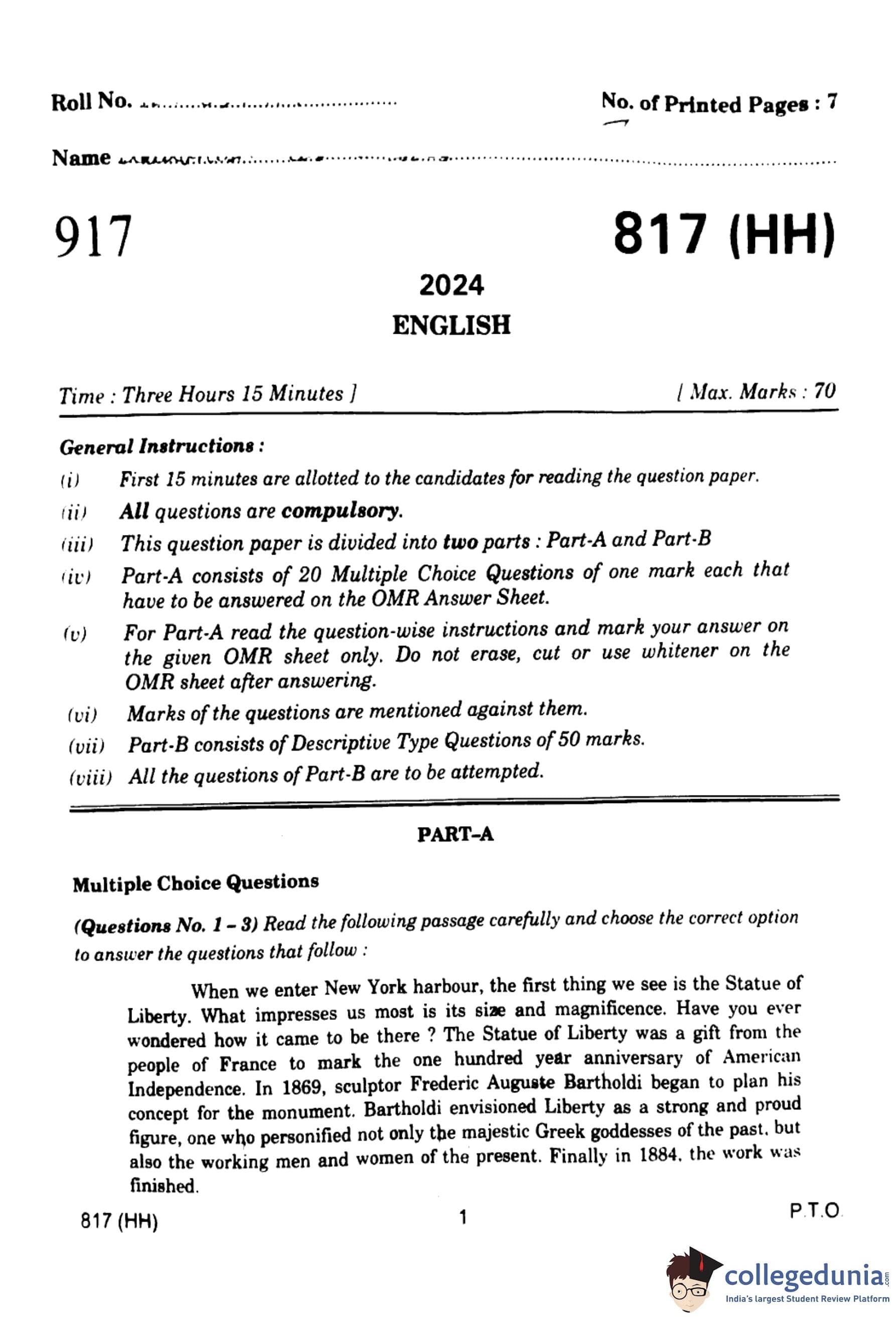
(Questions No. 1 – 3) Read the following passage carefully and choose the correct option to answer the questions that follow :
When we enter New York harbour, the first thing we see is the Statue of Liberty. What impresses us most is its size and magnificence. Have you ever wondered how it came to be there? The Statue of Liberty was a gift from the people of France to mark the one hundred year anniversary of American Independence. In 1869, sculptor Frederic Auguste Bartholdi began to plan his concept for the monument. Bartholdi envisioned Liberty as a strong and proud figure, one who personified not only the majestic Greek goddesses of the past, but also the working men and women of the present. Finally in 1884, the work was finished.
Question 1:
When we enter New York harbour, the first thing we see is :
View Solution
Step 1: Understanding the Concept:
This question is based on reading comprehension. It asks to identify the first thing seen when entering New York harbour, according to the provided passage.
Step 2: Detailed Explanation:
The first sentence of the passage states: "When we enter New York harbour, the first thing we see is the Statue of Liberty."
This directly answers the question. The other options are not mentioned in the text.
Step 3: Final Answer:
Based on the text, the correct option is (C).
Quick Tip: For reading comprehension questions, always locate the exact sentence or phrase in the passage that provides the answer. This helps avoid errors based on prior knowledge or assumptions.
The Statue of Liberty was a gift from the people of .
View Solution
Step 1: Understanding the Concept:
This is a factual recall question based on the provided passage. It asks about the origin of the Statue of Liberty as a gift.
Step 2: Detailed Explanation:
The passage clearly states: "The Statue of Liberty was a gift from the people of France to mark the one hundred year anniversary of American Independence."
This sentence explicitly names France as the country that gifted the statue.
Step 3: Final Answer:
Therefore, the correct option is (A).
Quick Tip: Pay close attention to specific details like names, places, and numbers mentioned in the passage. These are common sources for direct questions.
The Statue of Liberty personifies .
View Solution
Step 1: Understanding the Concept:
This question asks what the Statue of Liberty represents or personifies, according to the sculptor's vision described in the text.
Step 2: Detailed Explanation:
The passage describes Bartholdi's vision: "Bartholdi envisioned Liberty as a strong and proud figure, one who personified not only the majestic Greek goddesses of the past, but also the working men and women of the present."
The phrase "not only... but also" indicates that the statue embodies both concepts mentioned in options (A) and (B). Option (C) is not mentioned.
Step 3: Final Answer:
Since the statue personifies both the Greek goddesses and the working people, the correct choice is (D).
Quick Tip: Look for conjunctions like "and," "not only... but also," and "as well as" in reading passages. They often signal that multiple ideas are linked, which can be a key to answering "Both A and B" type questions correctly.
Complete the following sentence :
I will not go to his party he invites me.
View Solution
Step 1: Understanding the Concept:
This question tests the correct usage of conjunctions to express a condition. The sentence structure requires a word that means "except if".
Step 2: Detailed Explanation:
Let's analyze the options:
- until: Implies a time condition. "I will not go until he invites me" means I will wait for his invitation and then go. This changes the meaning.
- if: "I will not go if he invites me." This is grammatically correct but means the invitation is the reason for not going, which is an unusual sentiment.
- unless: Means "if not" or "except on the condition that". "I will not go to his party unless he invites me" means the only condition under which I will go is if he invites me. This fits the context perfectly.
- but: Is a coordinating conjunction used to connect contrasting ideas, which doesn't fit here.
Step 3: Final Answer:
The most logical and grammatically correct conjunction for this sentence is "unless". Therefore, the correct option is (C).
Quick Tip: Remember that "unless" introduces the only condition that can prevent the main clause from being true. It is equivalent to "if...not". For example, "You will fail unless you study" means "You will fail if you do not study."
Complete the following sentence :
This young man is true his word.
View Solution
Step 1: Understanding the Concept:
This question tests knowledge of prepositions and fixed idiomatic expressions in English.
Step 2: Detailed Explanation:
The phrase "true to one's word" is a common English idiom. It means that a person is reliable and keeps their promises. The preposition that correctly completes this idiom is "to".
- "true of" is incorrect.
- "true for" is used in different contexts (e.g., "This rule is true for everyone").
- "true at" is incorrect.
Step 3: Final Answer:
The correct idiom requires the preposition "to". Hence, the correct option is (D).
Quick Tip: Many adjectives are followed by specific prepositions (e.g., proud of, interested in, kind to). Learning these common collocations is essential for preposition-based questions.
Rearrange the following words cluster to make a meaningful sentence :
last / raining / it / been / night / has / since
View Solution
Step 1: Understanding the Concept:
This question requires rearranging a jumbled set of words to form a grammatically correct and meaningful sentence. This tests knowledge of sentence structure, specifically the Present Perfect Continuous tense.
Step 2: Key Formula or Approach:
The structure for the Present Perfect Continuous tense is:
Subject + has/have + been + Verb-ing + object/complement.
The time reference "since" is used to indicate the starting point of the action.
Step 3: Detailed Explanation:
1. Identify the Subject: "it" is the subject.
2. Identify the Verb form: The words "has", "been", and "raining" (verb-ing) form the verb phrase "has been raining".
3. Assemble the main clause: "It has been raining".
4. Add the time phrase: The remaining words are "since", "last", and "night". The correct phrase is "since last night".
5. Combine to form the full sentence: "It has been raining since last night."
Options (A), (B), and (C) are grammatically incorrect and do not follow the standard English sentence structure.
Step 4: Final Answer:
The correctly arranged sentence is in option (D).
Quick Tip: When rearranging sentences, first identify the subject and the main verb. Then, build the rest of the sentence around this core structure, adding objects, adverbs, and prepositional phrases.
He spent a lot of money on purchasing costly clothes. (Identify the word 'spent')
View Solution
Step 1: Understanding the Concept:
This question asks to identify the part of speech of the word 'spent' in the given sentence.
Step 2: Detailed Explanation:
- A verb is a word that describes an action, state, or occurrence.
- In the sentence "He spent a lot of money...", the word 'spent' describes the action that the subject 'He' performed.
- 'He' is the pronoun (subject).
- 'spent' is the action. It is the past tense of the verb 'spend'.
- Therefore, 'spent' is a verb.
Step 3: Final Answer:
The word 'spent' functions as a verb in this sentence. The correct option is (C).
Quick Tip: To identify a verb, ask "What is the subject doing?". The answer to that question is usually the verb. In this case, "What did He do?", He "spent".
Which of the following words is misspelled?
View Solution
Step 1: Understanding the Concept:
This question tests spelling. You need to identify the word that is not spelled correctly from the given options.
Step 2: Detailed Explanation:
- (A) Prayer: This is spelled correctly.
- (B) Mischief: This is spelled correctly. (A common mistake is "mischeif", but "ie" is correct).
- (C) Grammer: This is misspelled. The correct spelling is Grammar.
- (D) Attach: This is spelled correctly.
Step 3: Final Answer:
The misspelled word is "Grammer". Therefore, the correct option is (C).
Quick Tip: Spelling questions often target words with double letters or tricky vowel combinations like 'ie'/'ei'. When in doubt, try to break the word into syllables or think of related words (e.g., grammatical).
Siddhartha Gautam wandered in search of enlightenment for .
View Solution
Step 1: Understanding the Concept:
This is a reading comprehension question that asks for a specific duration mentioned in the passage.
Step 2: Detailed Explanation:
The first sentence of the passage says: "He wandered for seven years and finally sat down under a peepal tree...".
The passage explicitly states the duration of his wandering was seven years.
Step 3: Final Answer:
Based on the direct information from the text, the correct answer is (B).
Quick Tip: When a question asks for a number, date, or duration, scan the passage specifically for numerical information. This can help you find the answer quickly.
Siddhartha Gautam got enlightenment sitting under .
View Solution
Step 1: Understanding the Concept:
This question requires identifying the location (specifically, the type of tree) where Siddhartha Gautam attained enlightenment, as stated in the passage.
Step 2: Detailed Explanation:
The passage states: "...and finally sat down under a peepal tree, where he vowed to stay until enlightenment came."
The text clearly mentions that he sat under a peepal tree. This tree was later renamed the Bodhi Tree.
Step 3: Final Answer:
The correct option according to the passage is (C).
Quick Tip: Be careful with details. The passage mentions the tree was renamed the "Bodhi Tree", but the original type of tree was a "peepal tree". Read the question carefully to see what it's asking for.
Which quality of Lencho impressed the postmaster most?
View Solution
Step 1: Understanding the Concept:
This question is from the chapter "A Letter to God" and asks about the specific quality of the protagonist, Lencho, that moved the postmaster.
Step 2: Detailed Explanation:
In the story, when the postmaster reads Lencho's letter addressed to God, he is initially amused. However, he soon becomes serious. He is deeply impressed by the writer's unshakable faith. The postmaster exclaims, "What faith! I wish I had the faith of the man who wrote this letter." He decides to answer the letter to preserve this faith. Therefore, it was Lencho's great faith in God that impressed him the most.
Step 3: Final Answer:
The quality that impressed the postmaster was Lencho's profound faith. Thus, the correct option is (B).
Quick Tip: In literature-based questions, focus on the motivations and reactions of characters. Understanding why a character acts a certain way is often key to answering the question correctly.
Who is the author of the lesson ‘His First Flight’ ?
View Solution
Step 1: Understanding the Concept:
This is a direct factual question asking to identify the author of the short story 'His First Flight'.
Step 2: Detailed Explanation:
The story 'His First Flight', which is about a young seagull learning to fly, was written by the Irish novelist and short-story writer Liam O'Flaherty. The other authors are famous for different works: Paulo Coelho for "The Alchemist", Roald Dahl for children's books like "Charlie and the Chocolate Factory", and Frederick Forsyth for thrillers like "The Day of the Jackal".
Step 3: Final Answer:
The correct author is Liam O'Flaherty. Therefore, the correct option is (B).
Quick Tip: For exams, it's crucial to remember the names of authors and poets for all the chapters and poems in your syllabus. Creating a simple table of 'Title - Author/Poet' can be a great revision tool.
Who had invited Rajvir to visit his home in Upper Assam ?
View Solution
Step 1: Understanding the Concept:
This question is from the chapter "Tea from Assam" and asks to identify the person who invited the character Rajvir to Assam.
Step 2: Detailed Explanation:
In the story, Pranjol and Rajvir are classmates studying in a school in Delhi. Pranjol's father is the manager of a tea garden in Upper Assam. Pranjol invites his friend Rajvir to visit his home during the summer vacation to experience the tea country.
Step 3: Final Answer:
It was Pranjol who invited Rajvir. Therefore, the correct option is (B).
Quick Tip: Keep track of the relationships between characters in stories. Questions often test your understanding of who did what and their connection to other characters.
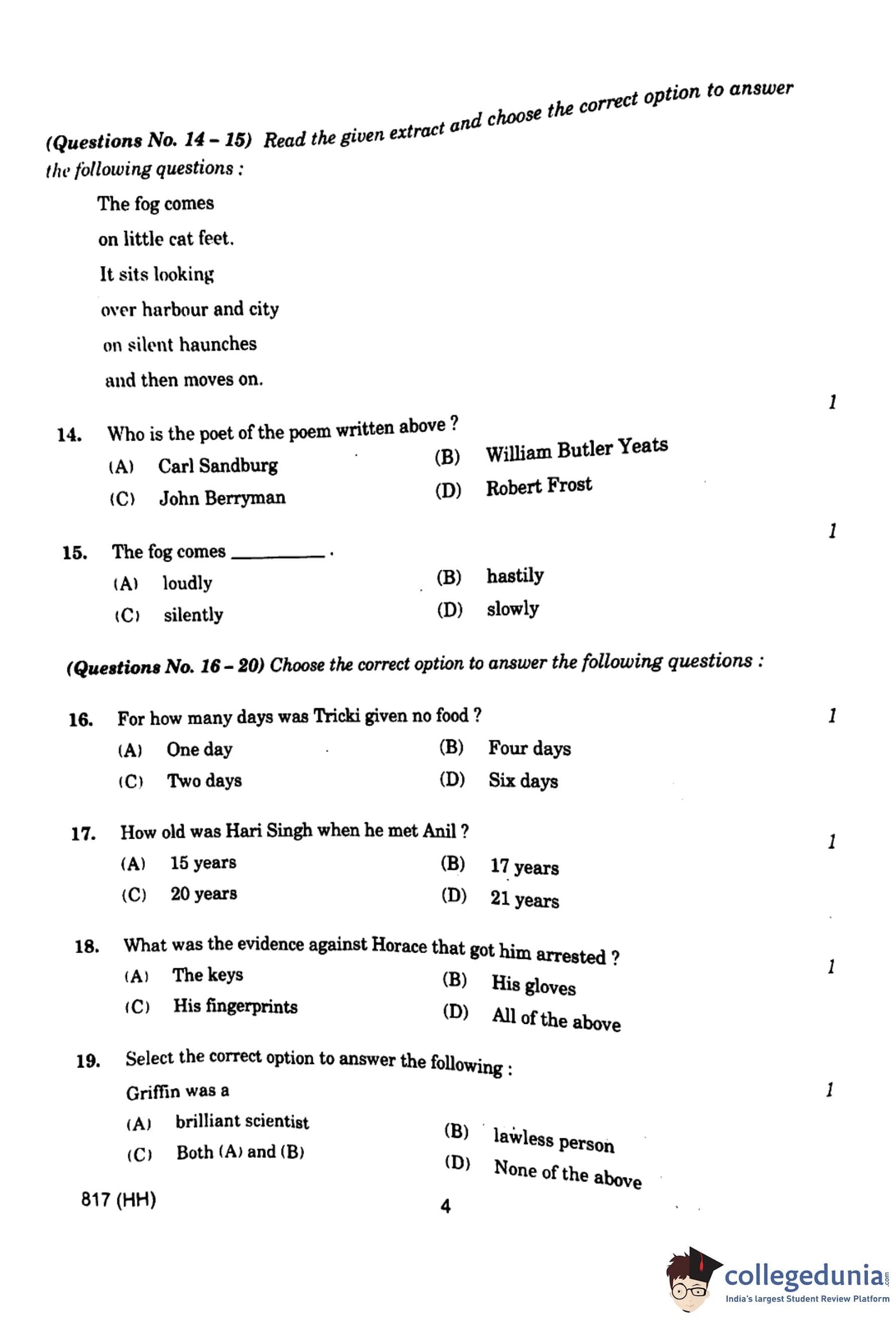
(Questions No. 14 – 15) Read the given extract and choose the correct option to answer the following questions :} \\
The fog comes
on little cat feet.
It sits looking
over harbour and city
on silent haunches
and then moves on.
Question 14:
Who is the poet of the poem written above ?
View Solution
Step 1: Understanding the Concept:
This is a factual recall question asking to identify the poet of the given lines.
Step 2: Detailed Explanation:
The lines "The fog comes / on little cat feet." are the beginning of the poem "Fog". This poem was written by the American poet Carl Sandburg. The poem uses the metaphor of a cat to describe the quiet, stealthy arrival and departure of the fog.
Step 3: Final Answer:
The poet of "Fog" is Carl Sandburg. Thus, the correct option is (A).
Quick Tip: Memorizing the first line or a key image from each poem along with its poet is an effective way to prepare for "identify the poet" questions.
The fog comes .
View Solution
Step 1: Understanding the Concept:
This question asks to interpret the imagery used in the poem to describe how the fog arrives.
Step 2: Detailed Explanation:
The poem uses the metaphor of a cat to describe the fog. It says the fog comes "on little cat feet" and sits "on silent haunches". Cats are known for being quiet and stealthy. This imagery suggests that the fog arrives quietly and without making any noise. Therefore, the best word to describe its arrival is "silently".
While "slowly" might also be true, "silently" is a more direct interpretation of the "cat feet" and "silent haunches" metaphor.
Step 3: Final Answer:
The poem's imagery implies a silent arrival. The correct option is (C).
Quick Tip: When analyzing poetry, pay close attention to metaphors and similes. Understand what qualities of the compared object (in this case, a cat) the poet is trying to attribute to the subject (the fog).
For how many days was Tricki given no food?
View Solution
Step 1: Understanding the Concept:
This question is from the story "A Triumph of Surgery" and asks about a specific detail of the dog Tricki's treatment.
Step 2: Detailed Explanation:
In the story, the veterinary surgeon, Mr. Herriot, takes the overfed dog Tricki to his surgery. For the first two days, he gives Tricki no food but plenty of water. This was part of the treatment to help the dog recover from his illness caused by overindulgence. On the third day, Tricki starts to show interest in his surroundings and begins his recovery.
Step 3: Final Answer:
Tricki was given no food for two days. The correct option is (C).
Quick Tip: Details like numbers, durations, and specific actions are important in storytelling. Pay attention to the sequence of events and timelines described in the text.
How old was Hari Singh when he met Anil?
View Solution
Step 1: Understanding the Concept:
This question is from the story "The Thief's Story" and asks for the age of the narrator, Hari Singh, at the time he met Anil.
Step 2: Detailed Explanation:
The story is narrated by Hari Singh. At the very beginning, he describes his first meeting with Anil. He states, "I was still a thief when I met Anil. And though only 15, I was an experienced and fairly successful hand." This line directly gives his age as 15.
Step 3: Final Answer:
Hari Singh was 15 years old when he met Anil. The correct option is (A).
Quick Tip: The opening paragraphs of a story often introduce key characters and provide important background information, including their age, profession, and circumstances. Pay close attention to these initial details.
What was the evidence against Horace that got him arrested?
View Solution
Step 1: Understanding the Concept:
This question is from the story "A Question of Trust" and asks for the key piece of evidence that led to the arrest of Horace Danby.
Step 2: Detailed Explanation:
Horace Danby was a meticulous thief who always wore gloves to avoid leaving fingerprints. However, during the robbery at Shotover Grange, he is tricked by a young lady (who is also a thief) into believing she is the owner of the house. She asks him to open the safe for her as she has forgotten the combination. Deceived by her, Horace takes off his gloves to open the safe. He then leaves without the jewels. When the robbery is reported, the police find his fingerprints all over the room and on the safe, which serves as conclusive evidence to arrest him.
Step 3: Final Answer:
The crucial evidence against Horace was his fingerprints. The correct option is (C).
Quick Tip: In detective or thriller stories, the "mistake" made by the criminal is often the turning point of the plot. Identifying this crucial error helps in understanding the resolution of the story.
Select the correct option to answer the following :
Griffin was a
View Solution
Step 1: Understanding the Concept:
This question is from the story "Footprints without Feet" and asks to describe the character of Griffin, the invisible scientist.
Step 2: Detailed Explanation:
- (A) brilliant scientist: The story establishes that Griffin was indeed a brilliant scientist. He discovered a way to make the human body transparent, which is a remarkable scientific achievement.
- (B) lawless person: Despite his intelligence, Griffin misused his discovery. He was short-tempered and vindictive. He burned down his landlord's house, stole food and clothes from a London store, robbed a theatrical company, and assaulted a village constable. These actions clearly show him to be a lawless person.
Since both descriptions are accurate, the best answer is the one that includes both aspects of his character.
Step 3: Final Answer:
Griffin was both a brilliant scientist and a lawless person. The correct option is (C).
Quick Tip: Character analysis questions often require you to consider multiple facets of a character's personality. Don't just focus on one trait; look for evidence throughout the story that reveals their complexities.
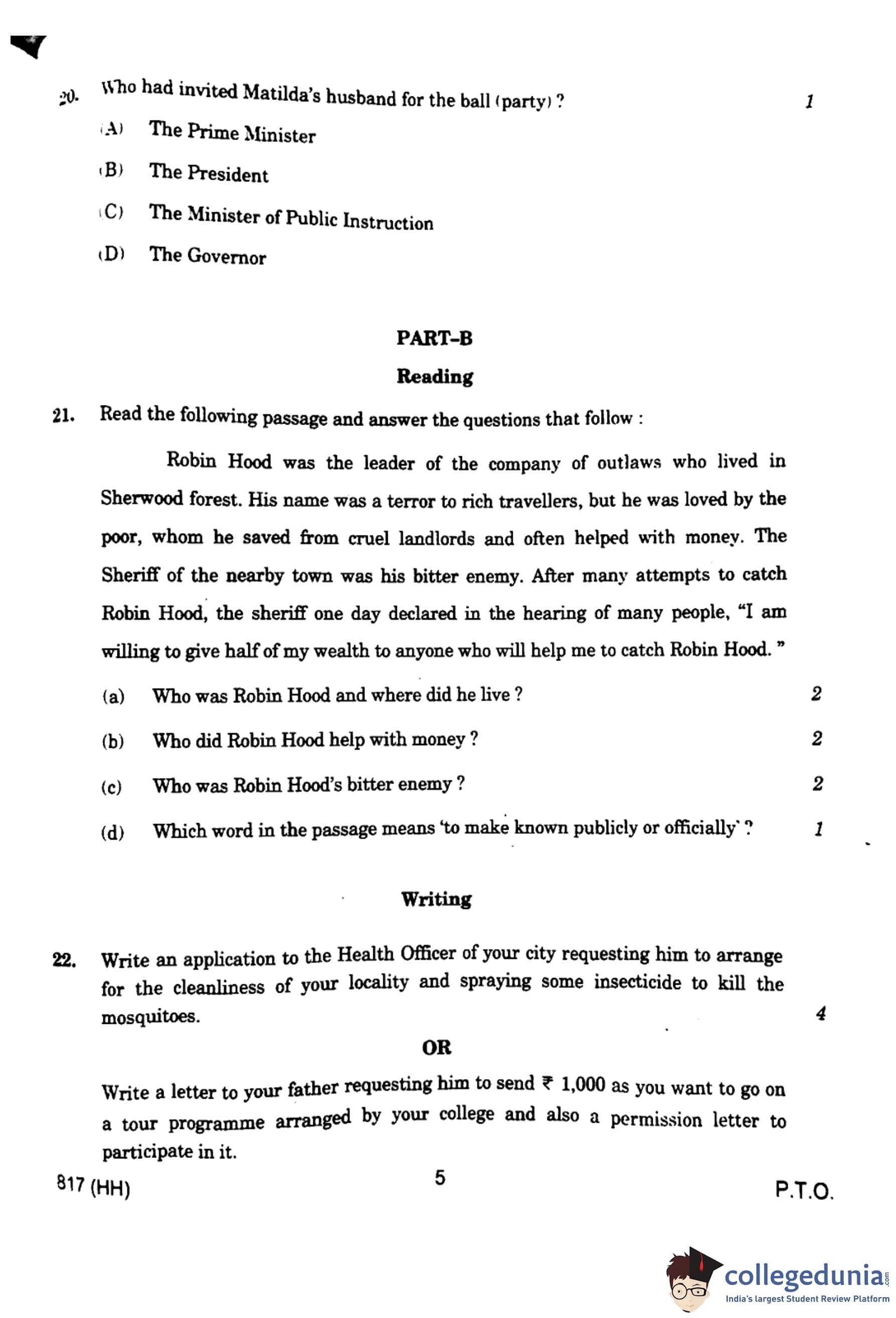
Who had invited Matilda's husband for the ball (party) ?
View Solution
Step 1: Understanding the Concept:
This question is from the chapter "The Necklace" and asks to identify the person or office that sent the invitation for the ball.
Step 2: Detailed Explanation:
In the story, Matilda's husband, M. Loisel, is a clerk at the Ministry of Public Instruction. One evening, he comes home with an invitation to a party. The invitation is from his superior, the Minister of Public Instruction, and his wife. This invitation is the catalyst for the entire plot of the story.
Step 3: Final Answer:
The invitation was from The Minister of Public Instruction. Therefore, the correct option is (C).
Quick Tip: In literature questions, remember the occupations and social status of the characters. M. Loisel's job is a key detail that explains how he received such a prestigious invitation.
Robin Hood was the leader of the company of outlaws who lived in Sherwood forest. His name was a terror to rich travellers, but he was loved by the poor, whom he saved from cruel landlords and often helped with money. The Sheriff of the nearby town was his bitter enemy. After many attempts to catch Robin Hood, the sheriff one day declared in the hearing of many people, “I am willing to give half of my wealth to anyone who will help me to catch Robin Hood.”
Question 21:
Who was Robin Hood and where did he live?
View Solution
Step 1: Understanding the Concept:
This question asks for two pieces of information from the passage: Robin Hood's identity and his place of residence.
Step 2: Detailed Explanation:
The very first sentence of the passage provides a clear answer to both parts of the question. It states: "Robin Hood was the leader of the company of outlaws who lived in Sherwood forest."
- Who was he? The leader of a company of outlaws.
- Where did he live? In Sherwood forest.
Step 3: Final Answer:
Based on the text, Robin Hood was the leader of outlaws living in Sherwood forest.
Quick Tip: For questions with multiple parts (like "Who" and "Where"), make sure your answer addresses all parts. Skim the text for keywords related to identity (leader, king, thief) and location (forest, town, city).
Who did Robin Hood help with money?
View Solution
Step 1: Understanding the Concept:
This question asks to identify the group of people that Robin Hood assisted financially, according to the passage.
Step 2: Detailed Explanation:
The second sentence of the passage describes Robin Hood's relationship with different groups of people. It says, "...but he was loved by the poor, whom he saved from cruel landlords and often helped with money."
This clearly indicates that it was the poor who received financial help from him.
Step 3: Final Answer:
According to the passage, Robin Hood helped the poor with money.
Quick Tip: Look for connecting words like "who" or "whom". In the passage, "whom" refers back to "the poor", linking them directly to the action of being helped with money.
Who was Robin Hood's bitter enemy?
View Solution
Step 1: Understanding the Concept:
The question asks to identify the antagonist or the main enemy of Robin Hood as described in the text.
Step 2: Detailed Explanation:
The third sentence of the passage directly answers this question. It states: "The Sheriff of the nearby town was his bitter enemy."
The phrase "bitter enemy" explicitly defines the relationship between the Sheriff and Robin Hood.
Step 3: Final Answer:
The passage identifies the Sheriff of the nearby town as Robin Hood's bitter enemy.
Quick Tip: Keywords like "enemy," "rival," "opponent," or phrases like "fought against" are strong indicators of conflict and can help you quickly locate the answer to questions about antagonists.
Which word in the passage means 'to make known publicly or officially'?
View Solution
Step 1: Understanding the Concept:
This is a vocabulary-in-context question. It requires finding a word in the passage that matches the given definition.
Step 2: Detailed Explanation:
Let's analyze the passage to find a word that means 'to make known publicly or officially'.
The last sentence says: "...the sheriff one day declared in the hearing of many people..."
The word "declared" means to announce something formally, publicly, or officially. In this context, the sheriff is making a public proclamation to many people. This perfectly matches the given definition.
Step 3: Final Answer:
The word in the passage that means 'to make known publicly or officially' is "declared".
Quick Tip: When faced with a vocabulary question, read the sentence where the target word appears. The surrounding words and the overall context can provide strong clues to its meaning.
Write an application to the Health Officer of your city requesting him to arrange for the cleanliness of your locality and spraying some insecticide to kill the mosquitoes.
View Solution
12-B, Nehru Nagar,
Prayagraj, Uttar Pradesh.
25th July, 20XX
The Health Officer,
Municipal Corporation,
Prayagraj.
Subject: Request for cleanliness and spraying of insecticide in Nehru Nagar.
Sir/Madam,
I am a resident of Nehru Nagar, and I wish to draw your attention to the unsanitary conditions prevailing in our locality. The garbage bins are overflowing, and the drains are not cleaned regularly. This has led to stagnant water in several places, which has become a breeding ground for mosquitoes.
The mosquito menace has increased significantly, posing a serious health risk to the residents, especially children. There is a growing fear of the spread of diseases like malaria and dengue.
Therefore, I kindly request you to take immediate action to arrange for the proper cleanliness of our locality and to get insecticide sprayed to control the mosquito population. Your prompt action will be highly appreciated.
Thank you.
Yours faithfully,
[Your Name]
A concerned citizen
Quick Tip: When writing a formal application, ensure you follow the correct format: sender's address, date, receiver's address, a clear subject line, a formal salutation, a concise body, and a formal closing. The tone should always be polite and respectful.
Write a letter to your father requesting him to send Rupees 1,000 as you want to go on a tour programme arranged by your college and also a permission letter to participate in it.
View Solution
Room No. 54,
St. John's College Hostel,
Agra, Uttar Pradesh.
15th October, 20XX
My dear Father,
I hope this letter finds you and everyone at home in good health. I am doing well in my studies here.
Our college has arranged an educational tour to historical places in Rajasthan for five days during the upcoming autumn break. It will be a great opportunity to learn about our country's history and architecture. All my friends are going, and I am very eager to join them.
The total cost for the tour is Rupees 1,000. I request you to please send me this amount. The college also requires a signed permission letter from parents for students who wish to participate. Kindly send me a letter granting me permission to go on this tour.
Give my regards to Mother and love to Chotu.
Yours lovingly,
[Your Name]
Quick Tip: In an informal letter, the tone should be personal and friendly. Start with a warm greeting, state your purpose clearly but politely in the body, and end with personal remarks and a loving closing.
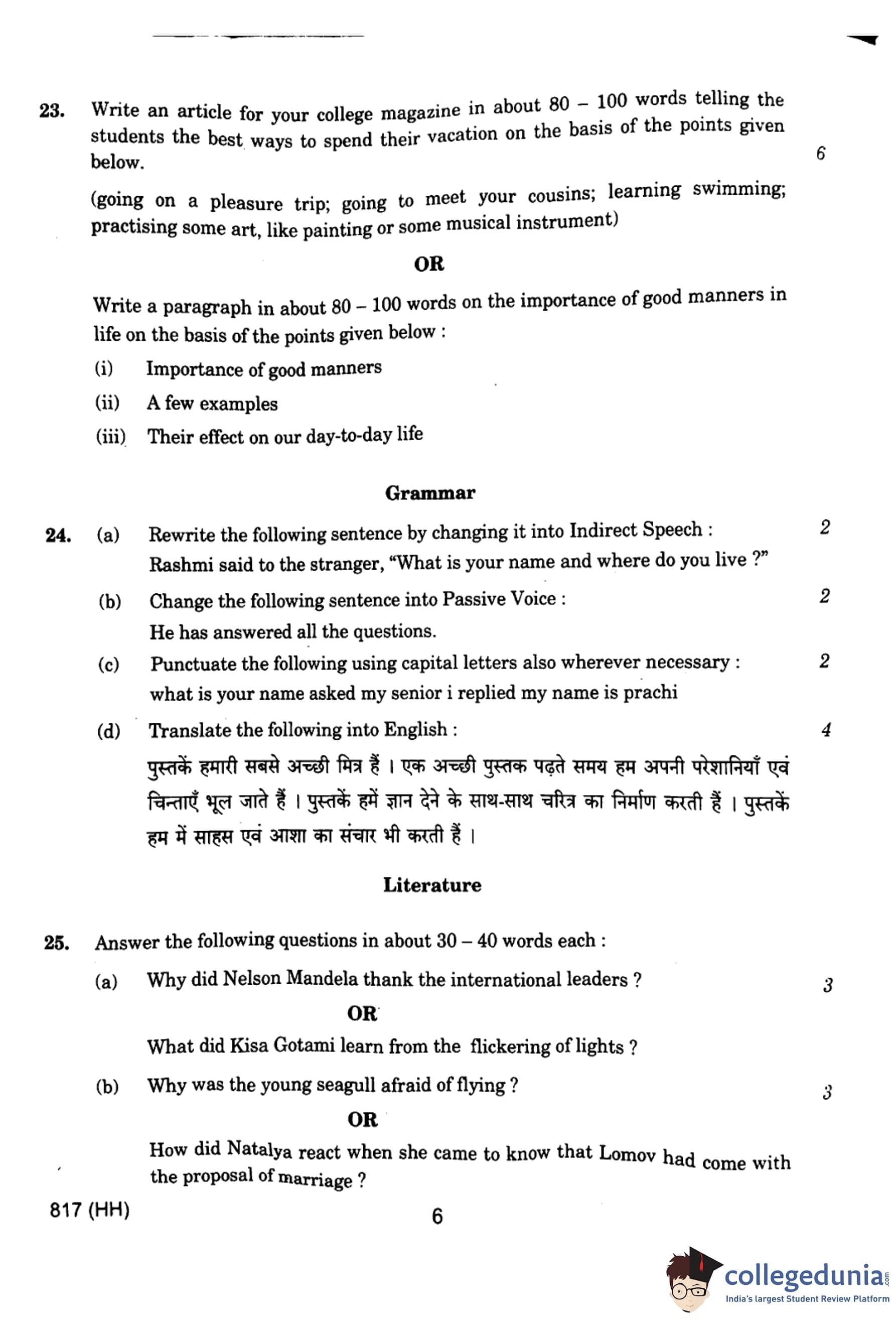
Write an article for your college magazine in about 80 – 100 words telling the students the best ways to spend their vacation on the basis of the points given below.
(going on a pleasure trip; going to meet your cousins; learning swimming; practising some art, like painting or some musical instrument)
View Solution
Making the Most of Your Vacation
\textit{By [A Student's Name]
Vacations are a perfect time to relax and recharge. Instead of wasting these precious days, we can make them productive and memorable. A pleasure trip to a new place can be a refreshing experience. It's also a great time to strengthen family bonds by visiting cousins and relatives. Vacations offer the ideal opportunity to learn a new life skill, such as swimming, which is both fun and useful. Furthermore, you can pursue a hobby by practising an art like painting or learning a musical instrument. A well-spent vacation rejuvenates our mind and body for the challenges ahead.
Quick Tip: For article writing, start with a catchy title and a byline. Structure your content logically, incorporating all the given points smoothly. End with a concluding line that summarizes the main idea. Always adhere to the word limit.
Write a paragraph in about 80 – 100 words on the importance of good manners in life on the basis of the points given below :
(i) Importance of good manners
(ii) A few examples
(iii) Their effect on our day-to-day life
View Solution
The Importance of Good Manners
Good manners are invaluable in life as they reflect our character and upbringing. They are the foundation of positive social interactions and help us earn respect. Simple gestures, such as saying 'please', 'thank you', and 'sorry', listening to others without interrupting, and showing respect to elders, are examples of good manners. Incorporating these habits into our day-to-day life has a profound effect. They make our interactions with others pleasant and smooth, help build strong relationships, and create a positive impression in both personal and professional spheres. Ultimately, good manners are essential for success and for creating a civilized society.
Quick Tip: When writing a paragraph based on given points, ensure you cover all of them. Start with a topic sentence that introduces the main idea (importance), then provide supporting details (examples), and finally explain the consequences or effects, leading to a concluding thought.
Rewrite the following sentence by changing it into Indirect Speech :
Rashmi said to the stranger, “What is your name and where do you live ?”
View Solution
Rashmi asked the stranger what his name was and where he lived.
Quick Tip: When converting a 'Wh-' question to indirect speech, the reporting verb (like 'said to') changes to 'asked' or 'enquired'. The question mark is removed, and the sentence structure becomes a statement (subject + verb), not a question. The tense of the verb in the reported speech shifts one step back (e.g., present to past).
Change the following sentence into Passive Voice :
He has answered all the questions.
View Solution
All the questions have been answered by him.
Quick Tip: To change from Active to Passive voice, the object of the active sentence becomes the subject of the passive sentence. The verb form is changed to `to be + past participle`. For the present perfect tense, the structure is `has/have + been + V3`. The original subject can be added at the end with 'by'.
Punctuate the following using capital letters also wherever necessary :
what is your name asked my senior i replied my name is prachi
View Solution
“What is your name?” asked my senior. I replied, “My name is Prachi.”
Quick Tip: Punctuation for dialogue requires quotation marks (" ") around the spoken words. The first word inside the quotes must be capitalized. A question mark or comma should be placed inside the closing quotation mark. The pronoun 'I' and proper nouns like names (Prachi) must always be capitalized.
Translate the following into English :

View Solution
Books are our best friends. While reading a good book, we forget our problems and worries. Besides giving us knowledge, books also build our character. Books also fill us with courage and hope.
Quick Tip: When translating, aim for the natural phrasing in the target language rather than a literal word-for-word translation. Focus on conveying the core meaning of each sentence smoothly. For example, can be translated as 'instill', 'fill us with', or 'infuse'.
Why did Nelson Mandela thank the international leaders ?
View Solution
Nelson Mandela thanked the international leaders for joining the inauguration ceremony to witness the victory of justice, peace, and human dignity. He considered it a special honour because, during the apartheid era, South Africa was diplomatically isolated. Their presence signified the world's recognition and approval of the first democratically elected, non-racial government in South Africa.
Quick Tip: To answer 'Why' questions effectively, focus on the reasons and motivations behind a character's actions. Use keywords from the question (e.g., "thanked international leaders") to locate the relevant section in the text and then explain the context and significance of the event.
What did Kisa Gotami learn from the flickering of lights ?
View Solution
As Kisa Gotami sat by the roadside feeling hopeless, she watched the city lights flicker up and then get extinguished. This sight made her realize that human life is similar to these lights—it is brief and temporary. She understood the profound truth that death is common and inevitable for all living beings.
Quick Tip: Symbolism is a key literary device. When a question mentions an object or an event like 'flickering of lights', think about what it represents. In this case, the lights symbolize the transient nature of human life, helping the character reach an important realization.
Why was the young seagull afraid of flying?
View Solution
The young seagull was afraid of flying because he lacked confidence in his wings. He believed that his wings would not support him over the vast, intimidating sea below. Despite his siblings flying fearlessly with shorter wings, he was overcome by fear and couldn't muster the courage to take the plunge from the ledge.
Quick Tip: When discussing a character's fear or hesitation, focus on both the internal feelings (lack of confidence, self-doubt) and the external factors (the vast sea, the high ledge) that contribute to their state of mind. This provides a more complete answer.
How did Natalya react when she came to know that Lomov had come with the proposal of marriage?
View Solution
When Natalya's father revealed that Lomov had come to propose, her reaction changed dramatically from anger to desperation. She was shocked and immediately became hysterical. She started wailing and accused her father of driving Lomov away. She desperately begged him to bring Lomov back at once, showing her strong desire to get married.
Quick Tip: In plays, characters often have dramatic and sudden changes in emotion. When answering questions about character reactions, describe the initial state, the event that causes the change, and the new emotional state, using specific details from the text (e.g., "wailing," "begged him").
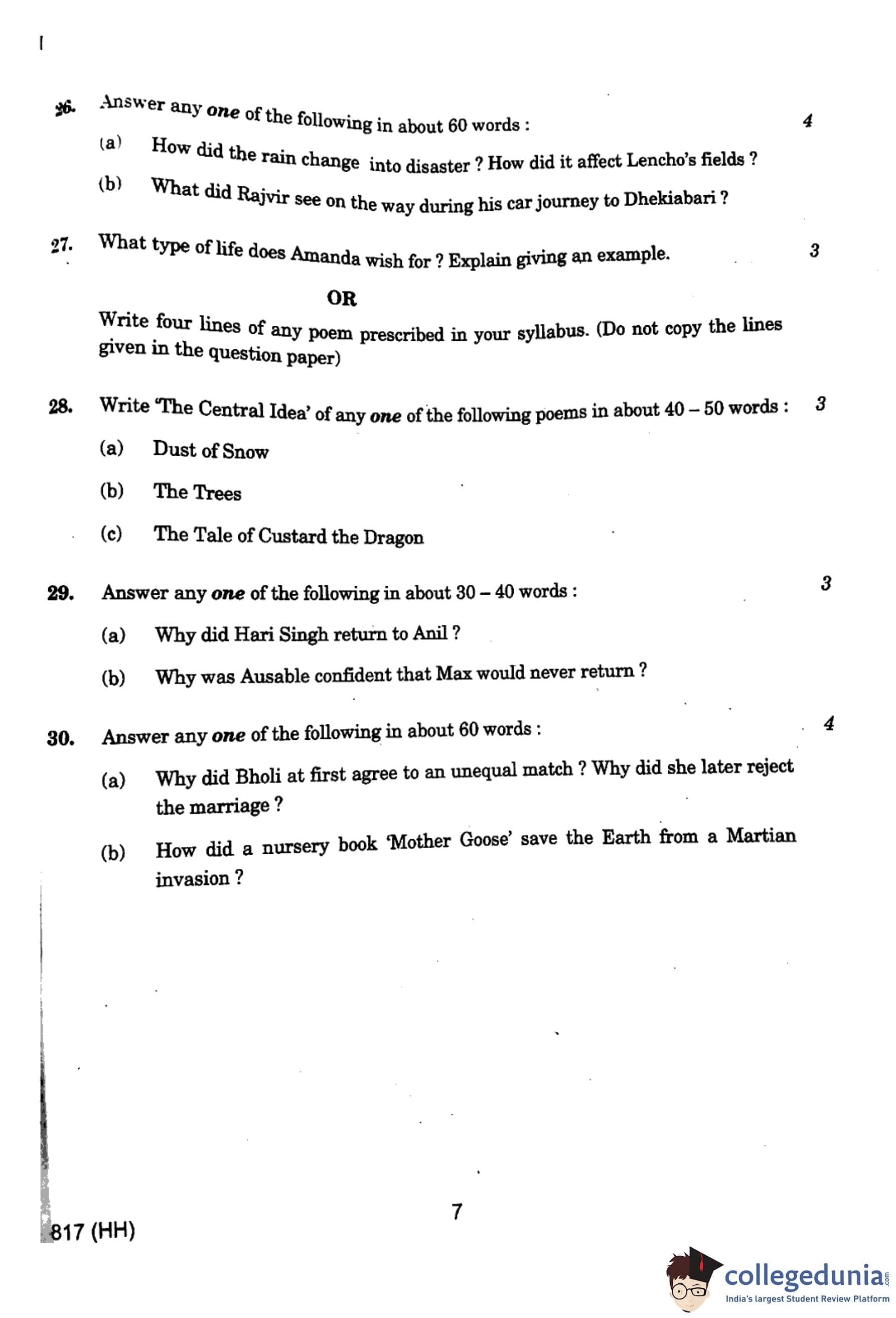
How did the rain change into disaster? How did it affect Lencho's fields ?
View Solution
The rain, which initially brought joy to Lencho, quickly turned into a disaster when it was accompanied by strong winds and large hailstones. The hailstorm raged for an hour, completely covering the valley. It destroyed everything in its path. Lencho's fields of ripe corn were totally ruined, with not a single leaf left on the trees. The field looked white, as if covered with salt, leaving Lencho and his family devastated and facing a year of hunger.
Quick Tip: When a question asks 'How', it requires an explanation of the process. Structure your answer chronologically: describe the initial situation (welcome rain), the turning point (hailstorm), and the final result (total destruction of the fields). Use descriptive words from the story to make your answer more effective.
What did Rajvir see on the way during his car journey to Dhekiabari?
View Solution
During his car journey to Dhekiabari, Rajvir was captivated by the scenic beauty of the Assam tea country. He saw vast expanses of neatly pruned tea bushes stretching as far as the eye could see, resembling a sea of green. Amidst these tea gardens were tall, sturdy shade-trees. He also observed groups of tea-pluckers, wearing plastic aprons with bamboo baskets on their backs, busily plucking the newly sprouted tea leaves.
Quick Tip: For questions asking 'What did [character] see?', focus on providing a vivid description from the character's perspective. Use sensory details mentioned in the text (e.g., 'sea of tea bushes', 'doll-like figures') to create a clear picture for the reader, just as the author did.
What type of life does Amanda wish for ? Explain giving an example.
View Solution
Amanda wishes for a life of freedom, peace, and silence, away from the constant nagging and instructions of her parents. She longs for a world where she is not told what to do or how to behave. For example, she imagines herself as a mermaid drifting blissfully alone in a languid, emerald sea. This fantasy represents her deep desire for a serene and unrestricted existence, where she can be herself without any external control.
Quick Tip: When answering questions about a character's desires, focus on the contrast between their reality and their imagination. Use specific examples from the poem's fantasy stanzas (mermaid, orphan, Rapunzel) to support your explanation of what they wish for.
Write four lines of any poem prescribed in your syllabus. (Do not copy the lines given in the question paper)
View Solution
Poem: Dust of Snow
The way a crow
Shook down on me
The dust of snow
From a hemlock tree
Quick Tip: For questions that require quoting from memory, it's wise to memorize the first four or last four lines of a few short, important poems from your syllabus. This ensures you can answer accurately and quickly without violating instructions.
Write 'The Central Idea' of the following poem in about 40 – 50 words :
Dust of Snow
View Solution
The central idea of "Dust of Snow" is that even small, seemingly insignificant natural events can have a profound and positive impact on our mood. The poem conveys that one should not be pessimistic, as a simple moment of beauty, like snow falling from a tree, can change one's perspective and save a day from being wasted.
Quick Tip: To find the central idea, look for the main message or lesson the poet is trying to convey. In "Dust of Snow," the focus is on the power of nature to bring about a sudden, positive change in human emotions.
Write 'The Central Idea' of the following poem in about 40 – 50 words :
The Trees
View Solution
The central idea of "The Trees" is the conflict between humanity and nature. The poem personifies trees, depicting their silent struggle to break free from the artificial confines of a house and reclaim their rightful place in the forest. It symbolizes nature's intrinsic need for freedom and its rebellion against human attempts to domesticate it.
Quick Tip: Focus on the main conflict or tension in the poem. Here, it is the movement of the trees from inside to outside. This physical movement symbolizes a deeper theme of nature's resistance and the desire for liberation.
Write 'The Central Idea' of the following poem in about 40 – 50 words :
The Tale of Custard the Dragon
View Solution
The central idea of "The Tale of Custard the Dragon" is that true courage is demonstrated through actions in times of crisis, not through boastful words. The poem satirizes the idea that appearances can be deceiving, as the seemingly cowardly dragon, Custard, proves to be the bravest of all when faced with real danger.
Quick Tip: This poem is a ballad with a humorous tone. Its central idea is a moral lesson. Identify the character who acts heroically versus those who only talk, and the message about true bravery becomes clear.
Why did Hari Singh return to Anil?
View Solution
Hari Singh returned to Anil because his conscience was pricked by Anil's trust and his own desire for a better life. He realized that the stolen money would soon be spent, but the opportunity to learn how to read and write from Anil would open the door to a respectable and honest future.
Quick Tip: When analyzing a character's decision, consider their internal conflict. Hari Singh's choice wasn't just about money; it was a conflict between his life as a thief and the potential for an educated, respected life that Anil offered him.
Why was Ausable confident that Max would never return?
View Solution
Ausable was confident that Max would never return because he knew there was no balcony outside the window. He had cleverly fabricated the story of the balcony to create an escape route in Max's mind. Ausable was certain that Max, in his panic to escape the "police", would jump to his death from the sixth floor.
Quick Tip: This story hinges on mental acuity versus physical force. To answer this question, focus on Ausable's clever deception. The key is that the 'escape route' he provides is actually a fatal trap.
Why did Bholi at first agree to an unequal match ? Why did she later reject the marriage ?
View Solution
Bholi initially agreed to the unequal match with the lame, old widower Bishamber Nath out of obedience and for the sake of her family's honour, as she didn't want to be a burden on her parents. However, she later rejected the marriage when Bishamber greedily demanded a dowry of five thousand rupees and showed utter disrespect to her father. Her education had instilled in her a sense of self-respect and the courage to stand up against injustice, empowering her to make her own decision and refuse to marry a mean and contemptible man.
Quick Tip: For two-part questions, structure your answer to address both parts distinctly. Use words like "initially" and "later" to show the shift in the character's actions and explain the reason for this change, which in Bholi's case was the transformative power of her education.
How did a nursery book 'Mother Goose' save the Earth from a Martian invasion ?
View Solution
The nursery rhyme book 'Mother Goose' saved Earth through misinterpretation. The Martian leader, Think-Tank, decoded the rhymes literally and believed them to be threats from a highly advanced Earthling civilization. When they saw the rhyme about Humpty Dumpty's great fall, they mistook Humpty for their own master (who resembled an egg) and thought Earthlings were planning to capture and kill him. Terrified by this perceived threat and Earth's "advanced" knowledge, the Martians aborted their invasion and fled back to Mars in panic.
Quick Tip: The key to this answer is the theme of 'literal interpretation leads to comical error'. Explain how the Martians' lack of understanding of creative literature like nursery rhymes led them to a completely wrong and frightening conclusion, ultimately saving the planet.





Comments