




UP Board Class 10 English Question Paper 2024 PDF (Code 817 HK) is available for download here. The English exam was conducted on March 4, 2024 in the Morning Shift from 8:30 AM to 11:45 AM. The total marks for the theory paper are 70. Students reported the paper to be easy to moderate.
UP Board Class 10 English Question Paper 2024 (Code 817 HK) with Solutions
| UP Board Class 10 English (817 HK) 2024 Question Paper with Solutions PDF |  Download Download |
Check Solutions |

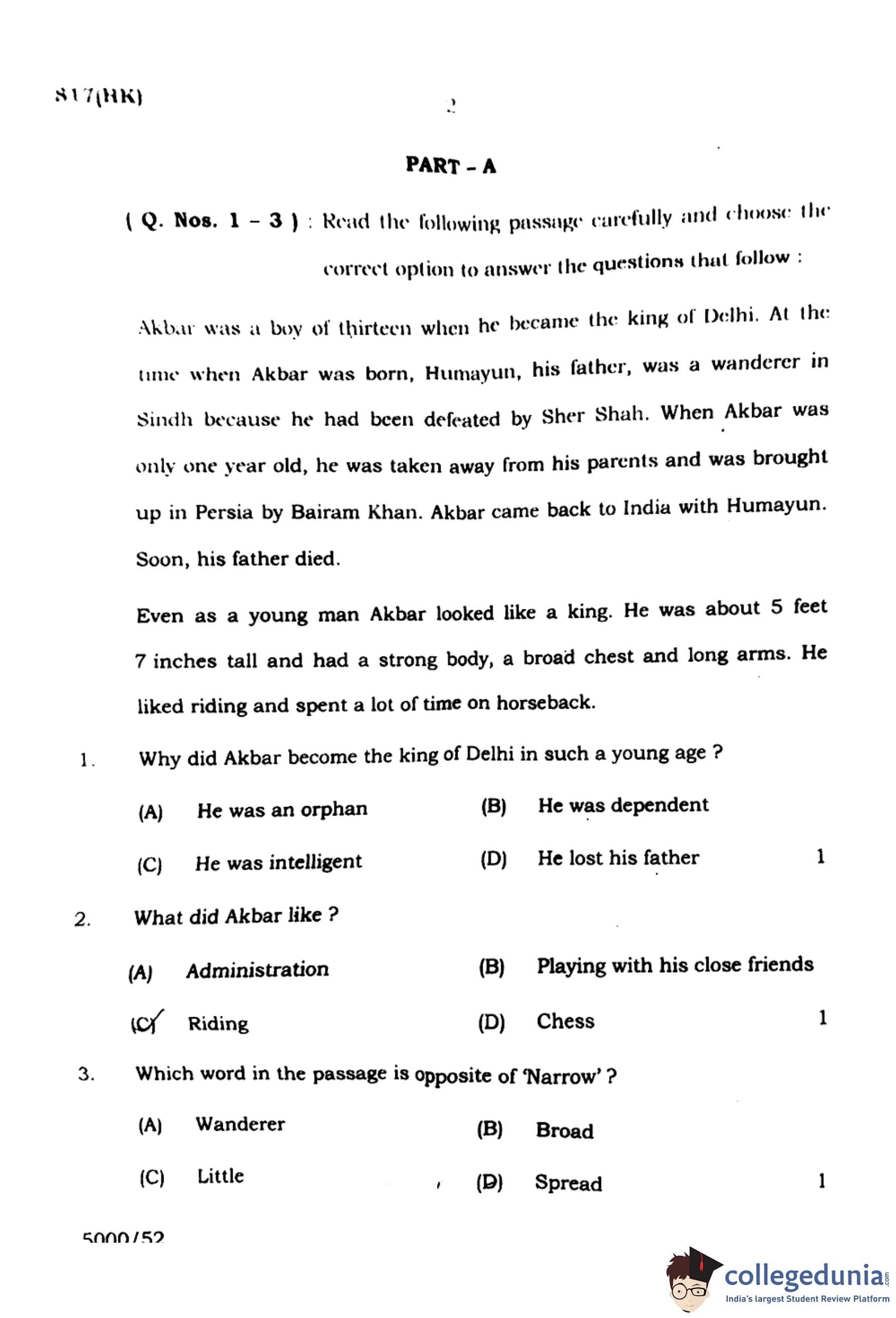
Directions (Q. Nos. 1-3): Read the following passage carefully and choose the correct option to answer the questions that follow:
Akbar was a boy of thirteen when he became the king of Delhi. At the time when Akbar was born, Humayun, his father, was a wanderer in Sindh because he had been defeated by Sher Shah. When Akbar was only one year old, he was taken away from his parents and was brought up in Persia by Bairam Khan. Akbar came back to India with Humayun. Soon, his father died.
Even as a young man Akbar looked like a king. He was about 5 feet 7 inches tall and had a strong body, a broad chest and long arms. He liked riding and spent a lot of time on horseback.
Question 1:
Why did Akbar become the king of Delhi in such a young age?
View Solution
Step 1: Understanding the Concept:
The question asks for the specific reason why Akbar ascended the throne at the young age of thirteen. We need to find the information in the provided passage that explains this event.
Step 2: Detailed Explanation:
Let's analyze the passage for clues. The text states: "Akbar came back to India with Humayun. Soon, his father died."
The death of a ruling king (Humayun) would necessitate his heir (Akbar) taking the throne, regardless of his age. This directly explains why Akbar became king so young.
Option (A) is incorrect because while his father died, the term 'orphan' implies both parents are deceased, which is not stated. More importantly, the direct cause was his father's death, making him the successor.
Option (B) and (C) are not mentioned in the passage as reasons for his coronation.
Step 3: Final Answer:
The passage clearly states that Akbar's father, Humayun, died. This event led to Akbar becoming the king. Therefore, the correct answer is that he lost his father.
Quick Tip: In reading comprehension, locate the exact sentence or phrase that answers the question directly. Avoid making assumptions or choosing options that are plausible but not explicitly supported by the text.
What did Akbar like?
View Solution
Step 1: Understanding the Concept:
The question asks about Akbar's preferences or hobbies as described in the passage. We need to identify the activity that the text explicitly states he enjoyed.
Step 2: Detailed Explanation:
Scanning the passage, the last paragraph describes Akbar's physical appearance and interests. The last sentence says: "He liked riding and spent a lot of time on horseback."
This sentence directly answers the question. The other options (Administration, Playing with friends, Chess) are not mentioned in the passage.
Step 3: Final Answer:
Based on the clear statement in the passage, Akbar liked riding.
Quick Tip: Questions about details like preferences, characteristics, or actions are often found towards the end of a descriptive passage. Pay close attention to the concluding sentences.
Which word in the passage is opposite of 'Narrow'?
View Solution
Step 1: Understanding the Concept:
This question tests vocabulary, specifically the ability to identify an antonym (a word with the opposite meaning) within the context of the given passage. The word is 'Narrow'.
Step 2: Detailed Explanation:
'Narrow' means of small width. We are looking for a word in the passage that means of large width.
The second paragraph describes Akbar's physique: "...he had a strong body, a broad chest and long arms."
The word 'broad' means wide, which is the direct opposite of 'narrow'.
Let's check the other options:
Wanderer: a person who travels aimlessly; not an antonym for narrow.
Little: small in size; it can be an antonym in some contexts, but 'broad' is a more precise opposite for width.
Spread: to extend over a large area; a verb, not an adjective used in the passage as an opposite.
Step 3: Final Answer:
The word 'broad' is used in the passage and is the correct antonym for 'narrow'.
Quick Tip: When searching for a synonym or antonym in a passage, first understand the precise meaning of the word given in the question. Then, scan the text for words that match or oppose that meaning.
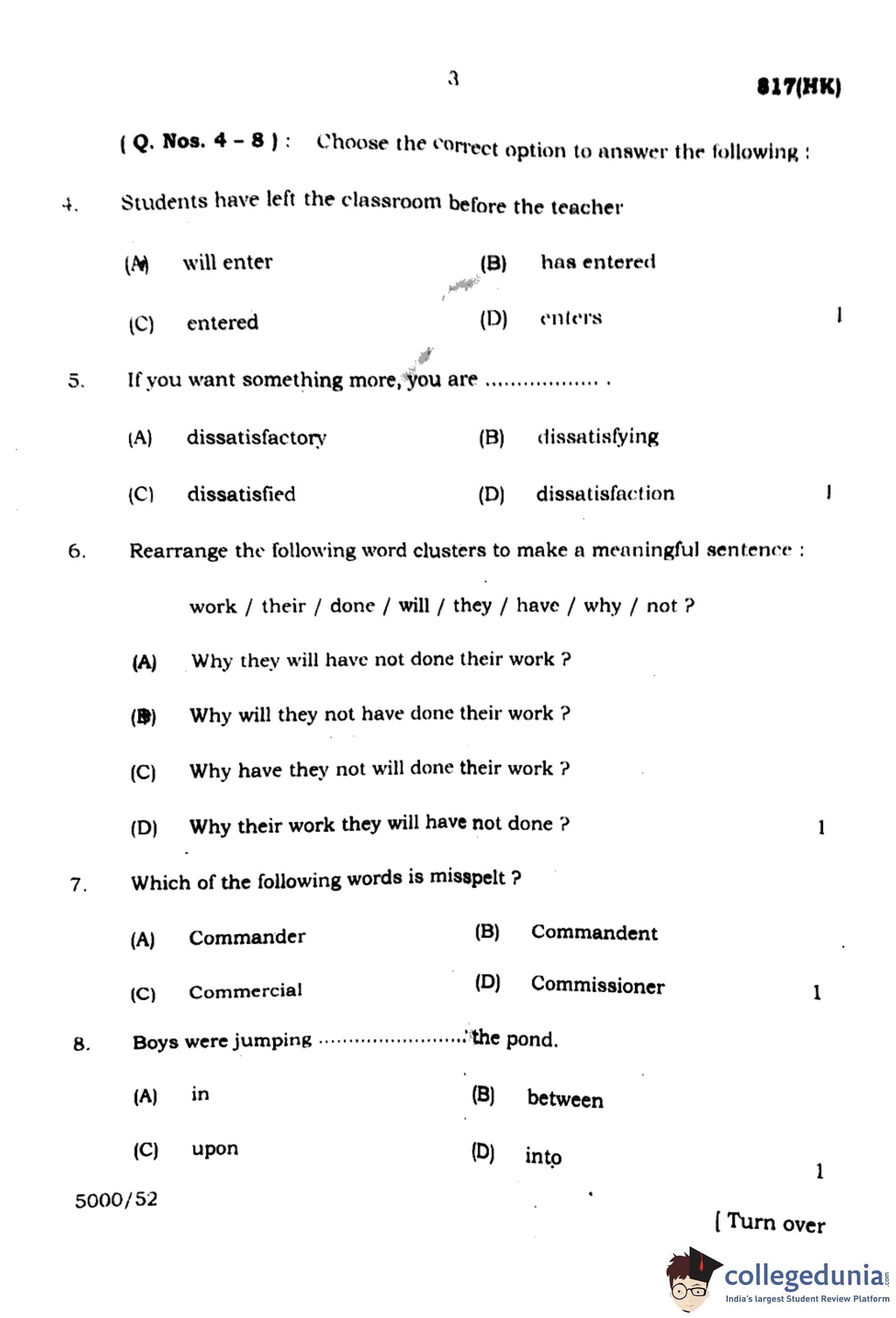
Students have left the classroom before the teacher ______
View Solution
Step 1: Understanding the Concept:
This question tests the rules of tense sequence, particularly how different tenses are used together in a complex sentence with a conjunction like 'before'.
Step 2: Detailed Explanation:
The first clause, "Students have left the classroom," is in the Present Perfect Tense. This tense is used to describe an action that happened in the past but has a connection to the present.
When 'before' is used to connect a Present Perfect clause with another clause, the second clause is typically in the Simple Present Tense to indicate a future event from a present perspective or a general truth.
The correct structure is: Present Perfect Tense + before + Simple Present Tense.
Applying this rule: "Students have left (Present Perfect) the classroom before the teacher enters (Simple Present)."
Step 3: Final Answer:
The correct verb form to complete the sentence according to the rules of tense agreement is 'enters'.
Quick Tip: Remember the common tense pairings with conjunctions. For instance, "Past Perfect + before + Simple Past" (e.g., They \textbf{had left} before she \textbf{arrived}) and "Present Perfect + before + Simple Present" (e.g., They \textbf{have left} before she \textbf{arrives}).
If you want something more, you are ______
View Solution
Step 1: Understanding the Concept:
This question tests the correct usage of different forms of a word (adjective, noun, etc.). The sentence requires an adjective to describe the state of the subject "you".
Step 2: Detailed Explanation:
Let's analyze the options:
(A) dissatisfactory: An adjective used to describe a thing or situation that is not good enough (e.g., "The result was dissatisfactory.").
(B) dissatisfying: An adjective (present participle) used to describe a thing or situation that causes dissatisfaction (e.g., "It was a dissatisfying meal.").
(C) dissatisfied: An adjective (past participle) used to describe a person's feeling of not being pleased or happy (e.g., "The customer was dissatisfied.").
(D) dissatisfaction: A noun representing the feeling of being dissatisfied (e.g., "He expressed his dissatisfaction.").
The sentence "you are ______" describes the feeling of the person ("you"). Therefore, the correct adjective is 'dissatisfied'.
Step 3: Final Answer:
The correct word to fill in the blank is 'dissatisfied'.
Quick Tip: Remember the difference between '-ed' and '-ing' adjectives. Adjectives ending in '-ed' typically describe a person's feelings (I am bor\textbf{ed}), while adjectives ending in '-ing' describe the thing that causes the feeling (The movie is bor\textbf{ing}).
Rearrange the following word clusters to make a meaningful sentence:
work / their / done / will / they / have / why / not ?
View Solution
Step 1: Understanding the Concept:
This question tests your knowledge of English syntax, specifically the correct word order for forming an interrogative (question) sentence in the Future Perfect Tense.
Step 2: Detailed Explanation:
The sentence is a 'Wh-' question (starting with "Why") and is negative ("not"). The tense involves "will have done," which is the Future Perfect Tense.
The standard structure for a negative 'Wh-' question in the Future Perfect Tense is:
Wh-word + auxiliary verb (will) + subject + not + auxiliary verb (have) + past participle + object?
Let's apply this structure to the given words:
Wh-word: Why
Auxiliary verb: will
Subject: they
Negative: not
Auxiliary verb: have
Past participle: done
Object: their work
Assembling these gives: "Why will they not have done their work?" This matches option (B). The other options violate the standard rules of English word order.
Step 3: Final Answer:
The correctly arranged sentence is option (B).
Quick Tip: For jumbled questions, first identify the sentence type (statement, question, command). For questions, remember the "QUASI" rule for word order: Question word -> Auxiliary verb -> Subject -> Infinitive (or main verb).
Which of the following words is misspelt?
View Solution
Step 1: Understanding the Concept:
This question tests spelling. You need to identify the word that is not spelled correctly among the given options.
Step 2: Detailed Explanation:
Let's examine each option:
(A) Commander: This spelling is correct. It refers to a person in authority, especially over a body of troops or a military operation.
(B) Commandent: This spelling is incorrect. The correct spelling for the officer in charge of a particular force or institution is Commandant.
(C) Commercial: This spelling is correct. It relates to commerce or business.
(D) Commissioner: This spelling is correct. It refers to a person appointed to a role on or by a commission.
Step 3: Final Answer:
The word 'Commandent' is misspelt. The correct spelling is 'Commandant'.
Quick Tip: Pay close attention to word endings like '-ant' and '-ent', as they are common sources of spelling errors. When in doubt, try to recall seeing the word in a book or text.
Boys were jumping _________ the pond.
View Solution
Step 1: Understanding the Concept:
This question tests the correct use of prepositions, specifically prepositions of movement.
Step 2: Detailed Explanation:
The verb "jumping" indicates motion. The sentence describes the action of moving from a location outside the pond to a location inside the pond.
Let's analyze the prepositions:
in: Indicates a state of being inside something (e.g., "The boys were swimming \textit{in the pond."). It does not show movement from outside to inside.
between: Used to describe the space separating two things (e.g., "The path is \textit{between the trees.").
upon: A more formal version of 'on', meaning on top of something (e.g., "He sat \textit{upon the throne.").
into: Used to show movement toward the inside of a place or container (e.g., "He walked \textit{into the room.").
Since the boys are moving from outside to inside the pond, the correct preposition is 'into'.
Step 3: Final Answer:
The correct preposition to complete the sentence is 'into'.
Quick Tip: Differentiate between prepositions of place (in, on, at) and prepositions of movement (into, onto, towards). Use prepositions of movement with action verbs like jump, go, throw, etc.
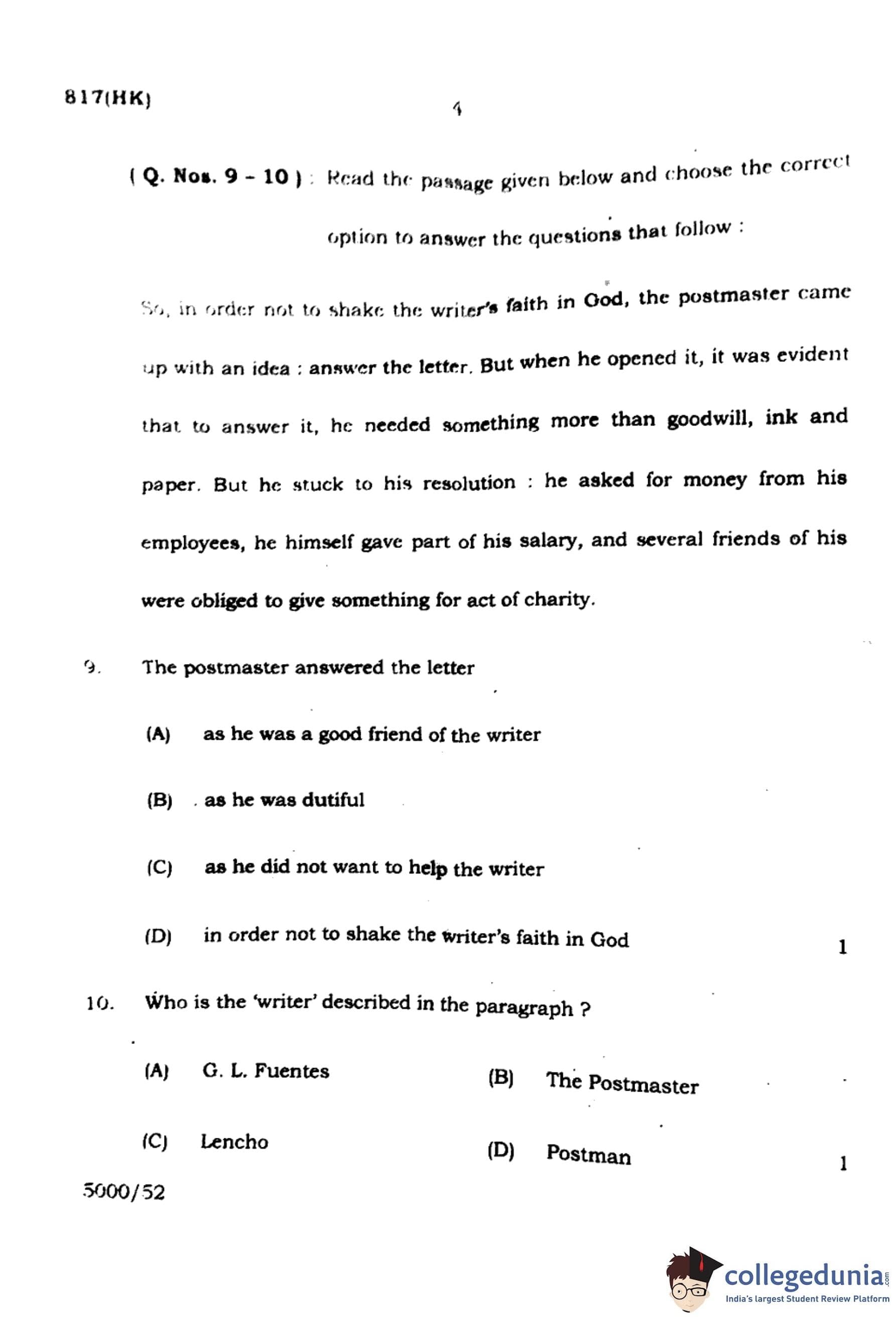
Directions (Q. Nos. 9-10): Read the passage given below and choose the correct option to answer the questions that follow:
So, in order not to shake the writer's faith in God, the postmaster came up with an idea: answer the letter. But when he opened it, it was evident that to answer it, he needed something more than goodwill, ink and paper. But he stuck to his resolution: he asked for money from his employees, he himself gave part of his salary, and several friends of his were obliged to give something for act of charity.
Question 9:
The postmaster answered the letter
View Solution
Step 1: Understanding the Concept:
The question asks for the postmaster's motivation for answering the letter. The answer can be found by carefully reading the provided passage.
Step 2: Detailed Explanation:
The very first sentence of the passage explicitly states the reason for the postmaster's action: "So, in order not to shake the writer's faith in God, the postmaster came up with an idea: answer the letter."
This phrase directly corresponds to option (D). The passage does not suggest that the postmaster was a friend of the writer (A) or that he was merely being dutiful (B). Option (C) is the opposite of what he did.
Step 3: Final Answer:
The postmaster's primary reason for answering the letter was to preserve the writer's faith in God.
Quick Tip: Often, the reason or purpose for an action in a narrative is stated at the very beginning of the sentence or paragraph that describes the action. Look for introductory phrases like "In order to...", "Because...", or "So...".
Who is the 'writer' described in the paragraph?
View Solution
Step 1: Understanding the Concept:
This question requires contextual knowledge of the source text from which the passage is taken. The passage describes a famous scene from a story in the curriculum.
Step 2: Detailed Explanation:
This passage is an excerpt from the story "A Letter to God" by G. L. Fuentes.
Lencho is the main character, a farmer, who writes a letter to God asking for money after his crops are destroyed. He is the 'writer' with unwavering faith.
The Postmaster is the character who reads the letter and decides to answer it.
G. L. Fuentes is the author of the story, not a character within it.
Postman is the one who first finds the letter.
Therefore, the 'writer' of the letter to God is Lencho.
Step 3: Final Answer:
The 'writer' described in the paragraph is Lencho.
Quick Tip: For literature-based comprehension, questions may require you to identify characters or context from the original story. It's important to be familiar with the plots and characters of the prescribed texts.
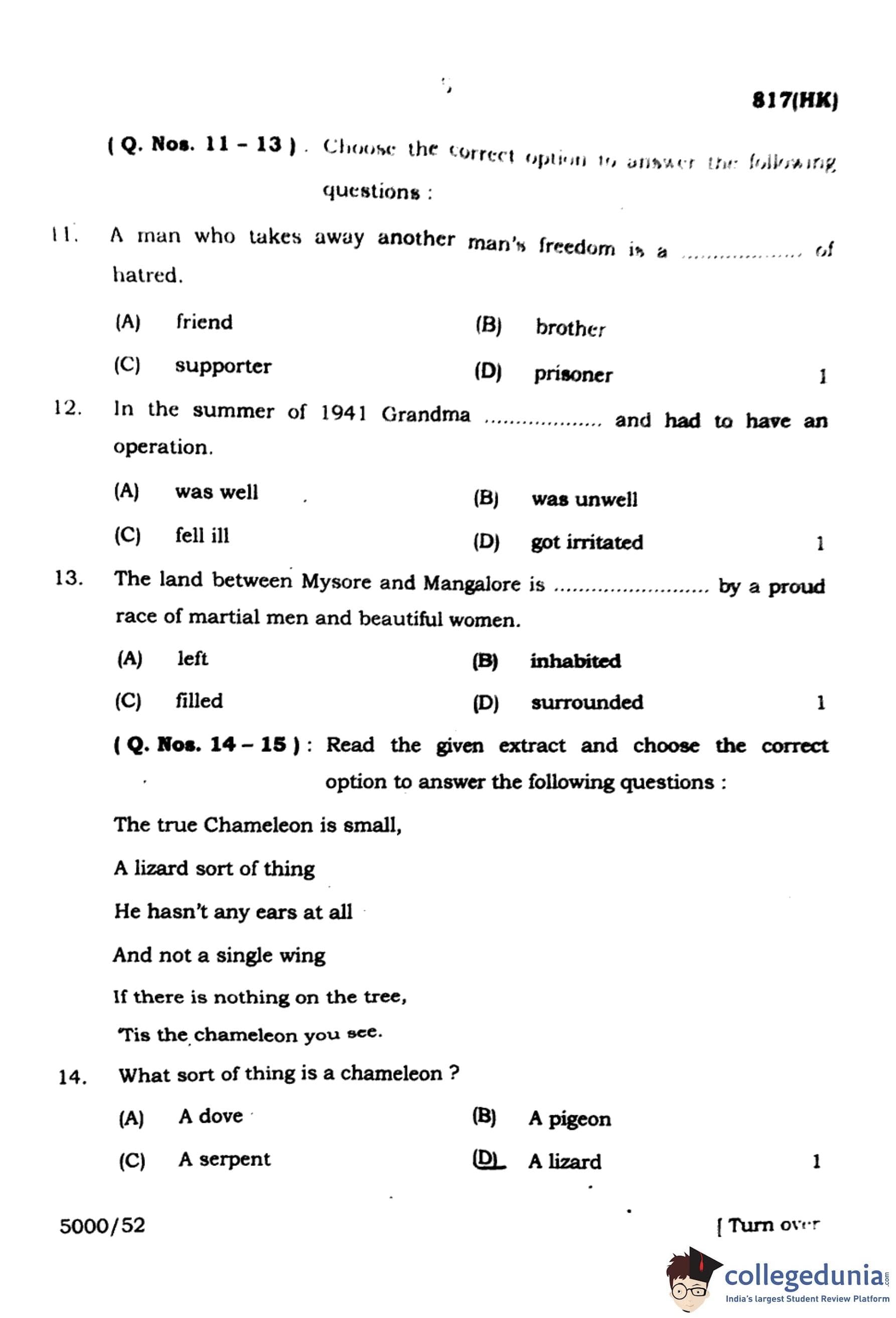
A man who takes away another man's freedom is a __________ of hatred.
View Solution
Step 1: Understanding the Concept:
This question is a direct quote or a concept from the chapter "Nelson Mandela: Long Walk to Freedom." It tests your understanding of Mandela's philosophy on freedom and oppression.
Step 2: Detailed Explanation:
In his autobiography, Nelson Mandela states that both the oppressor and the oppressed are robbed of their humanity. He famously writes, "A man who takes away another man's freedom is a prisoner of hatred; he is locked behind the bars of prejudice and narrow-mindedness."
According to this philosophy, the oppressor is not free but is a 'prisoner' of his own hatred and prejudice.
Step 3: Final Answer:
The correct word to complete the sentence based on the text is 'prisoner'.
Quick Tip: Pay close attention to the philosophical statements and key quotes made by main characters in literary texts. They often form the basis for exam questions.
In the summer of 1941 Grandma __________ and had to have an operation.
View Solution
Step 1: Understanding the Concept:
This question tests factual recall from the chapter "From the Diary of Anne Frank." It refers to a specific event mentioned by Anne in her diary.
Step 2: Detailed Explanation:
In her diary, Anne Frank recounts her family's life. She mentions that in the summer of 1941, her grandmother became sick and required surgery. The phrase used to describe this event is that her grandmother "fell ill". This phrase accurately captures the sudden onset of a serious sickness that would necessitate an operation. While "was unwell" is generally correct, "fell ill" is more specific to the context of the story.
Step 3: Final Answer:
The most appropriate phrase to complete the sentence is "fell ill".
Quick Tip: For questions based on diaries or autobiographies, remembering the sequence of key life events, dates, and their descriptions is important.
The land between Mysore and Mangalore is __________ by a proud race of martial men and beautiful women.
View Solution
Step 1: Understanding the Concept:
This question is a fill-in-the-blank from the chapter "Coorg." It tests your comprehension of the text's description of the region and its people.
Step 2: Detailed Explanation:
The chapter on Coorg describes the location as a piece of heaven that must have drifted from the kingdom of God. It then describes the people who live there. The sentence structure requires a verb that means "lived in" or "occupied by." The word "inhabited" means to live in a place. The text states that this beautiful land is inhabited by the Kodavus (Coorgis), who are known for their bravery and hospitality.
Step 3: Final Answer:
The correct word to fill the blank is 'inhabited'.
Quick Tip: In fill-in-the-blank questions from prose, read the entire sentence to understand the context. This will help you choose the word with the most precise meaning for that context.
Directions (Q. Nos. 14-15): Read the given extract and choose the correct option to answer the following questions:
\noindent The true Chameleon is small,
A lizard sort of thing
He hasn't any ears at all
And not a single wing
If there is nothing on the tree,
'Tis the chameleon you see.
Question 14:
What sort of thing is a chameleon?
View Solution
Step 1: Understanding the Concept:
This question asks for the description of a chameleon as provided in the poem. The answer is stated directly in the text.
Step 2: Detailed Explanation:
The second line of the poetry extract explicitly describes the chameleon. It says: "A lizard sort of thing". This clearly identifies the chameleon as being like a lizard. The other options are birds or a snake, which are incorrect based on the poem.
Step 3: Final Answer:
According to the poem, a chameleon is a "lizard sort of thing".
Quick Tip: In poetry comprehension, answers to direct questions are often found verbatim in the lines of the poem. Read each line carefully to locate the specific description asked for.
What do you see if there is nothing on the tree?
View Solution
Step 1: Understanding the Concept:
This question tests your understanding of the poetic device used in the last two lines, which describe the chameleon's special ability.
Step 2: Detailed Explanation:
The last two lines of the extract are:
"If there is nothing on the tree,
'Tis the chameleon you see."
This is a paradox. The poet is humorously explaining the chameleon's ability to camouflage itself perfectly with its surroundings. When it is on a tree, it changes its color to match the tree, making it seem like there is "nothing" there. Therefore, if you look at a tree and see nothing, it might just be a perfectly camouflaged chameleon.
Step 3: Final Answer:
According to the poem's logic, if you see nothing on the tree, you are actually seeing a chameleon.
Quick Tip: Be aware of figurative language like paradox, irony, and metaphor in poems. The literal meaning can sometimes point to a deeper, non-literal interpretation, as with the idea of camouflage here.
What kind of citizen was Horace Danby thought?
View Solution
Step 1: Understanding the Concept:
This question is about the character Horace Danby from the story "A Question of Trust." It specifically asks about his public reputation, i.e., what people thought of him.
Step 2: Detailed Explanation:
The story describes Horace Danby as a successful locksmith who was about fifty years old and unmarried. The text explicitly states that he was considered a "good and honest citizen." Although he had a secret life of robbing one safe per year, his public image was that of a respectable and honest man. The question asks what he was "thought" to be, not what he actually was.
Step 3: Final Answer:
Horace Danby was thought to be an honest citizen by those who knew him.
Quick Tip: In character analysis questions, distinguish between a character's true nature and their perceived public image. The wording of the question (e.g., "was thought," "was considered," "actually was") is a key clue.
By whom was Horace Danby tricked?
View Solution
Step 1: Understanding the Concept:
This question tests your knowledge of the plot of the story "A Question of Trust" and the characters involved in the main conflict.
Step 2: Detailed Explanation:
In the story, while Horace Danby is attempting to rob a safe at Shotover Grange, he is interrupted by a young woman dressed in red. She very cleverly pretends to be the wife of the owner of the house. By acting confidently and tricking him into believing her story, she persuades him to open the safe for her, after which she takes the jewels and leaves him to be caught by the police. Therefore, he was tricked by a clever young lady.
Step 3: Final Answer:
Horace Danby was outsmarted and tricked by a clever young lady.
Quick Tip: Remembering the key turning points in a story's plot and the roles different characters play (protagonist, antagonist) is essential for answering plot-based questions.
What did Griffin do in revenge when his landlord tried to eject him?
View Solution
Step 1: Understanding the Concept:
This question asks about a specific action taken by the main character, Griffin, in the story "Footprints without Feet." It concerns the event that made him a homeless wanderer.
Step 2: Detailed Explanation:
The story explains that Griffin was a brilliant but lawless scientist. His landlord disliked him and tried to evict him. In revenge, Griffin, who had already made himself invisible, took action. The text states: "In revenge Griffin set fire to the house." This act forced him to remove his clothes to become unseen and flee into the cold London air.
Step 3: Final Answer:
In revenge against his landlord, Griffin set fire to the house.
Quick Tip: The opening paragraphs of a story often provide crucial background information or describe the "inciting incident" that sets the plot in motion. Pay close attention to these details.
Mrs. Hall was convinced that the room was haunted by
View Solution
Step 1: Understanding the Concept:
This question asks about the belief of a secondary character, Mrs. Hall, regarding the strange events happening in her inn in the story "Footprints without Feet."
Step 2: Detailed Explanation:
When the invisible Griffin causes furniture to move on its own in his room at the inn, Mrs. Hall and the other villagers are terrified. The floating hat and the chair that springs to life and pushes her out of the room convince her that supernatural forces are at work. The text specifically mentions her thoughts: "My poor mother used to sit in that chair," she moaned. "To think it should rise up against me now!" The villagers thought it was witchcraft, and Mrs. Hall herself became hysterical, crying that the room was haunted by spirits. While 'ghosts' is a similar concept, 'spirits' is the word more directly associated with her reaction in the text.
Step 3: Final Answer:
Mrs. Hall was convinced that the room was haunted by spirits.
Quick Tip: Pay attention to the specific vocabulary used by characters or the narrator to describe events. Sometimes, options may seem similar (like spirits and ghosts), but one word is more accurate according to the source text.
One thing that Richard Ebright could do is
View Solution
Step 1: Understanding the Concept:
This question is about the main character from "The Making of a Scientist," Richard Ebright. It asks to identify one of his key activities or hobbies mentioned in the text.
Step 2: Detailed Explanation:
The chapter highlights that Richard Ebright had a driving curiosity from a very young age. This curiosity manifested in his hobby of collecting things. The text says he collected butterflies, rocks, fossils, and coins. This hobby of collecting, particularly butterflies, was what set him on his path to becoming a great scientist. The other activities listed are not mentioned as his prominent hobbies in the story.
Step 3: Final Answer:
A key activity that Richard Ebright was known for was to collect things.
Quick Tip: In biographical stories, questions often focus on the subject's childhood hobbies, interests, and key experiences, as these are presented as the foundation for their later success.
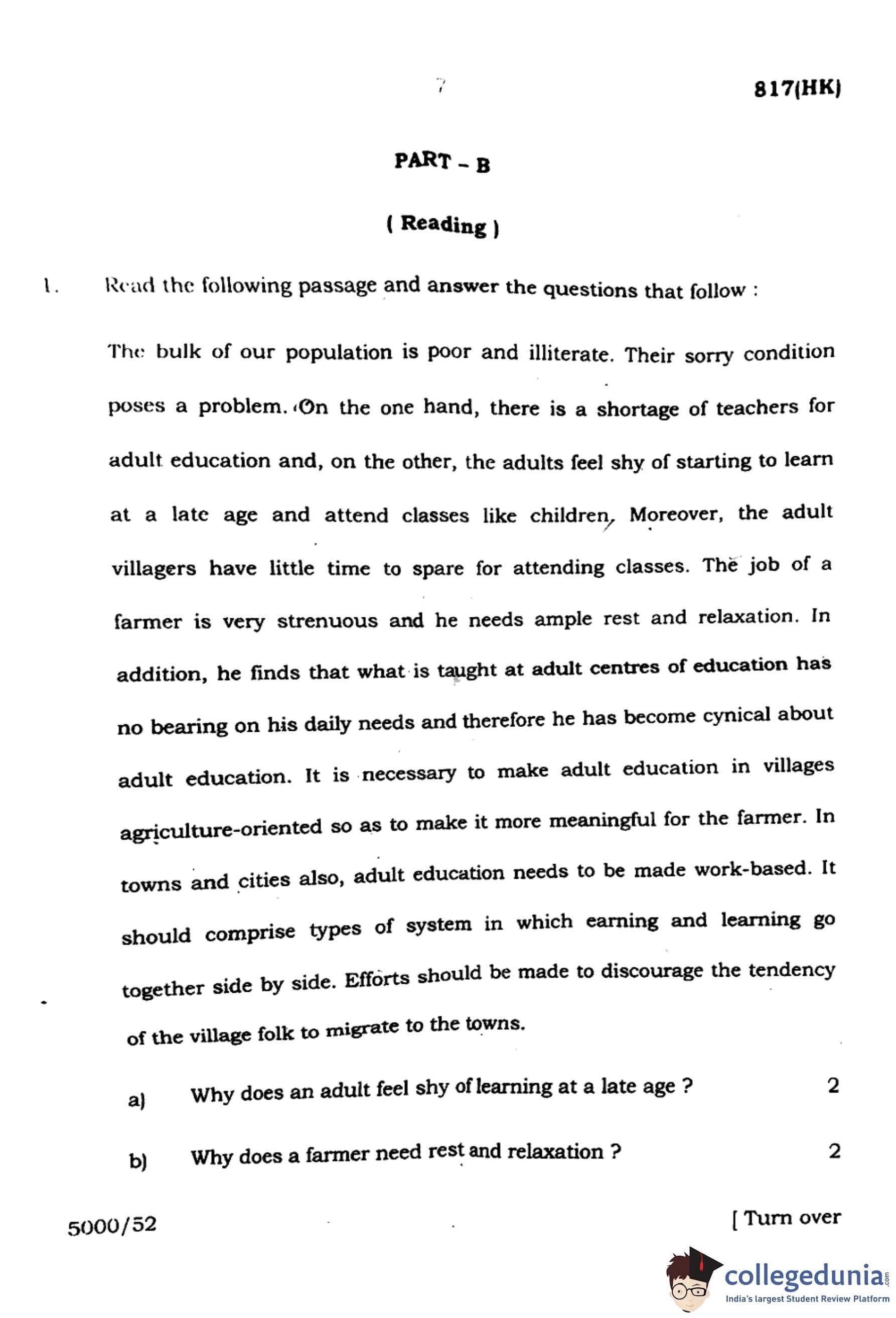
The bulk of our population is poor and illiterate. Their sorry condition poses a problem. On the one hand, there is a shortage of teachers for adult education and, on the other, the adults feel shy of starting to learn at a late age and attend classes like children. Moreover, the adult villagers have little time to spare for attending classes. The job of a farmer is very strenuous and he needs ample rest and relaxation. In addition, he finds that what is taught at adult centres of education has no bearing on his daily needs and therefore he has become cynical about adult education. It is necessary to make adult education in villages agriculture-oriented so as to make it more meaningful for the farmer. In towns and cities also, adult education needs to be made work-based. It should comprise types of system in which earning and learning go together side by side. Efforts should be made to discourage the tendency of the village folk to migrate to the towns.
Question 21:
Why does an adult feel shy of learning at a late age?
View Solution
Step 1: Understanding the Question:
The question asks for the reason mentioned in the passage for why adults feel shy about starting their education late in life.
Step 2: Locating the Information in the Passage:
We need to scan the passage to find the part that discusses the feelings of adults regarding education. The passage states: "...the adults feel shy of starting to learn at a late age and attend classes like children."
Step 3: Formulating the Answer:
Based on the passage, an adult feels shy of learning at a late age because they have to attend classes and learn in the same manner as children, which can feel embarrassing or awkward for them.
Quick Tip: When answering comprehension questions, try to locate the exact sentence in the passage that contains the answer. Formulate your answer using the information given in that sentence.
Why does a farmer need rest and relaxation?
View Solution
Step 1: Understanding the Question:
The question asks for the reason provided in the text for why farmers require rest and relaxation.
Step 2: Locating the Information in the Passage:
The passage discusses the challenges faced by adult villagers, including farmers. It states: "The job of a farmer is very strenuous and he needs ample rest and relaxation."
Step 3: Formulating the Answer:
According to the passage, a farmer needs ample rest and relaxation because their job is very strenuous, meaning it is physically demanding and tiring.
Quick Tip: Look for keywords in the question (e.g., "farmer," "rest") and then scan the passage for those same words to quickly find the relevant information.
"In towns and cities, adult education needs to be made work-based." What meaning do you draw from this statement?
View Solution
Step 1: Understanding the Question:
The question asks for an interpretation of the statement that adult education in urban areas should be "work-based," based on the context provided in the passage.
Step 2: Locating the Information in the Passage:
The sentence immediately following the quoted statement provides the explanation. It says: "It should comprise types of system in which earning and learning go together side by side."
Step 3: Formulating the Answer:
The statement "adult education needs to be made work-based" means that education for adults in towns and cities should be practical and vocational. It should be designed in such a way that it helps them acquire job-related skills, allowing them to earn a livelihood while they are still in the process of learning. The focus is on practical application rather than just theoretical knowledge.
Quick Tip: Often, a passage will clarify a key statement in the sentence that immediately follows it. Read the surrounding text carefully to understand the intended meaning.
Which word in the passage is opposite of 'Bold'?
View Solution
Step 1: Understanding the Question:
The question asks us to find a word in the given passage that has the opposite meaning to the word 'Bold'.
Step 2: Analyzing the Word and Searching for its Opposite:
'Bold' means confident, courageous, and not afraid or hesitant. The opposite would be a word that means timid, hesitant, or not confident.
Scanning the passage, we find the sentence: "...the adults feel shy of starting to learn at a late age..."
The word 'shy' means nervous or timid in the company of other people, which is a direct antonym for 'bold'.
Step 3: Formulating the Answer:
The word in the passage that is the opposite of 'Bold' is 'shy'.
Quick Tip: To find an antonym in a passage, first clearly define the meaning of the given word. Then, read through the passage looking for words that convey the opposite feeling or state.
Write a letter to your father explaining why you could not get good marks in Science.
View Solution
Step 1: Understanding the Task:
The task is to write an informal letter to your father. The purpose of the letter is to explain the reason for scoring low marks in Science. The tone should be respectful, honest, and reassuring.
Step 2: Key Components of an Informal Letter:
An informal letter should include the following parts:
Sender's Address: Your address at the top left.
Date: Below the address.
Salutation: A greeting like "Dear Father," or "My Dearest Papa,".
Body: The main content of the letter, divided into paragraphs. It should explain the reason for the low marks and outline a plan for improvement.
Closing: A concluding phrase like "Yours lovingly," or "Your affectionate son/daughter,".
Your Name: Below the closing.
Step 3: Drafting the Letter:
B-14, Sunlight Colony,
Model Town,
New Delhi - 110009
17 October 2025
My Dearest Papa,
I hope this letter finds you in good health. I received my term examination results yesterday, and I am writing to you about my performance. I have scored well in all subjects except Science, in which my marks are not up to the mark.
I am deeply sorry for my poor performance and for disappointing you. I have been analyzing the reasons for this, and I feel that I did not give enough time to practice the numerical problems in Physics and the chemical equations in Chemistry. I found some of the concepts in Biology difficult to memorize as well. I take full responsibility for not seeking help from my teacher earlier.
I assure you that I will not let this happen again. I have already spoken to my Science teacher, who has kindly agreed to give me extra time to clear my doubts. I have also made a new study schedule with more hours dedicated to Science every day. I promise to work much harder and improve my score significantly in the final examinations.
Please do not be too worried. I will make you proud.
Yours lovingly,
[Your Name]
Quick Tip: When writing an explanatory letter like this, it's important to be honest and take responsibility. Follow up your explanation with a concrete plan of action to show that you are serious about improving. This will reassure the recipient.
OR
Write an application to the Principal of your college requesting him to provide some more furniture to your class.
View Solution
Step 1: Understanding the Task:
The task is to write a formal application to the Principal of your college. The purpose is to request additional furniture for your classroom. The tone must be formal, polite, and respectful.
Step 2: Key Components of a Formal Application:
A formal application should follow a specific format:
Recipient's Address: The Principal's title and the college's address at the top left.
Date: Below the address.
Subject: A clear and concise line stating the purpose of the application.
Salutation: A formal greeting like "Respected Sir/Madam,".
Body: The main content, explaining the problem, its impact, and the request.
Closing: A formal closing such as "Yours obediently," or "Yours faithfully,".
Your Details: Your name, class, and roll number.
Step 3: Drafting the Application:
To,
The Principal,
ABC Inter College,
Prayagraj, Uttar Pradesh
17 October 2025
Subject: Request for additional furniture for Class X-B
Respected Sir/Madam,
With due respect, I, [Your Name], on behalf of the students of Class X-B, would like to bring to your kind attention the acute shortage of furniture in our classroom. The total number of students in our class is fifty, but we only have forty desks and benches.
Due to this shortage, about ten students have to sit on the floor or share benches, which is very uncomfortable. This situation makes it difficult for us to concentrate on our studies and take notes properly. It is particularly challenging during long classes.
Therefore, we kindly request you to look into the matter and arrange for at least ten more sets of desks and benches for our classroom. We would be very grateful for your prompt action in this regard.
Thanking you.
Yours obediently,
[Your Name]
Class X-B
Roll No. [Your Roll Number]
Quick Tip: In a formal application, be direct and clear about the problem and your request. Always maintain a polite and respectful tone. Providing specific details, such as the number of students and the furniture deficit, makes your application more effective.
Write a report on 'Importance of Trees' in about 80 – 100 words.
(Hints: Essential for all beings; provide foliage and fruits; food and shelter for cattle; useful to human beings; keep environment clean; plant and protect trees)
View Solution
Step 1: Understanding the Task:
The task is to write a short report on the "Importance of Trees" using the provided hints. The report should be structured, concise, and within the 80-100 word limit.
Step 2: Structuring the Report:
A report typically has a headline, byline (reporter's name), and the main body. We will use the hints to build the paragraphs of the body.
Headline: A catchy title.
Byline: Name of the writer.
Body:
Start with the general importance of trees (essential for all beings).
Mention their direct benefits (foliage, fruits, food, and shelter for cattle).
Highlight their usefulness to humans and the environment (keep environment clean).
Conclude with a call to action (plant and protect trees).
Step 3: Drafting the Report:
\large The Lifeline Called Trees
\textit{By a Staff Reporter
Trees are an essential part of our ecosystem and are vital for the survival of all living beings. They are nature’s greatest gift, providing us with life-giving oxygen, cool foliage, and delicious fruits. Trees serve as a source of food and shelter for cattle and countless other creatures. For human beings, they are a source of timber, medicine, and raw materials. By absorbing carbon dioxide, they keep the environment clean and help combat pollution. It is our collective responsibility to plant more trees and protect our green cover for a healthier planet.
Quick Tip: When writing a report with hints, try to connect the hints into smooth, logical sentences rather than just listing them. Start with a strong opening sentence and end with a concluding thought or a call to action.
OR
Write an article on "An Important Day in my Life' in about 80 – 100 words.
(Hints: Which day is important; why it is important; what happened that day; how you enjoyed it)
View Solution
Step 1: Understanding the Task:
The task is to write a short, personal article about an important day in one's life. The article should be guided by the given hints and be within the 80-100 word limit.
Step 2: Structuring the Article:
An article needs a title and a body. The hints provide a clear structure for the body.
Title: A title that reflects the content.
Body:
Introduction: Mention the important day (e.g., a birthday, a competition win).
Reason for Importance: Explain why that specific day stands out.
Events of the Day: Briefly describe what happened.
Conclusion: Describe the feelings and enjoyment associated with the day.
Step 3: Drafting the Article:
\large An Unforgettable Victory
\textit{By [Your Name]
The most important day of my life was when I won the first prize in the inter-school debate competition last year. It was a significant achievement for me because I had worked tirelessly for weeks, overcoming my fear of public speaking. On the day of the competition, I was nervous, but I delivered my speech with confidence. When my name was announced as the winner, my heart swelled with pride and joy. Holding the trophy in my hands, with my parents and teachers cheering for me, was a moment of pure bliss that I will cherish forever.
Quick Tip: For a personal article, use the first-person perspective ("I", "my", "me") to make it more engaging. Use descriptive words to express your feelings and emotions to help the reader connect with your experience.
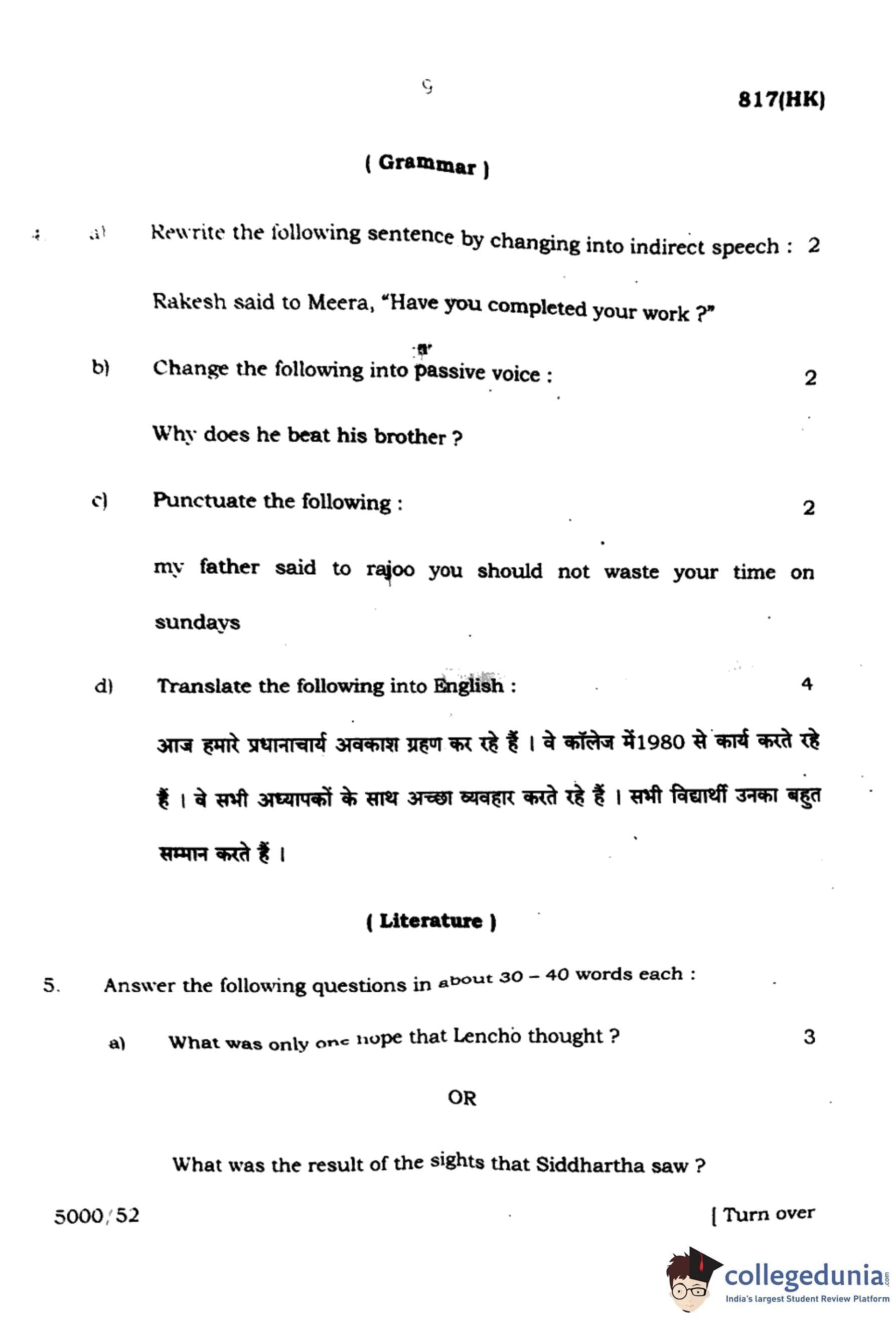
Rewrite the following sentence by changing into indirect speech:
Rakesh said to Meera, "Have you completed your work?"
View Solution
Step 1: Understanding the Question:
The task is to convert a sentence from direct speech to indirect (or reported) speech.
Step 2: Key Concepts for Conversion:
The reporting verb 'said to' changes to 'asked' because the sentence is a question.
The sentence is a yes/no interrogative, so the conjunction 'if' or 'whether' will be used to connect the reporting clause and the reported speech.
The tense of the reported speech will change. Present Perfect ("Have you completed") changes to Past Perfect ("had completed").
Pronouns will change. 'You' will change to 'she' (referring to Meera) and 'your' will change to 'her'.
The interrogative structure will change to an assertive (statement) structure. The question mark will be replaced by a full stop.
Step 3: Applying the Rules:
Rakesh said to Meera \(\rightarrow\) Rakesh asked Meera
Add conjunction \(\rightarrow\) Rakesh asked Meera if
Change pronoun and tense \(\rightarrow\) she had completed her work
Change structure to assertive and end with a full stop.
The final sentence is: Rakesh asked Meera if she had completed her work.
Quick Tip: When changing a question to indirect speech, always remember to change the sentence structure from question form (verb before subject) to statement form (subject before verb) after the conjunction (if/whether/wh-word).
Change the following into passive voice:
Why does he beat his brother?
View Solution
Step 1: Understanding the Question:
The task is to change an active voice sentence into the passive voice. The given sentence is in the Simple Present tense and is an interrogative sentence starting with a 'Wh-' word.
Step 2: Key Concepts for Conversion:
Identify S-V-O: Subject (he), Verb (beat), Object (his brother).
In the passive voice, the object becomes the new subject.
The verb form changes to a 'be' verb (is/am/are for simple present) + the past participle (V3) of the main verb. The V3 of 'beat' is 'beaten'.
The original subject becomes the agent, introduced by 'by'.
For 'Wh-' questions, the 'Wh-' word remains at the beginning. The auxiliary verb comes before the new subject to maintain the question format.
Step 3: Applying the Rules:
Active structure: Wh-word + does + subject + V1 + object?
Passive structure: Wh-word + is/am/are + new subject (old object) + V3 + by + agent (old subject)?
Wh-word: Why
New subject: his brother (singular, so use 'is')
V3: beaten
Agent: by him
Combining these parts gives: Why is his brother beaten by him?
Quick Tip: For changing interrogative sentences to passive voice, first, mentally change the assertive form (He beats his brother -> His brother is beaten by him) and then convert it back into a question (Is his brother beaten by him?), finally adding the Wh-word at the beginning.
Punctuate the following:
my father said to rajoo you should not waste your time on sundays
View Solution
Step 1: Understanding the Question:
The task is to apply the correct punctuation marks to the given sentence. This includes capitalization, commas, quotation marks, and full stops.
Step 2: Key Punctuation Rules:
Capitalization: The first word of a sentence must be capitalized. Proper nouns (names of people, days of the week) must also be capitalized.
Direct Speech: A comma is used to separate the reporting clause from the direct speech. The exact words spoken are enclosed in quotation marks ("...").
Quotation Marks: The first word inside the quotation marks is capitalized.
Full Stop: A sentence ends with a full stop (or question mark/exclamation mark).
Step 3: Applying the Rules:
'my' should be 'My'.
'rajoo' is a proper noun, so it should be 'Rajoo'.
'sundays' is a day of the week, so it should be 'Sundays'.
A comma is needed after 'Rajoo'.
Quotation marks are needed around "you should not waste your time on sundays".
'you' inside the quotes should be capitalized to 'You'.
A full stop is needed at the end of the sentence, inside the quotation marks.
The correctly punctuated sentence is: My father said to Rajoo, "You should not waste your time on Sundays."
Quick Tip: Remember the acronym M.I.N.T.S. for capitalization rules: M (Months, Days), I (the pronoun 'I'), N (Names), T (Titles), S (Start of a sentence). This helps ensure all proper nouns and sentence beginnings are capitalized.
Translate the following into English:

View Solution
Step 1: Understanding the Question:
The task is to translate a given paragraph from Hindi into grammatically correct and meaningful English.
Step 2: Sentence-by-Sentence Translation:
Sentence 1: आज हमारे प्रधानाचार्य अवकाश ग्रहण कर रहे हैं।
आज (Aaj) = Today
हमारे प्रधानाचार्य (hamare pradhanacharya) = our Principal
अवकाश ग्रहण कर रहे हैं (avakash grahan kar rahe hain) = is retiring
Translation: Today our Principal is retiring.
Sentence 2: वे कॉलेज में 1980 से कार्य करते रहे हैं।
वे (Ve) = He
कॉलेज में (college mein) = in the college
1980 से (1980 se) = since 1980
कार्य करते रहे हैं (karya karte rahe hain) = has been working (This indicates an action that started in the past and continued up to the present, so Present Perfect Continuous tense is appropriate).
Translation: He has been working in the college since 1980.
Sentence 3: वे सभी अध्यापकों के साथ अच्छा व्यवहार करते रहे हैं।
वे (Ve) = He
सभी अध्यापकों के साथ (sabhi adhyapakon ke saath) = with all the teachers
अच्छा व्यवहार करते रहे हैं (achha vyavhar karte rahe hain) = has been behaving well / his behaviour has been good. A more natural translation would be "He has always treated all the teachers well."
Translation: His behaviour with all the teachers has been very good.
Sentence 4: सभी विद्यार्थी उनका बहुत सम्मान करते हैं।
सभी विद्यार्थी (sabhi vidyarthi) = All the students
उनका (unka) = him
बहुत सम्मान करते हैं (bahut samman karte hain) = respect very much (Simple Present Tense).
Translation: All the students respect him very much.
Step 3: Combining into a Coherent Paragraph:
Today our Principal is retiring. He has been working in the college since 1980. His behaviour with all the teachers has been very good. All the students respect him very much.
Quick Tip: When translating from Hindi, pay close attention to the verb endings. Suffixes like 'रहा है' (raha hai - present continuous), 'ता है' (ta hai - simple present), and 'ते रहे हैं' (te rahe hain - present perfect continuous) are key to selecting the correct tense in English.
What was only one hope that Lencho thought?
View Solution
Step 1: Understanding the Question:
The question asks about Lencho's single source of hope after his crops were completely destroyed by the hailstorm, as described in the story "A Letter to God."
Step 2: Key Concept from the Text:
The core of Lencho's character is his simple, unwavering, and absolute faith in God. This faith becomes his only refuge in a time of crisis.
Step 3: Detailed Explanation:
After the devastating hailstorm destroyed his entire cornfield, Lencho was filled with sadness as his family faced starvation. In this moment of utter despair, his only hope was help from God. He had been taught that God's eyes see everything, even what is deep in one's conscience. Therefore, he firmly believed that God would not let him and his family go hungry and would surely help them. This single hope motivated him to write a letter to God asking for financial assistance.
Quick Tip: When answering questions about a character's motivations, focus on their defining traits. For Lencho, his unshakeable faith in God is the key to understanding all his actions in the story.
OR
What was the result of the sights that Siddhartha saw?
View Solution
Step 1: Understanding the Question:
The question asks about the consequence or impact of the four sights that Prince Siddhartha Gautama witnessed, which is a pivotal event in the story "The Sermon at Benares."
Step 2: Key Concept from the Text:
The four sights (a sick man, an aged man, a funeral procession, and a monk) were the catalyst for Siddhartha's renunciation of his worldly life in search of spiritual truth.
Step 3: Detailed Explanation:
The result of the sights that Siddhartha saw was transformative. These encounters with sickness, old age, and death exposed him to the reality of human suffering, which he had been shielded from his entire life. Deeply moved and troubled by these truths, he decided to leave his palace, his wife, and his newborn son. He renounced his princely life to become a wanderer and seek enlightenment, hoping to find a way to end the sorrows of the world.
Quick Tip: In narrative-based questions, it's important to understand the cause-and-effect relationships in the plot. The "four sights" are the direct cause that leads to the effect of Siddhartha's renunciation and his journey to becoming the Buddha.
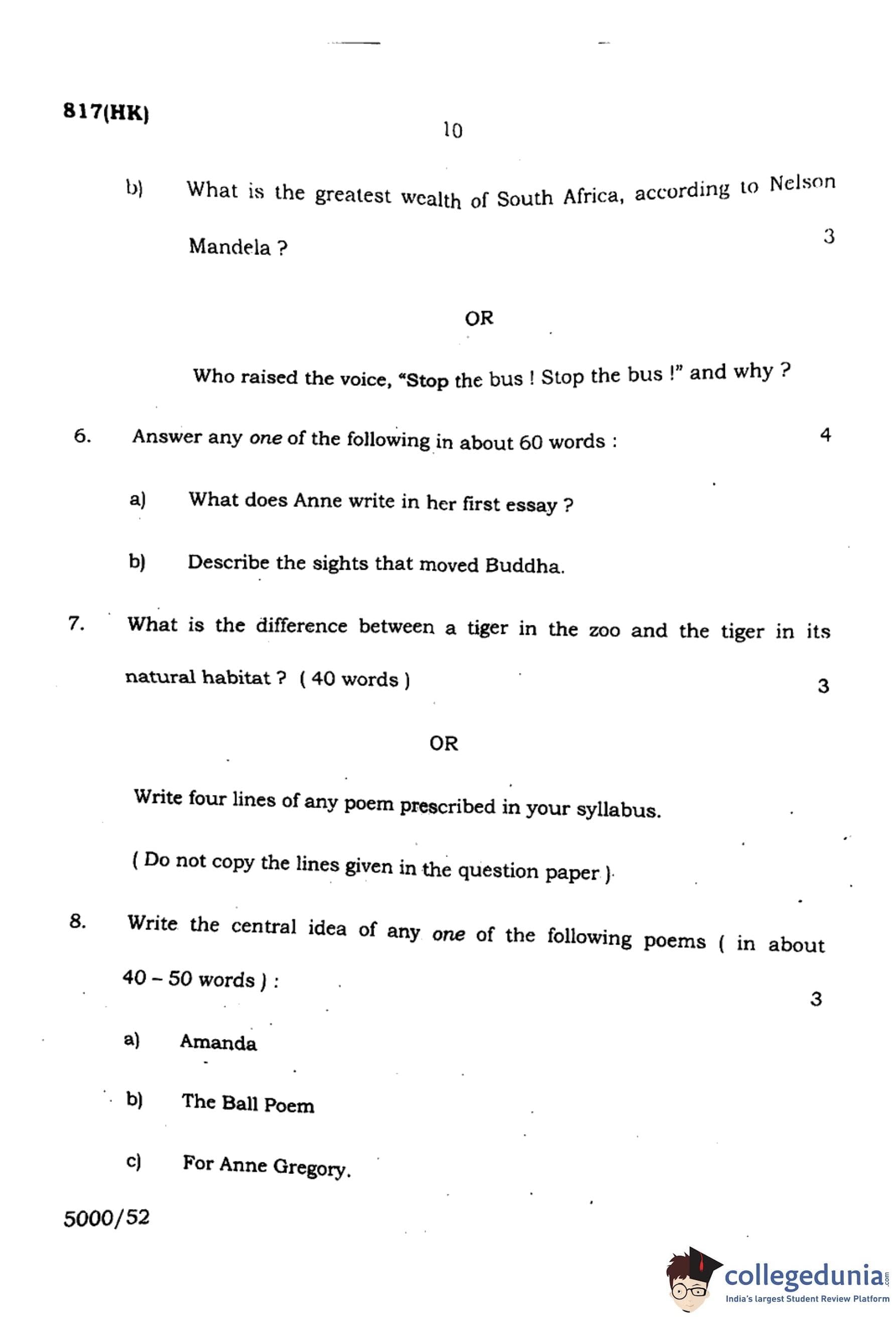
What is the greatest wealth of South Africa, according to Nelson Mandela?
View Solution
Step 1: Understanding the Question:
The question asks about Nelson Mandela's perspective on what constitutes the true wealth of his country, South Africa, based on the text "Nelson Mandela: Long Walk to Freedom."
Step 2: Key Concept from the Text:
In his inaugural speech, Mandela reflects on the sacrifices of countless patriots who came before him. He moves beyond the country's physical resources and focuses on its human capital. He explicitly states that the people are the nation's greatest asset.
Step 3: Detailed Explanation:
According to Nelson Mandela, the greatest wealth of South Africa is not its rich reserves of minerals and gems, but its people. He describes his comrades and the people of his nation as being "finer and truer than the purest diamonds." He believes that the courage, wisdom, and resilience of the South African people are the country's most precious asset and its true foundation. This human wealth, in his view, is far more valuable than any material riches.
Quick Tip: When answering questions about a leader's philosophy, focus on their core beliefs as presented in the text. Mandela consistently prioritized human dignity and potential over material wealth.
OR
Who raised the voice, "Stop the bus ! Stop the bus !" and why ?
View Solution
Step 1: Understanding the Question:
The question asks to identify the character who shouted "Stop the bus!" and the reason for this action, based on a specific event from the story "Madam Rides the Bus."
Step 2: Identifying the Character and Context:
The character is the young girl, Valliammai, known as Valli. This event occurs when she is trying to hail the bus to the town for her first secret journey.
Step 3: Detailed Explanation:
The voice was raised by the eight-year-old girl, Valli. She was standing on the roadside, waiting to catch the bus for her first ride to the town. As the bus approached, she raised her tiny hand to signal it to stop. However, the conductor, in a jovial mood, teased her and started to drive the bus away slowly. To ensure she was not left behind, Valli shouted commandingly, "Stop the bus! Stop the bus!" to make her intention clear and assert her right as a passenger.
Quick Tip: Character-based questions often test your knowledge of specific dialogues and the context in which they were spoken. Remember Valli's confident and assertive nature, which is highlighted in this scene.
What does Anne write in her first essay?
View Solution
Step 1: Understanding the Question:
The question asks for the content of the first essay Anne Frank was assigned as a punishment by her teacher, Mr. Keesing, in "From the Diary of Anne Frank."
Step 2: Identifying the Essay Topic and Anne's Arguments:
The topic of the essay was 'A Chatterbox'. Anne decided to present convincing arguments to justify her talkative nature.
Step 3: Detailed Explanation:
In her first essay, titled 'A Chatterbox', Anne cleverly defends her talkativeness. She argues that talking is a student's trait and that she would do her best to control it. However, she explains that she inherited this trait from her mother, who is also very talkative, and one cannot do much about inherited traits. She presents her points with such wit and logic that her teacher, Mr. Keesing, has a good laugh after reading it.
Quick Tip: When describing events from a story, focus on the character's motivations and the outcome of their actions. Anne's intelligence and wit are central to this episode with her teacher.
Describe the sights that moved Buddha.
View Solution
Step 1: Understanding the Question:
The question asks to describe the four specific sights that deeply affected Prince Siddhartha (before he became the Buddha) and led him towards the path of enlightenment, as mentioned in "The Sermon at Benares."
Step 2: Key Concept - The Four Sights:
The core of Buddha's renunciation story lies in his encounter with four sights that revealed the reality of human suffering, which had been shielded from him.
Step 3: Detailed Explanation:
The sights that moved Buddha were witnessed by him during a hunting trip outside his palace. First, he saw a sick man, which made him realize that all bodies are subject to illness. Next, he saw an aged man, which taught him about the inevitability of old age and decay. Then, he witnessed a funeral procession, which exposed him to the ultimate reality of death. Finally, he saw a monk begging for alms, who seemed calm and at peace despite having no worldly possessions. These sights made him realize the prevalence of suffering in the world and inspired him to leave his palace to seek enlightenment.
Quick Tip: To remember the four sights, think of the life cycle and its sufferings: Sickness, Old Age, Death, and the path to overcome them (the Monk).
What is the difference between a tiger in the zoo and the tiger in its natural habitat? (40 words)
View Solution
Step 1: Understanding the Question:
The question asks for a concise comparison between a tiger in captivity (zoo) and a tiger in the wild, based on the poem "A Tiger in the Zoo."
Step 2: Key Concept - Freedom vs. Captivity:
The poem's central theme is the contrast between the two environments and the tiger's corresponding behavior and emotional state.
Step 3: Detailed Explanation:
A tiger in the zoo is a prisoner, confined to a small concrete cage. Its majestic nature is suppressed, and it walks with quiet rage, ignoring visitors. In contrast, a tiger in its natural habitat is a free, powerful creature. It lurks in the long grass near a water hole, hunting its prey, and terrorizing the village with its snarl, living a life of freedom and wild instinct.
Quick Tip: For comparison questions, use contrasting words like "in contrast," "while," or "on the other hand" to structure your answer clearly. Focus on the key differences in freedom, behavior, and environment.
OR
Write four lines of any poem prescribed in your syllabus. (Do not copy the lines given in the question paper).
View Solution
Step 1: Understanding the Question:
The task is to recall and write four consecutive lines from any poem in the prescribed syllabus, ensuring they are not already printed in the exam paper.
Step 2: Choosing a Poem:
A simple and memorable choice is "Dust of Snow" by Robert Frost.
Step 3: Writing the Lines:
The following four lines are from the poem "Dust of Snow" by Robert Frost:
The way a crow
Shook down on me
The dust of snow
From a hemlock tree
Quick Tip: Memorize the first four or last four lines of a few short poems from your syllabus. This makes it easy to answer such recall-based questions accurately and quickly during the exam.
Write the central idea of... Amanda
View Solution
Step 1: Understanding the Question:
The question requires summarizing the main theme or central idea of the poem "Amanda."
Step 2: Key Concept - Child Psychology and Upbringing:
The poem explores the conflict between a child's desire for freedom and a parent's desire to instill good manners and discipline.
Step 3: Detailed Explanation:
The central idea of the poem "Amanda" is the struggle of a young girl against the constant control and instructions imposed by her parent. The poem highlights how excessive nagging can make a child feel restricted and misunderstood. To escape the harsh realities of her controlled life, Amanda retreats into a world of fantasy where she imagines herself as a mermaid, an orphan, and Rapunzel—all symbols of freedom and tranquility. The poem conveys the message that children need space and freedom to grow and develop their own identity.
Quick Tip: When asked for a central idea, focus on the underlying message or conflict. In "Amanda," the contrast between the parent's nagging (in regular stanzas) and Amanda's daydreams (in parentheses) is the key to understanding the theme.
Write the central idea of... The Ball Poem
View Solution
Step 1: Understanding the Question:
The question asks for the central theme or message of "The Ball Poem" by John Berryman.
Step 2: Key Concept - The Nature of Loss and Growing Up:
The poem uses the simple incident of a boy losing his ball to explore deeper philosophical ideas about loss, responsibility, and maturity.
Step 3: Detailed Explanation:
The central idea of "The Ball Poem" is the painful but necessary process of learning to cope with loss in life. The lost ball symbolizes the boy's first encounter with grief and the loss of his childhood innocence. The poet suggests that loss is an inevitable part of life, and money cannot replace the emotional attachment to things we lose. The experience teaches the boy the meaning of responsibility and the importance of standing up and moving on from setbacks, which is a crucial aspect of growing up.
Quick Tip: Look for the symbolic meaning behind objects in poems. The ball is not just a toy; it represents cherished possessions, memories, and even people that we may lose in life.
Write the central idea of... For Anne Gregory.
View Solution
Step 1: Understanding the Question:
The question asks for the main theme of the poem "For Anne Gregory" by W.B. Yeats.
Step 2: Key Concept - Inner vs. Outer Beauty:
The poem is a dialogue that explores the concept of true love and whether people are loved for their physical appearance or for their inner selves.
Step 3: Detailed Explanation:
The central idea of "For Anne Gregory" is the distinction between superficial, physical love and true, spiritual love. The poem argues that human beings are often attracted to external beauty, like Anne's beautiful yellow hair. Anne wishes to be loved for herself alone, not for her appearance. The poet concludes that only God is capable of loving a person for their inner self and soul, completely ignoring their physical attributes. The poem critiques the human tendency to judge and love based on appearances rather than character.
Quick Tip: The central idea of this poem is encapsulated in its final stanza. Understanding the religious and philosophical argument made in the last lines is key to grasping the poem's message.
Why is Mrs. Pumphrey worried about Tricki?
View Solution
Step 1: Understanding the Question:
The question asks for the reasons behind Mrs. Pumphrey's anxiety regarding her dog, Tricki, as described in the story "A Triumph of Surgery."
Step 2: Key Concept from the Text:
Mrs. Pumphrey's worry stems from her observation of Tricki's deteriorating health, which, ironically, is a direct result of her over-pampering and overfeeding him.
Step 3: Detailed Explanation:
Mrs. Pumphrey was worried because Tricki had become listless and seemed to have no energy. He had become hugely fat, like a bloated sausage, with bloodshot and rheumy eyes. He refused to eat his favourite foods and had bouts of vomiting. He would just lie on his rug, panting, and showed no interest in going for walks or playing. She feared that he was suffering from a serious illness.
Quick Tip: When answering questions about a character's concerns, list the specific symptoms or problems mentioned in the text that are causing the worry. This shows a detailed understanding of the story.
What kind of a person is Loisel's husband?
View Solution
Step 1: Understanding the Question:
The question asks for a character analysis of Monsieur Loisel, Matilda's husband, based on his actions and personality in the story "The Necklace."
Step 2: Key Character Traits:
Monsieur Loisel is portrayed as a simple, content, caring, and sacrificing individual, who stands in stark contrast to his ambitious and materialistic wife.
Step 3: Detailed Explanation:
Loisel's husband is a simple and loving man who is content with his modest life as a clerk. He is very caring towards his wife, Matilda, and tries his best to make her happy. For instance, he sacrifices his own savings, which he had been saving to buy a gun, to buy her a new dress for the party. He is a responsible and honest person who works tirelessly for ten years to repay the debt, showing his sense of duty and integrity.
Quick Tip: To analyze a character, look for their actions, dialogues, and how they react to situations. Citing specific examples from the story, like M. Loisel giving up his savings, strengthens your answer.
Why does Anil not hand over the thief to the police?
View Solution
Step 1: Understanding the Question:
The question asks for the reason behind Anil's decision not to report the thief, Hari Singh, to the police after Hari stole and then returned his money in "The Thief's Story."
Step 2: Key Concept - Forgiveness and Reform:
Anil's character is defined by his kindness, trust, and belief in human goodness. His decision is based on the desire to reform Hari Singh rather than punish him.
Step 3: Detailed Explanation:
Anil does not hand over the thief, Hari Singh, to the police because he realizes that Hari has had a change of heart. Although he knew about the theft (the notes were still damp from the rain), he saw that Hari had returned out of his own conscience. Anil is a kind and understanding person who wants to give Hari a second chance at an honest life. He believes that education and trust can reform a person more effectively than punishment. By forgiving Hari and offering to pay him regularly, Anil chooses compassion over retribution, hoping to inspire a genuine transformation in the boy.
Quick Tip: The central theme of "The Thief's Story" is the transformative power of kindness and trust. When answering questions about Anil's actions, always connect them to this core message.
What was the cause of Matilda's ruin? How could she have avoided it?
View Solution
Step 1: Understanding the Question:
The question has two parts: first, to identify the main reason for Matilda Loisel's downfall in "The Necklace," and second, to suggest how this fate could have been prevented.
Step 2: Key Concepts - Vanity and Honesty:
Matilda's ruin is a direct consequence of her character flaws, particularly her vanity and pride. The avoidance of this ruin hinges on the value of honesty.
Step 3: Detailed Explanation:
The primary cause of Matilda's ruin was her vanity and dissatisfaction with her humble life. Her intense desire to appear wealthy and glamorous at the party led her to borrow a diamond necklace. When she lost it, her pride and fear of being shamed prevented her from confessing the truth to her friend, Madame Forestier. This dishonesty led her and her husband into a decade of crushing debt and hardship to replace the necklace.
She could have easily avoided this ruin by simply being honest. If she had told Madame Forestier immediately that she had lost the necklace, she would have discovered that it was a fake, worth very little. This simple act of honesty would have saved her from ten years of poverty and suffering.
Quick Tip: This story serves as a cautionary tale. When analyzing it, focus on the moral lessons. The cause of the problem is always linked to a character flaw (vanity, pride), and the solution is linked to a moral virtue (honesty, contentment).







Comments