




UP Board Class 10 English Question Paper 2024 PDF (Code 817 HI) is available for download here. The English exam was conducted on March 4, 2024 in the Morning Shift from 8:30 AM to 11:45 AM. The total marks for the theory paper are 70. Students reported the paper to be easy to moderate.
UP Board Class 10 English Question Paper 2024 (Code 817 HI) with Solutions
| UP Board Class 10 English (817 HI) 2024 Question Paper with Solutions PDF |  Download Download |
Check Solutions |

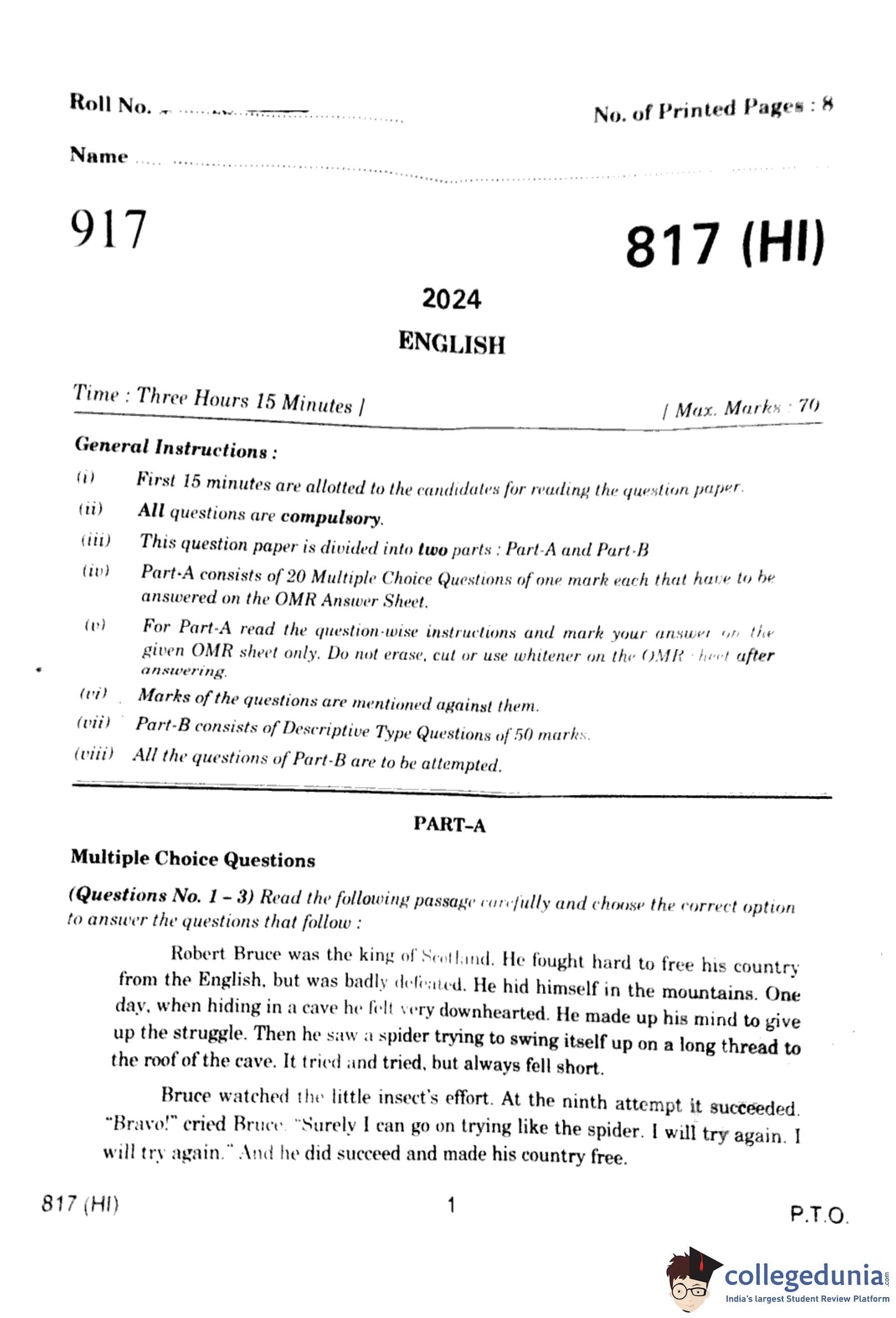
Read the following passage carefully and choose the correct option to answer the questions that follow:
Robert Bruce was the king of Scotland. He fought hard to free his country from the English, but was badly defeated. He hid himself in the mountains. One day, when hiding in a cave he felt very downhearted. He made up his mind to give up the struggle. Then he saw a spider trying to swing itself up on a long thread to the roof of the cave. It tried and tried, but always fell short. Bruce watched the little insect's effort. At the ninth attempt it succeeded. "Bravo!" cried Bruce. "Surely I can go on trying like the spider. I will try again. I will try again." And he did succeed and made his country free.
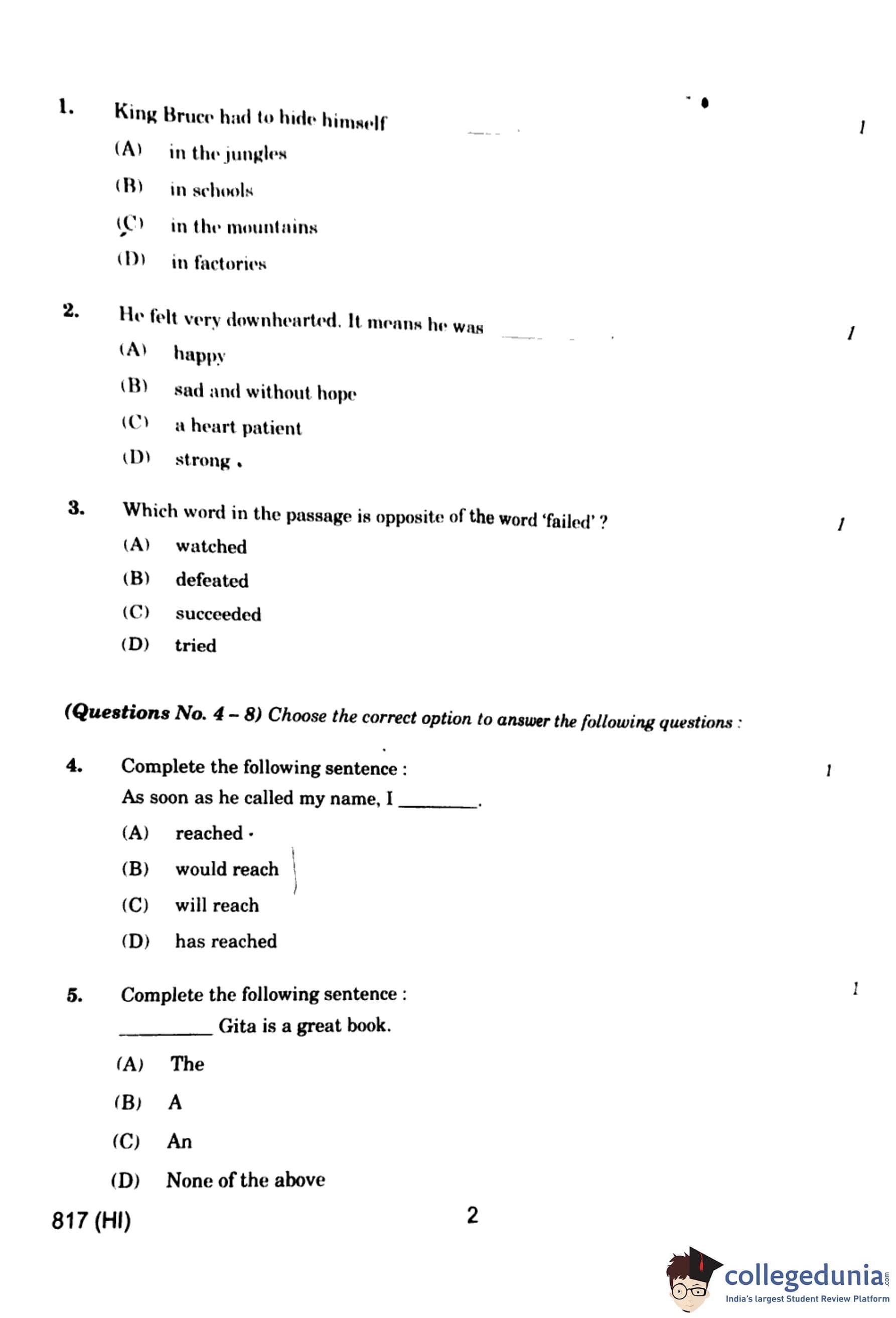
Question 1:
King Bruce had to hide himself
View Solution
Step 1: Understanding the Question
The question asks where King Bruce hid himself after being defeated.
Step 2: Locating the Information in the Passage
We need to scan the passage for the sentence that describes where Robert Bruce went to hide.
Step 3: Detailed Explanation
The passage states, "He fought hard to free his country from the English, but was badly defeated. He hid himself in the mountains."
This line directly answers the question.
Comparing this information with the given options:
(A) in the jungles - Incorrect.
(B) in schools - Incorrect.
(C) in the mountains - Correct.
(D) in factories - Incorrect.
Step 4: Final Answer
Based on the passage, the correct option is (C) because it explicitly mentions that King Bruce hid in the mountains.
Quick Tip: In reading comprehension questions, always locate the exact sentence or phrase in the passage that supports your answer. This helps avoid making assumptions.
He felt very downhearted. It means he was
View Solution
Step 1: Understanding the Question
The question asks for the meaning of the word "downhearted" as used in the passage.
Step 2: Contextual Analysis
The passage says, "One day, when hiding in a cave he felt very downhearted. He made up his mind to give up the struggle."
The fact that he decided to "give up the struggle" indicates a state of despair and sadness.
Step 3: Detailed Explanation
The word "downhearted" means to be discouraged, dejected, or in low spirits.
Let's analyze the options:
(A) happy - This is the opposite of downhearted.
(B) sad and without hope - This meaning aligns perfectly with being discouraged and wanting to give up.
(C) a heart patient - This is a literal interpretation of "heart" but is incorrect in this context. "Downhearted" refers to an emotional state, not a medical condition.
(D) strong - This is the opposite of how someone who is giving up would feel.
Step 4: Final Answer
The most accurate meaning of "downhearted" in the given context is "sad and without hope." Therefore, option (B) is correct.
Quick Tip: When asked for the meaning of a word, use the surrounding sentences (the context) to infer its meaning. The context often provides clues about whether the word has a positive or negative connotation.
Which word in the passage is opposite of the word 'failed' ?
View Solution
Step 1: Understanding the Question
The question asks for the antonym (opposite) of the word "failed" from the given passage.
Step 2: Analyzing the Word and Passage
The word "failed" means to be unsuccessful in achieving a goal. We need to find a word in the passage that means to be successful.
The passage describes a spider's attempts: "It tried and tried, but always fell short." This is a form of failing.
Then, the passage states, "At the ninth attempt it succeeded."
Step 3: Detailed Explanation
The word "succeeded" means to achieve a desired aim or result. This is the direct opposite of "failed."
Let's look at the other options:
(A) watched - This means to look at or observe, not the opposite of failed.
(B) defeated - This is a synonym for failed, not an antonym.
(C) succeeded - This is the correct antonym.
(D) tried - This means to make an attempt, which can result in either success or failure. It is not the opposite of failed.
Step 4: Final Answer
The word in the passage that is the opposite of "failed" is "succeeded." Therefore, option (C) is correct.
Quick Tip: Pay close attention to whether the question asks for a synonym (similar meaning) or an antonym (opposite meaning). Misreading this one word can lead to an incorrect answer.
Complete the following sentence:
As soon as he called my name, I ______________.
View Solution
Step 1: Understanding the Concept
This question tests the concept of tense consistency in a sentence, specifically with the conjunction "As soon as."
Step 2: Key Formula or Approach
The structure "As soon as + Subject + Simple Past Tense, Subject + Simple Past Tense" is used to describe two actions that happened one immediately after the other in the past.
Step 3: Detailed Explanation
The first clause of the sentence is "As soon as he called my name...". The verb "called" is in the simple past tense.
To maintain tense consistency, the verb in the second clause must also be in the simple past tense.
Let's examine the options:
(A) reached - This is the simple past tense of the verb "reach." This fits the rule.
(B) would reach - This indicates a conditional or habitual past action, which doesn't fit the context of an immediate past event.
(C) will reach - This is the simple future tense, which is incorrect as the first action is in the past.
(D) has reached - This is the present perfect tense, used for actions completed in the recent past with relevance to the present. It doesn't fit the sequence of two completed past actions.
Step 4: Final Answer
The correct verb form to complete the sentence is the simple past tense, "reached." Thus, option (A) is correct.
Quick Tip: When you see conjunctions of time like "as soon as," "when," or "after," always check the tense of the verb in the first clause. The tense in the second clause must logically follow it.
Complete the following sentence:
_______________ Gita is a great book.
View Solution
Step 1: Understanding the Concept
This question tests the use of articles (A, An, The). Specifically, it deals with the use of the definite article "The."
Step 2: Key Formula or Approach
The definite article "The" is used before the names of unique objects, such as holy books, rivers, oceans, mountain ranges, and well-known buildings.
Step 3: Detailed Explanation
In the sentence, "Gita" refers to the Bhagavad Gita, which is a specific and well-known holy book of Hinduism.
According to the rules of article usage, the definite article "The" must be used before the names of holy books.
Examples: The Bible, The Quran, The Ramayana.
Therefore, the correct article to use is "The."
(A) The - Correct, as "Gita" is a holy book.
(B) A - Incorrect. "A" is an indefinite article used for non-specific singular countable nouns.
(C) An - Incorrect. "An" is an indefinite article used before vowel sounds.
(D) None of the above - Incorrect.
Step 4: Final Answer
The correct article to complete the sentence is "The." Therefore, option (A) is the correct choice.
Quick Tip: Remember the specific categories of proper nouns that require the definite article "The": holy books, newspapers, rivers, oceans, seas, mountain ranges, and groups of islands.
Rearrange the following word clusters to make a meaningful sentence and choose the correct arrangement:
great / we / have / should / parents / our / for / respect
View Solution
Step 1: Understanding the Concept
This question tests the ability to form a grammatically correct and meaningful sentence by arranging jumbled words and phrases. This involves understanding the standard English sentence structure (Subject-Verb-Object).
Step 2: Key Formula or Approach
A typical declarative sentence follows the structure: Subject + Modal Verb + Main Verb + Object/Complement.
Step 3: Detailed Explanation
Let's identify the parts of the sentence from the given words:
- Subject: we
- Modal Verb: should
- Main Verb: have
- Object: great respect
- Prepositional Phrase: for our parents
Now, let's assemble them according to the standard structure:
Subject (we) + Modal Verb (should) + Main Verb (have) + Object (great respect) + Prepositional Phrase (for our parents).
This forms the sentence: "We should have great respect for our parents."
Let's check the options:
(A) Respect we should have great our for parents. - Incorrect structure.
(B) Our parents for great respect have we should. - Incorrect structure.
(C) For great respect our parents have we should. - Incorrect structure.
(D) We should have great respect for our parents. - Correct structure and meaning.
Step 4: Final Answer
The correctly arranged sentence is given in option (D).
Quick Tip: When rearranging sentences, first identify the subject (who or what is doing the action) and the main verb (the action). This will form the core of your sentence, and you can then add other elements like objects and prepositional phrases around it.
Fill in the gap with a suitable preposition:
I am proud _______________ my students.
View Solution
Step 1: Understanding the Concept
This question tests the knowledge of appropriate prepositions that follow certain adjectives. This is a topic related to collocations and phrasal verbs.
Step 2: Key Formula or Approach
The adjective "proud" is always followed by the preposition "of" when it is followed by a noun or a pronoun that is the object of the pride. The structure is proud of someone/something.
Step 3: Detailed Explanation
The sentence expresses a feeling of pride towards "my students." The fixed prepositional phrase is "proud of."
Let's check the options:
(A) at - Incorrect. We might say "angry at" or "good at," but not "proud at."
(B) for - Incorrect. We might say "sorry for" or "happy for," but not "proud for."
(C) of - Correct. This forms the correct collocation "proud of."
(D) to - Incorrect. "Proud to" is used when followed by a verb (e.g., "I am proud to be your teacher"), not a noun.
Step 4: Final Answer
The correct preposition to use with "proud" in this context is "of." Therefore, option (C) is the correct choice.
Quick Tip: Many adjectives in English are followed by specific prepositions. It is helpful to learn these as fixed phrases (e.g., "fond of," "interested in," "afraid of," "keen on").
Which of the following words in mis-spelled?
View Solution
Step 1: Understanding the Concept
This question tests spelling proficiency by asking to identify the incorrectly spelled word among the given options.
Step 2: Analyzing Each Word's Spelling
We need to check the spelling of each option.
(A) Maker - Correctly spelled. A person or thing that makes or produces something.
(B) Creator - Correctly spelled. A person or thing that brings something into existence.
(C) Greater - Correctly spelled. The comparative form of "great."
(D) Inspecter - Incorrectly spelled.
Step 3: Detailed Explanation
The word "Inspecter" is misspelled. The correct spelling for a person who inspects something is Inspector. The suffix is "-or," not "-er."
Step 4: Final Answer
The misspelled word is "Inspecter." Therefore, option (D) is the correct answer.
Quick Tip: Pay close attention to common suffixes like -er, -or, -ar, -able, and -ible. These are frequent sources of spelling errors in exams. When in doubt, try to think of related words (e.g., inspect, inspection).
Read the following passage carefully and choose the correct option to answer the questions that follow:
It was nothing less than a letter to God. “God,” he wrote, “If you don't help me, my family and I will go hungry this year. I need a hundred pesos in order to sow my field again and to live until the crop comes, because the hailstorm...”
Question 9:
_______________ wrote a letter to God.
View Solution
Step 1: Understanding the Question
The question asks to identify the person who wrote the letter to God described in the passage.
Step 2: Contextual Knowledge
This passage is a well-known extract from the story "A Letter to God" by G. L. Fuentes from the Class 10 English textbook. The protagonist of this story is a farmer named Lencho.
Step 3: Detailed Explanation
In the story, Lencho's crops are destroyed by a hailstorm. Having immense faith in God, he writes a letter to God asking for one hundred pesos to sow his field again and support his family. The provided passage is the content of that letter.
(A) The postmaster - He reads the letter but does not write it.
(B) A postman - He discovers the letter but does not write it.
(C) A child - The writer is an adult farmer, not a child.
(D) Lencho - He is the farmer who writes the letter to God.
Step 4: Final Answer
Based on the story "A Letter to God," the person who wrote the letter was Lencho. Therefore, option (D) is correct.
Quick Tip: For questions based on literature chapters, it's crucial to remember the names of main characters and their key actions. Even a short extract can be easily identified if you know the plot.
He needed a hundred pesos in order to :
View Solution
Step 1: Understanding the Question
The question asks for the reason why the writer needed one hundred pesos.
Step 2: Locating the Information in the Passage
The answer can be found directly in the text of the letter quoted in the passage.
Step 3: Detailed Explanation
The passage quotes the letter: "I need a hundred pesos in order to sow my field again and to live until the crop comes, because the hailstorm..."
This part of the sentence explicitly states the two reasons for needing the money.
Let's compare this with the options:
(A) purchase a new field - Incorrect. He wanted to sow his existing field.
(B) water his field - Incorrect. The problem was the destruction of crops by hail, not lack of water.
(C) sow his field again and to live until the crop comes - Correct. This matches the passage exactly.
(D) do some business instead of farming - Incorrect. He wanted to continue farming.
Step 4: Final Answer
The passage clearly states that the money was needed to sow the field again and for sustenance until the new crop grew. Thus, option (C) is correct.
Quick Tip: In comprehension questions, look for keywords from the question in the passage. The answer is often located in the same sentence or very close to those keywords. Here, the keyword is "hundred pesos".
Nelson Mandela had to spend _______________ years in prison.
View Solution
Step 1: Understanding the Question
The question asks about the duration of Nelson Mandela's imprisonment.
Step 2: Recalling Factual Information
This question is based on the chapter "Nelson Mandela: Long Walk to Freedom." It requires recalling a key biographical detail about Nelson Mandela.
Step 3: Detailed Explanation
Nelson Mandela was imprisoned for 27 years, from 1964 to 1990. However, the chapter and many sources often refer to this period as "nearly three decades" or round it up.
Let's analyze the given options:
(A) thirty-three - Incorrect.
(B) twenty - Incorrect, this is too short.
(C) thirty - This is the closest round number to 27 years and is often used to refer to the period (almost three decades). In the context of multiple-choice questions based on textbook summaries, this is the most likely intended answer.
(D) twenty-nine - While closer to 27 than 30, "thirty" is a more common approximation for "three decades".
In the chapter "Long Walk to Freedom," Mandela mentions spending "almost 30 years" in prison. Therefore, "thirty" is the best fit among the choices.
Step 4: Final Answer
Based on the common approximation used in the context of the chapter, Nelson Mandela spent nearly thirty years in prison. Option (C) is the correct answer.
Quick Tip: For fact-based questions from literature or history, pay attention to numbers, dates, and durations mentioned in the text. Sometimes, authors use approximate figures (like "nearly three decades"), and the options will reflect this approximation.
Mahseer is a large fish found in the fresh waters of _______________ river.
View Solution
Step 1: Understanding the Question
The question asks to identify the river where the Mahseer fish is found, based on the relevant literature chapter.
Step 2: Recalling Factual Information
This detail is from the chapter "Glimpses of India," specifically the part about "Coorg."
Step 3: Detailed Explanation
The chapter on Coorg describes the region's natural beauty and wildlife. It explicitly mentions that the waters of the river Kaveri abound with Mahseer, a large freshwater fish. The text states, "The river, Kaveri, obtains its water from the hills and forests of Coorg. Mahseer - a large freshwater fish - abound in these waters."
Step 4: Final Answer
As mentioned in the chapter on Coorg, the Mahseer fish is found in the river Kaveri. Therefore, option (D) is correct.
Quick Tip: When studying chapters that describe specific places (like Coorg), create a mind map or a short list of key features mentioned: rivers, wildlife, crops, local people, etc. This helps in recalling specific details.
Riding a bus for the first time, Valli was a girl of _______________ years.
View Solution
Step 1: Understanding the Question
The question asks for the age of Valli, the main character in the story "Madam Rides the Bus."
Step 2: Recalling Factual Information
This is a direct question about a character detail from the story.
Step 3: Detailed Explanation
The story "Madam Rides the Bus" by Vallikannan begins by introducing its protagonist, Valliammai, or Valli for short. The text clearly states her age in the initial paragraphs: "There was a girl named Valliammai who was called Valli for short. She was eight years old and very curious about things."
Step 4: Final Answer
According to the text, Valli was eight years old. Therefore, option (B) is the correct answer.
Quick Tip: Pay attention to the introductory descriptions of main characters in a story. Authors often provide key details like age, appearance, and personality at the very beginning.
Choose the correct statement :
View Solution
Step 1: Understanding the Question
The question asks for a correct statement about the hemlock tree mentioned in the poem.
Step 2: Contextual and Factual Knowledge
The poem is "Dust of Snow" by Robert Frost. The poet intentionally uses a hemlock tree and a crow, both of which are traditionally considered symbols of sorrow, death, and bad omens. A hemlock tree is known in reality to be poisonous.
Step 3: Detailed Explanation
Let's analyze the options:
(A) Hemlock is a tree with sweet healthy fruits. - Incorrect. Hemlock is poisonous and does not bear sweet fruits.
(B) Hemlock is a tree known for furniture making. - Incorrect. Woods like oak, teak, or pine are used for furniture, not hemlock.
(C) Hemlock is a tree bearing fragrant flowers. - Incorrect. It has small, white flowers, but it's primarily known for its toxicity, not its fragrance.
(D) Hemlock is a poisonous tree. - Correct. This is a well-known fact. The choice of this tree in the poem is significant because it represents a negative or somber element that leads to a positive change in the poet's mood.
Step 4: Final Answer
The correct statement about the hemlock tree is that it is a poisonous tree. Therefore, option (D) is correct.
Quick Tip: In poetry analysis, understanding the symbolism of objects, animals, and nature is key. Poets often choose specific elements for their connotative meanings (the ideas or feelings they evoke).
Name the poet of the above lines.
View Solution
Step 1: Understanding the Question
The question asks to identify the poet who wrote the given lines.
Step 2: Recalling Literary Knowledge
The given extract is the first stanza of the poem "Dust of Snow." This poem is a famous work included in the Class 10 English syllabus.
Step 3: Detailed Explanation
The poem "Dust of Snow" was written by the renowned American poet, Robert Frost. His poetry often explores themes of nature, human experience, and rural life.
The other poets listed are:
- William Wordsworth: A major English Romantic poet.
- Walt Whitman: An American poet, known for "Leaves of Grass."
- Robert Klein: A comedian and actor, not the poet in question.
Step 4: Final Answer
The author of the poem "Dust of Snow" is Robert Frost. Therefore, option (B) is the correct answer.
Quick Tip: For your exams, it's essential to memorize the names of all the poems and their respective poets, as well as the prose chapters and their authors. This is a common and easy-to-score type of question.
During the treatment of the dog, the doctor
View Solution
Step 1: Understanding the Question
The question asks about the method of treatment used by the doctor for the dog, Tricki. This is from the story "A Triumph of Surgery."
Step 2: Recalling Plot Details
The story revolves around a small, overfed dog named Tricki. The narrator, a veterinary surgeon Mr. Herriot, treats Tricki not with medicine but with a controlled diet and exercise.
Step 3: Detailed Explanation
When Mr. Herriot takes Tricki to his surgery, he knows the problem is overfeeding, not a disease. His treatment plan was:
- For the first two days, he gave Tricki no food, only plenty of water.
- On the third day, Tricki started to show interest in his surroundings and joined the other dogs.
- He did not perform any surgery.
Let's evaluate the options based on this:
(A) provided the dog many eatables to eat - Incorrect. This was the problem, not the solution.
(B) operated on the dog - Incorrect. No surgery was performed.
(C) gave the dog a lot of food, but no water - Incorrect. It was the opposite.
(D) kept an eye on the dog, giving him no food, but plenty of water - Correct. This accurately describes the initial and most crucial part of Tricki's treatment.
Step 4: Final Answer
The doctor's treatment involved withholding food and providing plenty of water. Option (D) correctly describes this approach.
Quick Tip: When answering questions about plot, focus on the problem and the resolution. Understanding the core conflict and how it was solved will help you remember the key events accurately.
Anil taught Hari Singh to _______________.
View Solution
Step 1: Understanding the Question
The question asks what skills Anil taught Hari Singh in the story "The Thief's Story."
Step 2: Recalling Character Interactions
The story details the relationship between Anil, a writer, and Hari Singh, a young thief. A key part of the story is Anil's kindness and his effort to educate Hari.
Step 3: Detailed Explanation
Let's break down what Anil taught Hari:
1. Cooking: Although Hari's first meal was terrible, Anil let him continue and taught him how to cook properly.
2. Writing: Anil taught him to write his name and promised to teach him to write whole sentences.
3. Adding Numbers: Anil also promised to teach him how to add numbers.
Now let's review the options:
(A) write only his name - Incorrect. Anil promised to teach him more than just his name.
(B) cook and add numbers - Incomplete. Anil also taught him to write.
(C) cook, write and add numbers - Correct. This option covers all the skills that Anil taught or promised to teach Hari Singh.
(D) cook and write - Incomplete. Anil also taught him to add numbers.
Step 4: Final Answer
The most comprehensive and accurate description of what Anil taught Hari Singh is to cook, write, and add numbers. Therefore, option (C) is the best answer.
Quick Tip: In questions with multiple similar options, choose the most complete and accurate one. Read each option carefully to see if it covers all aspects mentioned in the story.
Ebright's mother gifted him a book titled _______________.
View Solution
Step 1: Understanding the Question
The question asks for the title of the book that Richard Ebright's mother gave him. This is from the chapter "The Making of a Scientist."
Step 2: Recalling Key Details
The story highlights a turning point in young Ebright's life as a scientist, which was prompted by a specific book.
Step 3: Detailed Explanation
The chapter states that when Ebright was in second grade, he had collected all 25 species of butterflies found around his hometown. At that point, his mother bought him a children's book. The exact title of that book was "The Travels of Monarch X." This book described how monarch butterflies migrate to Central America and opened up a new world of science for him, particularly the idea of tagging butterflies.
Step 4: Final Answer
The title of the book was "The Travels of Monarch X." Therefore, option (C) is the correct answer.
Quick Tip: Pay attention to specific names, titles, and places mentioned in biographical stories. These details are often the basis for factual recall questions.
Bholi's father Ramlal had seven children, _______________.
View Solution
Step 1: Understanding the Question
The question asks for the composition of Ramlal's seven children, i.e., how many sons and daughters he had. This is from the story "Bholi."
Step 2: Recalling Family Details
The story provides details about Bholi's family background to explain her situation and neglect.
Step 3: Detailed Explanation
The text clearly states the number of children Ramlal had: "Ramlal had seven children — three sons and four daughters. And the youngest of them was Bholi." The story then lists the daughters Radha, Mangla, and Champa, with Bholi (Sulekha) being the fourth and youngest daughter.
Step 4: Final Answer
Ramlal had three sons and four daughters. Therefore, option (D) is the correct answer.
Quick Tip: When reading stories, it can be helpful to jot down a simple family tree or list of characters and their relationships. This is especially useful for stories with many family members.
Which of the following statements is correct?
View Solution
Step 1: Understanding the Question
The question asks for the correct statement summarizing the central event of the story "The Necklace."
Step 2: Recalling the Plot and Twist
The story is about Matilda Loisel, who borrows a necklace from her friend, Madame Forestier, to wear to a party. She loses the necklace and spends the next ten years in poverty to repay the debt for a replacement. The story's climax is the twist ending.
Step 3: Detailed Explanation
Let's trace the events concerning the necklace:
1. Borrowing: Matilda borrows a diamond necklace from Madame Forestier, believing it to be genuine and very valuable.
2. Losing and Replacing: She loses the necklace. To replace it, she and her husband buy a genuine diamond necklace that looks identical, costing them 36,000 francs and putting them into immense debt.
3. Returning: She returns this new, expensive, real diamond necklace to Madame Forestier.
4. The Twist: At the end of the story, ten years later, Matilda learns that the original necklace she borrowed was a fake (artificial), worth at most 500 francs.
So, the correct sequence is: she borrowed an artificial necklace but returned a real one.
Let's check the options:
(A) Incorrect. The borrowed one was artificial.
(B) Incorrect. The borrowed one was artificial and the returned one was real.
(C) Correct. This accurately describes the ironic situation.
(D) Incorrect. The returned one was real.
Step 4: Final Answer
The statement that correctly summarizes the events is that Matilda borrowed an artificial diamond necklace and returned a real diamond necklace. Therefore, option (C) is correct.
Quick Tip: Stories with ironic twists, like "The Necklace," are common in exams. Make sure you understand the twist clearly, as it is often the main point being tested.
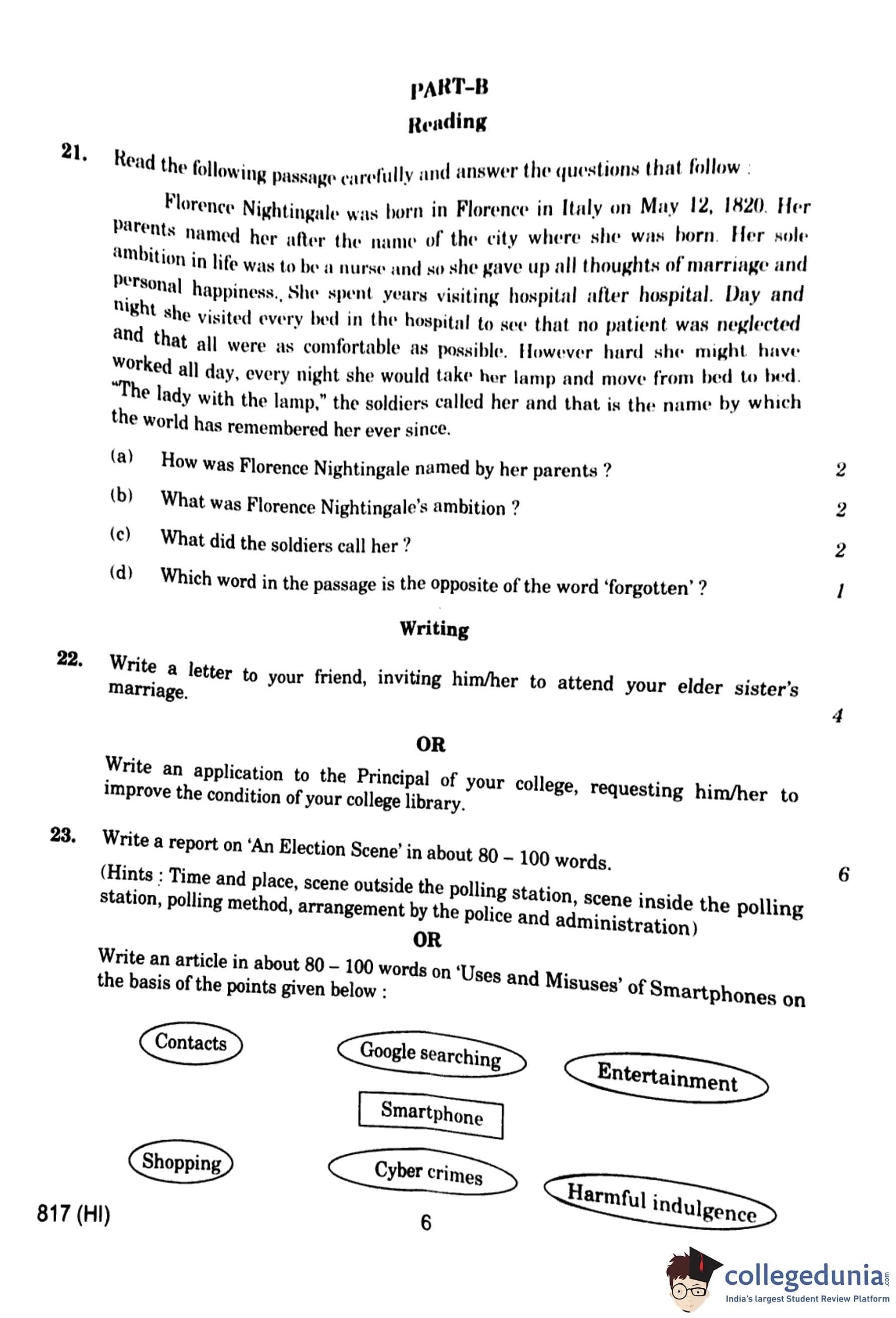
Read the following passage carefully and answer the questions that follow:
Florence Nightingale was born in Florence in Italy on May 12, 1820. Her parents named her after the name of the city where she was born. Her sole ambition in life was to be a nurse and so she gave up all thoughts of marriage and personal happiness. She spent years visiting hospital after hospital. Day and night she visited every bed in the hospital to see that no patient was neglected and that all were as comfortable as possible. However hard she might have worked all day, every night she would take her lamp and move from bed to bed. "The lady with the lamp," the soldiers called her and that is the name by which the world has remembered her ever since.
Question 21:
How was Florence Nightingale named by her parents?
View Solution
According to the passage, Florence Nightingale's parents named her after the city where she was born.
The passage explicitly states, "Her parents named her after the name of the city where she was born," which was Florence in Italy.
Quick Tip: For direct questions like this, scan the passage for keywords from the question (e.g., "named," "parents"). The answer is often found in the same sentence or a nearby one.
What was Florence Nightingale's ambition?
View Solution
Florence Nightingale's sole ambition in life was to become a nurse.
The passage mentions, "Her sole ambition in life was to be a nurse and so she gave up all thoughts of marriage and personal happiness."
Quick Tip: Look for words that indicate goals or desires, such as "ambition," "dream," or "goal," to quickly locate the answer in the text.
What did the soldiers call her?
View Solution
The soldiers called Florence Nightingale "The lady with the lamp."
This is directly stated in the passage: "'The lady with the lamp,' the soldiers called her and that is the name by which the world has remembered her ever since."
Quick Tip: Pay attention to text enclosed in quotation marks (" "). It often highlights important names, dialogues, or titles mentioned in the passage.
Which word in the passage is the opposite of the word 'forgotten'?
View Solution
The word in the passage that is the opposite of 'forgotten' is 'remembered'.
The last sentence of the passage says, "...that is the name by which the world has remembered her ever since."
Quick Tip: For vocabulary questions (synonyms/antonyms), first understand the meaning of the given word. Then, read the passage carefully to find a word that has the opposite meaning in its context.
Write a letter to your friend, inviting him/her to attend your elder sister's marriage.
View Solution
[Your Address Line 1]
[Your Address Line 2]
[City, Pin Code]
[Date]
My dear [Friend's Name],
I hope this letter finds you in great health and spirits. I am writing to share a very happy piece of news with you. My elder sister, [Sister's Name]'s marriage has been fixed for [Date of Marriage]. The ceremony will take place at [Venue Name], [City] at [Time].
It is a grand occasion for our family, and your presence would make it even more special. I would be delighted if you could join us for the celebrations and bless the new couple. We will have a lot of fun together.
I am eagerly looking forward to seeing you at the wedding. Please convey my regards to your parents.
Yours lovingly,
[Your Name]
Quick Tip: In an informal letter, maintain a friendly and personal tone. Always include the sender's address, date, a warm salutation (like "Dear [Friend's Name]"), a clear body with all necessary details, and a friendly closing (like "Yours lovingly").
OR
Write an application to the Principal of your college, requesting him/her to improve the condition of your college library.
View Solution
To,
The Principal,
[College Name],
[College Address]
[Date]
Subject: Request for improvement in the condition of the college library
Respected Sir/Madam,
I am writing this application on behalf of the students of [Your Class/Department] to draw your attention to the current condition of our college library. While the library is a valuable resource, it requires urgent improvements to better serve the student community.
The library lacks a sufficient number of latest edition books for various subjects. Moreover, many existing books are in a worn-out condition. The seating arrangement is inadequate, and the lighting is poor, making it difficult for students to study for long hours.
We kindly request you to take necessary steps to update the book collection, improve the infrastructure, and ensure a conducive learning environment in the library.
Thank you for your consideration.
Yours obediently,
[Your Name]
[Your Class/Roll Number]
Quick Tip: A formal application must be concise, polite, and to the point. Key elements include the recipient's designation and address, a clear subject line, a formal salutation and closing, and your details. Clearly state the problem and suggest a solution.
Write a report on 'An Election Scene' in about 80 – 100 words.
(Hints: Time and place, scene outside the polling station, scene inside the polling station, polling method, arrangement by the police and administration)
View Solution
An Election Scene
\textit{- By a Staff Reporter
New Delhi, [Date]: The assembly elections were held yesterday at the Government Senior Secondary School polling station. From early morning, voters queued up peacefully outside the station. The scene was bustling yet orderly, with tight security arrangements by the police and administration. Inside, polling officers guided voters through the process. Voters presented their ID cards, had their fingers inked, and cast their votes electronically using the EVM. The process was smooth and systematic, reflecting a well-organized democratic exercise. The polling concluded peacefully at 5 PM.
Quick Tip: Report writing requires a factual and objective tone. Start with a headline, followed by the byline, place, and date. Structure your report logically using the provided hints to ensure all key aspects are covered within the word limit.
OR
Write an article in about 80 – 100 words on ‘Uses and Misuses' of Smartphones on the basis of the points given below :
(Hints: Contacts, Google searching, Shopping, Entertainment, Cyber crimes, Harmful indulgence)
View Solution
Smartphones: A Double-Edged Sword
Smartphones have become an indispensable part of modern life, offering numerous benefits. They keep us connected with contacts, provide a gateway to infinite knowledge through Google searching, and offer endless entertainment. Online shopping has become incredibly convenient with just a few taps.
However, the misuse of this technology poses significant threats. Cyber crimes like hacking and fraud are on the rise. Moreover, harmful indulgence in social media and gaming can lead to addiction and negatively impact mental health. Therefore, it is crucial to use smartphones wisely to maximize their benefits while minimizing their risks.
Quick Tip: For an article on 'Uses and Misuses,' present a balanced view. Start with a catchy title and a brief introduction. Dedicate separate parts of the body to discuss the pros (uses) and cons (misuses) using the given keywords, and conclude with a summary or a final thought.
Rewrite the following sentence by changing into indirect speech :
The mother said to her son, "Why are you not paying attention to your books these days?"
View Solution
The mother asked her son why he was not paying attention to his books those days.
Step 1: Understanding the Concept:
This question requires converting a direct interrogative sentence (a question) into indirect (reported) speech.
Step 2: Detailed Explanation:
1. The reporting verb 'said to' changes to 'asked' because the sentence is a question.
2. The question word 'Why' acts as the conjunction, so no other conjunction like 'that' or 'if' is needed.
3. The sentence structure changes from a question to a statement (subject + verb). So, "are you" becomes "he was".
4. The present continuous tense ("are not paying") changes to the past continuous tense ("was not paying").
5. The pronoun 'you' changes to 'he' (referring to the son), and 'your' changes to 'his'.
6. The adverb of time 'these days' changes to 'those days'.
Quick Tip: When converting a Wh-question to indirect speech, use the Wh-word as a linker, change the question into a statement, and shift the tense, pronouns, and time/place words appropriately.
Change the following into passive voice :
You know him well.
View Solution
He is well known to you.
Step 1: Understanding the Concept:
This question requires changing a sentence from active voice to passive voice. The active voice focuses on the doer of the action, while the passive voice focuses on the receiver of the action.
Step 2: Detailed Explanation:
1. Identify the subject (You), verb (know), and object (him) in the active sentence.
2. The object of the active sentence ('him') becomes the subject of the passive sentence ('He').
3. The verb 'know' is in the simple present tense. The passive form is 'is/am/are + past participle (V3)'. So, it becomes 'is known'.
4. The verb 'know' is followed by the preposition 'to', not 'by'.
5. The subject of the active sentence ('You') becomes the object of the preposition ('to you').
6. The adverb 'well' is placed before the verb phrase.
Quick Tip: Remember that certain verbs like 'know', 'oblige', and 'surprise' take prepositions other than 'by' in the passive voice (e.g., 'known to', 'obliged to', 'surprised at').
Punctuate the following:
hari said to aman i like your dress
View Solution
Hari said to Aman, "I like your dress."
Step 1: Understanding the Concept:
Punctuation involves using standard marks and signs in writing to separate sentences and their elements and to clarify meaning.
Step 2: Detailed Explanation:
1. Capitalization: 'Hari' and 'Aman' are proper nouns and must begin with a capital letter. The first word of a sentence and the first word inside quotation marks ('I') should be capitalized.
2. Comma: A comma is used to separate the reporting clause ('Hari said to Aman') from the direct speech.
3. Quotation Marks: Double quotation marks (" ") are used to enclose the exact words spoken by the speaker.
4. Full Stop: A full stop (.) is placed at the end of the sentence, inside the closing quotation mark.
Quick Tip: When punctuating direct speech, remember the rule: Capitalize the first word of the speech, enclose it in quotation marks, and separate it from the reporting verb with a comma.
Translate the following into English:

View Solution
Ashoka was a famous emperor. He loved his subjects very much. After the Kalinga war, he began to hate war. He started working for the welfare of his subjects.
Step 1: Detailed Explanation:
Sentence 1: "अशोक एक प्रसिद्ध सम्राट हुआ है ।" translates to "Ashoka was a famous emperor." The context refers to a historical figure, so past tense is appropriate.
Sentence 2: "वह अपनी प्रजा से बहुत प्रेम करता था ।" translates to "He loved his subjects very much." 'प्रजा' means subjects, and 'प्रेम करता था' is past tense for 'loved'.
Sentence 3: "कलिंग के युद्ध के बाद वह युद्ध से घृणा करने लगा ।" translates to "After the Kalinga war, he began to hate war." 'घृणा करने लगा' means 'began to hate'.
Sentence 4: "वह प्रजा की भलाई के काम करने लगा ।" translates to "He started working for the welfare of his subjects." 'भलाई' means welfare. Quick Tip: When translating from Hindi to English, pay close attention to the tense (e.g., था, है, लगा) to ensure the English translation is grammatically correct and accurately reflects the timeline of events.
Whom did Lencho call 'a bunch of crooks' and why?
View Solution
Lencho called the post office employees 'a bunch of crooks'.
He did so because he had an unwavering faith in God and believed that God could not make a mistake. When he received only 70 pesos instead of the 100 he had asked for, he immediately suspected that the employees at the post office had stolen the remaining 30 pesos.
Quick Tip: To answer 'why' questions effectively, focus on the character's motivations and beliefs. Lencho's simple and absolute faith in God is the key to understanding his suspicion of men.
OR
Why did Anne Frank maintain a diary?
View Solution
Anne Frank maintained a diary because she felt lonely and believed she had no true friends with whom she could share her deepest thoughts and feelings. She famously wrote, "Paper has more patience than people." She wanted a confidant, a friend who would listen without judgment, so she named her diary 'Kitty' and poured her heart out to it.
Quick Tip: When explaining a character's actions, use key quotes or concepts from the text to support your answer. Mentioning 'Kitty' and the idea that "paper has more patience" strengthens the explanation.
Why did Valli not like to be called a child?
View Solution
Valli did not like to be called a child because she considered herself to be a mature and independent person. Despite being only eight years old, she had meticulously planned her secret bus journey all by herself. She felt that the term 'child' was patronizing and did not acknowledge her intelligence and self-respect. She wanted to be treated as an equal to the other adult passengers.
Quick Tip: Focus on the character's personality traits. Valli's strong sense of self-respect and independence is the primary reason she rejects the label 'child'.
OR
In Mandela's opinion, what is the greatest wealth of a nation?
View Solution
In Nelson Mandela's opinion, the greatest wealth of a nation is its people. He believed that his country was rich in minerals and gems, but its people were its true treasure. He stated that his people were "finer and truer than the purest diamonds," valuing their courage, wisdom, and resilience above any material riches.
Quick Tip: When a question asks for a specific person's opinion from a text, it's very effective to include a direct quote or a close paraphrase from their speech or writing to make your answer more authentic and accurate.
Why was Kisa Gotami sad? What lesson did she learn in the end?
View Solution
Kisa Gotami was sad because her only son had died. In her immense grief, she was unable to accept his death and carried his body from house to house, desperately seeking medicine that could bring him back to life.
In the end, she learned a profound lesson from the Buddha: death is universal and inevitable. By sending her to find mustard seeds from a house where no one had died, the Buddha made her realize that every family has experienced loss. She understood that sorrow and grieving cannot overcome death, and true peace can only be found by accepting this reality.
Quick Tip: For two-part questions, make sure to answer both parts distinctly. Structure your answer with a clear separation between the explanation of the problem (her sadness) and the resolution (the lesson learned).
How did the bus conductor receive Valli?
View Solution
The bus conductor, a jolly and fun-loving man, received Valli with amused kindness. Seeing her act like a grown-up, he playfully called her 'madam' and engaged in light-hearted banter with her throughout the journey. He showed genuine concern for her safety, ensuring she was seated and even offering to buy her a cold drink. He respected her fierce independence and pride, treating her like a regular passenger while making sure her journey was safe and enjoyable.
Quick Tip: When describing a character's interaction, use descriptive adjectives (e.g., 'jolly', 'amused', 'kind') to paint a vivid picture of their personality and behaviour.
How is a tiger in the zoo different from a tiger in the jungle? (40 words)
View Solution
A tiger in the zoo is a captive, stripped of its freedom and natural instincts. It paces helplessly in its small cage with "quiet rage." In contrast, a tiger in the jungle is a majestic, free creature living in its natural habitat, hunting fiercely, and instilling fear, symbolizing wild liberty and power.
Quick Tip: Use strong contrasting words (e.g., captive vs. free, helpless vs. powerful, rage vs. majesty) to clearly highlight the differences between the two environments within the given word limit.
OR
Write four lines of any poem prescribed in your syllabus. (Do not copy the lines given in this question paper)
View Solution
Four lines from the poem "Dust of Snow" by Robert Frost are:
\textit{The way a crow
\textit{Shook down on me
\textit{The dust of snow
\textit{From a hemlock tree.
Quick Tip: For such questions, choose a short, simple poem that you have memorized perfectly to avoid any mistakes. Mentioning the name of the poem and the poet can fetch you extra credit.
Write the central idea of the following poem in about 40 – 50 words :
A Tiger in the Zoo
View Solution
The central idea of "A Tiger in the Zoo" is the poignant contrast between freedom and captivity. The poem highlights the misery and helplessness of a powerful tiger confined in a cage, whose true life belongs to the wild. It critiques the cruelty of caging animals for human entertainment, emphasizing that their natural habitat is where they are truly majestic and alive.
Quick Tip: To capture the central idea, focus on the theme of freedom versus confinement. Use keywords like 'natural habitat', 'captivity', 'suppressed rage', and 'loss of liberty' to effectively convey the poem's message.
Write the central idea of the following poem in about 40 – 50 words :
Dust of Snow
View Solution
The central idea of "Dust of Snow" is that even a small, seemingly insignificant moment in nature can have a profound and positive impact on one's mood. The simple act of a crow shaking snow onto the poet uplifts his spirits, changing his gloomy day for the better and saving it from being completely wasted in regret.
Quick Tip: Emphasize the theme of nature's healing power and the significance of small moments. Mentioning the symbols used (the crow and hemlock tree, typically negative omens) and how they bring about a positive change can strengthen your answer.
Write the central idea of the following poem in about 40 – 50 words :
The Trees
View Solution
The central idea of "The Trees" is the conflict between humanity and nature. The poem uses the metaphor of trees struggling to break free from the confines of a house to move back to the forest. It symbolizes nature's intrinsic need for freedom and its silent rebellion against human attempts to domesticate and control it.
Quick Tip: Focus on the powerful symbolism of the trees' struggle. Use keywords like 'confinement', 'rebellion', 'freedom', and 'nature's reclamation' to effectively explain the central theme of the poem.
How did the doctor cure Tricki?
View Solution
The doctor, Mr. Herriot, cured Tricki not with medication but with a practical approach. He took Tricki to his surgery and put him on a strict diet, giving him no food for the first two days and only plenty of water. He then gradually increased his food and ensured Tricki got enough physical exercise by playing with the other dogs. This common-sense treatment cured Tricki of his illness caused by overindulgence.
Quick Tip: The key to this answer is to highlight that the cure was not medical but a change in lifestyle. Emphasize the role of a controlled diet and physical activity in Tricki's recovery.
Why was Bholi's father worried about her?
View Solution
Bholi's father was worried about her because she lacked both good looks and intelligence. An attack of smallpox had left her with pock-marks all over her face. Furthermore, a head injury in her childhood had made her a slow learner. Her father despaired that with these disadvantages, it would be extremely difficult to find a suitable husband for her.
Quick Tip: To provide a complete answer, be sure to mention both the physical reason (pock-marks) and the mental reason (being a slow learner) that contributed to her father's anxiety about her marriage prospects.
What would have happened, if Matilda had not lost the diamond necklace?
View Solution
If Matilda had not lost the diamond necklace, her life would have been drastically different. She would have continued to live her simple, middle-class life, possibly remaining discontented with her status but avoiding the ten years of extreme poverty and hardship she endured to repay the debt. She would have retained her beauty and youth for longer. Most importantly, she and her husband would not have had their lives ruined over a piece of jewelry that, ironically, turned out to be fake. They would have lived a life of simple comfort instead of abject misery.
Quick Tip: When answering such hypothetical questions, it is effective to create a contrast between the actual events of the story and the potential alternative. Discuss both the emotional and physical consequences that would have been avoided.
Why did the thief become a friend to Anil?
View Solution
The thief, Hari Singh, became a friend to Anil primarily because of Anil's unwavering trust, kindness, and forgiving nature. Anil not only gave him a place to stay and work but also began teaching him how to read, write, and cook, offering him a path to a respectable life. Even after Hari stole his money, Anil’s unspoken forgiveness upon his return had a profound transformative effect on him. This kindness and the opportunity for education made Hari Singh value their relationship over the stolen money, leading to a genuine change of heart and friendship.
Quick Tip: Focus on the transformative power of trust and education. Anil's character is the catalyst for Hari Singh's change. Explain how Anil's actions appealed to Hari's desire for a better life, which ultimately overshadowed his criminal instincts.







Comments