




UP Board Class 10 Mathematics Question Paper 2024 PDF (Code 822 IB) is available for download here. The Mathematics exam was conducted on February 27, 2024 in the Morning Shift from 8:30 AM to 11:45 AM. The total marks for the theory paper are 70. Students reported the paper to be moderate.
UP Board Class 10 Mathematics Question Paper 2024 (Code 822 IB) with Solutions
| UP Board Class 10 Mathematics (822 IB) 2024 Question Paper with Answer Key |  Download Download |
Check Solutions |

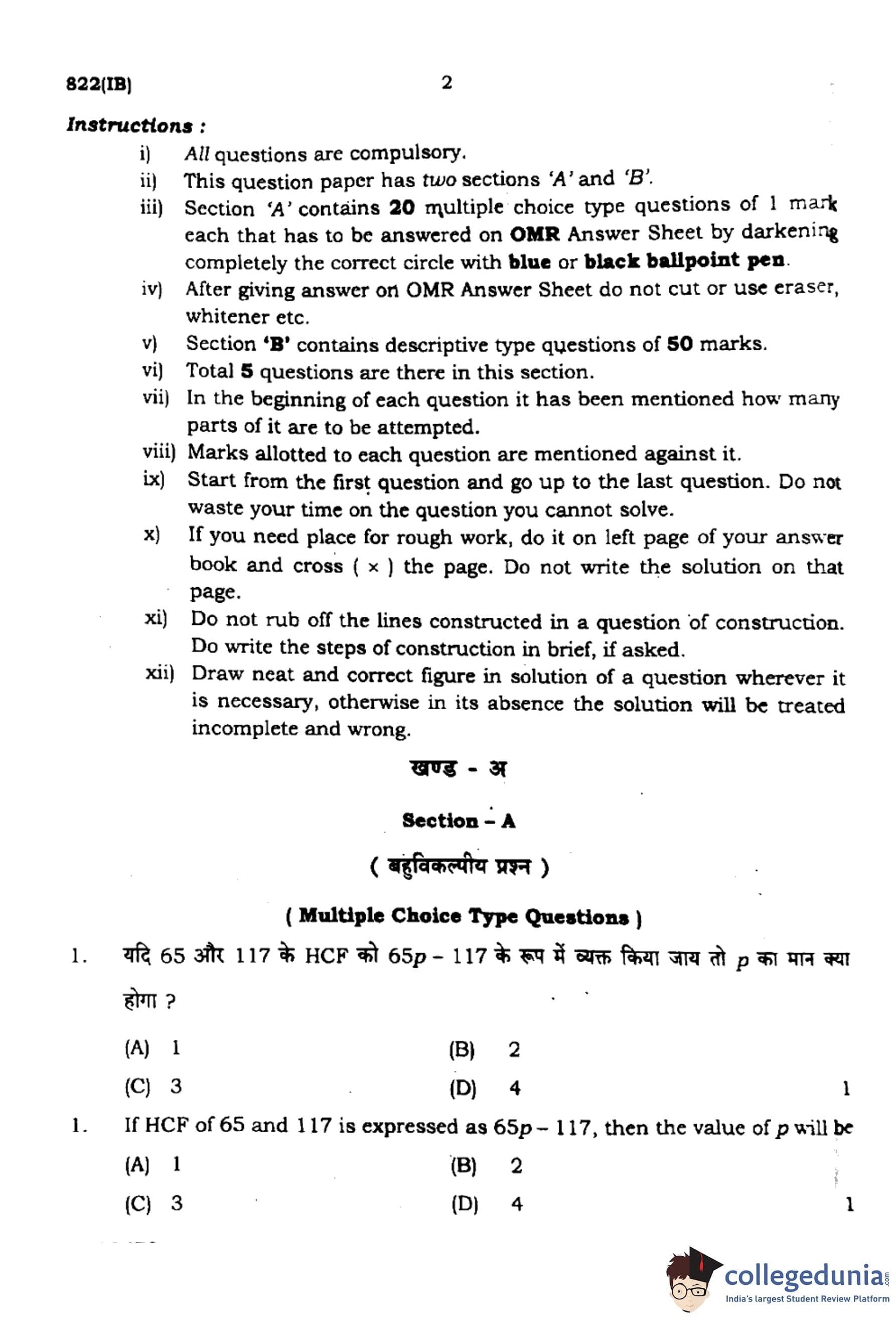
If HCF of 65 and 117 is expressed as 65p - 117, then the value of p will be
View Solution
Step 1: Understanding the Concept:
The question requires us to first find the Highest Common Factor (HCF) of 65 and 117. Then, we need to equate this HCF value to the given expression `65p - 117` to solve for the variable `p`.
Step 2: Key Formula or Approach:
We will use the prime factorization method to find the HCF of the two numbers.
HCF is the product of the lowest powers of common prime factors.
Step 3: Detailed Explanation:
First, find the prime factors of 65 and 117.
\[ 65 = 5 \times 13 \] \[ 117 = 3 \times 39 = 3 \times 3 \times 13 = 3^2 \times 13 \]
The common prime factor between 65 and 117 is 13.
Therefore, the HCF of 65 and 117 is 13.
Now, according to the problem, the HCF is expressed as `65p - 117`.
So, we can set up the equation:
\[ 65p - 117 = 13 \]
Add 117 to both sides of the equation:
\[ 65p = 13 + 117 \] \[ 65p = 130 \]
Divide by 65 to find the value of `p`:
\[ p = \frac{130}{65} \] \[ p = 2 \]
Step 4: Final Answer:
The value of `p` is 2.
Quick Tip: For finding the HCF of two numbers, the Euclidean algorithm can be faster. Divide 117 by 65: `117 = 1 \times 65 + 52`. Then divide 65 by 52: `65 = 1 \times 52 + 13`. Then divide 52 by 13: `52 = 4 \times 13 + 0`. The last non-zero remainder, 13, is the HCF.
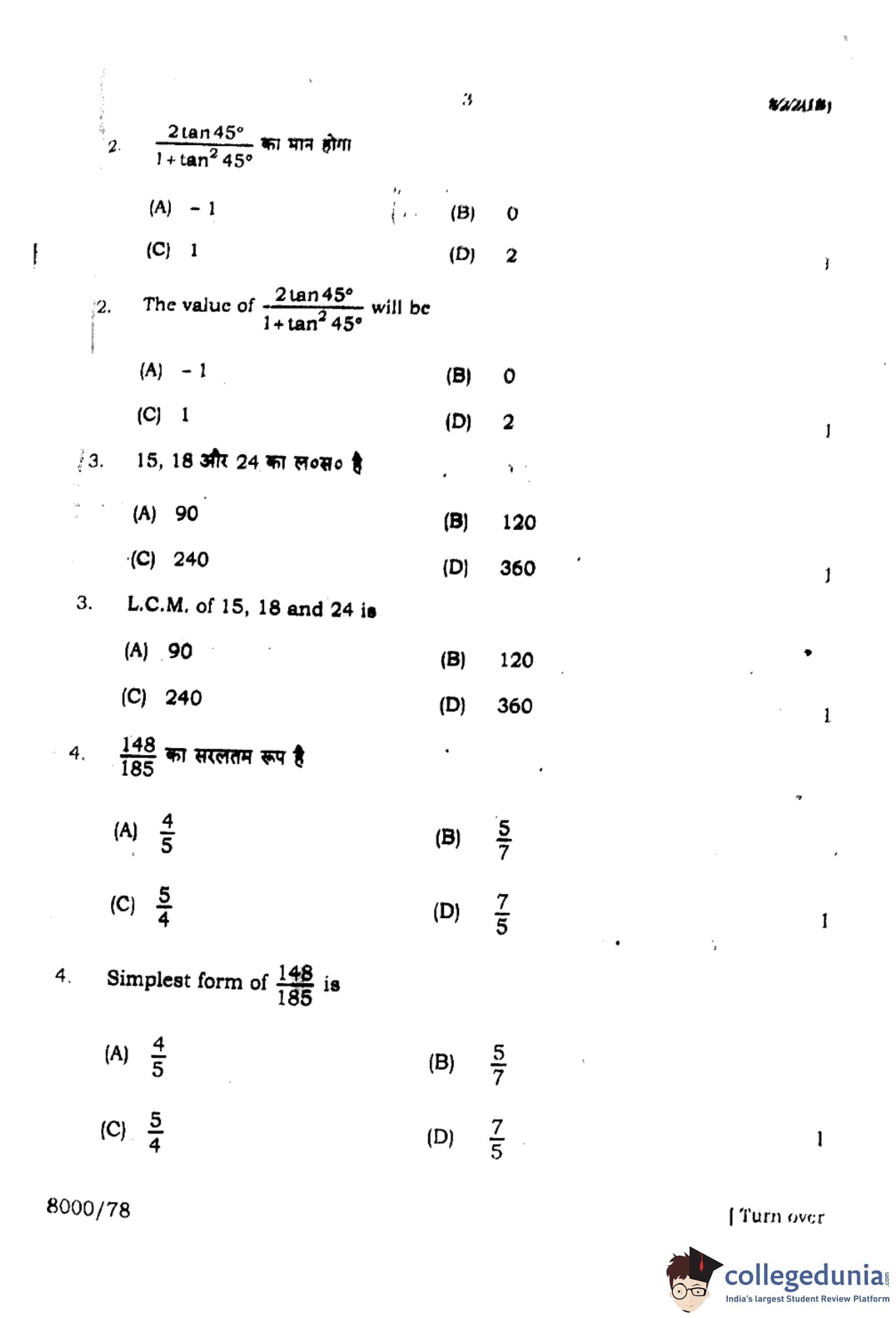
The value of \( \frac{2 \tan 45^\circ}{1 + \tan^2 45^\circ} \) will be
View Solution
Step 1: Understanding the Concept:
This problem requires the evaluation of a trigonometric expression. We need to know the value of \( \tan 45^\circ \) and substitute it into the given expression.
Step 2: Key Formula or Approach:
We will use the known value of \( \tan 45^\circ = 1 \).
Alternatively, we can use the trigonometric identity for sine of a double angle: \( \sin(2\theta) = \frac{2 \tan \theta}{1 + \tan^2 \theta} \).
Step 3: Detailed Explanation:
Method 1: Direct Substitution
We know that the value of \( \tan 45^\circ \) is 1.
Substitute this value into the expression:
\[ \frac{2 \tan 45^\circ}{1 + \tan^2 45^\circ} = \frac{2 \times (1)}{1 + (1)^2} \] \[ = \frac{2}{1 + 1} \] \[ = \frac{2}{2} \] \[ = 1 \]
Method 2: Using Double Angle Identity
The given expression is in the form of the identity for \( \sin(2\theta) \).
\[ \sin(2\theta) = \frac{2 \tan \theta}{1 + \tan^2 \theta} \]
In this problem, \( \theta = 45^\circ \).
So, the expression is equal to \( \sin(2 \times 45^\circ) \).
\[ \sin(90^\circ) \]
We know that \( \sin(90^\circ) = 1 \).
Step 4: Final Answer:
The value of the expression is 1.
Quick Tip: Memorizing key trigonometric identities like the double angle formulas can provide a very quick shortcut for solving such problems. Recognizing the pattern \( \frac{2 \tan \theta}{1 + \tan^2 \theta} \) immediately tells you the answer is \( \sin(2\theta) \).
L.C.M. of 15, 18 and 24 is
View Solution
Step 1: Understanding the Concept:
The question asks for the Least Common Multiple (L.C.M.) of the numbers 15, 18, and 24. The L.C.M. is the smallest positive integer that is a multiple of all the given numbers.
Step 2: Key Formula or Approach:
We will use the prime factorization method to find the L.C.M. The L.C.M. is the product of the highest powers of all prime factors that appear in any of the numbers.
Step 3: Detailed Explanation:
First, find the prime factorization of each number.
\[ 15 = 3 \times 5 = 3^1 \times 5^1 \] \[ 18 = 2 \times 9 = 2^1 \times 3^2 \] \[ 24 = 2 \times 12 = 2 \times 2 \times 6 = 2 \times 2 \times 2 \times 3 = 2^3 \times 3^1 \]
Now, identify the highest power of each prime factor present in the factorizations.
The prime factors are 2, 3, and 5.
Highest power of 2 is \( 2^3 \).
Highest power of 3 is \( 3^2 \).
Highest power of 5 is \( 5^1 \).
To find the L.C.M., multiply these highest powers together.
\[ L.C.M. = 2^3 \times 3^2 \times 5^1 \] \[ L.C.M. = 8 \times 9 \times 5 \] \[ L.C.M. = 72 \times 5 \] \[ L.C.M. = 360 \]
Step 4: Final Answer:
The L.C.M. of 15, 18, and 24 is 360.
Quick Tip: To quickly check your answer in a multiple-choice setting, verify if the correct option is divisible by all the given numbers (15, 18, and 24). For instance, 360/15 = 24, 360/18 = 20, and 360/24 = 15. This confirms it's a common multiple. To ensure it's the *least* common multiple, check if smaller options work (they don't).
Simplest form of \( \frac{148}{185} \) is
View Solution
Step 1: Understanding the Concept:
To find the simplest form of a fraction, we need to divide both the numerator and the denominator by their Highest Common Factor (HCF).
Step 2: Key Formula or Approach:
We will find the HCF of 148 and 185 using prime factorization.
Step 3: Detailed Explanation:
First, find the prime factors of the numerator, 148.
\[ 148 = 2 \times 74 = 2 \times 2 \times 37 = 2^2 \times 37 \]
Next, find the prime factors of the denominator, 185. Since it ends in 5, it is divisible by 5.
\[ 185 = 5 \times 37 \]
The highest common factor (HCF) is the common prime factor, which is 37.
Now, divide both the numerator and the denominator by their HCF (37).
\[ \frac{148 \div 37}{185 \div 37} = \frac{4}{5} \]
Step 4: Final Answer:
The simplest form of \( \frac{148}{185} \) is \( \frac{4}{5} \).
Quick Tip: When simplifying fractions with large numbers, look for less common prime factors like 11, 13, 17, 19, 37, etc., after checking for the easy ones (2, 3, 5). In this case, recognizing that 185 is `5 * 37` is the key. Then you can check if 148 is also divisible by 37.
For which value of p, the equations 3x - y + 8 = 0 and 6x - py = 16 represents coincident lines?
View Solution
Step 1: Understanding the Concept:
Coincident lines are lines that completely overlap. This means they are essentially the same line. For two linear equations to represent coincident lines, their corresponding coefficients must be in proportion.
Step 2: Key Formula or Approach:
For two linear equations \( a_1x + b_1y + c_1 = 0 \) and \( a_2x + b_2y + c_2 = 0 \) to represent coincident lines, the condition is:
\[ \frac{a_1}{a_2} = \frac{b_1}{b_2} = \frac{c_1}{c_2} \]
Step 3: Detailed Explanation:
First, let's write both equations in the standard form \( Ax + By + C = 0 \).
Equation 1: \( 3x - y + 8 = 0 \)
Here, \( a_1 = 3, b_1 = -1, c_1 = 8 \).
Equation 2: \( 6x - py = 16 \), which can be rewritten as \( 6x - py - 16 = 0 \).
Here, \( a_2 = 6, b_2 = -p, c_2 = -16 \).
Now, apply the condition for coincident lines:
\[ \frac{3}{6} = \frac{-1}{-p} = \frac{8}{-16} \]
Let's simplify the known ratios:
\[ \frac{1}{2} = \frac{1}{p} = -\frac{1}{2} \]
This leads to a contradiction, as \( \frac{1}{2} \neq -\frac{1}{2} \). This indicates a likely typo in the original question. A common form for such problems is for the second equation to be a direct multiple of the first. Let's assume the second equation should have been `6x - py + 16 = 0` for the ratios to match.
Corrected Interpretation:
Let's assume the second equation is \( 6x - py + 16 = 0 \).
In this case, \( a_2 = 6, b_2 = -p, c_2 = 16 \).
The condition becomes:
\[ \frac{a_1}{a_2} = \frac{b_1}{b_2} = \frac{c_1}{c_2} \] \[ \frac{3}{6} = \frac{-1}{-p} = \frac{8}{16} \]
Simplifying the ratios gives:
\[ \frac{1}{2} = \frac{1}{p} = \frac{1}{2} \]
From the equation \( \frac{1}{2} = \frac{1}{p} \), we can solve for `p`.
\[ p = 2 \]
Step 4: Final Answer:
Assuming the intended equation was `6x - py + 16 = 0`, the value of `p` is 2.
Quick Tip: In competitive exams, if you find a contradiction like \( 1/2 = -1/2 \), double-check your work. If it's still there, it's likely a typo in the question. Assume the most plausible typo that makes the problem solvable and matches one of the options. Here, changing the sign of the constant term is the most common type of error.
If the lines represented by 3x + 2py = 2 and 2x + 5y + 1 = 0 are parallel, then the value of p will be
View Solution
Step 1: Understanding the Concept:
Parallel lines have the same slope but different y-intercepts. For two linear equations in standard form, this relationship can be expressed as a condition on their coefficients.
Step 2: Key Formula or Approach:
For two linear equations \( a_1x + b_1y + c_1 = 0 \) and \( a_2x + b_2y + c_2 = 0 \) to represent parallel lines, the condition is:
\[ \frac{a_1}{a_2} = \frac{b_1}{b_2} \neq \frac{c_1}{c_2} \]
Step 3: Detailed Explanation:
First, write both equations in the standard form \( Ax + By + C = 0 \).
Equation 1: \( 3x + 2py = 2 \), which is \( 3x + 2py - 2 = 0 \).
Here, \( a_1 = 3, b_1 = 2p, c_1 = -2 \).
Equation 2: \( 2x + 5y + 1 = 0 \).
Here, \( a_2 = 2, b_2 = 5, c_2 = 1 \).
Now, apply the condition for parallel lines:
\[ \frac{a_1}{a_2} = \frac{b_1}{b_2} \] \[ \frac{3}{2} = \frac{2p}{5} \]
To solve for `p`, cross-multiply:
\[ 3 \times 5 = 2 \times 2p \] \[ 15 = 4p \] \[ p = \frac{15}{4} \]
We should also check the second part of the condition: \( \frac{a_1}{a_2} \neq \frac{c_1}{c_2} \).
\( \frac{3}{2} \neq \frac{-2}{1} \). This is true.
Step 4: Final Answer:
The value of `p` is \( \frac{15}{4} \).
Quick Tip: Remember the conditions for different types of lines: Intersecting: \( \frac{a_1}{a_2} \neq \frac{b_1}{b_2} \) Parallel: \( \frac{a_1}{a_2} = \frac{b_1}{b_2} \neq \frac{c_1}{c_2} \) Coincident: \( \frac{a_1}{a_2} = \frac{b_1}{b_2} = \frac{c_1}{c_2} \) Keeping these three conditions clear will help you solve these problems quickly and accurately.
If 15 cot \(\theta\) = 8, then the value of sin \(\theta\) will be
View Solution
Step 1: Understanding the Concept:
This problem involves finding the value of one trigonometric ratio (\(\sin \theta\)) given the value of another (\(\cot \theta\)). We can solve this by constructing a right-angled triangle or by using trigonometric identities.
Step 2: Key Formula or Approach:
From the given equation, we find \( \cot \theta \). We know that \( \cot \theta = \frac{Adjacent}{Opposite} \). We can then use the Pythagorean theorem (\( Hypotenuse^2 = Opposite^2 + Adjacent^2 \)) to find the hypotenuse and subsequently \( \sin \theta = \frac{Opposite}{Hypotenuse} \).
Step 3: Detailed Explanation:
Given the equation:
\[ 15 \cot \theta = 8 \] \[ \cot \theta = \frac{8}{15} \]
In a right-angled triangle, \( \cot \theta \) is the ratio of the adjacent side to the opposite side.
Let the adjacent side = 8k and the opposite side = 15k, where k is a positive constant.
Using the Pythagorean theorem to find the hypotenuse (H):
\[ H^2 = (Opposite)^2 + (Adjacent)^2 \] \[ H^2 = (15k)^2 + (8k)^2 \] \[ H^2 = 225k^2 + 64k^2 \] \[ H^2 = 289k^2 \] \[ H = \sqrt{289k^2} = 17k \]
Now, we can find \( \sin \theta \), which is the ratio of the opposite side to the hypotenuse.
\[ \sin \theta = \frac{Opposite}{Hypotenuse} = \frac{15k}{17k} \] \[ \sin \theta = \frac{15}{17} \]
Step 4: Final Answer:
The value of \( \sin \theta \) is \( \frac{15}{17} \).
Quick Tip: Memorizing common Pythagorean triplets can save a lot of time. (8, 15, 17) is a common triplet. When you see \( \cot \theta = 8/15 \), you can immediately identify the sides as 8 and 15, and the hypotenuse as 17, making the calculation for \( \sin \theta \) (Opposite/Hypotenuse = 15/17) very fast.
If ABC and XYZ are two similar triangles and \(\angle A = 75^\circ\) and \(\angle Y = 57^\circ\), then the value of \(\angle C\) will be
View Solution
Step 1: Understanding the Concept:
The problem is based on the properties of similar triangles. When two triangles are similar, their corresponding angles are equal. The sum of angles in any triangle is always 180°.
Step 2: Key Formula or Approach:
1. For similar triangles \(\triangle ABC \sim \triangle XYZ\), we have \(\angle A = \angle X\), \(\angle B = \angle Y\), and \(\angle C = \angle Z\).
2. The sum of angles in \(\triangle ABC\) is \(\angle A + \angle B + \angle C = 180^\circ\).
Step 3: Detailed Explanation:
We are given that \(\triangle ABC\) is similar to \(\triangle XYZ\).
This means their corresponding angles are equal.
\[ \angle A = \angle X \] \[ \angle B = \angle Y \] \[ \angle C = \angle Z \]
We are given the values:
\[ \angle A = 75^\circ \] \[ \angle Y = 57^\circ \]
From the property of similar triangles, we know that \(\angle B = \angle Y\).
Therefore, \(\angle B = 57^\circ\).
Now, consider \(\triangle ABC\). The sum of its angles must be 180°.
\[ \angle A + \angle B + \angle C = 180^\circ \]
Substitute the known values of \(\angle A\) and \(\angle B\):
\[ 75^\circ + 57^\circ + \angle C = 180^\circ \] \[ 132^\circ + \angle C = 180^\circ \]
Subtract 132° from both sides to find \(\angle C\):
\[ \angle C = 180^\circ - 132^\circ \] \[ \angle C = 48^\circ \]
Step 4: Final Answer:
The value of \(\angle C\) is \( 48^\circ \).
Quick Tip: Pay close attention to the order of vertices in the similarity statement (\(\triangle ABC \sim \triangle XYZ\)). It tells you exactly which angles and sides correspond. A corresponds to X, B to Y, and C to Z. Misinterpreting this correspondence is a common error.
The distance of the point m(-3, 4) from the origin is
View Solution
Step 1: Understanding the Concept:
This question asks for the distance between a given point and the origin (0, 0) in a Cartesian coordinate system.
Step 2: Key Formula or Approach:
The distance `d` between two points \( (x_1, y_1) \) and \( (x_2, y_2) \) is given by the distance formula:
\[ d = \sqrt{(x_2 - x_1)^2 + (y_2 - y_1)^2} \]
A special case is the distance from the origin (0,0) to a point (x, y), which simplifies to \( d = \sqrt{x^2 + y^2} \).
Step 3: Detailed Explanation:
The two points are the origin \( (0, 0) \) and point m \( (-3, 4) \).
Let \( (x_1, y_1) = (0, 0) \) and \( (x_2, y_2) = (-3, 4) \).
Using the distance formula:
\[ d = \sqrt{(-3 - 0)^2 + (4 - 0)^2} \] \[ d = \sqrt{(-3)^2 + (4)^2} \] \[ d = \sqrt{9 + 16} \] \[ d = \sqrt{25} \] \[ d = 5 \]
Step 4: Final Answer:
The distance of the point m(-3, 4) from the origin is 5 units. Note that option (C) \( \sqrt{49} \) is equal to 7.
Quick Tip: The coordinates (-3, 4) form a right-angled triangle with the origin, where the legs are the absolute values of the coordinates (3 and 4). This is a classic (3, 4, 5) Pythagorean triplet. Recognizing this allows you to find the distance (the hypotenuse) instantly without calculation.
The coordinates of the mid-point of the line segment made by joining the points (-2, 6) and (-2, 10) are
View Solution
Step 1: Understanding the Concept:
The question requires finding the coordinates of the midpoint of a line segment given the coordinates of its endpoints.
Step 2: Key Formula or Approach:
The coordinates of the midpoint of a line segment with endpoints \( (x_1, y_1) \) and \( (x_2, y_2) \) are given by the midpoint formula:
\[ \left( \frac{x_1 + x_2}{2}, \frac{y_1 + y_2}{2} \right) \]
Step 3: Detailed Explanation:
The given endpoints are \( (-2, 6) \) and \( (-2, 10) \).
Let \( (x_1, y_1) = (-2, 6) \) and \( (x_2, y_2) = (-2, 10) \).
Calculate the x-coordinate of the midpoint:
\[ x_{mid} = \frac{x_1 + x_2}{2} = \frac{-2 + (-2)}{2} = \frac{-4}{2} = -2 \]
Calculate the y-coordinate of the midpoint:
\[ y_{mid} = \frac{y_1 + y_2}{2} = \frac{6 + 10}{2} = \frac{16}{2} = 8 \]
So, the coordinates of the midpoint are \( (-2, 8) \).
Step 4: Final Answer:
The coordinates of the mid-point are (-2, 8).
Quick Tip: Notice that the x-coordinates of both points are the same (-2). This means the line segment is vertical. For any vertical line, the x-coordinate of the midpoint will be the same as the endpoints' x-coordinate. You only need to find the average of the y-coordinates: (6+10)/2 = 8. This simplifies the problem.
If AD \(\perp\) BC in an equilateral triangle ABC, then AD\(^2\) will be
View Solution
Step 1: Understanding the Concept:
In an equilateral triangle, the altitude from a vertex to the opposite side bisects the opposite side. This creates two congruent 30-60-90 right-angled triangles. We can use the Pythagorean theorem to establish a relationship between the altitude (AD) and the segment of the base (CD).
Step 2: Key Formula or Approach:
1. In \(\triangle ABC\), since it is equilateral, AB = BC = AC.
2. Since AD \(\perp\) BC, AD is an altitude. In an equilateral triangle, the altitude is also the median, so D is the midpoint of BC. Thus, CD = \( \frac{1}{2} \) BC.
3. Apply the Pythagorean theorem to the right-angled triangle \(\triangle ADC\): \( AC^2 = AD^2 + CD^2 \).
Step 3: Detailed Explanation:
Let the side length of the equilateral triangle be \(s\).
So, AB = BC = AC = \(s\).
Since D is the midpoint of BC, we have CD = \( \frac{1}{2} \) BC = \( \frac{s}{2} \).
Now, consider the right-angled triangle \(\triangle ADC\).
According to the Pythagorean theorem:
\[ AC^2 = AD^2 + CD^2 \]
Substitute the values of AC and CD in terms of \(s\):
\[ s^2 = AD^2 + \left(\frac{s}{2}\right)^2 \] \[ s^2 = AD^2 + \frac{s^2}{4} \]
Rearrange the equation to solve for AD\(^2\):
\[ AD^2 = s^2 - \frac{s^2}{4} = \frac{4s^2 - s^2}{4} = \frac{3s^2}{4} \]
We need to express AD\(^2\) in terms of CD\(^2\).
We know that CD = \( \frac{s}{2} \), which implies CD\(^2\) = \( \frac{s^2}{4} \).
Substitute \( \frac{s^2}{4} \) with CD\(^2\) in the expression for AD\(^2\):
\[ AD^2 = 3 \times \left(\frac{s^2}{4}\right) \] \[ AD^2 = 3 CD^2 \]
Step 4: Final Answer:
The value of AD\(^2\) is \( 3 CD^2 \).
Quick Tip: For a 30-60-90 triangle, the sides are in the ratio \(1:\sqrt{3}:2\). In \(\triangle ADC\), \(\angle C = 60^\circ\), \(\angle D = 90^\circ\), and \(\angle CAD = 30^\circ\). The sides are CD (opposite 30°), AD (opposite 60°), and AC (opposite 90°). Thus, AD = CD \(\times \sqrt{3}\). Squaring both sides gives AD\(^2\) = 3 CD\(^2\).
The vertices of triangle ABC are (7, 5), (5, 7) and (-3, 3) respectively. If the mid-point of BC is D, then the measure of AD will be
View Solution
Step 1: Understanding the Concept:
This problem involves two main concepts from coordinate geometry: finding the midpoint of a line segment and finding the distance between two points. We first need to find the coordinates of point D, and then calculate the length of the line segment AD.
Step 2: Key Formula or Approach:
1. Midpoint Formula: The coordinates of the midpoint of a line segment with endpoints \( (x_1, y_1) \) and \( (x_2, y_2) \) are \( \left( \frac{x_1 + x_2}{2}, \frac{y_1 + y_2}{2} \right) \).
2. Distance Formula: The distance between two points \( (x_1, y_1) \) and \( (x_2, y_2) \) is \( \sqrt{(x_2 - x_1)^2 + (y_2 - y_1)^2} \).
Step 3: Detailed Explanation:
The vertices are A(7, 5), B(5, 7), and C(-3, 3).
First, find the coordinates of D, the midpoint of BC.
Using the midpoint formula with B(5, 7) and C(-3, 3):
\[ D = \left( \frac{5 + (-3)}{2}, \frac{7 + 3}{2} \right) \] \[ D = \left( \frac{2}{2}, \frac{10}{2} \right) \] \[ D = (1, 5) \]
Next, find the length of the median AD using the distance formula with A(7, 5) and D(1, 5).
\[ AD = \sqrt{(1 - 7)^2 + (5 - 5)^2} \] \[ AD = \sqrt{(-6)^2 + (0)^2} \] \[ AD = \sqrt{36 + 0} \] \[ AD = \sqrt{36} \] \[ AD = 6 \]
Step 4: Final Answer:
The measure of AD is 6 units.
Quick Tip: When using the distance formula, if you notice that either the x-coordinates or the y-coordinates are the same, the distance is simply the absolute difference of the other coordinates. Here, for A(7, 5) and D(1, 5), the y-coordinates are the same. The distance is just \( |7 - 1| = 6 \).
If sec \(\theta\) = 2, then the value of \(\theta\) will be
View Solution
Step 1: Understanding the Concept:
This question requires knowledge of the values of trigonometric ratios for standard angles (0°, 30°, 45°, 60°, 90°).
Step 2: Key Formula or Approach:
The secant function is the reciprocal of the cosine function: \( \sec \theta = \frac{1}{\cos \theta} \). We can use this relationship to find the value of \( \cos \theta \) and then determine the angle \(\theta\).
Step 3: Detailed Explanation:
We are given:
\[ \sec \theta = 2 \]
Using the reciprocal identity:
\[ \cos \theta = \frac{1}{\sec \theta} = \frac{1}{2} \]
We need to find the angle \(\theta\) (for \(0^\circ \le \theta \le 90^\circ\)) for which \( \cos \theta = \frac{1}{2} \).
From the standard trigonometric values, we know that:
\[ \cos 60^\circ = \frac{1}{2} \]
Therefore, the value of \(\theta\) is 60°.
Step 4: Final Answer:
The value of \(\theta\) is 60°.
Quick Tip: It's highly beneficial to memorize the trigonometric values for standard angles (0°, 30°, 45°, 60°, 90°) for all six ratios (sin, cos, tan, cosec, sec, cot). This allows for instant recall and saves valuable time during exams.
The value of \( (cosec^2\theta - \cot^2\theta)(1 - \cos^2\theta) \) is
View Solution
Step 1: Understanding the Concept:
This problem requires the application of fundamental trigonometric identities, specifically the Pythagorean identities.
Step 2: Key Formula or Approach:
We will use the following two Pythagorean identities:
1. \( \sin^2\theta + \cos^2\theta = 1 \), which can be rearranged to \( 1 - \cos^2\theta = \sin^2\theta \).
2. \( 1 + \cot^2\theta = cosec^2\theta \), which can be rearranged to \( cosec^2\theta - \cot^2\theta = 1 \).
Step 3: Detailed Explanation:
The given expression is \( (cosec^2\theta - \cot^2\theta)(1 - \cos^2\theta) \).
Let's simplify each part of the expression separately.
Part 1: \( (cosec^2\theta - \cot^2\theta) \)
From the Pythagorean identity \( 1 + \cot^2\theta = cosec^2\theta \), we get:
\[ cosec^2\theta - \cot^2\theta = 1 \]
Part 2: \( (1 - \cos^2\theta) \)
From the Pythagorean identity \( \sin^2\theta + \cos^2\theta = 1 \), we get:
\[ 1 - \cos^2\theta = \sin^2\theta \]
Now, substitute these simplified parts back into the original expression:
\[ (cosec^2\theta - \cot^2\theta)(1 - \cos^2\theta) = (1)(\sin^2\theta) = \sin^2\theta \]
Step 4: Final Answer:
The value of the expression is \( \sin^2\theta \).
Quick Tip: Always look for fundamental identities when you see squared trigonometric functions. The three Pythagorean identities (\(\sin^2\theta + \cos^2\theta = 1\), \(1 + \tan^2\theta = \sec^2\theta\), and \(1 + \cot^2\theta = cosec^2\theta\)) are the keys to simplifying most such expressions.
Area of the base of a right circular cylinder is 9\( \pi \) cm\(^2\). Radius of its base will be
View Solution
Step 1: Understanding the Concept:
The base of a right circular cylinder is a circle. The problem gives the area of this circular base and asks for its radius.
Step 2: Key Formula or Approach:
The formula for the area of a circle with radius \(r\) is:
\[ Area = \pi r^2 \]
Step 3: Detailed Explanation:
We are given that the area of the base of the cylinder is \( 9\pi \) cm\(^2\).
Using the formula for the area of a circle:
\[ \pi r^2 = 9\pi \]
To find the radius \(r\), we can solve this equation. Divide both sides by \( \pi \):
\[ r^2 = 9 \]
Take the square root of both sides. Since radius must be a positive value:
\[ r = \sqrt{9} \] \[ r = 3 \]
Step 4: Final Answer:
The radius of its base will be 3 cm.
Quick Tip: Always pay attention to the units given in the question and make sure your answer has the correct units. In this case, the area is in cm\(^2\), so the radius will be in cm.
Area of the square which can be drawn in the circle of radius 4 cm will be
View Solution
Step 1: Understanding the Concept:
The largest square that can be drawn inside a circle is an inscribed square. The vertices of this square lie on the circumference of the circle. The diagonal of the inscribed square is equal to the diameter of the circle.
Step 2: Key Formula or Approach:
1. Diameter of a circle = 2 \( \times \) Radius.
2. The diagonal (\(d\)) of an inscribed square is equal to the diameter of the circle.
3. The area of a square can be calculated using its side (\(s\)) as Area = \(s^2\), or using its diagonal (\(d\)) as Area = \( \frac{1}{2} d^2 \).
Step 3: Detailed Explanation:
The radius of the circle is given as 4 cm.
First, calculate the diameter of the circle:
\[ Diameter = 2 \times Radius = 2 \times 4 = 8 cm \]
The diagonal of the inscribed square is equal to the diameter of the circle.
\[ d = 8 cm \]
Now, calculate the area of the square using the diagonal formula:
\[ Area = \frac{1}{2} d^2 \] \[ Area = \frac{1}{2} (8)^2 \] \[ Area = \frac{1}{2} \times 64 \] \[ Area = 32 cm^2 \]
Step 4: Final Answer:
The area of the square is 32 cm\(^2\).
Quick Tip: Knowing the formula for the area of a square in terms of its diagonal (Area = \( \frac{1}{2} d^2 \)) is a very useful shortcut for problems involving inscribed squares in circles. It saves you the step of calculating the side length.
The mean from the following table will be
Class-interval & 3-5 & 5-7 & 7-9 & 9-11
Frequency & 4 & 2 & 1 & 3
View Solution
Step 1: Understanding the Concept:
To find the mean of grouped data, we use the direct method, which involves finding the class mark (mid-point) for each class interval, multiplying it by the corresponding frequency, summing these products, and then dividing by the total frequency.
Step 2: Key Formula or Approach:
The formula for the mean (\(\bar{x}\)) of grouped data is:
\[ \bar{x} = \frac{\sum f_i x_i}{\sum f_i} \]
where \(f_i\) is the frequency of the \(i\)-th class and \(x_i\) is the class mark of the \(i\)-th class.
The class mark \(x_i\) is calculated as \( \frac{Upper limit + Lower limit}{2} \).
Step 3: Detailed Explanation:
We will create a table to organize the calculations.
\begin{tabular{|c|c|c|c|
\hline
Class-interval & Frequency (\(f_i\)) & Class Mark (\(x_i\)) & \(f_i x_i\)
\hline
3-5 & 4 & \( \frac{3+5}{2} = 4 \) & \( 4 \times 4 = 16 \)
\hline
5-7 & 2 & \( \frac{5+7}{2} = 6 \) & \( 2 \times 6 = 12 \)
\hline
7-9 & 1 & \( \frac{7+9}{2} = 8 \) & \( 1 \times 8 = 8 \)
\hline
9-11 & 3 & \( \frac{9+11}{2} = 10 \) & \( 3 \times 10 = 30 \)
\hline
Total & \(\sum f_i = 10\) & & \(\sum f_i x_i = 66\)
\hline
\end{tabular
First, calculate the total frequency (\(\sum f_i\)):
\[ \sum f_i = 4 + 2 + 1 + 3 = 10 \]
Next, calculate the sum of the products of frequency and class mark (\(\sum f_i x_i\)):
\[ \sum f_i x_i = 16 + 12 + 8 + 30 = 66 \]
Now, use the formula for the mean:
\[ \bar{x} = \frac{\sum f_i x_i}{\sum f_i} = \frac{66}{10} = 6.6 \]
Step 4: Final Answer:
The mean from the given table is 6.6.
Quick Tip: For calculating the mean of grouped data, the direct method is usually the simplest and fastest, especially when the numbers (frequencies and class marks) are small. Always double-check your arithmetic, as a small calculation error can lead to a wrong answer.
A die is thrown once. The probability of getting a prime number will be
View Solution
Step 1: Understanding the Concept:
Probability is the measure of the likelihood of an event occurring. It is calculated by dividing the number of favorable outcomes by the total number of possible outcomes.
Step 2: Key Formula or Approach:
\[ Probability of an event = \frac{Number of favorable outcomes}{Total number of possible outcomes} \]
Step 3: Detailed Explanation:
When a standard six-sided die is thrown once, the set of all possible outcomes (the sample space) is:
\[ S = \{1, 2, 3, 4, 5, 6\} \]
The total number of possible outcomes is 6.
The event we are interested in is "getting a prime number". A prime number is a natural number greater than 1 that has no positive divisors other than 1 and itself.
The prime numbers in the sample space S are:
\[ \{2, 3, 5\} \]
The number of favorable outcomes is 3.
Now, calculate the probability:
\[ P(prime number) = \frac{3}{6} = \frac{1}{2} \]
Step 4: Final Answer:
The probability of getting a prime number is \( \frac{1}{2} \).
Quick Tip: Be careful with the definition of a prime number. Remember that 1 is not a prime number. This is a common point of confusion that can lead to an incorrect answer. The smallest prime number is 2.
If mean of a frequency distribution is 20.5 and median is 21 then mode will be
View Solution
Step 1: Understanding the Concept:
There is an empirical relationship that connects the three measures of central tendency: mean, median, and mode for a moderately skewed distribution. This relationship allows us to estimate one measure if the other two are known.
Step 2: Key Formula or Approach:
The empirical formula relating mean, median, and mode is:
\[ Mode = 3 \times Median - 2 \times Mean \]
Step 3: Detailed Explanation:
We are given the following values:
Mean = 20.5
Median = 21
Substitute these values into the empirical formula to find the mode:
\[ Mode = 3 \times (21) - 2 \times (20.5) \] \[ Mode = 63 - 41 \] \[ Mode = 22 \]
Step 4: Final Answer:
The mode of the frequency distribution will be 22.
Quick Tip: Memorize the empirical relationship: Mode = 3 Median - 2 Mean. A simple way to remember it is to note that the median is "in the middle" of the mode and mean in the formula, and it has the largest coefficient (3).
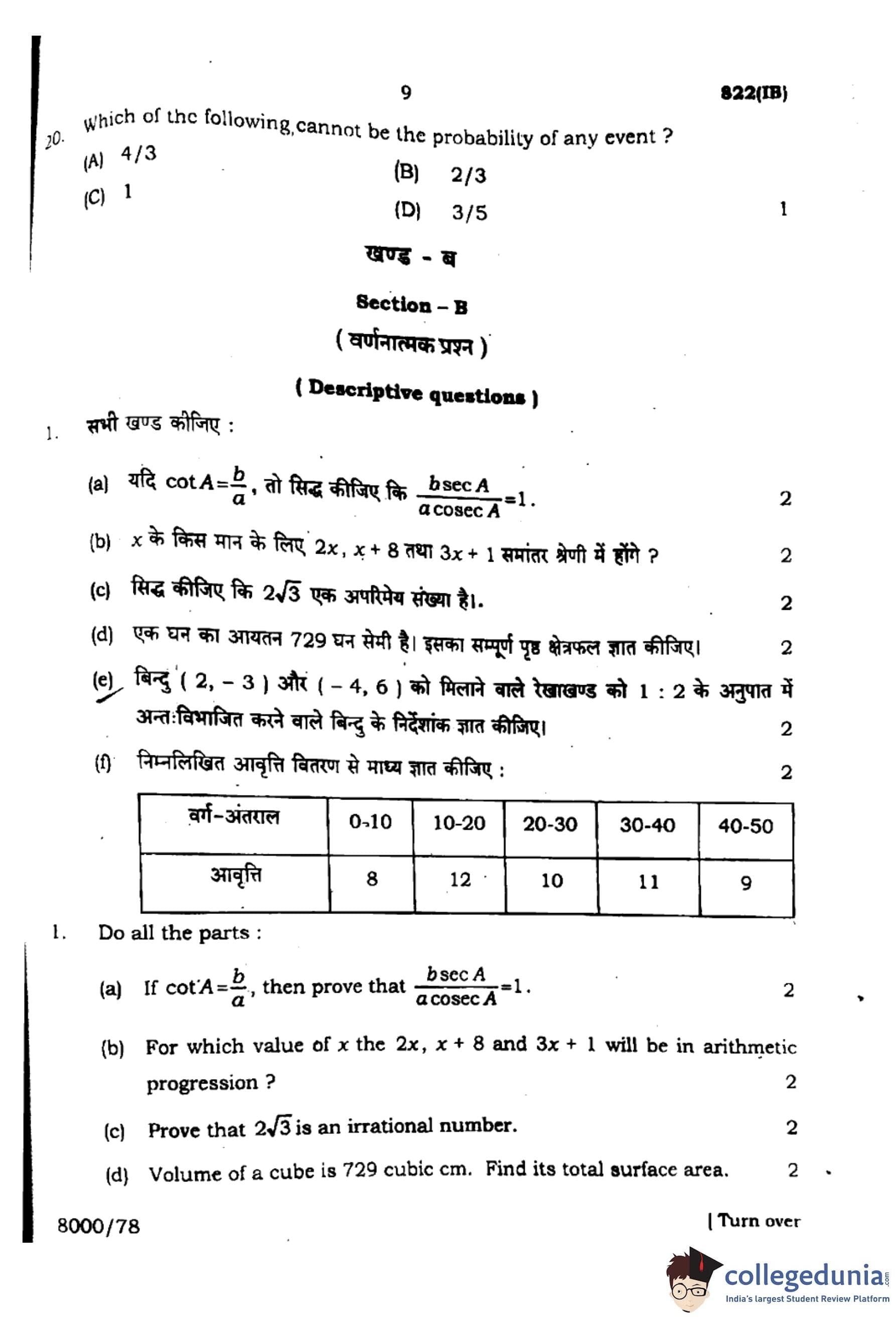
Which of the following cannot be the probability of any event ?
View Solution
Step 1: Understanding the Concept:
The probability of any event is a number that represents the likelihood of that event occurring. This number must always fall within a specific range.
Step 2: Key Formula or Approach:
The fundamental rule of probability states that for any event E, its probability P(E) must satisfy the condition:
\[ 0 \le P(E) \le 1 \]
This means probability can be 0 (for an impossible event), 1 (for a certain event), or any value in between. It can never be negative or greater than 1.
Step 3: Detailed Explanation:
Let's evaluate each option to see if it falls within the range [0, 1].
(A) \( \frac{4}{3} \): This is an improper fraction. \( \frac{4}{3} = 1.333... \). Since this value is greater than 1, it cannot be the probability of any event.
(B) \( \frac{2}{3} \): This value is approximately 0.667. It is between 0 and 1, so it can be a probability.
(C) 1: This is a valid probability, representing a certain event.
(D) \( \frac{3}{5} \): This value is 0.6. It is between 0 and 1, so it can be a probability.
Based on the analysis, \( \frac{4}{3} \) is the only value that cannot represent a probability.
Step 4: Final Answer:
The value \( \frac{4}{3} \) cannot be the probability of any event.
Quick Tip: To quickly identify if a fraction can be a probability, check if it's a proper fraction (numerator is smaller than the denominator). If it is, its value is between 0 and 1. If it's an improper fraction (numerator is greater than or equal to the denominator), its value is greater than or equal to 1. Only improper fractions equal to 1/1, 2/2 etc., are valid probabilities.
If \( \cot A = \frac{b}{a} \), then prove that \( \frac{b \sec A}{a \operatorname{cosec} A} = 1 \).
View Solution
Step 1: Understanding the Concept:
We need to prove the given trigonometric identity by simplifying the Left Hand Side (LHS) of the equation and showing that it equals the Right Hand Side (RHS), which is 1. We will use fundamental trigonometric identities and the given value of \( \cot A \).
Step 2: Key Formula or Approach:
We will use the following reciprocal and quotient identities:
1. \( \sec A = \frac{1}{\cos A} \)
2. \( \operatorname{cosec} A = \frac{1}{\sin A} \)
3. \( \tan A = \frac{\sin A}{\cos A} \)
4. \( \tan A = \frac{1}{\cot A} \)
Step 3: Detailed Explanation:
Let's start with the Left Hand Side (LHS) of the equation:
\[ LHS = \frac{b \sec A}{a \operatorname{cosec} A} \]
Substitute the reciprocal identities for \( \sec A \) and \( \operatorname{cosec} A \):
\[ LHS = \frac{b \left( \frac{1}{\cos A} \right)}{a \left( \frac{1}{\sin A} \right)} \]
Simplify the complex fraction:
\[ LHS = \frac{b}{a} \times \frac{\sin A}{\cos A} \]
Using the quotient identity \( \tan A = \frac{\sin A}{\cos A} \):
\[ LHS = \frac{b}{a} \tan A \]
We are given that \( \cot A = \frac{b}{a} \). We know that \( \tan A = \frac{1}{\cot A} \).
Therefore, \( \tan A = \frac{1}{\frac{b}{a}} = \frac{a}{b} \).
Now, substitute this value of \( \tan A \) back into the LHS expression:
\[ LHS = \frac{b}{a} \times \left( \frac{a}{b} \right) \] \[ LHS = 1 \]
Since LHS = RHS, the identity is proved.
\[ Hence Proved. \] Quick Tip: A common and effective strategy for proving trigonometric identities is to express all trigonometric ratios in terms of sine and cosine. This often simplifies the expression and makes the path to the solution clearer.
For which value of x the 2x, x + 8 and 3x + 1 will be in arithmetic progression ?
View Solution
Step 1: Understanding the Concept:
An arithmetic progression (AP) is a sequence of numbers where the difference between consecutive terms is constant. This constant difference is called the common difference.
Step 2: Key Formula or Approach:
If three terms \(t_1, t_2, t_3\) are in an AP, then the common difference is the same.
\[ t_2 - t_1 = t_3 - t_2 \]
This can be rearranged to a more convenient form:
\[ 2t_2 = t_1 + t_3 \]
Step 3: Detailed Explanation:
We are given three terms in AP:
\( t_1 = 2x \)
\( t_2 = x + 8 \)
\( t_3 = 3x + 1 \)
Using the property \( 2t_2 = t_1 + t_3 \):
\[ 2(x + 8) = (2x) + (3x + 1) \]
Now, we solve this linear equation for x.
Distribute the 2 on the left side:
\[ 2x + 16 = 2x + 3x + 1 \]
Combine like terms on the right side:
\[ 2x + 16 = 5x + 1 \]
Move the x terms to one side and the constant terms to the other:
\[ 16 - 1 = 5x - 2x \] \[ 15 = 3x \]
Divide by 3:
\[ x = \frac{15}{3} \] \[ x = 5 \]
Step 4: Final Answer:
The value of x for which the terms are in arithmetic progression is 5. We can check this: the terms are 2(5)=10, 5+8=13, 3(5)+1=16. The sequence 10, 13, 16 has a common difference of 3.
Quick Tip: For any three consecutive terms in an AP, the middle term is the arithmetic mean of the other two. This property, \( Middle Term = \frac{First Term + Last Term}{2} \), is the basis for the formula \(2t_2 = t_1 + t_3\) and is the fastest way to solve such problems.
Prove that \( 2\sqrt{3} \) is an irrational number.
View Solution
Step 1: Understanding the Concept:
To prove that a number is irrational, we often use the method of proof by contradiction. We start by assuming the opposite (that the number is rational) and then show that this assumption leads to a logical contradiction.
Step 2: Key Formula or Approach:
1. A rational number can be expressed in the form \( \frac{p}{q} \), where \(p\) and \(q\) are integers, \(q \neq 0\), and \(p\) and \(q\) are co-prime (have no common factors other than 1).
2. We will use the established fact that \( \sqrt{3} \) is an irrational number.
Step 3: Detailed Explanation:
Let us assume, to the contrary, that \( 2\sqrt{3} \) is a rational number.
By definition, we can write it in the form \( \frac{p}{q} \):
\[ 2\sqrt{3} = \frac{p}{q} \]
where \(p\) and \(q\) are co-prime integers and \(q \neq 0\).
Now, let's isolate \( \sqrt{3} \) in the equation:
\[ \sqrt{3} = \frac{p}{2q} \]
Since \(p\) and \(q\) are integers, \(p\) and \(2q\) are also integers. Since \(q \neq 0\), it follows that \(2q \neq 0\).
Therefore, \( \frac{p}{2q} \) is a rational number.
Our equation shows that \( \sqrt{3} \) is equal to a rational number \( \frac{p}{2q} \). This implies that \( \sqrt{3} \) is a rational number.
However, this contradicts the well-known fact that \( \sqrt{3} \) is an irrational number.
This contradiction has arisen because of our incorrect initial assumption that \( 2\sqrt{3} \) is rational.
Therefore, our assumption must be false.
Hence, \( 2\sqrt{3} \) is an irrational number.
\[ Hence Proved. \] Quick Tip: This proof strategy works for any number of the form \( k\sqrt{n} \), where \(k\) is a non-zero rational number and \( \sqrt{n} \) is irrational. The key is to isolate the irrational part and show that it equals a rational part, which creates a contradiction.
Volume of a cube is 729 cubic cm. Find its total surface area.
View Solution
Step 1: Understanding the Concept:
This problem requires us to use the formula for the volume of a cube to find its side length, and then use the side length to calculate the cube's total surface area.
Step 2: Key Formula or Approach:
1. Volume of a cube with side length \(a\): \( V = a^3 \)
2. Total Surface Area (TSA) of a cube with side length \(a\): \( TSA = 6a^2 \)
Step 3: Detailed Explanation:
We are given the volume of the cube:
\[ V = 729 cm^3 \]
Using the volume formula, we can find the side length \(a\):
\[ a^3 = 729 \] \[ a = \sqrt[3]{729} \]
Since \( 9 \times 9 \times 9 = 81 \times 9 = 729 \), the side length is:
\[ a = 9 cm \]
Now, we can find the total surface area using the TSA formula:
\[ TSA = 6a^2 \]
Substitute the value of \(a = 9\):
\[ TSA = 6 \times (9)^2 \] \[ TSA = 6 \times 81 \] \[ TSA = 486 cm^2 \]
Step 4: Final Answer:
The total surface area of the cube is 486 cm\(^2\).
Quick Tip: To solve such problems quickly, it's helpful to memorize the squares and cubes of common numbers (e.g., up to 20 for squares and 10 for cubes). Recognizing that 729 is \(9^3\) saves significant time.
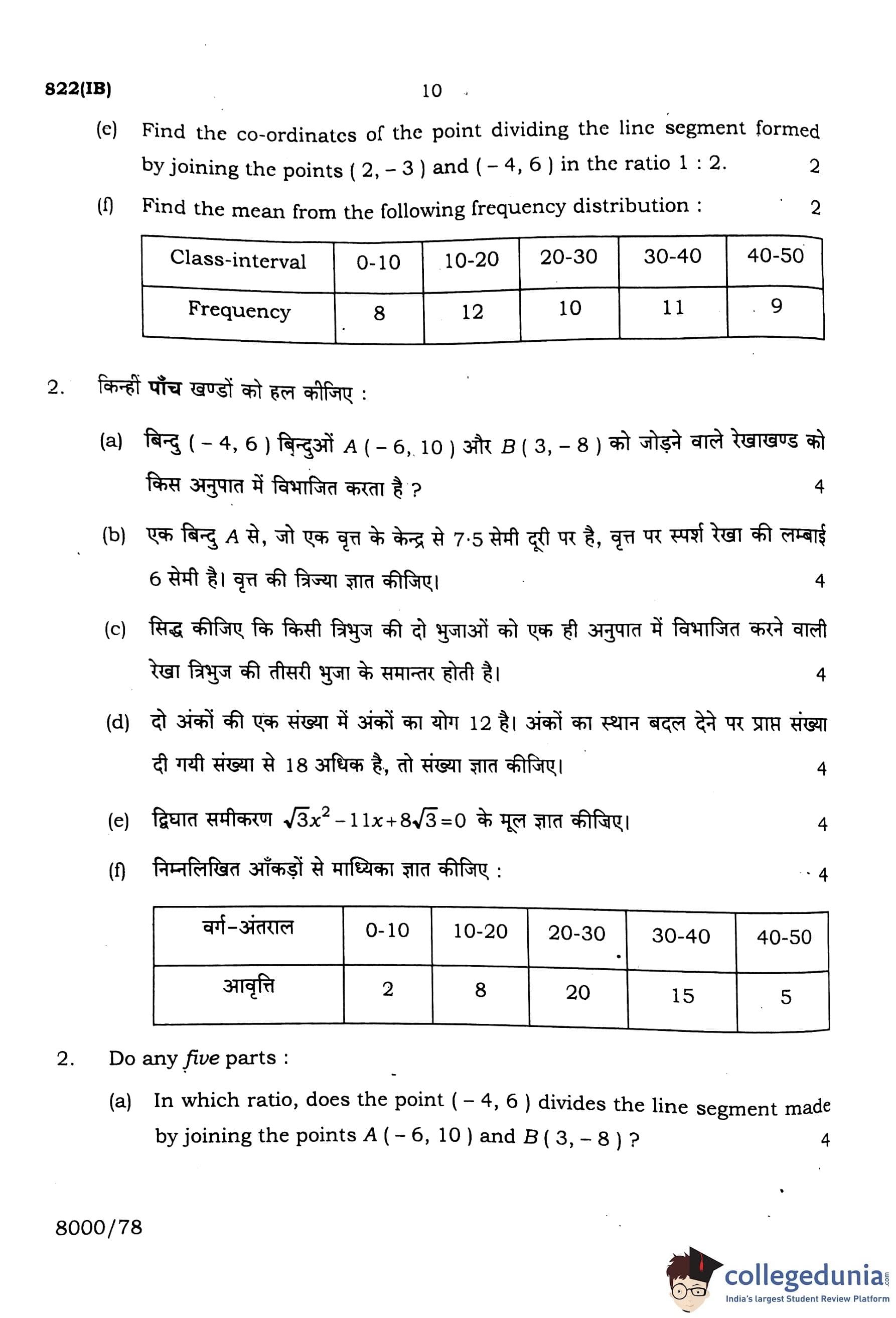
Find the co-ordinates of the point dividing the line segment formed by joining the points (2, -3) and (-4, 6) in the ratio 1 : 2.
View Solution
Step 1: Understanding the Concept:
This problem requires the use of the section formula, which gives the coordinates of a point that divides a line segment into a given ratio.
Step 2: Key Formula or Approach:
The coordinates \(P(x, y)\) of a point that divides the line segment joining \(A(x_1, y_1)\) and \(B(x_2, y_2)\) in the ratio \(m_1 : m_2\) are given by the section formula:
\[ P(x, y) = \left( \frac{m_1x_2 + m_2x_1}{m_1 + m_2}, \frac{m_1y_2 + m_2y_1}{m_1 + m_2} \right) \]
Step 3: Detailed Explanation:
The given points are \( (2, -3) \) and \( (-4, 6) \). The ratio is \( 1 : 2 \).
Let \( (x_1, y_1) = (2, -3) \), \( (x_2, y_2) = (-4, 6) \), \( m_1 = 1 \), and \( m_2 = 2 \).
Now, substitute these values into the section formula.
For the x-coordinate:
\[ x = \frac{1(-4) + 2(2)}{1 + 2} = \frac{-4 + 4}{3} = \frac{0}{3} = 0 \]
For the y-coordinate:
\[ y = \frac{1(6) + 2(-3)}{1 + 2} = \frac{6 - 6}{3} = \frac{0}{3} = 0 \]
The coordinates of the point are (0, 0).
Step 4: Final Answer:
The co-ordinates of the point dividing the line segment are (0, 0), which is the origin.
Quick Tip: To avoid errors, clearly label your points and ratio (\(x_1, y_1, x_2, y_2, m_1, m_2\)) before substituting them into the formula. This systematic approach minimizes the risk of mixing up values.
Find the mean from the following frequency distribution :
Class-interval & 0-10 & 10-20 & 20-30 & 30-40 & 40-50
Frequency & 8 & 12 & 10 & 11 & 9
View Solution
Step 1: Understanding the Concept:
To find the mean of grouped data, we use the direct method. This involves finding the midpoint (class mark) of each class interval, multiplying it by the frequency, summing these products, and finally dividing by the total number of observations (total frequency).
Step 2: Key Formula or Approach:
The formula for the mean (\(\bar{x}\)) of grouped data is:
\[ \bar{x} = \frac{\sum f_i x_i}{\sum f_i} \]
where \(f_i\) is the frequency of the \(i\)-th class and \(x_i\) is the class mark of the \(i\)-th class.
The class mark is calculated as \( x_i = \frac{Upper class limit + Lower class limit}{2} \).
Step 3: Detailed Explanation:
We will construct a table to perform the calculations systematically.
\begin{tabular{|c|c|c|c|
\hline
Class-interval & Frequency (\(f_i\)) & Class Mark (\(x_i\)) & \(f_i x_i\)
\hline
0-10 & 8 & \( \frac{0+10}{2} = 5 \) & \( 8 \times 5 = 40 \)
\hline
10-20 & 12 & \( \frac{10+20}{2} = 15 \) & \( 12 \times 15 = 180 \)
\hline
20-30 & 10 & \( \frac{20+30}{2} = 25 \) & \( 10 \times 25 = 250 \)
\hline
30-40 & 11 & \( \frac{30+40}{2} = 35 \) & \( 11 \times 35 = 385 \)
\hline
40-50 & 9 & \( \frac{40+50}{2} = 45 \) & \( 9 \times 45 = 405 \)
\hline
Total & \(\sum f_i = 50\) & & \(\sum f_i x_i = 1260\)
\hline
\end{tabular
First, find the total frequency (\(\sum f_i\)):
\[ \sum f_i = 8 + 12 + 10 + 11 + 9 = 50 \]
Next, find the sum of the products (\(\sum f_i x_i\)):
\[ \sum f_i x_i = 40 + 180 + 250 + 385 + 405 = 1260 \]
Now, calculate the mean:
\[ \bar{x} = \frac{\sum f_i x_i}{\sum f_i} = \frac{1260}{50} = \frac{126}{5} = 25.2 \]
Step 4: Final Answer:
The mean of the frequency distribution is 25.2.
Quick Tip: For grouped data with larger numbers, the Assumed Mean Method or Step-Deviation Method can simplify the multiplication and reduce the chance of calculation errors. However, for relatively small numbers like these, the Direct Method is efficient.
In which ratio, does the point (–4, 6) divides the line segment made by joining the points A(–6, 10) and B(3, –8)?
View Solution
Step 1: Understanding the Concept:
We need to find the ratio in which a given point divides the line segment connecting two other points. This can be solved using the section formula.
Step 2: Key Formula or Approach:
Let the point P(x, y) divide the line segment joining A(\(x_1, y_1\)) and B(\(x_2, y_2\)) in the ratio \(k : 1\). The coordinates of P are given by:
\[ P(x, y) = \left( \frac{kx_2 + x_1}{k + 1}, \frac{ky_2 + y_1}{k + 1} \right) \]
Step 3: Detailed Explanation:
Here, the dividing point is P(–4, 6), and the endpoints are A(–6, 10) and B(3, –8).
So, \( (x, y) = (–4, 6) \), \( (x_1, y_1) = (–6, 10) \), and \( (x_2, y_2) = (3, –8) \).
Let the required ratio be \(k : 1\).
Using the section formula for the x-coordinate:
\[ x = \frac{kx_2 + x_1}{k + 1} \] \[ -4 = \frac{k(3) + (-6)}{k + 1} \] \[ -4(k + 1) = 3k - 6 \] \[ -4k - 4 = 3k - 6 \] \[ 6 - 4 = 3k + 4k \] \[ 2 = 7k \] \[ k = \frac{2}{7} \]
The ratio is \(k : 1\), which is \( \frac{2}{7} : 1 \). Multiplying by 7, we get the ratio 2 : 7.
We can verify this using the y-coordinate:
\[ y = \frac{ky_2 + y_1}{k + 1} \] \[ 6 = \frac{k(-8) + 10}{k + 1} \] \[ 6(k + 1) = -8k + 10 \] \[ 6k + 6 = -8k + 10 \] \[ 6k + 8k = 10 - 6 \] \[ 14k = 4 \] \[ k = \frac{4}{14} = \frac{2}{7} \]
Both coordinates give the same value of \(k\), confirming our result.
Step 4: Final Answer:
The point (–4, 6) divides the line segment in the ratio 2 : 7.
Quick Tip: When asked to find the ratio, assuming the ratio as \(k:1\) is generally faster than assuming \(m:n\). It reduces the problem to solving for a single variable, \(k\).
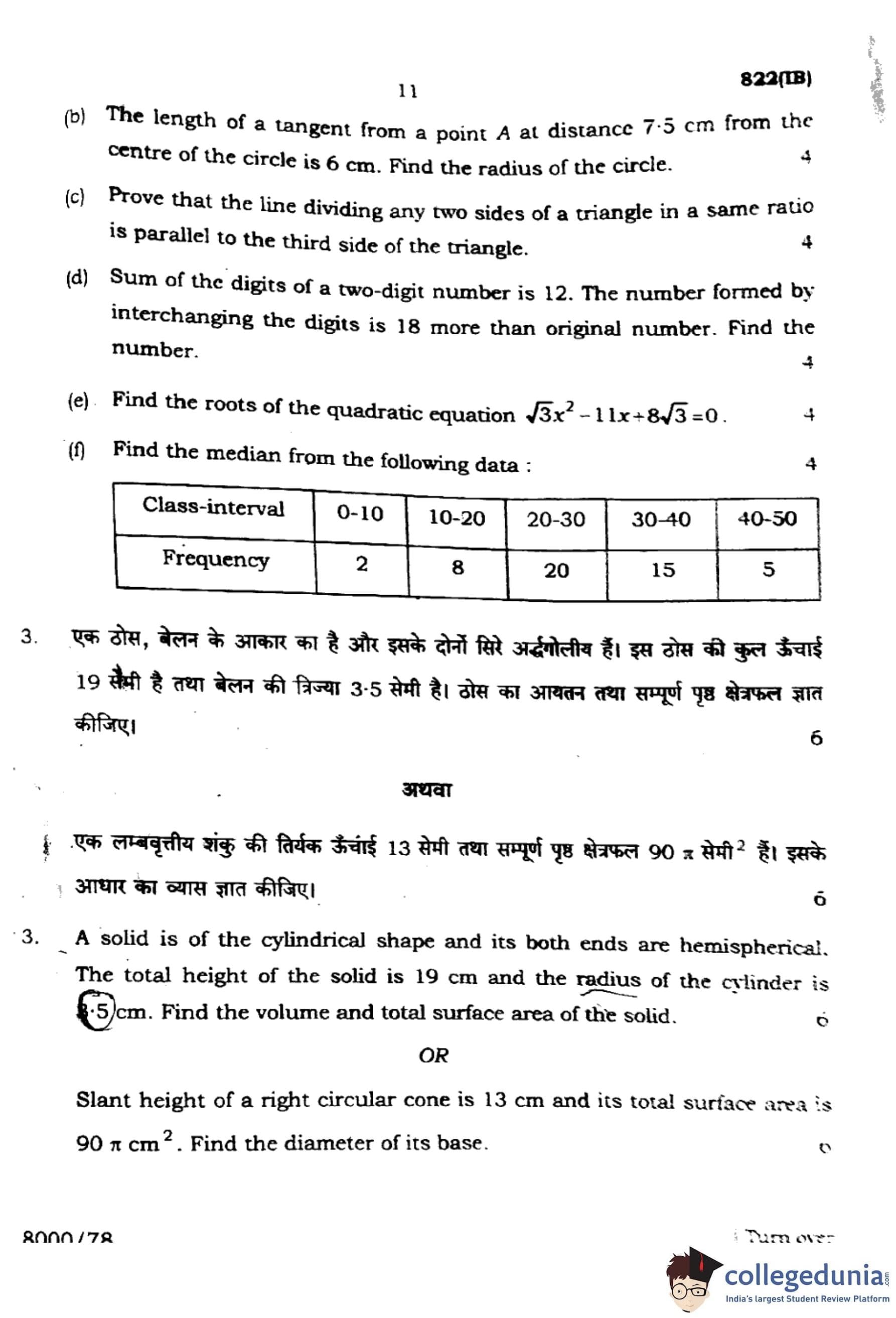
The length of a tangent from a point A at a distance 7.5 cm from the centre of the circle is 6 cm. Find the radius of the circle.
View Solution
Step 1: Understanding the Concept:
A tangent to a circle is a line that touches the circle at exactly one point. The radius drawn to this point of tangency is always perpendicular to the tangent. This forms a right-angled triangle, which allows us to use the Pythagorean theorem.
Step 2: Key Formula or Approach:
Let O be the center of the circle, A be the external point, and T be the point of tangency. The radius OT is perpendicular to the tangent AT. The triangle \(\triangle OTA\) is a right-angled triangle with the hypotenuse being OA.
By Pythagorean theorem: \( OA^2 = OT^2 + AT^2 \).
Step 3: Detailed Explanation:
Let \(r\) be the radius of the circle.
Given:
Distance of point A from the center, OA = 7.5 cm.
Length of the tangent from point A, AT = 6 cm.
Radius of the circle, OT = \(r\).
In the right-angled triangle \(\triangle OTA\):
\[ OA^2 = OT^2 + AT^2 \] \[ (7.5)^2 = r^2 + (6)^2 \] \[ 56.25 = r^2 + 36 \] \[ r^2 = 56.25 - 36 \] \[ r^2 = 20.25 \] \[ r = \sqrt{20.25} \] \[ r = 4.5 \]
Step 4: Final Answer:
The radius of the circle is 4.5 cm.
Quick Tip: Recognizing Pythagorean triplets can save time. This problem involves a scaled version of the 3-4-5 triplet. If you divide the given lengths by 1.5, you get 4 (for 6 cm) and 5 (for 7.5 cm). The missing side must be 3, and scaling it back by multiplying by 1.5 gives \(3 \times 1.5 = 4.5\) cm.
Prove that the line dividing any two sides of a triangle in a same ratio is parallel to the third side of the triangle.
View Solution
Step 1: Understanding the Concept:
This is the statement of the Converse of the Basic Proportionality Theorem (also known as Thales's Theorem or the Intercept Theorem). We need to prove this geometric property using a proof by contradiction.
Step 2: Key Formula or Approach:
We will use the Basic Proportionality Theorem (BPT), which states that if a line is drawn parallel to one side of a triangle intersecting the other two sides, then it divides the two sides in the same ratio.
Step 3: Detailed Explanation:
Given: A triangle \(\triangle ABC\) and a line DE intersecting sides AB and AC at points D and E respectively, such that \( \frac{AD}{DB} = \frac{AE}{EC} \).
To Prove: DE is parallel to BC (DE || BC).
Proof by Contradiction:
Let us assume that DE is not parallel to BC.
If DE is not parallel to BC, then there must be another line through D which is parallel to BC.
Let's draw a line DF such that DF || BC, where F is a point on the side AC.
Since DF || BC, by the Basic Proportionality Theorem (BPT), we have:
\[ \frac{AD}{DB} = \frac{AF}{FC} \quad \ldots (i) \]
But, it is given that:
\[ \frac{AD}{DB} = \frac{AE}{EC} \quad \ldots (ii) \]
From equations (i) and (ii), we can conclude:
\[ \frac{AF}{FC} = \frac{AE}{EC} \]
Adding 1 to both sides of the equation:
\[ \frac{AF}{FC} + 1 = \frac{AE}{EC} + 1 \] \[ \frac{AF + FC}{FC} = \frac{AE + EC}{EC} \]
Since AF + FC = AC and AE + EC = AC, we get:
\[ \frac{AC}{FC} = \frac{AC}{EC} \]
This implies that \( FC = EC \).
This is only possible when the points F and E coincide, meaning they are the same point.
Therefore, the line DF is the same as the line DE.
Since we constructed DF || BC, it must be that DE || BC.
This contradicts our initial assumption. Hence, our assumption was wrong.
Thus, the line DE is parallel to BC.
\[ Hence Proved. \] Quick Tip: The proof by contradiction is a powerful tool in geometry. The strategy is to assume the opposite of what you want to prove and show that this assumption leads to a logical impossibility.
Sum of the digits of a two-digit number is 12. The number formed by interchanging the digits is 18 more than original number. Find the number.
View Solution
Step 1: Understanding the Concept:
This is a word problem that can be solved by setting up a system of two linear equations in two variables representing the digits of the number.
Step 2: Key Formula or Approach:
Let the tens digit of the two-digit number be \(x\) and the units digit be \(y\).
The original number can be expressed as \(10x + y\).
The number formed by interchanging the digits is \(10y + x\).
Step 3: Detailed Explanation:
From the first condition, the sum of the digits is 12.
\[ x + y = 12 \quad \ldots (1) \]
From the second condition, the new number is 18 more than the original number.
\[ (10y + x) = (10x + y) + 18 \]
Rearrange the terms to form a second linear equation:
\[ 10y - y + x - 10x = 18 \] \[ 9y - 9x = 18 \]
Divide the entire equation by 9:
\[ y - x = 2 \quad \ldots (2) \]
Now we have a system of two linear equations:
1) \( x + y = 12 \)
2) \( -x + y = 2 \)
Adding equation (1) and equation (2):
\[ (x + y) + (-x + y) = 12 + 2 \] \[ 2y = 14 \] \[ y = 7 \]
Substitute the value of \(y = 7\) into equation (1):
\[ x + 7 = 12 \] \[ x = 12 - 7 \] \[ x = 5 \]
The tens digit is 5 and the units digit is 7.
Step 4: Final Answer:
The original number is \(10x + y = 10(5) + 7 = 57\).
Quick Tip: Always verify your answer with the conditions in the problem. The number is 57. Sum of digits: 5+7=12. Interchanged number is 75. Difference: 75-57=18. Both conditions are satisfied.
Find the roots of the quadratic equation \( \sqrt{3}x^2 - 11x + 8\sqrt{3} = 0 \).
View Solution
Step 1: Understanding the Concept:
We need to solve a quadratic equation. This can be done by factoring (splitting the middle term) or by using the quadratic formula.
Step 2: Key Formula or Approach:
We will use the method of splitting the middle term. We need to find two numbers that sum to the coefficient of the middle term (-11) and multiply to the product of the first and last coefficients (\( \sqrt{3} \times 8\sqrt{3} \)).
Step 3: Detailed Explanation:
The given equation is \( \sqrt{3}x^2 - 11x + 8\sqrt{3} = 0 \).
Product of the first and last coefficients = \( (\sqrt{3}) \times (8\sqrt{3}) = 8 \times 3 = 24 \).
Sum of the coefficients for the middle term = -11.
We need to find two numbers whose product is 24 and whose sum is -11. These numbers are -3 and -8.
Now, split the middle term:
\[ \sqrt{3}x^2 - 3x - 8x + 8\sqrt{3} = 0 \]
Factor by grouping. Note that \( 3 = \sqrt{3} \times \sqrt{3} \).
\[ \sqrt{3}x(x - \sqrt{3}) - 8(x - \sqrt{3}) = 0 \]
Take out the common factor \( (x - \sqrt{3}) \):
\[ (x - \sqrt{3})(\sqrt{3}x - 8) = 0 \]
This gives two possible solutions:
Either \( x - \sqrt{3} = 0 \), which means \( x = \sqrt{3} \).
Or \( \sqrt{3}x - 8 = 0 \), which means \( \sqrt{3}x = 8 \), so \( x = \frac{8}{\sqrt{3}} \).
Rationalizing the denominator for the second root: \( x = \frac{8}{\sqrt{3}} \times \frac{\sqrt{3}}{\sqrt{3}} = \frac{8\sqrt{3}}{3} \).
Step 4: Final Answer:
The roots of the quadratic equation are \( \sqrt{3} \) and \( \frac{8\sqrt{3}}{3} \).
Quick Tip: When dealing with quadratic equations involving square roots, the splitting the middle term method can be tricky. If you're struggling to find the right factors, the quadratic formula \( x = \frac{-b \pm \sqrt{b^2 - 4ac}}{2a} \) is a reliable alternative that will always work.
Find the median from the following data :
Class-interval & 0-10 & 10-20 & 20-30 & 30-40 & 40-50
Frequency & 2 & 8 & 20 & 15 & 5
View Solution
Step 1: Understanding the Concept:
The median is the middle value of a dataset. For grouped frequency data, we first identify the median class and then use a specific formula to calculate the median value.
Step 2: Key Formula or Approach:
The formula for the median of grouped data is:
\[ Median = l + \left( \frac{\frac{N}{2} - cf}{f} \right) \times h \]
where:
\(l\) = lower limit of the median class
\(N\) = total frequency
\(cf\) = cumulative frequency of the class preceding the median class
\(f\) = frequency of the median class
\(h\) = class size
Step 3: Detailed Explanation:
First, we create a table with cumulative frequencies (cf).
\begin{tabular{|c|c|c|
\hline
Class-interval & Frequency (\(f\)) & Cumulative Frequency (\(cf\))
\hline
0-10 & 2 & 2
\hline
10-20 & 8 & 2 + 8 = 10
\hline
20-30 & 20 & 10 + 20 = 30
\hline
30-40 & 15 & 30 + 15 = 45
\hline
40-50 & 5 & 45 + 5 = 50
\hline
\end{tabular
Total frequency, \( N = \sum f = 50 \).
Next, we find the position of the median: \( \frac{N}{2} = \frac{50}{2} = 25 \).
The median class is the class interval whose cumulative frequency is just greater than or equal to 25. Looking at the cf column, the value just greater than 25 is 30, which corresponds to the class interval 20-30.
So, the median class is 20-30.
From this, we identify the values for the formula:
Lower limit of the median class, \(l = 20\).
Cumulative frequency of the preceding class, \(cf = 10\).
Frequency of the median class, \(f = 20\).
Class size, \(h = 10\) (e.g., 20 - 10 = 10).
Now, substitute these values into the median formula:
\[ Median = 20 + \left( \frac{25 - 10}{20} \right) \times 10 \] \[ Median = 20 + \left( \frac{15}{20} \right) \times 10 \] \[ Median = 20 + \frac{150}{20} \] \[ Median = 20 + 7.5 \] \[ Median = 27.5 \]
Step 4: Final Answer:
The median from the given data is 27.5.
Quick Tip: A common mistake is using the cumulative frequency of the median class itself (\(cf=30\)) instead of the preceding class (\(cf=10\)). Always be careful to use the cf of the class *before* the median class.
A solid is of the cylindrical shape and its both ends are hemispherical. The total height of the solid is 19 cm and the radius of the cylinder is 3.5 cm. Find the volume and total surface area of the solid.
View Solution
Step 1: Understanding the Concept:
The solid is a composite shape made of a central cylinder and two hemispheres at its ends. To find the total volume and total surface area, we need to calculate these properties for each component and then sum them up.
Step 2: Key Formula or Approach:
Let \(r\) be the radius and \(h\) be the height of the cylindrical part.
1. Volume of Cylinder = \( \pi r^2 h \)
2. Volume of two Hemispheres (one Sphere) = \( \frac{4}{3} \pi r^3 \)
3. Total Volume = Volume of Cylinder + Volume of two Hemispheres
4. Curved Surface Area (CSA) of Cylinder = \( 2\pi r h \)
5. CSA of two Hemispheres (Surface Area of one Sphere) = \( 4\pi r^2 \)
6. Total Surface Area (TSA) of Solid = CSA of Cylinder + CSA of two Hemispheres
Step 3: Detailed Explanation:
Dimensions:
Radius of cylinder and hemispheres, \( r = 3.5 cm = \frac{7}{2} cm \).
The height of the two hemispherical ends is equal to the diameter, \( 2r = 2 \times 3.5 = 7 cm \).
Height of the cylindrical part, \(h\) = Total height - Height of two hemispheres
\[ h = 19 - 7 = 12 cm \]
Volume Calculation:
Total Volume = \( \pi r^2 h + \frac{4}{3} \pi r^3 = \pi r^2 \left( h + \frac{4}{3}r \right) \)
\[ V = \frac{22}{7} \times \left(\frac{7}{2}\right)^2 \left( 12 + \frac{4}{3} \times \frac{7}{2} \right) \] \[ V = \frac{22}{7} \times \frac{49}{4} \left( 12 + \frac{14}{3} \right) \] \[ V = \frac{11 \times 7}{2} \left( \frac{36+14}{3} \right) = \frac{77}{2} \left( \frac{50}{3} \right) \] \[ V = \frac{77 \times 25}{3} = \frac{1925}{3} \approx 641.67 cm^3 \]
Total Surface Area Calculation:
TSA = CSA of Cylinder + CSA of two Hemispheres
TSA = \( 2\pi r h + 4\pi r^2 = 2\pi r (h + 2r) \)
\[ TSA = 2 \times \frac{22}{7} \times \frac{7}{2} \left( 12 + 2 \times \frac{7}{2} \right) \] \[ TSA = 22 (12 + 7) \] \[ TSA = 22 \times 19 = 418 cm^2 \]
Step 4: Final Answer:
The volume of the solid is approximately 641.67 cm\(^3\) and the total surface area is 418 cm\(^2\).
Quick Tip: For composite solids, always break down the problem into its basic geometric shapes. Calculate the dimensions of each part first before applying the formulas. For surface area, only include the surfaces that are exposed on the outside.
Slant height of a right circular cone is 13 cm and its total surface area is 90\( \pi \) cm\(^2\). Find the diameter of its base.
View Solution
Step 1: Understanding the Concept:
The total surface area (TSA) of a cone is the sum of the area of its circular base and its curved surface area. We are given the TSA and the slant height, and we need to find the radius to calculate the diameter.
Step 2: Key Formula or Approach:
The formula for the TSA of a cone with radius \(r\) and slant height \(l\) is:
\[ TSA = \pi r^2 + \pi r l = \pi r(r+l) \]
Step 3: Detailed Explanation:
Given values:
Slant height, \( l = 13 \) cm.
Total Surface Area, TSA = \( 90\pi \) cm\(^2\).
Substitute these values into the TSA formula:
\[ 90\pi = \pi r(r + 13) \]
Divide both sides by \( \pi \):
\[ 90 = r(r + 13) \] \[ 90 = r^2 + 13r \]
Rearrange into a standard quadratic equation:
\[ r^2 + 13r - 90 = 0 \]
We can solve this by factoring. We need two numbers that multiply to -90 and add up to 13. These numbers are 18 and -5.
\[ (r + 18)(r - 5) = 0 \]
This gives two possible values for the radius: \(r = -18\) or \(r = 5\).
Since the radius cannot be negative, we take \( r = 5 \) cm.
The question asks for the diameter of the base.
\[ Diameter = 2 \times r = 2 \times 5 = 10 cm \]
Step 4: Final Answer:
The diameter of the base of the cone is 10 cm.
Quick Tip: When solving a quadratic equation in a geometry problem, always check the physical feasibility of the solutions. Lengths, areas, and volumes cannot be negative, so discard any negative roots.
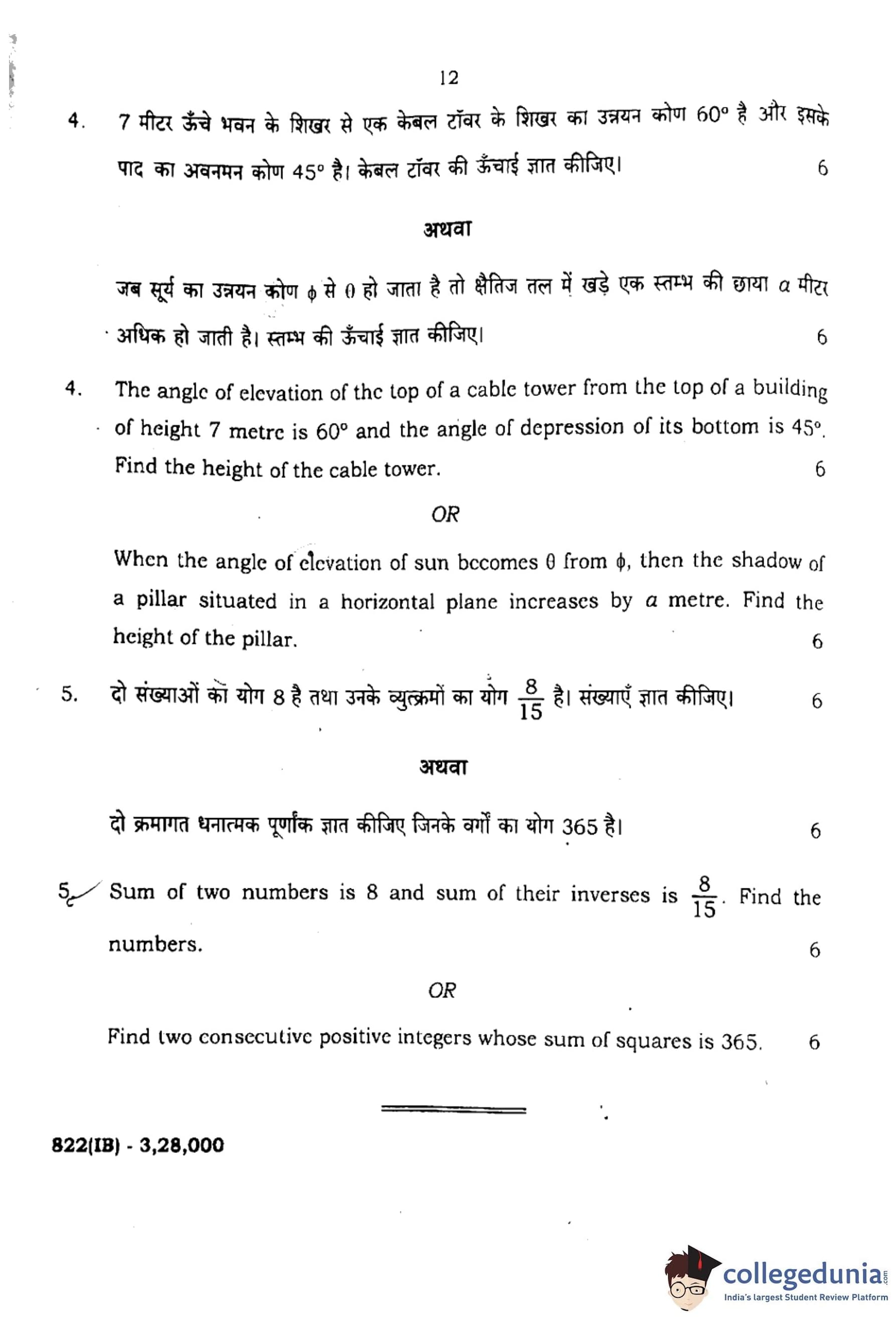
The angle of elevation of the top of a cable tower from the top of a building of height 7 metre is 60\(^\circ\) and the angle of depression of its bottom is 45\(^\circ\). Find the height of the cable tower.
View Solution
Step 1: Understanding the Concept:
This problem involves heights and distances, using trigonometry. We can model the situation with two right-angled triangles and use trigonometric ratios (tan) to find the unknown lengths.
Step 2: Key Formula or Approach:
We will use the tangent ratio in the right-angled triangles: \( \tan \theta = \frac{Opposite}{Adjacent} \).
Step 3: Detailed Explanation:
Let AB be the building and CD be the cable tower. Let the height of the building be AB = 7 m.
Let A be the top of the building and C be the top of the tower.
Draw a horizontal line AE from A to the tower, meeting CD at E.
Then ABDE is a rectangle, so ED = AB = 7 m and AE = BD.
Let the height of the tower be CD = \(h\). Then CE = CD - ED = \(h - 7\).
The angle of elevation of C from A is \( \angle CAE = 60^\circ \).
The angle of depression of D from A is \( \angle EAD = 45^\circ \).
Consider the right-angled triangle \(\triangle AED\):
\[ \tan(\angle EAD) = \frac{ED}{AE} \] \[ \tan 45^\circ = \frac{7}{AE} \]
Since \( \tan 45^\circ = 1 \):
\[ 1 = \frac{7}{AE} \implies AE = 7 m \]
Now, consider the right-angled triangle \(\triangle AEC\):
\[ \tan(\angle CAE) = \frac{CE}{AE} \] \[ \tan 60^\circ = \frac{h-7}{7} \]
Since \( \tan 60^\circ = \sqrt{3} \):
\[ \sqrt{3} = \frac{h-7}{7} \] \[ 7\sqrt{3} = h - 7 \] \[ h = 7\sqrt{3} + 7 \] \[ h = 7(\sqrt{3} + 1) m \]
Step 4: Final Answer:
The height of the cable tower is \( 7(\sqrt{3} + 1) \) metres.
Quick Tip: Drawing a clear, labeled diagram is the most crucial first step in solving any heights and distances problem. It helps you visualize the triangles and correctly identify the angles and sides.
When the angle of elevation of sun becomes \( \theta \) from \( \phi \), then the shadow of a pillar situated in a horizontal plane increases by a metre. Find the height of the pillar.
View Solution
Step 1: Understanding the Concept:
As the sun's angle of elevation changes, the length of an object's shadow also changes. This problem relates the change in shadow length to the change in the angle of elevation using trigonometry. The shadow is longer when the angle of elevation is smaller, so we assume \( \phi > \theta \).
Step 2: Key Formula or Approach:
We will model the situation with two right-angled triangles and use the cotangent ratio: \( \cot \theta = \frac{Adjacent}{Opposite} \).
Step 3: Detailed Explanation:
Let PQ be the pillar of height \(h\).
Let QA be the initial shadow when the angle of elevation is \( \phi \), so \( \angle PAQ = \phi \).
Let QB be the final shadow when the angle of elevation is \( \theta \), so \( \angle PBQ = \theta \).
The shadow increases by 'a' metres, so AB = 'a'.
Let the length of the initial shadow QA = \(x\). Then the length of the final shadow QB = \(x + a\).
In the right-angled triangle \(\triangle PQA\):
\[ \cot \phi = \frac{QA}{PQ} = \frac{x}{h} \] \[ x = h \cot \phi \quad \ldots(1) \]
In the right-angled triangle \(\triangle PQB\):
\[ \cot \theta = \frac{QB}{PQ} = \frac{x+a}{h} \] \[ x + a = h \cot \theta \quad \ldots(2) \]
Substitute the value of \(x\) from equation (1) into equation (2):
\[ h \cot \phi + a = h \cot \theta \]
Rearrange to solve for \(h\):
\[ a = h \cot \theta - h \cot \phi \] \[ a = h (\cot \theta - \cot \phi) \] \[ h = \frac{a}{\cot \theta - \cot \phi} \]
Step 4: Final Answer:
The height of the pillar is \( \frac{a}{\cot \theta - \cot \phi} \) metres.
Quick Tip: Using the cotangent ratio (\(\cot = Adjacent/Opposite\)) can sometimes lead to simpler algebraic manipulation in heights and distances problems, especially when the adjacent side is the unknown you are trying to relate.
Sum of two numbers is 8 and sum of their inverses is \( \frac{8}{15} \). Find the numbers.
View Solution
Step 1: Understanding the Concept:
We need to solve a system of two equations with two variables. One equation is linear, and the other involves reciprocals, which can be transformed into an equation involving the product of the variables.
Step 2: Key Formula or Approach:
Let the two numbers be \(x\) and \(y\). We are given:
1. \( x + y = 8 \)
2. \( \frac{1}{x} + \frac{1}{y} = \frac{8}{15} \)
We can solve this system to find \(x\) and \(y\).
Step 3: Detailed Explanation:
First, simplify the second equation:
\[ \frac{1}{x} + \frac{1}{y} = \frac{y+x}{xy} = \frac{x+y}{xy} \]
So, the equation becomes:
\[ \frac{x+y}{xy} = \frac{8}{15} \]
We are given from the first equation that \( x + y = 8 \). Substitute this into the simplified second equation:
\[ \frac{8}{xy} = \frac{8}{15} \]
From this, we can deduce that \( xy = 15 \).
Now we have a simple system of equations:
(i) \( x + y = 8 \)
(ii) \( xy = 15 \)
We can solve this by substitution or by forming a quadratic equation. The quadratic equation with roots \(x\) and \(y\) is given by \( t^2 - (sum of roots)t + (product of roots) = 0 \).
\[ t^2 - (x+y)t + xy = 0 \] \[ t^2 - 8t + 15 = 0 \]
Factor the quadratic equation:
\[ (t - 3)(t - 5) = 0 \]
The roots are \(t = 3\) and \(t = 5\).
Step 4: Final Answer:
The two numbers are 3 and 5.
Quick Tip: When you know the sum and product of two numbers, forming a quadratic equation \(t^2 - (sum)t + (product) = 0\) is the most direct way to find the numbers.
Find two consecutive positive integers whose sum of squares is 365.
View Solution
Step 1: Understanding the Concept:
We need to translate this word problem into a single quadratic equation with one variable and then solve it to find the integers.
Step 2: Key Formula or Approach:
Let the two consecutive positive integers be \(x\) and \(x+1\).
The problem states that the sum of their squares is 365. This gives the equation:
\[ x^2 + (x+1)^2 = 365 \]
Step 3: Detailed Explanation:
Expand the equation:
\[ x^2 + (x^2 + 2x + 1) = 365 \]
Combine like terms:
\[ 2x^2 + 2x + 1 = 365 \]
Move all terms to one side to form a standard quadratic equation:
\[ 2x^2 + 2x - 364 = 0 \]
Divide the entire equation by 2 to simplify it:
\[ x^2 + x - 182 = 0 \]
Now, we factor this quadratic equation. We need to find two numbers that multiply to -182 and add to 1. The factors of 182 are (1, 182), (2, 91), (7, 26), (13, 14). The pair 14 and -13 fits our requirements (14 \(\times\) -13 = -182 and 14 + (-13) = 1).
\[ (x + 14)(x - 13) = 0 \]
This gives two possible solutions for \(x\): \(x = -14\) or \(x = 13\).
The problem specifies that we are looking for positive integers, so we discard \(x = -14\).
Therefore, the first integer is \(x = 13\).
The second consecutive integer is \(x + 1 = 13 + 1 = 14\).
Step 4: Final Answer:
The two consecutive positive integers are 13 and 14. We can check the answer: \(13^2 + 14^2 = 169 + 196 = 365\).
Quick Tip: Always read the question carefully for constraints like "positive," "negative," "integer," or "even/odd." These constraints are crucial for selecting the correct solution from the roots of your equation.





Comments